Seasons & Celebrations
FOR MORE ON THE CONSECRATION OF THE U.S., CHECK OUT THESE STORIES: ‘Catholic Saints of America’ event celebrates America’s 250th birthday Voting rights: A people of hope in the long journey toward justice National Eucharistic Pilgrimage’s Florida kickoff roots US history in the Mass To view these stories and more, scan the QR code
or visit: trentonmonitor.com/category/usa-250/
im
rk wo
H
ow might you help a nation in political turmoil celebrate its 250th anniversary and the unlikely creation of the first large-scale, self-governing republic in the modern world? Dedicate it to the Sacred Heart of Jesus – as the U.S. bishops will do for the United States of America on June 11, marking the first such formal consecration of the country to Christ’s heart. The prelates made the decision to do this during a Nov. 11, 2025, session of the U.S. Conference of Catholic Bishops’ fall plenary assembly in Baltimore – and while they were singularly focused on an exceptional gesture to mark our country’s semiquincentennial, the consecration still probably can’t come at a better time. According to a CNN/SSRS poll released April 3, Americans are divided by intense levels of cynicism, viewing both
the Democratic and Republican parties in deeply negative terms. A full 77% of Americans, the Pew Research Center reported April 15, think the nation’s political system needs major changes or complete reform. Archbishop Alexander K. Sample of Portland, Oregon, who chairs the USCCB Committee for Religious Liberty, told OSV News there are three essential reasons the bishops voted for the consecration. First “would be to place our nation under the kingship of Christ,” he said. “Yes, we are a democratic republic; we are a civil society – but no civil society can long endure without being under the kingship of Christ himself; to place ourselves under God’s providence and care.” And while our young nation fought a revolution to throw off a monarchy, Archbishop Sample emphasized the continuity between Jesus’ kingship and America’s founding ideals. “In the history of our nation, it’s undoubtable and it’s irrefutable that the faith – and our reliance on God – really was the foundation that our Founding Fathers placed this nation on,” he said. “So at this time, as we celebrate the 250th anniversary of the signing of the
rN
et
BY KIMBERLEY HEATHERINGTON OSV News
a ge
U.S. bishops’ consecration of nation to Sacred Heart of Jesus affirms ‘our reliance on God’
P o p e ’s W
orl
de d wi
P ra
ye
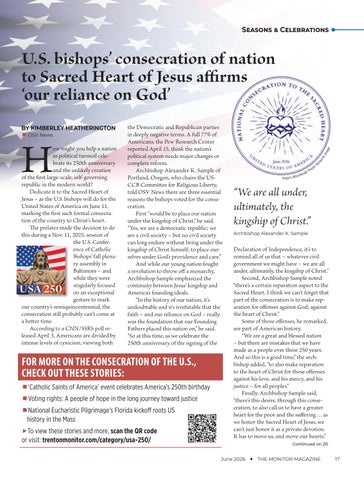
“We are all under, ultimately, the kingship of Christ.” Archbishop Alexander K. Sample
Declaration of Independence, it’s to remind all of us that – whatever civil government we might have – we are all under, ultimately, the kingship of Christ.” Second, Archbishop Sample noted “there’s a certain reparation aspect to the Sacred Heart. I think we can’t forget that part of the consecration is to make reparation for offenses against God; against the heart of Christ.” Some of those offenses, he remarked, are part of American history. “We are a great and blessed nation – but there are mistakes that we have made as a people over these 250 years. And so this is a good time,” the archbishop added, “to also make reparation to the heart of Christ for those offenses against his love, and his mercy, and his justice – for all peoples.” Finally, Archbishop Sample said, “there’s this desire, through this consecration, to also call us to have a greater heart for the poor and the suffering … as we honor the Sacred Heart of Jesus, we can’t just honor it as a private devotion. It has to move us, and move our hearts.” Continued on 20
June 2026
THE MONITOR MAGAZINE 17
Seasons & Celebrations
America at 250: A reflection by
BISHOP DAVID M. O’CONNELL, C.M.
O
utside my office window in the Chancery, two flags rise and fall together in the same breeze – the “Stars and Stripes” of the United States of America and the yellow-andwhite banner of the Holy See. Their colors catch the morning light in different ways, yet they move in a shared rhythm, reminding me that the story of this nation and the history of the Church – although the Church is far more ancient – have long unfolded side by side.
anniversary, those two flags prompt and offer an invitation to reflect upon how these ideals have shaped both our national identity and our Christian vocation. Our nation was born from a bold conviction: that every human being possesses an inherent dignity bestowed not by kings or governments, but by the Creator. This truth, so central to the Declaration of Independence, resonates profoundly with the Church’s teaching on the dignity of the human person.
That simple daily sight has often become a quiet meditation for me. The values we celebrate as Americans – liberty, justice, solidarity and the pursuit of the common good – find deep resonance within the truths of our Catholic faith. As our country marks its 250th
18 THE MONITOR MAGAZINE
June 2026
FREEDOM AND WITNESS Catholics have long recognized in America’s founding principles a moral horizon that points beyond politics to something transcendent. Our nation’s founders, imperfect though they were and limited by the blind spots of their times, understood that freedom is not merely the ability to choose but carries with it the responsibility to
choose what is right, good, true and just. For this reason, the Church has consistently affirmed the promise of America – not as a finished achievement, but as an ongoing vocation. From the earliest days of the Republic, Catholics have contributed to the nation’s growth and development. Immigrant families who arrived with little more than hope found in America a place where faith could flourish. They built homes, parishes, schools, hospitals and charitable institutions that became anchors of community life. Catholics have served in Congress and on the battlefield, in classrooms and labor unions, in courtrooms and in the quiet corners of parish halls where the hungry were fed and the grieving were consoled. Their witness has reflected the theological virtues: faith that God guides history, hope that tomorrow can be better than today, and charity that sees Christ in every neighbor. These virtues did not make Catholics – or,
... every human being possesses an inherent dignity bestowed ... by the Creator.
Our shared journey of faith and freedom
indeed, Christians and people of faith generally – outsiders to the American story; they made them indispensable contributors to it. CATHOLIC AND AMERICAN COMMITMENTS The two flags outside my window remind me each day that our Church and our nation share a common moral vocabulary. Catholic teaching and American ideals meet in several important ways. We share a commitment to ordered liberty. American freedom is not simply license; at its best, it is ordered toward the common good. This understanding aligns with the Church’s teaching that authentic
freedom is found in truth and virtue. The pledge of “liberty and justice for all” echoes the biblical call to defend the widow, the orphan and the stranger. Catholic teaching reminds us that justice is not optional; it is a measure of a society’s moral health. The American ideal of E pluribus unum – “out of many, one”—harmonizes with the Church’s teaching on solidarity, the conviction that we are responsible for one another and bound together in a common humanity. Likewise, both the American constitutional tradition and Catholic social teaching recognize that society should be ordered toward the common good, enabling all people to flourish. Here, civic responsibility and Christian discipleship – while distinct in their purpose – can reinforce one another. Anniversaries invite gratitude, but
they also invite examination. The United States of America has accomplished much over the past 250 years, yet the work of liberty, justice, peace and reconciliation remains unfinished. We give thanks for the blessings of our nation’s history while also acknowledging its failures and injustices. The promise that all people are created equal has not always been extended equally to all. Yet the American story is, in part, the story of continually striving to bring our laws, institutions, and culture into closer alignment with that enduring truth. Gratitude and honesty belong together, for genuine patriotism is strengthened – not Continued on 20
The flags of the United States and the Holy See fly together outside the Diocese of Trenton Chancery, a quiet reminder of the enduring relationship between faith and freedom. Ryan Larason photo
June 2026
THE MONITOR MAGAZINE 19
Seasons & Celebrations
Continued from 19
diminished – by a willingness to learn from the past. The Church calls us to confront the wounds that still mark our national life: divisions that fracture communities; economic inequalities that burden families; threats to human life and dignity at every stage, from conception to natural death; the erosion of civil discourse; and the temptation to retreat into fear, resentment, or cynicism. Yet Catholics do not face these challenges with despair. We face them with the hope born of the Gospel and with confidence that God’s grace can transform hearts, communities and even nations. VISION FOR ENDURING TRUTH As we look toward the next 250 years, the Church offers a vision rooted in Christ and directed toward the flourishing of all: • A nation where every human life is cherished and protected, from conception to natural death.
CONSECRATION OF NATION Continued from 17
Pope Francis, he said, “was a man who loved these beautiful, rich devotions we have in the faith … and wanted to call our attention to the fact that the heart of Christ is the heart of mercy … [through which] we find healing and reconciliation.” Pope Francis brought the Sacred Heart to wider Catholic attention with the 2024 encyclical “Dilexit Nos” (“He Loved Us”). Devotion to the Sacred of Heart of Jesus – which traces its roots to at least the second century – grew 20 THE MONITOR MAGAZINE
• A society where marriage and families are supported and strengthened. • A culture where truth is honored and freedom is safeguarded. • A people committed to peace, justice and responsible stewardship of creation. • A country where faith is not pushed to the margins but contributes to the renewal of civic life. This is not a partisan vision. It is a vision that is deeply Catholic and profoundly American. Indeed, the best of our nation’s ideals and enduring truths of our faith need not stand in opposition; they can and do enrich one another. As the two flags outside my window continue to rise and fall in the same breeze, they remind me that our nation’s story is still being written. The Church, together with all people of goodwill, has a vital role in shaping its next chapter – through service, through witness and through prayer for our country and all who call it home. As we celebrate its 250th anniversary, may God bless the United States of America. May God guide our leaders, protect our people and strengthen our commitment to the virtues that elevate both our civic life and our life of faith.
during the Middle Ages and was later extended to the universal Church following Christ’s revelations of his Sacred Heart to St. Margaret Mary Alacoque, a 17th-century French woman religious. Emily Schumacher-Novak – associate director of Education and Outreach at the USCCB’s Secretariat of Justice and Peace – said the June 11 consecration is accompanied by an abundance of USCCB resources, including a prayer and downloadable prayer card; a Novena to the Sacred Heart (June 3-11); a ceremony to enthrone the Sacred Heart in the home; consecration resources for parishes; materials
June 2026
Magnific image
May faith and freedom reign
And may the Holy Spirit inspire us to build a future worthy of the dignity with which our Creator has endowed every human person, so that this nation may continue to be a beacon of hope, liberty, justice and peace for generations to come. And may Mary, our Immaculate Mother and patroness of America lead us ever more closely to the Sacred Heart of her Son.
from the Knights of Columbus and the Pope’s Prayer Network; and the “We Hold These Truths – America 250” article and video series, which feature the contributions of Catholics to the United States. “We are also offering a resource that invites people to do 250 hours of adoration and 250 works of mercy,” Schumaker-Novak said. “It’s that connection back to charity and justice that our Church calls us to – to pray for all the things in our world that need healing – that we can do in front of the Blessed Sacrament.” The national consecration – at Mary, Queen of the Universe Basilica in Orlando, Florida – will be live
streamed via the USCCB homepage on June 11. “As the bishops of the United States do the consecration of the whole nation to the heart of Christ, the Sacred Heart of Jesus, we’re also encouraging local communities to do the same – especially in our families and in our dioceses,” concluded Archbishop Sample. “It’s so we’re sort of doing it on all levels, so to speak,” said Archbishop Sample, “to really make this a meaningful moment in the light of the Church here in this great and blessed land.” Kimberley Heatherington is a correspondent for OSV News.
Seasons & Celebrations
Close at Heart Bishop, Diocese join in observing Consecration of the Nation to the Sacred Heart BY MARY STADNYK Associate Editor
I
n anticipation of the 250th anniversary of the signing of the Declaration of Independence in the United States, the U.S. Bishops have asked all Catholics throughout the country to participate in the Consecration of the Nation to the Sacred Heart of Jesus. And the Diocese of Trenton is responding to that call. PARISH CONNECTIONS Leading the way is Bishop David M. O’Connell, C.M., who is celebrating May and June Masses in the four Sacred Heart Parishes of the Diocese. The Bishop visited Mount Holly on May 31, and he’s scheduled to visit Bay Head on June 6, Trenton on June 14 and Riverton on June 20. The Mass in Mount Holly coincided
Bishop O’Connell celebrates Mass in Sacred Heart Church, Mount Holly, May 31. At the ambo is Father John Czahur, pastor. Mary Stadnyk photos
“The Sacred Heart ... is a revelation of the inner life of God.” Bishop O’Connell with the Solemnity of the Most Holy Trinity, which the Bishop described as “the central mystery of our faith, the mystery of who God is in himself: Father, Son and Holy Spirit – one God, three divine Persons, united in perfect love.” Tying together the Feast of the Holy Trinity and the upcoming Feast of the
Sacred Heart on June 12, Bishop O’Connell said, “Here at Sacred Heart Parish, this solemnity takes on a special radiance because the Trinity is not only a doctrine to profess, it is a love to behold, receive and imitate,” the Bishop said. “The Sacred Heart of Jesus is the human and divine expression of that Trinitarian love poured out for the world.” Bishop O’Connell told the Mount Holly congregation saying that their parish “bears a name that is not sentimental, but theological.” “The Sacred Heart is not merely a devotion; it is a revelation of the inner life of God,” he said. “To be a parish of the Sacred Hert means: to be a community rooted in mercy, like the Father; to be a community shaped by self-giving love, like the Son; to be a community alive with unity and peace, like the Spirit,” he said. Continued on 46
At left, a parishioner recites the Prayer of Consecration to the Sacred Heart of Jesus. At right, parishioners kneel during the Eucharistic prayer.
For a photo gallery, visit TrentonMonitor.SmugMug.com
June 2026
THE MONITOR MAGAZINE 21
Seasons & Celebrations
Princeton academic: America is celebrating, and so should Catholics BY EMMALEE ITALIA Contributing Editor
T
he foundational document that defined a rising new nation 250 years ago declared that “all men are created
equal.” But as a Princeton University academic and nationally-renowned expert recently told a parish gathering in Hamilton Square, that “self-evident truth” most importantly means that “the equal dignity of all human beings as creatures of one creator is the foundation of all our political principles.” Speaking May 19 in St. Gregory the Great Parish Center on America’s impending anniversary, Matthew Franck argued that Catholics have strong historical and philosophical reasons to celebrate the nation’s founding, rejecting claims from both the political left and right that Catholicism and America’s origins are fundamentally at odds. Franck, a visiting lecturer in politics at Princeton University and senior fellow at the Witherspoon Institute, delivered a sweeping historical lecture tracing the relationship between Christianity, religious liberty and the founding
principles of the United States. Addressing skepticism surrounding patriotism and faith, Franck said some secular progressives view the American founding as rooted solely in Enlightenment rationalism, while some traditionalist Catholics see the nation’s founding principles as hostile to Christianity. On Catholic faith and American patriotism’s discordance, “Secularists of the left … and traditionalists of the right … are both wrong. There is no fundamental incompatibility,” he said. “The founders of our country saw none, and they are correct; neither should we.” LIBERTY ROOTED IN GOD The Declaration of Independence, Franck noted, was a group product, “a statement of the Continental Congress of 1776 whose members included Anglicans, Unitarians, Quakers, Baptists, Presbyterians, including the lone ordained minister at the Congress, John Witherspoon of Princeton – and one Catholic, Charles Carroll of Maryland.” Central to his presentation was the argument that the American Revolution
Attendees hear the reasoning behind why it’s important for Catholics to observe America’s 250th anniversary. 22 THE MONITOR MAGAZINE
June 2026
Matt Franck reflects on the Catholic perspective of America’s patriotism during a presentation he gave in St. Gregory the Great Parish, Hamilton Square. EmmaLee Italia photos and the Declaration of Independence were deeply influenced by biblical and Christian concepts. Referring to the Declaration’s references to “nature’s God,” a Creator, divine providence and a “Supreme Judge of the world,” Franck said the document reflected an active understanding of God, who is “not a mere watchmaker who wound up the world and let it go. This is the God who reveals himself in Scripture.” Franck emphasized that the idea that “all men are created equal” emerged from Christian teaching on the dignity of the human person. “America and the West in general owe this idea to the Church – that man is imago dei, made in the image of God,” he said. Without Christianity, Franck argued, many concepts now associated with modern democracy and human rights would not have developed. “No Christianity, then no dignity for women or for children or for the unborn, no abolition of slavery, no moral crusade against racial bigotry, no universal human rights transcending Continued on 46