In Focus
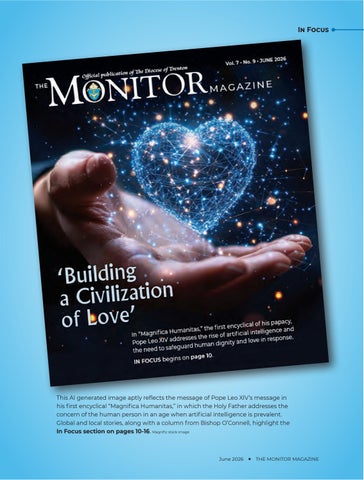
This AI generated image aptly reflects the message of Pope Leo XIV’s message in his first encyclical “Magnifica Humanitas,” in which the Holy Father addresses the concern of the human person in an age when artificial intelligence is prevalent. Global and local stories, along with a column from Bishop O’Connell, highlight the In Focus section on pages 10-16. Magnific stock image
June 2026
THE MONITOR MAGAZINE
Magnific stock image
In Focus
Pope urges humanity to build civilization of love in digital world BY CAROL GLATZ Catholic News Service VATICAN CITY • At a time when digital technologies are developing at a rapid and unpredictable pace, every single person must decide if she or he will be: a passive bystander; an unhelpful commentator; an avaricious architect of a new “Tower of Babel”; or a patient, hope-filled builder of a “civilization of love,” Pope Leo XIV said in his first encyclical, “Magnifica Humanitas.” In the 82-page document, released May 25, the day after Pentecost, the Pope also asked forgiveness for the Church’s long tolerance of slavery, and he declared that its “just war theory” was now outdated. “Today, more than ever, without prejudice to the right to self-defense in the strictest sense, it is important to reaffirm that the ‘just war’ theory, which has all too often been used to justify any kind of war, is now outdated,” he wrote. “Humanity possesses far more effective and capable tools for promoting human life and resolving conflicts, such as dialogue, diplomacy and forgiveness. The use of force, violence and weapons reflects a relational poverty that always has disastrous consequences for civilian populations,” the Pope’s new document said. REAL WORLD CONSEQUENCES The document, signed May 15, marked the 135th anniversary of his namesake’s landmark social encyclical, “Rerum Novarum,” which reflected on society, the economy and 10 THE MONITOR MAGAZINE
June 2026
“Today, the Social Doctrine of the Church is a legacy of wisdom ...” Pope Leo XIV
politics, and ushered in what is now known as the “Social Doctrine of the Church.” “When some objected that the Church should not waste energy on worldly matters, but instead focus on communicating the message of eternal life, Leo XIII responded with realism and wisdom, saying that the proclamation of the Gospel cannot overlook the concrete lives of people,” Pope Leo XIV wrote. While his turn-of-the-last-century predecessor focused on the industrial revolution’s impact on the human being and society, Pope Leo looked at the consequences of the digital revolution in the 21st-century and how best to safeguard “the human person in the time of artificial intelligence.” Pope Leo used nearly the first half of the document to outline the role and development of the Church’s social teaching, and why and how it continues to be needed in a world facing both old and new challenges. “Today, the Social Doctrine of the Church is a legacy of wisdom, where we find principles for thought, criteria for discernment and judgment, and concrete guidelines for action” to “clearly interpret the challenges of the present and identify appropriate ways for living out a clear Christian witness, with
joy and in service to the world,” he wrote. “It is not an inert set of concepts, but a living corpus of truth that safeguards and interprets humanity’s vocation to a full and just life. I therefore wish to add my own voice to this living tradition,” he added. Listening to and engaging with the wider world, especially those active in the fields of science, technology, academia and politics, he wrote, is crucial to a process of “shared discernment” to identify and heal the spiritual and cultural roots of present-day problems rather than issuing reactive pronouncements or “risk letting the succession of emergencies dictate the direction of our path.” While the Church is concerned with theological, “anthropological” and social questions, it is also “necessary to establish adequate regulatory tools capable of upholding justice and curbing the distorting effects of technological power,” the Pope wrote. “Nevertheless, the issue is not limited to regulation. As Pope Francis warned, we must realistically ask ourselves who holds this power today and how they use it,” he added. “Humanity, created by God in all its grandeur, is today facing a pivotal choice: either to construct a new Tower of Babel or to build the city in which God and humanity dwell together,” he wrote. Every generation has the same duty of “guiding history to become a place where the dignity of every person is safeguarded, justice is promoted and fraternity is made possible.” THE EVILS OF EXPLOITATION While the document was embedded “in a time of artificial intelligence,” it also included a wide gamut of ongoing, lingering ills such as: the exploitation of people and nature; war; the arms race; disrespect for human life; threats to democracy and the common good; discrimination against the poor and women; and new forms of slavery. “Human trafficking must be recognized as a contemporary
Pope Leo XIV speaks at a presentation of his encyclical, “Magnifica Humanitas: On Safeguarding the Human Person in the Time of Artificial Intelligence,” at the Synod Hall at the Vatican May 25, 2026. CNS photo/Lola Gomez form of slavery and a grave violation of human dignity. Failing to respond firmly, or tolerating these practices in any way, is in some way to become complicit in today’s sins, which are akin to those of the past when slavery was being concealed and justified,” Pope Leo wrote. While the Catholic Church constantly affirmed the dignity of every human being, he wrote, “neither can we deny or diminish the delay with which both society and the Church came to denounce the scourge of slavery,” noting it wasn’t until the 19th century “that a formal, absolute and universal condemnation of slavery was clearly articulated, notably under Pope Leo XIII.” “This development offers a clear example of the Church’s growth in understanding the perennial truths of Revelation that she safeguards,” he wrote, “even if it took eighteen centuries for its full incompatibility with slavery to be explicitly recognized.” “This constitutes a wound in Christian memory, one from which we cannot consider ourselves detached,” he wrote, and “for this, in the name of the Church, I sincerely ask for pardon.” It is “a shared responsibility,” he wrote, of all members of the human family to come together and discern “Where are we going? Toward what goal do we wish to orient ourselves? What direction should we choose as a people and as a human community?” Continued on 12
This is Pieter Bruegel’s 1563 painting of the “Tower of Babel.” In “Magnifica Humanitas,” Pope Leo XIV writes that humanity “is today facing a pivotal choice: either to construct a new Tower of Babel or to build the city in which God and humanity dwell together.” OSV News photo/ courtesy Kunsthistorisches Museum
June 2026
THE MONITOR MAGAZINE 11
In Focus
Understanding God’s plan for his creation Continued from 11
“The search for the truth in public life, education in the digital environment, the transformation of work, the fragility of families and new forms of slavery are not isolated phenomena,” he wrote. “Rather, they reflect a common underlying issue, namely that if technology becomes the ultimate criterion, the human person risks being reduced to data, a cog in a machine or a commodity.” “If, however, technology is integrated with a wise perspective, it can become an instrument of growth, justice and fraternity,” he added. Innovation can genuinely serve integral human development and integral ecology, Pope Leo wrote, “rather than becoming a source of exclusion and dominance.” PEACE IS THE ‘FRUIT OF JUSTICE AND CHARITY’ Referring often to St. Augustine’s teachings, Pope Leo clearly defined the two “cities” people today must choose to contribute to: either a worldly, selfish land dedicated to building a “Tower of Babel” or a Christian “civilization of love in the digital age.”
He decried today’s “culture of power” that was “normalizing” war, ballooning military arsenals, and fomenting fear and polarization; he reinforced the Vatican’s long-standing opposition to leaving the decision to use lethal force to AI or “to opaque or automated processes.” The Pope also condemned today’s “false realism,” calling it “truly irresponsible” to stoke resignation by pretending war is inevitable and peace and dialogue are “utopian or irrational positions that ignore the risks at stake.” “In fact, peace is neither a naïve hope nor merely the absence of war; instead, it is always possible as the fruit of justice and charity,” he wrote. Pope Leo underlined the need for everyone to take responsibility in building a better world by quoting the wizard Gandalf in J.R.R. Tolkien’s “The Lord of the Rings. The Return of the King.” “It is not our part to master all the tides of the world, but to do what is in us for the succour of those years wherein we are set, uprooting the evil in the fields that we know, so that those who live after may have clean earth to till.” Pope Leo then proposed five paths toward daily and public responsibility: “the need to disarm words; building
FOR MORE ON MAGNIFICA HUMANITAS: Babel, Nehemiah and algorithms: A guide to key terms in Pope Leo’s new encyclical on AI Pope Leo calls for ‘educational alliance’ on AI: Here are takeaways for parents, teachers What is Anthropic? A look at the company joining Pope Leo for AI encyclical release
Encyclical: What Pope Leo thinks about just war theory, historic Church apology for slavery Pope Leo encyclical on AI shows need for humanity in healthcare, says expert 10 quotes from Pope Leo’s first encyclical you should know for the era of AI
To view these stories and more, scan the QR code or visit: trentonmonitor.com/category/AI/ 12 THE MONITOR MAGAZINE
June 2026
Pope Leo XIV’s first encyclical, “Magnifica Humanitas” was launched in May 2026. OSV News illustration/Our Sunday Visitor
peace through justice; adopting the perspective of victims; cultivating a healthy realism; and reviving dialogue and multilateralism.” Fundamentally, he added, what is needed is the Christian view of humanity and understanding of God’s plan for his creation. “As a believer among believers, I invite everyone to contemplate, in the face of the Son of God, the grandeur of humanity that shines a light also on the era of AI,” he wrote. “In Christ, we are called to cooperate in the work of creation, rather than be disinterested observers of technological processes that limit our freedom and responsibility.” “The dignity inscribed in each of us by the Holy Spirit can also be seen in our capacity to reflect critically, choose and love freely, and form authentic relationships,” Pope Leo wrote. “No computational system, however sophisticated, can create a heart that gives itself, or a conscience that discerns good from evil,” he wrote. “Even when machines excel in efficiency, a human face that asks to be gazed upon remains the center of our history.”
In Focus
Pope Leo’s first encyclical … in a nutshell BY MARIA WIERING OSV News
W
hat does it mean to safeguard our humanity? That question is at the heart of Pope Leo XIV’s much anticipated first encyclical, “Magnifica Humanitas: On Safeguarding the Human Person in the Time of Artificial Intelligence,” released May 25. The following are some key things to know about this weighty papal letter. 1. Latin for “Magnificent Humanity,” the title is drawn from the opening words of the text as rendered in Latin, as is customary for papal encyclicals. Those words state, in its English translation, “Humanity, created by God in all its grandeur, is today facing a pivotal choice: either to construct a new Tower of Babel or to build the city in which God and humanity dwell together.” Throughout the encyclical, Pope Leo points to “the grandeur of humanity,” with men and women created by God for relationship with him and each other, cooperating in God’s creative work and guided by the Holy Spirit. 2. The document is about 42,000 words long, including footnotes, making it roughly the size of a novella. It spans five chapters sandwiched between a robust introduction and conclusion. From education and jobs to private tech companies and families, “Magnifica Humanitas” is wide-ranging. It touches on the prospect of massive unemployment, the future of education, the protection of human freedom, excessive screen time for young people and technology addiction, data ownership, cryptocurrencies, economic disparities, environmental impacts, transhumanism and posthumanism, and cyberattacks and other forms of warfare. Pope Leo addresses the idea of “moral AI,” and argues that the basis for “alignment of AI with human values” requires “openly discussing
A service member of the 422nd Unmanned Systems Regiment walks next to a heavy strike drone at a training ground, amid Russia’s attack on Ukraine, in Zaporizhzhia region, Ukraine, last March. In his first encyclical, Pope Leo XIV addresses the impact of AI on modern warfare and cites criteria for its use. OSV News photo/Reuters
“Tools,.. can cause harm when not oriented toward the good.” Pope Leo XIV the ethical frameworks involved and subjecting them to shared standards of social justice” in a conversation inclusive to all communities. 3. The document includes references to an array of influential thinkers. Beyond Pope Leo’s papal predecessors, the letter points to or quotes Dorothy Day, Maria Montessori, the Rev. Dr. Martin Luther King Jr., J.R.R. Tolkien, Plato, the U.S. Conference of Catholic Bishops and the American humanist thinker Hannah Arendt, among others. And, of course, Pope Leo weaves in St. Augustine, the patron of Pope Leo’s Augustinian religious order and Pope Leo’s ever-present guide, particularly through the African bishop’s important fifth-century book, “The City of God.” 4. It uses biblical imagery, imploring people to examine what humanity is building in “the construction site of our time.” The Tower of Babel and the City of God are contrasted throughout the encyclical to illustrate the two possible directions that the era of AI could take:
a path of arrogance, artificial sense of self-sufficiency and chaos, or a path towards communion, relationship and God. Pope Leo underlines the critical need for developing a process for discernment to guide the development of AI. “The task of building today must place our relationship with God at its center,” Pope Leo writes. 5. Despite its challenges, AI is not to be inherently feared. “Technology should not be considered, in itself, as a force antagonistic to humanity,” he writes. “Over the centuries, technological development has significantly improved the living conditions of humanity. At the same time, each phase of progress has also revealed the ambiguity of tools that can cause harm when not oriented toward the good.” He speaks directly to AI developers, telling them that “technological innovation can represent human participation in the divine act of creation,” and therefore they “bear a particular ethical and spiritual responsibility,
June 2026
Continued on 29
THE MONITOR MAGAZINE 13
Beyond the Algorithm:
Magnifica Humanitas and the call to safeguard the human person in the digital age
A message from
BISHOP DAVID M. O’CONNELL, C.M.
“Be the authors yourselves ... learn to humanize the digital.” Pope Leo XIV
P
apal encyclicals have long served as a privileged means by which the Successor of Peter offers guidance to the Church and the world. Addressed primarily to bishops but intended for all the faithful, they illuminate moral, theological and social questions that require thoughtful discernment. While not typically issued as infallible ex cathedra (from the chair) teachings, encyclicals carry significant doctrinal authority as expressions of the Pope’s ordinary Magisterium and often set the pastoral priorities of a pontificate. On May 25, 2026, Pope Leo XIV released his first encyclical, Magnifica Humanitas: On Safeguarding the Human Person in the Time of Artificial Intelligence (MH). In this landmark document, the Holy Father offers a profound meditation on the opportunities and dangers emerging technologies present. He insists that the dignity of the human person must remain the central criterion for evaluating and guiding technological progress – a theme that has marked his teaching from the earliest days of his pontificate. Read “Magnifica Humanitas”at www.vatican.va/content/leo-xiv/en/encyclicals/documents/20260515-magnifica-humanitas.html ‘DO NOT SURRENDER AGENCY’ Pope Leo XIV has consistently spoken with
14 THE MONITOR MAGAZINE
June 2026
both hope and caution about artificial intelligence. He recognizes its enormous potential for good, yet he warns that it can also become a force of dehumanization, especially for the young. In a 2025 address to university students gathered in Rome for the Jubilee of the World of Education, he urged them not to surrender their agency to algorithms: “Do not let the algorithm write your story! Be the authors yourselves… learn to humanize the digital.” He reminded them that while AI may be one of the rerum Novarum – the “new things” – of our age, it cannot replace emotional, spiritual, social or ecological intelligence. Similarly, speaking to young people Nov. 21, 2025 at the National Catholic Youth Conference in Indiana, he cautioned that AI can never replace the human capacity for wonder, moral judgment or authentic friendship. It must be used in ways that foster growth, not diminish it. At the heart of Magnifica Humanitas lies a simple but urgent question: What direction will humanity choose? Pope Leo observes that “never before has humanity had so much power over itself ” (MH 6). Such power demands responsibility, humility, and collaboration. No individual or nation can bear the weight of today’s challenges alone (MH 13). When human dignity is threatened by new forms of dehumanization, he writes, we must “re-
In Focus
Pope Leo XIV signs “Magnifica Humanitas” at the Vatican’s Synod Hall May 15, 2026, the first encyclical of his papacy, which focuses on the rise of artificial intelligence. OSV News photo/Simone Risoluti, Vatican Media
main profoundly human” and “lovingly safeguard the grandeur of humanity… which no machine can ever replace” (MH 15). To illustrate the stakes, the Pope offers two biblical images: A new Tower of Babel (Genesis 11:1-9) – a technological project built without God and without regard for human dignity Or the rebuilding of Jerusalem – a cooperative work rooted in God’s presence, fraternity and hope. The choice between these two paths will define our moment in human history. MACHINE LIMITATIONS Pope Leo situates his reflections within the rich tradition of Catholic social teaching, which he describes as “embodying God’s love in the concrete events of life” (MH 47). Every human person, he insists, is “planned and willed by God to enter into communion with him” (MH 50). This truth must guide our discernment of technological innovation. Thus, he asks: “Do technological innovations truly help individuals and peoples become more humane and fraternal, while respecting our com-
mon home and future generations?” (MH 85) This becomes the fundamental moral question regarding AI in the digital age. AI may assist us, but it cannot replace the human heart. It does not experience joy or suffering or any emotion. It has no conscience. It cannot bear moral responsibility. It has no soul. It cannot love. For this reason, decisions affecting life, justice and peace must never be relegated to machines. The encyclical highlights three essential goods that require vigilant protection: Truth – in a world where information can be manipulated or distorted Work – which must always honor the dignity of the worker, even amid automation Freedom – threatened by subtle forms of surveillance, control, and behavioral prediction These gifts are not optional; they are pillars of human flourishing. Pope Leo warns against a culture of power that uses technology to make war more distant, impersonal or seemingly “clean.” “No algorithm can make war morally acceptable (MH,198),” he writes. Instead, he calls humanity to build the “civilization of love” envisioned by Pope St. Paul VI – a society rooted in justice, fraternity and peace. “Nothing is lost with peace, whereas with war everything can be lost” (MH 219).
AI may assist us, but it cannot replace the human heart.
EFFICIENCY VS. COMMUNION
ON THE WEB In an earlier message on AI published in December 2025 Bishop O’Connell writes: “At its most basic level, AI refers to machines or systems that simulate human intelligence — learning, reasoning and problem-solving. While AI can perform tasks with remarkable efficiency, it remains a human creation, devoid of soul, conscience or moral agency. It is not a person, nor can it possess the dignity that belongs uniquely to human beings whom God made in his own image and likeness, as we learn in Genesis 1:27.” To read the full message, The Church in the Digital Age: Upholding morality and human dignity in the rise of AI, scan the QR code. Or visit: trentonmonitor.com/2026/05/26/thechurch-in-the-digital-age-upholding-morality-andhuman-dignity-in-the-rise-of-ai/
Ultimately, Magnifica Humanitas leads us back to the mystery at the center of Christian faith: the Word became flesh. God enters human history not through power or efficiency but through vulnerability and love. This truth reveals the measure of all human greatness and the standard by which all technologies must be judged. As we navigate the digital frontier, Pope Leo invites us to become builders of communion rather than architects of Babel. The Church’s mission is to help the world rediscover the magnificence of every human heart – the dwelling place where God desires to live. As Bishop, I invite all the clergy and faithful of the Diocese of Trenton to embrace that mission as we consider the profound thought and wisdom contained in Pope Leo XIV’s first encyclical letter, Magnifica Humanitas. June 2026
THE MONITOR MAGAZINE 15
In Focus
Princeton lecture to explore Christian witness amid AI concerns BY EMMALEE ITALIA Contributing Editor
T
he responsibility of Christians to evangelize in an increasingly AI-shaped world will be explored in a July 17 seminar at Princeton Theological Seminary. Supported by the Diocese of Trenton and organized by Msgr. Thomas Mullelly, diocesan vicar for clergy, and Father Joseph Thomas of Princeton’s Mercer House, the event is not only a continuing education opportunity for priests, but also something of wider interest to other faithful Catholics. “Pope Leo XIV, in his first encyclical, has called upon the Church to engage in a task of discernment … regarding the great technological possibilities brought about by artificial intelligence,” said Father Thomas. “In this way, AI might serve the true good of humanity rather than be a dehumanizing force.” The seminar will run from 10 a.m. to 3 p.m. in Stuart Hall, Room 6, and will feature lecturer Father Paul O’Callaghan, Ordinary Professor of Theological Anthropology at the Pontifical University of the Holy Cross in Rome, where he has taught since 1990. He holds a licentiate and doctorate in theology
PARISH
Carnivals & Festivals
from the University of Navarre, Spain, and he is the author of numerous theological works, including “God’s Gift of the Universe: An Introduction to Creation Theology.” Father Thomas suggested that AI’s possibilities, however powerful, only illustrate the unique dignity of the human person, created in the image of God. “This special identity of the person is Father Joseph shown particularly in the witness which Thomas Christians are called to give of their faith,” he said. “Such witness is not just a question of passing information as a computer might do. This witness involves the whole person, body and soul, and offers testimony to Christ as a living person and to the Christian himself who has personally experienced the transforming action of grace.” Father Thomas anticipated that Father O’Callaghan “will help us to reflect on the deep theological meaning of this important service which each Christian is called to offer.” He acknowledged that despite intense formation in seminary, priests’ day-to-day responsibilities can make continuing study challenging. “I hope this seminar might serve as one more opportunity … for priests to be renewed in their commitment to the truths which inspire our ministry,” Father Thomas said. Sponsored by the Santa Croce Institute in collaboration with the Pontifical University of the Holy Cross Foundation, the seminar cost is free and will include light breakfast; lunch will be available for purchase in the Seminary cafeteria. Registration is due by July 10 at www.SantaCroceInst. org/#register. Livestream link will also be made available. For questions, email puhcusrep@gmail.com.
PLEASE HELP SUPPORT OUR MINISTRY. TrentonMonitor.com
The Monitor continues to expand its online presence. We are pushing new and varied content out to our readers and visitors through TrentonMonitor.com as well as our profiles on Facebook. Please consider making a donation to The Monitor’s publishing ministry so we may continue to bring the Good News - in print and digital form - to all who seek it. Contact us to place your ad here: monitor-advertising@DioceseofTrenton.org
16 THE MONITOR MAGAZINE
June 2026
to donate: dioceseoftrenton.org/donate-to-the-monitor