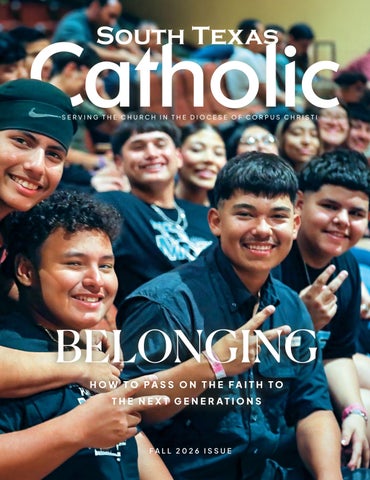
SERVING THE CHURCH IN THE DIOCESE OF CORPUS CHRISTI
BELONGING H OW TO PAS S O N T H E FA I T H TO T H E N E X T G E N E R AT I O N S
FALL 2026 ISSUE
S
TH
T E X A S C AT
HO
INSIDE
L
IC
O
U
E S T. 1 9 6 6
4
Keep up with the faith at
southtexascatholic.com Vol. 62/No. 4 Publisher
6
«EL PRESENTE Y EL FUTURO DE NUESTRA FE »
Director of Communications and Public Relations
8
PASSING ON THE FAITH IN YOUR DOMESTIC CHURCH
Bishop Mario A. Avilés, C.O.
Katia Uriarte Philipello kuriarte@diocesecc.org
Assistant Director of Communications and Public Relations
Jesse DeLeon jdeleon@diocesecc.org
11
Managing Editor
Susanne Janssen sjanssen@diocesecc.org
Mensaje de nuestro Obispo Mario A. Avilés, C.O.
How parents and teachers can do their part in raising future Catholics
TRANSMITIR LA FE EN SU IGLESIA DOMÉSTICA
Cómo los padres y maestros pueden desempeñar su papel en la formación de los futuros católicos
Theological Consultant
14
“I FELT LIKE I BELONGED”
Communications Specialist
16
THE ROLE OF CATHOLIC SCHOOLS IN PASSING ON THE FAITH A community that builds upon the formation begun at home
Social Media Coordinator
17
Rev. Richard Libby fatherlibby@yahoo.com
Adel Sauceda asauceda@diocesecc.org Teresa Saenz tsaenz@diocesecc.org
Broadcast Technical Director Richard Luna rluna@diocesecc.org
23
Design & Layout Eric Moreno
Correspondents
25
Rebecca Esparza, Cynthia Morales, Luisa Buttler
Translator/Correspondent
Gloria Romero, Catalina Longoria
Contributors
Sr. Caritas Sparke, SOLT, Dr. Rebecca Hammel, Fr. Francis Makut, Alex Derise
MANAGE SUBSCRIPTIONS
If you or someone you know would like to receive the link to South Texas Catholic online contact us at (361) 882-6191 555 N Carancahua St, Ste 750 Corpus Christi, TX 78401-0824 stc@diocesecc.org To subscribe or unsubscribe, go online at:
28 30 32
diocesecc.org/subscribe
The South Texas Catholic is not liable or in any way responsible for the content of any advertisement appearing within these pages. All claims, offers guarantees, statements, etc. made by advertisers are solely the responsibility of the advertiser. Deceptive or misleading advertising is never knowingly accepted. Complaints regarding advertising should be made directly to the advertiser. “South Texas Catholic” (USPS 540-860) Published quarterly (March, June, September, and December) plus a Special Issue in January by the Diocese of Corpus Christi, 555 N Carancahua St, Ste 750, Corpus Christi, TX 78401-0824 for $25 per year. Periodicals postage paid in Corpus Christi, TX 78401-0824. POSTMASTER: Send address changes to South Texas Catholic, 555 N Carancahua St, Ste 750, Corpus Christi, TX 78401-0824.
2
"THE PRESENT AND FUTURE OF OUR FAITH”
“A message from our Bishop Mario A. Avilés, C.O.
SOU T H T E X AS CAT HOLIC
FALL 2026
34
How to accompany teens on their faith journey
OUR DIOCESE AT A GLANCE
A snapshot of our parishes, missions, people, ministries and activities that make our local Church come alive
THE GIFT OF SHOWING UP
Why attending Mass as a family matters
THE GREAT COMMISSION, ALIVE TODAY
An interview with Austin Habash of the Augustine Institute about Evangelization in our parishes
RESPECTING GOD’S PLAN
Bioethics 101: Pope Paul VI and the development of the encyclical Humanae Vitae
BE A TREASURE SEEKER
Following Jesus: The Parable of the Treasure in the Field invites us to give everything to the Lord with joy
WHEN NO ONE SHOULD BE INVISIBLE
What seafarers taught me about human dignity
BROTHERHOOD FOUND BEHIND BARS
A Kolbe Retreat in the McConnell Unit
On the COVER:
Teens at the Diocesan Youth Conference DCYC, March 2026. Picture: S. Janssen
Message from the Editor Dear Readers, One of the joys of being your editor for South Texas Catholic is sharing the life of our diocese with you through our magazine and online. From major diocesan celebrations to initiatives in our parishes, to the ministry of our Bishop Mario A. Avilés, C.O., to news about young people, faith formation, Catholic Schools and how we live our faith across the 12 counties that make up our diocese. Our goal is to keep us connected as one family in Christ. Because STC is printed four times a year, we also share news, photographs, and videos throughout the year on southtexascatholic.com and on our Facebook and Instagram pages. This allows us to celebrate joyful moments immediately, as they happen and to unite in prayer for those in need. Beginning with the Winter issue, we will place an even greater emphasis on our digital presence. You will be able to read the full magazine, along with additional stories and timely updates on our website. Those who subscribe will receive a direct link to each new issue by email or text. We also invite you to follow STC on Facebook and Instagram, so you never miss a story.
We will continue to offer a print edition of the magazine. However, beginning with the Winter issue, copies will no longer be mailed to every household. The reason? We need to be good stewards of our financial resources, and postage costs are rising each year. With the upcoming Winter Issue, printed magazines will be available at your church or parish center. We want to ensure that people who can’t read online receive a printed copy! Thank you for your understanding and support, and most of all, for being part of the South Texas Catholic family. We look forward to continuing to share the stories of faith that unite and inspire us. May God bless you and your loved ones this Fall!
SUSANNE JANSSEN Managing Editor, South Texas Catholic
Submit your News and Stories! Send us your parish, school, ministry news stories, pictures and calendar events via our online form at diocesecc.org/send-news or via email to stc@diocesecc.org. If you have any questions, call STC at (361)693-6609. We are looking forward to hearing from you!
In the spirit of proper stewardship, the Diocese of Corpus Christi encourages reporting any financial abuse concerns or related issues. Report confidentially to: financialconcerns@diocesecc.org En el espíritu de una administración adecuada, la Diócesis de Corpus Christi alienta a informar cualquier inquietud de abuso financiero o problemas relacionados. Informe confidencialmente a: financialconcerns diocesecc.org Bishop Mario A. Avilés and the staff of the Office for Safe Environment and Child and Family Resources are committed to assisting those who have faced abuse of any kind. For immediate assistance, support, and referral information, please call Victim Assistance Coordinator Stephanie Bonilla at (361) 693-6686. El obispo Mario A. Avilés y el personal de la Oficina del Medio Ambiente Seguridad y Recursos para Niños y Familias están comprometidos a ayudar a aquellos que han sufrido abusos de cualquier tipo. Para asistencia inmediata, apoyo e información de referencia, llame al Coordinador de Asistencia a Víctimas Stephanie Bonilla al (361) 693-6686.
SOU T H T E X AS CAT HOLIC
FALL 2026
3
"Do not underestimate what God is doing in everyone who seeks His presence in the Most Holy Sacrament of the altar."
4
SOU T H T E X AS CAT HOLIC
FALL 2026
A MESSAGE FROM OUR BISHOP
“The present and future of our faith” BY BISHOP MARIO ALBERTO AVILÉS, C.O.
O
ver the past two months, I have had the opportunity to spend time with our young people at various mini youth conferences, as well as with youth ministers, catechists, teachers, and school staff. It was edifying to see how our youth are alive and vibrant in their faith, how they are thirsty for the living God, and how they are willing to get to know Him more deeply. I also encountered dedicated youth ministers, catechists, and teachers who are willing to accompany them on their journey. Caring for our teens and youth is especially important because they will be the adults who lead the Church in the future and make a difference in the world. Let’s look at how we can bring our faith to the next generations.
Be present The Blessed Mother Mary can be our role model. She carried Jesus in her womb and visited her cousin Elizabeth (see Luke 1:42-44). In many key moments in the Gospel, she was known less for her words than for her presence. Catechists, teachers, and youth ministers, as well as parents and relatives, teach most powerfully not only by what they say but by what they are. Be present and listen to young people, and also pray and kneel before the Lord so that our words and actions reflect the Truth. Mary did not magnify herself, but the Lord. A catechist or teacher after Mary’s heart does not teach from a pedestal but humbly proclaims the whole truth.
Rely on the Holy Spirit Staying faithful in today’s world can be difficult. St. Paul offers an answer to the tension Christians have faced from the beginning: “We have not received the spirit of the world but the Spirit that is from God, so that we may understand the things freely given us by God” (1 Corinthians 2:12). That does not mean we suddenly know all the answers, but that the Holy Spirit dwells within us. And He helps us grow closer to the Lord. He challenges us to love as Jesus loved. We can choose what is good, even when the world around us deems it foolish. The world often says, “Look out for yourself.” However, we have the mind of Christ (cf. 1 Cor 2:16). We are here to be His witnesses: noticing the one who is left out, refusing to join in gossip, and not staying silent when someone speaks against the truth.
Seek the Presence of the Lord When I celebrated Mass at the end of September with 250 altar servers from the diocese who were recognized for outstanding service, I told them how privileged they are to stand closer than most people ever do to the mystery unfolding at the altar. They help the whole Church pray and, through their reverence, remind the assembly that something holy is happening. Even without being an altar server, each of us can always stay close to the Lord by attending Mass and spending time in adoration. Do not underestimate what God is doing in
everyone who seeks His presence in the Most Holy Sacrament of the altar. Parents, catechists, youth ministers, priests: thank you for immersing young people and people of every age in the life of the Church. Some of those young people will one day be called to the priesthood or consecrated life; others to be holy husbands, wives, parents, and faithful laity. God is calling them, and they are already in the heart of the Church. As the Lord told Jeremiah, “Do not say, ‘I am too young’” (Jer 1:7). The recently canonized St. Carlo Acutis and St. José Sánchez del Río show that God is already calling teenagers to sainthood.
Deepening Our Faith As lifelong learners, we also apply this to our faith. We continually discover new aspects and grow in our understanding of the mysteries of our faith and tradition. To help the laity deepen their faith, we will inaugurate a new initiative in our diocese: the Our Lady of Guadalupe Institute for Evangelization and Catechesis. Fr. Eric Chapa will spearhead it, and it will offer various courses taught by priests and religious from our diocese. The lessons will begin in January 2027, and courses will last three hours, with two attendance options: two 90-minute weeknight sessions or one three-hour Saturday morning session. I hope this is another opportunity for us to learn, live out our faith, and pass it on to others. SOU T H T E X AS CAT HOLIC
FALL 2026
5
«No subestimen lo que Dios está haciendo en cada persona que busca su presencia en el Santísimo Sacramento del altar.»
6
SOU T H T E X AS CAT HOLIC
OTOÑO 2026
U N M E N SA J E D E N U ES T RO PAS TO R
«El presente y el futuro de nuestra fe» POR EL OBISPO MARIO ALBERTO AVILÉS, C.O.
E
n los últimos dos meses, he tenido la oportunidad de compartir tiempo con nuestros jóvenes en varias miniconferencias juveniles, así como con dedicados líderes de pastoral juvenil, catequistas, maestros y personal escolar dispuestos a acompañarlos en su camino. Fue edificante ver cómo nuestros jóvenes viven su fe con vitalidad y entusiasmo, cómo tienen sed del Dios vivo y cómo están dispuestos a conocerlo más profundamente. Cuidar de nuestros adolescentes y jóvenes es de suma importancia, ya que no solo constituyen la Iglesia en el presente, sino que serán los adultos que lideren la Iglesia en el futuro y marquen la diferencia en el mundo. Veamos cómo podemos transmitir nuestra fe a las próximas generaciones.
Estén presentes La Santísima Virgen María puede ser nuestro modelo a seguir. Ella llevó a Jesús en su seno y visitó a su prima Isabel (véase Lucas 1, 4244). En muchos momentos clave del Evangelio, se la reconoció menos por sus palabras que por su presencia. Los catequistas, maestros y líderes de pastoral juvenil, así como los padres y familiares, enseñan con mayor eficacia no solo mediante lo que dicen, sino a través de lo que son. Estén presentes y escuchen a los jóvenes; asimismo, oren y pónganse de rodillas ante el Señor para que nuestras palabras y acciones reflejen la Verdad. María no se engrandeció a sí misma, sino al Señor. Un catequista o maestro que sigue el corazón de María no enseña desde un pedestal, sino que proclama humildemente la verdad completa.
Confíen en el Espíritu Santo Mantenerse fiel en el mundo actual puede resultar difícil. San Pablo ofrece una respuesta a la tensión que los cristianos han enfrentado desde el principio: «Nosotros no hemos recibido el espíritu del mundo, sino el Espíritu que viene de Dios, para que comprendamos los dones que Dios nos ha concedido» (1 Corintios 2, 12). Esto no significa que de repente conozcamos todas las respuestas, sino que el Espíritu Santo habita en nosotros. Y Él nos ayuda a acercarnos más al Señor. Nos desafía a amar como Jesús amó. Podemos elegir lo que es bueno, incluso cuando el mundo que nos rodea lo considera una insensatez. El mundo a menudo dice: «Mira por ti mismo». Sin embargo, nosotros tenemos la mente de Cristo (cf. 1 Cor 2, 16). Estamos aquí para ser sus testigos: fijándonos en quien se siente excluido, negándonos a participar en chismes y no guardando silencio cuando alguien habla en contra de la verdad.
Busquen la presencia del Señor Cuando celebré la Misa a finales de septiembre con 250 monaguillos de la diócesis, reconocidos por su servicio ejemplar, les hablé del privilegio que tienen de estar más cerca que la mayoría de las personas del misterio que se desarrolla en el altar. Ellos ayudan a toda la Iglesia a orar y, mediante su reverencia, recuerdan a la asamblea que algo santo está sucediendo. Aun sin ser monaguillos, cada uno de nosotros puede mantenerse siempre cerca del Señor asistiendo a Misa y pasando tiempo en adoración. No subestimen lo que Dios está haciendo en cada persona que busca su presencia en el Santísimo Sacramento del altar.
Padres, catequistas, responsables de pastoral juvenil y sacerdotes: gracias por integrar a los jóvenes y a personas de todas las edades en la vida de la Iglesia. Algunos de esos jóvenes serán llamados algún día al sacerdocio o a la vida consagrada; otros, a ser esposos, esposas y padres santos, y laicos fieles. Dios los está llamando y ya se encuentran en el corazón de la Iglesia. Como dijo el Señor a Jeremías: «No digas: "Soy demasiado joven"» (Jer 1, 7). Los recién canonizados san Carlo Acutis y san José Sánchez del Río demuestran que Dios ya está llamando a los adolescentes a la santidad.
Profundizar en nuestra fe Como aprendices constantes, descubrimos continuamente nuevos aspectos y crecemos en nuestra comprensión de los misterios de nuestra fe y tradición. Para ayudar a todos a profundizar en su fe, hemos puesto en marcha una nueva iniciativa diocesana: el Instituto de Evangelización y Catequesis Nuestra Señora de Guadalupe. El padre Eric Chapa lidera este proyecto y ofrecerá diversos cursos impartidos por sacerdotes y religiosos de nuestra diócesis. Las clases comenzarán en enero de 2027 y tendrán una duración de tres horas, con dos modalidades de asistencia: dos sesiones de 90 minutos entre semana por la noche o una sesión de tres horas los sábados por la mañana. Para más información, por favor visite www.diocesecc.org/olginstitute. Que el Instituto de Nuestra Señora de Guadalupe nos guíe a profundizar en nuestra fe, a crecer como discípulos y a compartir con alegría el amor de Cristo con los demás. Y que nuestra Santísima Madre nos acerque cada vez más a su Hijo, enseñándonos a decir «sí» a su llamado con fe y amor.
SOU T H T E X AS CAT HOLIC
OTOÑO 2026
7
Pixabay/Pexels Children first learn the core values of life in their family.
HOW PARENTS AND TEACHERS CAN DO THEIR PART IN RAISING FUTURE CATHOLICS
Passing on the faith in your domestic Church BY SUSANNE JANSSEN
E
very generation faces the same question: how can we pass on our Catholic faith to the next generation? What are the best practices, and how should we approach the basic questions, especially in our fastchanging world? Throughout the centuries, society has mostly changed slowly, though life has been interrupted by historical events – wars, revolutions, epidemics. Over the past 50 years, though, the pace seems to have accelerated; new technology and societal developments have changed our lives in fundamental ways. Shifting cultural norms have driven people away from religion since the 1960s. According to a Pew Research study, about 29% of adults in the United States and 26% of adults in Texas identify as religiously unaffiliated, or “nones.” In 2000, this percentage was 14% in the United States and 12% in Texas. Faced with these sobering facts, parents, catechists, and pastors are asking themselves: 8
SOU T H T E X AS CAT HOLIC
what can be done to pass on the faith? While Christ is the same “yesterday, today, and forever” (see Hebrews 13:8), methods of sharing the faith with the next generation may change, yet some best practices are universal.
Learning the Faith at Home Faith is a core value, and as such, it is formed first within the family unit, even before a child goes to school and has these convictions tested with peers. The Catechism of the Catholic Church (CCC) describes the family as a “domestic church” where faith is first lived out and experienced at home, not merely taught. “Parents have the first responsibility for the education of their children. They bear witness to this responsibility first by creating a home where tenderness, forgiveness, respect, fidelity, and disinterested service are the rule” (CCC, 2223). Children perceive whether faith plays a role in their parents’ lives. They feel the presence of the divine that Jesus promised those
FALL 2026
who strive to be united in Him (“For where two or three are gathered together in my name, there am I in the midst of them,” Mt 18:20). Of course, no one can be a perfect parent (or teacher), and that is not required. However, putting one’s own faith into practice is the best foundation parents can give to their children. And that goes beyond obvious signs of faith like going to Mass, praying, or saying grace before meals: Parents cultivate a faithbased environment through love, forgiveness, mutual respect, fidelity, and service. Faith, ideally, influences other core values a child picks up along the way. Catholic parents should encourage spiritual and interior realities over material and instinctual ones (CCC, 2223); thus, guide their children toward service, sharing, awareness of others’ needs, and gratitude. Lasting happiness comes from selfgiving and fulfilling relationships, not from passing pleasures and material rewards.
L. Buttler Religious education enhances the foundation of faith.
“The Catechism describes the family as a ‘domestic church’ where faith is first lived out and experienced at home, not merely taught.” Be a Role Model As parents, teachers or youth ministers, try to be authentic. Children and mentees learn most from what they see. Let them catch you spending time with God and be real about your own spiritual journey, including how you handle doubts and challenges. Children don’t need believers who have all the answers or handle everything
well; they need to see that faith is an integral part of life. One element is the importance you place on Mass and prayer: If children often see you arrive late to church without a good reason (of course, running late can happen, especially when the children are small and throwing a tantrum – no worries about that), they learn that Church is less important than school or work. If you complain about the length of Father’s homily or the music, they listen and come to see Mass as a TV show that you might like or not. Beyond these specific moments, faith is present in ordinary moments. Parents can use everyday occurrences to point to Christ. For instance, when you hear a siren, stop and pray for the people involved, or use mealtime and bedtime for brief spiritual discussions. In line with the saying, “Actions speak louder than words,” St. Paul insisted from the beginning on being a good role model – not because we are good, but because we try to imitate Christ and become always more like Him. He never asked people to copy him for his own glory, but he made it clear that his life was worth imitating only because he first imitated Jesus. In 1 Corinthians
11:1, he writes, “Be imitators of me, as I am of Christ.” This can seem daunting, as we all know our shortcomings, our temper, and our sinfulness too well. Again, being a credible role model doesn’t mean being perfect. When your children see you lose your temper, gossip, or have road rage, say that it was wrong, that you’ll ask God for forgiveness, and that going to confession helps you start over. Your children will learn that they don’t need to be perfect, but that sins and shortcomings need to be addressed, not hidden or denied, as the world often tries to teach us.
Don’t put God into a spiritual corner! Finding God in all things is central to the Ignatian spirituality, which means God is present in everyday life, not just in holy places. If your family life is not divided into “holy” and “ordinary” parts, but recognizes God’s presence in everything, your children will learn to see God as the foundation of everything. God’s love can be found in everyday moments: while cooking breakfast, walking a pet, or doing chores. Young children learn gratitude for God’s creation on a walk in nature or while preparing food. SOU T H T E X AS CAT HOLIC
FALL 2026
9
L. Buttler Children learn at Vacation Bible Schools in a fun and playful way more about our Catholic faith.
Teenagers tend to contest every bigotry or false morality that they perceive. They want to explore the world outside, and there are always two (or more) possible attitudes: fall in love with the world and leave religion behind, or find God in the world and discern where there is value and where there are temptations. Or, as St. Peter Claver put it: “Seek God in all things and you shall find God by your side.” St. Ignatius, the founder of the Jesuits, created a short daily prayer called the Ignatian Examen to reflect on where God was active during your day. You can even adapt it with your children while praying – invite them to reflect on their day. Was God there? How did I live today – did I love my neighbor as myself, or did I have a selfish attitude? All of our life can be sacred. We participate in God’s creation in a small way through our work (see Seven Themes of Catholic Social Teaching, usccb.org). We serve others when we cook, clean, and do the shopping. We take care of ourselves when we rest or work out.
Scripture and Prayer Everyone knows the saying, “A family that prays together, stays together,” and there is much truth to it. If we don’t nourish our spiritual life, it won’t grow. We nurture 10
SOU T H T E X AS CAT HOLIC
relationships by talking with our friends or family members. In the same way, we need to talk to God and listen to what He tells us so we can grow deeper in our relationship with Him. The Catechism specifically states that “parents have the mission of teaching their children to pray and to discover their vocation as children of God” (CCC, 2226). Establish achievable goals for reading the Bible as a family – maybe starting small with the Sunday Gospels in Advent or Lent, reading them several times during the week (they are available at bible. usccb.org/daily-bible-reading ). Share how God has answered your prayers, provided for you in tough times, and shown you grace. Pray together in the evenings, or at least a few times a week. When your children grow older, find ways to pray together with them – going to adoration, saying the rosary, or collecting prayer intentions in a jar. Not all these ideas will work for you. However, it is the wrong approach to assume that religious education or youth group will do their part. They are essential – especially youth ministry for teenagers, when they forge friendships and evaluate what their parents taught them. But if you can lay a foundation at home, it amplifies what teachers and youth ministers try to accomplish.
FALL 2026
L. Buttler La educación religiosa fortalece los cimientos de la fe establecidos en el hogar.
CÓMO LOS PADRES Y MAESTROS PUEDEN DESEMPEÑAR SU PAPEL EN LA FORMACIÓN DE LOS FUTUROS CATÓLICOS
Transmitir la fe en su Iglesia doméstica POR SUSANNE JANSSEN
C
ada generación se enfrenta a la misma pregunta: ¿cómo transmitir nuestra fe católica a quienes vienen detrás? Esta misión siempre ha sido esencial para la Iglesia. Durante siglos, la sociedad cambió lentamente, salvo en momentos marcados por guerras, revoluciones o epidemias. Pero en los últimos cincuenta años el ritmo se ha acelerado de manera profunda. Las nuevas tecnologías y los cambios sociales han transformado nuestra vida cotidiana. En medio de este mundo en movimiento, estamos llamados a discernir cómo compartir la fe y cómo acompañar a quienes buscan a Dios. La misión permanece, pero el modo de vivirla requiere cercanía, esperanza y fidelidad al Evangelio. Según un estudio del Pew Research, alrededor del 29% de los adultos en Estados Unidos y el 26% en Texas se identifican hoy como personas sin afiliación religiosa (nones). En el año 2000, estos porcentajes eran del 14% en Estados Unidos y del 12% en Texas.
Ante estos datos que invitan a la reflexión, padres, catequistas y pastores se preguntan cómo transmitir la fe. Aunque Cristo es el mismo “ayer, hoy y siempre” (Hebreos 13, 8), los modos de compartir la fe con la siguiente generación pueden variar. Sin embargo, hay prácticas que permanecen y siguen iluminando nuestra misión.
Aprender la fe en el hogar La fe es un valor esencial y, como tal, nace y se fortalece primero en el seno de la familia, incluso antes de que el niño vaya a la escuela y encuentre un entorno donde sus convicciones comienzan a ponerse a prueba. El Catecismo de la Iglesia Católica describe a la familia como una “Iglesia doméstica”, el lugar donde la fe se vive y se experimenta cada día, más que simplemente se enseña. “Los padres tienen la primera responsabilidad en la educación de sus hijos. Dan testimonio de esta responsabilidad, ante todo, creando un hogar donde la ternura, el perdón, el respeto, la
fidelidad y el servicio desinteresado sean la norma” (CIC, 2223). Los niños perciben si la fe ocupa un lugar real en la vida de sus padres. Intuyen la presencia de lo divino que Jesús prometió a quienes buscan permanecer unidos en Él: “Porque donde dos o tres están reunidos en mi nombre, allí estoy yo en medio de ellos” (Mt 18, 20). Nadie puede ser un padre —o un maestro— perfecto, y eso no es lo que se pide. Pero vivir la propia fe con sencillez y coherencia es el mejor cimiento que los padres pueden ofrecer a sus hijos. Esto va más allá de las manifestaciones visibles de fe, como asistir a Misa, rezar o dar gracias antes de las comidas. Los padres crean un ambiente de fe cuando cultivan el amor, el perdón, el respeto mutuo, la fidelidad y el servicio en la vida diaria. Lo ideal es que la fe ilumine los demás valores fundamentales que el niño adquiere a lo largo de su vida. Los padres católicos están llamados a fomentar las realidades espirituales e interiores por encima de las materiales e instintivas
SOU T H T E X AS CAT HOLIC
OTOÑO 2026
11
Pixabay/AnilSharma
Los niños pequeños perciben el ambiente en casa.
(Catecismo de la Iglesia Católica, 2223); así orientan a sus hijos hacia el servicio, la generosidad, la atención a las necesidades de los demás y la gratitud. La felicidad duradera nace de la entrega personal y de relaciones plenas, no de los placeres pasajeros ni de las recompensas materiales.
Sea un ejemplo a seguir Como padres, maestros o animadores de la pastoral juvenil, procuren ser auténticos. Los niños y quienes los acompañamos aprenden, sobre todo, de lo que ven. Permitan que los vean dedicar tiempo a Dios y muestren sinceridad respecto a su propio camino espiritual, incluyendo cómo afrontan las dudas y los desafíos. Los niños no necesitan creyentes que tengan todas las respuestas o que lo hagan todo a la perfección; necesitan ver que la fe es una parte integral de la vida. Un aspecto clave es la importancia que ustedes dan a la Misa y a la oración. Si los niños ven con frecuencia que llegan tarde a la iglesia sin una razón justificada —y es natural que a veces ocurra, sobre todo cuando los pequeños tienen una rabieta— aprenden que la Iglesia ocupa un lugar secundario frente a 12
SOU T H T E X AS CAT HOLIC
la escuela o el trabajo. Si escuchan quejas sobre la duración de la homilía o la música, terminan viendo la Misa como un programa de televisión que puede gustarles o no. Más allá de los momentos concretos, la fe está presente en la vida cotidiana. Los padres pueden aprovechar las situaciones de cada día para señalar a Cristo. Por ejemplo, al escuchar una sirena, pueden detenerse a rezar por quienes necesitan ayuda; o pueden usar la hora de la comida y el momento de irse a dormir para sostener breves conversaciones espirituales. En consonancia con el dicho “las acciones valen más que las palabras”, San Pablo insistió desde el principio en la importancia del buen ejemplo; no porque él fuera perfecto, sino porque buscaba imitar a Cristo y parecerse cada vez más a Él. Nunca pidió ser imitado para su propia gloria, sino porque su vida reflejaba la de Jesús. Por eso puede decir: “Sed imitadores de mí, así como yo lo soy de Cristo” (1 Cor 11, 1). Esto puede parecer abrumador, porque todos conocemos nuestras propias faltas, nuestro mal genio y nuestra fragilidad. Pero ser un modelo creíble no significa ser perfecto. Cuando los hijos los vean
OTOÑO 2026
perder la paciencia, hablar mal de alguien o enfadarse al conducir, reconozcan que actuaron mal, digan que pedirán perdón a Dios y expliquen que la confesión les ayuda a comenzar de nuevo. Así, los niños aprenderán que no necesitan ser perfectos, sino que los pecados y las faltas deben afrontarse, no ocultarse ni negarse, como el mundo a veces pretende enseñar.
¡No encasilles a Dios únicamente en el ámbito espiritual! Encontrar a Dios en todas las cosas es un aspecto central de la espiritualidad ignaciana; significa reconocer que Él está presente en la vida cotidiana, no solo en los lugares sagrados. Cuando la vida familiar no se divide entre lo “sagrado” y lo “ordinario”, sino que acoge la presencia de Dios en todo, los hijos aprenden a verlo como el fundamento de la existencia. El amor de Dios se descubre en los momentos simples: al preparar el desayuno, al pasear a la mascota o al realizar las tareas del hogar. Los niños pequeños aprenden a agradecer la creación durante un paseo por la naturaleza o mientras se preparan los alimentos. Los adolescentes tienden a cuestionar cualquier prejuicio o falsa
tareas diarias. Servimos a los demás cuando cocinamos, limpiamos o hacemos las compras; y cuidamos de nosotros mismos cuando descansamos o hacemos ejercicio. En cada una de estas acciones, Dios está presente, acompañando y dando forma a nuestra vida cotidiana.
Las Escrituras y la oración Todos conocemos el dicho: “La familia que reza unida, permanece unida”, y encierra una gran verdad. Si no alimentamos nuestra vida espiritual, esta no crece. Así como cultivamos nuestras relaciones conversando con amigos y familiares, también necesitamos hablar con Dios y escuchar lo que Él nos dice para profundizar nuestra relación con Él. El Catecismo afirma que “los padres tienen la misión de enseñar a sus hijos a orar y a descubrir su vocación de hijos de Dios” (CCE, 2226). Esta tarea, vivida con sencillez y constancia, fortalece el corazón de la familia y la orienta hacia Dios. Establezcan metas alcanzables para leer la Biblia en familia; pueden comenzar poco a poco con los Evangelios dominicales de Adviento
o de Cuaresma, leyéndolos varias veces a lo largo de la semana —están disponibles en https://bible.usccb. org/es/ bible/ lecturas/092126. cfm. Compartan cómo Dios ha respondido a sus oraciones, los ha sostenido en momentos difíciles y les ha mostrado su gracia. Oren juntos por las noches, o al menos algunas veces a la semana. Y, a medida que los hijos crezcan, busquen nuevas formas de orar con ellos: asistiendo a la adoración eucarística, rezando el Rosario o reuniendo intenciones de oración en un frasco. Cada gesto, por sencillo que sea, fortalece la vida espiritual del hogar. No todas estas ideas funcionarán para ustedes. Sin embargo, es un error pensar que la educación religiosa o el grupo juvenil harán todo el trabajo. Estas instancias son fundamentales —especialmente la pastoral juvenil para los adolescentes, etapa en la que forjan amistades y revisan lo que han recibido en casa—, pero cuando logran establecer unas bases sólidas en el hogar, refuerzan y potencian la labor que los maestros y los responsables de la pastoral juvenil buscan realizar.
Pixabay/Urirenataadrienn
moralidad que perciben. Desean explorar el mundo, y siempre existen dos —o más— caminos posibles: enamorarse del mundo y dejar atrás la fe, o encontrar a Dios en medio del mundo y discernir dónde hay verdadero valor y dónde se esconden las tentaciones. Como expresó San Pedro Claver: “Busca a Dios en todas las cosas y lo encontrarás a tu lado”. San Ignacio, fundador de los jesuitas, propuso una breve oración diaria —el Examen ignaciano— para reconocer dónde estuvo presente Dios a lo largo del día. Esta práctica puede adaptarse fácilmente para rezarla con los hijos, invitándolos a reflexionar sobre su jornada: ¿estuvo Dios allí? ¿Cómo viví hoy? ¿Amé a mi prójimo como a mí mismo o actué con egoísmo? Así, poco a poco, aprenden a descubrir la presencia de Dios en su propia historia y a mirar cada día con gratitud y discernimiento. Toda nuestra vida puede ser sagrada. Participamos en la obra creadora de Dios incluso en lo sencillo, especialmente a través del trabajo — como recuerdan los Siete Temas de la Doctrina Social de la Iglesia en usccb. org— que nos invita a ver la dignidad y el sentido espiritual de nuestras
SOU T H T E X AS CAT HOLIC
OTOÑO 2026
13
S. Janssen Young people at the Diocesan Youth Conference 2026
HOW TO ACCOMPANY TEENS ON THEIR FAITH JOURNEY
"I felt like I belonged"
E
BY SR. MARYAM CARITAS SPARKE, SOLT
very Monday afternoon, religious sisters from the Sisters of the Society of Our Lady of the Most Holy Trinity would embark upon an afternoon of relational ministry at a local High School in Mora, NM. At this High School, which was an independent school system, the sisters would eat lunch with all the students from grades K-12. It was a time of great joy, yet a blitz of conversations within an hour. During one of these endeavors, the sisters met a young man named Joseph. He hadn’t gone to Church or been formally taught about the ardent love of Jesus Christ. During this first meeting, one of the sisters invited Joseph to Confirmation classes at the local parish, St. Gertrude the Great Catholic Church in Mora, NM. To their surprise, the following Sunday morning, Joseph showed up for class. Little did they know he was unbaptized and completely unfamiliar with Christianity as a whole. The following week, Joseph returned. Each week he continued to come Sunday morning to Confirmation class and then to Mass. He walked to church for class and Mass. His house was about a 14
SOU T H T E X AS CAT HOLIC
mile away, and in Northern NM, that meant walking in the freezing cold during the winter. He faithfully went to class and Mass, and rarely ever missed. He was later baptized, confirmed and made his First Holy Communion. God was at work. When asked, “Why did you keep coming?” he turned to the group of sisters and said, “I liked the vibe.” He went on to explain, “I felt like I belonged.” Truth be told, Joseph isn’t unique in the longing deep within to belong, as this is a deep longing for every person. People long to belong, and in a particular way, the youth of our day deeply desire to belong. In fact, a recent study found that Generation Alpha will not return to a church, a ministry setting, or an event if they feel out of place or like they don’t belong. Our ability to welcome and help young people feel at ease and at home is essential in ministry with the youth. It’s the first action that helps them feel they have a place within the heart of the Church and in the heart of God. Little did those sisters know that their ability to welcome Joseph won numerous graces for his soul. The art of reception is tricky, because it requires receiving
FALL 2026
the person as they are, in whatever circumstances they find themselves. In a recently published book, “Reaching Generation Alpha,” authors Shane Pruitt and Shelly Melia state, “Unfortunately, belonging is sometimes found more easily in the world than in the Church. Wherever they feel the most support and belonging is where they will tend to gravitate.” In working with teens, this step is tantamount to accompanying young people in their faith. When a young person feels like they belong, it’s natural to guide them on their faith journey because they have found a home: the Church (our truest home). Accompanying young people in their faith journey can be messy, trying, and heartbreaking, yet deeply joyful, satisfying, and beautiful. This is because as you walk with young people in their Catholic faith, you begin to see the reality of their lives, their struggles, their heartaches, their pain, their losses, their insecurities, and their doubts. As you walk with them, you also see how Christ meets them right where they are, in the midst of their struggles, pain, losses, insecurities, and doubts, and He
on His truth and His love: “I am loved, I am good, I am worthy…etc.” This helps teens grow and transform into the person God is truly calling them to be here and now and in Heaven. One teen at the camp began to write down her identity lies, but what was so neat to see was that during adoration, unbeknownst to her, God was cementing truths about her very existence: “you are loved, you are wanted, etc.” The remarkable thing wasn’t that she could write these down, but the transformation that radiated from her face. You could tell that because she spent time in prayer, listening to God; when He spoke those truths to her, transformation took place. This transformation happened because youth ministry leaders were willing to sit with her in that
messy place, where she believed lies about herself. This transformation took place because they not only listened to where she was; they encouraged her to go to Jesus and ask Him for the truth. They created a space for this young person to be real and vulnerable, then directed her to Jesus Christ, and He did the rest. This posture can feel scary and vulnerable, but it’s necessary if we want to see these youth encounter Jesus’ deep and lasting love. In the words of Joseph, “I liked the vibe,” but that was all that was needed to help him feel a sense of belonging, which then transferred to truth, which then allowed God’s grace to impact his life deeply.
God is so good!
Courtesy of Sr. C. Sparke
restores their hearts. This is deeply rewarding because a transformation takes place. This transformation can’t be scripted, but it happens! Teens come to know the deep and abiding presence of Christ through youth leaders who tirelessly accompany them in their faith, and these encounters with Christ transform them here and now and for all eternity. Recently, I had the honor of hearing a testimony from a teen who attended the Diocesan Summer gathering, Camp Rooted. A core purpose of Camp Rooted is to identify ungodly roots, such as: “I am bad, I am not good enough, I am unlovable, I am not worthy…etc.” After identifying the roots, you ask the Lord to renew your heart and create deep, lasting roots that center
At the service retreat Let’s Brighten Our Community, teens experience the joy of giving their time to serve others. SOU T H T E X AS CAT HOLIC
FALL 2026
15
S. Janssen (3) Catholic Education helps children grow into adults who continue their faith journey.
A COMMUNITY THAT BUILDS UPON THE FORMATION BEGUN AT HOME
The Role of Catholic Schools in Passing on the Faith
A
BY REBECCA HAMMEL, PH.D.
t Baptism, parents bring their child to the baptismal font and publicly undertake a profound responsibility before God and the Church: to raise the child in the Catholic faith and to guide him or her along the path toward Christ. It is a beautiful and memorable moment, filled with hope and joy. Yet no parent fully knows what the years ahead will bring – what questions the child will ask, the influences he or she will encounter, or the challenges that may test the very faith the parents wish so deeply to pass on What we, as Catholic parents, want to know is “How do I help my children grow into adults who fully practice the faith?” A recent study offers some insight. In 2024, the Center for Applied Research in the Apostolate (CARA) published the Future Faithful Families Project: Successfully Raising Catholic Children to be Active Catholics as Adults. While 16
SOU T H T E X AS CAT HOLIC
previous research focused on why Catholics leave the Church, this project approached the question from another direction: What could we learn from parents whose children grew into adults who remained Catholic and active in their faith? The study examined decades of data, revealing that in the 1970s, an average of 36% of Americans raised Catholic remained Catholic and attended Mass weekly as adults. By the 2010s, that figure had fallen to a sobering 15%. However, encouraging signs of renewed interest in the Catholic faith remain. You may recall that dioceses across the United States reported significant increases in the number of people entering the Church this Easter. These signs remind us that people thirst for God. A 2018 study commissioned by St. Mary’s Press and conducted by CARA offers another sobering finding: among former Catholics ages 15–25, the median age at which they reported deciding to leave the faith was thirteen. When asked why
FALL 2026
they left, the most common response was that they stopped believing in God and/or religion. Thirteen. An eighth grader. This captures our attention as we consider what is at stake: the faith lives of our young brothers and sisters and the very journey that leads them home to Heaven. There is good reason for hope. While the Future Faithful Families revealed that no single perfect formula exists for raising practicing Catholic adults, the families who successfully passed on the faith shared one important characteristic: they intentionally wove faith into the ordinary rhythm of family life. Families protected time together, particularly on Sundays, when Mass and family life took priority. They prayed together, especially at meals. Parents talked about faith and life with their children, served others, and sought to model the faith they hoped their children would embrace. C O N T I N U E D O N P. 2 1
OUR DIOCESE AT A GLANCE SE P TE M B E R 2025 - AUG UST 2026
S
panning the Coastal Bend and the ranchlands of South Texas, the Diocese of Corpus Christi is home to a rich heritage of Catholic faith, vibrant communities, and selfless service. Led by Most Rev. Mario A. Avilés, C.O., our local Church is united across 12 distinct counties. “Our Diocese at a Glance” reflects our shared mission over the 2025–2026 pastoral year. From the celebrations of the sacraments in our 94 parishes and missions to the academic and moral formation of children in our 12 Catholic schools, these figures bear witness to God’s grace alive in our domestic churches and communities.
94 PARISHES & MISSIONS: 69 Parishes & 25 Missions across 6 Pastoral Deaneries. 99% of parishes & missions visited by Bishop Avilés during his first 9 months in our diocese. 10,951 square miles. 220,000 Catholics 38% of the 591,500 inhabitants. PRIESTS & CLERGY IN MINISTRY
89 ACTIVE PRIESTS: Ministering across diocesan parishes, including 16 priests from religious congregations.
25
RETIRED PRIESTS: Faithful senior clergy continuing in dedicated prayer and sacramental supply.
2 BISHOPS EMERITI: Most Rev. Michael Mulvey and Most Rev. Edmond Carmody, dedicated to the people of the Diocese of Corpus Christi.
VOCATIONS & FORMATION
5
SEMINARIANS: Men currently enrolled in collegiate and graduate theological seminaries preparing for Holy Orders.
8
IN ACTIVE DISCERNMENT: Candidates actively discerning a priestly vocation with our diocesan Vocations Office. Accompanied by clergy mentorship, prayer across the diocese.
RELIGIOUS & CONSECRATED LIFE
126 WOMEN RELIGIOUS: Sisters serving across 15 religious congregations, alongside 5 Lay Consecrated Women.
37 MEN RELIGIOUS: Priests & Brothers across 4 religious congregations, alongside 3 Lay Consecrated Men.
Bearing joyful witness to the Gospel through prayer, teaching, health care, & parish service.
SOU T H T E X AS CAT HOLIC
FALL 2026
17
SACRAMENTAL LIFE & FORMATION
A
cross our 94 parishes, missions, and campus centers, the Sacraments remain the living heartbeat of our diocesan family. Through Baptism, regular Eucharistic encounter, and ongoing faith formation, God’s grace continues to transform South Texas one soul at a time.
2,791
SACRAMENTS OF INITIATION: Celebrated across parishes and
missions during the 2025–2026 pastoral year.
SACRAMENTS OF INITIATION
731 INFANT BAPTISMS: Welcomed into the divine life of the Church. 871 FIRST HOLY COMMUNIONS: Children receiving Christ in the Eucharist. 890 CONFIRMATIONS: Youth sealed with the gift of the Holy Spirit.
ADULT FORMATION & CATECHESIS
126 ADULT BAPTISMS: Reborn in Christ and welcomed into the Church through parish OCIA communities.
173
ADULT CONVERTS: Entering into full communion with the Catholic Church.
5,350 RELIGIOUS EDUCATION: Children and youth enrolled in ongoing parish catechesis.
Accompanied by dedicated catechists, sponsors, and parish families across 12 counties. * Reflects the 2026 Catechetical Report
CATHOLIC SCHOOLS: FORMING MINDS & SOULS
1,910 STUDENTS ENROLLED: A net growth of +156 students over the prior academic year.
12 DIOCESAN CAMPUSES: 7 parochial elementary schools; 1 diocesan academy (St. John Paul II middle and high school levels); and Incarnate Word Academy (elementary, middle and high school levels).
Partnering with parents to provide academic rigor illuminated by Catholic faith, virtue, and intellect.
18
SOU T H T E X AS CAT HOLI C
FALL 2026
FORMING THE NEXT GENERATIONS DIOCESAN YOUTH MINISTRY
1,100
DCYC PARTICIPANTS: High school youth gathering for worship, Eucharistic Adoration, & sacramental encounter at the Diocesan Catholic Youth Conference.
200 TEENS IN SERVICE: Serving Coastal Bend neighbors across three Let’s Brighten Our Community parish service projects.
70
CAMP ROOTED RETREATANTS: High school teens discovering deep identity and purpose in Christ.
4 REGIONAL MINI CONFERENCES: Bringing vibrant youth ministry formation directly into diocesan deaneries.
YOUNG ADULT MINISTRY
365
YOUNG ADULTS CONNECTED: Actively engaged through the diocesan Young Catholic Adults network.
7 ACTIVE PARISHES: Parishes providing dedicated young adult ministries and spiritual communities.
20–50
REGULAR ATTENDEES: Young adults gathering weekly and monthly for Bible studies, Holy Hours, fellowship, and retreats.
CAMPUS MINISTRY: TEXAS A&M CORPUS CHRISTI
175
SUNDAY MASS ATTENDANCE: University students gather weekly for two Sunday liturgies at the Newman Chapel.
72
IN DISCIPLESHIP GROUPS: Students forming intentional small groups for weekly prayer and faith sharing.
70 ISLANDER AWAKENING RETREATANTS: Undergraduates encountering Christ during the student-led semester retreat.
12 OCIA CANDIDATES: College students prepared to enter the Catholic Church. CAMPUS MINISTRY: KINGSVILLE & BEEVILLE
197 SUNDAY MASS ATTENDANCE: Across two liturgies on campus. 134 STUDENTS IN BIBLE STUDY: Active in weekly scripture encounter. 52 FALL RETREATANTS: Encountering Christ on weekend retreats. 17 OCIA CANDIDATES: College students prepared to enter the Catholic Church. COASTAL BEND COLLEGE (BEEVILLE)
45 STUDENTS REACHED WEEKLY: Through on-campus Catholic fellowship & ministry. SOU T H T E X AS CAT HOLIC
FALL 2026
19
OUTREACH & WORKS OF MERCY CATHOLIC CHARITIES: EMERGENCY RELIEF
29,000
SERVED ANNUALLY: The Choice Food Pantry provides emergency nutrition, serving approximately 120 individuals each day.
2,500 HOUSEHOLDS REACHED: Families provided with nutritious holiday food through the annual Christmas distribution.
259
INDIVIDUALS ASSISTED: Emergency rental and utility relief preventing eviction and homelessness in times of crisis.
FAMILY STRENGTHENING & ADVOCACY
99
FAMILIES GUIDED: Nurtured through the Parents as Teachers early childhood home visitation program.
165 CHILDREN & ADULTS followed through the Ministry & Life Enrichment program.
11
FAMILIES empowered in Circles of the Coastal Bend, a proven long-term poverty alleviation model.
MOTHER TERESA SHELTER: EMBRACING THE UNHOUSED
52,000
HOT MEALS: Fresh, nutritious meals prepared and served annually to individuals experiencing homelessness.
920 CLIENTS SERVED: Individuals provided daytime shelter, comprehensive case advocacy, showers, and laundry.
18
RESIDENT MEN: Accompanied in the Men’s Transitioning House working toward permanent independence and housing.
HEALTHCARE & PRISON MINISTRIES
7
2
PRIEST CHAPLAINS & LAY CHAPLAINS: Providing 24/7 pastoral care, prayer, and sacraments at CHRISTUS Health.
1
1
14
PRIEST CHAPLAIN, DEACON & VOLUNTEERS: Ministering in state facilities through Kolbe Retreats, Mass, and spiritual accompaniment. Living out the Gospel call to comfort the sick, shelter the stranger, and visit the imprisoned across South Texas.
20
SOU T H T E X AS CAT HOLIC
FALL 2026
Lessons at Catholic Schools aim to transmit values while teaching academics. C O N T I N U E D F R O M P.1 6
Their traditions and routines differed, but one consistency emerged: faith permeated family life. This is the domestic church at work, a culture of faith that our Catholic schools seek to reinforce.
“Catholic schools help children understand who they are and whose they are. Before one can confidently answer, ‘Who am I?’ he or she must know ‘Whose am I?’” The Church has long recognized parents as the primary educators of their children, particularly in matters of faith. Catholic schools cannot replace that sacred responsibility. Rather, we have the extraordinary privilege of walking alongside parents as they fulfill the promise made at their child’s Baptism. One of the greatest characteristics of our Catholic schools is the community
that surrounds each child and builds upon the formation begun at home.
Families who choose our Catholic schools enter a community united by something deeper than a desire for a quality education. They join other parents, faculty, staff, priests, and coaches who share a common goal: to form children in faith and virtue and to preserve the goodness and innocence of childhood. In this way, our Catholic schools have a distinct character rooted in Christ Jesus. Children spend thousands of hours at school during some of their most formative years. During those hours, they learn mathematics, science, history, and literature. They develop an understanding of themselves, of others, and of the world around them. They learn what is worthy of their attention, what constitutes success, what is good, and ultimately, what gives life meaning. Herein lies the distinction of Catholic education. Education inevitably forms more than the intellect; it shapes who a child becomes. In the Diocese of Corpus Christi, we seek to form the whole person – mind, body, and soul – with every aspect of education
First Day of School – encountering a community.
SOU T H T E X AS CAT HOLIC
FALL 2026
21
S. Janssen (2) As Pope Francis recommended, Catholic formation involves the head, the heart and the hands.
illuminated by our Catholic faith so that each child becomes who God calls them to be. Our students encounter what is true, good, and beautiful and learn to recognize those things through the lens of our Catholic faith. The truths of science awaken wonder at God’s creation. Literature allows students to wrestle with timeless questions about human nature, suffering, sacrifice, love, and redemption. History offers lessons in human dignity, virtue, sin, courage, and justice. Athletics and extracurricular activities teach discipline, perseverance, humility, care for our opponents, and responsible use of God-given talents. Service programs teach our children to recognize Christ in those whom the world may overlook. Add prayer, the sacraments, Scripture, religious instruction, and the witness of faithful adults, and we not only give our students opportunities to learn about God, but to encounter Him. In a society that offers our children countless competing messages about identity, happiness, freedom, and success, Catholic education continually brings them back to something more fundamental. Catholic schools help children understand who they are and whose they are. Before one can 22
SOU T H T E X AS CAT HOLIC
confidently answer, “Who am I?” he or she must know “Whose am I?”
I am a child of God. From that truth flows an understanding of human identity that no other achievement, failure, social status, or cultural trend can change. Each child is a beloved son or daughter of God, created intentionally, endowed with immeasurable dignity, and called to a life of purpose and holiness. This truth shapes how we understand ourselves, how we treat others, and ultimately, how we live. None of us can guarantee the choices a child will make as an adult, though as parents we pray fervently that they seek and follow God’s will. Ultimately, faith must be freely embraced. We can, however, till the soil. We can teach the truth. We can model a life of faith. We can make our homes and schools places where children experience the joy of knowing Christ and understand that the Church is not simply a place they go to pray, but a family to which they belong. The child carried to the baptismal font is, first and foremost, a beloved child of God. Parents undertake the responsibility of raising their child in the faith and of teaching him or her to know, love,
FALL 2026
and serve our Lord. Catholic schools have the extraordinary privilege of reminding parents, “You do not undertake that responsibility alone. We are here to help.”
Courtesy of the Charba family
Sunday Mass has been a priority for the Charba family – which helps make it happen!
WHY ATTENDING MASS AS A FAMILY MATTERS
The Gift of Showing Up
B
BY LUISA BUTTLER
y the time the sun rises on Sunday morning, Audrey and Karl Charba have already begun preparing their family for Mass. The evening before, they spend a few quiet minutes getting ahead. Shoes are lined up on the dining room table — because in a large family, shoes have a way of disappearing. Church clothes are washed and narrowed to one or two options for each child. Years ago, they learned that too many choices create too many battles. On Sunday morning, the house comes alive. Hair is brushed. Diapers are changed. Teenagers help younger siblings. Breakfast is skipped, because getting a dozen people out the door takes enough coordination without adding pancakes to the mix. As they pull into the parking lot of St. John Nepomucene Catholic Church in Robstown, the couple reminds the children of the family
refrain: “Quiet hands. Quiet feet. Quiet mouths.” Before anyone steps through the church doors, another ritual begins. “I rejoiced when they said to me, ‘Let us go to the house of the Lord,’” Audrey recites. Her children respond. “Our help is in the name of the Lord, who made heaven and earth.” The reminders aren’t simply about good behavior. They are the family’s way of preparing their hearts for Mass. For Audrey and Karl, Mass has always been non-negotiable. That decision has shaped every season of their marriage, from raising newborns to parenting teenagers. “When the goal is fixed,” Audrey said, “we’re going to Mass, we are bringing the kids, then the question becomes, ‘How do we make this work better?’ instead of ‘How do we get out of this?’” They don’t bring coloring books, snacks, or toys. They simply teach their children to participate. “I hold my babies until they’re
about three years old so I can quietly explain what’s happening during Mass,” Audrey said. “I let my toddlers stand on the kneeler if it helps them see the altar. I also point out stained-glass windows, candles, vestment colors, and the sanctuary lamp.” There was a season when Audrey was certain they would spend the rest of their lives standing in the church foyer as children babbled and squirmed. Sitting through an entire Mass felt impossible. Somewhere among all those difficult Sundays, the children learned the rhythms of Mass. Her experience changed how she encourages young parents today. “Jesus is so happy that you’re making the effort to be there,” she said. “Please don’t ever feel like you aren’t wanted. The Mass is just as much for you and your baby as for anyone else.” These days, for the mother of ten with another baby on the way, Sundays look a little different than
SOU T H T E X AS CAT HOLIC
FALL 2026
23
Courtesy of the Charba family (2) The whole Charba family participating in a Christmas play.
they used to. Karl directs the parish music ministry. Several of the older children sing in the choir loft, and others serve at the altar. Audrey usually has only the youngest children beside her in the pew. After Mass, the family helps host coffee, treats, and fellowship. “The biggest impact isn’t whether the children exactly remember Father’s homily,” she said. “It’s knowing they are fostering a love of God, and they are part of something bigger.” Like many large families, the Charbas juggle homeschool lessons, sports, choir rehearsals, and 4-H. But the family calendar is built around Sunday Mass, not the other way around. “If an activity regularly conflicted with Sunday Mass,” she said, “we simply wouldn’t sign up.” In the Diocese of Corpus Christi, only about one in four Catholic families attends Mass weekly. At St. Helena of the True Cross Catholic Church, Deacon Richard Longoria has spent nearly 14 years watching families make that commitment week after week. He remembers when many of the children could barely see over the pews. “From little squeakers to altar servers,” Longoria said. “Now they’re coming up with their families to receive Holy Communion. That’s a beautiful thing to see.” For Longoria, the Church is at its best when it doesn’t merely tolerate children but welcomes them. He 24
SOU T H T E X AS CAT HOLIC
invites families with young children to sit closest to the altar. “It is their child, but he or she is also a child of God,” Longoria said. “If a child is babbling, I always make it a point after Mass to tell parents, ‘I really appreciated your child’s prayers. I look at them as praising God as they do their wiggles.” Longoria encourages parents not to judge Mass by how much of the homily or readings they were able to hear, because caring for a child during Mass is still part of being present. “Parents have to remember that Jesus gets a whole lot out of their being there,” he said. “He is constantly smiling and watching as a loving father who can’t take his eyes off his own children, not as a disciplinarian.” Longoria cautions families against putting off Mass until the children are older and easier to manage. “Be careful about taking a break,” he said. “Because if you take a break, things might get broken.” At the end of every Mass, Longoria often greets the youngest parishioners with the same joyful welcome. “Hello, my queen,” he’ll tell a little girl. “The king is here,” he’ll say to a little boy. Then he bows before them. “It is not a show,” he said. “It is the truth.” Back at St. John Nepomucene, four generations of Charbas, including Karl’s father, now worship together each Sunday. Henry, the
FALL 2026
oldest, who was once the little boy Audrey worried would never make it through Mass, now attends with his wife and young daughter. “We couldn’t ask for more than that,” she said. “That’s exactly what we hoped for. We can’t expect every child will have that same path, but we are laying the foundation, not just for here on earth, but for their path to heaven.”
Fr. Richard Libby and Deacon Richard Longoria from St. Helena of the True Cross Parish in Corpus Christi.
S. Janssen Austin Habash invites parishes to think about how people can experience authentic community.
AN INTERVIEW WITH AUSTIN HABASH OF THE AUGUSTINE INSTITUTE ON EVANGELIZ ATION
The Great Commission, Alive today How can the Catholic Church form missionary disciples and engage parishioners in evangelization? Austin
Habash: Two things are often missing when living out the Great Commission (“Go, therefore, and make disciples of all nations, baptizing them in the name of the Father, and of the Son, and of the Holy Spirit” (Mt 28:1920)): community and outreach. Community is essential for helping people grow and persevere in their faith, as well as attracting new members. A weekly gathering for faith formation on a weekday night or Sunday morning can provide a welcoming place where people build relationships and grow together. As more people experience authentic community, those gatherings naturally begin to grow. We often invite people to Mass, but people might not be ready for it – try a lower-entry meeting. You can easily set it up, maybe by watching an episode of The Chosen and talking about it. Maybe a
Bible study or another welcoming event. First steps can help people experience the warmth of parish community and open the door to a deeper relationship with Christ. Think of all the elements mentioned in Acts 2:42, “They devoted themselves to the teaching of the apostles and to the communal life, to the breaking of the bread and Listen Live on any internet browser at klux.org
KLUX 89.5 HD-1
DIGITAL
SUNDAY MORNING PROGRAMMING 5:00 - 6:00 6:00 - 6:30 6:30 - 7:00 7:00 - 7:30 7:30 - 8:00 8:00 - 8:30 8:30 - 9:00 9:00 - 9:30 9:30 - 10:30 10:30 - 11:00 11:00 - 11:30
Sacred Music Jesus En Mi Vida Diaria Spanish Rosary Semillas De Esperanza Con Permiso The Catholic Cafe Personally Speaking Our Shepherd’s View Cathedral Sun Mass Live Christopher Close-Up Catholic Answers Live
to the prayers.” All are required to persevere in the faith. So we need to find ways to do all four of those things in the parish. Outreach is also necessary for persevering in the faith. Rather than waiting for people to come to us, let us go into our neighborhoods and personally invite people to parish gatherings.
CCN RADIO 89.5 HD-2
Catholic talk, news and information 24/7.
CATHOLIC Programming on RADIO, TV and INTERNET Cathedral Sunday Mass: LIVE BROADCAST at 9:30 a.m.
KLUX-HD 89.5, KLUX.ORG AND KDF-TV (cable subscribers should consult their cable guide)
INTERNET AUDIO PODCASTS AT GOCCN.ORG Our Shepherd’s View, Semillas de Esperanza and Con Permiso
Good Company For 37 years! Call us at 361-289-2487
La Misa en Español: WEBCAST LIVE Sunday 11 a.m.
For H-D Radio Information: KLUX.org
SOU T H T E X AS CAT HOLIC
FALL 2026
25
S. Janssen Going door to door to evangelize can lead to astounding results and revive a parish.
What can be done to engage children and youth? Habash: Very often, they just listen to it because it’s a task that has to be fulfilled; it doesn’t really reach the heart. Data shows that if we want to reach children and teens, we have to reach their parents. There are many creative ideas for bringing parents into the community and ensuring they receive the faith. Data also show that parents’ faith practices significantly influence whether children continue to attend Church as adults. We have to make sure that when we are thinking about reaching the kids, we are also reaching the parents. There are different models, such as meeting with the parents in a separate room while the children are in class, or one parish would go so far as to just teach the parents, then send them home to teach their own kids. One thing that works well for teens is to have mentors, like youth leaders, who are just a little bit older, maybe in their early 20s – they can be good role models. . In that period of life, everything in the “world” is attractive; it’s a daunting time for our young people, but community, 26
SOU T H T E X AS CAT HOLIC
mentors, tenacity, and God willing will move the needle for them. Our life is going against the current. It’s not that we adapt to the world; rather, we are sent into the world.
Speaking of outreach, how can we be “sent into the world”? Habash: Many people are afraid of
door-to-door evangelizing until they do it and realize that it is far more ordinary than they think. A simple way to start this is to gather a group of volunteers, pray together and then go out two by two for 60 minutes. The first step is not a presentation but a question: “How can I pray for you today?” Listening to them. Community means service and helping one another; the Lord has called us to action, not just words. Sometimes, we are also called to serve them concretely. I remember knocking on the door of a woman who still had her Christmas lights out in March. She shared with us that her son had committed suicide. He had put up the lights, and they just couldn’t take them down. I called for some help, and we removed the lights. A week later, I saw her at Mass!
FALL 2026
“If we want to reach children and teens, we have to reach their parents. Parents’ faith practices significantly influence whether children continue to attend Church as adults.” Once people see the fruit of it, God willing, they’ll get an itch to do it and keep doing it. When we’re out preaching the Catholic faith, not only do we need to talk about Jesus Christ and salvation in His name, but we also need to talk about our Lord founding this particular community, protecting it and guarding it.
How was your own experience? What brought you back to the faith?
Habash:
I always enjoyed my Catholicism. When I was a kid in elementary school, in middle school, and in high school, I thought it was
cool. My priest was very cool. When I went to college, I left because I didn’t have the intellectual knowledge to be sure whether there’s a God or whether I have a soul. And then there are the ethical questions. Ethics, in general, are probably going to condemn you more than make you feel good, and religion has an ethics behind it, so it’s easier just not to think about it. When I learned about the Eucharist, read the Catechism, and realized that Jesus had founded this Church and that He sustains it, the answer was very simple for me. How do I give my entire life to Him? However, I didn’t have a community yet. I found a community in the Church, and that community moved me from just coming to Mass on Sunday to thinking about going to confession for the first time since I was very young and about praying every day. The community pushed me further, challenged me, and helped me grow.
So, it is really about understanding the fundamentals of the faith? Habash: Yes, without intellectual formation, most young people won’t stay or resist the world’s temptations. Only “feel-good” messages won’t help people resist. We came up with the GOSPEL acronym: God exists, Our Creation, Sin, Payment – Jesus paid for all sins and transgressions, Ecclesia – we need the community
– and Livelong endurance. Next, you move to the five fundamental truths of our faith: 1) Does God exist? 2) Are the Gospels historically reliable? 3) Did Jesus claim to be God & prove it? 4) Did Jesus establish a Church and bestow upon it the charism of infallibility? 5) Is that Church the present-day Catholic Church? There is so much you can do in a welcoming atmosphere on a weekday night, and it will help people understand what we believe more deeply.
Many parishes in our diocese have a subscription that allows parishioners to access the Formed website – please contact your parish administration!
Announcement of Announcement of Ordination Ordination The Diocese The Diocese of of Corpus Corpus Christi Christi joyfully announces joyfully announces the the ordination ordination of of
Stephen Augustus Stephen Augustus Beadle Beadle to the to the Order Order of of the the Diaconate Diaconate celebrated by celebrated by
Most Rev. Most Rev. Mario Mario Alberto Alberto Avilés, Avilés, C.O. C.O. Bishop of of Corpus Corpus Christi Christi Bishop
Saturday, November Saturday, November 28, 28, 2026, 2026, 10 10 am am Corpus Christi Christi Cathedral Cathedral Corpus 505 N N Upper Upper Broadway Broadway 505 Corpus Christi, Corpus Christi, TX TX 78401 78401 SOU T H T E X AS CAT HOLIC
FALL 2026
27
BIOETHICS 101: POPE PAUL VI AND THE DEVELOPMENT OF THE ENCYCLICAL HUMANAE VITAE
Respecting God’s Plan
M
Wikimedia Commons
ost people know that contraception is not morally permissible according to the teachings of the Catholic Church, but many don’t know why. After all, proponents of birth control have done a good job of selling it to the public, and sometimes it seems as if the Catholic Church is out of step and behind the times in maintaining Her teaching on this matter. In fact, the concerns the Church has held regarding contraception in every age are still valid, and advances in medicine have done nothing to allay them. While opposition to contraception may seem uniquely Catholic, it was the position of every Christian church, Catholic and Protestant alike, until 1930, when the Anglican Church approved the use of contraception for married couples who had serious reasons for wanting to avoid pregnancy. (It is worth noting that the Anglican Church maintained its moral objections to abortion and to the use of contraceptives in any cases other than those to which it had given explicit approval.) Within a few decades, other Christian congregations dropped
Yourklem/Pixabay
BY FR. RICHARD LIBBY
Pope Paul VI, the author of Humanae Vitae
28
SOU T H T E X AS CAT HOLIC
Being open to becoming parents is part of the vocation of marriage.
their opposition to contraception, and the Catholic Church stood practically alone in maintaining its teaching that contraception is not morally permissible. Medical scientists continued to develop new ways of avoiding conception and raised the question of whether some of these might receive the Church’s approval. In 1963, Pope John XXIII established a commission of six to study the matter and make recommendations. Although he died later that same year, he was succeeded by Pope Paul VI, who added members to the commission and asked it to continue its work. Under Paul VI, the commission had seventy-two members from five continents, including physicians, bishops, theologians, and women. The commission produced a report in 1966, in which it recommended that the Church approve the use of contraceptives. (Those who disagreed wrote a minority report and sent it to Pope Paul.) Then, in 1968, despite the commission’s
FALL 2026
recommendation, Pope Paul promulgated Humanae Vitae, an encyclical that upheld the Church’s teaching that artificial birth control is not morally acceptable, a teaching the Church continues to uphold to this day. In Humanae Vitae, Pope Paul asserted that the marital act has two meanings: the unitive (the two partners in a marriage are united to one another through this act) and the procreative (the act is the way God intended human life to be transmitted). These two meanings go together in the marital act, and it is not appropriate to separate one from the other; the marital act should remain open to the transmission of life. Further, Pope Paul foretold three consequences of accepting the contraceptive mentality. He said that contraception “could open wide the way for marital infidelity and a general lowering of moral standards.” He predicted that “a man who grows accustomed to the use of contraceptive methods may
Wikimedia Commons (2) The Pope strongly advocated for the sanctity of the unborn.
forget the reverence due to a woman, and, disregarding her physical and emotional equilibrium, reduce her to being a mere instrument for the satisfaction of his own desires.” He warned of “the danger of this power passing into the hands of those public authorities who care little for the precepts of the moral law.” One does not need much research to see that Pope Paul was correct, because each of these consequences has come to pass (Quotations from Humanae Vitae, Section 17). There is an inherent inconsistency in contraception: it
treats a healthy condition (fertility) as if it were unhealthy and a problem to be corrected. By extension, it treats new life as something to be avoided. Clearly, this kind of thinking is incorrect. God has built fertility into the human person for the propagation of the human race, and His plan must be respected. Noting the nature of a man, a woman, and the marital act, it is clear that God intended the act to be the means by which new life is begotten. However, the Church recognizes that there are times when it may be prudent for a couple to postpone
AGAPE
RELIGIOUS ARTICLE STORE (361) 854-1853 OPEN THU - SAT 12 p.m. to 6 p.m. SUN 8 a.m. to 12 p.m.
SS. CYRIL & METHODIUS CATHOLIC CHURCH 3210 SOUTH PADRE ISLAND DR.
having a child. Humanae Vitae encouraged couples in those situations “to take advantage of the infertile period” and to practice abstinence during fertile periods. This method is known as “Natural Family Planning” (NFP). It can be challenging, but the advantages are significant: there are no costs except the time and effort to learn NFP; no pills or devices are involved; there are no health risks; NFP can be used either to achieve or to avoid pregnancy; its effectiveness rate is very high when practiced properly; and it has the blessing and approval of the Church. The main difference is that, while the couple who practices NFP may seek a certain result, they ultimately leave the decision in God’s hands. Pope Paul VI didn’t write Humanae Vitae as a theologian or bioethicist. He wrote it as a shepherd with pastoral concern for the good of the faithful. Today, it is easier than ever to learn Natural Family Planning; instruction is available both in person and online. The Church invites all peoples to discover the beauty of St. Paul VI’s teaching in Humanae Vitae. FR. RICHARD LIBBY
is a pastor at St. Helena of the True Cross of Jesus Parish in Corpus Christi and holds a Certificate in Bioethics from the National Catholic Center for Bioethics.
Send your question for Fr. Libby on bioethics to
stc@diocesecc.org.
CORPUS CHRISTI, TEXAS 78415
SOU T H T E X AS CAT HOLIC
FALL 2026
29
FOLLOWING JESUS: THE PARABLE OF THE TREASURE IN THE FIELD INVITES US TO GIVE EVERYTHING TO THE LORD WITH JOY
Pexels/Pixabay
Be a Treasure Seeker
J
BY FR. BRADY WILLIAMS, SOLT
esus often teaches discipleship not through abstract ideas but through stories that quietly overturn our assumptions. His parables invite us to see ordinary life in an extraordinary light and to discover the Kingdom of God hidden in plain sight. Some parables deal with the present (such as the seeds), while others are more future-oriented (for example, the wise and foolish virgins). Both address us personally and invite us to recalibrate our lives according to the Gospel. In one of his first series of Wednesday Audiences, Pope Leo XIV spoke of parables in this way: “Every parable tells a story that is taken from everyday life, yet wants to tell us something more, to refer us to a deeper meaning. The parable raises questions in us; it invites us not to stop at appearances. Before the story that is told or the image that is presented to me, I can ask myself: where am I in this story? What 30
SOU T H T E X AS CAT HOLIC
does this image say to my life? In fact, the term “parable” comes from the Greek verb paraballein, which means to throw in front of. The parable throws before me a word that provokes me and prompts me to question myself.”
“The treasure hidden in the field is ultimately Christ himself, and by his grace we discover that we are treasured by him. Purchased at the price of his own life, we are invited to surrender ours with joy.” Let us consider just one of the parables, the treasure found in the field (Mt 13:44): “The kingdom of heaven is like a treasure buried in a field, which a person finds and hides again, and out of joy goes and sells all that he has and buys that field.”
FALL 2026
First, we can ask ourselves: am I a treasure seeker? Do I seek to discover God’s work in my life through the Sacraments, prayer, study, and apostolic service? In the trials and difficulties of living out my faith, do I seek to discern what God is about in my life? It is interesting that the person in the parable, although there is a sense of searching, seems to stumble upon the treasure in the field. Was there a big X that marked the spot? Maybe, but in any case, the person discovered something
of the field is precisely the totality of the person who is willing to sacrifice everything for the Kingdom of God — not primarily what we have, but our free will in order that “Thy will be done.” Fr. Nguyen further points out: “Yet the Gospel reminds us of the secret behind this sacrifice: unspeakable joy. “In his joy he goes and sells all that he has” (Mt 13:44). He does not relinquish everything out of grim obligation or stoic resignation … Joy makes the surrender not only possible but turns it into an opportunity that cannot be passed up.”
Is that a fair exchange? Not from a human economic standpoint. The divine economy, of course, is different. Once we discover that our response to the treasure should be the same as Christ’s, we realize that our Christian life is one of immense discovery. The treasure hidden in the field is ultimately Christ himself, and by his grace we discover that we are treasured by him. Purchased at the price of his own life, we are invited to surrender ours—not reluctantly, but with the joy of one who has found what can never be lost. This is the mystery at the heart of every
Nowaja/Pixabay
of immense value. All of us can think of a time in our lives when we found or experienced something of significant value, when and where we least expected it. The surprising detail is not merely finding the treasure but hiding it again before purchasing the field. It is a treasure buried twice: first by the unknown owner who buried it, and then by the discoverer who buries it again. St. Gregory the Great, commenting on the parable in a homily, offers an interesting perspective: “The treasure hidden in the field is the desire of heaven … this, when a man finds, he hides,
Seeking the light that shines from above is a lifelong journey that leads us deeper into God’s mystery.
in order that he may preserve it; for zeal and affections heavenward it is not enough that we protect from evil spirits, if we do not protect from human praises.” Commenting on St. Gregory the Great’s spiritual insight into this parable, Fr. Marion Nguyen, Abbot of St. Martin Abbey in Lacey, Washington, explains: “What is most precious is preserved not by exhibition, but by humble concealment. Yet this concealment is not cold secrecy; it is the quiet, protective thrill of a soul that knows it has touched real beauty. The cost
Ultimately, the parable of the Kingdom points beyond our own search and reveals something even more astonishing: God’s search for us. Each of us is the treasure Jesus has been seeking, has found, and hidden within Himself so that we might be joyfully purchased at the price of His life. We have indeed been buried with Him so that His life may be manifest in us (c.f. Rm 6: 3-5), and He has given everything so that He might be ours. This is the divine economy: Christ gave himself completely in order to purchase you and me.
Christian vocation: to seek the Kingdom, to be found by Christ, and to spend our lives discovering even more deeply that He is worth everything. FR. BRADY WILLIAMS, SOLT Fr. Brady Williams, SOLT, is the Director of Our Lady of Corpus Christi Retreat Center and Novice Servant of the SOLT (Society of Our Lady of the Most Holy Trinity).
SOU T H T E X AS CAT HOLIC
FALL 2026
31
Courtesy of Merci McCoy “Our Lady Star of the Sea,” the protector of seafarers on their journeys.
WHAT SEAFARERS TAUGHT ME ABOUT HUMAN DIGNITY
When No One Should Be Invisible
E
the Holy Eucharist aboard merchant vessels. The setting is humble. A small room becomes a chapel. A table becomes an altar. Crew members from different countries gather in prayer. For a brief moment, the steady rhythm of engines gives way to silence, Scripture, and the presence of Christ. Some have not attended Mass in many months. Some quietly ask for prayers for their spouses, children, or aging parents thousands of miles away. Some simply smile because someone came to remind them that they have not been forgotten.
very morning, we wake up and go about our lives without giving much thought to how the things around us arrived. The coffee on our tables, the food in our kitchens, the medicine in our hospitals, the fuel in our vehicles, and even the phones in our pockets have often crossed oceans before reaching us. Behind every shipment is a crew. Behind every crew is a family waiting at home. Behind every uniform is a person created in the image and likeness of God. Before I began serving as Chaplain of the Port of Corpus Christi through Stella Maris, I admired the size of ships but rarely stopped to think about the lives of the people aboard them. Today, every visit to a vessel reminds me that one of the deepest forms of poverty is not always material. Sometimes it is simply being unseen. One of the greatest privileges of my ministry has been celebrating 32
SOU T H T E X AS CAT HOLIC
Courtesy of Fr. Francis Makut (3)
BY REV. FR. FRANCIS MAKUT
Those encounters have changed me. They have also deepened my understanding of human dignity. Human dignity is not measured by how visible a person’s work is, how often they are recognized, or how much applause they receive. Every seafarer deserves to be seen not merely as someone who transports cargo but as a person with hopes, fears, relationships, and an inherent dignity that can never be reduced to economic value. This conviction lies at the heart of both the Gospel and the Church’s moral vision. Jesus never measured
As a Chaplain to the Port of Corpus Christi, Fr. Francis Makut cares for seafarers.
FALL 2026
“One of the deepest forms of poverty is not always material; sometimes it is simply being unseen. The greatest act of love is refusing to let another person become invisible.” people by their usefulness. He called fishermen by name. He welcomed those society ignored. He touched those others avoided. Again and again, He reminded the world that no one is forgotten in the eyes of God. Maritime ministry continues that same mission. Every time a chaplain climbs a gangway to board a vessel, the Church quietly proclaims a powerful message: You matter. Your life matters. Your work matters. God has not forgotten you. In many ways, seafarers represent countless people whose
Liturgical artist Merci McCoy gifted her painting to the Seafarer Center.
contributions sustain our society while remaining largely unnoticed — whether in hospitals, farms, ports, prisons, factories, schools, or other demanding workplaces. There
In July, Bishop Mario Avilés celebrated Mass and blessed the Seafarer Center.
are communities whose physical, emotional, and spiritual needs often remain hidden because they exist outside the public eye. One of the moral challenges of our time is ensuring that efficiency never replaces compassion, that productivity never overshadows the dignity of the human person, and that economic progress never comes at the expense of those whose labor makes that progress possible. Maritime ministry reminds us that every person deserves accompaniment — not because of what they produce, but because of who they are. Every visit to a ship reminds me that the Church belongs wherever God’s people are. Whether in a parish, a hospital, a prison, a family home, or aboard a vessel crossing the sea, Christ continues to seek those the world often overlooks. Our mission is not simply to preach the Gospel but to make sure no one is forgotten. The greatest act of love is refusing to let another person become invisible.
SOU T H T E X AS CAT HOLIC
FALL 2026
33
Courtesy of Dcn. R Rosenbaum The retreats in prison lead to life-changing encounters with Christ.
A KOLBE RETREAT IN THE MCCONNELL UNIT
Brotherhood found behind bars BY ALEX DERISE
F
or many of us, the idea that we would come to prison to find brotherhood and a sense of belonging seemed completely farfetched. Little did any of us know that the power of a retreat could change our lives forever: the Kolbe retreat at McConnell Unit, similar to an ACTS retreat. It starts on Thursday morning. Retreatants, known as pilgrims of all faiths, are taken into a gymnasium that is normally dull, drab, and chilly. It has been transformed into something that will help take our hearts and minds out of this place. The normal head nods and hand slaps we use to greet each other are replaced by hugs from all the free-world volunteers and inmates helping out. Some of us haven’t been hugged in years and feel a bit uncomfortable. We are divided into groups and seated at various tables. For the next three days, these groups become our families. Each table group is named after a saint. Meals are shared throughout the day, featuring food not normally seen behind prison walls. I have witnessed people who would 34
SOU T H T E X AS CAT HOLIC
normally not speak to one another become close friends when seated at the same table. Over the next three days, many talks and testimonies will be given about Christ’s love. Several skits provide entertainment while illustrating key tenets of the Catholic faith, including the seven sacraments, the Mass, and the practice of praying the Rosary; they also clarify how we venerate the saints and do not worship our Blessed Mother Mary. About half of the pilgrims attending the retreat are not Catholic, and these talks and skits help clarify many misconceptions they may have about the Catholic faith. By the third and final day of the retreat, those who arrived feeling uncomfortable with hugs are doling them out as they arrive in the morning. All of us, from pilgrims to inside and outside volunteers, have become a Kolbe family. Some of the people here never receive outside visits, so for these volunteers to take time from their daily lives to come, show us Christ’s love, help teach the faith, embrace us as brothers, and care about our
FALL 2026
salvation is a true blessing. The fact that these volunteers act on Matthew 25:36, “I was in prison, and you came to visit me,” is not something any of us take lightly. We give those volunteers our utmost respect and love. The sense of camaraderie and brotherhood doesn’t have to end on the last day of the retreat. Pilgrims are invited to join an OCIA catechesis class. Furthermore, once a month, we hold a Kolbe reunion, in which all previous attendees of a Kolbe Retreat are invited to share in worship, teaching, and fellowship. Witnessing this transformation is a true blessing. The sense of belonging that some of us have experienced for the first time is a wonderful feeling. The love of Christ has been shown to all, and seeds have been planted for the Holy Spirit to water. If you feel called to assist in any way in this wonderful ministry, please contact Deacon Roger Rosenbaum at Our Lady of Victory Catholic Church in Beeville, Texas. We look forward to seeing you and welcoming you into our community. Saint Maximilian Kolbe, pray for us.
Linda G. Cancer Survivor
A simple step toward peace of mind. A mammogram takes only minutes and offers years of peace of mind. Regular screenings can save lives by detecting breast cancer early when it’s most treatable. Don’t let it go unnoticed. Did you know? In the United States, approximately one in eight women will be diagnosed with
Schedule your mammogram today.
breast cancer in their lifetime
26+2003050
SOU T H T E X AS CAT HOLIC 26-2003050 Placements October 2026_NLA - Oncology - Diocese of Corpus Christi.indd 1
FALL 2026
35
9/30/26 2:04 PM
FALL 2026 ISSUE South Texas Catholic 555 N Carancahua St, Ste 750 Corpus Christi, TX 78401-0824 (361) 882-6191
Read the magazine wherever you are! Our media landscape keeps changing, and it's becoming so convenient to read news and feature stories online. South Texas Catholic will now be fully available online, along with additional stories and timely updates on our website. However, we will still deliver printed magazines to your parish! Subscribe online to receive a direct link to each new issue by email or text- scan the QR code or go to diocesecc.org/subscribe And follow us on social media so you’ll never miss a story!
36
Call (361) Call (361) 693-6609 693-6609 oror send send an an email email toto stc@diocesecc.org stc@diocesecc.org
SOU T H T E X AS CAT HOLI C
FALL 2026