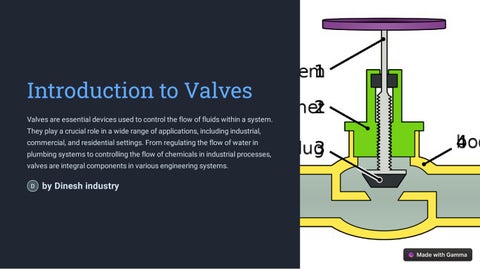
Introduction to Valves Valves are essential devices used to control the flow of fluids within a system. They play a crucial role in a wide range of applications, including industrial, commercial, and residential settings. From regulating the flow of water in plumbing systems to controlling the flow of chemicals in industrial processes, valves are integral components in various engineering systems.
by Dinesh industry
Types of Valves Gate Valves
Ball Valves
Check Valves
These valves control the flow of
Ball valves use a spherical
Check valves permit fluid to
fluid by either fully opening or
obstruction to regulate the flow
flow in only one direction,
fully closing the pathway.
of liquids.
preventing backflow.
Applications of Needle Valves 1
2
3
Hydraulic Systems
Oil and Gas Industries
Needle valves are commonly
They are employed in the oil
Instrumentation Systems
used in hydraulic systems to
and gas sector for precise
They play a critical role in
finely regulate the flow of fluid
control and shut-off of fluid
instrumentation systems to
within the system.
flow.
maintain accurate pressure and flow control.
Advantages of Needle Valves 1
3
Precision Control
2
Leak-Free Performance
Needle valves offer the capability to fine-tune
These valves provide reliable leak-free
the flow rate with high accuracy.
performance, crucial for critical applications.
Durability
4
Extended Lifespan
They are built to withstand high pressures
Needle valves have a long operational life,
and harsh operating conditions.
reducing the frequency of maintenance and replacements.
Conclusion
94%
25K
Flow Control
Operational Hours
Needle valves provide precise flow control with
They can operate continuously for extensive
minimal effort.
periods, making them highly reliable.
For More Details : https://dineshind.com/valve.html