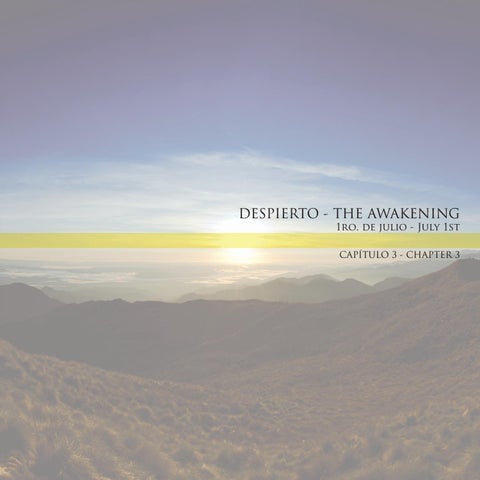
DESPIERTO - THE AWAKENING 1ro. de julio - July 1st
CAPÍTULO 3 - CHAPTER 3
136
EL DESPIERTO - 1ro. de Julio
the awakening - july 1st
Cuando uno se enamora hace de todo para estar con
When you fall in love, you do everything to be with that special
esa persona especial. Lo mismo pasa con Paucartambo y su gente. He preparado todo para salir rumbo a Paucartambo el 29 de Junio, y quien diría que cada año estaría haciendo maletas, esperando ansioso que llegue el mes de Julio para ver a los amigos y a la gente que cariñosamente me ha adoptado y acogido en sus familias. En Paucartambo este mes es de la Mamacha Carmen, por eso empezamos a celebrarla desde el 1ro. de Julio con la “Misa del Despierto” a las 4:30 am. Es una celebración más íntima, con menos gente de la que asiste a la Fiesta Central desde el 14 al 19 de Julio. La Misa la cantan los Qhapac Negros (uno de los 19 grupos de danzantes) vestidos de civil, la gente se congrega sin importarle el frío de la madrugada, y después de terminada la Misa, la Mamacha Carmen sale en procesión y recibe el primer amanecer de su mes de fiesta. Esta misa me recuerda mucho el año 2007. A las 2.00 am con José Ignacio, Chobi, Ciro y LuisMi salimos a Tres Cruces. Un lugar de ensueño muy cercano a Paucartambo, camino a la Selva del Manu, a 3800 m.s.n.m. Este lugar tiene la particularidad de mostrar un espectáculo natural hermoso. El sol sale del Oriente como una bola de fuego que revolotea en el espacio, la vista se extiende y se pierde sobre el horizonte de la Selva Cusqueña. Esa misma sensación de sentir los rayos del Sol acariciando la tierra en las madrugadas congelantes de este paraje, es la misma que he sentido al ver a la Mamacha Carmen después de un año de espera. Es la alegría de verse iluminar Paucartambo (¨la tierra¨) con la presencia de la Mamacha. Los Carguyoc o Cargo de las danzas (devotos de la Mamacha que asumen la responsabilidad de proveer todo lo necesario para que las comparsas y cuadrillas de danzantes puedan bailarle a la Mamacha) preparan las demandas (retablos que contienen imágenes de la Mamacha y algunos detalles típicos de cada danza con un alto valor religioso y devocional) para participar de todos los ritos y acompañar a la Mamacha Carmen y al pueblo de Paucartambo.
person. The same goes for Paucartambo and its people. I have prepared everything to leave for Paucartambo on June 29, and who would have know that every year I would be packing, waiting anxiously for the month of July to see friends and people who have lovingly adopted me and welcomed me into their families. In Paucartambo the month of July is for Mamacha Carmen. That’s why we start celebrating it on July 1st. with the “Mass of the Awakened” at 4:30 am. This is a very intimate celebration, with fewer people than the many who attend the Central Celebration from July 14 to 19. The Mass is sung by the Qhapac Negros (one of the 19 groups of dancers) dressed in civilian clothes. People gather without caring about the cold of dawn, and after the Mass is over, the Mamacha Carmen goes out in procession and receives the first sunrise of her celebration month. This Mass reminds me of the year 2007. At 2:00 a.m. I, with José Ignacio, Chobi, Ciro and LuisMi went to Tres Cruces. This is a dream place very close to Paucartambo, on the way to the jungle (Selva del Manu), 12400 feet high. This special place shows a beautiful natural spectacle. The sun comes out like a ball of fire that flutters in space, the view extends and loses itself over the horizon of the Cusco Jungle. That sensation of feeling the rays of the Sun caressing the earth in the freezing dawn of this place is the same one that I feel when I see Mamacha Carmen after a year waiting. It is the joy of seeing Paucartambo illuminated (“la tierra”) with the presence of the Mamacha. The “Carguyoc” or ”Cargo” of the dance groups (devotees of the Mamacha who assume the responsibility of providing everything necessary so that the devotees can dance to the Mamacha) prepare the “demandas” (altarpieces containing images of the Mamacha and some typical details of each dance with a high religious and devotional value) to participate in all the rites and accompany Mamacha Carmen and the people of Paucartambo.
137
138
139
La noche previa al Despierto los devotos se preparan para celebrar en la Plaza Principal con música y fuegos artificiales. The night before the Awakening devotess prepare to celebrate in the Main Square with music and fireworks.
140
141
4:30 AM Los devotos comienzan a reunirse en el templo. Ni el frío ni el sueño son impedimentos para que empiecen a celebrar el mes de la Mamacha Carmen.
142
4:30 AM The devotees begin to gather in the church. Neither cold nor lack of sleep is an impediment to start celebrating the month of Mamacha Carmen.
143
144
145
146
147
148
Cuando la Misa ha terminado los devotos llevan a la “Mamacha” en
When the Mass ends, the devotees take the “Mamacha” in proces-
Procesión por las calles principales de Paucartambo para que ella
sion through the main streets of Paucartambo, and she starts to
empiece a bendecir a su pueblo.
bless her people.
La Mamacha Carmen sale junto a su pueblo a recibir los
She goes out to her village to receive the first rays of the Sun
primeros rayos del Sol del mes de Julio. Así como el Sol vibra y
of the month of July. As the Sun vibrates and flits in the dawns of
revolotea en los amaneceres de Tres Cruces, ella sale a saludarlo e
Tres Cruces, she goes out to greet it and radiate “the earth” with
irradiar “la tierra” con su presencia.
her presence.
149
150
151
Margot y sus hijos son Paucartambinos. Devotos y danzantes de la Mamacha Carmen. En el 2016 ella junto a su familia y los “Carguyoc” de la Fiesta Central encabezaron la procesión porque asu- mieron el cargo de la Misa del Despierto. Margot and her children are “Paucartambinos.” They are devotees and dancers of the Mamacha Carmen. In 2016 she, her family and the “Carguyoc” of the Central celebration led the procession because they assumed “el Cargo” (people in charge) of the Awakened Mass.
152
153
154
155
En el 2018 el Sr. Raul Aranibar y su familia asumieron con devoción el Cargo Mayor de la fiesta y también de la Misa del Despierto. Año tras año siempre hay algún devoto que generosamente desea agradecerle a la Mamacha Carmen asumiendo esta responsabilidad. Igualmente los devotos de las diferentes danzas se presentan con sus demandas para participar del inicio de la Festividad. In 2018 Mr. Raul Aranibar and his family assumed with devotion the “Cargo Mayor” (responsibility of the whole festival) of the Celebration and also of the Awakened Mass. Year after year there is always a devotee who generously wishes to thank the Mamacha Carmen by assuming this responsibility. Likewise, the devotees of the different groups of dancers participate with their “Demandas” at the beginning of the Festival.
156
157
158
159
160
161
162
LA ESPERA
THE WAIT
Durante los días siguientes la Mamacha permanece en el altar
During the following days the Mamacha remains on the high
mayor y los feligreses preparan, con misas y rezos, la llegada de la
altar. The devotees prepare, with masses and prayers, the arrival
Fiesta Principal, donde todos volverán a estar reunidos para cantar,
of the main celebration, where everyone will be reunited to sing,
bailar y rezar a la Mamacha Carmen.
dance and pray to Mamacha Carmen.
163
164
165
166
167
168
Bibliografía y Referencias
Bibliography and Notes
Capítulo 1: Los textos que describen las danzas están tomados
Chapter 1: The dance descriptions have been taken from the
de las leyendas del Museo de la Dirección Desconcertada de
captions of the Museum of the Direction of Culture of Cusco
Cultura del Cusco en Paucartambo que a su vez ha recopilado la
in Paucartambo, that compiled the information from the people
información de los responsables de cada danza.
responsible for each dance.
Capítulos 2 y 3: Los textos están inspirados en canciones del
Chapters 2 and 3: The texts are inspired by songs of the musical
grupo musical los Campesinos (grupo musical Paucartambino), el
group Los Campesinos (musical group from Paucartambo), the
“Plan de Salvaguarda de la Mamacha del Carmen” publicado por el
book: “Safeguarding Plan of the Mamacha del Carmen” published
Crespial y el Ministerio de Cultura (2012) y testimonios recogidos
by Crespial and the Ministry of Culture (2012), and testimonies
de algunos danzantes y gente del lugar.
collected from dancers and Paucartambo people.
Los textos en inglés han sido revisados por Peter Wool a quien estoy eternamente agradecido por su ayuda en este proyecto.
The English translation have been reviewed by Peter Wool to whom I am eternally grateful for his help in this project.
169