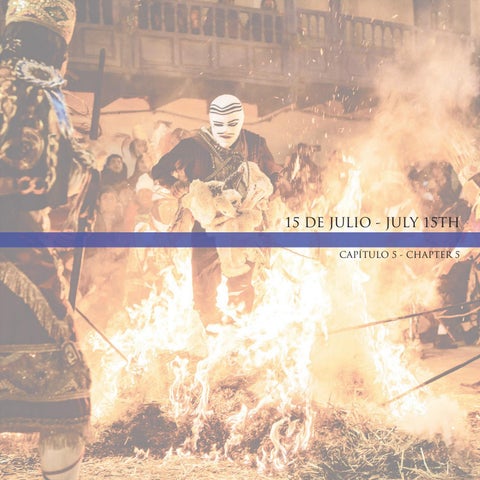
15 DE JULIO - JULY 15TH CAPÍTULO 5 - CHAPTER 5
36
15 DE JULIO
JULY 15TH
Este día empieza todo muy temprano:
This day starts very early:
4.00 am Watayuyarichikuy
4.00 am Watyuyarichikuy
6.00 am Saludo a la Mamacha Carmen por el prioste y visita a
6.00 am Greeting to the Mamacha Carmen by the “prioste”
los cargos pasados por parte del cargo mayor y carguyoc de las
(organizer of the celebration) and visit to the old “priostes” and to
diversas danzas.
the carguyoc (organizers) of the various dance groups.
12.00 pm Inicio de la festividad con el encendido de los 12
12.00 pm The beginning of the festivity with the lighting of
cohetes desde el cargo wasi y el saludo de los albazos con
the 12 rockets from the “cargo wasi” (organizer house) and
camaretazos y repique de campanas.
the greeting with “albazos,” “camaretazos” and ringing of the
12.00 pm Ingreso de los Maqt’as, iniciando oficialmente la entrada de las 19 danzas. 3.30 pm Recepción de autoridades, vecinos notables e invitados en el cargo mayor, champañada y brindis de honor. 4.00 pm Cera apaycuy (traslado de ceras o velas, voladoras y flores) al santuario de la Mamacha Carmen. 6.00 pm Misa de víspera de devoción del prioste. 8.00 pm Tradicional Qonoy en la plaza de armas seguido con la quema de fuegos artificiales. 9.00 pm Inicio del alba o saludo a la Mamacha en el atrio del templo y visita a los albazos. 12.00 am Tradicional Punchayniyquipi y retreta por el cargo mayor en la puerta del templo.
church bells. 12.00 pm Entrance of the Maqt’as. The oficial start of the entrance of the 19 dance groups. 3.30 pm The reception of authorities, notable neighbors and guests in the “cargo wasi,” champagne and toast of honor. 4.00 pm Cera Apaycuy (transfer of the candles, angel dolls and flowers) to the Mamacha Carmen sanctuary. 6.00 pm Devotion mass organized by the prioste. 8:00 pm “Qonoy” (fire representation) in the main plaza followed with fireworks. 9.00 pm “Alba” (dawn) or greeting to Mamacha Carmen in the atrium of the church and visit to the “albazos.” 12.00 am “Punchayniyquipi” (greeting to Mamacha Carmen) and presentation by the “cargo mayor” at the church door.
37
38
4.00 am Watayuyarichikuy
4.00 am Watayuyarichikuy
Es de madrugada y a partir de las 4.00 am se puede escuchar
It is very early in the morning. Since 4.00 am you can hear the
la música de las diferentes danzas andando por las calles
music of the different dance groups walking through the streets
de Paucartambo.
of Paucartambo.
En este rito, el guiador o caporal de cada danza junto con sus
In this ritual, the “guiador” or “caporal” (leader) of each dance
carguyoc (encargados de organizar todo lo necesario para que
group, with the “carguyoc” (responsible for organizing everything
la danza participe con devoción durante la fiesta) salen muy
necessary for the dance group to participate with devotion during
temprano y buscan a cada uno de los miembros de su danza.
the festival) go very early to look for the dancers.
Los carguyoc llevan ponche (bebida caliente) con tortas, galletas o pan para dar la bienvenida a los que se crucen en el camino. El ritual implica que cada danzante al escuchar la música de su
The “carguyoc” carry a hot drink with cakes, cookies or bread to welcome those who cross the road. When the dancers listen to the music of their dance group by
danza sale de su casa, primero saluda a la demanda, luego a los
the door of their house, they go out and the first thing to do is
carguyoc y al guiador, y después a los miembros de la danza que
to greet the “demanda,” then to the “carguyoc” and the “guiador”
están ahí.
or leader, and finally to the members of the dance group that
Un momento emotivo para mí es cuando dos o más grupos de
are there.
danzas se cruzan en el camino, primero se saludan las demandas,
I feel very emotional when two or more groups of dancers
luego los guiadores o caporales, la gente que los acompaña saluda
meet on the way, first the “demandas” greet each other, then the
a la demanda y se comparte la bebida caliente con torta o pan.
“guiadores” or “caporales” (dance group leaders) after that, the people who accompany them greet the “demanda” and share the hot drink with cake or bread.
39
40
41
42
43
44
45
46
47
48
49
50
12:00 pm Ingreso de los Maqt’as y las 19 Danzas
12:00 pm Entrance of the Maqt’as and the 19 Groups of Dancers
Al mediodía los Maqt´as hacen su entrada al pueblo y ellos
At noon the Maqt’as make their entrance to Paucartambo. They
exteriorizan la presencia humorística del folklore paucartambino.
symbolize the humorous presence of Paucartambo folklore.
Cuando ellos llegan a la puerta del templo ofrecen a la
When they arrive at the church door they offer to Mamacha
Mamacha Carmen su famoso “Yawar Unu” (río de sangre), ritual en
Carmen her famous “Yawar Unu” (blood river), a ritual in which
el que por parejas intercambian fuertes azotes.
couples exchange strong lashes.
Luego todas las danzas van haciendo su entrada en distintos momentos y por diferentes rutas. Todas las danzas llegan hasta la puerta del templo donde postrados de rodillas ofrecen sus danzas y cantos a la
After that, all the dance groups prepare their entrance at different times and by different routes. Every dance group arrives to the church door where they kneel, pray and offer their dances and songs to Mamacha Carmen.
Mamacha Carmen.
51
Entrada de los Maqt’as Maqt’as entrance 52
53
54
55
Yawarunu - Río de sangre Es un osado ritual en el que las parejas intercambian fuertes azotes con sus warak’as (hondas), demostrando coraje, habilidad, valentía y talento. Para algunos es un signo de purificación. Yawarunu - Blood river It is a daring ritual during which couples thrash each other with their “warak’a” (slings) showing courage, skill, bravery, and talent. For some, it is a sign of purification. 56
57
58
59
Entrada de los Qhapac Chunch’u y su saludo a la Mamacha Carmen en la puerta del templo. Qhapac Chunch’u entrance and his greeting to Mamacha Carmen at the church door. 60
61
62
63
64
65
Pechera de un Qhapac Negro. Ellos hacen su entrada con cantos y bailes al ritmo de la matraca del guiador. Ornamental chest of a Qhapac Negro dancer. They make their entrance with songs and dances to the rhythm of the “guiador’s rattle.” 66
67
68
Sin música no hay danza ni cantos ni rezos. Don Porfirio es un hombre bueno que ha estado acompañando a los Qhapac Negros desde hace muchos años y su devoción y cariño a la Mamacha Carmen hacen que regrese año tras año tocando su acordeón. Without music there is no dance or singing or prayers. Don Porfirio is a good man who has been with the Qhapac Negros for many years and his devotion and love to Mamacha Carmen makes him return year after year playing his accordion. 69
70
Cuando los Qhapac Qolla hacen su entrada, los cascabeles de sus trajes anuncian su presencia. La llama es la mascota que casi siempre los acompaña y hace travesuras con los feligreses. Mi ahijado Luis Miguel bailó como Qhapac Qolla en el 2012 y su devoción a la Mamacha Carmen permanece. When the Qhapac Qollas make their entrance, the bells of their suits announce their arrival. A llama is their mascot and most of the times it is with them. The Qhapac Qollas joke and play with the devotees. My godson Luis Miguel danced with the Qhapac Qollas in 2012 and his devotion to Mamacha Carmen remains. 71
Los Majeños bajan desde un cerro aledaño en sus caballos y arreando a las mulas que llevan el aguardiente para la fiesta. The Majeños come down from a nearby hill riding their horses and herding mules that carry the brandy for the celebration. 72
73
74
75
76
Los Qoyachas se reúnen en la casa de la familia de la Sra. Petronila que desde años los acoge para que ahí se junten y hagan su entrada llevando productos y ruecas en un burro. The Qoyachas meet in the house of Mrs. Petronila’s family, who has welcomed them for many years to gather there and prepare their entrance carrying products and spinning wheels on a donkey. 77
78
79
80
Mis amigos los Chucchus bajan desde un cerro aledaño en un camión. Al llegar a la plaza empiezan a repartir plátanos y naranjas que llevan en sus talegas. Han sido un par de veces que he disfrutado mucho cuando he montado el camión con ellos. My friends, the Chucchus, come down from a nearby hill in a truck. When they arrive at the plaza, they begin to distribute bananas and oranges that they carry in their bags. A couple of times I have ridden in the truck with them which I enjoyed a lot. 81
Todas las danzas tienen una tradición cuando hacen su entrada para la fiesta de la Mamacha Carmen. Cada entrada es un signo de devoción, cariño y gratitud. Tendría que pasar 19 años para poder capturar la mística y forma de cada una de ellas, por ser únicas y auténticas. Every dance group has a tradition when they make their entrance to the Mamacha Carmen festival. Each entrance is a sign of devotion, affection and gratitude. It would take me 19 years to be able to understand the mysticism and form of each of them, as they are unique and authentic. 82
83
84
3.30 pm Champañada y Brindis de Honor 4.00 pm Cera Apaycuy
3.30 pm Champagne and Toast of Honor 4.00 pm Cera Apaycuy
Después de las entradas, todas las danzas se dirigen al “albergue
After the dance groups enter, they go to the “municipal shelter”
municipal¨donde se encuentra el cargo mayor.
where the ¨cargo mayor¨ is located because it is the biggest space
Allí se realiza la champañada y brindis de honor por el inicio de la fiesta. Después se realiza el Cera Apaycuy (procesión de velas, flores y voladoras o ángeles que se colocan al pie de la imagen de la Mamacha Carmen). La tradición muestra que las mujeres llevan las flores en botellas de colores y se ubican al lado derecho, los varones llevan los cirios
in town. There, the toast of honor with champagne is celebrated for the beginning of the festival. Then the Cera Apaycuy (procession of candles, flowers and angel dolls that are placed at the foot of the image of Mamacha Carmen) is performed. The tradition tells that women carry flowers in colorful bottles,
y están al lado izquierdo. Las voladoras las llevan indistintamente
and they are located on the right side of the procession. The men
varones o mujeres.
carry the candles and they are on the left side. Men or women can
Todos los años son cientos las velas y los arreglos florales que llegan para la Mamacha Carmen. Cada año que llego a Paucartambo siempre llevo un cirio que contiene todo el cariño y necesidades de mi familia, amigos y personas queridas.
carry the “doll angels.” Every year there are hundreds of candles and floral arrangements that arrive for Mamacha Carmen. When I arrive in Paucartambo I always carry a candle that symbolizes all the love and needs of my family, friends and loved ones.
85
Champañada y brindis de honor. Champagne and toast of honor. 86
87
88
Cera Apaycuy 89
90
91
92
93
94
95
96
97
98
99
100
101
102
103
104
6.30 pm La Merienda
6.30 pm The “Merienda”
A la hora de la cena, todas las casas de cargo ofrecen la comida
At dinner time, all “cargo houses” offer the typical food of the
típica de la fiesta.
celebration.
La merienda es un plato que solamente disfruto en
The “merienda” is a dish that I only enjoy in Paucartambo. It has
Paucartambo. Contiene: tallarín sancochado, q’apchi de habas,
parboiled stew, beans of “q’apchi,” cabbage, potatoes, lamb or beef
repollo, papa, guiso de carne de cordero o de res, arroz graneado,
stew, grained rice, stuffed chilly without punching or puffing, a
rocoto relleno sin emponchar ni arrebozado, porción de cuy al
portion of baked guinea pig, maize omelet, slice of hard boiled egg,
horno, torreja de maíz, rodaja de huevo duro, rodaja de rocoto y
chilly slice and “tákapa” of parsley.
tákapa de perejil.
105
106
107
108
8.00 pm Qonoy
8.00 pm Qonoy
El primer año que estuve en Paucartambo, José Ignacio me dijo
The first year I was in Paucartambo, Jose Ignacio told me that the
que la Plaza desborda en locura la primera noche de la fiesta. Me
Plaza gets crazy the first night of the celebration. He said that there
contó que habían muchos fuegos artificiales y la gente disfrutaba
are fireworks and people revel in the dramatic start of the festival.
muchísimo con el inicio de la festvidad. Yo esperaba ver tradicionales fuegos artificiales, con muchos
I expected traditional Western fireworks, colorful lights in the sky, and people celebrating all around. What I found was an
colores en el cielo paucartambino y la gente celebrando alred-
amazing experience. People were running crazy with the dancers
edor. Pero lo que encontré fue una experiencia asombrosa. La
by the Plaza. The real excitement began when the dancers started
gente corría de un lado para otro de la plaza con los danzantes.
to burn straws on the Plaza streets.
La verdadera locura empezó cuando los danzantes empezaron a quemar paja en las calles de la plaza.
What is Qonoy? The story tells that the night before the central day of the
Pero, ¿qué es el Qonoy?
celebration everybody remembers how the Qhapac Qolla (white
La historia cuenta que la noche antes del día central de la
masked men who represent the llamas’ caretakers), came from
celebración, todos recuerdan como los Qhapac Qollas vinieron
their town in the highlands of the Andes, el Altiplano, to steal the
desde sus pueblos en las alturas del Altiplano para robar la imagen
Mamacha Carmen and take her to their town, which according to
de la Mamacha Carmen y llevarla a su pueblo, porque según ellos
them, is theirs by right. They tried to lay siege to the city and set
les pertenece por derecho. Ellos intentaron asediar al pueblo y le
fire to it, but they were impeded by the Qhapac Chunch’us from
prendieron fuego, pero los Qhapac Chunch’us lo impidieron.
doing so. (The Qhapac Chunch’us are the dancers with feathers
Lo más exitante de verlos corriendo con fuego sobre sus cabezas, es que impresiona, estimula todos los sentidos y el
on their heads who live in the jungle area of Paucartambo). The excitement of seeing them running with fire on their
espectáculo se desarrolla con mucho frenesí. Aún puedo sentir
heads impresses and stimulates the senses of everyone, and the
como las chispas de fuego quemaron mi cuello en el 2007 cuando
spectacle takes on an even greater frenzy. I can still feel the sparks
vi esta celebración por primera vez.
that burned my neck in 2007 when I saw this celebration for the first time.
109
110
111
112
113
114
115
116
117
118
119
120
121
122
123
124
125
126
9.00 pm El Alba
9.00 pm The Dawn (Alba)
Una vez terminado el Qonoy el prioste da inicio al “alba”.
Once the Qonoy is finished, the “prioste” (responsable of the
Todas las danzas vestidas sin sus trajes y máscaras ofrecen sus coreografías en la puerta del templo a la espera del día central de la festividad.
celebration) starts the dawn (el alba). All the dancers dressed without their costumes and masks offer their choreographies at the door of the church waiting for the central day of the celebration.
127
128
129
130
131
132
133
134
12.00 am Punchayniykipi
12.00 am Punchayniykipi
El Punchayniykipi es la serenata a la Mamacha Carmen.
The Punchayniykipi is the serenade to Mamacha Carmen.
El “prioste” o “cargo mayor” se traslada hasta la puerta del templo y junto con la banda de músicos le canta “cumpleaños feliz” a la Mamacha Carmen.
The “prioste” or “cargo mayor” moves to the door of the church and together with the band of musicians sing “Happy Birthday” to Mamacha Carmen.
135
136
137
138
139
Bibliografia y Referencias En este volumen los textos están inspirados en el libro: “Plan de
bibliography and notes In this volume the texts are inspired by the book: “Safeguarding
Salvaguarda de la Mamacha del Carmen” publicado por el Crespial
Plan of the Mamacha del Carmen” published by Crespial and the
y el Ministerio de Cultura (2012) y varios testimonios recogidos de
Ministry of Culture (2012) and testimonies collected from dancers
algunos danzantes y gente del lugar.
and Paucartambo people.
Otros textos han sido tomados de las leyendas del Museo de la
Another group of texts have been taken from the captions of
Dirección Desconcertada de Cultura del Cusco en Paucartambo
the Museum of the Direction of Culture of Cusco in Paucartambo,
que a su vez ha recopilado la información de los responsables de
that compiled the information from the people responsible for
cada danza.
each dance group.
Los textos en inglés han sido revisados por Peter Wool a quien estoy eternamente agradecido por su ayuda en este proyecto.
The English translation have been reviewed by Peter Wool to whom I am eternally grateful for his help in this project.
141
142