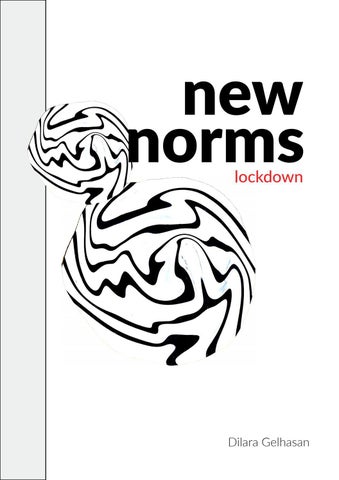
lockdown
Dilara Gelhasan
In this book, each page and each artwork represents a new normal that was formed during or as a result of coronavirus lockdowns. The book acts as a pandemic diary, based on observations and personal experiences. Many struggles of the lockdown period was pictures in this book. Humour plays a big role in coping with challenges, therefore you will find that too. Yes, you have been isolated; but you have never been alone.
Around 8.6 million UK adults are drinking more frequently under lockdown. Source: https://alcoholchange.org.uk/
35% of people surveyed found themselves eating more and reaching for unhealthy food.
Survey by: King’s College London and Ipsos MORI
Home fitness training, which includes bodyweight exercises like press-ups and pull-ups, showed a rise of more than 550,000 during lockdown. Source: https://www.runnersworld.com/
Source: https://thebillingtongroup.com/
Research from Mintel found that 55% of people plan on cooking from scratch more since the COVID-19 outbreak, with Bain and Company estimating 60% of meal occasions were cooked in the home pre-pandemic which has now increased to 72%.
Source: https://thedrug.store/
Google searches for “self-care routine” up 250% during lockdown, highest levels since 2004.
More than 27 million bought hairdressing equipment to sort out their own and family members’ hairs.
afterm
math
Half of all households in England where the Household Reference Person (HRP) is aged 16 to 29 have less than 29.9 square metres of living space per person. Source: https://www.if.org.uk/
In April 2020, 46.6% of people in employment did some work at home. Of those who did some work from home, 86.0% did so as a result of the coronavirus (COVID-19) pandemic. Source: https://www.ons.gov.uk/
37% of IT leaders said that employees didn’t have the right tools to be able to work when the transition to remote work was first made Source: https://bdaily.co.uk/
Levels of anxiety and happiness saw the greatest change when lockdown was introduced, compared with pre-pandemic levels. Source: https://www.ons.gov.uk
O
ur house plants were how we kept in touch with nature during the lockdown. And we got attached to our plants more than before. A British online plant store, Patch, reported a 500% increase in sales during lockdown, with stock finishing in 2 weeks that was intended to last 12 weeks. If we look at history and different cultures, we can recognise different traditions about the human-plant relationship. For example, Fabiana Maizza, an anthropologist and an author, observes that Jarawara people in Brazil considers plants as children. (Maizza, 2017) This caring approach to plants can also be seen in the tradition of penjing in China, which later became bonsai in Japan. (Elias, n.d.) Caring for our plants gave us responsibility and purpose. We felt proud when our plants were blooming. ‘Plant parent’ became a thing during lockdown. We were happy as long as our plants were healthy. We watched them grow taller and in a way we related to them. They couldn’t go out, we couldn’t go out, so we stayed in an experienced these crazy times together. In a way, they provided us with strength and support.
At the height of lockdown, adults spent an average of six hours and 25 minutes each day watching TV and online video. Source: https://bdaily.co.uk/
F
or many people, enjoying travel now, having experienced the pandemic and going through the lockdown, includes all the relaxing empty spaces, fresh air, nature and a the lack of other people. (Rushby, 2021) On the other hand, people are looking forward to more active holidays. Having been stuck inside our houses, limited, repetitive days after days, we want adventure, excitement and new experiences. Our mindset has changed and we are ready to take on those more challenging trips that we have been putting off for ages. There is also the virtual travels. Since we couldn’t go out and travel physically, but still wanted to see new places, we started to explore places through internet and technology. There are all kinds of virtual tours and experiences to join, and they provide us with new perspectives when we need it.
T
here are now many virtual travelling opportunities available, including VR experiences. These improved and increased during the lockdowns where we really missed travelling and were well, bored at home. Although this way of ‘travelling’ provides us with a temporary getaway and we might learn about a new place, we have to ask ourselves: “Is it really the same?” It is certain that this approach lacks the authenticity of nature. Experiencing an environment fully requires the use of all senses. Even though with the advancements of technology we are able to imitate some senses, there is nothing that can replace physical interaction with surroundings, smelling the fresh air and feeling the breeze as you wander around. Virtual ways fill some of our hunger for travelling, but it is not there to replace it. We can call it a teaser for the real life adventures.
cubicle sunbathing
Survey by: The Sport England Active Lives
Almost 12 million adults in England were ‘inactive’ between mid-March and mid-May, a rise of 7.4 per cent, compared to before the pandemic.
Research found that 41% of people said they were reading more books since lockdown began. Research by: Nielsen Book
D
uring the pandemic, face masks have been an essential part of our daily lives. We have been wearing them to fight spread the virus, protect ourselves and others. As we adapt to change, masks are quickly becoming a part of our daily outfits, a fashion statement. Self expression has always played a huge part in fashion. Therefore many people are going for masks that represent their personalities and styles. DIY masks have been a part of this expressionist choice too. So we have been seeing lots of unique and personalised masks on social media as well as streets (when we are allowed to go out).
D
uring the lockdowns, technology, internet and social media were our tools for socialising. Our smartphones allow us to reach the whole world and maintain our relationships with others. A research by Primack et al. (2017) and Verduyn et al. (2017) shows that use of social media may improve our social connections by providing us with ways of social support. This of course led to the overuse of our mobile phones. A survey conducted by Statista discovered that 46% of participants were spending more time on their mobile phones since the beginning of lockdown. Since we could not do much else, we became dependent, and for some addicted, to our phones.
W
e have been using dating apps for a while now. According to a study conducted by Stanford, people are now more likely to become a couple and start a relationship through online dating than any other way. According to a Pew Research Center survey conducted in 2019, three-in-ten U.S. adults say they have used either an online dating site or an app. Of course, during the pandemic we have felt alone, bored and fed up. This resulted in increased use of online dating platforms just like any other social media channels.
In March 2020, Tinder had its highest ever activity on a single day: 3 billion swipes. OkCupid also saw a 700% increase in dates and Bumble recorded 70% more video chatting activity between users. Although we were not allowed to meet in person, we had to adapt. Having more video chats was the first part of adjusting to a new world with limits. This is why the pandemic and living in lockdown is changing the way we date, and these changes are most likely going to stay with us permanently.
I am not who I am, I am not who you see, My house that shelters me, Became my reality.
The End The end is the beginning, Beginning of a new world, We try, we fail, And then we learn. We learn the new ways, We learn to cope. And when the end comes We already know; The Beginning
Anderson, M., Vogels, E. and Turner, E., 2020. The Virtues and Downsides of Online Dating. [online] Pew Research Center: Internet, Science & Tech. Available at: <https://www.pewresearch.org/ internet/2020/02/06/the-virtues-and-downsides-of-online-dating/>. David, M. and Roberts, J., 2021. Smartphone Use during the COVID-19 Pandemic: Social Versus Physical Distancing. International Journal of Environmental Research and Public Health, 18(3). Elias, T., n.d. History of the Introduction and Establishment of Bonsai in the Western World. Friedman, V., 2020. Should Masks Be a Fashion Statement? (Published 2020). [online] Nytimes.com. Available at: <https://www.nytimes.com/2020/04/22/fashion/coronavirus-fashion-face-masks. html>. Lasco, G., Goldfield, A., Coates, K. and Nash, S., 2021. How COVID-19 Is Changing People’s Relationships With Houseplants. [online] SAPIENS. Available at: <https://www.sapiens.org/column/ entanglements/covid-19-houseplants/?fbclid=IwAR32a9PK_rf4GsMQ0pTRPlE3LXvNtRgJch48YaCG MztStvc-VN6ZHxNykpY>. Maizza, Fabiana (2017). “Persuasive Kinship: Human–Plant Relations in Southwest Amazonia,” Tipití: Journal of the Society for the Anthropology of Lowland South America: Vol. 15: Iss. 2, Article 6, 206220. Primack, B.; Shensa, A.; Sidani, J.E.; Whaite, E.O.; Lin, L.Y.; Rosen, D.; Colditz, J.B.; Radovic, A.M.; Miller, E. Social media use and perceived social isolation among young adults in the U.S. Am. J. Prev. Med. 2017, 53, 1–8. Rabimov, S., 2020. 20 Fashion Brands Getting Most Creative With Coronavirus Face Masks. [online] Forbes. Available at: <https://www.forbes.com/sites/stephanrabimov/2020/04/27/20-fashionbrands-getting-most-creative-with-coronavirus-face-masks/?sh=7d65e3c07599>. Rushby, K., 2021. A year on from the first lockdown, what has become of travel?. [online] the Guardian. Available at: <https://www.theguardian.com/travel/2021/mar/23/a-year-on-from-the-firstlockdown-what-has-become-of-travel>. Shashkevich, A., 2019. Online dating is the most popular way couples meet | Stanford News. [online] Stanford News. Available at: <https://news.stanford.edu/2019/08/21/online-dating-popular-way-us-couples-meet/>.
Southan, J., 2021. Travel industry experts weigh-in on post-COVID trends. [online] euronews. Available at: <https://www.euronews.com/travel/2021/05/14/what-will-travel-look-like-in-a-postcovid-world>. The Conversation. 2021. House plants were our link with nature in lockdown – now they could change how we relate to the natural world. [online] Available at: <https://theconversation.com/ house-plants-were-our-link-with-nature-in-lockdown-now-they-could-change-how-we-relate-to-thenatural-world-147637>. The Guardian. 2021. ‘If my plant is OK, so am I’: readers on small Covid lockdown saviours. [online] Available at: <https://www.theguardian.com/lifeandstyle/2021/feb/19/covid-lockdown-saviours>. Verduyn, P.; Ybarra, O.; Reisbois, M.; Jonides, J.; Kross, E. Do social networks sites enhance or undermine subjective well-being? A critical review. Soc. Issues Policy Rev. 2017, 11, 274–302. Williams, S., 2020. Coronavirus: How face masks are becoming fashionable. [online] BBC News. Available at: <https://www.bbc.co.uk/news/world-52691164>.