Junction & Kimble county
tX DEER Country 2026-2027
Hunters
Guide
The JuncTion eagle
Published in Kimble County Since 1882
Welcome to Kimble County
A GOOD SEASON STARTS WITH STRONG ROOTS.
SERVING JUNCTION AND KIMBLE COUNTY SINCE 1947
For generations, we have helped local families, ranchers and businesses plan what comes next. Count on friendly service and local decisions from people who call Kimble County home. AGRICULTURE | REAL ESTATE | COMMERCIAL CONSUMER LOANS | MOBILE BANKING
2002 MAIN STREET | JUNCTION, TEXAS | 325-446-3391 | FSBJUNCTION.COM
Publisher’s Message
The staff at The Junction Eagle welcomes hunters and visitors to the best hunting country in the great state of Texas. While you’re here in the splendid “Land of Living Waters”, we want you to enjoy yourselves, forget about the shenanigans in Washington and Austin (Can they get any sillier?) and have the most successful hunting experience ever. As always, Asia Happner did most of the heavy lifting on this guide. She is the daughter I never had and my friend. I am so fortunate that she has worked with me for 22 years. Kimble County has a lot to offer hunters: whitetail deer, exotics, turkey, feral hogs (Please kill feral hogs!), quail, javelina, bobcats, coyotes, red fox, predator
and appreciate your business. They have years of experience in stocking what you need, and they will go out of their way, with typical Hill Country hospitality, to make sure you are well served. We hope visitors to Kimble County will enjoy this publication. We’ve attempted to give you some hunting information, a little local history and info about local services. We are grateful to Spring Creek Outdoors and wildlife biologists Macy Ledbetter, Matt Nuernberg and Wade Ledbetter for the wealth of information they provide. This year, we are also pleased to publish some works by Kendra McKinney and Kalea Simon, Kimble County AgriLife Extension Agent. Enjoy the beautiful wildlife photography from the following: Macy Ledbetter, Wade Ledbetter and Matt Nuernberg. Other Debbie Cooper, age nine. Open sight contributors include: Colt Brandenberger, target practice at turtle heads in the North Ginger Gladden Frizzell, Billy Leavings, Llano River. Shelby Barron, Roger Smith, Texas A&M contests, welcoming free breakfasts, fun AgriLife, Marvin Wilson, India Buscha, wild game dinner and lunches; and there Gwen Hull, Marie Armes and Special are some of the finest folks here that you’ll Collections-USDA National Agricultural ever meet anywhere. Library. We encourage you to shop with Thank you for choosing to visit us. Be our advertisers. The local merchants careful; have a great time while you’re here who advertise in our Hunter’s Guide ..... and come back soon! demonstrate that they want, will work for, Debbie Cooper Kistler, owner
CONTENTS Publisher’s Message - pg. 3 Welcome From KC Judge Hal Rose - pg. 3 Important Info From KC Game Warden - pgs. 5-6 Spring Creek Outdoors Contributors - pg. 8 Kimble County Hunting Forecast - pg. 10-11 Burning For Better Land - pg. 12 Critical Time For Wildlife Surveys- pgs. 14-15 From Lease To Table - pg. 16 Recipes - pgs. 17-18 Grey Foxes - pg. 19
Junction and Kimble County Hunters Guide Thermal Drone Surveys - pg. 21 A Hunter’s Guide to Axis Deer - pgs. 22-23 Places To Set Your Sights On - pgs. 24-25 Coke Stevenson: Son of Kimble County - pgs. 26-30 Cattle, Wildlife, and Taxes - pg. 33 Broomweed - pg. 36 Crafting a Turkey Haven - pgs. 37-38 New World Screwworm in Texas - pgs. 41--42 Coyote Control - pg. 45 Worship With Us - pg. 47
Welcome message from Kimble County Judge Hal Rose On behalf of the Kimble County Commissioners Court and all of my friends and neighbors in Kimble County, I’d like to welcome you to Junction, located on the banks of the beautiful North and South Llano Rivers. As someone who grew up here, I believe you have chosen to visit the finest 1,251 square miles Texas has to offer, and we are all very happy that you did. Our part of the Texas Hill Country is deeply important to the JUNCTIONTEXAS.COM
multi-billion-dollar hunting, fishing and recreation industry. The opportunity to spend time surrounded by nature, with family and friends, proves to be a constant enticement for folks visiting our “Land of Living Waters.” Once again, welcome to Kimble County. I hope your stay is pleasant and enjoyable, and that we will see you again in the years to come. 3
ADVERTISING INDEX HOMESTEAD & RANCH REAL ESTATE
22
KIMBLE COUNTY PREDATOR MANAGEMENT, INC
27
I-10 MOBILE ROADSIDE & REPAIRS
17
KIMBLE COUNTY SHERIFF
6
ISAACK’S RESTAURANT
13
KIMBLE HOSPITAL
39
JAZZY COWGIRL
29
KOTHMANN REAL ESTATE
11
JOHNSON’S PEST CONTROL
36
JUNCTION A&M CLUB
14
LUKE TILLMAN LAND IMPROVEMENT
10
JUNCTION AREA FARMERS MARKET
31
LYSSY & ECKEL FEEDS
20
JUNCTION AUTOMOTIVE NAPA
7
M&M PLUMBING
18
JUNCTION BURGER
28
NANO’S PRO WORK
15
JUNCTION MEDICAL CLINIC
39
NIXON ROOFING
23
JUNCTION NATIONAL BANK
48
PIZZA JUNCTION
46
JUNCTION PLUMBING
36
PONCE LAND & WILDLIFE
41
JUNCTION TEXAS EDC
44
POUR DECISIONS
19
JUNCTION WAREHOUSE
32
R&R STAPPER RANCH
28
15
KEVIN WALL DIRT WORK
28
RHODES BROS. TAXIDERMY
27
HILL COUNTRY ELECTRICIAN/ RUDIE GONZALEZ
16
KIMBLE COUNTY CHAMBER OF COMMERCE
35
ROCKIN CR CONSTRUCTION
34
ROCKSPRINGS MEDICAL CLINIC
39
HILL COUNTRY FAIR ASSOCIATION
40
KIMBLE COUNTY FARM BUREAU
18
ROY’S GARAGE
18
HILL COUNTRY WELL SERVICE
36
KIMBLE COUNTY HISTORICAL MUSEUM
42
SEALE RANCH
18
SIMON BROS. CAFE
20
SIMON BROS. MERCANTILE
20
SPRING BRANCH TRADING POST
23
SPRING CREEK OUTDOORS
12
SPURS LIQUOR
37
TILLMAN TRUCKING & MATERIALS
10
TRACI PHILLIPS/HOMESTEAD & RANCH REAL ESTATE
25
TREY SULLIVAN REAL ESTATE
26
TWIN OAKS PORTABLE BUILDINGS
21
WAGS IN BAGS
21
WEST BEAR CREEK
43
AFFORDABLE AIR & HEAT
6
AFFORDABLE ROOFING
9
AUSTIN ACRES APIARY
11
BIERSCHWALE LAND COMPANY
38
BUSTER’S LAUNDRY
45
CAPITAL FARM CREDIT
17
CARQUEST
30
COWBOY COTTAGE
26
COWBOY’S CAYOOSE COOKIES
21
DODSONS TIRE & AUTO REPAIR
42
ELITE AUTOMOTIVE
11
FIRST STATE BANK
2
FRONTERA HEALTHCARE
11
HARAMES BROTHERS PAINT & BODY
15
HARAMES IRONWORKS
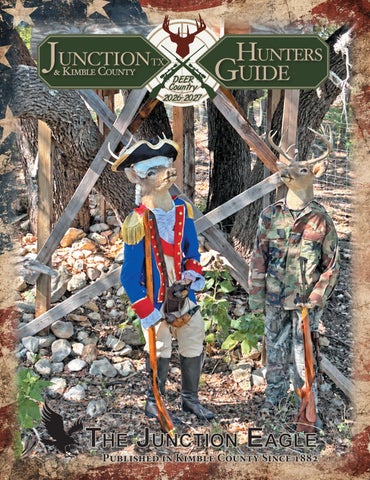
Bubba to Clem: “I know it’s our 250th, and I know you are a patriot. But I really don’t think that get-up is gonna work as camo out here!”
4
JUNCTIONTEXAS.COM
Important information from local Game Warden As the Hill Country settles into the crisp, familiar air of fall and rifle reports begin to echo across our canyons and live oak ridges, I want to welcome all hunters—new and returning—to Kimble County. Each new hunting season brings renewed excitement, time with friends and family, and the chance to enjoy one of the most beautiful regions of Texas. It is also an important time to refresh our knowledge of current regulations, wildlife conditions, and safety expectations to ensure a lawful and successful season. Below is your comprehensive guide to the 2026–2027 hunting season, including major regulation updates, detailed season dates, CWD sampling opportunities, indepth wildlife forecasts, information on the New World Screwworm outbreak, and important reminders on wildlife pharmaceuticals and navigable waterways. New Regulations & Licensing Changes Identity Verification & Residency Strengthened ID verification requirements are now in effect for all hunting and fishing license purchases to combat residency fraud. Digital Licenses & Tags All recreational licenses and endorsements now have fully digital options. Hunters choosing digital licenses will not receive printed tags and must use the Texas Hunt & Fish or TPWD Outdoor Annual mobile app for tagging. Updated Muzzleloader Definition Modern muzzleloading technologies are now permitted, so long as the firearm loads exclusively from the muzzle. Wild Turkey Restrictions Matagorda and Wharton counties are fully closed to turkey hunting this year, and the harvest of unbearded hen turkeys is prohibited statewide. Expanded Doe Days In 22 specified counties, antlerless deer harvest days have expanded to 16 days, running November 14–29, 2026. 2026–2027 Season Dates for Kimble County Kimble County falls within the Whitetailed Deer North Zone, Turkey North Zone, and Dove Central Zone. WhiteTailed Deer • Archery: Oct. 3 – Nov. 6, 2026 • General Season (North Zone): Nov. 7, 2026 – Jan. 3, 2027 • Youth Only Early: Oct. 30 – Nov. 1, 2026 • Special Late Season (North Zone): Jan. 4 – 17, 2027 • Muzzleloader Only: Jan. 4 – 17, 2027 • General Season (South Zone): Nov. 7, 2026 – Jan. 17, 2027 • Special Late Season (South Zone): Jan. 18 – 31, 2027 Dove (Special Whitewinged Days Eliminated) • Central Zone: Sept. 1 – Oct. 25, 2026 & Dec. 11, 2026 – Jan. 14, 2027 Quail & Chachalaca • Statewide: Nov. 1, 2026 – Feb. 28, 2027
JUNCTIONTEXAS.COM
Whitetail Rut Timing Rut timing in the Edwards Plateau remains consistent each year: • PreRut: Late October • Peak: Early to mid November (median breeding date around November 13) • PostRut: Late November into early December Cold fronts continue to be the biggest driver of rut activity and daytime buck movement. Wildlife & Weather Outlook for the 2026– 2027 Season This year’s hunting season is shaped by a heavy acorn crop, excellent spring and early-summer rainfall, and a continuing El Niño pattern. Heavy Acorn Crop — Expect Challenging Early Deer Movement This year’s strong mast crop will reduce deer dependence on feeders and food plots. Hunters should expect: • Reduced long-distance deer movement • Increased bedding-to-oakflat patterns • Strong body condition entering the rut Focus on natural travel routes and fresh sign under live oaks. El Niño Weather Influence — Cooler, Wetter Conditions El Niño typically brings: • Frequent cold fronts • Higher humidity and cloud cover • Better late-season forage quality These conditions can prolong morning movement and increase rut activity, especially during frontal passages. Spring & Early Summer Rainfall — Big Boost for Deer, Turkey, and Quail
WhiteTailed Deer Abundant spring rainfall supported antler development and fawn survival. Expect improved antler quality and strong body condition across most age classes. Rio Grande Turkey Excellent poult survival due to abundant insects and vegetation. Flocks should be noticeably larger. Bobwhite Quail Outstanding nesting cover and moisture resulted in multiple successful nests. This could be one of the best quail seasons in recent years. Chronic Wasting Disease (CWD) Update Kimble County remains a Voluntary Sampling Zone. Segovia Voluntary Check Station • 24-hour drop box: Oct. 3, 2026 – Feb. 28, 2027 • Appointments: 512-8036174 • Closed on major holidays South Llano River State Park Station • 24-hour drop box: Oct. 3, 2026 – Feb. 28, 2027 • Appointments: 512-8036174 • Same holiday closures Voluntary sampling remains vital for monitoring herd health. New World Screwworm – What Hunters Need to Know Texas is responding to a resurgence of the New World screwworm, a parasitic fly whose larvae feed on living tissue. While most confirmed cases involve livestock and pets, wildlife species such as deer, turkeys, and small mammals remain vulnerable, particularly when they have fresh wounds. More than fifty cases have been confirmed across Texas since June, prompting an aggressive response that includes the release of sterile male flies to reduce the wild population. Although Kimble County has recently been released from movement restrictions, hunters should remain vigilant. Signs to Watch For • Maggots in wounds on harvested game • Foul smelling or rapidly worsening sores • Deer with velvet or rut wounds attracting fly activity If you suspect a screwworm infestation, report it immediately to TPWD or the Texas Animal Health Commission. Protect Your Harvest • Inspect carcasses closely • Clean and treat wounds promptly • Securely dispose of carcass remains Wildlife Pharmaceuticals — Legal Use Only Possession or use of tranquilizers, antibiotics, or immobilization drugs without a veterinarian-client-patient relationship (VCPR) is illegal. Many wildlife pharmaceuticals—especially immobilization agents—are federally controlled substances.
5
Always work through a licensed veterinarian. Navigable Waterways in Kimble County Our navigable public waterways. The public may boat, wade, fish, and walk the streambed within the gradient boundary, but may not cross private land to gain access. Landowners must also respect lawful public use. Obstructions such as fences or dams require proper permits and must allow for boater passage. Unauthorized structures must be removed at the violator’s expense. Responsible Visitor Expectations As more folks visit Kimble County each hunting season, I ask everyone to help us keep this region clean, safe, and respectful. • Secure your trash, feed sacks, and loose items in the bed of your truck. Wind can scatter even heavy bags, causing litter and hazards for wildlife and livestock. • Keep UTVs and ATVs off public roadways. These vehicles are not legal for roadway operation except in limited circumstances. Operating them on county roads or highways creates safety concerns and may result in citations. • Support local businesses whenever possible. Our cafés, feed stores, processors, welders, gas stations, mechanics, and small shops rely on the hunting season. Your support helps keep Kimble County strong. Final Thoughts As always, be safe, be legal, and be respectful: • Handle firearms responsibly • Know your target and what lies beyond • Respect private property boundaries • Properly tag and report all harvested game • Pack out what you pack in If you witness or suspect a wildlife violation, please call me at (325) 2805224 or contact Operation Game Thief at 1(800) 792-GAME (4263). Leave a detailed message if I miss your call, and I will return it as soon as possible. Have a safe, memorable, and successful hunting season. I look forward to seeing y’all out in the field. — Game Warden Marcus Whitworth, Texas Parks & Wildlife Department, Kimble County
Welcome to Kimble county
sheriff Matt suttle deputies:
and
Jailers:
Shelby Macha, K-9 Sergeant/SrO branDOn leach, Jail aDMin Stephen Wherry, Sergeant ryan rOgerS Will allen, inveStigatOr trent MacKie terry chaney rObert WalKer Will chapMan MarcO OJeDa SaKOta tOMlinSOn aDriana venZOr traviS brOWn Seth barclay ricK DaviS dispatchers: blaKe MOrrOW clariSSa rOMO, SuperviSOr charlie WilSOn bethany baKer traviS griffin sheriff adMin: chriSti aDaMS chriS gibSOn Kelli Harames brent KOehn ZacK McneW
ARE ALWAYS AVAILABLE TO ASSIST YOU DURING YOUR VISIT!
325-446-2766 6
Marvin Wilson captured this scimitar-horned oryx on his property in February, 2026.
Call the Burtons for all your AIR CONDITIONING and HEATING needs!
Veteran and Senior Citizen Discounts on Service Calls TACLB012854C
Serving The Hill Country For Over 30 Years WE RECYCLE
JUNCTIONTEXAS.COM
In Business for over 45 years.
Junction Automotive supply
The friendly staff at Junction Automotive—Skyler Duran, Connie Stapp, and Jessie Cantrell—invite y’all to come by and check out everything they have in stock!
Your hometown source for all things automotive — parts, supplies, and even oxygen & acetylene for your welding needs!
815 Main • Junction, TX. 76849 • (325) 446-2501
Macy Ledbetter Macy Ledbetter is a professional wildlife biologist with a life-long passion for intensive wildlife and habitat management. Macy earned his degree from Texas A&M University and created the wildlife consulting business, Spring Creek Outdoors, based from his historic family ranch. Macy is a fifth-generation rancher and actively manages his ranch for optimum cattle and wildlife production. His client list totals millions of acres in all eco-regions of Texas. He understands and explains wildlife management processes like few others and can make each individual step palatable and educational for his clients. When he is not surveying wildlife, hunting, or writing about game management, he may be found supporting legislative projects or working as an expert witness in a wide array of legal cases. Macy and his wife Cathy live on their family ranch in northern San Saba County, along with a variety of pets. You can reach Macy anytime at Macy.Ledbetter@gmail.com
Matt Nuernberg Matt Nuernberg is a professional wildlife biologist and valued member of Spring Creek Outdoors, LLC team. He became interested in wildlife and habitat management at a young age and started working on helicopter captures, surveys, and with captive white tail deer while still in high school. Matt graduated Texas A&M--Kingsville in 2013 with a B.S. in Range and Wildlife Management and has worked as an assistant biologist and hunting guide on a King Ranch corporate hunting lease, and as manager, biologist, and guide on two large South Texas ranches and a North Texas exotic game operation. Matt and his family live near Poth, Texas. You can reach Matt anytime at Matthew.nuernberg@gmail.com
Wade Ledbetter Wade Ledbetter is a professional wildlife biologist and a valued member of the Spring Creek Outdoors, LLC team. He grew up both in the thornscrub of south Texas and on his family’s historic ranch in San Saba County. Wade has grown up in the family business working directly with landowners, conducting helicopter surveys and wildlife captures and has more handson experience with intensive wildlife management than most professionals three times his age. As a sixth-generation landowner, he is intimately familiar with the responsibility of landownership and intensive wildlife management. Wade received his Wildlife and Fisheries Science degree from Texas A&M in 2020, was a member of Company E-1 in the Corps of Cadets, and a member of the Corps Marksmanship Unit, where he helped win seven collegiate national shooting championships. When he is not counting or catching wildlife, Wade continues to shoot competitively and conducts private, intensive shooting courses for individuals, law enforcement, and shooting industry representatives. With his wife Macie, Wade lives in Mason County and can be reached at any time at wadeledbetter@me.com 8
JUNCTIONTEXAS.COM
A
Ready Your Home for Storm Season
AFFORDABLE
ROOFING (of Texas)
WHERE INTEGRITY COUNTS MOST Residential & Commercial Roofing in the Hill Country
•CALL FOR FREE ESTIMATES• We handle All Insurance Claims Labor Warranties Provided on ALL Work
325-721-2292 10543 Ranch Road 385
JUNCTIONTEXAS.COM
9
2026-27 Hunting Season Forecast for Kimble County Team Spring Creek Outdoors Wildlife in the county is doing very well overall. January to late July rains were abundant before it turned hot and dry for the last few months. Habitat conditions depend upon the livestock grazing pressure, so not all ranches will have the same experience this fall. Acorn production is also hit or miss but browse plants remain strong and healthy. This year may not be very uniform throughout all parts of the county, so predictions are more of ranges than specifics. As you likely know, we spend every day in the field, starting in August, looking, counting, photographing, monitoring, measuring and judging wildlife and habitat conditions throughout our travels. The entire month of September finds us in a helicopter all over central Texas, primarily counting deer, turkey, quail and shooting predators, so we get to see some incredible wildlife on incredible ranches up close and personal covering a very large area and many, many acres. The dead trees you continue to see are left over from the two ice storms a few years back, combined with back-to-back droughts that really impacted our big trees. Some of those trees are now falling to the ground and that is part of a critical nutrient recycling process. What you may see now underneath or around the stump of those dead trees are new growth, new life and that is important. Birds deposit seeds as they perch, nest or roost in the dead limbs so new browse plants and/or even new trees are occupying the space that the dead tree is vacating. The layer of dead limbs on the ground is helping to protect the new plants from browsing and grazing animals, allowing the grass to grow taller and more moisture to remain near the stump. Termites, grub worms, earth worms and other beneficial insects have moved in to feed on the dead tree and further break it down. The soil is being enriched with
abundant decaying organic matter, and the cycle of life is happening all over again. It really is something to witness so take the time to study the ecosystem around the dead trees on your property and appreciate the formation of brand new habitat right in front of your eyes. The following is our 2026-27 hunting season forecast for Kimble County based on our company’s recent helicopter and thermal drone surveys and landowner meetings throughout the county: Whitetail Deer: The county-wide fawn survival averages this year is 65%. However, it ranges from 50-90% and the variable is grass. If you had good grass on your ranch back in May, you are in the high end of that range but if you saw more white rocks than grass, you are certainly on the lower end, despite the tall weeds now. This means if your fawn survival is low, you need to make certain you know your herd dynamics before you start shooting deer this fall. And for sure you need to harvest the correct deer this fall to ensure production will continue next summer. Antler quality and body condition are average to above average this year. There is a strong cohort of four and five year old bucks this year and there are some very nice six year old bucks out there. Every buck photo you see in this years’ Guide was taken in September in this county by our Spring Creek Outdoors team of wildlife biologists. We saw above average numbers of kickers and forked tines this year. Turkey: For the third consecutive year, turkey production has increased. The freezes and droughts that impacted the trees nearly devastated the turkeys too. Two of the past five years have shown positive gains, so the numbers
210-216-9304 (LUKE) Fully Insured Many References 10
are slowly increasing but nothing approaching historic levels. Turkey hunters looking for trophy long beards will still have to hunt hard this year to be successful, but if simply harvesting a turkey is on your radar, you might have an opportunity this year due to all the young birds available. Quail: The 1980’s was a great quail decade for Kimble County. I am not sure if we can ever return to such quail densities as the 1980’s, however, quail are improving for the fourth consecutive year in a row. Every ranch I have flown so far this year has increased quail numbers from the last three years. Covey size is as large with 12-14 birds; however, most birds are fairly young to middle-aged...So I am not sure about huntable numbers in general terms, but some ranches certainly do have a lot of birds this year for the third or fourth year in a row. Rabbits: Rabbits are a “boom or bust” species, meaning that when times are good, they do well and when times are hard, they don’t do as well. There are both cottontail and jackrabbits in surplus this year and you will certainly notice the increase of both for the second year in a row. Rabbits do not over-winter well and the migratory hawks are moving in right now, so their numbers will begin to drop weekly, but know it was a great year for both rabbit species. If you haven’t tasted a cottontail rabbit in a few years, this winter might be a good time to put it back on the menu and teach the kids in camp just how good they can be, especially if they harvest and prepare it themselves.
Trucking & Materials 325-215-3468 325-446-2735 JUNCTIONTEXAS.COM
Feral hogs: Feral hogs are resilient and stubborn. Their numbers are holding steady generally speaking. Sounder size is down this year as sows struggled to raise their normal litter size through the hot summer months. We conduct many feral hog aerial shoots after game surveys and what we observed and harvested has been down from a typical year. Continue to do your part to help the other wildlife and native grasses and shoot as many feral hogs as you can and as often as you can this fall and winter. Predators: Most predator species (coyote, bobcat, fox) had a very good spring and summer this year. Our surveys and aerial shoots show the numbers are up across the board, especially coyotes. There are many coyote young out there this year, so do your part this fall and harvest predators when and as often as you can. Raccoon numbers are up significantly too so reducing their numbers will help save you protein feed and minimize ground nest predation on quail and turkey nests. If your property, lease-hunters, or you need assistance and you want to improve the wildlife herds and/or their habitat on the ranch, give us a call because that is all we do and what we do. We work in every eco-region in Texas, have trucks and will travel and we can make your ranch better. Enjoy this time with friends and family, never forget those who we have lost since last year’s campfire and do your best to introduce a child to hunting this year.
A cardinal adds a splash of color as it perches among the autumn leaves of a red oak tree. Photo submitted by India Buscha.
Kothmann Real Estate
Serving the Hill Country since the ‘40s
1701 Main St., Junction, TX 76849
Kelly Kothmann
325-446-3013
www.kothmannrealestate.com
AUSTIN ACRES APIARY LONDON, TX
BEEKEEPING SERVICES ROBBY AUSTIN - BEEKEEPER
214-724-1995
RWAUSTIN3@hotmail.com
FACEBOOK.COM/AUSTINACRESLONDONTX
JUNCTIONTEXAS.COM
Welcome to Junction!
EliteANDAutomotive TIRE SERVICE 24 HOUR ROADSIDE ASSISTANCE
Nathan Silva: Owner
325-446-2206
24 hour: 512.745.0003 eliteautomotiveandtire.com
2003 Main St.
Junction, TX 76849 Like us on Facebook 11
Burning for better land: prescribed fire Emerging as Key Texas Tool A recent Texas A&M AgriLife article highlights the growing importance of prescribed fire as a land management tool across Texas, emphasizing its ecological benefits, safety considerations, and role in reducing wildfire risk. Prescribed fire, also known as a prescribed burn, is the controlled application of low-intensity fire under specific weather and safety conditions to achieve land management goals such as improving wildlife habitat, controlling invasive species, and reducing excess vegetation that can fuel wildfires. Fire has historically been a natural and essential part of Texas ecosystems. Many native plant communities and wildlife species evolved alongside periodic fires, which helped maintain healthy habitat conditions. As a result, modern prescribed burns are designed to mimic these natural processes in a controlled and planned way. When used correctly, prescribed fire can offer multiple benefits to landowners and natural resources. Experts say it can improve forage for livestock, enhance habitat for wildlife such as whitetailed deer and quail, and help control invasive plants like woody brush species. These practices not only support agricultural productivity but also contribute to broader ecosystem health. However, officials stress that prescribed burns are complex operations that require careful planning and expertise. Each burn must follow a detailed written plan outlining specific objectives, weather requirements, safety precautions, and contingency measures. Factors such as wind speed, humidity, fuel conditions, and nearby infrastructure are closely monitored to ensure the fire remains controlled and effective. The AgriLife article also underscores the importance of communication and coordination. Burn plans typically include notifying neighbors, emergency personnel, and relevant agencies before ignition. This helps minimize risks to surrounding communities and ensures that all stakeholders are prepared. Despite the benefits, experts note that prescribed fire is still
12
underutilized in Texas, partly due to misconceptions and concerns about safety. With most land in the state privately owned, successful implementation often depends on education, collaboration, and access to trained professionals. AgriLife officials encourage landowners to expand their management toolbox and learn more about prescribed fire through local networks and training opportunities. Those interested in getting involved with prescribed burning in their area can join a local prescribed burn association by visiting the Upper Llano Prescribed Burn Association website at https://www.ulpba.org/. Ultimately, by restoring a natural process that shaped Texas landscapes for centuries, prescribed burning can improve land health, reduce wildfire danger, and support long-term sustainability across the state. For more information: Understanding the role of prescribed fire in Texas - AgriLife Today.
Prescribed fire is the highly coordinated application of fire under specific weather and safety conditions to reach defined land management goals such as wildlife habitat improvement, invasive species control or wildfire fuel reduction. (Laura McKenzie/Texas A&M AgriLife)
JUNCTIONTEXAS.COM
Est. in 1950
Jennifer SideS - Owner
We serve cold beer!
ls! a i c e ch sp at n u l Da i l y o u c a n e S! Al l y n F R IDAY ho s fi t a C
Enjoy Hill Country Hospitality Salad Bar Homemade Desserts Banquet Facility
Closed Monday Tuesday - Saturday 6 A.M. - 9 P.M. • Sunday 6 A.M. - 2 P.M.
1606 Main Street • 325.446.2629
Critical Time for Wildlife Surveys Annual fall wildlife surveys are mission critical for herd and production monitoring purposes. The data is needed to calculate harvest recommendations and guidelines to best balance the herds with the supporting habitat under the ever-changing weather conditions. Surveys provide densities, sex ratios, production success, age structure, and can be an early indication of predator problems or even nutritional deficiencies. Survey data is the primary tool biologists and managers use to direct specific management efforts rather than guesswork. Data is needed for optimum efficiency and effectiveness. With the arrival of New World Screwworm (NWS) in Texas on June 3 and flooding events in July, survey data may never be as important as this year. Mother Nature and rainfall have historically been the primary reasons for surveys—the need to gauge the current production rate is ultimately used to formulate harvest guidelines, but now that the flies are present, it is going to be critical to measure, understand, and respond to best manage the wildlife resources on your property. Screwworm flies target newborn fawns. Not that they “prefer” them, but rather, newborns are the most vulnerable because of the umbilical cord.
Scholarship
Golf Tournament
Held annually in April at the Junction Golf Course
We are committed to raising scholarship money so that students from Junction who aspire to attend Texas A&M University will have the resources available to them. Check our social media for more information on Club events.
facebook.com/JunctionAgs www.aggienetwork.com/club-page/junct/
14
Macy Ledbetter
The umbilicus provides easy and instant access into the body cavity for the New World Screwworm because they are the only flies that seek wounds and/or natural openings on a living animal to deposit their eggs. Once the eggs hatch, screwworm young—or maggots—consume living, healthy flesh to sustain themselves as they feed and grow. In time, they eventually leave the wound, drop to the ground, and develop into adult flies that repeat the life cycle over again. Young animals are impacted the most because they are the most vulnerable during early stages of life. Peak fawning dates in north and central Texas range from late May through early August. Peak fawning dates in south Texas range from late June through late August. Unfortunately, the flooding events happened in mid-July and the adult NWS fly thrives in similar warm and humid climes, so the summer months were ideal for insect activity. The timing of the floods and screwworm’s arrival in Texas could not have been any worse for fawn production. Most other wildlife species are also born in the late spring or early summer, too, so this is not simply a deer issue. Think rabbits, feral hogs, mule deer, many bird species, small mammals, desert big horn sheep, and most other exotic species that are now so prevalent throughout Texas. Texas Parks and Wildlife Department has predicted that a severe screwworm outbreak could negatively impact up to 80% the whitetail fawns in a given year. Texas Animal Health Commission has indicated this fight against screwworms may last 3-4 years and could take a full decade for wildlife to recover if the outbreak is severe. The previous history of screwworm infestations supports both predictions. The NEED for wildlife surveys has never been greater. Surveys come in many forms, but some are much better than others. Survey method should be based on the size of the property, terrain, canopy cover, and labor required. State-approved survey methods will be required if you intend to utilize state-issued deer permits, so that means spotlight, helicopter, thermal drone, or trail cameras, again, depending on the size, terrain, canopy cover, and labor required. Supplemental data may also need to be included such as daylight observation data, stand/feeder observation data, and additional trail camera data to support and confirm the survey data. Even historic and current body weights collected from harvested animals will also be very important for managers to use. Selecting the correct survey method for your ranch is critical to gather the data needed to best understand any impacts required to formulate decisive management decisions this hunting season. Is the density down? Specifically, how low is the fawn survival rate? Is there still a need to harvest surplus antlerless deer this fall? Or was there no impact at all? Hunting is a tool and method to manage surplus animals on the rangeland. Surplus animals are those that are taken off to balance the herd with the local habitat. If floods or screwworms negatively impact your fawn survival, it is possible that no surplus will exist this year, so hunting pressure will need to be adjusted. But to factually know, realize, and understand it, you first need quality survey data. Reach out to professionals for assistance if needed or make your own plans to use the right survey method for your ranch this fall. Timing is equally important so plan to start your surveys soon and continue into the fall until you have the data--and the confidence—needed to make an informed, data-driven decision that may impact your ranch’s wildlife management program for many years to come. If you need professional assistance and want to use thermal drones, helicopters, or trail cameras, reach out to us at www.SpringCreekOutdoors.com so that our team of degreed professional wildlife biologists can help. Planning and coordination using survey data and directed hunting pressure has never been more important than the present, so start making plans now to be prepared moving forward.
JUNCTIONTEXAS.COM
Josh Leavings, 11 year old, shot his first deer at his family property off of Kensington Hull harvested her first deer, this 12-point buck, while hunting Ranch Road 2169 in November of 2025. Photo provided by his father Billy with her Popo, Michael Opela, during youth season, and looks really proud! Photo submitted by mom, Gwen Hull. Leavings.
Harames brotHers Paint & body Plus, llC &
Harames Ironworks PAINT & STAIN • FRAMING DRYWALL • TILE ADDITIONS • REMODEL
(325) 446-2970
haramescompanies.com James Harames & robert Harames owners
317 Industrial Dr. • Junction, TX 76849 JUNCTIONTEXAS.COM
830.928.9320 NANOSPROWORK@GMAIL.COM @NANOS PRO WORK 15
From lease to table: What to do after the hunt Every hunting season, our taxidermists and processors are assailed with a wide range of crimes against their craft. Taxidermists are asked to work with damaged, spoiled, and hairless hides, and processors are asked to make gourmet foods out of dirty, waterlogged, bloodshot cuts of meat. I’ve asked several of these professionals for tips and pointers that will help hunters go home with better mounts for their walls and better food for their tables. Safe and efficient meat handling Improper handling of game meat results in lots of lost meat in the best case, and consumption of low quality or unsafe food in the worst case. Properly caring for meat begins with planning before the hunt even begins. First, ensure that you have the proper equipment and that it is clean and ready to go. Sharp knives, a saw or hatchet, coolers, ice, plastic bags, clean rags or paper towels, and plenty of clean water are essential to hygienic processing. The key to producing a good haul of quality and tasty game meat is to keep it clean and dry, and get it cool as soon as possible. This begins with making a clean and ethical shot that kills the animal quickly and doesn’t contaminate the body with debris from the digestive tract. Gutting should be performed quickly after the harvest, both to help the body cool more quickly and prevent bacterial growth. Avoid perforating the stomach, intestines, colon, or bladder as this will spread bacteria throughout the carcass and can putrefy meat. Next, you’ll skin the carcass, and this should be done carefully to not spread hair all over. Some hair is unavoidable and can be removed from meat at a later stage using a damp cloth or a quick pass with an open flame. After gutting and skinning, remember to wash your blades and hands to prevent cross-contamination when quartering or deboning. After gutting and skinning, the meat should be cooled as soon as possible. For cold late-season hunts, letting the carcass hang overnight is perfectly fine as long as the temperatures don’t dip below freezing. For many hunters though, it will be necessary to put the meat either in a cooler or on ice to get it to the desired temperature of between 32 and 40°F. A common practice at this step is to lay meat in direct contact with ice, but this should be avoided! Leaving the meat in sustained contact with ice and the resulting meltwater encourages the growth of bacteria and causes the meat to break down and discolor. Meat kept on ice should be sealed away from it in plastic bags or kept above the ice on racks to keep it dry. Frozen jugs of water are also a handy way to keep meat cool but dry in a cooler. If you desire to dry age your meat, which is an excellent choice for deer, keeping it dry in the cooler will allow this in a hygienic way. Remember to check the cooler frequently so that you can drain off stagnant meltwater and top off the ice as needed. As long as it is kept cool and dry, game meat will keep for many days until it can be delivered to a processor or your freezer at home. Caring for hides and keeping your taxidermist happy If you intend to mount a trophy, proper care of the hide is essential to ending up with a beautiful and long-lived mount. Even more crucial than with meat, it is essential to get the hide cooled as soon as possible, at most within 2-3 hours. If cooling the hide is not feasible within this timeframe, then it must be salted to aid in drying and prevent the growth of bacteria. If a hide is not chilled or salted within a couple hours of death, the hair will begin to “slip”, or fall out, resulting in a mangy-looking mount or even an unusable hide. Also important is to try not to drag your animal too much, or over rough ground. Dragging is a surefire way to lose hair and damage the hide and can result in a scarred and ragged looking mount. When skinning, it is important to minimize the number of cuts that must
Wade Ledbetter
Marie Armes
Clay Armes shows off the axis buck he harvested on his property off of RR 2291 in Kimble County. be repaired by the taxidermist. If planning on a shoulder mount, cut the hide up the back of the forelegs as straight and clean as possible, and leave at least 10 inches of extra hide behind the shoulders. If you choose to cape the head yourself, try not to cut the hide up the back if possible and take extreme care around the antler pedicles, eyes, and lips. Most taxidermists will prefer that you simply bring in the head with hide attached and allow them to cape it for you, since it’s such a delicate task. Whether the hide is still attached to the head or not, fold it neatly, place it inside of a plastic bag to keep it clean and dry, and put it in a cooler or on ice. Folding instead of bunching will ensure that the entire hide is cooled evenly, instead of insulating itself from the cold. Following these tips will result in better quality meat, better-looking mounts, and an all-round better hunting experience. Respecting the resource is a core component to ethical hunting and ensuring that care is taken through the entire process benefits everybody involved. Safe travels and happy hunting!
HILL COUNTRY ELECTRICIAN Rudie Gonzalez 330 N. 16TH, JUNCTION, TEXAS 76849 rudiemg2015@gmail.com
GONZALEZ
806-367-1526 325-446-6130 ALT. Veteran owned
16
JUNCTIONTEXAS.COM
Venison Chili (Serves 6-8) Ingredients 2 teaspoons cayenne pepper (or to ¼ cup vegetable oil taste depending on how much spice 2 lbs venison you like!) Salt & pepper (to taste) 1 tablespoon ground cumin 2 poblano peppers, stemmed and ½ teaspoon oregano diced 1 can black beans ½ large onion, chopped 1 can chili beans 5 cloves garlic, chopped 1 ½ tablespoons ancho chile powder 1 can canned diced tomatoes 2 cups game stock or chicken broth Instructions Brown the venison on medium-high heat with a smidge of the vegetable oil, just enough to swirl around the Dutch oven/large cast iron. The oil/fat from the meat will keep the rest from sticking (if using venison with no fat mixed in, note that it will be much leaner). Sprinkle with salt and pepper. When venison is browned, transfer to another bowl and set aside. Add the remaining oil, reduce to medium heat, add the poblanos and the onion. Stir often and cook until soft. Raise the heat to medium-high and add the garlic, ancho chile powder, cayenne pepper, cumin, and oregano and cook, stirring constantly for a minute. Add the beans, tomatoes, stock, and venison back into the pan. Stir until combined and then bring to a simmer. Cook, partially covered, stirring occasionally, for 2 hours. Serve with whatever fixins you like, cheese, sour cream, onions, corn chips, etc. *Note: If you firmly believe beans don’t belong in chili, just use more meat.
Find the piece of land that brings you peace of mind.
The land isn’t just made for working. It’s ripe for playing, too. Whether you’re a hunter, fisherman, four-wheeler or simply a nature lover, there’s land all around suited for those pursuits. At Capital Farm Credit, we’re here to finance recreational land with flexible terms and competitive rates. To learn more, visit CapitalFarmCredit.com.
Carter Smith’s Jalapeño Dove Poppers (Serves 8 to 10) Ingredients 15 whole plucked dove breasts Garlic salt Black pepper 1 package (8 ounces) cream cheese 15 jalapeño slices, each slice halved (fresh or canned) 2 packages regular-sliced bacon, cut in half Instructions With a paring knife, separate breasts from breastbones to make 30 lobes. Sprinkle very lightly with garlic salt and pepper. Take a breast lobe, some cream cheese and a jalapeño slice, and wrap in bacon. Secure with a toothpick. Grill over mesquite, oak, or charcoal for 3 to 5 minutes, then turn and continue grilling until bacon is crisp. Carter Smith served as Executive Director of the Texas Parks and Wildlife Department from 2008 through 2023. From Texas Parks & Wildlife Magazine
24/7 Roadside Assistance & Mobile Repair Emergency Roadside Services Jump-starts & battery replacement • Flat tire changes • Fuel delivery • Vehicle lockout assistance Vehicles We Service Passenger vehicles • Heavy-duty trucks Motorhomes & RVs Serving the Texas Hill Country & South Texas
JERI LANGEHENNIG CHAD SCHMIDT NMLS612367
NMLS1008865
JUNCTIONTEXAS.COM
MASON 325.347.6653 NMLS493828
325-446-6415
Email: george@i10roadsiderepair.com 17
Cook-In Dove
Dry Venison Sausage
Ingredients Breasted Doves, breast plate attached Maple-cured Bacon Several Small to Medium Potatoes 1 medium Onion 2 cloves Garlic Carrots/Bell Pepper (optional)
Ingredients 30 lbs. Venison 15 lbs. Boston Butts 12 oz. Salt 1 cup Black Pepper 2 tablespoons Red Pepper 3 tablespoons Sugar 1-½ teaspoons Garlic Powder 1 oz. Salt Peter 2 oz. Mustard Seed
Instructions Wrap dove breasts with a slice of bacon and place a layer of wrapped dove breast on the bottom of a crock pot or slow cooker. Chop the onion and garlic cloves very finely and mix well. Core the potatoes and fill the core with the onion-garlic mixture, plugging each end of the core with small pieces of potato and then place a layer of potatoes over the layer of doves. Repeat process, layering doves and then potatoes until the cooker is filled. Add a chunk or two of carrots and bell pepper, mainly for color. Season to taste with salt and pepper. Watch closely so the doves don’t overcook and fall completely apart. Serve with rice.
Instructions Grind the meat and mix in the seasoning. Stuff into sausage casings. Smoke 150º for 3 hours in a smokehouse. Remove heat and smoke for 24 to 36 hours or until sausage starts to wrinkle. Hang in a dry area for about 1 month. By Harold Farley, Bastrop Texas © Country Secrets - Wild Game Cookbook, 1992 By Texas Game Warden Association
WELCOME HUNTERS AND VISITORS!
Kimble County
FARM BUREAU The Voice of Texas Agriculture
(325) 446-2561
Roy’s
By Jesse Miller, Lake Jackson Texas © Country Secrets - Wild Game Cookbook, 1992 By Texas Game Warden Association
M & M Plumbing +
The Morgans
Ted - RMP45016 Georgia - A176163 Chad - A199508
www.mmplumbingplus.com
830-459-7718
Garage Wrecker & Tire Service
314 E Main St. • Junction Shop (325)446-2955 18
Roy (325)446-5126 JUNCTIONTEXAS.COM
Grey Foxes: The Tree-Climbing Canine If you spend enough time in brushy draws, cedar brakes, and oak bottoms, you may have caught a glimpse of a sleek, salt-and-pepper creature slipping silently through the shadows. Weighing between seven and 13 pounds, the Grey Fox (Urocyon cinereoargenteus) is often confused with its cousin, the red fox, due to the red fur lining its neck, flanks, and legs. However, a distinct, black-tipped tail, a dark stripe running down its spine, and a cat-like build set it apart. The grey fox is one of the oldest extant canid species, representing an ancient lineage distinct from true foxes and coyotes. Monogamous by nature, breeding pairs establish home territories in mid-winter. By early spring, after a 53-day gestation, females give birth to a litter averaging three to five kits. Den sites are hidden in rock crevices, hollowed-out logs, abandoned burrows, or dense brush piles. Both parents share responsibilities in hunting and raising the young until late summer when the offspring disperse. What makes the grey fox truly unique among North American canids is its ability to climb trees. Equipped with strong, semi-retractable, hooked claws and catlike flexible ankle joints, the grey fox can climb limbless tree trunks as high as they please and shimmy down headfirst or in reverse. This arboreal mobility allows them to escape larger predators like coyotes and exploit food sources high above the ground. While listed as a carnivore, the grey fox is an opportunistic omnivore. Its diet adjusts dramatically based on seasonal availability: • Small Mammals and birds: Cottontail rabbits, cotton rats, field mice, and squirrels make up the core diet, along with Bobwhite quail, turkeys, and bird eggs. Grey foxes are prolific nest robbers! • Fruits and Mast: During late summer and autumn, a significant portion of its diet shifts to cedar berries, persimmons, prickly pear fruit, acorns, and wild grapes. • Insects & reptiles: Grasshoppers, beetles, scorpions, lizards, and snakes round out their diet. Rarely, grey foxes will attack and even subdue larger prey such and whitetail fawns or even full-grown deer. There are some famous photos and videos of them doing so, but these are rare and presumably desperate attacks. In Central Texas, grey foxes inhabit a complex predator dynamic. Coyotes actively target them as both prey and competitors, but the fox’s ability to scramble up trees to safety give it a distinct survival advantage. Foxes are a top predator for native rabbit species, and this relationship can sometimes cause huge population swings in both predator and prey. Like all wild carnivores, grey foxes are vulnerable to diseases, such as canine distemper, rabies, parvovirus, and mange. Canine distemper is a common disease in this species and can cause large scale die-offs when their population becomes too dense. Historically, the grey fox was a staple species of the North American fur trade. While less valuable than the soft, dense coat of a red fox, grey fox pelts were harvested heavily throughout the 19th and 20th centuries for the inter-
Wade Ledbetter
national clothing industry. The collapse of fur prices and reduced trapping intensity led to a steady increase in fox numbers throughout the state. For landowners and hunters, grey foxes serve as efficient, natural pest control around barns and pastures, keeping rodent populations in check. Though they occasionally draw the ire of poultry owners, they are shy animals and generally avoid human contact, preferring the safety of dense cover and elevated roosts.
HAPPY HOUR EVERY DAY 4-6 P.M.
THEME NIGHTS & TRIVIA EVENTS OPEN DAILY
Sunday-Thursday 2-10 p.m. Friday-Saturday 2 p.m.-12 a.m.
GOOD DRINKS. GOOD TIMES.
JUNCTIONTEXAS.COM
19
Simon Bros·., Mercantile & Cafe - Since 1912 MERCANTILE
CAFE
MONDAY-SATURDAY 7:00 AM - 7:00 PM Hunting license, gasoline, soft drinks, wine, all your grocery needs, and clean restrooms.
W-Th 7 AM - 8 PM F-S 7 AM - 9 PM Daily and weekly specials! Draft Beer!
I.
LYSSY & ECKEL FEEDS TGR BIG BUCK CONTEST SCORING STATION Corn, deer pellets, deer block, bulk feed, milo, batteries and feeders, timers for deer feeders, and blinds. Monday-Saturday 7:00 AM - 7:00 PM
MAIN STREET, ROOSEVELT 325-446-2604
R /• �-4: ®. � LEFEEDS.COM
20
JUNCTIONTEXAS.COM
Thermal Drone Surveys Effectively managing a property with a focus on white-tailed deer in Texas requires having a good handle on how many deer are present. Beyond that, we need to know other details like sex ratio, age structure, fawn survival rate. There are several methods that can be used to collect this information, but the newest method available to landowners and managers is thermal drones. For decades now, a large percentage of the deer counted annually in Texas has been done via helicopter surveys. This method still works extremely well and is, quite often, the best fit for the job. Fortunately, the places that helicopters struggle is the exact spot that thermal drones do the best. Smaller acreage properties might not be able to justify the price of hiring a helicopter or might have concerns about scaring the deer off the property or running them into a high fence and risking injury or death. Hunting properties close to urban areas or those with neighbors who are not the easiest to get along with can present other issues that make a helicopter less than ideal. Thermal drone surveys are best conducted at night. At night, animals are calmer and temperature differences between the environment and the animal are more stark and help the animals stand out better to the thermal sensor. Depending on the weather conditions, we tend to start flying within an hour after sunset and can go until sunrise if needed. The last reason a drone is a clear choice for many people is the safety factor. Manned aircraft are extremely safe, but accidents can and do happen, and the risk to life and property is nearly eliminated when surveying via drone. Drone surveys are conducted similar to helicopter surveys. They both fly parallel lines across a property counting animals, but there are some key differences. Helicopters can cover more ground faster while surveying than a drone; there is no doubt about that. Part of this is because the helicopter is much louder and causes animals to move more, making them easier to count as you fly past. The drone causes less animal movement, and it must slow or stop to look at every animal as they simply stand still and stare, many times from behind a tree or bush. When drone surveys are conducted at night with a thermal sensor, this often times means you count more animals overall as some animals do not run from a helicopter, making them harder or impossible to see. One thing to remember is that “more” doesn’t always mean “better” data. Just like with a
Matt Nuernberg helicopter, you must ensure you are not double counting animals. Helicopters can typically survey 1,200 or more acres per hour, while a drone can effectively survey 250-500 per hour as a general rule. This varies based on topography, vegetation height and density, overall animal density, ambient temperature and other factors. While drones are not and will never be a complete replacement for helicopters in wildlife surveying, they are much needed and very valuable addition in many circumstances.
Black and white thermal picture of 6 bucks
325-215-1714
Barns Cabins Cottage Sheds Metro Sheds
Utility Garages Dog Kennels Recreational Items
Rent to own $0 down
Portable Buildings 2323 N. Main St, Junction, TX JUNCTIONTEXAS.COM
21
A hunter’s guide to Axis deer
Wade Ledbetter
the differences in their behavior and ecology do not make them happy or willing companions. Axis deer are generally more tolerant of human activity than white-tailed deer and are often found in areas with higher levels of disturbance such as towns and neighborhoods. They are also more gregarious and more likely to be found in large groups, while white-tailed deer are often solitary or found in small groups. When Axis deer and whitetails compete for space and resources such as food and water, the Axis will nearly always triumph due to their larger physical size, larger group size, and more aggressive nature. Axis can Breeding Habits Axis deer can breed year-round, but the breeding season for the bulk of Axis also be more difficult to control than whitetails due to their extremely flighty in Texas typically occurs from May to July. Depending on the individual herd, nature and love of impenetrable brush cover. many may breed in the wintertime from December to January. During this time, bucks become more active and territorial, often fighting other bucks for dominance and access to does. Breeding typically takes place at night. Axis does give birth to one or two fawns at a time but can enter estrus multiple times per year. Axis deer (Axis axis) are a non-native species that were introduced to Texas in 1932, from the Indian sub-continent. These exotic deer are easily idenitified by their distinctive reddish-brown coat, white spots, and elegant antlers. While they are not yet as numerous as white-tailed deer throughout Texas, they have become a prolific part of the Hill Country wildlife community and hunting culture.
Antler Shedding Cycle Axis bucks shed their antlers after each rut, just like whitetails. The shedding cycle typically begins in late summer or early spring, shortly after the dominant breeding seasons. New antlers begin to grow shortly after shedding and will reach full maturity by early summer or early winter. The antlers of axis bucks are distinctive, with long, gently curving main beams and stag-like tines. Bucks typically run through dense brush with their noses held high and antlers tucked tightly against their backs. Diet Axis deer can feed on browse and mast just like native whitetails, but also graze on grasses throughout the year. They are highly adaptable animals and can thrive in a variety of habitats, including woodlands, grasslands, deserts, and agricultural areas. Axis deer are much less selective eaters than white-tailed deer and will often consume a wider variety of plants. Interactions with White-Tailed Deer Axis deer and white-tailed deer can and do coexist in the same habitat, but
22
Ginger Frizzell
JUNCTIONTEXAS.COM
Shelby Barron
Ginger Frizzell
Hail Has Come, Never Fear
NIXON ROOFING Is Here!
Juan Salinas
JD Salinas
Cell: 830-739-1941
Cell: 830-362-7552
jsnixonroofing@gmail.com
jdnixonroofing@gmail.com
Trusted Name In Roofing Since 1946
Free Estimates Call Us For All Your Roofing Needs, Gutter & Exterior Improvements.
Numerous construction-ready designs & floor plans to choose from.
BRANCH G N I R P S TRADING POST Specializing in Cedar Cabins Since 1972
Four Generations
of Wholesale Lumber & Building Construction State License & Registered
www.SpringBranchTradingPost.com
Cabins
Cedar Shell Homes • Complete rustic turnkey homes available • Exterior metal doors • Dbl. pane bronze divided lite windows • 29 ga. galvalume 5-v crimp metal roof • 1x10’ L&G cedar siding • Cedar trim • Interior studded walls
Cedar Cabinets Specialty Buildings Garden Sheds Play Houses • Dog Houses Custom Buildings
8 Texas locations... Our main location in Spring Branch Satellite locations in Midway , San Angelo, Melvin Display lots in Garvin Store, Bulverde, Eden & Bandera on Hwy. 173
JUNCTIONTEXAS.COM
• 2x6 treated skids • 2x6 floor joists 16” O.C. • 3/4 T&G OSB plywood flooring • 2x4 7’ studs 16” O.C. • 2x6 rafters 16” O.C. • 7/16 OSB plywood decking • 29 ga. galvalume 5-v crimp metal roof • 2 windows • 1 3’6 panel metal door
830-885-6114
Owner - Zack Shipman Cell - 210-414-0396
23
SOUTH LLANO RIVER STATE PARK 1927 Park Road 73 Junction, TX 76849 Five miles from Junction on Highway 377 S
Entrance Fees Adult: $5 Daily Child 12 Years and Under: Free
(325) 446-3994
CITY PARK & COUNTY PARK Located along the South Llano River, just below the historic metal bridge that leads from town to Interstate 10. • Fishing, swimming, disc golf, BBQ pits, picnic tables, pavilions, canoe launch, playground, basketball and volleyball courts
KIMBLE COUNTY LIBRARY & O.C. FISHER MUSEUM 208 N 10th St, Junction, TX 76849 (325 )446-2342 Hours:
Mon., Tues. & Thurs. 9 a.m. -6 p.m Wed. - 9 a.m. -5 p.m. Fri. - 9 a.m. - 4 p.m.
FREE WIFI
Houses memorabilia of US Congressman O.C. Fisher, a Kimble County native.
LOVER’S LEAP Beautiful sunrise and sunset views over Junction at Lover’s Leap hilltop. Cross the South Llano Metal Bridge, take Loop 481 to the first “scenic view” which leads you to the top of the hill for a breathtaking view.
JUNCTION DEER HORN TREE The Deer Horn Tree is a must photo opportunity in Kimble County. Sitting in front of Kimble Processing facing Main Street, it is composed of hundreds of deer antlers. It was erected in 1968 by the Kimble Business and Professional Women’s Club.
24
JUNCTIONTEXAS.COM
Brought to you by: Traci Phillips
512-393-9996
TEXAS TECH UNIVERSITY JUNCTION LLANO RIVER FIELD STATION 254 Red Raider Lane Junction, Texas, 76849, 325-446-2301 Home of the largest inland field station in Texas, and the Internationally recognized Outdoor Learning Center. Call and schedule a tour of the campus!
KIMBLE COUNTY HISTORICAL MUSEUM The Kimble County Historical Museum is located at 130 Hospital Dr. Junction, TX 76849 (325) 446-4219 KCHCmuseum@gmail.com Open Monday-Friday 9 a.m.-4 p.m. Saturdays by appointment
FT MCKAVETT Historic Site • Reenactments Star Parties 7066 FM 864, Fort McKavett, TX 76841 (325) 396-2358 Open daily from 8 a.m. to 5 p.m. Admission: Adults - $4, 6-18 - $3 Seniors - $3, 5 and under Free
LONDON COMMUNITY London Community Hunter’s Breakfast November 7 (annually first day of open season) Breakfast 9 - 11 a.m. at London Community Center
JUNCTIONTEXAS.COM
ROOSEVELT COMMUNITY Lyssy & Eckel Simon Brothers Mercantile 3861 TX-291 Loop (325) 446-2604 Hunter’s Appreciation Lunch Simon Brothers Mercantile November 7, 11:30 a.m. Sausage wraps, beans and fixings until food runs out!
25
Coke Stevenson: Son of Kimble County An honest politician is an oxymoron by today’s political standards, but even in the 1920s, when Coke Stevenson entered the state-level political arena, his staunch morals and straightforward approach set him apart from his peers. But standing tall at over 6 feet, dressed entirely in western wear and more comfortable on a horse than behind the wheel of a car, Stevenson’s morals weren’t the only thing that made him stand out in Austin. He presented in stark contrast to the politicians around him in almost every way. “When [Stevenson] became a statewide candidate, he took a very minimal approach,” Jane Stevenson Chandler, Stevenson’s daughter, recalled. “No entertainment or catchy slogans for him. At that time, ‘Pass the Biscuits Pappy O’Daniel was touring the state with the Light Crust Doughboy and entertaining. But my father told his advisors, ‘Boy, there will be no dang music in my campaign.’ One of the few things he promised is that he would not make any promises at all. [And] he refused to accept most campaign donors, thinking it would create an obligation on his part. Reporters began to write stories about this straight talking cowboy from the Hill Country. He lived on the code of the west where a man’s word was his bond and a handshake was his civic contract. His authenticity was appealing to the people of Texas because it rang true.” In a long-spanning career of political victory, serving in offices from Speaker of the House and Lieutenant Governor, to being elected as the longest serving Governor of Texas at that time, Stevenson
had unmatched enthusiasm by his constituents, making him the only candidate in history to carry every county in Texas in a contested election. While his career peaked in one of the most disputed races in political history, Stevenson refused to live by Washington rules. Throughout his varied life, he was a statesman, a politician, a banker, a judge, a rancher, a lawyer, a janitor, a cedar chopper, and a freight operator. The “Cowboy Knight”, as he was dubbed, not only rose above his rural upbringing, but used the grit, determination, and integrity he developed as the very secret to his success. Born in 1888 in a log cabin in Mason County to devoted parents, Coke Stevenson was named, as all of his brothers had been, after a Methodist bishop. In his case, after Bishop Thomas Coke. His father, Robert Stevenson, was a school teacher and taught three month terms rotating between the different schools in little communities in Kimble, Mason, Menard, and Sutton counties. Stevenson was taught by his scholarly father, but his formal education ended when he entered the workforce at 10, earning $1 a week. “When my grandfather was teaching at the Bear Creek School near Cleo, [Stevenson] was trying to do some day work by a area rancher,” Chandler recalled. “A neighbor, who owned the gravel top place nearby, stopped to visit and offered the boy a steady job if he wanted to work. Money was tight and the family was growing and would grow to eight children altogether. So with his parents’ approval, Coke dropped out of school
and went to work on that large ranch. He did everything from digging ditches to working livestock. He was furnished a working saddle and paid like a cowhand.”
xpected at e u o y n a More th rice you want ! the p
trey sullivan real estate www.treysullivan.com
Farm & ranch ReSidential • coMMeRicial
Kendra McKinney
ows, r, Wind g, Deco Floorin s & More! Gift
1802 Main St. • Junction, tx 76849 oFFice: 325-446-3725 • Mobile: 325-446-6060 Fax: 325-446-3679
WE DO GIFT REGISTRIES! Mon. - Fri. 10 AM - 5 PM • Sat. 10 AM- 2 PM
310 Main • 325-446-3394 • Look us up on Facebook, Pinterest & Instagram!
26
JUNCTIONTEXAS.COM
Stevenson and his family moved to and they took my father’s brand new a homestead near Roosevelt when he raincoat, his rain slicker, which he was was 13, where he continued working still mourning the loss of decades later. as a day laborer to local ranchers, and They were thought to be some bank chopped cedar and cut posts and staves robbers headed off to Mexico.” to sell. When his parents later moved When Stevenson was eighteen years to Junction to start a general store, old, he sold his business and applied for Stevenson was inspired by the almost a bank teller position in Junction. The impassable roads to start his own busifuture Governor of Texas was told in no ness. “He borrowed to money to buy uncertain terms by the laughing bank a freight wagon and horses and he set manager that, “someone with a fourth up a freight line between Junction and grade education was not qualified for Brady and back,” Chandler explained. the job.” Instead, he was offered the role Brady was the nearest railroad at the of janitor, which he took. A few months time. “He was 16 years old and he ran later, when the teller job was again that freight line for two years. The open, he reapplied. This time, he was round trip was 150 miles. It took six met with more success and was allowed days and he walked much of the way. November 30, 1934 - Coke R. Stevenson killed this deer on the 141 Ranch to work the position on a trial basis. He He carried anything his wagon could in Kimble County, Texas. Scored 226 1/8 by Boone and Crockett did so well, that he was promoted to carry and he ran errands for his cusassistant cashier when he was twenty tomers. By himself, out in the wilderness, the teen continued his education in years old. However, the position required a bond, and at twenty he was not yet a an unconventional way, reading and studying by the light of his campfire, even legal adult at the time. A local attorney was consulted to file paperwork with the going so far as to take a correspondence course in bookkeeping to help with court to declare him an adult. The episode allowed him to work as a cashier and the family store and his own freight business. It was on one such night that rise to the position of Vice President of the bank by the time he was twenty-five, Stevenson got a front row seat to the lawlessness and violence that ran rampant but more importantly, it sparked an interest in the law which would catapult in the area. him into the highest office in the State of Texas. “Not long after he started his freight line,” Chandler said, “[Stevenson] was In those days, Kimble County was a hot seat of lawlessness and rustlers. The camped out … on one of the creeks between here and Brady and two men springs and canyons of the surrounding hill country made perfect hiding places rode into camp. One of them got off his horse and started looking through the for outlaws and stolen livestock. Despite several attempts by various authorities, wagon. My father protested and the other one pulled a gun on him and said they kept just out of reach of the long arm of the law. One year after Stevenson they were hungry. They kind of looked through things and Daddy said that had passed the bar to receive his license to practice law, he was approached by the man said, ‘Well, sit down boy or I’ll shoot you’ and [Stevenson] said, ‘Well, Judge Randolph and the County Commissioners and asked to accept the role it would sure make my mother unhappy if you did that.’They took some food as County Attorney. “The position of Kimble County Attorney had been vacant
Kimble County Predator Management, INC. Minimum $75 (0-750 acres = $75.00) or Total Acres: ____(x) 0.10/acre=_____
BOUNTIES: $23,882
paid on 607 Feral Hogs, 131 Coyotes, 11 Bobcats, 0 Mountain Lion & 1 Red Fox (Must be a contributor to receive bounties)
CUSTOM MOUNTS AFRICAN GAME NATIVE GAME • EXOTICS
For more information and to become a contributor
325-446-2620
Gary Broach, Owner
(830) 896-6996 gbroach@ktc.com
2391-A Junction Hwy. Kerrville, Texas 78028
www.rhodestaxidermy.com
www.rhodestaxidermy.com 8 a.m. - 8 p.m. • 7 days a week JUNCTIONTEXAS.COM
27
for several years,” Chandler said. “The sheriff seldom arrested anybody because there was no one to prosecute the crime at that time. [They thought Stevenson] might be tough enough to take on the job and the clean up the mess. He agreed to take the job with one condition. That the county hire a friend of his as a special deputy to help him get ahold of the situation. His friend’s name was Frank Hamer.” Hamer was not yet the gunslinging Wild West legend that he would later become. The future Texas Ranger would deal with unrest during the Mexican Revolution, fight bootleggers and bandits along the border during prohibition, fight the Ku Klux Klan, saving 15 people from lynch mobs, and would later go on to track down and kill the infamous outlaws Bonnie and Clyde, but in 1914, he was a young lawman with little on his side but a good eye and intelligence. Together, Hamer and Stevenson were very successful at restoring law and order to Kimble County. Stevenson later ran for the office of judge, offering a solution to the poor roads that plagued the county. He won the race and completed the first paved road connecting Kimble County to the rest of the state, and in 1928, Stevenson was elected to the Texas House of Representatives where he served for five years before he ran for lieutenant governor in 1938. He succeeded to Governor in 1941 when current Governor O’Daniel resigned to take a seat in the US Senate. “When Daddy went to Austin, he made an impression,” Chandler laughed. “He looked the part of Mr. Texas. You seldom saw him without a Stetson hat and boots. Daddy stood well over 6ft tall, he had penetrating icy gray eyes, broad shoulders and a level stare. He had a dry sense of humor and a West Texas drawl.” The way he conducted proceedings and his calm and deliberate manner set him apart as well. “Once he halted proceedings in the legislature for several minutes, making the lawmakers wait
while he sat with his pipe and explained, ‘I just needed some time to calculate a bit about that matter, so they started to call him ‘Calculating Coke’. When asked for a response to a situation that annoyed him, he told the reporter to come back later. He said, ‘I need to let that coffee cool a little before I burn my tongue on it. And one of my favorites was his comment to a reporter asking his opinion on a controversial subject. [Stevenson] said, ‘I will not comment. I just do not care to strike a match anywhere close to that particular pile of dynamite.’” Ever the cowboy, Stevenson preferred travel on foot or on a horse rather than in a car. Despite writing and championing the driver’s license law and receiving the first driver’s license in Texas (his driver’s license number was the number one until the day he died), Stevenson was a terrible driver. “He had never even rode in an automobile until he was eighteen years old,” Chandler said. “One of the DPS guards assigned to his office when he was Governor was told by his boss that no one was very concerned about the Governor’s personal safety, even though he liked to walk around alone. [Stevenson] was a formidable man and he usually carried his own pistol. The guard was told his most important task for the public good was to make every attempt to prevent the Governor from driving. Daddy was more comfortable on a horse or even driving in a carriage. In his political career, he had no qualms about climbing into a saddle on a horse anywhere in the state and leading the parade. In 1947, when his term as Governor ended, Stevenson chose not to seek reelection and returned back to Junction to ranch and practice law. However, after much coaxing from his constituents, he was persuaded in 1948 to run for the vacant US Senate seat. That primary pitted him against Lyndon B. Johnson and catapulted him into the most dramatic political episode of his life. Stevenson and
RRSR
R&R Stapper Ranch Hay for sale. ALL TYPES.
Junction, TX • 830-683-7322 KEVIN WALL DIRT WORK Dozer & Blade Work
Follow us on Facebook for
Roads • Clearing Pads Granite Gravel • Road Base Material Hauling + more
Daily Lunch Specials & Burger of the Month!
325-446-4154
www.junctionburgerco.com
Cell: 210-827-6990
432 KC 312, Junction, TX 76849 28
446-2695
1907 Main St.
M-Sat
11 a.m.-9 p.m. JUNCTIONTEXAS.COM
Johnson both ran on the Democratic Primary, with a third candidate. While Stevenson came out victorious, he didn’t get the required 50% of the votes, which triggered a run-off. That five-week run off highlighted the differences in not only Johnson and Stevenson, but in their approaches. “Stevenson campaigned in his old-fashioned way,” Chandler recalled, “traveling around the state by car, shaking hands, giving speeches, and refusing to accept most donations. Lyndon Johnson’s campaign was one you might recognize today. Along with a media blitz, a multitude of radio and newspaper ads, Lyndon Johnson attacked his opponent personally and viciously with ridicule and outright lies. In some appearances, he stuck a crude corn cob pipe in his mouth to make fun of Stevenson, calling him Old Man Dickinson from Hicksville. By contrast, Johnson traveled around the state in a helicopter provided by one of his rich supporters, which became an attraction of its own since many people had never seen one. Then worrisome information came to the Stevenson campaign that the Johnson people had approached several county Democratic officials around the state with offers of cash money in return for making sure that the totals showed Johnson ahead of Stevenson. In a shocking development, it became clear to my father that LBJ even had a spot in the very inner circle of the Stevenson campaign. Information about Daddy’s speeches and schedule seemed to be getting to the Johnson people so Johnson could sabotage them. The first time Lyndon flew in unexpectedly just before one of my father’s planned appearances might have been a coincidence, but it happened repeatedly. A speech handwritten by [Stevenson] for delivery a few days later, and passed around to his closest advisors, was read on the radio by Lyndon Johnson word for word before Daddy could give it himself. Lyndon knew, of course, that [Stevenson] would realize the theft and be infuriated. Some people characterized Stevenson as oblivious during this campaign for allowing himself to be outwitted by Johnson, but Chandler knows it was honor, not naivety, that kept Stevenson from muckraking right along with Johnson. “[Stevenson] was aware of what was going on, but he had moral lines he would not cross even to win an election. Although he was deeply upset, he refused to engage in anything he considered unethical.” Stevenson would rebut Johnson’s false claims against him, but would not stoop to list the dubious past Johnson had already accumulated for himself. “He would not go any further, saying, ‘I have never made a personal attack on my opponent, and I will not do so now. I would not want any public office if I had to win it by such tactics. He said the people of Texas knew him and his record.” To a certain extent, he was right. The politician who had never lost an election and had won over 90% of the popular vote in the 1942 and 1944 general election was declared the winner of the Democratic primary for Senator by a very narrow margin. Then six days after the election, Jim Wells County, the domain of political boss George Parr, corrected its count, saying uncounted ballots had been discovered in ballot Box 13. The county reported Box 13 contained another 202 votes for Johnson, but only one for Stevenson. This gave Lyndon Johnson an 87 vote lead. Needing concrete evidence of the fraud in order to demand a recount, Stevenson sent two representatives to Alice, Texas, to investigate. Keilis Dibrell and Jim Gardner were both attorneys and former FBI agents. They made their way to Alice to examine the ballot box and voter tally sheets, but did not get very far. They were met with armed men following them around in a show of intimidation. Dibrell and Gardner planned to return and prepare paperwork to file a lawsuit.
JUNCTIONTEXAS.COM
“My father asked them to wait in Alice in their hotel room,” Chandler said, “He would go there himself, he said, and he asked an old friend to go with him, Frank Hamer. Now at this time, Frank Hamer was retired from the Texas Rangers. He had been shot 17 times in his life and left for dead several times. He had killed over 50 people in the line of duty, including the famous outlaws Bonnie and Clyde. He was the most renowned lawman in the country, maybe even the world. He detested crooked politicians, and he had already placed Lyndon Johnson in that category.” When Stevenson and Hamer got to Alice, they dropped their name to the hotel clerk and went to consult with Dibrell and Garner. ‘Dibrell told me that he and Jim were talking about injunctions in legal matters when he noticed [Stevenson] and [Hamer] were looking out the window at the groups of armed men. Daddy asked [Hamer] what he thought and Hamer snorted contemptuously. And then Daddy said, ‘Boys, I believe I’ll stroll down and have a look at that box myself.’” The audacious plan was something out of a western. While the young lawyers protested, Hamer agreed to the dangerous walk and asked the three other men to leave their guns and coats behind. Hamer went openly armed with his loaded pistol visible. The group left the hotel and approached the mob of armed men.
THE
Specializing in sizes small-3X
1409 Main Street, JUNCTION, TEXAS
325-446-9100 29
“Hamer went up to the first group of pistoleros and just told them to ‘git’ and they left. Then, those two old men, followed a few feet behind by the younger ones, walked two blocks down straight to the bank. There was another group of armed men in front of the back door, and Hamer touched his gun, walked up to them and said, ‘fall back’, and they moved aside.” When the men entered the bank to examine the tally sheets they saw immediate signs of tampering, with the total of 765 votes being crudely changed to 938, the last 203 names written in different ink, and the names listed alphabetically and signed in the same handwriting. When Stevenson’s investigators checked into the names of those last voters, they had managed to copy down before the tally sheet was ripped away, they did not find anyone who had actually voted. Some had moved away and could not be found, three were dead, and eleven agreed to file affidavits affirming that they had not voted. Decades later, a 1977 New York Times article featured the confession of Jim Wells’ election judge for the 1948 runoff, Luis Salas. The 76-year old told the Times in a conscious-driven confession that he had indeed added the 200 ballots in ballot Box 13 on the orders of George Parr in order to steal the election from Stevenson, but back in 1948 no one from Alice was talking, and the all important ballot Box 13 allegedly containing the votes was never found. A 1998 Texas Monthly article delving into the scandal quotes an unnamed source in Alice who claimed he or she had first hand knowledge regarding the whereabouts of the mysterious ballot box 13 said, “The ballots were burned that night in the Ranch Motel, and the tally sheet was taken across the border by some of George Parr’s men. The ballot box was probably burned along with everything else.” While the elusive ballot box was not produced, Stevenson had enough evidence to take the matter to court; however, political favoritism proved more fruitful than all their valiant efforts. While the investigation in the court system produced more evidence of widespread voter fraud, the executive committee of the Democratic Party voted by one vote to place Lyndon Johnson on the November ballot. With the help of his Washington connections, Johnson secured an injunction to stop the Texas fraud inquiry. Chandler is conflicted about the 1948 runoff and how it affected her father. “Those 87 ballots changed history and it still fascinates people. I still get random
30
messages from strangers across the country and even around the world who have questions and comments about it and I have mixed feelings. I’m cognizant of the terrible injury done to my father, but I realize I probably would not be here if that election had turned out differently.” Coke Stevenson came back to Kimble County, remarried after the death of his late wife, and fathered Jane Stevenson Chandler when he was 68. He ranched and practiced law in Kimble County as a pillar of the community for the rest of his life. When he passed away at the age of 87, he was buried in a plain wooden coffin at the ranch in Telegraph in accordance with his wishes, rather than be interred in the state cemetery in Austin with other dignitaries. He died as he had lived, staunchly following his own rules without the fanfare expected of successful politicians. In life and death Coke Stevenson was the ‘Cowboy Knight’ of the Hill Country.
JUNCTIONTEXAS.COM
JUNCTIONTEXAS.COM
31
32
JUNCTIONTEXAS.COM
Cattle, Wildlife, and Taxes As time goes on, this world seems to continue to find new ways to divide people into groups that struggle to find common ground. As wildlife biologists, common ground is all we speak. Every living animal has the same basic needs: food, water, and shelter and as they say, “everything else is window dressing.” Taking care of the wildlife on the property means taking care of the land itself, and taking care of the land doesn’t only happen by filling feeders and shooting deer. In Texas, if you’re managing for trophy whitetail deer, you need to be managing your habitat, and one of the most effective tools you can use is livestock grazing. Beyond the benefit to the land and wildlife, there is the potential for benefit to your pocketbook as well. Grazing cattle on a property can be a very profitable endeavor, but it can often times save you more money than it is making you. Texas property taxes are climbing year over year, and properties running livestock are eligible for a reduced tax rate, or “ag exemption” as most people call it. As I said, it is a reduced rate, you still pay taxes for your land, just significantly less than you would without the cattle. This reason alone is a major contributing factor of why many people run cattle on their properties or lease it to someone who will. A few years ago, I met with a county appraiser who was new to the job and was wanting to discuss the “level of intensity” of management occurring on a client ranch. Before I had the meeting, I did the math on what the difference in tax rates would amount to in dollars annually if the ranch did not have this exemption and it amounted to $90,000 a year. For some folks who have been financially blessed, they might swing that without a blink of the eye, but for most folks, that price would be enough to put the ranch on the market. Running livestock on your ranch, even if it makes zero net income, can still save tens of thousands of dollars annually. Ginger Frizzell
JUNCTIONTEXAS.COM
Matt Nuernberg In addition to standard ag valuation, there is a wildlife valuation as well. The acreage requirements to qualify vary by county, and the amount of work that needs to be done annually varies by property size, but the tax rate is the same between standard ag (1-D-1) and wildlife (1-D-1w) valuations. A large number of new landowners make the switch from Ag to Wildlife in the first year of purchase, something that has put a great strain on the County Appraisal District employees, and a thorn in the side of many who lease land to graze cattle on. One of the qualifying practices (minimum three required annually) for this valuation is Habitat Management, and grazing cattle can check that box, while giving you more benefit than that. Cattle and quality deer management go hand in hand, but cattle and deer hunting not so much. Many new landowners will completely remove livestock from a ranch that has been grazed annually for decades, only to face a pile of problems that were once solved by the cattle. Even if they are only present on the ranch a few months out of the year, cattle can do things to a ranch that would cost thousands of dollars with heavy machinery, and all while gaining weight that will later feed mouths all over the world. With ground beef prices currently hovering around the cost of a minimum wage hourly rate, many folks are feeling the pressure at the meat market or grocery store. And while it’s not as simple as I’m making it, supply and demand tells us that more cattle means cheaper beef. Whether you chose to do so to save on taxes, save money on pasture management, increase your quail numbers, stimulate the seed bank and have more successful pastures, or to lower the cost of beef at the check-out, I strongly encourage folks to consider that grazing be incorporated into the management program of your ranch. Colt Brandenberger
Kimble County’s Colt Brandenberger, left, poses with his kill, along with his dad, Dale Brandenberger, on a successful archery javelina hunt in Big Bend State Park.
33
34
JUNCTIONTEXAS.COM
. JUNCTIONTEXAS.COM
35
Broomweed
Wade Ledbetter
Another issue is the potential Amphiachyris dracuncufor Broomweed to cause health loides, commonly known problems in livestock. While the as Annual Broomweed or plant is not typically toxic, excesCommon Broomweed, is a plant sive consumption can lead to that you have probably seen digestive upset and reduced very often this year. Its rapid weight gain. In rare cases, growth, adaptability, and tolBroomweed may contain toxerance for tough soils make it ins that can cause neurological prolific across the hill country. problems in livestock. On wet years such as this one, While cattlemen justifiably it can cover vast areas. While consider Broomweed a nuisance this poorly understood plant can plant, it does play a useful role in pose a challenge to livestock and the ecosystem. It provides food ranchers, it does provide valuand shelter for a variety of wildable benefits to wildlife. life, including insects, birds, and Common Broomweed is a small mammals. The plant’s member of the Asteraceae famseeds are an important food ily, which also includes sunsource for many bird speflowers, daisies, and asters. It cies, particularly during the fall is a herbaceous plant that typThis photo shows the typical growth form of broomweed. and winter months when other ically grows as a forb or subshrub, reaching heights up to four feet. The plant’s stems are slender and food resources may be scarce. Both Bobwhite and Scaled Quail benefit greatly erect, often covered in fine hairs. Its leaves are alternate, linear in shape, and from Broomweed, both by foraging on its seeds and from the unique type of bright green in color. The flowers are small, yellow, and clustered in dense, flat- shelter that it provides. The height and dense canopy of the plant, supported by topped inflorescences known as corymbs. These flowers bloom from late sum- the central stem, creates an open understory with thick overhead cover. This is ideal habitat for quail, who require overhead cover to avoid predation by hawks mer to early fall, attracting pollinators such as bees and butterflies. Due to its early and fast growth in response to spring rains, one of the pri- and other raptors. Thick stands of Broomweed provide quail not only with food mary concerns with Broomweed is its potential to compete with forage plants and shade from the hot sun, but also safe access to acres of foraging grounds that for water, nutrients, and sunlight. When Broomweed becomes abundant, it may otherwise be totally inaccessible due to exposure. For those wishing to prevent the growth of Broomweed, regular healthy grazcan reduce the availability of slower-growing forage species, leading to lower livestock carrying capacity and decreased grazing efficiency. The growth form ing practices can head off a large outbreak of the plant. Since Broomweed does of the plant causes it to block sunlight from reaching lower-growing plants, and so well in disturbed and exposed soils, preventing overgrazing is the simplest the stiff stems discourage cattle from sticking their faces into them to graze. way to avoid its preferred conditions. In pastures where it does show up, timely mowing, herbicide application, and prescribed burning can knock it back.
Hill Country
Well Service
and drilling
Marvin and Laura Wilson, owners Drilling, Pumps – Solar & Electric, Water Storage, Sprinkler Systems, Sales and Service For all your windmill and pump services,
(call or text) 325-446-3456
Residential & Commercial Plumbing Septic Systems Installer
Ryan Robinson
Installer II license #OS0034109 36
Master license #M15010
“Let us know what’s bugg’n you!” www.johnsonspest.com
325-446-3462
1922 N. Main • Junction, TX
General and Termite Pest Control
JUNCTIONTEXAS.COM
Crafting a turkey haven
Wade Ledbetter
Whether you hunt them or just enjoy having them around, Rio Grande turkeys can be a tricky species to manage for in central Texas. On many ranches, they come and go throughout the year with seemingly no rhyme or reason. While turkeys do tend to travel more than some of our other headliner wildlife species, their travel plans can be influenced more than you may realize. By implementing targeted practices, hunters and landowners can attract, retain, and support breeding populations of these birds, ensuring that they hang around for reliable hunting. The Rio Grande wild turkey is well-adapted to Texas’s semi-arid and predator-rich environment, but survival is still an uphill battle. In our part of the world, where variable rainfall and land use pressures combine to make life hard on turkeys, just a few management efforts can give them the conditions they need to thrive. The following strategies focus on key habitat components to foster booming populations. A foundational element is food availability, which draws turkeys to an area and sustains them through seasonal demands. These omnivores consume a varied diet consisting of approximately 50% grass and forb seeds, 30% invertebrates, and 20% mast, such as fruits, pecans, and acorns. To enhance forage, consider shallow disking (2-4 inches deep) along wooded edges in early spring, creating strips roughly 20 feet wide. This promotes the growth of native forbs and enhances the diversity of food available. For supplemental food, small food plots planted with cowpeas, wheat, or clover can provide choice foraging if soils and rainfall are favorable. Feeders are another option, but some research suggests that feeders increase the number of turkeys lost to predators. Which brings us to a critically important factor: ensuring safe nesting and roosting sites. While adult turkeys are pretty good at taking care of themselves (as any turkey hunter can attest), eggs and poults are highly vulnerable. Most folks hear the word predators and think coyote, but even smaller varmints like foxes, raccoons, possums, snakes, skunks, owls, and hawks can put a huge dent in turkey numbers. Hens themselves are sometimes so committed to their nest that they become easy prey for otherwise avoidable predators, but egg predation by foxes and racoons in particular is probably the biggest obstacle to turkey pro-
SpurS
Roger Smith
duction. Preserving some patches of thorny underbrush where hens can build well-hidden and protected nests can help reduce nest predation, as can timely predator control. A little trapping, calling, spotlighting, or other predator control efforts prior to nesting season (March-June) can go a long way to helping hens raise a clutch or two of poults unmolested. Equally critical is cover, providing security for roosting and rearing young. Turkeys prefer mature hardwoods like live oaks, pecans, or cottonwoods for overnight roosts-trees at least 40 feet tall with ample limb space and dense overhead canopies. Turkeys need ample runway both for getting up into the roost and coming back down in the morning, so they favor an open understory with room to fly. Selective brush control in suitable stands of trees can create a preferred turkey roost, which they will return to over and over again. Turkeys
WE H
AVE A DRIVE
THRU
!
LIQUOR Welcome Hunters!
FRIEnDly SERVIcE!
• HUGE Selection of Liquor, Beer & Wine • Soda Fountain & Ice • Gifts & Novelty Items
2323 N. Main Street • Junction, TX • 325-446-4200 JUNCTIONTEXAS.COM
37
take great care in pruning and maintaining their roosts, so they will happily reuse a proven spot rather than fix up a new one. For nesting, hens prefer grassy areas where woods and pasture meet, especially when cattle grazing has been very light. Deferring cattle grazing in such habitat prior to nesting season can not only attract more hens but also increase nest survival. Water sources are essential since turkeys can consume up to a quart daily, especially during breeding season or hot weather. A good rule of thumb is to have one permanent water source per square mile, such as ponds, troughs, or guzzlers. Protect natural creeks or seeps by fencing them off from livestock to ensure clean, reliable access. With central Texas’s unpredictable precipitation patterns, these permanent features help retain birds on the property, and support population stability. Some more intensive management techniques can further enhance recruit-
ment. Prescribed burns in late winter on fallow fields stimulate forb growth and insect populations that are key for poults, as insects comprise up to 90% of their diet. Apply burns in a mosaic pattern, blending treated and untreated areas to provide diverse cover options. Similarly, targeted brush control that removes invasives while preserving mast-producing trees can increase forage diversity without removing too much cover. Avoid burns, heavy grazing, or other disturbances during spring nesting to minimize losses. These practices can significantly improve poult survival rates, from as low as 10% in unmanaged areas to levels that sustain huntable populations. Well-managed habitats not only help the turkeys but also benefit co-occurring species like quail and deer. With consistent effort, your property can become a reliable stronghold for these iconic birds, yielding recreation and conservation for years to come.
Ginger Frizell
Ginger Frizell
le b m i K n i s s e Doing busin ars! e y 0 4 r e v o r County fo
Real Estate Appraisals, Brokerage, Consulting & Mapping Paul E. Bierschwale, ARA, CRE
Justin P. Bierschwale,
Real Estate Broker, Appraiser,
ARA, MAI
Consultant
Real Estate Appraiser
Scott Phillips
Nathan Tonne, ARA, MAI
Real Estate Broker
Real Estate Appraiser & Agent
Cell: (432) 631-0589
Cell: (254) 212-9160
Aaron D. Bierschwale, ARA
Erin Chapman
Real Estate Appraiser
Real Estate Appraiser
Carmen Bierschwale Office Manager
JUNCTION, TX
www.bierschwalelandco.com
Call us Today for a Consultation!
(325)446-3052
Bierschwale Land Company, LLC is a full service appraisal, brokerage and consulting firm established in 1980. Through the years, our office has provided valuation expertise, litigation support and consultation services to our clients throughout the nation. Our background in real property valuation provides a unique perspective to clients in search of brokerage services. We also offer consulting and mapping services on recreational properties. Learn more about how our office can assist you in all your real property needs.
517 College Street • P.O. Box 154 • Junction, TX 76849 38
JUNCTIONTEXAS.COM
Kimble HOSPITAL
JUNCTION MEDICAL CLINIC & ROCKSPRINGS MEDICAL CLINIC
A Member of the Preferred Family
The outdoors can be unpredictable. Quality care shouldn’t be. LEVEL IV TRAUMA CENTER OPEN 24/7
JUNCTION MEDICAL CLINIC
ROCKSPRINGS MEDICAL CLINIC
MINOR INJURY OR ILLNESS
MINOR INJURY OR ILLNESS
349 Reid Rd., Junction, TX 76849
399 Reid Rd., Junction, TX 76849
212 W. Main St., Rocksprings, TX 78880
325-446-3321
325-446-3305
830-308-7734
KIMBLE HOSPITAL EMERGENCY ROOM AND OUTPATIENT SERVICES
Providing care that when is close. Quality care that is close you need it. JUNCTIONTEXAS.COM
39
Mark your Calendar AUGUST
13 & 14 ALWAYS THE SECOND FULL WEEKEND IN AUGUST
ADMISSION GATES OPEN:
6:30 p.m.
$10 ADULT NATIONAL ANTHEM: CHILDREN 7:30 . . $5 (12 & UNDER)
pm
DANCING UNDER THE STARS
EACH NIGHT AFTER THE RODEO
For more inFormation: Kimble County Chamber oF CommerCe (325)446-3190 www.FaCebooK.Com/hCFajunCtiontx
JUNCTION, TEXAS • HILL COUNTRY FAIRGROUNDS JUNCTIONTEXAS.COM
40
New World Screwworm in Texas I feel pretty sure those reading this article already know a bit about screwworms by now. If not, you may have been on vacation on a different planet, or at least on the other side of the Earth for a spell and I can’t describe it all to you here; however, I can hit several points that are important to know! New World Screwworm first showed up in Texas way back in 1931, so we have been battling this pest for nearly a century now. But back then and all the way up until 1962, there was nothing landowners could do other than treat the infestations and hope for cooler weather. Back then, nothing was able to be done to prevent screwworm other than avoidance and post-infestation treatments. Today, however, we have many tools in our toolbox to use, but the toolbox is still not complete. Today we can help prevent infestations by treating the surrounding brush/grass/habitat where the flies roost, we can medicate domestic animals ahead of time to kill any potential infestations immediately and we have a ton of high quality, sound, treatment options should an animal actually get infested. But the word “animal” only refers to domestic animals—cattle, sheep, goats, horses, mules, dogs, cats, and heck, even people. But, as of this writing, it does NOT include wildlife. It does not include wildlife because, up until a couple of months ago, almost no research had been done on wildlife. You should remember though, in all honestly, wildlife held very little economic value—particularly when compared to domestic animals—from 1931 up until about the mid 1980’s. Screwworms were “officially” declared eradicated from Texas in 1966; however, isolated sporadic outbreaks did occur from time to time all the way up until 1982. So wildlife pretty much stayed out of sight and out of mind from a screwworm research perspective, until recently. The idea of creating medicated feed for wildlife to help combat new world screwworm started in earnest late in 2023. A handful of others and I were among the first to alert the masses about the potential threat once the flies escaped the Darien Gap—the remote jungle region located at the southeastern border of Panama and northwestern Colombia. There are many contributing factors that caused that escape, and it doesn’t really matter now, but know that some of us have been ringing the alarm bells for a while now. Initial concerns were downplayed and dismissed. Then the flies were reported 750 miles south of Texas. Then 500 miles. Then 300 miles. Then 100 miles and then BOOM, it was suddenly 43 mile into interior Texas, and all of the sudden, we were mysteriously not prepared! The tried-and-true method of combating New World Screwworm is the Sterile Insect Technique (SIT) that involves creating sterile male flies. The sterile male fly mates with fertile wild female flies, both die soon after mating yet the larvae never hatch, thereby breaking the lifecycle. Sounds simple and easy on the surface, however, it rarely is. To first produce enough sterile male screwworm flies, the facility must meet federal agricultural biosecurity protocols and the ones we had used previously in Texas had long been shut down and/or destroyed after the last case back in 1982. So brand new facilities had to be constructed and if you know anything about the federal government, brand new construction happens as quickly as a turtle moves in a January snowstorm. So construction progress lagged way behind schedule while the flies were on a much more efficient schedule, and they arrived long before the construction was half completed. This means we simply did not have the needed flies to repel them at the border. Prior to the flies entering Texas, the United States had to
JUNCTIONTEXAS.COM
Macy Ledbetter
A United States Department of Agriculture photograph taken circa 195355 reads, “Flies From Irradiated Pupae Were Permitted to Emerge in Special Paper Bags and Held Until Released.” Special Collections, USDA National Agricultural Library first expand the fly production facilities in Panama, then Mexico and finally, begin construction on the new facility in deep south Texas. As of this writing, the Panama facility is at full capacity, the Mexico facility is still ramping up, and the south Texas facility is still under construction. In the meantime, the screwworm flies have spread north and west into Texas and are currently impacting about 35 different counties. They have infested dogs, cattle, sheep, goats and horses so far with no “official” wildlife cases being reported. But wildlife surveys started in September, and hunters
41
These converted aircraft buildings on former Moore Air Force Base near Mission, Texas, house the sterile screworm production plant that is the heart of the Southwest Screwworm Eradication Program. Aircraft in the foreground distribute flies reared in the plant. Photo from Special Collections, USDA National Agricultural Library are just now getting back into the field, so any potential impacts to wildlife are clearly not yet understood. If landowners and hunters had access to commercially available medicated feed for wildlife, it would help slow the spread and impact of new world screwworm. Instead of allowing all wildlife species to serve as hosts for additional new screwworms and spread infestations, they could instead be used as a part of the solution to stop them. New research out of Uvalde, at the AgriLife facility, using captive whitetail deer have shown excellent, proven, results. Those results have been shared with all state and federal agencies but once again, have fallen on deaf ears. Despite the clear and positive results, landowners are still left with no legal way to protect their wildlife from new world screwworm, despite big game hunting bringing in TEN BILLION DOLLARS annually to the Texas economy! Texas landowners and hunters are standing ready, willing, and able to help defend against new world screwworm. The federal government refuses to acknowledge and allow them to help make a difference. Texans, not bureau- A United States Department of Agriculture photograph circa 1956-59 crats, should be in charge of fixing this problem because we know how and shows Edward F. Knipling (right, pointing) with colleagues inspecting what to do. ground meat. Special Collections, USDA National Agricultural Library.
Hours of operation: Mon-Fri: 9 am-4 pm
Saturdays by appointment only. Call (325) 446-4219 to schedule an appointment.
130 Hospital Dr., Junction, TX
432-528-3933 Shop hours: Monday - Friday 8 am - 5 pm
Services
Roadside Assistance Fuel Delivery Tire Repair Mechanic
Vehicle Unlock Brakes Oil Change & More
2105 Main Street, Junction, TX 42
JUNCTIONTEXAS.COM
gear up at
West Bear Creek general store
Hunting & Fishing Licenses
SOLD HERE!
Ammo • Knives • Corn • Milo Hunting Supplies • Livengood Hi-Pro, Jacoby’s, Acco, Rowena Feeds Sporting Goods Ladies’ Clothing Men’s Wear • Kid’s Clothing Jewelry Gifts • Books • Ariat • Twisted X • Chippewa • Justin Boots • Hats All-Season & Lamco Feeders
Mark your calendar for our Customer Appreciation Lunch, held annually the Friday before general deer season opens.
406 Main st. (325) 446-2514 JUNCTIONTEXAS.COM
Monday-Friday 7:30 a.M.- 5:30 p.M. saturday 7:30 a.M. - 1:00 p.M. 43
Hunters, Welcome to Junction! Where the deer have gone inognito, where the coffee is strong and served with a smile, and Kimble County has the official cure for “buck fever”!
Put growth in your sights. The Junction Texas Economic Development Corporation is happy you’re here for the big hunt-and if you’re also hunting for a business opportunity, don’t worry, we don’t make you wear camo to apply! Whether you’re expanding an existing business or tracking down a brand-new idea, JTEDC has grants that can help make your business hunt a trophy-worthy success.
MAKE A DAY OF IT. Whether you’re chasing the big one, telling the tallest Texas tale about the one that “looked you right in the eye,” or loading up on snacks like your deer blind has a concession stand, we’re glad you made Junction part of your adventure. While you’re here, hunt through our local shops, restaurants, lodgings, and businesses-because camo may hide you in the woods, but shopping local makes you seen!
JTEDC Grants START EXPAND
A TROPHY THAT COUNTS. Good luck. Take the shot. Make the shot. Hunt safe. And remember antlers look great on the wall, but a receipt from a Junction business is the kind of trophy that makes the whole herd cheer!
CAMO HIDES YOU. SHOPPING LOCAL GETS YOU SEEN.
44
702 College Street | www.junctionedc.org | 325-446-3402 JUNCTIONTEXAS.COM
Coyote control: best practices and misconceptions Wade Ledbetter Anybody spending time outdoors in the hill country will eventually spot coyote tracks crisscrossing dirt roads, or find scat riddled with hair. Maybe you’ve even found kills, with deer gruesomely cornered, dissected, and stripped to the bone. Canis latrans, the cunning coyote, is a top predator and scavenger that’s as adaptable as they come. Weighing 20-40 pounds, these canine opportunists devour rodents, rabbits, deer, game birds, and even livestock, while sometimes snacking on prickly pear, mesquite beans, and persimmon. Their impact on deer herds is stark: they devour fawns and sometimes adults, leaving tailless survivors and messy kill sites. Misconceptions and misinformation about coyotes abound, but understanding them is essential for the deer manager. Coyotes are monogamous breeders, pairing up in February-March for litters of five to seven pups after a 63-day gestation. Dens are dug into in banks, crevices, or brush piles, with both parents raising the young until dispersal in late summer. Packs revolve around the breeding pair, bolstered by last year’s offspring or wanderers. Coyotes hunt with their eyes and noses so they stick to lines of sight like ranch roads and ridgelines, with hunting activity peaking at dawn and dusk. Coyotes are quick learners and will become forever trap-shy if they escape from a close call. Predation ramps up in early summer when pup-rearing increases nutritional demands, coinciding with whitetail fawning season. Studies show that 40% of an adult coyote’s summer diet may be made up of whitetail fawns, and coyote parents have been recorded bringing five or more fawns per week back to the den. Coyotes are a leading cause of natural mortality in whitetail bucks during late winter, when bucks are weakened from the rut and vulnerable to predation. Lethal control is a proven remedy for the impact of coyotes, as in trapping, snaring, and shooting. Some of my clients have seen their fawn survival rates increase up to five times over after implementing diligent predator control practices. Ranches bordered by net-wire fences can be snared year-round, and when done correctly snaring can ensure that the ranch is kept coyote-free for years at a time. Properties that are already infested or have more porous fencing can make huge gains in fawn survival by aggressively hunting and trapping coyotes leading up to the fawning season. February and March yield the best results for calling and aerial hunting since coyotes are most active then, but trapping and calling through May and June can give fawns the breathing room they need to survive. Remember that every whitetail buck starts life as a vulnerable four-pound fawn, so protecting fawns is the first step in growing a trophy. In recent years, anti-hunting organizations have published and funded viral articles and studies with titles like “Why Hunting Coyotes Doesn’t Work”. These studies often use small but heavily extrapolated datasets and dubious methods of measurement to claim that hunting coyotes can actually increase the overall numbers of coyotes, or that high numbers of coyotes have no effect on deer populations. My own experience working with hundreds of ranches across Texas have shown these claims to be exaggerated and often outright
false. Time and time again, when a ranch experiences an increase in coyote numbers, the fawn survival rate drops accordingly. The data is quite clear, and I have never once seen a ranch with a large coyote population that had a fawn crop even approaching regional average. One client ranch that I surveyed recently only had one pasture with any coyotes, and that was the only pasture that totally lacked any whitetail fawns! Other pastures with zero coyotes featured 50-65% fawn survival rates, above average for the area. These studies also neglect to account for the differences in how the age of a coyote affects it’s eating habits. Coyotes do not breed until they are two years old, and do not tend to establish territories until they are mature. While it’s true that one coyote killed may be quickly replaced by another, the newcomer will generally be younger and make its living hunting small prey such as rats, rabbits, and insects. Mature, territorial, breeding coyote pairs are the most prolific fawn-eaters, so routinely hunting coyotes even on small or poorly fenced properties will keep breeding pairs from getting established and aid your game species.
Dry cleaning hours: Mon-Thurs 7aM-5:30pM, Fri 7aM-4:30pM launDroMaT hours: Mon-Fri 7aM-9pM, saT-sun 8aM-9pM
510 Main • JuncTion • 325-446-2314 Kary & lee WarDen - oWners • cell 325-446-6937 JUNCTIONTEXAS.COM
45
Open Tuesday-Saturday Breakfast served from 6:30-11 a.m. Lunch & dinner served from 11 a.m.-9 p.m.
Serving FRIDAY NIGHT, SATURDAY NIGHT, STEAK NIGHT, DATE NIGHT 10 oz Ribeyes offered daily WOOD BURNING OVEN Breakfast daily specials HOMEMADE DOUGH AND SAUCE
On The Beans Coffee House
PIZZA &SPAGHETTI WINGS CHEESE GARLIC BREAD BURGERS COLD AND HOT SUBS SALADS DESSERTS
1112 Main St, Junction TX 76849 • 325-215-2323 46 JUNCTIONTEXAS.COM
Worship With Us
FIRST BAPTIST CHURCH 202 South 8th Street 9:45 a.m. - Sunday School 10:55 a.m. - Morning Worship Steve Myers, Pastor
LONDON METHODIST CHURCH 9 a.m. - Sunday Service Stephen Curry, Pastor
FIRST METHODIST CHURCH 904 Main Street 9:45 a.m. - Sunday School 11 a.m. - Morning Worship Stephen Curry, Pastor
FULL GOSPEL CHURCH 209 North 15th Street 10 a.m. - Morning Worship 10:30 a.m. - Sunday School 7 p.m. - Evening Worship 7 p.m. Wednesday Worship Rev. Donna Carroll
FIRST PRESBYTERIAN CHURCH 201 S. 11th Street 9:45 a.m. - Sunday School 11 a.m. - Morning Worship Rev. Jim Barker Co-Pastor Laurie Barker
HILL COUNTRY BAPTIST CHURCH 322 South 11th Street 10 a.m. - Sunday School 11 a.m. - Morning Worship Lewis Nowlin, interim Pastor
COLLEGE STREET 1 FAITH COMMUNITY CHURCH CHURCH OF CHRIST 3759 S US HWY 377 815 College Street (4 miles south of Junction) 10 a.m. - Bible Study - Sunday 10:30 a.m. - Sunday Fellowship 11 a.m. - Church Worship 11 a.m. - Sunday Service 6 p.m. - Evening Worship 6:30 p.m. - Wednesday Youth 6:45 p.m. Wednesday Evening Bible Fellowship Class 7 p.m. - Wednesday Youth Service Darion Dalton, Preaching Minister Daniel Henderson, Pastor ST. THERESA CATHOLIC CHURCH 114 South 7th Street 11 a.m. - Sunday Morning 5:30 p.m. - Thursday 8:30 a.m. - Friday English/Spanish Father Arokiasamy Arokiadoss IVY CHAPEL TBA JUNCTIONTEXAS.COM
MEN’S BIBLE CLASS 109 N. 9th Street 8:50 a.m. Sunday Morning Broadcast live at 9 a.m. on FM 93.5 or YouTube
SAVED BY GRACE TABERNACLE OF JUNCTION 602 S. Llano St. Services: 10 a.m. & 7 p.m. - Saturday Thursday - 7 p.m. Rena B. Sue, Pastor GOODWILL BAPTIST CHURCH 1201 North Llano Bilingual Services 10 a.m. - Sunday School 11 a.m. - Morning Worship 5 p.m. - Evening Worship Interim Pastor THE RIVER APOSTOLIC CHURCH 143 East Pine Street 2 p.m. - Sunday Rev. & Mrs. Shad McIntosh
JUNCTION CHRISTIAN FELLOWSHIP 1209 College Street 9:30 a.m. - Sunday School 10:30 a.m. - Morning Worship
CASA DE ORACION/ HOUSE OF PRAYER 1519 Main Street Pastors James and Irma Williamson Sunday services 11:00 a.m. & 7:00 p.m. Wednesday service - 7:00 p.m.
TRINITY EPISCOPAL CHURCH 1119 Main Street Sunday Holy Communion 11 a.m. - year round Bible Study - Wednesday, 5:30 p.m. Rev. Samuel A. Hunnicutt
LONDON BAPTIST CHURCH U.S. Hwy. 377 10 a.m. - Sunday School 11 a.m. - Morning Worship Bill Ragsdale, Pastor www.londonbaptistchurchtx.com 47
Let us help you get started with your own Livestock operation ... Start owning all the things you love about the beautiful Hill Country!
Do you enjoy the experience your deer lease has to offer? Why not own it for yourself?
J unction n ational B ank Come see us at Junction National Bank to learn about all our products and full range of services including real estate, agricultural, commercial, and consumer lending.
THE BRAND NAME IN KIMBLE COUNTY BANKING SINCE 1935 701 Main Street • www.junctionnational.com • (325) 446-2531