TexasDoveHuntersMagazine.com
Official Publication of the Texas Dove Hunters Association
FALL 2020
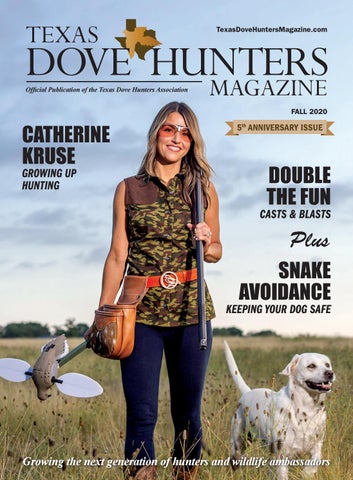
CATHERINE KRUSE GROWING UP HUNTING
5th ANNIVERSARY ISSUE
DOUBLE THE FUN
CASTS & BLASTS
Plus SNAKE AVOIDANCE
KEEPING YOUR DOG SAFE
Growing the next generation of hunters and wildlife ambassadors
Official Publication of the Texas Hunters Association
TexasDoveHuntersMagazine.com
.......................... Publisher TEXAS DOVE HUNTERS, LLC
ON OUR COVER
Catherine Kruse
Lessons my Daddy taught me in the field
Editor SUSAN THORNTON Graphic Design STUDIO SYKES Contributing Photographers ATA GIRL PHOTOGRAPHY JOE RICHARDS JAY SCHWISOW Contributors
10
CHRISTIE CUTHBERT DEVIN ERXLEBEN STEVE HALL HOLLY HEARN
CONTENTS ALSO IN THIS ISSUE: 8
Cast & Blast
18
Combining two outdoor experiences into one
Founders letter
14 Texas BB Challenge 22 Ladies in the Field 24 Season Dates 26 Texas Outfitters 28 Tools of the Trade 34 Hunting Party 36 Families in the Field 38 Texas Brigades 40 Photos from the Field 42 Habitat
Snakes in the Field
30
45 Dove Recipe 46 TDHA Store
Prepare Your Dog
Follow us on social media 6 | FALL 2020
DAVID HEFLIN, D.V.M. COLTON NOLEN BUCK RYCKMAN NATALIE WOLFF Advertising Sales CINDY JENNINGS PATRICIA MCGRATH Printing SHWEIKI MEDIA, SAN ANTONIO, TX
.......................... FOR ADVERTISING INFORMATION CALL 210.764.1189 EMAIL info@TexasDoveHuntersMagazine.com
.......................... TEXAS DOVE HUNTERS MAGAZINE is published bi-annually by Texas Dove Hunters, LLC (Publisher). Reproduction in any manner in whole or part is prohibited without the express written consent of the Publisher. Material contained herein does not necessarily reflect the opinion of the publisher or its staff. TEXAS DOVE HUNTERS MAGAZINE reserves the right to edit materials for clarity and space and assumes no responsibility for accuracy, errors or omissions. TEXAS DOVE HUNTERS MAGAZINE does not knowingly accept false or misleading advertisements or editorial, nor does the Publisher assume responsibility should such advertising or editorial appear. Articles and photographs are welcome and may be submitted to our office to be used subject to the discretion and review of the publisher. Printed in the U.S.A. © 2020 Texas Dove Hunters, LLC. 900 N.E. Loop 410, Suite D300 San Antonio, TX 78209 texasdovehunters.com
LETTER FOM THE FOUNDER
The
undisputed
leader of
snake boots in the
world
Dove season is upon us and it is a time of uncertainty for everyone, the hunting and wildlife industry included. While dove hunting has its own built-in means of “social distancing,” it is still important to maintain a safe distance from others and wear a mask in public. I can’t wait to be able to go outside and pull the trigger on a passing dove with my friends and family. For the Thornton household, this is a recreational luxury we all enjoy and take advantage of all season long. I know many of you are the same way. During this pandemic, Texas Dove Hunters has taken the opportunity to do some restructuring and updating. texasdovehunters.com, has a whole new look. It has been streamlined to be more efficient and user-friendly for finding outfitters and dog trainers, as well as for membership, hunting dates, a new store, and more. We have revised our membership options and have added more logo items to the TDHA store so you can proudly carry the Texas Dove Hunters logo on products like coolers, shirts, hats, and drinkware. Like so many small businesses Texas Outfitters are concerned about the effects of COVID-19 on their operations. I encourage you to support your favorite outfitter and if you don’t have one, there are many excellent ones located all over the state that you can find throughout the magazine. The Texas Banded Bird Challenge entries have opened. Be sure to enter by September 1, so you won’t be caught in the field without it. You don’t want to miss out on an opportunity to win a new truck, Polaris, exotic game hunt, shotguns, and more! Hunting, in general, is probably going to look a little different this year but if we all take precautions we should still be able to enjoy it and stay well. Take a kid hunting and stay safe,
MISSION STATEMENT: Texas Dove Hunters Association promotes strong family unity through hunting and outdoor programs. We are committed to research, education and habitat conservation.
8 | FALL 2020
TAKE IT TO THE LIMIT TEXAS DOVE HUNTERS ASSOCIATION CORPORATE OFFICE 900 N.E. Loop 410, Suite D300 San Antonio, TX 78209 Off: (210) 764-1189 Fax: (866) 233-0507 email: info@texasdovehunters.com texasdovehunters.com
Our Hondo ranches offer Central and South Zone hunts among irrigated sunflower fields in the heart of the migratory flight path. Options include day hunts, group packages and all-inclusive lodge hunts featuring private chef service, skeet shooting at our five-stand pavilion and luxury accomodations. Book now for fall and winter hunts, call 210-865-1423.
FOUNDER Bobby Thornton
DIRECTOR OF OPERATIONS Susan Thornton
ADMINISTRATIVE ASSISTANT Myrna Hassfield
PHOTOGRAPHER Jay Schwisow
GRAPHIC DESIGNER Christine Sykes
DESIGN CONSULTANT
W W W .V E N AT U R A E X C U R S I O N S . C O M
Tony Rodriguez
18th Annual
SaSaturday, turday, SSeptember eptember 5, 5,2020 2020
SUSAN THORNTON
MYRNA HASSFIELD
DIRECTOR OF OPERATIONS
ADMINISTRATIVE ASSISTANT
Hunter’s Barbeque Hunter’sAppreciation Appreciation Barbeque Lunch: 10:30to1:30 to 1:30 Lunch:10:30 Winters Community Center Winters Community Center Meal and Drink, Entertainment, and chance at Door Prizes Free Beer Until Supplies Run out Meal and Drink, Entertainment, and chance at Door Prizes Free Beer Until Supplies Run out Organizations All Proceeds Benefit Local Youth & Non-Profit
All Proceeds BenefitFun Local Youth & Non-Profit Al– 8-11 Clay Pigeon Shoot am & Gun Organizations Raffle Ten quality guns $5.00 per ticket ClayDo Pigeon Funto win—For Shoot – 8-11 not have to be present purchasing optionsam call (325) 754-0120 or e-mail wintersdovefest@gmail.com Gun Raffle A
CHRISTINE SYKES
JAY SCHWISOW
GRAPHIC DESIGNER
PHOTOGRAPHER
2 Handgun Boards Ten Quality guns $5.00 per Ticket
onbe each-$20 perto chance begins at 9 a.m., Sept.call 5 A • Sale purchasing Do 100 notChances have to present win—For options (325) 754-0120 or e-mail wintersdovefest@gmail.com
2 Handgun Boards Live Entertainment-Self Family
Free Kid’s Events from 11-1:30 • Admittance to pool with meal ticket Silenton Auction from 101:30Chance • Live Auction at 1:30 100 Chances each-$20 Per Sales starting Begin at 9am Sept. 5 TONY RODRIGUEZ DESIGN CONSULTANT
For more information visit us at Family Live Entertainment-Self www.wintersdovefest.com • (325) 754-0120
Free Kid’s Events from 11-1:30 Admittance to Pool with meal ticket Silent Auction from 10-1:30 Live Auction starting at 1:30 TexasDoveHuntersMagazine.com | 9 For More Information Visit Us AT
www.wintersdovefest.com
(325) 754-0120
FEATURE
CATHERINE KRUSE LESSONS MY DADDY TAUGHT ME By Christie Cuthbert Photography by Ata Girl Photography
A s a teenage girl growing up in Houston,
Catherine (Arrighi) Kruse preferred to be out in the fields dove hunting with her dad versus spending time at the mall with friends on the weekends. “It’s kind of funny now when I think back,” she said. “None of my other friends were into hunting, but I never really thought what I was doing was different.” Her love of the sport didn’t come from just following in her father and grandfather’s footsteps. It was nurtured over time with patience and a real appreciation for God’s presence in the outdoors and all creations. “I can just remember being out there, each time we went, it was a learning experience,” she said. “Not just about hunting, but about life.” At five years old, she can remember the cotton fields outside the property her family lived on in Tucson, Arizona. Her father, Ed Arrighi, built water parks, and his work would eventually bring the family to Texas when Catherine was six. Her grandfather was also into hunting, and the tradition and love of the sport were passed down through generations. Her birthday is in September, and was always the beginning of the dove hunting season, and she loved nothing more than spending time with her dad, learning everything there is to know about hunting and life. “It’s just kind of like a way of life as far as food supply and the enjoyment of the outdoors,” she said. “We love the Lord a lot, and sometimes you don’t get to see a lot of His
10 | FALL 2020
heart in everyday city life. But once you get outside, He’s everywhere.” As a young child, she’d run with the dogs into the fields to pick up the birds, help take the feathers off and prepare them for harvest. It wasn’t until she was 10 or 12 that her father finally handed her a gun to shoot. “For an Italian man, the patience he had with me was incredible,” she said with a laugh. “I don’t sit still well. He would always talk with me about what I was perceiving versus telling me what I should be perceiving. He allowed me to fall in love with the outdoors in my own way.” Giving his daughter the ability to grow into the sport on her terms, Kruse said her father never pushed her into hunting. “He always made sure I enjoyed it,” she said. “He never forced it. If I ever got too hot or tired, he’d just say ‘that’s ok, let’s head in.’” Part of Ed’s delay in handing his daughter a gun right away was to show her God’s beauty in everything the universe creates. “When we’d get back into the blind, he’d have me peel the feathers back so I could see how the skin was made to hold the feathers,” she said. “He would explain how God created birds and how He put every detail into the design of every bird’s feather. When we would cut open the birds, he would tell me what fields they had been to prior based on what they had been eating. It was like a science lesson every time, and I found it so intriguing. By the time I was 14 or 15, I wanted to shoot everything that moved because I had spent so much time learning and watching.” During Kruse’s teen years, her dad began a side business importing shotgun shells from Spain called Armusa. At that time, there was a young sporting clay shooter that needed a sponsor, named Cory Kruse. When Ed sponsored Cory, Catherine said she immediately had the biggest teenage crush imaginable, and little did she know, years later, would become his wife. “We were always friends growing up, we were always shooting tournaments together,” Catherine said. “All in all, I just loved shooting, and it was just a big bonus that there was a cute boy involved.” Catherine and Cory would remain friends through their teens and college, often competing together. After graduating from Texas A&M, where she sold firearms while attending classes, Catherine took a job in marketing and sales with an oil field company. Cory happened to also be in the industry. The old friends reconnected, and one night, Cory mustered up the courage to declare his feelings
TexasDoveHuntersMagazine.com | 11
for Catherine. From that day on, they knew it was meant to be. The couple married in 2012 and are parents to a five-year-old daughter, Claire. “Cory is my best friend,” she said. “Being married to your best friend is just the best. We’ve known each other for so long; it’s just so amazing to be together.” Now raising a daughter of her own, Catherine approaches hunting with Claire the same way her dad did with her. “When I explain it to my daughter, I tell her that hunting is like pizza,” she said. “When you order a pizza, it’s whole, but there are 8-10 slices. One slice is practice; another is preparation; one is watching the world wake up, the bugs move around, the animals moving around, safety, etc.” She also tells Claire that God doesn’t just exist in church. “Sometimes, if you can’t hear him go outside and he’ll speak to you,” Catherine said. “He’s everywhere.” While Claire prefers fishing to hunting right now, Catherine said she enjoys dove hunting because she gets to run out and get the birds. The family also took Claire along on a recent international goose hunting trip in Canada. Being able to explain the world to her daughter, the way her dad did for her, has been profoundly enriching in her life. “It has enhanced everything in our lives, teaching Claire to love the outdoors,” Catherine said. “I’m actually working on a children’s book right now to empower children to find their own love of the outdoors. I wanted Claire to feel included in our big hunting trip, and I wanted to give her words that would resonate with her. We ended up turning it into a little book about hide and seek. I would tell her, ‘we need to hide when the geese fly over.’ We read the book every day for two weeks leading up to the trip, and she was so prepared. She would wake up at 5 a.m. ready to go hunting.” In 2017, Kruse had to tone down the recoil in her weapons when faced with health concerns. One morning she woke up with a migraine, and it never went away. “My body shut down,” she said. “I was so young. I started praying.”
12 | FALL 2020
While dealing with her health setbacks, she and Cory found comfort and strength in a church community in Austin. They began driving from Houston every weekend for services. “Something in my heart just knew,” she said. “We fell in love with the community. It’s been amazing.” Catherine, Cory, and Claire made the move to the Hill Country to be closer to their church, and they are loving their new home. Throughout the time Kruse suffered, she continued to shoot despite the pain, because she didn’t want the migraine to steal her joy in life. The migraine finally went away six months ago, and she’s looking forward to being back out in the field this fall, bringing home plenty of dove for her favorite dish – dove poppers. “I’m very traditional in how I like my dove,” she said. “I like it soaked in seasoning and marinade and partnered with cream cheese and jalapeno. We keep them in the fridge all week. They’re so delicious I’ll even eat them cold.” In 2019, Catherine’s husband Cory became the Sporting Clay World Champion, and together they run a consulting firm, Kruse Interests. They provide upscale outdoor event planning, help non-profits maximize their fundraising profits from shooting tournaments, help with marketing, branding, species analysis, and more. In Kruse’s mind, dove hunting is the perfect sport to get started in for anyone interested in shooting. “To me, it’s really the best introduction to hunting because it’s social,” she said. “You can hang out with people, you don’t have to be incredibly still and quiet, and you can bring kids. It’s a great way to get started into outdoor sporting.”
TexasDoveHuntersMagazine.com | 13
TEXAS BANDED BIRD CHALLENGE
TEXAS BANDED BIRD CHALLENGE Biologists tell us that after three years, we will be able to examine habitat preferences to some extent but that with even more time, those numbers start to tell a story. It requires years of data to arrive at theories based on consistencies and somewhat predictable patterns, and it just hasn’t been long enough to verify the results. For example, bands released in August that are harvested and reported in September don’t give us much time to gather data. However, birds harvested from this point on that were banded in 2018 give us a little more to go by to establish a baseline that will be compared to with each bird harvested as we move ahead. With two full years of data collection on the bands that reported, we can see distance traveled over periods of time but not yet a long enough time to be able to compile quantitative results with data that has been out long enough to form consistent patterns. Of the birds reported in 2019, three were reported that were released in 2018. One bird was 93 miles from where it was released before being harvested 372 days later. Another bird was 168 miles from where it was released over 370 days before, and the third bird was only 3 miles from where it had been released before being harvested 374 days later. When there is this much difference in distance traveled over comparable periods, it’s important to take a look at the terrain, and dominant habitat found where they were released and harvested to see if this was a driving factor for movement. The two birds that traveled the furthest distance were both released in areas where commercial farm crops were predominately milo and corn. One was harvested in an area that grows mostly milo, sesame, and black oil sunflower. The other was an area dominated by milo, cotton, and native sunflower. Judging by these results at first, it appears that food was not the determining factor that led to their travel; however, this was only over one year. Only time will tell where other birds released in the same area were going. Within three miles, the third bird was released west of San Antonio, where there are plenty of landowners who plant for birds year-round to try and hold them. These three 2018 birds are an excellent example of how time will help us build a foundation from which to build. These examples are consistent with the majority of the bands reported from the standpoint that some birds that traveled long distances over a short period and some birds that hardly moved at all over a long period. The furthest distance traveled by a harvested bird reported has been 272 miles, released just south of Hondo, and harvested near Roscoe. The assumption is that
14 | FALL 2020
the bird was headed to the panhandle where there are vast numbers of Eurasian Collared Doves already. Each hatch-year (in the first year) bird released has been documented so that over time we will be able to get a better idea of life expectancy outside of other studies throughout the country. With 800 more birds being banded and released this summer and the season to begin in the north and central zone on September 1. The new numbers that will continue to come in and the results that they will bring is exciting. We have a fantastic lineup of prizes this year including a new truck, a Polaris donated by Hoffpauir Outdoor Superstore, an exotic game hunt at RecordBuck Ranch, shotguns, two ultimate dove packages with Chippewa snake boots, a Chama Chair, a CZ-USA shotgun, Bird Down Brand Ultimate Gun Rest, Cowboys Game Washer, a Blake Jone custom bird bag, a Dove cord, and a Frio ice chest. We also have a custom TDHA firepit donated by All Season’s Feeders, a TDHA lifetime membership complete with custom leather bird bag donated by Blake Jones designs, a TDHA shotgun case, and a life-member hat, and a McKenna Quinn hunting shirt. Due to some set-backs with COVID, we are anticipating announcing a few more prizes soon. Don’t let the time get away from you; be sure to get your entry before the season starts!
bandedbirdchallenge.com Texas BB Challenge Retail Partners Oasis Outback •Uvalde Ranger Firearms •San Antonio Buck & Does •San Antonio
Check bandedbirdchallenge.com for updated lists of Retail Partners. If you are interested in becoming a Retail Partner and selling BB Challenge entries, call 210-764-1189. TexasDoveHuntersMagazine.com | 15
Field Bags Shell Bags Apparel Custom Leather Goods Travel Bags
Leather Goods and Apparel. Made in Texas. Designed for the Southern Sportsman.
222 E. Kleberg Ave Kingsville, TX 78363 361.592.8885 twodoveoutdoors.com IG @Two_Dove_Outdoors FB Two Dove Outdoors
TexasDoveHuntersMagazine.com | 17
FEATURE
CAST AND BLAST PAIRS CAMARADERIE AND OUTDOOR FUN By Christie Cuthbert Photos provided by Baffin Bay Rod & Gun and Casa Arroyo Sporting Lodge
It’s really something special we have here in Texas, to be able to do these activities back to back in one day without having to travel far in between.
18 | FALL 2020
S
an Antonio resident Ty Sheehan, 40, grew up hunting and fishing with his dad and brother throughout Texas. For him, dove and duck hunting and fishing has always been a time to bond and socialize with others, and in recent years, he discovered cast and blast trips, which combine the two sports into one experience. “It’s really something special we have here in Texas, to be able to do these activities back to back in one day without having to travel far in between,” he said. “Unlike deer hunting or turkey hunting where you must be in a blind silent and still, cast and blasts are a real social experience. It’s something you can do with your buddies or your wife, and sometimes you even meet new people and become friends.” With growing popularity throughout Texas, a cast and blast experience includes fishing and hunting in one day. Some lodges are making it an experience that will be remembered for years. Doug Dunkin, of Casa Arroyo Sporting Lodge in Arroyo City, has been guiding hunters and fishermen for more than 30 years. He calls his cast and blast tour a “turn-key operation.” Perfect for groups of four to 25 people, Dunkin’s two-day cast and blast excursions include lodging, meals, equipment, game preparation, and guides. Those who attend will arrive at the lodge around noon and head out for a short drive to the sunflower fields to hunt dove. After that, they’ll head back to the lodge for a steak dinner with all the fixings and scenic views from their sleeping accommodations. In the morning, guests are treated to a full breakfast before heading out to catch trout and redfish. Once that’s complete, it’s back out to the fields for more hunting, and then the night is completed with a fresh fish and game dinner prepared multiple ways. “You show up, and everything is taken care of,” Dunkin said. “We often have people come who don’t want to fly with guns, so we have lodge guns we can provide.” The cost of the 2-day trip includes everything from start to finish. Casa Arroyo Sporting Lodge is located near Brownsville, and with more than 150 acres of sunflowers, they guarantee birds and a great time. “We’re fortunate in our location,” Dunkin said. “We’re located on the bay and just 35 minutes from the fields, so it makes it very easy to do both in one day.” Another cast and blast tour located in South Texas is Baffin Bay Rod and Gun. Situated in Riviera, Texas, Captain Sally Black and her team offer cast and blast, blast and blast and blast and nap packages that also provide lodging and are dog friendly. Guests can hunt 14 different duck species and fish for trophy trout and giant red with no bay pressure. When they return to the lodge, complimentary cold beer on tap awaits them along with a swimming pool and fire. Dinner prepared by a private chef and wine is also included. “Having the swimming pool in the summer and the fire ring in the winter helps a lot,” Black said. “When people get off the water, they can take a siesta, have a dip in the pool, and a change of clothes and mindset. We also have a full outdoor kitchen and covered patio area where guests can relax and watch sports. We’re in the middle of nowhere, and it really is a tropical oasis.” Those who strictly want to hunt can take advantage of the overlap in dove and duck season and book the blast and blast, which includes duck hunting in the morning, a hearty lunch at the lodge, and dove hunting
TexasDoveHuntersMagazine.com | 19
in the afternoon. The experience takes place in September with early Teal and late December through January. Black said that by far, the most popular guided tour is the cast and blast, and Baffin Bay is loaded with big, fat fish ready for reeling in. And you do not need to be experienced to join in on the fun. Families are welcome with children and first-timers. “We love taking beginners out because they’re likely to become our customers,” Black said. “We always take people out to shoot, and we have a flinger, so we can get people warmed up if they haven’t shot in a while.” Black says her lodge gets people from all walks of life, and last year she hosted a bachelor party for 20 gentlemen who had a surprise mariachi band on the excursion. “It was so fun; I couldn’t believe we pulled it off,” she said. “The place where we were hunting had four or five ponds, and we were staged all over, so the band went from pond to pond. It was so South Texas.” Prices and accommodations vary based on location.
When people get off the water, they can take a siesta, have a dip in the pool, and a change of clothes and mindset.
20 | FALL 2020
Welcome Hunters!
TexasDoveHuntersMagazine.com | 21
LADIES IN THE FIELD
I AM THE DAUGHTER YOU TOOK HUNTING By Holly Hearn
I
remember when I saw my first buck. I was six years old sitting in the blind with my dad and papaw. It was freezing cold and I struggled to stay quiet and still (I still do!). My dad whispered and pointed, holding his binoculars to my eyes. That’s when I saw him: a giant mature 10 point buck. My father and grandfather had no way of knowing the significance of that moment. They couldn’t have known that they had just laid the foundation for my ever-growing love of the outdoors, and that 19 years later, I’d be in that same deer stand, waiting to pull the trigger on my own massive buck, and that I’d devote myself to conservation, sustainable eating and wild game cooking. I grew up like a lot of girls. My favorite color was (and still is) pink. I loved princess dresses and anything that sparkled. But I was also a little rougher, and a little tougher than the other girls. My parents always encouraged us to do what made us happy. For me, that meant a combination of ballet, shooting and just generally running around the woods being a feral child behind our house. My parents taught me to honor both sides of myself: the rough-andtumble and the soft, feminine. As the years went by, I continued to tag along on my dad’s hunts. I couldn’t participate until he felt confident that I had enough knowledge and practice to make ethical and precise shots, but I still loved being out there with him. It was “our” time, with no distractions. Looking back, I see how my own interest in the sport developed. I loved to deer hunt but the first time I shot a 12 gauge at clay targets in the neighbor’s backyard and watched them shatter, I was hooked. That following year, my dad took my brother and I on our first quail hunt. I’ll never forget beading up and dropping birds with my dad’s shot gun that was way too big for me, or his look of shock when I asked to clean my own birds. My dad looked so proud. Even then, it was important that I be involved in every element of the hunting process. It’s a form of respect to our game. So much so that I may have asked Santa Claus for a professional vertical meat band saw last Christmas. It makes bone in in cuts on pigs and deer easier. My college years are when I discovered where my true heart for hunting was: the kitchen. I was 19, and had just dropped out of college and moved back to dad’s place. The nearest grocery store was 45 minutes away, and I was hungry. Instead of making the trek, I started cooking with
22 | FALL 2020
whatever we had on hand. Of course, it was wild game. Previous experience with my uncle’s cooking taught me that there is, in fact, a limit to how much fried game meat one can eat. So, I went to my computer and started researching wild game dishes and butchering techniques. I wanted to know what people were doing with their game, that wasn’t breaded and fried. My research brought me to the Hunter Gardner Angler cook blog written by Hank Shaw and I started to see just how much you could do with wild game. I began experimenting with recipes like crazy, starting with stir fry’s and Asian flavors (my favorite!). The First time I made venison stir fry for my dad he was blown away at how flavorful the dish was. Eventually I developed a cooking style all my own. When I enrolled in engineering school in the spring of 2015, people thought I’d drift away from cooking and hunting. Instead, it became an area of refuge and a creative outlet after long days of calculations and studying. Not to mention I saved quite a bit of money cooking my own meat instead of going out to eat and buying meat at the grocery store.
Last August, at the beginning of my senior year, I began shooting sporting clays; considering you can only hunt for six months of the year, it’s a natural move! I have learned so much in that short time, mainly that there is always something to improve upon. Much like hunting camp, I’m often the only woman on the squad. It was intimidating, especially when I showed up to practice and was literally the only female. But more often than not, I’m welcomed with open arms and encouraging words. Believe me, sometimes I really need them! Lord knows I still have a very long way to go when it comes to shooting clays - the gosh darn rabbit targets get me every time. But I’m okay with not being the best shot in the world (yet). Because hunting has taught me how to work hard, be patient, and humble. And it’s fun! I improve and learn every time I head to the range. Occasionally, it’s hard being a solo female shooter and hunter. You miss out on certain invites, because you make people uncomfortable. But that’s never deterred me. I look forward to my solo hunts, and shooting birds with my dad every year. And I’ve discovered communities of women who love to hunt and shoot. Companies, like McKenna Quinn, host ladies’ hunts and have made it easier than ever for women to get involved in the sport, even if they didn’t grow up in the field like I did. These communities of women are so encouraging for ladies of all skill levels. As I transition into post university life, I’m excited to grow as a cook, a hunter and a shooter. Perhaps most of all, I’m looking forward to encouraging more women and young ladies to join these sports that have shaped me into the woman I am today, and showing the world that wild game can be gourmet.
TexasDoveHuntersMagazine.com | 23
ZONE MAP & SEASON DATES
NORTH ZONE That portion of the state north of a line beginning at the International Bridge south of Fort Hancock; thence north along FM 1088 to State Highway 20; thence west along State Highway 20 to State Highway 148; thence north along State Highway 148 to Interstate Highway 10 at Fort Hancock; thence east along Interstate Highway 10 to Interstate Highway 20; thence northeast along Interstate Highway 20 to Interstate Highway 30 at Fort Worth; thence northeast along Interstate Highway 30 to the TexasArkansas state line. CENTRAL ZONE That portion of the state between the North Zone and the South Zone. SOUTH ZONE That portion of the state south of a line beginning at the International Toll Bridge in Del Rio; thence northeast along U.S. Highway 277 Spur to U.S. Highway 90 in Del Rio; thence east along U.S. Highway 90 to State Loop 1604; thence following Loop 1604 south and east, then north, to Interstate Highway 10; thence east along Interstate Highway 10 to the Texas-Louisiana Line. SEASON DATES & ZONE INFORMATION COURTESY OF TEXAS PARKS & WILDLIFE DEPARTMENT ZONE MAP ART BY MATT TUMLINSON, SAN ANTONIO www.tumlinsonart.com
DOVE SEASONS & REGULATIONS North Zone September 1 – November 12, 2020 December 18, 2020 – January 3, 2021
Special White-Winged Dove Days September 5, 6, 12, 13 (SWWDD shooting hours noon to sunset)
Central Zone September 1 – November 1, 2020 December 18, 2020 – January 14, 2021
Shooting Hours: Unless otherwise noted, one-half hour before sunrise to sunset
South Zone September 14 – November 1, 2020 December 18, 2020 – January 23, 2021
Daily Bag Composition* 15 mourning, white-winged and white-tipped (white-fronted) doves in aggregate, to include not more than 2 white-tipped (white-fronted doves. *Except South Zone September 5, 6, 12, and 13, 2020
IMPORTANT NUMBERS TDHA Banded Bird, If harvested call 210-764-1189 Federal Banded Bird, If harvested: Report at reportband.gov Public Hunting: tpwd.texas.gov/huntwild/hunt/public Operation Game Thief: Witness a Violation, call 800-792-4263
24 | FALL 2020
Possession Limit: Three times the daily bag limit Migratory game Bird Stamp & HIP Certification required. Texas Dove Hunters Association 210-764-1189
TexasDoveHuntersMagazine.com | 25
TEXAS OUTFITTERS
OUTFITTERS IN TEXAS
NORTH ZONE CENTRAL ZONE SOUTH ZONE
26 | FALL 2020
CIRCLE E OUTFITTERS • • • • •
Day-Family-Group Dove Hunts 20 miles south of Abilene 10 miles south of Clyde Sunflower, Milo and Wheat Central Zone
RANDY EDWARDS
DEREK EDWARDS
325-370-2185
325-669-0796 TexasDoveHuntersMagazine.com | 27
TEXAS OUTFITTERS
DOVE STUFF YOU GOTTA HAVE
1 Blake Jones Designs Canvas Bird Bag
Leather trim, water repellant with brass hardware and a zip off rear bag. $150
2 Chama Chair Chama Pursuit All-Terrain Swivel Chair with travel bag in vintage camo. $169.95
3 Bird Down Brand The Ultimate Shotgun Rest Shotgun rest for bird hunters and clay shooters, protects your gun and vehicle. $76
4 The Dove Cord Dove Cord 15 visual tethers will keep you within your legal limit. $25
5 Peregrine Field Gear Insulated Venture Bucket Pack Carry your ammo, gear and water and still have a place to sit. $84.99
6 Cowboys Wild Game Washer Flushes away all kinds of debris when washing breasted birds. $49.99
7 Chippewa Descardo Snake Boots Provide maximum protection by combining thickness of leather and ViperclothÂŽ. $289.95
8 Texas Dove Hunters Texas Banded Bird Challenge Entry Win prizes. Don’t go to the field without it. $20
9 Dove Gear The Ultimate Dove Vest Loaded with features 6-way adjustability, hidden security pockets and mesh construction. $89.95
28 | FALL 2020
1
2
4
3
6 5
9
7
8
TexasDoveHuntersMagazine.com | 29
HUNTER SAFETY
THE IMPORTANCE OF SNAKE AVOIDANCE TRAINING By Buck Ryckman Ryckman Kennels
30 | FALL 2020
W
hether your dog goes hunting with you or not, it is essential for any dog that’s going to be outside, or around your hunting camp, to experience what a rattlesnake is all about. Each year, numerous dogs are bitten by rattlesnakes in accidents that could have been avoided if the dog had been schooled, and had a bad association with the snake using a high-level e-collar stimulation. There are some negative reactions to using an e-collar on a dog, but the best thing to compare it to is spanking a child when they walk out into the street. The association of the brief discomfort can save their life. Back in the ‘70s, we hoped our dogs wouldn’t encounter any rattlesnakes but realized that was impossible. So, in the late ‘80s, my dad and I started rattlesnake avoidance training for our own hunting dogs, that we used to guide Quail Hunts with in South Texas. After purchasing ten rattlesnakes from a snake dealer, we had a friend build some small wire cages where the dogs could easily see, smell and hear the rattlesnake yet would be safely contained during the training session. We started offering snake avoidance to the clients whose dogs were in training. Now days, we train two or three dogs each morning. Most customers call in the spring or right before dove season to schedule. We also do the snake avoidance when their retriever graduates training. Now, we offer snake avoidance training clinics. We have snake avoidance trained most breeds from Chihuahuas to Great Danes. The whole process takes about 45 minutes. Ideal conditions for snake training are 75 to 80 degrees with a breeze that is moist and 8 to 12 mph to float the scent of the snake. The dog and rattlesnake must not get too warm during the training process. The first step is putting an e-collar and rope on the dog and letting them walk around the field before we put the rattlesnakes out. After the dog is comfortable with the surroundings and the trainer, the customer and dog leave the field and the cages with the snakes are placed out in the field. The dog is taken back out into the field for its first encounter with the snake, letting them experience the snake at their own pace, downwind, not forcing them into it.
WHAT IF YOUR DOG GETS A BITE? By David Heflin, D.V.M. Mission Veterinary Hospital
As a veterinarian, I have seen too many dogs with snake bites. Some with a minor reaction, others with severe muscle damage that requires extensive healing time, and others clinging to life and some die before they arrive at the clinic. Snake bites are a risk, so what can we do to protect the pets that we hunt with and love? Snake avoidance training may be controversial, but has merit. There are many previously trained dogs that return for a “refresher course” that will not get anywhere close to a hidden training snake. The newbies quickly catch on too. Having your dog be rattlesnake alert in the field far outweighs the minor physical discomfort or adverse behaviors that may occur with rattlesnake avoidance training. I also recommend having your dog vaccinated with the “rattlesnake vaccine” at least one month prior to hunting season. The vaccine generates protective antibodies against venom. It is intended to lessen the damage that venom causes and increase survival rates. It is not a 100% remedy and there are some recipients that will still die from a bite, but the consensus of opinion among veterinarians (especially those that see a lot of snake bites) is positive. Know the location of the nearest veterinary clinic and call before you hunt to make sure they carry rattlesnake antivenom. If your dog is bitten get it to the clinic as quickly as possible, even if you haven’t seen any symptoms yet. Do not apply a tourniquet or try to extract the venom. Medications for shock, pain, and possible infection may seem like a logical choice to give in the field but they often complicate treatment and may actually be harmful in some cases. Finally, consider the risk of the hunt. If it looks like a “snaky” day, maybe it’s wise to leave your hunting buddy at home. They will be as disappointed as you are, but they’ll be safe!
TexasDoveHuntersMagazine.com | 31
Most dogs catch the smell of the rattlesnake at about five to eight feet away, then begin to pursue the scent. The snake will then start rattling, and the dog will keep moving closer until they get one to two feet away. At that point, I press the button on the E-collar transmitter, and the dog reacts to the stimulation. Some dogs will jump straight up; some will backflip, some pull the rope very hard trying to get away; on rare occasions, try to bite the snake or the trainer. Eventually, after the dog calms down from its first encounter, the owner is positioned at a distance opposite the dog and trainer, with the snake between them. The owner begins to call the dog towards them, but with the dog actively avoiding the snake and going around it to get back to the owner. If the dog does not actively avoid the snake, it will get another e-collar stimulation. They are also exposed to the snakes in different scenarios where they are hidden under cactus or bushes. Sometimes the rattles are hushed to assure that the dog is using its nose and avoiding the snake’s smell and not just the sound. The snake training goal is to have the dog associate a timely unpleasant electrical stimulation with the sight, sound, and smell of the rattlesnake. The smell part of the snake training can be the most difficult of the three associations to the snake. The first rattlesnake avoidance training is highly recommended when the dog is at least six months old. We have snake trained dogs younger than six months of age, if they were going to visit a snake prone area but it is rare and not usually recommended. Refresher courses are highly encouraged after a year or two. Run them through a snake class again, and if they avoid the snake right away in the second class, the dog should be good for many years. Many times, the senses of older dogs diminish, so be careful.
32 | FALL 2020
Rattlesnake vaccines are recommended as a precaution as well. When retrieving, a bird dog gets so focused on the bird that they might not be aware of a snake. So even with snake avoidance training and the rattlesnake vaccine, your dog could receive a fatal snakebite. If you have the opportunity before the hunt, put your snake boots on, take your shotgun in hand, walk the field where the dove are going to fall (hopefully) and scout out for snakes where they may be hiding. If you notice your dog acting strangely or see them jump back, recall your dog. Get him secured in a safe place and check him thoroughly. Watch him for a while and if you notice any swelling or tiny blood spots anywhere on the body, get to the nearest vet as soon as possible.
San Antonio’s Premier Indoor Firearm & Archery Center
FIREARMS RANGE RETAIL TRAINING
Long Range Off-Site Training Available! HIT YOUR TARGET AT 1,000 YARDS!
Present this ad in-store to receive 10% Off a Long Range Precision Rifle Basic Course & a FREE D.O.P.E Book. *Offer expires 12/01/20
LONG RANGE PRECISION RIFLE COURSE
SCAN HERE FOR MORE INFORMATION!
10% OFF COURSE
When you present this in-store!
210.504.9000 | 4507 N Loop 1604 West, San Antonio, TX 78249
TexasDoveHuntersMagazine.com | 33
GUN SAFETY
THE “HUNTING PARTY” By Steve Hall, Texas Parks & Wildlife Hunter Education Coordinator
H
unter "Safety" Education has been an institution in this country since the mid-1940s and in Texas since 1972. It is a rite of passage for all hunters to learn the basics of safe, legal, and ethical behaviors. Unfortunately, not everyone follows the law or the ethical rules of hunting. When this happens rules are broken, people and animals can get hurt and hunters and hunting are given a bad name. n Driving across crop fields; leaving gates open
n Going into a hunting pasture with cows present instead of the landowner-assigned area n Swinging shotgun out of a “safe zone of fire” into another hunter’s direction n ‘Skybusting’ – taking shots beyond the effective range n Giving up too easily on finding a downed bird, despite having a retriever n Shooting a meadowlark or non-target species and laughing about the ‘mistake' n Littering and being loud and obnoxious around other hunters still in the field n Party hunting – combining doves shot by all hunters into one pile; no regard for limits n Firearms displayed in open gun rack of a vehicle; blood on the clothing upon departure n Cavalier/arrogant attitude around landowner and other (responsible) hunters This does not even mention other issues that game wardens witness in the field when checking dove hunters covered during the “Game Laws” section in hunter education courses: n No license and over the bag limit – two most common violations by dove hunters n No ‘plug’ in the semi-auto or pump shotgun, which limits them to 3 total shotshells 34 | FALL 2020
Fortunately, because of programs like hunter education, and the Texas Youth Hunting Program, and partner projects such as 4-H Shooting Sports and the Brigades, the proverbial ‘rite of passage’ that exists, for adults to pass on the proper values and ethics, is strong in Texas. Add to that, organizations like the Texas Dove Hunters Association, which fosters continued involvement in conservation for hunters and their families, and you get a sense that most dove hunters do it the right way by responsibly passing on the hunting heritage. In the early 20th century, Aldo Leopold, considered the “Father of Wildlife Management”, aptly wrote in his essays entitled “A Sand County Almanac,” “Voluntary adherence to an ethical code elevates the self-respect of the sportsman, but it should not be forgotten that voluntary disregard of the code degenerates and depraves him.” Dove hunting is a social sport – fun, exhilarating and memorable tradition, especially in Texas. It truly is a party, of sorts. This year, when you head out the dove fields, keep in mind these reminders, and you, your family, and friends will remember this year’s Hunting Party! Be SAFE!
REMINDERS FOR A SUCCESSFUL DOVE HUNT SAFE
n
Practice the 5 C’s of Hunting
n
Always point the muzzle in a SAFE direction; always treat a firearm as if it is loaded
• Be CONSIDERATE of your group and other hunting groups or individuals
n
Keep your finger outside the trigger guard until you fire and be sure of the target
game wardens, non-hunters)
n
Be sure you know where other hunters are and stick to your safe zone of fire
n
Unload immediately when not hunting or when crossing difficult terrain/fences
n
Inspect shotguns and ammunition before the hunt, ensuring they are in good shape
n
Make sure ammunition you carry in the field matches only your firearm
n
Wear blaze orange into and out of the field, so other hunters know your location
LEGAL n
Make sure you have proof of hunter education certification on your person
n
Purchase and carry the proper hunting license
n
Be sure there is a plug in your semi-auto or pump-action shotguns
n
n
Only shoot within the designated season and daylight hours Properly identify the targets – doves in flight – before pulling the trigger
n
Ensure there is no illegally scattered bait or active corn feeders where you hunt
n
Retain and take photos with only your limit of doves, not in a pile with others
ETHICAL n
n
n
n
Avoid taking shots beyond the maximum effective range of around 30 yards Take a good shot – use the right ammo and techniques through proper practice Use a dog for proper game retrieval or make sure you mark your downed birds Hunt in a location that makes for easy retrieval and not near neighboring fences
• Show COURTESY to others (landowners, • Be CAPABLE by practicing your shooting skills well before the season
• Be CAREFUL by planning the hunt and hunting the plan
• COMMUNICATE with others at all
times, especially when retrieving firearms from vehicles or when positioning yourselves in the dove fields n
Educate yourself – take a “Dove Hunting 101” from Texas Parks & Wildlife
TAKE CARE OF GAME n
Take care not to shoot too closely and destroy the meat
n
Check with the landowner on where to clean birds or dispose of bones and feathers.
n
Along with a cooler of ice/water, carry knives, gloves, baggies, and shears afield
n
Clean and cool meat as quickly as possible, Cut out blood and pellets
n
Eat and share what you harvest with friends and family
PRESENT A GOOD PUBLIC IMAGE n
Present a clean appearance in public (no blood on clothing, etc.)
n
Take only ‘tasteful’ photos, especially before sharing on social media
n
Show respect for others in terms of loud gatherings, use of alcohol, etc.
n
Mentor others – especially relatives, friends and newcomers to hunting
n
Support Texas Dove Hunters Association and other conservation groups
n
Be an ambassador for hunting and role model to those with whom you hunt
TexasDoveHuntersMagazine.com | 35
FAMILIES IN THE FIELD
SEND YOUR DOVE HUNTING PHOTOS TO:
photos@txdove.org 36 | FALL 2020
TexasDoveHuntersMagazine.com | 37
TEXAS BRIGADES
Stakeholder Discussion
THE NEXT GENERATION OF CONSERVATION LEADERS
Round Table Discussion
By Natalie Wolff Executive Director of Texas Brigades Photography by Joe Richards
In today’s fast-paced, ever-distracting world, we seem to be disconnected, even though we have tools to connect us more than ever before. To communicate the importance of being a voice for our state’s bountiful and beautiful natural resources, Texas Brigades works year-round to connect youth with nature in a meaningful and personal way, critical when inspiring young ambassadors. Oftentimes, starting a conversation is the hardest part of one, whether it’s speaking up or out, speaking for or against, providing a personal viewpoint, or gaining other perspectives and ideas. Have you heard of an elevator speech? It relates
38 | FALL 2020
to a short window of time seized by a motivated individual to introduce one’s self, topic, or idea, creating an opportunity. Texas Brigades’ version is called a Silver Bullet. It is a tool that cadets use to introduce themselves, recite and give meaning to an impactful quote, and finish with a war cry (Hoo-rah!). Silver Bullets (or Gold Hooks at some camps) are an excellent way for cadets to gain confidence in boldly introducing themselves and starting a conversation. I once heard someone say that “conversation is conservation without the funding.” For someone who has been involved in conservation for most of my life, I had never
Leadership Activity
heard or thought of that. In reflecting on my prior consulting career, it made sense. Don’t get me wrong, conservation efforts are indeed based on sound, scientific principles (and funding), but before you implement anything, you have to communicate needs, goals, options, plans, and expectations. I believe this statement just as easily connects to Texas Brigades because we build confidence in young ambassadors to start that much-needed conservation conversation. Following the Texas Brigades camp model, various topics, components, and leading research are broken down for cadets by leaders and instructors who are professionals in their fields. Cadets learn from those who not only teach but who also do. Likewise, cadets learn from each other, as various cadet backgrounds provide different perspectives, which sharpen awareness and communication skills. Within five days, cadets are immersed in a specific topic or species, learning it from the inside and out. They determine its needs and limiting factors, understand how to manage for those factors, and connect the need for stewardship to all Texans. We tend to use the same concepts to grow as leaders. Understanding ourselves, our inspirations, our choices, learning our limiting factors, and managing our surroundings for a stronger environment, likely leads us to a greater chance of success. Bold? Far-reaching? Hardly. With the vision of “Conservation Leaders in Every Community,” we must set the bar high.
Professionals in the Field
instruction and experience that builds their self-confidence and equips them with their own, personalized conservation message so they can confidently speak on behalf of our resources. Simply put, Texas Brigades has three core values: leadership, conservation, and legacy. The latter part of our mission speaks to educating youth on natural resources subjects “to become conservation ambassadors for a sustained natural resource legacy.” The legacy Texas Brigades works to leave for the next generation of stewards is a lasting impression of why stewarding our wild things, our open lands, and our God-given natural resources are so important. As our 26th United States President stated, “Optimism is a good characteristic, but if carried to an excess, it becomes foolishness. We are prone to speak of this country’s resources as inexhaustible; this is not so.” Texas Brigades builds clarity around the importance of properly functioning ecosystems for safe and fresh food, for clean and abundant water, and ultimately for future generations. We work to provide cadets with tools to be better stewards, regardless of what profession they chose. Whether a cadet becomes a biologist, an officer of the law, a stay-at-home parent, a volunteer firefighter, a state senator, the local butcher, or taxidermist, we aim to keep that lasting impression of responsibility to leave a sustained natural resource legacy for generations to come.
One of my favorite camp activities is the round table discussion. Cadets are provided an opportunity to address their peers and instructors to express their ideas, views, or thoughts on relevant topics. Here, instructors and stakeholders may push “sensitive” or “hot” industry topics that can quickly bring up contrasting views. During this activity, you can see the cadets’ growth as they learn to listen to, communicate with, respect, disagree, or agree with their peers they’ve already befriended. As the cadets become aware, frustrated, anxious, and resolving all in one sitting, it may not be comfortable. Still, it keeps the bar high when it comes to preparing them for future conversations with peers and adults alike. Throughout camps, Texas Brigades works to fuse life-lessons with conservation. Cadets gain hands-on
TexasDoveHuntersMagazine.com | 39
PHOTOS FROM THE FIELD
40 | FALL 2020
BIRD DOWN BRAND CO. WING SHOOTERS | DEER HUNTERS | OUTFITTERS
ultimate shotgun rest Don’t lean your shotguns just anywhere. Perfect for dove hunting and clay shooting.
ultimate rifle rest Rest your rifle in the perfect position. Great for your deer blind.
waterfowl design Suspends off the ground for your flooded duck blind or flooded timber hunters.
“MOST CONVENIENT AND FUNCTIONAL SHOTGUN AND RIFLE REST AROUND”
birddownbrand.com
three centers.
RIFLE & PISTOL | SPORTING CLAYS | TRAP & SKEET
one gun club.
ONE OF THE COUNTRY’S LARGEST PUBLIC RANGES AND EVENT CENTERS LOCATED IN HOUSTON, TEXAS.
WWW.AMERICANSHOOTINGCENTERS.COM 281.556.8199 | 16500 WESTHEIMER PARKWAY, HOUSTON, TX 77082 TexasDoveHuntersMagazine.com | 41
FEATURE - HABITAT
THE ROGER R. FAWCETT WILDLIFE MANAGEMENT AREA By Devin Erxleben and Colton Nolen Texas Parks and Wildlife Department
A native annual sunflower field planted at the Roger R. Fawcett WMA. Walk-in public dove hunting will be available to Annual Public Hunting Permit holders on a first-come, first-served basis beginning in September 2020.
T
exas Parks and Wildlife Department (TPWD) gained a new wildlife management area (WMA) in April 2015 with the acquisition of the former “XO Ranch” in southern Palo Pinto County. The 5,459-acre property lies in the western Cross Timbers Ecoregion approximately 70 miles west of Fort Worth and 90 miles east of Abilene. The previous owner, Mr. Roger R. Fawcett, purchased the property in 1995 and managed it for livestock grazing, hunting, and fishing. Since the 1960s, when known as the Waddell Ranch, TPWD biologists have provided wildlife management technical guidance on the property. On several occasions, TPWD expressed interest in acquiring the property to serve as a wildlife research and demonstration area for the Cross Timbers. The Roger R. Fawcett WMA provides an ideal setting to investigate techniques for the management of wildlife species and their habitats; demonstrate the results of proven wildlife management practices to resource managers, landowners, students, and other interested groups; and provide additional public hunting opportunity in north Texas. The WMA is operated under the Cross Timbers and Prairies Ecosystem Management Project. Conservation efforts are guided by a project leader, a wildlife biologist, and a fish and wildlife technician dedicated to the WMA. Positioned in the southern Palo Pinto Mountains with over 350 feet of elevation change, the WMA encompasses unique habitat types, including old-growth post oak and blackjack oak woodlands interspersed with areas of open grassland savanna and rocky sandstone outcrops. The property has numerous small ponds and lakes that benefit the WMA by providing
42 | FALL 2020
habitat for freshwater fish and migrating waterfowl, allowing for public demonstration of wetland habitat management, and providing surface water necessary for future livestock grazing. The WMA boasts excellent populations of white-tailed deer, upland game, and waterfowl. The Fawcett WMA’s current activities include the development of ecological baseline inventory surveys, habitat improvement and demonstration projects, public hunting opportunities, and infrastructure. Early documentation of the plants and animals that occur on the property is essential for establishing management plans and evaluating the effectiveness of management activities on the WMA. Initial habitat improvements include removing mesquite and cedar brush from wildlife openings and old agricultural fields through grubbing and herbicide applications. Range reseeding using native plant mixes will be conducted to improve plant diversity and restore feeding and nesting areas for grassland species. In 2019, staff began increasing habitat for doves by converting two old agricultural fields into native sunflower fields. The fallow fields were disked during late winter, and native annual sunflower seeds were broadcast at a rate of 3-5 pounds per acre as recommended for establishing new dove fields in the Cross Timbers. TPWD staff also recently developed a comprehensive prescribed fire plan, and the first cool-season burn was conducted in January 2020. Prescribed fires will be applied annually on the WMA to help slow the growth of woody brush, remove dense vegetation and plant litter, and promote additional plant diversity. Livestock
grazing was a vital management component prior to TPWD ownership of the property, and staff will utilize the interior fencing and split-pasture design to re-establish a rotational grazing program in the near future. As additional habitat improvement and research projects are established, TPWD staff will use those areas to demonstrate wildlife management techniques during various programs, including landowner workshops, field days, and public hunts. Public hunting will be conducted on the Fawcett WMA as a tool to help manage populations of native and non-native game animals and increase recreational hunting opportunities for the general public. During the 2020-2021 hunting season, Special Drawn Permit hunts will be offered to both youth and adult participants, providing the opportunity to harvest white-tailed deer, Rio Grande wild turkey, aoudad, feral hogs, and coyotes. Permit holders will also be offered the opportunity to fish in designated lakes during hunt periods. Additionally, walk-in
dove hunting will be available to Annual Public Hunting Permit holders during select days on a first-come, first-served basis. For more information about public hunting in Texas, go to https://tpwd.texas.gov/huntwild/hunt/public/ or for more information about the Fawcett WMA, contact the area biologist at 325-430-8373.
A scenic view of “The Big Lake,� one of several lakes at the Roger R. Fawcett WMA in southern Palo Pinto County.
TexasDoveHuntersMagazine.com | 43
Cast & Blast
- The Most Epic White Wing Dove Hunt in South Texas.
Cast and Blast seasons starts in September.  Fish in the rich waters of the Lower Laguna Madre and hunt in the afternoon over 135 acres of Sunflowers. Stay in South Texas' newest lodge on the water - Casa Arroyo Sporting Lodge (The lodge accomodates up to 25 guests) For more details and to book your reservations: Doug Dunkin 956-873-3850 dunkinguide@gmail.com Dunkinguide.com
44 | FALL 2020
www.cas aarroyos portinglo dge.com
WILD ABOUT DOVE RECIPE
Dove Ravioli in Brown Butter Sage Sauce By Holly Hearn Many pasta recipes can be found on the web or sometimes pasta sheets can be found in grocery stores or can be ordered online.
INGREDIENTS Filling
Brown Butter Sage Sauce
• 10 dove breasts finely minced (ground if you can)
• 2 sticks unsalted butter
• 1 shallot minced
• 4 cloves of minced garlic
• 3 large cloves minced garlic • 1 Tbsp of oil • 2 cups minced baby bella mushrooms
• 1 cup water • 1 package (2/3 oz.) fresh sage • Dash of coarse sea salt
• 2 eggs • Salt and pepper to taste
DIRECTIONS Filling 1.
Add oil and butter to a non-stick skillet over medium heat.
2.
Sauté shallot with salt and pepper until translucent. Add minced mushrooms and cook for 3 to 4 minutes or until tender.
3.
Add minced dove and sauté on medium until dove is cooked through, about 7-8 minutes.
4.
Mix in minced garlic and continue cooking for one minute.
5.
Remove dove mixture and place in a bowl allow to cool to room temperature. Once cooled, add 2 eggs.
6.
Place a tablespoon of filling about one inch from the edge, place another tablespoon of filling about 2 inches away from the first in a straight line. Repeat this process until you have come to end of your pasta sheet.
7.
Take the top portion of the pasta sheet and fold it over the filling to meet the opposite edge. With your fingers press down around the filling ensuring that no air bubbles are trapped.
8.
With a pasta wheel or pizza cutter cut in between the ravioli, if using a pasta wheel, skip this step.
9.
With a fork, crimp the sides of the ravioli, to ensure they do not break open when boiling.
10. In a large pot bring salted water to a boil. 11. Cook ravioli for 2-3 minutes Sauce 12. While boiling your ravioli in a separate pan, place two sticks of cold butter in a cold pan and turn on to medium low. Let cook until bubbly brown (approx 10 minutes on low heat) Add sage leaves and garlic. Fry until crispy. Add 1 cup of water to the butter and bring to simmer. 13. Add ravioli to the pan and coat with sauce. 14. Remove from heat and enjoy!
TexasDoveHuntersMagazine.com | 45
TDHA STORE • TDHA.FRIOICECHESTS.COM
TEXAS DOVE HUNTERS ASSOCIATION STORE
Texas Dove Hunters Face Mask $9.99
Frio Manta Neck Sleeve – Texas Dove Hunters Theme in Camo $12.99
Order Texas Dove Hunters Merchandise at: shopTDHA.com
Texas Dove Hunters Ladies and Men’s Solar Performance LS - White $49.99
Frio Long Sleeve Performance Fishing Shirt with Texas Dove Hunters logo $49.99 Frio Short Sleeve Performance Fishing Shirt with Texas Dove Hunters logo $42.99
46 | FALL 2020
Mossy Oak Camo Cap with Neon Orange Mesh Back with Texas Dove Hunters logo $24.99
TDHA STORE • TDHA.FRIOICECHESTS.COM Richardson 112 Cap Leather Badge with Texas Dove Hunters – Black/Charcoal $24.99
Richardson 112 Cap Leather Badge with Texas Dove Hunters – Charcoal/Pink $24.99
Richardson 112 Cap Leather Badge with Texas Dove Hunters – Black $24.99
Richardson 112 Cap Leather Badge with Texas Dove Hunters – Khaki/Olive $24.99 Ladies and Men’s Camouflage Microfleece Full-Zip Jacket with Texas Dove Hunters Logo $49.99
Navy Richardson Garment Washed Trucker Cap with Texas Dove Hunters $19.99
Richardson Garment Washed Trucker Cap with Texas Dove Hunters $19.99 Texas Dove Hunters Est. 2012 Short Sleeve $19.99
TexasDoveHuntersMagazine.com | 47
TDHA STORE • TDHA.FRIOICECHESTS.COM
Texas Dove Hunters Frio 26 oz. Water Bottle $17.99 Texas Dove Hunters 12 oz. Slim Can Beverage Hugger – 6 Pack $11.99
16 oz. Stemless Tumbler with Texas Dover Hunters Logo $28.99
Texas Dove Hunters Frio 17oz. Water Bottle $12.99
Frio 14 oz. Stainless Steel Mug – with Texas Dove Hunters logo $19.99
48 | FALL 2020
TDHA STORE • TDHA.FRIOICECHESTS.COM
Frio 24 Vault – with Texas Dove Hunters logo $199.99
Frio 360 18 Can Cooler – Tan with Texas Dove Hunters logo $124.99
Texas Dove Hunters Frio Eye Case $9.99
Texas Dove Hunters Full-Length Bib Apron $39.99
Texas Dove Hunters Mouse Pad $5.99
TexasDoveHuntersMagazine.com | 49
50 | FALL 2020