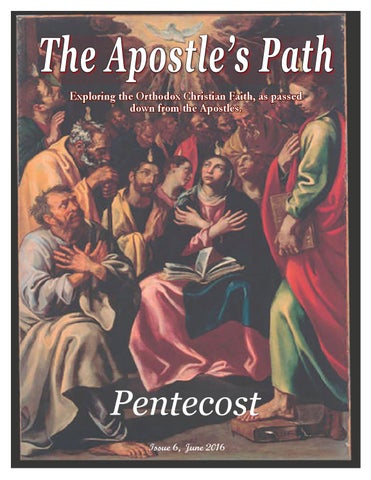
The Apostle’s Path Exploring the Orthodox Christian Faith, as passed down from the Apostles.
Pentecost Issue 6, June 2016
The Apostles Path 2
Cover Photo
Out Pouring of the Holy Ghost by Luis Tristan, 1613
Short Stories
Poetry Collections Author R. C. Gibbons www.rcgibbons.com To advertise in The Apostle’s Path, call 346-444-2711
The Apostles Path 3
From the Publisher Think Not So Highly Of Yourself One day not long ago, while my wife and I were driving through the city, we saw a stretch limousine and it stirred up a conversation. My wife asked me “Who uses those cars? Do they own them or what?” The obvious answer was that it could be anyone, i.e., musicians, movie stars, politicians, elected officials, or it could be rented for special event celebrations or wedding parties. It was however, as I was thinking of these answers, that another thought came to mind, and this led to my final observation about who uses these limousines. My next answer was, “They are used by people who think of themselves as so important that they need them, or someone who is trying to impress someone else.” Now obviously, this was a really broad statement that is not true in all circumstances, but quite possibly in many cases, it is true when you get right down to it. Our conversation ended with that, but my thoughts on the matter continued, and they led me down a preverbal rabbit trail. What I began thinking about, was how people can think so highly of themselves, and that thought then led me further along, to a self examination of myself and how easily I can slip into this prideful indulgence as well. Then, an awareness of an old foe of mine came to my remembrance again. That old foe, an issue that I have had to deal with all of my life, is a confidence in myself that I could accomplish anything that I set my mind to, because I had talents enough to do so. For many years, prior to my understanding of how strongly God dislikes pride, I lived like that, and I was relatively successful in doing so. I had a ton of confidence in my own abilities, and trusted in this confidence to take on whatever it was that I was interested in pursuing. I didn’t understand how far removed from God’s plan I was. Sure, God has given us all talents and skills to use in our livelihoods, and in serving Him, but it is not God’s desire for our confidence to be in those abilities. It is His command that our confidence be in Him alone. We must come to understand that we are nothing without God. Just as He did with the Israelites when He led them from captivity in Egypt, God has taken me through the desert on many occasions. He has brought me to my knees many times to remind me of just who is in charge, and how I am nothing without Him. We must come to realize that we are just humans, and we will only occupy this earth for a very short time, maybe 80 or 90 years if we are lucky. We must realize just how quickly time passes, and how short of a time span our life on this earth is. We have no true comprehension of reality as far as the universe and our Creator are concerned. Even our most brilliant minds cannot come to agreement on most issues, and that alone provides evidence of our limited understanding. If we really want to understand just how intelligent we are as a human race, all we have to do is listen to those, whom we have accepted as our experts, and how they argue with each other. The Apostles Path 4
We must realize our true place in God’s created world, and what our place id in His plan. When we do this, and when we learn to let God work through us with His power, then we can truly utilize the talents that He has blessed us with, and use them for a purpose that is greater than us. We will be successful, in God’s terms, because we will be doing what He alone has equipped us to do, based on the projection of His power through our lives. We are a highly refined creation, developed beyond our own understanding, but we are of no value until we are plugged into the proper power source, and the power source that we are designed to work with is God. He created us this way! We must eliminate self-confidence in OUR abilities, but at the same time, we must understand that God has equipped us with abilities that are designed to be used in His power. That is where we must place our confidence, in Him, and Him alone. I mentioned that for awhile I was relatively successful depending on myself, but when God said enough was enough, it all came to a screeching halt, and all of a sudden, I could do nothing on my own. The things that I was able to do one day, did not work the next, and my world came to a screeching halt. God had given me plenty of opportunities to change my behaviors prior to bringing me to my knees, but I ignored Him. He had patience with me for a long time, but then took corrective action to bring me back to a more true understanding how my life in Christ should be lived. Randall Gibbons
The Apostle’s Path Issue 6, June 2016
The Apostle’s Path® magazine is published with the blessing of His Grace, Bishop Peter, Administrator of The Diocese of Chicago and Mid-America (ROCOR). EDITOR Randall Gibbons THEOLOGICAL CONTENT ADVISOR Fr. John Whiteford CONTRIBUTING WRITERS Fr. John Whiteford Fr. Stephen Freeman PHOTOGRAPHS St. Nicholas Center, Saint Petersburg Theological Academy, Ted The Apostle’s Path, ISSN 2168-6807, is published monthly in Tomball, Texas by RNG Publishing, LLC. Copyright © 2016 RNG Publishing, LLC. All rights reserved. No part of this publication may be reprinted in any way without permission from the publisher. Just ask!
Dont’ forget to tell our advertisers that you saw them here!
Orthodox Living Pentecost and Creation Fr. Stephen Freeman Earth is a wondrous place – no matter where we go – how deep, how far, how high, how hot, how inhospitable – in this place we find life. Everywhere we look on our nearest neighbor – Mars – we find – no life. We want to find life. We hope to find life. We theorize life. But we have yet to find it. There is something about life, at least in our earthly experience, that is inexorable. Any individual case of life may be fragile, but life itself endures. In the Genesis account we are told that God blessed this planet and said: “Let the earth bring forth grass, the herb that yields seed, and the fruit tree that yields fruit according to its kind, whose seed is in itself, on the earth”; and it was so. And the earth brought forth grass, the herb that yields seed according to its kind, and the tree that yields fruit, whose seed is in itself according to its kind. And God saw that it was good.” (Gen 1:11-12 NKJ) Note that the account does not say that God said “Let there be life!” and life just appeared… (Boom! Trees!) But that He blessed this place and commanded that it bring forth grass… herbs… trees… according to their kind… and it was so!
that like the planet itself, civilization with its drive for beauty and order seem inexorable. The history of humanity is not the story of a fall from a great civilization with increasing instances of barbarism and cave dwelling. Great civilizations have risen and fallen, but civilizations continue to occur. Some may already have begun in the ruins that surround us now. The story told in Scripture is not the story of collapse and decay. There are certainly dire warnings of terrible trials and great catastrophes. But these things do not reveal the mystery of God’s will. These things are cracks in the pavement while life continues to burst forth: “God has made known to us the mystery of His will, according to His good pleasure which He purposed in Himself, that in the dispensation of the fullness of the times He might gather together in one all things in Christ, both which are in heaven and which are on earth– in Him (Eph. 1:9-10).” What appeared as tongues of flame upon the heads of the disciples at Pentecost was a manifestation of this Divine Purpose at work. With the sound of a mighty rushing wind, the Holy Spirit filled the room. The fullness of the Church burst into the streets proclaiming the Gospel in a multitude of languages. Being birthed in Jerusalem was the New Jerusalem, where there is neither slave nor free, Jew nor Greek, male nor female. Instead there is the fullness that fills all things bringing forth all things in one – in the One Christ Himself.
“Pentecost” by Jean Restout II, 1732. Public domain.
The feast of Pentecost in Eastern tradition, celebrates the Descent of the Holy Spirit on the Church as Christians do across the world. However, there is a strange aspect to the Eastern version of the feast (or so it might seem). The Feast focuses as much on the Holy Spirit’s work in Creation as it does on the Spirit’s work in the Church. The Church is decorated in green. In Russian tradition, branches of birch are brought into the Church; fresh green grass is placed on the floor; flowers are everywhere. In Soviet times a secular version of the festival remained, called the Day of Trees. The outpouring of the Holy Spirit on the Church is not something separate from Creation – nor are the trees a distraction from the Church. They are, together, a proper reminder of the role God’s Spirit plays always, everywhere. He is the “Lord and Giver of Life.” Just as the Spirit moved over the face of the waters in the beginning of creation, so He moves over the face of all things at all times, bringing forth life and all good things. Though I am frequently assaulted with bouts of pessimism, despairing over various aspects of our distorted civilization, the truth is
The voice of Pentecost is the voice of creation’s groans being transformed into the glorious liberty of the children of God. Stones cry out, trees clap their hands and the song of creation rejoices in the One Christ.
Fr. Stephen is a priest of the Orthodox Church in America, serving as Rector of St. Anne Orthodox Church in Oak Ridge, Tennessee. He is also author of ‘Everywhere Present’ and the ‘Glory to God’ podcast series.
To advertise in The Apostle’s Path, call 346-444-2711
The Apostles Path 5
THE CREED “I believe in One God, Father Almighty, Maker of heaven and earth and of all things visible and invisible. And in One Lord, Jesus Christ, the only-begotten Son of God, begotten of the Father before all ages. Light of Light, true God of true God, begotten, not created, of one essence with the Father, through whom all things were made. For us and for our salvation He came down from heaven and was incarnate by the Holy Spirit and the Virgin Mary and became Man. He was crucified for us under Pontius Pilate, and He suffered and was buried. On the third day He rose according to the Scriptures. He ascended into heaven and is seated at the right hand of the Father. He will come again with glory to judge the living and the dead. His kingdom will have no end. And in the Holy Spirit, the Lord, Giver of Life, who proceeds from the Father, who together with the Father and the Son is worshipped and glorified, who spoke through the prophets. In one, holy, catholic, and apostolic Church. I acknowledge one baptism for the forgiveness of sins. I expect the resurrection of the dead; and the life of the age to come. Amen.”
Pentecost The Apostles Path 6
Dont’ forget to tell our advertisers that you saw them here!
The Church Fathers “The soul that really loves God and Christ, though it may do ten thousand righteousnesses, esteems itself as having wrought nothing, by reason of its insatiable aspiration after God. Though it should exhaust the body with fastings, with watchings, its attitude towards the virtues is as if it had not yet even begun to labour for them.” --St. Macarius the Great of Egypt, 300-391
§§§§§§§§§§§§§§§ “When you are praying alone, and your spirit is dejected, and you are wearied and oppressed by your loneliness, remember then, as always, that God the Trinity looks upon you with eyes brighter than the sun; also all the angels, your own Guardian Angel, and all the Saints of God. Truly they do; for they are all one in God, and where God is, there are they also. Where the sun is, thither also are directed all its rays. Try to understand what this means. Do not fear the conflict, and do not flee from it; where there is no struggle, there is no virtue. Our faith, trust, and love are proved and revealed in adversities, that is, in difficult and grievous outward and inward circumstances, during sickness, sorrow, and privations.” --St. John of Kronstadt, Russia, 1829-1908
§§§§§§§§§§§§§§§ “Fortunate is the man who has come to have God as his helper and to have his hopes in Him alone. Let the Devil bear malice towards him, let all men persecute him and plot against him, let all his adversaries fight against him - he never fears anyone, because his has God as his helper. He remains always a victor, always glorified, always happy, always rich, always cheerful and joyful, even if he happens to fall into extreme poverty and into a great many adverse and grievous circumstances of this present life. For inasmuch as he hopes in Almighty God, he does not despair, he is not sorry, is not anxious, but expects help from Above. Fortunate, then, is such a man and worthy to be deemed happy, just as the Prophet-king David regards such a man as happy, saying: “Blessed is he whose helper is the God of Jacob, whose hope is in the Lord his God.” Such were all the Prophets, the Apostles, the Martyrs, the Holy Ascetics and all the Saints from the beginning of time.” --St. Nikephoros of Chios, Aegean Islands, 1750-1821
“When a man walks in the fear of God he knows no fear, even if he were to be surrounded by wicked men. He has the fear of God within him and wears the invincible armor of faith. This makes him strong and able to take on anything, even things which seem difficult or impossible to most people. Such a man is like a giant surrounded by monkeys, or a roaring lion among dogs and foxes. He goes forward trusting in the Lord and the constancy of his will to strike and paralyze his foes. He wields the blazing club of the Word in wisdom.” --St. Symeon the New Theologian, Constantinope, 949-1022
§§§§§§§§§§§§§§§ “For faith is the foundation of everything that comes after it, I mean hope and love, and firmly establishes what is true. Hope is the strength of the extremes, I mean faith and love, for it appears as faithful by itself and loved by both, and teaches through itself to make it to the end of the course. Love is the fulfilment of these, wholly embraced as the final last desire, and furnishes them rest from their movement. For love gives faith the reality of what it believes and hope the presence of what it hopes for, and the enjoyment of what is present.” --Maximus the Confessor, Constantinople and then Africa, 580-662
§§§§§§§§§§§§§§§ “Know that if a person is oppressed by some thought and he does not confess it (to his spiritual father), he will give the thought more power to oppose and torment him. If the person confesses the oppressive thought, if he opposes and struggles with it, instilling into himself the desire for the opposite to the thought, then the passion will weaken and will eventually cease to plague him. Thus with time, in committing himself and receiving assistance from God, that person will conquer the passion itself. It is impossible for anyone to get angry with his neighbor without initially raising himself above him, belittling him and then regarding himself higher than the neighbor. The first humility consists in considering that one’s brother has better judgment and is in all things superior to oneself—or in considering oneself below all men. The second humility consists in ascribing one’s achievements to God. This is the perfect humility of the saints.” --St. Dorotheus of Gaza, Gaza, Palestine, 505-565?
To advertise in The Apostle’s Path, call 346-444-2711
The Apostles Path 7
Fr. John’s Corner Assurance of Salvation Question: “Often in Protestant circles and Bible studies one will reference 1 John 5:13, “These things I have written to you who believe in the name of the Son of God, that you may know that you have eternal life.” This is a verse that they claim as a basis for having complete assurance of their salvation. What is the Orthodox teaching on this passage?” The question here is what does it mean to know that you have eternal life? Do we have to know that there is nothing we could possibly do to lose our salvation in order to know that we have eternal life? This sort of thinking is something that has emerged from a strange Protestant mix of Arminianism and Calvinism. Calvinism teaches that God has decreed before all eternity who will be saved and who will be damned, and so obviously, if you are among the elect, there is nothing you could possibly do to become unelected. But a Calvinist would say that those who are elect will show the fruits of their election at some point before they die, and begin to live like Christians. Arminians, on the other hand deny that God determines who will be saved, and that the offer of salvation is open to everyone, and that furthermore, one can fall away from God and lose their salvation. Most Baptists are partially Calvinistic and partially Arminian -- they believe that salvation is open to all, but that once who are saved, you cannot lose your salvation. You could “steal a horse and ride it into heaven.” And for those who have bought into this perspective, the idea of eternal security is something they believe in very strongly. And in fact, they seem to have a hard time understanding how anyone could have any confidence in their salvation if they did not have the absolute assurance that they could not possibly lose their salvation.
the other involves striving on our part. However, the latter is our contribution only to the extent that we submit to His grace and do not surrender the treasure nor extinguish the torch when it has been lighted. By this I mean that we contribute nothing which is either hostile to the life or produces death. It is to this that all human good and every virtue leads, that no one should draw the sword against himself, nor flee from happiness, nor toss the crowns of victory from off his head” (The Life in Christ, trans. by Carmino J. DeCatanzaro, (Crestwood, NY: St. Vladimir’s Seminary Press, 1974), pp. 48-49). Countless passages of Scripture could be cited to demonstrate that it is possible for us to lose our salvation, but the following words of the Prophet Ezekiel are a fairly clear example: “The soul that sinneth, it shall die. The son shall not bear the iniquity of the father, neither shall the father bear the iniquity of the son: the righteousness of the righteous shall be upon him, and the wickedness of the wicked shall be upon him. But if the wicked will turn from all his sins that he hath committed, and keep all my statutes, and do that which is lawful and right, he shall surely live, he shall not die. All his transgressions that he hath committed, they shall not be mentioned unto him: in his righteousness that he hath done he shall live. Have I any pleasure at all that the wicked should die? saith the Lord God: and not that he should return from his ways, and live? But when the righteous turneth away from his righteousness, and committeth iniquity, and doeth according to all the abominations that the wicked man doeth, shall he live? All his righteousness that he hath done shall not be mentioned: in his trespass that he hath trespassed, and in his sin that he hath sinned, in them shall he die” (Ezekiel 18:20-24).. Fr. John Whiteford is the Pastor of St. Jonah Orthodox Church (ROCOR) in Spring, Texas. He is the author of ‘Sola Scriptura: An Orthodox Analysis of the Cornerstone of Reformation Theology’, published by Conciliar Press, and the General Editor of the ‘St. Innocent Liturgical Calendar’.
I have known my wife since I was 17, and we have been married for more than 27 years. I feel very secure in our relationship, but I am quite certain that there are things I could do to destroy that relationship. I am not in fear of that happening, however, because I have no intention of doing any of those things. So I know that my wife loves me, but I also respect her, and make sure that I treat her with love and respect so as to maintain that relationship. Our relationship with God is similar. We know God loves us, but we also know that if we turn our back on Him, we will not remain in a right relationship with Him. All we need to do, however, is to not do that. St. Nicholas Cabasilas explains how we are saved in our cooperation with God this way: “There is an element which derives from God, and another which derives from our own zeal. The one is entirely His work, The Apostles Path 8
Dont’ forget to tell our advertisers that you saw them here!
The Apostle’s Path® magazine is a trademarked publication of RNG Publishing LLC. Reader correspondence and editorial contributions are welcome, but we reserve the right to edit or rejects all submissions. Advertisers assume all liability for content of their advertising. Publisher assumes no responsibility should false or misleading advertising appear. The Apostle’s Path magazine is distributed freely, but subscriptions are available if there is a desire to have a single copy of the magazine delivered to your home or business. The Apostle’s Path magazine is distributed freely, and is therefore, supported by our advertisers. We strongly encourage you to patronize our advertisers and tell them that you saw them in our magazine, so they will understand the value in continuing their support. Advertising inquiries should be made to:
advertising@rngpublishing.com or 346-444-2711
let us take care of all your printing needs
MAGAZINES | CATALOGS POSTCARDS | CALENDARS & BROCHURES
4954 Space Center Dr., San Antonio, TX 78218 210.480.0860 | www.shweiki.com
ABC-123 INSURANCE
ROSE G. BENNETT Your Independent Agent!
OUR MISSION: TO HELP YOU PROTECT YOUR HOME • YOUR AUTO • YOUR ASSETS AND ALL THAT YOU CARE FOR, BECAUSE WE KNOW HOW IMPORTANT THEY ARE TO YOU AND YOUR FAMILY. 281-210-9596 abc123insuranceplus@gmail.com
The Apostles Path 10
Dont’ forget to tell our advertisers that you saw them here!
Feast of Holy Pentecost The Feast of Holy Pentecost is celebrated each year on the fiftieth day after the Great and Holy Feast of Pascha (Easter) and ten days after the Feast of the Ascension of Christ. The Feast is always celebrated on a Sunday.
baptized continued daily to hear the teaching of the Apostles, as the early Christians met together for fellowship, the breaking of bread, and for prayer. Many wonderful signs and miracles were done through the Apostles, and the Lord added to the Church daily those who were being saved (Acts 2:42-47).
The Feast commemorates the descent of the Holy Spirit upon the Apostles on the day of Pentecost, a feast of the Jewish ORTHODOX CHRISTIAN CELEBRATION OF tradition. It also celebrates the establishment of the Church THE FEAST OF PENTECOST through the preaching of the Apostles and the baptism of the thousands who on that day believed in the Gospel message of This great Feast of the Church is celebrated with the Divine salvation through Jesus Christ. The Feast is also seen as the Liturgy of Saint John Chrysostom on the Sunday that is the fiftieth day after the celebration of Pascha. The Liturgy is culmination of the revelation of the Holy Trinity. conducted on the day of the Feast, and is preceded the evening before by a Great Vespers service and on the morning of the BIBLICAL STORY Feast by the Matins service. On the day of the Feast a Vespers The story of Pentecost is found in the book of The Acts of the service is conducted that includes the kneeling prayers. These Apostles. In Chapter two we are told that the Apostles of our prayers mark the beginning of the practice of kneeling during Lord were gathered together in one place. Suddenly, a sound the Liturgy at the time when the holy gifts of bread and wine came from heaven like a rushing wind, filling the entire house are consecrated as the body and blood of Christ. The practice of where they were sitting. Then, tongues of fire appeared, and kneeling has been suspended during the Paschal season. On the one sat upon each one of Apostles. They were all filled with the Monday following the Feast, the Divine Liturgy is conducted Holy Spirit and began to speak in other languages as directed in commemoration of the All-holy and Life-creating and Allpowerful Spirit, Who is God, and One of the Trinity, and of by the Spirit (Acts 2:1-4). one honor and one essence and one glory with the Father and This miraculous event occurred on the Jewish Feast of the Son (From the Synaxarion of the Feast). Pentecost, celebrated by the Jews on the fiftieth day after the Passover as the culmination of the Feast of Weeks (Exodus Scripture readings for the Feast are the following: At the 34:22; Deuteronomy 16:10). The Feast of Weeks began on the Saturday Vespers: Numbers 11:16-17, 24-29; Joel 2:23-32; third day after the Passover with the presentation of the first Ezekiel 36:24-28. At the Orthros (Matins): John 20:19-23. At harvest sheaves to God, and it concluded on Pentecost with the Pentecost Sunday Divine Liturgy: Acts 2:1-11; John 7:37the offering of two loaves of unleavened bread, representing the 52, 8:12. At the Divine Liturgy on the Monday of the Holy first products of the harvest (Leviticus 23:17-20; Deuteronomy Spirit: Ephesians 5:8-19; Matthew 18:10-20. 16:9-10). PRAYER OF THE HOLY SPIRIT Since the Jewish Feast of Pentecost was a great pilgrimage feast, many people from throughout the Roman Empire Heavenly King, Comforter, the Spirit of Truth, everywhere were gathered in Jerusalem on this day. When the people in present and filling all things, Treasury of blessings and Giver of Jerusalem heard the sound, they came together and heard their life: come and abide in us, cleanse us from every impurity and own languages being spoken by the Apostles (Acts 2:5-6). The save our souls, O Good One. people were amazed, knowing that some of those speaking were Galileans, and not men who would normally speak many HYMNS OF THE FEAST different languages. They wondered what this meant, and some Apolytikion (Plagal Tone Four) even thought the Apostles were drunk (Acts 2:7-13). Blessed are You, O Christ our God, who made fisherman Peter, hearing these remarks, stood up and addressed the all-wise, by sending down upon them the Holy Spirit, and crowd. He preached to the people regarding the Old Testament through them, drawing all the world into Your net. O Loving prophecies about the coming of the Holy Spirit. He spoke One, glory be to You. about Jesus Christ and His death and glorious Resurrection. Great conviction fell upon the people, and they asked the Kontakion (Plagal Tone Four) Apostles, “What shall we do?” Peter said to them, “Repent, and When the Most High came down and confounded tongues of let every one of you be baptized in the name of Jesus Christ for men at Babel, He divided the nations. When He dispensed the the remission of sins; and you shall receive the gift of the Holy tongues of fire, He called all to unity, and with one voice we glorify the Most Holy Spirit. Spirit” (Acts 2:38-39). The Bible records that on that day about three thousand were Used with permission from the website of The Greek Orthodox baptized. Following, the book of Acts states that the newly Archdiocese of America.
To advertise in The Apostle’s Path, call 346-444-2711
The Apostles Path 11
Geography "We Are Going Up to Jerusalem" “We are going up to Jerusalem...and the Son of Man will be betrayed to the chief priests and teachers of the law. They will condemn him to death and will hand him over to the Gentiles” (Mark 10:33). The spectacular 17-mile-long route to Jerusalem via Wadi Qelt heads west from Tulul Abu al-Alayiq, the site of New Testament Jericho (also called Herodian Jericho). “Wadi” is Arabic for a creek bed or ravine, dry throughout the year
Map of Old Testament Israel. www.Bible-History.com. Used with permission.
except in the rainy season; not an inspiring definition, but Wadi Qelt is a wonder. The Judean desert between Jericho and Jerusalem is not a monotonous, sandy wasteland, like the Sahara, for example, but a constantly renewing landscape of hills and valleys. Even today, despite the encroachment of Jewish settlements on the edges of Jerusalem, it is an awesomely beautiful place, like the newly emerged dry land at the dawn of creation, awaiting only the word of God to bring forth life. Wadi Qelt is a natural rift in the Judean hills with high, sheer rock walls between Jericho and Jerusalem. The narrow and difficult road lining the wadi was once the main route to Holy City. It is now used only by tourists, having been superseded by the modern paved highway, Route 1. It follows the line of a Herodian a q u e d u c t (actually a The Apostles Path 12
channel through with the water flowed) built along on the north side of the valley to bring water to the Hasmonean and Herodian palaces at Jericho from the Ein Farah spring. The route saw frequent use right up to the end of the Ottoman period in 1917. Some of the biblical events which likely occurred on this route include David’s flight from Absalom (2 Samuel 15-16), Zedekiah’s flight from the Babylonians (2 Kings 25:4), and the story of the Good Samaritan (Luke 10:25-37). Heading westward from Tulul Abu al-Alayiq, the narrow road climbs swiftly into an unrelenting landscape of barren, brightly colored hills and valleys that see very little water. In the summer the temperatures here can be in excess of 100º F. Less than a mile west of Herod’s palace complex is the site of Cypros (bottom left), a strategic peak that once guarded the old road as it left the plains around Jericho. Often described as a “miniMasada,” most of its buildings (including two bath houses) are attributed to Herod the Great. Named for Herod’s mother, it was the nearest fortress where the paranoid king could retreat in the event of a revolt. The silence is broken only by the wind, the rattle of pebbles tumbling down the slopes of the hills, and the scuffing of sandals. As Jesus trod the dusty path heading up to Jerusalem for the last time he likely remembered the 40 days he spent alone in this area following his baptism at the Jordan by John the Baptist. Text and photos from www.welcometohosanna.com. Used with permission.
And they were in the way going up to Jerusalem; and Jesus went before them ...
Dont’ forget to tell our advertisers that you saw them here!
+ Medicine Cabinet + All I Need To Know I Learned From Noah And The Ark 1. Don’t miss the boat. 2. Try to remember that we’re all in the same boat. 3. Plan ahead. It wasn’t raining when Noah built the ark, you know. 4. Stay fit. When you’re 600 years old, someone might ask you to do something REALLY big. 5. Don’t listen to critics, just get on with what has to be done. 6. Build your future on high ground. 7. For safety’s sake, travel in pairs. 8. Two heads are better than one. 9. Speed isn’t always an advantage; after all, the snails were on board with the cheetahs. 10. When you’re stressed, try floating awhile. 11. Remember that the ark was built by amateurs; it was the Titanic that was built by professionals. 12. Remember that woodpeckers inside are a larger threat than storms outside. 13. No matter what the difficulty, trust in the Almighty: There’ll be a rainbow at the end of the storm. ------------------------------------Two ladies of lighter hair color are on opposite sides of the river, “How do I get to the other side?” yelled one lady. “You are on the other side,” the other one yelled back. ------------------------------------The factory of the future will have two employees, a man and a dog. The man will be there to feed the dog, and the dog will be there to keep the man from touching the computers. ------------------------------------Dispatching her ten-year-old son to pick up a pizza, a mother handed him some money and a discount coupon. Later he came home with the pizza AND the coupon. When asked to explain, he replied, “Mom, I had enough money. I didn’t need the coupon.” ------------------------------------John, who is noted for his gracious manners, was awakened one morning at 4:00 A.M. by his ringing telephone. “Your dog’s barking, and it’s keeping me awake,” said an angry voice. John thanked the caller and politely asked his name and number before hanging up. The next morning at precisely 4:00 A.M., John called his neighbor back. “Good morning, Mr. Williams. I just called to say that I don’t have a dog.”
To advertise in The Apostle’s Path, call 346-444-2711
The Apostles Path 13
A Bit Of History Where Is Nicea? The city Nicea, also Nicaea, now known as Iznik in Turkish, was the site of two Ecumenical Councils of the early Christian Church. During Latin rule of Constantinople after its capture in 1204 by the Fourth Crusade, Nicea was the capital city of the Empire of Nicea, which was the strongest of the surviving Byzantine states. Located near the eastern end of the Sea of Marmara on what is now Lake Iznik, Nicea was built on the site that was originally called Ancore/Helicore. There are two versions of how Nicea received its name. In one story the town later came under the control of Lysimachus who renamed the town Nicea after his wife. In another account it was founded by Alexander’s men from Nicea near Thermopylae. The nearness of Nicea to Constantinople appeared to have contributed to the use of the city in the important events involving the Church and the Roman emperors. It was only 43 miles (70 km) from the capital. Nicea was encircled by a wall that was 14,520 feet (4,426 meters) long. The wall is almost entirely intact today. Nicea was the site of the First, in 325, and in 787, the Seventh Ecumenical Councils. These councils are also known as the First and Second Councils of Nicea. The First Council addressed the Arian heresy and more clearly defined the concept of the Trinity which the council expressed in the Nicene Creed. The second council addressed the issues relating to icons raised by the iconoclasts, expressing their proper use for veneration. The first council was held in the Senatus Palace that now lays beneath the waters of Lake Iznik. The seventh council was held in the Church of Hagia Sophia that was built by Justinian in the sixth century. This church was modeled after the Hagia Sophia in Constantinople. Located in the center of the city, Hagia Sophia was turned into a mosque by the Turks and renamed Orhan Ghazi Mosque in 1331. Over the years this structure has been badly damaged by earthquakes and fires. Some mosaics and a fresco of Christ, however, remain. The Church of the Dormition, a major church in Nicea, was destroyed by the Turks in 1922. This church was decorated with many fine mosaics that dated from the ninth century. In 1081, Nicea was captured by the Seljuk Turks, but was recaptured in 1097 by Emperor Alexius I Comnenus. During the period that the Turks held Nicea, they renamed the city Iznik. When Constantinople was captured by the Latin crusaders in 1204, the Byzantine Romans established separate realms in the parts of Anatolia that were not held by the Latins. Nicea became the capital of the Empire of Nicea and served for 50 years as the political and cultural center of this, the strongest of the Byzantine states, until Michael VIII Palaeologus recaptured Constantinople from the Latins and restored Byzantium. The Apostles Path 14
Eastern Orthodox Icon of the First Ecumincal Council
Dont’ forget to tell our advertisers that you saw them here!
St Cyril of Jerusalem Orthodox Church
St Anthony the Great Orthodox Church Saint Jonah Orthodox Church St Sava Serbian Orthodox Church
St Mary Magdalene's St Joseph Orthodox Christian Church
St Vladimir Russian Orthodox Church
St. Paul's Orthodox Christian Church Saint George Orthodox Church St Basil the Great Greek Orthodox Church
Annunciation Greek Orthodox Cathedral
St. Andrew Orthodox Mission
Holy Forty Martyrs of Sebaste Antiochian Orthodox Church
St John the Theologian Greek Orthodox Church
In the Houston area, we have parishes under seven different general jurisdictions. ORTHODOX CHRISTIAN PARISHES IN THE GREATER HOUSTON AREA ARRANGED BY JURISDICTION: The Antiochian Orthodox Christian Archdiocese of North America
The Orthodox Church in America
Holy Forty Martyrs of Sebaste Antiochian Orthodox Church St. Anthony the Great Antiochian Orthodox Church St. George Antiochian Orthodox Christian Church St. Joseph Antiochian Orthodox Church St. Michael Antiochian Orthodox Church St. Paul Antiochian Orthodox Church St. Silouan Orthodox Church
St. Cyril of Jerusalem Orthodox Church
The Greek Orthodox Archdiocese of America
Life Giving Spring Orthodox Church St. Jonah Orthodox Church St. Vladimir Russian Orthodox Church
Annunciation Greek Orthodox Cathedral Assumption of the Virgin Mary Greek Orthodox Church St. Basil the Great Greek Orthodox Church St. George Greek Orthodox Church St. John the Theologian Greek Orthodox Church St. Paraskevi Greek Orthodox Monastery
The Orthodox Church in America - Romanian Episcopate St. Andrew Orthodox Mission St Mary of Magdala Romanian Orthodox Mission The Russian Orthodox Church Outside Russia
The Serbian Orthodox Church in America Ss. Constantine & Helen Serbian Orthodox Church St. Sava Church
Orthodox Houston Clergy Association www.orthodoxhouston.org
The Apostles Path 15
The Apostles Path 16