31ST ANNUAL OLD SETTLER’S MUSIC FESTIVAL
TILMON (NEAR LOCKHART),
TEXAS
THURSDAY-SUNDAY
APRIL 19-22
2018
GREENSKY BLUEGRASS * RAILROAD EARTH * CALEXICO * BOB SCHNEIDER I’M WITH HER – SARA WATKINS, SARAH JAROSZ, AOIFE O’DONOVAN JD MCPHERSON * RAY WYLIE HUBBARD * BALSAM RANGE * DONNA THE BUFFALO THE GRATEFUL BALL FEATURING THE TRAVELIN’ MCCOURYS & JEFF AUSTIN BAND WILL HOGE * DARLINGSIDE * THE TRAVELIN’ MCCOURYS * STEVE POLTZ THE CALIFORNIA HONEYDROPS * JEFF AUSTIN BAND * FRONT COUNTRY BILLY BIL STRINGS * THE WAR & TREATY * COLTER WALL * THE DEER THE PETERSON BROTHERS * WE BANJO 3 * JON STICKLEY TRIO * SOPHIE SCOTT AND MORE TO COME! CAMPING, JAMMING, PERFORMANCE WORKSHOPS, YOUTH COMPETITION, KIDS’ ACTIVITIES, ARTS & CRAFTS.
TICKETS: WWW.OLDSETTLERSMUSICFEST.ORG
table of contents JANUARY
features COVER STORY
4
Online This Month
6
Student Exhibition
-----------------------------
The Fabric of Change
In Need of Translation
16 -------------
40
To save a vital nonprofit from shutting down, native-Belizean Rowan Garel began an aggressive fundraising effort predicated on doing things that no blind person had ever done before. Now, the Drew University sophomore is world famous and barely slowing down. BY JOIYA REED
BY MAAHFIO OTCHERE
Intramurals
When Kyle Kurdziolek, a linebacker at the Illinois University of Saint Francis, came out of the closet, his admission helped transform college locker rooms across the country.
STUDYBREAKS.COM
18
22
Talking Notes
Miami-based synth-pop group Souvenir defies the recycled, washedout sounds of the genre with preternatural talent and candor. BY JACK BRANDON
Student Government
BY PATRICK MURTHA
STEM Gems
After taking first place in LaunchLab’s Entrepreneur Pitch Contest, industrial engineering major Will Keefe won more than he bargained for. BY MAYA HALABI
Tastemakers
Ithaca’s Peter Champelli uses motion graphics, radio and video to create journalism with style. BY CARLI SCALF
Greek Life
Delta Gamma member Addison Keilty created an online platform to feature sorority women heading remarkable accomplishments in the science field. BY GISELLE KRACHENFELS
23 25 26 27 46 --------------
Blind Determination
14 ---------
34
After being spurred into action by the Charlottesville protests, University of Virginia’s Amalia Garcia-Pretelt began working for the city’s witness protection program, giving embattled immigrants a voice by translating theirs. BY CHERYL SUTTON
13 -------------
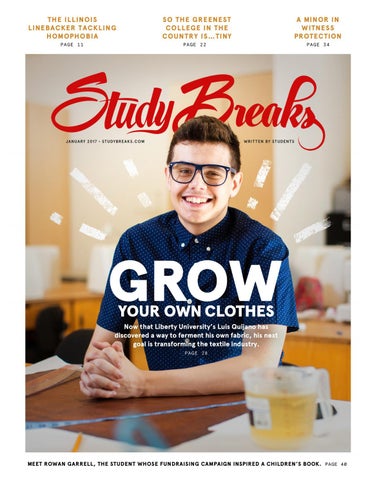
By combining green tea, kombucha, sugar and water, Liberty University senior Luis Quijano has developed a process to grow his own clothing. Now he wants to disrupt the fashion industry. BY LESLIE CURRIE
University of Southern Mississippi student Whitson Ramsey’s paintings use soft edges and muted colors to allow for occasional bursts of extreme contrast.
/
-----------
11
28
2018
47
What’s Your Major? The Meal Plan University Report #CollegeHacks Extra Credit
Lauren LaMonica, the Yale student and co-president of A Leg Even, is using combining her love for public health with her passion for facilitating class equality. BY SHASHANK RAO
Meet the President
+ editor’s note
------------
table a grand new vision for the future of the publication. We hired Jesus with the intent of bringing some major aesthetic changes to the magazine, and I’m sure you’ll see what I’m talking about in the next few months. Alongside Jesus is Raquel Alonzo, our new web editor and a recent graduate of the University of Texas at San Antonio. Raquel began working with us part-time in early October, and as the scale of our website has continued to increase— nearly three-hundred long form pieces a month (!)—we realized it was time to bring her on full-time, a decision that everyone in the office, especially Raquel, was happy about. In getting to hire these two recent graduates, it’s become apparent to me, really for the first time, that one of the best things about running a growing business is getting to bring in new, talented people. Hopefully, as we continue to expand, Study Breaks will continue growing, we’ll be able to continue hiring new graduates and the whole enterprise will evolve, improve and be able to serve our student readership even better.
J
anuary is always an interesting month on the Study Breaks editorial calendar, as much of our student readership is still at home for winter break when the magazine is released. As we become an increasingly digital-first platform, winter and summer breaks certainly affect us a lot less, but the tradition of using January as a bit of an experimental month—because no one is on campus for half of it—is still one that we cherish. Last year we used the month to publish a photography issue, a decision half motivated by the fact that goading our writers into meeting their deadlines over the holidays is harder than herding cats—cats who, by the way, can ignore your Slack messages until after the New Year. So, we figured, we’d go with the flow, put together a labor-unintensive issue and get to produce a visually stunning publication that at least the staff would get to have a fun time making. This year, though we opted to forego putting out another photography issue, we’ve kept the spirit of experimentation alive by bringing in two important additions to the Study Breaks team. This month marks the first magazine released under the art direction of Jesus Acosta, a recent University of Texas at Austin graduate who’s joined the team and brought to the
Finally, it should go without saying that none of this would be possible without our continued readership, both of the print magazine and our online platform, so thank you. Thanks for believing in a tiny project that’s increasingly turned into a career-defining publication, for me at least, and thank you for supporting your peers—whether they’re writers, artists, entrepreneurs, engineers—Study Breaks will always be a magazine by students, for students. Thanks for playing a part in bringing that to life.
our team FOUNDER Gal Shweiki ART DIRECTOR Jesus Acosta EDITOR-INCHIEF Mark Stenberg WEB EDITOR Raquel Alonzo DIGITAL EDITORS Jake Devin, Anh Le MARKETING DIRECTOR Carmina de Alba ACCOUNTING Elizabeth Castro DISTRIBUTION MANAGER Marcus Flores DISTRIBUTION Frank Hartfield, Jose Espinoza, Ernest Ward
Sincerely, Mark Stenberg @MarkStenberg3
----------------------------------------------------------------------------PRODUCTION: Shweiki Media Study Breaks magazine is published twelve times per year by Shweiki Media, Inc. copyright 2012. All rights reserved. This magazine may not be reproduced in whole or in part in any form or by any means electronic or mechanical, including photocopying or recording, or by any information storage and retrieval system now known or hereafter invented without written permission from the publisher. Reproduction or use in whole or in part of the contents of this magazine or of the trademarks of Study Breaks Magazine, Inc., without written permission of the publisher is prohibited. The publisher assumes no responsibility for care and return of unsolicited materials. Return postage must accompany material if it is to be returned. In no event shall such material subject this magazine to any claim for holding fees or similar charges. Study Breaks Magazine is an entertainment magazine for the students of San Antonio, San Marcos, Austin and Lubbock, published 12 times a year. CORPORATE OFFICE: Study Breaks Magazine Inc., 4954 Space Center Dr., San Antonio, TX 78218 • CONTACT STUDY BREAKS: Editorial: Mark Stenberg, 210-705-3284, editorial@studybreaks.com • Study Breaks Magazine is excited to help your brand reach our audience through video and written content. SALES: Ralph Chaplin, 210-892-0951, contact@studybreaks.com
Writer
///
MA AHFIO OTCHERE @maahfio Villanova University
Journalism Student Exhibition PA G E 6
+ contributors
------------
Photographer
JACK BR ANDON University of Michigan
English Talking Notes PA G E 1 8
M AYA H A L A B I @mayaemii
PAT R I C K M U R T H A @patrickmurtha_
University of Texas at San Antonio
Eastern Connecticut State University
International Relations and Communications STEM Gems PA G E 1 3
New Media Studies Intramurals PA G E 1 1
J O I YA R E E D
BR ANDI LOVING @literallythebest
LESLIE CURRIE @lesliecurrie
CAMELIA JUAREZ @shescamie
University of Virginia
Texas State University
Foreign Affairs Student Government, The Fabric of Change PA G E 2 2 , 2 8
Journalism What’s Your Major? PA G E 2 3
Journalism and Spanish The Meal Plan, Blind Determination PA G E 2 5 , 4 0
C H E RY L S U T T O N @cheryl_98
JOSEPH COOLEY @josephcolleythe3rd
Purdue University
Creative Writing In Need of Translation PA G E 3 4
GISELLE KRACHENFELS USC
Business Greek Life PA G E 1 6
CARLI SCALF @carliscalf18 Ball State University
English and Journalism Tastemakers PA G E 1 4
CHRISTIAN ZEITLER
SHASHANK R AO
Carnegie Mellon
University of Michigan
English College News PA G E 2 7
Professional Writing and Creative Writing #CollegeHacks PA G E 2 8
English and Creative Writing Extra Credit PA G E 4 6
N AV I S C H I F F @spazzground
G A RY M U R R AY @gary_a_murray
KRISTEN HARRISON @krhphoto
R ACHAEL K ARP @rachhaelkarpp
University of Southern Mississippi
School of the Art institute
University of West Virginia
Ithaca College
Southern Connecticut State University
Fine Arts Student Exhibition PA G E 6
Photography Intramurals PA G E 1 1
Industrial Engineering STEM Gems PA G E 1 3
Documentary Studies and Production Tastemakers PA G E 1 4
Marketing Greek Life PA G E 1 6
Georgia Southern University
St. Mary’s University
Study Breaks Writing Internships MARIA-ELENA ARJONA @mariashutter Paier College of Art
Photography Greek Life PA G E 1 6
ALEX ANDER MCPHEE University of Miami
Marketing Talking Notes PA G E 1 8
ANDREW SNYDER @andrewrsnyd Liberty University
Web Development The Fabric of Change PA G E 2 8
Study Breaks is written exclusively by a team of student interns from across the country. These writers work with the editorial team to pitch and submit one piece a week for the website, in addition to writing for the monthly print magazine. Spring internships run from January 28 to May 28, and applications close January 14. If interested, email editorial@studybreaks.com with “Student Writing Internship” in the Subject.
SARAH DODGE @sarahdodgephotography
JAMIE PIERRE @blckphotography
University of Virginia
Drew University
Media Studies and Psychology In Need of Translation PA G E 3 4
Art Blind Determination PA G E 4 0
ROBBIE SHORT @thetallestshort Yale
Photography Extra Credit PA G E 4 6
Introduce yourself in the body, making sure to include your name, school and major. Please attach at least two samples of your work. Ideal writers are intelligent, funny and talented, though no formal experience is necessary.
+ online this month ----------------
ONE LINERS
Right now at
StudyBreaks.com spotlight U T S T UD E N T F O R M S F IR S T RE C O R D L A B E L O N C A MP U S Maria Tangarova, a sophomore at the University of Texas, created a multifaceted record company for students because she felt that, despite being the purported “live music capital of the world,” Austin offered very little to local student artists. Enter, UTalent Records.
from the vault
T HE O T HE R W O R L D LY P H O T O G R A P H Y O F U S C ’S A L E X C URRIE Last year, for the January issue, “Study Breaks” published a photography issue featuring five of the country’s most talented student photographers, one of whom was USC student Alex Currie. The twenty-year-old, whose magical, color-saturated photography looked like something out of “A Wrinkle in Time,” was already working with HBO and Complex as a production consultant. A year later, his work is only more impressive.
4 L I T E R A RY M A G A Z INE S E V E RY A S P IRIN G W RI T E R S H O UL D S UB S C R IB E T O
by Angela Herbst, Lakeland University
------------------------------------------------------O NL INE C O L L E G E This month on the website, learn how to: Read what writers read // Tactfully lie on your resume // Spot a Nazi from across the room // Avoid getting caught for doping at the Olympics // Tweet better than Trump // Cut your hair and change your life // List the worst Christmas movies of all time
“To that I say: Isn’t Nazism the real danger to democracy?”– Shashank Rao, University of Michigan, Why Letting a Nazi Speak on Campus Is a Danger to Democracy “However, as Russia’s one of the United States’ biggest rivals, not to mention the unofficial Slytherin of the Olympics, their absence will affect the medal turnout significantly.” – Maya Halabi, University of Texas at San Antonio, The Dopest Dope Russia Ever Smoked “Here’s to hoping every character I love survives relatively intact.” – Marissa Cortes, Stony Brook University, What Can Audiences Expect from “Avengers: Infinity War”? “Leave it to white privilege to find three jokes in ‘Get Out’ and call it a comedy.” – Brandi Loving, St. Mary’s College, Is There Room for Black Horror in Hollywood? “After all, feminism deals with gender roles a lot more than sushi rolls anyway.” – Karen Guan, Southern Methodist University, The Rise of Feminism Has Become a Fashion Statement
what’s on the inside
Photography by Alexander McPhee
STUDENT EXHIBITION
THE BEAUTY OF CONTRAST By Maahfio Otchere
6 INTRAMURALS
LOVE
AND
FOOTBALL
By Patrick Murtha
10 STEM GEMS
LAB
PRACTICAL
By Maya Halabi
12 TASTEMAKERS
THE ART OF STORYTELLING By Carli Scalf
14 GREEK LIFE
THE SCIENCE OF SISTERHOOD By Giselle Krachenfels
16 talking notes more than a memento From Carly Rae Jepsen’s “Emotion” to Netflix’s “Stranger Things,” the styles and sounds of the ’80s have returned. There’s something in the wavy current of synth and the sharp kick of a drum machine that evokes a deep nostalgia.
Continued on page 18
the honor roll
HIS WORK
Whitson Ramsey B Y M A A H O T C H E R E , V I L L A N O VA U N I V E R S I T Y P H O T O G R A P H Y B Y J O S E P H C O O L E Y, UNIVERSI T Y OF S OU T HERN MISSISSIP P I
+ honor roll: student exhibition ------------ ------------
W
hitson Ramsey, a visual artist and student at the University of Southern Mississippi, will be the first person to tell you that contrast, especially in colors, is a fickle thing, even moreso when its use is your hallmark.
finished product or as a preparation for paintings, and I use both methods. When it comes to working on drawings as a means to simply make a drawing, I like to let it stand for itself. Using color would add more, but also take away from the form. I like to use drawing as a way to focus on shape.
By nature, the concept is a product of precise restraint: a profusion, or an absence, of color can kill it. So, though it might seem counter-intuitive, stark, truly effective contrast comes only as the result of meticulous balance.
MO: A LOT OF YOUR FIGURES HAVE SIMILAR FACES TO THE ONE IN “BACK TO THE LAKE,” WHICH WON FIRST PLACE IN DRAWING AT THE 2017 USM STUDENT SHOW. WHY USE SIMILAR PHYSIOGNAMIES? WR: I always draw from live models, but I have never been one to think of the drawing process as representational. I don’t think there are real, nameable features about my work that call for some sort of individuality. If I draw from someone, I am not necessarily trying to draw that person; I’m only using them as a point of reference. I never thought of putting identifiable factors or personality into my figures because that’s not what I am trying to make my drawings about. They’re more about getting the figure established in some sort of environment and then making it a part of that environment.
Ramsey, a native of Hattiesburg, Mississippi, creates in that interstice where contrast lives. He works primarily in three mediums: drawing, painting and sculpture. His drawings, which are all monochrome, balance white and black, color and darkness; his paintings, almost Munchian in their swirling, melting colors, have won a number of awards, including Best in Show at the 44th Annual Bi-State Art Competition at the Meridian Museum of Art; and his sculpture, in a masterwork of juxtaposition, turns steel, concrete and wood into soft, rounded blooms. I was able to speak with the artist about his work, philosophy and future in the field. MAAHFIO OTCHERE: YOUR DRAWINGS ARE ALMOST ALL MONOCHROMATIC. WHY DO YOU CHOOSE TO USE ONLY BLACK AND WHITE? Whitson Ramsey: I think that when it comes to drawing, you can view it in two separate ways: as a
NAME
FACT FILE
Whitson Ramsey
SCHOOL
University of Southern Mississippi
INSPIRATION
Contrast, muted colors, shapes, designs
MEDIUM
Fine arts (drawing and paintings)
MO: JUST AS YOUR DRAWINGS SHARE A SIMILAR MONOCHROMATIC AESTHETIC, MOST OF YOUR PAINTINGS FEATURE MUTED COLORS. DO YOU THINK THE SOFTER TONES INFLUENCE THE WAY PEOPLE SEE YOUR WORKS? WR: After studying the imagery of color, I found that using muted colors served as a way to make small amounts of brighter colors pop even more. So, I use the muted colors to establish a unifying color key, where the duller greys allow for the brighter colors to show more. I really think I am rather conservative when it comes to using color, which I think comes from me not wanting to overuse brighter colors unncessarily. I want to make a visual point when I use a highly saturated color because I think that there is a reaction to its use. As a result, having such contrasting colors next to one another creates an almost conflicting emotion within the viewer. MO: YOUR PAINTING “THE PINK MAN” WON BEST OF SHOW AT THE 44TH ANNUAL BI-STATE COMPETITION AT THE MERIDIAN MUSEUM OF ART IN MERIDIAN, MISSISSIPPI. WHAT WERE YOU TRYING TO DO WITH THAT WORK, AND DO YOU THINK YOU SUCCEEDED? WR: That painting was definitely a trial-and-error process of using what I had learned from earlier paintings, but in a more abstract way. I remember the painting being more about placing and laying colors and shapes without identifying an area as a feature. I moved the shapes and colors so much that the work ended up being a mess. But from this I discovered the figure inside of it and saw different things that weren’t there before. I also had never painted in mostly pink, so I thought that would be interesting.
STUDYBREAKS.COM
|
9
“Untitled” by Whitson Ramsey
MO: IN PAINTINGS SUCH AS “THE PINK MAN” AND OTHERS, THE IMAGES SEEM TO BLEND TOGETHER. WHY AVOID FIXED LINES? WR: Similiar to my use of colors, I think that edge quality and lines have more distinction if I use loose, soft areas to show hard edges in a more impactful way. Whenever I then decide to put in a hard edge, it becomes a contrasting feature, rather than a unifying factor. By using soft edges, you can get away with getting more colors into the painting while maintaining their natural fluidity. MO: CONSIDERING YOUR PREDILECTION FOR FLUIDITY AND BOUNDARYLESSNESS, YOUR SCULPTURES ARE INCREDIBLY RIGID. WORKS SUCH AS “STEEL AND STAINED WOOD” AND “RUSTED STEEL” ARE SHARP DEPARTURES FROM THE SOFTNESS OF YOUR PAINTINGS. WHY DELVE INTO SCULPTURE AT ALL? WR: As a medium, sculpture is definitely a branch-off of what I had been doing at the time, but it was an opportunity to explore metal and wood. With my sculptures, I have always gone a non-objective route and chose unnatural
forms to invade the environment we inhabit. While I had never done non-objective painting and drawings, when it came to sculpture, the field offered a chance for me to explore a new realm, even if it was not related to to my twodimensional work. MO: IN YOUR SCULPTURES, THERE IS OFTEN A THICK, CIRCULAR OR CRESCENT-SHAPED PIECE ATTACHED TO AN ARCHED BASE. IS THE REPETITION OF THAT THEME SIGNIFICANT? WR: Sculptures are a more industrial way of art because of the machinery and metal used to create the piece. In the structures you’re referring to, I think you get a more organic shape that contrasts against the inorganic materials. Since the materials are very processed, playing that aspect against the free organic shapes helps define the nature of the work.
+ honor roll: student exhibition ------------ ------------
STUDYBREAKS.COM
|
11
Tackling Homophobia
When Kyle Kurdziolek, a linebacker at the Illinois University of Saint Francis, came out of the closet, his admission helped transform college locker rooms across the country. BY PAT RI C K MUR T H A , E A S T E RN C ONNE C T I C U T S TAT E UNI V E R S I T Y P H O T O G R A P H Y BY N AV I S C HIF F, S C H O OL OF T HE A R T INS T I T U T E OF C HI C AG O
I
n February 2014, Michael Sam, an All-American defensiveend from the University of Missouri, publicly announced that he was gay. In a game like football, which has historically been suffocated by the stigma that it is a strictly heterocentric
sport, Sam opened a door for LGBT players to proudly step out of the shadows, and was met with wholesale acceptance from his teammates and coaches. Just over two years later, in May 2016, Kyle Kurdziolek, a linebacker at Illinois’ University of Saint Francis, followed in Sam’s footsteps, announcing to his teammates, and the world, that he too was gay. In doing so, Kurdziolek became just the fifth active college football player to ever openly come out; what Kurdziolek could not have predicted, however, was just how much of an impact that his decision to reveal himself would have. Following the news that Kurdziolek had come out, four other college football players from across the country also publicly announced that they were gay, creating a moment in college football in which there were as many active LGBT players during that season as there had been in the entire history of the sport. Similarly to Michael Sam, all five players have been met with open arms by their teammates and coaches, and have found solace in the fact that they are not alone. Prior to his announcement, Kurdziolek once found comfort in the fact that a player of Sam’s standing was able to come out without sacrificing the bond that he had formed with his teammates, and is now excited that his story could have a similar effect on others. “I honestly feel humbled more than anything,” Kurdziolek says in reference to the impact that his story has had. “It surprises me when I have people reach out to me about how my story has impacted them, and I just feel so humbled and blessed.” Most of all, however, Kurdziolek finds joy in the fact that each LGBT player that came out after him has been met with acceptance and support. “It is honestly an
+ honor roll: intramurals
------------ --------
amazing feeling [to see them be accepted],” he says. “Love is love, and it’s uplifting to see that our society is now realizing that.” Unlike some other sports, football requires a yearround commitment; even for high school players, the time spent with teammates and coaches usually outweighs the time that players spend with their own families. The bonds that are created through this consistent grind are lasting, and the trust that exists on the field usually extends off the field, as well. Kurdziolek believes that it was easier coming out to his teammates than anyone else, and credits the communal atmosphere, along with a general feeling that his sexual orientation is irrelevant to how well he plays football, as the reason why. “My teammates play a huge part of my life and how I have grown as an individual, but, in the end, my sexuality has no effect on their personal life, so why should it matter? Sure, some of my teammates looked at me differently,” Kurdziolek admits, “but my teammates who I am close with, they are happy for me, and love me for who I am as a person, not because of which sex I like.” In the end, Kurdziolek, and the other players who came out this year, represent a shift in the stereotypes surrounding the LGBT community, as well as the sport of football; gay men can, and will continue to, not only survive, but thrive in the violent world of college football. However, Kurdziolek’s story should not be limited to a football story, as his outlet for expressing himself just happens to be found on the gridiron. What is important about Kurdziolek, and other LGBT athletes, is that they represent, to the fullest extent, a confirmation that nothing about self-expression should be based on sexual-identity; instead, Kurdziolek hopes that other people who find a beacon of hope in his story understand what football, a place where no one can judge you, and couldn’t even if they wanted to, means to him. In essence, football is an escape from the trials of the real world. “Honestly, I feel like [football] is an outlet where all the suppressed feelings and emotions translate to your personal performance. When I play football, it’s just me and the game,” Kurdziolek says. “I play for my personal performance, and the success of my team, and that’s what matters. There is no personal judgement coming from anyone about your personal life. It’s about them, their relationship to the game and their performance.”
FACT FILE NAME
Kyle Kurdziolek
SCHOOL
University of Saint Francis
HOMETOWN Streator, IL
YEAR Senior
MAJOR
Criminal justice
SPORT
Football (Linebacker, #29)
ACCOLADES
All-State as a senior at Streator High School (118 tackles in only 9 games), MSFA All-Academic selection
Love is love, and it’s uplifting to see that our society is now realizing that.
STUDYBREAKS.COM
|
13
Research and Development
what he learned from the process. MAYA HALABI: HAVE YOU ALWAYS BEEN INTERESTED IN INDUSTRIAL ENGINEERING? Will Keefe: Well, actually, I first came to West Virginia as a computer science major. Later, I came to the realization that my true passion was for industrial engineering and made the switch. MH: THOSE TWO MAJORS AREN’T TOO FAR FROM EACH OTHER. WHAT SPARKED YOUR SUDDEN INTEREST IN INDUSTRIAL ENGINEERING?
After taking first place in LaunchLab’s Entrepreneur Pitch Contest, industrial engineering major Will Keefe is realizing he won more than he bargained for.
B Y M A Y A H A L A B I , T H E U N I V E R S I T Y O F T E X A S AT S A N A N T O N I O P H O T O G R A P H Y B Y G A R Y M U R R A Y, U N I V E R S I T Y O F W E S T V I R G I N I A
N
ot just anyone can study and excel in industrial engineering, the business-oriented side of engineering, but out of the pool of science and technology students at West Virginia University (WVU), sophomore Will Keefe has managed to stand out. In the course of only two years, the industrial engineering major has risen to become the technology consultant for the university’s LaunchLab, worked on a variety of “applet” projects and won first place in LaunchLab’s Entrepreneur Pitch Contest for an app he created, called “Band Books,” which connects musicians with venues and fans. I spoke with Keefe about his winning idea and
WK: I’ve always been involved in technology and STEM in general—I’m a little on the “nerdier” side. When I started computer science and programming in high school, I realized that I would solely be programming different software. My original plan, though, was to have a leadership role and take charge of some kind of management. One of my favorite professors at West Virginia then recommended I look into industrial engineering, or what some places call management sciences, in his department. It sounded like an awesome way to jumpstart my career. MH: I’M SURE YOUR SCHOOL ALSO HAS A LOT OF OPPORTUNITIES TO EXCEL IN THAT FIELD. HOW HAS WEST VIRGINIA HELPED YOU ACHIEVE YOUR GOALS? WK: Well, when it comes to comparing a small institution versus a big school, you have to consider their different benefits. West Virginia, for example, is one of the largest schools in the state, so the amount of funding it receives opens up a variety of opportunities for STEM students like myself. The alumni network at West Virginia is very strong as well; I’m almost guaranteed a job because we have so many connections and networks for so many different fields. MH: THAT’S AN ASPECT I THINK
+ honor roll: stem gems
------------ -------MANY STUDENTS OVERLOOK WHEN CHOOSING A SCHOOL. DID YOU GET CONNECTED TO LAUNCHLAB, WHERE YOU’RE NOW THEIR TECH CONSULTANT, THROUGH ONE OF THOSE PROFESSIONAL NETWORKS? WK: Yeah, though I actually just had my last week with them because I’ve received a job offer from the industrial engineering school for another project. Originally, I had just come in to discuss an app idea, but as technology consultant, I was basically a project manager for technology-based ideas, which, since there are specific processes for making websites and creating apps for different platforms, allowed me to really help other students.
MH: I’M ASSUMING IT TOOK A LOT OF PREPARATION TO WIN THE PITCH LAB, LET ALONE FIRST PLACE. HOW DID YOU COME UP WITH YOUR WINNING PITCH IDEA, THE APP BAND BOOKS? WK: I was brainstorming ideas for an app and really just thought of Band Books, an app that would act like LinkedIn, Stub Hub and Facebook, but specifically for artists, venues and fans to interact. I pitched the idea in January and won, prototyped all throughout February and did market research. Unfortunately, in March, an app called Bandsintown released a major update that did everything Band Books did and more. The app-development process was beginning to get expensive, so I couldn’t compete with Bandsintown. Instead, I reinvested my funds in other projects, such as my skills with the Alexa assistant for Amazon. In doing so, I was able to focus on other personal gad-
MH: AND THROUGH THAT, I IMAGINE, IS HOW YOU GOT INVOLVED WITH THE ENTREPRENEUR PITCH CONTEST, WHICH YOU LATER WON? WK: The LaunchLab hosts a variety of “labs,” or workshops, on many different topics. In the past, we have had code labs, public-speaking labs and more. The Entrepreneur Pitch Contest is similar in that it’s a series we do to help students prepare to be on the spot with their ideas.
gets and research projects, including my next, newest app.
FACT FILE
NAME
Will Keefe
MAJOR
Industrial engineering
INSPIRATION Elon Musk
FAVORITE STUDY
PLACE
TO
Industrial Engineering Lounge
SPECIALIZATION
MH: EVEN THOUGH YOU WERE UNABLE TO TAKE THE APP TO COMPLETION, I’M SURE THAT YOU LEARNED A LOT FROM THE EXPERIENCE OF WINNING AND CONDUCTING THAT MARKET RESEARCH. WK: With enough time and effort anyone can make an app, but to make a really killer app everyone will want, you need a decently sized team, a lot of time, effort and a moderate amount of money. For every Flappy Birds or Instagram that makes billions of dollars, there are thousands of failed apps. To be successful, you need to be passionate and believe in your idea. It’s tough to carry that momentum with a “just okay” idea. MH: DO YOU THINK IT WILL HAVE A BRIGHTER FUTURE THAN BAND BOOKS? CONSIDERING YOUR EXPERIENCE, HAVE YOU DONE ANYTHING DIFFERENT DURING THE PRODUCTION PROCESS? WK: It will definitely have a brighter future. With Band Books though, there isn’t anything I would’ve changed. In retrospect, it would have been a great idea five years ago, but not now. If I wanted to invent this now, it would be a “just okay” idea that would require a lot of people and money to see through. I can guarantee you at least $50,000, if not $100,000, went into Bandsintown, as well as a much larger team of people and a lot more time. They’ve earned their spot. And hey, if you can’t beat them, join them. Just because you’re an entrepreneur doesn’t mean you have to work alone or lead every project. Working on a team toward a common goal can be just as successful, meaningful and lucrative.
Operations and innovations leadership
STUDYBREAKS.COM
|
15
Putting Stories in
O
n any given day, Peter Champelli could be shooting video of a live
news event, designing motion graphics for a non-profit or putting together the perfect radio story package. All are part of his daily life as a sophomore emerging media major at Ithaca College in New York, and all fall under Champelli’s unique way of looking at journalistic storytelling. “What I try to bring to projects is journalism plus art,” he says. “It’s style-focused journalism, so just making sure to keep style in mind when producing reports and bringing those artistic elements into journalism projects.” Champelli’s
specific
viewpoint
didn’t
develop overnight; it is the product of years of interest and experimentation in communicating stories to the public. He attended a journalism and communication magnet high school, where he began developing
skills
in
reporting
and
videography through student media. In his spare time, he took online courses in graphic design and began to see a pathway for the two areas to connect. While journalism was the medium through which he told his stories, his first love has always been art. “I had the non-journalism background of wanting to make art, but journalism outlets [were] where I could use those skills. They gave me an excuse to learn design in high school so that I could B Y C A R L I S C A L F, B A L L S T AT E U N I V E R S I T Y PHOTO GR APHY BY KRIST EN HARRISON, ITHACA COLLEGE
use it for my own art, too.” Champelli first saw the opportunity for an intersection between motion graphics and video production while he was covering a high school basketball game. “I made intro and outro logo animations for the
Ithaca College’s Peter Champelli is using motion graphics, radio and video to create journalism with style.
broadcast, and info cards that could slide in and show their stats. Using motion graphics was what really made me think, ‘Wow, this is what makes it look like a real
+ honor roll: tastemakers ------------ -------viewpoint on the aesthetic, visual appeal of stories to both
news outlet,’” he says.
roles. “I’ve used my focus on design, art and motion graphics Meanwhile, Champelli’s hard work had paid off; during
to rebrand the radio station and recap videos,” he says. “I’ve
his senior year he was accepted into the Park Scholar
tried to focus on making sure the way we package and deliver
Program at Ithaca College, a prestigious full-ride
content is all staying within the same style and workflow.”
scholarship for communications students. It was the realization of a longtime goal. “At the start of high school that was my ideal goal, but I didn’t think I had a chance for that,” he says of the program. “It was my perfect situation come true.” Since starting at Ithaca in 2016, Champelli has become
In the right hands, journalists can use art to tell more effective and engaging stories.
the news director of WICB News, Ithaca’s radio news publication, and the web director of The Ithacan news website. Even when motion graphics don’t seem like
The program also opened up the door for an internship at
the top priority, he has been able to bring his specific
Inside Louisville, where he created the short documentary “A Picture of Bad Health” to unpack the dismal rates of health in his hometown of Louisville. After months of research and interviews, the edited film was released at the end of
FACT FILE
NAME
November. “The whole point is to give the average citizen a full report on what health is like in Louisville, and what people can do to push the government to enhance the health,” he says.
Peter Champelli
“It’s all very motion-graphics driven.”
SCHOOL
But Champelli’s work goes beyond his journalism roots; he
Ithaca College
loves hip hop, and has directed music videos for artists both from his hometown and at college. He’s also done design work
HOMETOWN Louisville, KY
for local businesses and non-profits to keep his skills sharp.
YEAR
together all of the things he loves in his future career. “My
Though his interests are varied, Champelli hopes he can bring
Sophomore
focus is to figure out a way to do a lot of the things I’m doing
MAJOR
develop my style and trying to see where I can fit,” he says.
in an interconnected way when I graduate—just continuing to
Emerging media
RADIO
ROLE
MODEL
Jad Abumrad of “Radio Lab”
FAVORITE ARTISTS
MUSIC
No matter what Champelli does in the future, he hopes that it will emphasize the power of art to transform the storytelling experience. “Art lets people tell narratives in unique ways,” he says. “In the right hands, journalists can use it to tell more effective and engaging stories.”
Kendrick Lamar, Frank Ocean, Chance the Rapper
STUDYBREAKS.COM
|
17
+ honor roll: greek life ------------ -----
Breaking into a Boys’ Club, One Girl at a Time BY GISELLE KRACHENFELS, UNIVERSITY OF SOUTHERN CALIFORNIA PHOTOGRAPHY BY RACHAEL KARP, SOUTHERN CONNECTICUT STATE UNIVERSITY + MARIA-ELENA ARJONA, PAIER COLLEGE OF ART
Delta Gamma member Addison Keilty has created an online platform to feature sorority women heading remarkable accomplishments in the science field.
S
tatistically speaking, it’s rare for women to be in the STEM field. Roughly 6.7 percent of college women graduate with a degree in a STEM field, compared to 17 percent of male college students. Women are often not encouraged to pursue STEM careers, and when they do, they’re met with disbelief. American University student Addison Keilty is here to change the stereotype that sorority women belong in
FACT FILE NAME
Addison Keilty
SCHOOL
American University
YEAR Junior
MAJOR
Environmental studies with a minor in marketing
SORORITY Delta Gamma
SORORITY Beta Epsilon
CHAPTER
“easy” fields. To do so, she founded Sorority Girl in the Science Field, a website intended to disprove the stereotype that sorority women are not involved in the sciences. Keilty, a junior majoring in environmental studies with a minor in marketing, was fed up with the negative connotations the word sorority seemed to have around others in the science world. Her passion for science, particularly environmentalism, began when she just a kid. “My parents were really into getting my brother and I outdoors, so we would go hiking, camping, fishing, etc., on the weekends, and to the beach over the summers,” she says. “I have always loved being outside, so I knew I wanted to study something regarding the environment.” She went on to apply and be accepted into the prestigious Forman Rainforest Project, where she was able to pursue this passion. “The program was a dream come true for me. I was able to learn extensively about tropical ecology and the conservation efforts that are so crucial in order to protect our environment. Through the project, I was also able to take a ten-month course in tropical ecology and then travel to Costa Rica for three weeks to conduct research on a species of spider called the Nephila clavipes. This trip sparked my interest in field research as a whole,” she says. Keilty has returned to Costa Rica three more times to continue studying different areas of tropical ecology. During her second semester, Keilty made the decision to go through recruitment, something she had not considered before, after seeing that many of her friends were going to participate “When I was applying to colleges, the last thing I factored in was whether or not the university had Greek life. I didn’t know anyone in a sorority or fraternity and didn’t believe it was for me.” However, she found herself in awe of the women she met. “I was so taken aback by the incredible women that I met during recruitment and after joining Delta Gamma. These women were not the ditsy girls I pictured they’d be like in ‘Legally Blonde’ or any of those other Hollywood movies that portray sorority girls. Many of these women, including in my sorority alone, will soon become doctors, lawyers, business entrepreneurs and
politicians. Or, in my case, an environmental scientist,” says Keilty. As college went on, Keilty saw that she and many of her sorority sisters, as well as female students in general, were often disregarded in the science field, and discounted as less serious or less competent. She says, “Even now, in 2017, women are still working and fighting to being treated equal in the academic world. In many fields of study and work, including the sciences, women are under-represented and remain the minority.” Thus, the idea for Sorority Girl in the Science Field (SGSF) was born. “As a member of a sorority, I feel that I have a unique voice as one of a group of hardworking women to break down the belief that sorority women are not making contributions to science,” she says. “Through SGSF, I hope to share my knowledge and enthusiasm for environmental research, particularly rainforest ecology, as an engaged sorority sister focused on combining these two interests in a positive light.”
Even now, in 2017, women are still working and fighting to being treated equal in the academic world. Keilty believes that she can motivate more girls to pursue science through continuing to be vocal about her own involvements in the field. She provides an outlet for just that on her website via the Science Sister Spotlight section, which highlights outstanding sorority women in the science field. She says, “I started Science Sister Spotlight because I knew that in my sorority alone, there were over ten difference science majors. I wanted to learn more about other science majors in my own sorority, and then other sorority women started reaching out. Together we will dispel the notion that women in sororities are not involved members of the science field by making our fields of study known.” She knows that the science field is a difficult one to pursue, but the payoff is infinitely rewarding. For young girls considering entering the science world, she says, “Do it. It is not easy, but it is so, so worth it. Do your research and reach out to others who are in your
prospective field.” This strong feeling of community amongst women in the science field is echoed in the warm reception SGSF has received. “I have received a lot of amazing feedback since starting SGSF,” she says. “Sorority members from across the country have reached out to me asking to be featured or asking for advice on how to go about declaring a science major. I have been really pleased by the amount of support I have received.”
STUDYBREAKS.COM
|
19
BY JACK BR AND ON, UNIVERSI T Y OF MICHIG AN ANN ARB OR P HOTO GR AP HY BY ANDRE W MCP HEE, UNIVERSI T Y OF MIAMI
SOUVENIR
More Than a Memento Miami-based synth-pop group Souvenir defies the recycled, washedout sounds of the genre with preternatural talent and candor.
F
rom Carly Rae Jepsen’s “Emotion” to Netflix’s “Stranger Things,” the styles and sounds of the ’80s have returned. There’s something in the wavy current of synth and the sharp kick of a drum machine that evokes a deep nostalgia. After running through countless iterations, Michael Fenuccio, pictured, and Andrew Novoa have, as members of the synthpop project Souvenir, latched on to this au current sound, and their timing couldn’t be better. The pair met in 2014 in the University of Miami’s Frost School of Music and have been collaborating ever since. After releasing a few singles here and there, they released the “Neon Dream” EP in June 2017. The pair began recording in Novoa’s dorm room, experimenting with different sounds for a few years before deciding on the buoyant, energetic feeling of synthpop, producing a sound similar to that of Troye
Sivan and Years & Years. During their process of creating new music, the two take a collaborative approach, though each has a specific role. Novoa stays behind the scenes, working on production and instrumentation, while Fenuccio serves as both songwriter and lead singer. “We’ve always been co-writing and collaborating,” says Fenuccio. Defining their perspective liberated them from the cycle of trial and error, allowing Souvenir, as it is now, to form. “All of the other genres we had been writing in had been an act,” says Fenuccio. All that was left was to start production.
+ honor roll: talking notes ------------ --------
Progress was slow yet steady—an intentional move by Fenuccio and Novoa. The pair got the first inkling of the direction of “Neon Dream” after Fenuccio wrote “Chase Me Down.” The track progresses deliberately and evenly, as Fenuccio croons over the thumping of muffled beats, before bursting into a theatrical chorus. Verses like “Touch me, velcro / Oh, it hurts when you let me go,” demonstrate the economy of language that is essential to effective songwriting. The duo was pleased with the result of “Chase Me Down,” and set a path for the release of an EP. “We wanted to build a more cohesive idea, so over the next year we wrote the other tracks and tried to get a nice variety so we could make a statement about who we are,” Fenuccio says. It didn’t take long for Fenuccio to write “Neon Dream,” the track that would solidify the direction of the release. It’s not hard to tell why “Neon Dream” blazed the trail for the rest of the EP to follow. As an assortment of synths and chimes subtly complement the froggy ribbets of the bass, Novoa shows that he can borrow from the library of ’80s sounds without ever being derivative. Fenuccio, too, exhibits his talents as a vocalist with melismatic runs and as a songwriter with smart lines of verse. “Neon Dream” shows the best of both Novoa and Fenuccio. Their years of collaboration and teamwork shine through. As the primary songwriter, Fenuccio is given a lot of creative control, which is something he doesn’t take lightly. “Songwriting is different every time for me, sometimes it’s work, sometimes it pours out,” he says. Upon reflecting on “Neon Dream,” Fenuccio plans to be more open about his identity on future works. “Being a gay artist is always something I’ve wanted to shine through as a musician. It’s becoming more and more important to me.” In the songs he writes now, Fenuccio attempts to be more forthcoming as an LGBT artist. “None of the lyrics on ‘Neon Dream’ clearly referenced my identity, and that’s why we ended up writing ‘Something Good.’ The songs that I have been writing since the release have been much more about my identity.” Thankfully, Fenuccio’s push for self-revelation has never been at odds with the mission of Souvenir. While the group is deeply collaborative, the frontman also embraces the name as an individual performer. “Sometimes Souvenir is my solo moniker, sometimes it’s the collective group.” While Novoa and Fenuccio haven’t been able to play live as Souvenir very often, that is beginning to change. “We’re at
a really exciting point right now. For the last few years, so many of these songs have lived in the studio, or we were doing shows where it was only him and me, but we finally put together a full band,” says Fenuccio. “We’ve been booking shows all around Miami for the winter and spring. We’re going to get a chance to give the full experience as Souvenir.” In addition to their future plans to perform, Novoa and Fenuccio are back in the studio, working on new material. As a major in music business at University of Miami, Fenuccio writes songs for homework fairly often. Despite the personal triumph of defining a sound for “Neon Dream,” he is still seeking a new and interesting sonic palette to experiment with. “It was a big thing for me to do a cohesive project, but as soon as it was over, I was itching for the next new thing,” he says. “Andrew and I have started a couple new Souvenir tracks. We’re hoping by the end of the school year, we will have two or three new songs we can roll out as singles.” With the momentum and talent behind Souvenir already, the future looks bright.
FACT FILE
BAND
Souvenir
SCHOOL
University of Miami
GENRE
Synth-pop
LABEL
Cane Records
MEMBERS
Michael Fenuccio and Andrew Novoa
EP
“Neon Dream”
MUST-LISTENS
“Push Pull,” “Chase Me Down”
STUDYBREAKS.COM
|
21
4 410 19 T H S T • 13 0 | 8 0 6.771.5 3 82 | K E VA J U I C E L U B B O C K .C O M
BOGO SMOOTHIE
FREE YOGURT
LARGE FOR MEDIUM CHARGE
BOGO SELF SERVE
BUY ONE GET ONE SMOOTHIE OF EQUAL OR LESSER VALUE | ONLY @ 19TH ST
FIRST 4 OZ. FREE W/ PURCHASE ONLY @ 19TH ST
LARGE SMOOTHE AT THE PRICE OF A MEDIUM SMOOTHIE | ONLY @ 19TH ST
BUY ONE SOFT SERVE GET ONE OF EQUAL OR LESSER VALUE | ONLY @ 19TH ST
EXP 10/31/2017 NOT VALID W/ OTHER OFFERS EXCLUSIONS MAY APPLY
EXP 10/31/2017 NOT VALID W/ OTHER OFFERS EXCLUSIONS MAY APPLY
EXP 10/31/2017 NOT VALID W/ OTHER OFFERS EXCLUSIONS MAY APPLY
EXP 10/31/2017 NOT VALID W/ OTHER OFFERS EXCLUSIONS MAY APPLY
K E VA J U I C E L U B B O C K T X
K E VA J U I C E L U B B O C K T X
K E VA J U I C E L U B B O C K T X
K E VA J U I C E L U B B O C K T X
what’s on the inside STUDENT GOVERNMENT
THE COUNTRY’S MOST SUSTAINABLE COLEGE By Leslie Currie
22 WHAT’S YOUR MAJOR?
ASTROBIOLOGY By Camelia Juarez
23 MEAL PLAN
NIGHTS OF THE KALE By Joiya Reed
25 #COLLEGEHACKS
#NEWYEARSHACKS By Christian Zeitler
27
college news california burnin’ With wildfires ravaging large swaths of California, several colleges were forced to cancel or postpone final exams. St. Thomas Aquinas, UC Santa Barbara and Mount St. Mary’s all pushed their finals back to the beginning of the spring semester, ruining the winter breaks of thousands.
Continued on page 26
s
+ around campus: student government ------------ ------------------
Go Green or Go Home The College of the Atlantic is setting a nationwide example for how forward-thinking universities should approach environmental sustainability. By Leslie Currie, University of Virginia
F
or the second year in a row, the College of the Atlantic in Bar Harbor, Maine, was ranked as the Princeton Review’s “greenest college,” thanks to its hardline commitment to the environment. The college claims to be the first of its kind, focusing heavily on the interaction between humans and the environment and diffusing that focus throughout the entire university. Environmental consciousness, in fact, is written into the school’s policies. The College of the Atlantic community works to implement sustainable practices through its student government, instead of the traditional separate student-government model. As climate change looms as arguably the most pressing national security issue facing both the United States and the world, the College of the Atlantic presents two interesting strategies that might aid in the fight against Earth’s disintegration. First, all of the school’s policies take into account their potential environmental damage, making it Princeton Review’s number one greenest college in the nation, which is a huge accomplishment. Second, the faculty, staff and students work together to govern the school, which, in and of itself, attests to the collective action that is required to defend the world from human-caused climate change. POL ICIES FOR G O OD Achieving the top rank of Princeton Review’s “Top 50 Green Colleges” is no small feat; to this end, the College of the Atlantic did not accomplish the task instantaneously. The school began its journey to “greenest college” in 1996, when the governing body passed the Campus Environmental Initiative, which formally devoted the college to the environment. In essence, any decision, policy or program implemented at the school must allow for environmental
responsibility. The environment is, in fact, a priority to the College of the Atlantic, thanks to its legislation that is now over twenty years old. The Bar Harbor school’s extremely small population aids in its ability to pass such legislation. With only three hundred and thirty-seven students, implementing such a policy is evidently not a stretch. In other words, a school with tens of thousands of students would have an arduous time passing such a bill. Nevertheless, environmental consciousness is imperative for schools to consider, which the College of the Atlantic does and continues to build upon, as its transition to sustainability did not end in 1996. The university has passed multiple measures to ensure it maintains an edge on environmental issues. Perhaps the most accessible for other schools is that containerized water is no longer sold, purchased, received as gifts or distributed by the college. Though a college with less than four hundred students, this policy puts immense pressure on fellow schools to espouse similar initiatives. Completely abandoning disposable water bottles, as well as any other form of containerized water (think boxed), is a huge step forward for the planet. If other colleges and universities took similar steps, the results would be monumental. Imagine even a ban solely on plastic water bottles at schools across the nation. Policies like the College of the Atlantic’s Containerized Water Policy, or even variations of this policy that only include plastic bottles, are feasible for any school to adopt in order to achieve a “greener” campus—a goal that should be in every school’s future, no matter the size of the student population. G OVERNING A S ONE The College of the Atlantic’s website boasts
an inclusive government: “Our students, faculty and staff work together to govern the college.” Below this text, the website presents each policy it has enacted, all of which involve the environment. Again, the distinctly small number of students at the school likely makes this form of government viable; however, the general idea of students, faculty and staff collectively overseeing legislation that coincides with each of their values holds weight. Perhaps a cohesive governing body that represents each faction of a college community is the key to encouraging more sustainable policies across the nation. Perhaps, though this might be far-fetched, a government that values each group within its jurisdiction is the first step in enabling a comprehensive strategy to fight climate change. Ultimately, The College of the Atlantic does not provide a perfect template for every university and college in the United States to adopt. Its green policies and varied government, however, set a high standard, and schools across the nation should aspire to reach its level of environmental excellence in order to participate in the fight against human-made climate change.
+ around campus: what’s your major? ------------ -----------------
This month, we’re studying
Astrobiology By Camelia Juarez, Texas State University
90K AVG.
SALARY
Are you that one person who always calls b.s. when watching movie scenes set in outer space? Did “Interstellar” give you such bad heartburn that you couldn’t even finish writing that scathing letter to Matthew McConaughey? If so, you might just be the perfect candidate for a Bachelor’s of Science in astrobiology from Penn State, i.e. the ultimate clapback when someone questions your boundless knowledge of the final frontier. It’ll make you think twice before doubting an alien invasion and have you scouting your cornfields for signs.
myth & fact M Y T H : Astrobiologists and scientists in related fields are too nerdy to get a girlfriend. T R U T H : Who needs Tinder when you study species that are out of this world? It worked in “Guardians of the Galaxy” and “Avatar,” right? M Y T H : Only men are in astrobiologist positions.
T R U T H : No one understands life within the universe better than Dr. Mary A. Voytek, the NASA senior scientist for astrobiology. M Y T H : Thousands of taxpayer dollars go into studying aliens. F A C T : Millions of taxpayer dollars go into studying aliens.
key terms BIOSIGNATURE Any indication that suggests the presence of organic life. For example, an 8 a.m. class lacks a biosignature. HABITABLE WORLDS The study of which planets corrupt politicians can be exiled to. HARSH CONDITIONS Anywhere without Wi-Fi EVOLUTION Current studies involve Donald Trump’s hair and Kim Kardashian’s butt.
potential jobs SPACECRAFT
conversation starters
ENGINEER
Designers of the next Millennium Falcon, Death Star and Slave 1
ASTRONAUT “If you were wondering how NASA can throw such a good party it’s because…we planet.” “Do you ever just look up at the stars and wonder, ‘What exoplanets might be forming around it?’” “Let’s get this straight. Aliens. Exist. Wage gap, on the other hand? Completely false. ”
An intelligent space explorer who poops in a diaper and drinks their own urine. See also: primate.
LECTURER A person who mastered PowerPoint and whose speeches include sophisticated words like biosignature.
fun fact In February 2017, NASA discovered seven, potentially habitable, Earth-like planets in the TRAPPIST system.
STUDYBREAKS.COM
|
25
GET BROWS THAT RAISE BROWS.
YOUR FIRST BROW WAX IS FREE* ONE WAX IS ALL IT TAKES TO FALL IN LOVE. AUSTIN - THE TRIANGLE | 512 452 4929 4700 W. Guadalupe, St. Suite #A-10 WAXCENTER.COM I europeanwax
COUPON CODE: BROW18. *Valid at participating European Wax Center locations. Guests must not have received a brow service at any European Wax Center location within one year of redemption to qualify, and must reside within the state where redeemed. Proof of residency may be required. Additional restrictions may apply. European Wax Center locations are independently owned and operated. Offer expires 3/31/18. © 2018 EWC Franchise, LLC. All Rights Reserved.
+ around campus: the meal plan ------------ -------------
B Y J O I YA R E ID, G E O RG I A S O U T HE RN UNI V E R S I T Y
E
at your greens, they say. It’ll make you stronger, they say. Well, we may be college students, years older with more diverse appetites and palates, but the only thing our budget can afford is still ramen noodles and the occasional Starbucks coffee. As a result, eating healthy, if a consideration at all, is pretty much an afterthought, mostly because of what makes conscientious consumption so unattractive.
Nights of the Kale This month, get your New Year’s detox started with the least nasty way to eat the healthiest vegetable in the world.
In plain terms, eating healthy limits your food options. When you rearrange your diet to fit certain health-conscious nutritive requirements, you are succumbing to the peer-regulated rules of the worlds of veganism, gluten-free-ism and mydiet-makes-me-superior-ism. Peer pressure, my friends, exists on every level of life. And second, healthy food is hard. In college, the motto is the easier, the better, so if freezer French fries and Eggo waffles are available, you’re more likely to buy those than anything that has to prepped, chopped, sliced or cooked in any way. Nevertheless, it’s a new year and, as the cliché but very determined side of you is saying, “New year, new me.” You’ve decided to put health before convenience and not take the easy way out. If you are a New Year’s resolutionist who’s decided to make 2018 the year of drool-worthy abs, then this is the recipe for you. Winter kale salad is the healthy, college-friendly recipe you’ve been dreaming of. Two things about the recipe stand out: First, it’s season friendly (i.e. it’s literally named for winter), and second, it’s health conscious (i.e. it’s a salad). Salads are pretty easy to make because they pretty much all start off the same way—with a crunchy green part. After that, everything else comes down to taste, but be warned: Even something healthy can be made unhealthy if you layer fatty pieces of meat over it. Unlike other salads though, this particular recipe has one ingredient that demands more of an existential reckoning than a spot on your shopping list: kale. I won’t lie to you: Kale is a special kind of disgusting. Anyone who says they like kale has either baked it or smoothie-fied it; no one has ever eaten the dinosaur fern outright and enjoyed it, and if you have—no, I’m not even going to go there because I know you haven’t. As is always tragically the case though, it’s the healthy stuff that’s generally the hardest to scarf down, but at least with kale, you
Image via Inspiralized.com
know there’s nowhere to go but up. Which leads me to the skinny on this trim salad. Winter kale salad isn’t just a good—nay, a great meal because of its simplicity, it’s great because it can get complicated. It’s January, and there are plenty of fruits in season, including apples (which are seemingly always in season), pomegranate (my personal favorite) and citrus fruits, so even though this particular recipe calls for carrots and onions, feel free to throw out the root veggies and toss in some lively seedlings. But hey, I don’t want to tell you how to make your salad, I’ll just leave that to you.
winter kale salad INGREDIENTS
INSTRUCTIONS
Two bunches of kale Three teaspoons of olive oil Two grated carrots ¼ cup minced red onions ½ chopped cucumber One lemon (for juice) Your choice of fruits, vegetables and spices
1. Wash, steam and chop kale. 2. Combine kale with olive oil and a pinch of salt. 3. Massage kale for at least five minutes. 4. Mix in the carrots, red onions, cucumber, lemon juice and you own choice of fruits, vegetables and spices.
STUDYBREAKS.COM
|
27
+ around campus: university report
------------ ----------------
THE BUZZ
College News By Brandi Loving, St. Mary’s University
CHRISTIAN COSTS Studies show that students are increasingly attending Christian colleges rather than secular private schools, as religious universities have, on average, lower tuition rates.
meanwhile, in texas Image via National Weather Service
S N O W IN T HE S O U T H On the night of December 7, snow miraculously fell and stuck in southern Texas, causing a social media uproar. For many students, the night was their first time seeing the cushy, white substance.
F O R F U T URE G E NE R AT I O N S South Texas College invited select elementaryaged students to attend the fifth annual Junior Jaguar Leadership Conference. These ambassadors were taught to promote college in their classrooms so other kids will be aware of the importance of education.
F R I G H T E NIN G F E E S According to the Texas Tribune, tuition for Texas public schools is set to increase by about 4 percent by 2018.
on the lighter side O H , C HR I S T M A S T RE E . O H , C HR I S T M A S T R E E After a tweet of hers went viral, University of Alabama’s Kelsey Hall committed to wearing a Christmas tree costume every day in December. As of this printing, she’s kept her word.
DEATH AT ELON On December 8, Elon University senior Harrison Durant was found dead in his apartment. While the cause of the computer science major’s death is unknown, the case is being investigated as a suicide and marks the school’s second death in two months. WONDER WINNER During the annual Women in Entertainment breakfast, actress Gal Gadot presented Loyola University freshman Carla Arellano with a full-ride scholarship, a moment that left many in the room in tears. WHITE NOISE After flyers saying “It’s Okay to Be White” were posted on the campus of Clark College, students and faculty convened to discuss the incident. Many felt as though the posters had white supremacist undertones, and the school has deemed them “unacceptable.”
FIC T IONAL RE AL I T Y For students who are tired of studying for finals, try the simulation game, “Student Sim,” instead. Stressing over fictional college is way better than stressing over your actual classes. Image via Twitter
+ around campus: college hacks
------------ -------------
#NewYearsHacks By Christian Zeitler, Carnegie Mellon University
As the last wisps of holiday magic fade into oblivion, America is met with January’s reminder that winter is actually kind of a bullshit season. When the inability to spend time outside turns your college campus into a ghost town, you may find yourself sinking into the soul-numbing, nihilistic waters of the internet or, heaven forbid, your own mind. If that is the case for you, here are some tips for survival of the mind, body and spirit.
HOW TO DEAL WITH FRIENDS WHO LIVE IN WARM PLACES AND COMPLAIN ABOUT THE LACK OF SEASONS • Pretend you didn’t hear them! No one wants to hear their friends explain that they’re so comfortable all the time that it’s unnerving, so just don’t respond and maybe they’ll drop it. • If they keep talking about it, try to change the subject. Talk about movies, music, the geopolitical situation in Israel—anything less controversial. • If they insist on complaining despite your attempts at civility, carry around a spray bottle and politely spritz them in the face every time they use the term “stir crazy.” • With enough time, maybe they’ll realize that other people have real problems and will stop bringing it up! Here’s to hoping.
The 3 Types of New Years Resolutions PHYSICAL: Whether it’s losing weight, gaining bulk or drinking less, these are the worst resolutions to make because not only are they the least likely to come to fruition, you will be able to quantifiably see that you have not met them. Too specific. Too hard. FINANCIAL: These goals are slightly better because they are frequently born out of necessity and are therefore more likely to actually happen. Have you been unable to pay your electricity bill for a month? Make paying it your resolution, then it’s like it was your decision to pay it. ABSTRACT: These are the best resolutions because there is no way to discern if they’ve been accomplished. Examples: be more organized, be kinder, live in the moment. Without a real goal, it’s impossible to fail!
Netflix and Your Mental Health You’ve probably been warned that too much binge-watching will result in a slow-building dread that inevitably consumes you. But what they don’t tell you is that if you just push through and keep watching, eventually you’ll stop feeling pleasure or pain, slowly becoming nothing until you are one with the universe and your soul is no more. So, it’s not all bad.
1
84
STUDYBREAKS.COM
168
|
29
The Fabric of
Change
BY L E S L IE C U RRIE , U NI V E R S I T Y O F V IRG INI A P HOTO GR AP HY BY ANDRE W SNYDER, L IBERT Y UNIVERSI T Y
LUIS
QUIJANO:
My first year I was actu-
ally a political science/pre-law major, and I switched to fashion design. Ironically, I felt like I could make more of an impact in the world through the fashion industry. I also
By combining green tea, kombucha, sugar and water, Liberty University senior Luis Quijano has developed a process to grow clothing. Now he wants to disrupt the fashion industry.
liked how it was always changing; there are always new, innovative things to look at. The people in the political science route weren’t people I could see myself being around for four years. There’s just a lot of corruption, and I didn’t want to be around that for my entire college career. I felt that there was
As a fashion design major at Liberty University, Luis
more opportunity for me to make a differ-
Quijano doesn’t just design clothes, he grows the
ence in the fashion industry. It’s an interna-
fabric. To do so, he ferments a mixture of water,
tional industry—it’s very big—so there’s more
sugar, green tea and kombucha, which creates a
that I can do there.
material that resembles leather, called bacterial cellulose. The textile can then be sewn together and used as fabric for clothing, though Quijano is only in the early stages of producing garments with his work. While he began fermenting the material in his dorm room, Quijano is now partnered with Liberty’s Department of Biology and Chemistry and uses the Center for Natural Sciences’ incubators to grow larger batches of bacterial cellulose. By creating a natural, cruelty-free fabric that mirrors leather, Quijano hopes to restructure the fashion industry by initiating a sustainable and equitable field of business. He plans to continue
LC: DID ANY SPECIFIC FASHION DE-
his research and design after he graduates in the
SIGNERS INSPIRE YOU TO SWITCH TO
spring, but before then, he plans to develop a few
THE FASHION INDUSTRY?
articles of clothing using the bacterial cellulose
LQ: To be honest, I didn’t know that much
for Liberty’s 12th Annual Fashion Show. Until then,
about fashion when I switched my major.
Quijano will continue tweaking his textile recipe to
At the time, I didn’t even know how to sew
make it as affordable and attractive as he can.
anything until I started. It was a sort of new deal for me. I mean, people complimented
LESLIE
CURRIE:
WHAT
INSPIRED
PURSUE A CAREER IN FASHION?
YOU
TO
my style growing up, but I didn’t really know much other than the fact that fashion is al
STUDYBREAKS.COM
|
31
ways changing. After seeing some of the classes at Liberty, I was really interested and wanted to learn more. So that, in a way, guided me toward this major. LC: YOU MENTIONED THAT YOU WANT TO MAKE AN IMPACT WITH FASHION. HOW DO YOU PLAN ON DOING THAT? LQ: I’ve come across a statistic a lot, which is that the fashion
industry is the second dirtiest industry in the world, behind only oil. According to the World Bank, textile dying alone accounts for 17-20 percent of all global industrial water pollution. So, a lot of people don’t realize that the clothing that everyone wears actually has a significant environmental impact. That’s where I want to make a change: How can I make clothing affordable but also sustainable and more ecologically friendly?
I want the fabric to speak for itself rather than doing too much and overpowering it There’s always been the buzzword “sustainability,” even though people don’t always take into account why it’s a buzzword. Why is sustainability even necessary? What practices are industries using that make sustainability necessary? It seems like no one is actually going to make a change in these dirty business sectors. So, I want to raise awareness, for instance, of the chemicals that are used by the fashion industry and the underpaid and abused textile workers that aren’t always heard. There have to be alternatives to these practices, which is one of the reasons why I really like this leather-like material I’ve been working on, bacterial cellulose. It presents an alternative to the pollution and chemicals. That’s one reason why I decided to research it. LC: YOU FIRST HEARD OF BACTERIAL CELLULOSE WHILE WATCHING A TED TALK. HOW DID YOU DECIDE TO TRY MAKING THE MATERIAL?
it’s unlike any other textile i’ve worked with LQ: I’m on the forensic speech team at my school and
Then, during my junior year, I had to start doing semester
I needed a topic to speak about. Then I remembered a
projects for my fashion design major. I decided that for
Ted Talk I had seen a while back. So, I found it—it was the
one of my projects, in my textile class that fall semester,
Suzanne Lee Ted Talk, “How to Grow Your Own Clothes,”
I would try growing my own clothes. After doing speeches
which I highly recommend watching. The topic is pretty
about the issue, it piqued my curiosity. I figured if I wasn’t
abstract, but her Ted Talk addresses everything clearly. It
able to physically grow the material, then I would write a
was my sophomore year that I chose bacterial cellulose
paper about why I failed. It was a win-win, because either
as my topic to speak about for a few of my speeches.
way I had a project. And then I ended up actually growing STUDYBREAKS.COM
|
33
it! From there, it’s just been onward.
the Fulbright Student Program, which is a grant program that would allow me to travel abroad and work
LC: HOW MANY TRIES DID IT TAKE YOU TO
with foreign schools to cultivate my studies on this
ACTUALLY PRODUCE THE TEXTILE?
project. So if I get that, I’ll start my doctorate right
LQ: Honestly, there isn’t much research online that
after I graduate; I would bypass my master’s. I just
tells you how to grow your own bacterial cellulose.
plan on developing—whether I study in the United
Even then, I wasn’t sure what tea to use or any-
States or abroad—this material through graduate
thing specific. I had to really do my own research. I
school. For instance, bacterial cellulose is not wa-
searched online and learned what I could by talking
terproof. It doesn’t retain moisture well because of
to other people who had heard of it. It took me that
the fact that it isn’t waterproof when it’s dry. So,
whole semester to figure out how to grow the fab-
I want to try to find ways to solve that issue. I also
ric. Toward the end of the semester I finally started
want to find ways to make this textile a commercial
growing it successfully. So, I know how to grow it on
practicality, where clothing companies could use the
my own now, but every single time you grow it the
fabric affordably. Those are my next steps, I hope.
textile can end up looking completely different from the last batch. There isn’t one pattern or marking
LC: IS THE TEXTILE EXPENSIVE TO MAKE?
that always occurs, which can be a cool thing. It’s
LQ: Well, anyone can grow it on their own at home if
like leather in the sense that every hide is different
they have water, sugar, green tea and kombucha tea.
in some way. Each has its own distinct look.
They would just need some sort of breathable fabric to cover the container while it ferments for three
LC: WHAT KINDS OF GARMENTS CAN YOU USE
weeks to a month. I will say, though, that I think the
IT FOR?
most expensive part of creating bacterial cellulose
LQ: Well, I haven’t created anything yet. I’ve only
just started growing it. But in April, Liberty hosts its annual fashion show, and I plan on making at least three garments just using this product. So, I’m starting to prepare for that event. Each batch takes about three weeks to a month to grow, and I need enough fabric to make everything. I guess it’s a little crazy because it’s not a small project in the slightest. My first design project with this material is going to be a very huge one—we’ll see how it goes! LC: SO YOU HAVE THE ANNUAL FASHION SHOW IN THE SPRING, AND YOU GRADUATE AS WELL, RIGHT? WHAT ARE YOUR PLANS AFTER GRADUATION? LQ:
Yeah, commencement will be in the spring,
which is pretty crazy. But I actually just applied for
on a large scale is having the space to store all of the materials, which comes down to the bin itself. I’m also trying to find the cheapest sugar that is still effective in the fermentation process, but finding a bin that fits everything that’s needed is the most costly part. The fabric grows to the size of the container. So, if you have a really big container, say nine feet by nine feet, the fabric will be nine feet by nine feet in size. Something that would increase efficiency would be designing something where multiple layers of the fabric could grow on top of each other, or finding ways to stack the containers so that space is used more effectively. I know it’s a little abstract. But, for example, with a woven fabric like cotton, the fibers are converted into yarn, which is then converted into the fabric.
That cloth is then dyed the preferred color and cut into the correct shapes and sizes. Once cut, the material is sewn into garment, which requires some finishing touches, as well. With this material—bacterial cellulose—the fabric is grown. It develops from the first four ingredients all the way into the finished product, almost. It just needs to be cut and sewn. In the future, we might be able to make containers that are already formed as specific pattern pieces, such as an arm sleeve, so that the extra step of cutting the material is circumvented. It would streamline the entire process from fermentation to sewing so that certain steps would be sidestepped. LC: CAN YOU DYE THE FABRIC? DOES IT WORK ESSENTIALLY LIKE ANY OTHER TEXTILE? LQ: Yes! Bacterial cellulose is actually very color
receptive. Most of the clothing that shows up if you search the material online is some shade of brown, but for the fashion show, I really want to dye everything. I want to focus on the color potential of this fabric because it definitely has that capacity. I’m starting to plan what I want to design for the show in April. Because the fabric is a bit more rigid than a lot of other materials, it doesn’t drape well, so I won’t make flowy clothing. My designs are going to be more simplistic with sharp edges. I want the fabric to speak for itself rather than doing too much and overpowering it. I also want to the color of the dye to pop because the fabric dyes so beautifully. It’s unlike any other textile I’ve worked with. I’m pretty excited to see how it’s going to turn out.
STUDYBREAKS.COM
|
35
in need of
translation After being spurred into action by the Charlottesville protests, University of Virginia’s Amalia Garcia-Pretelt began working for the city’s witness protection program, giving embattled immigrants a voice by translating theirs. BY C HE RY L S U T T ON, P URDUE UNIVERSI T Y PHOTOGRAPHY BY SARAH DODGE, UNIVERSI T Y OF VIRGINIA
When
Amalia
Gar-
here but being the ‘American cousin’ back home,”
cia-Pretelt, a junior at the
she says. “So, it kind of felt like I was in limbo for a
University of Virginia (UVA),
while, not really knowing how I was supposed to be
got a text from her sis-
presenting myself to other people, whether it was
ter last August telling her
here or with my family in Colombia.”
that there was a crowd of white men with torches
When she got to college, the political philosophy,
gathering on her campus,
policy and law major began exploring career paths
she was unsurprised. Gar-
that were centered around helping other bilingual or
cia-Pretelt, a Columbian American herself, has been
immigrant families more easily overcome many of the
on the receiving end of racism for much of her life—
challenges she faced. She began working at the Le-
most of it mild-mannered and less physically threat-
gal Aid Justice Center, a non-profit in Charlottesville
ening than the white nationalist demonstration in
that offers legal services and advocacy to low-in-
Charlottesville, Virginia, but none of it welcome.
come individuals, where she first became involved in translation services, a field that she would later
The rally reminded her of a day in high school, when,
come to pursue more seriously. For Garcia-Pretelt,
as students stood before class for the Pledge of Al-
who had long been considering law school, the ex-
legiance, she declined to rise and instead remained
perience was eye opening. “It showed me that there
seated during the recital. As the class was finishing
is a huge need for Spanish-speaking lawyers,” she
“with liberty and justice for all,” one of her class-
says. “Doing the translation work made me want to
mates turned to Garcia-Pretelt and said, “You need
take advantage of all the opportunities I’d been of-
to decide if you’re Columbian or American.” While
fered, taking the fact that I can speak Spanish and
the comment was one of the milder ultimatums that
using that in a legal capacity.”
she had dealt with in high school, the threat still
stung because she had, for most of her life, been
With her interest in using her bilingualism for legal
trying to answer that very question herself.
advocacy piqued, Garcia-Pretelt began to explore the idea further. In spring 2016, the then-sophomore
Garcia-Pretelt was born in Bogota, Columbia, and
turned to a UVA organization called the University In-
moved to America with her family when she was four
ternship Program (UIP), which helps connect third-
years old. At times, as a dual citizen fluent in both
and fourth-year students with internships related to
English and Spanish, much of her childhood and ad-
their career interests, to find opportunities to gain
olescence felt as if she was a character leading a
more practical experience. After submitting an ap-
double life. At home, her family spoke only Spanish;
plication, students undergo an interview process
every year they traveled back to Bogota to be with
designed to help the program best understand the
family, and much of what she considers “her life” ex-
applicants’ budding interests, whereupon the UIP
ists outside of Charlottesville, all of which made her
then helps pair students with local internship op-
attempts to pin down a simple sense of self-iden-
portunities that complement their skillset and ex-
tity very complicated. “I’ve always experienced this
pose them to what they want to do.
weird dichotomy of being the ‘Colombian friend’ STUDYBREAKS.COM
|
37
The program also offers specific scholarships that
Soon after receiving the scholarship, UIP an-
are rather competitive. After applying, Garcia-Pretelt
nounced that they had matched her with the
was awarded one of four Wallerstein Scholarships, a
Albemarle County Victim/Witness Program,
$2,500 stipend reserved for students who have gone
a department of the Albemarle County Police
through UIP to intern in some form of local Virginian
that works to assist and protect victims and wit-
government. In the process of getting the scholarship,
nesses during the process of the Albemarle le-
Garcia-Pretelt was able to talk to local public officials,
gal system. The program was in desperate need
who imparted their experience of working in local gov-
of bilingual employees, which Garcia-Pretelt
ernment with her. “It really empowered me to go into
was, and it offered a front-row view of the le-
public service, which is a field that can tend to be a
gal system, which she wanted, so the match was
little thankless,” she says, “so it was very rewarding to
perfect.
see what they had to say.” Though her responsibilities differed from day to day, her main role was to operate as a translator for Spanish-speaking victims and to update Spanish literature for victims of crime. As a result, she spent many days in court, either supervised or alone, keeping the department up to date on any cases in which the Albemarle County Victim/Witness Program was involved. She was able to witness legal proceedings from start to finish on several different occasions, and was even able to sit through two, full-length criminal jury trials. On days when she wasn’t in court, her responsibilities were a little more mundane—it was an internship, after all—but much more personal. She was tasked with jobs such as assembling packets of stuffed animals and coloring books for police officers to give to children at crime scenes and making phone calls to victims and witnesses. Since the position was the primary point of contact for families who had been the victim of crimes, the job could be, at times, emotionally fraught. In one case, the UVA student was in charge of translating for a minor who had been the victim of sexual battery. She met with the victim on several occasions, staying by the fam-
They feel compassion the same way we feel compassion.
ily throughout the legal procedures and helping as-
Another case, this one in July 2016, stood out for
sure them that the system was working on behalf of
a different reason. The police were investigating a
their daughter, a valid concern given the complexity
murder in Charlottesville, which was relatively un-
of the American judiciary and the family’s sociopolit-
common in the small town. The Victim/Witness office
ical powerlessness.
took on the case, and Garcia-Pretelt found out that the family of the victim was Spanish-speaking, so she
In fact, since many of the victims she represented
was tasked with helping the detective with translation
were Spanish-speaking, Garcia-Pretelt’s role often
services. At the time, she had only been in the intern-
extended beyond simply communicating to the fam-
ship for a few weeks, so the prospect of working a
ilies and authorities. Instead, given how vulnerable
homicide was intimidating. Nonetheless, she and the
the witnesses were, as a result of their inability to
detective went to the family’s home to talk to them,
communicate and their having recently been made
see how they were doing and offer witness protec-
the victim of a serious crime, it was not uncommon
tion services. This was all just one day after their son
for the families to look to her as their representative.
had been murdered.
Since she was their conduit for communicating to the authorities, the fate of the families rested on her
When Garcia-Pretelt arrived at their house, she was
ability to code-switch between English and Spanish,
astounded by how they treated her. The family had
confidant and prosecutor, ally and employee of the
prepared a bunch of food for her and the detective
state, a role that her struggle as a dual citizen, con-
and were trying their hardest to be incredibly hospi-
stantly shifting between two different identities, had
table, insisting that they eat and drink to make sure
been preparing her for her whole life. STUDYBREAKS.COM
|
39
she and her coworker were comfortable. “It showed
system, cheated of basic human rights and forced
me, especially considering that this particular family
to work twice as hard, every day, just to be treated
was undocumented, how much society demonizes
equally. The solution, according to the UVA student, is
immigrants in this country, making them seem like
a different way of thinking about immigrants.
‘the other,’ when really, they’re real people that go through the same things that Americans go through.
“It’s important to value every person that comes into
They feel compassion the same way we feel compas-
this country the same way,” she says. “Programs such
sion,” she says. “It made me want to become a better
as DACA are important and a good first step, but I’d
resource for people who come here seeking a better
like to see to see some that go even further, that help
life.”
people who couldn’t even dream of coming to this country. I want to see a push for a full picture of what
As a result of her internship, Garcia-Pretelt feels more
an immigrant can look like. It doesn’t have to be an ed-
sure of her career path than ever before. And, given
ucated, wealthy, English-speaker; it can be anyone.”
that she lives in Charlottesville, a city that has unfortunately become synonymous with the white nationalist
Now, as Garcia-Pretelt makes her way through her
protest it played host to in August 2016, she feels that
fourth year of college, her experiences over the sum-
her work representing immigrant families is, in some
mer have helped refine where she wants her career to
sense, taking place in the eye of the storm. The adver-
take her, and after learning what her skills can do for
sity, however, has only motivated her to work harder
other people, she has a better idea.
for equal protection under the law, meaning the altright demonstration had the welcome, if unintended
“I’m either interested in criminal defense or immigra-
effect of galvanizing the UVA student in her choice to
tion law, and there’s an interesting intersection be-
defend marginalized individuals in the legal system.
tween them. Oftentimes, Spanish-speaking people are detained and in need of legal help,” she says, “and
When it comes to American xenophobia, Gar-
there’s a large Spanish-speaking community here in
cia-Pretelt believes that part of the problem stems
Charlottesville. Rather than going somewhere else to
from the “model minority” myth. Since the American
find people that need help, I think there’s plenty to be
government places a preference on highly educat-
done right where I am.”
ed, English-speaking immigrants, often the kind who come to the country seeking doctorate degrees and are already financially secure, the unintended effect of that mentality is that other immigrants become less valuable in the eyes of the state. Non-English speakers or those with little-to-no education are treated as less desirable than their accolade-laden counterparts, which, although perhaps seemingly innocuous, results in widespread, persistent mistreatment. As Garcia-Pretelt has witnessed, when immigrants can’t speak the language they don’t just get nasty looks at the grocery store, they get cast aside by the legal
It’s important to value every person that comes into this country the same way.
BLIND DETERMINATION BY J OI YA RE ID, S OU T HERN UNIVERSI T Y P HOTO GR AP HY BY JAMIE P IERRE, DRE W UNIVERSI T Y
To save a vital nonprofit from shutting down, native-Belizean Rowan Garel began an aggressive fundraising effort predicated on doing things that no blind person had ever done before. Now, the Drew University sophomore is world famous and barely slowing down.
At only nineteen-years-old, Rowan Garel, a sophomore at Drew University in Madison, New Jersey, has already climbed Victoria Peak, walked across a country and dived the Great Blue Hole, accomplishments that have made the blind Belizean an internationally recognized figure. Garel began his efforts when he discovered that the Belize Council for the Visually Impaired (BCVI), a nonprofit organization critical for blind students in the country, was at risk of being defunded. In response, he set out to bring attention to the issue by taking on highadventure treks as a means of fundraising. His efforts helped raise enough money for the BCVI to continue hosting their summer camps, which are vital for helping ensure that the visually impaired students are all able to attend school. As a result of his work, Garel has been recognized by Taiwan’s Cho Ta-Kuan Foundation for his service and was made into the protagonist of a children’s book, “Climb, Walk, Dive: The Adventures of Rowan Garel,” the proceeds of which go to rehabilitation and education services for Belizeans who are blind or visually impaired. I was able to speak with Garel about his challenges and accomplishments, as well as what he wants others to take from his story. JOIYA REID: YOU’VE DONE A LOT OF TRAVELING AND VISITED A LOT OF REMARKABLE PLACES IN YOUR LIFE. HOW DO YOU REGISTER THE MEMORIES OF THOSE TRIPS? Rowan Garel: That’s an interesting question: It’s a combination of sounds, things that I touched and things that stood out to me. I’ll give you a specific memory.
When I remember my dad showing me a lizard for the first time, what I remember is the feeling of the animal and him telling me how to hold it properly and explaining what it looks like. So, the memory is his voice and the texture of the animal and his hands on mine, guiding them, making sure that I’m holding it so that I’m not bitten or hurting the creature. JR: YOU’VE WALKED ACROSS BELIZE, DIVED THE GREAT BLUE HOLE AND CLIMBED VICTORIA PEAK, THE SECOND-TALLEST MOUNTAIN IN THE COUNTRY. WHICH OF THESE ADVENTURES WAS THE MOST MEMORABLE? RG: In terms of actually being involved with nature, Victoria Peak stands out most to me because that’s the one in which I got to experience the most wildlife. Obviously the Blue Hole has tons of marine life, but you can’t hear fish. Don’t get me wrong, the water is an amazing place, but walking on those trails and up those hills, you hear all types of birds. There was even a species of toad that we saw—my dad told me about it— that I was really excited to encounter because it’s only found at high altitudes. The trip was more intimate. JR: WHY DID YOU CHOOSE TO CLIMB VICTORIA PEAK? RG: My dad has been tour-guiding for a very long time, so he’s taken people, primarily student groups that would come down from either the U.S. or the U.K., all over the country. He would often take them to the Cockscomb Basin, where Victoria Peak is, and stay with them for a couple of days and take them on hikes. When he would come back, he used to tell me about all these amazing animals, sight and sounds that he would encounter, and that’s how we decided on the location.
Not only was it a challenge, but it was something I got to share with my dad. JR: “CLIMB, WALK, DIVE: THE ADVENTURES OF ROWAN GAREL,” WHICH WAS PUBLISHED IN JUNE 2016, WAS WRITTEN ABOUT YOU. WHAT IS THE BOOK ABOUT? RG: I’m glad you asked that question, because people read the book and tell me that they’re really glad that I’ve done all thse things, or that I’m an amazing person for doing all these things. It’s a very nice compliment but, at the end of the day, I hope that the takeaway is not that I’ve done these things, but that anyone can do these things. That’s the purpose of the book: to show that blind or disabled people, on the whole, are capable of doing anything that sighted or people without disabilities are capable of doing, and maybe sometimes more. We’re on the same playing field. JR: HOW DID THE IDEA TO CREATE THE BOOK COME ABOUT? RG: The Belize Council for the Visually Impaired (BCVI) is an organization that provides services for blind people, and the son of the executive director at the time had the idea for the book. He approached us and asked if he could get some people together to write and illustrate a children’s book about all the fundraisers that I’d done. We said sure because we wanted to ensure that there would be something going on, especially since I was set to come to Drew University that year. JR: SO IF THE BOOK WAS A CHRONICLING
OF YOUR FUNDRAISING EFFORTS, HOW DID YOU GET INVOLVED IN RAISING MONEY IN THE FIRST PLACE? RG: As I said, my dad and I came up with the idea for the climb because my dad had hiked that particular mountain several times before, and it was something that sounded very interesting to me. Then, one day, he and I were sitting on the grass on my dad’s property in Belmopan, the capital of Belize, when he mentioned that the BCVI’s summer camp might not be able to happen because some major sponsors from the Caribbean had withdrawn. The BCVI is a nonprofit, so they rely on donations from other places, but the purpose of the camp is critical. During the camp, counselors work to make sure that all the blind students are at the level we need to be at for the upcoming school year and that we have all our skills. If we’re behind in something, it’s an opportunity to refresh it; it’s the most important aspect of the rehabilitation program. When my dad told me that the camp might not happen that year, we started thinking about things to do. That’s when we thought about the climb. He said it should be something that shows that blind people can do anything so that, apart from the funds it raises, it also raises awareness. JR: WHEN YOU LEARNED THAT YOU HAD RECEIVED THE GLOBAL FERVENT LOVE OF LIVES MEDAL, WHICH IS AWARDED BY TAIWAN’S CHOU TA-KUAN CULTURAL AND EDUCATIONAL FOUNDATION, WHAT WAS YOUR INITIAL REACTION? RG: Well, actually, at first we didn’t know that I was nominated for the award, so we were definitely caught
blind or disabled people, on the whole, are capable of doing anything that sighted or people without disabilities are capable of doing, and maybe sometimes more. We’re on the same playing field.
off-guard. After finding out exactly what it stands for, I felt very honored. The Foundation uses the award to highlight a select group of yearly winners who are positive role models for their communities. There are so many great people who have won the award, and it was a privilege to be counted among them. It’s very humbling. JR: YOU WENT TO TAIWAN TO RECEIVE THE AWARD WITH YOUR MOM. WHAT WAS YOUR EXPERIENCE LIKE THERE? RG: It was great. While we were there, the recipients had to make several speeches and visit several places, including an elementary and a high school to share our stories. All the recipients had amazing stories, so it was very inspiring. Also, the people of the foundation made absolutely sure that we got to see exactly what made Taiwan, Taiwan. We got to eat at local restaurants and go to the night market, which was an amazing experience. I don’t think I would have ever visited Taiwan if it weren’t for the award, so I’m
incredibly grateful for that. JR: HOW DID YOU END UP AT DREW UNIVERSITY? RG: We chose Drew primarily because it’s a small campus, which is nice because blind people don’t require that much. Teaching a blind person is no different than teaching a sighted one, but you do need a little bit more one-on-one time with the professor. Drew is a very small campus and the professors are extremely accommodating—we’re not just numbers; we all have names. Your professors really want to get to know you and ensure that you succeed, so that’s great for me. JR: YOUR STORY SOUNDS LIKE YOU’RE CONSTANTLY OVERCOMING IMPROBABLE ODDS AND PUSHING BOUNDARIES, BUT THERE HAVE TO HAVE BEEN SOME LOW POINTS. HAVE YOU EVER FELT LIKE QUITTING?
STUDYBREAKS.COM
|
45
RG: I had my left eye removed when I was in my last year of primary school, and that was a horrible time for me. I’d been having pain in it for years and, eventually, nothing worked. The pain made everything really hard, which made me not want to do anything. At one point, my mother came in asked if I needed anything to eat. She asked me, in Spanish, “Do you need anything?” and I said, “Yes, take it out.” At that point I’d been in pain for a long time, but my parents didn’t really want to have the eye removed unless they absolutely had to; no one wants to remove a part of their child. I guess, in some part of their brains, they were holding on to hope that maybe, one day, something could be done to at least give me some vision. JR: HOW DID YOU GET BACK ON YOUR FEET AFTER THAT? RG: My family has always been there for me, and my dad is a huge proponent of tough love. I remember after my surgery, he looked at me and said, “You don’t have a pupil. You look like an alien.” It’s that type of humor and making fun of people that’s his way of saying, “It’s okay, you’ll be fine.” Also, my teacher in that year of primary school would come to my house and help me catch up with all the work that I’d missed, which took a huge weight off my chest. She’s always been patient and great, but it takes a special person to come to a student’s house and help them. I could tell that she wasn’t there for the money; she wasn’t there because she was expected to be. She genuinely wanted to help me. She would be there for as long as she needed to be and, although I’ve of course since graduated from primary school, she’s still a friend of mine. It’s people like that who you can tell really care about what they do.
STUDYBREAKS.COM
|
47
L
auren LaMonica is an efficient worker, but you have to be with a schedule like hers. The Yale senior is the founder of HomeslessHope.net, an online resource that connects homeless in New Haven with essential social services; she is an active member in a number of student-run councils related to public and global health, and she is the co-president of the student-run organization “A Leg Even,” a group that provides assistance to first-generation and lower-income freshmen at her university. In addition, LaMonica is also an avid STEM major and has used her background to help facilitate access to healthcare for lower-income communities. At the core of her activism is an essential belief that providing opportunities to the less fortunate will always benefit the community at large.
getting to know
Lauren LaMonica
BY S H A S H A NK R AO, UNI VE R S I T Y OF MI C HI G A N P H O T O G R A P H Y B Y R O B B I E S H O R T, Y A L E U N I V E R S I T Y
Through a variety of her own initiatives, Yale senior Lauren LaMonica is combining her love for public health with her passion for fostering class equity for first-generation and lower-income students.
“I remember filling out college applications with both of my parents. Neither of them attended college. They tried to help as much as they were able to, but my father, who couldn’t spell the word ‘college,’ just sat next to the stack of papers and felt pretty hopeless that he couldn’t offer the same resources that the parents of my peers, who were doctors, lawyers and professors, could provide. It was really during the college-application process that I could see all the challenges I would be facing as a first generation college student.” “I didn’t really know what to expect my freshman year at Yale. I’m in a STEM field, so the first time I walked into class, I found that many of my classmates were already in far more advanced positions on day one of Math Models in the Biosciences or BIO 101: Biochemistry and Biophysics. At that moment, I realized how
-----------many first-generation and low-income students might already have been at a day-one disadvantage on their STEM path.” “My academic advisor suggested that I reach out to an organization called ‘A Leg Even,’ which she said was designed to help integrate first-gen and low-income students both academically and professionally. I didn’t really have a ‘campus family’ that I could identify with, so I was excited to finally find a community focused on the challenges I’d faced during my first two years. I also realized that the community was a lot larger than what I’d initially assumed.” “I first became involved in the academic and tutoring sector because most first-gen and low-income students don’t have adequate or individual academic support. We wanted to reduce the stigma surrounding tutoring and academic support, and in asking for support among deans and heads of college concerning financial resources or even how to go about purchasing
NAME
FACT FILE
Lauren LaMonica
HOMETOWN Boston, MA
SCHOOL Yale
YEAR Senior
MAJOR
Molecular, cellular, and developmental biology
winter clothing and textbooks.” “Our freshman cohort is the most important aspect about A Leg Even, though. They’re an incredible group of about twenty to thirty students each year who lead discussions about the struggles first-year first-gen and low-income student face in the transition from high school to Yale. A particularly valuable piece is our mentorship component, because it allows first-gen and low-income students to share their advice for navigating an elite institution.” “I have always been drawn to STEM because of the challenge, but I’ve found that my interdisciplinary coursework has allowed me to ask questions not only as they apply at the molecular level, but also on a broader population level—raising questions about access to care, quality of treatment and disparities among vulnerable populations.” “After hearing stories directly from homeless and transient individuals living on the New Haven Green, it’s been made really clear to me that we need to leverage not only institutional, but also non-institutional resources, and ones expanding to basic medical care, legal assistance and daily tasks that we don’t often think about.” “I’m expanding an organization I founded a few years ago, called HomelessHope.net, which is a resource directory designed to facilitate connections between social workers and homeless individuals to local shelters, food pantries and services. I’m working with Yale students now to create a mobile app called HomeBridge and a resource booklet to more effectively serve the New Haven community.” “We’ve always adopted a mission of inclusivity, rather than fostering the environment of exclusivity that our political climate and discussions of class have created. It has provided me with an even greater desire to reach out to first-year students, especially as the current class profile reveals that there’s a much larger population that A Leg Even and Yale have yet to reach.”
INFLUENTIAL CLASSES
MCDB, Global Health, and Chronic Disease Epidemiology
STUDYBREAKS.COM
|
49
+ meet the president ------------ ---
Image via LSU
Jason Badeaux
Student Body President of Louisiana State University
WHAT IS YOUR MAJOR? I am pursuing a Bachelor of Science in Economics. WHAT IS YOUR DREAM JOB? My dream job after college would be working as a business analyst at a Big Three management consulting firm. WHAT ACADEMIC FOCUS MOST INTERESTS YOU? Economic public policy. It’s fascinating how policy decisions trickle all the way down to the micro level. Economics, at its simplest, is the study of how people respond to incentives, and it’s interesting to see how incentives ingrained in policy motivate an individual’s decisions. WHAT ARE YOUR INTELLECTUAL STRENGTHS? Self-motivation and determination. I’m a self-starter, and when I set my mind on something, it’s hard to
distract me from finishing it. WHAT WILL YOU NEVER UNDERSTAND? The Kardashian family WHAT QUALITIES DO YOU MOST ADMIRE IN A PERSON? Loyalty. You’d be surprised at how hard it is to find someone trustworthy and who stays true to themselves and their responsibilities. Maybe that’s why I like dogs more than people. WHAT IS YOUR MOST MARKED CHARACTERISTIC? I’m a thinker. I’m always thinking about something; my brain is always coming up with new ideas and plans. WHAT ANGERS YOU? When people call caramel car-mel, and when people put up Christmas lights before Thanksgiving. Come on, people, one thing at a time. WHAT IS CURRENTLY ON YOUR MIND? One more week until finals are over, and then I’m hitting the slopes in Colorado. WHAT HISTORICAL FIGURE DO YOU ADMIRE? Teddy Roosevelt. He was an incredible leader, and had a vigor for life and all it has to offer. I also share his passion for the outdoors, and appreciate what he did for land and wildlife conservation. WHO ARE YOUR FAVORITE SPORTS TEAMS? LSU Tigers—is that even a question? WHAT’S THE LAST BOOK YOU READ? “The New Geography of Jobs” by Enrico Moretti WHAT MUSIC ARE YOU INTO AT THE MOMENT? Hard to go wrong with Mumford & Sons. They’re my go-to. WHEN YOU’RE COOKING, WHAT IS YOUR GO-TO MEAL? Ha. Can’t cook. I can whip up some mean pizza rolls though. WHAT’S YOUR BIGGEST STRUGGLE AS A STUDENT? There’s not nearly enough time in the day to accomplish everything. Sleep’s always the first thing to go. WHAT’S THE LAST MOVIE YOU WATCHED? “Gone Girl.” I love thrillers. WHAT IS YOUR MOST
TREASURED POSSESSION? A metal matchbox that my greatgrandfather passed down to my grandfather, and he passed down to me. It comes with me every time I go on a camping trip, and contains things like matches, my grandfather’s survival compass from Vietnam, fishing line, etc. I come from a long line of outdoorsmen, so it has seen its fair share of adventures, and I hope to show it a few more. WHAT IS YOUR FAVORITE ALCOHOLIC BEVERAGE? Gin and tonic with a lime. Someone once told me there was a study that said people who drink gin are more likely to be psychopaths. Don’t know what that says about me. WHAT IS YOUR TYPICAL OUTFIT? Jeans, boots and a polo WHAT’S THE BEST CLASS YOU’VE TAKEN IN COLLEGE? Public Policy Economics WHAT IS YOUR FAVORITE PLACE TO EAT? Sushi Masa. All you can eat sushi for $15. Sign me up. WHAT’S A SECRET TALENT OF YOURS? I create some pretty good Spotify playlists. Give me a follow. WHERE DO YOU WANT TO GO MOST IN THE WORLD? Backpacking in Iceland IF YOU COULD CHANGE ONE THING ABOUT YOURSELF, WHAT WOULD IT BE? I wish I was a morning person. I’m as much of a night owl as they come. Don’t talk to me before 9 a.m. WHERE WOULD YOU BE IF NOT IN COLLEGE? I’d be a ski bum in Colorado. Sometimes that’s a very enticing prospect, like finals week. WHAT LIVING PERSON WOULD YOU MOST LIKE TO MEET? Elon Musk. He and his companies have made the unthinkable reality. I would love to pick his brain and see how he thinks. He’s a true visionary. WHAT IS YOUR GREATEST ACHIEVEMENT? Being elected student body president of LSU, of course! WHAT IS YOUR MOTTO? “Get after it.”
V I S I T U S @ 4 522 F R ED ER I C K S B U R G R D # B 6 4 INSIDE WONDERL AND OF THE AMERICAS MALL SAN ANTONIO, T X 78201 210 . 5 3 0 .18 5 9 | U P T O W N G Y P S Y. C O M
20% OFF
PURCH ASE O F $50 OR MORE E X P 10 / 31/ 2017 E XC LU D ES OT H ER S A L ES, PR O M OS & L AYAWAY
10% OFF ENTIRE PURCH ASE E X P 10 / 31/ 2017 E XC LU D ES OT H ER S A L ES, PR O M OS & L AYAWAY
W E S P E C I A L I Z E I N:
DESIGNER CORSETS & WAIST TRAINERS I N T I M ATE A PPA R EL | B AT H & B O DY PR O D U CTS SEN S UA L BED R O O M PL AY ITEM S
210.212.6969 | WWW.CALFASLAW.COM 310 S. St. Mary’s St., Tower Life Building 24th Floor, San Antonio, Texas 78205