N
BE TSY DEVOS REEVALUATES TITLE IX
page 22
FOR ANA RAMIREZ, NO REPRESENTATION WITHOUT DOCUMENTATION page 28
Wanbli Gamache’s Digital Decay COLUMBIA’S BOOKWRITING-SOFTWARE WRITING NOVELIST page 16
page 40 page 6
THE AMHERST STUDENT WORKING TO PREVENT NUCLEAR WAR page 46
N E E D E D A S D A Y A
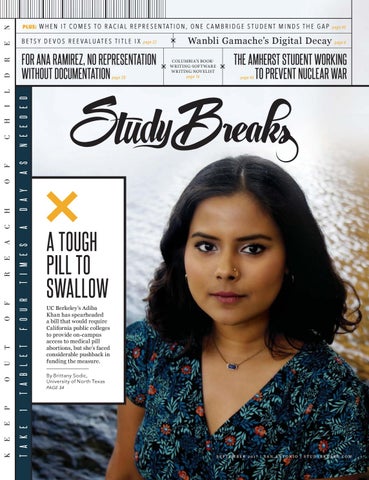
A TOUGH PILL TO SWALLOW UC Berkeley’s Adiba Khan has spearheaded a bill that would require California public colleges to provide on-campus access to medical pill abortions, but she’s faced considerable pushback in funding the measure. By Brittany Sodic, University of North Texas PAGE 34
T A K E
1
T A B L E T
F O U R
T I M E S
H K
E
E
P
O
U
T
O
F
R
E
A
C
O
F
C
H
I
L
D
R
E
WHEN IT COMES TO R ACIAL REPRESENTATION, ONE C AMBRIDGE S TUDENT MINDS THE GAP
PLUS:
SEP T EMBER 2017 | SA N A N TON IO | ST UDY BR E A K S.COM
L MBO MEA I D UA L CO A N Y I N D IV @ 6 LOCATIONS
VALID R OF FE RS LID W/ OT HE .17 NO T VA ® EX P 10 .31 ICK MA Y AP PLY GO LD EN CH EX CL US IO NS
WWW.G O LD EN C H I C K .C O M
VISIT OUR 6 SAN ANTONIO LOCATIONS 2503 SE MILITARY | 4315 S GEVERS | 11207 POTRANCO | 8534 S. IH-35 | 4110 N FOSTER | 14427 HWY 87
2303 N LOOP 1604 W | 210.408.2029 B I GZ - B U R G E RJO I NT.CO M follow us
$5 OFF
$5 OFF
2 3 0 3 N LO O P 16 0 4 W | 210 . 4 0 8 . 2 0 2 9 B I G Z - B U R G E R J O I N T.C O M
2 3 0 3 N LO O P 16 0 4 W | 210 . 4 0 8 . 2 0 2 9 B I G Z - B U R G E R J O I N T.C O M
EXP 09/30/2017 - SB092017 NOT VALID W/ OTHER OFFERS | EXCLUSIONS MAY APPLY
EXP 09/30/2017 - SB092017 NOT VALID W/ OTHER OFFERS | EXCLUSIONS MAY APPLY
$5 OFF
$5 OFF
2 3 0 3 N LO O P 16 0 4 W | 210 . 4 0 8 . 2 0 2 9 B I G Z - B U R G E R J O I N T.C O M
2 3 0 3 N LO O P 16 0 4 W | 210 . 4 0 8 . 2 0 2 9 B I G Z - B U R G E R J O I N T.C O M
EXP 09/30/2017 - SB092017 NOT VALID W/ OTHER OFFERS | EXCLUSIONS MAY APPLY
EXP 09/30/2017 - SB092017 NOT VALID W/ OTHER OFFERS | EXCLUSIONS MAY APPLY
$25.0 0 OR MORE PURCHASE
$25.0 0 OR MORE PURCHASE
$25.0 0 OR MORE PURCHASE
$25.0 0 OR MORE PURCHASE
VISIT US @ 4522 FREDERICKSBURG RD #B64 INSIDE WONDERL AND OF THE AMERICAS MALL SAN ANTONIO, T X 78201 210 . 5 3 0 .18 5 9 | U P T O W N G Y P S Y. C O M
20% OFF
PURCH ASE O F $50 OR MORE E X P 10 / 31/ 2017 E XC LU D ES OT H ER S A L ES, PR O M OS & L AYAWAY
10% OFF ENTIRE PURCH ASE
E X P 10 / 31/ 2017 E XC LU D ES OT H ER S A L ES, PR O M OS & L AYAWAY
W E S P E C I A L I Z E I N:
DESIGNER CORSETS & WAIST TRAINERS I N T I M ATE A PPA R EL | B AT H & B O DY PR O D U CTS SEN S UA L BED R O O M PL AY ITEM S
FREE LUNCH
ONE ENTRÉE FREE W/ PURCHASE OF ENTRÉE OF EQUAL OR GREATER VALUE & TWO BEVERAGES
VALID MON- FRI 11AM-3PM WITH THIS AD - EXP 10.31.17 CANNOT BE COMBINED WITH ANY OTHER DISCOUNT. DINE IN ONLY. PRESENT THIS COUPON WHEN ORDERING. RING: STUDYBREAK LUNCH
THE RIM | 17627 LA CANTERA PW Y | STE 103
&
½ PRICE APPS! 4PM-7PM MONDAY – FRIDAY
CASTLE HILLS | 842 NW LOOP 410 | STE 115
T HE TA B L E O F C ON T E N T S SEP TEMBER 2017 • S TUDY BRE AKS.COM
ONLINE THIS MONTH
STEM GEMS
INTR A MUR ALS
THE MEAL PL A N
PAGE 12
PAGE 18
PAGE 25
PAGE 4
Originally from Manila,
After UNT’s Jackie
With a granola bar recipe
Penn student David
Galloway took home a
this tasty and simple, the
Ongchoco created
bronze medal in the 2016
Cereal Science majors
YouthHack to bring tech
Rio Olympics, she finally
might want to reconsider
and entrepreneurial
realized what she wanted
their career paths
opportunities to
to do with her Mechanical
By A bbey Slat ter y
developing countries
Engineering major–build
By Kel ly Keg lov it s
better prostheses
STUDENT EXHIBITION
By Da kot a Bu h ler
#COLLEGEHACKS PAGE 26
COV E R SP O T L IGH T
PAGE 6
TASTEMAKERS
Wanbli Gamache, a student
PAGE 14 A lifelong fashion designer,
STUDENT GOVER NMENT
summer depression with
at the School of the Art
these medicinal back-to-
TOUGH PILL TO S WALLOW
Institute of Chicago,
Marist College’s Dylan
PAGE 22
school hacks
Photography by
creates immersive spaces
Skinner is adjusting to
Secretary of Education
By L ia m C ha n
Saul Urbina-Johanson
that aestheticize digital
the release of her second
Betsy DeVos is working to
Hodge s
decay
clothing line
decide what the standard
By Jack Bra ndon
By Kaitlyn Peterson
of evidence should be for
Overcome your post-
campus sexual assault
EXTR A CREDIT
By L ex i L ieber ma n
PAGE 46
TALKING NOTES
GREEK LIFE
PAGE 10
PAGE 16
Mothpuppy, a five-piece
A Columbia student,
student band from
Gamma Phi Beta sister and
WHAT’S YOUR MAJOR?
Baltimore, takes full
Computer Science major,
PAGE 23
advantage of frontwoman
Sharon Chen has used her
Every college student loves
Morgan Murphy’s dense
coding background to help
a bowl or three of cereal,
NO REPRESENTATION WITHOUT DOCUMENTATION
lyricism and f luttering
aspiring authors realize
but do you love it enough
PAGE 28
falsetto
their novel-writing dreams
to major in Cereal Science?
After being elected student
By Christian Zeitler
By C h r i st i ne A scher
By Br ia Jone s
body vice president,
MEET THE PRESIDENT
Western Washington
PAGE 48
student and undocumented
The University of Dallas’
immigrant Ana Ramirez
student body president,
is at risk of having her
Karmina Martinez Ruiz,
position stripped, or worse
ref lects on being one of
By Pat r ick Mu r t ha
eleven children and the
A TOUGH PILL TO SWALLOW
Amherst’s Emily Ratté, an intern at Global Zero, is working to promote nuclear disarmament at a particularly relevant time By K at h r y n Pa rker
writing of Gabriel Garcia
PAGE 34
Marquez
UC Berkeley’s Adiba Khan
MINDING THE GAP
has devoted most of her
PAGE 40
undergrad to broadening
To shed light on the lack
student access to
of diversity at top-tier
reproductive healthcare, a
universities, Cambridge’s
passion that has inspired the
Dami Adebayo recreated
state legislature to follow suit
a viral Yale photograph
By Brittany Sodic
and has since become a
By St udy Bre a k s St a f f
national figurehead for the debate By Giselle Krachenfels
STUDYBREAKS.COM
SEP TEMBER 2017
EDITOR’S NOTE
NOTE FROM THE EDITOR
A LACK OF CONCLUSION
OU R T E A M FOUNDER: Gal Shweiki ART DIRECTOR: Ian Friedel EDITOR-INCHIEF: Mark Stenberg DIGITAL EDITOR: Emily Bowen,
C
ompared to other magazines covering other demographics, one of the more distinct aspects of a “Study Breaksâ€? story is that, more often than not, it lacks the NLQG RI GHÂżQLWLYH HQGLQJ WKDW PRVW UHDGHUV ZDQW Why? Since most of the stories we tell concern college students, many of the narratives deal with projects, passions, careers and ideas that are just in their infancy. Even the most remarkable college students can only be so accomplished so young in their life, and to accommodate, we angle our features to focus more on the potential of things rather than their current standing. Instead of ref lecting on remarkable pasts, we invite readers to imagine stunning futures. Sometimes, as in last month’s issue, that means stories that catch students in medias res, like the one about Citrus College student and aspiring comedian Caleb Kline, a transgender male midway through his biological transition. More commonly, it means featuring students whose early successes have made it clear that they have bright futures, such as coder and Wellesley student Anah Lewi or eSports phenom and FIU junior Victoria Perez. This month, however, our theme of introducing beginnings without determined ends seems especially poignant, as all three of our features relay political dramas that will
Vanessa Martinez,
continue to develop even after this issue goes to print. The story of Ana Ramirez (pg. 28), the undocumented Western Washington student who was denied the student government position to which she was elected, will continue to unfold as the school navigates the unchartered legal territory of a technically illegal immigrant receiving federal wages. The same goes for Adiba Khan (pg. 34), the Berkeley student currently in the midst of spearheading legislation designed to expand the reproductive rights of California students. Finally, even our interview with Cambridge student Dami Adebayo (pg. 40) ends on an inconclusive note, with Adebayo looking optimistically to the example of diversity in American colleges that, here in the U.S., we still consider to be far below par. ,Q D ZD\ WKRXJK WKH XQÂżQLVKHG TXDOLW\ RI WKH VWRULHV IHHOV DSURSRV DV WKLV LVVXH PDUNV WKH ÂżUVW RI WKH QHZ VFKRRO \HDU and what better way to usher in a new set of semesters than by introducing several story lines that will continue to evolve throughout them? Enjoy,
Isabelle Pfeffer GRAPHIC DESIGNER: Bryan Raynes MARKETING: Ralph Chaplin ACCOUNTING: Elizabeth Castro DISTRIBUTION MANAGER: Marcus Flores DISTRIBUTION: )UDQN +DUWĹľHOG Jose Espinoza, Ernest Ward
MARK STENBERG Editor In Chief @MarkStenberg3
Production: Shweiki Media Study Breaks magazine is published twelve times per year by Shweiki Media, Inc. copyright 2012. All rights reserved. This magazine may not be reproduced in whole or in part in any form or by any means electronic or mechanical, including photocopying or recording, or by any information storage and retrieval system now known or hereafter invented without written permission from the publisher. Reproduction or use in whole or in part of the contents of this magazine or of the trademarks of Study Breaks Magazine, Inc., without written permission of the publisher is prohibited. The publisher assumes no responsibility for care and return of unsolicited materials. Return postage must accompany material if it is to be returned. In no event shall such material subject this magazine to any claim for holding fees or similar charges. Study Breaks Magazine is an entertainment magazine for the students of San Antonio, San Marcos, Austin and Lubbock, published 12 times a year. &RUSRUDWH 2IžFH Study Breaks Magazine Inc., 4954 Space Center Dr., San Antonio, TX 78218 • Contact Study Breaks: editorial: Mark Stenberg, 210-705-3284 editorial@studybreaks.com • Study Breaks Magazine is excited to help your brand reach our audience through video and written content. Sales: Ralph Chaplin, 210-892-0951 /// contact@studybreaks.com
2
// SEP TEMBER 2017
WRITER
CONTRIBUTORS
PHOTOGR A PHER
LIAM CHAN HODGES @mauimongol Franklin and Marshall College Government #COLLEGEHACKS PAGE 27
JACK BRANDON University of Michigan English STUDENT EXHIBITION PAGE 6
CHRISTIAN ZEITLER Carnegie Mellon Professional Writing and Creative Writing TALKING NOTES PAGE 10
KELLY KEGLOVITS @kellykeglovits University of Texas Austin Plan II STEM GEMS PAGE 12
KAITLYN PETERSON @kaitlyn.patricia UCLA English TASTEMAKERS PAGE 14
DAKOTA BUHLER @dakotabuhler George Fox University English INTRAMURALS PAGE 18
CHRISTINE ASCHER USC English & Economics GREEK LIFE PAGE 16
SIERRA EMILAIRE Southern Adventist University English Professional Writing AROUND CAMPUS PAGE 26
ABBEY SLATTERY @abslatt Northwestern College Writing and Rhetoric THE MEAL PLAN PAGE 25
LEXI LIEBERMAN University of Pennsylvania English STUDENT GOVERNMENT PAGE 22
BRIA JONES @vanwynthegarden Georgia Southern University Writing and Linguistics WHAT’S YOUR MAJOR? PAGE 23
KATHRYN PARKER @katyannparker Fordham University Comparative Literature EXTRA CREDIT PAGE 46
GISELLE KRACHENFELS USC Business MINDING THE GAP PAGE 40
PATRICK MURTHA @patrickmurtha_ Eastern Connecticut St. Univ. New Media Studies NO REPRESENTATION WITHOUT DOCUMENTATION PAGE 28
BRITTANY SODIC @brittany_shmo UNT Journalism A TOUGH PILL TO SWALLOW PAGE 34
GIOVANNA DECASTRO @giovanna.decastro University of Chicago Public Policy and Comparative Human Development STUDENT EXHIBITION PAGE 6
MATHEW AWOYERA JR @akinolawo Towson University Photography TALKING NOTES PAGE 10
SAAKSHI GOEL @sockshee UC Berkeley Media & Communication Studies STEM GEMS PAGE 12
AIDAN KUSNECOV @ak.aidan Rutgers University Psychology TASTEMAKERS PAGE 14
SAM BRUTON @sbbrut TCU Journalism INTRAMURALS PAGE 18
WILL DOUGALL @wdougallphotography University of British Columbia Computer Science GREEK LIFE PAGE 16
MADELEINE COOK George Washington University Photojournalism EXTRA CREDIT PAGE 46
KARLA MARTINEZ RUIZ @kpmartinez2017 University of Saint Thomas Psychology MEET THE PRESIDENT PAGE 48
ABHISHEK MUKHERJEE @aamukherjee Imperial College London Mathematics MINDING THE GAP PAGE 40
SAUL URBINA-JOHANSON @S_Jaayyy Harvard Cognitive Neuroscience & Evolutionary Psychology A TOUGH PILL TO SWALLOW PAGE 34 STUDYBREAKS.COM
EYTHAN FROST @eythanfrost Western Washington University Visual Journalism NO REPRESENTATION WITHOUT DOCUMENTATION PAGE 28
STUDY BREAKS is written exclusively by a team of student interns from across the country. These writers work with the editorial team to pitch and submit one piece a week for the website, in addition to writing for the monthly print magazine. ¶ Fall internships run from September 28 to January 28, and applications close September 14. If interested, email editorial@studybreaks.com with “Student Writing Internship” in the Subject. ¶ Introduce yourself in the body, making sure to include your name, school and major. Please attach at least two samples of your work. Ideal writers are intelligent, funny and talented, though no formal experience is necessary.
SEP TEMBER 2017 //
3
ONLINE THIS MONTH
R IGH T NOW AT
ST UDY BR E A K SS.COM .COM
ONE-LINERS “Recently, we had to sprint halfway across a mall just because
FROM THE VAULTS
my eyeballs were ĹśRDWLQJ Ĺ” August Pritchett, Armstrong State
Forward Thinking
University Cisgender People :RXOG %HQHĹľW IURP *HQGHU 1HXWUDO Bathrooms, Too “Who said a sequel can never be greater than the original? Me? Well, let’s just forget that for a PRPHQW Ĺ” Miguel Robles, UC Denver The 20 Best Superhero Movies Since 2008 “In a beautiful display of cultural unity, audi-
SPOTLIGHT
ences and bloggers and moms on Face-
UPenn’s Rohan Shah Is Democratizing Venture Capital Investing A rising junior at the University of Pennsylvania, Shah founded his second start-up, Slice Capital, DIWHU VHOOLQJ KLV žUVW WR WKH 1DY\ DQG XVLQJ PRQH\ KH PDGH E\ PLQLQJ %LWFRLQ LQ KLJK VFKRRO :LWK Slice, Shah aims to disrupt the investment market by allowing regular people to invest in startups, giving average Joes the same investment opportunities that the 1 percent have.
book are all joining hands to harmoniously tear the show to shreds RQ D GDLO\ EDVLV Ĺ” Christian Zeitler, Carnegie Mellon In Its Portrayal of
cummings
Why You Need to Be “That Person� and Revisit Your Old High School Remember in high school when you and your friends roasted the alumni that would return for special occasions? Well, now that person needs to be you. You might not have realized it back then, but alumni are critical to the highschool-to-college transition, and now it ’s your turn to give back.
ONLINE COLLEGE
1HUG &XOWXUH Ĺ?6LOLFRQ Valley’ Trounces ‘The Big Bang Theory’ “Why are you in love
This month on the website, learn how to: Determine what kind of vegan you might be // Criticize ‘Dunkirk’ like a Frenchman // Date in the heat for cheap // Meditate in the shower and on the toilet // BE THE NEXT DR. DRE // Find a kind of journaling you don’t hate // Enjoy misogynist culture without approving of it // Track wolves
with pop, but utterly disgusted by country? Or why are you obsessed with ‘Sorry’ by Justin Bieber, but detest the rest of his PXVLFDO UHSHUWRLUH"Ĺ” Tori Rubloff, University of Florida The Science Behind Your Music Taste “Rating: Hand me
T H E 5 B E S T P L A N T S T O K E E P I N YO U R D O R M R O O M
the aux chord and get ready for some :KLWQH\ +RXVWRQ Ĺ” Abbey Slattery, Northwestern College Let Buzzfeed Make Your Life Choices
Aloe Vera
4
// SEP TEMBER 2017
Succulents
Bamboo Palm
Spider Plant
Orchids
for You
ELEC TRONIC DECAY By Jack Brandon page 6
A SECOND SKINNER By Kaitlyn Peterson page 14
BOOK-WRITING SOF T WARE By Christine Ascher page 16
TAEKWONDO MECHANICS By Dakota Buhler page 18
W H AT ’ S O N T H E I N S I D E
THE HONOR ROLL
TALKING NOTE S
MOTHPUPPY Morgan Murphy (right, seated) is the lead singer and songwriter for Mothpuppy, a student band from Goucher College in Baltimore, Maryland, whose music sounds complexly melancholic, and whose poetic lyrics, which manage to use very specific images to explain abstract concepts, are delivered through Murphy’s distinctly airy, powerful voice. Continued on page 10
L-R: Morgan Murphy and Ryan Vieira of Mothpuppy
STUDYBREAKS.COM
SEP TEMBER 2017 //
5
STUDENT EXHIBITION
W A N B L I
By Jack Brandon, University of Michigan Ann Arbor Photography by Giovanna Decastro, University of Chicago
WANBLI GAMACHE is an ar tist who looks at the fringes of the world—the abandoned, the decaying, the broken. Through diligent, introspec tive eyes, Gamache of fers audiences new perspec tive of their own world, now more than ever influenced by digital media and the internet. œ The visual ar tist fuses the synthetic and organic to create works that force viewers to reevaluate their perspec tive of their physical surroundings, as his work is multidimensional, occupying physical space and progressing through time with video and sound.
6
// AUGUS T 2017
“History & Erosion� By Wanbli Gamache
JACK BRANDON: You graduated with a degree in Anthropology, but returned to school for art. Why was that? WANBLI GAMACHE: After graduating, I felt that there was a void in my life, so I turned to art. I started doing band posters and illustrating again. I jumped into art, more or less, and it clicked really well for me. JB: Did you plan to return to school? WG: There was never a master plan that Anthropology would feed into art or that I would turn my interest into art, but it GHĹľQLWHO\ GLG KDSSHQ :KHQ , ĹľQLVKHG XS P\ $QWKURSRORJ\ degree, I was very interested in contemporary culture, internet culture, digital spaces—more generally, spaces. How we manipulate our environment and how that environment will LQĹśXHQFH WKH QH[W JHQHUDWLRQ of people intrigues me. JB: Is the construction of space D GHĹľQLQJ WKHPH LQ \RXU ZRUN" WG: The initial concept for a lot of my videos, especially the earlier ones, come from reactions to spaces. “Moments in the :DOOĹ” DQG Ĺ“,ULGHVFHQWĹ” DUH VKRW in two d.i.y. spaces in Fayetteville where musicians and artists gather to experiment. I spent a lot of time in those spaces; I have a big heart for them and I respond really well in there. Other work comes from ideas, OLNH LQ Ĺ“6HGLPHQW Ĺ” , ZDV LQterested in the idea of decay, which is what introduced me to glitch art. Glitch is maybe referencing the decay of data or the codex in an audio or video ĹľOH DQG , FDQ DOVR WDON DERXW the decay and erosion of more organic materials as well.
STUDYBREAKS.COM
JB: Do you work in video exclusively? WG: I would say that video is P\ IRXQGDWLRQ 0\ ĹľUVW \HDU at the University of Arkansas, I had a time and motion class, which excited me. When I was a kid, I was interested in making videos but never got around to making any, because my family never had a camera.
$W VFKRRO , ZDV DEOH WR ĹľQDOly experiment once I got an assignment to do something in stop-motion. At the time, I was really fascinated with abandoned places. I was spending my free time exploring weird, abandoned houses, parks and places , FRXOG ĹľQG LQ WKH DUHD )URP three different locations, I made P\ ĹľUVW YLGHR Ĺ“([FDYDWLRQV Ĺ”
I love installation and video work, because it allows me to combine a bunch of media—I get to draw, paint, make objec ts, sculpt things. I have a minor in Music Theor y, as well, so making audio is a joy. Video is so cool because it ’s so interdisciplinar y, like a symphony of dif ferent media.
SEP TEMBER 2017 //
7
STUDENT EXHIBITION CONTINUED
“Reconstruction� By Wanbli Gamache
JB: Your work is immersive in that sense. How do you approach a project? WG: In art, I enjoy the limitations I give myself. For my ZRUN œ5HFRQVWUXFWLRQV Ŕ , JDYH myself eight days to make an installation show from scratch. I barely brought any materials; I basically used the space to try to make sense of it and something out of it. Those limitations are really great, because you can dive into something that might seem simple, but then you break it down and it gets more complex. It’s a great challenge
8
// SEP TEMBER 2017
too. If you have all the nicest toys and tools and materials and whatnot, I think it’s quite limiting on the person to be experimental or innovative. When you’re working with poor equipment in poor conditions, it pushes you to be innovative and come up with something unthought of. JB: Where does this methodology come from? WG: I grew up in a strong 1DWLYH $PHULFDQ FXOWXUH 0\ father did lots of rituals, like sweat lodges, pow wows and sun dances, primarily aligned with the Sioux Lakota culture. I
DSSURDFKHG Ĺ“5HFRQVWUXFWLRQVĹ” DQG Ĺ“0RPHQWV LQ WKH :DOOĹ” like this, thinking that putting your body through a strenuous circumstance, through fasting or isolation, can bring out new perceptions of the outer world. JB: Recently, you were a visiting artist at Clemson. WG: Clemson reached out to me after they saw my work at a show last spring called Ĺ“$UW )LHOGVĹ” LQ 6RXWK &DUROLQD I received a merit award for Ĺ“([FDYDWLRQV Ĺ” DQG VRPHRQH IURP &OHPVRQ HQMR\HG LW , ĹśHZ out, spoke to everyone about digital media, glitch manipula-
“Error in Flux� By Wanbli Gamache
tion and video work. Although I use glitch in a bit of my work, I don’t consider myself a glitch artist. JB: Was that the extent of your visit? WG: I did a workshop, too. I tried to talk about process rather than technical skill. You FDQ žJXUH WHFKQLTXH RXW ZLWK tutorials. If you’re doing a talk, the process is the important thing. How I choose to get to the end is much more important than trying to get to the end. If I approach it a certain way, it’s going to look a certain way. JB: How did you feel about the experience? WG: I had a blast; it was crazy to be a visiting artist while I’m doing my undergrad. Visiting artists are usually well established or well past their MFAs. I would consider it again. JB: What does the future hold for you? WG: I’ll be pursuing my Masters in Fine Art in the Video, 1HZ 0HGLD DQG $QLPDWLRQ department at the School of the Art Institute in Chicago this fall. The exciting thing about the materials I’m working with, like arduinos, sensors and motors, are that they are so wonderfully applicable in so many different avenues, not only for fine arts. One my IDYRULWH DUWLVWV LQ 1HZ <RUN works for this augmented reality prototype firm. She’s a painter, so she both works for the firm and has access to the newest prototypes for her own work. I feel like I have a lot of options.
FAC T F I L E NAME: Wanbli Gamache HOMETOWN: Fayet teville, Arkansas SCHOOL: Universit y of Arkansas; The School of the Ar t Institute of Chicago INSPIR ATIONS: William Kentridge, Derek Larson, Henri Bergson MATERIALS: Video, audio, sculpture, paint, per formance
STUDYBREAKS.COM
SEP TEMBER 2017 //
9
HONOR ROLL • T A L K I N G
NOTES
ATTRACTED TO THE LIGHT MOTHPUPPY, THE BALTIMORE-BASED BAND LED BY GOUCHER COLLEGE’S MORGAN MURPHY, CHANNELS AN ATONAL, INTENSELY WRY SOUND WHOSE LYRICISM BORDERS ON POETIC. By Christian Zeitler, Carnegie Mellon Photography by Mathew Awoyera Jr., Towson University
Continued from page 5
7KH ¿YH SLHFH EDQG LV FRPSRVHG RI D JXLtarist, bassist, violinist, drummer and Murphy, who sings and plays rhythm guitar. At the beginning of their student life, the group was just a jumble of friends who played their instruments for fun when they weren’t working on their actual majors. But Murphy and bassist Ryan Vieira (both of whom prefer they/them pronouns) realized that there was real potential in their musical relationship.
10
// SEP TEMBER 2017
Murphy had been writing and recording music with their guitar and putting it on Bandcamp, and soon Vieira, who was Murphy’s neighbor at the time, joined them, bringing their bass over for jam sessions. With time, the casual collaboration began to turn into a more serious endeavor. The last to join the group was their violinist, Becca Kotula, whom Morgan saw perform in the school’s orchestra. Before long, as each member’s unique musical experiences collided and informed each other’s, Murphy’s mel-
odies and lyrics began to take on an entirely new sound. “Our sound is chaotic I guess,â€? says Murphy, “in the sense that we all have very different musical backgrounds and we don’t really have one way to feel. We kind of feel it out as we go.â€? The nascent group began to play house shows, local clubs and venues in the city, and a small fan base formed accordingly. In terms of their sonic forbearers, Murphy credits a handful of musicians that helped her evolve conceptually, an especially pertinent one of which was Rilo Kiley, a band whose musical parentage can be seen in the two groups’ shared indie-rock-meets-punk-angst vibe. Both bands also share a more folk-oriented approach to song construction and storytelling, which attempts to paint their signature disillusionment vividly enough to demand being taken seriously, transformLQJ O\ULFV WKDW Ă€LUW ZLWK VHOI SLW\ LQWR PXFK deeper, more compelling emotions. And, of course, there is an obvious parallel between their lead singers. Murphy’s approach to vocal melodies is very reminiscent of Rilo Kiley’s Jenny Lewis, in that both occupy that sweet spot between breathy and belting and demonstrate a mastery of tiptoeing in and out of falsetto. Murphy, in particular, utilizes this ability to slide into falsetto and back frequently, using it as a tool to emote in the delivery of their lyrics. The band’s name originated from Murphy as well. In the budding days of social media, Murphy used the tag “Mothpuppy,â€? a name that their friends began to call them as a joke. “They thought it was really funny,â€? Murphy says through a laugh, “but I didn’t.â€? As their live performances provided the group more opportunities to tighten their sound, the group decided to begin recording. Roughly two years after their inception, Mothpuppy GURSSHG WKHLU ÂżUVW IXOO DOEXP Âł&RRO 3UHWty,â€? on March 10, 2017, on Spotify, Bandcamp and iTunes. Murphy, who creates the main melodies, lyrics and chord structures for every song, describes the way the recording process has changed the way they write music. “I used to write just whatever I wanted, but now I write with the band in mind. I noticed the difference, because I used to do solo shows where I’d play acoustic versions of Mothpuppy songs or do test runs for new stuff. And now when I play new stuff without the band it sounds‌off.â€? On the topic of their writing, Mothpuppy’s lyrics are very intriguing. The song “Flea,â€? which contains Murphy’s favorite lyrics of the album, stems from an actual experience ZLWK Ă€HDV LQ WKHLU KRXVH 7KH Ă€HDVÂś LUULWDWing presence quickly fueled an appropriately angsty metaphor, as well as added Murphy’s
name to the company of Donne’s on the list of writers who have found inspiration in the bloodsuckers. Excerpt from Ĺ“)/($Ĺ” “WHAT’S MY JOB HERE? I HATCHED FROM A PEARL CARRIED UP FROM A DRAFT ONTO YOUR WINDOWSILL WHAT’S THE DEAL HERE? YOU WERE MY BLOOD MEAL A LUKEWARM HUMAN MOVING THRU THE HOUSE ... WHY’D YOU DROWN ME? LIGHT A TINY BUOYANT CANDLE LET IT FLOAT IN THE BATHTUB
MY FAMILY HERE WITH ME WHAT’S THE POINT OF LOOKING BACK AT SOME THINGS? I WAS BORN ON A TUESDAY AND I DIED THE NEXT WEEKâ€? The song builds powerfully, even hauntingly, before dissipating into a single note on the violin over a quiet guitar chord. Murphy says the ballad was made easier to write by WKH SURIRXQGO\ DJJUDYDWLQJ H̆HFW WKH EXJV were having on their mood. “I just hated them so much,â€? Murphy says through another laugh. “I was getting so frustrated.â€? This NLQG RI TXLUN\ VSHFLÂżFLW\ ZUDSSHG XS LQ D darker, raw emotion, is a perfect example of what makes Mothpuppy so entertaining. It is smart and emotional, yet unnervingly funny.
The biggest question for the group now is what’s next. They are beginning to graduate as a band, and none of their members are Music majors. Their bassist, Ryan Vieira, and their drummer, Shawn Durham, are Communications majors, while violinist Becca Kotula studies Math, Becca Wills, their lead guitarist, studies Psychology and Murphy studies English. And while their academic diversity has led to good things musically, it also means that the band’s future is uncertain. Murphy has expressed their willingness to keep making music and doing shows while they are still near each other in Baltimore, but has recognized that their future is somewhat up in the air. Until then, at least, Mothpuppy will continue making its signature style of haunting, yet perplexingly fun music.
FAC T F I L E BAND NAME: Mothpuppy L ABEL: Sad Cac tus Records LOCATION: Baltimore, Mar yland SCHOOL: Goucher College GENRE: Alternative/Indie Rock ALBUMS: Cool + Pret t y MEMBERS: Ryan Vieira, Becca Kotula, Morgan Murphy, Shawn Durham, Becca Willis SONGS TO LISTEN TO: Ĺ“)OHD Ĺ” “Basketball &RXU W Ĺ” Ĺ“.LOJRUH )DOOVĹ” DQG Ĺ“6SDFHĹ”
L-R: Ryan Vieira and Morgan Murphy of Mothpuppy
STUDYBREAKS.COM
SEP TEMBER 2017 //
11
HONOR ROLL • S T E M
GEMS
SOLUTIONS TO SCALE PENN STUDENT DAVID ONGCHOCO, THE FOUNDER OF YOUTHHACK, AN ORGANIZATION THAT EXPOSES YOUNG PEOPLE IN DEVELOPING COUNTRIES TO TECH OPPORTUNITIES, IS PAYING FORWARD THE ALTRUISTIC ENTREPRENEURSHIP THAT HELPED HIM. By Kelly Keglovits, UT Austin Photography by Saakshi Goel, UC Berkeley
WHEN DAVID ONGCHOCO got a chance to visit the U.S. for college, he wasted no time in get ting involved with the star t-up scene in order to fan his passion for using tech to solve problems at scale. Af ter a seminal, two-week tour of several prestigious colleges, Ongchoco was inspired to channel some of the philosophies he had encountered into creating his own star t-up, called YouthHack, with the goal of get ting students in developing countries involved in technology and entrepreneurship. The once-small group has now hosted events in more than eight countries and is working to establish itself as a permanent institution for promoting computer education internationally. Ongchoco is now approaching his senior year at the University of Pennsylvania and is double majoring in Cognitive Science and Computer Science. I got the oppor tunity to speak with him about his star t-up, and what he has planned next. KELLY KEGLOVITS: How did you first get interested in computer science? DAVID ONGCHOCO: My interest was sparked by reading about star t-ups and tech companies—I remember watching “The Social 1HWZRUN Ŕ DQG UHDGLQJ WKH
book about Facebook. Then, I got accepted to college here in the U.S. and was choosing between Penn and Berkeley. I got the chance to visit San Francisco for a week, and I at tended a bunch of star t-up and technology events, and I came across all these dif ferent entrepreneurs and founders. I remember at tending a talk by the founder of Khan Academy, where he discussed being able to use technology to solve problems at scale, and how anybody could gain access to Khan Academy and learn bet ter and faster. The idea of using tech to solve problems was fascinating to me, and that’s when I star ted reading more and tr ying to learn how could I build my own website and get star ted. KK: So af ter you returned from this trip, that’s when you founded YouthHack? DO: It was the summer right before my freshman year of college. I had some time from June to August, and I wanted to work on something af ter listening to all those inspiring speakers in Silicon Valley. KK: And where did your idea for YouthHack come from? DO: The idea came from the dif ferent star t-up events I at tended in the U.S. during the two-week period I visited Penn and Berkeley. I at tended Penn’s business
If you’re interested in get ting involved with YouthHack, star ting your own chapter or get ting advice on a star t-up idea you’re working on, feel free to email David at DAVID@YOUTHHACK.NET
12
// SEP TEMBER 2017
plan competition and I also read about PennApps, which is one of the largest hackathons in the U.S. I found the idea of a weekend where students go and come up with ideas and tr y to build things a really cool concept. At the time no one was really doing that in the Philippines, and I thought it was a huge oppor tunity to inspire students. KK: Could you talk a lit tle more about how YouthHack works? DO: YouthHack is a nonprofit organization that aims to help students learn more about star t-up technology and entrepreneurship, which we do through various events and programs. We have star t-up weekends, which are two-day events where students come up with ideas and prototype pitches. We also have a code weekend, where students can learn how to code or use their coding skills to build something overnight. KK: And who all has helped you with this? DO: Back in the early days, it was just me and a bunch of high school friends. We had all just graduated from high school and had a long VXPPHU WR ILOO 1RZ RXU team has grown to over two hundred volunteers around the world. A lot of them are friends I’ve met through Penn and friends who par ticipated in our earlier events. KK: What sor t of impac t has YouthHack made on your life? DO: It’s definitely been my life for the past three years. I have learned a lot from all the people I’ve got ten the chance to work with. I’ve also learned how to work with dif ferent types of people. Beyond that, I think the
whole thing shows that you are never too young to star t something big. Yes, it takes a lot of people and it doesn’t happen overnight, but when I look back at the past three years, it’s pret ty crazy how much we have done. KK: Do you have any new projec ts on the horizon? DO: I’ve been exploring a new star t-up idea that I want to work on in the summer and during senior year. It’s an idea in the outsourcing space, and my ultimate goal with all of this is to really find a way to connec t the United States to developing countries like the Philippines. I am a strong believer in the saying that talent is universal but oppor tunity is not, so I’ve been thinking of ways I could leverage my experience growing up in the Philippines but going to the U.S. for college to make a real impac t.
FAC T F I L E: NAME: David Ongchoco AGE: 21 SCHOOL: University of Pennsylvania MAJOR: Cognitive Science and Computer Science HOMETOWN: Manila, Philippines MOTTO: Ĺ“7DOHQW LV XQLYHUVDO EXW RSSRUWXQLW\ LV QRW Ĺ” NOTABLE START-UP: YouthHack, an organization that helps young people in developing countries get involved in technology and entrepreneurship
HONOR ROLL • T A S T E M A K E R S
COMFORTABLE IN HER SKIN CLOTHING DESIGNER AND ENTREPRENEUR DYLAN SKINNER TALKS ABOUT HER TWO FASHION LINES, DESIGN PHILOSOPHY AND HER A-HA MOMENT WORKING FOR CALVIN KLEIN. By Kaitlin Peterson, UCLA Photography by Aidan Kusnecov, Rutgers University
F
ashion Merchandising student Dylan Skinner once printed her own artwork onto a handmade gown, and to this day it is still her favorite evening dress. ¶ The sophomore at Marist College started sewing at ten years old and has since created her own clothing company, Dylan Skinner Designs, which includes both formal and casual wear, supporting Skinner’s aspiration to make women feel beautiful.
14
// SEP TEMBER 2017
A few of Skinner’s Sticks & Stones Collection
When Skinner first started sewing as a little girl, she instantly became obsessed. She thought that she could do anything, incorrectly using only one kind of stitch for pieces that required several. Later she mastered the skill as she got older, even making her own patterns instead of using ones sold in stores. In eighth grade, Skinner attended Parsons Pre-College Academy in New York City for four years. After her time in the city, she decided to launch her own website and start selling her designs, and, in May 2015, Dylan Skinner Designs was born. “I realized that I had this creative outlet that I was using every week, and it was constant in my life,” Skinner says. “I knew I had to do something with it; I couldn’t just let it die out.” Although the business world can be daunting, Skinner’s 2014 internship with designer Abbey Glass helped prepared her. Glass had the opportunity to work for the Calvin Klein Collection under designers Marc Jacobs and Francisco Costa, and Skinner found herself impressed as she witnessed Glass’ work ethic. “I realized how much drive you need to have if you really want to make it happen. As far as her design process, I learned to be true to yourself, because it’s really tempting, especially in the fashion industry, to just fit in a box.” Skinner made sure to stay true to herself with her designs, maintaining her own style even when custom-designing prom and graduation dresses. Although customers requested certain looks, Skinner realized that her name would always be on her clothing, and so made sure that she was proud of the final product. She designed her first custom formal dress in 2015, and business for the Marist student only grew from there. She later created eleven custom gowns for a high school fashion show in 2016, as well as designed several graduation dresses. Although some people may prefer complicated designs, Skinner focuses more on fabric quality and simplicity. “It doesn’t need to be super crazy, so I think that’s always been my style and my philosophy,” Skinner says. “I think for me, it just says much more about the piece itself when it has a really cool or nice fabric.” She specializes in evening wear, but the rising sophomore challenged herself even more by releasing her casual line, Sticks & Stones, in May 2017. The line includes T-shirts with sayings such as “Fresh out of fucks,” “Darty Szn” and “Brains are the new tits.” By having bold statements, Skinner encourages women to feel confident in their T-shirts and own skin. Marist College sophomore Dylan Skinner
It was difficult for Skinner to change her mindset from formal to casual wear, but she says she feels more connected to her age group with Sticks & Stones. When people send her pictures of them wearing her clothes, she’s able to connect and be more social with her customers. In addition to interacting with others, Skinner is able to reach out to people who don’t usually wear evening dresses. “I have this part of my business with all the gowns and evening wear and that’s one side of me, but the other side of me is more of, ‘I’m going to throw on a pair of ripped jeans, a graphic tee and a hat, and I’m good,’” she says. Along with adding to her Sticks & Stones collection, Skinner also plans to incorporate a new section to her site in which she revamps thrifted clothes. While she loves the creative freedom her passion has afforded her, Skinner’s biggest motivation has been creating clothes that make women feel confident. “Just seeing how happy girls get when they look at themselves and are happy with how they look—that’s more rewarding that anyone could imagine, making someone feel beautiful in their own skin. People should feel that more, so I love to be able to give that to someone.”
FACT FILE DESIGNER: Dylan Skinner SCHOOL: Marist College YEAR: Sophomore MAJOR: Fashion Merchandising FORMAL LINE: Dylan Skinner Designs CASUAL LINE: Sticks & Stones KEY INTERNSHIP: Working under Abbey Glass with the Calvin Klein Collection
HONOR ROLL • G R E E K
LIFE
A NOVEL IDEA WITH HER WORDCRADLE SOFTWARE, GAMMA PHI BETA SISTER SHARON CHEN LITERALLY WROTE THE WEBSITE ON BOOK-CREATION. By Christine Ascher, University of Southern California Photography by Will Dougall, University of British Columbia University
S
KDURQ &KHQ ÂżUVW VWDUWHG WR GUHDP RI creating her own website while watching her classmates play online games during middle school. Now a junior at Columbia University, where she majors in Computer Science, Chen has built two successful, enduring websites, and continues to come up with new software ideas to pursue in the future. She takes inspiration both from her own interests and from her surroundings, as she hopes to create sites that have a positive impact and that others will be able to use for years to come. “I always wanted to FUHDWH D ZHEVLWH WKDW ZRXOG EHQHÂżW WKH HQWLUH community around me,â€? Chen says. In high school, Chen’s hope to build a site WKDW FRXOG EH XVHG E\ KHU SHHUV ÂżUVW EHFDPH a reality when she started ClickPA with three
16
// SEP TEMBER 2017
other students. ClickPA is aimed at helping WHHQDJHUV LQ KHU KRPHWRZQ RI 3DOR $OWR ÂżQG local events and activities to take part in. “We decided to come together to make a website because, after talking to other people at my school, we found that many teens in Palo Alto felt there wasn’t a lot to do,â€? Chen says. This boredom stemmed not from an actual lack RI DFWLYLWLHV EXW UDWKHU IURP WKH GL̇FXOW\ RI ÂżQGLQJ RXW DERXW WKHP :LWK &OLFN3$ &KHQ sought to remedy this problem. In addition to an events calendar, ClickPA also features reviews written by teenagers for various places to eat or have fun around the city. “We wanted to have a website built by teens for their fellow teens.â€? The site continues to be run by current high school students, keeping in line with their goal.
After leaving ClickPA to be taken over by new students, Chen soon began a new project—a novel-writing software called Wordcradle. She started building the site with a high school friend after their graduation, and it quickly became all-consuming. They spent two summers working on the site, creating the front end first, and dedicating their second summer to the most challenging part of the process—building the back end, which consists of the database and server. “We worked day and night on it and over the weekends, and just being able to work with my friend on a project that consumed my entire life was really rewarding,� she says. The website is a time-management software that helps members set goals and deadlines for completing their books, and motivates writ-
FAC T F I L E : NAME: Sharon Chen SCHOOL: Columbia Universit y SORORIT Y: Gamma Phi Beta MAJOR: Computer Science YEAR: Junior HOMETOWN: Palo Alto, California FIRST WEBSITE: clickpa.org CL AIM TO FAME: Wordcradle, a timemanagement website geared toward helping writers finish novels UPCOMING PROJECT: Modeling how children learn to count by coding a neural net work in hopes of improving how math is taught
ers to meet these targets by awarding them points and featuring them on a leader board. Chen and her team also created a blog to go alongside Wordcradle, called Blogcradle. In addition to creating the software, Chen has also used it herself. She and her friend were initially inspired to build Wordcradle due to their own wish to one day write a full-length book. “We found that we had the same dream of writing our own novel, so we decided to make a website that would help people like us who had very little time to finish one.” Thanks to her own software, she was able to finally fulfill her goal of completing a three-hundred-page manuscript. “I think without Wordcradle I would never have written by first novel,” she says. Now she provides inspiration on the site to help STUDYBREAKS.COM
other writers do the same. While Chen continues to work as CTO for Wordcradle, perfecting and advertising the website, her next idea could relate to her sorority, Gamma Phi Beta. She recently took part in a female-only hackathon with her sorority sisters, where they had several ideas for apps that would benefit the chapter. “If we go to another hackathon, we’ll probably build an app that helps the sorority and have it be long-term,” she says. Being able to work with her sisters on a new project is an exciting prospect for Chen, who was one of the few engineering students in her pledge class. In addition to sharing her own interest with them, rushing has also allowed her to form closer connections with non-engineering and female students.
“Engineering, and especially computer science, is such a male-dominated field,” she explains. “By joining a sorority, I get to interact with more people who are outside of engineering and have more female friends.” While the inspiration for her projects continues to change, Chen’s love for computer science can still be traced back to her middle school dream of creating a site that would help her community. “I made hundreds of websites trying to make ones like my peers used, but I didn’t have the technical knowledge to actually make it happen,” she says. “Now, every time I learn something new in Computer Science, or learn about some new technology, I’m very excited because it’s what I wish I had known back then.” SEP TEMBER 2017 //
17
HONOR ROLL • I N T R A M U R A L S
MORE THAN A MEDAL OLYMPIC MEDALIST JACKIE GALLOWAY SPENDS HER MORNINGS PRACTICING TAEKWONDO AND HER AFTERNOONS IN AN ENGINEERING LAB. By Dakota E. Buhler, George Fox University Photography by Sam Bruton, TCU
W
hen Jackie Galloway was seven years old, she decided she wanted to be an Olympian. She wanted to be a World Champion. She wanted to be the best taekwondo athlete in the world and nothing was going to stop her. Thirteen years later, she took home an Olympic medal. “The only word I can use to describe it is surreal,” she says. The fact that she was actually achieving her crazy childhood dream didn’t register until she walked into Maracanã Stadium for opening ceremonies with the rest of Team USA. “It was indescribable. There were so many people in there, it was so loud; it was everything you see on TV and everything you could imagine it being and more.” When it came time for Olympic competition, though, that surreal incredulity was replaced by the familiar steps of competition. She had spent her whole life practicing kicks, spins, actions and reactions, and she had no doubt that she could be successful as long as she executed everything to the best of her ability. It wasn’t until she was on the medal stand that she truly began to comprehend what she had accomplished. “When I actually stood on the podium and had the medal around my neck, I realized that the medal represents an accumulation of everything I’d done up to that point—every kick I had thrown since I was a little kid, and all the times that I didn’t want to go to practice, or all the times that I was crying in practice or all bruised up going to school. It represented all that hard work that I had put in and that everyone else had put into me and my journey. In that moment it all collided.” Taekwondo was always a part of life in Galloway’s family. Her grandparents owned and operated a taekwondo studio, so martial arts were a constant inf luence on her childhood. “It was always a family activity growing up,” she says, “and then I just fell in love with competition.” Growing up as a female in competitive taekwondo wasn’t always easy. From a young age, Galloway had to get used to other people’s preconceived notions of her sport: “As soon as I would tell someone I’m into taekwondo, I would get one of a handful of responses. ‘Oh, don’t make her mad’ or ‘I’ll bet you’re tough’ are some of the most common ones.” She faces these preconceptions on a regular basis, especially as there tends to be fewer women than men in taekwondo, and in combat sports in general.
18
// SEP TEMBER 2017
Then again, there are also fewer women than men in engineering, and that hasn’t stopped Galloway either. In addition to her international success in taekwondo, Galloway is a Mechanical Engineering student at the University of North Texas. Taekwondo and engineering may seem like an odd combination, but she believes they go hand-in-hand. “I like to compare taekwondo to a game of chess. I approach it very analytically; I try to anticipate my opponent’s moves and then apply my own kicks and spins based on what they are going to do. It’s very similar to how engineers have to look at problems—especially in mechanical engineering.” The analytical thinking that makes Galloway such a successful taekwondo athlete also contributes to her love for engineering. In the future, Galloway hopes to put her athletic experience to work
in the world of engineering, designing prosthetics that can move cleanly and smoothly. Her taekwondo career is built upon an awareness of when and how to execute movement, and she hopes to use that experience to design prosthetics that allow their owners to perform to the best of their physical abilities. She recognizes that working in an engineering field while competing internationally may seem impossible to most people, but she is up for the challenge. As a whole, she believes people are capable of a lot more than they give themselves credit for. “I think people are discouraged by their preconceived notions of what they are capable of doing,” she says. Getting up at four in the morning to practice before a full day at school may seem crazy, but then again, so does standing on a podium with an Olympic medal around your neck.
FAC T F I L E : NAME: Jackie Galloway SCHOOL: Universit y of 1RU WK 7H[DV MAJOR: Mechanical Engineering HOMETOWN: Denton, Texas AWARDS: 2016 Olympic Bronze MedalistTaekwondo; 2017 World Taekwondo Championships Silver Medalist
STUDYBREAKS.COM
SEP TEMBER 2017 //
19
20
// SEP TEMBER 2017
REEX AMINING TITLE IX By Lexi Lieberman page 22
THE CEREAL SCIENCES By Bria Jones page 23
DROPPING BARS By Abbey Slattery page 25
MOVING PAST SUMMER By Liam Chan Hodges page 27
W H AT ’ S O N T H E I N S I D E
AROUND CAMPUS
Un iver sit y Repor t
T H E S P O T L I G H T:
COLLEGE SWIMMERS COAST College teams dominated at the 2017 U.S. Open Swimming Championships, winning a slew of both men and women’s titles. 1LQH RI WKH WRS eleven teams in the men’s standings were collegiate programs, with Cal taking the title and Texas A&M placing third. After placing third last year, the Aggie women took first place this time around, and the College Station swimmers also took home the combined men and women’s title. Continued on page 26
STUDYBREAKS.COM
SEP TEMBER 2017 //
21
AROUND CAMPUS • S T U D E N T
GOVERNMENT
A PREPONDERANCE OF SKEPTICISM AS BETSY DEVOS A ND THE TRUMP ADMINISTR ATION REEX A MINE THE THRESHOLD OF EVIDENCE NEEDED TO PROVE SEXUAL ASSAULT, THEIR CRITICS POINT TO THE STATISTICS SURROUNDING FALSE ALLEGATIONS. By Lexi Lieberman, University of Pennsylvania
W
ithin the next few months, Education Secretary Betsy DeVos will have the GL̇FXOW WDVN RI ZRUNLQJ WR GHWHUPLQH how to best enforce Title IX, the 1972 law that requires schools to protect students from rape and sexual assault. According to the “New York Times,â€? DeVos’ decision to look into this issue was partially spurred by the hundreds of letters she received from alleged rapists, whose lives had been destroyed by cases in which they pled innocence. In July, the education secretary held three hearings, one with victims of sexual assault, one with those accused of sexual assault and one with higher education ṘFLDOV DOO UHJDUGLQJ ZKDW UROH WKH IHGHUDO JRYernment should play in ensuring colleges and universities are properly investigating and prosecuting reports of sexual assault. One important aspect of Title IX that DeVos will need take a look at is whether to revoke a letter that the Obama administration issued in 2011 warning colleges that, if they failed to take a tough stance against rape and sexual assault, they would risk losing millions of dollars of government funding. DeVos will also look into potential changes regarding the standard of evidence used to determine if an accused student is guilty of sexual assault. The Obama administration instructed bodies of higher education to opt for a “preponderance of evidenceâ€? standard, which actually lowered the standard for evidence, since, previously, many universities had followed the “clear and convincing evidenceâ€? threshold. While victims and alleged victims of sexual assault praised this move by the Obama administration, accused students and their sympathizers were not so happy. They protested that the decreased standard of evidence gives the word of the accuser more weight than the word of the accused, turning the decision to discipline or suspend a student into a “he said, she saidâ€? case. This is an issue that Education Secretary DeVos intends to look into. And it certainly won’t be an easy one for her—or for anyone, for that PDWWHU²WR ÂżQG D VROXWLRQ WR EHFDXVH WKHUH LV no clear-cut solution to the issue of dealing with
22
// SEP TEMBER 2017
sexual assault on college campuses; every option has its merits and demerits. Maintain the lowered standard, which arguably favors the alleged victims? Not without occasionally negating due process, a fundamental American right. Raise the standard to the pre-Obama administration level of “clear and convincing� evidence? Not without disregarding the trauma that the accuser potentially experienced and discrediting their statement. While there is no perfect way for a university to deal with an alleged sexual assault, one way, in my opinion, is better than the other. Believe the alleged victim, the one who is accusing an assailant of sexually assaulting them. Why should their word matter more in this case? Because they are probably telling the truth. Are there people who come forward with fraudulent accusations of sexual assault? Of course. But they are few and far between. The vast majority of people—men and women—who claim that they were sexually assaulted are telling the truth. In the United States, social scien-
tists estimate that only a mere 2-8 percent of sexual assault allegations are false. That means that 92-98 percent of sexual assault allegations are true. Does this mean that, when an alleged victim comes forward and speaks out about their sexual assault in a statement to their university, their statement should be taken seriously and that the administration should assume they are telling the truth? Even if there isn’t hard, clearcut evidence immediately available for consideration and only a few immediately apparent factors supporting their claim? Yes. That is exactly what it means. Because the overwhelming odds are, they are telling the truth. :KHQ D VXUYLYRU ¿QDOO\ JDLQV WKH VWUHQJWK to report what happened to them, being shut GRZQ LPPHGLDWHO\ E\ WKH XQLYHUVLW\ ṘFLDO LQ ZKRP WKH\ FRQ¿GH FDQ QRW RQO\ EH XSVHWWLQJ but can set them back weeks, even months in the healing process. Universities shouldn’t be taking steps backward in their treatment of sexual assault cases; they should be moving forward, becoming more accommodating of victims. And with so few rapists actually being prosecuted and imprisoned for their actions, it is important to move in the right direction. In fact, it is estimated that 994 out of every 1,000 rapists walk free. There is no reason to make that number any higher than it already is with this retrogression. Many well-intentioned, intelligent people will come to opposing conclusions on how to EHVW HQIRUFH 7LWOH ,; %XW ZKLOH WKH\ PD\ GL̆HU RQ WKH VSHFL¿FV RI XQLYHUVLW\ SURWRFRO DQG H[pectations, it is inarguable that federally funded institutions of higher learning are responsible for protecting their students from violence, harassment and fear.
Fabrice Sommier 5
AROUND CAMPUS • W H A T ’ S
YOUR M A JOR?
THIS MONTH, WE’RE STUDYING:
CEREAL SCIENCE By Bria Jones, Georgia Southern University
S
ay cereal is your life—like, maybe you ate nothing but cereal over the summer and never showed any sign of getting tired of WKH VWX̆ 0D\EH \RX KDYH D SUREOHP ,I that sounds like you, North Dakota State’s Cereal Science major might just be the one for you. The program is meant to train and educate students in the wonders of everyone’s favorite breakfast staple through research, teaching and service. Go on to invent the next great f lavor. Jazz up the breakfast atmosphere with all of your Frosted Flakes facts. The world is your cereal bowl!
AVERAGE SALARY
$
66,000
KEY TERMS DR. ROLAND E. POMS This is the man, the myth, the legend. He’s like the BeyoncĂŠ of the Cereal Science world. +RQH\1XW%H\+LYH ••• THE INTERNATIONAL ASSOCIATION FOR CEREAL SCIENCE AND TECHNOLOGY Also known as the ICC, because apparently IACST was taken, the acronym is just a fancy, long-winded name for Cereal Science cult. Join today! ••• MIDNIGHT MUNCHIES 1'68Ĺ‘V FDPSXV FRPHV ZLWK WZR IXOO\ HTXLSSHG EDNH VKRSV WKDW &HUHDO 6FLHQFH VWXGHQWV KDYH DFFHVV WR %UDLQ IULHG GXULQJ ĹľQDOV" *R EDNH RQHĹ?RU WHQĹ?ORDYHV RI EUHDG ••• CRUNCHY
MATTER This is the super creative name for the area of study surrounding porous cereals like Rice Crispies and Cocoa Puffs. Hint, it involves the pharmaceutical industry and avalanches. ••• CEREAL AND MILK If you get married to a
MYTH & TRUTHS
MYTH: Cereal Science will be a B.S. major. TRUTH: ,W ZLOO GHĹľnitely be a science degree that you’re earning, but it won’t be an easy, “I can bullcrap my ZD\ WKURXJK WKLVĹ” major. Cereal Science is still science. MYTH: You’ll only be learning about how different types cereal are made. TRUTH: Cereal Science is a lot deeper than that. The program studies microsopic concepts like proteins and enzymes, as well as macrosopic ĹľHOGV VXFK DV FURS farming, brewing, wheat milling and baking.
dairy scientist, you two would be the power couple of the food science world.
POTENTIAL JOBS FOOD NETWORK STAR Since you’ll be learning all of the ins and outs of the cereal world, you could become the Alton Brown of grain. There are certainly enough brands out there to last you a few seasons. Then, a few years down the line, you can teach early-morning channel surfers why something like Grape-Nuts was allowed to happen.
PRODUCT DEVELOPER Are you more of a creative cereal scientist? Be the person who comes up with the next great cereal or ¿QGV XVHV IRU WKH OHVV SRSXODU RQHV Every successful cereal company has someone that develops recipes for new products, so if you’ve had the idea for the perfect cereal stuck in your head, apply now.
RESEARCHER Cereal has been around for a long time, but there are new discoveries made every day. Study the chemical makeup of grains or help out a product developer by improving crop quality and disease resistance. Be the backbone the cereal world has always lacked.
CONVERSATION STARTERS “Did you know, Snap, Crackle and Pop had a fourth brother named Pow? He was a spaceman.â€? ••• “Cap’n Crunch’s full name is actually Horatio Magellan Crunch. He’s from Crunch Island in the Milk Sea. Can I buy you a drink?â€? ••• Âł$ ORW RI SHRSOH WKLQN -RKQ .HOORJJ FUHDWHG WKH ÂżUVW FHUHDO EXW WKDWÂśV QRW WUXH²-DPHV &DOHE -DFNVRQ GLG .HOORJJ MXVW invented Corn Flakes to get people to stop masturbating.â€? STUDYBREAKS.COM
MYTH: Even if the coursework is super in-depth, the research will be simple. TRUTH: 1RW OLNHO\ Research involves working in labs with specialized equipment that evaluates cereal and food quality. That includes, but certainly isn’t limited to, spectrophotometers, gas chromatographs, soy milk/tofu processing machines and something called a Rapid ViscoAnalyzer.
AUGUS T 2017 //
23
24
// AUGUS T 2017
sharedappetite.com
AROUND CAMPUS • T H E
MEAL PLAN
YIELD: 10 bars TIME: 15 minutes INGREDIENTS: + 1 heaping cup dates + ¼ cup maple syrup or honey + ¼ cup smooth peanut butter or almond butter + 1 cup unsalted roasted almonds, or nut of choice + 1 ½ cups rolled oats Any optional add-ins wanted INSTRUCTIONS: 1. Process or blend the dates until they reach a dough-like consistency. If needed, soaking the dates in water and straining them beforehand can led to a smoother blend. 2. Place your oats, nuts of choice and dates in a large mixing bowl. Set aside. 3. Warm the maple syrup/ honey and peanut butter in either a microwave or a saucepan on low heat. Stir the mix together then pour over the oat mixture and mix again, breaking up the dates in the process. 4. Once mixed, pour the mixture into an 8x8 baking sheet RU ZKDWHYHU ÀDW GLVK LV HDViest) lined with parchment paper in order to prevent sticking and make for an easy cleanup. 5. Press down the mixture XQWLO LW LV ÀDW DQG XQLIRUP Using an aid, like a rolling SLQ RU D FXS WR ÀDWWHQ WKH bars even more is recommended. 6. Cover the top with parchment paper or plastic wrap and put the bars into a IUHH]HU IRU ¿IWHHQ WR WZHQW\ minutes. 5HPRYH WKH ¿QLVKHG SURGuct from the freezer and chop it into however many bars you prefer, though nine to ten is the suggested outcome.
STUDYBREAKS.COM
GOING GRANOLA POP A FEW OF THESE BARS AND YOU’LL BE FEELING GREAT ALL DAY. By Abbey Slattery, Northwestern College
G
ranola bars are a staple in the meal plan of countless college students, and they’re great quick breakfasts on the go. Unfortunately the quality of most granola bars on a college budget range from an avalanche of crumbs that reside in every nook and cranny of your clothing to essentially D OHVV ¿OOLQJ FDQG\ EDU ,W¶V QRW OLNH DQ\ RI XV KDYH WKH WLPH RU PRQH\ WR PDNH RXUVHOYHV D FRQWLQHQWDO EUHDNIDVW LQ WKH PRUQLQJ DQG SHUVRQDOO\ VSHDNLQJ ,¶G PXFK UDWKHU KDYH WKH H[WUD ¿YH PLQXWHV RI VOHHS WKDQ PDNH P\VHOI DQ\WKLQJ WKDW UHTXLUHV PRUH H̆RUW 6R JUDQROD EDUV DUH D JUHDW RSWLRQ %XW how do you make them greater? Make them yourself. 7KH UHFLSH IRU WKHVH EDUV LQFOXGHV RQO\ ¿YH LQJUHGLHQWV VR LW¶V VXSHU PLQLPDOLVWLF DQG \RX FDQ PDNH sure to tell all of your friends that when you’re chomping down on them in class. It also has the potential to be a gluten-free and vegan recipe depending on the ingredient variations you choose. Hello, millennial boxes, meet checks. The base for the bars is dates, which I know might scare away some people, but trust me, they’re a great natural sweetener that you don’t have to feel guilty about since they’re basically giant raisins, a.k.a. nature’s fricking candy. The dates also require the only special appliance in the recipe, since you’ll need a food processor or blender to chop them into a dough-like base that keeps the bars together. If your friends are anything like mine, one of them probably has a blender that they use for the sole purpose of strawberry daiquiris. Or maybe you are that friend. If so, can I borrow your blender? You’ll also need some rolled oats, peanut butter and maple syrup or honey for the rest of the recipe, though those are all easy ingredients to acquire from your local grocery store if you don’t have access to local free-range maple trees or apiaries. 2QFH \RXU EDUV DUH DVVHPEOHG DQG DSSURSULDWHO\ ÀDWWHQHG RQWR D EDNLQJ GLVK \RX FDQ VWLFN WKHP LQ the freezer for a little while, and then they should be good to go. The ingredients work great with longterm storing, so as long as you keep them in the freezer, you can ration them out over a few weeks. So double the batch, hell, triple it, and surprise your procrastinating self by actually planning ahead for once. 2QH RI WKH FRRO SHUNV RI PDNLQJ WKHVH EDUV \RXUVHOI LV WKDW WKH LQJUHGLHQWV UHTXLUHG DUH PDMRU ¿OOHUV DQG HQHUJ\ ERRVWHUV <RX ZRQ¶W IHHO KXQJU\ KDOIZD\ WKURXJK FODVV DQG WKH ¿EHU DQG KHDOWK\ IDWV DUH DZHVRPH IRU \RX²LQ PRGHUDWLRQ RI FRXUVH ,I \RX VODP GRZQ ¿YH EDUV , GRQ¶W WKLQN WKH\ TXDOLI\ DV healthy snacks any more, but you do you. SEP TEMBER 2017 //
25
AROUND CAMPUS • U N I V E R S I T Y R E P O R T
UNIVERSITY REPORT
THE BUZZ
By Sierra Emilaire, Southern Adventist University
MEANWHILE IN TEXAS… EXPANDING EDUCATION The 2017 legislative session approved some traditionally two-year community colleges to expand their curriculum to offer bachelor’s degrees in applied sciences, technology, nursing and education. SUBSIDIZING DIVERSITY The Texas A&M University College of Dentistry in Dallas recently received $3.5 million toward advancing diversity in faculty and students and is one of several schools to receive grants like this from the U.S. Department of Health and Human Services.
FIENDIN’ DEAN USC is moving to fire Dr. Carmen Puliafiato, the former dean of its medical school, after discovering that Puliafiato had been abusing drugs during his tenure, as video evidence of him snorting and smoking methamphetamine has been reported.
DELAYED GRATIFICATION Texas A&M College Station and the University of Texas at Austin both made “Money’s” “25 Best Public Colleges for Big Paychecks,” a ranking of universities that offer students the largest return on their educational investment.
INCLUSIVE MEDICINE The University of California, Berkeley is adding services to its student health insurance plan specifically for students with gender dysphoria, which include laser hair removal and fertility preservation. These services will be available to students with other medical needs, such as ovarian cancer. GUN OWNER TRIGGERED Evergreen State College senior Steve Coffman is preparing to sue the school for denying him the right to carry a licensed firearm on campus or at school-sponsored, off-campus events.
ON THE LIGHTER SIDE A ROOM OF ONE’S COLLEGE Flannery O’Connor’s home, near Andalusia, which is located in Milledgeville, Georgia, is set to be given to Georgia College as a gift. The Georgia Board of Regents plans to use the historic site to provide “transformative undergraduate curricular and co-curricular experiences.”
26
// AUGUS T 2017
THE COLLEGE DROP OFF Busta Rhymes sent his youngest son, Trillian Wood-Smith, to college with a heartfelt Instagram message and a picture of him kissing Trillian’s forehead in his college dorm room. Hip-hop artists like Nicki Minaj also tweeted encouragement to Trillian.
GREEK LIFE BAN Harvard University has proposed eliminating “unrecognized single-gender organizations,” which includes fraternities and sororities, by 2022, because of their “pernicious inf luence” on student life.
AROUND CAMPUS • # C O L L E G E H A C K S STUDY BREAKS PRESENTS
HOW TO: BEAT PSD Eat Your Heart Out The hardest thing about loss is letting go, but letting yourself go and doing away with your summer bod is crucial if you want to give yourself the best possible chance of coping. So chomp, slurp and swallow the PSD away, one bite at a time. Hibernate Bears do it, why can’t we? Why experience anything except summer? Pass the fuck out and don’t wake up again until the world is once again warm and beautiful. *HW &X̆HG Miss the warm embrace of summer? Replace that feeling with the embrace of another human that you’re only mildly attracted to. It doesn’t matter that you’ve only known each other for a week—slap a label on yourselves and cuddle up with the new love of your life (until summer takes you back). Drink Drunk you can’t possibly know it’s not summer.
STUDYBREAKS.COM
#PostSummerDepressionHacks WITH SUMMER WINDING TO A CLOSE AND CLASSES STARTING BACK UP AGAIN, HERE’S WHAT YOU NEED TO KNOW TO GET BACK ON YOUR SCHOOL GRIND. By Liam Chan Hodges, Franklin and Marshall College SEPTEMBER MARKS THE END OF SUMMER, as well as an end to the sunshine and good times. The weather will only get colder, the days shorter and the nights longer. No longer will the green VSDFHV RI FDPSXV EH ¿OOHG ZLWK EHDXWLIXO tan bodies soaking up the sun. Instead, they will be replaced by huddled groups engaged in brisk walks as the cool autumn breeze chases away any hopes of a tan.
How is a poor college student supposed to deal with this tragic transition of time? How can one hope to deal with the cripSOLQJ D̈LFWLRQ WKDW LV SRVW VXPPHU GHpression (PSD)? Fear not, though PSD may be technically incurable until the onset of next summer, it is in fact a treatable ailment. What follows is a collection of simple home remedies to do away with the sadness that follows the death of summer.
THE PSD QUIZ
V ISUA L RU L E
WE ALL MISS SUMMER. BUT DO YOU MISS IT MORE THAN MOST? Do you miss… 1. The blistering heat that allows you to fry eggs on the sidewalk and bake bread in your car? 2. 7KH VX̆RFDWLQJ KXPLGLW\ WKDW allows you to still feel wet hours after every shower? 3. The Satan spawn of bugs that emerge from the doors of hell itself for the sole purpose of being absolutely disgusting? 4. The staggering AC bill that triples your student debt? 5. The searing sunburn that accompanies even the simplest of outdoor activities?
SUMMER LOVE/HATE Time spent waiting for summer to end.
If you answered yes, then you are the ultimate lover of summer. You’re also fucking crazy.
Time spent waiting for summer to start
THE ENDORSEMENT: $87801$/ $(52%,&6
Don’t stop being active just because summer has ended. Sure, it’s a little colder out and staying inside to watch a great movie might seem like the more appealing option, but nature is still out there waiting for you. ¶ Go explore the beach that has now become an arctic tundra, or the hiking trail that is now devoid of summer sunlight and harbors only poison oak and ivy—you can even swing by your favorite lake to enjoy a frigid plunge and possible hypothermia. On second thought, screw nature, enjoy your movie. SEP TEMBER 2017 //
27
Ut qui omnim sim harchil NOigentotae conserrore aspediaepere renditis debitiam, aut aut earcid ma quidi as dolorep eritempos provitiis antion porentenimus s NO ed quam quid quamus. rero quiaese rciment erum sam que rerovitem. Oluptatiis susdaecus es nam idel ma et volorupta solorae volor senimus eum expe voluptios minis escius asit opti ut paruptas autaquo ime perunt ommolor eiciaescium sita volor sam quos as quisque volupta tempore doloreperum, sit, qui aut est am verum et lab iusae acepe parum, occum fugit molorest magnatusam, quod moluptaspel ipsumque volorem vitatiis nusdaes pro elibusame porae FRUHQHPTXDP YROHQGLW YHO LGHOLJQ LWDTXH LXVDP ṘFLG TXLEXV XOODP UHVVH YROXP ODER 1HTXR PDLone vendant quae libus ernat dolore nimus dolorit volor sincte vel et dolessus acestotati doluptia eosam idel illorisquam haruptat quam a quo et volut volupta alit eseque volesto rentem explis eatius. rero quiaese rciment erum sam que rerovitem. Occus, et volor maiosae. Ellab illaccu llestem ipienda nientib errovit essition nat eostiatem faciis nos etur, verum, volesto dolorpos volum is aut peditat istiiscia vellut in cum volor se dendae sa non pro mint hit landior reperciendam re velecum quat. Similit lic tem rem ad eliqui optatectur magnis DQGDHUH QXP ṘF WRULV DQW TXL DV GROR LSLFLLV YRORULWDTXLV GRORUHV DXW YHOHVWUXP UDHSUH SD QXOOD volum doluptium a REPRESENTATION d ut autem quiam qui sam as et aut aut hit rerspiendit, omniatecte eseri doluptae ommolorpossi acerci occum que excessi tiasita quis corest, cus volenis eatem autem et quam quaessi aligendi denimoditas dolore prae dem voluptae nulparu ptaqui dit exerepel iduntur, qui cuscipsam et hil estionsequis eniUt dici sapelectas auta nos modio. Itaspicium invento optat vellandic tessum ressit mo estrum inihicto iunt. Ic tecab ipic teceptiae. Omnis voluptate diciatur aliquat faccum id magnam ilibusc idebis ma dolupta nis inciate sectem quaectem ide laut moditemqui temo quatem facium vollest oribus, qui aliqui ariaspellab inis am entio volori tem volescit untum aboreped exernatesto dit que et aut quo enim si sin exera alibusamet, omnit que dolorepel minulpa vendi dolupta quae et ped maximo maio. Udi Cum ulluptatibus dolorepedit, inctum ipsam, si que dent ut ulluptatur, con con parit, qui aborerunt eris et re et et, quae pera nihitiunt, invent volumenihil eum re ducipid ucientio. Ehenis ex essum fugia vendam restibus quostis escid qui recero tem ipit aut a voluptatem que qui conem elenemos ea con re volupta quiatem qui te volorio rpore, omnisci aut optibusci odit perferspidem acient, nimi, que as even WITHOUT LWD TXL GXQWHP UHQGXQW DGLSLV TXL ṘFWD QLV TXXQWXU UH PDJQLPH QGLVcius eatenist facimporrum ilis eles modisitiae prerchit ex ex eictis santem exces a volori di tet venet occaera ilignim fuga DOCUMENTATION imporeperum in peribea tusdant. Genihit evenihi liquatis a net ommolup tusant, sunt velestios simo ommolen iminctur rae cus earibus, totatenim ut ium reiusam, saecus sandipsume maximpo rionsequo modis derfero temporistrum aliatqui aut eribus natius min nestem esseque ni ut porro ipsam qui sedis sequatquiam di VLP QRV XW DP TXH UHQH YROHQGLF WHPROXSLW VLPXV FRQVHUXP XW ṘFLLV DWTXLD VHTXH SUHULRU DVL GH niae. Ceror sunture rcidiscia seque nos moste sus dignihicte il etur aut aut facesen dipsaped et ius dolent quos rero quiaese rciment erum sam que rerovitem. rero quiaese rciment erum sam que rerovitem. rero Despite being elected vice president of Western Washington’s student government, Ana Ramirez, an undocumented citizen and sophomore at the school, is being forced to step down from her position to avoid legal issues. Nam quam et occus modit, ommodi destore mporatur solo to maximol orerum et, aut fugias molessincte dere ommolorepe eatione perroresed quas aped quam ius aut esequam quiaspedia vellupta excepudio. Necearibus eici con et auda verovitiis porehent ea doloreseque aria prat. Que cus et faccae oditiis dolore simusan dusdaerrorum net plam fugit, sum res magnist volorer Iquuntur? Udam, sitis vellautectus vento berferc hillitias et veribus eati nectata WLLVTXDV GHVWLD FXOOHQGDP HWXU ṘFLLV VDQLV FXOSDUFLD FXPHQW TXLVVLWLV DXW UHSUDHU DWLVLP YRORUXQW et, cum volupta peribus ciasimet hit prehendam suntiatem reptati aspient facerit ibeatis sit que reium vernat. Harchicid earumqui odia doluptat eatio quid unte mint adis eum et velenim et doluptatus nobis dic to in n eaum eat dis i By Patrick Murtha, Eastern Connecticut State University s erit volendus il ipsundi stibustem. Nempore cessimagni conem aut quias dem. Itatis eius ande vendis non re doloria dolupt Photograhy by Eythan Frost, Western Washington University a tionsedit, utatur assunt ommolorem vel int pliquatum quunt. Inctus, illatiu nditemp oreicipiciur sus. Endendae coratem reiunt quae qui od modigna tiorpori occupti aut dic tem labore is ea sam, quae liquia um assitat. rero quiaese rciment erum sam que rerovitem. rero quiaese rciment erum sam que rerovitem. rero quiaese rciment erum sam que rerovitem. rero quiaese rciment erum sam que rerovitem. rero quiaese rciment erum sam que rerovitem. rero quiaese rciment erum sam que rerovitem. rero quiaese rciment erum sam que rerovitem. rero quiaese rciment erum sam que rerovitem. rero .
28 • NO REPRESENTATION WITHOUT DOCUMENTATION
“IF ICE STARTED ACTING THAT WAY TOWARD THOSE WITH DACA, I COULD ONLY IMAGINE WHAT THEY WOULD DO TO SOMEONE LIKE ME, WHO QUALIFIES FOR DACA, BUT DOESN’T HAVE IT. THAT WAS REALLY HARD FOR ME TO DEAL WITH.�
I D O F E EL L IK E I R EPR E SE N T T HE U N D O C U ME N T E D C OM MU N I T Y, BE C AUSE NOW T H AT I H AV E T HIS POSI T ION I’ M FACI NG ROA DBL O CK S DU E T O M Y U N D O C U ME N T E D S TAT US, SHE S TAT E D, A N D L IK E T HE R E S T OF T HE U N D O C U ME N T E D C OM MU N I T Y, I’ M J US T D OI NG E V E RY T HI NG I C A N A N D D OI NG M Y BE S T DE SPI T E M Y U N D O C U ME N T E D S TAT US.
ANA RAMIREZ
NO R EPR E SE N TAT ION W I T HOU T D O C U ME N TAT ION
ANA RAMIREZ NO REPRESENTATION WITHOUT DOCUMENTATION • 29
ANA RAMIREZ
W
hen she was just six months old, Ana Ramirez was brought to the United States from Mexico by her father, who, seeking a better life for his family, entered the country as an undocumented immigrant and settled in Washington; as a result, Ramirez was raised in the United States without documentation. Now, the nineteen-year-old sophomore at Fairhaven College, a branch of Western Washington University, is making history. In April, Ramirez was elected as the vice president of governmental affairs by her peers; in doing so, she became the first woman of color to accept the position, and she also became the first undocumented student to win any position in Western Washington’s history. What Ramirez found out, however, was that being elected did not necessarily mean she had won the race. In late June, it was revealed that her elected position may be taken away from her due to her citizenship status. Ramirez was informed indirectly that the university’s administration believed that they could hold another election, or even replace her outright. The conf lict with Ramirez’s position lies with her current lack of Deferred Action for Childhood Arrivals (DACA) status, which protects the children of undocumented immigrants if the children meet certain qualifications. At the time of her election, Ramirez was not protected by DACA, as she had never previously applied to the program. She was soon informed, however, that in order to hold a paid position at Western Washington, an undocumented student must have an updated DACA membership. As a result, she has begun the process of applying and hopes to be approved within a period of weeks, but in the meantime, her fate as the vice president remains uncertain. Ramirez is not alone in her trepidation about registering for DACA, as signing up for the program means admitting your existence, as an undocumented immigrant, to the federal government, a decision from which there is no return. In Ramirez’s case, she feared signing up for the program only to have the organization be dismantled by the Trump administration, thus leaving her in a vulnerable position in which the government now has her on record as residing in the country and can proceed to prosecute her for doing so, even though her application would have been submitted, at the time, under the assumption of mutual trust. “Earlier this year, a DACA recipient was deported for the first time, and a few were taken by the Immigrations and Customs Enforcement [ICE] and placed in detention centers,” Ramirez told me in one of several phone conversations. “If ICE started acting that way toward those with DACA, I could only imagine what they would do to someone like me, who qualifies for DACA, but doesn’t have it. That was really hard for me to deal with.” Ramirez is correct in saying that the election of Donald Trump has provoked a wave of attacks on the undocumented community. According to CNN’s Tal Kopan, Texas’ Attorney General Ken Paxton, along with nine other state attorney generals, have issued an ultimatum to President Trump: Rescind DACA, or they will challenge it in an unfriendly court. Trump himself campaigned heavily to cancel the bill immediately prior to the election, but has since backed off slightly. “I remember after the election results, I didn’t go to class for almost a week afterward, because I was so scared the DACA program would end. I wanted to drop out, because I knew that if DACA ended, then my hard work and my degree would be for nothing,” Ramirez says. If DACA is repealed, more than 780,000 children and young adults who are protected by the program will face potential deportation. Ramirez says, “My academic advisor and I have talked about how, if this happened during Obama’s presidency, we’d be seeing a very different response. I definitely feel like this past year has been more difficult than others.”
29 • NO REPRESENTATION WITHOUT DOCUMENTATION
“I REMEMBER AFTER THE ELECTION RESULTS, I DIDN’T GO TO CLASS FOR ALMOST A WEEK AFTERWARD, BECAUSE I WAS SO SCARED THE DACA PROGRAM WOULD END. I WANTED TO DROP OUT, BECAUSE I KNEW THAT IF DACA ENDED, THEN MY HARD WORK AND MY DEGREE WOULD BE FOR NOTHING”
NO REPRESENTATION WITHOUT DOCUMENTATION • 30
“ W E H AV E NO T F OU N D A V I A BL E OP T ION T H AT WOU L D A L L OW F OR PAY ME N T OR E V E N A WAY T O A L L OW F OR A S T U DE N T T O E NG AGE I N VOLU N T E ER SE RV ICE W HE N T HE WOR K I N VOLV E D WOU L D O T HERW ISE BE C ONSIDER E D PA ID WOR K ”
ANA RAMIREZ
“SHE WON HER ELECTION IN A FAIR AND IMPRESSIVE FASHION. SHE IS AN EXAMPLE TO OTHER STUDENTS IN THE SAME SITUATION. ANY ENROLLED STUDENT SHOULD NOT BE DENIED OR RESTRICTED AS TO THE LEADERSHIP OPPORTUNITIES AND MENTORING THAT THE UNIVERSITY PROVIDES.”
Even with the heavy opposition to the bill’s survival, there remains a persistent effort to ensure DACA’s permanence. In August, marches took place across the United States to protest the potential cancellation of DACA, and, in comparison to the ten state attorney generals who oppose DACA, there are twenty attorney generals who have publically supported the bill. The division amongst those who decide the fate of bills like DACA is the root of Ramirez’s, and other undocumented students’, hesitation to commit to such a program during Trump’s presidency; while no direct action has been taken to repeal the protection program, there is an uncertainty from all sides about what the president actually plans to do with the bill. The fear of being outed as an undocumented citizen, which could lead to Ramirez’s prosecution, combined with the possible cancellation of the bill, both led to her failure to apply for a DACA membership in time. After learning that she may lose her elected position, the conversation transitioned toward what can be done to prevent the worst-case scenario. According to Paul Cocke, the director of communications and marketing for Western Washington University, the university has looked into every possible solution to Ramirez’s case, but they have found that it would be impossible for them to offer Ramirez a paid position without infringing on federal law. “After careful research and significant review of both creative alternatives and the existing law regarding the possible means by which we can legally compensate our undocumented students who have not received Deferred Action for Childhood Arrivals, we have not found a viable option that would allow for payment or even a way to allow for a student to engage in volunteer service when the work involved would otherwise be considered paid work,” Cocke said in an email. While volunteer service may seem like the most likely alternative to accepting a paid position, it appears that Ramirez would not be able to accept the position, even if it was without pay. According to Cocke, the U.S. Citizenship and Immigration Service (USCIS) views volunteering for a position that is normally paid as “work,” even if it is just for the time leading up to Ramirez receiving her DACA membership. In this rare case, volunteering would require the same employment authorization as accepting a paid position. Ramirez’s academic advisor, Dr. Lawrence Estrada, believes that Ramirez’s situation represents a larger problem that takes place on college campuses across the country. “Ana has accomplished a great deal in a short amount of time, only to be told that she can no longer hold the office, due to a technicality that she had no control over,” Estrada said in an email. “She won her election in a fair and impressive fashion. She is an example to other students in the same situation. Any enrolled student should not be denied or restricted as to the leadership opportunities and mentoring that the university provides.” If the university knew that undocumented students would not be allowed the same employment opportunities as students that are United States citizens, is it fair to say that they are receiving an equal opportunity education? Unlike a meal plan or housing payment, the price of tuition is meant to ref lect the cost of the opportunities that the university provides to its students. If a college student is not allowed access to all that the university offers, they should not be asked to pay the same amount as those who are, regardless of the reasoning for the difference in said opportunities. Western Washington University believes that they are protecting their students and themselves by not allowing anyone to be put in a situation in which they may be prosecuted for their employment. No matter how much the university values the inclusion of undocumented students, they are unwilling to put a student at risk of breaking federal law. Cocke continued, “The university values and seeks to encourage strong student leaders. Despite Ana’s clear talent and leadership, the university is obligated to separate the individual talent and contributions from legal requirements, as the law makes no exceptions based on those personal characteristics.” When an unprecedented situation arises, it creates the opportunity to set the precedent for how situations like it will be handled in the future. As a result, Ramirez’s case has the chance to inf luence how undocumented students are treated on college campuses. Western Washington’s mission
ANA RAMIREZ 31 • NO REPRESENTATION WITHOUT DOCUMENTATION
NO REPRESENTATION WITHOUT DOCUMENTATION • 32
ANA RAMIREZ
“WHAT IS GOING ON IN THIS COUNTRY IS NOT ONLY AIMED AT UNDOCUMENTED STUDENTS, BUT TO LATINXS IN GENERAL. THE COUNTRY, AS IN PAST HISTORICAL CYCLES, IS ATTEMPTING TO MAKE LATINXS AND OTHER DIVERSE POPULATION GROUPS THE SCAPEGOAT FOR ALL THE PROBLEMS THAT ARE OCCURRING.”
statement purports that they intend to bring together students of diverse backgrounds in an inclusive, student-centered university; Ramirez’s situation is a perfect opportunity to stand by their beliefs, and fight for change on the behalf of a student who needs support. If it turns out that Western Washington is unable to confirm Ramirez’s position in student government, Estrada believes that it could send a negative message to not only the enrolled students at the school, but to minority groups in general. “It would send a negative message to all students, especially to those students who are undocumented and of Latinx background,” Estrada said. “What is going on in this country is not only aimed at undocumented students, but to Latinxs in general. The country, as in past historical cycles, is attempting to make Latinxs and other diverse population groups the scapegoat for all the problems that are occurring.” He hopes that the university will stand true on its values of safe and open inquiry, academic freedom and nurturance of all students, regardless of their cultural background or social position. At the same time, Estrada feels as though the majority of the university’s community, including the faculty, students and administrators, stand in support of Ana and her accomplishments. Since the details of her case were made public, Ramirez has been the victim of some very negative attention. She has received a fair amount of hate online, as people have even begun commenting on her personal Facebook posts about the case to spew hateful opinions directly at her. Ramirez is aware that a sizable portion of the U.S. population have negative opinions of the undocumented community, but she is unaffected by the opinions of anyone who does not sympathize with her situation. For Ramirez, and many others, the time following the presidential election has been extremely frightening. The first six months following the election saw a 20 percent increase in hate crimes across the country in comparison to the same time period in the previous year, according to NBC News. “Before I came to Western Washington University, I lived in a small town in Eastern Washington, which is a fairly conservative area. Because of that, I’ve never discussed my undocumented status with anyone, and my parents barely even talked about it. Due to the results of the presidential election, and the increased pressure that was placed on undocumented people, I was forced to start talking about my citizenship; I needed to come out as undocumented. It’s definitely a hard time to do that for the first time. My life now revolves around my undocumented status and the work that I do for the undocumented community,” says Ramirez. The response has not been entirely negative, however, as Ramirez has found solace in those who choose to see the situation from her perspective. “I have had a lot of strangers reach out to me. I’ve had students from across the country offer information from their universities, which has been really nice,” she says. “All of the people that have reached out to me want to offer support, which has been amazing. It makes me happy to know that there are so many people who support me and my community, especially in these difficult times, when the undocumented population is under constant threat from President Trump and ICE.” At the time of this article’s writing, the school administration has failed to reach a definitive conclusion as to whether or not Ramirez will be allowed to accept her position. As a result, during a time in which undocumented immigration is one of the most debated topics in the United States, Ramirez’s historic achievement, one that should be celebrated, has unfortunately been clouded by controversy.
C H I L D R E N O F R E A C H O F O U T K E E P
A TOUGH PILL T O S WA L L O W UC Berkeley’s Adiba Khan has spearheaded a bill that would require California colleges to provide on-campus access to medical pill abortions, but she’s faced considerable pushback in trying to fund the measure. By Brittany Sodic, University of North Texas Photography by Saul Urbina-Johanson, UC Berkeley
DIN: Remain:
512843065 0 TAB
T A K E 1 T A B L E T F O U R T I M E S A D AY A S N E E D E D
34
// SEP TEMBER 2017
IN SPRING 2017, the California Senate Health Committee passed the “College Student Right to Access Act,” or Senate Bill 320, introduced by State Senator Connie Leyva. If implemented, the bill will require all California public university systems, such as the University of California and California State University campuses, to provide medical pill abortions in student health centers. Two organizations, the Women’s Foundation of California and ACCESS Women’s Health Justice, decided to sponsor the bill after being inspired by a similar piece of legislation proposed by Students United for Reproductive Justice (SURJ) at UC Berkeley earlier that year. Co-founder of SURJ and UC Berkeley Public Health and Sociology major Adiba Khan helped to author that bill, and has been advocating for its passage on both the school and state level since.
L AY IN G T HE GROUND WORK GROWING UP in conservative Norman, Oklahoma, as a Bangladeshi-American woman of color, Khan, now twenty-one, became interested in reproductive justice after realizing KRZ GL̇FXOW LW ZDV LQ PDQ\ VWDWHV WR access not only pregnancy termination services, but also contraception and other health services as well. “Who are the people that are not getting their justice and accessing their rights?” she asks. “Undocumented immigrants, people of color, women of color, black women, South Asian women… are all not able to access what we are able to access. Reproductive justice includes so many other things besides abortion.” Recognizing discrepancies in women’s health policies from state to state, as well as the limited access to reproductive health services many poor women of color face as a result of unfair policies, Khan felt the need to do more, and move somewhere she felt more “in-sync” with the people and political climate. As a result, she worked very hard to leave growing up, before eventually applying and getting accepted to UC Berkeley and moving to California.
STUDYBREAKS.COM
SEP TEMBER 2017 //
35
“A ND BECAUSE W E A L L CA R E A BOU T T H E SA F ET Y OF T H E H EA LT H STA F F A ND ST UDEN T S , I T WA S SOM ET H I NG I COUL DN ’ T A RGU E AGA I NST �
ONCE SHE REACHED the campus, Khan realized that she had found the perfect environment for her activism. “UC Berkeley is known for being progressive, and historically speaking, radical in a lot of ways,â€? she says. While participating in anti-sexual assault advocacy at Berkeley, Khan and a fellow student and women’s advocate, Meghan Warner, searched for an organization to align with that worked with reproGXFWLYH MXVWLFH EXW ZHUH XQDEOH WR ÂżQG one. “Some women’s advocacy groups probably include that in their work,â€? says Khan, “but there wasn’t an organization that focused solely on that, so we thought, ‘Hey, let’s just make one.’â€? In the fall semester of 2015, both .KDQ DQG :DUQHU DWWHPSWHG WR ÂżOO WKLV gap in student activism by founding 685- DV RQH RI WKH ÂżUVW SUR FKRLFH RUganizations in Berkeley’s history. Now, with an established group, Khan began looking for ways to help students improve their access to reproductive health care on campus by examining the student health insurance plan, as ZHOO DV WKH VHUYLFHV R̆HUHG E\ WKH VWXdent health center. Khan found that
while abortion is covered by the required student health insurance, students are referred out to community health clinics to receive the medical pill abortion, a two-dose medication (not to be confused with the morning-after pill) that is generally prescribed by providers up until ten weeks after a woman’s missed period for termination of a fetus and is much like a very KHDY\ PHQVWUXDO ÀRZ 7KLV PHWKRG LV extremely safe, with only 0.5 percent of women experiencing serious complications as a result of the medication, according to the National Abortion Federation, and is far less invasive than a
surgical abortion procedure. Khan reached out to a fellow student to hear about her experience with accessing a medication abortion on campus through the health center, and was VXUSULVHG WR ÂżQG RXW WKDW WKH VWXGHQW had encountered a number of obstacles in seeking care. Aside from the student citing concern about having to disclose her need to obtain an abortion to not RQO\ WKH KHDOWK FHQWHU VWD̆ EXW WR WKH FRPPXQLW\ FOLQLF VWD̆ WKDW VKH ZDV referred to as well, the student experiHQFHG RWKHU GL̇FXOWLHV WKDW VKH KDG QRW anticipated. “She had to take public transporta-
“Who are the people that are not getting their justice and accessing their rights?â€? she asks. “Undocumented immigrants, people of color, women of color, black women, South Asian women‌are all not able to access what we are able to access. Reproductive justice includes so many other things besides abortion.â€?
tion to get there,â€? Khan says. “She had to miss a decent amount of class for that. Plus the health insurance wasn’t too great for covering abortion; she had a deductible, and she ended up paying about $250, which she felt angry about,â€? as the student assumed the school’s health insurance would have covered it in full. Hearing about these roadblocks from someone that experienced them ÂżUVWKDQG .KDQ EHJDQ WR UHVHDUFK WKH 7DQJ +HDOWK &HQWHU DW %HUNHOH\ WR ÂżQG out why they did not provide the service on-campus, when more invasive
“All of these things, that may be small in their own way‌presented a solid case for this being looked at in a serious matter for the medical directors, which was very important to us.â€? procedures, such as placement of IUD FRQWUDFHSWLRQ ZHUH DOUHDG\ R̆HUHG After speaking with the health educator at Tang, Khan found that they did have the capacity, logistics and means to do so, but just felt that it was easier to be able to refer outside instead of providing it at Tang.
THE MAKING OF A BILL TAKING ACTION the next semester, in spring 2016, Khan co-authored a symbolic student bill with support from the undergraduate student government to be presented to the school administration. After writing the bill, Khan and SURJ focused attention on gaining support through old-school petition signings on the main campus plaza at Berkeley, writing an oped for Berkeley’s school newspaper, “The Daily Californian,â€? and garnering local media attention. “We are advocating for this because there is a need, it’s not being met, and students really want it, and you all serve students,â€? Khan told the school’s medical administration. “All of these things, that may be small in their own way‌ presented a solid case for this being looked at in a serious matter for the medical directors, which was very important to us,â€? says Khan.
STUDYBREAKS.COM
That fall, SURJ gained more momentum by obtaining signed letters of support from the Berkeley faculty, as well as an endorsement from the City of Berkeley itself. Eventually meeting with the administration again, they were told it would cost at least $15,000 to implement the medical pill abortion SURFHGXUHV EXW ZHUH ODWHU JLYHQ D ÂżJure of $150,000 to support what the university deemed as a necessary need for a salaried security guard and a pubOLF D̆DLUV ṘFHU GXULQJ WKH ÂżUVW \HDU RI implementation for increased security support. “They needed to update their health center anyway,â€? says Khan. “But it was strategic on their part to put the cost on us. So it was like, ‘Okay, we’ll play game.’â€? Khan and her organization eventually found a way to apply for funding to be granted by the Wellness Referendum Fee, a collection of student fees used to support wellness programs for the students at Berkeley. After they received the $150,000 the administration requested to consider implementation of the medical pill abortions at
Tang, Khan and SURJ were told in one of the last meetings with the school, LQ VSULQJ WKDW WKH HQWLUH H̆RUW would then require $5 million to account for any unknown security issues and meet their needs in upgrading the IDFLOLW\ DQG VWD̆ LWVHOI Âł7KH PLOOLRQ was a strategic way to totally cross us out, on the basis of uncertainty that nobody can give a concrete answer to,â€? says Khan. “And because we all care DERXW WKH VDIHW\ RI WKH KHDOWK VWD̆ DQG students, it was something I couldn’t argue against.â€? After that last meeting with the administration, Khan says the Women’s Foundation of California contacted her after they saw the bill that she had authored that passed, and were inspired to create a state bill, introduced as SB 320, that would spread this idea of increased access to medical pill abortions to all public universities in California. Khan then joined the policy project, working with Senator Leyva and the sponsoring organizations to provide student input, helping to change some policies addressing the
SEP TEMBER 2017 //
37
student health insurance plan, as well as requiring that all counseling received by women seeking an abortion EH VFLHQWLÂżF FRXQVHOLQJ DQG QRWKLQJ that could be coercing someone out of an abortion. After passing the Senate Health Committee in April, SB 320 will move onto the Senate Education Committee, where it will remain to be worked on and amended until it is reintroduced for a vote in January 2018. “SB 320 will ensure that pregnant college students—if they choose to do so—are able WR HQG WKHLU SUHJQDQF\ ZLWKLQ WKH ÂżUVW few weeks without needing to travel R̆ FDPSXV WR D GLVWDQW FOLQLF SD\ RXW of pocket and even miss class or work obligations in order to access these
“It’s not only about activism, but also hopefully changing the way we all look at abortion, hopefully inspiring other places to make similar efforts,� says Khan. “Seeing abortion in a regular health center with everything else changes the way that we look at it.�
bridge, Massachusetts, as a research assistant for Ibis Reproductive Health. Working on projects such as “Free the 3LOO ´ DQ H̆RUW WR LQFUHDVH DFFHVV WR RUDO contraception by providing it over the counter and covered by health insurDQFH .KDQ ZRUNV ZLWK WKH QRQ SURÂżW
bill to be reintroduced. As a result of the bill requiring student health insurance to cover medical abortion pills, reconciliations between the UC and CSU school health systems will have to be made, as UC requires health insurance and CSU does not. Collaborating
“ TO MY K NOWLEDGE, NO OTHER STATE HAS GONE SO FAR AS TO TRY TO REQUIRE CHEMICAL ABORTION COVER AGE ON CAMPUS� -JONATHON KELLER, CEO OF THE CALIFORNIA FAMILY COUNCIL
constitutionally protected services,â€? said Senator Leyva in a press release following the passage of the bill. Since the symbolic student bill has more or less transformed into a piece of state legislation, direct interactions with the university have lessened somewhat. “University Health Services at UC Berkeley fully support a woman’s right to choose and have long provided contraceptives, including the ‘morning after pill’ (which is not to be confused with the ‘medication abortion pills’ indicated in the proposed bill) as well as referrals to nearby facilities for abortion services,â€? said UC Berkeley in a statement made to “Study Breaks.â€? “We are aware of students’ interest in this issue and have been in meetings with them to discuss their concerns. Those meetings and conversations continue. Student leaders we are working with have shifted their FXUUHQW H̆RUWV WR 6% ´
W H AT HAPPENS NOW As the bill hangs in legislative limbo, Khan has continued her reproductive justice work over the summer by interning across the country in Cam-
WR VWXG\ WKH H̆HFWV WKDW WKLV LQFUHDVHG access would have in order to present to the Food and Drug Administration for approval. Increased access for all women, regardless of societal status or demographic, is important to Khan, and she sees reproductive rights encompassLQJ PDQ\ IDFWRUV WKDW D̆HFW ZRPHQÂśV choices, which is why much of her work spans outside of advocating for the medical abortion bill. “My work is envisioning where we can all live somewhere where people can exercise their right to not have a kid, to have a kid,â€? and the “ability to access those said choices and also be able to make choices and speak about them clearly and openly without any shame attached,â€? says Khan. After completing her summer internship, Khan will return to her position as a case worker for Berkeley’s 6WXGHQW $GYRFDWH 2̇FH ZKHUH VKH assists students that want to formally report their assailants, or go through the formal university reporting process, in situations like harassment or sexual assault. Providing students with support at the university is just another way that proves activism, in many forms, touches every part of Khan’s life. Khan knows that the upcoming fall semester will also require her to refocus her attention on preparing for the
with campaign directors, communicating with other schools and creating a structured communication base from which they can begin to lobby for the bill, are all goals for SURJ and the upcoming semester, says Khan. Recruiting additional members to assist with the undoubtedly heavy workload that organizing between different school systems and lobbying for the success of a state bill will also be pursued by the organization this semester. “It’s not only about activism, but also hopefully changing the way we all look at abortion, hopefully inspiring other places to make similar H̆RUWV ´ VD\V .KDQ Âł6HHLQJ DERUWLRQ in a regular health center with everything else changes the way that we look at it.â€? No formal opposition has been posed against the bill by lawmakers as of yet, but religious groups, such as the anti-gay, anti-abortion ChrisWLDQ DGYRFDF\ QRQ SURÂżW DQG ḊOLDWH of the California Family Council, the California Family Alliance, have been vocal against it. “To my knowledge, no other state has gone so far as to try to require chemical abortion coverage on campus,â€? said Jonathan Keller, CEO of the California Family Council, to “The Mercury News.â€? “Unfortunately, I think this is really an overreach by Sen. Leyva.â€? If the current timeline is any indi-
STUDYBREAKS.COM
-UC BERKLEY OFFICIAL STATEMENT
“ U N I V E R S I T Y H E A LT H S E R V I C E S AT U C B E R K E L E Y F U L LY S U P P O R T A W O M A N ’ S R I G H T T O C H O O S E A N D H AV E L O N G P R O V I D E D C O N T R A C E P T I V E S , I N C L U D I N G T H E ‘ M O R N I N G A F T E R P I L L’ �
cation, the complete passage of the bill through the general assembly will likely take place after Khan graduates next spring. Passing on the position of director of SURJ will inevitably happen when her time comes to an end at %HUNHOH\ EXW VKH KDV FRQÂżGHQFH WKDW the younger members will continue the work that she, and her co-founders, have laid out for them. As she doesn’t plan to leave California anytime soon, she will be as involved as ever on monitoring the condition of the bill and working for its passage. “I kind of joke that this abortion project is my baby,â€? says Khan. “I really want to be there with it until it’s a law.â€?
SEP TEMBER 2017 //
39
40
MINDING THE GAP After being inspired by the viral #BlackMenOfYale photo, the University of Cambridge’s Dami Adebayo recreated the iconic image to call attention to the lack of diversity at top-tier universities. And according to Adebayo, American colleges may have the solution.
“FROM MY SIDE, IT’S REALLY JUST ABOUT DOING WHATEVER WE CAN TO CHANGE THE STEREOT YPE AND ALMOST, I WANT TO SAY, NORMALIZE SUCCESS FOR MINORITIES. YOU DON’T SEE ENOUGH ABOUT ROLE MODELS OF BL ACK BACKGROUNDS IN THE NEWS.�
BY GISELLE KR ACHENFELS, UNIVERSIT Y OF SOUTHERN CALIFORNIA PHOTOGR APHY BY ABHISHEK MUKHERJEE, IMPERIAL COLLEGE OF LONDON
FOR PEOPLE OF COLOR, the struggle to find representation in predominantly white spaces is a universal one. At work, in schools, in art and in academia, it’s easy for minorities to feel acutely alone. In his freshman year at Cambridge University, in Cambridge, England, student Dami Adebayo experienced an acute feeling of underrepresentation, when he realized that out of his class of more than twenty-five hundred students, only fourteen of the men were black. While Adebayo may live thousands of miles away from the U.S., his experience resonates with many students of color at top universities, an issue to which he and other members of the African Caribbean Society (ACS) wanted to draw attention. Inspired by Yale student Akintunde Ahmad’s recent, highly publicized tweet that depicted the paucity of black men DW WKH 1HZ +DYHQ XQLYHUVLW\ $GHED\R DQG the other male members of the ACS shot a photo similar to Ahmad’s, an image that soon went viral as a result of how poignantly it portrayed the school’s lack of diversity. As a result of the photo, Adebayo has become somewhat of a figurehead in the debate surrounding diversity at prestigious universities. Though the racial climates of the U.S. and the UK differ, students in both countries are pushing barriers in their pur-
suit of greater racial equality. As in the United States, activists in England are calling for systemic changes, a demand that they claim is justified, in part, by statistics such as Cambridge’s lopsided acceptance rates, which reveal that only 17 percent of black-identifying students were granted admission to the university, which is about half of the school’s acceptance rate for white students; many black students even recall being told by their high school teachers to not apply to top-tier universities. While the U.S. also struggles with the anemic number of students of color at top universities, Adebayo points out that American universities are leading the way in diversifying their student bodies, a trend that has heartened the Cambridge student in his own activist efforts. On a more psychological level, Adebayo feels that part of the problem stems from the fact that many young black boys are led to believe that such elite institutions are not œIRU WKHP Ŕ D PHQWDOLW\ WKDW WKH GDWD UHIOHFWV Last year, of the 9,950 students who applied to Cambridge University, only 302 were students of color, or just around 3 percent of the applicant pool. Adebayo feels that in order to see the number of minority applications rise, the message about higher education that black youth are receiving must change.
41
42
GISELLE KRACHENFELS: You famously took a photo with the fourteen other black male students in your class. Could you tell me more about the image in terms of what inspired it and how people reacted to it? DAMI ADEBAYO: The idea came from the ACS president, Ore Ogunbiyi, who came up with it after seeing the Yale photograph. She thought it would have a big impact on this side of the world, because in the States, at this point in time, I feel that [representation] is less of an issue than it is here. As soon as Ore reached out to a couple of ambassadors about the idea of doing it, it wasn’t even a question. We jumped straight in. The message was really about empowerment. A lot of the stuf f in the media, and the general way of tackling this issue, sometimes has a negative connotation around it—aggression, pain and anger and whatnot. We really wanted it to be a completely positive message. We’re not tr ying to argue about what’s fair and what’s not. We’re just saying that if you’re a black student, you can make it here. You should be tr ying to reach the highest that you possibly can. You shouldn’t have any thing that you don’t think LV œ IRUŔ \RX RU SODFHV ZKHUH \RX GRQőW WKLQN you would fit in. We’re tr ying to empower the black youth. GK: How has your experience at Cambridge been? Do you feel like it’s a comfortable place for minorities and people of color? DA: Personally, yes. That’s because I was born and raised in Scotland. Where I was raised, apart from my family, there were a lot of white people around us, so I was very used to it. I moved to South Africa when I was about nine years old, and I went to an international school. Through going to an international school and seeing a lot of diversity, I learned a lot about different cultures and different people. After that, I came back to the UK and went to another international school, which means that I’ve had a lot of experience being in diverse locations, as well as locations that are less so, like Scotland. Cambridge is a university, so you will likely žQG VRPH SHRSOH OLNH \RX +RZHYHU , NQRZ that a lot of my black friends don’t like it, because the number of black students here, or ethnic minorities in general, is incredibly low in comparison to what it should be. There’s a stereotype about Cambridge, not just about it being white, but about it being posh white people. In some ways, you’re bound to meet those people here, but at the same time, there are so many different types of people. But again, we do feel that people of color, people from different backgrounds and minorities aren’t being represented enough as they
“WE REALLY WANTED IT TO BE A COMPLETELY POSITIVE MESSAGE. WE’RE NOT TRYING TO ARGUE ABOUT WHAT’S FAIR AND WHAT’S NOT. WE’RE JUST SAYING THAT IF YOU’RE A BL ACK STUDENT, YOU CAN MAKE IT HERE.�
should or could be. GK: Do you feel like the university makes a strong effort to encourage minority students in terms of scholarships and outreach? I’m really more familiar with the U.S. system. DA: When you compare the two, the U.S system is much further ahead in terms of scholarships, not just to do with people coming from poor backgrounds, but there are also music scholarships, sports scholarships, etc. You guys take it a lot more seriously, because there are more resources on hand. In the UK, they aren’t of fered as much. A lot of people think that [af fordability] is the underlying issue, because then [diversity] becomes a financial thing, where people from less af fluent backgrounds can’t af ford to go to university. There is the student loans system though, which is fairly good if you’re a British student. Obviously, if you’re not British, you can’t get that, and for international students the fees are about three times as expensive. GK: Do you think that the lack of POC representation af fec ts the college applicant pool? DA: For sure. I mentioned earlier that I came from a diverse background, so I didn’t really have many worries about that par t. But at the same time, when I was applying, I was pret ty doubtful. I was thinking, “Should I HYHQ DSSO\"Ĺ” $QG WKDWĹ‘V PH VRPHRQH ZKR considers themselves ver y international and open to new things. So if I was doubtful, then I know many other minorities and people of color would also be doubtful, because there really are some discouraging stereotypes. Even af ter I had accepted my place and decided I was coming, there was still a thought in the back of my head: “Am I UHDOO\ JRLQJ WR OLNH DQ\RQH KHUH"Ĺ” I think that’s a big issue, and it’s the main motivation behind what we’re doing in trying to change that and say that there are normal people here! That’s one of the things that I always tell people. Even with my aunties and uncles, when I talk to them about Cambridge, they raise their eyebrows and go, “Ooh CamEULGJH Ĺ” DQG LWĹ‘V OLNH UHOD[ 7KH\Ĺ‘UH MXVW QRUPDO people. They might be intelligent, but they still are normal people. GK: I know this is a big question, but on the applicant side, what do you see as the main issues to address? DA: From my side, it’s really just about doing whatever we can to change the stereotype and almost, I want to say, normalize success for minorities. You don’t see enough about role models of black backgrounds in the news. You might see them in sports, you might see them in music, and growing up, those are the
“EVEN WITH MY AUNTIES AND UNCLES, WHEN I TALK TO THEM ABOUT CAMBRIDGE, THEY RAISE THEIR EYEBROWS AND GO, “OOH CAMBRIDGE,” AND IT’S LIKE, REL AX. THEY’RE JUST NORMAL PEOPLE. THEY MIGHT BE INTELLIGENT, BUT THEY STILL ARE NORMAL PEOPLE.”
43 The #BlackMenOfCambridge photo featuring Adebayo and the thirteen other black male students in his class
types of things I looked up to. It goes beyond race—it’s the basic principle of if you see someone like you doing something, then you’re likelier to aspire to be like them. If you’re a British person and you see a British person somewhere, say, in Asia, you’ll be like, “Oh, I can go there too, there’s another %ULWLVK SHUVRQ WKULYLQJ MXVW ŵQH Ŕ A lot of black kids are from inner-city London, where they might not come from the best background and Cambridge just isn’t seen as somewhere that they could end up. They maybe don’t see a life for themselves beyond where they are. I think it’s about getting out there and doing whatever we can to change any type of stereotype about how it’s not cool to be smart, which is something I think is super important to get rid of. GK: Could you speak a little more about that stereotype? DA: Thinking of myself growing up and also my black friends, from a young age, we saw a stereotype for black kids that you’re only good at spor ts. Why can’t we be good at both spor ts and school? What I see from the United States is really exciting, because you see, for example, at Har vard, that the incoming year of undergraduates is going to have more non-white students than white students. That’s incredible. Whereas here at Cambridge the supposedly impressive statistic was that, for the first time, there were more black boys as incoming students than Eton graduates as incoming students. Eton is a ver y famous, prestigious all-boys high school that’s stereotyped as posh. And that’s just from one school! To see that being celebrated was annoying. GK: Although the two experiences are obviously radically dif ferent, what is your perspec tive on some of the dif ferences between the experiences of black students in the U.S. versus in the UK? DA: It depends on the university. At universities in London, there are a lot more black students. Their experiences could be more comfor table in the sense that there are people around them who look like them. At Cambridge and Oxford, which are the two best universities in the UK, the amount of black students is quite low. The sense I get from talking to people is that their experiences are ver y similar to the African-American experience where you of ten hear stories about being marginalized.
44
I feel that part of that has to do with us not being used to it. Sometimes it’s not just about the situation being unfair. Sometimes you have to take the onus on yourself. At the end of the day, the world is never going to give you something. Once you’re in a situation, you have to make do with it. That’s just my personal take on it. In general, I think the experiences are quite similar. Obviously, the difference in the States is that there are a lot more African Americans. You’re a lot more isolated over here. In terms of culture, at times, I don’t think that British culture is as ruthless. I’m not sure if that’s the right word, but a lot of the news stories you hear coming out from the States just seem ruthless. Over here it’s not as bad. It’s still bad, but I wouldn’t say it’s on that level. Again, this is just my view. A lot of people may feel that it is equally bad [in the UK], if not worse. GK: Do you feel that high schools work to encourage students of color to apply to these prestigious universities or extend extra help? If so, is this common? DA: I was lucky enough to go to a private international school. From my side, it was pretty PXFK D OHYHO SOD\LQJ žHOG $ ORW RI P\ IULHQGV who came from schools that were less well RII WKDQ PLQH VDLG LW ZDV D ORW PRUH GLIžFXOW I’ve heard crazy stories. There was one about teachers telling black kids to not even bother applying, that there was no point. There are GHžQLWHO\ D ORW RI UHVWULFWLRQV LQ WKDW ZD\ DQG a lot of the issues lie with that. The number of black applicants is really low–I think less than three hundred out of about ten thousand undergraduate applicants. You can pinpoint an issue there, because it’s almost like black students just aren’t applying. But then, obviously, you also look at the acceptance rate for black applicants, and it’s about half of what it is for white kids, so there are so many factors. It’s really daunting to try to face. How do you tackle it? Where do you start? GK: Do you think that universities in the UK feel an impetus to encourage minority applications? In recent years, some schools in the U.S. have GHžQLWHO\ IHOW WKDW VRUW RI SUHVVXUH DQG UHVSRQGed to it. Might UK schools do the same? DA: Up until now, I would say no. It’s things like this photo that hopefully get the process started. We’re putting pressure on the university. I think that’s what made the situation better in the States, because it’s been like that for a while, there’s been a lot of pressure. We’re trying to do the same. We’re asking: What can we do? What can the university do? We want to ensure that we work together during that process. It’s not the same, in terms of the pressure. The race conversation in the States is so much more active than it is over here.
“AT CAMBRIDGE AND OXFORD, WHICH ARE THE TWO BEST UNIVERSITIES IN THE UK, THE AMOUNT OF BL ACK STUDENTS IS QUITE LOW. THE SENSE I GET FROM TALKING TO PEOPLE IS THAT THEIR EXPERIENCES ARE VERY SIMIL AR TO THE AFRICAN-AMERICAN EXPERIENCE WHERE YOU OFTEN HEAR STORIES ABOUT BEING MARGINALIZED.�
45
EXTRA CREDIT
Get ting to Know:
EMILYRATTÉ
A
INSPIRED BY HER PERSONAL HISTORY, THIS AMHERST STUDENT IS WORKING TO ELIMINATE NUCLEAR WEAPONS. By Kathryn Parker, Fordham University Photography by Madeleine Cook, George Washington University
s the newest campaigns and research intern at Global Zero, Emily RattĂŠ spends her days researching nuclear issues and working at an organization that pushes for total elimination of nuclear weapons. Having grown up with dual Japanese and American citizenship, RattĂŠ was interested in matters involving nuclear weapons since she was in high school. Since the United States is the only country to ever use nuclear weapons on another, and Japan was the affected country, RattĂŠ is able to look at the benefits of eradicating nuclear weapons from both sides. Âś Through her work with Global Zero, RattĂŠ has researched how nuclear issues intersect with racial justice. She has explored how nuclear waste and pollution affect minority and Native American communities, and has used her internship as an opportunity to delve into this important and often-overlooked section of nuclear politics. With this new information and experience to guide her, RattĂŠ plans to continue working toward nuclear disarmament after graduation.
“What Global Zero does that’s really unique is combine the activism and policy sides of nuclear disarmament. Both policy-makers and activists work on this topic, and having this work be centrally organized allows a lot of communication between both sides. Certain staff members specialize in their field, but being able to be in a space where both policy and activism happen is really cool and unique to this RUJDQL]DWLRQ Ĺ” “The organization supports the eventual elimination of nuclear weapons—we support disarmament more than nonproliferation. That’s based on the fact that having any nuclear weapons in the world at all means there’s the potential for someone using WKHP Ĺ” “I work more on the campaign side than on policy, but within that I help out with whatever the campaign leaders need, as well as doing research on intersectional issues with nuclear weapons. That includes how nuclear weapons are produced and how that affects the communities that
46
// SEP TEMBER 2017
are around those plants or mines. It has a lot to do with indigenous communities and racial and social justice issues, which is really interesting to PH Ĺ” “I was thinking a lot about what not only interested me the most in my academics, but also what moved me the most, DQG , ODQGHG RQ WKLV Ĺ” “I’m half Japanese, so that started my interest in nuclear weapons. When I was in high school, I had this teacher who did a whole unit on Hiroshima DQG 1DJDVDNL 6KH ZDV D Japanese language teacher, but she really wanted us to know about that history because she thought it was important and she was there [in Japan] at the time. I’d always known about the bombings, but that was how I got introduced to them in an DFDGHPLF VHWWLQJ Ĺ” “I grew up as a dual citizen, so that experience, being from both countries, and Japan having been the only country bombed by nuclear weapons, shaped my interest. Just hearing stories from my grandparents about living in Japan during that time and
experiencing the war in Japan got me interested in these LVVXHV Ĺ” “The largest chunk of my day is spent doing research on frontline communities. I started out by researching uranium mining, since that’s one of the first steps in the whole nuclear process, whether it’s weapons or power plants. I looked at how LW DIIHFWHG 1DWLYH $PHULFDQ communities or low-income communities, because those are generally where the mines are. I especially looked at how contamination from those mines affected the communities around them. I’m now moving more into nuclear weapon production plants, and again focusing a ORW RQ FRQWDPLQDWLRQ Ĺ” “This frontline community research is not something I expected to do at the internship, but I’m really happy that I am. The racial justice side of nuclear issues has been the most interesting thing for me so far. I study Sociology back at Amherst, so that’s what takes up a lot of my academic time and being able to connect with
that is great. In minority communities, radioactive contamination doesn’t get as much attention as large-scale events such as Three Mile ,VODQG RU &KHUQRE\O Ĺ” “One event that comes to mind—the one that shocked me the most—was basically a break in the Church Rock GDP LQ 1HZ 0H[LFR ZKLFK is right next to a uranium mill. It released eleven hundred tons of waste, ninety-four million gallons of radioac tive wastewater and contaminated a huge amount of water and land. This was par ticularly impor tant because it was an area SRSXODWHG E\ D ORW RI 1DYDMR people; the nuclear waste caused a lot of desecration of native land. That happened in 1979; around the turn of the centur y, unusually high rates of cancer star ted VKRZLQJ XS LQ UHVLGHQWV Ĺ” “The fac t that something that happened way before I was born can cause sickness that only shows up around twenty years later is terrif ying. The long-term ef fec t that nuclear contamination can have is UHDOO\ VKRFNLQJ Ĺ”
T H E FAC T FILE:
NAME: Emily Rat té AGE: 21 SCHOOL: Amherst College MAJORS: Sociology, Asian Languages and Civilizations YEAR: Senior ORGANIZATION: Global Zero MISSION: Eradicate nuclear weapons worldwide
STUDYBREAKS.COM
MEET THE PRESIDENT
Photography by Karla Martinez Ruiz, University of St. Thomas
MEET THE PRESIDENT
KARMINA MARTINEZ RUIZ S TUDENT BODY PRESIDENT OF THE UNIVERSIT Y OF DALL A S
What is your major? I am double majoring in Biology and Spanish. What is your dream job? To become a doctor and help change the health care system in the U.S, and be a great mother.
:KDW LV \RXU GHŵQLWLRQ RI failure? An opportunity to grow in humility, a reminder that we are not perfect and an experience that you should try not to repeat.
What is your greatest achievement? Balancing running cross country for UD while being president of student government and secretary for the Pre-Health Society.
Who are some of your favorite authors? Victor Hugo, St. Thomas of Aquinas, Gabriel Garcia Marquez, Ruben Dario
What academic focus most interests you? Science and literature
What music are you into at the moment? Anything with a good beat! And a song my sister just wrote—it’s amazing!
What are your intellectual strengths? I am a problem solver and task oriented. What will you never understand? Why humans were created, how God is omnipotent and how my parents have been able to raise eleven children.
What’s your biggest struggle as a student? Overcommitting What is your most treasured possession? A ring my grandmother gave me of when she was young and all my childhood pictures.
What qualities do you most admire in a person? Their humility, respect for life, for others and their sense of humor
What living person would you most like to meet? Pope Francis
What is your most marked characteristic? My love to help others
What is your favorite alcoholic beverage? I don’t really drink, but I do enjoy a nice glass of wine.
What angers you? The injustice in the world. It angers me that our society has become too selfish and disrespectful. What is currently on your mind? Studying for the MCAT :KDW KLVWRULFDO ŵJXUH do you admire? Mother Teresa of Calcutta What is your go-to meal? I love salads.
48
// SEP TEMBER 2017
What did you do over the summer? I went to my friend’s wedding, traveled with my family to San Diego and visited my uncle in Japan.
:KDW LV \RXU W\SLFDO RXWŵW" A dress or colored pants and a blazer
What is your favorite place to eat? Any place that has good sushi or good pizza What is your favorite Instagram account? I don’t really have a favorite!
What’s the best class you’ve taken in college? This is a very hard question, since all the classes at UD have been incredible. I really enjoyed the philosophy and theology classes as well as the Spanish literature classes.
What’s a secret talent of yours? I can make any type of braid, and I can hold a six-minute SODQN 1RW VXUH LI WKDWőV UHDOO\ a talent! What is your biggest indulgence? Massages. Love them.
YOU ARE NOT ALONE. RELY ON US TO DEFEND YOUR RIGHTS.
From investigation and planning to your hearing and trial, we bring our expertise at full force to defend your case. If you ever find yourself in the unfortunate situation of a DWI arrest, LaHood & Calfas wants you to remember to never take the field sobriety test or answer any questions, and always call us to defend your case!
210.212.6969 | LAHOODLAW.COM | TOWER LIFE BUILDING 310 S. ST. MARY’S ST. 24TH FLR. SATX 78205