Postcards
Lake Conroe






There is something about spring that reminds me how much life is meant to be lived together. Maybe it’s the return of baseball.
Across our community, ballfields are coming back to life. Little ones pull on oversized jerseys, parents unfold lawn chairs, and coaches patiently explain things like where to stand, when to run, and why you always cheer for your teammates. Some of these kids are holding a glove for the first time. Others already know the rules, but they’re still learning the bigger lessons that come with the game.
Lessons about teamwork.
About encouragement.
About showing up for each other.
Of course, spring baseball also means spring weather. Around here, the weather can change in a hurry. One moment the sun is shining and the crack of the bat echoes across the field. The next, dark clouds roll in; everyone is scrambling to grab chairs, blankets, and little brothers and sisters as the rain begins to fall.
And somehow, even those moments become part of the memory. People huddle together under dugouts and concession stands. Someone shares an umbrella. Someone else helps carry equipment. Before long the storm passes, and everyone drifts back out again, ready to keep playing.
It strikes me that community often looks a lot like that. Life gives us sunny days when everything seems to go just right. But there are storms, too. Times when plans get interrupted and things don’t go the way we hoped. In those moments, what makes the difference is the people around us.
The neighbors who check in.
The friends who show up.
The volunteers, coaches, teachers, and parents who quietly pour their time into the next generation. They remind us that none of us is meant to do life alone. Spring has a way of bringing us back outside, back to ballfields, front porches, and community events. It reminds
us that the best parts of life happen when we gather together, share the sunshine, and help each other weather the storms.
And if you listen closely at one of those little league games, you’ll hear it.
Parents cheering. Teammates encouraging one another. A community, doing life together.


October 2014 (written by Ruth Fields)
Kathy Blossom has always liked to get her hands dirty. She entertained herself by playing in the mud when she was a first grader in Midland; when she was a young mother, she learned to throw pottery on a potter’s wheel.
Kathy’s “first career” was motherhood, but when her younger son was about to leave for college, she embarked on a new career. She’d always dabbled in artistic endeavors, but she wanted to be a master of something. Pottery, she decided, would be her specialty. The family had recently moved to The Woodlands, so she unpacked her boxes and enrolled at Sam Houston State University. “I took every ceramics class I could take,” she says, sometimes staying with classmates in the pottery lab until well past midnight to develop her skills on the potter’s wheel.
In May 2002, Kathy graduated with a bachelor’s degree in studio art with a concentration in ceramics. Meanwhile,
she’d heard of a potter who demonstrated pottery-making to illustrate the Bible verses that refer to God as a potter (and people as clay). Although the thought of public speaking was intimidating, Kathy wanted to use her pottery as a ministry. So, she invited two Christian mentors from Midland to her home. As Kathy explained each step of the pottery-making process, the three women saw spiritual applications and found supporting Scripture.
With the mantra “have wheel, will travel,” Kathy began giving presentations at churches and retreats, concentrating on Jeremiah 18:1-6. She has given more than 50 presentations since throughout Texas and Oklahoma.
Kathy soon felt a nudge to write a book, both to provide to attendees and to help other potters give similar presentations; however, the prospect seemed overwhelming. Kathy did nothing for nearly 20 years, but in 2025, she relented. For nine months, she wrote and navigated the challenging selfpublication process. “It was like giving birth to my third child,” she says, “but God was with me every step of the way.”
In His Hands: 21 Daily Devotions from the Potter’s Perspective, available on Amazon, was published in December 2025. It includes 21 devotions based on Kathy’s pottery presentation.
“My hope is that the book will show people that God wants to be a part of our lives,” she says, “and to shape and mold us to be who he created us to be.”
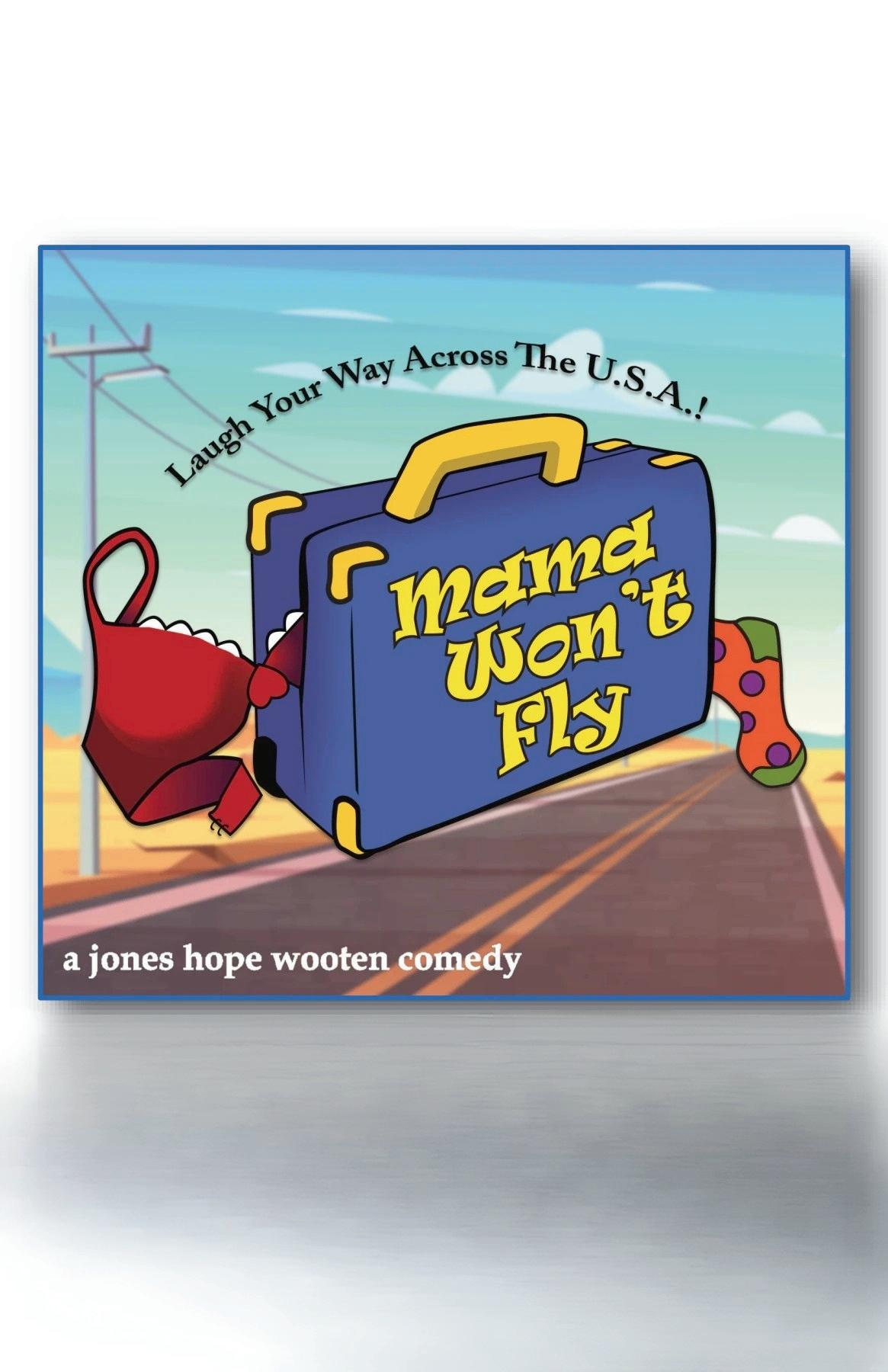
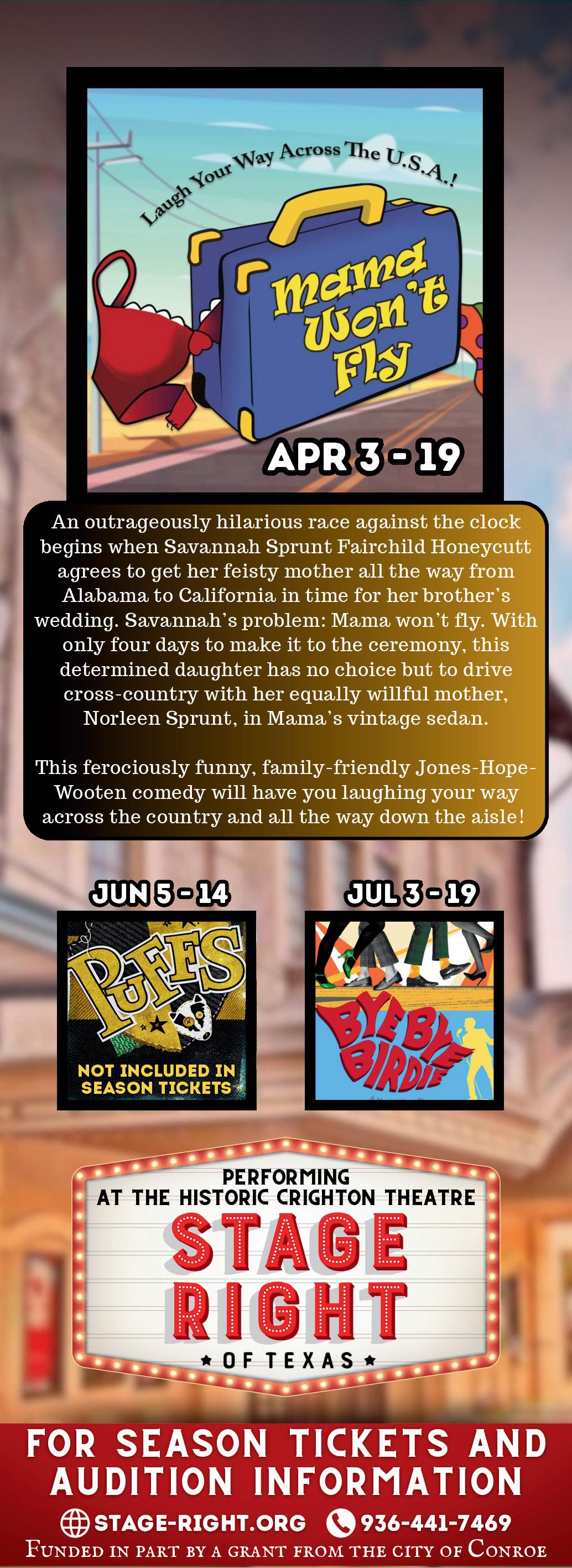
An outrageously hilarious race against the clock begins when Savannah Sprunt Fairchild Honeycutt agrees to get her feisty mother all the way from Alabama to California in time for her brother’s wedding. Savannah’s problem: Mama won’t fly. With only four days to make it to the ceremony, this determined daughter has no choice but to drive cross-country with her equally willful mother, Norleen Sprunt, in Mama’s vintage sedan.
This ferociously funny, family-friendly Jones-Hope-Wooten comedy will have you laughing your way across the country and all the way down the aisle!
apr 3 - 19
To get to storybook views, some “pages” are easier turned than others.
The territory that straddles the border of Arizona and Utah near Page, Arizona is known for its otherworldly beauty. Some landmarks are famous throughout the world; others are less well-known, yet still worthy of a visit. Page, once a housing camp for workers who constructed the Glen Canyon Dam, is now a town that welcomes millions of tourists each year.
Antelope Canyon, one of the most dramatic and well-known slot canyons in America, is situated on Navajo land about six miles east of Page. It was named after the herds of pronghorn antelope that once frequented the area. Today, instead of antelope, there are herds of people. Most estimates agree that somewhere around four million people visit Antelope Canyon each year.
There is no public access to Antelope Canyon; all visitors must reserve spots through one of several tour companies authorized by the Navajo Nation. The tours are pricey, but give visitors peace of mind. Storms originating miles upstream from Antelope Canyon have been known to produce deadly flash flooding inside the slot canyon; therefore, Navajo Nation Parks personnel watch the weather closely—in the immediate vicinity of the canyon and throughout the watershed area—and close Antelope Canyon when storms threaten. In addition, tour guides ferry visitors from the main roadway across several miles of sandy road that is accessible only by four-wheel-drive vehicles.
Antelope Canyon is actually two strikingly similar canyons, Upper Antelope Canyon and Lower Antelope Canyon, which are in the same immediate area. They do not connect, and separate tours must be booked for each of the sister canyons. Some people visit both.
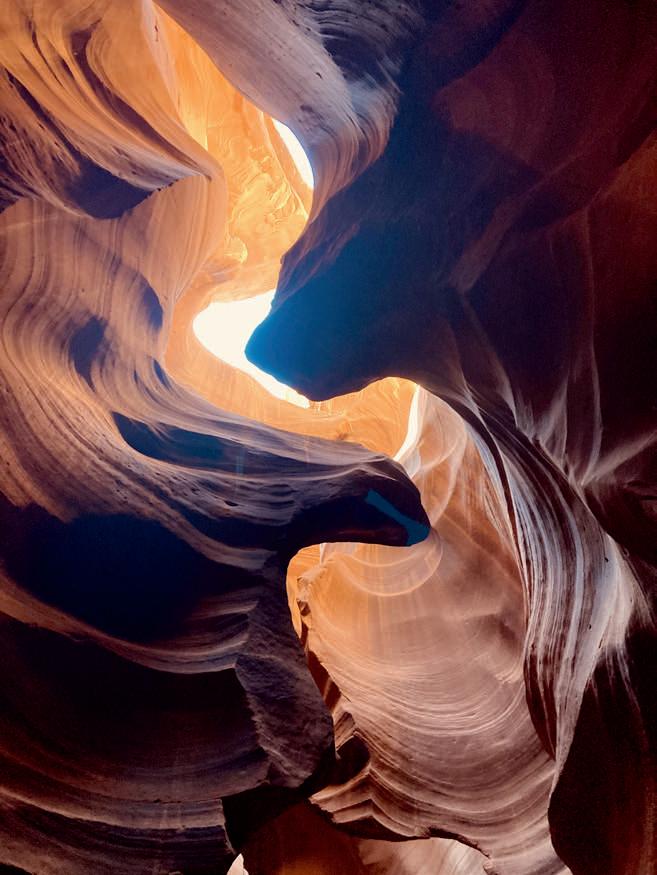
The Navajo name for Upper Antelope Canyon is “Tse’bighanilini,” which means “the place where water runs through rocks.” The entrance looks simply like a crack in a rock wall, which may be how it got its nickname “The Crack.” Once inside, however, there is nothing ordinary about Upper Antelope Canyon. Swirling sandstone extends about 120 feet above the streambed. When my husband and I visited Upper Antelope Canyon, we were awestruck as we meandered between the narrow canyon walls. We weren’t able to see the canyon’s iconic light beams, which shine through the canyon to the streambed during the months of May through September between about 11 a.m. and 1:30 p.m. on sunny days; however, it was still an unforgettable experience.
The Navajo name for Lower Antelope Canyon is “Hasdssez’ twazi,” which means “the spiral role arches.” Of the
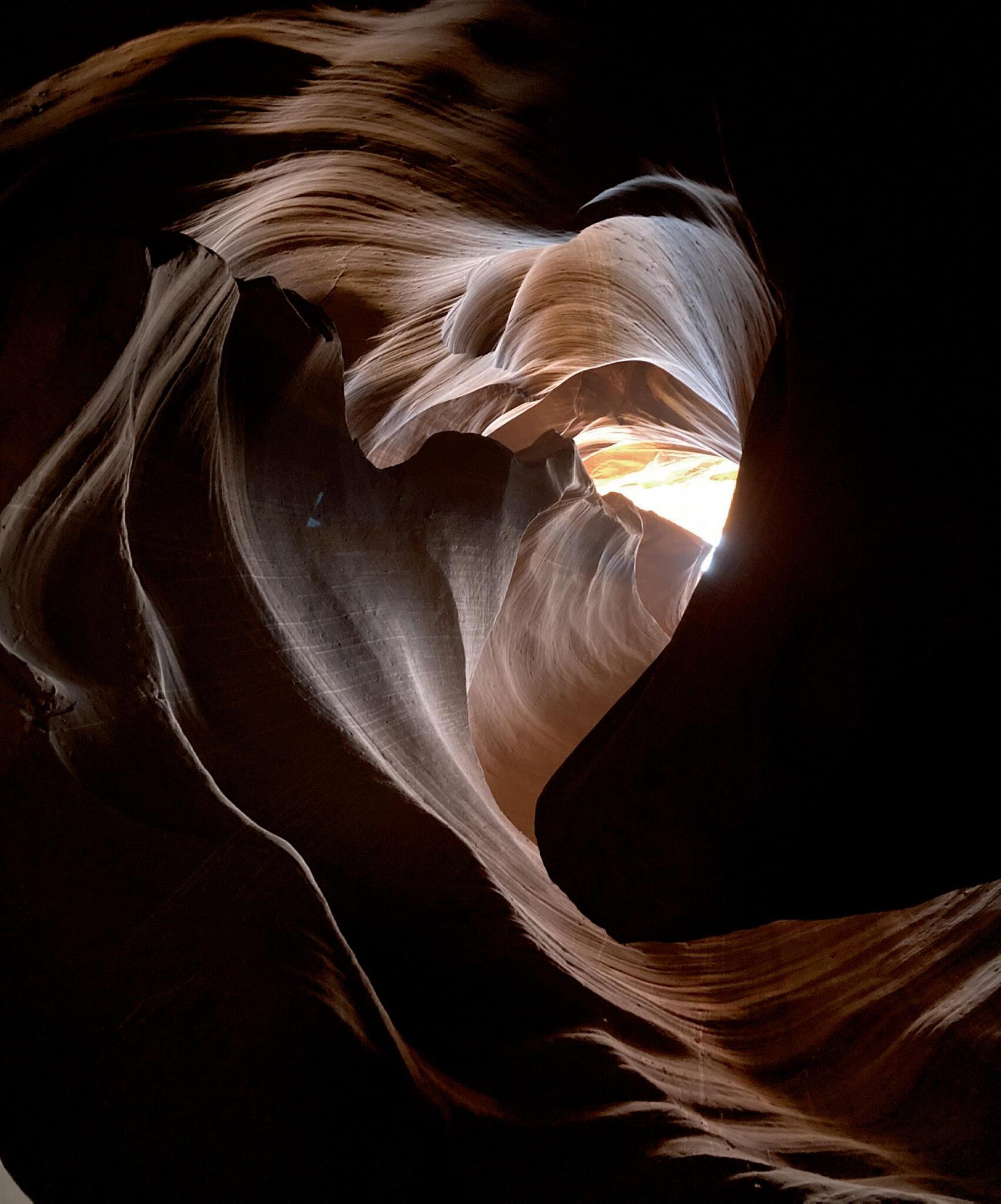
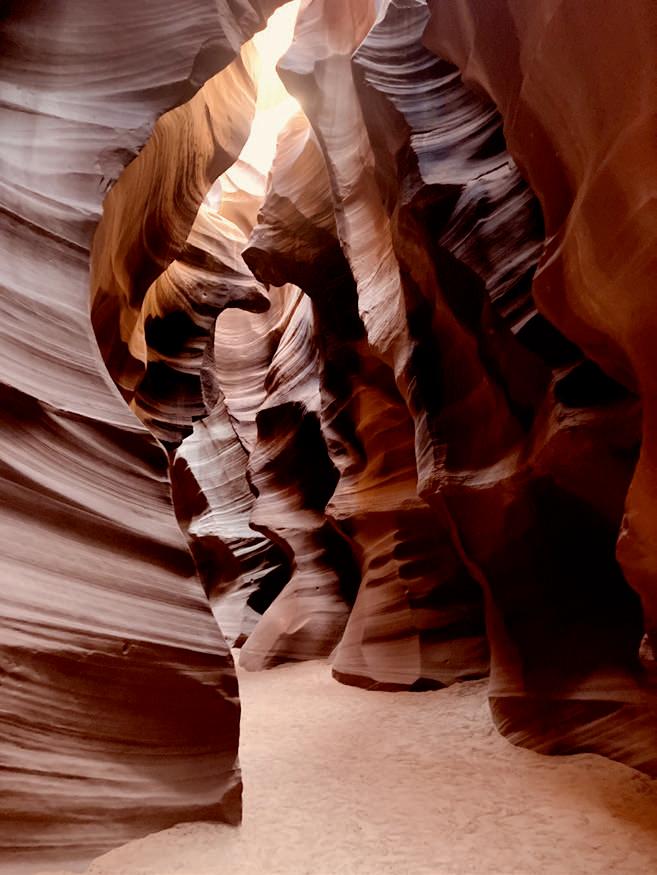
two sister canyons, Lower Antelope Canyon, sometimes called “the Corkscrew,” is deemed to be a more difficult hike, requiring visitors to traverse steps and ladders. In contrast to Upper Antelope Canyon, which is narrower at the top, Lower Antelope Canyon is wider at the top than at the streambed, and at 1,335 feet long, it is about twice the length of Upper Antelope Canyon.
Unlike the state of Arizona, the Navajo Nation observes Daylight Saving Time; however, to avoid confusion, Antelope Canyon tours operate on Mountain Standard Time all year. When we visited Antelope Canyon, we were accustomed to Central Daylight Time, so we found it advantageous to book an early morning tour. We were rewarded with relatively cool weather and a small tour group.
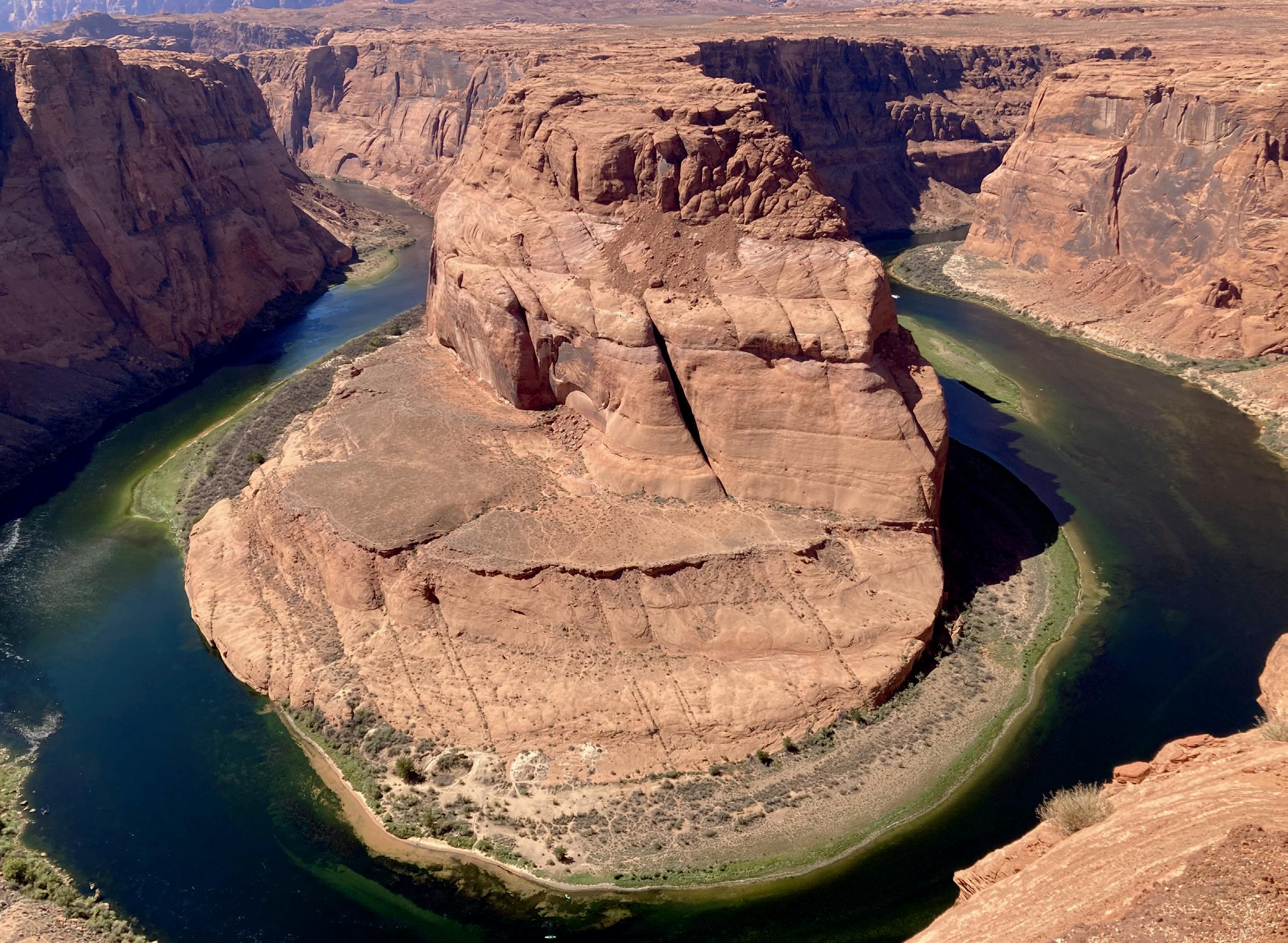
Less than five miles south of downtown Page, the Colorado River makes a pronounced U-turn known as Horseshoe Bend. It’s what my husband calls a “one-trick pony,” but it is quite a trick. More than two million people visit Horseshoe Bend each year to view this natural phenomenon.
Getting to Horseshoe Bend requires a 1.5-mile round-trip hike on an improved trail that is accessible to wheelchairs, strollers, and leashed dogs; however, there is minimal shade and a 137-foot change in elevation. In 2018, a fenced overlook was added to improve safety, but according to the National Park Service, “much of the rim remains exposed to the 1,000-foot drop.” Be careful!
Horseshoe Bend is in the Glen Canyon National Recreation area; however, the parking lot is within the city limits of Page, and national park passes are not accepted. There is a $10 parking fee, and cash may be requested on busy weekends and holidays.
The 280,000-acre Vermilion Cliffs National Monument, under the care of the Bureau of Land Management (BLM), is west of Page. Among the scenic areas in this unspoiled wilderness are the Vermilion Cliffs, Paria Canyon, and Coyote Buttes. According to the BLM, “Coyote Buttes North is just a small part of the 112,500-acre Paria Canyon-Vermilion Cliffs Wilderness, but has some of the most visually striking geologic sandstone formations in the world, including The Wave.”
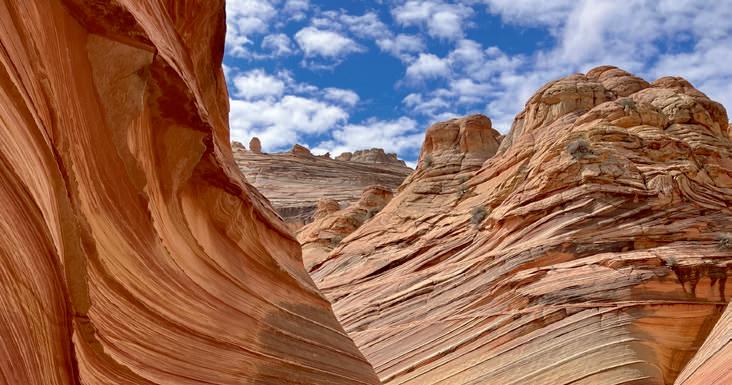
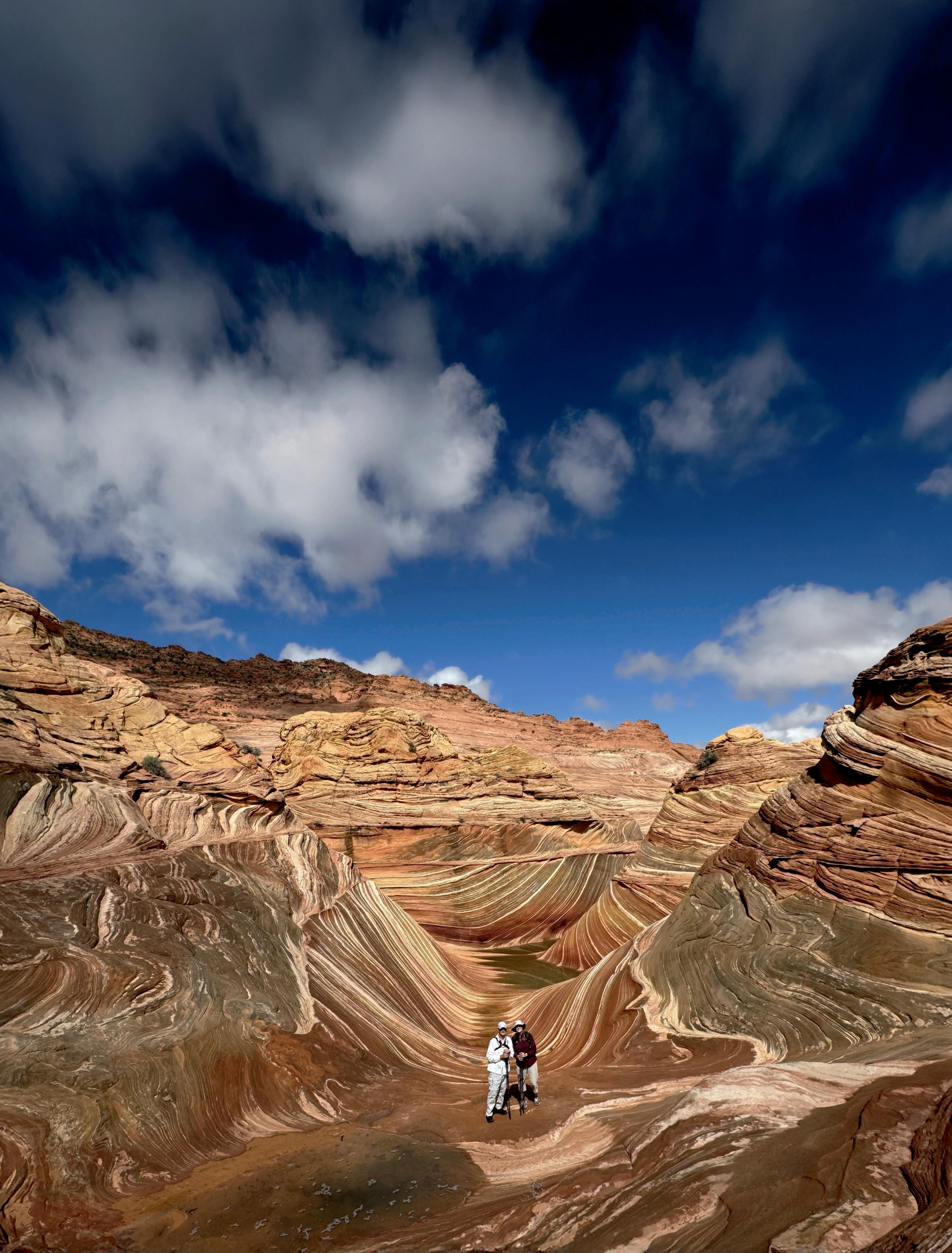
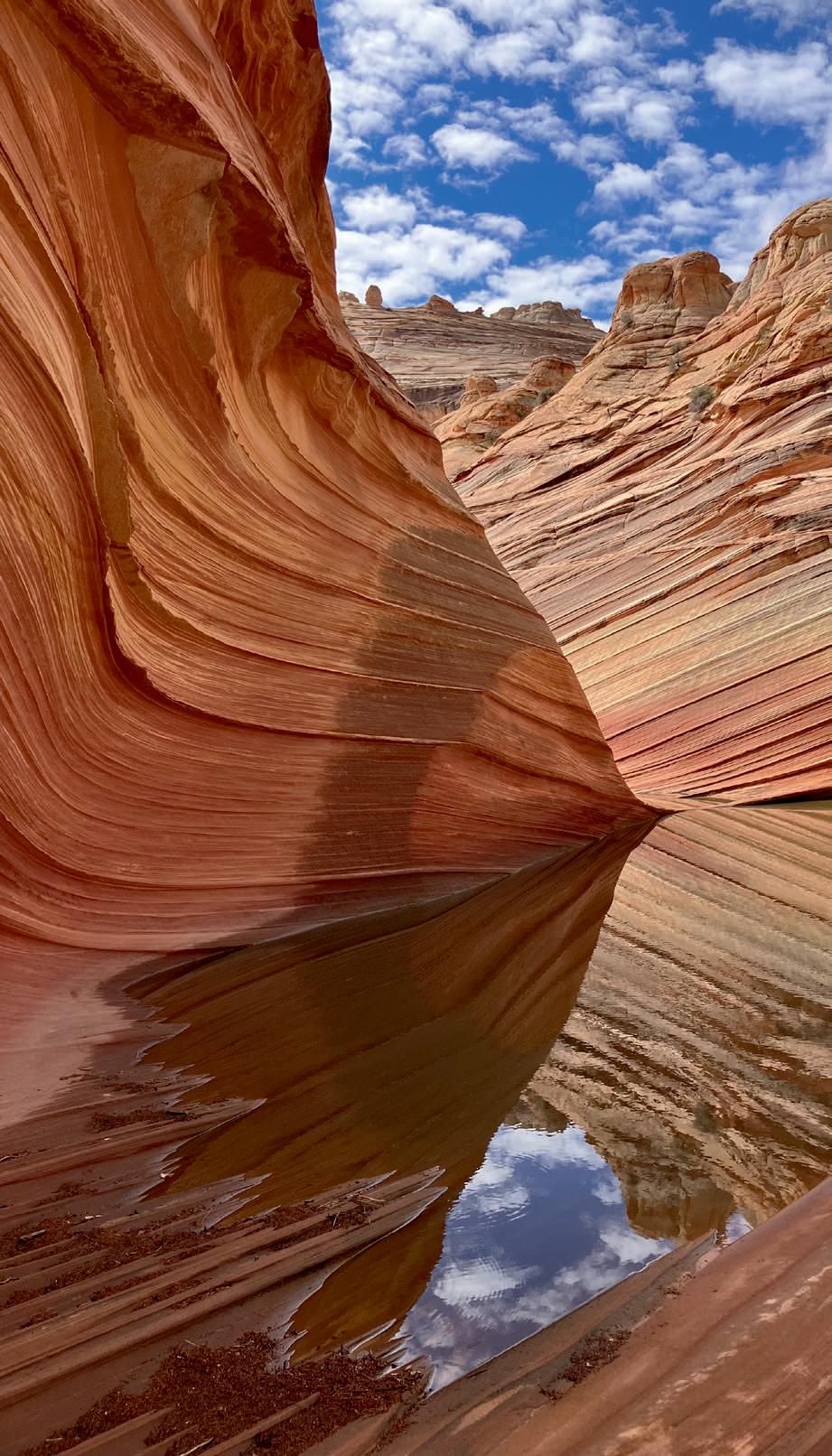
The Wave, a massive series of swirly striations in sandstone, has become a hiking destination of immense popularity. Due to incredible demand and the fragile landscape, the BLM now restricts access through a strict lottery system. People who live in the immediate vicinity have a separate lottery, which allows up to 16 hikers each day; the “advance lottery,” for those outside the local area, selects up to 12 groups or up to 48 people each day, whichever comes first. (Each permit covers up to six people.) Competition is stiff.
According to some estimates, more than 300,000 people entered the lottery to hike to The Wave in 2023, and many people enter month after month, despite the non-refundable $6 fee for each entry. Entering the lottery, however, is a must: hiking without a permit is punishable by a staggering fine and even imprisonment.
In April 2025, our younger son entered the lottery for the first time and—in a stunning reversal of expectations—won a permit for four. I had been dreaming of hiking to The Wave for years, so as soon as I stopped squealing, I devised a four-month plan to get in shape for the challenging 6.4mile hike.
As it turned out, preparation for a high-altitude hike with significant changes in elevation was only part of the equation. The BLM does not reschedule permits for any reason, including weather, and the eight-mile, minimally maintained dirt road to the trailhead is impassable when wet. (Interestingly, the trailhead is in Utah, but The Wave itself is in Arizona.) Our
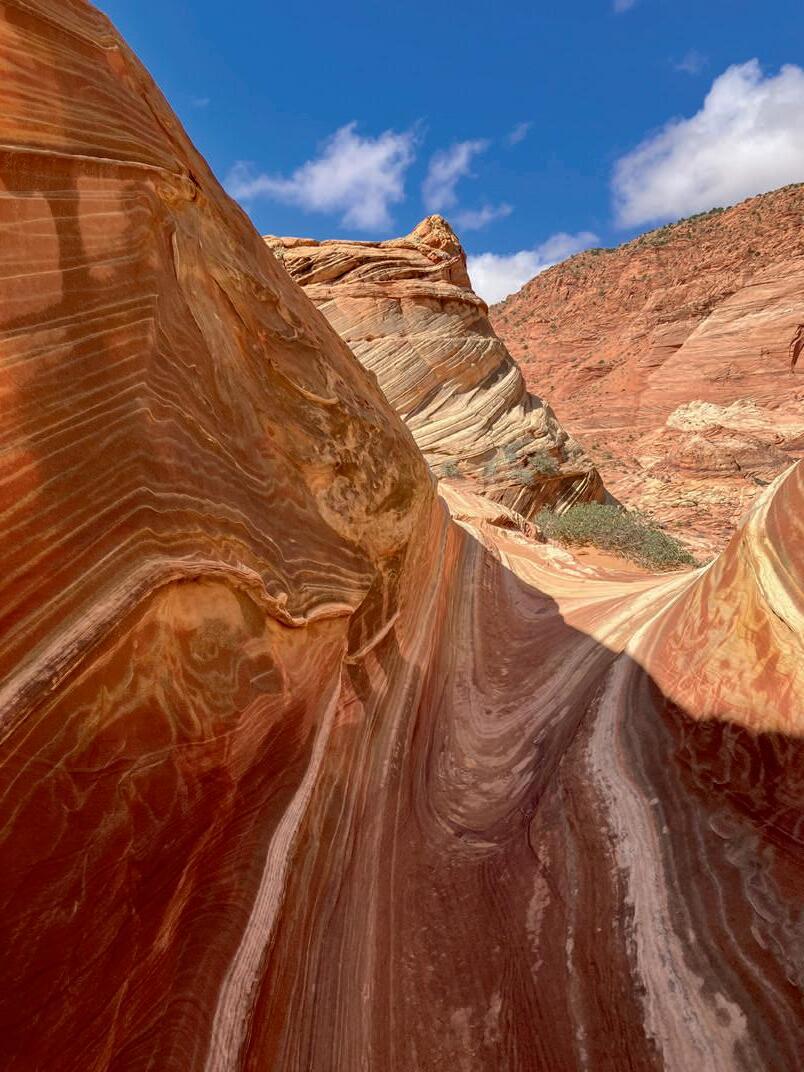
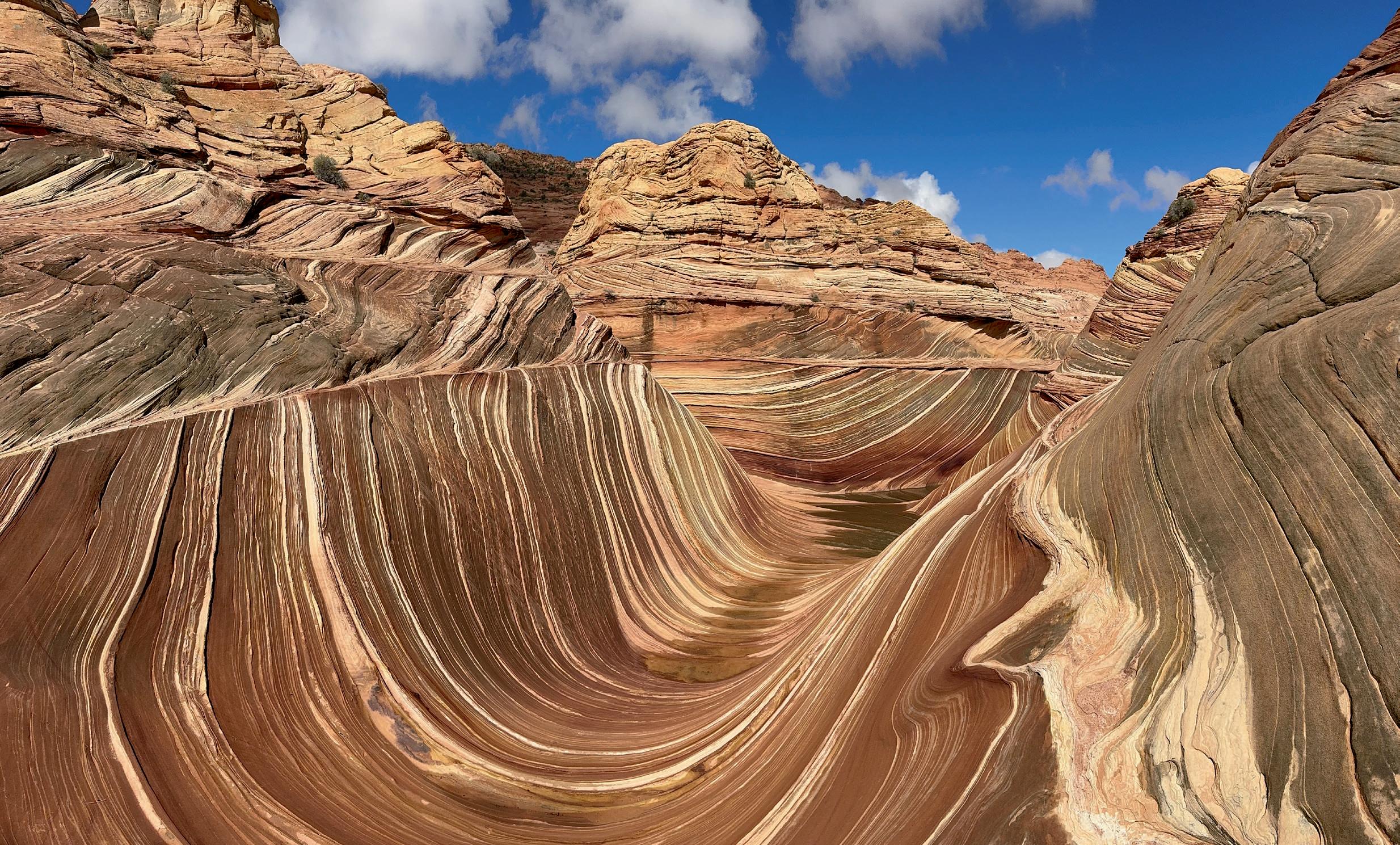
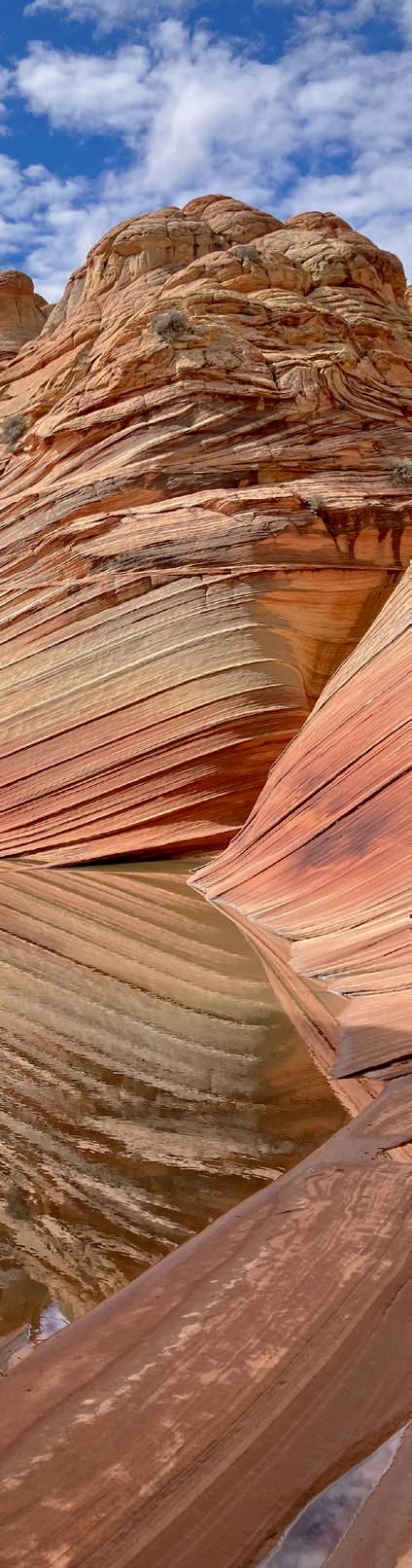
permit was for August 29, toward the end of monsoon season. We nearly got rained out, which would have been enormously disappointing after anticipating the hike for four months and traveling 1,200 miles to get there.
We were among the most fortunate. We made it to the trailhead after a white-knuckled drive and were blessed with a glorious hike through areas of unparalleled beauty. The Wave is not a one-trick pony. Even before we reached The Wave, we saw what I called “pre-Wave swirls.” Beyond, there was more striated sandstone, including the Second Wave, a smaller wave-like formation. The hike was tough, sometimes necessitating multiple points of contact in rocky areas, and we had to navigate without benefit of a trail; however, the unimaginably vibrant, multi-color striations in the sandstone made it all worthwhile. We even saw six bighorn sheep, which was an unexpected bonus. We were grateful for the
once-in-a-lifetime opportunity to hike to The Wave. (To enter the lottery, visit recreation.gov.)
There are many other noteworthy destinations near Page. Lake Powell, extending 185 miles, well into Utah, is one of the largest man-made lakes in North America. In addition, the Grand Staircase-Escalante National Monument, managed by the BLM, begins just north of Page in Utah. It includes nearly 1.9 million acres of cliffs, canyons, plateaus, colorful rock formations and arches. It is named for the Escalante River and for the staircase-like increases in elevation between Lake Powell and Bryce Canyon National Park. There are many hiking opportunities in this scenic wilderness. While in the area, it’s tempting to visit one or more of Utah’s five national parks, but that’s another story for another day.

















3-yo: Where's you berilla?
Me: My what?
3: Berilla!
Me: I don't know what you're talking about.
3: What you hold above my head.
Me: ...
3: Outside!
Me: ...
3: For the rain!!
Me: Ohhhh, you mean umbrella.
3: Oh yes, umberilla.
Abby Boyd
I thought I was having a chill night until my toddler walked into the living room completely naked, covered in lotion, and proudly said, "I'm a slippery dolphin!"
•••••••••••••••••••••••••••••••
It's so exciting. My son turned 14, and now he knows everything! Everything!! I don't have to tell him anything anymore because he already knows! In fact, he knows more than I do AND more than his dad does! We couldn't be more thrilled. What a joyous time.
Whenever I say goodbye to my 4-yo at school, I tell him something silly like, "I love you stronger than Hulk!" and he says something like, "I love you faster than a cheetah!" But this morning, he was mad at me (we had a dispute over not biting the baby) and he goes, "I only love you NORMAL today."
My 7-yo wouldn't eat his dinner because he said it tastes like [checks notes] "the inside of a vacuum."
INGREDIENTS
6 large hard-boiled eggs, peeled and chopped
3/4 cup mayonnaise
1/2 cup cooked, crumbled bacon
2 oz sharp Cheddar cheese, shredded
1/3 cup thinly sliced green onions
2 tsp Dijon mustard
1/2 tsp kosher salt
1/4 tsp ground black pepper
4 (2 oz) slices white bread

DIRECTIONS
Step 1: Stir eggs, mayonnaise, bacon, Cheddar, green onions, mustard, salt, and pepper in a bowl until combined. Use the back of a fork to mash ingredients together until evenly combined.
Step 2: Spread half of the egg salad mixture evenly on 2 of the bread slices; top each with 1 bread slice. Cut sandwiches in half and serve.




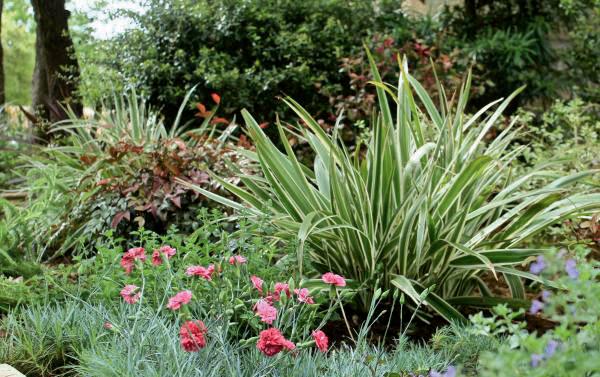
Spring is in the air! The garden bug has bitten, and every gardener in Texas is on the hunt for spring color! The number one request is perennials. Perennials are plants that will return each year from the root system and will thrive for many multiple seasons/ years. Perennials often die back in winter and reappear in the spring. Keep in mind many plants we consider to be perennials will be annuals in a colder climate. The term “tender perennial” will refer to plants that will not survive temps below 32 for a sustained time.
Here are our top picks for hardiness and sun tolerance. Please keep in mind, new plantings will require more water than your existing landscape and will take additional water to develop a good root system. There seems to be a misconception that “hardy” refers to no water, other than mother nature...that is a myth, Even native plant varieties will die during a drought. Please ensure you will be able to water consistently there first year.
“TOUGH AS NAILS” perennials require sandy loam, good sun, and well-drained soil; here are our tip picks.

Achillea (yarrow) – 1⁄2 sun to full sun; tolerates high heat; butterfly friendly; grows 2’-4’ x 3’, depending on variety.
Sage – Salvia greggi- mystic spire – practically all sage -1/2 sun to full sun; various sizes from less than 12” tall to 4’; a definite for any butterfly garden.
Coneflower – Echicacea –takes more water; grows 12”-24”; a must for bees and butterflies; blooms spring through early fall. Requires sandy loam soil with good drainage.
Chrysanthemum – a personal favorite! Blooms spring and fall; spreads beautifully; requires more water for establishment; tough as nails after a year. If planted in 1⁄2 sun, mums have been known to have a third bloom set.
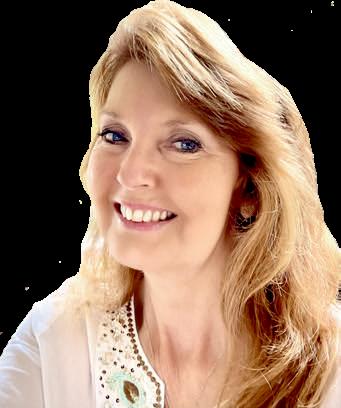
Kim Bius President, Kim's Home & Garden Center
Foxtail Fern – not a fern, but a hardy perennial that will take the toughest west sun, drought and return after a harsh winter. No blooms, but red berries; grows 2’-4’ tall x 3’-4’ wide; perfect under palm trees or in containers. The prickly foliage makes a great barrier for small animals. You may know her sister, Asparagus Fern – grows the same but without the conical foxtails.
Bulbine – blooming succulent from Africa; has orange/ yellow spike blooms, spring – fall. It is hardy, drought tolerant and heat resistant; great groundcover for area that will receive irrigation on a very limited basis.
Dianella – Variegated Blue Flax – personal favorite for landscape! This striking grass-like clumping foliage provides the perfect texture variation with white variegation to make any area “pop.” Grows 3’ tall x 3’ wide. Downside – may not return with winter temps below 15; beautiful tropical look; shade – sun.
Lantana – available in over 50 varieties and immense color choices; 12” tall – 3’ tall x 1.5’ to 4’ (depending on variety); deer proof.
Esperanza – a larger perennial – available in orange/red/ yellow blooms; native to South Texas and Northern Mexico. Grows 3’ tall x 3’ wide; aka “yellow bells”; tolerates sandy soil, high heat and drought; butterflies and hummingbirds love it.
No garden should be without one or more of these beauties, and there are hundreds more to choose from when making the annual pilgrimage to the garden centers.
Happy Gardening!


Send me your questions at
Welcome back to the April 2026 edition of the Dear Gabby advice column. To update your calendars: April Fool’s Day is (as always) on the 1st; Good Friday is April 3rd; and Easter Sunday is April 5th. I hate to mention it, but April 15th is the deadline to file your tax returns. April showers would be most welcome in our parched part of the world. Bring them on! A few May flowers wouldn’t hurt, either. Send me your questions by clicking on Dear Gabby at www.PostcardsLive.com/share.
I barely survive tax season worrying about whether I will get a juicy refund or owe a lot of money. I can’t afford an accountant, and the tax code is intimidating, at best. Do you have any suggestions on taking some of the sting out of the process?
PETRIFIED PETE
It’s all fun and games until the IRS shows up. Their motto is: we have what it takes to take what you have. Even the sign over their door reads THEIRS. In other words, how much did you make? Send it to us. It’s called a 1040 Form because for every 50 dollars you make, you get 10 and they get 40. By the way, a refund is actually your own money that you have overpaid the government. If you are unable to calculate the tip at a restaurant, I strongly urge you to get professional help or, at least, a computer program. Because, if you accidentally add a couple of zeroes on your tax return, the IRS acts like it’s a federal offense. Just don’t let this tax process cause you to doubt your mental prowess. The average novel has 90,000 words. The US tax code, with regulations, has over a million. Albert
Einstein is quoted as saying, “The hardest thing to understand in the world is the income tax.”
DEAR GABBY
Call me stodgy, but I detest April Fool’s Day and see no humor in it. I think the people who play tricks and pranks on unsuspecting individuals are the fools!
DEAR STODGY
Since there’s no fool like an old fool, April 1st holds little meaning for me, but it brings joy to many people. I detest harmful pranks, but I hope you realize you can’t change the behavior of anyone other than yourself. There’s a simple solution. If harmless, playful antics annoy you, I suggest you take the day off and stay at home, avoiding the chance that your sensibilities will be offended.
GABBY


Saturday, April 2 5 , 202 6 10 a.m. – 5 p.m.
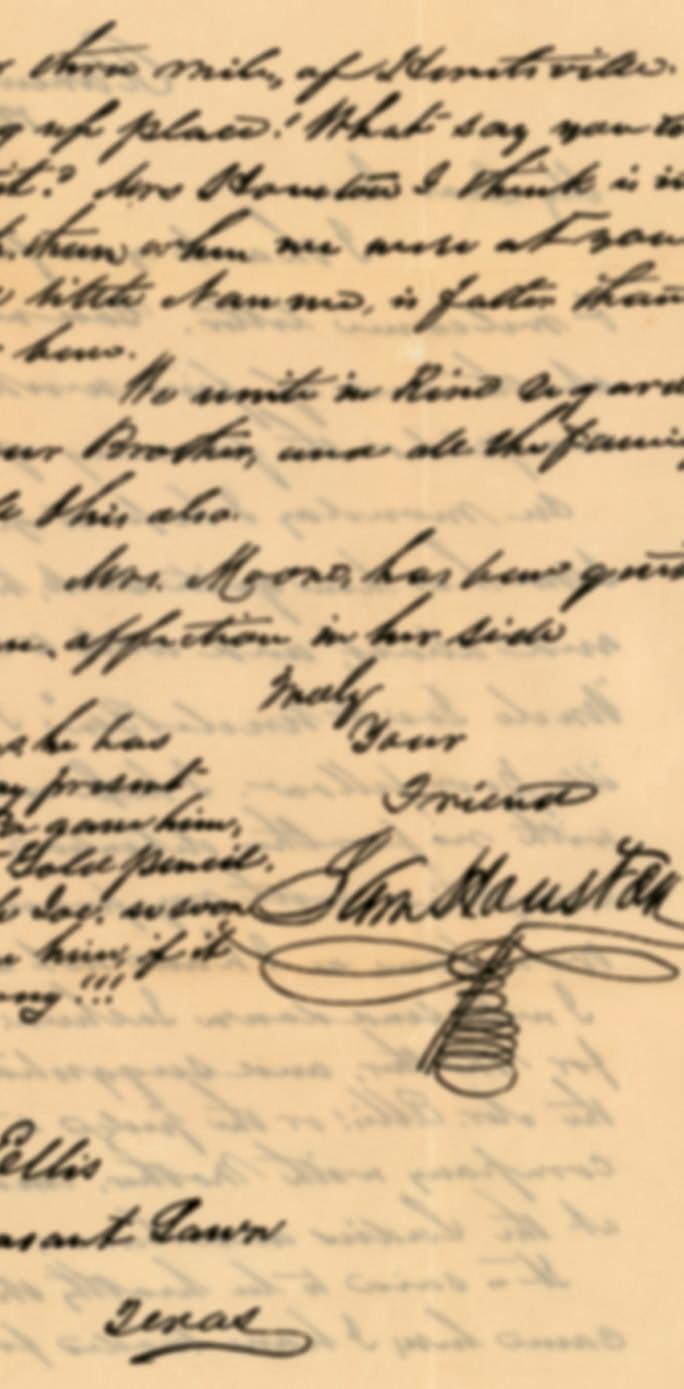
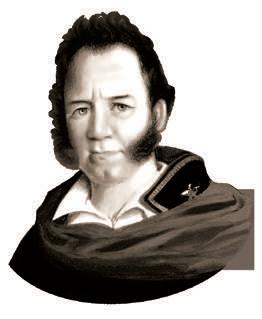
Step back in time for a free event honoring Sam Houston and his times (1793-1863). Historical demonstrations, period music, hands-on activities and more!
Sam Houston Memorial Museum Grounds 1836 Sam Houston Avenue Huntsville, TX 77340
samhoustonmemorialmuseum.com 936.294.1832








The Business Focus is chosen each month by random drawing from among Postcards contract advertisers.
Learn more about a great place to start…for both healers and healing.
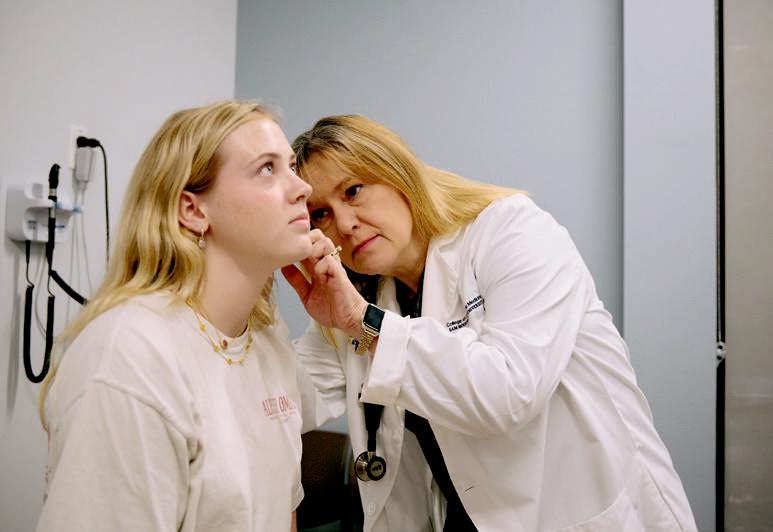
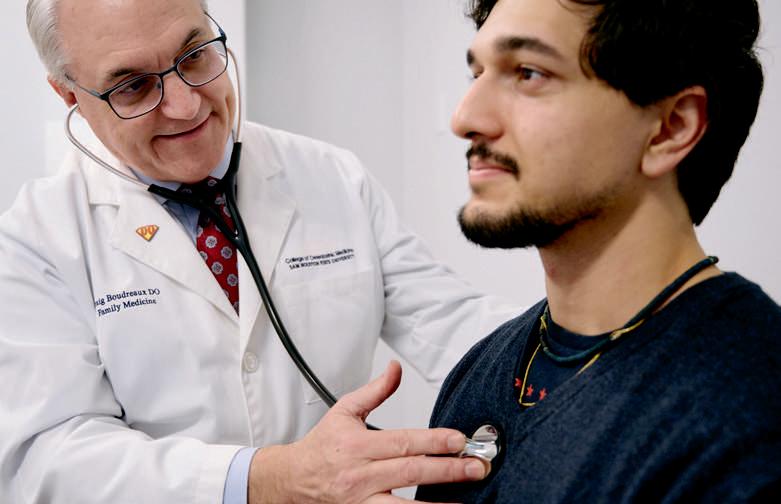
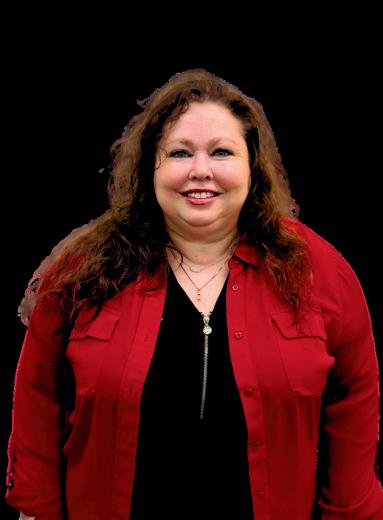
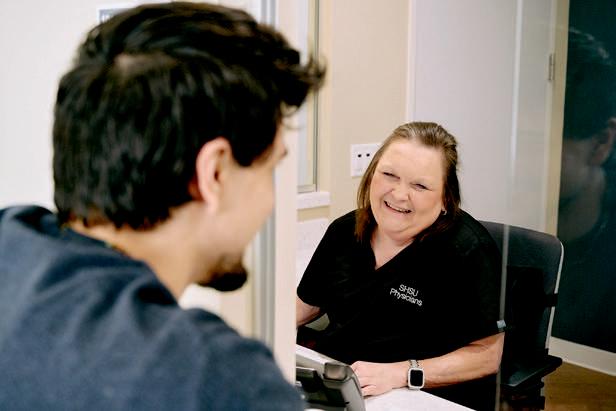
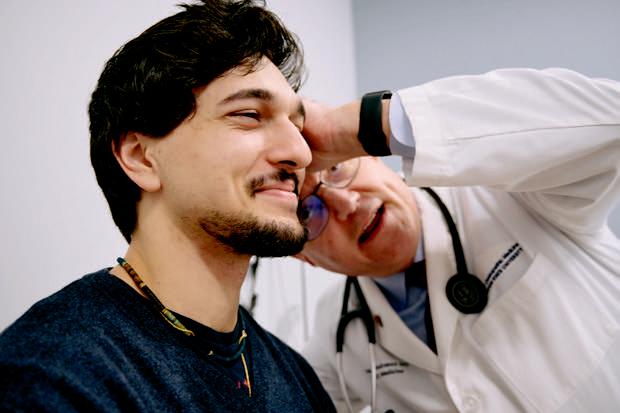
Finding the right doctor can feel overwhelming, especially as healthcare becomes increasingly specialized. For many families, the right doctor is a trusted primary care physician who can guide their health from childhood through adulthood— someone who takes the time to listen, answer questions, and build a relationship with patients and their families.
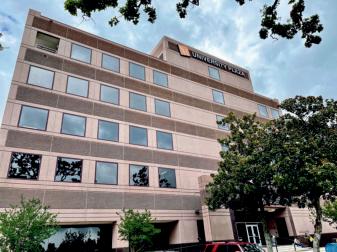
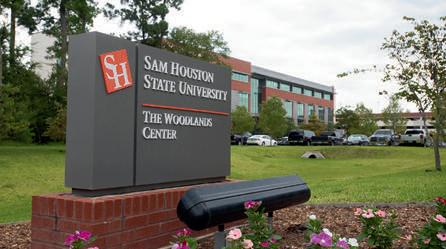
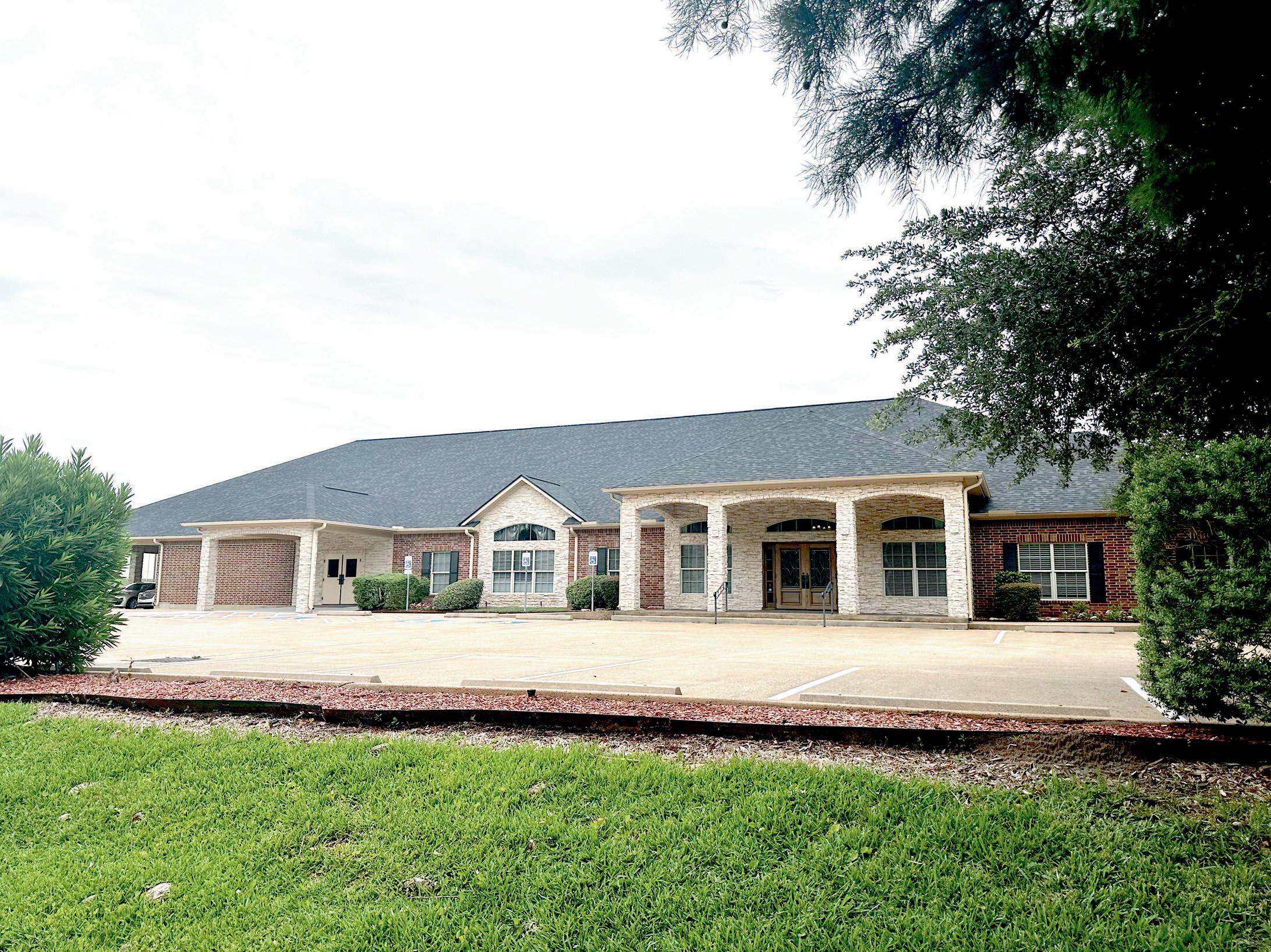
At SHSU Physicians in Conroe, the focus is simple: providing
comprehensive, compassionate care for patients of all ages in one place.
The combination of doctors at the practice can provide services for newborns all the way to geriatrics—offering wide-ranging, high-quality care for the whole family. SHSU Physicians serves families across the community and welcomes anyone seeking a primary care doctor, not just Sam Houston State University students or employees.
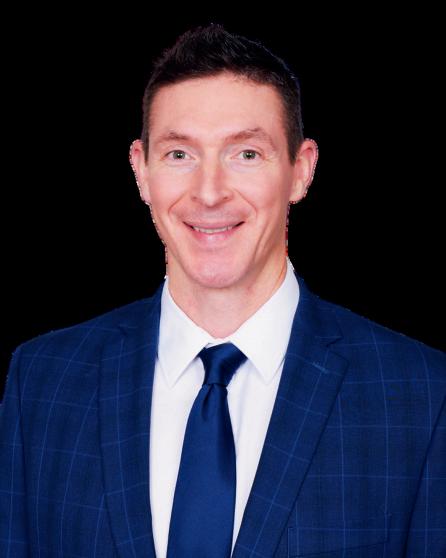
Dr. Craig Boudreaux, the medical
director and a Doctor of Osteopathic Medicine (D.O.), said he has a lofty— and achievable—goal for the practice. “We sort of want to be the primary care practice in the Conroe area—the practice that all other practices are compared to.”
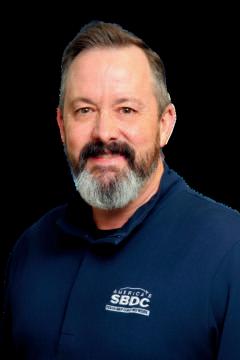
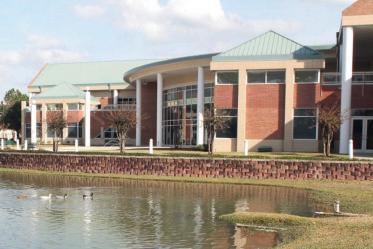
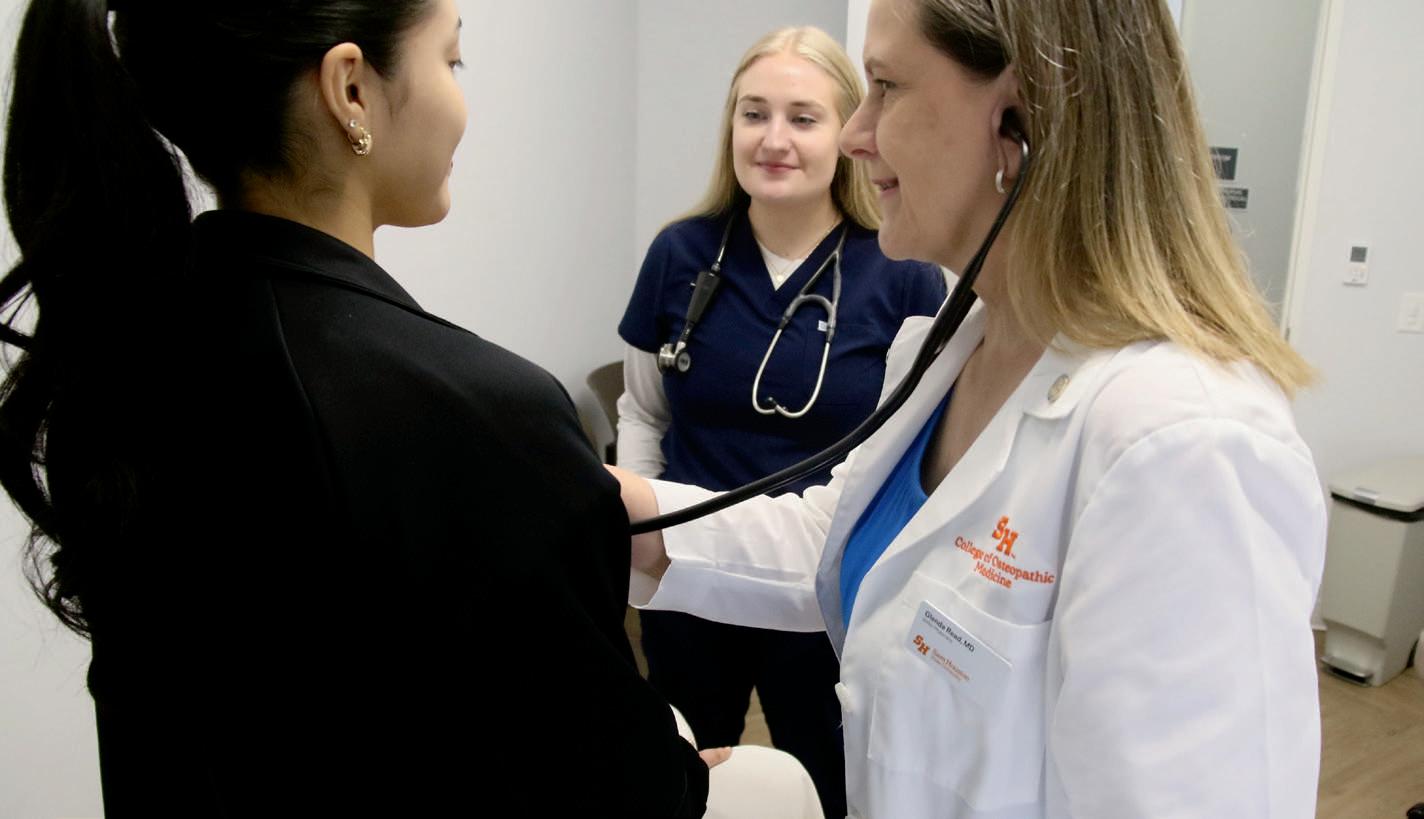
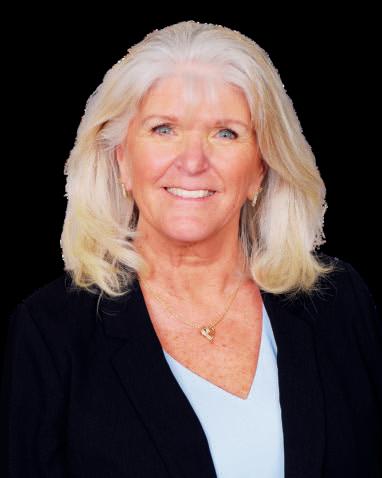
Dr. Glenda Read, a physician at the practice, said one of the things that attracted her is that, thanks to the partnership with the medical school next door, patients benefit from physicians
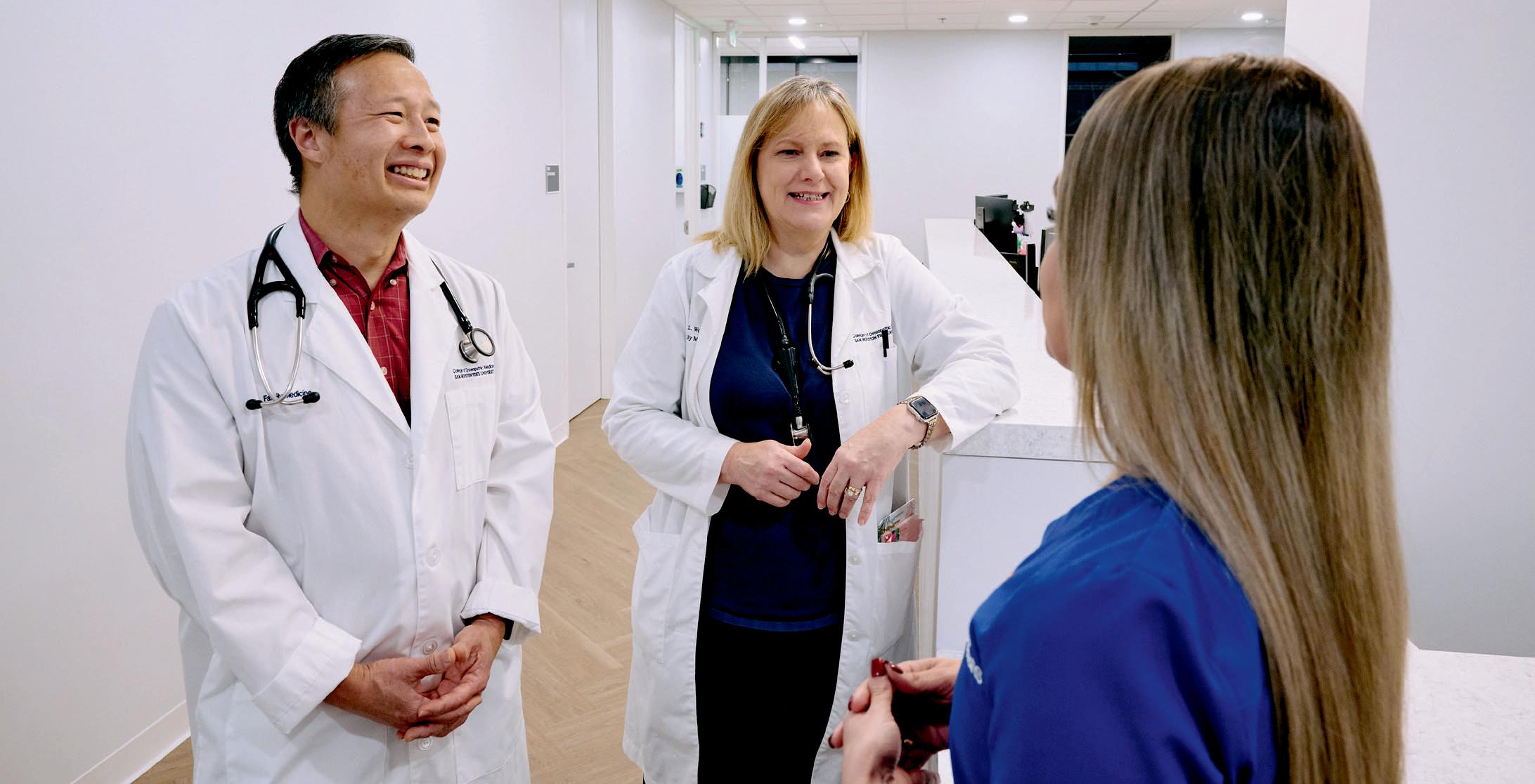
with a wide range of training and experience working together. “If I have a patient who needs a service, I can often keep them within the same office and not have to go somewhere else to get that done,” she said.
That coordinated approach allows many patients to receive the care they need in one place, while still having access to specialists when necessary.
Primary care at SHSU Physicians emphasizes prevention, a hallmark of osteopathic medicine, while also helping patients manage ongoing health needs. Physicians regularly treat conditions such as diabetes, hypertension, and other chronic illnesses, while also providing services in pediatrics, internal medicine, as well as counseling, with a licensed psychologist on staff.
Osteopathic manipulative treatment (OMT) is also available at the practice. The hands-on approach used by doctors of osteopathic medicine can help diagnose, treat, and prevent certain conditions, particularly those involving muscles, joints, and overall mobility.
Boudreaux said the team can perform minor outpatient procedures, such as skin procedures, and manage injuries like sprains, strains, and even some fractures, coordinating referrals to an appropriate specialist when additional care is needed.
Pediatric care includes vaccine schedules, developmental checkups, and support for parents navigating their child’s health. As patients grow, care continues with services for adolescents, such as required vaccinations and pre-participation physicals for activities like athletics or band. Pap smears, referrals for mammograms, basic well-woman care, and routine screenings are all part of the day-today services available. From children and college students to working adults and seniors, the practice provides care through every stage of life.
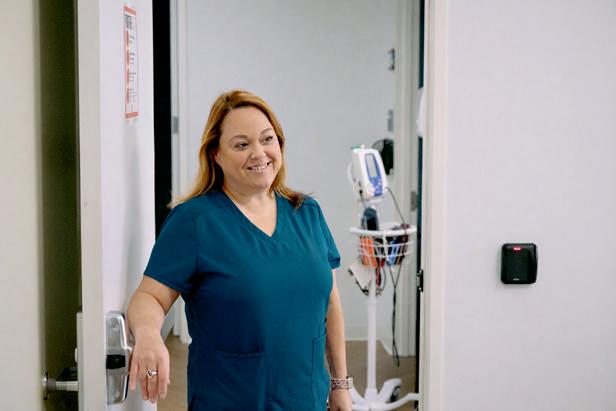
The style of care at SHSU Physicians focuses not just on symptoms, but on the patient as a whole. Doctors make it a priority not to rush appointments, taking the time to listen to patients, understand their concerns, and develop a care plan together.
Boudreaux said it can be difficult to coordinate mental health support

• Comprehensive primary care
• Osteopathic manipulative treatment (OMT)
• Preventive care & wellness exams
• Management of chronic conditions
shsuphysicians.com
• Vaccinations & immunizations
• School, sports & work physicals
• Medicare annual wellness visits
• Psychology and counseling sessions
• Plus more Healthcare for all ages SHSU Physicians 1169 Grand Central Pkwy Conroe, TX 77304 (936) 525-3600
• Acute illness & injury treatment
for patients. Having behavioral health professionals available within the same practice allows physicians to connect patients with counseling when it may help their overall health and recovery.
The team is also working to expand convenient services for patients. Plans include on-site lab draws, x-ray services, and expanded ultrasound access through collaboration with faculty specialists at the medical schools.
Boudreaux said thanks to the ties to the Sam Houston State University College of Osteopathic Medicine (SHSU-COM) the practice has deep roots in osteopathic medicine, a style of medicine founded in the late 1800s by physician Andrew Taylor Still. Still believed the structure and function of the body are closely connected, and physicians should focus not only on treating disease, but also on supporting the body’s natural ability to heal.
Dr. Read said once patients experience care at the clinic, they’ll often notice a difference. “They’ll know we have time to spend with our patients, and we really want to utilize that time to provide comprehensive care to them,” she said.
“It’s a building full of good old country doctors,” Boudreaux said. “In a nutshell, it’s a really good place to start your healthcare journey.” For families across Montgomery, Walker, and surrounding counties, SHSU Physicians is intentionally designed to be a trusted starting point for lifelong care.
While SHSU Physicians works closely with SHSU-COM/Sam Houston State University, it is focused on patient care and service to the community. “The mission of the college is to serve underserved areas, especially rural areas in East Texas,” Boudreaux said. “SHSU Physicians helps support that mission by providing primary care for local families while helping train the next generation of doctors to serve communities like ours across rural Texas.”
As most people know, the state of Texas has a physician shortage (that will probably be close to 20,000 physicians short by 2030, maybe even larger by some estimates). Boudreaux said there are many factors for the shortage,
including an aging physician population and an increasing population throughout the state. Addressing the shortage will require more physicians and more opportunities to train and practice in communities across Texas.
The mission is to build more infrastructure to not only train new physicians, but also to keep them here in the state in rural areas, building graduate medical education opportunities and residency programs for them in those rural areas,” he said. The relationship between the medical school and SHSU Physicians allows faculty physicians to continue caring for patients while also helping train the next generation of doctors. “That has been the design since its inception,” Boudreaux said. “Most osteopathic medical schools don’t have a clinic like this. But we felt compelled to have a place for our physicians to stay up to date on the latest medical training.”
That connection helps bring the latest medical knowledge and evidence-based care directly into the exam room. “We wanted to build a clinic the faculty could work in,” Boudreaux said. “All of us are hired as faculty members that work in the clinic. Those clinical faculty (must) maintain their licensure, their board certification, to stay up on current teaching and concepts in medicine they’ll have to be teaching the students. This is a place for them to
practice. It’s better to have a place for them to practice that is close.”
Today, the practice includes pediatricians, family medicine physicians, internal medicine physicians, and behavioral health specialists, providing a broad base of primary care services.
Legacy medical schools tend to focus on pumping out more graduates who are interested in specialty medicine. While specialists are necessary, SHSUCOM’s emphasis is on primary care, and mostly in rural settings.
“The cool thing about our practice is that when you come here, you’re going to be seeing a physician,” Boudreaux said. “There may be students and learners in tow, but patients always are cared for by a licensed physician.” Read said the environment also creates meaningful connections between physicians, patients, and future doctors.
“It’s exciting to care for patients while also working with students and helping prepare students for the future of primary care.”
That combination of patient care and physician training is part of the larger mission shared by SHSU Physicians and the medical school. “You’re not going to find a smarter bunch of docs who are going to spend their time with you, make sure you’re satisfied with your care, and ensure you have the best care possible than when you walk through our doors,” Boudreaux said.
SHSU Physicians offers a wide range of healthcare for everyone, and that means you. ”



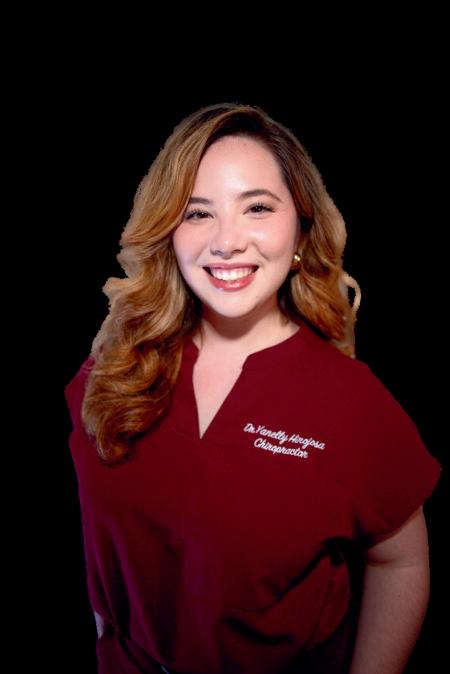
Natasha Shah, MD FAAP
Board-certified in Pediatrics
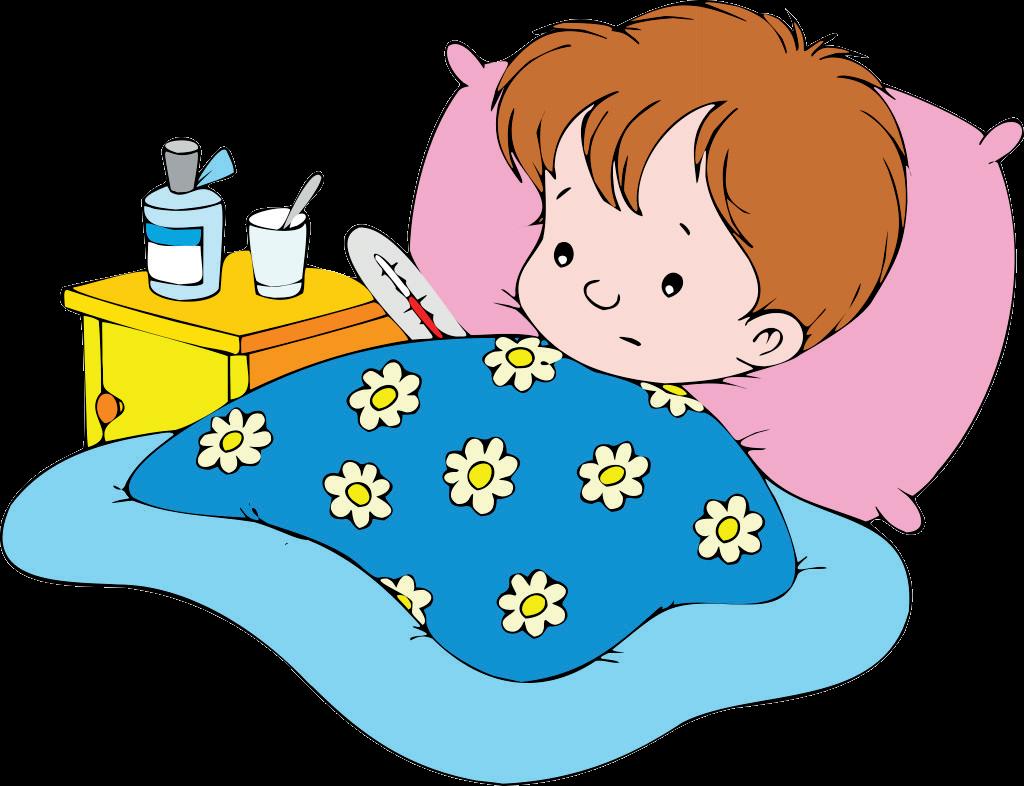
Few things worry parents faster than seeing a fever on the thermometer. As a pediatrician, one of the most common questions I hear is simple: How high is too high?
The good news is fevers are very common in children. In most cases, a fever is a normal part of how the body fights infection.
A fever happens when the body raises its temperature to help fight infections such as viruses or bacteria. For children, a temperature of 100.4°F or higher is considered a fever. While the number on the thermometer can be alarming, a fever is often a sign that the immune system is doing its job.
Most fevers in children are caused by common viral illnesses. These include upper respiratory infections commonly known as “colds,” the flu, and other infections that spread easily in schools and daycare settings. Children with these illnesses may also have symptoms like cough, runny nose, sore throat, tiredness, or a lower appetite. In many cases, the fever improves as the illness runs its course over a few days.
When I talk with parents about fevers, I remind them to look at how their child is acting, not just the number on the thermometer. A child who is drinking fluids, resting, and responding normally is often doing well while their body
However, there are times when a fever should by a doctor.
For infants younger than six months, any fever 100.4°F or higher should be evaluated by a physician right away. Young babies have developing immune systems, and fevers at this age can sometimes more serious infection.
For older babies and children, parents should seek medical advice if a fever rises to or above 104°F, lasts longer than three to five days, or comes with other concerning symptoms. These may include trouble breathing, repeated vomiting, signs of dehydration, severe headache, unusual sleepiness, or a rash that spreads quickly.
Febrile seizures can sometimes occur when a child’s temperature rises too
quickly. Although these seizures are generally not harmful, closely monitoring a fever allows parents to better manage symptoms and provide accurate information to healthcare providers. Parents should also trust their instincts. If a child seems very weak, hard to wake, or much more uncomfortable than expected, it is always okay to call a healthcare provider for guidance.
When caring for a child with a fever at home, comfort and fluids are most important. Encourage your child to drink water or other fluids and allow them to rest. Fever-reducing medicines may also help children feel more comfortable when used as directed. Dressing children in light clothing and keeping the room at a comfortable temperature can also help.
It is important for parents to remember that fevers themselves are usually not dangerous. In most cases, they are simply a sign that the body is working to fight infection.
If you ever have concerns about your child’s fever, a pediatric provider can help you decide whether your child should be seen. Having a trusted healthcare team to turn to can provide reassurance and help families handle the many minor illnesses that are a normal part of childhood.










-
HUNTSVILLE “Grand Theft Opera” shsu.universitytickets.com
County Fair & Rodeo
Fiesta San Antonio fiestasanantonio.org
Diva Night 2026: Glam at the Palm Royale huntsvillewalkerchamber.com
Ben and Noel Haggard thebarnhillcenter.com
Derek Spence: George Strait Tribute oldtowntheatre-huntsville.org



By JRA
Go ye therefore, and teach all nations, baptizing them in the name of the Father, and the Son, and of the Holy Ghost. --Matthew 28:19
I needed to refer to this passage for another lesson, and when I read these words, it was like a slap in the face. I had to put the other lesson on hold and let the Spirit talk to me; this was a hard lesson I was guilty of, and the Spirit drove home my failures.
You see, I started driving for Uber back in April 2025, so I pick up at least 15-20 riders per day (and often many more). I realized this was a great opportunity to witness and invite riders to church. My church gave me cards with all the church information on them. I thought I was doing good and even patted myself on the back. But I was guilty of picking who got the cards and the invite. I was making a decision…inviting some, but not inviting others. I was letting the race, the long hair, the no hair, the braided hair, the tattoos, the language, the look, and the smell make up my mind.
In other words, I was guilty of blocking the way to God, because I was deciding who had a chance to go to heaven and who did not. As I read (and re-read) this verse, the Spirit brought to my attention the little three letter word “all.”
All means everybody. Christ died to save all, and here I was deciding. Guilty, guilty, guilty…no way around it, I am guilty. The Spirit reminded me that my duty was to plant the seed and not be concerned about the soil the seed landed on. All I can do is pray and trust I will get to open the door to my car and also open the door to heaven for those I have failed many times.
I like what I have heard my friend Reagan Cooksey say many times, “Come to the cross, and we will show you Jesus.”
Lord, I pray you will forgive me and let me show people what Jesus did on the cross. Give me love for those I have deemed unlovable. Give me boldness and a heart to say, “Come to Jesus and be saved from your sins.” Thank you for those who prayed for me, led me to Jesus, and were/are such an influence in my walk with you. I saw Jesus in them, so let others see Jesus in me.