VOLUME 30 ISSUE 7 + ST UDYBREAKS.COM
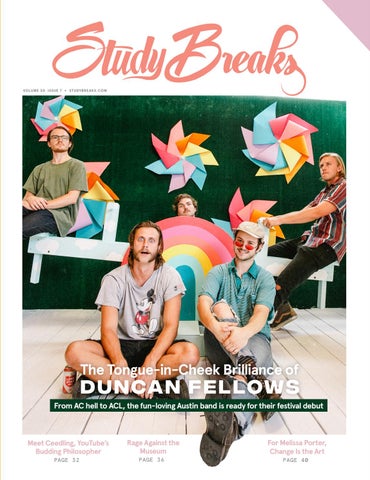
The Tongue-in-Cheek Brilliance of
D u n ca n F e l lows
From AC hell to ACL, the fun-loving Austin band is ready for their festival debut
Meet Ceedling, YouTube’s Budding Philosopher PAGE 32
Rage Against the Museum PAGE 36
For Melissa Porter, Change Is the Art PAGE 40
on the cover.
DUNCAN FELLOWS BY THEA ROBINSON
fixtures
features
thoughts
Note from the Editor ....
02
The Watercolor Foodie ..............
10
DUNCAN FELLOWS MAKE TONGUE-IN-CHEEK ROCK
Who’s Who ...................
03
Indigenous Peoples’ Day and You
12
24
Playlist .........................
04
In Praise of ‘Psycho-Pass’ ..........
14
CEEDLING, THE BUDDING PHILOSOPHER
Backdrop ...................
06
The Pitfalls of Celebrity Activism
16
30
October Horoscopes ....
42
2018 Horror Watch List .............
18
The Roots of Identity .................
20
Crazy, Politically Engaged Asians
22
RAGE AGAINST THE MUSEUM
34 MELISSA POTTER AND THE REVOLUTION IN THE ART WORLD
38
behind Uncomfortable Art tours. The English activist, who only recently graduated, has taken to leading public tours through England’s public museums that criticize the imperialism that explains why their tiny island has artwork from all across the world. Her activism has been met with extraordinary backlash, but it’s just one example of many that the Western world is finally starting to acknowledge the implications of its past. For another example, look to Ayanna Totten’s piece on the growing recognition of Indigenous Peoples’ Day, which takes place on the 8th of this month. Other examples of this newfound skepticism abound. On page 38, for instance, artist and writer Josue Romero profiles the artist and philosopher Melissa Potter, a proponent of the concept of socially engaged art, or social practice. The idea rejects the artistic notion of the inspired, solitary genius, which it finds to be a manifestation of the patriarchy; until recently, few but white, hetero men had the economic and social agency required to devote their lives to art. Instead, social practice focuses on recognizing and empowering the communities behind artists. To quote Romero, “In social practice, the [social] change is the art.”
Scrutiny is one of the primary agents of change. Nothing not visibly broken has ever been found to need fixing until it was the subject of a close examination. Today, as the world changes around us so rapidly, a number of long-accepted social tenets have found themselves subjected to a newfound scrutiny, and the resulting shifts have been paradigmatic. #MeToo has put toxic masculinity and the patriarchy squarely under the microscope. A growing political unrest has led millions to reject the status quo and elect leaders who look like them and promise to champion their interests. The recognition of the importance of media representation has changed the very fabric of who and what appears on our televisions, laptop screens and phones. The old ways, all across the board, are being called into question. So many times, the college world acts as a microcosm of the world at large. However, while students across the country are engaging in some of the same scrutinies as their professional peers, they are also testing the validity of a number of other long-held beliefs more pertinent to a younger generation. You see it clearly in the story of Alice Procter, the museum curator
Like Potter, who’s challenging the very structures of art and criticism, two other figures in this magazine are subverting the traditional pathways to success. Artist Ashiya Kisa has freelanced her way to fame, as has become so common in the recent decade because of Instagram, and Caitlyn Conville details her rise on page 10. Likewise, Ceedling, the YouTube moniker of doctorate student Celia Edell, has used her video platform to address millions. In her videos, she offers a counterbalancing female voice in the male-dominated, rigidly exclusive world of philosophy. By rejecting the very routes that have traditionally been required to succeed, Kisa and Edell have avoided many of the restraints that female artists and academics have long faced. So, this semester, call something into question. Scrutinize a practice, idea or pathway that no one else finds fault with — at least once. After all, every revolutionary idea starts with one question: why?
Enjoy, Mark Stenberg Editor-in-Chief @markstenberg3
our team. FOUNDER Gal Shweiki
ACCOUNTING Elizabeth Castro
ART DIRECTOR Jesus Acosta
DISTRIBUTION MANAGER Marcus Flores
EDITOR-IN-CHIEF Mark Stenberg
DISTRIBUTION Frank Hartfield, Jose Espinoza, Ernest Ward
contributors. WRITERS Ayanna Totten, East Stroudsburg University Danielle Richardson, Florida State University Casey LaValley, Ferris State University Christine Fang, University of California San Diego Tricia Crimmins, Bates College Erika Skorstad, Champlain College Caitlyn Conville, Bergen Community College Jen Tombs, University of Warwick Josue Romero, Southwest School of Art Kylie Harrington, University of Southern California Lexi Anderson, Pratt Insitute Sarah Penix, Ohio University
PHOTOGRAPHERS Emlyn Orr, Pratt University Hannah Schiff, School of the Art Institute of Chicago Thea Robinson, University of Texas at Austin Georgia Graham, Concordia University ILLUSTRATORS Yun Yao, Academy of Art University Kira Widjaja, Rhode Island School of Design Kayla Rader, Northwest Vista College Ben Miller, Towson University
writing internships. Study Breaks is written exclusively by a team of student interns from across the country. These writers work with the editorial team to pitch and submit one piece a week for the website, in addition to writing for the monthly print magazine. Spring internships run from Jan. 28 to May 28, 2019, and applications close Jan. 14. If interested, email editorial@studybreaks.com with “Student Writing Internship� in the Subject. Introduce yourself in the body, making sure to include your name, school and major. Please attach at least two samples of your work. Ideal writers are intelligent, funny and talented, though no formal experience is necessary.
STUDY BREAKS
|
5
backdrop. EXPLORING COLLEGES + THEIR CITIES
P H O T O S A N D W O R D S B Y E M L Y N O R R , P R AT T I N S T I T U T E I N B R O O K L Y N , N Y
Sometimes, when I’m up high in one of the old industrial work buildings on my campus, the distant whine of a lone saxophone will drift its way in through one of the large open windows. It’s simultaneously the most comforting and most mournful sound. What I like about cities, about Brooklyn, is that it’s hard to feel truly alone. This is a blessing and a curse - though I like to think of it as a blessing. No matter where you are it’s expected that the noise of another human being will manage to find you. Sometimes it will be the pneumatic explosion of a jackhammer against pavement early in the morning. Sometimes, the giggling of toddlers on a nearby playground or the loud conversation of high school kids on their way home. Maybe happy exclamations from a pair of old friends meeting up at the end of the block. Living in close proximity to so many other people means bearing witness to these small moments, which often serve to make us all feel a bit more connected.
STUDY BREAKS
|
9
10
|
STUDY BREAKS
STUDY BREAKS
|
11
B Y C A I T LY N C O N V IL L E , B E RG E N C O M M UNI T Y C O L L E G E
the
/
I L L U S T R AT I O N B Y K A Y L A R A D E R , N O R T H W E S T V I S T A C O L L E G E
foodie
Russian artist Ashiya Kisa’s breathtaking illustrations will leave your jaw hanging and mouth watering.
12
|
STUDY BREAKS
Born and raised in a small town in Russia, Ashiya Kisa’s passion for watercolor began when she was about 8 years old. She and her friend would create fan art and design their own characters based off of anime, mostly the popular series “Sailor Moon.” This passion drove Kisa to attend and graduate from a design program in her university and subsequently work in a professional studio as a graphic designer and illustrator. But this position only lasted a few
years before Kisa decided to concentrate on her own thing and become a freelance illustrator. And she has been doing rather well for herself. Today, at 27 years old, Kisa has amassed a combined total of nearly 700,000 followers across her Instagram, YouTube and Twitter accounts. She also owns a shop on Tictail, an online marketplace, where she sells zines filled with various watercolor prints and sketches. Instagram is Kisa’s primary social media platform, which she uses to post her most recent works of art. A typical Kisa piece will show a cute girl doing commonplace activities, such as eating ramen, shopping at a mall or taking a selfie, against a Japanese-style backdrop — reflecting her anime roots — with gorgeously coordinated watercolors and meticulous detail. She often uses real-life settings as her backgrounds, depicting even the most mundane moments, like buying bread at the store, as colorful reasons to be alive. Garlands of flowers appear frequently, providing fresh breath to an already vibrant piece, and muted neon hues, such as lilacs, shell pinks, turquoise and vermillion, dominate the color palette. Using watercolors allows Kisa to keep her style organic but still refined. Any geometrics are saved for simple backdrops, so that her almost ethereal girls stand out even more. Although it was anime that initially spurred her interest in design, the Instagram artist now finds inspiration in a host of other mediums. “I can see a nice light, color or hear a song, or watch a movie, read a book or the picture can just randomly appear in my head,” she says. “[Making art] is like eating and sleeping for me. I just need to transfer the pictures I see in my head to a piece of paper.” Currently, Kisa is taking her love of food and cooking and turning it into a series called “Hungry.” After you see her jaw-dropping, mouth-watering illustrations of different meals and beverages from around the world, you’ll understand why she titled it as such. From ice cream and pizza to bibimbap and samgyeopsal, each illustration is laden with the kind of micro-details that make it nearly indistinguishable from the real pictures of food on your Instagram feed. She even has plans to release the series as an illustration book with added recipes sometime in the future.
paint each piece in the “Hungry” series, as well as other stunning watercolors and sketchbook tours. Her most popular video is “Sketchbook Tour,” which has over 800,000 views and was uploaded last February. In it, she showcases her first finished sketchbook ever to a cheerful soundtrack. The sketchbook includes a variety of illustrations, but the video became popular largely because it features multiple sketches of characters from the wildly successful anime “Yuri!!! on Ice.” Kisa’s work even caught the attention of the Michael Kors’ advertising team, who sent her an email in July asking her to draw her interpretation of graffiti for the company as part of their Graffiti capsule collection campaign. Kisa felt inspired to draw something that matched the “strong and sketchy print” of the Graffiti collection, and because she is a big fan of black and white clothing as well, the pitch was a perfect opportunity for her to create another watercolor masterpiece. Although she has dipped her brush into a number of other art mediums, especially during her university years, Kisa is committed to watercolors. “There’s no surprise,” she says. “I love watercolor. I love how it looks, how it behaves — literally anything about it.” In fact, even when she uses digital tools, she imitates the aesthetic of watercolor in those pieces as well. On her personal Instagram account, you can see a different side of Kisa, a mellower, more relaxed version of the artist. Soft sketches of tiny boats on cool blue water, book recommendations, artfully arranged supplies and the occasional photo of her cat, aka her “furry princess,” adorn the page. Although she makes personal account available, the Russian artist still values her privacy, which is why she has only posted a handful of selfies on the account and will not provide the name of the school she attended. Even “Ashiya” is a shortened version of her full name. Mysterious or not, Kisa approaches her work and self-improvement with optimism. And she should — the 27-year-old artist is just getting started. At one point, I asked her which piece of hers she was most proud of. “It will be my next work,” she replied. “And then, the work after that.” Never stop improving.”
On her YouTube channel, you can watch her speed-
STUDY BREAKS
|
13
indigenous people’s you day As Columbus Day fades into history, here’s how to celebrate its rightful replacement this Oct. 8. BY
AYA NN A T O T T E N , E A S T S T RO UD S B URG UNI V E R S I T Y
I L L U S T R AT I O N B Y B E N M I L L E R , T O W S O N U N I V E R S I T Y
For the people who choose to ignore Columbus Day’s historical context, the federal holiday can offer a reprieve from their soul-crushing nineto-five job or at least a televised invitation to a parade in the nearest metropolis. Most millennials, on the other hand, continue to face the stark reality that Christopher Columbus was a false hero who didn’t discover America. As a result, Columbus’ legacy has been increasingly challenged in recent years. As the memes and Jay-Z’s lyrics will tell you, the only Christopher you need to acknowledge is Wallace (i.e., The Notorious B.I.G). So, if you’re looking for an alternative to Columbus Day on Oct. 8, you can celebrate Indigenous Peoples’ Day instead, a holiday that honors the life, history and culture of Native Americans.
A QUICK HISTORY LESSON Recognizing Columbus as one of their own, Italian and Catholic communities throughout the United States organized religious ceremonies and parades dating back to the 18th century to celebrate his voyage. It wasn’t until 1937, however, that President Franklin D. Roosevelt officially declared Columbus Day a national holiday. At the time, Roosevelt faced intense pressure to commemorate the holiday from the Knights of Columbus, a powerful Catholic fraternal organization. Despite all the hoopla, history proves Columbus wasn’t the real MVP after all. When the Spanish explorer reached Hispaniola, which he mistakenly identified as Japan, he and his 39 travel companions established Spain’s first colony in the Americas. They returned to Spain with gold, spices and Native American captives. Who knew people were souvenirs in disguise? The spoils of Columbus’ first voyage aroused European interest in the riches of the New World, and soon the mercantilist greed of 15th century monarchs spurred the aggressive colonization of the newly founded continents. His voyage ultimately led to the colonization of the Americas, the transatlantic slave trade and the deaths of millions, mostly through disease. In addition to their ships and malicious intentions, European settlers brought various
contagious bacterial strains, such as smallpox and influenza, which virtually eradicated indigenous populations. Any Native Americans who weren’t killed by sickness met their demise through warfare.
nous Peoples’ Day festivities. Taking the time to understand and respect other cultures leads to a greater sense of perspective, a quality integral to maintaining healthy, diverse communities and democracies.
INDIGENOUS PEOPLES’ DAY IS ON THE MOVE
Kayla Bointy and Sean Parrish, two students from Haskell Indian Nations University in Kansas, have two drastically different views toward Indigenous Peoples’ Day. Bointy, a 22-year-old member of the Kiowa, Comanche and Omaha Tribes, feels fortunate to attend a university that celebrates different aspects of students’ tribal cultures on a daily basis. “If there is an Indigenous Day event, I participate proudly,” she says. “I enjoy taking part by dancing traditionally as well as intertribal Pow Wows. Celebrating Indigenous Peoples’ Day by dancing and singing is important to me because up until my great-grandparents’ generation, it was outlawed. Now we can sing, dance and speak freely; carrying on and sharing our traditions is paramount.”
Native American activists have pushed to end Columbus Day for years. The United Nations declared Aug. 9 as International Day of the World’s Indigenous Peoples in 1994, but Berkeley, California, became the first U.S. city to actually replace Columbus Day with Indigenous Peoples’ Day in 1992. The city’s decision was the result of the First Continental Conference on 500 Years of Indian Resistance in Quito, Ecuador, which led to a Northern California conference in 1990 that presented the same issues to the Berkeley City Council. As of today, 55 cities have replaced Columbus Day with Indigenous Peoples’ Day, including Los Angeles, Denver, Phoenix, Nashville and Austin.
HISTORY HAS TO LOOK IN THE MIRROR TOO Last October, Washington, D.C., Council member Anita Bonds proposed the Indigenous Peoples’ Day Amendment Act. The legislation suggested Indigenous Peoples’ Day replace Columbus Day as a federal holiday, a bold move considering the commemoration’s ties to Italian-American heritage. Nonetheless, Bonds stood by her assertion that the Columbus story is “woefully incomplete” and “fails to acknowledge the brutality to which the indigenous people were subjected by European explorers.” A nationwide poll conducted by Marist College and the Knights of Columbus revealed 57 percent of Americans approve of Columbus Day celebrations, and 76 percent believe Columbus and other historical figures should be judged according to the moral standards of their time periods. However, history is not a fictitious hypothetical, and it should by no means be considered passively with a suspended civic conscience. The narratives a society tells itself about its origins play a part in dictating its social, political and economic decisions. If people don’t question the character of their predecessors and apply modern values and ethics systems, they risk rising to no higher moral ground than their ancestors.
COMMUNITY VOICES
Parrish, a member of the Navajo Nation who is also 22 years old, doesn’t assign the same importance to Indigenous Peoples’ Day, despite the holiday’s “good intentions.” “We don’t need to have a designated day to celebrate what we, Natives, live every day,” he says. Tony Brave, a 38-year-old member of the Rosebud Sioux Tribe, offers a more in-depth perspective. He celebrated Indigenous Peoples’ Day for the first time in Olympia, Washington. “Speakers, singers and many from around the community came together in celebration of Indigenous peoples. As a Tribal member, it warmed my heart to see such great work being done in my area,” he says. “These days, Americans are getting better educated on the facts around Columbus, and many seem to have little interest in seeing Columbus Day continue. Why not turn it into a day of celebration and awareness for the peoples whose land you live your lives upon, yet to this day must struggle for their cultural and political sovereignty?”
CHANGE IS POSSIBLE The spread of Indigenous Peoples’ Day is proof that social customs and traditions aren’t immutable. For a society to evolve, its citizenry must challenge the ideals that have been accepted as truth. Atrocities can’t be erased, and history can’t be rewritten, but the next chapter can acknowledge the injustices that have deprived others of their life, liberty and pursuit of happiness. Change is an outgrowth of awareness.
Although many people might not have Native American ancestry, that doesn’t mean they are excluded from IndigeSTUDY BREAKS
|
15
psycho-pass:
an unlikely champion of social justice B Y C A S E Y L A VA L L E Y, F E R R I S S T AT E U N I V E R S I T Y
I L L U S T R AT I O N B Y K A Y L A R A D E R , N O R T H W E S T V I S T A C O L L E G E
Somehow, a 6-year-old Japanese anime has become an unsparingly woke commentary on police brutality and the U.S. legal system. The year is 2030. You live in a crumbling utopian cityscape. Your government is unveiling the newest technology for curbing crime. Law enforcement now relies solely on your demographics, past experiences and mentality to judge you. You don’t have to commit an actual crime to be eligible for punishment. It doesn’t even have to be probable — just possible. Blasphemous, right? However, the machinations of this world might be more tangled in reality than you or I care to admit. This premise constitutes the allure of the critically acclaimed anime “Psycho-Pass.” Released six years ago this month, the cyberpunk thriller follows police recruit Akane Tsunemori as she grapples with the true definition of justice while apprehending a serial murderer. Throughout her journey, viewers become acquainted with the “Sibyl System,” a government-endorsed enterprise responsible for changing the face of the legal structure. Despite its age and Japanese origin, “Psycho-Pass” has stumbled into a “woke” commentary on police culture in the United States since hitting the screen. I doubt the anime meant to make a contribution to the trend, but it managed to do so in a brilliant, yet subtle fashion.
HOW SO?
Under Sibyl’s law, the police use firearms, called “Dominators,” to measure criminal predisposition. Once aimed at an individual, the Dominator returns a number from zero to 300. The higher the value, the higher the risk of lawbreaking. Anything that can impact one’s mental state contributes to the ranking, meaning disorders, economic status and everything in between can play a role. As a result, the cookie-cutter citizen is seldom deemed a criminal. Let me think. Where have I seen that one before? Today, this standard hits close to home for a number of Americans in minority groups. Victim blaming and racial profiling are at the forefront of headlines and lawsuits alike. Regardless of your beliefs regarding justice system, forming assumptions about character and criminality based on anything but hard evidence is repulsive. Although the cast of “Psycho-Pass” contains little diversity, some characters are targeted with the same superficial standard of “proof” — thus mirroring similar concerns.
SHIFTING THE BLAME
Tsunemori’s initial foray into policing ends with the system’s wounds completely exposed. Tasked with catching a potential rapist, her division ventures into a seedy neighborhood and quickly eliminates (yes, I mean kills) the suspect. The situation sours when her colleagues shift the Dominator over to the assaulted woman. I’ll let you guess where
this goes. Yes, the Sibyl System really did that. Because her newly heightened sense of stress translates into a hefty score, the assault victim also becomes a guilty party. This is an obvious allusion to the concept of “victim blaming,” which a majority of women in the U.S. have to deal with. The public and the police are keen to hold rape victims accountable for their role in the assault. Indeed, whether critics are blaming the victim’s skimpy clothing or dubious consent, the perpetrator rarely shoulders the entire burden of blame — sometimes not even the majority. In 2015, the controversial Brock Turner case showcased exactly this, pushing fault onto Turner’s victim for drinking the night of the rape. By electing for the sympathetic viewpoint of Tsunemori, “Psycho-Pass” has the audience immediately questioning the legitimacy of these fictional laws — and hopefully even their own.
THE POWER OF PRIVILEGE
Conversely, antagonist Shogo Makishima is illustrated as a man of great luxury and even greater influence. Wielding his charisma and upscale education like a refined blade, Makishima manipulates others into killing in his stead. Eventually, he dabbles in the act himelf. When Tsunemori catches him moments prior to slitting the throat of a young woman, she aims the Dominator in his direction, expecting to finally stop his reign of terror. Unfortunately for her, it yields a minuscule number. The system refuses to judge Makishima despite him blatantly committing a crime. Based on his status and wealth, I’m not confident the U.S. justice system would properly condemn him either. Those with similar assets, from politicians to police officers, often receive the same privilege as Makishima. The death of Trayvon Martin comes to mind, as the officer who shot him faced no legal consequences. Interestingly enough, that incident occurred seven months prior to the anime’s premiere. Intentional or (probably) not, the dwindling faith present in Tsunemori’s eyes afterward certainly reflected the feelings of millions of Americans witnessing the verdict unfurl. Ultimately, your favorite news station isn’t the only way to #StayWoke anymore. With anime like “Psycho-Pass” manning the helm, a greater understanding of social justice within the legal system is reaching a global audience — and I’m thrilled. After all, without a healthy level of awareness, the Sibyl System could be one step away from reality.
STUDY BREAKS
|
17
the glamorous pitfalls of
When stars dabble in public affairs, philanthropy gets messy. B Y T R I C I A C R I M M I N S , B AT E S C O L L E G E I L L U S T R AT I O N B Y Y U N Y A O , A C A D E M Y O F A R T U N I V E R S I T Y
In the summer of 2018, celebrity activism was virtually everywhere. Chance the Rapper bought Chicagoist, BeyoncĂŠ hired the first black photographer to shoot the cover of Vogue and Lebron James opened a public school in his hometown and began producing a docu-series for Showtime. Among countless
18
|
STUDY BREAKS
other celebrity political debuts, Cynthia Nixon is running for governor of New York. All of the above are examples of celebrities using their platforms to express opinions, political or otherwise. But, is it within their
right as creative public figures to do so? Social good fueled by star power undoubtedly benefits society on some level. However, upon further investigation, the seemingly selfless actions of some stars might allow such celebs to reap the benefits of their own activism, as well as serve promote their own celebrity brand. The boundaries of acceptable celebrity activism become clear upon examination of the career paths, actions and possible motivations of charitable celebs. If these A-listers are able to profit from their do-gooding, their intentions might appear ever-so-slightly impure. Chance the Rapper’s acquisition of Chicagoist followed on the heels of years of Chicago-focused activism by the musician, the majority of which was funded by the proceeds of his fruitful career. Chance explained his purchase as part of an effort to “[amplify] diverse voices and content” through a known Chicago independent media outlet. The rapper has received a lot of flak for his executive ownership of the online news source. Many feel he shouldn’t be trusted as the new captain at the helm of Chicagoist because of his complicated relationship with the media in the past. In addition, Chance’s success as a musician and a creative is inextricably linked to reviews and publicity provided by media outlets. Therefore, suspicions have arisen that Chance cannot be impartial in his ownership because he may have granted himself the power to amplify both diverse voices and his own. If Chicagoist becomes a platform that bolsters the rapper’s brand and celebrity, his purchase could cross a line. Due to the nature of his success and the journalistic power of the site, Chance’s motivations could be partially self-serving. He could give himself good press so people will buy his music. In contrast, Beyoncé made headlines recently for editorial activism of her own. For its September issue, Vogue granted the superstar full creative direction over a feature solely focused on her to celebrate her continued success. Notably, Beyoncé used her slice of power to hire photographer Tyler Mitchell for her feature, making him the first black photographer to ever shoot a Vogue cover. Within her contribution to a greater publication, Beyoncé achieved a nugget of social
change: She brought a catalyzing diversity to a long-standing, powerful magazine. The star did not have executive control over the entirety of Vogue’s September issue, and her opinions and allegiances didn’t influence later features in magazine. Beyoncé’s altruistic influence was within bounds: It began and ended, transparently, within her feature. Vogue’s journalistic integrity remained uncompromised. Outside the news media industry, other celebrities are taking great strides. This past March, in a total Miranda move, Cynthia Nixon announced her campaign for governor of New York. Lebron James, too, is diversifying his resume. In addition to creating the “I Promise” school for at-risk youth in Akron, Ohio, James is producing a docu-series cogently titled “Shut Up and Dribble,” which will detail the experience of being a star athlete in the current political climate. Both Nixon and James are being unabashedly clear in holding accountable the powers that be. Particularly in doing so, neither of them are furthering their own respective celebrity careers. Both will inevitably improve their public images, but Nixon won’t be nominated for an Emmy award for her performance as fearless gubernatorial candidate and James won’t win future NBA championships as a result of his docu-series and educational altruism. Their activism is separate from their success and their influences on society are within bounds. In truth, celebrity activism should be a wake-up call. Disparities in high-quality public education is a societal ill that should have been remedied by the government. Widespread diversity within the media industry and queer, female gubernatorial challengers are progressive ideals that society should have already achieved. And most concerning, these problems have been long neglected by the powers that be. Current political processes are skewed and traditional paths to success are arbitrarily exclusive, so stars have resorted to being heroes. Because they have the capital and name recognition, celebrities are able to solve seemingly unfixable problems. By achieving fame and fortune within the pop culture realm, modern day celebrities assemble enough power to play the role of societal savior. Whether or not their activism redounds to their credit, the problems lie within a much larger, broken system.
STUDY BREAKS
|
19
the horror, the horror! B Y E RIK A S KO R S TA D, C H A MP L A IN C O L L E G E I L L U S T R AT I O N B Y K I R A W I D J A J A , R H O D E I S L A N D S C H O O L O F D E S I G N
With Halloween approaching, here are the year’s four best frightening flicks to help you set a macabre mood. It’s that time again, folks. The air is crisp, the leaves are changing colors and pumpkin flavoring has sprinkled its way into most food and beverages. And for those who’ve been counting down to Halloween since the first sweltering day of summer, it’s finally time to engage in some spooky activities. October is the perfect time to snuggle up with your significant other, friend group or cat — no judging from this self-proclaimed crazy cat lady — to watch a scary movie. Of course, there’s never a wrong time to watch a scary movie, but there’s no denying the appeal of watching a blood-chilling flick on an equally chilly night.
the incidents can be chalked up to troubled individuals, until he starts to witness unexplained phenomena. The whole “skeptical until it happens to them” shtick isn’t a new one, but after piling on several confusing, dream-like occurrences, the film deposits viewers in an unexpected place, leaving them to connect the dots. While I didn’t enjoy “Ghost Stories” as much as the other films on this list, the spooky settings (an abandoned asylum and darkened woods) are appealing, and the impactful ending is sure to stick, inspiring rumination long after the credits roll.
3. HEREDITARY
1. MARROWBONE
When I saw multiple articles touting “Hereditary” as the most terrifying movie in years, I thought, “Yeah sure, just like how every new release is the No. 1 movie in America.” But alas, director Ari Aster’s debut film did not disappoint. After Annie’s mother passes away and her daughter, Charlie, begins to act more abnormal than usual, Annie begins to unravel macabre family secrets. The movie’s pacing creeps along while masterfully building up suspense and developing characters until the extent of the family’s dark past is revealed.
Prior to her demise, Sam’s mother makes him promise to be there for his three younger siblings — no matter what. After her passing, the children must hide their situation from the world until Sam turns 21, lest they be separated. But there is something sinister happening within the walls of the antiqued farmhouse.
“Hereditary” experiments with the supernatural, cults and disturbing images. But unlike the “Saw” franchise, the carnage (such as decapitation) is used sparingly and is therefore more effective.
So, ready to indulge but not sure where to start? I’ve compiled a list of what I believe are the best scary movies released in the United States this year.
The newest film from “The Orphanage” director Sergio G. Sanchez is a successful venture into psychological suspense, made possible by an eerie atmosphere and skilled actors.
The creepy flick features Charlie Heaton, who plays Will Byers’ brother, Jonathan, on “Stranger Things,” as well as actress Anya Taylor-Joy, who horror buffs will recognize from the third installment in the “Insidious” series, although her acting chops have improved since then. Nothing can hinder a movie faster than a one-dimensional plot, consisting solely of hollow characters, an abundance of gruesome images and jump scares. In this respect, “Marrowbone” succeeds by weaving its theme of unconditional familial bonds throughout the film.
2. GHOST STORIES
This British film, adapted from Andy Nyman and Jeremy Dyson’s stage play, grabs viewers’ attention from the get-go with a startling noise followed by chalk board scratching. The rest of the movie follows suit and serves up authentic scares and spooky situations. “Ghost Stories” follows supernatural skeptic Philip Goodman as he investigates three unexplained cases (featuring “End of the F***ing World” star Alex Lawther and Martin Freeman, Watson from BBC’s “Sherlock”). Originally, Goodman believes
Aside from the stellar script and special effects, the film owes much of its success to actors Toni Collette (Annie) and Milly Shapiro (Charlie). Collette demonstrates her acting range by portraying a range of emotions, from heart-wrenching grief to grotesque terror, and Shapiro embodies the creepiest child to grace the big screen since “The Ring”’s Samara.
4. A QUIET PLACE
John Krasinski’s directorial debut is a welcome addition to the sci-fi thriller genre. Lacking cheap jump scares or gratuitous gore, “A Quiet Place” is an intellectual piece of art. In a post-apocalyptic world overrun by blind aliens, virtually any noise sends a barrage of extraterrestrials to its source. Fortunately for Lee (Krasinski) and his family, they know American Sign Language, since their daughter Regan is deaf. The silence itself is an omnipresent character in the film, serving as a testament to the acting skills of Krasinski, his real-life wife Emily Blunt and talented deaf actress Millicent Simmonds. Even from your couch, you’ll find yourself too petrified to even nibble on popcorn, for fear of the creatures’ wrath. Much like “Marrowbone,” “A Quiet Place” answers the age-old question “How far will you go to protect your family?”
rooted in
As black women find increasing representation in media, their hairstyles get political. B Y D A N I E L L E R I C H A R D S O N , F L O R I D A S T AT E U N I V E R S I T Y I L L U S T R AT I O N B Y Y U N Y A O , A C A D E M Y O F A R T U N I V E R S I T Y
When it comes to black women, hair has always been a topic of serious conversation. People often use various aspects of their outward appearance to reflect something about their personalities, and for many black women, hair is that medium. Black culture has long been considered highly influential in the history of hirsute fashion, produc-
22
|
STUDY BREAKS
ing a number of now iconic hairstyles, including locs, cornrows, relaxers, afros and weaves. In television and movies, these hairstyles are often used to reflect personalities, encouraging actors to use their coiffures as characterization. Naturally, a woman is more than her hair, but this does not mean that her hair says nothing about her.
Many shows with black female protagonists tend to have each woman with a different type of hairstyle. In HBO’s “Insecure,” Issa Rae plays Issa Dee, an extremely awkward and likeable millennial woman. Her best friend, Molly Carter, is quite different from her, with her high-powered law firm job and more put-together aura. Both Issa and Molly’s hair are reflections of their personalities and professional circles. Issa wears her short afro-textured hair in a variety of quirky and memorable styles. Her changing hair could be representative of her somewhat scattered personality, with her never really knowing where she’s headed in life and changing aspects of her routine regularly. Her job is also much less uptight than her friend’s. Molly’s hair is more predictable. She often wears straight wigs and weaves, which are considered more professional in corporate circles, and only rocks more Afrocentric hairstyles, like cornrows, when she’s on vacation. Molly is more similar to the protagonist of Netflix’s upcoming “Nappily Ever After,” the black women who excels in the workplace but doesn’t know when to let her hair down (no pun intended). However, rocking more Afrocentric hairstyles is not always linked to professionalism or a more reserved personality. In other movies and shows, hair is also used to mark a significant transformation in a character or some form of personal growth. Much like Molly, Charley Bordelon-West is a well-composed and collected woman. In the television series “Queen Sugar,” her frizz-free straightened hair stands in stark contrast to her journalist/activist sister’s long locs. Charley often puts up a front to hide her true feelings from others, preferring instead to appear more perfect. Her sister, Nova, is nearly the exact opposite. Being a writer, Nova often pours her emotions into her articles for all to see, not showing any regard for how others might view her as damaged or melodramatic. On top of this, she is an extremely vocal activist for black rights and never seems afraid of causing controversy. However, once Charley begins overseeing their father’s old sugar mill in town, she begins to go through a transformation of sorts. She slowly becomes more passionate about standing up for black people, though in a way more suited to her character than Nova’s methods of protest rallies and the like. Instead, Charley chooses to go after things from a business perspective, making strategic moves toward the betterment of the black community where the sugar mills are concerned. Amidst all of this, she faces one obstacle after another in her not-so-pic-
ture-perfect life. The drama all builds to Charley realizing she would rather her appearance display something nearer to her true self, rather than keep up her façade. In a sudden decision one morning, she puts down the blow dryer and wears her hair in its naturally curly texture. Charley’s journey to revealing her inner passions is similar to the protagonist’s in the 2014 film “Beyond the Lights.” Gugu Mbatha-Raw plays the role of an emerging musical artist named Noni Jean. Her trademark wavy purple weave shows her fans what every woman wishes she could be: sexy, fun, trendy and successful. But underneath her image of the desirable woman, Noni is battling her own demons, including depression and a lack of real connection with anyone in her life. Over the course of the movie, this slowly changes as she falls in love with a cop named Kaz. Eventually, in an attempt to escape from the whirlwind of media attention in Noni’s life, the couple head to a foreign country where she won’t be recognized. It is here that Noni removes her purple hair to reveal a head of curly strands, and she makes the decision to become the artist she really wants to be, rather than maintain an image that makes her unhappy. While many recent stories have used a black woman’s hair to reflect her job position and personality, as is common in reality, just as many narratives have begun to use hair to symbolize a black woman developing and coming into her own. The most blatant use of this symbolism would be in Tomi Adeyemi’s debut fantasy novel, “Children of Blood and Bone,” and it’s all the more empowering for its lack of subtlety. At the beginning of the story, the main character, Zélie, has straight white hair. As she gains strength in her magical powers, Zélie’s hair gradually becomes kinkier and kinkier until it is a full-blown afro at the end of the book, framing her head like a cloudy white halo. What these characters and their accompanying hairstyles seem to be saying the most is, yes, black women are powerful, though many of them have yet to reach their full potential. However, they are also as diverse as any other group of women, and their variety of hairstyles in the media seems to reflect this diversity, as well as their capacity for personal growth.
STUDY BREAKS
|
23
crazy, politically engaged asians Could the uptick in Asian-American representation help move the needle in the midterm elections?
B Y C H R I S T I N E FA N G , U N I V E R S I T Y O F C A L I F O R N I A , S A N D I E G O I L L U S T R AT I O N B Y K I R A W I D J A J A , R H O D E I S L A N D S C H O O L O F D E S I G N
24
|
It is no secret that the Asian-American constituency is barely present in contemporary American politics. In comparison to the 66 percent voter turnout of, say, African Americans, the Asian population reports a dismal 47 percent.
is largely statistical: The term “Asian� encapsulates hundreds of ethnicities that speak dozens of different languages with varying commands of the English language, rendering a precise percentage somewhat difficult to come by.
When trying to find an explanation for this anemic engagement, several reasons emerge. The first, to be fair,
In addition, Asian Americans face an obstacle that all minority groups experience, though to different degrees.
STUDY BREAKS
According to the International Institution for Democracy and Electoral Assistance (IDEA), an intergovernmental organization that seeks to support democracies around the world, marginalizing minority voices can lead the effected groups to feel a sense of indifference regarding politics. In other words, potential voters can feel alienated from political or social matters because it might seem that “the voice of the citizen does not have a sufficient level of influence.” Thus, underrepresented groups in media, like Asian Americans, can feel as if their individual voices are not enough to trigger significant political changes.
1980s, Lawrence Bobo and Franklin D. Gilliam, social scientists who explored the relationship between African Americans and political involvement, attributed minority political empowerment to “the extent to which a group has achieved significant representation and influence in political decision making.” Indeed, in comparison to the African-American community, which has been historically active in opposing the injustices that face them, the reluctance of the Asian-American community to become politically engaged has only perpetuated their lack of media representation.
“Crazy Rich Asians,” however, has helped change that. Featuring an all-Asian cast and a protagonist who is unapologetically 100 percent American and 100 percent Chinese, the film has demonstrated that Asians have a voice that is present, powerful and ready to influence the polls.
Having Asian-American actresses and actors, then, such as Constance Wu and Ken Jeong, discuss social and sometimes political matters in the media marks the beginning of a more outspoken Asian presence in America. So, it should come as little surprise that, following in the wake of “Crazy Rich Asians” and its box office success, more stories about the Asian-American diaspora, as well as its accompanying tales of alienation and belonging, are emerging.
REPRESENTATION MATTERS As the first film to feature an all-Asian cast since the 1993 film adaptation of Amy Tan’s “Joy Luck Club,” “Crazy Rich Asians” has finally returned Asian representation to the big screen — and this time, not as some supplementary chicken-flavored MSG, but as the whole chicken. The achievement is doubly important considering the unique set of obstacles the East Asian community has encountered, namely whitewashing, in its attempts to grab some spotlight. Earlier this year, critics panned “Annihilation” for casting Emma Stone to play a half-Chinese, quarter-Hawaiian character, rather than cast someone with Asian or Pacific Islander heritage. And in 2017, Scarlett Johansson portrayed the protagonist in “Ghost in the Shell,” an adaptation of a Japanese animation. Both instances stung with a special poignancy, as not only were Asian-American actors denied roles, they were denied roles that specifically called for their casting. In light of snubs like these and others, both “Crazy Rich Asians” and I say, “Bak bak, bitches.” But will increased Asian representation in the media actually affect Asian-American voter turnout? A 2015 meta-study, “Social Media Use and Participation: A Meta-analysis of Current Research,” shows a positive correlation between representation in media and increase in civic or political participation. And while correlation does not always equal causation, having a platform to voice opinions is certainly a prerequisite to having important discussions in the first place. In addition to the meta-study, the relationship between representation and political involvement has been well documented in other communities of color. In the late
NOVEMBER ELECTIONS When the production of “Crazy Rich Asians” was announced in 2016, the media began focusing an increasing amount of attention toward Asian-American voices. Since then, issues regarding the community have been hot topics in both the social and political realms. One recent example of this increased engagement was the highly criticized protest staged by many Asian Americans this spring to contest the Orange County, California, plan to build temporary homeless shelters. Although the protests were fractured along generational fault lines, with the older protestors advocating conservative values and the younger ones promoting more progressive ideals, the event was just one of many that has made it increasingly clear that the Asian-American community is newly intent on influencing civic matters. In a local interview, Frank Chen, an Asian-American engineer from Irvine, said, “Asians are realizing, ‘Hey,’ you can’t just be silent.’” For the state of California, votes from districts like Orange County — a historically red district that went blue in the last presidential election — are crucial. Now more than ever, when the Asian-American vote could be the difference between maintaining or disrupting the Republican majority in Congress, it is time to reject silence. “Crazy Rich Asians” has brought more than just diversity to mainstream media — it has placed Asian Americans in a position of visibility. The film is just the latest in a series of signals to the American public that Asian voices can and will play active roles in shaping the future of the country. First up, the box office. Second, the voting polls.
STUDY BREAKS
|
25
THE
TONGUE-IN-CHEEK BRILLIANCE
After years of jamming together, the fun-loving Austin band is ready for their festival debut BY K YL IE HARRINGTON, UNIVERSI T Y OF S OU T HERN CAL IFORNIA P H O T O S B Y T H E A R O B I N S O N , U N I V E R S I T Y O F T E X A S AT A U S T I N
Colin Harman and Cullen Trevino met in an overstuffed one-story house on Duncan Lane. As students at the University of Texas at Austin, they spent the summer between their freshman and sophomore years on the verge of heat exhaustion — the house had 14 inhabitants and no air conditioning. “Our house was a living hell,” says Trevino. “I had to soak my shirt in water in the morning and throughout the day to stay cold ... and it was a really, really dirty place,” he said. The boys, who had time to kill and shared a love of music, got through the balmy Texas days by jamming together in the sweaty garage with a rotating group of friends. The group started writing music of their own, and soon these coping mechanisms slash jam sessions became rehearsals, and the loose group solidified into a band. Six years later, all five members of Duncan Fellows have graduated from both UT and their cockroach-infested
26
|
STUDY BREAKS
point of origin. With bandmates Jack Malonis, David Stimson and Tim Hagen, they’ve released a full-length album, become a fixture of the Austin music scene and will soon make their festival debut at the Austin City Limits Music Festival on Oct. 12, a mere four miles away from the house where it all began. “It’s very surreal,” says Harman, who works as a software engineer when he’s not splitting songwriting and vocal duties with Trevino. “When I was growing up, that’s a festival that I went to quite often and I never really thought that I’d be playing there, which is pretty crazy.” Combining the sunny guitar hooks of indie pop with the organic harmonies of old-school American folk, Duncan Fellows has a fun, lightweight sound built on a solid foundation of mid-20s melancholy, accented by wry songwriting and high-energy live performances. They insist on not taking themselves too seriously and remaining unde-
fined, genre-wise. Duncan Fellows makes music “by humans, for humans. That’s the genre,” said Harman. “Our genre is self described as Cheesy Gordita Crunch pop,” says Trevino, comparing their music to Taco Bell’s infamous quesadilla-taco hybrid. “It’s not entirely new necessarily, but it tastes good,” adds Harman. Duncan Fellows’ ACL debut didn’t come quickly — as a small, independent band balancing their burgeoning music careers with the necessary evils of day jobs, their success has come in fits and starts. “The first couple years we were just messing around for the most part was playing music because it was fun,” said Trevino. “About three years ago it really started kicking up and it’s just been a progression of us figuring out how all this stuff works. We just liked playing tunes at first,” he said. The band released their two EPs while they were in college, mostly viewing music as a hobby, but as they started playing more shows around the city, things started to feel more serious. A turning point came at the release party for their second EP, “Marrow,” when they were seniors in college and played a show at Stubb’s BBQ. “I think that was when our friends would say like, ‘Wait, y’all actually got good,’ because we were pretty rag-tag for the first while there,” says Harman. “I think that was after that gig when we were like, ‘Oh wow, this is actually pretty fun.’ That’s as much of a turning point as I remember.” From there, they toured with through the Southeast with blues rockers Houndmouth and down the West Coast with Portland folk trio Joseph. They also embarked on writing and recording their first full-length album, “Both Sides of the Ceiling,” which was released in August 2017. The 10-track album opens with a few bouncy indie pop songs, but goes through a tonal shift halfway through, the songs becoming slower and darker. “It was kind of like a yin and yang thing, we wanted to include like both sides of that emotional spectrum ... not that there’s not happy parts in the sad songs or happy lyrics in the sad songs, it’s all jumbled together,” says Trevino. As the two songwriters and vocalists of the group, Harman and Trevino find joy in the jumble. “Initially writing songs we are always just trying to figure out what makes you feel something, you know, whatever that might be,” says Harman. “Usually Cullen and I will either come up with something on our own or just have a little idea that we’ll come upon on our own or bring it to each other and then we’ll workshop that for a while, come up with a full structure of a song, make revisions and then bring it to the rest of the boys and arrange it with a full band,” he says. They tend to stick to the usual combination of guitar, keys, drums and
28
|
STUDY BREAKS
WRITING SONGS WE ARE ALWAYS JUST TRYING TO FIGURE OUT WHAT MAKES YOU FEEL SOMETHING, YOU KNOW, WHATEVER THAT MIGHT BE.
bass, with the occasional addition of synthesizers and layers of fuzz and distortion. The album retains a strong sense of place, creating soundscapes about suburban adolescence and heartbreak that feel uniquely tied to their Texas upbringing. “The Texas landscape and heat both felt their way onto that record very tangibly,” says Harman, referencing the fact that the Denton, Texas, studio where they recorded “Both Sides” also lacked a functioning A/C unit. “Most of my memories of childhood and growing up are where it’s like really like hot and sweaty and I’m doing something around those landscapes.”
They were also highly influenced by the vibrant Austin music scene. “I know it’s kind of cliché that Austin is the live music capital of the world or whatever, but there are so many great bands that live in Austin and play weekly and so many great bands come through that there’s never a shortage of inspiration watching live acts,” said Trevino. In March, they joined thousands of other bands at South by Southwest for their third year in a row, but it felt anticlimactic. “SXSW can feel like a lot of work for a very intangible pay off, just because it’s like a logistical nightmare having thousands of
STUDY BREAKS
|
29
bands on just a couple square blocks and it’s so stressful. We just finished this year and were kind of feeling like ‘What the fuck are we doing?’ Like we’d just played nine shows in four days or something and we had nothing to show for it really,” says Harman. But then, a magical email came, asking them to play at Austin City Limits Music Festival in October. “We got this random email that was like ‘You guys want to play ACL?’” says Harman. “Spirits immediately shifted,” adds Trevino. For a band made up of Austin natives, playing at the city’s premier music festival means a lot. “It’s kind of everything, in some sense. ACL was the festival that we all grew up going to, that was the first festival I ever went to,” says Trevino, who also worked at the festival as a line cook for two years. “I got to watch from behind the grill, greasy as shit ... making burgers and getting to see all these artists do incredible things, and knowing that I want to do that one day.” “Being in Austin, you go to Zilker [Park, the location of the
festival] all the time. It’s in the heart of the city, and when I’m out there either walking around or throwing the ball with my dog, I’m like ‘Shit, in a few months, thousands of people are going to be here and we get to play on a stage right over here,” says Trevino. “Playing at ACL means you are following the footsteps of all these people that you look up to and you get to share the bill with people like Paul McCartney.” Even at this major milestone in the band’s career, they still find themselves surprised by their success after making the jump from making music for their friends to a larger audience. “When people listen to our music and reach out to us, I’m continually like ‘Damn, y’all like this. That’s nice,’” says Trevino. Trevino says that they are in the process of writing the songs for their second album, but are still trying to balance songwriting with working their day jobs: “We always want to be in writing mode. There’s a lot of things we’re stoked on, but we don’t have as much time in the day as we’d like, so the process always gets stretched out, but that’s okay. It’s still fun.”
STUDY BREAKS
|
31
the budding philosopher
Doctoral student and YouTuber Celia Edell is helping sow commonsense feminism throughout the internet.
B Y L E X I A N D E R S O N , P R AT T I N S T I T U T E P HOTO GR AP HY BY GEORGIA L. GR AHAM
Currently a McGill University student working toward her doctorate degree in ethics and feminist philosophy, Montreal-based YouTuber Celia Edell — “Ceedling” on the internet —has devoted her channel to providing viewers with accessible, thought-provoking videos that don’t require any prestigious academic knowledge to understand. She covers topics such as feminism, mental health and anxiety, and strives to explore how they intersect. Additionally, Edell is breaking boundaries in the world of academia by pushing the limits of self-expression and appearances in the male-dominated community of philosophy. In a sea of YouTube videos claiming to be educational or genuine when addressing such heavy topics, Edell’s material stand out as nothing more than what they’re advertised to be: simple, easy to follow, edit-less and from the heart. Between the mix of deep academic knowledge and authentic, personal experience, Edell has created a space online that is insightful, honest and for any and every viewer that stumbles upon it. I recently had the opportunity to chat with Edell to discuss what inspires her videos, the ideas she feels passionate about and how she balances life on the internet with her educational and professional journey.
LEXI ANDERSON: I’VE NOTICED THAT FEMINISM IS PROBABLY YOUR MOST POPULAR AREA OF DISCUSSION ON YOUR CHANNEL. WHY IS FEMINISM SO IMPORTANT TO YOU? CELIA EDELL: I think feminism, in a sort of simplistic idea, is
about men and women and equality between the sexes, but I think in a more broader understanding, it includes all kinds of oppression: racial oppression, even things like fat-phobia or ableism — all of these different kinds of oppression that intersect with each other. I think talking about these ideas is really important. I think that ignorance is a huge part of what perpetuates these kinds of oppressions — and not ignorance strictly in the sense of “We just didn’t know,” because there are lots of things that I don’t know — but there is also a kind of learned ignorance that is perpetuated through the way that we’re taught in school and the way that things are presented to us in the media. If I can try to speak about what my experiences are and what I’ve learned about, to try to amplify the voices of those people who might not be listened to as much as me, I think that gives me some kind of purpose on the internet.
LA: HAVE YOU FOUND THAT THE DIFFERENT SUBJECTS IN YOUR VIDEOS OVERLAP AND CONNECT IN TERMS OF HOW THEY AFFECT EACH OTHER? CE: I’ve found an interesting thing, that when I talk about anxiety
and bring in feminism, people get really upset. People have this idea of feminism that it should only cover things like the wage gap, double standards or cat-calling; in reality, feminism can speak for a lot STUDY BREAKS
|
33
of different areas of our lives. I enjoy looking at the way that those things overlap. For instance, one of my videos is about the pressure to have clear skin. I had really bad cystic acne for many years until I ended up taking Accutane for it. I experienced a lot of pressure to have clear skin, and I couldn’t live up to it for a very long time.
of videos like it that I’ve done, is not to say my stance on something. It’s to ask a question and allow a philosophical lense to question what we’re thinking about. There’s more of a grey area, and what philosophy has taught me is to look closely at that grey area, and not to be afraid of not having all the answers.
It got me thinking about this pressure and where this pressure comes from, and what feminism could do to try to address that, insofar as bringing attention to these unrealistic standards. I got a lot of backlash from people who were upset because they thought I was saying that acne is only a problem for women. But that’s not what I was saying. I think that feminism can help all genders, including men. I think the pressures might be different, which is the case for all beauty standards. But that isn’t to say that feminism isn’t there to break down all of those standards.
LA: HAVE VIEWER COMMENTS EVER MADE YOU QUESTION YOUR STANCE ON A PARTICULAR ISSUE? CE: I have had some comments that didn’t make me
LA: DO YOU HAVE ANY SORT OF TARGET AUDIENCE? CE: When I first started making videos, I was a young
undergrad. I was looking to talk to the people who were in my same age group and with similar views, but maybe didn’t know the issues that I was talking about that well. Now, it has evolved in the sense that I’ve gotten older and the target audience has more or less stayed the same. I like to talk to people who are still coming into their own and are still figuring out where they stand on these issues. When I was in university, I didn’t know where I stood on so many things, didn’t know feminism at all, so I was able to learn through the internet about these issues and make my own opinions. That’s all that I really want to be able to do, to put these views out there in an accessible way and in a way that isn’t too confusing or scary for people to be able to identify with. Hopefully that makes them want to do their own research and continue.
LA: YOU’RE CURRENTLY A DOCTORATE STUDENT STUDYING PHILOSOPHY. DO YOU THINK YOU TAKE A PHILOSOPHICAL APPROACH TO THE TOPICS YOU DISCUSS? CE: I definitely think that I naturally take a philosophical
approach, insofar as philosophy is about questioning things and really deconstructing a statement or an argument and making sure that all the parts add up. I think that I have taken that approach with the issues I discuss. I like to break them down and really understand if they logically make sense to me. A lot of the time they don’t, and that’s what the video will be addressing. I’m also really interested in ethics, that’s generally the kind of philosophy that I do. I have one quite controversial video about whether we have a moral requirement to be vegetarian or vegan. The point of that video, and a lot 34
|
STUDY BREAKS
question my stance, but have made me question the way that I said something or the tone that I used. If I said something with a lot of confidence and then someone said something that made me go, “Oh, maybe I didn’t think about all the sides of this,” or someone who is saying, “Listen, you can’t speak for me on this issue, I have experience with it and your acting like your experience is the only one,” I have to take a step back and think, “Okay, I was speaking too broadly and maybe there are more nuances to this that I considered before.”
LA: THERE’S ALSO A GREAT DEAL OF BEAUTY-CENTRIC VIDEOS ON YOUR CHANNEL AND YOU’RE KNOWN FOR YOUR EVER-CHANGING HAIR COLORS. WHEN DID YOU FIRST START GETTING INTERESTED IN STYLE AND BEAUTY? CE: That was mostly at the beginning of university. In
high school I was a lot more concerned with fitting in. I wanted to look like the people that I was surrounded by, so that meant being blonde and tan and looking like my peers, which is fine. But when I got into university I started to feel like, “Okay, I’m one person in a class of 600 people.” I started to realize that I was a lot more anonymous there. I also started using Tumblr and the internet more, and it gave me a lot more confidence to explore different kinds of style that I wouldn’t try when I was a little younger. I think I’ve started to settle into what feels comfortable to me now, but I think it was all part of trying to express myself, especially at a university that was very preppy and athletic based. I never really felt fully like one of them, so I started to embrace that and experiment more with my style. It was a pure way to express myself in my hometown.
LA: SO WOULD YOU SAY THAT SELF-EXPRESSION IS SOMETHING REALLY IMPORTANT TO YOU? CE: Yeah, I think it is. In a doctorate program, you’re
really being professionalized to be able to get a job by the end of it. One thing that I’ve learned over the past couple of years in this program is that, for women, it’s really not accepted or encouraged to care about the way you look, and I had never noticed this. It’s becoming more apparent to me now that none of the philosophy professors that I’ve had that are women have ever worn makeup. None
of them have ever presented themselves in a way that is drawing attention to themselves or their physical body, face or whatever. That, to me, is something that I am now coming up against. I’m starting to feel this pressure to “tone it down,” and to look more serious. That’s something that I’m struggling with because self-expression is so important to me and I don’t want to give it up, but I also don’t want to ostracize myself. Now it’s about finding this balance of, “Yeah I can still dye my hair colors and I can still wear makeup if I want to, and I can still be taken seriously.” It should be about my work and how I teach my students and not how I look. I like to think that embracing that will be a positive influence on young women who are taking their first philosophy class, and they see me with turquoise hair, wearing a pink dress. You don’t really see that expression or that kind of femininity in philosophy because it’s so male dominated and cerebral. If I can communicate without words to one undergraduate girl that you can keep experimenting with the way you look, you can keep wearing what you like to wear and keep going in academia if you want to, that will be really meaningful for me.
LA: WHAT WOULD YOU SAY TO SOMEONE WHO FEELS STRONGLY ABOUT SOCIAL ISSUES BUT DOESN’T REALLY KNOW HOW TO GET THEIR THOUGHTS OUT THERE? CE: As a woman in philosophy, my opinion is not the
opinion that is held in the most regard, but I’ve had to push past that and say, “No, I actually have something to say on this matter.” It takes a lot of learning to trust yourself, and honestly it takes a lot of faking it until you believe it, and sometimes still faking it. On the other hand, I think that if you want to be able to talk on these issues, it’s important that you don’t just talk out of nowhere. You should read and do your research. You obviously can’t be expected to know everything about something before you speak on it, but reading about it or listening to other people who might have experience in that area is a really good way to learn the different sides of an issue. Once you have a good grasp on what the sides are, you can decide where you stand.
LA: DO YOU HAVE ANY GOALS FOR YOUR CHANNEL IN THE FUTURE? CE: My goal is to continue to create accessible content
about issues that I think are important and not to lose myself in the language and the lifestyle of academia. It is very much in its own bubble, where people talk only in this academic language that’s really hard to understand, and they talk only to each other. As I advance in my studies I want to keep sharing the ideas that I’m thinking about in academic life, but break it down in a way so that you don’t need a philosophy degree to understand.
STUDY BREAKS
|
35
rage against the
museum Alice Procter is the anti-establishment art historian changing how we approach galleries. B Y J E N T O M B S , U N I V E R S I T Y O F WA R W I C K
If you’re asked what words you associate with tour guiding, the terms “disruptive” or “subversive” are most likely not the first ones to come to mind. For most people, the world of art galleries and museums is something firmly tied to the past and to the establishment, the domain of field trips and tiring family vacations. Alice Procter is challenging that. Taking crowds of tourists around the packed museums of England’s biggest and most diverse city, 23-year-old Procter initially seems, in her own words, like “like every other nice little white girl tour guide with an art history degree.” But she’s not. Procter runs Uncomfortable Art tours in London, tours that have got a lot of attention recently for showing a side of art that most tour guides don’t. The tours are based in some of the most renowned art museums in the UK: the National Gallery, the National Portrait Gallery, the British Museum, the Victoria & Albert, Queen’s House and the Tate Britain. However, Procter isn’t employed by these galleries — she simply uses the spaces, which, being nationally owned, have policies to let people run independent tours. Procter regularly shows guests around these nationally and internationally famous venues — buildings that house works by Leonardo Da Vinci, Vincent Van Gogh and Edvard Munch, not to mention artifacts such as the Rosetta Stone and Egyptian mummies — but she has no time for reverence. “These institutions aren’t sacred and they shouldn’t be sacred,” she says. Instead, Procter’s tours reveal the dark underside of famous and iconic art. She sees physical pieces of art as not just having aesthetic value but also reflecting and coming
from their specific historical context. Starting at the late Tudor period in the 1500s and working up to the Victorian period in the 1800s, she explores the galleries’ pieces by putting them into the context of the British Empire and historical systems of oppression. She looks specifically at the period from the beginning of the British slave trade and the powerful East India Company, to the dissolution of both in the 19th century. For instance, she contextualizes Elizabethan art by explaining that Queen Elizabeth I, the British “Virgin Queen” whom the state of Virginia was named after, presided over the beginning of Britain’s slave trade. It’s a part of history that many Brits themselves aren’t aware of, and isn’t usually taught in-depth in schools. So Procter has taken it upon herself to fill in the gaps and make this history less abstract, showing how it’s interconnected with Britain’s art and culture. She argues that it would be dishonest — telling an incomplete story — to leave this history out when teaching about the art of that period. Uncomfortable Art tours are arguably particularly relevant and important right now. Procter says that she happened to have “caught a wave of questioning and fear and confusion” in the context of an international political shift, with Brexit on one side of the Atlantic and Trump on the other. This “wave” might be partly responsible to how receptive the public has been to Uncomfortable Art tours so far; Procter only started the project in mid 2017, and it’s since blown up, providing a refreshing, unique and increasingly popular take on art tourism. The motto of Uncomfortable Art tours is “Display it Like
STUDY BREAKS
|
37
If you’re in a museum saying, ‘Well, let’s talk about the violence embedded here,’ you can kind of occupy the space in a different way and it also becomes activist work ... it’s not just academia in a bubble You Stole it,” which Procter sells on stickers and has encouraged to become a hashtag on Twitter, explaining the phrase as a call for museums to rethink the politics of display on her website. She argues that many works on display in Britain were acquired through imperialism, something that museums don’t make clear. This is a hot-button issue in the world of museums, and has been for some time. In 2015, activists protested the British Museum possessing and displaying Indigenous Australian items. The debate over repatriation is constantly raging, and not by any means just in the UK — for instance, there have been recent calls for Germany to return a bust of Nefertiti to Egypt. Even human bodies aren’t immune to museum’s colonial practices: the dead corpse of black South African woman Saartjie Baartman, displayed as a “freak” in Europe in the 1800s, was on display in Paris until 1974. An article for the Independent argues that museums in Britain have partaken in a “colonial cultural massacre of sorts,” through their collecting of other countries’ histories. The exhibits of the British Museum, where Procter conducts tours, include Egyptian, Aztec and Easter Island artifacts gained during the colonial period. Procter is clearly on a political mission to bring attention to these hidden histories and modern injustices — but why does she choose to spread her message in the form of guided tours? For the Australian-born Procter, art has always been important and present in her life. “My parents would take me to exhibitions and museums from when I was literally a babe in arms,” she says. “I’ve always just
38
|
STUDY BREAKS
been at home in museums and been super interested in them as spaces for storytelling.” She has also always been keenly aware of imperial history: her parents taught her about how she “would literally not exist” were it not for the colonization of Australia. At school, Procter was interested in pursuing art, but after struggling in art class a teacher took her aside and explained that she could engage with it without actually having to be an artist. In high school, she took art history at A-level (the pre-university qualifications that encompass the last two years of school in the UK) and volunteered at art galleries at the same time. “I started volunteering to get out of sports, which is a classic kind of accidentally found my career story,” she laughs. She then went on to do her bachelor’s degree in art history at University College London. Yet Procter found some elements of art history frustrating. She found there was a pressure to be talking about aesthetics, when she wanted to explore the politics and ideology behind art. She didn’t “just want to look at paintings.” So when Procter set up her own tours, she took a different approach. “I was talking to some friends about the fact that I wanted to start running these tours and what they said was ‘So basically you want to take people into art galleries and make them feel really really awkward.’ Yeah, that’s kind of the point,” she explains. “If you’re in a museum saying, ‘Well, let’s talk about the violence embedded here,’ you can kind of occupy the space in a different way and it also becomes activist work ... it’s not just academia in a bubble.”
Procter’s work is making a lot of waves. She has an ambivalent relationship with museums and galleries, who she says aren’t always too fond of her — plus they now all know who she is, making things more awkward — but they also recognize that her work fills in gaps that they haven’t managed to fill, and that she brings in an audience who want to approach the exhibits in a different way. Her guests certainly seem to appreciate her work, going off the reviews on her Facebook page. Twenty-five-year old Lydia Smith was recently one such guest on an Uncomfortable Art tour. She says that she “wanted a different perspective” and that she “learnt so much, more than I’d expected...we were encouraged by Alice as a group to ask lots of questions.” One of the things Smith learned was that taxpayer compensation for slave owners “was only paid off by the government in 2011, meaning I have paid taxes that covered the losses of slave owners.” Of course, not everyone has such a favorable view of Procter’s tours, which remain controversial. Maybe the biggest backlash to Uncomfortable Art tours stemmed from the publicity she gained after British newspaper the Daily Mail catapulted her into a moment of semi-fame, publishing an article about her with the headline “Art historian, 23, and museum guide is using sell-out tours to label Lord Nelson a ‘white supremacist’ and brand Queen Victoria a ‘thief’.” The article pointed out that a historian and Member of Parliament had called Procter’s tours “babyish.” Comments largely disagreed with her take on history, and she says she woke up the day the article was published to an email saying that “I should leave the country before someone did the right thing and killed me.” However, Procter is adamant that she would much rather alienate her critics than to stay quiet about what she sees as the silencing of minority groups within the art world, and the obscuring of dark truths behind British culture. “It made me realise that I have a kind of public profile in a way that I would never considered before,” she says, adding: “There’s always someone who’s going to dislike what you’re doing.” In fact, that moment was something of a turning-point for her; she decided to stop playing nice with museums and appeasing those who disagree with her message. She jokes that she was “radicalized” by the backlash she received and realized that she can’t please everyone; she now takes an approach of “if you’re not here for it, you’re not here for it.” It’s not just the conversation around art pieces them-
selves that Procter wants to change either, though. She also wants to lift the lid of how museums are run and open up a dialogue around their purpose, asking how art venues function and what they teach. She takes a firm stance on museums: “This is an activist project and I’m not here to support institutions.” She argues that as state-run, free-entry spaces — as most of the famous London galleries are — they present themselves as impartial, objective fountains of knowledge. But “official” knowledge isn’t always untainted by ideology. Procter also argues that art conferences and panels on the future of museums are simply too expensive to be accessible to the vast majority of people; not to mention that a disproportionate amount take place in the UK and coastal U.S., excluding the majority of the world. She also takes a stand against what she calls “tokenism” and “box tick... diversity,” that she argues lets museums and art spaces appear progressive while simply recruiting minority communities for unpaid work. She certainly takes no prisoners — and so far her method is achieving success, or at least fueling an important debate. Her tours, as well as her other projects, are becoming more and more known, sparking conversation and reflection in the art world and beyond. So what’s next for her? “I need to take the tours outside London,” she says. “The problem is that right now it’s just me...everything is currently just run from my kitchen.” That could change, though. Procter is already leaving the “London bubble” by teaching a class in Philadelphia later this month. She has a podcast — humorously named “The Exhibitionist” — and is considering pursuing a doctorate degree. She’s even writing a book, focusing on colonialism and institutions of art and history. It’s a lot to juggle for anyone, let alone a 23-year-old also working part-time on a master’s degree. In the meantime, though, Procter will continue working out of her kitchen to fix the art world. “I want to give people the sort of critical toolkit to engage in this in their own ways,” she says. “I want a reconsideration of what museums are for and I want the institutions to do some navel gazing and think about what their actual purpose is, because it’s not just about protecting objects, it’s about telling stories and representing communities and representing experiences.” One thing’s definitely clear: the future of how we approach the past is going to be different, and Alice Procter, armed with art history knowledge and anger, will undoubtedly be a part of shaping that future.
melissa Potter and the Revolution in the Art World BY J O S UE RO ME RO, S O U T H WE S T S C H O OL OF A R T P H O T O S B Y H A N N A H S C H I F F,
S CHO OL OF T HE ART
INS T I T U T E OF CHICAG O
According to a school of thought Potter champions called social practice, change is the art.
Imagine a work of art. What comes to mind? A painting perhaps? A photograph? A big public sculpture? And along with those objects, might you have thought about the museum or gallery that houses it? You’ve likely associated them with a hefty price tag. You’re also bound to imagine an artist spending long, hard hours laboring away at a masterpiece, oblivious to the world around them. You would be perfectly right in describing the art world over the last 200 years. However, this preoccupation with valuable objects, exhibiting institutions and individual genius is not the only way to consider art, it’s just the dominant one. Imagine again, if you will, an art practice that isn’t focused on creating objects, but rather focuses on producing meaningful human interaction and social change. It doesn’t need a fixed location to be displayed or a prominent gallery to assign it’s worth. To some extent, even the importance of the individual artist themselves is blurred away, replaced by collaboration and community.
This model of art making is being referred to as socially engaged art, or social practice. You won’t be blamed for being confused about it. Even at its clearest, its boundaries are a purposefully ambiguous blend of “politics, community organization and art.” It is by nature, elusive of traditional art definitions and markets. Melissa Hilliard Potter, a socially engaged artist with extensive insight into this relatively new field, is one of its premier practioners. Potter eloquently conveys the clearest definition she can muster, as well as the origins of the practice, and its significance. Although the methodolgy of social practice can be difficult to pin down, its motivation is clear: challenging the status quo. “There are a lot of lies in the art world,” says Potter. “The greatest lie is that if you’re good you’ll be discovered. What we really know is that access to money, power, privilege and whiteness are how you gain power in the art world. It’s up to artists to dismantle that mythology, and to resist and refuse it.”
STUDY BREAKS
|
41
MELISSA POTTER AND SOCIALLY ENGAGED ART Potter works out of Chicago, teaching full time at Columbia College. Her resume is extensive, spanning the last two decades and headed by a number of grants, including an impressive three Fulbright awards. (The Fulbright program supports cultural exchange between the U.S. and other nations around the globe.) While her art spans many disciplines, Potter maintains a feminist and socially engaged practice, and she works to position this marginalized form in a broader art context. Even in her early career, Potter never separated art and politics. “I was raised in a politically active family. The idea that art would have an engagement with politics or with the cultural condition was always the way I considered it,” she says. Potter was brought up in a Quaker community, through which activism and social justice were commonplace. To this day, Quakers are well known for activating their faith through political engagement. She credits her mother in encouraging political research as a child, even outside of school. This upbringing, and her time at Guilford college, a school also maintaining Quaker values, had a huge influence on Potter’s values as a socially engaged artist. From there, she pursued art academically, first through Virginia Commonwealth University, and then Rutgers in New York. Following this upbringing, Potter focused her work on feminism and social issues primarily through alternative distribution networks. This meant that she wasn’t looking to thrive in the traditional artist’s role, but rather was actively looking to work outside of it. Potter found herself regularly working within the field of handmade paper, both as artist and teacher. She continued to do this when she moved to Chicago, which allowed her to bring a “new vocabulary” to her work with socially engaged art. It was amidst this conversation that Potter formulated her ideas about social prac-
42
|
STUDY BREAKS
tice. To her, the term “socially engaged art” was used to legitimize practices that existed within feminist and activist realms anyways. She frames the subject through its roots in feminism, activism and the field of education, with collaboration being the key that underpins all of these practices. “What feminism proposes as a challenge to single authorship is that nothing takes place without collaboration,” she say, “that as a philosophy we have to accept that there is no such thing as individual genius, that genius is based on position, privilege and right place, right time, but that there are multiple labors happening at any given time that enable artworks to take place.” This emphasis on the distribution of labor is what makes social practice so radical. It shifts the focus away from individual artists and empowers communities instead. Rather than focus on the creation of objects, it raises cooperation as the most important part of art making. In this way, it directly challenges the art market and the way it currently values the production of art. “This idea of static, object-based works that are only circulated by a museum is very retro thinking … the gallery and the institution of power that artists have been connected to is only one small part of how a visual and or social engagement can take place in the world.” Potter and the practice are motivated by the rapid changes occurring throughout society, especially the interconnectivity that social media has afforded artists and consumers. The philosophy behind social practice, then, reflects the shift that art needs to make to keep up with these changes. Says Potter, “Social practice, to me, is any activity that challenges the art establishment status quo, that distribution strategy has to be about money, the proper institutional support, and vetting through acceptable systems that are really about power, access and economy. And so anytime that [someone] is working outside of that arena, they are engaging in social practice.”
POTTER’S WORK Potter describes her work as being “interested in recording, preserving, promoting and evaluating female culture as alternatives to prevailing and dominant history.” “Feminist Felt,” the work modeled in the accompanying photos, embodies her practice by engaging her heritage. Through her work with the Fulbright scholarship project, Potter, along with Miriam Schaer and Clifton Meador, went to the Republic of Georgia and taught bookmaking as a sort of skill swap with felt artisans. In a second iteration of the project, she brought a lot of her older research on mask cults and pagan rituals from former Yugoslavia into conversation with activists who were using those to create their anonymity.
of the socially engaged attributes that have been discussed so far. Firstly, it is preserving and validating feltmaking as a valuable practice. It also requires teaching and the transference of skills in a collaborative setting. Certainly, “Feminist Felt” has produced beautiful objects, but they are a byproduct of the project’s social function: to empower women activists and give them a tool by which to achieve their goals. The masks are only a vehicle with which to achieve social change. In social practice, the change is the art.
Social practice, to me, is any ac� tivity that chal� lenges the art establishment status quo
Feltmaking has a long history in Georgian craft, but has been marginalized as a tradition, likely because it is associated with femininity. The project displays many
Over the last five years, Potter has also found herself working with Maggie Puckett, a friend and fellow papermaker, to maintain “Seeds InService.” The project revolves around a thematic garden bed housed on the Columbia College campus. Each year the pair settle upon a topic, such as “Women’s Health,” “Las Mujeres Zapatistas,” “Pre-Colonial Gardens,” etc. and proceed to plant a garden that then becomes material for further projects under the theme.
STUDY BREAKS
|
43
In this way, “Seeds InService” becomes a forum and impetus for the accompanying projects. The collaboration with subsequent work is the main artistic function, rather than the plants themselves. The metaphor in the title becomes clear, referring not only to physical seeds, but also to the seeding of broader projects, and in turn, planting ideas and fostering social change. The way Potter conceives it, this type of project is only possible because she is able to collaborate not only with other artists, but Columbia as well, to produce work that would be impossible on her own. For her, collaboration is about inverting the system of power that requires that you have everything. “I’ve never had my own studio. I probably never will. I’m never gonna have that capital, and that’s okay. My collaboration is with my institution and my students,” she says. EDUCATION AS SOCIAL PRACTICE I first met Potter through a workshop at the Haystack Mountain School of Crafts in Maine. She led a course in handmade paper, with the goal of sourcing material from the environment, taking advantage of the diverse flora lining Maine’s coast. My time under her instruction perfectly captures what social practice has the potential to be and was the inspiration for this interview. She shared her knowledge, teaching us to make paper, bind books and forage for material, but allowed us complete freedom as to what to do with these newfound tools. Each of us got to explore and create at our own pace, and toward our own goals. In this way we all learned collectively from each other, without having to pursue every path individually. Potter was the instructor, but she was just as much a student as the rest of us. She says, “Haystack was not just me teaching, Haystack was about me taking a research idea, which is ethnographic interpretations of feminism ... and [transforming] them as art. But in the old art world we would designate those as two seperate things: Mel Potter’s artwork, which is object-based, and Mel Potter’s teaching, which is conceptual and in service. I think social engagement is to bring those two back together.” Potter conceived of this project to use the environment as material, but it took a collaborative effort to implement. The time we spent working and the knowledge we gained collectively became the artistic labor. Conceiving of education as a form of art is another challenge to the status quo. It means that the familiar model of teaching becomes a tool to empower communities, and the passing of knowledge becomes the art, as opposed to the product of the knowledge itself. “Socially engaged artists often engage pedagogy as practice,
44
|
STUDY BREAKS
[and take] the educational environment, the audience engagement in teaching a skill and transform it into art,” says Potter. SOCIAL PRACTICE IS THE FUTURE For Potter and a rapidly growing cohort of artists, socially engaged art is a necessary evolution as art moves further into the 21st century. It is slowly becoming normalized, being introduced in academia as a formal path of study. It’s natural for emerging artists to be looking to make work that matters, that stands for something, that has tangible impact, and it’s safe to assume that this desire will continue as politics get more complicated and the world becomes more interconnected. As the practice grows, it is important to maintain its historical context within feminist practices and education, as this is what lends it strength against the existing power structures. “Social practice is about resisting the normative art movement, because the normative is white-male-based power dynamics. So anything that resists those points of entry is social engagement, because you’re socially engaging with a wider idea about community … That’s pretty broad but that’s pretty exciting. What we’re really saying is that it’s bigger than the art world — it’s way bigger than the art world.” Throughout our conversation —despite the broad, at times elusive nature of social practice — Potter places the appropriate emphasis on collaboration and the search for tangible social change. Investing oneself into this type of work requires a long-term mentality, a recognition that there is still plenty to be figured out and that it is not yet readily accepted in the art world. Nonetheless, it will be necessary if art is to remain relevant in socially turbulent times. This foresight is captured in wonderfully in Potter’s words. “It’s imperative that people who believe in the political implications of our work come together as a humanity, to enforce this idea that collaboration is the practice … we’re gonna have to collaborate if we’re gonna transform. Collaboration is the only way forward.”
your october horoscope BY S AR AH P ENIX, OHIO UNIVERSI T Y
VIRGO Use the creative energy presented to you at this time to be productive in new ways. The full moon will push for balance and force greater awareness on how you learn.
ARIES Expect light to be shed on your finances and personal life by the end of this month. With the full moon in Taurus on the 24th, you should spend the month preparing for transformation. TAURUS With Mercury in your sixth house this month, you will be inclined to organized every aspect of your life — from your partnerships to your career and accomplishments, you will be able to zero-in on sorting out details. GEMINI With Venus transiting in Virgo, you may find love and work getting mixed up, so keep a long fuse and remember to stay rational. You will feel more intuitive during this time. CANCER Although you will feel levelheaded during this time, Cancer, be aware of emotional drama and remember to get the support you need from family and friends. LEO Although the beginning of this month will feel nostalgic and family-oriented, the full moon on the 24th will push you into the spotlight so use the sentimental energy from earlier in the month to interact with others with grace and compassion.
LIBRA The beginning of the month will present you with stress and strain that will encourage change and self-adjustment; however, look forward to all that changing by the end of the month. You will find greater ease in your material life through release. SCORPIO Although your appearance may cloud your thoughts during this time, you will have a heightened sense for what you want in life so take the autonomy while keeping others in mind too. SAGITTARIUS The full moon will bring a need for action in your life; however, use the quiet, private energy you harness this month in order to make the best decisions possible. CAPRICORN Prepare to feel the urge to change your look this month, Capricorn, your identity will be especially important to you this month. AQUARIUS You will be inclined to focus on work this month, Aquarius, but it’s important to also find balance with your personal life or else the full moon will show where you went wrong. PISCES Although you may feel restless this month, it will serve you well to channel that energy productively by establishing new goals and being intuitive.
For more content, visit StudyBreaks.com