www.dfwnewsflash.com
August 2015
DFW NEWSFLASH - August 2015
DFW International Jalonick Lecture Meacham International chronicles DFW’s aviation Airport celebrates 90th Airport welcomes Dallas Cowboys Club history birthday
DFW AIRPORT PERMIT NO. 239084
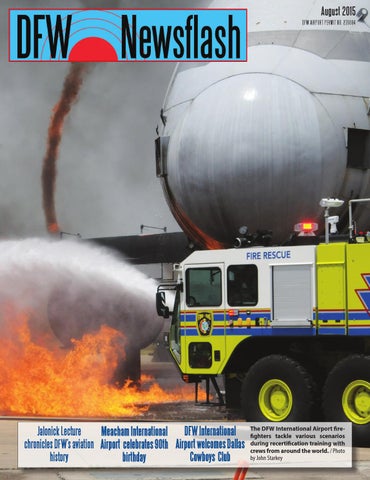
The DFW International Airport firefighters tackle various scenarios during recertification training with crews from around the world. / Photo
by John Starkey
August 2015 - DFW NEWSFLASH
Page 2
972-870-1992
COVER STORY The entire contents of this magazine are the sole property of Rambler Newspapers, Inc., with all rights reserved. Reproduction or use, without permission, of editorial or graphic content in any manner is prohibited. If you have an upcoming event, game, a press release, or interesting story, please let us know. DFW NewsFlash encourages submission of articles, facts, and photographs pertaining to the people, life, business, and entertainment of aviation industry in the DFW metroplex. DFW NewsFlash is published monthly by Rambler Newspapers, Inc. and is distributed throughout the DFW Airport in businesses and public areas. DFW NewsFlash is also delivered to locations at many of the other airports throughout the DFW metroplex market. Deadline for the submission of articles and advertising is the 10th of the month prior to the publication date. All submitted articles are subject to editing. Opinions expressed in submitted advertisements, articles, editorial, or commentary are those of the writer, and not necessarily those of DFW NewsFlash, the publisher, editor, or any staff member. All articles, press releases, photographs and other materials submitted become the property of Rambler Newspapers, Inc. The Publication of columnists’ views, as well as advertising, does not constitute endorsement. Rambler Newspapers, Inc. reserves the right to reject or edit any advertising. DFW NewsFlash, its publisher, and editor are not responsible for errors in advertising. Mailed subscriptions of DFW NewsFlash are $45 per year. POSTMASTER: Send address changes to Rambler Newspapers, Inc., P.O. Box 177731, Irving, TX 75017. Publisher John Starkey Managing Editor Stacey Starkey Advertising sales@dfwnewsflash.com 972-870-1992. Newsroom news@dfwnewsflash.com Correction: Seidel Chapter AFA Teacher of the Year Al Brooks does a final check of Ashton (incorrectly cited as Austin) Sittig’s handcrafted RC plane before its inaugural flight. DFW NewsFlash is Copyrighted 2015
DFW Airport firefighters share proactive approach with crews around the world By Courtney Ouellette Containing a fire that gives off overwhelming amounts of heat and sends massive clouds of thick, black smoke into the air is a typical day for DFW International Airport firefighters. The DFW crew recently teamed up with firefighters from Canada and San Francisco on Thursday, July 9 for annual recertification live burn training, which is required by certain aviation regulations. The DFW Fire Training and Research Center often shares this proactive approach with crews from around the world, including China, South Africa, Singapore, and countries in Central and South America, Europe and Africa. DFW has one of the foremost programs in the world due to its advanced tools,
While earning their fire safety merit badge, a group of Boy Scouts ride in style following a training exercise. /Photo by Courtney Ouellette
a very large international hub, DFW being the third busiest airport in the United States. “Not only do we do training here, we have an academy of instructors that travel to other locations. Some departments have a large group of students they have to train, so we’ll send instructors with the necessary materials and experience and a subject matter expert.” The day’s course included various types of fires inside and outside of an aircraft and exercises involving the 3D liquid hydrocarbon pit. “Today in the The DFW International airport fire training program is one of three in the world with an A380 small narrow body aircraft aircraft, which provides DFW with unique training opportunities. /Photo by Courtney Ouellette technology and facility, according to Battalion Chief Randall Rhodes. “Our training facility is available for use year-round,” Rhodes said. “A lot of the other training facilities in the country have to close down in the wintertime. We’re also
www.dfwnewsflash.com simulator, they’ve gone in and done interior search and rescue operations involving cabin fires and cockpit fires. They’ve also done training with wheel break fires and engine fires,” Rhodes said. “The exercises give firefighters the opportunity to use foam and dry chemical applications with liquid fuel fires such as fuel tanks, storage tanks, and wing cracks,” he said. Despite the rarity of major aircraft accidents, the DFW crew, along with their international partners, refuse to become complacent. “Fortunately for aircraft technology, it’s very rare that we do have an aircraft accident or incident, but there are a lot of minor incidents that happen throughout the country all the time,” Rhodes said. “Firefighter training is an ongoing constant thing, in case something big does happen. The last big one occurred three years ago this month and that was in San Francisco.” Rhodes referred to the Asiana Airlines flight from Seoul, South Korea, that crashed while landing at San Francisco International Airport on July 7, 2013. “We’ve actually increased our capabilities to train firefighters,” Rhodes said. “Right now, we’ve averaged just over 20,000 students in the last 20 years.” One of those students is Pasco Valana, from Vancouver. “In Canada, we are required by our government to make sure that we meet certain standards every year,” Valana said. “For example, in one particular drill, we have to do a three-dimensional field fire, so pretending that fuel is burning from the wing
DFW NEWSFLASH - August 2015 down to the ground and then pooling, we have to use dry chemical, which immediately snuffs out the fire but doesn’t give us a lot of post-fire security, so we have to learn to cool things down.” Not only has Valana participated in several certification courses, he’s been trained at several different locations. “This is my eleventh year and fourth time down at Dallas Fort Worth doing this program. We’ve been very blessed that the Vancouver International Airport authority sends us to a variety of places,” Valana said. He does, however, consider DFW one of the best. “This is much more modern as far as the facilities, not to mention the male and female instructors here have a wealth of knowledge,” he said. “There is no ego; it’s
about serving their brothers and sisters in the fire service, which is great.” Max Deno, an Eagle Scout with Boy Scouts of America, is looking to pursue a career like Valana’s. “Our scout troop is trying to get the fire safety merit badge, and so our scoutmaster invited us all out here to the DFW Airport to watch some of the training fires go on,” Deno said. “I love what they do. I respect them a lot, and I’m always thankful that they’re there to help people in need.” Deno and his troop had the opportunity to talk with the firefighters and watch as they battled various fires. Many of the scouts even tagged along during an exercise with the fire trucks. “I got to talk to one of the captains and the battalion
Page 3 chief, and he told me the ins and outs of what it is, how old you have to be, what the qualifications are,” he said. “I’ve looked into the airport before and have always had an interest in firefighting.” Firefighter training programs vary from state to state and country to country. Though the nation standard is a one-week course, Texas requires a three-week course for airport firefighters. “I think a lot of people out there don’t know exactly what we do,” Valana said. “It’s nice for people to see that we’re not just sitting around waiting for something to happen. A lot of what we do is very proactive, so we’re looking for ways to keep the environment and our guests safe.”
Following scenarios involving the 3D liquid hydrocarbon pit, the American and Canadian crews practice maneuvering and containing an aircraft and runway fire with the fire truck’s hose. /Photo by Courtney Ouellette
Page 4
August 2015 - DFW NEWSFLASH
972-870-1992
Irreversible damage to batteries delays Solar Impulse’s flight HAWAII, July 15th, 2015 - to Hawaii, the battery temperDespite the hard work of the ature increased due to a high Solar Impulse team to repair climb rate and an over insuthe batteries which overheat- lation of the gondolas. And ed in the record breaking while the Mission Team was oceanic flight from Nagoya monitoring this very closely to Hawaii, the solar powered during the flight, there was airplane of Bertrand Piccard no way to decrease the temand André perature for Borschberg the remainwill stay in ing duraHawaii until tion as each early spring daily cycle 2 0 1 6 . requires Following an ascent the longest to 28’000 and most feet and difficult descent for leg of the optimal enround-theergy manworld jour- Bertrand Piccard and Andre Borschberg agement. ney which reunite in Hawaii and celebrate the world Overall the lasted 5 record for longest solo flight ever, flown airplane days and 5 by Borschberg. / Courtesy photo per for med nights (117 very well hours and 52 minutes), Solar during the flight. The damImpulse will undergo mainte- age to the batteries is not a nance repairs on the batteries. technical failure or a weakDuring the first ascent on day ness in the technology but one of the flight from Nagoya rather an evaluation error in
The ground crew prepares Solar Impulse 2 for takeoff from Nagoya to Hawaii. / Courtesy photo
terms of the profile of the mission and the cooling design specifications of the batteries. The temperature of the batteries in a quick ascent / descent in tropical climates was not properly anticipated. Irreversible damage to certain parts of the batteries will require repairs which will take several months. In parallel, the Solar Impulse engineering team will be
Solar Impulse 2 remains in its hangar in Hawaii awaiting repairs. The plane will continue the around-the-world-adventure in April 2016. / Courtesy photo
studying various options for better cooling and heating processes for very long flights. The University of Hawaii with the support of the Department of Transportation will host the airplane in its hangar at Kalaeloa airport. Post maintenance check flights will start in 2016 to test the new battery heating and cooling systems. The round-the-world mission will resume early April from Hawaii to the USA West Coast. From there Solar Impulse will cross the USA to JFK in New York before making the Atlantic crossing to Europe and then returning the point of departure in Abu Dhabi. Solar Impulse is attempting a historic first of flying around the world only on solar energy. While Solar Impulse has completed eight legs, covering nearly half of the journey, setbacks are part of the challenges of a project which is pushing technological boundaries to the limits. Solar Impulse will try to complete the first ever round-theworld solar flight in 2016 and this delay will in no way influence the overall objectives of this pioneering endeavor. SOURCE Solar Impulse
www.dfwnewsflash.com
DFW NEWSFLASH - August 2015
Page 5
Dallas Cowboys Club opens in DFW Airport By Courtney Ouellette
Anywhere Rowdy the mascot is found wandering, Dallas Cowboys and cheerleaders are sure to follow. The grand opening of the Dallas Cowboys Club at DFW International Airport in Terminal A was no exception. Guests of
flights and aircraft, Donohue was pleased and surprised to find a large number of guests, and attributed the success to the Cowboys. “Typically, we do this type of event when we’re starting an international service. We’ve had quite a bit of in-
CEO of HMSHost Steve Johnson expresses his excitement about the club’s opening and praises the Cowboys and DFW Airport before the ribbon cutting./ Photo by John Starkey
the opening and airport passengers alike took pictures and met Rowdy preceding the ribbon cutting on Tuesday, July 21. The new club marks an even stronger partnership between the Cowboys organization, HMSHost and the DFW International Airport according to the CEO of DFW Airport Sean Donohue. “This is a great event for the airport,” Donohue said. “We have a longstanding partnership with the cowboys, as well as HMSHost with many, many concessions at the airport. “The cowboys have several other pro shops in the terminal, they have a gigantic distribution warehouse at the airport as well, and so this is just a continuation of the partnership that we have with the Cowboys.” Despite several other openings and celebrations including new international
ternational service inaugurations in the last year or two, and I would say we are actually seeing more media here for this opening than we do when we get flights for Chi-
na, so I think that says something about the power of the Cowboys brand,” he said. “As you all know, the Cowboys are one of the most recognized sports brands, not just in the U.S., but globally, and I’d like to share with everyone, we from the airport, usually go on an economic development service mission every year.” During these trips, Donohue and the members of DFW Airport Board spend time with dignitaries and businessmen and women, and exchange gifts. “The gift we always bring is a Dallas Cowboys jersey, and we put the name of the dignitary or the business leader on it. Typically that’s the highlight of the event, because they just love the Cowboys jersey, so we’re going to continue to do that because it makes such an impact. “As you all know the Cow-
boys have won five Super Bowls, and on their way to more Super Bowl championships – there are parallels to the airport. We have five terminals at DFW Airport and we are actually on the way to more terminals,” Donohue said. “We’re excited about this partnership; I can’t imagine how this place will look on a game day when the cowboys are playing so it’ll be fun.” Among Rowdy, Cowboys cheerleaders and former players, Cowboys Chief Operating Officer Stephen Jones expressed his excitement for the continuation of successful partnerships and the establishment of a Cowboys venue for those who may not have an opportunity to visit AT&T Stadium. “These things are so important to us, the Cowboys, and people follow a player like See COWBOYS, Page 6
From left to right: Steve Johnson, President & CEO, HMSHost; Stephen Jones, COO, Dallas Cowboys; Frank Howell, President, F. Howell Services Ltd.; Curtis Ransom, Board Member, Dallas/Fort Worth International Airport; Sean Donohue, CEO, Dallas/Fort Worth International Airport; William Tsao, Board Member, Dallas/Fort Worth International Airport; and Rowdy, Dallas Cowboys Mascot offically open the Dallas Cowboys Club. /Photo by John Starkey
Page 6 Continued from page 5 Dez Bryant or Tony Romo. It’s because of the brand,” Jones said. “We are so fortunate to get to partner here today with one of the key brands, and that’s what we like to do is get with key people. “It’s so important to us because we have so many fans that never get to go to a Cowboy game, and they
August 2015 - DFW NEWSFLASH
972-870-1992
do travel through DFW and through this airport, but there was a study done that only about five percent of NFL fans have actually attended a football game. “We think that what we’re doing here with the Dallas Cowboys Club is giving people a taste of it that never get to go to a game.” Jones praised partner HM-
Manager Cindy Zimmet helps Kristina Linkous prepare and serve celebratory beverages during the club’s opening. / Photo by John Starkey
Rowdy, mascot of the Dallas Cowboys, shows off his team’s new club, while also taking time to watch game highlights at the bar. /Photo by John Starkey
SHost and its impressive representation of AT&T Stadium and the Cowboys brand. “Our partners at Host have done a fantastic job of working with us. We just think this is a special, special place for those who are either on their way out, coming from the DFW area and are maybe going to miss the game or thought they were going
to miss the game, but can come in here and really feel like they’re at AT&T stadium,” Jones said. “I was just looking around for the first time and was blown away by the classiness of this club.” For Texas native Steve Johnson, the CEO of HMSHost, the club holds personal significance.
www.dfwnewsflash.com “This is exciting,” he said. “I had to leave Dallas in 1989 to move to Washington to work for HMSHost, and I left my home. I get to be back now; I get to be back in DFW, in my home state, opening up the Dallas Cowboys Club.” “I grew up in Arlington, want-
DFW NEWSFLASH - August 2015 ing to play for the Cowboys. That dream never came true. But the next best thing, we get to open a bar with them. How much fun is that?” Like his partners, Johnson feels the club’s success will be due in large part to its ability to provide an experi-
ence similar to that of the stadium and the extension of the Cowboys brand. “But truly, we have a great experience for people coming through DFW. You get a true local experience; they get to experience the Cowboys, they get to get some
Page 7 fresh food, a beautiful menu, great open design,” he said. “So if you don’t actually get to go to a Cowboys game, you can come here and get the same experience as you would, here at the Cowboys Club.”
Meacham International Airport stands the test of time By Teri Webster Meacham International Airport in Fort Worth celebrated its 90th birthday on Saturday, July 25. The birthday celebration featured airplane and helicopter rides, aircraft displays, airport tours, live entertainment, a wall-climbing center, a bounce house and other children’s activities. About 700 people attended, according to organizers. From its humble beginnings as a 100-acre site with runways made of dirt and sod, the airport has grown into a premiere general aviation airport. “Meacham Airport is a re-
liever airport for [Dallas-Fort Worth International Airport],” said Joe Hammond, the airport operations officer. “DFW has a lot of jets that are fast and large. They need to keep a certain flow. When you bring a small aircraft into the mix, it disrupts that flow.” Meacham Airport’s history goes back to 1925. It was founded by a former Fort Worth Mayor, Henry C. Meacham (1869-1929). In 1927, it was renamed Meacham Airport in his honor. One year later, in February 1928, the state’s first airline passenger flight departed from Meacham Airport to
The Dynamic Swing Machine plays on Saturday, July 25, during the the 90th birthday celebration for Meacham International Airport in Fort Worth. /Courtesy photo
Guests got up close and personal with the aircraft while they were on display during the 90th birthday celebration. /Courtesy photo Oklahoma City, said Hammond. Back then, air travel was considered a novelty, as the Wright brothers’ first manned flight happened roughly 20 years earlier. That first flight led to an era of “regularly-scheduled airline passenger service at the facility,” starting in 1929, according to airport documents. A time of significant growth for the airport started in 1932, when American Airways, which later became American Airlines, relocated one-half of the personnel of its southern division headquarters and two airmail routes to Meacham. In October of 1933, Ameri-
can Airways opened a new hangar and office building at Meacham. By 1936, paved runways and a new terminal building were in place. In 1995, Meacham Airport was renamed Meacham International Airport. Today, the airport sits on 880 acres and has “two runways, 88 buildings, 1.55 million square feet of hangar space, three fullservice fixed base operators, aircraft maintenance facilities, flight schools and two aviation museums,” according to airport documents. Presently, the airport supports about 100,000 operations a year, including general aviation, military, air carrier and air taxi operations.
Page 8
August 2015 - DFW NEWSFLASH
972-870-1992
Battle for the skies: DFW’s aviation history By Courtney Ouellette In the years leading up to the completion of DFW International Airport, the state of aviation in the Metroplex was turbulent, according to Dr. Darwin Payne and Bruce Bleakley, the guest speakers of the Jalonick Lecture Series hosted by the University of Texas at Dallas on Saturday, July 11. In his lecture titled “The Dallas-Fort Worth Struggle for Aviation Supremacy: How it Started and How it Ended,” Payne traced the history of aviation in DFW up to the 21st Century. In the 1900s, pilots performed daredevil stunts that often ended in death. One such pilot was Lincoln Beachey. “In Dallas, the sensational Lincoln Beachey flew, doing stunts like the loop-de-loop, flying upside down, and making a vertical drop of 1,500 feet before pulling up. He was evidently too reckless because the next year, he died when his plane went into the waters of the San Francisco Bay,” Payne said.
Eventually, people began to realize aviation’s potential outside of daring stunts and entertainment. “The idea arose that Dallas and Fort Worth should be connected through the air. The young Dallas pilot, who had made his first solo flight in the plane powered by a motorcycle engine, made the connection in January of 1917. His name was Lester Miller,” he said. “He delivered to Fort Worth a bag filled with letters from Dallas, greetings from the Dallas rotary club to the Fort Worth rotary club and different mementos, then he returned with similar items from Fort Worth.” When the First World War began, military uses for planes emerged, including scouting the location of enemy forces, arming planes with machine guns and dropping small bombs. “Our federal government, even with the late entry into the war, built as many as 48 training fields across the nation to train pilots. Fort Worth especially with three of these fields, and Dallas with one,
Bruce Bleakley discusses the state of the aviation industry in DFW with a guest during the Jalonick Lecture Series. /Photo by John Starkey
Following his lecture on aviation in DFW prior to the 21st century, Dr. Darwin Payne speaks with guests and signs copies of his book. /Photo by John Starkey played key roles,” Payne said. Following the war, thousands of trained pilots remained at the airfields, unsure of what to do next. “After the war, airfields saw potential in using aviation for mail, and pilots began to push the limits of current aviation practices, resulting in a number of deaths,” Payne said. “We tend to forget or not to even recognize, that there’s a surprising number of fatalities in these early years. In 11 months in those three airfields at Fort Worth, 106 aviators died in crashes.” Soon after, the battle for aviation supremacy began with the construction of Love Field in 1917. The new airfield, which was named for Lieutenant Moss L. Love who died in a military training flight in California, competed with Fort Worth’s airfields for Texas Air Transport (TAT) contracts. “TAT won important contracts for picking up mail around Texas and delivering them to Dallas, where they could take off for Chicago.
TAT was quickly taken over by the entrepreneurial AP Barrett of Fort Worth with Amon Carter’s backing,” Payne said. “Barrett created charter service and training schools in Fort Worth with the vision that it would become the aviation hub of the nation and Central and South America.” As the airline expanded, the name was changed to Southern Air Transport. It became the most important airline in the south and a key component of what would become American Airlines. “As the 20s ended, both Fort Worth and Dallas continued to be firmly committed to developing their separate airfields. The newer and stronger airplanes were extending their ranges, but at this point it didn’t seem necessary to have a single airport servicing both cities, in fact, it was convenient to have two,” Payne said. Texas was at the forefront of aviation, ranked second only to California in the number of airfields, in addition to having the third largest number of pilots.
www.dfwnewsflash.com In the late 1920s, pilots began fastening wicker chairs to the floors of aircraft and started carrying passengers. Finally, the aviation industry entered the age of passenger transport. By 1936, there were 10 airlines that were flying passengers out of Love Field every day, and by 1940 more than 100,000 incoming and outgoing passengers annually were served by 13 hangars. “With all the advancements in aviation and with the distances between the two cities soon to be far closer now, the question seriously arose; why not serve both cities with a single airport?” Payne said. The question ignited a grudge match that would span almost 35 years.
DFW NEWSFLASH - August 2015 curred often over the next three decades. The Dallas and Fort Worth chambers attempted to work out an arrangement that would evenly combine the two, and they came close, desiring a midcity airport. However, during WWII most runways were put to military use, and following the war, Fort Worth decided to move forward with the construction of the mid-city airport without Dallas. “In 1947, Fort Worth announced it would build an $11.5 million super mid-cities airport and terminal. The acreage for the airport would be increased from 966 acres to 1,344 acres,” Payne said. Dallas received even more bad news in 1948. A plan
Darwin Payne, Sally Ann Hudnall, Mary Jalnick and Bruce Bleakley take time to talk about the lecture. /Photo by John Starkey “In 1940, the Civil Aeronautics Board (CAB) received requests for federal money for both airports, Meacham and Love Field. It occurred to some that maybe it wasn’t right for both airports to be considered separately,” Payne said. “Dallas said that a joint airport might be appropriate, but if so, it should be in Dallas County. Of course Fort Worth didn’t see it that way.” Arguments like these oc-
surfaced that the new airport would be the primary airport for both Dallas and Fort Worth. “Love and Meacham would become auxiliary facilities. The new airport’s runways could be readily lengthened. Love Field couldn’t really lengthen without a great deal of trouble,” he said. In 1953, the new Fort Worth terminal at Amon Carter Field was completed, but the directors knew it would need
Dallas’ greater number of passengers. “Another problem for the new airfield was the significant difference in operating costs for the airlines. At Amon Carter Field, the cost of each passenger for American Airlines was $40, while the costs per passenger at Love Field was only $6,” Payne said. So, Carter Field tried again to get Dallas to join. Fort Worth was willing to negotiate, even offering to change the name to Dallas Fort Worth Field dropping ‘Amon Carter.’ Dallas wasn’t biting. “Eventually, the government, fed up with funding two airports so close together, refused to help fund Love Field,” Payne said. “The Fort Worth city council went ahead and they renamed Amon Carter Field. Without asking permission, they changed it to Great Southwest International Dallas Fort Worth Airport, removing Carter’s name.” Dallas still refused to cooperate. Finally, the CAB stepped in and handed down a surprising demand. “Dallas and Fort Worth would pick a site together for a regional airport. If not, [the CAB] would do it for the cities,” he said. However, following the assassination of President Kennedy, Dallas became the most hated city in the U.S. and it took a toll on the airports. Eventually, Dallas Fort Worth Airport opened in 1974, the largest in the world at the time, with 18,000 acres. “So the feud was over. It took nearly 10 years to complete the airport,” Payne said. Bruce Bleakley, author of Dallas Aviation and Dallas/
Page 9
Payne shows photos during his presentation. /Photo by John Starkey Fort Worth International Airport and current Museum Director at the Frontiers of Flight Museum, highlighted the major struggles and success of the DFW Airport. “During its 41-plus year history, DFW Airport’s taken three big hits, but it’s survived due to the fact that it’s well led and well designed, but there were big hits nonetheless,” Bleakley said. “The first occurred in May of 1982 when Braniff Airlines declared bankruptcy. Very literally overnight, pilots and crewmembers were told that when you arrive back at DFW, park the airplane and walk away and thanks for being part of the company.” At that point, the airport lost $6,000 a month in landing fees and $21 million a year in facility rentals. Luckily, American Airlines had recently moved its headquarters from New York to Dallas Fort Worth. Shortly after, the airport changed its name to DFW International Airport in 1985. “Not that there hadn’t been international flights before, as a matter of fact there were, almost from day one, but this represented more and more international airline traffic coming through the airport,” See AVIATION, Page 10
Page 10 Continued from page 9 Bleakley said. The second big hit was one shared by every airport in the nation. “On September 11, 2001, along with every other airport in the country, things really got crazy for a while,” he said. “One hundred and fifty aircraft were on the ground after all of the dust had settled. The airplanes had landed, but at that time, DFW did not have 150 gates, so a lot of them were stacked up along the taxiways. “On one score, DFW really shines on this tragic situation; the FAA [Federal Aviation Administration] required
August 2015 - DFW NEWSFLASH all major airports to recertify their security measures before beginning flight operations. DFW was the very first major airport to recertify, and on Thursday, the 13th of September, managed to see 377 departures.” At this point, the DFW board had to decide whether or not to move forward with a $2.75 billion development plan they intended to begin prior to the events of 9/11. They decided to move forward. “They made the right decision, because if they hadn’t, terminal D would have been a half million dollar hole in the ground, and their philosophy was that the aviation industry
can recover from this. It will take several years, but we can recover,” Bleakley said. “The third big hit that the airport has taken was in 2005 with Delta Airlines, which by this time had grown to be the second largest airline, right behind American. Delta decided to de-hub their operations. They went from 270 plus flights a day, to I think seven or eight, and so again, American Airlines was able to pick up some of the slack.” Currently, there are 50 nonstop international destinations out of DFW International Airport. The airport has seven runways, three control towers, five terminals
972-870-1992 and 165 gates, according to Bleakley. In addition, DFW hosts 27 airlines, 12 domestic and 15 international, with over 60,000 jobs at the airport, including employees of the airlines and the vendors. American Airlines accounts for 84-85 percent of traffic at DFW. “The economic impact to this area, the Metroplex, is over $30 billion a year,” Bleakley said. The lecture was followed by an opportunity to ask the speakers questions and book signings by both Payne and Bleakley.
DFW Airport Board approves budget By Teri Webster The Dallas Fort Worth International Airport Board of Directors recently approved a $791.7 million budget for 2016, which includes a hike in parking fees. Overall, the budget represents a $74.2 million or 10.3 percent increase over 2015. Budget documents indicate most of the increase (62 percent) is due to rising debt service costs. The parking rate for everyone who parks at DFW Airport will be the same at beginning of the fiscal year on Oct. 1 of this year. But TollTag users will no longer receive a discount at that time. On Oct. 1, the Terminal TollTag daily parking rate (6 – 24 hrs.) will increase from $20 to $22. This is the current amount for cash and credit card transactions, according to budget documents. About 57 percent of
transactions use TollTag, an increase of about 21 percent over the past 10 years. Additionally, intra-day parking rates (between two to four hours) will increase from $6 to $7 for all users. Valet parking increases from $25 to $27 a day. In all, the parking fee increases are expected to generate an additional $4.8 million in revenue. Total parking revenues are projected at $143.2 million, a $7.2 million or 5.3 percent increase over the 2015 fiscal year. The new parking rates will help pay for a number of customer enhancements, including the parking control system, new parking garages, roadway improvements on airport property, and the parking guidance system that has overhead lights along the outer edge of each parking space. The light is green if the space is open
and red if it is taken. In the past four years, the airport made a $279 million investment in parking garages, structures and systems. An additional $121 million is expected from future projects. The airport recently completed a project at the “Terminal A” parking facility, a five-story parking garage with an additional 7,500 parking spaces. Terminal A represents the largest new structure project at the airport since 2005, when Terminal D and Skylink opened. The Terminal A parking garage also has the parking “guidance system.” With the completion of Terminal A, the airport has a total of 42,000 parking spaces on site. “Our Terminal A parking facility was designed with enhanced customer convenience and accessibility in mind,” Mazhar Butt, senior
vice president of customer experience for DFW Airport, said. “Customers will instantly experience state-of-the-art technology that helps them find their way, and customers liked the guidance technology so much that we also installed it in Terminal D.” Terminal A is part of the airport’s Terminal Renewal and Improvement Program (TRIP). The $2.7 billion program is designed to renovate the airport’s four original terminals. Renovation work on Terminal A should be finished later this year, while work on Terminals B and E is expected to be completed in 2016. In other action, the board approved a 3.5 percent merit pool increase for employees, starting with the first pay period in January. The hiring of new and vacant positions has been spread throughout the fiscal year.
www.dfwnewsflash.com
DFW NEWSFLASH - August 2015
Page 11
Kaboom Town explodes over Addison By Jess Paniszczyn
More than half a million pairs of eyes watched the skies as Addison, Texas celebrated Independence Day with a
unique flare during Addison Kaboom Town on July 3. The Cavanaugh Flight Museum and Addison Airport presented an air show fea-
turing warbirds, barnstormers, skydivers and ultralights. After the sun went down, guests were treated to one of the nation’s most impressive
fireworks displays. Igniting 1,500 pounds of fireworks made the event the largest fireworks display in the Dallas–Fort Worth Metroplex.
Page 12 STRANGE BUT TRUE by Samantha Weaver * If you’re of a certain age and facing up to wrinkles, you might be interested to learn that, according to the American Academy of Dermatology, one of the top causes of skin wrinkles is your habitual sleeping position. Rounding out the top five contributing factors are sun exposure, gravity, smoking and facial expressions. * Reportedly, anyone caught in the jaws of a crocodile can release him- or herself instantly by pressing on the animal’s eyeballs (though I cannot personally attest to the veracity of this claim). * In a recent survey of nearly 1,500 American adults, only 36 percent of respondents could correctly name all three branches of the United States government. Even
August 2015 - DFW NEWSFLASH more disturbing, a full 35 percent couldn’t name even one branch.
972-870-1992
www.dfwnewsflash.com
DFW NEWSFLASH - August 2015
Page 13
DFW AIRPORT POLICE REPORT Public Intoxication July 6, 7:03 a.m. Officers were dispatched to Terminal C Gate 26 in reference to a possible intoxicated passenger. D/FW Communications informed officers a white male had fallen on an escalator at the Terminal D “North” Skylink Station and was enroute to Terminal C Gate 26 to catch his connecting flight. D/FW Communications further informed officers the male was wearing a blue shirt, glasses and would have blood on his person. D/ FW Communications informed officers a D/FW EMS Unit was enroute to treat the male’s injuries. On arrival, the officer noticed a male, matching the description given by D/FW Communications, sitting in a chair next to Gate 26. The officer observed the man had dried blood on the right side of his face and several lacerations on his right forearm. The officer asked the man how he received his injuries and he stated he fell. The officer asked the man if he had any medical conditions that we needed to know about and he stated “No.” The officer asked the man when he arrived at the airport and he stated he arrived on a flight from Greece. When asked if he had consumed any alcoholic beverages on his flight from Greece, he stated “Yes.” The officer observed the man was sweating from his forehead, seemed disoriented and was slurring his words as he spoke. D/ FW EMS arrived on scene and attempted to treat the man’s injuries, but the man wouldn’t consent to any treatment. The officer informed the man our presence was for his welfare and safety, and we needed to make sure he was okay; but the man started to become less cooperative and stated he was going to leave. The officer asked the man to stand up, and as he did, the officer observed the man to be very unsteady on his feet, moving side to side with a strong odor of an alcoholic beverage coming from his person as he spoke. All of the officer’s observations of the man’s condition were consistent with an intoxicated state. The officer informed the man, he was intoxicated, in a public place, to a degree that if left unattended he would be a danger to himself and/or others. The man was placed under arrest for Public Intoxication. Public Intoxication July 7 An officer was dispatched to a medical
emergency at Terminal A, Gate 23. Upon arrival airline personnel were walking a female up the jet bridge who was very unsteady on her feet. A flight attendant who had worked the flight that had just arrived informed the officer that the female was passed out after they had landed and they were unable to wake her for several minutes. They became concerned and had called for paramedics. American Airlines management also would not allow her on her connecting flight due to her severe intoxicated state. DFW Airport paramedics arrived and examined the passenger, who declined to be taken to the hospital. She stated she had consumed several drinks on the plane and had also consumed four to five mini alcohol drinks that she had stored in her purse. The passenger stated she was an alcoholic and had to stay intoxicated to avoid seizures from withdrawals. She further advised she was supposed to go to rehab upon returning to Florida. The passenger was traveling alone and did not know any responsible person in the Metroplex that could take custody of her. She also stated that she was currently taking several different medications for panic attacks. The officer located numerous prescription bottles in her bag which were all prescribed to her. While speaking with the passenger, the officer smelled a strong odor of an alcoholic beverage on or about her person, her speech was soft slurred, her eyes were heavy and watery and she was unsteady on her feet. Once paramedics cleared the passenger the officer placed her into custody for Public Intoxication as she was a danger to herself or others if left unattended. Assault July 8, 8:38 a.m. Officers were dispatched to Terminal B, Entry 10, Upper Level, in reference to an assault call. Upon arrival the officer met with the reporting party who is employed with MBJ3 as a supervisor. The reporting party stated that two of his employees were involved in an altercation. The reporting party stated he was contacted by the victim who stated he was just punched in the face by another employee. The reporting party pointed out one subject and stated that the other was on his way. The officer approached the suspect, a temporary worker for Staff Zone. The suspect advised he was working at Terminal B, Entry 7 on the roof of the
building near column 33. He stated at approximately 8:30 a.m., his supervisor, the victim, came up to the location where he was working and began accusing him and other employees of not working. The suspect stated the victim made some racist remarks including “Ni**a Ni**a” and suspect followed the victim outside to confront him about being offended by the use of his language. The suspect said they continued to verbally argue and once outside, the victim’s phone fell to the ground. The suspect picked up the cell phone and handed it back to him. The suspect stated there was never any physical contact between him and the victim. The officer later spoke with the victim who stated he was doing a routine check on his employees and noticed they were not working. The victim stated he asked suspect to assist him in cleaning another location. The victim stated the suspect wanted to speak to him outside. Once outside, the victim said the suspect grabbed his cell phone out of his hands and threw it on the ground causing it to break. The victim stated he was punched
on the right side of his head by suspect causing his construction helmet to fall off. The victim stated suspect threatened to kill him if he tried to call his supervisor. The victim stated he felt pain initially however; he refused medical attention when being interviewed. The officer didn’t observe any marks, redness or bodily injuries on or near the victim’s head. The officer did observed a crack screen on the victim’s cell phone. After the assault, the victim walked away and contacted his supervisor. The victim also stated this was his personal cell phone and valued it at approximately $40. The victim stated MBJ3 management would replace his phone. The victim spoke limited English so his voluntary statement was written by a security service supervisor. The suspect was terminated and escorted off the work site by officers. Public Intoxication July 8, 3:22 p.m. Officers were dispatched to Terminal See POLICE, Page 14
Page 14 Continued from page 13 B gate 45 in regard to an irate passenger. Upon the officers’ arrival the gate agent stated the passenger had left and was walking towards the higher numbered gates. As officers were leaving gate B45, several passengers pointed to a white male wearing a blue shirt and brown shorts. The passengers stated the male was cursing and causing a scene. The officer asked the passengers if they were offended by his language, and they replied “yes.” An officer observed the man walk up to the gate counter, let go of his carry-on bag then stagger while he was trying to pick it up. The man sat down in the gate area for approximately 30 to 45 seconds then got up and walked back to gate B45. Once at gate B45, the man walked back up to the gate agent that he had been cursing at earlier. The man started cursing again, so the officer approached the man and told him to stop cursing and to come away from the gate counter. The man started arguing and the officer immediately smelled a strong odor of an alcoholic beverage coming from his breath as he spoke. The man stated he wasn’t going to come with the officer and he was going to his flight. The officer told the man he was coming away from the gate counter, and he was not free to leave. The man then walked with the officer to the back wall away from the gate counter. The officer asked the man for his identification and asked him where he was flying to. The man began arguing and cursing about missing his flight. The officer informed the man to stop cursing and causing a scene because there were kids in the area. The officer asked the man once again how much he had to drink because the odor of an alcoholic beverage coming from his breath was so strong. The man stated he had two drinks then started arguing. The officer again told the man he needed to stop cursing and causing a scene. Other officers observed the man repeating the same things over and over when they asked him specific questions. Officers also observed the man swaying front to back as he was talking. The officer informed the man if he didn’t stop cursing and causing a scene the officer was going to place him under arrest for Public Intoxication. The man was given the opportunity to have a seat, stop cursing and causing a scene. The man then stated “I’ve been sitting here all F*cking Day”. The officer told the man that
August 2015 - DFW NEWSFLASH was enough and he was being arrested for Public Intoxication. The officer reached out with his left hand and grabbed the man’s right arm to place it behind his back. The man pulled his right arm forward up to his chest and was actively resisting the officer’s attempt to place him in handcuffs. The officer then grabbed the man with his right hand and another officer grabbed his left arm due to him resisting. Officers gave the man several commands to stop resisting and put his hands behind his back. The officer placed the right cuff on the man’s right wrist as he was trying to pull away from the other officer with his left arm. Once the man was in handcuffs, the officer checked for fit and double locked the cuffs. Again, the officer told the man he was under arrest for Public Intoxication. The man began pulling away so the officer held on to the man’s right arm just below his elbow and held on to his hand with the officer’s left hand. While escorting the man to the upper level curb the man would stop walking, attempt to pull away as they walked, and continued cursing. Once on the curb, an officer searched the man incident to arrest. While searching the man there was a receipt located for Cantina Laredo showing the purchase of two (2) Casa Rita alcoholic drinks purchased on 07-08-2015 at 15:02 hours (same time he was scheduled to be boarding a flight). In the man’s carryon bag, officers located a prescription bottle that was prescribed to him with a warning label stating, “When taking this medication Do Not Drink Alcoholic
Beverages.” An officer transported the man to the Station One jail. Once at the jail the man complained of pain in his right wrist. The man requested to be seen by paramedics. A DFW Airport EMS Unit arrived on scene and transported the man to the hospital. Due to the man going to the hospital, the charge for Public Intoxication was being dropped. Criminal Mischief July 9, 6:43 p.m. Officers were dispatched to the North Parking Control Plaza Office in reference to Criminal Mischief. The reporting party, a supervisor with Parking Control, stated at 4:25 p.m., a vehicle drove straight through the North Toll Booth entrance from South Service onto S. International Pkwy (Lane 64) without stopping, damaging the gate. The vehicle exited the North Parking Control Plaza at 4:36 p.m. by obtaining a ticket from a parking employee due to the fact that they did not receive a ticket upon entry. The driver of the vehicle paid $2 in cash. Officers proceeded to the North Toll Booth entrance onto S. International Pkwy (Lane 64) to inspect the damage. Upon arrival, the officer viewed the gate arm in the up position, but broken in half and damaged beyond repair. The estimated cost of replacing the gate arm is approximately $400. Public Intoxication July 10 at 8:05 p.m. Officers were dispatched to Terminal
972-870-1992 C Gate 21 in reference to a medical emergency (female passed out on aircraft). A DFW EMS Unit arrived and the passenger (W/F) refused treatment. The passenger arrived at DFW Airport at 6:25 p.m. from San Antonio. On a flight from DFW Airport to Ft. Lauderdale, she passed out while the aircraft was taxiing to the runway for takeoff, and the aircraft returned to the gate. The officer asked if she knew what airport she was at and the passenger stated “somewhere in Texas.” When asked if she had consumed any alcoholic beverages, she stated “yes I’m on vacation.” The officer asked how much she had consumed, and she stated “a lot”. When asked how many a lot, she said “five glasses of wine.” The officer asked the passenger if she was traveling alone, and she stated “I always travel alone.” The officer observed the passenger unsteady on her feet and moving side to side. The passenger seemed disoriented and was slurring her words as she spoke. She had a strong odor of an alcoholic beverage coming from her person as she spoke. The passenger was placed under arrest for Public Intoxication. Possession of Marijuana July 13 at 1:55 p.m. Officers were dispatched to Terminal E, E18 TSA checkpoint in response to a passenger in possession of marijuana. Upon arrival, officers observed a male passenger standing beside a table with a TSA agent. While performing his duties, the TSA
www.dfwnewsflash.com agent conducted an inspection of an adult male passenger. While conducting a “pat down” a strange object was felt in the waist band of the male. The male responded by saying, “let me throw it away.” The TSA agent said the man told him the item was marijuana. The TSA agent called for the police and waited for our arrival. The passenger stated he had marijuana and reached into his waistband and pulled out a sealed “Zip Lock” bag and handed it to an officer. The officer told him he was under arrest for Possession of Marijuana. The officer searched and handcuffed the passenger and did not find any other contraband. Criminal Tresspass July 26, 4:38 p.m. Officers were dispatched to Terminal D Gate 17 in regard to a disturbance. DFW Communications advised there was a male who ran onto a plane and was refusing to come off. Officers made contact with the subject near the D17 gate. The subject had already got off the aircraft and was trying to leave the area. Officers escorted the male away from the gate area and sat him down to question him. The subject began crying and would not cooperate or answer any of our questions. An officer asked the subject where his ID and airline ticket were. He would not answer the questions after being asked several times. For officer safety and the safety of the public the subject was handcuffed and escorted to the public side. Once on the public side, the officer patted the subject down. The officer located a set of car keys and a cell phone. The subject did not have a photo ID or an airline ticket. The officer asked the subject how he got through the door without an ID or airline ticket. The subject stated, “I walked.” Due to the subject breeching TSA Security the officer requested a Sgt. to come to our location. The officer notified DFW MCR and asked them for their assistance in determining the subject’s method of entry to the sterile area of the terminal. DFW MCR stated the subject had walked through the TSA D18 checkpoint Lane 1 without being stopped by a TSA agent. At the checkpoint are signs indicating that entry to the sterile area of the terminal is restricted to ticketed passengers with valid identification. An officer asked the subject how he got to DFW Airport, and he stated he drove. The officer asked were the vehicle was located and the subject stated it was
DFW NEWSFLASH - August 2015 outside on the curb. The officer took the keys and proceeded to the upper level curb in an attempt to locate the vehicle. Officers relocated the subject out of the general public and into a vacant office near the D18 checkpoint. An officer asked the subject why he had went through the checkpoint and got on an aircraft bound for Guatemala. The subject said he didn’t want his girlfriend going down there and being with the wrong guy. The officer asked him how he knew she was on the flight and he said he looked at the board. Due to the subject knowingly entering into the TSA security checkpoint at Terminal D18 without a ticket and
bypassing the screening process the subject was placed under arrest for Criminal Trespass. When officers confirmed the vehicle belonged to the subject the vehicle abandoned at the curb, Terminal D, near entry UL-D22, a canine sweep of the vehicle was requested as a precautionary measure due to the subject’s demeanor and reluctance to answer questions. During the sweep of the vehicle, the canine exhibited a positive response for the presence of energetic materials. An officer asked the subject if there was anything in his vehicle that would cause any harm to the officers or the general public and he stated he made
Page 15 some bad choices. The officer asked the subject again if there was anything in his car that would cause anyone harm and he stated no. A perimeter of the area was established and TSA checkpoint D22 was closed by TSA. An EOD response was initiated and the ensuing investigation revealed the presence of chemicals known as “precursor” chemicals, but no explosive device was present. The perimeter was lifted and Terminal D was returned to normal operations at 9:17 p.m. The subject’s vehicle was impounded.
August 2015 - DFW NEWSFLASH
Page 16
972-870-1992
FEDERAL BUREAU OF INVESTIGATION REPORT Woman convicted of health insurance fraud INDIANAPOLIS—Drula Faye Fields, 62, Buckeye, Arizona, was convicted July 17 of stealing over $1 million from multiple health insurance providers. She was sentenced to 30 months in federal prison by U.S. District Chief Judge Richard L. Young. “Health care fraud gets into the pockets of all of us through waste, theft and abuse,” said Josh J. Minkler, the United States Attorney. “Ms. Fields and others like her should know the U.S. Attorney’s Office will hold you accountable for this type of behavior.” Fields was a medical biller for multiple doctors in the Chicago and Central Illinois area. She worked as the record keeping agent for Doctor’s Billing Service. One of the doctors she billed for had a practice in Peoria, Illinois, who primarily performed medical physicals for pilots. The doctor was certified by the FAA to perform the physicals for pilots who needed the examination to retain their license. Beginning in December of 2010 and continuing until 2012, Fields sent approximately 68 false claims for pilot physical examinations which were never rendered. Two pilots visited the doctor three times each, but Fields billed the health care providers for nearly ten times those visits. All total, health insurance companies were billed for over $1 million in fraudulent claims and diverted to an
account controlled by Fields. She then squandered this money at casinos and on home and Internet shopping. This case was investigated by the Federal Bureau of Investigation, Anthem Insurance, and the Indiana State Police. Fields was ordered to pay over $1,000,000 in restitution to victims and serve three years of supervised release after her sentence.
According to evidence presented at trial, the officers pinpointed the source of the laser to a commercial property and motorhome surrounded by a chain link fence on Sillect Avenue in Bakersfield. Bowser, who was residing in the motorhome, admitted to the officers that he had just placed new batteries in the laser and was testing its capabilities. This case is the product of an investigation by the FBI, Kern County Jury finds man guilty Sheriff’s Office, and the Bakersfield Police of laser strikes on Kern Department. County Sheriff’s helicopter Bowser is scheduled to be sentence FRESNO, CA—After a two-day trial, Barry by United States District Judge Lawrence Lee Bowser Jr., 52, of Bakersfield, Calif., J. O’Neil on Sept. 28. Bowser faces a was found guilty on July 1 of one count maximum penalty of five years in prison of aiming the beam of a laser pointer at and a $250,000 fine. The actual sentence, an aircraft. however, will be determined at the According to court documents, on discretion of the court after consideration Sept. 12, 2014, Bowser aimed the beam of any applicable statutory factors and of a green laser at Air-1, a Kern County the Federal Sentencing Guidelines, which Sheriff’s helicopter while it was providing take into account a number of variables. support to ground units responding to a man armed with a gun. The helicopter Oregon resident charged was struck two times by a powerful with planting a fake bomb green laser from a distance of about 1/8 on airplane mile. The beam of the laser appeared to PORTLAND, OR,—Sean Michael track the helicopter, which was flying at Davies, 22, a U.S. Citizen residing in about 400 to 500 feet above the ground. Warrenton, Ore., was arrested June 30 The helicopter’s mission was diverted after he surrendered to agents of the near the approach to Meadows Field FBI in connection with charges involving Airport because of the laser strike. The the planting of a fake bomb on a Dutch pilot experienced flash blindness and eye airliner. Davies is charged in a two-count discomfort and pain that lasted several indictment with making a false report of hours. a destructive device which could damage
or destroy an aircraft, and conveying false information about a destructive device which could damage or destroy an aircraft. Both charges carry a maximum penalty of five years in prison and a $250,000 fine. According to the indictment, on Oct. 20, 2014, Davies was travelling on Flight 569 operated by KLM Royal Dutch Airlines between Amsterdam, Netherlands, and Kilimanjaro and Dar Es Salaam, Tanzania. Davies allegedly constructed what appeared to be a possible bomb or destructive device, hid it in the restroom of the aircraft, and then falsely reported to the flight crew that he had discovered the device, causing KLM Flight 569 to be diverted to Cairo, Egypt. Davies appeared before United States Magistrate John Acosta who set the trial on the charges for Sept. 1 before United States District Judge Michael W. Mosman. Davies is charged in the District of Oregon, as he is a U.S. citizen and a resident of Oregon. This case was investigated by the FBI with the assistance of authorities in the Netherlands. The prosecution is being handled by Assistant U.S. Attorney Charles F. Gorder, Jr. from the U.S. Attorney’s Office in the Portland, Oregon. An indictment is only an allegation and not evidence of guilt. Davies is presumed innocent unless and until proven guilty in court. SOURCE Federal Bureau of Investigation
TSA in Review From June 26 to July 24: 182 firearms were discovered. Of those firearms, 156 were loaded and 67 had a round chambered. Inert Ordnance and Grenades etc. – An inert cannonball was discovered in a checked bag at Lexington (LEX). Five inert/ r e p l i c a grenades were discovered in carry-on bags at Atlanta (ATL), Baltimore (BWI), Jacksonville (JAX), Los Angeles (LAX) and Santa Fe (SAF). An inert/replica grenade was also discovered in a checked bag at Santa Fe (SAF).
Five inert/replica grenades were discovered in both carry-on and checked bags: Gulfport (GPT), Glacier Park (FCA), Las Vegas (LAS), Spokane (GEG) and Guam (GUM). Seven inert/replica grenades were discovered in both carry-on and checked baggage at Albuquerque (ABQ), Fort Lauderdale (FLL), Houston (IAH), Little Rock (LIT), Kansas City (MCI), Chicago O’Hare (ORD), and Salt lake City (SLC). The inert grenade at MCI resulted in a 23 minute evacuation of the checked baggage area as well as Terminal B. Artfully Concealed
Prohibited Items – A belt buckle knife was discovered at Rapid City (RAP). A knife was discovered inside of a book and under the lining of a carry-on bag at Minot (MOT).
A cane sword was discovered at LaGuardia (LGA). An artfully concealed cane knife was discovered at Bradley (BDL). Miscellaneous Prohibited Items –
www.dfwnewsflash.com A traveler at Albany (ALB) packed four boating flares in his carry-on bag. Flares are prohibited in both carry-on and checked bags.A jawbone tomahawk and an inert pineapple grenade were discovered in a carry-on bag at Las Vegas (LAS). A traveler at Baltimore (BWI) had the following items in his carry-on bag: two smoke bombs, 12 bottle rockets, three paracord cutters, four knives, a hatchet, a folding saw and a credit card knife. A Columbia (CAE) traveler had the following items in his carry-on bag: Lopping shears, a sling shot, a carving knife, a hatchet, a limb saw and a machete. Two propane tanks (13.1 and 8 ounce) were discovered this week in separate incidents at San Diego (SAN). Propane is prohibited in both carry-on and checked
DFW NEWSFLASH - August 2015 bags. Camping fuel was discovered in a checked bag at (PDX). A live M18 smoke grenade was discovered in a checked bag at Madison (MSN). Stun Guns – 104 stun guns were discovered in carry-on bags this week around the nation. Ten at Dallas/Fort Worth (DFW), Ten were discovered at Las Vegas (LAS), Nine at Dallas Love (DAL), Five were discovered at Phoenix (PHX), Five at San Francisco (SFO) Three at Sacramento (SMF), Three at Denver (DEN), Two at Norfolk (ORF), Two at Eugene (EUG), Two at Memphis (MEM), Two at Cleveland (CLE), Two at Nashville (BNA), Two at Portland (PDX),
Two at Orange County (SNA), Two at Jacksonville (JAX), Two at Charleston (CHS), Two at Minneapolis (MSP), Two at Newark (EWR), Two at Phoenix (PHX), Two at St. Louis (STL), and the remainder were discovered at Albuquerque (ABQ), Houston Intercontinental (IAH), Huntsville (HSV), Manchester (MHT), Ontario (ONT), Rafael Hernandez (BQN), Rochester (ROC), Salt Lake City (SLC), College Station (CLL), Columbus (CMH), Fayetteville (FAY), Jackson (JAN), Kahului (OGG), Little Rock (LIT), Medford (MFR), Milwaukee (MKE), Newark (EWR), Punta Gorda (PGD), Atlantic City (ACY), Charleston (CHS), Kansas City (MCI), Lafayette (LFT), Raleigh Durham (RDU), Roanoke (ROA), San Diego (SAN), Austin (AUS), Burbank (BUR),
Page 17 Monroe (MLU), New Orleans (MSY), Oakland (OAK), Pensacola (PNS), Seattle (SEA) and Spokane (GEG).
DFW Airport selected as pilot participant for RapBack program Dallas/Fort Worth International Airport has been selected by the TSA Office of Intelligence and Analysis Program Management division for a “proof of concept” pilot of the FBI RapBack service. The program will enable real time criminal history monitoring of the aviation worker population. “I’m pleased to announce that DFW has been selected to take part in the RapBack pilot program,” said Sean Donohue, Chief Executive Officer at DFW Airport. “DFW is honored to be one of two airports in the United States selected to be part of this im-
DFW NewsFlash is distributed to the employees of 7 airports in the DFW area. ------Call 972-870-1992 or email courtneyo@ ramblernewspapers.net
to advertise
portant program.” RapBack is part of the FBI’s Next Generation Identification Program, introduced in September 2014. In its selection process,
TSA’s OIA Program Management Office considered factors such as risk profile, volume of biometric submissions, Boston Logan International Airport was also
selected to participate in the pilot program. The pilot is expected to begin by the end of 2015. SOURCE Dallas/Fort Worth International Airport
Page 18
August 2015 - DFW NEWSFLASH
972-870-1992
www.dfwnewsflash.com
DFW NEWSFLASH - August 2015
Page 19
Moon condos may be in your future By Teri Webster
“You’re going to the moon!” That famous line from the vintage comedy show “The Honeymooners,” was a zinger Ralph Kramden often told his wife, Alice. But for members of the Moon Society, sending people to the moon is something they would like to do – literally. At some point, people could work and live underground on the moon in bases located in “lava tubes” or tunnels. The tunnels are the “drained conduits of underground lava rivers,” according to NASA. “The moon is open for business,” Ken Murphy told a small crowd gathered for his talk on Cislunar Space: The Moon You Never Knew. Murphy, a Moon Society member and principle with Space Finance Group, made the
comment during Moon Day 2015 at the Frontiers of Flight Museum in Dallas. Cislunar refers to an area of orbit surrounding the moon. In part, Murphy was referring to resources on the moon that could be profitable to people on earth. Minerals, metals and oxygen are just some of the riches that could be mined on the moon. The idea may not be as farfetched as it seems. According to Popular Mechanics, NASA has a robot that can “break down lunar soils and extract oxygen for use in life support and as a rocket propellant.” It could be done with a device about as big as a lawnmower, the magazine reported in 2012. Murphy also discussed the various locations of satellites in space. Solar panels connected to satellites could be
used to collect energy from the sun and turn it into electricity. Although it would be costly to get the equipment into space, it would provide a source of free energy once it is in place. Murphy pointed out that solar power is much cleaner and is also “unspillable.” “We can take out the middleman and get it directly,” he said. “It’s a long-term solution for energy.” Much of today’s emphasis in space travel is placed on going to Mars, Murphy said. “There are good reasons to go to Mars,” he said. “There are also good reasons to go to cislunar space.” Murphy’s presentation was one of several held during Moon Day, which featured activities, displays and lectures for people of all ages who are interested in space-
exploration. The museum’s Moon Day also commemorated the 46th anniversary of the first lunar landing: Apollo 11 on July 20, 1969. “While the anniversary of the first Moon landing serves as a reason to celebrate, the Frontiers of Flight Museum and the National Space Society of North Texas have created an annual event to showcase the present and future of space exploration,” Bruce Bleakley, Museum Director of the Frontiers of Flight Museum, said in a written statement. “Our extensive content is provided by local and regional spacerelated organizations, who work—as we do—to inspire new generations to embrace a scientific and technological future.”
Students speak with International Space Station By Teri Webster
Catching up with someone travelling 200 miles above earth at 17,000 miles per hour is not easy. But it happened before an audience at the Frontiers of Flight Museum in Dallas on Saturday, July 18. The demonstration was part of the museum’s Moon Day 2015, a day-long event featuring nearly 40 exhibitions and a variety of lectures. A total of about 1,600 people attended. Following a couple of minutes of static, Russian cosmonaut Gennady Padalka, Commander of Space Station Expedition 44, was finally communicating live.
Tim Bosma, an amateur ham radio operator, made the connection from his station in Santa Rosa, Calif. “This is the International Space Station, how can you read me?” Padalka asked in an enthusiastic voice when he finally came through. Shortly after the connection was made, questions from area students began. They primarily wanted to know what it is like to see the earth from such a distance. At times, the connection made it difficult to hear Padalka’s replies. “It’s a big difference, looking at our planet,” Padalka said. “It looks like a blue spaceship flying in the universe.”
Many of the questions centered on the type of foods cosmonauts eat on the space station. Eating ice cream is a challenge. “To eat this we had to melt it. It was like a liquid,” Padalka said. “It was possible for us to eat it by using a straw.” Other types of food are Mexican, Italian, Russian, Japanese, and fresh foods such as apples oranges and tomatoes. During a separate presentation, space enthusiasts heard a first-hand account of the travels of cosmonaut Anousheh Ansari, an IranianAmerican engineer, businesswoman, and co-founder
and chairwoman of Prodea Systems. In 2006, Ansari became the first female privately-funded space explorer. She made her mark in history during an eight-day mission on the International Space Station, alongside NASA astronaut Michael Lopez-Alegria and Russian cosmonaut Mikhail Tyurin. Ansari talked the audience through a video of herself floating through the space station and doing routine activities such as eating and washing her hair in zero gravity. Sleeping in the space staSee STUDENTS, Page 21
Page 20
August 2015 - DFW NEWSFLASH
972-870-1992
www.dfwnewsflash.com Continued from page 19 tion is tricky, she said. The video shows Ansari floating on her back and ‘jumping’ into a sleeping bag. Once inside, cosmonauts have
DFW NEWSFLASH - August 2015 to fasten themselves in with straps. The museum’s annual Moon Day brings together people from various backgrounds who are interested in space
exploration, according to organizers. It is also designed to increase student interest in STEM (Science, Technology, Engineering, and Math) topics as well as careers that
Page 21 relate to these areas. “It’s pretty cool,” said Cosette Cook, 9, of Bedford. “There’s a lot of really fun things you can do.”
Wilson leads team to victory in Alaska plane pull SEATTLE — Alaska Airlines’ Chief Football Officer Russell Wilson led his team to victory in the Alaska Plane Pull for Strong Against Cancer on July 28. Funds raised at the event go directly to research in immunotherapy treatments developed by the Ben Towne Center for Childhood Cancer Research at Seattle Children’s Research Institute. In clinical trials, this breakthrough treatment has had a 91 percent success rate. Since the launch of Strong Against Cancer in
2014, Alaska has contributed more than $350,000 in cash and in-kind donations. In total, the plane pull raised an additional $30,490 that will be used to help find a cure for childhood cancer. Wilson faced off against actor and comedian Joel McHale in the plane pull, competing to see whose team could pull a 92,000-pound Alaska Airlines 737-800 25 feet in the shortest amount of time, as well as whose team could raise the most money for Strong Against Cancer. Teams were made up of
Alaska and Horizon Air maintenance and engineering employees and local winners of a Facebook contest. Team Russell successfully pulled the jet 25 feet in 16.9 seconds, with Team Joel coming in at over a minute. (A second pull by Team Joel actually netted a time of 15.6 seconds, but was unofficial.) All agreed that Strong Against Cancer was the real winner. “Russell is a great guy, and a great fit for Alaska,” said Joe Sprague, Alaska’s senior vice president of communications and external
relations. “He’s known for his hard work, down-to-earth attitude and commitment helping youth in our community. The entire team at Alaska thanks both Russell and Joel for coming out in support of this great cause.” Fans are encouraged to continue the fun and vote for their favorite team by texting “TEAMJOEL” or “TEAMRUSSELL” to 501501 to donate $10 to Strong Against Cancer. SOURCE Alaska Air Group
Travel dilemmas: Americans answer “What would you do?” PLYMOUTH, Minn. -- Selfie stick bans at major attractions, tourist behaving badly and “seat sprawl” on airlines have all created waves in the news media recently. In fact, four Western tourists were fined and released from prison in Malaysia after being convicted of posing naked for photos atop a sacred mountain – similar incidents with tourist have occurred in Cambodia and Peru. In a recent survey, Travel Leaders Group asked Americans how they would handle certain uncomfortable – yet fairly common – travel dilemmas such as “seat sprawl,” the “knee defender” and arm rest hogs on airplanes, as well as banned selfie
sticks, tourists defacing major attractions and sightseers snapping photos where they are prohibited. The survey was conducted by Travel Leaders Group from April 3 to April 30, 2015, and includes responses from 3,371 consumers throughout the United States. “With shrinking airline seat space and planes flying at full capacity, it’s not surprising over 76 percent of those polled would take some sort of action if the person in front of them reclined their seat all the way back. Yet 52.6 percent of respondents said they would not use the ‘knee defender’ given the opportunity,” said Barry Liben, CEO of Travel Leaders Group.
“For three straight years, we’ve asked consumers these types of questions. We encourage travelers take action, particularly in situations where tourists are demonstrating poor behavior by damaging major artifacts or skirting rules and regulations. Travelers should know they can always go to official personnel – be it security guards or flight attendants – if they don’t want to confront someone directly.” Selfie Sticks: Selfie sticks are being banned at some very popular tourist attractions, such as Rome’s Colosseum, the Palace of Versailles, the Smithsonian and on Disney World rides.
When asked, “If you knew it was prohibited and you saw another tourist taking photos with a selfie stick, what would you do?” the responses were: Say something directly to the person. 8.9% Tell a security guard or official personnel. 31.2% Say nothing. 33.7% Not sure. 26.2% In turn, when asked, “If you were taking photos in a location that banned selfie sticks, what would you do?” the responses were: I don’t own a selfie stick, so See TRAVEL, Page 22
Page 22 Continued from page 21 it’s not a problem. 78.5% I’d still try to use my selfie stick and hope not to get caught. 0.5% I’d abide by the rules and not use my selfie stick. 18.8% Not sure. 2.3% Banned Photos: When asked, “Have you ever taken photos at a location, destination or exhibit that strictly prohibited all photos (such as the Sistine Chapel, England’s Crown Jewels, certain Japanese temples, etc.)?” the responses were: Yes, I secretly took a photo when no one was looking. 10.1% No, but I really wanted to sneak a photo. 18.2% No, I’ve never done that. 71.7% Also, tourists have been arrested, fined, and/or deported for taking nude photos atop a sacred mountain in Malaysia and at a temple inside Cambodia’s Angkor complex. In addition, Machu Picchu, in Peru, has dealt with nude tourism incidents. When asked, “If you were visiting a popular tourist destination and witnessed other visitors behaving badly in this manner, what would you do?” the responses were: Say something directly to the person. 7.2% Tell a security guard or official personnel. 65.6% Say nothing. 11.2% Not sure. 16.1%
August 2015 - DFW NEWSFLASH Defacing or Destroying Major Attractions: Tourists at Rome’s Colosseum were caught carving initials into the ancient site. Also, two tourists in Italy recently broke a piece off a historic statue while climbing it to take a picture. When asked, “If you were at a major tourist attraction and saw another visitor damaging the attraction (by carving their initials into it, walking off-path and trampling sensitive vegetation, breaking off a piece to take home as a souvenir), what would you do? the responses were: Say something directly to the person. 14.6% Tell a security guard or official personnel. 72.5% Say nothing. 4.2% Not sure. 8.7% Airline Etiquette – Seat Sprawl, Arm Rests, Reclining Seats: When asked, “If you are seated in the middle seat on an airplane and the people on either side of you staked out the armrests, what would you do?” the responses were: Say something directly to your seatmates. 36.8% Sit quietly and say nothing. 33.3% Not sure. 22.2% When asked, “If you encountered ‘seat sprawl’ (where the person next to you on an airplane clearly is too large for their seat and invades what little space you have) on an airplane, what would you do?” the responses were: Say something directly to your seatmates.
4.5% Call a flight attendant and let him/her handle the situation. 9.3% Call a flight attendant and ask if you can be reseated elsewhere on the plane. 58.1% Sit quietly and say nothing. 17.4% Not sure. 10.7% When asked, “If the person in the airline seat in front of you reclined their seat so much that you were unable to lower you tray table or perhaps unable to open up a laptop, what would you do?” the responses were: Say something directly to the person.
972-870-1992 37.9% Call a flight attendant and let him/her handle the situation. 38.7% Sit quietly and say nothing. 13.1% Not sure. 10.3% When asked, “If someone gave you a ‘knee defender’ (a newer device created so the person in the airplane seat in front of you won’t be able to recline), would you ever use it?” the responses were: Absolutely – in fact, I have used one. 0.7% Absolutely I would use it. 14.9% I’d think about it, but chicken
www.dfwnewsflash.com
DFW NEWSFLASH - August 2015
out and not use it. 20.3% 11.5% When asked, “If you were I wouldn’t use it because ev- on a plane and realized the eryone should have the op- person behind you used tion to recline their seat. the “knee defender” on your 52.6% airplane seat so that you I don’t know. couldn’t recline, what would
you do?” the responses were: Say something directly to the person. 15.3% Call a flight attendant and let him/her handle the situation.
Page 23 43.7% Sit quietly and say nothing. 25.0% Not sure. 15.9% SOURCE Travel Leaders Group
Boeing forecasts demand for 38,050 new airplanes SEATTLE, June 11, 2015 / PRNewswire/ -- Boeing projects a demand for 38,050 new airplanes over the next 20 years, an increase of 3.5 percent from last year’s forecast. Boeing released its annual Current Market Outlook (CMO) June 11, estimating the total value of those new airplanes at $5.6 trillion. “The commercial airplane market continues to be strong and resilient,” said Randy Tinseth, vice president of Marketing, Boeing Commercial Airplanes. “As we look forward, we expect the market to continue to grow and the demand for new aircraft to be robust.” By the end of the forecast period, the commercial airplane fleet will double, from 21,600 airplanes in 2014 to 43,560 airplanes in 2034. Fifty-eight percent of the 38,050 airplanes delivered over that time will be to accommodate growth. Passenger traffic will continue to grow at about a 4.9 percent annual pace, near the historic trend line of 5 percent. More than 7 billion passengers will fly by the end of the forecast period. Cargo traffic will grow at about 4.7 percent per year. The single-aisle market continues to be the fastestgrowing, largest overall segment, requiring 26,730 airplanes over the coming two decades. These aircraft are the foundation of the world’s
airline fleet, carrying up to 75 percent of passengers on more than 70 percent of the world’s commercial aviation routes. This sector is fueled by growth in low-cost carriers and airlines in developing and emerging markets. “At the heart of the singleaisle market are the Boeing 737-800 and the future 737 MAX 8,” Tinseth said. “ About 35 percent of the single-aisle market will go to low-cost carriers, Tinseth noted. “Low-cost carriers will require airplanes that combine the best economics with the most revenue potential. With 20 percent lower fuel use, the 737 MAX 200 will be the ideal machine for them,” he said. Boeing forecasts that the widebody segment will require 8,830 new airplanes, led by small widebody airplanes in the 200- to 300seat range such as the 787-8 and 787-9 Dreamliner. This year’s forecast reflects a continued shift in demand from very large airplanes to efficient new twin-engine products such as the 787 and new 777X. “The 737 MAX, 777 and 787 are perfectly positioned to capture this important wave of replacement,” Tinseth said. The air cargo market continues to strengthen, and will drive demand of some 920
new airplanes over the 20year forecast. “We’ve seen two years of solid growth in the air cargo market and we expect that growth to continue,” Tinseth said. “That’s great news for our line of production freighters, including the 747-8, 767 and 777.” Boeing’s Current Market
Outlook is the longest running jet forecast and regarded as the most comprehensive analysis of the aviation industry. The Asia market, including China, will continue to lead the way in total airplane deliveries over the next two decades. Source: Boeing
Page 24
August 2015 - DFW NEWSFLASH
972-870-1992