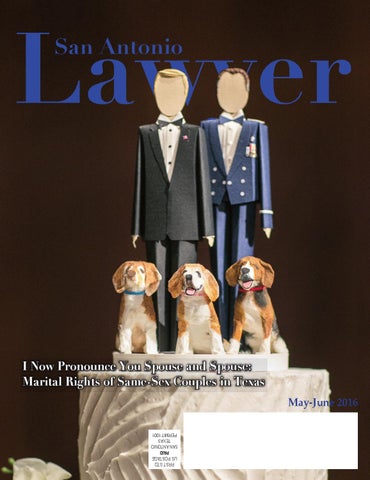
I Now Pronounce You Spouse and Spouse: Marital Rights of Same-Sex Couples in Texas May-June 2016 PRST STD US POSTAGE PAID SAN ANTONIO TEXAS PERMIT 1001
ON THE COVER:
5
Departments
10
George W. Fremont: San Antonio’s First African-American Lawyer By John G. Browning
13
A Tribute to Jimmy Allison By Allan K. DuBois and Sara E. Dysart
16
What Children Tell Judges By Harry L. Munsinger
Feedback
18
Fourth Court Update Parental Termination Orders: Unintended Consequences By Justice Karen Angelini
20
Federal Court Update By Soledad Valenciano and Melanie Fry
Contents
4
I Now Pronounce You Spouse and Spouse: Marital Rights of Same-Sex Couples in Texas By Jo Chris Lopez
May-June 2016 On the Cover: Wedding cake - Photo by Scott Hagar Photography Photo contributions from: Scott Hagar Photography (p. 1, 3, 5-6), Guillermo Contreras/San Antonio ExpressNews (p. 8), Efron & Efron (p. 8) SABA Archives (p. 13-15), Graphic - Kristi Cochran (p. 16-17) Archives of the San Antonio Lawyer are available on the San Antonio Bar Association website, www.sabar.org. San Antonio Lawyer is an official publication of the San Antonio Bar Association. Send address changes to the Bar Association address at the top of page 4. Views expressed in San Antonio Lawyer are those of the authors and do not necessarily reflect the views of the San Antonio Bar Association. Publication of an advertisement does not imply endorsement of any product or service. Contributions to San Antonio Lawyer are welcome, but the right is reserved to select materials to be published. Please send all correspondence to erinb@sabar.org. Copyright Š2016 San Antonio Bar Association. All rights reserved.
San Antonio Lawyer
3
May-June 2016
Features
Lawyer San Antonio
The San Antonio Bar Association 100 Dolorosa, San Antonio, Texas 78205 210.227.8822 Fax: 210.271.9614
Officers/Directors
President James M. “Marty” Truss President-Elect Bobby Barrera Vice President Beth Watkins
Secretary Santos Vargas Treasurer Tom Crosley Immediate Past President Thomas g. Keyser
Directors Dave Evans Dawn Finlayson Hon. Rebeca C. Martinez Hon. Jefferson Moore
Hon. Richard Price Christine Reinhard Mark Sessions Ty Sheehan
Mexican American Bar Association Veronica Leal Vasquez
San Antonio Bar Foundation James M. “Marty” Truss
San Antonio Young Lawyers Association J. Barrett Shipp
State Bar of Texas Directors Andrew L. Kerr Hon. Rebecca Simmons
Bexar County Women’s Bar Executive Director Association Jimmy Allison Katherine Noll San Antonio Black Lawyers Association Stephanie Boyd
Editors Articles Editor Natalie Wilson
Departments Editor Leslie Sara Hyman
Managing Editor Erin Boren
Editor in Chief Emeritus Hon. Barbara Nellermoe
San Antonio Lawyer
Sara Murray, Chair
Pat H. Autry, Vice-Chair
Juliet Yassamin Azarani Sherry M. Barnash Barry H. Beer Amy E. Bitter Merritt Clements Gayla Corley Ryan V. Cox Paul Curl Cristina Tijerina DeLeon Samatha Demory Magda DeSalme Kala Dumont Jane Rankin Dure Tanya Feinleib Jose Galvan Marie Gerard Granger Shannon Greenan Gilbert S. Gonzalez Stephen H. Gordon Per Hardy Sam Houston Leslie Sara Hyman Rob Killen
John R. Lane Rob Loree Burke C. Marold Meagan Rachele Marold Hugh McWilliams James Meyrat Harry Munsinger Curt Moy Hon. Barbara Nellermoe Steve Peirce Donald R. Philbin Edward L. Pina Jason Rammel Rob Ramsey Yanira Marie Reyes John Rightmyer James Rodriguez Alexis Adams Scott Regina Stone-Harris Etan Z. Tepperman Johnny W. Thomas David Willis Natalie Wilson
Ex Officio
James M. “Marty” Truss
Love the tribute edition. Thanks for your most meaningful contribution to the bar. The San Antonio Lawyer is one of my most favorite reads. I feel indebted to you for all your decades of contribution. — Judge Tom Rickhoff to Judge Barbara Nellermoe and the SAL Editorial Board Ms. Brandmiller – I read your “juror” article this morning and want to compliment you on your fine article. Thank you for sharing your experience with us. My experience on a jury panel is what you expected; I was struck on two occasions, and the third because I was not reached. Again, thank you for your insightful article. — Jim Higdon
Correction
We regret that in the January-February 2016 issue of the San Antonio Lawyer, an incorrect photo was published alongside the In Memoriam listing for Carl Henry Pfeiffer. The correct photo is pictured below.
Editor in Chief Sara Murray
Board of Editors
F feeee d db b aacck k
Erin Boren
Carl Henry Pfeiffer died in July at the age of 83. Pfeiffer attended Central Catholic High School, Notre Dame University, and St. Mary’s University School of Law. Following a few years of private practice, Pfeiffer acquired Security Title Co. and Security Title & Trust and embarked on what was to be a long and successful career in that aspect of the law. Security Title Co. became First American Title Company, a business which Pfeiffer sold in 1994. Following the sale, Pfeiffer continued to work in various real estate and business endeavors until December 2014. He enjoyed hunting and ranching and was a longtime member of the San Antonio Liederkranz.
Advertise with us! Low cost, big impact!
Chellie Thompson Monarch Media & Consulting, Inc. email: chellie@monarchmediainc.com phone: (512) 293-9277
Chellie Thompson
For advertising inquiries, contact:
Monarch Media & Consulting, Inc. (512) 293-9277 chellie@monarchmediainc.com
Layouts by Erin Boren Managing Editor, San Antonio Bar Association
We offer low-cost display and classified advertising. Save on rates with our bulk advertising purchase pricing. Reach thousands of your peers, colleagues and community members today — call or email Chellie Thompson for more information. San Antonio Lawyer
4
May-June 2016
I Now Pronounce You Spouse and Spouse
Marital Rights of Same-Sex Couples in Texas
By Jo Chris Lopez
This article is Part I of a three-part series addressing the myriad legal issues arising from the Supreme Court of the United States’ opinion in Obergefell v. Hodges, ___ U.S. ___, 135 S. Ct. 2584 (2015), declaring same-sex marriage constitutional. Ed. The ancient origins of marriage confirm its centrality, but it has not stood in isolation from developments in law and society. The history of marriage is one of both continuity and change. That institution—even as confined to opposite-sex relations—has evolved over time. Obergefell v. Hodges, ___U.S. ___, ___, 135 S. Ct. 2584, 2595 (2015).
Texas Proscribes Same-Sex Unions
The Texas proscription against same-sex unions was formalized in 2003 when the Legislature enacted Texas Family Code § 6.204, declaring that a marriage between persons of the same sex or a civil union is contrary to the public policy of the state and is void. Tex. Fam. Code Ann. § 6.204(b) (West 2006). Then, in 2005, Texas voters amended the Texas Constitution to add a provision that “[m]arriage in this state shall consist only of the union of one man and one woman,” and “[t]his state or a political subdivision of this state may not create or recognize any legal status identical or similar to marriage.” Tex. Const. art. I, § 32(b). Several challenges in the Texas courts followed. In 2008, two men, who had legally married in Massachusetts before they moved to Texas, filed for divorce in Dallas County. In the Matter of the Marriage of J.B. and H.B., 326 S.W.3d 654 (Tex. App.—Dallas
San Antonio Lawyer
5
May-June 2016
2010, pet. dism’d). The men argued that Texas was required to recognize a marriage validly conducted in another state under principles of comity. Id. at 667–68. Although the trial court agreed and struck the state’s intervention, the Fifth Court of Appeals reversed, holding that Texas courts lacked subject-matter jurisdiction to hear a same-sex divorce, even if the marriage was valid in the state issuing the marriage license. Id. at 670. The Court of Appeals reasoned that “Texas laws . . . do not violate . . . equal protection, a provision never before construed as a charter for restructuring the traditional institution of marriage by judicial legislation.” Id. at 681. The Texas Supreme Court granted review and heard oral argument, but the case was
dismissed in June 2015, after one of the parties died while the case was pending. On the same day that J.B. and H.B. was dismissed, the Texas Supreme Court, in a consolidated case, affirmed a samesex divorce involving two women who married in Massachusetts and filed for divorce in Travis County. State v. Naylor, 330 S.W.3d 443 (Tex. App.—Austin 2011), aff’d, 466 S.W.3d 783 (Tex. 2015). In Naylor, one day after the Travis County trial court had orally approved the parties’ settlement agreement, granted a divorce, and rendered judgment, the State attempted to intervene “to defend the constitutionality of Texas and federal laws that limit divorce actions to persons of the opposite sex who are married to one another.” Id. at 787. The trial court
struck the intervention because it was too late, and the Third Court of Appeals affirmed, holding that the State was not a proper party and lacked standing to appeal the divorce decree. Id. at 789. The Texas Supreme Court agreed, finding that procedurally the State lacked standing, but did not address the merits of the constitutional arguments underlying its position because they were not preserved for review. Id. at 795. Similar challenges were also launched in the San Antonio courts. In De Leon v. Perry, 975 F. Supp. 2d 632 (W.D. Texas 2014), aff’d, 799 F.3d 619 (5th Cir. 2015), the plaintiffs—two women who married in Massachusetts and wanted their marriage recognized in Texas and two men who wanted to marry in Texas—brought suit against the State in federal court to declare the Texas laws unconstitutional and to enjoin enforcement of section 32 of the LEFT: Grooms Mark Phariss and Vic Holmes Constitution. The district court concluded that the Texas “current marriage laws admire their wedding cake. BELOW: A deny homosexual couples the right to Holmes/Phariss wedmarry, and in doing so, demean their ding photo celebrated dignity for no legitimate reason.” Id. at the litigation victory 639. The court explained that “even under with Neel Lane (Akin the most deferential rational basis level of Gump), Vic Holmes, review,” the State “failed to identify any Mark Phariss, Hon. rational, much less a compelling, reason Charles Gonzalez that is served by denying same-sex (Officiated), Cleopacouples the fundamental right to marry.” tra DeLeon, Nicole Id. at 660. Dimetman, Frank Another San Antonio case, In the Stenger (Akin Gump) and Michael Cooley Matter of the Marriage of A.L.F.L. and K.L.L., No. 04-14-00364-CV, 2014 WL (Akin Gump) 4357457 (Tex. App.—San Antonio 2014, corrected order), disp. on merits, 2015 WL 4561231 (Tex. App.—San Antonio 2015, no pet.), involved two women who married in Washington, D.C., and moved to Texas where they had a child by donor insemination. See In re State of Texas, No. 04-14-00282 CV, 2014 WL 2443910 (Tex. App.—San Antonio May 28, 2014, orig. proceeding) (mem. op.). A short while later, one of the women filed in Bexar County for divorce and joint custody of the parties’ child. Id. The other woman responded with a jurisdictional challenge, asserting the Texas ban on recognition of same-sex marriage. Id. The trial court denied the plea to jurisdiction and, relying on the district court’s reasoning in De Leon, held that: (1) Texas marriage laws and sections 102.003 (General Standing to File Suit) and 160.204 (Presumption of Paternity) of the Texas Family Code were unconstitutional; and (2) because of the child involved, the dissolution
San Antonio Lawyer
6
May-June 2016
proceeding would continue to determine the parentage rights of each woman. Id. The State was notified of the litigation and, in response, intervened, gave notice of appeal, and sought mandamus relief on its plea to the jurisdiction. Id. The proceedings were stayed by the Fourth Court of Appeals, pending resolution of J.B. & H.B. and Naylor, both of which were then pending in the Texas Supreme Court. In the Matter of the Marriage of A.L.F.L. and K.L.L. and In the Interest of K.A.F.L., a Child, No. 04-14-00364-CV (Tex. App.— San Antonio, July 8, 2014, order), disp. on merits, 2015 WL 4561231 (Tex. App.—San Antonio 2015, no pet.).
Obegefell’s legacy is that: • Same-sex marriage is recognized in all states, territories, and Washington, D.C. • State courts should be available to same-sex couples for divorce, custody, child support and other family law matters, as they are for other litigants. • Children born to couples in a same-sex marriage should have two legally recognized parents, regardless of gender or biological connection. Obergefell also raises several questions for same-sex couples in Texas.
The United States Supreme Court Decides Obergefell
Are Same-Sex Marriages that Predate Obergefell Valid in Texas?
These cases set the stage in Texas for the United States Supreme Court’s decision in Obergefell v. Hodges, ___, U.S. ___,135 S. Ct. 2584 (2015). Obergefell consisted of six lawsuits in which the plaintiffs (fourteen same-sex couples and two men whose same-sex partners were deceased) from four states (all within the jurisdiction of the United States Court of Appeals for the Sixth Circuit—Kentucky, Michigan, Ohio, and Tennessee) challenged same-sex marriage bans in their home states. Id. at 2593. In each case, the federal district court ruled in favor of the plaintiffs. Id. The Court of Appeals consolidated the cases and reversed the rulings. Id. On June 26, 2015, the United States Supreme Court ruled that the United States Constitution requires all states to recognize a marriage between two people of the same sex, and further, that all states must issue marriage licenses for same-sex couples who apply for such licenses. Id. at 2591. Following on the heels of U.S. v. Windsor, ___ U.S. ___, 133 S. Ct. 2675 (2013)—which set aside parts of the 1996 Congress-enacted Defense of Marriage Act (DOMA) as unconstitutional and validated same-sex marriages for most federal purposes— Obergefell requires all states to permit samesex couples to marry and to recognize such marriages wherever performed. See Obergefell, 135 S. Ct. at 2607-08. For Texas citizens, this means that the Texas Constitution’s and Family Code’s prohibitions against same-sex marriage are invalid. For same-sex couples living in Texas after they were lawfully married in a jurisdiction that permitted samesex marriage, their marriages are now recognized in Texas. More broadly,
Same-sex couples without recourse to a marriage license have spent years, even decades, in marriage-like relationships: they lived together, owned property together, opened bank accounts together, invested together, and raised children together. Although same-sex marriages formally licensed and performed after Obergefell (i.e., June 26, 2015) are valid in Texas (and in all other states), those unions that pre-date the Court’s decision may be affected, at least in part, by whether Texas Courts apply the decision retroactively to recognize those de facto marriages in existence before the clerk’s office was open to same-sex couples. If the marriage was licensed and performed lawfully out-of-state, the date of the marriage is technically certain. But when a same-sex couple has been in a long-term marriagelike relationship without the sanction of a license and has lived for all or part of the time in a state where such marriages were not recognized, the anniversary date could be subject to scrutiny.
How Will an Informal Marriage Between Same-Sex Couples Be Treated?
Texas is one of a few states that recognizes an informal marriage (also referred to as “common law marriage”). An informal marriage, i.e. a marriage not solemnized through a legal or religious ceremony, is equivalent legally to a formal or ceremonial marriage. In re Glasco, 619 S.W.2d 567, 571 (Tex. App.—San Antonio 1981, no writ). Texas Family Code § 2.401 provides for an informal marriage between a man and a woman by evidence of:
San Antonio Lawyer
7
May-June 2016
• • •
a signed declaration of marriage; or an agreement to be married and cohabitation within the State of Texas as “husband and wife” and • representation to others that they were married. An argument that only oppositesex couples qualify for an informal marriage should not survive the mandate of Obergefell that prohibits states from marriage discrimination on the ground of same-sex character. It seems reasonable that, after Obergefell, same-sex couples who register an informal marriage by signing a declaration consistent with the statute will be treated as married under state law. And, for divorce purposes, the duration of a marriage begins from the date of the declaration, as it does generally with opposite-sex couples. Aside from creating a marriage by declaration, for same-sex couples who agreed to marry and otherwise satisfy the requirements of section 2.401, an informal marriage could exist by operation of the statute applicable to opposite-sex couples, long before Obergefell was decided. A pending question is whether an informal marriage between same-sex couples will be created like an informal marriage of opposite-sex couples and, if so, can the effective date of such marriages pre-date Obergefell? It is interesting to consider the question in light of the proof typically required of opposite-sex couples who claim an informal marriage: Agreement to be married. To establish an informal marriage, the proponent of the marriage must show that the parties agreed to be married; that is, that the parties “intended to have a present, immediate, and permanent marital relationship and that they did in fact agree to be [spouses].” Small v. McMaster, 352 S.W.3d 280, 283 (Tex. App.— Houston [14th Dist.] 2011, pet. denied). The agreement to be married must be a present agreement; “it is not sufficient to agree on present cohabitation and future marriage.” See Rosetta v. Rosetta, 525 S.W.2d 255, 261 (Tex. App.—Tyler 1975, no writ). The agreement to be married may be established by circumstantial evidence, but cannot be inferred from evidence of cohabitation and holding out as married without an agreement to be married. Russell v. Russell, 86 S.W.2d 929, 932-33 (Tex. 1993). The type of evidence typically used by opposite-sex couples to show an agreement to be married may not
ABOVE: Barry Efron represented the biological mother, Kristi Lyn Lesh, in the suit affecting the parent-child relationship. LEFT: Deanna Whitley (left) and Judith Wemmert (right) represented the petitioner, Allison L. Flood Lesh, in the A.L.F.L. and K.L.L. divorce action in Bexar County District Court.
be available to same-sex couples. For example, because of social stigma, references to a same-sex partner as “spouse,” “wife,” or “husband,” or as “stepparent” were sometimes used more guardedly than by opposite-sex couples. Because same-sex couples could not invoke divorce courts to divide property they acquired together, some hesitated to title property, particularly significant purchases, in joint names. For the same reason, bank accounts and other joint investments may not exist for same-sex couples who could not legally marry. Until 2013, the joint filing of federal income tax returns was not available to same-sex couples who could only file their 1040 returns as single individuals. Cohabitation. A party urging a same-sex marriage may have cohabitated in a jurisdiction that does not recognize informal marriage (same-sex or oppositesex). See Farrell v. Farrell, 459 S.W.3d
114 (Tex. App.—El Paso 2015, no pet.). Farrell concerned a man and a woman who lived in New Mexico and later in Texas, and the issue was the beginning date of the informal marriage. Id. at 116. Because New Mexico does not recognize informal marriage, the court held that the couple could not have been married until they cohabitated in Texas, where informal marriage was recognized. Id. at 117-18. Will Texas, by analogy, recognize cohabitation for purpose of establishing an informal marriage between same-sex couples only if it occurred in a jurisdiction that permitted same-sex marriage? What about same-sex cohabitation in those states that do not recognize informal marriages and also prohibited same-sex marriages? Will cohabitation under these circumstances be considered in Texas to support a claim of an informal marriage where its inception pre-dates Obergefell? Holding out to the public. Texas’ informal marriage statute requires that the couple “represented to others that they were married.” Small, 352 S.W.3d at 284-85. The “holding out to the public” element requires more than an occasional introduction as “a spouse.” Rather, the question turns on whether the couple “consistently conducted themselves as [spouses] in the public eye or that the community viewed them as married.” Id.
San Antonio Lawyer
8
May-June 2016
at 285. There can be no “secret” informal marriage in Texas. See Ex parte Threet, 333 S.W.2d 361, 364 (Tex. 1960). The question then is: Could a same-sex couple agree to be married and hold themselves out as married in a state where same-sex marriage was void? Some same-sex couples who could not legally marry in Texas routinely held commitment ceremonies to publicly memorialize their relationship anyway, but policies like “Don’t ask, Don’t tell” and the perceived social stigma of same-sex relationships kept many same-sex couples in the closet. How will fairness be achieved for samesex couples in a long-term relationship where a licensed marriage was not available, and the licensed marriage is of very short duration?
Why Does It Matter?
An informal marriage is the equivalent of a formal marriage. In re Glasco, 619 S.W.2d at 571. All states provide laws specific to married couples, which create rights and duties during marriage and upon death or divorce. In a community property state, such as Texas, the date of the marriage and its duration may alter: • the accumulation of community property; • separate property character; • the entitlement of a spouse to maintenance upon divorce; and • other spousal entitlements such as health care, retirement benefits, and life insurance. In Texas, whether property is community property or separate property will affect its disposition in a divorce because a court cannot divide separate property. See Eggemeyer v. Eggemeyer, 554 S.W.2d 137 (Tex. 1977). In general, a spouse is entitled to his or her separate property—that is, property owned before marriage or acquired by gift or inheritance—free of any claim of a spouse. Id. at 140. Although a trial court has broad discretion in dividing community property, a court may consider myriad factors in making a just and right division. Murff v. Murff, 615 S.W.2d 699 (Tex. 1981). The length of the marriage is one factor ordinarily considered. See Vannerson v. Vannerson, 857 S.W.2d 659 (Tex. App.— Houston [1st Dist.] 1993, writ denied). In a dissolution action after Obergefell, how will courts consider the length of the relationship vs. the length of the marriage for same-sex couples? Is a
same-sex marriage measured, for divorce purposes, from the date of the beginning of the relationship, which could be many years or decades, or from the earlier of the date of the formal marriage or June 26, 2015? The answer can have an enormous economic effect in allocating for same-sex spouses the same rights that are available to opposite-sex couples upon divorce, including, among many other things, a larger community estate, benefits as the dependent of a spouse, survivor benefits, and joint liability for debts created during the marriage.
and domestic partnerships, which afford a marriage-like status to same-sex couples when actual marriage licenses were not permitted. The issue arises as to whether Texas courts can or will dissolve a marriage-equivalent relationship obtained by Texas residents in another jurisdiction. The effect of Obergefell is to create a new frontier for family law in Texas where, in the next few years, the courts will grapple with these questions and determine how our laws evolve into the new millennium.
Has the Divorce Conundrum Been Solved?
There is no such thing as a “common law divorce” or “informal divorce” in Texas. Once an informal marriage is consummated, it can only terminate by death, divorce, or annulment. Estate of Clavera v. Clavera, 615 S.W.2d 164 (Tex. 1981). Those Texas same-sex couples who wanted a legally valid marriage went to Massachusetts, New York, California, and other states which permitted such unions, and then returned to live in a state without the legal framework that ordinarily governs marital relationships. Before Obergefell, Texas same-sex couples could not file for divorce in Texas, and those who could not satisfy the residency requirements of the state where they were married were left without a straightforward solution to dissolve their marital status or settle property. Although some parents could file suits affecting the parent-child relationship to address issues regarding their children, and could look to other judicial remedies to divide property and debt, they could not terminate their marriage in a Texas divorce court other than by bringing a suit to declare the marriage void. See In the Matter of the Marriage of J.B. and H.B., 326 S.W.2d at 667. However, such suits did not provide for property rights, maintenance or support, debt allocation, or other rights legally afforded oppositesex couples. After Obergefell, same-sex couples who need the courts should have the same access as other litigants.
How Will Texas Courts Handle “Civil Unions and Domestic Partnerships” Created in Other States?
Some states implemented marriagelike equivalents, including civil unions
San Antonio Lawyer
9
May-June 2016
Jo Chris Lopez is a shareholder at Langley & Banack, Inc. She is Board Certified in both Family Law and Civil Appellate Law by the Texas Board of Legal Specialization.
Special thanks to Scott Hagar Photography (www.scotthagar.com) for allowing the publication of the Holmes/Phariss wedding photos.
George W. Fremont
San Antonio’s First African-American Lawyer
In the Winter 2016 issue of account
the Journal of the Texas Supreme Court Historical Society, my co-author Chief Justice Carolyn Wright and I attempt to answer the question “Who was Texas’ first African-American attorney?” And while the likeliest candidates we identified were William A. Price of Fort Bend County (practicing as early as 1872 and the first African-American to serve as a county or district attorney when he was elected in 1876) and lawyer/ legislator A.W. Wilder of Washington County (practicing as early as 1878), one of Texas’ first African-American lawyers happened to be San Antonio’s own George W. Fremont. One of only a dozen black attorneys in the state as of 1890, Fremont was unlike most of his contemporaries. They shunned the cities for rural areas or small towns, usually places “with sizeable black populations and receptive political climates,” such as the black-majority counties like Washington County.1 Fremont chose San Antonio. But what do we know about George W. Fremont, who in 1879 became San Antonio’s first black lawyer?2 Much of what we do know about him comes from contemporary newspaper accounts. As did virtually all of his contemporaries, Fremont arrived in Texas to seek his fortune during Reconstruction. Fremont arrived in San Antonio in 1876, although he actually “began the study of law in Wisconsin in 1873.”3 One newspaper
described Fremont in condescending terms as someone who “manifested remarkable intelligence for one of his race,” and who “expressed a desire to study for the legal profession.”4 Another article heralding his admission as “a negro attorney” noted that Fremont had received help while in Wisconsin from an unexpected source.5 He had purportedly “applied to leading republican lawyers for assistance, but could get none,” and then “applied to prominent democratic lawyers who gave him all the help he desired.”6 Because of this, the newspaper said, “When he came to San Antonio he applied to democrats because he had always found them to be true friends.”7 Fremont received both “friendly encouragement” and the use of their private law libraries from several local attorneys in San Antonio, including “Col. C. Upsom [sic] now member of Congress, Col. J.H. McLean, and other prominent Democratic attorneys,” who “rendered him valuable aid in various ways.”8 Fremont “made rapid progress” in his studies, which culminated in his examination by a committee of three local lawyers. This committee, consisting of “two Democrats and one Republican,” “unanimously reported in favor of his admission to the bar, and supplemented their report, among their friends, by words of praise and commendation.”9 As a result of the successful examination, the newspaper
San Antonio Lawyer
10
May-June 2016
By John G. Browning
noted, George W. Fremont was no longer “a stranger” but a “colored attorney” who “now has full authority to practice in the courts of that district.”10 The assistance he received from local white lawyers may have been what one historian had in mind when he made the sweeping (and not entirely accurate) generalization that while the number of African-American lawyers in Texas was relatively small in the late 19th century, “they seemed to have been readily admitted to practice upon qualification.”11 Fremont’s experience in many ways reflected the “extraordinarily easy” standards for admission to the Texas bar during this period. Texas didn’t have a bar exam until 1903, and the standards for earning a license to practice law changed little between Texas’ days as a republic in 1839 and the passage of a bar licensing statute in 1891.12 A lawyer candidate had to be at least twentyone years of age, satisfy a residency requirement, and provide “undoubted testimonials of good reputation for moral character and honest and honorable deportment.”13 He would then have to pass an oral examination of his legal knowledge by a committee of lawyers (usually three) appointed by the local district judge. The standards for admission were notoriously lax. In 1886, the fledgling Texas Bar Association called for more uniform standards since “in most instances applicants were
admitted without having been subjected to an examination sufficient to test their qualifications.”14 Standards for becoming a lawyer in Texas were so loose, in fact, that even notorious outlaw and convicted murderer John Wesley Hardin was admitted to the Texas Bar after a fifteenyear jail stay for one of his murders.15 Fremont’s experience notwithstanding, African-Americans seeking admission often found that for them the bar was raised. John N. Johnson, Austin’s first black lawyer in 1883 and the first African-American to be admitted to practice before the Supreme Court of Texas, had to weather court-appointed committees in Brazos County in 1881 and 1882, who rejected him on both occasions because of his insufficient grasp of “the science of the law.” Admission to practice was but one hurdle for African-American lawyers. Being “a colored lawyer” during this era drew derisive comments in the local newspaper, as well as insults and demeaning references from white lawyers and judges. At one extreme, being an African-American attorney was dangerous. A.W. Wilder of Brenham lost an arm in 1884 after being shot by white men angered over his decision to run for county attorney. In 1871, three white men murdered Wyathal Wynn, a recent graduate of Howard University School of Law, when he arrived in Arkansas to set up a practice. And in 1895, a white mob in Tuskegee, Alabama, shot Thomas Harris because they “did not want any Negro lawyer” in their community.16 Fremont was, according to contemporary accounts, well thought of in San Antonio. One newspaper said that the “recently admitted colored lawyer . . . [was] a dark limb of the law, but [was] no blackleg, nevertheless.”17 Fremont at one point in 1879 spoke of publishing a newspaper for San Antonio’s AfricanAmerican community, but soon turned his attention full time to the practice of law, and advocated for members of the black population in unpopular cases.18 One had him “traveling about the country lecturing” to raise funds to prosecute a white man named Max Lindheim for the rape of an AfricanAmerican woman—a case that the white establishment chose not to pursue and which one newspaper dismissed as “a case of blackmail, or rather black
female.”19 The next year he defended an African-American named Sam Johnson, who was fined for “insulting and abusive language” directed toward a white man. Newspaper reports stated that Fremont threatened “to carry the case to the United States supreme court [sic], alleging that justice could not be had on account of color.”20 The Max Lindheim case illustrates the unlevel playing field of the time when it came to prosecuting whiteon-black crime. Lindheim was said to be “connected with some of the most respected and wealthy Jewish families of the city,” while the victim was a twenty-two-year-old African-American widow named Jenny Reed.21 Other newspapers in Texas took the local San Antonio paper to task for its blatantly partial coverage, including “refusing to publish editorially the name of the accused, and at the same time making all manner of excuses for him.”22 They also railed against the racist double standard. The Galveston Daily News observed: “If a negro commits rape upon a white woman he is hung [sic], but when the relations are reversed, it is merely an amusing occurrence, and all manner of innuendoes and insinuations are indulged in against the complainant. Is it to be wondered at that the Negroes are indignant at such treatment?”23 The biased treatment did not stop there. Newspapers including the San Antonio Freie Presse took exception to the fact that the presiding Judge Noonan refused to return from his “summer resort” and, without examining Lindheim, released him on $5,000 bond.24 The paper derisively referred to such “long range jurisprudence” as “an entirely new mode of dispensing justice, or rather dispensing with a justice.”25 George W. Fremont enjoyed a long career. An August 1914 article in San Antonio’s main newspaper refers to “G.W. Fremont, the colored lawyer of this city,” addressing “a meeting of colored people at Austin” on August 9 of that year.26 His career spanned an important period in Bexar County legal history. Over its course, his practice no doubt took him from the historic “French Building” (designated in 1868), to the remodeled “Masonic Building” on Soledad Street completed in 1883, to the 1896 Bexar County Courthouse.27 But more importantly, Fremont blazed a trail for the African-American attorneys who
San Antonio Lawyer
11 May-June 2016
would follow. These included AfricanAmerican lawyers ranging from those listed as practicing in San Antonio in the 1910 city directory—such as Richard A. Campbell, Lewis W. Greenly, and R.T. Russell—to lawyers like Hattie Ruth Briscoe during the second half of the 20th century, and to the many women and men of color practicing in San Antonio today. Perhaps unknowingly, all of them stood on the shoulders of a giant named George W. Fremont.28 John G. Browning is a shareholder and trial attorney with the law firm of Passman & Jones in Dallas. He has written extensively on legal matters and was a recipient of the Burton Award for Distinguished Achievement in Legal Writing in 2009, 2010, 2012, and 2014.
ENDNOTES Carter G. Woodson, The Negro Professional Man and the Community: With Special Emphasis on the Physician and the Lawyer, 107 (Negro Univ. Press 1969) . 2 Brenham Weekly Banner, Vol. 14, No. 21 (May 23, 1879) available at http://texashistory.unt.edu/ark:/67531/ metapth115378/ (last visited March 21, 2016) (hereinafter “Brenham Weekly Banner”). 3 George W. Fremont, the San Antonio lawyer, should not be confused with two other “George W. Fremonts”: the first a Buffalo Soldier with the 10th U.S. Cavalry who was court-martialed following a tragic patrol near Fort Concho, Texas, in 1877; and George W. Fremont a black lawyer in Alexandria, Virginia, who was convicted of fraud in 1897. 4 “A Negro Attorney,” Denison Daily News, Vol. 7, No. 57 (May 9, 1879) available at http://texashistory.unt.edu/ark:/67531/ metapth327221/ (last visited March 21, 2016) (hereinafter “A Negro Attorney”). 5 Daily Banner, May 23, 1879, http:// texashistory.unt.edu.ark:/67531/ metapth478298/. 6 Brenham Weekly Banner, supra note 2. 7 Id. 8 “A Negro Attorney,” supra note 4. The “Col. C. Upsom” mentioned is actually Christopher Columbus Upson (18291902), a transplanted Yankee who was 1
- Continued on page 22 -
San Antonio Lawyer
10
March-April 2016
A Tribute to Jimmy Allison
In June 2015, State Bar of Texas President Trey Apffel presented to Jimmy Allison a Presidential Citation for his “50 years of dedicated service as the executive director of the San Antonio Bar Association and [his] contributions to and service in support of the legal profession and the lawyers of Bexar County.” In August 2016, San Antonio Bar Association (SABA) President Marty Truss made the annual Installation Gala a tribute to its one—and only—Executive Director, Jimmy Allison. This magazine, with its commitment to recording the history of the San Antonio Bar, would be remiss if it passed on the opportunity to once more pay tribute to Jimmy Allison, the legendary leader of SABA for over fifty years. Raised in San Antonio, Jimmy graduated from Central Catholic High School, where his talent as a pitcher on the varsity team caught the attention of major league baseball recruiters. After graduation, the Baltimore Orioles signed a contract with Jimmy. He started his career in Tennessee on the minor league team, where his record as the only professional pitcher to pitch back-to-back no-hitters remains unbeaten. Judge Fred Biery, who first met Jimmy Allison when the former was just seven years old, called Jimmy “a giant” and compared him to baseball legend Willie Mays. Although an injury ended Jimmy’s professional baseball career, he did not give up the game. Judge Nelson Wolff recalled meeting Jimmy in the early 1950s when Jimmy was a pitcher for the Texas Consolidated Transporters, a company Judge Wolff’s father worked for. Judge Wolff was bat boy for the
team. And SABA Immediate Past President Tom Keyser— who was drafted by the Orioles about a decade after Jimmy— remembered meeting Jimmy in 1977, when he coached the San Antonio Blue Team to their first out of nine consecutive state championships. The Baltimore Orioles’ loss was Bexar County attorneys’ gain. While Willie Mays went down in sports history, Jimmy Allison would leave an equally indelible mark in the annals of his home town. Jimmy’s first job was in the Bexar County Clerk’s office. Back in those days, Fred Rodriguez recalled, “Smoking was allowed in the courtroom, and [there was] a dormitory for jurors on the fourth floor.” When the position of executive director for SABA was created, Jimmy stepped in to fill the position that would affect Bexar County attorneys for the next fifty-plus years. As Bobby Barrera, current President-Elect of SABA stated, “Jimmy is the San Antonio Bar Association. In the beginning there was light, there was darkness, and there was Jimmy Allison.” Starting with about 625 attorneys in 1965, Jimmy has led SABA as its membership has grown to over 3,000 members. The expansion of the Bar Association also resulted in its diversification, and Jimmy was instrumental in ensuring that SABA’s leadership reflected its membership. Sue M. Hall, SABA’s first female President (1990-1991), recounted: “Jimmy was instrumental in helping women integrate into the San Antonio Bar Association. He encouraged me, Jane Macon, and Evelyn Biery to get involved with, as we called it, the ‘boys’ bar association,’ and helped me
San Antonio Lawyer
13
May-June 2016
Jimmy Allison Executive Director San Antonio Bar Association move up the ladder to become president. I believe he won some money from Van Hilley in one of the elections, and I appreciate the fact that he put his money on me.” Jimmy was determined that every lawyer in the community should feel welcomed at SABA. Former Chief Justice Phil Hardberger harkened back to the 1970s, when he arrived in San Antonio with no contacts and no cases. As he remembers, “Jimmy took me under his wing, and there was something called the lawyer referral service. Jimmy made sure that I got lots of cases under that referral service.” Chief Justice Hardberger has always been grateful for Jimmy’s warm welcome to San Antonio. Jimmy’s service to our community has been recognized by the San Antonio Criminal Defense Lawyers Hall of Fame Award, the Texas Criminal Defense Lawyers Association Award in 1973, the Major League Baseball Association Award in 1987, the San Antonio Bar Association Award for then twenty-five years of service, the Community Service Award for Pro Bono Service in 2008, the
Appreciation Plaque for fifty years of service to Bexar County, the Appreciation Plaque by the San Antonio Bar Association Women’s Auxiliary in 1979, and the State Bar of Texas Presidential Citation in 2000. It is not easy to get Jimmy to talk about himself. The list of awards just mentioned was gathered by inconspicuously viewing them on Jimmy’s office walls. When Andy Kerr—District 10 State Bar of Texas Director and Past San Antonio Bar Association President—interviewed Jimmy about his career in anticipation of the State Bar of Texas Presidential Citation, Jimmy acknowledged that his goal was always to make things better for attorneys who practiced in Bexar County. One of his first actions as Executive Director was to join attorneys and legislators who lobbied for increased filing fees in civil cases to provide sufficient funds for the Bexar County Law Library, a resource that Jimmy has always worked to improve. Roy Barrera, Sr. (SABA President 1973-74) remembered fondly Jimmy’s justifiable pride when the new law library was opened. He also reminisced about how indispensable Jimmy’s knowledge was when each new President of SABA took the reins: “All presidents knew going TOP: Trey Apffel, President, State Bar of Texas, Jimmy Allison, in, they know Executive Director, San Antonio Bar Association, Tom Keyser, little or nothing President, San Antonio Bar Association (at the 2015 State about what the Bar Annual Meeting when Mr. Allison was presented a State mechanics are Bar of Texas Presidential Citation). MIDDLE: Jimmy Allison and what it and Gary Hutton, President, San Antonio Bar Association. is that you’re BOTTOM: Jimmy Allison and Mary Doggett, President, San expected to do. Antonio Bar Association. Jimmy took me, like he took
San Antonio Lawyer
14
May-June 2016
all presidents, past and present, by the hand and showed us around initially, initiated us into the office, and was a tremendous help and assistance to us in permitting us to do a good job for the San Antonio Bar Association. . . . I can’t remember when I did not know Jimmy. All of my experiences with him have been tremendous, and we’ve been good friends to the present.” Lamont Jefferson (SABA President 2006-07), echoed Mr. Barrera’s sentiments: “I was told that Jimmy Allison was the man whom you needed to know. Ever since then, Jimmy has been there for whatever I need, and he’s there for everybody. There is no question about it. Everybody knows. And I certainly know and appreciated so much Jimmy’s help and respect. It was comforting to know that Jimmy was there throughout my career. Jimmy is a great part of the San Antonio legal community and the history of the bar in San Antonio.” Jimmy’s commitment to helping lawyers in San Antonio was not limited to providing them with stellar resources or helping them build their law practices through the referral service. He has taken a genuine interest in the lives of the attorneys who practice in Bexar County. Judge Lorina Rummel recalled that when she was a “baby defense attorney” practicing out of her home, Jimmy helped her arrange for meeting rooms on the fifth floor of the Courthouse so that she would not have to meet with criminal defendants in her home and around her children. Allan DuBois (current State Bar of Texas President and SABA President 2007-08) reminisced about Jimmy’s “compassion for lawyers, especially ones who were having trouble and struggled sometimes, who needed a few extra bucks because of their families or because their personal situations were such that they were in need of some hope.” Jimmy was often the first to extend that ray of hope to struggling lawyers, starting collections at SABA Board meetings by making the first contribution. As Judge Karen Pozza (SABA President 2003-04) attested, Jimmy treated every lawyer in San Antonio like they were a member of his family. By forming the San Antonio Bar Foundation, providing the best local CLE, upgrading and expanding SABA’s courthouse offices, and establishing the award-winning Community Justice Program under the initial leadership of
For the 2016 San Antonio Bar Association Installation Gala, members of the Bar were invited to record video messages to Jimmy Allison, who was being honored for more than fifty years of service as the Bar’s Executive Director. Former SABA Presidents Joe Casseb (1996-1997) and Dan Pozza (1995-1996) delighted the assembled guests with their humorous tribute to Jimmy that captured his dedication to the Bar Association, as well as his enormous capacity for friendship and mentorship. Joe Casseb: In the 1950s there was a young man who was a terrific athlete and an even better baseball pitcher. His name, Jimmy Allison. Dan Pozza: Jimbo. Joe Casseb: Jimaru, Jimbalaya, and Jimmy was on his way to the pros when he blew out his elbow before anyone had ever heard of Tommy John. So Jimmy had an abrupt career change, and he went to the District Clerk’s office, where he was assigned as the clerk for the 56th District Court. Then presiding was one Judge Solomon Casseb, Jr., or as I like to call him, the real Judge Casseb. Dan Pozza: Whoa! Joe Casseb: Jimmy became court clerk there for a few years, and he survived that experience with the help of Valium, and it was only a matter of time before Judge Casseb recognized
Judge Karen Pozza and Justice Phylis Speedlin, Jimmy surely met his goals! Justice Speedlin (SABA President 2010-11) credits Jimmy for starting and sustaining the Community Justice Program. She explained that “it was his determination that it would happen, and his determination to keep the clinics going, that has kept this program for the last twelve years.” Jimmy’s tenure as Executive Director was highlighted at the 2016 Installation Gala. Past presidents, elected officials, and members of the judiciary were present, and included in the festivities were video clips where attorneys and judges related personal experiences with photos that spanned the decades of Jimmy’s involvement with SABA. Tributes to Jimmy were capped by current SABA President Marty Truss’s presentation of a check to Central Catholic High School, Jimmy’s alma mater, to fund a scholarship in his name; County Judge Nelson Wolff’s announcement that the Bexar County Law Library will be named in his honor, in recognition of his contributions to the restoration of the Commissioner’s Court; and Senator Carlos Uresti’s delivery of the Texas Senate Commendation. In a white dinner jacket, the speechless honoree took the microphone. He spoke only of gratitude for his family, starting with Barbara, his wife of fifty-two
Jimmy’s talents. When he heard there was an opening for the first executive director of the San Antonio Bar Association, he immediately thought of Jimmy Allison, and he made sure that Jimmy Allison was our initial director. What he saw then is what we know now, a marriage made in heaven of over 50 years. Dan Pozza: Joe—you know, Jimmy, your 50 years, I’m not saying it hasn’t been without issues. Obviously there’s ups and downs in a 50-year career. But other than that rather significant bump in the road about 20 years ago, I think it’s been a pretty good run. Joe Casseb: Bump in the road? Dan Pozza: Yes, as Jimmy is painfully aware, about 20 years ago, Jimmy Allison had to withstand the back-to-back presidencies of Dan Pozza and Joe Casseb. But, Jimmy, you handled those twin attacks, if you will, with grace and kindness. You were always kind to every—every president who served with you. I remember you would tell each and every one of us “you are my favorite bar president,” that was so— Joe Casseb: It meant a lot to me at the time. Dan Pozza: You didn’t—you weren’t told—oh. Happy Anniversary, Jimmy! Joe Casseb: Thank you, Jimmy, on behalf of the San Antonio Bar Association and all of the lawyers in Bexar County.
years, with whom he has two daughters and six grandchildren; his staff; past and present officers and directors of the San Antonio Bar Association; and the attorneys of our Bexar County legal community. He recalled his first day on the job when he was given a wooden desk and chair and a broken typewriter in the county law library, from Judge Karen Pozza, President, San Antonio Bar whence commenced this Association and Jimmy Allison illustrious career. Jimmy was nothing but smiles as he reminisced. Jimmy Allison, more than any other Texas District 10 Directors, for the SBOT individual, has shaped SABA into what Presidential Citation; (ii) State Bar of Texas it is today. As he passes the baton, his President, Allan K. DuBois, President’s friendship and leadership will be missed, Column, Texas Bar Journal (October but his legacy lives on in a congenial and 2016); and (iii) video testimonials produced outstanding legal community dedicated under the direction of San Antonio Bar to the well-being of its members and the Association President, Marty Truss, with community at large. Thank you, Jimmy, the assistance of Kim Tindall with Kim for more than fifty years of leadership Tindall & Associates, LLC, and June Moynihan, Executive Director of the San and service! Antonio Bar Foundation. This article is based upon (i) an interview with Jimmy Allison in June 2016 by Andy - Continued on page 22 Kerr and Sara Dysart, then State Bar of
San Antonio Lawyer
15
May-June 2016
What Children Tell Judges By Harry L. Munsinger
Often the most contentious
issue in a family law dispute is where a couple’s child will live. When parents don’t agree, judges usually want to know the child’s preference. Before the law changed in 2009, children over age twelve could state their preferences in writing, but this practice generated “dueling affidavits” that were often ignored because the affidavits usually reflected parental pressure. Today, a judge typically discovers where a child wants to live by interviewing the child in chambers.1 The interview is initiated by the judge or an attorney motion. I interviewed Bexar County district judges to obtain some insight into what children tell judges. How Interviews Happen. Some judges request interviews with children, while others interview a child upon written request. Former Bexar County District Court Judge Victor H. Negrón, Jr. saw between thirty and forty children a year in chambers. About half the time he initiated the interview. Judge Negrón said he learned a lot from interviewing children and hearing their preferences. Some judges interview a child only if they must. Judge Solomon Casseb, III, of the 288th District Court wants to know who asked for the interview because he feels it is not in the child’s best interest to be dragged into a custody fight. Judge Casseb does not allow parents or attorneys to attend a child’s interview unless all parties insist on being present. Because he does not want a child dragged into the parent’s divorce, he only interviews a child when compelled by law. Establishing Rapport. All judges reported that younger children are anxious about seeing a judge, while older children are often eager to tell the judge where they want to live. Judges try to put frightened children at ease by discussing topics such as sports, homework, friends, hobbies, and music. Bexar County Judge Larry Noll of the 408th District Court said, “I try to help the children relax before discussing why they
are in my chambers. I ask them about their school, friends, sports, or Mom and Dad.” Judge Negrón explained, “Most of the children don’t know why they are there and are frightened.” Judge Negrón spent thirty to forty-five minutes with the children because he wanted them to get comfortable, and he wanted to know what they thought. He said, “I enjoyed talking with the children but felt it was stressful for them.” Judge Peter Sakai of the 225th District Court said, “I dialogue with the children, asking them about school, sports, family, what they do in a day, and I talk about my common interests with them.” Judge Karen Pozza of the 407th District Court said she always tries to get children to relax. She said, “They often have an agenda, but I ask them to tell me about Mom and Dad. I want to know what happens in each home and who lives there.” Myths Children Believe. Some children believe they get to decide where they will live, a myth reinforced by parental coaching. Judge Noll reported, “Older children often come into my chamber with an agenda.” When this happens, Judge Noll tells the child, “It’s my decision, not yours.” He found children are surprised when he says that because often a parent has told the child, “It’s your call.” Judge Negrón agrees, explaining that older children often believe they get to decide, and that the judge is compelled to go along with their decision. Judge Sol Casseb said, “The child’s preference of where to live doesn’t mean a whole lot to me. It’s more important to find out how the child gets along with other members of her family.” When he sees a child with an agenda, Judge Casseb changes the subject. He tries to find out who has talked to the child about the case because he thinks it’s a mistake to bring a child into the middle of a custody battle. Judge Pozza also reported that many children believe they get to decide where
San Antonio Lawyer
16
May-June 2016
they live. She tells children, “I will make the decision, not you.” What Children Want. Children express a common theme: they want their parents to stop fighting and get back together. Judge Larry Noll said, “Almost all the children I see in chambers want their parents to stay together and stop fighting.” Judge Negrón agreed: “Children want their parents to stop fighting and get back together.” Judge Sol Casseb said, “Almost all the children want their parents to stop fighting and stay together.” Judge Karen Pozza said, “They want their parents to work together and bring peace to the family.” Judge Peter Sakai said, “They want their parents to work together. They want peace. They don’t want to be in the middle.” Many children don’t want to decide; they ask the judge to decide for them. Judge Sakai said, “I had two children clearly explain the issues in the case to me. They told me how traumatic the divorce was for them. They were mature and clear. They were not prejudiced and they loved both parents. But, they wanted help making the decision.” Testing Parental Truthfulness. A few judges reported that they collect information from children to test the parents’ truthfulness. For example, if a father says he spends a lot of time with the child, but the child reports that she rarely sees Dad, the judge has a better idea of who is telling the truth. Judge Negrón said that he generally viewed the children’s statements as a way to test the honesty of parents during his interview of a child. By contrast, Judge Sakai said, “I don’t do that.” Judge Pozza agreed—she never tests a parent’s truthfulness with the child. Stories from Chambers. Judge Negrón described a case that involved a teenage girl who lived with her dad. The girl reported physical abuse by the father. She had pictures of bruises on her arms where she said her father shook her hard. When Judge Negrón interviewed
the father, he admitted he grabbed his daughter’s arms and shook her. But the father asked, “Do you want to hear my side of it?” Judge Negrón told him he did. The father said, “She lied to me.” The father explained that he found nude pictures of his daughter with another girl and two boys in her bedroom. She was a latchkey child and apparently brought her girlfriend and two boys home with her. Both parents identified their daughter in the pictures. When Judge Negrón showed the pictures to the daughter, she said, “That’s not me.” Judge Negrón said, “It looked just like her to me, and I was convinced the girl was lying.” Judge Noll said he recently saw a boy who refused to visit his dad. The child told the Judge that his mom had said, “It’s up to you. You don’t have to go if you don’t want to.” Judge Noll felt the mom was poisoning the child against the dad, so the judge told the child, “I will put Mom in jail for the same number of days you have missed visiting your father.” The child explained, “Dad is a bad cook and can’t wash my clothes, so I didn’t want to visit him.” Judge Noll said, “Learn to cook and wash your own clothes. You’re old enough.” Most of the time judges do not have to threaten contempt and jail time to get a child to comply with visitation. Judge Pozza said, “I interview the children after hearing all the evidence. Often the children can’t wait to be independent and go away to college. We talk about their future and the hope it promises.” Judge Pozza recalled a case where she interviewed three siblings: “One of them was very quiet. It turned out he had been physically abused by one parent. He cried, and I learned something really important from that interview.” Judge Sakai reported, “Many of the kids see me as a father figure because I talk to them about grades, being disciplined, studying, and tell them not to play video games all the time.” Poignant Moments in Chambers. Judge Noll recalled a case involving two girls, ages eleven and thirteen. Both parents were drug addicts. The girls had been living with their grandmother, but the grandmother had a heart attack and could no longer care for them. Both parents had been in and out of prison and were still addicted to drugs. To make things worse, the thirteen-year-old was pregnant; her mother was also thirteen when she was born. Judge Noll asked the girls which
parent they wanted to live with. The older girl responded, “They’re both f****d-up, but Mom is the least f****d-up of the two, and we want to live with her. Also, Mom lives in a school district that has a special program for pregnancy.” Judge Negrón recalled an incident about a candy dish on his desk. Two children were staring at the candy dish and Judge Negrón said, “Go ahead and take a piece or two for later.” One of the children took a handful of candy and said, “I didn’t know judges ate candy.” What Judges Want Attorneys to Know. Judge Negrón said, “I want all attorneys out there to seriously weigh if it is in the child’s best interest to bring them into court. In my opinion, it would be much better for the child to be seen by a psychologist who could report her findings to the court.” Judge Casseb said, “I wish lawyers and parents would consider the harm they do to the child by dragging them into court.” Judge Casseb would rather speak with a professional counselor about the best living arrangement. His rule is: Don’t harm the child. By contrast, Judge Sakai said, “Kids give the best evidence, and they’re most credible.” He reported that early in his judicial career he did not like interviewing children because he felt it was not helpful. However, as he became more experienced, he began to feel that children need someone to hear what they have to say. Judge Sakai said, “I value the words of the children. Their words are often clean and truthful. Some are coached or even alienated from one parent, but I give an interview with the child equal weight with all other evidence I hear in a case. I think the children are already in the middle, and their words carry weight because they are often neutral.” Judge Pozza said, “The children often cry in my chambers because they are in such pain. Their parents don’t know how much damage they’re doing by fighting in front of the children.” She said, “We have no training in how to interview a child. I do it because I have to under the law. Some kids want to talk to me, while for others it’s scary. Most of the time I don’t believe it is a good thing for the child. The interview creates a lot of anxiety beforehand. However, I feel we need a discussion with the children.” Judge Pozza said, “Judge Martha Tanner told me years ago our job is to listen. This is their day in court.”
San Antonio Lawyer
17
May-June 2016
Harry Munsinger is a partner in Munsinger & Munsinger, 207 W. Summit, San Antonio, Texas 78212. His practice is limited to collaborative family law, probate, and estate planning. Endnotes 1 See Tex. Fam. Code §153.009 (Interview of Child in Chambers). The court must interview a child twelve years or older in chambers when requested by a party, amicus attorney, or attorney ad litem. The court may also interview a child on its own initiative. The Texas legislature believes it’s important to give children a voice in the custody battle. However, the court retains final discretion to decide where the child resides. In a jury trial, the court may not interview a child. The statute does not prescribe a procedure for conducting the interview with a child, so judges are free to formulate their own interview process. In suits alleging abuse, Tex. Fam. Code §263.302 requires a child’s presence in court. Thus, judges who hear CPS dockets routinely interview children.
TLIExceptional
Cindy Kolb, Senior Member Services Representative
Because of our exceptional coverage, Texas Lawyers’ Insurance Exchange has been voted best professional liability insurance company in Texas four years in a row by Texas Lawyer magazine. That same exceptional coverage and over 36 years in the business has also made TLIE a Preferred Provider of the State Bar of Texas. Not to mention, we have returned over $41,550,000 to our policyholders. See why exceptional coverage makes the difference.
512.480.9074 / 1.800.252.9332 INFO@TLIE.ORG / WWW.TLIE.ORG
@TLIE_
facebook.com/TLIE01
Fourth Court Update:
Parental Termination Orders: Unintended Consequences
By Justice Karen Angelini
I
Fourth Court Update
n the past few years, the Fourth Court of Appeals has experienced a dramatic increase in appeals from parental termination orders, mostly from Bexar County. Parental termination cases are somewhat unique in that they require extraordinarily expeditious treatment. And, of course, much is at stake as the courts, the State, the attorneys, and the parties involved try to balance, on the one hand, the constitutional rights of parents to their children and, on the other hand, the children’s best interests. So, it is of utmost importance that procedural mistakes do not result in unintended consequences causing parties to lose their right to appeal. The recent case of In the Interest of E.K.C., No. 04-15-00457-CV, 2016 WL 146990 (Tex. App.—San Antonio Jan. 13, 2016, no pet.), illustrates this point. The Department of Family and Protective Services sought to terminate the parentchild relationship between Alexander and his child, E.K.C. A Bexar County associate judge held a trial on the merits on May 29, 2015. On June 1, the judge signed a one page, mostly handwritten “Associate Judge’s Report and Order.” Among other things, the handwritten portion of the order recited that trial on the merits was held; the father’s rights were terminated on two grounds; and the Department was the sole managing conservator. The handwritten portion of the order also stated “clear and convincing evidence” and “best interest,” and contained the following notations: 6. 20 Days after sign Judgment—if no appeal move to Push AND Adopt by 60 Days 7. Preview 8/27/15 330 8. motion enter Judg’t 830 6/30/15
The order further stated in typewritten language: “Rendered on 6/1/15 and signed on 6/1/15.” The order was also signed as “adopted and ordered” by the presiding district court judge on June 4, 2015. Then, on July 17, 2015, the associate judge signed a formal and more detailed typewritten order terminating Alexander’s rights and reciting the order was “rendered by Associate Judge’s Report and Order on June 1, 2015.” Alexander filed a notice of appeal on July 17, 2015. Because this was an accelerated appeal, the notice of appeal was due to be filed within twenty days of the final order. See Tex. R. App. P. 26.1(b); 28.1(b). Thus, if the June 1 order was final and appealable, Alexander’s notice of appeal was late, and the appellate court lacked jurisdiction to consider the appeal. If, on the other hand, the June 1 order was interlocutory, the July 17 order was final and appealable and Alexander’s notice of appeal was timely. The court concluded that the June 1 order was final and appealable and, therefore, jurisdiction was lacking. The court also concluded that the July 17 order, which was signed after the trial court’s plenary power had expired, was a nullity. In analyzing this jurisdictional issue, the court was guided by In the Interest of A.W., 384 S.W.3d 872 (Tex. App.—San Antonio 2012, no pet.), and In the Interest of A.R.G., 420 S.W.3d 841 (Tex. App.— San Antonio 2013, no pet.). In those cases, the court found the handwritten Associate Judge’s Report and Order, which disposed of all issues and parties in the case, was final and appealable. The Associate Judge’s Report and Order in E.K.C. likewise disposed of all issues and
San Antonio Lawyer
18
May-June 2016
parties and, therefore, was the final and appealable order rather than the formal typewritten order of July 17. In reaching its conclusion, the court noted that Bexar County associate judges appear to have adopted a practice—as happened in this case—of rendering and signing handwritten orders terminating parental rights and waiting until after plenary power is lost to formalize the order. This practice of rendering a final judgment with a signed, primarily handwritten, and vague order “adversely affects the interest of parents seeking to appeal the termination of their rights and those of a child seeking a final adjudication and stability.” E.K.C., 2016 WL 146990, at *2. Thus, the court stated, “In the case before us, this practice has caused unintended consequences.” Id. at *3. And, unfortunately, the unintended consequence for Alexander was the dismissal for lack of jurisdiction of his appeal of the termination of his parental rights. Justice Angelini has served on the Fourth Court of Appeals since January 1997. Prior to joining the Court, Justice Angelini practiced law with the firm of Brock and Fuller, and served as a briefing attorney with the Fourth Court of Appeals and the U.S. District and U.S. Magistrate Courts in the San Antonio Division of the Western District of Texas.
LIMITED ENGAGEMENT MAY 14 − SEPTEMBER 5 An epicurean adventure your guests will never forget! Maya: Hidden Worlds Revealed brings together hundreds of authentic artifacts displayed in more than a half-dozen immersive environments. PRESENTED TO YOU BY
CURATOR LED TOURS • THEMED CORPORATE EXPERIENCES TRANSPORTATION AND ENTERTAINMENT • FOR GROUPS OF 65 GUESTS OR MORE
maya@therkgroup.com 210.670.6221
mayasa.wittemuseum.org
Discover Maya MAY 14 through SEPT 5 in the NEW Mays Family Center San Antonio Lawyer
19
March-April 2016
Federal Court Update By Soledad Valenciano and Melanie Fry Summaries
of
significant
decisions
rendered by San Antonio federal judges from 1998 to the present are available for keyword searching at Court Web found at
http://courtweb.pamd.uscourts.gov/
courtweb. Full text images of most of these orders can also be accessed through
Court Web. If you are aware of a Western District of Texas order that you believe would be of interest to the local bar and
should be summarized in this column, please
contact
Soledad
Valenciano
(svalenciano@svtxlaw.com, 210-787-4654)
or Melanie Fry (mfry@dykema.com, 210554-5500) with the style and cause number of the case, and the entry date and docket number of the order.
Federal Court Update
Motion for Summary Judgment; Need for Additional Discovery George v. Go Frac, LLC, No. SA-15-CV943-XR (Rodriguez, X., Jan. 7, 2016). Court denied plaintiff’s motion for summary judgment without prejudice. Defendant had argued that summary judgment was premature and sought relief under Rule 56(d). In the Fifth Circuit, courts have discretion to deny a motion for summary judgment as premature although Rule 56 motions are broadly favored and should be liberally granted. To obtain relief under Rule 56(d), the nonmovant must demonstrate: (1) why additional discovery is needed; and (2) how the additional discovery will likely create a genuine issue of material fact. While whether one is an “employer” for purposes of the FLSA is a question of law, it does not follow that no discovery should be needed. Rather, in examining the issue, court must make subsidiary findings of fact. Relatedly, the economic reality test is necessarily a fact-intensive inquiry that requires court to examine the totality of the circumstances and closely evaluate the facts of a corporate officer’s job functions.
Motion in Limine; Exclusion of Evidence Hague v. Univ. of Tex. Health Sci. Ctr. at San Antonio, No. SA-11-CV-1101-RCL (Lamberth, R., Jan. 15, 2016). Former employee sued hospital claiming she was retaliated against after having filed complaints against two doctors for sex discrimination. Court excluded two exhibits and the testimony of one of the investigators. At issue was whether the employee had, in fact, engaged in protected activity. The parties “generally” agreed to a stipulation that—as to the more egregious complaint against one of the two doctors (the only complaint resulting in a written reprimand)—the employee: (1) was engaged in protected activity when she reported an unlawful employment practice; and (2) had a reasonable, good-faith belief that the alleged sex discrimination and harassment she opposed was unlawful. The complaint and the reprimand, as well as any testimony from the witness who investigated the complaint, were excluded. Employee offered no basis to conclude that the witness’s testimony and the two exhibits would be relevant to any trial issue beyond what was already conceded by stipulation, and the probative value of the exhibits and testimony was substantially outweighed by the danger of unfair prejudice. Because there was no similar stipulation as to the complaint against the second doctor and a dispute as to whether employee was engaged in protected activity as to that complaint, employee was free to offer that complaint into evidence and examine the related investigator. Class Certification; Lusardi Test Cantu v. Circle Bar A, Inc., No. 5:15-CV468-XR (Rodriguez, X., Jan. 26, 2016). Plaintiffs brought suit as a collective action under the Fair Labor Standards Act, alleging that as sand coordinators, they were paid a fixed salary rate for all hours worked, with no overtime pay. The employer opposed certification. On one hand, the employer stated that the position of sand coordinator is exempt under the FLSA. On the
San Antonio Lawyer
20
May-June 2016
other, the employer stated that, for certification purposes, there have to be individual determinations as to whether the employee is exempt. Employer also argued that employees failed to establish that other putative class members wish to join the action. Court routinely adopts the lenient standard for certification known as the Lusardi test. However, even under this lenient standard, a plaintiff bears the burden of making a preliminary factual showing that a similarly situated group of potential plaintiffs exists by making a minimal showing that: (1) there is a reasonable basis for crediting the assertion that aggrieved individuals exist; (2) those aggrieved individuals are similarly situated to the plaintiff in relevant respects, given the claims and defenses asserted; and (3) those individuals want to opt into the lawsuit. Given the material fact dispute, created by opposing affidavits, about whether the sand coordinators performed supervisory duties and the limited number (two) of plaintiffs currently interested in pursuing the case, court denied the motion for certification without prejudice, thereby allowing the employee an opportunity to further develop the merits of the potential certification. Motion to Dismiss; Immunity Bagwell v. Livingston, No. 15-CV-584DAE (Ezra, D., Feb. 1, 2016). Plaintiff, currently an inmate at the TDCJ’s Connally Unit in Kenedy, Texas, filed a civil rights lawsuit under 42 U.S.C. § 1983, alleging that defendants—all supervisory TDCJ or Connally Unit officials— had failed to furnish plaintiff and others currently housed in administrative segregation with nutritionally adequate meals and adequate recreation to permit them to maintain their health during their incarceration. Defendants filed motions to dismiss based on the Eleventh Amendment and the “well-settled doctrine” that respondeat superior and other theories of vicarious liability do not apply to § 1983 actions. Plaintiff’s claims against defendants are in their official capacities and seek only declaratory and prospective
injunctive relief. Eleventh Amendment does not apply to a request for prospective injunctive relief against state officials. Plaintiff’s failure to allege specific facts showing precisely how each of the named defendants was personally involved in the alleged denials of adequate food and recreation to Connally Unit inmates housed in administrative segregation did not furnish a basis for the dismissal of this action. Motion to Withdraw as Counsel; Local Rule AT-3 Sanders v. UNUM Life Ins. Co. of Amer., No. SA-15-CV-310-DAE (Ezra, D., Feb. 5, 2016). Counsel for plaintiff requested leave to withdraw as counsel and for extension of time to respond to defendant’s motion to enforce mediated settlement agreement. After signing the agreement, plaintiff raised new objections, which the attorney attempted to address through meetings in person and on the phone, by means of e-mail conversations, and through further negotiation with defense counsel, which resulted in revisions to the final settlement agreement. Attorney told her client that she would file the instant motion if the client continued to refuse to sign the final settlement agreement. Attorney submitted various documents under seal corroborating these efforts. Court has discretion to grant an attorney leave to withdraw from representation upon a showing of good cause and reasonable notice to the client. Good cause must be corroborated by evidence in the record. The Local Rules for the Western District of Texas require additionally that where the successor attorney is not known, the attorney seeking to withdraw must provide the court with: (1) the client’s name, address, and telephone number; and (2) the client’s signature or a detailed explanation why the client’s signature could not be obtained after due diligence. Court concluded, given the evidence presented, that efforts to persuade attorney’s client to sign the final settlement agreement will continue to be futile. Attorney expressed
to her client and to the court that she believed the final settlement agreement was in the client’s best interests, and to file a motion before the court stating otherwise would violate her duty to zealously represent her client. Accordingly, attorney demonstrated good cause, provided the court with plaintiff’s address and phone number, and adequately explained plaintiff’s failure to sign the motion. Court, therefore, granted motion to withdraw. Anti-Piracy; Strict Liability; Local Rule CV-7(h) Joe Hand Promotions, Inc. v. O’l River Hideaway, LLC, et al., No. 5:15-CV-187DAE (Ezra, D., Feb. 11, 2016). Plaintiffs brought an “antipiracy” action under the Federal Communications Act of 1934, alleging that defendants illegally and without authorization intercepted the closed-circuit telecast of the UFC 171: Hendricks v. Lawler Event and exhibited the event at defendants’ bar without paying plaintiff the applicable licensing fee. Defendant bar owners believed they had the right to show the event at their bar without paying a licensing fee to plaintiff because they had purchased it from their television provider, Dish Network. Defendants contend that, through no fault of their own, their Dish Network account was set up and installed as a residential account instead of a commercial account. The Federal Communications Act is a strict liability statute, and to show a violation, a plaintiff must prove: (1) the event was shown in the bar; and (2) the plaintiff did not authorize the exhibition of the event at the bar. Plaintiffs sought statutory damages of not less than $1,000 or more than $10,000 per violation and additional damages for a willful violation for commercial advantage and financial gain. Pursuant to Local Rule CV-7(h), court found the action suitable for disposition without a hearing. Court awarded statutory damages but denied additional damages for willful conduct. Plaintiffs provided no evidence of a repeated violation of the law over an extended period of time, or that defendants received substantial
San Antonio Lawyer
21
May-June 2016
monetary gain by receiving plaintiff’s satellite programming without its authorization. Plaintiff failed to submit sufficient evidence that defendants knew they were paying less than they should be paying to Dish Network. Court awarded 1/3 of the attorney’s fees requested. First-to-File Rule Granado v. Quality Energy Servs., No. SA15-CV-1061-XR (Rodriguez, X., Feb. 18, 2016). Plaintiffs filed a proposed collective action in the Western District of Texas, San Antonio Division, against defendant when there was already a similar case filed in the United States District Court for the Western District of Louisiana, Lafayette Division. Plaintiffs and defendants filed a joint motion to transfer the case to Louisiana. The Fifth Circuit has adopted a firstto-file approach when separate actions are filed in different district courts, application of which is discretionary. In applying the firstto-file rule, a court must resolve two issues: (1) are the two pending actions so duplicative, or do they involve such substantially similar issues, that one court should decide the subject matter of both actions; and (2) which of the two courts should take the case? Court found the two cases substantially overlapped such that they should be decided in one court to avoid inconsistent outcomes and to preserve judicial resources. Given that the motion was filed jointly, court declined to depart from the Fifth Circuit’s prescribed course of action, which is for the second-filed court to transfer the case to the firstfiled court. Court left the question of consolidation of the two cases to the transferee court.
Soledad Valenciano practices commercial and real estate litigation with Spivey Valenciano, PLLC. Melanie Fry practices commercial litigation and appellate law with Dykema Cox Smith.
Lawyer San Antonio
Published by San Antonio Bar Association 100 Dolorosa, Ste. 500 San Antonio, Texas 78205 www.sabar.org 210.227.8822
For information on advertising in the San Antonio Lawyer magazine
Call 512.293.9277
Chellie Thompson Monarch Media chellie@monarchmediainc.com
San Antonio Lawyer
The San Antonio Lawyer is published bimonthly by the San Antonio Bar Association. Reproduction in any manner of any material, in whole or in part, is prohibited without the express written consent of the Editor in Chief. Material contained herein does not necessarily reflect the opinion of the Publisher or its staff. San Antonio Lawyer, the San Antonio Bar Assocation and the Publisher reserve the right to edit all materials and assume no responsibility for accuracy, errors or omissions. San Antonio Lawyer and the Publisher do not knowingly accept false or misleading advertisements, false or misleading editorials and do not assume any responsibility should such editorials or advertising appear.
Advertisers’ Index Broadway Bank
24
Gunn, Lee & Cave
12
Jeff Small
7
LawPay
2
Monarch
4
Sol Schwartz
23
TX Lawyers Ins. Exchange
17
The Witte Museum
19
University of Incarnate Word
qPlease recycle after reading.
7
- Continued from page 11 born and raised in Syracuse, New York, and educated at Williams College in Massachusetts before moving to San Antonio to practice law in 1854. After serving in the Confederate Army, he returned to his San Antonio law practice and briefly served in the U.S. Congress. The “Col. J.H. McLean” referred to is James Harvey McLean, who would go on to serve as Texas’ attorney general from Nov. 2, 1880 to Nov. 7, 1882. In 1882, McLean would be named the first chairman of a statewide organization of Texas lawyers known as the Texas Bar Association. This body laid the groundwork for what would eventually become the State Bar of Texas in 1939. In July 1940, the Texas Bar Association merged into the State Bar of Texas. 9 Id. The committee consisted of “N.O. Green, J.R. Mason, and Jno. R. Shook,” and Green was quoted as stating that “no young lawyer had passed a more creditable examination in this city the past 2 years than Fremont did.” Id. 10 Id. 11 Lawrence D. Price, The Negro in Texas 1874-1900, 194 (Louisiana State Univ. Press 1974). 12 Michael Ariens, Lone Star Law: A Legal History of Texas, 182 (Texas Tech Univ. Press 2011) (hereinafter (“Ariens”). 13 Id. 14 Berry B. Cobb, A History of Dallas Lawyers: 1840-1890, 18 (Bar Association of Dallas 1933). 15 Ariens, at 183. 16 See generally J. Clay Smith Jr., Emancipation: The Making of the Black Lawyer 1844-1944, 272, 304, 322-23 (Univ. of Pa. Press 1993). 17 Galveston Daily News, Vol. 38, No. 46 (May 16, 1879) available at http://www.texashistory.unt.edu/ ark:/67531/metapth464181/ (last visited March 21, 2016).
Galveston Daily News, Vol. 38, No. 194 (Nov. 3, 1879) available at http://www.texashistory.unt.edu/ ark:/67531/metapth464807/ (last visited March 21, 2016) (“The Herald reports that Geo. W. Fremont, the colored lawyer who was admitted to the San Antonio bar, is going to publish a colored paper, which he says will be bigger than the Herald, probably the size of Grant.”). 19 Galveston Daily News, Vol. 38, No. 127 (Aug. 19, 1879) available at http://www.texashistory.unt.edu/ ark:/67531/metapth465039/ (last visited March 21, 2016). 20 Galveston Daily News, Vol. 39, No. 15 (Apr. 9, 1880) available at http://www.texashistory.unt.edu/ ark:/67531/metapth463373/ (last visited March 21, 2016). 21 Galveston Daily News, Vol. 38, No. 101 Ed. 1 (July 19, 1879) available at http://www.texashistory.unt.edu/ ark:/67531/metapth463785/ (last visited March 21, 2016). 22 Id. 23 Id. 24 Galveston Daily News Vol. 38, No. 113 (August 2, 1879) available at http:// www.texashistory.unt.edu.ark:/67531/ metapth463962/ 25 Id. 26 “What Express Files Tell of Years Ago,” San Antonio Express News, Aug. 10, 1914, http://www.texashistory.unt.edu/ ark:/67531/metapth432248/ (last visited March 21, 2016). 27 Sylvia Ann Santos, “The History of the Bexar County Courthouse” (University of Texas at San Antonio / Bexar County Historical Commission, 1978). 28 The author wishes to thank Dr. Sarah Gould, Lead Curatorial Researcher at the Institute of Texan Cultures at the University of Texas at San Antonio for her many and valued contributions to this research and this article. 18
- Continued from page 15 Allan DuBois is a sole practitioner, civil trial attorney, and mediator, licensed in 1970 after graduating from UT Law School. He is the President of the State Bar of Texas and a past president of the San Antonio Bar Association, who has relied upon Jimmy Allison’s wise counsel for over four decades.
San Antonio Lawyer
22
May-June 2016
Sara Dysart is a past officer and director of the San Antonio Bar Association and former Chair of the San Antonio Bar Foundation. Sara is a solo practitioner and a frequent speaker at CLE presentations on real estate topics.
You make the case. We deliver the financial facts and skills for clear summaries in legal disputes.
Litigation Support Services I San Antonio, Texas I 210.384.8000 I www.ssacpa.com
CELEBRATING
GOOD IS is having a Wall Street aptitude with a Main Street attitude. What is good? Good is having a Wealth Management team that can guide you through industry trends. It’s partnering with advisors who use their expertise to help you build, preserve and transfer your wealth across generations. At Broadway Bank, good is providing the highest level of service so you can have the best of both worlds. Call today to speak with an advisor |
210.283.6700
WEALTH MANAGEMENT | INVESTMENTS | TRUSTS & ESTATES FOUNDATIONS | REAL ESTATE | OIL & GAS Available for qualified Broadway Bank customers. Ask for details.
210.283.6700 | broadwaybank.com 39 Neighborhood Locations | Memb INVESTMENTS ARE NOT FDIC INSURED | NOT GUARANTEED BY THE BANK | NOT A DEPOSIT NOT INSURED BY A FEDERAL GOVERNMENT AGENCY | MAY LOSE VALUE