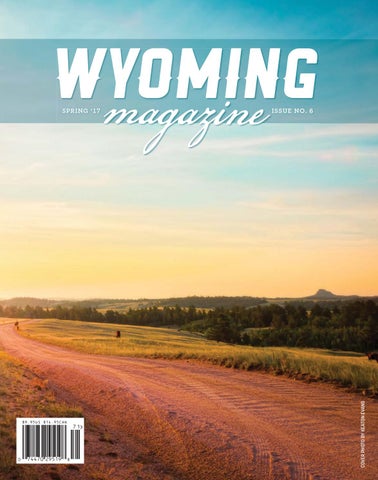
COVER PHOTO BY KEATON EVANS
SPRING ‘17 ISSUE NO. 6
THIS ISN’T A “SILK SCREEN” SHOP This is screen printing, and it is an art form. It is a delicate science marrying varied ink applications, precise heat modifications, chemical garment make-ups, and an exquisite dance that demands screen set-ups measured by the nanometer. We take this stuff seriously, and to be quite frank,
WE ARE REALLY DAMN GOOD AT IT.
SIGN. SCREEN. STITCH.
SPRING 2017 ISSUE NO. 6
Meanwhile, in Wyoming...
W
e sometimes ask ourselves here at Wyoming Magazine, “Why in a 21st century, internet-loving, social media-addicted society, hungry for nothing more than clickbait headlines and shallow content made up of false glimmers of inspiration and empty promises of prosperity and free tacos, would we continue to publish a literal print publication in the least populated state in the union?”
Published April 1, 2017 Wyoming Magazine is a publication aimed at showcasing the best (and most obscure) people, places, and events in this great square state we call home. Our team is full of people who are passionate about the lifestyle and personality of Wyoming, and with this magazine we do our best to share
Well… in short, because we do things a little differently in Wyoming. Here in the equality state, we've embraced modernity, but not at the expense of tradition. The culture of our home is unique in its embrace of the new world, and its reverence for the old. We have one of the highest museum-to-population ratios in the union, and we also have a few Tesla charging stations—talk about a dichotomy. We tackle pertinent issues, like how our homestead gives us a leg-up in the case of an apocalypse, how to properly prepare (for) a steak, and make a solid attempt to capture the spirit of Wyoming that drives local artisans and businessmen alike.
this with as many others as we can. We have multiple ways for you, our faithful readers, to get involved with what's going on here at Wyoming Magazine. Have an idea for content? Interested in advertising with us? Give us a shout at: hello@wyomingmagazine.com
Haven't subscribed yet? Visit us at www.wyomingmagazine.com or www.adventurewyoming.com.
All of this is to say that we still take the time to enjoy some of the finer things in life—though we're not blind to the changing times, nor do they do much to overwhelm us. Of course, none of this is meant to disparage other forms of media. We ourselves have a presence online, one that we're proud of (follow us on Instagram, Facebook—we're a social bunch), but there's a palpable difference in flipping through the pages of a solid, physical magazine as opposed to clicking through one online. That said, our constituency is one to which we're loyal and eternally grateful. Here's looking at you, kid.
The Mag
Jonathan Barragan, Writer/Editor Kristen Masters, Graphic Designer
CONTRIBUTORS Brenna Burgos, Writer Will Craft, Writer Liam Jones, Writer Tyler Julian, Writer Emily Maassen, Writer Chase McFadden, Writer Brady Mclean, Writer Molly Michieli, Writer PJ Treide, Writer Keaton Evans, Photography All uncredited photos have been purchased for use through select stock photography resources.
6
HAPPY 100TH BIRTHDAY! Wyoming's state flag was adopted on January 31st, 1917. Learn more about the flag's origin and its symbolic representation of our state.
10 A TRIBUTE TO MR. MARS
Forrest Mars, Jr. was an outstanding asset to the Sheridan area community and beyond—leaving behind a legacy that will impact generations to come.
16 (YOU BETTER) GET TO KNOW IAN MUNSICK A rising star quickly gaining recognition—Wyoming
born and raised. Ian Munsick could be a household name one day—learn more about his journey here.
4
WYOMING MAGAZINE - SPRING 2017
20 HUMBLE BEGINNINGS
Potato Ole®, anyone? What we know today as the ®
46 SURVIVING THE APOCALYPSE
Let's just say living in Wyoming gives us a leg-up in
fast food mogul Taco John's began as a small taco
certain end-of-the-world situations. Walking Dead,
stand right here in the Cowboy State.
anyone?
26 INTERSECTIONS
Sheridan area philanthropist and artist Neltje has
50 BUFFALO'S LONGMIRE DAYS 2017
Summer is just around the corner (or is it?) and the
joined forces with world-renowned photographer
6th Annual Longmire Days is bound to be one for the
Robin Layton to document her life's story.
record books as the popular show comes to an end.
38 WHERE IT ALL BEGAN
Wyoming Magazine's Molly Michieli sits down with
62 WYOMING WOMEN IN FLY FISHING
Women anglers aren't a new concept—and a group
the talented, sought-after Gabe Leonard—whose oil
of Wyoming ladies are committed to promoting a
paintings hang in art collections near and far.
lifestyle full of good fishing, strong women, and great friends.
PHOTO BY KEATON EVANS
WYOMING MAGAZINE - SPRING 2017
5
on january 31, 1917, the Wyoming state flag was officially adopted. The state of Wyoming was admitted as the 44th state in 1890 and went without a flag for almost thirty years. It was actually one of the last states to claim an official state flag, but it’s no less important. State flags are meant to show the country and the rest of the world our values and identity. Each state has their own history and collective identity, and Wyoming’s flag is no different. Our flag represents the state’s pride, its testimony, love of the land, and dedication to wildlife and its people. Written by Emily Maassen
W
hether it’s on a bumper sticker,
the front of a t−shirt, or waving from a banner way up above, we all know and love the Western− facing bison on the blue field of our state flag. To non−locals, the Wyoming flag may seem simplistic. But for those who live in Wyoming, it is so much more. Our state flag is a symbol of our pride and a quintessential piece of Wyoming’s history. And, if you didn’t already know, this year marks the 100th year
anniversary of the adoption of Wyoming’s state flag—giving us a grand reason to celebrate our heritage. 6
WYOMING MAGAZINE - SPRING 2017
take a look at wyoming’s flag. On the surface, you’ll see a white bison silhouette branded with the Wyoming state seal. Take a deeper look and you’ll see that every single part of Wyoming’s state flag has a meaning and a purpose. For instance, the red border that surrounds the flag represents the original Native Americans who inhabited the land and the blood of the pioneers who fought for their lives to reclaim the soil back in 1869. The white border symbolizes purity and uprightness of the state of Wyoming; the blue background represents our beautiful blue skies and our cascading mountains. Maybe it is simply a patriotic coincidence, but the colors of our state flag mirror that of our nation’s flag.
the meaning of wyoming’s state flag doesn’t stop there. You can’t miss the huge white silhouette of a bison smack dab in the middle of the flag. Yes, we all know and love our great bison, but so does the rest of the country. In fact, in May of last year, the American buffalo (rightly, bison) was named the official national mammal of the United States. millions of bison once roamed North America and were called the monarch of the plains, playing an essential role in shaping the ecology of the Great Plains. As more people inhabited the area, bison were hunted for sustenance, their prized fur, and for game. What was once millions of bison roaming the lands, alarmingly decreased to approximately 1,000 wild bison by the year 1900. Fortunately, in the early 1900s, conservationists and ranchers began to see the importance of the bison to the region’s ecosystem. It took a lot of hard work and grit to protect them but was supported by the installment of protected federal lands and providing bison the breathing room to increase in numbers. The American bison was luckily brought back from the brink of extinction. the state seal is also present on the state flag and holds a lot of meaning for the people of Wyoming. The woman on the seal holds a staff with a banner marked with the words “Equal Rights” to represent the equal political status of men and women. From that point on, we are also known as The Equality State. Wyoming has valued equality for a long time and was the first state to grant women the right to vote in 1869. The state seal also has two men representing cattle ranchers and miners. They stand behind two pillars draped with the words “Livestock,” “Mines,” “Grains,” and “Oil,” symbolizing Wyoming’s natural wealth in resources. The two burning lamps are a symbol for the Light of Knowledge. Wyoming’s state seal is located on the heart of our flag, symbolizing our honor, heritage, and regional pride. So, who actually designed the flag? back in 1916, the professor of Political Economy at the University of Wyoming and state advisor for the Daughters of the American Revolution, Dr. Grace Raymond Hebard,
suggested a flag be designed for the state. Of course, everyone thought this was a great idea. An even better idea was to hold an open competition for the design with a $20 prize, and that’s exactly what the Daughters of the American Revolution did. the winning design was to be chosen at the Daughters of the American Revolution’s state conference in Sheridan in the summer of 1916. They announced and advertised their open competition throughout the state of Wyoming. Wilbur Parke Keays of Buffalo noticed the advertisements and suggested to his daughter, Verna, that she submit a design. It was $20 after all! Verna had just graduated from the Art Institute of Chicago, studying Design and Decoration, so she was a shoo−in. stereotypical of a procrastinating teenager, Verna blew off the project because she had a friend visiting from out of town. However, Verna claimed that she was in a deep sleep and suddenly woke up in the middle of the night with inspiration for the perfect design of the state flag. She went to work and recreated the design that inspired her and submitted it as one of 37 entries. Lo and behold, Verna’s design was awarded the winner for her dream−inspired work. She was then invited to the conference to speak on her design and to accept the $20, and the rest, as they say, is history. the design, as well as a bill, was presented to the Fourteenth State Legislature and officially adopted and passed on January 31, 1917. Needless to say, everyone in the state of Wyoming was proud of their new state flag. Governor Robert D. Carey signed the bill into a law, and the State Legislature even voted to have folders printed with the design to be distributed to every school child in the state. for the last 100 years, people of Wyoming still uphold the virtues of our state flag: to value equality, our wildlife, the mining and oil industries, and our history. As this year marks the 100th birthday of Wyoming’s state flag, 2017 is sure to be a year filled with pride and honor for all things Wyoming. So let’s celebrate our great state and its history by flying our flag sky high for all to see, and by continuing to make time to do some of our favorite things in Wyoming, like hunting, hiking, fishing, star gazing, cattle ranching, rodeos, and so much more. Say it with me, “We live in Wyoming—and we’re damned proud of it!”
WYOMING MAGAZINE - SPRING 2017
7
www.adventurewyoming.com
www.wyomingmagazine.com GET YOUR SUBSCRIPTION TODAY
Put spring cleaning on pause.
PHOTO COURTESY OF MARS, INC. 10
WYOMING MAGAZINE - SPRING 2017
A
T R I B U T E
T O
many of us can follow the linking thread throughout our family lineage to discover our kinfolk’s legacy. Some families have a humble and noble pursuit of passing down trade professions, like being a generational shoe cobbler; others, may look to the seas and view their family’s legacy as seafarers before them. For Forrest Mars, Jr., he looked to the Milky Way to guide him, though, not by looking to the stars—but in the form of chocolate-y malted delight. I’m talking about the Milky Way candy bar, of course. Written by Jonathan Barragan
mr. mars had the confectionary history to trace his roots of that founded by his grandfather Franklin Clarence Mars who had, admittedly, limited success in forming Mars, Incorporated out of a small kitchen in Tacoma, Seattle in the 1920’s, who then passed the reins on to his son, Forrest Mars, Sr., where the family business was introduced to the global markets, then the keys were passed to Forrest Mars, Jr., whom -- along with his sister, Jacqueline Mars -- have been credited with much of what we know Mars, Inc. to be today, a behemoth, multi-faceted company bringing in $35 billion in annual sales. How’s that for a treat?
life is a fickle thing, but legacy is forever. Forrest Mars, Jr. was the 25th richest man in the world, but despite that lofty ranking -- he did well to fit right in with the western charm and lifestyle only a special place like Wyoming can offer after his move to Sheridan. His personal legacy permeated throughout the places he called home, much like it did from his homestead here in Sheridan. Contrary to what folk would assume of him outside of Wyoming, even to some just outside of Sheridan, most fancy themselves to think he lived way up on the mountainside in a secluded candy palace all to himself;
WYOMING MAGAZINE - SPRING 2017
11
however, this couldn’t be further from the truth for Mr. Mars. Now whether that was because of his upbringing or Wyoming having an influence on him or simply both, is beside the fact that he lived here by choice. He was someone of compassion and kindness, someone well at home in the thriving Wyoming culture we all know and love. to the uninformed, Mr. Mars moved to the beloved town of Sheridan, Wyoming in 1999, the same year his father, Forrest Mars, Sr., had passed away. Mr. Mars was without a doubt a business magnate, but for reasons almost completely unrelated to the chocolate empire at Mars, Inc., his presence as a bone fide local in Wyoming was something to behold. He frequented the local shops. He dined at the local restaurants in town. He became another friendly and welcoming face to the local community of Sheridan. So much so, you would be hard-pressed to walk around these parts to find someone who isn’t familiar with the local impact and fond memories formed as a result of the Mars’ family living here in Wyoming. From owning and living on their ranch property to donating financial gifts to build and expand community centers and even hosting friends for a dinner, their giving hands were farreaching in a place he loved to call home in his later years. bob berger, a good friend to Mr. Mars—or as he was affectionately known, Forrest—said, “Forrest was a close friend, and had been for years.” Spending time here in Wyoming and Montana, Mr. Berger would find himself traveling with his friend Forrest. “He was a delight to know and be with, and to share adventures.” Berger echoed the sentiments about Mr. Mars and his relationship with Wyoming, “Forrest, really liked Wyoming, really liked the people here. He made many friends.
He fit into the local society.” It didn’t matter much what your background was, “He easily fit in with others even those of differing circumstances.” when i asked berger about what he knew of Forrest’s usually quiet gifts to Wyoming, he was quick to list a range of his local endeavors, “He supported the Sheridan WYO Rodeo, the Snicker’s Soccer Cup tournament hosting teams from all over Wyoming, he also contributed to many community building projects, such as the major expansion to the WYO Theatre, an expansion to the local senior center, an aquatic center for the YMCA, and the M&M’s Center with a magnificent indoor ice skating ring.” And, soon to open, the Mars Agricultural Center at Sheridan College. Continuing on, one of the most notable of Forrest’s contributions was that to the Brinton Museum in Big Horn, “an old wood-framed ranch house with a $20 million dollar addition,” as Mr. Berger put it. “It’s an amazing display of Western history, artwork, and artifacts that can stand up to any of the nation’s greatest museums.” Mr. Mars always had a special place in his heart for the preservation of what he felt was worth sharing with others, such as museums, educational programs, preservation of wildlife, and much more.
BELOW: The legacy of Mars' generous local philanthropy will be seen for generations to come. His contributions have included expansions to performing arts centers, senior living facilities, and most recently an indoor ice skating rink. June 2015 saw the grand opening of the "Forrest E. Mars Building" at the Brinton Museum—home to an extensive Western and American Indian Art collection. PHOTO BY Tony Hochstetler, Courtesy of The Brinton Museum
12
WYOMING MAGAZINE - SPRING 2017
mr. mars strongly believed in genuine relationships and their governing principles. It is simply the type of person he was. Even after his passing, folks around Wyoming continue to see the fruit of Mr. Mars’ philanthropy. The man himself is still receiving awards, like the most recent Governor’s Arts Award bestowed upon him by the Wyoming Arts Council. Also, Forrest and his surviving wife Jacomien Mars are the winners of the Senior Center’s Keystone Award that will be presented at a ceremony in April. anyone you speak with here in Sheridan can more than likely provide you a firsthand account as to why and how Mr. Mars was one of our own in every way. He was a gracious man who was as selfless as they come. Something we locals pride ourselves in. Welcoming all with open arms and treating one another with the utmost respect, always with a friendly smile and nod, and always offering a helping hand. so, the next time you indulge in a piece of the “Melts in your mouth, not in your hand,” M&M’s, or the “You’re not you when you’re hungry,” Snickers Bars—chocolate produced by Mars—perhaps say a little prayer and a thank you to Mr. Mars, because he has left behind a little something we can all continue to enjoy. In Wyoming, we all shared a moment of silence as Mr. Mars recently passed. But rather than focus on where he is now, let us celebrate him and take the baton to treating others as they ought to be treated and always lending a helping hand should the opportunity present itself.
ABOVE: Well-known portrait artist and friend of Mr. Mars, Everett Raymond Kinstler, began this portrait of Forrest Mars, Jr. during a demonstration at the Brinton Museum in May of 2016, later completing it within his personal studio. ARTWORK BY Everett Raymond Kinstler, Courtesy of The Brinton Museum
You, Mr. Mars, were truly an exemplary soul and one we were proud to call our own. Thank you.
WYOMING MAGAZINE - SPRING 2017
13
Need a good read for the gym? www.wyomingmagazine.com GET YOUR SUBSCRIPTION TODAY
1/4 inch Margin
DOCUMENT SETUP 83/8X107/8 with a 1/4in. margin
1/4 inch Bleed 1/4 inch Margin
GREY SHADED AREA = LIVE IMAGE AREA All text and images that do not trim must be contained within the grey area
ADVERTISEMENT (M&M's?) THE BLUE GUIDES=THE TRIM The final trim is 83/8x107/8
THE MAGENTA SHADED AREA = BLEED All images and background color that bleeds must be extended 1/4in. beyond margin to reach red dotted lines
WWW.SHERIDANBRAND.COM 1/4 inch Margin
Written by Will Craft the phrase “i guess i still could” seemed to be the mantra of Sheridan County native Ian Munsick. While he only said this once during our chat—telling me a story about how he narrowly avoided a lifetime of wearing eye-patches— Ian yearns for the unknown. He doesn’t look just to new places to go, but also to new people, new tastes, sounds, words, instruments, and stories—and he’s well on his way.
best pursued through amiable collaboration, Ian originally treated it as a fierce competition. His two older brothers, Tris and Sam, had a head start on Ian seeing as, well, they’re older than he is. From the second his fingers first touched the keys, Munsick was “chomping at the bit to be a better player and lyricist,” and I’d say their brotherly competition has paid off handsomely.
at 23, ian is the youngest of three brothers raised in a ranching family in Big Horn and Tongue River, Wyoming. Driven by admiration for his father and siblings, Ian first tickled the ivory keys at age four, marking the beginning of a lifelong passion. Though he recognizes now that music is
i asked ian, the multi-instrumentalist – a most dreaded question: What is your favorite instrument to play? His initial response: “Jeez man that’s insane!” I didn’t have any expectations that he could legitimately answer the question, but damn, did he show me. Munsick didn’t lay out one favorite instrument, but he did lay out his favorites for different purposes. He said that his favorite instrument to write songs on is the guitar, his favorite to groove on is the
16
WYOMING MAGAZINE - SPRING 2017
bass, his favorite to write melodies on is the piano, and he’s fascinated with the mandolin. Eight strings and they’re all so close together. Well, if anyone could manage it, Ian is the man for the job. ian didn’t waste much time before steppin’ up on stage with his father, Dave “Bingo” Munsick, and brothers Tris and Sam. Ian was on stage by age 10, singing and strumming along with the family band. “Music was and still is the life of our household. I was lucky enough to be surrounded by it during my childhood.” With a solid musical foundation and an insatiable thirst for music, Ian left Wyoming to attend high school in Colorado Springs before returning to the 307 for a year at Sheridan College. Though he did and still does love Wyoming for all its natural beauty, Munsick sought an environment where he could surround himself with abundant music career opportunities and gain invaluable experience, so he left town once again, this time for Nashville, Tennessee. considered by many to be one of the nation’s hubs for all things music, Ian felt that his heart belonged in Nashville, specifically at Belmont University. Pursuing degrees in songwriting and music business, Munsick spent his time making connections, writing tunes, and having a damn good time getting to know himself as a musician. Aside from starting work on his own solo projects, Ian spent time with a number of artists as a bassist and background singer. Because of his work with names like Carlton Anderson, Riley Bria, and Chris Cavanaugh, Ian learned “how to be the ‘glue’ for the music and give the song what it needed rather than what I wanted the song to sound like,” and he considers these experiences to be helpful in providing him perspective into all aspects of a band.
into high gear being ensconced in the music heavy culture there. Compared to other art forms, Ian thinks music should be more of a conversation. With all of its layers, he sees writing and playing tunes as an opportunity to reach an audience not only through lyrics but also through chord structures, melodies, and rhythms. Ideally, Munsick wants to be able to create what he calls the “perfect product,” which consists of a message, a special energy, and a lasting impression. he’s not new to the songwriting game, having released a solo EP as well as two albums with the Munsick Boys. I asked Ian to share his methodology to how he writes songs. He told me that he typically starts with a melody or some chords unless he finds some lyrics first. Once he has his melody, he freestyles it, saying, “You already know what you want to say.” He begins with rattling off words, just singing about whatever’s on his mind. He explained that if you trust yourself and “get out of the song’s way,” the organic process will always yield the best results.
BELOW: Music has always been at the heart of the Munsick family. Here, Ian (kneeling) is pictured (from left to right) with his father, Dave, and brothers Sam and Tris. Together, the foursome perform as "The Munsick Boys".
during ian’s senior year at Belmont, he went on a cruise. Not only did he go on a cruise, but he played on a cruise. He was a “hired gun” for one of the bands headlining the Caribbean adventure, one of the other groups playing on the ship being Blackjack Billy, a country group labeling themselves as “redneck rock.” Following one of Ian’s performances, Noll Billings, the front man of Blackjack Billy, told Munsick that he liked his “swagger.” A few weeks later, Munsick was recruited as bassist and singer for the group joining Billings’ plan to “take over the world.” Touring across the globe in 2016, Ian wrote songs for the group and himself, took up a few pages in his passport, and watched all six seasons of Game of Thrones. Ian’s life has been inseparable from that of music, and his move to Nashville has only kicked his musical talents and interests WYOMING MAGAZINE - SPRING 2017
17
understandably, most of ian’s songs have some ties to home. “I couldn’t be any prouder to hail from the great state of Wyoming. There isn’t another place on God’s green [earth] that has people so kind, hard-working, humble, supportive, and down to have a good time.” Munsick says he draws on the positivity and organic-ness of our state when he writes, sings, and when he does pretty much anything else. Of all the places he’s visited, every stage he’s played on, every road he’s driven, Ian assured me that Wyoming is the best of them all. “I’ve left home so many damn times that you can take my word for it.” When he wrote “Horses are Faster,” Ian was basking in our 307 splendor, right at the foot of the Bighorns. “It was about 6 o’clock and the sun was just starting to kiss the summits when our four horses took off across the sagebrush sea. I thought ‘Yeah, right. This isn’t real.’” Though he’d grown up there, getting poked with sticks and peeing on electric fences (okay, just one electric fence— some things you only do once), Ian was still blown away by the incredible gift we’ve been privileged to know by growing up here. And he hasn’t forgotten where he’s come from and continues to live the way Wyoming raised him every day: “Thank you Wyoming, your boy is gonna make you proud.”
18
WYOMING MAGAZINE - SPRING 2017
BELOW: Munsick is moved to create the "perfect product" when it comes to music—consisting of a message, a special energy, and a lasting impression on those who hear it.
RIGHT: Of all the places he's visited, the stages he's played on, and the roads he's traveled, Ian remains faithful in his insistance that Wyoming is still the best of them all.
WYOMING MAGAZINE - SPRING 2017
19
20 W Y O M I N G M A G A Z I N E - S P R I N G 2 0 1 7
Written by PJ Treide
B
ack in 2007, I returned to my Wyoming roots after being away for eleven years, living in
several cities across the U.S. from the east coast to the west. Toward the end of my Cowboy State hiatus, I also met the woman who would eventually become my wife—and as luck would have it, she too was a Wyoming native looking to return to Wyoming to raise our family. we were excited to share our square−shaped state with our newborn daughter, and as my wife and I packed up the U−Haul truck, we began making a list of all of the things we were excited about for our return to Wyoming. It read like a to−do list from Sunset Magazine with trips planned to Yellowstone Park and Devil's Tower as the highlights. Scenic drives on the weekend to the local Bighorn National Forest, and visits to old friends in off−the−beaten−path small towns also made it to the top of our list. Rounding out our list was a fast−food restaurant, and maybe it didn’t deserve to be included on our scribbled agenda of all−world stops—except for the fact that we had said it in unison: “Taco John’s®!” to an outsider, the name “Taco John’s®” might scream of a shady back ally taco stand run by an aging Caucasian male, but in Wyoming, Taco John’s® has a cult−like following and a menu of items that are “nearly Mexican food” as some describe it, or as the restaurant advertises, “West−Mex.”
Replacing tortilla chips as a traditional Mexican side are the now–famous Potato Oles® or small tater tots sprinkled with an addictive Southwestern pixie dust of spices. This is just one of the signature items that has made Taco John’s® a staple of Wyoming’s culture. So how did this unorthodox Mexican restaurant get its humble beginnings in Wyoming? back in the late 1960’s, a gentleman by the name of John Turner, an Air Force serviceman from F.E. Warren Airforce Base, started a small taco stand with the simple name, The Taco House. Within a year and after some initial success, Mr. Turner sold franchising rights to two businessmen from Cheyenne and they changed the name to reflect its owner. Going for a seemingly more marketable title, James Woodson and Harold Holmes changed the name to Taco John’s®. much of the initial success was attributed to a blend of spices that John Turner and his wife ground in their basement each week. Customers raved about the flavor and since that time, the spices have remained and are now a trade secret of the restaurant. The success was also directly related to the Turner’s well−regarded customer service. The new taco restaurant stood out in a market of growing ideas for large portions of food that were made−to−order, fast. This became known as the fast food concept. with the initial success, Woodson and Holmes took the Turner’s recipes and drove their idea to duplicate the taco shacks in small Midwestern towns around Cheyenne. They started with locations in Torrington, Wyoming and WYOMING MAGAZINE - SPRING 2017
21
The Evolution of the
Taco John's® Logo IMAGES © TACO JOHN'S® INTERNATIONAL
Scottsbluff, Nebraska. They also had some interest from franchisees in Rapid City, South Dakota and Des Moines, Iowa who had tried the food while in Cheyenne. Their initial idea to target small towns was a great one as their fast food concept was catching on while many of the early fast food chains were targeting larger, urban areas. originally, the Taco House’s logo included a devilish character. After beginning their efforts to market the franchising concept, Woodson and Turner created a logo that included a stereotypical cartoon Mexican character complete with sombrero and a side− kick burro named Pepe. It is a logo I remember adorning some collector’s glasses and the packaging we received from our Gillette, Wyoming restaurant in the 1970’s. that logo was replaced with a more formal Mexican character and the font was changed to a more Southwestern feel in the mid−1990’s. Through those changes, the restaurant concept and the franchise base continued to expand. By the end of the 1980’s, Taco John’s® was growing quickly and had several hundred locations spanning twelve Midwestern states.
ABOVE: An early "Taco John's" destination. Much of the initial success of the restaurant has been attributed to the spices that founder John Turner and his wife ground in their basement each week. Today, those spices remain the same and are now a trade secret of the restaurant. PHOTO: TACO JOHN'S® INTERNATIONAL
1969 to 1990s By the end of the 1990’s, the chain had grown into larger metropolitan areas and expanded to over 450 stores in 25 states. in the late 1970’s and early 80’s, I remember our small Gillette location and the grainy pictures that depicted the menu items, along with the movable red number that depicted the pricing. Just like a small version of a gas station sign showing the current price of gas. I remember the smell of the place and the taste, just as it tastes today. Not much has changed other than the corporate look and well−done interiors, packaging, and marketing that you would expect of a major fast− food chain. Sadly, what is missing are some of the original menu items that were favorites in our household. Do you remember the Apple Grande®? It was a wild dessert mix of fried tortilla, topped with ground apple pie filling
22 W Y O M I N G M A G A Z I N E - S P R I N G 2 0 1 7
1990s to 2004
2004 to 2015
2015 to PRESENT
and topped with cheddar cheese and a mix of Cinnamon and Mexican Spices. growing up there were two things that created excitement for me about Taco John’s®. One was Taco Tuesday® and the other was getting free tacos from the local restaurant for any A’s I had on my report card. Later, in college, we weren’t able to get those free tacos for A’s, but my A’s were also much less typical. However, my roommates and I did partake often in one of their first meal deals—the Six−Pack and a Pound®. For $5, a couple of poor college kids could share six tacos and a pound of the addictive Potato Ole’s®. Their portions never disappointed. as the company has grown, so has their competition. As the second largest Mexican fast− food franchise behind Taco Bell, the restaurant made an early decision to not try and compete
with Taco Bell on price. Instead, they stayed true to their original core menu and offered the same high quality— with larger portions—at a premium price. That decision has served them well, and their loyal audience and growing presence around the country has welcomed new customers to buy into their model and to their consistent menu and service. with this competition, Taco John’s® and its management are staying true to their history and their growth model and expanding their presence to places that have yet to experience the West−Mex concept. The restaurant is driving growth in and around Denver, one of America’s fastest growing cities, and it is driving growth east of the Mississippi where Taco Bell dominates. There is plenty of room for continued growth for this Wyoming−based and founded business, just like there is always room in my belly for one more Potato Ole®.
WYOMING MAGAZINE - SPRING 2017
23
www.wyomingmagazine.com GET YOUR SUBSCRIPTION TODAY
Johnson county, WY
Written by Chase McFadden
PHOTOS COURTESY OF ROBIN LAYTON
26 W Y O M I N G M A G A Z I N E - S P R I N G 2 0 1 7
S
o life imitates art? Yes, there’s probably some truth to that. After all, it’s the intersections in each— and of each—where things get interesting.
for the painter, the convergence of two individual strokes on an otherwise blank canvas represents a sentient experience—one the artist strives to capture and share. For the photographer, the chance encounter between a horizontal ray of light emanating from a background and the vertical profile of a subject in the foreground may be the point of intersection, an occurrence revealing its own truth in a composition. And what if the paths of that painter and that photographer intersect? Well, that’s where life truly imitates art, and it’s where things get interesting.
neltje isn’t one for coloring inside the lines, figuratively or literally. In third grade, she received failing marks in art because of her refusal to do so— just a glimpse of the defiant spirit that has guided her throughout her 82 years. the mononymous sheridan−area artist hitched her wagon to that “I’ll−do−it−my−way” attitude in 1966 when she left the comforts and security of high society on the East Coast (she of the Doubleday Publishing Company family) and travelled west to Wyoming with her two children, where she cattle ranched, purchased and refurbished the historic Sheridan Inn—that of one William F. “Buffalo Bill” Cody— and fell in love with a land that to this day ignites her soul. “It comforts me, it excites me, it enlightens me, it makes me breathe deeply,” she said of the hold Wyoming has on her. “The scope of the landscape never ceases to awe me; it’s a landscape of wonder.” neltje began dabbling in art at age 30—first charcoal sketches of her children, then sculpture, collages, and painting. Along the way, her passion became more than a hobby; it became a calling she couldn’t ignore. OPPOSITE: Neltje took on a characteristically strong "I'll do it my way" attitude early on in life—and at age 82, she still finds new ways to challenge herself, never missing a beat in her constant support of the arts, the community, and the Wyoming landscape she's come to love.
By 1985 she was working as a full−time artist, and over the past 30 years, she has explored her emotions and creativity as an abstract expressionist. Her pieces are noted for their bold colors, depth, and innovative incorporation of papers and texts. Neltje’s paintings grace museums—including the Smithsonian Institution, Wyoming State Museum, and Yellowstone Art Museum—as well as numerous galleries and countless private collections. she is also an incredibly generous benefactor of the arts. Her philanthropic pursuits are equal of her artistic abilities. In 2001 she founded the Jentel Artist Residency Program to support creatives with multi−month residencies at her ranch in the Lower Piney Creek Valley, a property which will be gifted after her death—along with artworks and assorted financial holdings—to the University of Wyoming, the largest bequeathed estate in the history of the university. The UW Neltje Center for the Visual and Literary Arts will be an outreach center for the university’s MFA Creative Writing Program, the Department of Art, and the Art Museum. Her legacy cemented as a painter and a patron, it’d seem reasonable if the octogenarian slowed down a bit. But be certain: Neltje isn’t content with comfortable and easy. She is in constant pursuit of her next challenge. penning an autobiography? Now there’s a daring endeavor, so that’s just what she did. The details of a life incredibly−lived are exposed in Neltje’s recently−published memoir, North of Crazy. In telling her story via the written word, the painter−turned−author ultimately found common ground between what she initially viewed as two entirely unlike processes. “I’d thought of them as simply different because you have much more of an immediate possibility of understanding and evaluation and gratification in the visual arts,” Neltje explained of the similarities between painting and authoring. “Writing a book takes three−and−a−half years,” she laughed. “They each tell stories, but they tell them in very, very different ways,” she said of the two disciplines. “I’d gone to some writing workshops because I always wanted a way to express my story and looking back −− well, there’s the answer: even in looking back, it’s on a moment−to−moment basis, and painting is a moment−to−moment recording of how you feel.” WYOMING MAGAZINE - SPRING 2017
27
the past several months have been a whirlwind of touring, signing, and selling, during which time Neltje happened upon an idea: commissioning an artist to create a short film that would visually promote her story and her book. That filmmaker would end up being Robin Layton.
talk about an intersection. “I was 15−years−old, and I was sitting on my mom and dad’s couch in Richmond, Virginia. My mom was watching TV and I was looking through a National Geographic magazine. At the time I had a 110 camera and I would take pictures of rocks and ducks and flowers, and so I was interested in photography but didn’t know much about it,” Layton remarked. she continued, “I was flipping through the magazine and I said out loud, ‘Wow, I’d love to be able to take pictures like these,’ and my mom said, ‘You know, you can do that for a living if you want,’ and I took my hand, and I slapped it on the magazine on my knee, and I said, ‘This is what I’m going to do.’” “ironically—this is my life in a nutshell—a week later, I’m at my guitar lesson and the owner is there, who was never there. He was stringing a guitar, and he said, ‘Robin, your teacher’s running a little late, he’ll be with you in a second.’ Then out of the blue, he asks, ‘What do you want to be when you grow up?’ and I say a National Geographic photographer.” “He goes, ‘You’re kidding? Did you know that one of my student’s dad is a National Geographic photographer?’ And right then—I’m not kidding—right then the shop door opened (one with 28 W Y O M I N G M A G A Z I N E - S P R I N G 2 0 1 7
RIGHT: Robin Layton, a Pulitzer-nominated photojournalist and world-renowned freelance photographer, vowed to take her career in a new direction after the passing of her incredibly influential mother:"...I'm not leaving this planet without finding the artist in me."
bells on it) and he says, ‘In fact, here comes his wife right now.’ That’s my whole life. I’m very blessed.” layton, after fortuitously meeting and then mentoring under that National Geographic photographer, went on to become a Pulitzer−nominated photojournalist, world−renowned freelance photographer, and highly sought after artist and filmmaker. that “whole life” she referenced? It’s included some pretty remarkable moments that she never could have fathomed while she was sitting on that couch in Richmond, Virginia. she has published three books, taken celebrity portraits—including those of Jennifer Aniston, Felicity Huffman, and President Barack Obama—shot weddings for the stars, and created nine films for the Oprah Winfrey Network (Oprah has 24 of Layton’s art pieces gracing the walls of her Maui home). her mother, who planted that “of course you can do that!” seed at age 15, was also Layton’s inspiration for exploring her talents as a fine artist, which she has pursued full−time over the last nine years. “when my mom passed away, and as I was holding on to her in Powell, Wyoming — she was the most talented artist I’d ever known — I realized at that moment that she never did anything professional with her art, and I thought,
‘Gosh, I’m not leaving this planet without finding the artist inside of me,’” she explained of her decision to steer her career in a different direction, a new heading which eventually led Layton to Neltje and Sheridan, Wyoming.
this particular intersection is comprised of two narrow dirt roads at the base of the Bighorns, but there’s no need to slow down—traffic isn’t just light out here, it’s nonexistent. except for one massive diesel pickup truck, inside of which another intersection is occurring—this between a pair of artists. Life and all its wonderful undulations have brought together two beautifully strong−willed, talented souls from different worlds to share in a vision together. the project−at−hand will be a visual representation of
Neltje’s life told through the passing of the four seasons. Layton pitched the concept prior to seeing the series of four, 10’x30’ season−inspired paintings hung in the artist’s home during her recent visit to capture images of her subject and video the Wyoming landscape—with the assistance of drone pilot Josh Law of Flood Marketing—for the winter portion of the film. “there was a magic synergy when we met. It was a wonderful connection between us, a wonderful energy. We just felt that we were meant to work together,” Layton explained of the quick bond between her and Neltje. “She’s kind and generous. She’s a special soul, just an extremely talented artist. It was easy to work with her.”
WYOMING MAGAZINE - SPRING 2017
29
layton will return to Wyoming in the spring, summer, and fall of this year to continue her work with the painter and author, who looks forward to continued collaboration with the filmmaker.
SPREAD: “...It was a wonderful connection between us, a wonderful energy. We just felt that we were meant to work together... [s]he’s kind and generous. She’s a special soul, just an extremely talented artist. It was easy to work with her.”
“There’s a comfort in being able to talk the same language,” Neltje said of the simple bond between her and Layton. “It’s like any artist on the whole. You just feel at home and you can say, ‘Oh, my God, look at that,’ because you’re both visual. It’s a matter of belonging you come away with, a sense of community... “It’s a camaraderie of creativity; we all pull from the same stream.”
30 W Y O M I N G M A G A Z I N E - S P R I N G 2 0 1 7
– Robin Layton on collaborating with Neltje.
WYOMING MAGAZINE - SPRING 2017
31
1/4 inch Margin
DOCUMENT SETUP 83/8X107/8 with a 1/4in. margin
THE BLUE GUIDES=THE TRIM The final trim is 83/8x107/8
THE MAGENTA SHADED AREA = BLEED All images and background color that bleeds must be extended 1/4in. beyond margin to reach red dotted lines
www.wyomingmagazine.com GET YOUR SUBSCRIPTION TODAY
1/4 inch Margin
1/4 inch Margin
1/4 inch Margin
GREY SHADED AREA = LIVE IMAGE AREA All text and images that do not trim must be contained within the grey area
Written by Will Craft
there are many tasks that can be successfully completed in a myriad of ways. For example, one can ride in the bed of a pickup truck sitting, standing, planking, performing jumping jacks, or pretending to be a loose potato rolling hither and thither and still arrive at their destination, albeit a little bit bruised. There are also many tasks that can only yield the ideal result by following a specific plan. This is one of those plans. The task at hand: preparing to cook the perfect steak. Now, don’t misunderstand. There are plenty of ways to grill up tasty meat. You can butter it; you can choose not to butter it. You can rub it with some tasty meat rub or you can go sans rub. It’s all up to you. The real question you have to ask yourself is: Do you want to do things your way, or do you want to do things the right way?
WYOMING MAGAZINE - SPRING 2017
33
if you’re reading this, then you’re reading
METHOD ONE
Wyoming Magazine. Step one: complete. Well done.
Get up and go outside. You’re in Wyoming. And if you’re not, you’re obviously thinking of us fondly, as you’re reading Wyoming Magazine. Stretch those legs of yours, walk around the block and get lost in thought as you look upon our majestic mountains. Or, simply walk around outside ‘til you get a little chilly, and then keep goin’ for a while. But take in all that surrounds you here in the great Equality State – the crisp, fresh air, the wildlife, your uncle Bob rocking back and forth on the porch deck tenderly caressing his shotgun affectionately named Sherry. Once you’ve filled your cup with Wyoming’s natural beauty, begin to think about how hungry you are. Now, imagine sitting at the edge of Coney Lake in the Bighorns or along the Platte, enjoying a perfectly cooked steak.
If you’re not reading this, then we’re not exactly sure how you’re reading this article. Back to the matter at hand: Wyoming Magazine. Keyword: Wyoming. The magazine part is just explanatory. You’re in Wyoming, for Pete’s sake! Cooking a steak is about more than just the meat, dammit! It’s about the connection to the earth, taking into consideration the animal you’re about to feast upon, the people you’ll share a table with to dine, and – well, it’s a little bit about the meat, too! take a minute to close your eyes – wait keep them open, but let your mind daydream with me for a moment. Picture the perfect steak cooking scenario. You’re over a flaming red-hot grill outside on a cool Wyoming evening, ready to cook a few fine, high-quality steaks freshly thawed from your freezer of choice meats and seasoned to perfection, and best of all, you’re best friends have gathered and are all having a lively chat over bevies while patiently awaiting the arrival of their perfectly cooked steaks. Now imagine a hot blast of flame lunges upward to the heavens. When the blaze subsides, you can behold the Wind Rivers’ skyline through the smoke, the stars start to twinkle to life and dance across the night’s sky. You, wearing nothing but a ragged sheepskin smock, lay the steak down on the grill bed above glowing embers. Are you salivating yet? Can you see it now? This meal is about so much more than just a taste. now back to reality. Not all can master the journey so well without proper study, so let’s lay the foundations on the perfect approach to cooking the perfect steak. To start this process right, you’ll need to be in the right frame of mind. We’ve tried a number of methods and discovered a few that are especially effective in getting you into this mindset.
34 W Y O M I N G M A G A Z I N E - S P R I N G 2 0 1 7
METHOD T WO If the first method doesn’t work for you because you live in the middle of Casper, you don’t even live in Wyoming, or you don’t have legs that work too good, don’t sweat it. Just flip through the rest of this sweet, sweet publication you’re reading. Read about the people, places, and things that make this state the best there is. If that doesn’t put you in the mood for adventure and some perfectly cooked steak, I’m honestly not sure there’s any hope left for you – but maybe "Method Three" can help you out. METHOD THREE This one is for the brave souls out there. To the wanderers, adventurers, and those of you who are really bored – go out, hop in your ride, start ‘er up and drive. Drive until you run out of gas in the absolute middle of frickin’ nowhere. Or you could stop somewhere where you could sit for hours and just stare into the endless vast beauty of our Wyoming skies. Not as much of an adventure, but hey, you’re simply not much a thrill seeker. That’s okay. Another idea: Are you near some water? If so, strip down and jump in. Catch a fish with your
bare teeth for an added sense of primal adrenaline. Just please don’t get Giardia, which is better known as “Beaver Fever,” which is similar to, but not the same as “Bieber Fever.” It’s not fun. Well, Bieber Fever can be a good time, if you’re in the mood. Giardia – not so much, even if you are in the mood. Weirdo.
at this point, all you really need to do is get you a fine lookin’ steed and mount up. Swing your leg over that saddle and ride, steak in one hand, reins in the other. Ride until the sun kisses the jagged horizon, get off, stretch your legs, start up a fire, cook your steak, and enjoy.
now that you’re ready to do this right, let’s get started. You’ll need a few things in order to prepare your meat, the first of which being a reliable heat source that uses bone fide fire to cook. This is critical, if you don’t have one, you’re going to end up eating an unavoidably raw steak. While tartare can be quite scrumptious, eating a giant slab of uncooked meat doesn’t sound like the best idea, for taste reasons as well as for your good health. Some will say, “You can use your stove!” To that we say, you have no idea what you’re saying – shh. This is about a connection to the earth and her fruits, people! Find some fire! But, don’t cook anything that’s not supposed to be cooked. Just because we’re getting back to our roots doesn’t mean we have to forget fire safety. okay, so you’ve got some fire. Now you need some prime grade meat for optimal tenderness, juiciness, and flavor. If you can avoid it, don’t go to any chain store to buy something wrapped in plastic. Start going door to door until you find someone with multiple freezers full of different cuts wrapped in white butcher paper. According to un-validated statistics, you shouldn’t have to knock on more than four doors in either direction before you find someone who has a couple freezers full of delicious red meat. Once you find that person, invite them to accompany you on your quest. Be real, you know everyone who lives within a 5-mile radius, their siblings, and whose uncle their mom went to prom with, don’t make it awkward. of course, there is the slight possibility that you live too far away from anyone to find someone to go with you. If that’s the case, rip off your shirt, fluff up your chest hair, and fashion yourself a spear. Go wrangle up a bovine and procure your supper the old fashioned way. Best of luck, meat sojourner, best of luck.
WYOMING MAGAZINE - SPRING 2017
35
www.wyomingmagazine.com GET YOUR SUBSCRIPTION TODAY
Put spring cleaning on pause.
38 W Y O M I N G M A G A Z I N E - S P R I N G 2 0 1 7
"Double Fist" Oil on Canvas Courtesy of the Artist
G
rowing up in wyoming is unlike any place else. Here, there are boundless blue skies, heavenly−high mountains, and plenty of room for your imagination to run wild.
born in casper, wyoming, Cinematic Artist Gabe Leonard has fond memories of his Wyoming childhood and the beginning moments of when his artistic inspiration was first sparked. “I lived in Linch, a small oil camp town north of Midwest until I was eleven. We only had two channels on TV, so I spent a lot of time outside.” time spent in the great outdoors is something most all Wyoming kids can relate to. No matter which of the four seasons, there is always something to do outside. “During the summer I was busy trying to catch lizards, snakes, or
frogs, and riding my bike around with the other kids in town. During the winter, I was sledding on any hill I could find,” he said. “My mom would make me wear snow boots to school, but I hated them. When I was a block away from the house I’d kick them off and put my tennis shoes on so I could run faster‥ sorry, Mom.” as all children do, Gabe had many dreams of what he wanted to be when he grew up. “I remember wanting to be a paleontologist, so I drew pictures of dinosaurs. I also wanted to be an Airforce pilot, so I drew pictures of Jet Fighters. Drawing was something that I was good at as early as I can remember. It was something that helped me fit in with other kids at school. I always enjoyed doing it, people seemed to like what I did, so I kept doing it.”
WYOMING MAGAZINE - SPRING 2017
39
in sixth grade, Gabe and his family moved to Gillette, Wyoming. It was in Gillette where Gabe says he was “really able to develop my artistic talents in the arts programs” at school. Also, [I] was fortunate to have some of the best art instructors you are likely to find in public education.” Gabe continued, “I had Mike Plourd as a teacher at Sage Valley Jr. High, and Christopher Amend at Campbell County High School. Both very talented artists and great mentors.” With this artistic spark and his support at home, Gabe decided to pursue his passion in arts.
Gabe worked tirelessly to create a name for himself. Eventually graduating from the street festivals, Gabe entered art specific festivals and shows; this is when the art collectors began calling to ask about purchasing his art. So much so that he ended up recruiting help for his art sales and management.
halfway through his senior year of high school, Gabe’s parents were transferred to Virginia. He chose to stay in Wyoming with friends to complete his last year. Then at the age of eighteen, three days after his high school graduation, he set off for Columbus College in Ohio. His choice in school was simple, Columbus had offered him the largest scholarship and the added perk of having his parents a mere 300 miles away in Virginia. throughout college, Gabe kept working on fine tuning his skill in painting and eventually found his signature style of artistic expression. His style of painting has “developed naturally,” and in several of his pieces his unique thought process comes alive in drips and runs in the paint Gabe which G be affectionately refers to as, “organic ganic chaos.” os.” graduated from CCAD, Gabe once g uat d fro headed west ed out o wes for or Los Angeles, California, resides today. rnia, where here he still resi selling their When he saw other artists se work along the Venice Beach walk, it clicked click d for him that he could carve out a living the sunny ing ffrom m his passion. From Fr beachfront street festivals, chfront to bustling st stivals, 40 W Y O M I N G M A G A Z I N E - S P R I N G 2 0 1 7
ABOVE: From the small mining camp of Linch, Wyoming, to the bustling street festivals and oceanfront art scene of Venice Beach in Los Angeles, Gabe Leonard has become a vastly sought-after artist.
fast−forward to today, he is now a world−renowned artist. Gabe sells his paintings in the U.S. and the U.K. His distinctive themes of the American West, movie icons, musical legends, and strong characters, have caught the eye of some pretty h high profile fans. For instance, ance doess the th name me Quentin Q Tarantino o ring any bells? be
"All Alone" Oil on Canvas Courtesy of the Artist WYOMING MAGAZINE - SPRING 2017
41
when gabe received the call that Tarantino’s business associates were looking to gift the award−winning filmmaker with one of Gabe’s pieces, he was thrilled, to say the least. But what does an artist create for the one and only Quentin Tarantino? Gabe decided to take a limited−edition print on canvas of Double Fist and add “some extra hand painted smoke and blood splatters,” calling it the Rated R Version of Double Fist. This piece is one all Tarantino fans can appreciate.
"Crawling King Snake" Oil on Canvas Courtesy of the Artist
with creative inspiration coming at Gabe from all aspects of his life, he finds most of his inspiration after he begins the artistic process. He explains, “Creating a painting is often like solving a puzzle in that you’re not exactly sure what it’s supposed to look like when it’s finished.” One of the most difficult tasks as an artist, such as Gabe, is trying to decide when one of his “puzzles” is complete. Over the course of one year, Gabe can see through around 65 original works of art. Depending on size and complexity of the painting, one piece can take him anywhere from three hours to several weeks to finish.
Creating a painting is often like solving a puzzle in that you’re not exactly sure what it’s supposed to look like when it’s finished. this past february, Wyoming Art & Frame in Gillette hosted the Gabe Leonard Artist Reception, where he featured one of his latest pieces, “Persist.” He makes the pilgrimage back to Wyoming every two to three 42 W Y O M I N G M A G A Z I N E - S P R I N G 2 0 1 7
years and usually ends up spending most of his time in Gillette, though he often tries to make it out to one his other favorite Wyoming towns in the gorgeous land of Thermopolis. california is a world removed from Wyoming, but Gabe has taken up residence there finding a homestay in an artist community near Downtown L.A., and on the weekends Gabe heads to Venice Beach for some boogie boarding. He also trains in Brazilian Jiu−Jitsu in which he is a purple belt. Though now a Californian, it’s easy to see the love Gabe has for Wyoming and those unforgettable influences from his childhood, growing up in the great west. To the kids growing up in Wyoming today, Gabe’s success story is an inspiration. “I think we’re all artists when we start out, but most of us get talked out of it somewhere along the way.” luckily for gabe, and for all of us as admirers of his work, he wasn’t talked out of being an artist. To his fellow dreamers wanting to one day succeed in an arts career – Gabe’s message is to, “Start now. Keep doing it. Don’t give up. Don’t have a backup plan.” Art lovers everywhere, from Wyoming to California from Asia to the U.K. are certainly glad Gabe kicked off those snow boots and kept running to chase his dreams. at www.gabeleonard.com find locations where his work is sold, see him in action creating some of his most famous pieces, and learn more about the incredibly interesting and talented Wyoming native, Gabe Leonard.
"Arrival of the Wrecking Crew" Oil on Canvas Courtesy of the Artist
"Event Horizon" Oil on Canvas Courtesy of the Artist WYOMING MAGAZINE - SPRING 2017
43
1/4 inch Margin
DOCUMENT SETUP 83/8X107/8 with a 1/4in. margin
THE BLUE GUIDES=THE TRIM The final trim is 83/8x107/8
THE MAGENTA SHADED AREA = BLEED All images and background color that bleeds must be extended 1/4in. beyond margin to reach red dotted lines
1/4 inch Margin
1/4 inch Margin
1/4 inch Margin
GREY SHADED AREA = LIVE IMAGE AREA All text and images that do not trim must be contained within the grey area
Written by Liam Jones
46 W Y O M I N G M A G A Z I N E - S P R I N G 2 0 1 7
THERE ARE A FEW
end-of-the-world scenarios
that Hollywood seems to recreate over and over and over and... So, allow me to paint the picture in each situation, and how we would still come out on top as loyal citizens of the United State of Wyoming.
Y
ou’ve seen it before on the big screen. Decrepit, empty skyscrapers stand as monoliths to an age of man long passed. Vegetation has crept back and claimed home to the urban jungle, constricting slowly and deliberately. Local roads and highways are eternally congested with long-abandoned, rusting cars and the only pockets of humanity left are either roving bands of mutant cannibals or emaciated huntergatherers, clinging to a myopic existence in the remnants of civilization. Such a scene can only describe two things: the apocalypse or Detroit in about 5 years. however, fellow wyomingites, I am here to tell you that there is hope. You may not have realized it, but by the virtue of living in Wyoming, you’ve taken an important step in surviving these three end-of-the-world scenarios, and we’re here to tell you exactly why the Equality State will shine as a defiant beacon of humanity on even the most dreadful day of reckoning.
ZOMBIE APOCALYPSE this one is pretty easy. Say there’s a virus that turns its carriers into mindless, flesh-hungry eating machines. Now, imagine that the rest of the country has been overrun by these most unsavory characters and every yuppie from out of state is an autonomic bag of germs and hunting instincts. Do you know why Wyoming would be safe?
FAN OF THE SHOW? Here at Wyoming Magazine, a few staff members uphold a pretty loyal following when it comes to AMC's “The Walking Dead”. In the spirit of oddities and obscure facts—did you know? 1. “Among the common nicknames for the walking dead that are shared in different groups are "Walkers", "Lamebrains", "Biters", "Rotters", "Lurkers", "Roamers", [and] "Geeks". The term "Zombie" has never used throughout the course of the series.” * 2. “The leading character, Rick Grimes, is from the fictitious King County, Georgia, which is named in honor of Stephen King.” * 3. “Every potential walker must pass a short set of walker classes where they are taught to walk and move like a walker. One of the lessons they have to pass is to blink as little as possible.” *
4. "Breaking Bad" and "The Walking Dead" fans have pointed out crazy [and perhaps not so coincidental] similarities... In case you’ve missed them, the first... [is] the red Dodge Challenger Glenn rides to distract walkers is the same vehicle Breaking Bad‘s Walter White gets for his son. Later on, we see Heisenberg’s blue meth as Daryl is digging through his brother Merle’s belongings...” *
*This content was originally published in online articles featured on both www.hiddenremote.com (2014) and www.tickld.com (2016).
WYOMING MAGAZINE - SPRING 2017
47
first, since there’s so damn few of us, if you take a brisk walk in any direction, your odds of being within viewing (re: chomping) distance of a zombie are slim to none. Second, we own guns. A lot of guns. Zombies may be driven by some primal, animalistic desire for flesh and possess a devilish lack of empathy, but how well does all that stand up to a bullet barrage? Not well. Third, we’ve got a whole hell of a lot of mountains. Have you ever seen a zombie try to hike up a mountain? Neither have we, but we assume it wouldn’t be very successful. Fourth, we have incredibly harsh winters. Even now, as fully functional, non-brain-dead humans, we have a need to bundle up, build fires, seek shelter and generally suffer to survive our own winters. Now remove any practical motor skills and any sense of self-preservation and you’ve got a whole herd of Jack-Nicholsonat-the-end-of-the-Shining looking corpses.
a whole lot of flying things, and a whole lot of things in them that make enemies go bye−bye. anyway, suspend disbelief for a moment and assume that a full−scale invasion: bombs, ground troops, the whole enchilada, is in its infancy stage. If we were planning to launch an attack on the United States, a large, supposedly sparsely populated perfectly square state would be mighty suspicious. We might be thinking to ourselves, “There’s no way that’s an actual state. They must be hiding something there. Or, it’s a trap, and it’s just a gigantic pit of alligators. I’m not sending my troops to be swallowed by gators, nor will I waste any bombs on those prehistoric monsters.”
So, what’s next?
GEO - POLITICAL foreigners are scary, right? They sure are. Personally, I prefer to deny the existence of other countries and states in a true return to ‘40s−era isolationism. If you close the blinds and wrap yourself in an American flag, it’s fairly easy to pretend our 98,000−square mile slice of heaven is the only thing in the world. now, for a brief trip back to hypothetical reality, let’s assume that some dictator hates freedom, eagles, baseball and apple pie enough to declare war on the United States. Now, we’re asking you to suspend enough disbelief to assume that the dizzying weight of the United States Armed Forces wouldn’t crush any prospective ground invasion. To that point: it’s no surprise that the United States has the largest air force in the world. But, did you know that the Navy/Marines have the second largest air force? And can you guess who has the third largest air force? The US Army. That’s
48 W Y O M I N G M A G A Z I N E - S P R I N G 2 0 1 7
“There’s no way that’s an actual state. They must be hiding something there. Or, it’s a trap, and it’s just a gigantic pit of alligators. I’m not sending my troops to be swallowed by gators, nor will I waste any bombs on those prehistoric monsters.”
So, while the rest of the US is embroiled in something as unsavory as an invasion, we’d be sitting back, having a stiff drink and watching the rest of the world end around us. Now, if they were a savvy world leader, they might realize that Wyoming does indeed exist and that we have oil and nukes. Let’s say they send a few planes full of enemy soldiers looking to do general “enemy soldier” things. Well, we still have lots of guns. And horses. Angry horses. We could ride our angry horses armed to the teeth and secure our state against the coming foreign tide. Did this bit of the article get a little bit too nationalistic (or whatever the state equivalent of that is)? Feel free to cry about it to your new, foreign overlords, you traitor.
ENVIRONMENTAL the earth can be a cruel mistress. She’s also prone to violent mood swings all because of the relatively innocuous practices of humans poisoning her soil, water, and air. Personally, I’d say we’re relatively blameless, but the world seems intent to prove us wrong. If the 2004 plausible− documentary−in−retrospect The Day After Tomorrow is to be believed, an iceberg the size of Rhode Island will break off from an Antarctic ice shelf and wreck some deadly havoc. Oddly enough, this may not actually too far from the truth, as fate would have it.
stagnant water disease for dessert. Or, she might go pragmatic—yet equally deadly—and stir the pot with a bunch of tornadoes. even still, she might belch out an earthquake big enough to level Mt. Everest and the ensuing tsunamis could swallow the whole world in an instant. You might be asking how geography would play a role in such a case. Well, if the world’s ending, it would have a negligible effect on us. Despite that fact, I’d like to see a 25−foot wall of water stand up to all these guns. We’d make watery swiss cheese out of it, I reckon. Plus, if most of the world floods, we can seek shelter in the mountains, provided they haven’t crumbled. DISCLAIMER: In the case of the Yellowstone super volcano erupting, we, like everyone else, would be dead. But here’s the upside: we wouldn’t have to suffer the fallout from the poisonous ash. We’d all probably just be roasted straight out the gate. Take that, everybody else. So, there you have it. In the case of the world ending, you can sit back, enjoy your favorite beverage, and laugh at all those out−of−staters who made fun of us for Brokeback Mountain.
there’s an ever−growing rift in the Larsen C shelf, as of this writing it’s about the size of Rhode Island. Upon fully separating from the shelf, we might be living the unfortunate reality of a subpar disaster film. This isn’t the only gambit Mother Earth has in her lethal bag of tricks; however her worldly cunning knows no bounds. She might pop us off with some torrential storms, followed by a hearty entree of devastating floods and some
WYOMING MAGAZINE - SPRING 2017
49
Buffalo's
LONGMIRE DAYS 2017 Photos Provided by Craig Johnson & The Buffalo Chamber of Commerce
Written by Emily Maassen
A
s much as we love the beautiful scenery of winter in Wyoming, we can’t help but dream of warmer days to come. We’re talking about the 85−degree weather with our culture−filled music festivals, our beautiful wildlife, breath− taking hiking trails, and our picture−perfect mountain streams and pristine lakes. However, there’s one summer event that the city of Buffalo, Wyomingites, and visitors from around the world wait for all year. It’s an event that completely transforms the city of Buffalo for an entire weekend. this year marks the Sixth Annual Longmire Days, slated for Friday, July 7th through Sunday, July 9th. The Longmire Days event is the largest celebration of the Buffalo summer season lineup, and it’s a tip−of−the−hat to a local celebrity that brings thousands of people together from not only the entire state of Wyoming, but the entire world of Longmire
diehard fans. The event is only months away, and we’re itching to know what to expect in this year’s grand event. the buffalo chamber of commerce throws the weekend−long event to celebrate the best−selling author, Craig Johnson and his Walt Longmire Mystery Series, as well as the book−based Netflix show ‘Longmire.’ Johnson lives nearby the town of Buffalo, and has attended the event every year since its inception. His fifteen−novel mystery series is a modern−day Western based on life in Buffalo, Johnson County, and Wyoming. Buffalo served as a real−life ABOVE: The Netflix series "Longmire" follows sheriff Walt Longmire, played by Robert Taylor, as he solves the various crimes that take place in fictional Absaroka County, Wyoming and the town of Durant, which is inspired by the real life town of Buffalo.
50 W Y O M I N G M A G A Z I N E - S P R I N G 2 0 1 7
. hnson’s series l setting of Jo na io ct fi e of th ty t, ci tire Duran sforms the en inspiration for an tr s ay D e ir rmed, Longm To the uninfo kend. ant for the wee ur D to in o al Buff of Ucross and r mile outside te ar qu a h c n his log ilt h is r a After building s. ar jo h n so n b u ye ty ir th for n and do sidence there time to sit dow as has taken up re w it t gh ou th ing, Johnson sat down and cabin in Wyom novel. So, he a te ri w , do n s wanted to series. Johnso what he’s alway the Longmire of l ve no t rs fi l, but it d Dish, the d−alone nove an st wrote The Col a be to osed actually supp they thought says, “It was ew York and N in n ui ng by Viking Pe ing and would got picked up y were interest or st e th d an d , the place, e characters ha the characters e ‥ I knew th or m ow kn to to want entice people tell.” more stories to iff Walt arismatic Sher ch of e lif e th ov el s follow e mysteries y, and the crim jo h n so n ’s n nt ou C a ok ar yoming’s Abs er into a new Longmire of W merses the read im l ve no h ac al to solve. E warring person he’s challenged urney of Walt’s jo a on e us if s w his and take the passing of investigation om fr rs ve co al life as he re troubles. and profession se on−the−job or w ly ng si ea cr coupled with in h his Walt se success wit en m im ed c s ex pe r ie n ived starred jo h n so n h a vels have rece no s hi as es torical tery Seri Wyoming His y, kl Longmire Mys ee W r’s he rk Times ition by Publis ral are New Yo reviews, recogn ve se d an l, na w Netflix, d Library Jour lar A&E, and no Association an pu po e th to d s success le as Walt. bestsellers. Thi Robert Taylor ng ri ar st e, ir es Longm television seri
WYOMING MAGAZINE - SPRING 2017
51
SPREAD: Craig Johnson has experienced immense success with his Walt Longmire Mystery Series as his novels have received starred reviews, recognition by Publisher’s Weekly, Wyoming Historical Association and Library Journal, and several are New York Times bestsellers. This success led to the popular A&E, and now Netix, television series Longmire, starring Robert Taylor as Walt.
52 W Y O M I N G M A G A Z I N E - S P R I N G 2 0 1 7
WYOMING MAGAZINE - SPRING 2017
53
The show is about to go into its sixth and final season, which has us all wondering if this year will be the last of Longmire Days. director of membership and Communications at Buffalo Chamber of Commerce, Brittiny Morrison, says not to worry. Morrison reassured us that Longmire Days will continue, just not quite to this scale. If you’ve been to Longmire Days, you know that we get the opportunity to meet Craig Johnson and actors and filming executives of the television series. Although the show is coming to an end, Buffalo will always celebrate Craig Johnson’s achievements with the Longmire series. Morrison states, “He is dedicated to our community and we know this would never have happened without him.” longmire days started in 2011 as a book signing at a café on Main Street in Buffalo. Johnson says that he was asked if he thought the cast of the show would attend, so he invited them to the next year’s event and received a remarkable response where just about everyone from the show came up. over the years, Longmire Days has turned into a three−day event with over 10,000 folks in attendance. To put the size of this event into perspective, the population of Buffalo is about 4,600. The event draws in fans of Johnson’s
books and the show from across America and around the world, all to see Buffalo turned the real−life Durant. And, boy, are we glad Buffalo has Longmire Days. Not only is it an entire weekend filled with meet and greets, food, and music, but it also offers a lot of economic and community building benefit to Buffalo. last year, buffalo police estimated between 12,000 and 14,000 people in attendance, making it the biggest turnout for Longmire Days to
54 W Y O M I N G M A G A Z I N E - S P R I N G 2 0 1 7
date. Morrison says they’re expecting an even bigger turnout this year because of the final season. all of the visitors coming into town for Longmire Days stay in Buffalo’s hotels, eat in the local restaurants, and shop in their stores. This results in an incredible boost to Buffalo’s local economy. The city of Buffalo sees a huge boom to local businesses, which Morrison says, in turn, adds to the tax base for the city and county. “Even leading up to the event,” Morrison says,
SPREAD: There are events for all at Longmire Days, including meet and greets with cast and crew, horseback riding, parades, a charity softball game, and street dancing. Various photos from past Longmire Days events provided by the Buffalo Chamber of Commerce, as well as set photographs provided by Craig Johnson.
“we feel the magnitude of Longmire. When the dates were announced this year, the phone lines were overloaded for about an hour and our lodging establishments had filled by the end of the day.” the economic benefits of Longmire Days are easy to see. The social benefits are not but are an integral component to the longevity of Buffalo’s success in putting on the event. Longmire Days promotes community pride, a display of local history, and strengthening of relationships within the community as the entire city comes together to put on the event. So, what can we expect to see this year at Longmire Days?
morrison says the agenda has not yet been officially set for this year’s event, but we can look forward to some annual crowd favorites, including the Motorcycle Poker Run, Cowboys v. Indians Charity Softball Game, meet and greets with Craig Johnson, actors and filming executives, the Street Dance, and horseback riding. this year, we can celebrate the last Netflix season with Randy Moore and Maggie Johnson, special effects foreman, with Great FX from the television series. We can also expect the delicious food we all know and love to be plentiful, live music will be booming, meet and greets and autograph sessions to be had throughout the spectacle of Longmire Days. There may even be some new
and interesting activities for those who have attended in the past years, but we will have to wait and see. many of the events at Longmire Days are free and open to the public; however, some require a fee to participate and are offered on a first come, first served basis. So, if you’re interested in an event, make sure to sign up as soon as possible. Keep updated with the schedule on Buffalo Chamber of Commerce’s website (buffalowyo.com) and sign up for your favorites. until summer rolls around, we will continue to enjoy winter in Wyoming. As the snow falls, we will be daydreaming about this coming summer and happily wait with warm anticipation for Longmire Days.
WYOMING MAGAZINE - SPRING 2017
55
Need a good read for the gym? www.wyomingmagazine.com GET YOUR SUBSCRIPTION TODAY
A Worthy Pursuit... Written by Tyler Julian
T
here's something about the Coal Creek Coffee company, and I can’t
quite put my finger on it. Something draws people into the coffee shop in downtown Laramie, the sister shop on the east side of town, and—after 11 am—at the beer tap just on the other side of a sliding door on the west side of the downtown location. Maybe it is in the welcoming message on the door: “Home to Malcontents, Revolutionaries, and Do−Gooders of all types,” or the tagline on their website: “An Eclectic Place for People with Authentic Tastes.” Hell, you can even find an invite to get a free drink – coffee or beer – on Blossom Yoga Studio’s Partner Night, which I did last week and from which I may still be a little sore. I am not sure what exactly does it, but at Coal Creek Coffee, the Malcontents, the preachers, the Revolutionaries, the students, the Do−Gooders, those with authentic tastes and the local ranchers all come to the same coffee table here in Laramie.
58 W Y O M I N G M A G A Z I N E - S P R I N G 2 0 1 7
coal creek is a family−like business though
“An Eclectic Place for people with Authentic Tastes.”
it's sometimes hard to see everyone behind the scenes as they stretch from the kitchen to the serving counter. What you will see, however, is that every single person working at Coal Creek has been trained by John and all exude a similar affinity for coffee. On the coffee operations side, there are 22 employees. On the tap side, there are 8 or 9, but once you come in a few times—don’t be surprised if they remember you—you start to see the authentic candor they have with customers, one another, and their boss.
according to John, those who work here are “doers”
when i sat down with john guerin, alongside his wife and co−owner Jodi, I was surprised to find that it has been around for over 20 years. John and Jodi, almost on a whim, bought the coffee shop in 1995 with a dream to provide people a good cup of coffee. But, I think that is part of its allure. There is this next−big−thing vibe that permeates Coal Creek and makes this mainstay for Laramie locals the hottest “new” place for students, especially as the city has developed and continues to evolve. As John would put it, “This is just a really cool place that has really good coffee.”
and have his same drive to offer as high a quality of coffee as anyone else out there. For example, for several weeks before they can serve espresso, employees must work every other aspect of the job and be put to a test by John. This is not an attempt to root out the weak or anything autocratic like that—John, Jodi, and the managers are rooting for them, providing encouragement, guidance, and a genuine desire to see their staff produce great customer service and quality coffee. By collateral, this extra time spent together brings the staff that much closer in the form of lifelong friendships at Coal Creek. John says, “It’s a great place to work. As much as anything, it’s the staff. We try to treat everybody as we would like to be treated.”
really good coffee is an understatement. Coal Creek is one of only three places in the whole state that roasts its own coffee, but John would tell you he is not trying to be better. Quality is just an expectation, and that is what Coal Creek offers. He said, “We’re not Starbucks‥.we’re not trying to be, never have.” But, he quipped, “We’re as good as any place in San Fran” and shared a story of a student stopping him to explain that he had never seen anything this cool in Colorado. That is part of the natural charm of the place. And, I don’t mean organic coffee, though that is what you will get at Coal Creek— as John argued, if you expect and pay for the best coffee, you'll get organic coffee. The best coffee is grown at high elevation, on mountainsides, without pesticides, protected naturally. But, when I say organic charm, I do mean the word of mouth, small town coffee shop style that has organically grown at Coal Creek— serving up fresh coffee daily to its loyal patrons. This is a true mom−and−pop shop, but maybe something closer to a fun−aunt−and−uncle act in its “eclectic tastes.”
“Home to Malcontents, Revolutionaries, and Do-Gooders of All Types.”
WYOMING MAGAZINE - SPRING 2017
59
Coal Creek Coffee Company catches everybody from all stations of life, with its Golden Rule, small town, organic appeal, and stellar service. Personally, I can’t think of a better place in Laramie to sit and write, or people watch, or do homework, or meet friends, or hear music, or have a great cup of coffee, or you name it. Whether Malcontent or Do−Gooder, student or local, you will always be in excellent company and find a great cup of coffee at Coal Creek Coffee Company. To work and work out of Coal Creek—now that is a worthy pursuit.
LEFT: For over 20 years, Coal Creek Coffee has been offering quality organic coffee and a "come one, come all" attitude for locals and visitors alike. Now, as the day grows into evening, its loyal fanbase can also enjoy a libation or two next door at Coal Creek Tap.
i once wrote an article called “Why I Drink Coffee,” and, ultimately, I found that “Life percolates around a coffee pot.” In that piece I wrote that, while not completely true now that I think about it, I learned how to write in coffee shops. Still, the last piece I wrote (which turned into my application to a Master’s Program in Creative Writing) was completed at Coal Creek over high−quality coffee that, as time passes in the day, eventually turns into quality libations. This article has been written over several cups of coffee as I have sat and watched people come and go, smiling, pensive, warmed as they head back into the seemingly bipolar Laramie winter. as I wrote this, one day a friend came over, said hello, and then returned to his table and laughed with another friend to pass the time. My girlfriend corrected med sheets for her nursing classes alongside me. the baristas played their own music; we all sang along to “Jessie’s Girl” by Rick Springfield and “Runaround Sue” by Dion. And, I got invited to a local band’s concert set to happen in this very same coffee shop this coming weekend. i will say it again: there is something about this place. 60 W Y O M I N G M A G A Z I N E - S P R I N G 2 0 1 7
Specializing in Routine Eye Health Exams • Contact Lens Fitting Disease Management • Diabetic Eye Care Family Care • Cataract Co-Management Treatment of Eye-Related Injuries • Sunglasses
-T\ țDZǪȜW NǷ ȠȢǼW ǽNȤǮȣS$ (307) 745-8554
(307) 755-5929
4 1 8 S. 5 T H S T. L A R A M I E , W Y 8 2 0 7 0 www.albanyeyecare.net • aec@albanyeyecare.net
Enjoy a visit to one of Wyoming’s MOST STORIED DESTINATIONS:
the historic Sheridan Inn Since 1892, the Historic Sheridan Inn has given adventurous travelers a taste of Eastern luxury in the West.
With recent renovations, 21st century luxury has met 19th century history. The Inn is now open as a hotel for overnight stays, banquet events, weddings, and tours.
www.sheridaninn.com 307.674.2178
O
ne of the most striking aspects of fly fishing is its ability to capture
the interest and passion of a broad range of people. Women are no exception,
and many find their true calling on the river. Still, it never ceases to amaze me when I read article after article, and sit in numerous meetings where fly fishing industry folk inevitably pose the question: “How do we get more women into the sport?” For a long time, I sat back quietly in those meetings, but now I always speak up: “We are already here; all you have to do is open your eyes!”
Story & Photos by Brenna Burgos
62 W Y O M I N G M A G A Z I N E - S P R I N G 2 0 1 7
This usually elicits blank stares, confused looks, and a flurry of requests to explain. i could direct them to a plethora of studies and statistics, but instead, I offer a more straightforward answer, “We just aren’t a walking billboard for big industry names, tossing back PBR’s, and dropping slang like “Dude bro, sick fish!” We are anglers, yes, but we are moms, corporate gurus, students, and small business owners. The fact is, women have been in fly fishing for decades, and according to some historians, the first known female angler was Dame Juliana Berners in 1496. During the 19th century, Mary Orvis Marbury published the bestselling book Favorite Flies and Their Histories, which remains a standard reference for identifying flies. While there definitely has been an influx of female anglers, many feel the shift has more to do with the industry and fly shops recognizing the female presence, more than women “getting into” fly fishing. i learned to fish at a very young age and was usually the only girl on the river. Thankfully, my family has always been supportive of me fishing, (and life in general) and I never felt “less than” simply because I was a girl. I came to realize later in life it is not always that way. For the last handful of years, I have been consumed by fishing and wanted to create a sisterhood where women would feel comfortable being involved in fly fishing at any level and experience. What’s better than chasing something challenging, yet attainable, with some of your best girl friends?
RIGHT: Brenna Burgos learned to fish at an early age and came to love being on the river. The last few years have found her as an avid angler, and her passion for fly fishing led to her founding of "Rods, Reels & Heels", a women's lifestyle brand dedicated to those who love being women and love to fish. Find out more on Facebook or visit www.shop.rodsreelsandheels.com. WYOMING MAGAZINE - SPRING 2017
63
i dreamed up the idea of Rods, Reels & Heels in Colorado about 5 years ago, but it was slow going, as not many fly shops were open to my idea of women’s classes and a women’s lifestyle brand, just yet. I wanted to offer products designed by women, for women. It was equally important to carry products that reduce waste, like our recycled wader koozies and leather coffee sleeves. Once I moved to Wyoming, I was fortunate to find that the Fly Shop of the Bighorns more than welcomed these ideas for women in fly fishing. Since then, Rods, Reels & Heels has hosted several beginner classes and a couple advanced classes as well. The shop also offers fly tying events, day fishing trips, and we have weekend float trips planned. Rods, Reels & Heels is also involved in giving back by collaborating with local non−profits like “Joey’s Fly Fishing Foundation” and national organizations like Trout Unlimited. I am excited to see the women’s fly fishing community continue to grow, and I am grateful to be a part of it.
TOP: Dog days of summer carp fishing, with Brenna's trusty fishing parter—Ethel the Weimaraner.
one of the best parts of getting involved in the angling community has been the other women on a similar path, passionate about fly fishing and their related businesses. There are three Wyoming ladies, in particular, stand out for me: Alyssa Halls of Owl Creek Flies, Christy Carlson of Pioneer Anglers, and Liza Scott, a fly fishing guide with Rock Creek Anglers. alyssa started fly fishing about six years ago, finding it as a way of “communing with the wild” and “staying in tune with my environment.” It became a hobby she shared with her husband, along with fly tying. They opened Owl Creek Flies in Thermopolis in 2014.
64 W Y O M I N G M A G A Z I N E - S P R I N G 2 0 1 7
Christy Carlson, owner of Pioneer Anglers, discussing bugs with her daughter.
“One of the best parts of getting involved in the angling community has been the other women on a similar path, passionate about fly fishing and their related businesses.”
alyssa feels that the fly fishing community is supportive of women, although they sometimes assume her love of fly fishing and leading guide trips is due to her husband, rather than being a shared passion. She does not expect any special treatment in the fly fishing community because of her gender, though, she gathers that women fly fishers do want to be treated with the same respect as their male counterparts. Alyssa believes that with the increased exposure of fly fishing thanks to new outlets, like social media, as well as an increasingly supportive community of anglers, the representation of women in the industry will continue to grow.
christy began dabbling in fly fishing about 15 years ago, but it was just a hobby, and she did not take it very seriously in the beginning. This was a hobby she shared with her husband, and once they opened their fly shop—Pioneer Anglers in Alpine— in 2009 together, she began to learn to tie her own flies. She recalls the first time someone came into her store asking her to teach him how to tie a fly. She was nervous, but it was successful! This was a turning point for her.
WYOMING MAGAZINE - SPRING 2017
65
A day on the river with (LEFT TO RIGHT) Morgan Pfister, Hannah Pfister, Jessica Barnes, and Brenna Burgos—guided by Rock Creek Anglers.
66 W Y O M I N G M A G A Z I N E - S P R I N G 2 0 1 7
“Sharing is caring. Sharing what we know and learning with others is what makes the world go ‘round.” although, christy has had both positive and neutral (if not negative) experiences as a woman in fly fishing. The negative experiences have often been a result of not being acknowledged as quickly (and sometimes not at all) as a male customer upon entering a fly shop. Moreover, frequently she finds herself left to her own devices trying to figure things out and locate needed items.
liza picked up fly fishing 10 years ago, and as a guide for Rock Creek Anglers in Buffalo, notes that often times, “people simply seem to underestimate the ability of female anglers.” Whether it’s managing a drift boat, casting to the other side of the river, or tying up flies, women are just as capable and eager to fish and deserve the same respect as our male counterparts. She also explained how kids seem more engaged with her and other female guides. Liz also states that fly shops and the industry, in general, could
“Whether it's managing a drift boat, casting to the other side of the river, or tying up flies, women are just as capable and eager to fish as our male counterparts.”
LEFT: Brenna Burgos, founder of "Rods, Reels & Heels", releases a stellar cutbow catch.
these types of experiences inspired her to be sure that Pioneer focuses on women, too, as well as very young fly fishers and aging adult fly fishers; “the groups having the worst experiences in the ‘bro bra’ shops.” As women establish a bigger presence, Christy has noticed an industry shift overall. While some companies are making changes that are just “fluff and flash,” Christy appreciates those who take the feedback from women seriously to inform their products to be a better fit for women, too.
help women feel comfortable by offering more women− oriented apparel and gear in the shop and hosting women’s events. In the end, Liz explains, “it’s about passing along a passion.” a woman in fly fishing is not a new thing; we’ve just finally been able to break through molds of how we should look or act on the water. We are shaping the future of the angling world and the fly fishing industry has finally started to see that women, do indeed make damn good anglers. WYOMING MAGAZINE - SPRING 2017
67
www.wyomingmagazine.com GET YOUR SUBSCRIPTION TODAY
PUSH THE LIMITS, HAVE FUN MAKE A SCENE, DON’T SKIP LIFE
AND NEVER SETTLE. #GOFASTDONTDIE @gofastdontdie facebook.com/gofastdontdie GoFastDontDie.com
ONLY 21 LEFT
DOCUMENT SETUP 83/8X107/8 with a 1/4in. margin
GREY SHADED AREA = LIVE IMAGE AREA All text and images that do not trim must be contained within the grey area
THE BLUE GUIDES=THE TRIM The final trim is 83/8x107/8
FISH WHERE THE FISH ARE. THE MAGENTA SHADED AREA = BLEED All images and background color that bleeds must be extended 1/4in. beyond margin to reach red dotted lines
1/4 inch Margin
1/4 inch Margin
1/4 inch Bleed 1/4 inch Margin
1/4 inch Margin