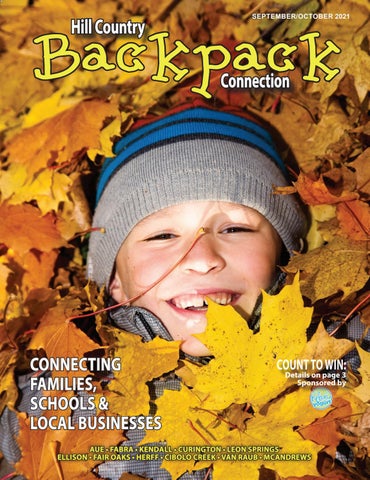
Hill Country
SEPTEMBER/OCTOBER 2021
Backpack Connection
CONNECTING FAMILIES, SCHOOLS & LOCAL BUSINESSES
COUNT TO WIN: Details on page 3 Sponsored by
AUE • FABRA • KENDALL • CURINGTON • LEON SPRINGS ELLISON • FAIR OAKS • HERFF • CIBOLO CREEK • VAN RAUB • MCANDREWS Backpack Connection
1
Distributed into the Backpacks of 6,000 Boerne / Leon Springs Students
students
Aue • Fabra • Kendall Curington • Fair Oaks Cibolo Creek • Ellison Van Raub • Herff Leon Springs Elementary Schools Art Director Susie Fluckiger
teachers
Sales Audra Miller Publisher BP PUBLISHING LLC Content for the Elementary School pages contributed by each school. Backpack Connection magazines are published every six weeks during the school year by BP Publishing LLC. The advertisements in this magazine are paid for by the advertisers, which allows this magazine to be distributed free to the families of the elementary students. Unless specifically noted, no advertisers, products or services are endorsed by the publisher, BISD, or NISD, or any districts employees. BP PUBLISHING LLC is not responsible for omissions, errors or misinformation within this publication. All real estate advertised within this publication are subject to the Federal Fair Housing Act, which make it illegally to advertise any preference, limitation, or discrimination because of race, color, religion, sex, handicap, familial status, or national origin or intention to make any such preference, limitation, or discrimination. We will not knowingly accept any advertising for real estate which is in violation of the law. All persons are hereby informed that all dwellings adverting are available on an equal opportunity basis. Reproductions of this magazine in whole or part without written permission is prohibited.
activities
Encouraging, Supporting and Loving the Children We Share...
ADVERTISING AND GENERAL INFORMATION BP Publishing LLC 209 Walnut Grove Rd. Boerne, TX 78006 (210) 367-3048
WEBSITE
www.backpackconnection.com 2
Backpack Connection
ENTER OUR CONTEST!
Count the Kelani Yogurt logos for a chance to win a $20 Gift Card Count the Kelani Yogurt logos in this issue (including this one!). Submit to: contest@backpackconnection.com by September 30, for a chance to win a $20 gift card to Kelani Yogurt. Include name, email, and phone number so we can contact the winner! Correct answers will be placed in a drawing to win; two winners will be chosen.
Backpack Connection
3
SCHOOL NEWS
4
Backpack Connection
Ritchie Automotive Repair and Alignment
Col. 3:23 “Whatever you do, work at it with all your heart, as working for the Lord not for men.”
29059 1H10 West Open M-F 8:00am to 6:00pm (830)755-8550
Backpack Connection
5
SCHOOL NEWS
6
Backpack Connection
Backpack Connection
7
SCHOOL NEWS
8
Backpack Connection
SCHOOL NEWS
Backpack Connection
9
SCHOOL NEWS
10
Backpack Connection
FEBRU ARY
2021
Backpack Hill Country
Connection
ADVERTISE WITH US! 210-310-6193
CODE NINJAS
www.backpackconnection.com education Providing digital in the Boerne area
S TON • LEON SPRING MCANDREWS • KENDALL • CURING • VAN RAUB • AUE • FABRA • CIBOLO CREEK Our Local Businesses tion OAKS • HERFF and Backpack Connec ELLISON • FAIR ing Our Families, Our Schools
1
Connect
Backpack Connection
11
Tips for a Successful School Year As a parent, you are your child’s first and most important teacher. When parents and families are involved in their children’s schools, the children do better and have better feelings about going to school. Below is a list of things you can do to help your child have a successful year. 1. Meet your child’s teacher. As soon as the school year starts, try to find a way to meet your child’s teacher. Let the teacher know you want to help your child learn. Make it clear that you want the teacher to contact you if any problems develop with your child. 2. Get to know who’s who at your child’s school. There are many people at your child’s school who are there to help your child learn, grow socially and emotionally, and navigate the school environment. 3. Attend parent-teacher conferences and keep in touch with your child’s teacher. Schools usually have one or two parent-teacher conferences each year. You can bring a friend to interpret for you or ask the school to provide an interpreter. A face-to-face meetings is important in helping keep up with how your child is doing in the classroom. 4. Find out how your child is doing. Ask the teacher how well your child is doing in class compared to other students. If your child is not keeping up, especially when it comes to reading, ask what you or the school can do to help. It’s important to act early before your child gets too far behind. Also be sure to review your child’s report card each time it comes out 5. Apply for special services if you think your child may need it. If your child is having problems with learning, ask the school to evaluate your child in his or her strongest language. The teacher might be able to provide accommodations for your child in class. If the school finds out your child has a learning disability, he can receive extra help at no cost
12
Backpack Connection
6. Make sure that your child gets homework done. Let your child know that you think education is important and that homework needs to be done each day. You can help your child with homework by setting aside a special place to study, establishing a regular time for homework, and removing distractions such as the television and social phone calls during homework time. 7. Find homework help for your child if needed. If it is difficult for you to help your child with homework or school projects, see if you can find someone else who can help. Contact the school, tutoring groups, after school programs, churches, and libraries. Or see if an older student, neighbor, or friend can help. 8. Help your child prepare for tests. Tests play an important role in determining a student’s grade. Your child may also take one or more standardized tests during the school year, and your child’s teacher may spend class time on test preparation throughout the year. As a parent, there are several ways that you can support your child before and after taking a standardized test, as well as several ways you can support your child’s learning habits daily that will help them be more prepared when it’s time to be tested. 9. Learn what the school offers. Read the information the school sends home. Talk to other parents to find
out what programs the school offers. Maybe there’s a music program, after-school activity, sports team, or tutoring program your child would enjoy. Remember to keep track of events throughout the school year. 10. Volunteer at your child’s school and/or join your school’s parent-teacher group. Teachers appreciate it when parents help at the school! There are many ways you can contribute. You can volunteer in your child’s class or in the school library. You can make food for a school event. 11. Ask questions. If something concerns you about your child’s learning or behavior, ask the teacher or principal about it and seek their advice. Your questions may be like these — What specific problem is my child having with reading? What can I do to help my child with this problem? How can I stop that bully from picking on my son? How can I get my child to do homework? Which reading group is my child in? 12. Demonstrate a positive attitude about education to your children. What we say and do in our daily lives can help them to develop positive attitudes toward school and learning and to build confidence in themselves as learners. Showing our children that we both value education and use it in our daily lives provides them with powerful models and contributes greatly to their success in school. 13. Monitor your child’s television, video game, and Internet use. American children on average spend far more time watching TV, playing video games, and using the Internet than they do completing homework or other schoolrelated activities 14. Encourage your child to read. Helping your child become a reader is the single most important thing that you can do to help the child to succeed in school-and in life. The importance of reading simply can’t be overstated. Reading helps children in all school subjects. 15. Talk with your child. Talking and listening play major roles in children’s school success. It’s through hearing parents and family members talk and through responding to that talk those young children begin to pick up the language skills they will need if they are to do well. For example, children who don’t hear a lot of talk and who aren’t encouraged to talk themselves often have problems learning to read, which can lead to other school problems. In addition, children who haven’t learned to listen carefully often have trouble following directions and paying attention in class 16. Encourage your child to use the library. Libraries are places of learning and discovery for everyone. Helping your child find out about libraries will set him on the road to being an independent learner. Remember that
libraries also offer a quiet place for students to complete homework and are often open in the evening. 17. Encourage your child to be responsible and work independently. Taking responsibility and working independently are important qualities for school success. You can help your child to develop these qualities by establish reasonable rules that you enforce consistently, making it clear to your child that he must take responsibility for what he does, both at home and at school, showing your child how to break a job down into small steps, and monitor what your child does after school, in the evenings and on weekends. If you can’t be there when your child gets home, give her the responsibility of checking in with you by phone to discuss her plans 18. Encourage active learning. Children need active learning as well as quiet learning such as reading and doing homework. Active learning involves asking and answering questions, solving problems, and exploring interests. Active learning also can take place when your child plays sports, spends time with friends, acts in a school play, plays a musical instrument, or visits museums and bookstores. To promote active learning, listen to your child’s ideas and respond to them. Let him jump in with questions and opinions when you read books together. When you encourage this type of give-and-take at home, your child’s participation and interest in school is likely to increase.
Backpack Connection
13
SCHOOL NEWS
14
Backpack Connection
Backpack Connection
15
16
Backpack Connection