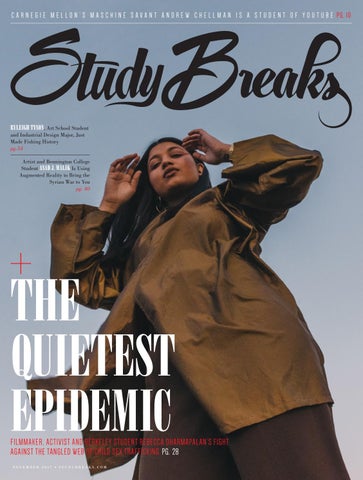
C A R N E G I E M E L L O N ’ S M A S C H I N E S A V A N T A N D R E W C H E L L M A N I S A S T U D E N T O F Y O U T U B E PG. 10
RYLEIGH TYSON, Art School Student and Industrial Design Major, Just Made Fishing History pg.34 Artist and Bennington College Student ASAD J. MALIK Is Using Augmented Reality to Bring the Syrian War to You pg. 40
WEAR » BUY » CELEBRATE 5 1 2 . 2 4 5 . 2 2 7 3 | w w w. b o o k s t o r e .t x s tat e . e d u
THE QUIETEST EPIDEMIC
FILMMAKER, ACTIVIST AND BERKELEY STUDENT REBECCA DHARMAPALAN’S FIGHT AGAINST THE TANGLED WEB OF CHILD SEX TRAFFICKING PG. 28 NOV E M BE R 2 017 • S T U DY BR E A K S .COM
V I S I T U S @ 4 522 FR ED ER I C K S B U R G R D # B 6 4 INSIDE WONDERL AND OF THE AMERICAS MALL SAN ANTONIO, T X 78201 210 . 5 3 0 .18 5 9 | U P T O W N G Y P S Y. C O M
20% OFF
PURCH ASE O F $50 OR MORE E X P 11/ 3 0 / 2017 E XC LU D ES OT H ER S A L ES, PR O M OS & L AYAWAY
10% OFF ENTIRE PURCH ASE E X P 11/ 3 0 / 2017 E XC LU D ES OT H ER S A L ES, PR O M OS & L AYAWAY
W E S P E C I A L I ZE I N:
DESIGNER CORSETS & WAIST TRAINERS I N T I M ATE A PPA R EL | B AT H & B O DY PR O D U CTS SEN S UA L BED R O O M PL AY ITEM S
THE TABLE OF CONTENTS NOVEMBER 2017 • ST UDYBR EAK S.COM
ONLINE THIS MONTH PAGE 4 By Study Breaks Staff
STUDENT GOVERNMENT PAGE 22 A bipartisan effort to reduce barriers to education for homeless and foster children stands to pass later this year, but does it do enough?
GREEK LIFE PAGE 16 STUDENT EXHIBITION PAGE 6 Graphic designer and visual artist Victoria Escobar, a student at MICA, steeps her work in anthropology, sometimes verging on the macabre
By Jack Brandon TALKING NOTES PAGE 10 A YouTube savant, self-taught Carnegie Mellon student Andrew Chellman uses a Maschine to blend new tech with classic sampling
Chi Omega sister Sara Miller pays homage to her late sister through SODA, an organization designed to educate and encourage student organ donors
By Abbey Slattery UNIVERSITY REPORT PAGE 26
By Christine Ascher
The best and worst college news from across the country
By Sierra Emilaire INTRAMURALS PAGE 18
WHAT’S YOUR MAJOR? PAGE 23
After leading McKendree University’s bowling team to its first National Championship, Breanna Clemmer can’t keep her mind off the gutters
Pursuing a Toy Design major at the Fashion Institute of Technology in New York is perfect for the kid in you, and their wallet
By Dakota Buhler
By Bria Jones
COVER SPOTLIGHT THE SEX TRAFFICKER NEXT DOOR Photography by Sena Alkbeu-Ian
#COLLEGEHACKS PAGE 27 Winter is coming, and with it comes cuffing season, a readymade excuse for bailing on plans and a serious chance of seasonal affective disorder
By Brittany Sodic THE RIGHT ANGLER PAGE 34
STEM GEMS PAGE 12
EXTRA CREDIT PAGE 46 After the Make-A-Wish Foundation helped Francesca Dabecco cope with an inoperable brain tumor, she knew she had to pay it forward
By Kathryn Parker
Ryleigh Tyson, an Industrial Design major at SCAD, is one of the best collegiate anglers in the country—and one of the only women
UCSD student Samantha Madala started the Healthy Scholars Foundation after a health scare made her realize how vital, but elusive, basic medicine can be
TASTEMAKERS PAGE 14
Pumpkin fluff is just the latest in a series of foods being served in odd containers, and we’re not mad about it
By Lexi Lieberman
By Christian Zeitler
By Kelly Keglovits
THE MEAL PLAN PAGE 25
By Cherie Litvin
THE QUIETEST EPIDEMIC
HOLOGRAMS FROM SYRIA PAGE 40
Columbia’s Anisa Tavangar, the editor-in-chief of “Hoot Magazine,” is using her platform to usher a new ethos into the fashion world
Artist, filmmaker and UC Berkeley student Rebecca Dharmapalan is fighting child sex trafficking with her award-winning short film and political activism
Bennington College student and Pakistani-native Asad J. Malik is at the forefront of augmented reality artistry, a position he’s using to bring the gruesome reality of war into American living rooms
By Kaitlyn Peterson
By Marissa Cortes
By Marissa Cortes
PAGE 28
MEET THE PRESIDENT PAGE 48 SMU’s David Shirzad doesn’t hesitate to name his biggest indulgence
By Study Breaks Staff
EDITOR’S NOTE
CONTRIBUTORS WRITER ///
IGNORANCE IS REST
O
n October 2, I woke up at 6:45 a.m. to a news alert on my cell phone from “USA Today” saying that a gunman had opened fire on a crowd of concertgoers the night before and that, at the time, at least fifty people were suspected dead. I swiped my thumb right to exit the notification and then opened up Instagram, where I watched several of my friends’ stories from the night previous, before turning on my lamp light and hopping out of bed. Over the course of the next few days, the shooting, combined with the recent hurricanes in Puerto Rico, Houston and Florida and the escalation of tensions with North Korea,
had put many of my friends into a state of anxiety. Several days later, a friend of mine was telling me how he’d had trouble sleeping as a result of the stress, and he asked me how I was coping with everything. At the time, I gave him my honest answer: I had tuned out. After the “USA Today” alert that woke me up on that Monday, I had refused to read another article about the shooting. I had stopped reading about the devastation in Puerto Rico, and I had buried my head in the sand when it came to our eroding international relations. I knew my self-imposed isolation wasn’t a longterm solution, nor was it the appropriate way to deal with crisis, but I was feeling overwhelmed as it was with personal, micro issues, and the last thing I felt capable of processing were global, macro catastrophes. So, I shut them out. When I read the piece by Stony Brook student Marissa Cortes about Asad J. Malik (pg. 40), I realized that the phenomenon he was describing, the desensitization of Americans toward humanitarian plight, was exactly what I was experiencing. Whether it was just going to be for a week, or two weeks or a month, I knew that, at the time, I couldn’t bring myself to empathize with the struggles, however serious and valid, of others. So I didn’t. Malik’s response to the kind of emotional apathy I and others were exhibiting was to double down, to create such a visceral, uncomfortable experience that it would break through my mental barriers and force me to reckon with, in this case, the suffering of Syrian refugees. To separate his voice from the chorus, Malik had found a way to be louder. Ultimately, everyone has their own priorities. As an artist, activist and entrepreneur, Malik has every reason to look for newer, more effective ways to make his message heard. He cares about, among many things, the Syrian Refugee Crisis, and he’s doing everything in his power to get you to care, too. At the same time, you have your own priorities, the first of which should always be your health, both mental and physical. The nature of media in 2017 means that access to a steady stream of demoralizing human atrocity is just a swipe away; when you are ready and healthy enough to confront it, do so. But don’t be afraid to recharge if you need to. There’s never been a time like this before, where so many horrendous things are happening and you have a front-row pass to all of them, so, especially as the stress of school ratchets up this month, do what you have to do to make sure that you’re staying afloat. And when you’re ready to go, get back in there.
OUR TEAM FOUNDER: Gal Shweiki ART DIRECTOR: Ian Friedel
JACK BRANDON University of Michigan English Student Exhibition Page 06
CHRISTIAN ZEITLER Carnegie Mellon Professional Writing and Creative Writing Talking Notes Page 10
KELLY KEGLOVITS @kellykeglovits University of Texas Austin Plan II STEM Gems Page 12
KAITLYN PETERSON @kaitlyn.patricia UCLA English Tastemakers Page 14
DAKOTA BUHLER @dakotabuhler George Fox University English Intramurals Page 18
CHRISTINE ASCHER USC English & Economics Greek Life Page 16
SIERRA EMILAIRE Southern Adventist University English Professional Writing College News Page 26
ABBEY SLATTERY @abslatt Northwestern College Writing and Rhetoric The Meal Plan Page 25
LEXI LIEBERMAN University of Pennsylvania English Student Government Page 22
BRIA JONES @vanwynthegarden Georgia Southern University Writing and Linguistics What’s Your Major? Page 23
BRITTANY SODIC @brittany_shmo UNT Journalism #CollegeHacks Page 27
KATHRYN PARKER @katyannparker Fordham University Comparative Literature Extra Credit Page 46
KAYLA KIBBE Connecticut College English The Quietest Epidemic Page 34
CHERIE LITVIN Binghamton University English The Right Angler Page 34
MARISSA CORTES @marissac0r Stony Brook University English Holograms from Syria Page 40
MATTHEW AWOYERA @akinolawo Towson University Photography Student Exhibition Page 06
JACOB PAUL Carnegie Mellon Photography Talking Notes Page 10
MICHAEL SPENCER @michael_spencer34 Stanford Management Science and Engineering STEM Gems Page 12
CAROLINE WALLIS @light_knife Barnard College Art History and Studio Art Tastemakers Page 14
GREGORY CROSS @gregoryRiot St. Charles Community College Secondary Education Intramurals Page 18
JIYOON KANG @Jyk_photos Washington University in St. Louis Photography Greek Life Page 16
SENAY ALKEBU-IAN @senay_jpg Merritt College African-American Studies The Quietest Epidemic Page 34
GALA MEYER @galameyer Bennington College Visual Arts and Psychology Holograms from Syria Page 40
SARAH KOHLBECK @s.kohl SCAD Graphic Design The Right Angler Page 34
EDITOR-INCHIEF: Mark Stenberg WEB EDITOR: Raquel Alonzo DIGITAL EDITORS: Jake Deven, Anh Le, Nicole Lovett GRAPHIC DESIGNER: Bryan Raynes ACCOUNTING: Elizabeth Castro DISTRIBUTION MANAGER: Marcus Flores DISTRIBUTION: Frank Hartfield, Jose Espinoza, Ernest Ward
MARK STENBERG Editor In Chief @MarkStenberg3
PRODUCTION: Shweiki Media Study Breaks magazine is published twelve times per year by Shweiki Media, Inc. copyright 2012. All rights reserved. This magazine may not be reproduced in whole or in part in any form or by any means electronic or mechanical, including photocopying or recording, or by any information storage and retrieval system now known or hereafter invented without written permission from the publisher. Reproduction or use in whole or in part of the contents of this magazine or of the trademarks of Study Breaks Magazine, Inc., without written permission of the publisher is prohibited. The publisher assumes no responsibility for care and return of unsolicited materials. Return postage must accompany material if it is to be returned. In no event shall such material subject this magazine to any claim for holding fees or similar charges. Study Breaks Magazine is an entertainment magazine for the students of San Antonio, San Marcos, Austin and Lubbock, published 12 times a year. CORPORATE OFFICE: Study Breaks Magazine Inc., 4954 Space Center Dr., San Antonio, TX 78218 • CONTACT STUDY BREAKS: Editorial: Mark Stenberg, 210-705-3284, editorial@studybreaks.com • Study Breaks Magazine is excited to help your brand reach our audience through video and written content. SALES: Ralph Chaplin, 210-892-0951, contact@studybreaks.com
2
PHOTOGRAPHER
STUDYBREAKS.COM
MORGAN RICHARDS @mrichardsphoto Point Park University Photography Extra Credit Page 46
SAM BRUTON @sbbrut Texas Christian University Journalism Meet the President Page 48
STUDYBREAKS.COM
STUDY BREAKS INTERNSHIPS Study Breaks is written exclusively by a team of student interns from across the country. These writers work with the editorial team to pitch and submit one piece a week for the website, in addition to writing for the monthly print magazine. ¶ Spring internships run from January 28 to May 28, and applications close January 14. If interested, email editorial@studybreaks.com with “Student Writing Internship” in the Subject. ¶ Introduce yourself in the body, making sure to include your name, school and major. Please attach at least two samples of your work. Ideal writers are intelligent, funny and talented, though no formal experience is necessary.
3
ONLINE THIS MONTH
ONE LINERS
RIGHT NOW AT
STUDYBREAKS.COM FROM THE VAULTS
“Perhaps asking for complexity is too much—‘Mr. Brightside’ goes in whether you choose to analyze the track or not.” Jack Brandon University of Michigan The Paradox of The Killer’s New Album, ‘Wonderful Wonderful’
MAKE IT STOP: A STUDENT’S PLEA FOR A MANDATORY FALL BREAK According to UTSA’s Daniel Wilcox, it’s around this time every year that students in Texas remember that they didn’t get a fall break and begin demanding that they receive one. Perhaps they have a point, though, as by the time Thanksgiving arrives, school is pretty much over. As Wilcox says, “I need some sort of break, or the next article you’ll be reading from me is ‘Things I’ve Learned Living in a Room with Padded Walls.’”
“Bringing a dog to college is a great idea, especially because it extends the lifespan of the ‘dog ate my homework’ excuse into higher education.” Haileigh Galloway Indian River State College The 7 Best Dog Breeds for College Students
SPOTLIGHT HOW TO MAKE FRIENDS ON TINDER (NO, SERIOUSLY) UTSA student Gaige Davila lays out, in no small amount of anecdotal evidence, how the popular hook-up app can just as easily be retooled for finding new friends. One important tip: Don’t tell your date you’re looking forward to their friendship.
4 BOOKS THAT WILL HELP YOU UNDERSTAND RACE IN MODERN AMERICA by Brittany Sodic, University of North Texas
“Tears We Cannot Stop: A Sermon to White America” by Michael Eric Dyson
“White Trash: The 400Year Untold History of Class in America” by Nancy Isenberg
“Burqas, Baseball, and Apple Pie: Being Muslim in America” by Ranya Tabari Idliby
“Translation Nation: Defining a New American Identity in the Spanish-Speaking United States” by Hector Tobar
ONLINE COLLEGE This month on the website, learn how to: Trick your Amazonian overlord // Binge-watch for your health // Dress like Selena Gomez // Pretend you’ve been into vinyl for years // Make your dog Insta-famous // Join a fraternity as a girl // Transfer schools while maintaining your sanity // Convince others to go commando // Fake the appearance of coping with graduation stress
4
STUDYBREAKS.COM
THE ART OF RESEARCH
THE PIANO MAN
PREVENTATIVE CARE
SUPER BOWLER
By Jack Brandon PAGE 6
By Christian Zeitler PAGE 10
By Kelly Keglovits PAGE 12
By Dakota Buhler PAGE 18
WHAT’S ON THE INSIDE
THE HONOR ROLL Tastemakers
The Style Guide Surrounded by the fashion hub of New York City, Columbia University provides the perfect space for Anisa Tavangar to speak out against the stereotypes of the fashion world. The senior Art History student currently serves as the editor-in-chief for “Hoot Magazine,” a college publication dedicated to cherishing people, cultures and fashion of all spectrums and environments. Continued on page 14
“The idea of two teenage boys conjuring up their dream woman—devoid of any inconvenient traits like sensitivity or fear—probably sounds off more alarm bells now than it did in the ’80s.” Benny Diaz II Southern New Hampshire University Not Everyone Is Excited About These ’80s Remakes “Finally, basketball is back and I can stop pretending I’m excited about football.” Patrick Murtha Eastern Connecticut State University The 2017-18 NBA Season Preview “How does one cure Alzheimer’s disease? With genetically mutated mako sharks, of course!” Terrica Singletary SNHU The 3 Best Shark Movies on Netflix
STUDYBREAKS.COM
5
HONOR ROLL: Student Exhibition
V I C T O R I A
ESCOBAR By Jack Brandon, University of Michigan Ann Arbor Photography by Matthew Awoyera Jr., Towson University
A native of Miami and graduate of DASH, an arts high school, college freshman Victoria Escobar has developed a practiced eye for graphic design, collage and illustration. Her work, in many respects, defies definition. She gravitates toward projects that involve historical or cultural examination, several of which feature an anthropological bent, such as “Teeth,” a book that, at times in an unsettlingly graphic fashion, examines depictions of orthodontia through various cultures. A recipient of an Honorable Mention award in Design Arts from the National YoungArts foundation, Escobar invites viewers to consider deep histories and explore questions of the human condition in her work. JACK BRANDON: Why are you an artist? VICTORIA ESCOBAR: I really struggle answering this question—I don’t know if that is a good thing or a bad thing. I’ve always done art. My aunt was an artist, so growing up, I would watch her paint. I was really inspired by doing small projects and enjoyed creating works that people can observe and connect to. A lot of things cannot give that same feeling. I went to Design and Architecture Senior High in Miami, and I realized that art wasn’t just a hobby. Also, I don’t like liberal arts or STEM or anything. Art is not work to me, it’s communicating in a way that isn’t with words. JB: How did your time at DASH influence your art? VE: DASH prepared me mentally and physically; I’ve already been staying up late nights working on projects. Talking about and thinking
6
“Untitled” by Victoria Escobar
STUDYBREAKS.COM
STUDYBREAKS.COM
about my work is much easier, too. I think that when you are the only art kid at a regular high school, for example, it’s hard to transition to a place where everyone is doing art and you’re no longer the only one that made art. When we do presentations and consider a piece of work, I’m more comfortable talking about it because I have critiqued so many times before, where some of my classmates are just now getting a feel of discussing art in a group setting. JB: What work do you most enjoy doing? VE: I enjoy doing cultural-based work. A lot of my work starts outside of the studio, and my favorite projects are those involving a lot of thought. A few years ago, I did a series about my grandfather, who died in 1994. I interviewed a lot of my family members and other people that knew
him. I documented his memories and other people’s memories in the way I imagined them. JB: Are you mainly attracted to personal works like that? VE: I’ve done projects that are more open. I made a book based on the anthropological study of teeth in key cultures throughout world history. I included Mayan, Japanese, Iban and a few other cultures, and each spread has the colors and depictions of abstracted forms of teeth. The book took a lot of research, and I prefer research and sketchbook work rather than getting my hands dirty. JB: Would you consider yourself an illustrator at all? VE: I love graphic design, but I don’t consider myself an illustrator. I do, however, really enjoy putting a lot of handiwork into my graphic design and scanning
7
HONOR ROLL: Student Exhibition
stuff in and working with textures and not keeping it strictly digital. JB: What themes are you attracted to in your work? VE: I’m at a point right now where I’m growing out of assignment work, like being given a prompt. Right now, I’m really starting to explore my own tastes. One project, “Time,” is based on the human condition and the idea that people live in the past and don’t appreciate the moment, so I have cutouts of old movies and references to past lifestyles. Time is a pretty general topic, but the thought and research are stimulating. JB: What cutouts or references do you tend to select?
8
VE: This may be abstract, but I like to work with textures, and the old magazines, when you zoom into them, have these intricately dotted half-tone colors. I love the variety of texture between the printed material, my own handwritten phrases and some digital aspects. When I look at art, I look for visual excitement, where there are several things that your eye can find and appreciate. JB: Do you remember any memorable responses to your work? VE: My teeth book–that one gets a lot of weird responses. Some of the imagery could be considered body horror. For the “Time” piece, people tend to view that positively because I approached that
in a very authentic way. It’s important to appreciate your own work because people will notice. When you make something for yourself, you tend feel justified in what you did. JB: What’s the best advice you have received? VE: Coming from four years at an arts high school and being surrounded by different artists, I feel that I’ve come in with a very open mind. Other students that aren’t used to that are intimidated with showing their work and scared to receive critique. In order to improve, you have to be open to different opinions, even if you disagree with them or they make you feel worse. When you start to compare yourself to others, you stop working for yourself.
If looking at your peers’ work encourages you to approach something differently, that’s fine, but you shouldn’t look at your works as less or more than anyone else’s. JB: So authenticity is an important part of your art? VE: It’s definitely important. I think creating art for yourself is important, and that’s where the authenticity shines. Not every piece of work has to be authentic to yourself, like I have a few pieces that are made to commemorate other artists, but I do think authenticity is key. Honesty makes you stand out. The conversations you’ll have about your work will be better, easier and more comfortable. You will talk about it differently. People know.
FACT FILE: NAME: Victoria Escobar SCHOOL: Maryland Institute College of Art INSPIRATION: Textures, JeanMichel Basquiat, Jasper Johns, Robert Rauschenberg, world culture, time MEDIUM: Digital work, oil pastels, charcoal, graphite, collage, acrylic paint
STUDYBREAKS.COM
STUDYBREAKS.COM
9
HONOR ROLL: Talking Notes
THE MAN ON THE MASCHINE Self-taught producer and YouTube savant Andrew Chellman has brought a decidedly futuristic sound to Carnegie Mellon. By Christian Zeitler, Carnegie Mellon Photography by Jacob Paul, Carnegie Mellon
A
ndrew Chellman is an electronic-music producer born out of the YouTube era whose sound is usually a pleasant mix of lo-fi hip-hop and instrumental accompaniment, somewhat reminiscent of Nujabes or Gramatik. Between clever sound design and clear, careful, melodic lines, Chellman approaches the genre with an atypical level of complexity. He loves sampling vinyl and adding his original piano riffs, a technique that he has grown so fluent in that he usually produces the entire blueprint for a song in a single sitting. “I try not to sit down with a preconceived idea of what I want to make, so when I’m making a song, I’ll let it come as it wants to,” he says. Though his virtuosity may sound rooted in years of classical training, Chellman’s greatest musical influence was the internet, as the young musician is a thoroughbred autodidact who taught himself almost everything he knows through internet tutorials and obsessive study. His musical education did begin, in elementary school, with classical piano lessons, but he quickly found that his passion for the piano did not lie in rote repetition, but in composing his own music. Soon, little melodies became little songs with little harmonies. By high school, Chellman had purchased a modern keyboard with different voices and sampling capabilities. “I learned all the functionality of the keyboard, I played the heck out of it,” he says, “and then I started feeling like I could move on to the next thing. I saw online everyone was doing computer music.” Chellman leapt at the chance to extend his creative abilities and began watching endless YouTube tutorials on how to produce, write percussion and sample tracks, adding in his own musical flair from the piano. Soon, while Chellman was still in high school, not only was he making music, he was making his own tutorial videos on YouTube. As he continued making videos about making music, he began to market himself to aspiring musicians and his web presence soon blossomed. His YouTube page, andrewchellmanmusic, now boasts more than twenty-eight thousand subscribers, and many of his videos have view counts approaching the one hundred thousand mark. His now-substantial social media presence reveals his entrepreneurial mindset: Thousands of people may produce electronic music, but how many teach others how
10
to use their equipment/software? In addition to the popularity, Chellman was also able to land a sponsorship and advertising agreement from Native Instruments, the distributor of his production hardware, the Maschine. Though Chellman has a knack for self-promotion and a gift for explaining music production to the uninitiated, neither overshadows his own musicianship. In total, he has released seven albums on Bandcamp, which range from movie soundtracks to the aforementioned hip-hop beats. His album “Windows,” in particular, showcases some of his range, from melodic yet ambient piano pieces, such as “Beyond,” to more electronic songs, like “Airwaves,” to those with deeper Eastern influences, such as the sitar-based “Lux.” He has even released two albums designed to be used as performance kits, a collection of samples and soundscapes that producers can use in their own music to avoid the notoriously crappy default samples on production hardware. Chellman has music on Soundcloud as well, although he uses the streaming site as a sort of dumping ground for ideas. Nonetheless, even the music there is extremely easy listening. There are tracks with heavily used vocal samples, such as “Lately,” as well as those extremely similar to the future-bass genre, such as “Romantics.” Some songs, like “Resonate,” are actually hype dance tracks. But the best way to experience Andrew Chellman’s music is to watch him perform. This is where his YouTube presence really shines. If you put on his “Everyday I Go Sailing” or “Boundless” videos, you will see him in his element. He starts with a base sample or loop and builds slowly, layer by layer. With the press of a button, a boom-bap, soulful percussion joins an ambient piano riff. With a twist of the fade dial, one melody replaces another. The songs evolve over their short lifespan, and all of it stays at Chellman’s fingertips. It is in these live videos that Chellman’s passion for the physicality of music becomes obvious. He wields the Maschine like a piano, his fingers dancing from button to button, sometimes playing multiple keys simultaneously, until, eventually, you realize that you are actually watching a recital. “The dream is to just have a little box that you can bring with you and you wouldn’t need a computer at all, you could just sit it down in your lap and make it happen,” he says.
FACT FILE: NAME: Andrew Chellman MAJOR: Mechanical Engineering LABEL: None SCHOOL: Carnegie Mellon GENRE: Electronic/Hip-Hop/ Indie ALBUMS ON SPOTIFY: “Seeing with Eyes Closed,” “Origins” SONGS TO LISTEN TO: “Boundless,” “Everyday I Go Sailing,” “Lately,” “Romantics”
STUDYBREAKS.COM
11
HONOR ROLL: STEM Gems
AN OUNCE OF PREVENTION After a medical scare in high school revealed how acutely academic performance depends on health, UCSD’s Samantha Madala started the Healthy Scholars Foundation to ensure less-fortunate students had the same chance she did. By Kelly Keglovits, University of Texas at Austin Photography by Michael Spencer, Stanford
A
fter constant exhaustion, hair loss and anxiety set in during the beginning of her high school career, Samantha Madala was diagnosed with hyperthyroidism and was quickly treated. Soon after, as her health improved and focus sharpened, her grades began to rise and the intimate correlation between wellness and academic success became acutely clear to her. In her sophomore year of high school, Madala, who is now a junior at the University of California San Diego, created a nonprofit called the Healthy Scholars Foundation. After experiencing firsthand how poor health can adversely affect a student’s ability to learn, Madala set out to ensure that what happened to her wouldn’t happen to others, especially in countries that lack the medical and now has means to diagnose harder-to-detect conditions like hyperthyroidism. Since its inception, the Healthy Scholars Foundation has screened more than ten thousand young students and has expansion in its sights.
12
KELLY KEGLOVITS: How did you get the idea for Healthy Scholars? SAMANTHA MADALA: After my freshman year of high school, I noticed that my health had changed a lot. No matter how much I slept, I felt extremely tired all the time; my hair was starting to fall out, I had really dry skin and I was starting to feel anxious constantly. I eventually found out, through a physician who noticed my symptoms at a routine checkup, that I was suffering from hyperthyroidism. Within about a month of taking medication, my
life had already started to completely turn around, and as a result, my grades improved significantly over time. The experience helped me realize that there is a huge correlation between a student’s health and their performance in school. I was lucky enough to have a physician who noticed these symptoms at my screening, but there are many children out there who lack access to modern medicine. So, I wanted to start the Healthy Scholars Foundation to raise awareness of illnesses that can impact students’ learning in school. KK: What is Healthy Scholars’ mission, and how do you go about achieving it? SM: We work to help students reach their full potential in the classroom through STAR: screening, treatment, awareness and research. We work with school districts in India to provide free health screenings and general physicals, as well as exams for illnesses and reproductive and menstrual wellness issues, because those services are often overlooked in those communities. We also have the treatment aspect of the program, in which, after a student has been diagnosed with an illnesses that might impact their learning, we either connect the student to free treatment options or help them find affordable treatment. We also try to tailor awareness to the different communities that we are working with. In India, we noticed that menstrual health is overlooked in a lot of the communities that we worked with because the topic can be kind of taboo. So, we have a “girls-to-girls”
STUDYBREAKS.COM
health program that focuses on empowering girls and equipping them with the tools that they need to keep track of their menstrual health and make sure that it doesn’t keep them out of school or from doing the best they can in the classroom. KK: Can you tell me about the process of building a nonprofit? SM: I was inspired to create the nonprofit after I did a study gauging awareness of hypothyroidism in the U.S. and India. In it, I found that general awareness of the condition’s basic symptoms was extremely low, and I realized that there was a huge knowledge gap we needed to address. So when I first started, we were just focusing on raising awareness for the illness.
I presented at ENDO 2013, the Endocrine Society’s conference, and from then on I was reaching out to people in the Bay Area. We fundraised, networked and talked to people who were as interested in improving pediatric health as I was, and I met lots of amazing people who wanted to expand to different aspects of pediatric health. For example, I met Dr. Marcella Alsan of Stanford, who helped me with putting together the “girls-to-girls” program. We expanded early on by partnering with people who resonated with the cause. KK: Did you encounter any setbacks during the process? SM: The earliest challenges came when we performed the health screenings in India. We didn’t realize
STUDYBREAKS.COM
how big of a need there was for a program of this kind, and there ended up being almost a thousand students at our very first health screening. We were overwhelmed trying to meet the needs of everyone. It was eye-opening, just realizing that the disparity is much larger than we thought. KK: So what’s next for Healthy Scholars? Do you have anything you are planning on the horizon? SM: Right now we are hoping to expand to low-income communities in California. We have actually already started working with one school district and are trying to reach as many students as possible to bring out health screenings and awareness programs.
FACT FILE: NAME: Samantha Madala SCHOOL: UCSD MAJOR: Biology YEAR: Junior HOMETOWN: San Jose, CA ORGANIZATION: Healthy Scholars Foundation ROLE: Founder and Executive Director
13
HONOR ROLL: Tastemakers
SECTION NAME: Group Name
GIVING A HOOT Columbia’s Anisa Tavangar, an Art History major and Editor-In-Chief of “Hoot Magazine”, has an ambitious vision for the fashion industry. By Kaitlyn Peterson, UCLA Photography by Caroline Wallis, Barnard College Continued from page 5
T
avangar joined “Hoot” as a contributor during her freshman year and soon earned herself the title of beauty director. Her involvement in the publication hadn’t even reached its height though, as she would later be chosen to head the entire magazine. Although she was thrown into such a prestigious standing, she approached the responsibility with an open mind. “I realized that this really provided a lot of opportunities to be creative and meet peers who are genuinely interested in collaborating, communicating and working together to make something beautiful,” Tavangar says. As editor-in-chief, Tavangar chooses to focus on the idea of inclusion and incorporating people of all backgrounds, appearances and identities. In an effort to combat some of the stereotypes that dominate the fashion world, she has made it a point to fight against the media’s unfair representation of specific minorities. Lingerie shoots are another aspect of Tavangar’s movement, as such shoots too often objectify the models in an attempt to sell their product. Rather than focusing on certain body parts and displaying women in an expensive studio, models for “Hoot” pose naturally in outdoor spaces and are portrayed with confidence and strength. “We are very conscious of the way we cast our models, the way we choose our photographers or stylists and who’s writing for us. It’s so much more than just creating some baseline diversity or checking off a box,” says Tavangar. In addition to representing their models holistically, “Hoot” also makes a statement through its streetwear shoots, taking efforts to reclaim urban areas from the catcalls and verbal harassment of men. In “Holler,” a zine affiliated with a “Hoot,” the cover features confident models in tie-dye colors, sneakers and embroidered clothing. By partnering with brands such as Brujas NYC and Venomiss, Tavangar hopes to stymie the objectification of women in the street sphere and extend her message beyond the college campus. “A woman wouldn’t typically wear an oversized T-shirt with heels at a skate park, so the publication sheds light on what real expression is,” Tavangar says. Your personal self-expression may or may not include six-inch heels, short skirts and excessive black eyeshadow and eyeliner, but, at the same time, everyone has their own unique way to represent themselves to the world. Just as models shouldn’t be limited to a caricature, Tavangar believes that her contributors should never be restricted to one section either. Students can direct a photo shoot and simultaneously write an article for the publication, while others have modeled and then worked behind the camera soon after. The team works to provide every contributor with opportunities for them to expand their creativity, talents and passion. As both former beauty director and current editor-in-chief, Tavangar has also had the opportunity to attend New York’s Fashion Week every year. By being present in the midst of the event’s bacchanalia, Tavangar has worked to promote not only her
14
FACT FILE: NAME: Anisa Tavanger SCHOOL: Columbia University MAJOR: Art History YEAR: Senior publication, but the message it communicates as well, in hopes of their vision acting as a breath of fresh air in the saturated market. Such passion spearheaded one of Tavangar’s most memorable photo shoots, in which “Hoot” shed light on gender identity and personal expression through fashion. Non-conforming trans-femme models posed wearing several brands that stood for the same message of transgender equality. As one of the featured brands in the shoot, SYRO speaks up for the femme population with its heels designed for men. The company not only creates feminine shoe styles in larger styles, but it also empowers boys and men who see fashion as their outlet of expression and liberation. “Hoot Magazine” hopes to instill that same love for fashion with its content and messages. “We’re able to defy these norms and these conventions, and we can expand the limited scope that traditional media offers. It doesn’t have to be through tokenism and stereotypical representation of different identities—you can do it in this really thoroughly, authentically beautiful way, and how motivating it is to be a part of that,” Tavangar says.
STUDYBREAKS.COM
MAGAZINE: Hoot Magazine MISSION: Debunk stereotypes in the fashion world
STUDYBREAKS.COM
15
HONOR ROLL: Greek Life
THE ORGAN TRIAL After witnessing the impact of her late sister’s organ donation, Chi Omega member Sara Miller has become a passionate advocate for educating and registering student donors. By Christine Ascher, University of Southern California Photography by Jiyoon Kang, Washington University in St. Louis
W
hen she was just twelve years old, Sara Miller faced one of the worst tragedies that she could have imagined: Her older sister, Laura, passed away suddenly from a cancerous brain tumor. However, after deciding to make Laura an organ donor, Miller’s family obtained some comfort from knowing that, despite the tragedy, they were able to save a life. Miller has since had the opportunity to meet her sister’s recipient and see firsthand the life-saving effects of the donation. As a result of this experience, she has become a passionate advocate for organ donation, founding the organization Student Organ Donation Advocates, or SODA, during her freshman year at Washington University in St. Louis. Now a senior studying Healthcare Management, Miller continues to expand SODA and to encourage students to learn more about registering. When she first arrived at Washington University, Miller knew that she wanted to channel her passion for spreading the word on organ donation into an organization. She began asking around to find out where she could promote it, but was unable to find any organized medium through which she could focus her energy. “I wanted to be part of something bigger where I would not only advocate and share my own story, but where I would be able to help mobilize other people to promote organ donation,” she explains. With the help of some upperclassmen and the advice and support of her sorority sisters, Miller co-founded SODA. Since then, the organization has amassed over forty trained volunteers, hosted more than forty programs and registered well over one hundred fifty people as donors. One quality that makes SODA stand out from other advocacy groups is their emphasis not simply on registration, but on education. Their events aim to make students think about organ transplants and all of the issues and controversies that surround them. “We want to give students the education they need to make an informed decision on whether organ donation is something they support,” she says. “We want people to register because they support organ donation, and if they don’t want to be an organ donor, we want them to express that wish as
16
well.” In addition to promoting registration, they hold discussions concerning the most recent and provocative developments in the field in the hopes of encouraging students to form their own opinions. “It’s rewarding when we have programs about the ethics of organ donation, the consent systems of different countries or new developments in transplantation, and students ask provocative questions that lead to new discussion and inspire more programming,” she says. As well as making an impact at Washington University, SODA has also formed partnerships with local organizations such as Mid-America Transplant and the Gephardt Institute for Civic and Community Engagement, and is in the process of expanding to two new college campuses. Eventually, Miller hopes that SODA will become a regular fixture at colleges around the country: “I would love to see an organ donation chapter on every campus. So many people are affected by organ donation, whether it’s being part of a donor or a recipient family, or having a friend who needs an organ,” she says. In extending the reach of SODA, Miller hopes that giving organs will one day become a topic that is discussed as commonly as giving blood. Miller’s dedication to organ donation advocacy has filtered into her studies and career goals as well. This past year, she conducted research concerning donation and registration in Israel, focusing on the psychological factors that inf luence citizens’ decisions to register. In better understanding the measures in place internationally, Miller hopes to learn new ways to think about giving organs in the U.S. “By studying organ donation in another country like Israel, I’m able to bring ideas back to the U.S. about how we can better educate and register individuals as organ donors,” she says. In addition to continuing to support SODA following her graduation, Miller plans to make an impact by working in healthcare administration, all the while keeping her own story close at heart. “I’ve spent the last eight years of my life fiercely promoting organ donation, and I do it in the memory of my sister and in honor of Trish, my sister’s organ recipient,” Miller says. “I strive to make an impact like the one that my sister had through her life.”
FACT FILE: NAME: Sara Miller SCHOOL: Washington University in St. Louis MAJOR: Healthcare Management YEAR: Senior SORORITY: Chi Omega HOMETOWN: Milwaukee, WI GOAL: To educate students about organ donation and help them make an informed decision about registering ORGANIZATION: Student Organ Donation Advocates (SODA)
STUDYBREAKS.COM
STUDYBREAKS.COM
17
HONOR ROLL: Intramurals
FACT FILE: NAME: Breanna Clemmer SCHOOL: McKendree University MAJOR: Elementary Education HOMETOWN: Clover, SC PERSONAL ACHIEVEMENTS: 2017 National Tenpin Coaches Association Division II/III Player of the Year; 2017 NCAA Tournament MVP; Member of the 2017 NCAA Women’s Bowling Championship winning team
THE QUEEN PIN Bowling prodigy and McKendree University student Breanna Clemmer aims to lead her school’s four-year-old team to its second national championship. By Dakota E. Buhler, George Fox University Photography by Gregory Cross, St. Charles Community College
W
hen I was in fifth grade, one of my friends invited me to go black-light bowling for her birthday. I was looking forward to a fun but relatively uneventful party filled with kids, bumpers, oddly fitting shoes and colorful bowling balls. What I actually got was much more exciting, as her father dropped two bowling balls into his pants and danced down the lane to the horror of the bowling alley attendants. While that wasn’t my last experience with bowling, I can’t exactly claim expert status, as my skill level never progressed past a general competence. Today, when I go to the local lanes with my friends, I might as well be attempting the sport with two bowling balls stuffed into my pants; it’s not pretty. Bowling incompetence is certainly not a problem for McKendree University sophomore Breanna Clemmer, who is the National Ten Pin Coaches Association Division II/III Player of the Year, as well as the reigning NCAA Women’s Bowling Tourna-
18
ment MVP. Clemmer takes bowling seriously, and has done so since she was eleven years old, when she began to bowl competitively. Her love for the sport, however, began even earlier. “My grandpa and my uncle started me out bowling when I was two years old, just pushing a ball down the lane,” Clemmer says. “It’s something that my family loves to do.” From that point on, she was hooked. She won Junior gold in the USBC U15 division (United States Bowling Congress, competitors ages fifteen and younger), and then a second gold two years later, this time in the U20 division. It was around this point that she began to realize the real possibility of competing on a college team: “I had colleges coming up to me and speaking to me and wanting to offer me things and wanting me to come to their schools,” remembers Clemmer. To add to the excitement, she also made the Junior Team USA in 2013-14; not only would she have the chance to compete in her sport collegiately, she would also be able to represent her country. By the end of the year, she had decided to join the bowling team at McKendree
STUDYBREAKS.COM
University, and thus began competing in one of the NCAA’s newest sports. According to the National Collegiate Athletics Association web archive, the NCAA was founded in 1906, but only began to organize into specific divisions and sports in 1956. Until that time, the organization was simply a rule-making committee. Today, the NCAA operates as a governing body for twenty-four sports; with the exception of women’s beach volleyball, which was added last year, women’s bowling is the newest addition to the NCAA lineup. Women’s bowling was added to the NCAA in 2004, but the McKendree University team hadn’t joined until recently. In fact, it wasn’t even until 2013 that the school became official members of the NCAA; previously, they had been competing under the rule of the National Association of Intercollegiate Athletics (NAIA). After joining the NCAA in 2013, the women’s bowling team worked their way into a championship position, scoring their first invite to the National Tournament in 2016. That year, they bowled their way to a Final Four finish before falling to five-time NCAA champions, Nebraska. This was the program into which Clemmer stepped for the 2016-17 season. It had been incredibly successful, garnering top National Tournament placements in both the NAIA and the USBC, but it had never won an NCAA title. As a freshman on the team, however, Clemmer was about to see that change. After qualifying for the 2017 NCAA tournament, the women of McKendree swept through their opponents, going undefeated all the way up to the championship game. In order to take home the title, they were going to have to beat Nebraska, who had knocked them out in the semifinal round the year before. In a best-of-seven match, where a team must win four of seven rounds to take home the title, McKendree won the first round. And the second, and the third. In the closing frame of the fourth and potentially final match, Clemmer stepped up to bowl, knowing she needed to compete at the top of her game if her team was going to win the tournament then and there. “I just remember getting up there and being comfortable with whatever was going to happen, so if I was going to split I knew my teammates would have my back, and if I went up there and struck, I knew I could turn around and give it all to my teammates,” says Clemmer. Her calm, confident demeanor paid off, as she bowled strikes in the final two frames of the tournament. The moment the last set of pins fell, Clemmer turned to her team. “We just hugged and embraced each other, and started crying,” she remembers. “It was one of the best days of my life; I don’t know how else to explain it.” This was their first NCAA title, but they are hoping it’s not their last. McKendree opened the 2017-18 season on October 27, and hopes to find success once again at the NCAA tournament in April.
19
SECTION NAME: Group Name
HOMELESS BUT HOPEFUL
TOYING AROUND
PUMPKIN OVERLOAD
#WINTERWEATHER
By Lexi Lieberman PAGE 22
By Bria Jones PAGE 23
By Abbey Slattery PAGE 25
By Brittany Sodic PAGE 27
WHAT’S ON THE INSIDE
AROUND CAMPUS
THE SPOTLIGHT
TECH TRAGEDY A police officer was shot by nineteenyear-old Communications major and Texas Tech student Hollis Daniels III after dispatchers were called to address concerns of Daniels expressing suicidal thoughts. Upon entering his room, university police found drugs and drug paraphernalia and arrested Daniels. While waiting in the debriefing room, Daniels shot and murdered officer Floyd East, forcing the university into a one-hour lockdown. He is being charged with capital murder of a peace officer and being held on a $5 million bond. Continued on page 26
20
STUDYBREAKS.COM
STUDYBREAKS.COM
21
AROUND CAMPUS: Student Government
AROUND CAMPUS: What’s Your Major?
T H I S MO N T H , W E ’ R E S T U DY I NG :
LIVING IN THE LIBRARY The new Higher Education Access and Success for Homeless and Foster Youth Act, if passed, marks a significant step toward leveling the educational playing field for disadvantaged students. By Lexi Lieberman, University of Pennsylvania
O
nce they have moved into their college dorms, students will often lament the fact that they must now suffer the unpleasantries of communal bathrooms and cramped living quarters. They might complain about the less-than-ideal conditions and express their excitement to return home to their mom’s cooking and their own bed when school breaks roll around. But students may not realize that some of their peers don’t have a home to return to. Granted, the majority of these homeless college students attend community colleges, where there is frequently no on-campus housing. A study that surveyed tens of thousands of community college students across the United States found that about 14 percent of them were homeless and about half were housing insecure, which meant that they had missed rent payments or that they had couch-surfed, staying over at their friends’ houses. The study also showed that about two out of every three community college students are food insecure, which means that they do not have the means to feed themselves a proper amount. Many students suffer from homelessness before college, preventing them from having access to higher education. In U.S. public schools, there are more than 1.3 million students who are homeless; another four hundred twenty-eight thousand are in foster care. Students who come from these socioeconomic backgrounds frequently lack the financial and emotional support to gain access to a college education and financial aid, through no fault of their own. Fortunately, a bill has been proposed to help them. A bipartisan group of lawmakers in Congress–both the House of Representatives and the Senate–introduced a bill on September 12, entitled the Higher Education Access and Success for Homeless and Foster Youth Act of 2017, that aims to remove barriers that are blocking homeless students and those in foster care from higher education. Congresswoman Katherine Clark, a Democrat from Massachusetts, introduced the legislation, which, among other initiatives, seeks to amend the Higher Education Act of 1965 to streamline FAFSA, supply housing options for students in between terms and extend outreach to homeless students.
22
Republicans and Democrats in the Senate and the House of Representatives have stated that reauthorizing the Higher Education Act is a top priority in Congress. However, other committees in the Senate have many issues to bring to the table, such as healthcare, which will undoubtedly be the focus of the Congress. This legislation is, frankly, common sense, which is why it has support across party lines. Children who grow up in the foster care system tend to face an uphill battle in pursuing higher education opportunities. Many of them age out of the foster-care system and do not know what to do next, so by creating opportunities for these children, we will have a more educated, employed youth. It is in the interest of everyone for these students to have the chance to afford housing while they study to become productive members of society. By easing the verification and determination process for those who are unaccompanied by an adult, the Homeless and Foster Youth Act removes barriers and makes going to college more practical for homeless and foster children. It clarifies that youth under age twenty-four who are determined to be unaccompanied or homeless are considered to be independent students, allowing them to receive the full financial aid package that they need. The act also will help provide homeless and foster youth in-state tuition rates, even if they live out of state, to reduce barriers to college attendance due to lack of financial support. In addition, by having institutions of higher education initiate a plan to aid homeless and foster youth in accessing campus-housing resources during and in between academic terms, the bill further encourages college retention, success and completion amongst homeless and foster youth. Beyond providing resources for itinerant students, the bill also implements systems that will help communicate the existence of these resources and aid to the students, which can often be a problem with homeless students, as many lack reliable access to phones, computers or power sources. The act would also collaborate with child welfare agencies, homeless service providers and school district homeless liaisons to identify, conduct outreach to and recruit homeless and foster youth to college. College may not be for everyone, but everyone deserves to make that choice for themselves. Young people born into disadvantaged situations should not have to suffer for the circumstances of their birth if they are willing to work hard, and this bill provides them with exactly what they need—a way to level the playing field. Homeless and foster care students face challenges that traditional students will never have to imagine, ranging from the complicated logistics of transportation to lacking a place to do homework at night, but with the Higher Education Act, their odds of succeeded are improved, if only a little bit.
STUDYBREAKS.COM
TOY DESIGN
$
By Bria Jones, Georgia Southern University
Starting Salary:
50K
The average ’90s kid has an intense, almost concerning love for talking about the decade in which they grew up. (Admittedly, it was a pretty sweet time to grow up.) Every chance they get, they talk about their favorite cartoons, movies and foods that are no longer around or relevant. But above everything else, what’s a ’90s kid’s favorite thing to talk about? How much better their toys were. ¶ Talking about how much better your childhood was than the next generation’s is normal—every generation does it—but most of them are all talk. If they really wanted to make current toys (and childhoods) better, they’d go to the Fashion Institute of Technology to get a degree in designing toys.
MYTH & TRUTH
CONVERSATION STARTERS
MYTH: Studying Toy Design means that you’ll be making toys year-round, like some sort of exhorbitantly priced knock-off version of Santa’s Workshop. TRUTH: Designing toys is definitely one part of the program, but students will also study child development and psychology, design and engineering of hard and soft toys, game design and model-making.
“The longest game of Monopoly lasted for over one thousand hours, so, no, I am not actually that stubborn.” ¶ “In sixteen-century Philippines, yo-yos were used as weapons. If how bad most middle schoolers were with them, then they were probably killing machines.” ¶ “There are fewer Canadians in Canada than there are Barbie dolls in Italy. Do with that information what you will.” ¶ “If all Rubik’s cubes in the world were collected and put in a row, they would make a line long enough to connect the North and the South Pole. Also, can I buy you a drink?”
MYTH: As someone with a degree in Toy Design, you’ll only be making dolls, action figures and anything of that sort. TRUTH: Toy Design encompasses all sorts of toys and entertainment for kids, which includes, but is not limited to, board games, video games and food-making devices like the EZ-Bake Oven. MYTH: Every Toy Design student ends up being the child’s-plaything version of a tortured artist—in other words, a toy designer. TRUTH: There are actually a good number of jobs for people in the field. See “Potential Jobs” for a few of them.
POTENTIAL JOBS PRODUCT DESIGNER A product designer is the most commonly thought-of job when it comes to this major. Responsibilities include the designing and developing of products from concept through production.
HEAD OF COMPLIANCE
TOY PRODUCT INSPECTOR
As the individual tasked with reporting directly to a company president, the head of compliance must have a nose for management and quality control. They should also like Chinese food, as very little toy production occurs in America.
As the name suggests, these people are in charge of making sure the products are safe for consumption. They should be detail-oriented and able to work under their own supervision and manage their own schedule.
FUN FACT Hasbro introduced a toy in 1962 called Flubber that was made from synthetic rubber and mineral oil. Unfortunately, it made people sick. More than sixteen hundred people developed sore throats, rashes and other reactions from contact with the stuff, and Hasbro had to recall it. To get rid of the evil goop, the company reportedly buried it and built a parking lot over the site. Legend has it that on hot summer days, Flubber still oozes through the cracks in the pavement.
STUDYBREAKS.COM
KEY TERMS TOY INDUSTRY ASSOCIATION (TIA) FIT NYC’s program is endorsed by the TIA, a non-profit trade association that represents all businesses involved in creating and delivering toys and entertainment products for kids. STORYBOOK As a part of the process for developing their own toy, each student has to create a book that will tell a story and build a world around their product’s character. BIG NAME BRANDS FIT alumni have designed toys for famous companies, such as Tyco Toys, the creators of Tickle Me Elmo, and Mattel, which is best known for its renaissance woman, Barbie. JUDY ELLIS As the program’s founder and chair, Ms. Ellis is the unofficial mom of every Toy Design major. She was also inducted into the Toy Industry Hall of Fame in 2013, which sounds vaguely like something out of a horror movie. INTERNATIONAL TOY FAIR The trade show, which is held every February on FIT campus for four days, brings toymakers from across the world to New York City.
23
SECTION NAME: Group Name
AROUND CAMPUS: The Meal Plan
PUMPKIN FLUFF COOK TIME: 5 minutes YIELD: A pumpkin full of dip INGREDIENTS: 1 (16 ounce) container frozen whipped topping, thawed 1 (5 ounce) package instant vanilla pudding mix 1 (15 ounce) can solid pack pumpkin 1 teaspoon pumpkin pie spice
ALL PUMPKIN EVERYTHING We heard you liked pumpkin flavoring, so we put pumpkin-flavored fluff inside a pumpkin. By Abbey Slattery, Northwestern College
F 4 410 19 T H S T • 13 0 | 8 0 6.771.5 3 82 | K E VA J U I C E L U B B O C K .C O M
BOGO SMOOTHIE
FREE YOGURT
LARGE FOR MEDIUM CHARGE
BOGO SELF SERVE
BUY ONE GET ONE SMOOTHIE OF EQUAL OR LESSER VALUE | ONLY @ 19TH ST
FIRST 4 OZ. FREE W/ PURCHASE ONLY @ 19TH ST
LARGE SMOOTHE AT THE PRICE OF A MEDIUM SMOOTHIE | ONLY @ 19TH ST
BUY ONE SOFT SERVE GET ONE OF EQUAL OR LESSER VALUE | ONLY @ 19TH ST
EXP 11/30/2017 NOT VALID W/ OTHER OFFERS EXCLUSIONS MAY APPLY
EXP 11/30/2017 NOT VALID W/ OTHER OFFERS EXCLUSIONS MAY APPLY
EXP 11/30/2017 NOT VALID W/ OTHER OFFERS EXCLUSIONS MAY APPLY
EXP 11/30/2017 NOT VALID W/ OTHER OFFERS EXCLUSIONS MAY APPLY
K E VA J U I C E L U B B O C K T X
K E VA J U I C E L U B B O C K T X
K E VA J U I C E L U B B O C K T X
K E VA J U I C E L U B B O C K T X
24
STUDYBREAKS.COM
or this month’s recipe, I would first like to address one of the hottest culinary trends of the moment—the avolatte. While the latte served in an avocado started as a tongue-in-cheek play on millennials’ supposed obsession with the dragon-skinned fruit, it helped set off a larger trend of serving normal foods in quirky, kooky ways: mushrooms in a garden shovel, croquettes in a fresh pair of sneakers, pastries on a skateboard, etc. And now people—especially the older sort—are outraged. “What was so wrong with the plates and cutlery we used?” they wheeze angrily. Well, genius and crazy go hand in hand, so get ready to embrace this trend in the most pleasing and fally-aesthetic way. It’s not a pumpkin spice latte in a pumpkin, but it’s damn close. Look, I know what you are thinking right now, and no, don’t roll your eyes. It’s not punk rock anymore to hate pumpkin everything, because pumpkin everything has already reached the level where it’s constantly parodying itself, and that just makes it cute and lovable, like we’re laughing with the spice. That’s why Crocs started to become unironic again, though I wholeheartedly reject that comeback. Please don’t @ me. You will probably be pleasantly surprised to find that this dip is actually a totally delicious dish, served in a pumpkin, and not some weird, gross hybrid of things
STUDYBREAKS.COM
done in the name of autumnal flavor. Fall is not really synonymous with dips, but this recipe takes some of the coziest essences of the season and transforms them into a popping party dish. Here’s the thing: This shit is truly fall af, and when you have to bring a dish to a Thanksgiving bash, not only is this super easy and cheap to make, but your presentation will be through the roof when show up with your dip in a damn pumpkin. Look out, Aunt Suzie, there’s a new showstopper in the family. The simplicity of the recipe cannot be overstated. Seriously, there are like four ingredients and two steps, and you’re done. There’s really no reason that you shouldn’t try this, unless you have some sort of pumpkin allergy. In that case, I am truly sorry; know that my thoughts are with you. In order to whip up this dip, all you will need is some whipped cream, instant vanilla pudding, pumpkin filling and pumpkin pie spice. Seriously, just four things. Then all you have to do is mix them together. One step. You could add in putting it in the fridge to cool if you wanted to stretch it to two, but I’m not trying to impress you with culinary feats here. Now, it isn’t a technical requirement for you to serve this dish inside of a pumpkin. Maybe you were an avid hater of the avocado latte trend and have taken a fierce stance against food being served on things other than plates. I gotta say, that seems like a pretty close-minded stance to take, but to each their own. Skateboard pastries aren’t for everyone. But, if you are of the adventurous variety and don’t mind getting your hands dirty, then go ahead and gut yourself a pumpkin, give the innards a quick once over (or throw a bowl in there as an understandable compromise) and there you have it: You can now claim the title of de facto ruler of autumnal snack dishes.
DIRECTIONS: 1. In a large mixing bowl, combine the vanilla pudding mix, pumpkin and pumpkin pie spice. Mix together, then fold in the thawed frozen whipped topping. 2. Let the dip cool in the fridge, then serve. Note: best used with graham crackers, pretzels or a similar salty sweet snack that complements a strong pumpkin flavor. No tortilla chips.
25
AROUND CAMPUS: #CollegeHacks
AROUND CAMPUS: University Report
COLLEGE NEWS
THE BUZZ
By Sierra Emilaire, Southern Adventist University
IMPOSSIBLE IS NOTHING Ten individuals, including four NCAA assistant or associate basketball coaches from Arizona, Auburn, USC and Oklahoma State, along with representatives of Adidas, were arrested on suspicion of coordinating thousands of dollars in bribes to athletes to attend Adidas-sponsored universities.
MEANWHILE IN TEXAS…
BUILD-A-BASIC-SNOWMAN
Texas A&M University-Central Texas is one of only three, exclusively upper-level universities in the U.S., meaning they accept and graduate only junior, senior and graduate-level students. The model works by pairing with proximate two-year institutions to help graduate local students as affordably as possible, shaving down costs by up to $20,000.
BUM SMOKE The University of Texas at Dallas, Prairie University and four other Texas colleges and universities are among the 126 institutions of higher learning receiving grants from the CVS Health Foundation, Truth Initiative and American Cancer Society for pledging to install smoke and tobacco free policies on campus, totaling $1.2 million.
Through a program called Ohio College Opportunity Grants, Ohio State University is constructing a student aid package specifically for low- and moderate-income students that will cover any tuition remaining after Pell Grants have been awarded.
ROTTEN COTTON Stalks of cotton taped to ten Confederate flag posters were hung on bulletin boards around the campus of American University with the phrases “Huzzah for Dixie” and “I wish I was in the Land of Cotton,” directly coinciding with the school’s creation of the Antiracist Research and Policy Center.
1. Roll that snow and stack it.
CONDEMNING CORRECTNESS Attorney General Jeff Sessions spoke out on the the national debate over protest and free speech on NPR, condemning “political correctness” on university campuses, especially the University of California, Berkeley, saying, “Freedom of thought and speech on American campus are under attack,” and claiming American universities are now shelters for fragile egos.
2. Place Ugg boots at base of snowman.
3. Place slouchy beanie on head, complete with infinity scarf around the neck.
5. Chant magic words: “I just can’t even,” to bring snowman to life.
WINTER HIBERNATION
80º 60º 40º 20º
Number of empty chairs in your lecture hall
26
4. Add stick arms, complete with Pumpkin Spice Latte attached to hand.
REGARDING:
100º
10 0 11 0 12 0 13 0 14 0 15 0 16 0 17 0 18 0 19 0
Texas university leaders, including University of Texas System Chancellor William McRaven, have issued statements to reassure college-aged students potentially affected by the overturning of DACA, saying, “You can be certain of our support as you continue to pursue your dreams to obtain an education…”
YOU’LL VOTE TOO The sighting of a clown driving a Dodge Viper near Roxbury Community College prompted worried phone calls to the Boston-area police from parents who thought the display looked like a scene out of the horror movie “It.” The culprit was later revealed to be a city council candidate trying to boost his campaign on preliminary election day.
While winter is one of the most enjoyable seasons for holidays, family time and the ability to use the weather as an excuse to flake out on plans, it can also be trying. Not only is it too cold to even think about leaving your dorm or apartment most days, but winter can also be the perfect storm of class deadlines, seasonal depression, bad health habits and a general slump. ¶ There’s something about shitty weather that seems to give people permission to be their shittiest self, but don’t let this winter be your excuse to do so. Own this season so that when spring comes around, you’re not killing yourself trying to put together the pieces of your life that came apart during the winter months.
50 60 70 80 90
UPPERCLASSMEN ONLY
PAU-LI-MUR-RAY Students at Yale University unveiled the winner of a mascot vote for newly opened Pauli Murray residential college by showing up in lemur costumes and performing a chant and dance that celebrated transgressive gender expression.
PREPARE FOR SNOW DAYS
THE BUCK-AYE STATE
COME AND TAKE IT
ON THE LIGHTER SIDE
HOW TO:
Winter is coming. Don’t get caught in the cold without these #hacks. By Brittany Sodic, University of North Texas
10 20 30 40
State Representative John Raney, R-College Station, pushed for the implementation and passing of House Bill 355, a measure that prohibits most sex offenders from living in dormitories on private or public college campuses in the state, leaving universities to make decisions regarding admittance for low-risk offenders.
#WinterWeatherHacks
Temperature Outside
SAFER SEX
STUDY BREAKS PRESENTS
STUDYBREAKS.COM
Hibernation isn’t just for the bears. As days grow shorter, naps, naturally, grow longer. With nothing else to do but Netflix and chill with bae (complete with take-out), it’s an apt time for the pounds to start adding up. ¶ Hibernating at home for the winter is natural, but should be balanced with healthy activity to keep you sharp for the coming thaw. Swap the streaming for reading or focusing on a hobby, create an easy-to-follow indoor workout plan to stay in (relatively) good shape and don’t be afraid to go outside and enjoy the fresh air once in awhile.
CARDBOARD Once the snow builds up, any hill on campus is game for sliding down. Grab a piece of cardboard or an empty box for a broke-kid’s version of a sled. QUEUE IT Let’s be honest, you’re probably not going to use that extra day to study (you know where your priorities lie). Make sure your Netflix queue is stocked up for days inside. Less time wondering, more time watching. FOOD There’s nothing worse than grocery shopping. Adding bad weather to the mix makes it a nightmare. Stock up on pantry items for those days. Until then, just make sure they survive your drunken snack binges. GEAR As the Boy Scouts say: “Be prepared for fuckin’ everything,” or something to that effect. Make sure you get a thick-ass coat so you don’t freeze outdoors. And extra blankets for those drafty, cinder-block dorms are essential.
27
THE INTERSECTION OF OPPRESSION Through her filmmakin, art and politcial activism, UC Berkley’s Rebecca Dharmapalan is working to spread the unsettling truth about child sex trafficking. By Kayla Kibbe, Connecticut College Photography by Senay Alkebu-Ian, Merritt College
BEFORE AWARD-WINNING FILMMAKER AND ANTI-CHILD-SEX-TRAFFICKING ACTIVIST REBECCA DHARMAPALAN RANKED AMONG GLAMOUR MAGAZINE’S WOMEN OF THE YEAR AND TEEN VOGUE’S 21 UNDER 21, SHE WAS A YOUNG FEMINIST LOOKING FOR A CAUSE.
passion: art. A lifelong musician, art has been Dharmapalan’s primary source of self-expression since she began playing the piano at age five. As a high schooler at Oakland School for the Arts, the young artist began to channel her growing passion for activism into a new artistic medium. The result was “International Boulevard,” a five-minute documentary she filmed with the help of the Oakland Police Department. Featuring interviews with prominent Oakland law enforcement figures and anti-child-sex-trafficking activists, the documentary sheds light on the widespread epidemic of commercial sexual exploitation of children (CSEC) within the United States. Since its 2013 release, the short film has gone on to receive a number of awards and acknowledgments from film festivals and organizations across the country, taking first prize at the 2013 “Girls Impact the World Film Festival” in Cambridge, Massachusetts, as well as second place in the 2014 Adobe Youth Voices awards. “I just thought, how can I educate people in the most efficient way possible? Through art, of course,” says Dharmapalan of her entry into filmmaking. “Film is a really incredible way of sharing a message. Visually, along with audio, it’s just a perfect way to represent an issue.” Following the success of “International Boulevard,” Dharmapalan continued her anti-CSEC activism, raising awareness about the issue in the TED Talk “In Our Own Backyards” at the 2015 TEDxTeen event in New York, as well as taking a position as chair of the Oakland Youth Commission, where she continued to develop campaigns and reforms with a focus on CSEC prevention. These days, the UC Berkeley student, now twenty-one, is preparing for a future in activism, either as a law student of international human rights or as a potential Fulbright scholar researching women’s empowerment in Sri Lanka. In her time at UC Berkeley, the Sociology major has learned new ways to navigate and express her beliefs, which are reflected in her ongoing CSEC activism. “I got to Berkeley with this mindset that this is a school for change-making, that change happens here,” Dharmapalan says. “In high school, I was a filmmaker and a musician. I really found myself through the arts. Then when I got to college, I learned the language. I was able to put words to what I was feeling and that was the most empowering thing that has ever happened to me. I had all of these feelings about oppression, I had all of these feelings about racism and classicism
As a young artist of color, the Oakland, California, native, now a senior at UC Berkeley, demonstrated a passion for effecting change at an early age, and traces her feminist roots all the way back to kindergarten, where she was the only person of color in her class. “Feminism really comes from my experience of being a brown person, being South Asian, and I think being a woman just adds on to that,” says Dharmapalan. “Being a brown woman growing up had a huge effect on my power and really helped me embrace who I was. My race was definitely involved in becoming an activist.” As the musician and aspiring activist continued to explore this power and cultivate her voice, her parents urged her to channel her passion. “My parents were like, ‘You’re a rebel without a cause, find your cause,’” she recalls. “I was like, ‘I know what my cause is, I am my cause!’” she laughs. In high school, a sixteen-year-old Dharmapalan found her cause after hearing about the sexual exploitation of one of her female classmates. Even as a teenager herself, Dharmapalan immediately recognized this issue as more than just high school drama. “At that time, it wasn’t being talked about as human trafficking. She was being referred to as a prostitute, as a ‘ho,’ and he was ‘pimping her out.’ So we as high schoolers didn’t really have the language to discuss or address the issue, per se, and I think that’s what sparked my interest in creating a film and bringing an awareness to an epidemic that, at the time, I didn’t know was such a large issue in the United States,” she says. Dharmapalan had found her cause—one outside herself, but still shockingly close to home. “BEING A BROWN WOMAN GROWING UP “Before we can do anything about it, we need for American people to recognize that this is an epidemic HAD A HUGE EFFECT ON MY POWER happening here in this country to children and adults who were born here,” says Dharmapalan of the ramAND REALLY HELPED ME EMBRACE pant misconception in America of sex trafficking as an exclusively foreign issue. “I think that Americans WHO I WAS. MY RACE WAS DEFINITELY love to empathize with issues that are happening abroad and kind of fetishize global trials. So I think it INVOLVED IN BECOMING AN ACTIVIST.” becomes a whole lot realer when it’s our own country. We don’t want to recognize what’s happening in our country because that makes it our problem. I think that’s why it has taken so long for us to address human and what it meant to be a woman of color, and when I got to college, I trafficking in this country, even though its been happening since the was taught the language,” she says. birth of this nation.” According to Dharmapalan, this intersectional approach to human Eager to start the conversation, Dharmapalan turned to her first
30
STUDYBREAKS.COM
rights activism is also the key to understanding the greater systems at play in the epidemic of sexual exploitation, systems she says are rooted in the history of this country. “The creation of this country started with genocide and slavery and that is what built it. Until we acknowledge that, we’re not understanding the true history of this nation. And if a country is built on genocide and slavery, then hundreds of years later you can’t expect it to be gone,” she says, noting that human sex trafficking is a modern example of ongoing slavery in America. “This issue of child sex trafficking is intertwined with racial politics, is intertwined with transatlantic slave trade; it is completely paralleled to the prison industrial complex and criminalizing black bodies and Black Lives Matter and all the current issues we are trying to alleviate. I think that when you’re looking at these complex issues, such as child sex trafficking, you have to look at the systems that create the problems to begin with,” she explains. Echoing Dharmapalan is Holly Joshi, the former supervisor of the Oakland Police Department’s Child Exploitation Unit. Now the Executive Director of MISSSEY (Motivating, Inspiring, Supporting, and Serving Sexually Exploited Youth), Oakland’s first non-profit organization dedicated to the fight against CSEC, Joshi also maintains the importance of addressing the underlying issues at work in the sexual exploitation epidemic. “It’s about root causes,” says Joshi. “It’s the same issues that impact all marginalized communities in this country. It’s the lack of access, it’s poverty, it’s racism, it’s sexism, it’s all of the ‘isms’ that impact this country. It’s a huge, large-scale issue about equity. Seeing ourselves in alignment with a lot of other movements is going to make the most progress.” Fellow activist Regina Evans, founder of Regina’s Door, an Oakland boutique that employs survivors of human sex trafficking, espouses similar sentiments about the intersection of oppression at the heart of sexual exploitation. “Trafficking is at the intersection of racism, greed, misogyny, sexism and colonialism,” says Evans. “Our own nation is built around those issues, and we don’t have a high regard for the black body in this country. People think fighting trafficking is just about raising awareness, but you can fight it by fighting poverty, you can fight it by fighting racism.” Keenly aware of the impact of her race on her own life as both an artist and activist, Dharmapalan maintains that race is inseparable from nearly all issues. “When you’re dealing with any issue in this country, race is always involved,” says the student activist. However, Dharmapalan cautions against seeing the issue as one purely involving people of color. “One thing to keep in mind is that human trafficking affects all bod-
STUDYBREAKS.COM
ies. It does not discriminate. This issue affects literally all different types of people, including white folks as well,” she says. Illustrating the racial and economic diversity at work in the sex trafficking industry, Dharmapalan points to the often overlooked third party of the sexual exploitation trifecta: the buyers. “The buyers of trafficked people are men of all races, all socioeconomic statues and from all professions. This includes police, this includes ministers, this includes doctors, lawyers, judges, homeless folks—everybody,” she explains. Joshi, too, calls attention to the relatively diverse population of buyers in comparison to other involved parties, blaming the more privileged demographic of buyers for a huge legal imbalance that has no small role in perpetuating the sex trafficking industry. “Both pimps and victims are coming from very challenged socioeconomic backgrounds,” explains Joshi. “We don’t see that same pattern with johns and tricks and that part of the equation,” she continues, echoing Dharmapalan in her assertion that buyers come from all racial and socioeconomic backgrounds, including privileged ones. For this reason, says Joshi, buyers seldom face legal repercussions of the same severity as those imposed on exploiters, and previously, even trafficking victims themselves.
31
“THE PROBLEM NOW IS THAT THERE ARE NO REAL CONSEQUENCES FOR THE DEMAND SIDE OF THE EQUATION. AS A COMMUNITY, THAT’S WHERE WE REALLY SHOULD BE FOCUSING: ENDING DEMAND, HOLDING JOHNS ACCOUNTABLE FOR COMING INTO OUR COMMUNITIES AND BUYING CHILDREN.”
This leniency, says Joshi, perpetuates the cycle of supply and demand at the heart of the sex trafficking industry. “The problem now is that there are no real consequences for the demand side of the equation. As a community, that’s where we really should be focusing: ending demand, holding johns accountable for coming into our communities and buying children.” Dharmapalan also emphasizes the importance of acknowledging and addressing the demand driving the industry: “I think we need to take a deep look at ourselves to understand that these are men, primarily men, in our communities that are a part of this industry, that are buying children. And this means that these are the men in our lives. They are the ones that are creating this epidemic, unfortunately. And most of the time it’s men that are critiquing me and my work, most of the time it’s men that are so shocked and surprised that this could be happening in this country. And it’s disgusting, it truly is disgusting.” Dharmapalan has even encountered this kind of gendered criticism of her CSEC activism among her mentors at UC Berkeley. The student recalls a recent interview with a professor who expressed skepticism about the relevance of domestic sex trafficking. “He was almost trying to argue with me about it happening,” says Dharmapalan. “And it was embarrassing, it was truly embarrassing that an educator at one of the top public universities in the world didn’t know that it was happening here, in Berkeley, in Oakland, in San Francisco.” In spite of her disappointment, Dharmapalan used the experience as motivation to work harder in her efforts to raise awareness. “I think that our first step in enacting change and eradicating sex trafficking is educating the people around us and having the tough conversations. This is an epidemic, and we can’t enact any further change as individuals unless we educate ourselves and we educate the people around us. So that’s my job in this movement.” In spite of all of her success as a young activist, the student and artist knows her work is nowhere near done. “We still have a huge issue on our hands. We have a lot of work to do, and, at this point, there is no silver lining, truly, aside from the community of activists that I’ve surrounded myself with.”
32
Fortunately, those activists envision a better future in the hands of young advocates like Dharmapalan. “Although I don’t believe that trafficking is strictly a women’s issue—I think it’s a societal issue— women are most marginalized and most impacted by it. So it’s going to take a movement of women helping women to end it,” says Joshi, who points to Dharmapalan as one of these women. “Rebecca’s an amazing asset in that she’s a real life example that there’s a place for everyone in the movement. It’s about where the demands of the world meet your passions, that’s where the magic is.” Dharmapalan has clearly found this magic intersection. In channeling her activism through her art, Dharmapalan has found that the two have always gone hand in hand. “Art is political. Art has no purpose unless it’s political,” she says. “I think that most artists are political because they’ve been so alienated from their communities. Artists are always alienated, so in that sense, everything that they create—everything that we create—has a purpose.” For Dharmapalan, art and activism continue to intersect, sometimes in surprising ways. Since gaining success as filmmaker, the student artist has learned that her role as woman of color is not only central to her activism, but to her art as well. “I realized that the rates of filmmakers of color are extremely low,” she says. “I was like ‘Oh wow, I am the only brown person here at this film festival, or I am the only brown person working on this issue, or I am the only brown person in this conference room.’” However, Dharmapalan has always made sure to use this position to her advantage. Her work as both an artist and activist remains informed by the feminist identity she traces back to her earliest days as a student: “I think that being a woman of color, I was able to express my message to girls in Oakland specifically and I was able to really make a statement. I really had to represent and recognize what a privilege it was for me to be an advocate, to have that voice. I was speaking on behalf of so many women of color and it has been a privilege to be able to be in that position. And I don’t take that lightly, I really don’t. It’s an extremely important job that I have.”
STUDYBREAKS.COM
STUDYBREAKS.COM
33
R I G H T
SECTION NAME: Group Name
As only a sophomore, SCAD student and Industrial Design major Ryleigh Tyson is already making history in the maledominated world of collegiate fishing.
T H E
By Cherie Litvin, Binghamton University Photography by Sarah Kohlbeck, SCAD
STUDYBREAKS.COM
STUDYBREAKS.COM
SECTION NAME: Group Name
LOOKING OUT ON LAKE HARTWELL, THE WIND BLOWING WISPS OF HAIR IN HER FACE, RYLEIGH TYSON HOLDS HER BREATH AS HER PARTNER, JACI SKIPPER, CASTS HER LINE. THE GIRLS HAVE A LITTLE UNDER AN HOUR LEFT ON THE WATER, AND THEY STILL NEED TO CATCH ONE MORE BASS TO MEET THE FLW TOURNAMENT’S FIVE-FISH WEIGH-IN LIMIT. For a second, Tyson considers telling Skipper they should head back toward the ramp for weigh-in; all the other boats are making their way there, and the two-hour time gap between their third and fourth catch makes it pretty clear they can only get lucky so many times. Not to mention everything else that has gone wrong on the water that day, from their trolling-motor battery dying to Skipper’s line getting caught in its blades. But before Tyson can get a word out, Skipper turns to her, eyes big, and next thing they know, her rod is doubling over. “Set the hook, Jaci! Set the hook!” Tyson cries. And a moment later, Skipper reels in a largemouth bass, their biggest catch of the day. The excitement didn’t end there. The girls learned at weigh-in that their total bag of fish came to 12 pounds, 8 ounces, earning them fourteenth place in the tournament out of 176 boats. Later on, another piece of news would make their competition experience all the more memorable. “I got a phone call while I was trying to load our boat onto the trailer and the lady [on the line] told me we qualified [for the national
championship],” Tyson says. And in doing so, she and Skipper made history—they were the first all-women’s boat to advance to the FLW College Fishing Nationals. A few years ago, Tyson never thought she’d be one half of a history-making angling team. She had grown up fishing with her dad and brother near her grandpa’s ranch, enjoying her time on the water as she waited for a bite on her line. As she got older, she was longing for more of a challenge, so she joined her high school fishing club and started to compete her junior year. But despite becoming the club team’s president the year after, she only planned on partaking in tournaments until graduation. “I didn’t really want to do a sport in college,” she says. “I just wanted to go to a school close to home and study something related to technology or engineering.” She started to change her mind, though, when the varsity fishing coach at the Savannah College of Art and Design, Isaac Payne, reached out to her. “He had come down to my high school to see me and my fishing club, and he later spoke to me and my family about scheduling a visit to the college,” Tyson says. Figuring there was no harm in exploring her op-
tions, she toured the school a few weeks later. Little did she know, SCAD had a major that perfectly matched her STEM interests. “[I learned that the school offered] industrial design,” she says. “[It’s] very similar to engineering—it’s just more of the design side of things.” During her visit, Tyson walked through the design-class buildings with her parents, her jaw dropping when she saw all the state-of-the-art equipment and cutting-edge tech she’d get to use as a SCAD student. “I was just in awe,” she says. And by the end of the tour, she knew there was nowhere else that she wanted to spend the next four years— especially knowing she’d get to pursue both fishing and design. ENTER VARSITY In the Florida town where Tyson grew up, fishing is more or less considered a lifestyle. “I think they say that Alabama, Texas and Florida are the three big states for fishing in general,” she says, “so you can find a lot of people in those states like myself that are passionate about it.” Given the popularity, several high schools across the Southeast have established
clubs and teams for students who have a considerable knack for angling. But even so, fishing teams are relatively new amongst the college athletics scene. In fact, SCAD is the latest in a handful of schools to have a team on the varsity level—and one of the only schools to have separate teams for both men and women. The team’s initiation makes Tyson one of the college’s first female varsity anglers, along with six other undergrad recruits. Like herself, her teammates competed on club teams in high school have fished since their single-digit years. However, she admits being on varsity was slightly daunting in the beginning, especially knowing that some of the other girls had extensive competition experience. “My high school team and I only competed against the other schools in our local area,” Tyson says. “But in Alabama, there are federation tournaments that run a high school series, and some of my varsity teammates got to participate in them.” In spite of that, their differing tournament resumes hardly affected the team’s dynamic, as the challenge fishing provided all of them continued to remain constant. In Tyson’s words, “You can’t always have a wonderful day on the water, but you also can’t always have a bad day on the water.” BREAKING THE MOLD The women’s varsity fishing team is also remarkable in that all the students on it—including Tyson—are studying at an arts school. Often,
students that try to balance sports and the arts end up seeming out of place in both, leading them to choose one over the other to escape derision. But according to Tyson, the SCAD community has been nothing but receptive toward her team. “[Most] people are usually like, ‘Wow, that’s so interesting,’ or they’ll ask questions like ‘How does the fishing work?’ or ‘How is it able to be a varsity sport?’” she says. “Nobody really judges us or thinks we’re weird.” Unfortunately, the same can’t be said for being a woman in the fishing industry. The competitive fishing scene has always been dominated by men, and most of the time, Tyson feels like she has to prove herself as a fisherwoman during tournaments. “Men tend to think fishing is a more masculine sport, and many of them don’t think women are capable of doing certain tasks on the water, such as driving a boat. But really, it’s something that just takes practice,” she says. So when she and Skipper qualified their boat for the 2018 YETI FLW College Fishing Nationals back in March, she was fully aware that the two of them were making waves amongst the industry. “I think it really opened the minds and insights of the men [who were at the tournament],” Tyson says. “They may have started to realize that girls can stand a chance in the industry, and that we weren’t just there to be women there.” That’s not the only reason she carries the accomplishment with pride. Tyson
STUDYBREAKS.COM
STUDYBREAKS.COM
37
SECTION NAME: Group Name
knows how common it is for girls to quit an activity they love because they don’t believe they can be as successful as their male counterparts. And naturally, she wants to see more girls who love to fish reach their full potential. “Jaci and I are more or less setting an example for other women in the industry not to give up on fishing,” she says. Moreover, Tyson hopes her and Skipper’s national qualification will make girls on high school club teams more aware of college fishing opportunities. “Before my coach reached out to me my senior year, I didn’t think it was a possibility to fish in college,” she admits. For what it’s worth, there has been a noticeable increase in women on the competitive fishing scene; and with a college such as SCAD creating a women’s team, there’s a definite likelihood more varsity teams will emerge in the coming years. “My team and I are just paving the way for more women to be in our position,” Tyson says.
junior year of high school, right after jettisoning her childhood dream of being a veterinarian. She couldn’t imagine going to college without a career path to follow, and after looking into the other career exploration programs that her school offered, she considered signing up for engineering.
The SCAD angler first became interested in design and engineering her
models using technology. “I’m not very good with hands-on work,” Tyson admits. Still, she knows she’ll have to create a few hands-on projects before she gets to focus mainly on online designing. “I still have to master the basics,” she says, laughing. BOBBING FOR APPLE
“I love techy things and I love math, so I thought that engineering would be pretty cool,” Tyson says. As it turned out, the program allowed her to use computer software to create 3D projects, something she never did before but always wanted to try. “One of the very first things I ever created online through design was a LEGO tractor,” she says. “I had to create each little piece of LEGO and join them together to make one big design.” She enjoyed the experience so much that she’d later do research on the College of Engineering and Computer Science at UCF, one of the top engineering schools in the U.S. Southeast region. “[Engineering] was something I could definitely see myself doing for the rest of my life,” she says.
HOOKED ON DESIGN Granted, Tyson didn’t just enroll at SCAD to fish. She also spends plenty of time taking classes, and now that she’s a sophomore, she’s beginning to delve into her Industrial Design major. “I’m taking a model shop class [this quarter] where I’m learning how to prototype and things like that, and I’m really enjoying it,” she says.
SECTION NAME: Group Name
But come her senior year, Tyson wasn’t sure if she’d commit to UCF like she planned; she couldn’t get over how much she loved SCAD after her visit. “When I walked into the building [design majors get to] work in and saw everything in it, I knew it was the kind of engineering I wanted to do,” she says. Ultimately, she chose SCAD, knowing the industrial design program would grant her more opportunities to create design
For the time being, Tyson has been looking into other design classes she wants to take while she’s attending SCAD. “Next quarter, I’m planning to take a computer modeling class where I’ll be taking what I’m doing hands-on now and turning it into a computer model,” she explains. Other than that, she’s still unsure about what other classes she’s going to register for. But luckily, she has someone she can go to whenever she’s in need of class recommendations. “My fishing coach actually did the same major I’m doing, so he’s very familiar with [the classes] and I’ll ask him for a little bit of insight sometimes,” she says. Even more, she hopes to eventually get an on-campus design internship—preferably within the Commercial Leadership Program. As an intern, Tyson would work with other students to create a product for a company; and after ten weeks of designing and working, they’d get to present their final product in front of the company executives. “[It’s cool] because they give the students insight on their product and let them know whether or not they’ll be having it [manufactured],” she says.
But above all, she wants to enhance her design and engineering skillset, especially if it helps her land her dream job at Apple someday. “I’ve always had kind of a huge obsession with Apple products,” Tyson admits. Every year, she tunes into the three-hour long livestream where the tech company reveals their latest devices. And while she usually doesn’t understand all the features the product developers discuss during the launch, the idea that she could someday take part in designing something that’s so popular and can do just about anything is an amazing thing to think about. Still, she doesn’t want to close the door on other career routes. In fact, her ongoing exposure to fishing since coming to college has opened her eyes to all the design opportunities that lie within the fishing industry. “The industry is way behind in terms of tech, and based on what I’ve learned on and off the water at SCAD, I’ve thought about so many ways I can help to transform it,” Tyson says. As of now, she can picture herself someday working in the design of either boats or bait. But being only a sophomore, she knows she still has plenty of time to think about it. “All I know is I want to explore my interests in both fishing and engineering, and see where they take me as I continue studying industrial design.”
STUDYBREAKS.COM
STUDYBREAKS.COM
“I WAS RAISED IN A COUNTRY WHERE THE IMPACTS OF THE POST-9/11 WAR ON TERROR WERE FELT IN EVERYDAY LIFE. THE IMAGES OF VIOLENCE THAT FREQUENTED OUR TELEVISION SCREENS WERE FROM THE SAME CITIES AND TOWNS THAT WE POPULATED.” SECTION NAME: Group Name
40
Performing Arts Centre at Bennington College in Vermont. To experiEARLY IN THE MORNING on September 2, 2015, before the sun ence the exhibition, viewers were invited to put on a Microsoft Hololens had risen and the pops of gunfire had begun for the day, three-year-old headset, which transformed the building into a structure littered with Alan Kurdi and his family boarded a tiny dinghy to flee Kobani, Syria, holographic images of war. In the foyer, young Alan Kurdi’s body rests their hometown and a war-torn battleground in the Syrian Civil War; on a bright red couch. In a stairwell, Aleppo elite forces, guns in hand when their boat capsized hours later in the middle of the Mediterranean and garbed in body armor, bound up the steps students use every day. Ocean, the young boy, his mom and his brother all drowned. A TurkThe effect of such a union is both jarring and powerful. “Viewers agreed ish journalist photographed Kurdi’s lifeless body lying facedown in the that they couldn’t see that space or that couch in the same way again, sand, and the image sparked an international outpouring of sympathy. whether or not they were wearing the Hololens,” says Malik. “The projIn that instant, through that photo, the horror of the Syrian Refugee ect served the simple purpose of reminding the viewer that in our state Crisis captured the attention of the world, the emotional weight of the of perpetual warfare, the couch that they sit on is socially, politically dead child’s image proving a more effective catalyst for action than the and economically connected to someone else’s dead body.” hundreds of activists who had tried to convey the desperation of their situation for years. It’s easier to ignore something you can’t see. BRINGING THE WAR TO YOU Asad J. Malik, a twenty-one-year-old junior at Bennington College, The holograms aid in recontextualizing the grisly images coming a private, nonsectarian school in the southwest corner of Vermont, unout of war-torn countries, such as Syria, by placing them into the same derstands better than most how divorced Americans are from the the space the viewer inhabits, forcing them into an active rather than pastragedies that they read about every day. Malik, who, since Bensive participation with the photos. Malik nington doesn’t offer traditional majors, is began working with augmented reality and on a specialized study track focusing on the Hololens nearly a year ago, fascinated by augmented and mixed reality, was born the possibilities that the technology offered. in Abbottabad, Pakistan, in a hospital not “Instantly, I was struck by the opportunity of five minutes from where Osama bin Laden producing creative content that would have was killed by U.S. special forces. In Pathe potential to change how the user perkistan, unlike in America, being “at war” ceives the reality they inhabit,” he says. viscerally affected his daily life. “I was The Microsoft Hololens is used to interaised in a country where the impacts of grate flat holographic image cutouts from the the post-9/11 War on Terror were felt in evwar in Syria to the viewer’s field of vision. eryday life,” Malik told me over the phone. They’re the same images you would see on “The images of violence that frequented Using augmented reality, artist the news, except that with the Hololens, the our television screens were from the same & Bennington College student distant images are now life-sized. To achieve cities and towns that we populated.” Asad J. Malik is bringing the the effect, using editing software, Malik reIn America, through television, the inSyrian Refugee Crisis to American moves the backgrounds of the photos and ternet and social media, the collective conliving rooms. cuts out the human figures until they bescience has been so inundated with images come reminiscent of architectural silhouof faraway tragedy that many people have By Marissa Cortes, ettes. “The images are then projected onto become desensitized to it. For over a decade, Stony Brook University the viewer’s eye to create the illusion that the the United States has been involved in a Syrians affected by war are interacting with war that has hardly come within a thousand Photography by Gala Meyer, the viewer’s surroundings. The backside of miles of American soil, which means that the Bennington College each hologram is composed of a zoomed in impact of that conflict on daily life has been portion of the original image.” virtually nonexistent. Tragedies abroad ocAccording to Malik, the actual Hololens cur and reoccur, each time spiking sympathy experience that became “Holograms from throughout the country for a few days, until Syria” was started and completed in one cafthe fervor passes and life returns to normal. feine-fueled sleepless night, though the project went through several When Malik moved to Vermont to attend college, this disparity asiterations before the Bennington junior settled on one he was satisfied tounded him. “Since I’ve moved to the U.S., images of war have followed with. In fact, he even considers some of the scrapped, earlier versions cat videos, Trump memes, mutilated dead bodies in Syria, beautifully more technically complicated than the final product. “It took me a while designed mattress ads—one after the other on a scrolling newsfeed. to be content with this conclusion since it seemed too simple,” he says. The country is at war but something’s fundamentally different; there is “The truth of the matter is that, while working with futuristic technolno war, at least not here. No drones in the sky, no fear of public spaces, ogy like the Hololens, it is very easy for the novelty of the technology no reason to hide. The war might be real in some foreign land. But not to become the most exciting feature of the project. Keeping the project here. Here, it’s merely rising defense stocks and a series of images on simple allowed for the concept to come through. a four-inch screen.” As a result of its blend of incisive political rhetoric and cutting-edge With his augmented reality project, “Holograms from Syria,” Malik technology, “Holograms from Syria” garnered international attention aims to undermine the ignorance that Westerners use to shield themalmost immediately. Right after announcing the project via a video inselves from having to acknowledge their complicity in foreign instaterview with “Quartz,” Malik was contacted by “The New York Times” bility. The project debuted first as an installation in the Visual and
HOLOGRAMS FROM SYRIA
STUDYBREAKS.COM
STUDYBREAKS.COM
41
and CNN, among others. He described the project to them as a chance to establish himself as an artist whose work is rooted in asking hard questions about the way we interact with war and with each other. INFLUENCES FROM THE PAST There are two principal influences in Malik’s work with augmented and mixed reality: “Bringing the War Home” by Martha Rosler and “The Gulf War Did Not Take Place” by Jean Baudrillard. In the 1960s, the collage work of Rosler, an American artist based in New York, brought the harsh realities of the Vietnam War into the American living room. One of her most famous works, “Balloons,” from the “Bringing the War Home” series, shows an immaculate American living room, complete with sunlight streaming through a sliding door onto several plush white sofas and a thick shag rug; in the picture’s foreground, an incongruously disarrayed Vietnamese mother with a look of terror on her face holds her naked, blood-flecked child. As Rosler used the series to recontextualize images of war into quotidian American life through the technology of her day, it’s impossible
42
to ignore the parallels between her work and Malik’s, a reality he fully acknowledges. Indeed, one still from Malik’s holograms transports the viewer to a crowded beach where, in the foreground, a crouching man holds the body of a bleeding boy in his arms, clutching him to his chest with an expression of agony on his face. Rosler relied on the imagination of her audience to visualize the shocking immediacy of living through a war that you couldn’t escape by turning off the TV. With technology such as the Hololens at his disposal, by using augmented reality to literally bring the images into the space that the viewer inhabits, Malik can take Rosler’s collages a step further. Jean Baudrillard, a French sociologist, philosopher and author of the heavily influential “Simulacra and Simulation,” penned a series of essays in 1991 entitled “The Gulf War Did Not Take Place,” which proposed that war in our current political reality has been reduced to a simulation. Baudrillard argued that the Gulf War was not a war, but a massacre masquerading as a war. The author also argues that an objective analysis of the conflict was nearly impossible, as much of the imagery that emerged from the attack met the definition of propaganda, rather than unbiased
STUDYBREAKS.COM
“OUR STATE OF PERPETUAL WARFARE, THE COUCH THAT THEY SIT ON IS SOCIALLY, POLITICALLY AND ECONOMICALLY CONNECTED TO SOMEONE ELSE’S DEAD BODY.” STUDYBREAKS.COM
43
THERE IS MORE THAN ONE KIND OF ABSURDITY: THAT OF THE MASSACRE AND THAT OF BEING CAUGHT UP IN THE ILLUSION OF MASSACRE. SECTION NAME: Group Name
imagery, meaning that the U.S. government controlled the narrative of what really happened in the military offense. Malik’s work lives in that struggle to distinguish between reality and unreality in modern war, and he points to a specific quote that helped motivate his efforts as an artist: “But there is more than one kind of absurdity: that of the massacre and that of being caught up in the illusion of massacre. It is just as in La Fontaine’s fable: the day there is a real war you will not even be able to tell the difference. The real victory of the simulators of war is to have drawn everyone into this rotten simulation.” The notion that a reality that everyone believes to be true—even those who were directly involved—could be a simulation, was considered controversial by Baudrillard’s contemporaries and detractors. DEFINING MIXED REALITY As a field, mixed reality (MR) is still very new. Definitions and official names are forever shifting around. The first mixed-reality system to provide an experience with sound, sight and touch was the Virtual Fixtures platform, which was developed at the U.S. Air Force’s Armstrong Laboratories in the 1990s to allow human users to control robots in real world environments. The currently accepted definition of mixed reality is “the merging of real and virtual worlds to produce new environments and visualizations where physical and digital objects co-exist and interact in real time.” In 1994, Paul Milgram and Fumio Kishino defined MR as “anywhere between the extreme of the virtuality continuum.” Malik locates his own work with “Holograms from Syria” on the scale created by Milgram and Kishino. The scale, which is a flat line, puts “real environment” on the far left and “virtual environment” on the far right. Just slightly to the right of “real environment” is “augmented reality,” and just slightly to the left of “virtual environment” is “augmented virtuality.” According to Milgram and Kishino, mixed reality is anything that falls anywhere on the scale between the two poles of a wholly real and wholly virtual environment. Initially, Malik labelled himself as a mixed-reality artist due to his work with the Microsoft Hololens; MR is a widely used term and more approachable for those new to the field. However, Malik recently switched to the more technically accurate designation of augmented-reality artist, since that’s closer to describing what his work actually is. Augmented reality is simply a computer-modified version of reality, similar to Pokemon Go. Virtual reality, on the other hand, is an entire computer-generated world that replaces the real life. A NEW MEDIUM FOR STORYTELLING Earlier artistic undertakings laid the foundations for Malik’s ambitious future goals. Prior to the creation of “Holograms from Syria,” Ma-
44
STUDYBREAKS.COM
STUDYBREAKS.COM
lik explored the realm of augmented reality in a project called “Harry Potter AR.” Yes, it is exactly what it sounds like. Hololens-users wielded a real life wand, casting spells and banishing dementors back to Azkaban with a well-placed Patronus. The process tested the waters for Malik before he began pursuing bigger projects. The success of “Holograms from Syria” has given the artist, who produces AR art under the pseudonym 1RIC, a strong voice in how augmented reality can be used as a medium to develop new storytelling techniques. In order to further explore the capabilities of the new field, Malik is currently in the process of converting 1RIC into the world’s first studio focused exclusively on non-fiction storytelling through augmented reality. Malik will be the first to acknolwedge that his work, since working on the Harry Potter AR, has certainly become more political. Unlike much of the AR industry, which, as a medium, is often dominated by escapist fantasies and alternate realities, Malik wants to use the technology to approach real stories from previously inaccessible perspectives. Instead of using the Hololens as another tool to help put reality out of mind, Malik sees the tech as a groundbreaking way to bring attention back to what matters. In a world of social media moments, sound bites, headlines and snippets, the Bennington College artist is looking for depth.
45
EXTRA CREDIT
SECTION NAME: Group Name
GETTING TO KNOW
FRANCESCA DABECCO By Kathryn Parker, Fordham University Photography by Morgan Richards, Point Park University Francesca Dabecco’s Make-A-Wish story began when her wish was granted, giving her the chance combine her passions for fashion and journalism during a once-in-a-lifetime experience writing a blog for a fashion magazine. After this incredible opportunity, Dabecco went off to Point Park University with a major in Journalism—but she didn’t stay away from Make-A-Wish for long. During her second semester in college, she started her internship with the same foundation that had made her wish come true. ¶ Dabecco has been with Make-A-Wish for years now, putting her journalistic skills to use as their marketing/communications intern. As part of her job, she gets to interview wish recipients and their families, write stories about fulfilled wishes, work on press releases and, best of all, be part of a team that makes kids’ dreams come true. “IN 2013, I WAS DIAGNOSED with an inoperable brain tumor called a brainstem glioma. I was very sick and unsure of my future—or if I would even have one. When I felt like my world was flipped upside down, Make-AWish came into my life and became a turning point in not only my sickness, but also my survival.” “AFTER I WAS DIAGNOSED, I received thirty radiation treatments over six weeks. During this time, I lived by the phrase, ‘If you look good, you feel good,’ and wore a different outfit to each treatment. It was something that helped me keep positive, show up and fight.” “WHEN I WAS REFERRED TO receive a wish, I knew that I had to do something
46
with style. I wished to be a writer for a fashion magazine, a combination of my two passions. That’s when Make-A-Wish pulled its magic to grant me my fashion fantasy: I got to cover the week of fashion shows at LA Style Fashion Week for ‘Glamour Magazine’s’ blog.” “MY FAVORITE PART about working with Make-A-Wish is being able to see the impact of a wish every single day. I am endlessly inspired by other wish kids and their stories.” “I LOVE EVERYTHING that I do with Make-A-Wish, but I especially enjoy being able to talk to wish kids and their families. One thing in particular that was super exciting to do was when I filmed a child’s wish coming true and
edited the video for our social media. Writing is my thing, but it was fun to do something out-of-thebox and tell a wish story in another compelling medium.” “I’VE BEEN WITH MAKEA-WISH going on four years now. Most students probably don’t want to spend so long at the same internship, but, for me, it is so much more than just a mark on my resume. I wouldn’t be where or who I am today if it wasn’t for Make-A-Wish.” “I’VE ALWAYS FELT AT HOME in the wish office, but having worked here so long, I feel even more a part of the team. I work with the most amazing group of people who have taught me so much, inspiring me to grow and
learn every day. They have become a part of me, just as much as the wish kids do.” “ANOTHER PERK OF INTERNING with the same organization for a long period is knowing your ‘groove.’ Going on four years, I am certainly now confident in what I do, opposed to those nervous beginnings of internships. I feel like my team can depend on me, and that is a great feeling to accomplish.” “AS A JOURNALISM STUDENT, my love will always be writing and telling other’s stories. But I also have another passion, which is the mission of Make-A-Wish: to grant the wishes of children facing life-threatening medical conditions, enriching their
lives with hope, strength and joy. I love what I do at Make-A-Wish, and I would be honored to continue to work with them after I graduate.” “I HOPE I ALSO CONTINUE to write articles and get my work published—I have dreams of writing a book or two. Who knows where the future will take me. All I know is that I am so lucky to be alive and have a future to dream about.” “WHEN I WAS SICK, it was so difficult for me to picture a future for myself because I wasn’t sure if I would make it. But after my wish, and now working with the organization, I am inspired every day to dream bigger than I ever did before. I am very thankful.”
STUDYBREAKS.COM
FACT FILE: NAME: Rebecca Dabecco SCHOOL: Point Park University MAJOR: Journalism KEY INTERNSHIP: Make-A-Wish Foundation HER WISH: Covering LA Style’s Fashion Week MOTTO: “If you look good, you feel good”
STUDYBREAKS.COM
47
MEET THE PRESIDENT
Photography by Sam Bruton, Texas Christian University
MEET THE PRESIDENT
DAVID SHIRZAD
Student Body President of Southern Methodist University WHAT IS YOUR MAJOR? Finance WHAT IS YOUR DREAM JOB? I honestly don’t have one. That’s always been a tough question for me. WHAT ACADEMIC FOCUS MOST INTERESTS YOU? Hard to choose one. I am a Finance major but I am also getting a minor in Public Policy and International Affairs, so that has been fun. Geography is another subject I find interesting. WHAT WILL YOU NEVER UNDERSTAND? Biology, chemistry and how the United States failed to qualify for the World Cup in Russia WHAT QUALITIES DO YOU MOST ADMIRE IN A PERSON? A genuine care and desire for others WHAT ANGERS YOU? People who only view situations from their point of view and do not think about others and how they might feel WHAT IS CURRENTLY ON YOUR MIND? SMU football and how far we have come in the four years I have been at school here. Also, some outrage at the U.S. soccer team for not qualifying for the World Cup. WHAT HISTORICAL FIGURE DO YOU ADMIRE? George Washington. His leadership skills were unmatched. The way that he put the United States before his own reputation was astonishing. WHO ARE YOUR FAVORITE SPORTS TEAMS? DC United and any other teams from Washington WHAT’S THE LAST BOOK YOU READ? “Too Big to Fail” by Andrew Ross Sorkin WHAT MUSIC ARE YOU INTO AT THE MOMENT? I love the Avett Brothers and the
48
Lumineers. WHEN YOU’RE COOKING, WHAT IS YOUR GO-TO MEAL? Mac and cheese. I only know how to cook a couple things, but I can make a mean mac and cheese. WHAT’S YOUR BIGGEST STRUGGLE AS A STUDENT? Not enough hours in the day WHAT’S THE LAST MOVIE YOU WATCHED? “Beauty and the Beast,” the new one with Emma Watson. This is how you know I am telling the truth here. WHAT IS YOUR MOST TREASURED
POSSESSION? My stuffed dinosaur named Dino. He used to be my dad’s and he sleeps with me every night. WHAT IS YOUR FAVORITE ALCOHOLIC BEVERAGE? Moscow Mule. Always refreshing and easy to make WHAT IS YOUR TYPICAL OUTFIT? Khakis and a polo WHAT’S THE BEST CLASS YOU’VE TAKEN IN COLLEGE? My accounting class with Barry Bryan. He was a great professor who pushed me to learn more than
I ever have in a single class. WHAT IS YOUR FAVORITE PLACE TO EAT? Rusty Taco. Go get the breakfast tacos with chips and queso on the side. WHAT’S A SECRET TALENT OF YOURS? My ability to learn the words to songs. I seem to have a large storage of song lyrics in my head. WHERE DO YOU WANT TO GO MOST IN THE WORLD? New Zealand would be an awesome adventure. IF YOU COULD CHANGE ONE THING ABOUT YOURSELF, WHAT WOULD IT BE? Nothing. I wish I read more growing up, but that’s it. WHERE DO YOU HANG OUT ON CAMPUS? Hughes Trigg Student Center, Fondren Library and the Beta Theta Pi house WHERE WOULD YOU BE IF NOT IN COLLEGE? Exploring the world mountain biking WHAT MAKES YOU NERVOUS? Anything further ahead than a year from now WHAT IS YOUR BIGGEST INDULGENCE? Ice cream! Easiest question on here. WHAT LIVING PERSON WOULD YOU MOST LIKE TO MEET? Pope Francis. I am not a Catholic, but he inspires me with his strong leadership, and his deep compassion for those with disabilities means a lot to me personally. WHAT IS IMPORTANT TO YOU RIGHT NOW? Enjoying my senior year with my friends and not leaving with any missed adventures. WHAT IS YOUR MOTTO? Carpe Diem
STUDYBREAKS.COM
V I S I T U S @ 4 522 FR ED ER I C K S B U R G R D # B 6 4 INSIDE WONDERL AND OF THE AMERICAS MALL SAN ANTONIO, T X 78201 210 . 5 3 0 .18 5 9 | U P T O W N G Y P S Y. C O M
20% OFF
PURCH ASE O F $50 OR MORE E X P 11/ 3 0 / 2017 E XC LU D ES OT H ER S A L ES, PR O M OS & L AYAWAY
10% OFF ENTIRE PURCH ASE E X P 11/ 3 0 / 2017 E XC LU D ES OT H ER S A L ES, PR O M OS & L AYAWAY
W E S P E C I A L I ZE I N:
DESIGNER CORSETS & WAIST TRAINERS I N T I M ATE A PPA R EL | B AT H & B O DY PR O D U CTS SEN S UA L BED R O O M PL AY ITEM S
C A R N E G I E M E L L O N ’ S M A S C H I N E S A V A N T A N D R E W C H E L L M A N I S A S T U D E N T O F Y O U T U B E PG. 10
RYLEIGH TYSON, Art School Student and Industrial Design Major, Just Made Fishing History pg.34 Artist and Bennington College Student ASAD J. MALIK Is Using Augmented Reality to Bring the Syrian War to You pg. 40
WEAR » BUY » CELEBRATE 5 1 2 . 2 4 5 . 2 2 7 3 | w w w. b o o k s t o r e .t x s tat e . e d u
THE QUIETEST EPIDEMIC
FILMMAKER, ACTIVIST AND BERKELEY STUDENT REBECCA DHARMAPALAN’S FIGHT AGAINST THE TANGLED WEB OF CHILD SEX TRAFFICKING PG. 28 NOV E M BE R 2 017 • S T U DY BR E A K S .COM