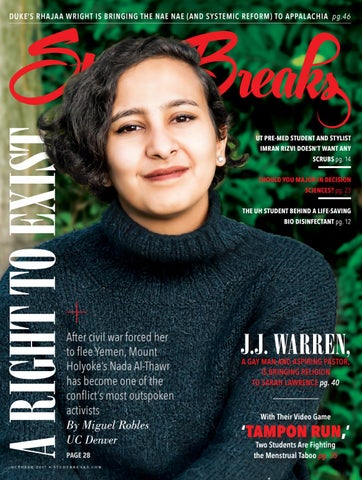
A RIGHT TO EXIST
DUKE’S RHAJA A WRIGHT IS BRINGING THE NAE NAE (AND SYSTEMIC REFORM) TO APPALACHIA pg.46
After civil war forced her to flee Yemen, Mount Holyoke’s Nada Al-Thawr has become one of the conflict’s most outspoken activists By Miguel Robles UC Denver PAGE 28
O C T OBE R 2 017 • S T U DY BR E A K S .COM
UT PRE-MED STUDENT AND STYLIST IMRAN RIZVI DOESN’T WANT ANY SCRUBS pg. 14 SHOULD YOU MAJOR IN DECISION SCIENCES? pg. 23 THE UH STUDENT BEHIND A LIFE-SAVING BIO DISINFECTANT pg. 12
J.J. WARREN, A GAY MAN AND ASPIRING PASTOR, IS BRINGING RELIGION TO SARAH LAWRENCE pg. 40
With Their Video Game
‘TAMPON RUN,’ Two Students Are Fighting the Menstrual Taboo pg. 35
4 410 19T H ST • 13 0 | 8 0 6.771.5 382 | K E VA J U I C E LU B B O CK .C O M
BOGO SMOOTHIE
FREE YOGURT
LARGE FOR MEDIUM CHARGE
BOGO SELF SERVE
BUY ONE GET ONE SMOOTHIE OF EQUAL OR LESSER VALUE | ONLY @ 19TH ST
FIRST 4 OZ. FREE W/ PURCHASE ONLY @ 19TH ST
LARGE SMOOTHE AT THE PRICE OF A MEDIUM SMOOTHIE | ONLY @ 19TH ST
BUY ONE SOFT SERVE GET ONE OF EQUAL OR LESSER VALUE | ONLY @ 19TH ST
EXP 10/31/2017 NOT VALID W/ OTHER OFFERS EXCLUSIONS MAY APPLY
EXP 10/31/2017 NOT VALID W/ OTHER OFFERS EXCLUSIONS MAY APPLY
EXP 10/31/2017 NOT VALID W/ OTHER OFFERS EXCLUSIONS MAY APPLY
EXP 10/31/2017 NOT VALID W/ OTHER OFFERS EXCLUSIONS MAY APPLY
K E VA J U I C E L U B B O C K T X
K E VA J U I C E L U B B O C K T X
K E VA J U I C E L U B B O C K T X
K E VA J U I C E L U B B O C K T X
THE TABLE OF CONTENTS OCTOBER 2017 • ST UDYBR EAK S.COM
GREEK LIFE PAGE 16
THE MEAL PLAN PAGE 25
UConn’s Christine Savino, a Pi Beta Phi sister, is a fervent activist for POC and women’s rights, both locally and abroad
Brew up a break from October’s pumpkin-flavored everything with the season’s true hero, the unsung apple
By Abbey Slattery
By Christine Ascher INTRAMURALS PAGE 18
A RIGHT TO EXIST PAGE 28
After civil war forced her to flee Yemen, Mount Holyoke’s Nada AlThawr has become one of the conflict’s most outspoken activists
COVER SPOTLIGHT A RIGHT TO EXIST Photography by Ayla Safran
Water polo player and Olympic hopeful Nic Carniglia is optimistic about his odds following UC Berkeley’s National Championship
By Dakota Buhler
By Miguel Robles ONLINE THIS MONTH PAGE 4 By Study Breaks Staff
TALKING NOTES PAGE 10
STUDENT GOVERNMENT PAGE 22
Bees?, a five-piece band from Shenandoah University, infuses its jazz-inspired spontaneity with a distinctly punk ethos
The newest iteration of the 1944 GI Bill has finally adapted the program to meet the needs of the twenty-first century
By Christian Zeitler
By Lexi Lieberman
THE GOSPEL ACCORDING TO J.J. PAGE 40 UNIVERSITY REPORT PAGE 26 The best and worst college news from across the country
Sarah Lawrence’s J.J. Warren discusses the challenges of being an openly gay man attempting to become a pastor at the country’s second most secular college
By Otis Roffman
By Sierra Emilaire STEM GEMS PAGE 12
WHAT’S YOUR MAJOR? PAGE 23
University of Houston student Reavelyn Pray’s award-winning work with bio disinfectants has the eye of hospitals across the country
Should you study Decision Sciences at Carnegie Mellon? Probably not, if you can’t answer that question
By Kelly Keglovits
By Bria Jones
#COLLEGEHACKS PAGE 27 Use commitment or our #HalloweenHacks to really spook your friends this October
By Liam Chan Hodges
EXTRA CREDIT PAGE 46 Duke student and social activist Rhajaa Wright is working to improve prisons, rural education and minority rights
By Kathryn Parker
TASTEMAKERS PAGE 14
THE LAUNCH PAD PAGE 34
With his fantastical, imaginative illustration, MCAD’s Kestrel Hendrickson takes a page out of the Studio Ghibli playbook
A pre-med student, Indo-Pakistani Muslim and style savant, UT’s Imran Rizvi is (and looks) as sharp as they come
Sophie Houser and Andy Gonzales created “Tampon Run” as a joke, but it’s changed the dialogue surrounding women in tech
TWU’s Kristopher Johnson reveals his odd, signature exclamation in this month’s questionnaire
By Jack Brandon
By Kaitlyn Peterson
By Abbey Slattery
By Study Breaks Staff
STUDENT EXHIBITION PAGE 6
MEET THE PRESIDENT PAGE 48
EDITOR’S NOTE
FINDING REFUGE IN COLLEGE
I
n last month’s issue, Eastern Connecticut State College student Patrick Murtha told the story of Western Washington University student Ana Ramirez, an undocumented immigrant who had been elected vice president of her student government, but was at risk of having her title stripped as a result of legal complications surrounding her citizenship. After the story was published, President Trump announced that he was revoking DACA, which added a bittersweet twist to Ramirez’s story, one that I thought I might share. When we first approached Ramirez, she explained that the problems facing her stemmed from the fact that she had not applied for DACA, even though she was qualified to do so. As a result, Western Washington was legally forbidden from paying her the stipend that comes with the vice president position. After inquiring as to alternatives, the administration told her that even as a volunteer she was unable to hold the role, and thus she would have to resign and a new election would be held. The logical next question was: If DACA status was all she needed to keep the position, why not apply? At the time her reasons were twofold. First, the initial application
costs nearly $500, and Ramirez was hesitant to spend that kind of money if there was a chance she might be wasting it, which leads to point two. Ramirez, like other undocumented immigrants, had heard rumors that the Trump administration might revoke the Obama-era executive order. The WWU vice president worried that if she applied for DACA, which meant declaring her presence in the country to the U.S. government, that then, if the program was revoked, she would have essentially outed herself under the assumption of mutual trust only to end up in an even more vulnerable situation than she was previously. When our story went to print, Ramirez was still wrestling with the choice of whether or not to apply to the program. Then, days after the issue hit the presses, we received word that not only had Ramirez decided to apply for admittance into the program, but that her school had written to the DACA administration in hopes of expediting the process so that she could hold onto her VP position. This all took place around August 20, and Trump announced on September 5 that they would be “winding down” DACA. I reached out to Ramirez to find out how the announcement would affect her, but contacting her proved difficult. Dozens of emails and phone calls led to nothing, until she responded, via email, saying that she had changed her phone number but was happy to talk. I proposed a time and date, but then never heard from her again. According to an official Department of Homeland Security memo, while the program no longer admits new applicants, those who had applied for protection will have their applications processed normally. As a result, Ramirez will likely receive DACA protection until 2020, making her one of the last people to be admitted into the program and therefore, sort of, one of the luckiest. Her story felt especially poignant in light of this issue’s cover story, Miguel Robles’ profile of Nada Al-Thawr, a student at Mount Holyoke College and Yemeni who was forced to flee her country after it erupted into civil war two years ago. Al-Thawr’s saga, like Ramirez’s, will continue long after this issue is printed, distributed, read and then discarded; as they deal with the consequences of decisions made by powers much larger than them, the challenges they face will affect some of the most critical years of their lives. Whether they are forced to return to a country they have never known, or leave one that was all that they knew, students with stories like Ramirez and Al-Thawr are more common than you know. So this semester, if you can, reach out to the person next to you in class—they may have gone through the unimaginable to be sitting there.
OUR TEAM FOUNDER: Gal Shweiki ART DIRECTOR: Ian Friedel EDITOR-INCHIEF: Mark Stenberg DIGITAL EDITORS: Emily Bowen, Vanessa Martinez, Isabelle Pfeffer GRAPHIC DESIGNER: Bryan Raynes MARKETING: Ralph Chaplin ACCOUNTING: Elizabeth Castro DISTRIBUTION MANAGER: Marcus Flores DISTRIBUTION: Frank Hartfield, Jose Espinoza, Ernest Ward
MARK STENBERG Editor In Chief @MarkStenberg3
PRODUCTION: Shweiki Media Study Breaks magazine is published twelve times per year by Shweiki Media, Inc. copyright 2012. All rights reserved. This magazine may not be reproduced in whole or in part in any form or by any means electronic or mechanical, including photocopying or recording, or by any information storage and retrieval system now known or hereafter invented without written permission from the publisher. Reproduction or use in whole or in part of the contents of this magazine or of the trademarks of Study Breaks Magazine, Inc., without written permission of the publisher is prohibited. The publisher assumes no responsibility for care and return of unsolicited materials. Return postage must accompany material if it is to be returned. In no event shall such material subject this magazine to any claim for holding fees or similar charges. Study Breaks Magazine is an entertainment magazine for the students of San Antonio, San Marcos, Austin and Lubbock, published 12 times a year. CORPORATE OFFICE: Study Breaks Magazine Inc., 4954 Space Center Dr., San Antonio, TX 78218 • CONTACT STUDY BREAKS: Editorial: Mark Stenberg, 210-705-3284, editorial@studybreaks.com • Study Breaks Magazine is excited to help your brand reach our audience through video and written content. SALES: Ralph Chaplin, 210-892-0951, contact@studybreaks.com
2
STUDYBREAKS.COM
CONTRIBUTORS WRITER ///
PHOTOGRAPHER
JACK BRANDON University of Michigan English Student Exhibition Page 06
CHRISTIAN ZEITLER Carnegie Mellon Professional Writing and Creative Writing Talking Notes Page 10
KELLY KEGLOVITS @kellykeglovits University of Texas Austin Plan II STEM Gems Page 12
KAITLYN PETERSON @kaitlyn.patricia UCLA English Tastemakers Page 14
DAKOTA BUHLER @dakotabuhler George Fox University English Intramurals Page 18
CHRISTINE ASCHER USC English & Economics Greek Life Page 16
SIERRA EMILAIRE Southern Adventist University English Professional Writing Around Campus Page 26
ABBEY SLATTERY @abslatt Northwestern College Writing and Rhetoric The Meal Plan and the Launch Pad Page 25 & 34
LEXI LIEBERMAN University of Pennsylvania English Student Government Page 22
BRIA JONES @vanwynthegarden Georgia Southern University Writing and Linguistics What’s Your Major? Page 23
LIAM CHAN HODGES @mauimongol Franklin and Marshall College Government #CollegeHacks Page 27
KATHRYN PARKER @katyannparker Fordham University Comparative Literature Extra Credit Page 46
MIGUEL ROBLES @miguel.robles96 UC Denver English and Psychology A Right to Exist Page 28
OTIS ROFFMAN Beloit College Creative Writing The Gospel According to J.J. Page 40
SHANE TOOMEY @shanetoomeyfilm MCAD Photography Student Exhibition Page 06
NATALIE AHEARN @nnatalieahearnn Shenandoah University Jazz Studies Talking Notes Page 10
RYAN COX @rspc.photo Rice University Psychology STEM Gems Page 12
THEA ROBINSON @dorothealouise_ University of Texas at Austin Radio-Television-Film and Art Education Tastemakers Page 14
AMAR BATRA @Abatraphoto UConn Math-Stats Greek Life Page 16
SAAKSHI GOEL @sockshee UC Berkeley Media & Communication Studies Intramurals Page 18
PATRICIA PINCKOMBE Duke University Evolutionary Anthropology and African/African American Studies Extra Credit Page 46
SIERRA ANNE TAYLOR @sierrannetaylor Texas Women’s University Fine Art Photography Meet the President Page 48
ALEX KORMANN @alexkormann12 UNC Photojournalism The Launch Pad Page 34
JORDI-LAKEEM FOSTER @itz_jordii NYU Computer Science The Launch Pad Page 34
AYLA SAFRAN @aylasaf Mount Holyoke Math and Chemistry A Right to Exist Page 28
MORI PERICON Ithaca College Communication Management Design The Gospel According to J.J. Page 40
STUDYBREAKS.COM
STUDY BREAKS INTERNSHIP Study Breaks is written exclusively by a team of student interns from across the country. These writers work with the editorial team to pitch and submit one piece a week for the website, in addition to writing for the monthly print magazine. ¶ Spring internships run from January 28 to May 28, and applications close January 14. If interested, email editorial@studybreaks.com with “Student Writing Internship” in the Subject. ¶ Introduce yourself in the body, making sure to include your name, school and major. Please attach at least two samples of your work. Ideal writers are intelligent, funny and talented, though no formal experience is necessary.
3
ONLINE THIS MONTH
RIGHT NOW AT
ONE LINERS
STUDYBREAKS.COM FROM THE VAULTS
“Do you really want to show up to class wearing the same outfit as that girl that totally stole your unassigned assigned seat? Probs not!” Keegan Fornoff Southeast Missouri State University How to Not Be a Basic Bitch During the Fall “Meanwhile, Summer has an existential crisis when she finds out that in every universe where her parents are successful, she was never born.” Daniel DeAngelo University of Tampa The Top 5 ‘Rick and Morty’ Episodes Ever
3 TIPS FOR AVOIDING IGNORANT HALLOWEEN COSTUMES It bears reminding every year that while coming up with a badass Halloween costume can be difficult, avoiding cultural appropriation is pretty simple. One line from San Francisco City College’s Amelia Williams’ 2016 piece says it all: “Consider how you would feel if, as a minority, others dressed up to resemble you on a day centered around gawking at the grotesque?”
SPOTLIGHT MEET OLYMPIC HOPEFUL HUSSAIN AL HIZAM Saudi Arabian Hussain Al Hizam ended up in California after a pole-vaulting injury in Germany broke several of the vertebrae in his back and a supporter of his, the Saudi prince Nawaf Al Saud, recommended U.S. medical care. While recovering, Al Hizam enrolled at the University of Kansas, where he has continued his training and hopes to compete in the 2020 Olympics.
“Mix Captain and Coke, turn on ‘Riverdale’ and fantasize about sharing a milkshake with three straws between yourself, K.J. Apa and Cole Sprouse.” Tatianna Salisbury Northern Illinois University 4 Questions to Ask Yourself Before Being Friends with Your Ex
4 FILMS THAT WILL DEFINITELY MAKE YOU CRY By Megan Schnese, University of Alaska, Anchorage
The Boy in the Striped Pajamas
Marley and Me
Me Before You
Inside Out
ONLINE COLLEGE This month on the website, learn how to: Buy your way onto the “New York Times” bestselling list // Never set a snooze alarm again // Quench your PSL craving in anonymity // Make the case for Antifa // Curate the perfect assortment of dorm snacks // Get into David Sedaris, finally
4
“Why don’t you love yourselves, people at my high school?” Danielle Keating Concordia University 5 Benefits of Not Having Any Extracurriculars
STUDYBREAKS.COM
“What I really was not expecting was the emotional turmoil that came from a movie that sounded like it was about a reject superhero.” Bria Jones Georgia Southern University 3 Non-English Films That Will Make You Forget You’re Reading Subs
ILLUSTRATING BOUNDARIES
THE BEES? NEWS
ALL THE PHAGE
POLO PRO
By Jack Brandon PAGE 6
By Christian Zeitler PAGE 10
By Kelly Keglovits PAGE 12
By Dakota Buhler PAGE 18
WHAT’S ON THE INSIDE
THE HONOR ROLL
Tastemakers
Surgical By Design This past June, University of Texas student Imran Rizvi, a Biochemistry major, created the fashion website “Libaas by Imran” to showcase his personal style and embolden others to dress how they want. The Longhorn senior, who once kept a private journal of handwritten poetry in high school, has grown much more confident in his self-expression since then, as well as changed the medium through which he catalogues it. Other than a small description of the outfits he models, Rizvi keeps his website light on text, opting instead to let the stunning photography, clean design and curated clothing communicate for him. “It’s not really a writing project for me, but more just an artistic expression,” Rizvi says. Continued on page 14
STUDYBREAKS.COM
5
HONOR ROLL: Student Exhibition
6
STUDYBREAKS.COM
K E S T R E L
HENDRICKSON By Jack Brandon, University of Michigan Ann Arbor Photography by Shane Toomey, MCAD
On top of a beautiful, ornate, imaginative landscape, the artwork and characters of Kestrel Hendrickson come to life. Since his childhood, Hendrickson has been drawing creatures into being, and he retains a sense of that same wonder in his work to this day. Hendrickson’s illustrations are fantastical, surreal trips into the landscapes of foreign worlds unseen, while his paintings depict austere, bleak atmospheres. Now beginning his final year at Minneapolis College of Art and Design after a brief stint at Laguna College of Art and Design, Hendrickson aims to push and expand the boundaries of mainstream illustration.
JACK BRANDON: Where did you find you initial interest in the arts? KESTREL HENDRICKSON: A lot of my inspiration came from family encouragement. My aunt and uncle are both professional painters, and having them in my life made me realize that you can do art as something to make a living. They would always put out a bunch of watercolors or art materials when we were out on family vacation and let me and my siblings use them. I remember my first memory of making art, when I was two or three, just
drawing orange square people with crayons. JB: Are your siblings artists, too? KH: My sister took went to art school. My brother doesn’t do anything related to art anymore, but I remember when we were kids, we had a friend that lived out in rural Indiana. We would go and hang out with him and all draw different warriors and creatures for our own personal armies. I was the youngest, which brought out a little competitiveness in me. I wanted to be better at drawing than them, so I started getting serious and cared about
drawing well. JB: Your work still reflects a sense childhood wonder. Who do you look to for inspiration? KH: That’s a tough question, because I look to so many artists for inspiration. I’m trying to curate a personal style, but I have to say that Miyazaki is one of my biggest influences. All of his films are so beautiful, and not only does the artwork look amazing, but the story also has a deep message. Even the backgrounds are really beautiful paintings, and I love to paint as well. That’s something I want to do with my art, to tell
stories. JB: How would you describe your visual style? KH: I feel like my style is in between two points. I have my illustrative storytelling style, drawing characters and scenes, and a separate practice of doing landscape paintings. As a painter, I feel that I don’t necessarily identify with a lot of contemporary painting. JB: Do you prefer one over the other? KH: I like illustration and painting, because if I get tired of one I can do the other, but my favorite medium is pen or colored pencil. Painting is more
technical for me, because I like doing photorealistic stuff, which can be tedious sometimes. Illustration can be just as difficult, but it’s more rewarding to draw directly from my imagination. I like being able to bring my characters to life. JB: How do you bring them from your mind to the page? KH: A lot of my final work comes from casual doodling. I’ll start a character I like, do several sketches and bring it up to a final quality. Then I’ll color it in Photoshop or some other program. JB: What’s the most mem-
“Character Designs” by Kestrel Hendrickson STUDYBREAKS.COM
7
HONOR ROLL: Student Exhibition
orable feedback you’ve received on your artwork? KH: I remember there was this one guy who was looking super closely at my work one time. I did this illustration of a forest scene beneath a waterfall where there are various buildings and pieces of machinery. He told me that he was an engineer, and he really liked to see how artwork was composed and constructed. I also think of illustration like that, because you do have to build things from the ground up. Although you’re just draw-
8
ing the front of an object, you do have to think of things spatially. JB: Any memorable feedback from a professor at MCAD? KH: I had an exhibition for a merit scholarship in the spring. After the show, I saw one of my favorite teachers in the hallway. He told me that my exhibition was “way too polite” and “so nice.” His comments really bothered me for half a second, but once I thought about it, I laughed. I want my work to be inviting, not necessarily
childish or simplistic, but something that both children and adults can both appreciate. I don’t want to be the guy who makes pretty paintings and illustrations, because my art does have conceptual depth, but I do want my work to have a wholesome, inviting quality. JB: Has your time at MCAD been useful in developing your illustration? KH: I’ve done well for myself here. MCAD wasn’t the first school I wanted to attend. I wanted to go to SAIC or Pratt because I
knew they were prestigious, but I think MCAD is a better fit for me. A lot of the students here are doing work that I can draw inspiration from, but I still feel like my style is unique. The only drawback is that in the MCAD Illustration Program the classes start to get repetitive, because it’s always client/commission work. I with they had more variety, which is why I took last semester in Laguna College of Art and Design. JB: How was your semester at Laguna? Did you learn anything that MCAD hasn’t taught you? KH: I like to do a lot of character and environment design, which I could never focus on at MCAD. LCAD had these exact classes and a broad variety of game-art classes, too. The professors and students there were interested in a different part of the art market, which was refreshing. I learned a lot of things there that I couldn’t have learned at MCAD. The field of illustration can be so broad, but MCAD doesn’t push the boundaries with an experimental illustration class, where you could really try out different mediums. JB: What does the future hold for you? KH: I want a well-paying job in the arts, so developing a strong portfolio will be important. I want to be hired at a place where my creativity will be appreciated, not somewhere that I’ll be stuck at because I rushed to find a job. I’m not going to jump into anything that is going to compromise my artistic vision.
FACT FILE: NAME: Kestrel Hendrickson SCHOOL: Minneapolis College of Art and Design HOMETOWN: Minneapolis, Minnesota INSPIRATIONS: Hayao Miyazaki, Impressionist and Post-Impressionist Painters, Video Games MATERIALS: Pen, Colored Pencil, Paint, Digital Art (Photoshop, Illustrator)
Above left: Ejaaz and Blottboyy Tour Poster Clockwise from top left: Elemental Power Ranger Villains, Misc. Illustration, Mythical Sea
STUDYBREAKS.COM
STUDYBREAKS.COM
9
HONOR ROLL: Talking Notes
BEES? WAXES KINETIC Composed of five jazz enthusiasts at Shenandoah University, the Virginia band comes alive onstage with energetic, improvisational brilliance. By Christian Zeitler, Carnegie Mellon Photography by Natalie Ahearn, Shenandoah University
F
or some musicians, the heart of music lies in improvisation. Bees?, a five-piece student band from Shenandoah University in Virginia, takes that credo to heart, and, as a result, you will rarely see the group perform the same show twice. The band, which consists of guitarist/bassist/singer Bronsen Euard; keyboardist and singer Natalie Ahearn; saxophonist Andrew Herring; trumpeter Nick Serbu and drummer Chace Washington, routinely improvises during live performances, and when their passion for ad hoc jazz is combined with their distinctly punk rock ethos, the result is an energetic, complex musical experience. Though their core roster already features a dizzying array of instruments, the group’s first album, “Buzzkill,” shows the extent of their musical repertoire, with aural appearances from clarinets, flutes and even a flugelhorn. Through this heterogeneity, Bees? makes it apparent that their influences extend beyond jazz, nearing, in some aspects, a kind of classically inflected funk. The pairing is a natural one, as both genres are rooted in a predilection for musical virtuosity, though the key difference is in their adherence to a script: Classical music revels in codified structure, whereas jazz thrives in spontaneity. To hear a sound such as Bees? then, which seems to have reconciled the two, has all the charm of a sonic ying yang. Much of this accomplishment is the work of Herring, the saxophonist and, alongside Ahearn and Euard, one of the band’s three songwriters. The Shenadoah student is majoring in Composition, where he primarily studies classical music, an interest that clearly bleeds into his songwriting. Take the first two songs from “Buzzkill,” for example. The opening track, “Seven Seas,” starts immediately with a guitar groove that meets thick jazz chords from the winds. It builds powerfully, before pulling back suddenly to make room for Euard to croon. Not thirty seconds later though, Euard’s singing crescendos into belting, and the music returns to its original, high-level energy. Most of the instrumentation, from the drums to the singing to the guitar, occurs on the off-beats for the first two-thirds of the song; then, at the bridge, everything shifts: The music feels more on the beat itself, the sound becomes ambient and the chords lose their shape. From this dreamy soundscape, the band builds slowly again, creating tension, a keyboard solo raising the intensity until the exuberance explodes back into the chorus, an upswell more energetic than any before in the song. Before you even have time to process that the first song has ended, the second track on the album, “Awry,”
has begun. This one is perhaps the most influenced by jazz on the project. It has no vocals, but a musical theme that divides the different solo sections from each other. In one solo, you hear Herring on the sax, tiptoeing through a minimalist progression before cutting loose. Then Serbu jumps in on the trumpet, scaling between his highest and lowest registers with ease, and finally Euard takes over on the guitar, dancing through a dissonant and technically impressive solo while maintaining the prototypical rhythms of the genre. This stunning variety of sound is what makes Bees? such an interesting band. Their collaboration is not just on stage, but in the writing process as well. While Herring knows the most about classical music, Euard, Ahearn, and Serbu are all Jazz Studies majors. Euard explains that in the time before Bees? formed, he was a singer-songwriter with influences that ranged from metal to pop punk to hip-hop and R&B. Most notably, Eaurd’s interest in the band Hiatus Kaiyote seems to have influenced his approach to music-making in the last year. Ahearn, on the other hand, brings an understanding of EDM into her jazz training. She identifies artists like Porter Robinson as heavily influential on her sense of structure and sound design, and the effects of this affinity are hard to miss in several of their songs, including the beginning of “Awry” and all throughout “No Eyes Meet.” The group has gone through some pretty significant personnel changes over the years, and the only two members of the band who were a part of what they refer to as the “OG Bees?” are Euard and Ahearn, who split off from the original group due to differences in influence. The duo had already met Herring and were looking to jam together in a more jazz fusion, improvisational setting. OG Bees? seemed to be dissolving anyway, so the other members agreed to let Euard and Ahearn keep the band name as they moved forward. Shortly after their first few jam sessions, the members of the new Bees? knew they had found something special and set out to record. In winter 2015, they recorded “Buzzkill” at Cellar Recording Studios. However, because Bees? is much more of a performance band than a recording band, “Buzzkill” is the only project they have released thus far. Euard and Herring say that they’ve written a bunch of new music that they regularly perform, but that they haven’t gotten back into the studio until recently. “The thing is that the magic for us is in the moment, when we are actually playing music,” says Herring. Hopefully, there is more of that to come.
FACT FILE: BAND: Bees? LABEL: Unsigned SCHOOL: Shenandoah University LOCATION: Winchester, Virginia GENRE: Jazz Rock ALBUM: “Buzzkill” MEMBERS: Natalie Ahearn, Bronsen Eaurd, Nick Serbu, Andrew Herring, Chace Washington SONGS TO LISTEN TO: “Seven Seas,” “Awry,” “No Eyes Meet”
L-R: Nick Serbu, Bronsen Eaurd, Chace Washington, Andrew Herring, Natalie Ahearn
10
STUDYBREAKS.COM
11
HONOR ROLL: STEM Gems
A TURNING OF PHAGE From an introductory science class at her community college to award-winning research on bio disinfectants, the University of Houston’s Reavelyn Pray has success under the microscope. By Kelly Keglovits, University of Texas at Austin Photography by Ryan Cox, Rice University
R
eavelyn Pray has never been one to back down from a challenge. On her own from a young age, Pray got her high school diploma and began working full time while also attending community college. While enrolled at Del Mar Community College, in Corpus Christi, she got involved in research that changed her life, and, since then, has received three prestigious internships and won the National Science Foundation’s Community College Innovation Challenge for her team’s groundbreaking, life-saving work with phage as a bio disinfectant. Recently she started class at the University of Houston Downtown as a junior, majoring in Biotech, with hopes of eventually becoming a research professor. I was able to sit down with her to talk about her accomplishments.
12
KELLY KEGLOVITS: Hearing your story and all you’ve done with science is so fascinating. When did you first develop your interest in microbiology? REAVELYN PRAY: I’ve always been the type of person that had questions about the world and how things worked. I always was the person with the facts saying, “Hey, did you know…” but I didn’t realize that it was science that was fascinating me. Then I took the Science for Non-Majors class at my community
college and I just fell in love with it. So I switched to a Biology major, ended up in an advanced biology class and just fell in love with that, because I was able to do hands-on research that was actually impactful. The work we did in the class got sent to a real database that actually contributes to the scientific body of knowledge, and that was enthralling to me—the idea that the work I could do went somewhere and contributed to something. KK: After taking that seminal biology class, what opportunities opened up for you? RP: The biotech program is actually the one where students can receive a paid internship, and I had done really well in that class, so they gave me a great internship that was paid and gave me credit toward my degree. This was in 2015. Then, the summer after that, because of the internship I originally had, a professor at Texas A&M hired me for another internship. After those two internships, I attended a program at Berkeley and met someone who was involved in scholarships and summer internships. So, because of this contact and my experience in the field from the past two internships, I was able to get another internship for twelve weeks at Berkeley, where I studied bacteria. KK: Where, in between all of these internships, did you do your competition-winning research? RP: The competition was the National Science Foundation’s Community College Innovation Challenge (CCIC). The competition was
STUDYBREAKS.COM
encouraging STEM students to go out and think about what they can do with what they just discovered. The research was a separate project that I did with John Ramirez and Daniel Nasr. In November 2016, I wrote an essay and we did a short video about our product. We found out that we were finalists, and then we were paired with mentors who helped us design our poster and refine our product’s presentation. We also went to a boot camp that was about three days of intense workshops trying to understand the ends and out of marketing. KK: Can you explain what your product is? RP: It deals with the enterococci virus, which is a leading cause of hospital-acquired infections. Our product is basically a concentrate of phage. When you isolate the phage—in this case enterococci—from the bacteria, we know that phage are highly specific, so this virus will not only just attack bacteria, but only the specific type—enterococci. It’s not going to cause any harm to anything else, so what we do is we isolate the virus in high concentration, and after that, we distribute it to hospitals where they can dilute it in simple water and spray it on surfaces. It can be sprayed in areas where bleach and other things cannot be used, such as pediatric care facilities, where the fumes would be harmful. We call it a bio disinfectant. It’s going to target bacteria, and it’s a non-living thing that is designed to specifically attack its “prey,” which is enterococci.
KK: When you won the CCIC, what type of awards and recognition did you get? RP: We got first prize, and with that came $2,000 per team member and an “American Association for the Advancement of Science” article about our work. Then we were invited to go speak on a panel at the High Tech conference, which is an education-based technology conference where they aim to institute programs for STEM into colleges. It was actually a lot of engineering and biotech; we were the only people with anything remotely biological in the competition, which was interesting. KK: So, following the competition, what are your plans for your invention? RP: Right now we are still working out the kinks, and then the next step will be to get FDA approval. That’s where we stand now. In the future ,we would absolutely love for it to be used in hospitals and sold to help solve the issue of infections. KK: You just transferred to the University of Houston Downtown and are starting junior year, but what’s next for you? RP: I would love to be a research professor. I want to do something where I can still work with students, including undergrads, and also continue doing research, because I love it so much. I love teaching, learning something new and then turning to the person next to me and saying, “Hey guess what…”
STUDYBREAKS.COM
13
HONOR ROLL: Tastemakers
NO SCRUBS University of Texas student Imran Rizvi, a Biochemistry major on the pre-med track, is bringing his eye for design to the medical field. By Kaitlyn Peterson, UCLA Photography by Thea Robinson, University of Texas at Austin Continued from page 5
L
“
ibaas,” which means “attire/garments” in Urdu, reflects the importance that Rizvi places on honoring his heritage through his style. In fact, each post on Libaas, which all show Rizvi modeling in different locations and in different outfits, can be sorted neatly into one of two categories: Either a modern, trendy, Western style of dress, such as distressed denim, Chelsea boots, cuffed pants and turtlenecks; or clothing that reflects his Indo-Pakistani Islamic heritage, such as ornate, jacket-like sherwanis or elegant, shawl-like kurtas. For instance, in a post called “The Contemporary Austin,” Rizvi visited an art gallery in downtown Austin where Shariq Memon, another UT student, photographed him modeling a white ASOS polo, Zara sneakers and pants, a Vincero Collective watch and Prive Reveaux sunglasses. Then, in another shoot, this post titled “Eid al-Fitr,” which is the Muslim celebration marking the end of Ramadan, Rizvi poses with friends and family as he shows off his outfit, a Junaid Jamshed kurta, Topman loafers and a Tommy Hilfiger watch. Even though Rizvi’s sophisticated style has a decidedly luxurious air to it, his favorite stores are the local Zara and vintage shops: places that the average student can afford to shop at. In fact, the masthead at the top of his website reads: “Fashion and apparel on a college budget.” Rather than sourcing clothing purely from designer retailers, Rizvi fills his closet in the same way many students do, which is by mixing a few standout pieces with a legion of affordable staples. “My style is urban, fashion-forward and eclectic,” says Rizvi. “If I like it, I wear it. I don’t really put any boundaries on myself.” While Rizvi’s international tastes set him apart from many student designers, it’s his academic background that puts him in a field of his own. Rizvi, who is studying Biochemistry in hopes of making it into med school and becoming a physician, is well aware of the fact that pre-med students have very little time for non-medical pursuits.
14
Prestigious medical schools accept so few applicants that aspiring doctors often find themselves weighing every decision based on its likelihood to improve their odds of nabbing one of the spots. Rizvi knows that graduate schools love diversity of background and interests, and he is confident that as long as he remains competitive academically, Labaas by Imran not only gives him a creative outlet, but strengthens his likelihood of getting into a good school by distinguishing him from his competition. In fact, Rizvi sees a lot of potential for crossover between his two interests. When it comes to separating a good doctor from a great doctor, few qualities are as important as bedside manner. When patients feel that they are being treated merely as a statistic or a chart, they are more likely to distrust the doctor, which can increase the likelihood of them suing for malpractice or prevent the physician from treating the patient to the best of their ability. As a result, doctors who make a conscious effort to see patients as individuals often have greater success in establishing meaningful connections, which can lead to improved quality of care. It was with the importance of the provider-patient relationship in mind that Rizvi began experimenting with ways, through clothing, to individuate patients. If you have ever worn a hospital gown, you are probably familiar with how dehumanizing the garment can feel; patients wear them for days on end, during which time the only thing separating them from nakedness is a flimsy sea-foam sheet laced together by a string at the back. In response, Rizvi imagined a gown that would meet all of the necessary functional requirements, but would allow for a greater level of individualization, primarily through different color schemes and patterns. “A lot of how you feel is affected by what you wear, because it makes you feel more confident. It makes you feel more upbeat and happy if you’re wearing things that you like or things that look good,” Rizvi says. Before Rizvi goes to medical school he plans to take a design seminar, which he hopes will give him the background necessary to turn his vision into a reality. If nothing else, the UT senior plans to continue to cultivate his passion for design and hopes that it will keep inspiring new perspectives in his medical career.
STUDYBREAKS.COM
SECTION NAME: Group Name
FACT FILE: NAME: Imran Rizvi SCHOOL: UT Austin MAJOR: Biochemistry YEAR: Senior WEBSITE: Libaas by Imran INSPIRATION: His Indo-Pakistani Islamic heritage
STUDYBREAKS.COM
15
HONOR ROLL: Greek Life
SISTER ACTS As the founder or co-founder of three separate activist organizations, UConn student and Pi Beta Phi sister Christine Savino takes social justice to a new level. By Christine Ascher, University of Southern California Photography by Amar Batra, UConn
F
rom a young age, Christine Savino has been a strong advocate for social justice. Now a senior at the University of Connecticut where she majors in Business Management, Savino is focused on helping underprivileged women obtain the skills and resources they need to improve their lives through the organization Her Global Initiative. Savino was first motivated to create Her Global Initiative when she entered into the business field and saw firsthand the difficulties that women face in the sector. “As I got older, I became very involved in the business world. I saw the women around me struggle to move up, and I realized that there’s definitely a double standard,” she says. After witnessing the disparity between men and women in business in the United States, Savino realized how damaging the phenomenon must be in developing countries—and how far-reaching its effects can be. “The culture in many third-world countries is such that women are supposed to be reliant on men,” she says. “It doesn’t really encourage female independence.” With women unable to engage in entrepreneurial endeavors and limited in terms of the jobs they can occupy, it is difficult for them to achieve the financial freedom that would allow them to improve not only their own lives, but those of their families and communities as well. Her Global Initiative lends to women in countries such as Uganda and Kenya at low interest rates, which allows them to start building their own businesses and, over time, become self-sufficient. In addition to having raised its own funds, the organization also partners with other philanthropies to gain a wider reach. The group’s emphasis, rather than focusing solely on donating money, is to actually educate women and give them the initial means to eventually reach a point where they are able to make their own living. This is the best way, Savino asserts, to have a lasting impact. “I think that a common mistake that people make with philanthropy is to just give money or some form of capital, like an object,” she says, “but the key to really giving back to people who need it is to give them skills.” In empowering individual women, Savino hopes that she will, in turn, be able to help end the cycle of poverty faced by previous generations. Ultimately,
16
she would like to see her work with Her Global Initiative have a quantifiable impact on the GDP of the countries in which it has been implemented. In other words, she wants to help the economies of these developing nations grow through enabling women to contribute to them. “Of course, it takes many years to increase GDP and develop whole societies, but that’s what we’re really working toward and have made progress on already,” she says. “We think that by having the lowest interest microcredit loans, we’ll be able to make an impact on the market.” In order to achieve this goal, Savino plans to continue Her Global Initiative for many years to come. More locally, Savino has also extended her desire for social justice to her campus. She co-founded the organization Women’s Legacy, which aims to empower women and holds events in keeping with this objective. “We’ve had seminars between men and women talking about gender equality and how we can advocate for it; we’ve talked about feminism for men, we’ve had self-defense classes and we’ve had fun events just for our organization,” she says. She also co-founded the Student Coalition for Social Justice at UConn, which advocates for underrepresented groups. “Basically it’s an umbrella organization that partners with other social advocacy groups,” Savino explains. “Our goal is to bring people who are passionate about social advocacy together, to pool resources, ideas, capital, people and to make a largescale impact in our community through teamwork and collaboration.” Her passion for philanthropy, along with her desire to be part of a strong community, also inspired Savino to become a member of the sorority Pi Beta Phi at UConn. “I decided to rush, and I chose Pi Beta Phi, mainly for their positive community. My sorority, in particular, strongly emphasizes community, diversity and sisterhood, and I immediately clicked with them,” she explains. One major benefit of being a part of Pi Beta Phi is the encouragement that her sisters give her, both with regard to her work and in general: “They are huge advocates of diversity and inclusion, and of course philanthropy, so my values directly parallel the values of Pi Beta Phi Connecticut Alpha. They’ve been a huge help and a major resource for support.”
FACT FILE: NAME: Christine Savino SCHOOL: UConn MAJOR: Business Management YEAR: Senior HOMETOWN: Trumbull, Connecticut ORGANIZATIONS: Her Global Initiative; Women’s Legacy; Student Coalition for Social Justice SORORITY: Pi Beta Phi INSPIRATION: The feminist values instilled in her by her mother
STUDYBREAKS.COM
STUDYBREAKS.COM
17
HONOR ROLL: Intramurals
MAKING A SPLASH Nic Carniglia, a water polo player and Business major at UC Berkeley, is hoping Cal’s recent championship will keep his Olympic hopes afloat. By Dakota E. Buhler, George Fox University Photography by Saakshi Goel, UC Berkeley
T
he UC Berkeley Men’s Water Polo team was down by two goals in the NCAA Final, when their goalkeeper threw the ball down the pool to his teammate toward the end of the third quarter. With the ball in his hand, Nic Carniglia kicked up out of the water, reached over his defender and skipped the ball into the goal, bringing his team one score closer to a National Championship win. The Bears wouldn’t lead the game until the last three and a half minutes of regular play, but when the final clock hit zero, they were the ones leaping into the pool in celebration. In an 11-8 overtime win, Cal took the title for the first time in almost ten years in front of a home crowd. Carniglia’s goal in the third quarter was only one small piece of that victory, but every goal counts in a National Championship. Going into his senior year at Cal, Carniglia is finishing up a Business degree, preparing for one last season of collegiate water polo and hoping to take his shot at the 2020 Olympics. He has a lot on his plate, but the memory of that National Championship victory will continue to drive him for a long time. “That game was wild,” he remembers, “but preparation started a long time before game day.” Athletes are no strangers to long-term goals; Carniglia’s team started pre-
18
paring to take home a National Championship an entire year before their NCAA victory: “We’re always thinking about it. It’s always in the back of our minds at practice. Even after we lost in 2015, we started thinking about what it would take to win in 2016.” They put in the effort day-in and day-out, and when it came time for the Championship, they just focused on the task at hand. “To be honest, that whole day’s a blur,” says Carniglia. “I remember getting up that morning and knowing there wasn’t much more that could be done—we just had to go out and play our game. When it came time to get in the water, we played some of the best water polo Cal has ever played. We played like a team, which was what we really needed to do to win.” The victory was the first championship Carniglia, personally, had ever gotten to be a part of. “I didn’t come from an area that’s known for water polo at all, and I had never won a championship in anything, so the National Title was the first championship I had ever won. To have that be my first championship was really special, and it’s something that a lot of people never get to experience.” Carniglia learned to swim around the age of three, and was competing by the time he was six years old. A few years later, he went to water polo practice with one of his friends and fell in love with the game. “You get to swim, and you get to throw a ball into a goal. It’s really that simple,” he says. Since that day thirteen years ago, Carniglia has become one of the top water polo players in America; he is currently a member of the U.S. National Team and is looking at the possibility of playing at the Tokyo Olympics in 2020. “Tokyo is definitely attainable for me. The national team is doing well right now, and we have a really good shot at doing well in a few years.” The next Olympiad is an exciting thought, but it’s still a ways down the road and Carniglia has plenty of other goals to reach before then. He’s planning to graduate from Cal this coming spring with a Business degree, and is contemplating playing professional water polo in Europe for a few years following graduation to keep up his training. After 2020, however, his future is wide open. “I don’t want to think too far down the road, because tomorrow could be different. It’s nice to plan and have ideas, but I try to stay focused on what I can do now; I can’t do much more than that.” For now, he’s going to continue to juggle collegiate and international water polo along with his school schedule. The balance takes a lot of time management and communication, but it’s definitely a worthwhile endeavor. “A lot of it is just understanding what you can and can’t do,” Carniglia explains. “There’s a lot of communication involved, and proving to your professors that you’re dedicated to what you’re doing, both academically and athletically.” Finding that balance is a skill Carniglia has gotten down to a science, and one he’s going to need in the future. If all goes well, he just might end up playing his sport under the Olympic rings in 2020.
STUDYBREAKS.COM
FACT FILE: NAME: Nicholas Carniglia SCHOOL: UC Berkeley MAJOR: Business HOMETOWN: Lodi, California AWARDS: 2017 U.S.A. Men’s Water Polo National Team member; member of the 2016 NCAA DI Water Polo Championship winning team
19
SECTION NAME: Group Name
I’M SHORT ON TIME, BUT VERY, VERY LONG ON LEGS.
FIRST WAX IS FREE* ONE WAX IS ALL IT TAKES TO FALL IN LOVE. AUSTIN - THE TRIANGLE | 512 452 4929 4700 W. Guadalupe, St. Suite A-10 WAXCENTER.COM I europeanwax
20
*Offer expires 11/19/17. First-time guests only. Valid only for select services. Additional terms may apply. Participation may vary; please visit waxcenter.com for general terms and conditions.
STUDYBREAKS.COM
FOREVER GI BILL
DECISIONS, DECISIONS
TEA UP
#HALLOWEENHACKS
By Lexi Lieberman PAGE 22
By Bria Jones PAGE 23
By Abbey Slattery PAGE 25
By Liam Chan Hodges PAGE 27
WHAT’S ON THE INSIDE
AROUND CAMPUS
THE SPOTLIGHT DACA TERMINATED: The Trump administration officially announced the end of the Deferred Action for Childhood Arrivals (DACA) program, which was created under the Obama administration and provided a level of amnesty for undocumented immigrants who came to the U.S. as children. A six-month delay has been established for current recipients, punting the final decision to Congress. Continued on page 26
STUDYBREAKS.COM
21
AROUND CAMPUS: Student Government
cnn.com
KNOWING IS HALF THE BATTLE Under the recently passed Forever GI Bill, combat veterans will receive expanded access to higher education that benefits them and the country they served. By Lexi Lieberman, University of Pennsylvania
A
recurring point of discussion during the presidential election was improving the treatment of veterans in the United States. Lots of promises were made on both sides, and Americans wondered if any real change would happen. On August 16, when Trump signed into law what is known as the Forever GI Bill, that change seemed to come. The GI Bill has been updated many times since its creation in 1944, during World War II. Its original purpose has remained the same—to help veterans pay for college and training. The most recent alteration to the bill before the newly approved Forever GI Bill was the post-9/11 Veterans Educational Assistance Act, which was passed eight years ago. This new legislation seeks to enhance the old bill, improving the quality of the care for veterans and making sure they are getting the covered education they deserve after serving their country. For example, the Forever GI Bill will restore the benefits of veterans whose colleges shut down in the middle of the academic year. Many students who attended for-profit schools, such as ITT Technical Institute, ended up wasting their benefits on several months or even years of an education that didn’t result in a degree due to the closure of the university. Another change that will come with the passing of the updated bill is that new service members will be able to use the benefit throughout their lifetime. Previously, there
22
was an added pressure for veterans to use their benefit and attend college shortly after their time serving, with the benefit only being available for fifteen years. The fact that veterans can now take more time before jumping into their studies will give more military personnel the chance to take advantage of this opportunity and to pursue higher wage career paths. The expanded available time for veterans to pursue their studies will also allow them to study subjects that appeal to them more. Under the previous legislation, some veterans who began their studies several years after ending their military service felt pressured to study a subject that required less time to earn a degree in. This led some veterans who wanted to enroll in STEM programs to avoid them, since by the time they would have finished a five- or sixyear program, their GI Bill benefits would be up, and they would be in debt. However, under the Forever GI Bill, the expanded benefits actually emphasize STEM programs. Veterans interested in studying STEM programs will be eligible to receive either nine months more of educational benefits or up to $30,000 in a lump sum, which is the maximum amount. Helping veterans obtain these technical jobs is brilliant. There are hundreds of thousands of veterans in the United States who are unemployed and about 500,000 technical jobs that need filling. By providing those who served the country with the means necessary to work in the technical field, the lives of veterans will improve and the country’s economy will improve. There will be less unemployment and more productivity in the United States, helping the GDP. What’s more, all veterans who have received Purple Hearts since September 11, 2001, can attend college worry-free, with their benefits in order. Under the previous legislation, many veterans who were injured while serving didn’t qualify for the benefits under the GI Bill. Getting injured while fighting for our country and receiving the Purple Heart should definitely, in my opinion, allow veterans to attend college without carrying a financial burden. The Forever GI Bill will also permit the transfer of the educational benefits to a dependent or a spouse in the case that the veteran passes away without getting the opportunity to use them. If the recipient of the transfer does not need or want the benefits, they have the power to transfer them to another dependent, as well. In a time when national security is of great concern to the United States and when acts of terrorism are occurring on a seemingly weekly basis, it is crucial—now more than ever—to support our veterans. They served this country so that we could live freely and safely; now, it is America’s turn to give back to them. And while we are helping them, we will be helping the economy, and, ultimately, ourselves. This bipartisan legislation is a victory for our country and a step in the right direction toward improving the treatment of veterans.
STUDYBREAKS.COM
AROUND CAMPUS: What’s Your Major?
T H I S MO N T H , W E ’ R E S T U DY I NG :
DECISION SCIENCES
$
By Bria Jones, Georgia Southern University
Starting Salary:
80K
PICTURE THIS: You’re hanging out with friends and everyone starts getting hungry; you all decide that eating at a restaurant would be great, because no one can be bothered to cook. Unfortunately, the pressure of choosing where to eat is somehow put on you and that sucks, because you’re horrible at making decisions. You have to consider everyone’s tastes, budgets, hunger levels and dietary restrictions, and it’s way too much pressure. ¶ Consider though, what would have happened if you had opted for a degree in Decision Sciences from Carnegie Mellon? Instead of hemming and hawing for thirty minutes, you would have known immediately to suggest Taco Bell, your friend group would be elated and you would be the proud owner of the fastest decision-making process this side of the Pecos. Doesn’t that sound nice?
MYTH & TRUTH MYTH: Decision-making just involves picking one or the other, it’s not that deep. TRUTH: False. Before you make a real-world decision, you need to be very clear about the end goal. One right or wrong choice can affect a lot of things; that’s why CMU is here to help you refine your skills. MYTH: Being a professional decision-maker automatically makes you immune to bad decisions. TRUTH: Remember the part about keeping your feet on the ground? You’re a human, not Vision—mistakes happen. MYTH: Every choice you make will be automatically clear after getting this degree. TRUTH: Maybe really small decisions like Wendy’s or McDonald’s, but big, professional decisions take time. You’ll be learning how to make the best decision, not the quickest.
CONVERSATION STARTERS “Women help groups make better decisions, it’s been proven by Harvard.” ¶ “Choosing to ‘sleep on it’ is actually an effective strategy for decision-making; so, if you need me, you know where I’ll be.” ¶ “Doing nothing is still considered a decision; it’s one that I make every weekend.” ¶ “Decision-making is an art; therefore, I am an artist.”
POTENTIAL JOBS BUSINESS CONSULTANT:
SALESPERSON:
MANAGING DIRECTOR:
Everyone needs decisions made, so why not get paid to do so for someone else? A consultant should be an expert or professional in a specific field and have a wide knowledge of the subject. Once you have that, start your own consulting business and provide advice to companies in need.
You may not realize it, but sales actually involves a lot of decision-making. You have to deliberate on who to spend time with, how to market a product, how to negotiate with prospects and much more, which means a quick decision-making process goes a long way
As a managing director, you’ll be focusing on business development, recruiting employees and maintaining clients. With this high-level job, you’ll be overseeing a lot of things, and people will look to you for making big decisions (unless you hire a consultant, of course.)
FUN FACT Making choices is hardest at the end of the day because of a phenomenon called “decision fatigue.” As the day goes on, it becomes harder to consider every aspect of a decision. A 2011 study conducted by researchers at Ben-Gurion University found that in the morning, parole boards granted parole to 70 percent of cases; in the afternoon, the number dropped to only 10 percent, because parole officers defaulted to the safest choice—keeping prisoners in jail.
STUDYBREAKS.COM
KEY TERMS THE ARBITER This may become your new nickname. There’s a very good chance that friends and family will start coming to you with all of their difficult decisions—maybe even some strangers, if word gets out. 30 UNDER 30 Your newfound decision-making skills could help you climb the ladder of success a lot quicker. You could be the next twenty-fiveyear-old billionaire. OUT OF THE BOX Paying homage to the beloved Playhouse Disney show, you need to think “Out of the Box.” In order to make good decisions, you should to have a little imagination and be able to see the bigger picture. YES AND NO MAN Making decisions requires a degree of firmness; you don’t want to make choices based on pleasing other people. Don’t end up like Jim Carrey in “Yes Man.” MELTING POT MAJOR Decision Sciences is a very interdisciplinary major. It covers a wide array of subjects, including behavioral economics, applied psychology and cognitive science.
23
SECTION NAME: Group Name
24
STUDYBREAKS.COM
AROUND CAMPUS: The Meal Plan
SPARKLING APPLE TEA TIME: 25 minutes YIELD: 1 large pitcher INGREDIENTS: 2 black tea bags 2 short cinnamon sticks, more for optional garnishes 1 25 ounce bottle of sparkling apple cider 2 fresh lemons, or the equivalent in lemon juice DIRECTIONS: 1. Boil two cups, or 16 ounces, of water in a large, heatproof container.
BONE APPLE TEA During the fall, when even life itself seems pumpkin-flavored, break from the monotony with sparkling apple tea. By Abbey Slattery, Northwestern College
P
umpkins dominate fall flavors in every way, shape and form—latte, pie, patches— because when the leaves start falling, pumpkin is king. Or queen. Gender inclusive. But, as amazing as pumpkins are and as timeless as the traditional jack-olantern may be, here’s the cold hard truth: They’re overrated. I’m not saying I don’t indulge in many pumpkin-based festivities, but to me, the unsung hero of fall will always be the humble apple. We all take apples for granted. They’re available year round, they’re one of the most common fruits in the country and they are, in a word, boring. But oh, how wrong have we all been. Have you ever felt the pure bliss of wandering through an apple orchard on a crisp fall day, plucking a juicy red orb from a low-hanging branch and snagging a bite when no one’s looking? Apple orchards in the fall are, to me, on par with a quiet, snowy winter evening by the fire, or a mild summer day on the beach with fresh smoothies and a big ass umbrella. They’re the epitome of an entire season, and it’s high time apples get some more respect. So, according to the rules, there has to be a recipe in here somewhere, and if you didn’t pick up on all the foreshadowing, surprise—it’s sparkling apple tea. Yeah, frickin fancy, y’all.
STUDYBREAKS.COM
2. Remove the water from heat, and place the tea bags and cinnamon sticks in the container. 3. Let the tea bags and cinnamon sticks steep in the water for 10-20 minutes, then remove them and place the container in a refrigerator. 4. In a large pitcher, mix the cinnamon tea, sparkling apple cider and lemon juice. Once stirred, the punch is best served over ice. 5. Garnish with cinnamon sticks if desired.
As with most drinks, though the beverage is technically non-alcoholic, the option to spice it up with a little liquor is an option. But for those underage or attending schools with dry campuses, sparkling apple tea is the perfect, refreshingly cool seasonal drink to serve up at any bonfire, scary movie marathon or pumpkin patch outing. The good news is that this recipe is one of the most low-maintenance tasks you will likely undertake all semester. For prep and process, it’ll take about twenty minutes total and a whopping four ingredients. You’ll need the know-how to make tea, as well as a bottle of that sparkling apple cider you used to drink with your friends when you weren’t twenty-one but still wanted to feel cool and fancy—we all did it, and you know it. The last two ingredients are cinnamon sticks and lemons, which are simple enough to find in any local grocery store. The most time-consuming element of this recipe is steeping the tea. Luckily, it’s simple enough, and all you need is boiling water and ten to twenty minutes of your time. Also, sticking the cinnamon sticks in while the tea boils brings out that stronger spicy flavor, so make sure to throw them in, too. Once the tea boils, just toss it in the fridge to chill then add the last ingredients. Really, it’s super simple, and almost impossible to screw up unless some sort of apocalyptic event happens mid-brew. Feel free to garnish the finished product with some ice cubes and cinnamon sticks for an extra-refined aesthetic. It may be non-alcoholic, but it’s still dope as hell, and refreshingly pumpkin-free.
25
AROUND CAMPUS: University Report
COLLEGE NEWS
THE BUZZ DELIVERANCE FOR DACA
By Sierra Emilaire, Southern Adventist University
USC’s Undergraduate Student Government approved a $10,000 emergency fund to assist students affected by President Trump’s announcement to revoke DACA. The allocation is reserved for students who cannot afford the $500 application renewal fee that will be due in the next six months.
DUKE DICTATES TRANSPORTATION
MEANWHILE IN TEXAS… OVERNIGHT OPERATION
ALUMNI APPRECIATION
EXPANDING EXCELLENCE
ATHLETICS RELIEVE HOUSTON
A week before classes started, the University of Texas at Austin removed three Confederate statues from campus overnight. The decision to remove the statues was made following the violent protests in Charlottesville, which, according to University President Greg Fenves, opened the eyes of the administration to the true meaning of the statues.
University of Texas regent and alumnus Steve Hicks donated $25 million to the Austin campus’ School of Social Work, prompting the university to rename the school after Hicks. Hicks donated the contribution— one of the biggest in UT history—because, thanks to social workers, he has been sober for almost thirteen years.
The Texas Association of Community Colleges recently announced the expansion of their guided-pathway program to all fifty community college districts in the state. The program is meant to redesign current college programs to focus on improving student experience, providing better support to students during and after college, as well as helping students choose their careers.
Following Hurricane Harvey, University of Houston Men’s Basketball coach Kelvin Sampson tweeted, asking basketball coaches to donate twenty t-shirts and ten pairs of shoes. The result, after his tweet was seen by nearly three million people, was one of the biggest charity movements in college athletics history. The university is expecting at least three thousand parcels.
ON THE LIGHTER SIDE CANINE CURE-ALL Thanks to the university’s Counseling and Testing Services Department, students at the University of North Texas now have the opportunity to indulge in weekly dog-therapy sessions while watching episodes of “The Office” or complete art projects geared to encourage self-awareness and compassion. SNAPCHAT AND STUDENTS PARTNER Snapchat will soon feature college newspapers on its “Discover” section, which includes outlets such as “Buzzfeed” and the “New York Times,” to curate campus stories for students. These stories will be visible to Snapchat users near participating campuses, which currently include UC Berkeley, Texas A&M and Syracuse.
26
To improve safety in areas with high pedestrian congestion on Duke’s campus, students are now restricted from accessing taxi and ride-hailing services, such as Uber and Lyft. If requesting app-based transportation services, they will be redirected automatically to alternative pick-up zones nearby that have been approved by Uber, Lyft, Housing and Residence Life, Duke Police and the Duke Student Government.
CAREFUL CONSIDERATION Florida State University recently announced the formation of a panel that includes students, faculty, staff and alumni to review and examine the history of campus statues, campus names and other official recognitions with the intent of becoming a more inclusive campus.
SOUTHERN CAMPUS CARES Southern student organizations are collecting cash donations through September 22 to assist those affected by Hurricane Harvey and the flooding in Texas, in collaboration with Ohio University and the American Red Cross recovery effort.
AROUND CAMPUS: #CollegeHacks
STUDY BREAKS PRESENTS
#HalloweenHacks
HOW TO:
By Liam Chan Hodges, Franklin and Marshall College
HORRIFY YOUR HOMIES
October is a very special time, one for fall foliage, crisp, clean, autumn air, bountiful harvests and cozy family dinners. However, more importantly, the month of October is a time for fear, or at least it is for anyone who celebrates Halloween. ¶ College students, though they still lack common sense and a great deal of maturity in many aspects of their lives, are no longer children, and their childish fear of the Boogie Man has accordingly been replaced by the dreadful terrors that real life has to offer. So, if you really want to scare your college pals, put down the clown mask mask, the werewolf claws and the ghost sheet, and pick up this article: This shit’s about to get freaky. HALLOWEEN PARTY COSTUMES
25%
SCARY MONSTERS
40%
SEXY ANIMALS
25
REGARDING
%
PR ANKING
NO COSTUME BUT STILL SHOWS UP
10% WEIRD SHIT
Getting scared is good for the soul—the souls of those doing the scaring that is. But actually, scaring or pulling pranks on your friends and loved ones can be a fun bonding experience for everyone involved. Obviously you can take practical jokes too far, so maintain some common sense boundaries, but beyond that, get out there, scare the shit of your friends and expect them to thank you later.
THE COLLEGIATE HAUNTED HOUSE
The smoke monster that lives under your crummy ass stove and emerges to wreak havoc every time you try to cook yourself a hearty meal.
The evil air conditioner that you’ve suddenly become terrified of ever since you had to start paying the electric bill.
STUDYBREAKS.COM
The ghoul of a dishwasher that sometimes cleans your dishes and sometimes really doesn’t.
The banshee shower whose pipes scream bloody murder every night.
The sludge monster that lives in your fridge drawer and is impervious to all forms of cleaning agents.
COMMITMENT If you want to make your college friends’ skin crawl and their blood run cold, ask them for commitment of any kind. Whether it’s for a relationship, job or just a funfilled event, nothing will give your friends the heebie jeebies quite like the threat of being locked down. PREGNANCY Here’s a cute a treat (or maybe it’s a trick): Hand out positive pregnancy tests. It’s sure to be a real American horror story up and down the dorm room halls. EMPLOYMENT Nothing is quite as horrifying as realizing that the professional world is lurking right around the corner. To give your friends nightmares, ask them how they think their major will translate into a job, if the salary will cover their student loans and whether or not such an occupation will fulfill their spiritual and emotional needs.
27
A RIGHT TO EXIST AFTER CIVIL WAR FORCED YEMENI NATIVE NADA AL-THAWR TO FLEE THE COUNTRY, THE MOUNT HOLYOKE STUDENT HAS BEGUN AN AGGRESSIVE CAMPAIGN TO BRING HER COUNTRY’S PLIGHT TO THE ATTENTION OF ANYONE WHO WILL LISTEN. By Miguel Robles, University of Colorado Denver Photography by Ayla Safran, Mount Holyoke College
THE FIRST BOMBING, on March 26, 2015, in the Yemeni capital Sana’a, did little to faze Nada Al-Thawr, a native of the Arabian nation who now goes to school at Mount Holyoke in western Massachusetts. “I thought [the conflict] was only temporary,” she says. “I thought it would last a week at most.” Instead, the airstrikes, which were being dropped by a coalition of nations headed by Saudi Arabia, would continue for months, and the power struggle that became known as the Yemeni Civil War has continued to this day, leaving, according to moderate estimates, seventy-five hundred dead, forty-two thousand injured and 82 percent of the entire population in need of humanitarian aid. The events that precipitated her country’s internecine conflict began six years ago, in 2011, when Yemeni President Ali Abdullah Saleh, who had been in power since 1990, refused to step down from his executive position. At the time, the Arab Spring was unfolding throughout the Middle East, and Yemeni protestors, who were inspired by the political coup the world witnessed in Tunisia, took to the street by the thousands. On November 23, 2011, Saleh helped the country narrowly avoid civil war by signing an agreement that transferred his executive power to his vice president, Abdu Rabu Mansur Hadi. The power transfer, unfortunately, would result in a political tailspin that sent Yemen spiraling into chaos.
WHEN THEY LANDED IN JORDAN, THE HARASSMENT CONTINUED. THE AIRPORT WORKERS MADE YEMENIS STAND IN SEPARATE LINES, WAIT FOR HOURS ON END AND ALMOST LOST MOST PEOPLE’S LUGGAGE. “IT WAS INHUMANE,” SAYS AL-THAWR.
T
he new Hadi-led transitional government established the National Dialogue Conference, a set of negotiations between the country’s key political parties aimed at constructing a fairer, more accurate system of representation, in order to comply with the deal Hadi brokered with the UN and the Gulf Cooperation Council for his power. According to Al-Thawr, the National Dialogue was intended to dispel old animosities by inviting people from all parties, political affiliations and religions, as well as representatives from the old and new governments, to come together to create a better state. The hope was that diplomacy would ward off violence. In time, Hadi’s ineffectual rule, combined with the resistance of a militant Shia Muslim group, called the Houthis, in northern Yemen, mired the prospects of the transitional government. As instability in the region grew, corruption and unemployment soon followed, all while Hadi attempted to deal with the Houthi insurrection, persistent attacks from Al-Qaeda and pirates in the nearby Gulf of Aden. In September 2014, Houthi rebels overtook Sana’a, and by January 2015, they had ousted Hadi from power. Up to this point, all the fighting had occurred between Yemeni groups. When it appeared that the Houthis had seized authority in the country, however, surrounding Sunni powers, especially Saudi Arabia, grew anxious about their countries’ security. Their fear stemmed from suspicions that Iran, a majority-Shia nation, was covertly supporting the Houthi rebellion, and, as a result, the Saudis formed a coalition of Sunni nations to take military action against the rebels. Nations such as Egypt, Morocco, Jordan and Sudan, amongst many others, offered soldiers and support, and first-world powers, such as the U.S., France and UK, lent logistical support in hopes of toppling the rebellion. Soon, what had begun as an isolated political battle had deteriorated into a regional war, with the two sides viciously fighting to gain control of the country, leaving civilians like Al-Thawr caught in the crossfire. THE FORGOTTEN REFUGEE CRISIS As political pundits debated the fate of Yemen, Al-Thawr’s family was living through a modern-day hell. Several weeks into the conflict, many Yemenis had already reached a breaking point.
30
“After the bombings intensified, we he had to abandon our home,” explains Al-Thawr. “A month later, when we were staying at my grandmother’s house about thirty minutes away from my home, we heard a huge explosion coming from our town; we could feel it all the way at my grandma’s. A few days later, we saw the skeleton of what was our house.” What she had initially hoped to be a temporary conflict had soon stripped the bright twenty-year-old medical student of her family home. Like the two million civilians displaced by the war and the one hundred eighty thousand who have fled the country, Al-Thawr knew that she would have to leave Yemen. However, according to Al-Thawr, leaving the country was nearly impossible—and that was before the civil war began. “Most embassies shut down in Yemen in February, and the first airstrike hit the airport. With no airport, no open embassies and frozen bank assets, thousands of Yemenis were stranded on the streets, with no way home and no money.” Even when the government finally reopened the airport to allow the stranded Yemenis to flee, airlines took advantage of the high demand by raising the price for flights out of the country. What was normally a $300 round trip from Yemen to Jordan became a $2,000 one-way flight, plus an additional $300 insurance fee. Still, Al-Thawr was just beginning her long journey in the hopes of studying in the U.S. and had little choice but to pay the ludicrous fee. After catching the last flight available for the entire month, AlThawr was left with the feeling that she might be unable to return for years. But before her journey began in earnest, Al-Thawr was met with hostility. All flights from Yemen to Jordan had to stop in Saudi Arabia for a security inspection so agents could apprehend any wouldbe terrorists; in reality, the shakedowns were nothing more than thinly veiled, state-sponsored extortion. “It was nasty,” Al-Thawr says. “They went through your luggage, called random names to be more thoroughly searched and if you had more than X amount of money in your pocket they made you talk to them outside.” When they landed in Jordan, the harassment continued. The airport workers made Yemenis stand in separate lines, wait for hours on end and almost lost most people’s luggage. “It was inhumane,” says Al-Thawr. Her expatriation hit another snag when embassies across the world gave Al-Thawr the cold shoulder, refusing to accept a Yemeni application. Only Malysia approved her entrance, so the Southeast
STUDYBREAKS.COM
“ W H E N YO U T R E AT U S L I K E T E R R O R I S T S , I T M A K E S Y E M E N I S F E E L L E S S H U M A N .”
31
STUDYBREAKS.COM
Asian country became Al-Thawr’s safe haven as she worked to apply for a U.S. visa. While she was interviewing to enter America as a student, she found that she had one more double standard to overcome: Though a normal student visa lasts four years, most Yemenis only get a single year. Al-Thawr figured she had come too far to turn around, so she accepted the conditions of her U.S. visitation. ARRIVING IN TRUMP’S AMERICA While Al-Thawr dealt with her personal odyssey and Yemen dealt with its societal upheaval, the U.S. was experiencing its own political turmoil. Right around the time AlThawr’s drawn-out exodus from the Arabian Peninsula began, halfway across the world a surprise candidate had thrown his name into the 2016 presidential race. Donald Trump’s political platform espoused a radically isolationist stance, one that would, in effect, cut America off from the world; to realize his vision, the Republican firebrand proposed a massive wall spanning the country’s southern border and a strict travel ban on immigrants from countries that supposedly harbored terrorists. By December 2015, in response to the San Bernardino shootings, Trump doubled down, and called for a “total and complete shutdown of Muslims entering the U.S.” With one of his first orders in office, Trump proved that he was serious about curbing immigration. On January 27, 2017, the president issued an executive order initiating a ninety-day travel ban forbidding immigrants from Iraq, Syria, Iran, Libya, Somalia, Sudan and Yemen from entering the country. When she discovered that her home was included in the list, Al-Thawr was unsurprised. It takes a country only a few bad weeks to earn a negative reputation but years to clear its name, and her Middle Eastern home has been vilified by many first-world nations. Still, she knows the people of her country are good and regrets that the citizens of Yemen are forced to live with the consequences of actions they didn’t commit. Money, too, plays a role in which countries make the no-fly list, and Yemen, as an impoverished nation, lacks the cache its wealthier neighbors are afforded by their oil reserves. As if to prove her point, the six countries on the travel ban are a collection of the poorest nations in the world, while rich countries, such as Saudi Arabia and the United Arab Emirates, two nations that birthed the majority of the 9/11 hijackers, were excluded. Even though the travel ban has since been ruled unconstitutional, Al-Thawr has witnessed its emotional impact. In her eyes, not only does the ban encourage the misconception that Yemenis are a threat, but it has prevented peace in her own country. “The [travel] ban is helping to justify what is happening,” she says. “When you treat us like terrorists, it makes Yemenis feel less human. If people think the war in Yemen is just about getting rid of terrorists, then it makes it okay in a way.” In an atmosphere of political turmoil and xenophobia, especially one heightened by the rise of domestic terrorists, such as the alt-right, Mount Holyoke, a small liberal arts school in western Massachusetts, feels like the perfect shelter for Al-Thawr. The all-women’s college has supported her in the wake of the travel ban, but they can only do so much to make her feel welcome in the country.
32
STUDYBREAKS.COM
Despite relishing the opportunity to study in the U.S., AlThawr can’t help second-guessing her decision. “When you know this country is actively involved in funding [the Yemeni Civil War], it makes me sick.” In the U.S., the country once known for taking in poor, huddled masses yearning to break free, Al-Thawr still feels she is searching for her “right to exist.” REASONS TO BELIEVE Studying in the U.S. has been unbearably challenging to say the least. Trying to just be a normal student, striving for academic achievements like the rest of her classmates, is an unrealistic goal. What’s more, Al-Thawr feels a sense of guilt for living in relative safety as a student, while her family is still living through the hellish reality of civil war. Instead of being overwhelmed by the magnitude of the problem or settling into victimhood, Nada Al-Thawr has worked tirelessly in just one short semester to bring the plight of her country to the attention of her classmates and others outside her school. In response to the political upheaval in Yemen, Al-Thawr knew that her country would need a new generation equipped to lead in the near future. As a result, she switched from studying medicine to majoring in International Relations, and she plans to be a part of the political process when it comes time to rebuild her country. The Mount Holyoke student is not alone in her decision either, as she said that dozens of expatriate students have changed their majors to subjects such as Political Science, Writing, Sociology and Political Law in order to better serve Yemen in the future. “People have to be held accountable for what happened,” Al-Thawr says. Using her position as a college student, Al-Thawr has constructed a platform from which she can press the Yemeni issue onto the hearts and minds of everyday Americans. To do so, she organized an event on campus called “Bringing Yemen to the Table.” At the event, a guest speaker, Nadwa Al-Dawsari, a prominent Yemeni activist and researcher and Al-Thawr’s long-time family friend, discussed her recent research, which included the testimonials of over one hundred sixty Yemeni civilians’ experience with the war. The protracted bloodbath, as she saw it, was “a manifestation of the power struggle among the political elite.” Al-Thawr also worked with the dean of faculty to develop the course and curriculum for an independent study called “Exploring the War Through the Eyes of Yemeni Women,” and started an initiative called “Women of Yemen.” The former soon became a full-fledged course, which Al-Thawr enrolled in, and the latter became a website called www.womenofyemen.org, where the Mount Holyoke freshman collects stories of Yemeni women as a way to share the collective voice of the Yemeni people, particularly the women, involved in the struggle. Despite the bloodshed, widespread displacement, daunting power vacuum and xenophobia she has faced, Al-Thawr still has a sense of hope in her heart for her home. She doesn’t place faith in the leaders that drove her country into political instability, nor does she think the humanitarian crisis will just figure itself out; instead, she places hope in the Yemeni people. “They’re so driven and passionate,” she says. “Yemenis all across the world are working day and night to help rebuild Yemen. That gives me hope.”
STUDYBREAKS.COM
33
SECTION NAME: Group Name
After finding viral fame with their video game “Tampon Run,” students Sophie Houser and Andy Gonzales hope to propel an important shift in the dialogue surrounding menstruation and the role of women in tech. By Abbey Slattery, Northwestern College Photography by Jordi-Lakeem Foster, NYU, and Alex Kormann, UNC
34
STUDYBREAKS.COM
When you begin the video game “Tampon Run,” a dramatic 8-bit soundtrack spurs your character forward as text scrolls onto the opening screen: “Most women menstruate for a large portion of their lives. It is, by all means, normal. Yet most people, women and men alike, feel uncomfortable talking about anything having to do with menstruation.” The rest of the “instructions” expand on the menstrual taboo, as well as how guns and violence are normalized through video games, but tampons and menstruation are largely forbidden topics. Once the game starts, players must shoot tampons at enemies charging forward to confiscate them and collect boxes of tampons to refill on “ammo,” using basic controls and period power to advance. Though it’s a simple 8-bit sidescroller, there’s poignancy behind each tampon launched. Periods are a touchy topic for many people, but for a biological phenomenon that half the world’s population experiences monthly, it makes little sense that menstruation is more taboo than watching someone get beat to death with a baseball bat on “The Walking Dead.”
STUDYBREAKS.COM
35
SECTION NAME: Group Name
NOW ATTENDING BROWN and the University of North Carolina, respectively, then-high-school-students Sophie Houser and Andy Gonzales sought to change that dynamic. After creating the game “Tampon Run,” in 2014, during a Girls Who Code summer session, the two women took the internet by storm when their creation became a viral hit, garnering attention from outlets such as “Buzzfeed” and “TIME” in a matter of weeks, and eventually leading them to a book deal, an outcome neither expected. Today, you can even download an iOS-friendly app version of the game. Both Houser and Gonzales are in college now, but they still make it a point to incorporate social activism and creativity into their coding projects, a passion for which they claim “Tampon Run” was the launching pad. Coding found its way into Gonzales’ life far before “Tampon Run.” Coming from a first-generation immigrant family, finding a job that offered financial stability was a priority. Since her dad was in computer programming, Gonzales was familiar with the tech world and decided to pursue a future as an engineer, attending summer coding camps until she eventually found herself at Girls Who Code. In Houser’s case, however, coding came out of the blue. “In high school, I thought I was going to be an English major
36
in college, but I didn’t think coding was something I would become passionate about,” she says. After hearing from her older brother who worked in tech that “coding was the future,” her mom came across the Girls Who Code program and encouraged her to try it out. While attending Girls Who Code, Houser and Gonzales became friends and decided to team up for the final project, which, at the time, had nothing to do with tampons. Growing up playing PlayStation and GameCube games like “Tekken” and “Street Fighter,” Gonzales wanted her final project to put a spin on the way women were portrayed in the gaming world. “Whenever I wanted to play a game as a girl, I would look at all these women and see characters who were super muscular with huge boobs, tiny waists and big butts, and they looked like people that I would never encounter in my life,” says Gonzales. “And, obviously, in the tech industry all body types—male, female and in between—are super exaggerated, but even outside of that, in other video games, such as ‘Super Mario,’ you would see the female characters had no control over the story. In ‘Mario,’ Peach’s only role is to get kidnapped over and over and over again by Bowser. I felt like there was no space for women to take initiative.” Through questioning the hyper-sexualization of women in
Above: Sophie Houser Opposite page: Andy Gonzales STUDYBREAKS.COM
“WE REALIZED THAT WE COULD ACTUALLY USE THIS FUNNY LITTLE GAME THAT SEEMED LIKE JUST A JOKE AS A TOOL TO START A CONVERSATION.”
STUDYBREAKS.COM
video games, Gonzales realized that she wanted to create a game that exaggerated these tropes and demonstrated the sad state of female characters. When the two were discussing how to make Gonzales’ vision into a reality, Houser, who wasn’t as into video games but was still interested in social activism and the creative side of coding, instead, almost off the cuff, suggested the beginnings of what is now “Tampon Run.” “I don’t really know why this popped into my head, but I had this vision of a game where this girl throws tampons at oncoming enemies, so I suggested it, and we laughed about it for a little bit,” says Houser. “Then we actually started to talk about it and our own experiences with the menstrual taboo. I shared my experience of when, the first time I got my period, I was too embarrassed to go to the store and buy my own tampons; the horror of looking the cashier in the eye seemed too terrible. [Gonzales] echoed the same experience…and we realized that we could actually use this funny little game that seemed like just a joke as a tool to start a conversation.” Almost every girl whose period has unexpectedly arrived during school has memories of shoving tampons or pads up their shirtsleeves, embarrassed or scared that other people might see, as if having a period was some sort of dreaded disease that must never be discovered. Even carrying a box of tampons or pads in the grocery store requires reconnaissance-level efforts to hide any sign that you might have feminine hygiene products in your cart. Through “Tampon Run,” Gonzales and Houser hit on a phenomenon that spoke, and still speaks, to girls and women everywhere. Neither Gonzales nor Houser really expected the response to “Tampon Run” that they received. In fact, Gonzales was more worried about her parents’ reaction than anything else. After growing up with a stay-at-home dad, period education wasn’t really at the forefront of her adolescence. “While I was working at Girls Who Code with ‘Tampon Run,’ I didn’t tell my parents about it at all. They asked, ‘What are you doing for your final project?’ and I would say, ‘Umm, it’s like a video game.’ I think my dad saw an exploding tampon on my screen once and he asked, ‘What is that?’ and I was just like, ‘Uh, I don’t know, bye,’” says Gonzales. “After the project, [my parents] came up to me and said, ‘So this is definitely something we have never seen before, but we’re really proud of you, and we’re glad you’re doing something you’re really passionate about,’ and that was an incredibly rewarding experience for me—not just from the fact that I had made this video game in nine days, but that I had this realization about my relationship with my parents, and that they were really here for me regardless of what I did.” After they finished the final project, Houser and Gonzales posted “Tampon Run” online, happy at the thought of it reaching a few people. But thanks to the world wide web, it took one day before the game went viral. Though they were still in high school, both women went from homeroom and extracurriculars to press inquiries and auditorium speeches, which, for a shy person like Houser, was a big step. “I was so afraid of even raising my hand to answer a question that I would never talk in class; I would shake before presentations, and that had been an issue my whole life. Then I was thrust into all these
37
SECTION NAME: Group Name
situations where I was talking with strangers, and I had to be confident not only to talk to them, but to talk to them about my period, which was something I wasn’t totally comfortable with.” In time, people all around the country started playing “Tampon Run,” which led to a flood of emails thanking the girls for creating a tool that helped parents and older siblings talk to their children or siblings about periods in an approachable way. One of Gonzales’ most memorable interactions came from a middle school teacher in Berkeley, California, who wrote to tell the girls about how “Tampon Run” had swept their school by storm. Gonzales read the email in one of the girls’ TEDx Talks, saying: “Two sixth grade girls saw the game for the first time and reacted with ‘Ew,’ and ‘Gross, why are you guys talking about that stuff?’ I was about to step in and explain when four eighth graders, two boys and two girls, looked up from their computers to calmly and convincingly explain that there was nothing wrong with menstruation, and that, in fact, it was really weird that we talk about guns and violence all
38
the time, but periods are considered gross.” Interactions like this make the experience all the more worth it for Gonzales. “That was a really incredible landmark of the power of how far ‘Tampon Run’ has reached. I never would’ve been in contact with that middle school teacher in California without ‘Tampon Run,’” she says. For both women, the “Tampon Run” period of their lives was a life-changing learning experience, and now that they’re in college, they’re using those experiences to move forward professionally. Both went on to pursue Computer Science majors with humanitarian components—Houser double-majors in Literary Arts and Gonzales took on Journalism. Though her path isn’t concrete, Gonzales’ passion for social activism hasn’t faded. “I guess what has come from ‘Tampon Run’ is that I have become really fascinated in people’s stories and giving them a voice, especially through technology, because technology is constantly evolving, and I think it sort of manifested in my studies,” she says. Though she was confident in her choice to become an engineer before creating “Tampon Run,” the experience taught her not to limit herself.
STUDYBREAKS.COM
SECTION NAME: Group Name
“I’VE LEARNED TO JUST PUSH THROUGH, BECAUSE IT’S BETTER TO BE UNCOMFORTABLE THAN SHY AWAY FROM ANYTHING.”
“Having all those different experiences helped me realize that there is so much more I haven’t tried yet, and so much more that I can incorporate computer science with.” Houser has used her experience with coding to secure some high-profile internships and is currently working as a software engineering intern at Facebook, using the website’s code base to create a new project for the company. After she finishes up there, she’s headed off to Berlin for a semester, where she hopes to incorporate social activism and coding in a new way. “There is a big refugee population in Berlin, and I’m interested in how I could use coding to help improve the refugee experience. There is a nonprofit there that works with building community with the refugees and people from Berlin, and I think it would be cool to use my coding skills to somehow help them out,” says Houser. And though “Tampon Run” is certainly about breaking the menstrual taboo, it is also just as much about the importance of getting more women involved in the tech industry. In their TEDx Talk, Gonzales and Houser cite the statistic that in a room of twenty-five engineers, only three of them are likely to be women. Recently, dozens of articles have hit the internet detailing the sorts of harassment that women in tech face. A recent survey titled “Elephant in the Valley” questioned over two hundred women, all of whom had been involved in the tech industry for over ten years, about their experience with gender discrimination in the workplace. Eighty-four percent responded that they have been called too aggressive, 60 per-
STUDYBREAKS.COM
cent reported experiencing unwanted sexual advances and 39 percent of those women responded that they didn’t report the instance out of fear of negative career ramifications. So while “Tampon Run” may seem like a wacky way of addressing the menstrual taboo, it speaks to a much larger problem. In their book, titled “Girl Code: Gaming, Going Viral, and Getting It Done,” their talks and through “Tampon Run” itself, both women hope to spread a message that encourages young girls everywhere to invest in coding. “What I found working in tech is that the community of women is small compared to the community in general…In college it can be difficult, because you’ll go to class and see the divide between the number of women in the room versus the number of men, and it can make you feel isolated. I felt that coming into college, but it’s important to remind yourself that you’re doing something that you love, and hopefully by doing this, you can inspire other girls to start looking into it or stick with it, too,” says Gonzales. “There were a lot of points where I was really afraid of failing—while building it or getting on stage to give a speech—and I did fail,” says Houser. “There was one time where I literally forgot all my lines on stage to give a talk, and it was terrifying, and my worst nightmare come true, but it was fine in the end. I fumbled, figured it out and nobody knew. So I try to always carry that with me. When it seems like I’m not going to do something just because I’m afraid of failing, I’ve learned to just push through, because it’s better to be uncomfortable than shy away from anything.”
39
SECTION NAME: Group Name
40
STUDYBREAKS.COM
T H E G O SPEL ACCOR DI NG T O J. J.
A student at the infamously secular Sarah Lawrence College, J.J. Warren, a gay man and aspiring Methodist pastor, is attempting to reconcile his sexuality to his faith and his faith to the world. By Otis Roffman Beloit College Photography by Mori Pericon Ithaca College
STUDYBREAKS.COM
41
J.J. WARREN defies presumption. He’s a junior at Sarah Lawrence College, a school ranked the second-most secular university in the country by the “Princeton Review,” and yet he is well on his way to becoming a pastor in the Methodist church. He’s also gay. As a result, Warren represents a living tension between modern secularity and religious fundamentalism, and he uses his unique perspective to spread a more positive, open message through his evangelism. The former aspiring actor now runs the campus ministry at Sarah Lawrence, and has turned the rarely attended institution into a haven for a dynamic, distinctly contemporary dialogue about the intersection of faith and twenty-first-century life. Warren knows and understands that many people’s experiences with Christianity have been negative, but he wants to clear the air, educate, learn and preach the word. To do so, the New York native is releasing a six-week Christian video web series, entitled “Called to Love,” and is in the process of becoming an ordained minister of the church. I had the opportunity, before he left to Oxford for the semester to study early church history, to talk with him about his seemingly contradictory background, as well as how he plans to bring the Christian faith into the modern era.
OTIS ROFFMAN: Sarah Lawrence College is one of the most secular schools in the country. What made you to decide to attend? J.J. WARREN: I wanted to go to Sarah Lawrence because, at first, I wanted to be an actor, and since I’m from upstate New York—like way upstate, basically Canada—all of the schools I applied to were right in New York, because I wanted to be near the city. Then, the summer before I went to college, while I was working at this Christian summer camp I had grown up attending, people kept telling me, “You’re gonna make such a great pastor,” and I would say, “No, I’m going to be a famous actor!” While I was there, one day I was just sitting beside the lake, and the tension that I had felt about what I should do and what I was passionate about finally just…went away, and I felt peace, and
42
that’s when I said, “You know what, my faith is what I’m really passionate about, and reshaping what people think about it is what I want to do.” At that point, Sarah Lawrence was one of the only schools in New York that I’d applied to that wasn’t a BFA program, so it kind of became my only choice. I didn’t know any statistics; I didn’t know they were the most LGBTQ friendly in the nation or that they were the second-least religious. OR: Since you arrived on campus, you’ve done a lot of work related to faith. JJW: I lead the campus ministry, which, as you can imagine, on the second-least religious campus in the country, is like ten people. But it used to be like three, so that’s good! OR: What does leading the ministry in such a nonreligious environment entail? JJW: Because the campus is so secular, in most cases,
people hadn’t experienced Christianity before for themselves. A lot of people had a general idea about it, which was most often a negative idea, and then there were some people that knew nothing about Christianity and had never experienced it before. So, through the Christian Union, which is what the campus ministry is called, every week I would hold a different discussion group. I wanted it to be exciting and relevant, so we did a series called “Explore God,” and the first one asked, “Does life have a purpose?” and then others asked all these other big questions: Why do bad things happen, does God exist, what about the Bible? They were well attended, so we filled our little room with twelve to fifteen people every week, which is good. There were people who had never been before, so it was neat to have a dia-
logue about faith—not in a totally secular way, but in a place of learning. We really just approached the subject as we would with any other class: at a round-table discussion with fifteen of us and a professor. OR: How did the students react to the subject material? JJW: At first I expected people to be really distant from the idea of Christianity, to approach it negatively; to my surprise though, most often, people came at it searching honestly. That was really helpful, that people came with their walls down and treated the space as an area where everyone wants to learn. That’s what made it successful, I think—I wasn’t pushing an agenda, they weren’t approaching it with a negative agenda and we all just were learning together. OR: Not to focus on the negative, but is it ever frustrating to be as religious as you are and be in an environment that’s not as receptive to faith as you are? JJW: I have two things stacked against me. One, that Christianity already has a negative reputation in society as being oppressive; and two, the Christian Union traditionally held more of a conservative view, which of course wouldn’t work on our campus. So when I came in as someone living at the intersection of Christian and gay, even though I represent, in the fibers of my being and my identity, the exact opposite position, it was still hard for people to say Christianity is loving because of what they had heard in the past. It was
STUDYBREAKS.COM
STUDYBREAKS.COM
43
SECTION NAME: Group Name
44
STUDYBREAKS.COM
“I DIDN’T K NOW W HY I WAS DEFENDING GAY PEOPLE, I JUST THOUGHT, ‘I’M DOING THIS FOR SOMEONE ELSE.’”
really, and still is, an uphill battle to not only learn about this together, but to separate what they’ve heard from what I believe the reality is. OR: How has identifying as gay shaped your faith, or shaped your understanding of Christianity? JJW: I feel it can be phrased both ways: How has being gay shaped my faith, and how has faith shaped my view of being gay? Growing up in a conservative town in upstate New York in the middle of fields, my sexuality was never something I was comfortable with; being gay wasn’t normal or acceptable, and I just had believed what society said wasn’t acceptable, instead of questioning it for myself. I had a great pastor at my home church, and a couple years before I graduated, he went on this whole campaign to make the church more inclusive, which caused some division amongst parishioners. In response, I actually wrote some letters and posted on the bulletin, but at that point I didn’t realize why. I didn’t know why I was defending gay people, I just thought, “I’m doing this for someone else,” but, deep
down, I was doing it for myself. So going to Sarah Lawrence was beautiful for me, because it was the first time that I actually got to see that there are people like me and it’s normal here, and we’re just like everyone else. I’ve always been confident in my faith, though; for some reason, that’s always just been something that’s been there. When I was a baby, when my mom and I would walk into church, she said she could feel me automatically start kicking and dancing. I remember when I was three, I was in the bathtub, and my mom asked me, “Where does Jesus live?” expecting me to say “in the church” or something, and I said, “Right here!” and pointed to my heart. [Laughs] Now I sound like a basic Christian film. So that’s always been there, which has created this struggle of my two core identities always being in conflict, which I never wanted to be the case. I didn’t want being gay to exist. So when I went to college, I already had faith, but I also had my sexuality affirmed for the first time. OR: Are you saying that Sarah Lawrence helped
STUDYBREAKS.COM
you bring those two parts of your identity together? JJW: I don’t think that it necessarily made the two work together, because obviously the school’s culture doesn’t help religion. OR: No, it doesn’t. JJW: But the confidence that I brought with my identity as a Christian, and the confidence that Sarah Lawrence gave me as a gay person…when I put them together within myself, I was able to use that to share something that people hadn’t seen before. So I guess, in a way, Sarah Lawrence affirmed my identity, and it made my sexuality feel valuable and valid. OR: How do you reconcile your sexuality with the process of becoming a pastor? How do you expect being part of an institution like that is going to be? JJW: I feel like Sarah Lawrence created a space for me to experience the tension between sexuality and faith in a positive way. The campus allowed me to feel confident in one and challenge the other, so I think that really has set me up for the future. In regard to becoming a pastor, I’m in the middle of the process right now. First, your home church
has to say, “Yes we see a call.” If that happens, then you have to meet with a committee of pastors and laypeople from churches in the area, and they have to say, “Yes we see a call.” I did both of those last year. Then, in April, I met with them again, and that’s when they certified me, which means I’m officially a candidate to be ordained. Now, the next step in becoming a full, ordained minister is for me to go to seminary. Still, you see that the system, as is the case with all structures, can be corrupted by its humanity, but at least within this one, they aren’t looking at categories like sexuality, but instead at whether or not your calling is heartfelt. That’s been really neat, to see them ask me about what I feel, where I feel called, why I feel passionate and what I feel called to do—to answer those questions instead of, “Are you gay?” Unfortunately, the stance of the church still is that a married gay person can’t be ordained as a pastor. So I’m entering into a long struggle, but we all are. Even though it’s a struggle that’s going on, it’s nice to see that we’re refocusing, and that even among the
older generations, they’re seeing that what younger people want to find in Christianity is passion, authenticity and honesty, rather than, “Well you don’t fit this mold, so we can’t accept you.” OR: You also have a video series you’re releasing. Could you tell me your plans for that? JJW: The series is called “Called to Love.” It’s six weeks, and I’m going to be releasing them every Monday night at 7 p.m., EST, and that’s starting Monday, September 18. I’m really excited. OR: What’s your dream career within the church? JJW: I’m kind of living it. I already get to share a new vision of Christianity and get to, in some ways, support people in their spiritual journeys, and I really enjoy that. The next step for me, where I’ll feel fulfilled—as anti-establishment as I am, as all Sarah Lawrence hippies are—is having the church affirm that, not only am I doing this, but that they, as an ancient institution, stand by it. To be able to do the sacraments, to offer communion, baptisms, weddings, funerals and all that beautiful life stuff, that’s the dream.
45
EXTRA CREDIT
GETTING TO KNOW
RHAJAAWRIGHT By Kathryn Parker, Fordham University Photography by Patricia Pinckombe, Duke University Heading into her senior year at Duke University, Rhajaa Wright has plenty of experience under her belt. She has interned with the American Civil Liberties Union (ACLU), the Lawyers’ Committee for Civil Rights (LCCR) and the Partnership for Appalachian Girls’ Education (PAGE), and has found her home in Washington D.C. and her calling in mentoring and befriending disadvantaged children. Wright has worked on projects from prison reform to anti-bullying initiatives, and has done things as radically different as answering prison correspondence through the ACLU and teaching middle school girls the whip and nae-nae with PAGE. ¶ Now, having experienced so many different sides of the non-profit industry, Wright has settled upon teaching as her future career. Her passions, she says, are youth, music and dancing, and her goal is to combine those into one perfect job. Wright hasn’t stopped wanting to volunteer, however; the first job she wants to have after graduating is working with AmeriCorps in Washington D.C. public schools.
“A LOT OF MY TIME [at the ACLU] was spent answering prisoner correspondence. To be frank, it was draining. Oftentimes the resources that the prisoners were requesting were out of our jurisdiction. I did feel like I was making a difference as I was responding to prisoners who usually just wanted a pang of hope that someone was out there listening to them. It was heartwarming to read their letters of gratification and saddening to read their letters of fright.” “WORKING ON PRISON REFORM was really draining work, and I realized that it was not something that I could see myself making a career out of. However, when we had the chance to visit the Arlington County Jail, and see what an ‘ideal prison’ looks like, it made me see that all of the work is not in vain. There are existing prison systems that are
46
functioning as rehabilitative facilities as opposed to cruel, punishing facilities, and seeing these beacons of hope was definitely encouraging.” “PRISON REFORM in American is such an important issue today because it is a system that was designed with very vindictive intentions. There is a skewed proportion of black and brown people in the prison system that does not reflect the general population.” “OUR PRISON SYSTEM should aim to rehabilitate the people that enter it. Many of these people don’t have access to jobs, mental health resources, education, etc. We put them in prison, thinking that this will solve the problem. However, when they are locked into prison and are not rehabilitated in a way that can help them prosper in society, they will just end up in the
system again, and the cycle repeats.” “UNTIL WE FIND WAYS to completely eliminate bullying, we must inform victims of bullying that they are not alone. We do not want anyone to end their lives because they are being bullied. I believe we must humanize the people that do the bullying, so that victims can put in into perspective why someone might choose to bully—but that does not mean we should normalize bullying. Instead, we must remind victims of bullying that it is not their fault that they are being bullied and that oftentimes bullies are going through issues of their own.” “MY FIRST-YEAR SUMMER of college, I spent time in the Appalachian Mountains as a PAGE [Partnership for Appalachian Girls’ Education] intern for middle school girls… Honestly, my self-esteem
had never been as high as during that time. The girls were the sweetest, and in their eyes we could do no harm. In turn, they reminded me of the beauty of having people to look up to, rely on and simply be silly with. They reminded me that connections with people are even more important than connecting through technology.” “I AM A FIRSTGENERATION COLLEGE STUDENT, and, among many things, my grandma instilled the importance of education in me. She was a mentor, a revolutionary, a best friend. Her dying wish was for me to go to college. As I close out my senior year at Duke, the only job that I can see myself pursuing is one where I can also serve as a mentor, a friend and a revolutionary. My grandma, Yvonne Harris, was my first teacher, and I want to be the Yvonne
Harris for all of the children who don’t have someone like that in their life.” “AFTER GRADUATING, I hope to serve a year in the AmeriCorps, specifically under the Empowering Males of Color Initiative (EMOC) in DC public schools. I have a young nephew who is just now entering kindergarten, and as I examine our society I am troubled by the ways that young males—specifically males of color—are socialized. They have a lot of negative stereotypes pressed upon them, as well as expectations that they believe they have to live up to as a ‘man.’” “WHEREVER I END UP TEACHING, my students will have to accept that rapping to learn the material is just going to be part of the routine, as I want to be certain to brings parts of me and my culture into the classroom where I teach.”
STUDYBREAKS.COM
SECTION NAME: Group Name
FACT FILE: NAME: Rhajaa Wright SCHOOL: Duke University MAJOR: Public Policy MINORS: African-American Studies and Education GRADUATION YEAR: 2018 KEY INTERNSHIPS: ACLU, LCCR, PAGE
STUDYBREAKS.COM
47
MEET THE PRESIDENT
Photography by Sierra Anne Taylor, Texas Women’s University
MEET THE PRESIDENT
KRISTOPHER JOHNSON Student Body President of Texas Women’s University
WHAT IS YOUR MAJOR? Business Administration, Marketing WHAT IS YOUR DREAM JOB? A career in public administration has always interested me, but I am also interested in social justice law, so I wouldn’t mind being an attorney, judge or educator. I eventually want to start my own consulting firm and be CEO. WHAT ACADEMIC FOCUS MOST INTERESTS YOU? Business, government and philosophy. I feel like those three things go together, especially as an aspiring entrepreneur. WHAT ARE YOUR INTELLECTUAL STRENGTHS? Written communications, without a doubt. I have always been a strong writer and had a good command of the English language. I’m also pretty good at sociology and analyzing how people interact with one another. WHAT WILL YOU NEVER UNDERSTAND? How someone can be rude and inconsiderate to
48
people with no remorse. I’m a firm believer that every action/word that comes out of my mouth has the opportunity to positively/negatively impact the day of those around me. WHAT QUALITIES DO YOU MOST ADMIRE IN A PERSON? Honesty, genuineness and a good sense of humor! WHAT IS YOUR MOST MARKED CHARACTERISTIC? Probably my odd habit of making a “hmm/hmph” sound after I hear something that doesn’t seem right. WHAT ANGERS YOU? My pet peeves are when people are only concerned with themselves, missing the bigger picture and problems around them, as well as when people can’t think outside of the box and be open to new ideas. WHAT IS CURRENTLY ON YOUR MIND? As a Texan, the families in the Houston and other South Texas communities. Especially as a campus leader, I am worried about the TWU students and their families from our Houston campus.
WHAT HISTORICAL FIGURE DO YOU ADMIRE? Malcolm X! I have been reading up on him lately, and the influence that he had on the black community and history in general is amazing. WHO ARE YOUR FAVORITE SPORTS TEAMS? Not too big on sports, but I’m a big fan of the USA National Track Team and I like watching them at World/Olympic games. WHAT’S THE LAST BOOK YOU READ? The Bible WHAT MUSIC ARE YOU INTO AT THE MOMENT? Frank Ocean’s “Biking” and “Provider” are songs that I can put on and just vibe to. WHEN YOU’RE COOKING, WHAT IS YOUR GO-TO MEAL? Pasta and veggies WHAT’S YOUR BIGGEST STRUGGLE AS A STUDENT? Thinking about “what’s next” after graduation. I have three semesters left, so the time to choose the next chapter in my life is rapidly approaching. WHAT’S THE LAST MOVIE YOU WATCHED?
I don’t watch movies often, but “Wonder Woman” was my last. I watched it in theaters, and the plot twist at the end really got me! Gal Gadot has a new fan in me. WHAT IS YOUR MOST TREASURED POSSESSION? I’d say the monogrammed gavel that my old student government
advisor and business manager gave me as a present for being elected. The thought behind it means everything; they planned it like a semester in advance— that’s love! WHAT IS YOUR FAVORITE ALCOHOLIC BEVERAGE? I’m not 21 yet, so stay tuned until this
upcoming April! For now, I really have a thing for Vanilla Dr. Pepper. WHAT IS YOUR TYPICAL OUTFIT? A button down with a pair of chinos or dark jeans, and a fresh pair of kicks or oxfords. I like hats, so if my hair isn’t cut, you will probably catch me in a TWU hat to match.
STUDYBREAKS.COM
4 410 19T H ST • 13 0 | 8 0 6.771.5 382 | K E VA J U I C E LU B B O CK .C O M
BOGO SMOOTHIE
FREE YOGURT
LARGE FOR MEDIUM CHARGE
BOGO SELF SERVE
BUY ONE GET ONE SMOOTHIE OF EQUAL OR LESSER VALUE | ONLY @ 19TH ST
FIRST 4 OZ. FREE W/ PURCHASE ONLY @ 19TH ST
LARGE SMOOTHE AT THE PRICE OF A MEDIUM SMOOTHIE | ONLY @ 19TH ST
BUY ONE SOFT SERVE GET ONE OF EQUAL OR LESSER VALUE | ONLY @ 19TH ST
EXP 10/31/2017 NOT VALID W/ OTHER OFFERS EXCLUSIONS MAY APPLY
EXP 10/31/2017 NOT VALID W/ OTHER OFFERS EXCLUSIONS MAY APPLY
EXP 10/31/2017 NOT VALID W/ OTHER OFFERS EXCLUSIONS MAY APPLY
EXP 10/31/2017 NOT VALID W/ OTHER OFFERS EXCLUSIONS MAY APPLY
K E VA J U I C E L U B B O C K T X
K E VA J U I C E L U B B O C K T X
K E VA J U I C E L U B B O C K T X
K E VA J U I C E L U B B O C K T X
A RIGHT TO EXIST
DUKE’S RHAJA A WRIGHT IS BRINGING THE NAE NAE (AND SYSTEMIC REFORM) TO APPALACHIA pg.46
After civil war forced her to flee Yemen, Mount Holyoke’s Nada Al-Thawr has become one of the conflict’s most outspoken activists By Miguel Robles UC Denver PAGE 28
O C T OBE R 2 017 • S T U DY BR E A K S .COM
UT PRE-MED STUDENT AND STYLIST IMRAN RIZVI DOESN’T WANT ANY SCRUBS pg. 14 SHOULD YOU MAJOR IN DECISION SCIENCES? pg. 23 THE UH STUDENT BEHIND A LIFE-SAVING BIO DISINFECTANT pg. 12
J.J. WARREN, A GAY MAN AND ASPIRING PASTOR, IS BRINGING RELIGION TO SARAH LAWRENCE pg. 40
With Their Video Game
‘TAMPON RUN,’ Two Students Are Fighting the Menstrual Taboo pg. 35