CULTURE
CLASH a venue for Galveston’s free thinkers
G - Town
ast o c d ir h t y dirt
Texas
Shrimp N Stuff DowNtowN 2506 Ball Street, Galveston TX 409.974.4609
New Location, New Vibe! www.shrimpnstuffdowntown.com
Weekend’s Breakfast Full Bar
Shrimp N Stuff 3 9 0 1 A v e O, Galveston TX 409.763.2805
Catering Available!
Winner 2019
Best Seafood Restaurant Galveston County www.shrimpnstuff.com
OUT OF THIS WORLD SWAG CultureClashGalveston.com/shop
a venue for Galveston’s free thinkers
EARTH & SUSTAINABILITY A LETTER FROM THE PUBLISHER: Earth and Sustainability is always an issue, but this time it is a Culture Clash issue. With climate change accelerating and today’s culture of excess, we recognize the need for a conversation is greater than ever. For those of us in the Culture Clash offices, our day-to-day actions revolve around caring for the planet. We have committed ourselves to bettering the environment and leaving as little negative trace as possible. We invite you into the world as we know it and hope you find inspiration. Within these pages you will find several non-profits working toward change, learn to appreciate the island paradise you call home, and understand the true state of our delicate ecosystem. We encourage to read, enjoy and share. Write us an email or shoot us a comment any time online: CultureClashGalveston.com facebook.com/CultureClashMag Janese Maricelli-Thomasson CultureClashGalveston@gmail.com Publisher
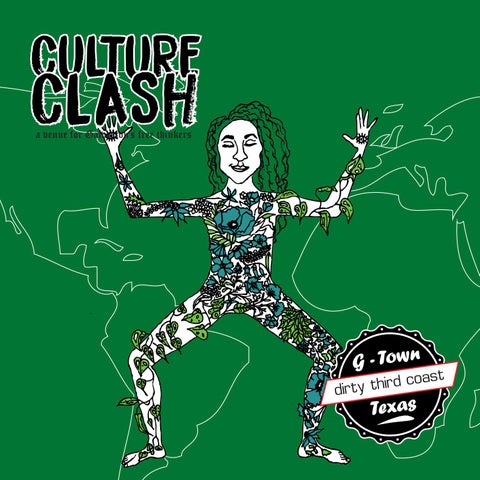
ON THE COVER: GODDESS OF THE LEAVES by Justine St. Cyr. “Goddess pose benefits include building strength in our lower half, improving balance and focus, and guiding the body through childbirth. My friend Olivia’s passion for nature manifests through her spirited arguments against plastic straws, collecting trash from the dunes, and leading yoga at the water’s edge. Olivia in goddess pose embraces the essence of Mother Earth and sustainability, adorned in nature, eyes focused on making change happen as “Goddess of the Leaves.” Contact Justine 281-723-9974 • jcstcyr9391@outlook.com • Instagram: justinechloe9391 • Facebook: Justine St. Cyr (only one!) CORRECTION: Page 20 of our May/June 2019 issue; FAMILY, was given an incorrect image credit. We would like to thank the Galveston County Museum for the use of their photo. More info call Sandy Siddall 409-766-2340 *This magazine is NOT printed on recycled paper or with soy-based inks YET! But we are working on it. Help us get there, advertise or sponsor us! Email for more details CultureClashGalveston@gmail.com. 4
C U LTU R EC L A S H G A LV E STO N . C O M • S E P T/O CT 2 0 1 9
table of contents Vol. 2 Issue 6 (Sept/Oct 2019)
CULTURE
CL AS H magazine
FEATURES
7
16 Climate Change
PUBLISHER Janese Maricelli-Thomasson LAYOUT & DESIGN JanMar Agency
20 Resiliency and Restoration 27 People of Galveston
EDITORS
DEPARTMENTS Be A Better Human
Valerie Fullen • Pat McGrew Leslie Whaylen
10
7 Cleaning Galveston 8 Seeding Galveston 10 The Final Straw
Express Yourself 12 Island Minded 14 Service of Sargassum
CONTRIBUTORS
14
Bianca Broman • Paige Breon Amy Caton • John Embesi • Julie Salinas Grace Sims • Joanie Steinhaus
MAKE A CONNECTION
For ad rates or personalized marketing strategies, call us at 409.502.8221
CHECK US OUT
Coolture 24 What Brings You Joy? 27 Pulse Calendar of Events
24
CultureClashGalveston.com facebook.com/CultureClashMag cultureclashgalveston@gmail.com ANNUAL SUBSCRIPTIONS Please mail check payable to JanMar Agency 1625 23rd St., • Galveston TX 77550 In the amount of $24 Note “Culture Clash” in memo line
GET READY FOR THE NEXT ISSUE!
C U LTU R EC L A S H G A LV E STO N . C O M • S E P T/O CT 2 0 1 9
5
Photo courtesy of Surfrider Foundation, Galveston Chapter
be a better human
Caring for the earth and the environment comes in many forms. Do your part, get involved. Many beach clean-ups are held each year by numerous organizations. Check out Turtle Island Restoration Network or Surfrider Foundation for events calendar.
6
C U LTU R EC L A S H G A LV E STO N . C O M • S E P T/O CT 2 0 1 9
Cleaning Galveston and Ocean Pollution
CULTURE CLASH (Be a Better Human)
ACCORDING TO RECENT ESTIMATES, OVER 8 MILLION TONS OF PLASTIC ENTER OUR OCEANS EVERY YEAR. Over 150 million metric tons of plastic currently circulate our oceans. The United Nations stated during a General Assembly high-level meeting that we have until 2030 to prevent irreversible damage from climate change.
Press Release by Ocean Mountain Project Hundreds of thousands of whales, sea turtles, fish, sharks, and seabirds die each year from ingesting plastic. Species that have been inhabiting the earth for millions of years are going extinct at an alarming rate.
Austen graduated from Texas A&M University at Galveston with a B.S. in marine biology in 2016. “After graduating college, I didn’t know exactly what I wanted to do with my degree. Galveston was my first home. The community gave me so much joy and happiness. All I wanted to do was to give back to Galveston. I wanted to teach others about ocean pollution, but I didn’t know where to start. That’s when I got the idea for MOP. The rest is history.” MOP recently partnered with Texas A&M University’s engineering program called Capstone. The Capstone experience bridges the gap between classroom and industry, offering senior engineers the opportunity to gain industry experience before graduating college. Over 70% of ocean pollution is sourced back to streets, sewage lines, storm drains and waterways. MOP engineered a device that aims to end the main source of ocean pollution. Their prototype has already proven their concept. Their design uses C U LTU R EC L A S H G A LV E STO N . C O M • S E P T/O CT 2 0 1 9
Austen Anderson
no energy, doesn’t interfere with natural wildlife, and in theory should mitigate flooding. MOP also recently joined forces with Seeding Galveston. Together they plan to provide easy curbside services to Galveston homes to reduce waste through composting and recycling. Businesses and residents can register online at mountainoceanproject.org/ zerowastegalveston. You can also sign up for beach clean ups, get free guides on how to recycle in Galveston and Houston, and receive a free business consultation on how your business can become more green. Austen often quotes one of his biggest idols, Andy Irons, “You’re always a better person when you come out of the water.” Surfing has given him a passion and a community he loves. Together Galveston can become a cleaner place for all of us to enjoy for years to come. 7
Photo courtesy of Mountain Ocean Project
Mountain Ocean Project (MOP) is a local ocean conservation organization established in Galveston. MOP’s mission is to educate and invest in the local community of Galveston and to stop ocean pollution. This local movement was founded by Austen Anderson, a local surfer. Ever since he caught his first wave next to Pleasure Pier back in 2011, he knew he had found his life’s purpose.
CULTURE CLASH (Be a Better Human)
Seeding Galveston Growing Community, Culture, and Economy By Grace Sims IT’S A WARM THURSDAY MORNING AS I PULL UP TO SEEDING GALVESTON ON 33RD AND AVENUE N. The sun hasn’t fully come out yet. Seeding Galveston co-founder Debby, who will be giving me a tour of the farm, warned me to come by before it gets too hot. I’m excited to see the turkeys, goats, and chickens that live there, but I’m a little nervous about the tour. I don’t know the first thing about gardening, farming, or what composting even really is. I’m a city girl, and it shows. I approach Debby, who is bent over a garden bed she tells me is home to a melon plant. I’ve never seen a melon plant before. Then I meet John, who is also co-founder of the program and who, like Debby, can be found working
on the farm or talking to folks about the garden. “These are the turkeys,” Debby says, leading me over to a pen. “Standard brawns,” John adds. “The most popular commercial turkey until 1840. It’s a very hearty bird, but commercially it was just eclipsed by the broad-breasted turkey.” He explains how certain breeds of chickens and turkeys became more widely used because of excess meat and higher egg-laying rates. We walk over to three large piles of compost. One has recently been added to, with pineapples, carrots, and melon peels resting on the surface. “Here are various stages of our compost system,” John says. He walks me through the composting process--what he calls the “lasagna method”-- which involves alternating layers of carbon and nitrogen-rich materials, turning the pile, and once it reaches a certain temperature and level of decomposition, sifting it and using it as soil. “There are different schools of thought on the right ratio of carbon to nitrogen,” John explains. “Basically, green is nitrogen and brown is carbon. Hay and leaves are the carbon. If the pile is all nitrogen [material], it just sits there and gets really putrid. I’m not a chemist, so I mostly just go by the feel of it.” Put simply, a successful compost system allows microorganisms to break down waste materials and produce a nutrient-rich “humus.” These microorganisms emit carbon dioxide and heat during a process known as aerobic respiration. “Turning” the compost pile gives the microorganisms the oxygen and moisture they need to survive. John and Debby gather compost materials from a variety of sources here on the island, including from the farm itself. “Right now, the majority of the compost materials are coming from UTMB’s food service Morrison,” John says. He
8
C U LTU R EC L A S H G A LV E STO N . C O M • S E P T/O CT 2 0 1 9
CULTURE CLASH (Be a Better Human) points to the stacks and stacks of buckets sitting nearby the compost piles. “All of these buckets that we just poured on here we got last night. We pick up [from UTMB] on Wednesdays and Fridays.” Debby adds, “We get between 35 and 50 or more [buckets] a week. And we have a lot of locals who drop off compost too, as well as Central Methodist Church. They have a program on Sundays where they provide us with compost materials.” In addition, plant material pulled from the beds on the farm are added to the compost system. “Almost everything that is pulled--the vines and stalks and stems--will be put into the compost,” John tells me. “It’s almost a closed system in a way, except the only part that’s not closed is that we don’t seed-save a lot here.” John and Debby walk me through the basics, like what the difference between raised beds and non-raised beds is and the meaning of “seed-saving.” My relative ignorance about farming, gardening, and sustainability only confirms the lack of interest and knowledge about these things, especially among younger generations, that Debby and John are trying to change.
Photos courtesy of Seeding Galveston
“As we move more into our technological spiral, we’re finding people want to do things on the computer more and do less with their hands,” John says with a sigh. “It’s really becoming a challenge to interest young people in actually physically farming and gardening. John and Debby are trying to encourage people just like me to forge connections with where their food is coming from, how it is produced, and who is producing it. They formed Seeding Galveston for those of us who don’t know the first thing about urban farming or eating locally, who need a place to get their questions answered.
Success for John and Debby (and everyone else involved in Seeding Galveston) looks like new micro-farms popping up all over the island, people eating locally, and the community growing through conversations about food. The best ways for residents to get involved and support Seeding Galveston are to come to markets at the farm (held weekly on Wednesdays and Saturdays), volunteer, donate to the program, and set up gardens themselves. Debby and John urge anyone new to gardening and farming to visit them for assistance. “We never turn anybody down for anything we can offer,” John explains. “Whether people need compost, seedlings, information, or support - that’s why we’re here.” Debby and John want to create a lasting impact on the island long after Seeding Galveston is gone. “When we’re run out of business by other farms that we’ve produced or inspired, then we’ve done our job,” they tell me. “And hopefully it will be within the next ten years. That’s what our goal really is. This isn’t for our retirement fund. As a matter of fact, it costs money to run this place. In the end, we’ve accomplished our mission if there are three hundred garden beds around the island, if there’s a dozen small market farms just in backyards that are represented at the farmers’ market or little stands that people open up on their block once a month.”
John explains the mission of Seeding Galveston, which he says consists of three pillars: economy, community, and culture. “We want to develop an economy, a real one you can make money from and spend that money,” he says, “and community. We’re already seeing the benefits of that aspect. Friends and contacts are being made through this process: through eating, through the market, through gardening. Culture is our third pillar. Getting people thinking and talking about food--food grown on the island, how they grow it themselves. We want conversations happening at the bar or a ball game or after church, where people ask each other, ‘What are you growing?’ and ‘Have you tasted this?’ We want to change the food culture; to make it relevant.” C U LTU R EC L A S H G A LV E STO N . C O M • S E P T/O CT 2 0 1 9
9
CULTURE CLASH (Be a Better Human)
The Final Straw By Joanie Steinhaus, Program Director of Turtle Island Restoration Network, Gulf of Mexico THE FACTS ABOUT SINGLE-USE PLASTIC STRAWS: • average lifespan is less than 30 minutes • Americans use 390 to 500 million single use plastic straws per day - enough to wrap around the earth 2.5 times • plastic straws take 200-500 years to decompose • plastic straws are not recyclable in many areas
Photo from Shutterstock.com
Turtle Island Restoration Network (TIRN), an ocean conservation group in Galveston, is joining a worldwide movement to protect the environment from an increasingly urgent threat: single-use plastic in our ocean! TIRN launched ‘The Final Straw Galveston’ to eliminate a source of singleuse plastic pollution by encouraging businesses and individuals in Galveston to go plastic-straw free. Single-use plastic has a devastating impact on our environment, our ocean, and ultimately— human health. “The Final Straw Galveston” is an opportunity for local businesses and individuals to be leaders in our community and help protect our environment.
someone else will save it,” said owner Robert Swan. “We are only one business, we can not do everything, but we can do something.”
The Final Straw Galveston provides registered businesses with resources to help them transition away from single-use plastic straws, including the option to purchase reusable straws. TIRN will issue signs to participating businesses that indicate they joined the movement. A map of participating businesses—several of which are already listed—will be available on TIRN’s website.
In March 2019, Galveston’s City Council unanimously passed a resolution encouraging restaurants to withhold plastic straws unless customers specifically ask for them. The resolution also encourages businesses to offer straws made of paper, plant fiber, or other material more biodegradable than plastic. “The City Council of the City of Galveston gives its strongest recommendation to all those entities in the food and beverage industry to refrain from providing plastic straws and/or stirrers to their customers except on their specific request,” the resolution states.
Many bars and restaurants in Galveston are already setting the example of what it means to be a sustainable leader in our community, and it’s as simple as only offering straws by request. By doing so, your establishment will be part of the solution. Among participating businesses is the 23rd Street Station Piano Bar, which has pledged to discontinue the use of straws completely. “The greatest threat to our planet is the belief that
Turtle Island Restoration Network invites all businesses and individuals in Galveston to be part of the movement to eliminate single-use plastic straws. To register your business for The Final Straw Galveston or to take the pledge to end your use of single-use plastic straws, visit www.seaturtles.org/the-final-straw.
10
C U LTU R EC L A S H G A LV E STO N . C O M • S E P T/O CT 2 0 1 9
Our island is majestic. We each experience the earth in our own unique way. Here, photographer John Embesi showcases sand dunes painted with sunflowers, capturing the island’s splendor.
express
C U LTU R EC L A S H G A LV E STO N . C O M • S E P T/O CT 2 0 1 9
Photo courtesy of John Embesi
Yourself 11
CULTURE CLASH (Express Yourself)
Island Minded Story and Images By Amy Caton I AM A 10-YEAR VETERAN, IBC GALVESTONIAN AND STILL EAGERLY EXPLORING AND BRINGING STORIES BACK TO MY CHOSEN COMMUNITY TO SHOW US ALL HOW LARGE, DIVERSE, AND EXCITING OUR OWN BACKYARD CAN BE. I am writing this from an adventure along the Texas Coast finding new stories and learning about the ways we help and hurt our environment along the way. But this is not a story of only beautiful scenery and luscious Texas vistas; this is a story of diesel exhaust, trashy highways, and polluting industries. 12
My daughter, dog, and truck (loaded with camping supplies) are all I have along the 832-mile, round-trip drive from Galveston to South Padre Island. We hit the highway and, along the first few miles, I think about how Texas ranks #1 in road mileage of any state in the U.S. with 314,319 miles of roads crisscrossing our state. That’s a lot of asphalt, but it provides paths in almost any direction I want to go; and so through the marshes and coastal prairie we travel along with hordes of sedans and trucks that thin as we leave the Greater-Houston Area and wind our way into C U LTU R EC L A S H G A LV E STO N . C O M • S E P T/O CT 2 0 1 9
CULTURE CLASH (Express Yourself) the wild coastline of the Padre Island National Seashore (PINS). I have memories of driving away from the South Houston area toward Galveston and watching the air become clear as we emerged from a fog of pollution; I am grateful for the coastal breeze creating about 20 miles of clear air between me and polluted air from industry and transportation. We arrive in PINS and promptly lose cell phone reception as we travel just part of the 70 miles along the longest stretch of undeveloped barrier island in the world. Idyllic warm beaches, clear waters, constant sea breezes, hyper-saline lagoons, sea turtle nests, and rolling prairies encourage us to think about how it felt to be a Native American or Spanish explorer discovering this haven. It’s hard to not compare this beach with our own, and find ours lacking due to tourism, erosion, port industry, and particulates in the currents from the merging Gulf of Mexico with the Mississippi Delta flow past our beaches and muddy our waters. The Galveston Bay Report Card and the many scientists working to monitor our waters are doing a great job, but this water and beach further south on the Texas coast are breathtaking. I stand in knee-deep water along with a collection of other travelers, all of us marveling at our toes wiggling in the clear water below and find myself sharing this knowledge about particulates, report cards, and conservation efforts with Texans that only know Galveston as a “kind-of dirty city with a brown beach and nice downtown”. Feeling I have vindicated Galveston, we packed camp wishing other travelers well and head to South Padre Island to discover the vast differences human habitation can make from one island to another.
C U LTU R EC L A S H G A LV E STO N . C O M • S E P T/O CT 2 0 1 9
Driving the first four miles of South Padre reveals the tourism of parasailing, riding surreys, dolphin tours, and an explosion of hotels with garish neon lights every 30 feet but no beaches in sight. Undeterred by the gross advertisements and street trash, we make our way to Sea Turtle Inc. and are utterly impressed when we learn about their sea turtle rescue, rehabilitation, and education efforts. On the road again, we head NE to Galveston travelling with a troop of work vans, 18-wheelers, and an army of pickup trucks - a cloud of exhaust trailing behind. Our last leg took us straight through the largest chemical complex in the Western Hemisphere in Freeport, which is rather soul crushing if you are looking to enjoy Texas nature and scenery. Before we could get one last glimpse of the coast traveling east toward the San Luis bridge and home to Galveston, we had to endure a teeming city of pipes, stacks, tanks, and the legion of plant workers keeping it all going. I wonder if this is one of the sources of the small, round, plastic balls (aka Nurdles) that we find by the thousands in our waters? Our journey showed us the diversity of our coast from perfect isolation and natural environments to crushing tourism and industry. And that was just one path which makes me wonder what direction we should go next and where your path might take you. Would we be awed by a different type of natural beauty, meet travelers with insights and adventures, encounter wildlife? Would we also find trashy cities, ignorant people, rehabilitation centers, and sprawling industrial complexes? I’d like to think that Galveston and our community are always working toward a sustainable balance with sanctuaries for all types of people. I hope you travel widely, explore wildly, and become an ambassador of Galveston to other Texans and the world.
13
CULTURE CLASH (Express Yourself)
The SERVICE of Sargassum
Photos from Shutterstock.com
By Paige Breon, Intern, Turtle Island Restoration Network
IF YOU LIVE IN GALVESTON OR HAVE VISITED OUR ISLAND OVER THE PAST DECADE, YOU MOST LIKELY HAVE HAD AN EXPERIENCE WITH SEAWEED. Even though it sometimes disrupts our surfing, swimming, or beach activities, seaweed is a very valuable resource for wildlife. When seaweed is removed, the beach atmosphere changes, leaving many animals and plants without a place to live and eat. Sargassum is on our beaches; the brown or dark green macroalgae that floats on the surface of the ocean and is carried in with the tide. If you look closely, you are able to see its leafy structure with many branches and circular balls. The balls are gas-filled with oxygen, which helps the plant with overall buoyancy and the ability to float on the surface. Each year, during late spring and summer months, large mats can wash up along the Gulf of Mexico’s coasts. These mats come from the Sargasso Sea in the North Atlantic Ocean, which is surrounded by four ocean currents. Many species call sargassum home, including sea turtle hatchlings, fish, shrimp, crabs, and more. Most blend in with the sargassum, their bodies camouflaging. 14
Birds of all kinds search the sargassum for these species to eat. Sea turtle hatchlings fight for their life trying to make it to these sargassum mats, and after arriving, it becomes their habitat for the next few years. While in these mats, these species not only receive protection but food as well. After a couple years of floating, sargassum mats lose their buoyancy and sink to the bottom of the ocean, becoming food for animals in the deep. The sargassum also washes ashore through currents and wind. Once on the beach, its seeds and nutrients contribute to dune plants. This vegetation is an important aspect of the shoreline, because it protects against storm surges and flooding. Having sargassum on beaches is great for beach combing, or searching the beach for items. The wrack line is the line of debris left on the beach by high tide, it is filled with sargassum, debris, and possible ocean treasures. Here you could find shells, sea beans, organisms and maybe even valuable items that were lost at sea. If we remove this sargassum, we are removing wildlife, nutrients, and the potential for a safer coast. Protecting our shoreline and the species that live here has become our responsibility. We need to learn to give, or let be, instead of take. Next time you’re out on the beach, I hope you will be able to see the value of sargassum, the floating ecosystem within our oceans and bays that brings many positive benefits to Galveston island for both humans and wildlife. If you encounter sargassum, pick it up, shake it out, and discover the wonders of this complete ecosystem! C U LTU R EC L A S H G A LV E STO N . C O M • S E P T/O CT 2 0 1 9
CULTURE CLASH (Express Yourself) Helps to reduce frizz. Great treatment for sun exposer. Perfect for curly hair. Now at ATMOSPHERE THE SALON
1221 23rd St. • Open Tues. - Sat. AtmosphereTheSalon.com 409-750-9810
OPEN Mon-
Thurs
FriSun
d Name Bran en King & Que Mattresses
$199
Queen Size Bed Frames & Night Stand with Mattress & Box Spring $699.00 Queen Size Adjustable Frame & Mattress $699.00 Sofa Sets with Free Tables $599.00 Dining Room Tables $299.00
2pm-2am 12pm-2am
with the
BEST HAPPY
HOUR
Downtown
Mon-Fri
C U LTU R EC L A S H G A LV E STO N . C O M • S E P T/O CT 2 0 1 9
FREE DELIVERY OR PILLOW!
(832) 614-5983 15
CULTURE CLASH (FEATURE)
16
C U LTU R EC L A S H G A LV E STO N . C O M • S E P T/O CT 2 0 1 9
CULTURE CLASH (FEATURE)
CLIMATE CHANGE By Grace Sims
CLIMATE CHANGE IS A GROWING CONCERN IN OUR SOCIETY, SPURRED BY RISING TEMPERATURES, DEVASTATING NATURAL DISASTERS, CATASTROPHIC PREDICTIONS, AND COUNTER-PRODUCTIVE ENVIRONMENTAL POLICIES ENACTED BY PRESIDENT TRUMP IN RECENT YEARS. Climate change deniers exist among us, including Texas Senator Ted Cruz. According to the Texas Tribune, Cruz stated in 2015 that “global warming alarmists are the equivalent of the flat-earthers.” In effect, he was comparing a phenomenon recognized by 97% of scientists with the beliefs held by a small group of conspiracists.
Dr. David Retchless identifies some of the immediate physical effects climate change will have on Galveston: more days of nuisance flooding (defined by NOAA as “flooding that leads to public inconveniences”), more damaging hurricanes, and, of course, hotter weather. “Many people look at how the averages will change,” he says. “[For example], the average annual temperature will be 2 degrees higher, or average sea level will be 9 inches higher. But they don’t think about the extremes — the hottest days will be hotter and there will be many more of them, and the most extreme flood events (like Harvey and Ike) will become more common.” The shrinking of beaches is another threat to island life as we know it. “Galveston island beaches are particularly vulnerable to high rates of erosion, leading to a long-term loss of beaches,” warns Dr. Meri Davlasheridze. “Some studies indicate the majority of Galveston beaches could disappear within 20 years without continuous beach nourishments. Projections along the west of the island indicate beaches could be fully lost by 2035.” C U LTU R EC L A S H G A LV E STO N . C O M • S E P T/O CT 2 0 1 9
17
Photo courtesy of David Mark Erickson
Although a significant disparity exists in agreement between Democrats and Republicans on climate change—a divide that Texas A&M University Galveston Professor Ashley Ross says has “only grown in recent decades,” her research reveals this gap is much lower in coastal communities such as Galveston island. So what exactly is the outlook for our beloved island? Culture Clash spoke with four professors in the Department of Marine Sciences at Texas A&M University Galveston about the implications of climate change for the island.
Photo courtesy of CBS News
CULTURE CLASH (FEATURE)
Galveston Flooding 2017
Planning for these changes falls upon individuals, companies, and local government. Retchless states “persons on the island need to think about climate change when making any large, long term investment.” Potential homeowners should consider future flood risks and the availability of insurance in the years and decades to come when deciding whether or not to buy. In addition, Dr. Retchless explains how Galveston’s tourism and retail sectors will have to anticipate lost revenue due to increasing occurrences of flooding. On a larger scale, local government must account for how the effects of flooding and natural disasters on individuals and businesses will, in turn, impact the city’s tax base. City officials will have to balance increased infrastructure maintenance costs with other expenses such as amenities needed to support tourist traffic and new projects designed to reduce flooding.
Risks within the 100 year storm surge are clear and easily measured through both historic surge depth and modeled inundation. 350,000 people live within 25’ of sea level and experience a gradient of storm surge.
Rendering Provided by SWA Group
18
C U LTU R EC L A S H G A LV E STO N . C O M • S E P T/O CT 2 0 1 9
CULTURE CLASH (FEATURE) Amidst these ever-expanding issues and risk factors—which only begin to scratch the surface of what awaits us locally and globally if climate change is not swiftly and dramatically checked—it becomes clear that simply mitigating the effects of climate change is comparable to patching holes in a sinking ship. Slowing the progression of climate change will only result from changed behavior on the part of individuals, as well as policy changes on the national and international levels. What can everyday people do to help slow climate change? It is easy to overlook the power we hold as individuals, consumers, and citizens, but the impact we can make is our greatest hope for saving the planet. For starters, voting for representatives who support environmentally friendly policies can help to reduce pollution on a larger scale. There are also everyday changes people can incorporate to dramatically reduce their emissions. An article published by the Guardian in 2018 reported “avoiding meat and dairy products is the single biggest way to reduce your environmental impact on the planet, according to the scientists behind the most comprehensive analysis to date of the damage farming does to the planet.” In addition to going vegetarian, vegan, or simply cutting down your consumption of meat and dairy, you can reduce your carbon footprint by choosing to buy clothes from sustainable fashion brands or secondhand from up-and-coming companies like ThredUp.com and Rent the Runway. A recent CBS article stated that “Total greenhouse gas emissions related to textiles production are equal to 1.2 billion tons annually -- more than those of all international flights and maritime shipping trips combined.” The fashion industry is among the most damaging to the environment, and changing our shopping habits is one of the most simple and affordable things we can do for the planet. Fossil fuels are a more notorious culprit of pollution, making up approximately three-quarters of the United States’ carbon emissions, according to the Natural Resources Defense Council. We can cut down on our use of these pollutants by carpooling, planning out errands in order to drive less, choosing to buy fuel-efficient cars, or using other modes of transportation like walking or biking. Finally, the “3 R’s” that we are all familiar with—reduce, reuse, recycle—can and should become a part of our daily routines. In order to make an even greater impact, we can now extend these to “6 R’s”: rethink, refuse, reduce, reuse, replace, and recycle. Although recycling is certainly beneficial in lowering emissions, the process does create a carbon footprint of its own, so it is important to incorporate other practices as well. For more information on the “6 R’s,” visit ProsperousWayDown.com/6rs. Of all the ways we can harm our planet, believing that as individuals we are helpless in saving it—and therefore giving up on making changes—is the most dangerous act of all. Every effort is important and impactful.
C U LTU R EC L A S H G A LV E STO N . C O M • S E P T/O CT 2 0 1 9
Galveston ECO Center 702 61st Street | Mon. - Sun 8 a.m. - 4:45 PM Now offering 24 hour drop-off!
Refrigerators, Air Conditioners (Must Remove Compressor) Stoves, Washers, Dryers, & all other Appliances Bottle Glass Only • All Types of Paper • Cardboard All Scrap Metals • Aluminum 5 Tires per Week – Proof of Residency Required Used Gas, Used Oil, and Antifreeze Printer Ink Cartridges 1-9 Plastics except #6* Computers and All Electronics – Proof of Residency Required Automotive Batteries and Rechargeable Batteries All Styrofoam (Please Remove all Food) Cell Phones HOME COLLECTION OF RECYCLABLES TO ELDERLY AND DISABLED RESIDENTS.
SCOPE THE SOURCES: https://www.cbsnews.com/news/ earth-day-2019-fashion-industryscarbon-impact-is-bigger-than-airlineindustrys/ https://www.nrdc.org/stories/fossilfuels-dirty-facts https://www.theguardian.com/ environment/2018/may/31/avoidingmeat-and-dairy-is-single-biggest-wayto-reduce-your-impact-on-earth https://www.texastribune. org/2015/03/24/ted-cruz-texastribune-interview/ https://oceanservice.noaa.gov/facts/ nuisance-flooding.html http://prosperouswaydown.com/6rsmaking-sustainable-impact/ 19
CULTURE CLASH (FEATURE)
Resiliency and Restoration Amidst an Environmental Crisis PLANTING SEEDS FOR A FUTURE OF HOPE By Bianca Broman, Texas A&M University at Galveston
AS SCIENTISTS ARE CONTINUOUSLY EVALUATING THE VITAL SIGNS OF OUR EARTH, THE DIAGNOSES ARE COMING BACK LESS AND LESS PROMISING IF WE CONTINUE OUR SOCIETY’S WAY OF LIFE IN THIS UNSUSTAINABLE DIRECTION.
Photo from Shutterstock.com
So, we’ve all heard it before – climate change. There are seemingly endless lists of negative ramifications that are the result of human perturbation on natural ecosystems including the alteration of land use in physical and chemical ways. Due to anthropogenic activity (industrialization, coastal runoff, nutrient loading, greenhouse gas emissions, deforestation, pollution, etc.), we as a global society are experiencing declines in water quality, air quality, endangered species populations, and rainforest coverage, with accompanying coral reef degradation and accelerated rates of ice caps melting. Now, many species are vulnerable and at risk due to these changes – polar bears, bees, tigers, sea turtles, panda bears, and more. Oftentimes, when light is shed upon these issues, it is in the context of loss – lost ecosystems, lost species, lost habitats, lost resiliency. We rarely hear these sensitive subjects discussed in terms of gain, a concept we as a society seem obsessed with. 20
C U LTU R EC L A S H G A LV E STO N . C O M • S E P T/O CT 2 0 1 9
CULTURE CLASH (FEATURE)
C U LTU R EC L A S H G A LV E STO N . C O M • S E P T/O CT 2 0 1 9
Photo courtesy of CBS News
So, do we stand to gain anything amidst this environmental crisis? Well, nothing good. There is more and more evidence to suggest that as we cross this threshold into a new ecological regime, we will gain more and more harmful algal blooms (HABs) and massive algal blooms in riverine systems and in the ocean. There is already evidence suggesting these massive Sargassum (seaweed) blooms impacting and inundating the Caribbean Islands at increasing rates per year could be the result of nutrient inputs from the Amazon River basin, as a result of land use conversion and deforestation. Eutrophication, which is characterized by an excessive development of seaweed and algae as a result of pollution of groundwater and river water by nitrate or phosphate, is a slow process which has a deferred character, meaning it could take several years for a drop of nitrate to seep into the soil and find its way into a river. The effects of deforestation on the continental nitrate and phosphate inputs can be felt years later. So, as we lose the gemstones of rainforests and coral reefs, we gain nuisances such as seaweed and algae. Unfortunately, we also stand to gain more and more plastics pollution, as plastic production continues, which research has found to be extremely harmful to marine life. Lastly, as industrialization increases to accommodate population growth, the increase in impervious surface (concrete) will lead to more intense flooding in the future. 21
CULTURE CLASH (FEATURE) Okay, so we know the problem – we stand to lose so much and there’s nothing good to be gained by ignoring these cries for help from our Mother Earth. But what can be done? It seems as though so many individuals these days have adopted a mindset of complacency and indifference. “Okay, but so what? There’s nothing that can be done – this is just how things are” or “The earth can handle it,” or “It’s over my head and it’s not really my problem” or my personal favorite, “We can’t ban plastic bags because grocery stores will suffer.” These mindsets are dangerous to the future of our societies, and at their core the arguments are rooted in hopelessness, or indifference. First, a mindset shift will be required. Individuals must adopt a mindset of hope and awareness in order for anything to get done.
Photo from PeeblesShireNews.com
So here, in spite of all of this doom and gloom, I aim to offer a vision of hope and confidence with the intention of raising awareness within individuals who are reading this magazine. We often forget that we are nature. When we have lost a connection to nature, we have lost a connection to ourselves. We must reconnect to nature, and to ourselves. Imagine lots of little people taking action in lots of little places. Then, eventually, BIG change would take place. Here, I offer what I consider to be necessary from both a planning and management perspective, as well as for individuals. INDIVIDUALS
- Greener urban planning - Investment in land restoration initiatives - Tree planting and reforestation efforts - Conservation and preservation of greenspace - Ban deforestation (Norway did it!) - Stewardship of watersheds in land planning - Ban single-use plastics - Invest in renewable energy
- Recycle plastics and nonbiodegradables! - Use your reusable bags at the grocery store - Keep a garden - Plant a tree (or two!) - Pick up garbage when you see it - Reusable cups for coffee and drinks - Say no to single-use plastics! - Buy from eco-friendly companies
Photo from Shutterstock.com
MANAGEMENT & PLANNING
22
Some of these suggestions may seem radical or require a shift in lifestyle, but doesn’t Mama Earth deserve our efforts, after she sustains us so much? The Earth has an incredible ability to restore itself and restore ecosystems, just as we can recover from broken bones and scraped knees. We must never grow complacent or hopeless, and we must never become indifferent to these issues. Rather, we must love Mother Earth, respect her, honor her, and protect her. We must plant these seeds of hope and restoration today, so that future generations can enjoy the fruits of our efforts. We must believe that every little effort counts. C U LTU R EC L A S H G A LV E STO N . C O M • S E P T/O CT 2 0 1 9
C00LTURE
FEATURED ARTIST:
JOHN EMBESI
“Untitled” Digital Photography
CONTACT THE ARTIST AT JEMBESI@YAHOO.COM
C U LTU R EC L A S H G A LV E STO N . C O M • S E P T/O CT 2 0 1 9
23
CULTURE CLASH (Coolture)
CHRISTUS Our Daily Bread is a day shelter that provides meals, clothing, and counseling services to homeless individuals in Galveston. Over this past summer, occupational therapy students from the University of Texas Medical Branch (UTMB) visited the facility weekly to provide therapy services and promote social engagement.
WHAT BRINGS YOU JOY ?
Given the therapeutic benefits of the arts, the students hosted an open studio event at the shelter, encouraging adults at every skill level to depict the things that brought them joy, or images or memories of things that have carried them through tough times. The primary objectives behind this project was to help reestablish a sense of ownership, reinforce selfefficacy, and to promote community engagement amongst this population. However, it was not until the artists were immersed in this experience that the students learned for themselves that the workshop also provided an opportunity for sincere, personal expression. Many of the artists opened up about very real and intimate human experiences, and some of the artworks have even been dedicated to lost loved ones. 24
Thanks to the support of the Galveston Arts Center (GAC), all of the work that was created during the open studio event is now exhibited at GAC August 24th, through the month of September. C U LTU R EC L A S H G A LV E STO N . C O M • S E P T/O CT 2 0 1 9
CULTURE CLASH (Coolture)
PEACE OF MIND – Courdell Middleton “I created this work of art by setting my mind free from everything that I can’t control and the thoughts I had as a little kid growing up. I learned that if you clear your mind, you can make better decisions in life. My favorite part of this piece is the sun. While making it, I was surprised that it came out so good. (I) Need to start doing (art) more often.”
BEGINNING – David McLaurin “I created this artwork by choice, and I learned while creating it that it’s okay not to finish. My favorite thing about this painting are the colors. Something else I want to share about this artwork is that I really liked the sun. I was surprised that it looked okay when I made it.” C U LTU R EC L A S H G A LV E STO N . C O M • S E P T/O CT 2 0 1 9
WONDERFUL – Jovboy Robinson “ I learned that I could paint while creating this painting. While I was making it, I was surprised that it felt like a creation. My favorite part of this (painting) is the sky.”
BE CAREFUL, JAWS! – Anonymous “I used to paint and did wood shop in high school, so it was nice to be able to sit and paint again.” 25
CULTURE CLASH (Coolture)
SHADES OF VONSHA – LaQuita Jones “ While creating this, I learned that I could start over and over on the same canvas. My favorite part was working in the different colors. While making it, I was surprised that it turned out the way it did. I have learned that I can be creative and that art can be fun. Creating the art made me feel expressive and I enjoyed doing it. Something else I want to share about this artwork is (that) my good friend of many years passed away on July 4th 2019, and I wanted to express her personality – she was awesome. My inspiration comes from Vonsha’s death.”
DEEP SEA – Heriberto Salazar “My favorite part about this is having everybody look at it. If I could change something about this artwork it would be to add more to it. While making it, I was really surprised that everybody liked it. Something else I want to share about this artwork is that I have never painted before. I was learning how to paint while creating it.”
BREEZY – Rene Quino “I like spending time on the Seawall. My favorite part of this painting are the trees. Something I want to share about this art piece is that I am from Guatemala – we have a lot of beaches too.”
26
MOUNTAIN VIEW – Robert Laymance “My favorite part of this was painting the tree. This is somewhere I wanted to live.”
C U LTU R EC L A S H G A LV E STO N . C O M • S E P T/O CT 2 0 1 9
pulse
CULTURE CLASH (Coolture)
SEE ART JOHN EMBESI
Sept. - Oct. 2019 Calendar of Events
September Artist Boat Kayak Adventure: East End Lagoon Sunday, September 1, 2019 8 AM - 10 AM East End Lagoon Admission: $25 - $50 ADOPT-A-BEACH SPRING CLEAN UP Saturday, September 21, 2019 11:30 AM - 2 PM Soundbar, 2411 Mechanic St. Admission: Free Seasonal Sunrise Labyrinth Walk: Autumnal Equinox Monday, September 23, 2019 7 AM Beach Labyrinth 17th & Seawall Blvd. Admission: Free The Art of Saving Sea Turtles Sunday, September 29, 2019 6 PM The Bryan Museum Admission: $100
C U LTU R EC L A S H G A LV E STO N . C O M • S E P T/O CT 2 0 1 9
“Untitled” 2014 Digital Photography SEE MORE NOW jembesi@yahoo.com
October Galveston Island Greek Festival Saturday, October 12-13, 2019 12 AM - 6 PM & 11 AM - 8 PM The Assumption of the Virgin Mary Greek Orthodox Church 714 19th Street Admission: Free Family Day at The Ocean Star: Sources of Energy Saturday, October 12, 2019 10 AM – 3 PM Ocean Star 1900 Harborside Dr. Admission: TBA
Drink up FLOWING LAVA
Banana schnapps, coconut cream, pineapple juice and light rum. Topped with passion fruit and a splash of grenadine with a cherry on top!
Get in NOW at Coastal Grill 1827 Strand St.
ARToberFest Saturday, October 19 - 20 10 AM - 6 PM & 11 AM - 5 PM Postoffice Street, between 20th & 23rd Streets Admission: $5 Witch’s Ball Saturday, October 26, 2019 8 PM – 1 AM Galveston Scottish Rite Cathedral, 2128 Church Street Admission: $85 - $100 27
e l p o e p lveston
CULTURE CLASH (FEATURE)
a g of
nion ur opi
o at is y
“Wh
on
s
Photo s and s w ie v r Inte ace Sim By Gr
Golden Zenon (below) “Climate change...I agree with it, I think we should push to save the planet. We should definitely reduce a lot of the fuels we use. I think, though, that making drastic changes [regarding environmentalism] takes a lot of money from everybody’s pockets-rich and poor. A lot of people unfortunately take time to go along with these changes.”
Andreus (above) “Climate change is a big issue. The ice caps are melting, the ozone layer is being torn apart from all the CO2 and other pollution we put into the atmosphere. Working [at the recycling center], we are able to gather plastic and other materials to reuse. Reusing the items people recycle eliminates having to remake plastics and other things, so we are taking a load off the big machinery used in production. It also keeps trash out of the ocean and landfills.” 28
e?”
ang h c e t clima
Aleyda Falcon (above) “Sometimes I feel like it’s hard to get really good, concrete information about what’s truly going on because there are so many sides to the argument. Some people are like, ‘It’s natural, the world goes up, the world goes down, temperatures and things of that nature change’ and I can see the point they’re making. The world is a really big place and it has systems for filtering and changing and it’s like, maybe we’re actually okay and [the idea of climate change] is a scare tactic to keep us in a state of fear. On the other hand, you can feel the difference when you walk outside and the sun is hotter and the water is warmer. I think climate change is happening. Some people I know will argue with me all day about how it’s not and we’re just reading into it. I think that climate change is a very scary thing that’s happening to us now. When I was younger, the big thing was, ‘Save the rainforest!’ and now that I’m older, the rainforests are basically gone. I read articles that say we’re past the point of being able to stop climate change, that we’re already there. But I disagree with that. I feel like it’s still within our ability to do something. It’s the little things we do everyday that make the difference.” C U LTU R EC L A S H G A LV E STO N . C O M • S E P T/O CT 2 0 1 9
CULTURE CLASH (FEATURE)
Chuck Carroll (above) “What’s really interesting to me is that we live in a society in which the idea of climate change is ‘ridiculous.’ Ninety-five percent of scientists claim that without question, climate change is being caused by humans. What’s scary is that there are sources who are able to argue that this isn’t a real thing--that this was a natural process that was happening anyway. Maybe some of it was going to happen anyway, but we’re perpetuating it at a rate that’s much faster. We’re seeing storms and [other events] that humankind has not recorded before.”
Alexa Conrad (left) “If people don’t start protecting the environment now, then later on it’s going to be a serious problem. We’re not gonna know how to handle it. Trump definitely does not know how to handle it.” C U LTU R EC L A S H G A LV E STO N . C O M • S E P T/O CT 2 0 1 9
29
HALLS LIQUOR
2121 45th Street • 409.763.0162 Open 10 am - 8:55 pm • Mon.- Sat. www.HALLSLIQUOR.com
Street Tacos, Tortas & Mexican Snacks! TRY OUR NEW EXPANDED
VEGAN MENU
4112 SEAWALL BLVD 409-682-6689 30
C U LTU R EC L A S H G A LV E STO N . C O M • M AY/J U N E 2 0 1 9
CULTURE CLASH (Coolture)
We We Are Are AA Marketing, Marketing, Design Design and and Talent Talent Agency Agency That Thinks That Thinks Differently Differently
MARKETING DESIGN WEBSITES BRANDING BANNERS PRESS RELEASES SOCIAL MEDIA
COLLABORATION
By Culture Clash Staff
NEWSLETTERS BROCHURES BILLBOARDS PROGRAMS MAGAZINES COMICS, LOGOS ADS, DISPLAYS COMMERCIALS
BIG CONVERSATIONS
BIG SOLUTIONS 32
409.502.8221
www.JanMarAgency.com
L ANS. HCGOAMLV• E NSTO O M2 0• 1S7 E P T/O CT 2 0 1 9 C U LTU R EC L A SCHUGLTU A LVREEC STO OV/N D. CEC