Spring 2016 6
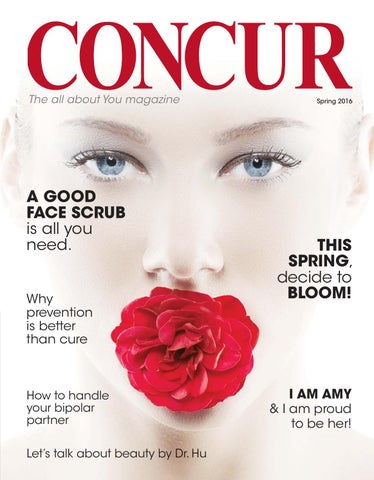
A GOOD FACE SCRUB is all you need. Why prevention is better than cure
How to handle your bipolar partner Let’s talk about beauty by Dr. Hu
THIS SPRING, decide to BLOOM!
I AM AMY & I am proud to be her!
CONCUR is a wellness magazine with a new twist. We focus on both your mind and body.
CONCUR is Here for YOU! CONCUR is not only a magazine, it’ss a ric C ich, h, div iversse, and n fun journe neyy tha hatt our rea aderrs rs get to tak a e. CON ONCU CUR R is an alllll abo out you u m ga ma azi zin ine ne It’s cre ne. eat ated d for or you, revol o ve v s around you ou, and is deliver e ed er d t loc to oca al businesse sess in you our neighborh hoo ood. CONCUR … if you believe more can be achieved in life. CONCUR … if you believe life can be better. CONCUR … if you believe you can reach your goals and live your dreams. CONCUR ... and the journey begins. CO CONCUR UR bring gs into o foc ocus us the h peo eople and d the sto tories tha at influ in fl en ence ce our u liives. Each Ea h issue is created ed d to hel elp p our rea e de ders r live e wel e l and learn morre. We briring ng current event ntts and d top opic icss tha at infl n ue uenc nce our lives ivves es most to th he local al lev e el and offer wor ords ds of wissdom ds m tha at tur u n cha halllllle enge gess int nto triu tr iump mph. CONC CO NCUR UR R hititss hom o e witth refreshing g and pos osititiv ive sto toriries e tha es hat tackkle e some of lifife’s mos ostt difficult issue es — parenting, relat atio ions nshi hips hi p , wor o k/ /lilfe balance, diet, exe xerc rcis ise, e bea e ut uty, well--being, g menta al hea alth h and more e. CONCUR UR rea eade ders rs wan antt wha h t’s best for the eir fam am millie iess and d they will find this in our ur editoririal a con o te tent nt. Rea e ch thiss tar a ge et aud die ence e whe en you partn t er with us and feature re you o r produ duct ctss and service ces in CONC CUR.
ADVERTISE WITH US Want to be a part of the action? CONCUR is a new destination for families who live life to its fullest. Our editors are devoted to providing the inspiration, ideas and guidance to help you live with confidence. From styling the perfect outfit, to parenting skills, to traveling to the best destinations, to having the hottest hair, our experts provide the information that helps the entire family. CONCUR, and the journey begins!
To advertise with CONCUR, contact Sales@concurmagazine.com Or call our sales executive, Claudia Madrigal at 832-597-6265
14
6
SPECIAL FEATURE I am Amy and I am proud to be her!
Contents Spring 2016
Read online at www.concurmagazine.com
18
26 SPECIAL FEATURE 6
I am Amy and I am proud to be her!
HEALTH 40
MENTAL HEALTH 30
How to handle your bipolar partner
OPINION 44
The toxic co-worker
STYLE 14
Your spring hair routine could use a lift
Prevention is the best treatment by Dr. Moosa
PARENTING 34 38
Ask Cynthia Childs play with purpose
DIET 18 22
The science of food addiction This spring, decide to bloom!
BEAUTY 10 26
A Good Scrub is All You Need Lets talk about beauty by Dr. Hu
4
Publisher’s Message
Spring 2016
3
W
hat makes us happy? Robert Waldinger, a Harvard psychiatrist, did one of the most interesting studies on human development. Dr. Waldinger recently gave a TedTalk on the subject. “People who are more isolated from others than they want to be ďŹ nd that they are
less happy, their health declines earlier in midlife, their brain functioning declines sooner, and they live shorter lives than people who are not lonely,� Waldinger said in his TedTalk. “Good, close relationships seem to buffer us from some of the slings and arrows of getting old.� This study challenges what humans have long thrived to gain through money, career achievements and fame. It also challenges the GBMTF USVUI XF USZ UP CVJME JO PVS NJOET PG TFMG DFOUFSFE FHP 3BUIFS JU claims self contentment should emerge from one’s ability to bond with family, friends, and society. For those who are thinking about restoring their happiness, Spring is a great time to work on your relationships. 4QSJOH GVMMZ The Publisher
Publisher and Editor in Chief Sarah Elsadre, MD Creative Design Editor Mary Bradshaw, Houston Desktop Graphics Beauty and Style Director Sarah Elsadre, MD
Sales Executive Claudia Madrigal
Photography Austin Miller
Portrait J. Pamela Photography
Web Producer Michael Mocilac
Research Editor Mona Hassan
Psychology Editor Cynthia Plymons, LPC
Beauty and Fashion Editor Bobby Wells
Fitness Editor Emilia Benton
Travel and Leisure Editor Michelle Ong
Writer at Large Patricia Gras
Bayan Raji
Hair Editor Phiet Ho
Editor at Large Tammy Adams Contributing Writers Sara Zaske Mona Hassan
Document Researcher Liz Davila Writer at Large Susan Neuhalfen
Jessica Vasquez
Read a digital copy at www.concurmagazine.com and like us on Facebook & .FEJDBM $FOUFS #-7% 8FCTUFS 59 t 5FM t 'BY Contact us at Editor@concurmagazine.com To advertise with us contact sales at sales@concurmagazine.com CONCUR Magazine does not endorse or recommend any article, product, service or information found within articles. The views and opinions of the authors who have submitted articles to CONCUR Magazine belong to them alone and do not necessarily reect the views of CONCUR Magazine or its staff. Š
4
Copyright by CONCUR .BHB[JOF BMM SJHIUT SFTFSWFE www.CONCURmagazine.com
TIRED OF BEING ON THESE?
Can’t get the results you want from them? Too many side effects?
We have a new option for you, TMS
(Trans-Cranial Magnetic Stimulation of the brain) FDA approved Covered by Medicare and most insurance plans Affordable Effective Painless Safe Available at The PsyClinic 330 E Medical Center BLVD, Webster TX, 77598
Call to schedule a consultation 281-837-MIND (6463) Or visit www.thepsyclinic.com for more information.
330 E Medical Center BLVD Webster, TX 77598 4201 Garth RD Suite 212 Baytown, TX 77521
YOU SURVIVE
I AM AMY
a nd I am Pr o ud t o b e H e r
“Getting better from depression demands a lifelong commitment. I’ve made that commitment for my life’s sake and for the sake of those who love me.” - Susan Polis Schutz
By Sarah Elsadre, MD
I
am Amy. If you have met me at the grocery store, I am the one wandering between the aisles with a sad face. I am the one spending double the time getting my shopping done because I can’t even remember what I needed in the first place! If you have met me at work, I am that clerk sitting behind the desk avoiding eye contact and not replying to your warm greeting. I am the member of your local gym that hasn’t been there for over a year! I am the member of your church that has been skipping Sundays for quite a while simply because I have no energy to get dressed to go to church. I am that PTO member that paid the fees at the beginning of the school year but has been avoiding all volunteer duties so that I don’t have to be around too many parents at once! If you watch me at home, I am the mother locking herself in her bedroom taking extra long naps, avoiding her kids’ discussions and the huge pile of never-ending laundry! If you lived your life like me, you would know very well how it feels to be depressed. You would understand why I choose to stay home on weekends and ignore all my friends’ invites. You would also understand why I never answer phone calls or color my gray roots. You would also understand why my husband and I barely carry on a conversation or go out for dinner. My life is shaped around this dark hole and I dissolve into this circle of infinite fatigue, guilt, and sadness. But a few months ago, I decided - with the help of a close friend - to give my life a second chance. I had been on anti-depressants for many, many years that I felt that they either no longer worked or my body was simply telling me enough is enough! My friend has also suffered from depression for a while. She tried a new treatment continued...
called Trans-cranial Magnetic Stimulation of the brain (TMS for short) and has been talking to me about how this has changed her life! I was skeptical about it at first until the first week of treatment when I felt a slight improvement in my energy level! For the first time in many years, I was able to get up easily in the morning and fix my kids a good breakfast! I always wanted to do that but never had the energy to jump out of bed! Then two weeks into the treatment, I started to have a different attitude at work. I no longer hate my co-workers. In fact, I can tolerate them on a daily basis now! I started smiling back at them and greeting them warmly. I even started to show interest in the topics they discussed at lunch break. On my final week of treatment, I was already falling in love with my husband all over again! I began to see the good things in him and appreciate his patience with me during my difficult time. My husband found a new wife and is really enjoying his marriage again. I found a new husband, and, more importantly, I found myself ! Today, I look back at my life and wonder; “How did I tolerate myself all this time?� It wasn’t fair to me and certainly wasn’t fair to my family. The thing about depression is that it occupies you and provides a comfort zone. It’s very difficult to break free. But once you do, you are off to a new life. Today I can say it out loud. “I am the person I lost many years ago�! I have my life, my energy and my motivation back! Best of all, I have the rest of my life to live it the way I should have lived it all along! I received a text message from my mom this morning. In her message she wrote, “ Amy, you may have been away from the family for a while, but you were always deep inside my heart. Seeing you get better brings life back to my heart!� Yes mom, I am back. Amy is back! If you or your loved one suffered from depression and would like to help others gain the strength to seek the help they need; join the pledge “ I am Amy!� pick up a t-shirt from The PsyClinic today and like and share Amy’s story and others on our FaceBook page, “I am Amy�. Q
Visit www.thepsyclinic.com for more information about TMS or to schedule a consultation.
NEUROSTAR TMS THERAPY
Dr. ElSadre holds a Medical Bachelor and Bachelor of Surgery (MBChB) from Cairo Medical School, Egypt. She is the director of clinical services of one of the largest and most successful practices in southeast Texas, The PsyClinic. She leads a team of more than 20 mental health providers and supporting staff. She created several new successful mental health programs such as theâ€? You are beautifulâ€? program. She started TRANS-CRANIAL MAGNETIC STIMULATION program -TMS-certiďŹ ed- at the Psyclinic and has performed on over 100 patients.
NeuroStar TMS Therapy is the ďŹ rst non-systemic and non-invasive outpatient depression treatment cleared by the US Food and Drug Administration (FDA) for patients who have not beneďŹ ted from prior antidepressant treatment. NeuroStar TMS Therapy uses highly focused, pulsed magnetic ďŹ elds to stimulate function in targeted brain regions. NeuroStar TMS Therapy is: t /PO JOWBTJWF NFBOJOH UIBU JU EPFT OPU JOWPMWF surgery. It does not require any anesthesia or sedation, as the patient remains awake and alert during the treatment. t /PO TZTUFNJD NFBOJOH UIBU JU JT OPU UBLFO by mouth and does not circulate in the bloodstream throughout the body. t $PWFSFE CZ NPTU JOTVSBODF DPNQBOJFT
TESTIMONIALS MELBA’S STORY
After two divorces and some serious life challenges, including a health scare, Melba brushed off her lack of energy or desire to do anything as just a response to the hard things she had come through. But her daughter recognized Melba’s symptoms as possible depression and suggested she see a psychiatrist. When Dr. Ahmed suggested TMS therapy, Melba was at first skeptical, wondering how such a protocol could actually work. But she decided to give it a try in early December. By Christmas, she was feeling so much better. “I wanted to be social, my energy returned and I even started painting again,” she said. “TMS is phenomenal. You cannot get to this machine fast enough if you’ve ever suffered from depression.”
JANE’S STORY Jane’s struggle with depression began after the birth of her first child and subsequently became worse each time she had another baby. Years later, with two failed marriages and what felt like a lifetime struggle with depression, Jane resigned herself to being on medications forever. “I was prescribed more varieties and higher dosages until I was on so many meds, I could not even keep up with taking them all each day,” she said. When she moved back to Texas to be near family, Jane entered an intensive outpatient program, met Dr. Ahmed and learned about TMS therapy. By the end of her fourth week of treatment, Jane was feeling so much better and had more clarity than she could ever remember having. “I realized I had been living in a fog for decades,” she said. Today, Jane has been weaned off of most of her medications by Dr. Ahmed and takes less than 25 percent of what she was taking when she started TMS. She quit smoking and feels so much healthier in every way. “I want to take care of myself; I want to live,” she said.
ELIZABETH’S STORY Elizabeth cannot recall ever being happy. Growing up, she always felt intimidated and just couldn’t relate to her happy siblings and schoolmates. Even as a young married woman and mother of two small children, Elizabeth could not escape her suffocating depression. When she divorced and moved back home with her parents and two little ones, Elizabeth finally found the courage to seek help for her crippling secret. One call to Mohamed Ahmed, M.D., changed her life. Dr. Ahmed is the founder of the Psyclinic and a board certified adult and child psychiatrist. He recommended TMS (Trans-cranial Magnetic Stimulation), an FDA-approved non-invasive, non-drug treatment for depression. Within her first week of treatment, Elizabeth felt lighter, more positive and more confident. “I will never regret my decision to try this treatment,” said Elizabeth. “It changed my life for good and made me who I always wanted to be.”
CALL THE PSYCLINIC TO SCHEDULE A CONSULTATION WITH DR. AHMED TODAY. MEET DR. AHMED Dr. Mohamed Ahmed Board Certified Adult and Child Psychiatrist Dr. Mohamed S. Ahmed, MD serves as the Chairman of the Department of Psychiatry at The San Jacinto Methodist Hospital in Baytown, TX. Dr. Ahmed is also an Assistant Psychiatry Clinical Professor at UTMB Galveston, TX. Founder of The PsyClinic in Baytown and Webster, TX.
Spring 2016
9
YOU YO OU G GLOW L W LO
A GOOD FACE SCRUB MAY BE ALL YOU NEED
By Bobby Wells
T
ime and time again, we roam the cosmetic departments and walls of Sephora in search of that perfect face scrub. We run out to splurge on the latest diamond and chemical peels. Glycolic pads were a fad and are still quite popular. But the simple truth lies right in your very own kitchen. Yes, there are some amazing exfoliants on the market, but there are some fabulous tricks lurking in your pantry and refrigerator as well. Let’s get down to the basics of skin. It’s really not so complex. Lactic Acid (found in dairy milk) is one of the most potent fighters against dry flaky skin. Mix a bowl half-filled with dry oats (oatmeal) and half a cup of dairy milk. Add 1 tbsp. of honey and stir together, creating a thick paste. Apply this all over a cleansed face, rubbing in a gentle circular motion. Leave on skin for 15-20 minutes. Rinse off with warm water in a scrubbing motion. Try this about once a week for a month and you will notice the dramatic results. The lactic acid will literally dissolve any dry skin flakes and the soft oats and honey enzymes will create a supple texture. When in a pinch, or when you feel crafty enough to make your own mask, this is your homemade, allnatural solution to dry skin! We call it the Milk-n-Honey Mask. If you decide you want to take the easy route and find a softening facial scrub that is available online and in certain cosmetic retailers—priced moderately—look for Jurlique Daily Exfoliating Cream. The smell is that of a sweet oats and honey, while the consistency is like a paste. It’s best used in the morning, to help induce that refreshing, supple glow. It’s really like oatmeal in a tube. The metal packaging is a bit tricky, but it’s one of the best softening exfoliants on the market. Jurlique is a truly natural continued...
continued...
company out of Australia, and creates gentle, effective skincare products in a moderate price range. Another favorite on my list of exciting exfoliants is the crafty Clarisonic. When the Clarisonic electronic face scrubbing brush was introduced to the market a few years ago, it was a basic, one-speed, gentle bristle brush for the face. Today, Clarisonic also offers a body brush and a wide array of colors and sizes for the little ones in your family as well…I recommend using your Clarisonic two times per week, preferably in the morning. This scrubbing action will wake up your skin while washing away the dead flakes, resulting in a more youthful glow and healthy color! When using your Clarisonic, it’s always best to find a gentle foaming face cleanser (I recommend Epicuren Gelee wash) to pour over the bristles and whisk the sleepy skin away. The Clarisonic products can be found at your local Nordstrom, online at Amazon or www.clarisonic.com. Now let’s discuss the fantastic concept of a “Scrub-Mask.” There are a few on the market. But there are two special ones that I highly recommend. I have used them both personally and see almost immediate results that will not disappoint. My first recommendation is called Exfolikate, by Kate Somerville, a skincare guru. Kate Somerville ExfoliKate is an intensive exfoliating treatment and also hails as Kate’s top-selling product! It’s the next best thing to seeing Kate herself in the clinic. This signature, expert formula works both physically and enzymatically to deliver safe, dramatic results upon first use in the comfort of your own home. The power-packed pumpkin enzymes effectively combat acne and blackheads, reduce discoloration, and polish skin for a smooth complexion. It is ideal for all skin types (with the exception of extremely sensitive skin). This fabulous formula harnesses the power of fruit enzymes to clarify skin by removing dead cells and eliminating bacteria. Skin will appear healthy, youthful, and vibrant. My second recommendation comes with a heavy price tag of $95 per jar, but is also my absolute favorite product on the market. Created by skincare genius Tracie Martyn, based in New York City, you will be truly pleased when you find the ENZYME EXFOLIANT. With a green, ocean sea foam sensibility, use this twice a week before an exciting event or hot date! The powerful enzymes, botanical skin lighteners and balanced fruit acids combine in a synergistic formula aimed at gently resurfacing the skin. All of this, while softening fine lines and wrinkles, minimizing large pores and safely lightening the complexion. This unique facial treatment deeply oxygenates your skin through cleansing and deep exfoliation. The pineapple enzymes and unique volcanic minerals actually calm the skin, reducing redness and sensitivity while stimulating a fantastic glow. It’s simply a facial in a jar. Take a step back and think about how many times you find yourself wondering how to control your flaky skin or wondering how to capture that glow you see all over magazine covers. Give some of my tricks and picks a try and let me know what you think! Wake up a new you! Q
YOU STYLE
Your
SPRING HAIR ROUTINE Could
Use A Lift
By Phiet Ho
W
armer days are coming. You are ready to ditch the winter clothes and spend some time outside with your fresh, new look. But unlike spring cleaning your house, your spring hair routine requires a bit of strategic planning. Here are some tips to help you transition your winter beauty routine to spring, keeping your hair healthy and beautiful.
TOSS OUTDATED HAIR PRODUCTS. There was a time when your products gave you amazing results with your specific hairstyle. However, you may need to re-evaluate the products as your style changes. For example, a pixie cut may have had you using a wax or a pomade. But the longer, grown-out hairstyle wouldn’t necessarily need that weight and texture. Hair product labels in general do not have a printed expiration life on the packaging, but they do have a finite shelf life. Generally, products have a 6-8 month shelf-life after they are opened. Products exposed to moisture and oxygen, and those you swipe with your fingers, tend to have a shorter shelf life due to contamination and bacteria. A good rule of thumb is to throw out products that are sitting on your shelf and not being used. It’s best to streamline and use this time to simplify the beauty routine.
ADD MOISTURE TO YOUR DRY WINTER HAIR. The winter season and cooler temperatures can wreak havoc on your hair, robbing it of much needed moisture. How do you go about adding moisture back to those damaged tresses? An easy at-home remedy is to use a moisture based conditioner with a cap for 15-30 minutes. For dryer hair, leave it in for 1-2 hours. Leave-in conditioners are great for detangling as well as hydrating hair. It also acts as a heat protectant for those times you blow dry or are outdoors under the sun’s harmful rays. For those that prefer to put their hair in the hands of a professional, your stylist can analyze your hair’s condition and conjure up the perfect salon treatment. If going lighter is something you are considering, a series of treatments should be done before the coloring process, avoiding any unnecessary damage to your locks.
BRIGHTEN UP YOUR HAIR WITH A NEW SPRING COLORS. Phiet Ho has been a hairstylist for 22 years. He has been the owner of Salon Vivid for the past 12 years. The salon has been recognized for its continued support of local charities as well as mentoring young stylists new in the hair industry. Salon Vivid was recently voted Best Salon in the Bay Area by The Citizen newspaper.
With the sunny days ahead, you will want to adjust your hues to the new season. Warmer, multi-tonal blondes are more aligned with the spring season, as opposed to cooler, flat shades we have seen in the past. Caramel and rose gold tones are perfect for melting and mixing together. Brunettes will see more of an amber rich brown or eggplant shade with a touch of face-framing highlights. Bronze is a hot new trend for both blondes and brunettes this season. For reds, the brighter the better; shades like copper or fiery reds, and even pink is a fun option. Don’t be afraid to ask your stylist for new multi-dimensional looks for a bold make-over or the best way to enhance your natural hue and give it a pop.
CHOOSE A HAIRCUT THAT WILL FIT YOUR LIFESTYLE. Before committing to a hairstyle, make sure it is in tune with your lifestyle. Make sure you have an honest conversation with yourself and your stylist to get an idea of what’s required to maintain your desired hairstyle. Stylists will recommend shorter more manageable lengths that are aligned with how much time you are willing to commit to daily styling. Where you live and the climate you’re exposed to play a big part in what type of haircuts are manageable. Opt for a style that will encourage your natural hair texture. This will reduce styling time as well as lessen damage caused by heating tools, such as a curling iron. Ask your stylist which cut is best suited for your hair type as well as which will bring out your best facial features. The new season is upon us and that means amping up our hair routine in order to look our best. We can bring forth our best selves by taking a moment and re-evaluating what works best with our beauty routine. Whether it be a new hairstyle, simplifying the tools to create it, or re-assessing the entire styling process, let the new season be the opportunity to take this on! For questions and comments about this article or specific hair questions, please email phietho@salonvivid.net. Q
Spring 2016
17
YOU CRAVE
Food addiction problem? Read this.. 18
www.CONCURmagazine.com
By Patricia Gras
J
oan Ifland, PhD., M.B.A., is a researcher and educator in the field of food addiction and allergies. She has a doctorate in addictive nutrition at Union Institute and University, Cincinnati, Ohio and holds an MBA from Stanford University. In 1996, she founded The Sugars and Flours Project of Houston, which provides education about food reactions. In 2007, she founded the Refined Food Addiction (ReFA) Research Foundation, which is dedicated to facilitating the flow of information between clinicians and researchers. She is the lead author of the first academically published description of food addiction in humans. She is a co-founder of the Society of Food Addiction Professionals. Her popular book is Sugars and Flours: How They Make Us Crazy, Sick, and Fat. She writes a weekly column for United Press International, Joan on Food. She was recently asked to write the first textbook on Food Addiction for the nation.
HOW DID YOU BECOME A FOOD ADDICTION RESEARCHER AND ACADEMIC, ASSIGNED TO WRITE THE FIRST TEXTBOOK ON FOOD ADDICTION? Processed foods had me sick. I was depressed, anxious, irritable and overweight. I had constant sinus infections and fatigue. I was trying so hard and finally I got this idea that it was caused by processed foods. Once I got them out of my diet, my goodness; it was like a whole new life. But the greatest gain was that before, I had so much irritability. I was mean. I was critical and I would rage. I was crazy. I now know my brain was awash in neurotransmitters so I had the highs and the crash. Getting rid of processed foods helped me have a stable brain.
IF YOU HAD TO PICK ONE ACTION TO START MOVING IN THE RIGHT DIRECTION TOWARD ELIMINATING PROCESSED FOODS, WHAT WOULD THAT BE? I would go to the grocery store. I would get a chicken, a bag of sweet potatoes, and a bag of carrots and some nice olive oil and I would just eat that as long as I could stand it. It is just a start, but it would get me through the first two days of withdrawal because there is a withdrawal.
IN AMERICA, WE TEND TO GO OUT TO EAT A LOT. WHAT DO YOU DO TO AVOID EATING PROCESSED FOODS? Before you get there, call and decide what you are going to order there. Do not look at the menu because all those choices are designed to make you crave, create confusion and get you all excited about food—especially the bread with the olive oil or the tortilla chips with sauce! There is research showing that if you eat a processed food before a meal, you will eat more. In the 1950s, they used to put raw vegetables out on the table, and that would slow down your appetite, but you don’t see that anymore.” continued... Spring 2016
19
WHAT IS WRONG WITH THE PROCESSING OF FOOD? There are two things that are wrong. One has to do with the processing itself. The processing techniques for food are the same as the processing for recreational drugs. It is about extraction. It is concentration and then adding them together in certain combinations. It is taking the fiber out and powdering it and crystallizing it so that it is absorbed quickly and you get that high. That is exactly what they do for recreational drugs. There are food additives and about 10,000 of them in use and they are combined by the food industry to suppress satiation in the brain so they want you not to experience restraint and a lot of foods are collapsed in the membrane of the mouth so they don’t go through a digestive process. It is just like taking drugs.
WHAT IS THE BEST ADVICE FOR PEOPLE WHO COOK AT HOME? The best advice is for them to keep it simple. Don’t buy anything with a label. It is so easy to put sweet potatoes in the oven and butternut squash and spaghetti squash and make five days of starch. It is very easy to bake a chicken or turkey breast or bake a meat loaf. Make a lot at one time and eat it at home.
IF YOU ARE NOT THE COOKING TYPE, WHAT SHOULD YOU DO? Go to ethnic restaurants and “Mom and Pop” restaurants where you can trust the organic food and buy from them. 20
www.CONCURmagazine.com
FOR PEOPLE WHO FAIL AT WEIGHT LOSS, WHAT SHOULD THEY KNOW ABOUT FOOD ADDICTION? They have to know the problem is in the brain. If you stabilize the brain and repair the brain, the weight loss will take care of itself. You have to desensitize the brain to craving cues and reminders and deliberately reestablish the cognitive functions, learning, memory decision-making and restraint. I have a program in my Facebook group called Four Walls. One of those walls is trigger avoidance so if you go to a family event, you write what you are going to do at the event before you go. For example you write, “I am going to stay away from the table with processed foods. I am going to stay positive, talk to someone I like,” etc. So you have a strategy before you go. I teach cue and trigger avoidance, which I believe is the missing link in weight loss treatment. It is not given enough attention. In our Food Addiction Education Facebook page, for example, we also have a food plan. The foods that you can eat and the foods you shouldn’t are listed and there is also a trigger inventory. There is very concrete advice there. This is a disease that can be activated at any time, so we help you plan ahead. Q
Marcus Welby type physicians still do exist! With all the change in health care, the charm of family medicine is slowly disappearing. Abdul R. Moosa, MD is a physician who is passionate about the care of his patients and still makes home visits. He believes his patients have the right to be treated with respect, dignity and compassion. Abdul R. Moosa, MD
For a small monthly fee, Dr. Moosa’s practice offers quality care and the time you deserve with each visit. Join for one year to experience Dr. Moosa’s health care. Uninsured patients welcome. Health care for individuals, families and children.
Serving the Greater Bay Area community for over 24 years, Dr. Moosa is board FHUWLÀHG VSHFLDOL]HV LQ )DPLO\ 0HGLFLQH DQG *HQHUDO 3UDFWLFH DQG LV DIÀOLDWHG with Bayshore Medical Center. &RQWDFW 'U 0RRVD¡V RIÀFH WR OHDUQ PRUH DERXW KRZ KLV SUDFWLFH LV IRFXVHG RQ \RXU KHDOWK ZHOOQHVV DQG SUHYHQWLRQ RI GLVHDVH 6RPH RI WKH EHQHÀWV RI KLV SURJUDP DUH ‡ 3HUVRQDO SDWLHQW GRFWRU UHODWLRQVKLS ‡ 6DPH GD\ DSSRLQWPHQW ZLWK QR ZDLW WLPH ‡ 4XDOLW\ WLPH RIÀFH YLVLWV PLQXWHV ‡ 7DLORUHG ZHOOQHVV SODQV JXLGDQFH LQ ZHLJKW PDQDJHPHQW VOHHS H[HUFLVH DQG PXFK PRUH
‡ $QQXDO FRPSUHKHQVLYH SK\VLFDO ‡ 6SHFLDOLVW FDUH ‡ $FFHVV WR GRFWRU¡V FHOO SKRQH
LA PORTE FAMILY CLINIC 401 West Fairmont Parkway, Suite D LaPorte, TX 77571
281.470.4740 www.mdvip.com
YOU BLOOM
decide to bloom!
By Bobby Wells
H
ave you taken a moment to sit and ponder how you will roll out your beauty plan for this spring? You may want that Rolls Royce, but that will come in due time. For today, let’s focus on your skin care regimen; specifically your face and body! The Number One Rule of Thumb—drink more water! We see numerous commercials, advertisements, and billboards, claiming how water is the most essential part of our diet. Too many Americans are consumed by soda and artificial soft drinks that they forget about our most pristine natural resource—water. If you think about it, our bodies are made up of over fifty percent water. Just as nature needs water for plants to grow, farmers to farm, and fish to swim, our bodies need water to provide us with oxygen. Water cleanses our bodies and our skin, in turn, giving us a natural glow from within. Each day, we are exposed to toxins in the environment, which disrupt the delicate balance of our bodies, causing premature aging and wrinkles. Water will indeed promote healthy living and helps combat wrinkles and fine lines. Bottled, filtered or tap, do not forget the most crucial part of our everyday diet. Drink more water. continued... ed d.. .... ..
Drinking alcohol is a wonderful treat from time to time, but remember, most alcoholic beverages are also high in calories. Be “body-conscious,” and go Green AND GlutenFree. Greens make us beautiful inside and out. Broccoli, Spinach, Peas, Kale; take your pick! Many of us choose to have our veggies in a soup or salad of some sort. Some of the best soups/salads are the most simple. Try some coleslaw hand mixed with Vegannaise (instead of Mayonnaise) or veggie soup with potatoes, brown rice or lentils. “Go Green to Get Lean” is the way to think about it. Greens are simply full of fiber and chlorophyll. The greens help us digest food easier and allow the body to flow with more ease and ammo. Fruits can help to jumpstart your mornings! You can blend them up or squeeze your fruits into a nutritious juice. My recipe for a perfect daily boost is simple. You will need just a few ingredients: Almond milk, ripe bananas, strawberries, frozen blueberries, coconut flakes, and almond butter. Blend it all up for two minutes, and taste the magic. Bundle up and get ready… because your New Year’s Beauty Resolution is hidden among the aisles of the supermarket (preferably Whole Foods or Central Market). These more “organic” supermarkets tend to carry fresh produce and more variety of healthy options. Wandering around town munching on fast food junk is not going to benefit you in the long run! Fast food is full of heavy salts, cholesterol, and is usually very fattening. As always, limit the heavy starches and carbohydrates to the early part of the day and afternoon. The majority of breads and pastas are full of gluten, which can lead to an inflammatory response within your body. Rich, buttery croissants, carrot muffins—they all promote the bulge below the belt. Instead, consider shopping for lunch or dinner and preparing some meals at home; assuming you want to be more beautiful in the New Year. Your body will thank you for making these minor changes. Just remember, when you crave some spaghetti or ravioli, reach for the brown rice pasta instead…it is glutenfree and tastes great, without any of the guilt. And the best part? Brown rice is very filling and full of protein. Now, for the last piece of advice in my Spring Beauty Tips; when you are lost in the vitamin aisle and wondering which brand to buy…my Top Three picks are here. 1. 2. 3.
Garden of Life Mega Foods Gaia Herbs
As we embark on our “bloom this spring” journey, healthy living just got much easier! Q 24
www.CONCURmagazine.com
Spring 2016
25
BEAUTY TALK
Dr. Melissa Hu is board certiďŹ ed in otolaryngology. She completed medical school at the University of Texas Health Sciences Center at San Antonio and graduated Alpha Omega Alpha in the top 10 percent of her class. During her residency and fellowship training at Louisiana State University Health – Shreveport, she authored several articles in Laryngoscope and American Journal of Otolaryngology. She has been awarded a resident research award by the Triologic Society and has co-authored a chapter in an upcoming book entitled Ethnic Considerations in Facial Plastic Surgery. Our readers can ask Dr. Hu by e-mailing her at Beautytalk@concurmagazine.com
BY DR. HU At what age should I start an anti-aging regimen? In general, the skin begins to lose collagen around the age of 30. You begin to see some early fine lines around the eyes, forehead and mouth. This varies by individual and may occur earlier in some people. Ideally, at 30, an anti-aging regimen should be established to combat this gradual loss of collagen. Everyone older than 40 will benefit from a good anti-aging skin care regimen - not only to address anti-aging, but also to focus on repair of pre-existing skin damage. This should include a good moisturizer, sunblock with at least SPF 30, a retinol to remove the superficial layers of dead skin, and agents that repair collagen and elastin in deeper layers of the skin to treat fine lines and wrinkles. Are expensive over-the-counter beauty products as good as medical-grade skincare products sold in the doctor’s ofďŹ ce? There is a significant difference between the products provided in the drug store (or even department stores) and medical-grade skincare products. Medical-grade skincare products, because they are monitored and dispensed by physicians, contain higher concentrations of active ingredients than over-the-counter creams. They are usually prepared in a way that is optimally delivered into the depths of the skin, targeting collagen and elastin to treat fine lines and wrinkles. Most department store products treat only the surface of the skin, which is largely made up of dead and sloughing skin. Treating the skin at a deeper internal level produces longer lasting external results. Medical-grade skincare products are often scientifically backed by studies showing measurable differences in improved skin pigmentation, hydration, concentration, and organization of collagen. Botox injections - can they help reduce the look of wrinkles over time? Yes! There are two types of wrinkles – static (present all the time) and dynamic (occur only with movement of muscles). Over time with overuse of certain muscles, dynamic wrinkles may become static wrinkles. continued...
ABOUT BEAUTY
Lets talk
Dynamic wrinkles often exist in the forehead, between the eyebrows, around the eyes – crow’s feet, and around the mouth. If done consistently, Botox can be used to treat your current wrinkles as well as prevent static wrinkles from developing in the future! But don’t fret if you have already developed static lines from overuse of your brow muscles. Botox combined with other treatments such as peels, laser resurfacing, micro needling, or fillers can also effectively erase existing static wrinkles.
4
Why is it important to see a doctor when seeking laser treatments versus licensed salons and beauty spa centers? Lasers are very effective in treating a variety of skin issues, from wrinkles, dark pigmentation spots, superficial blood vessels, vascular lesions, and even acne. There are some variations between the type of laser and technique of application between physician offices, salons and spas, but the biggest difference is in the initial laser consultation. Typically a physician is more comprehensive in his or her assessment. A physician usually has a wider knowledge base, a broader understanding of treatment options, and is less likely to sell you a treatment that is less than ideal. A physician is often more knowledgeable as to how to prep the skin for optimal treatment, when to combine therapies for more effective results, and assess your skin and habits to avoid any bad results and help manage any complications that might arise. Q
28
www.CONCURmagazine.com
Caring for your loved ones can be a full time job... Let us help you with Bathing, Laundry Meal Preparation Dressing, Grooming Light Housekeeping Ambulation, Transfers Medication Reminders Transportation & Errands Hospital & Facility Sitting Dementia, Alzheimers Care Toileting, Incontinence Care
Nassau Bay OfďŹ ce 1120 Nasa Parkway, Suite 405 Houston, Texas 77058 www.SafeHarborCare.com
VOTED BEST AFTER-SCHOOL TUTORING CENTER IN BAY AREA! <]e @SUWabS`W\U T]` $ Ac[[S` 1O[^a on-line @ BayAreaLearningCenter.Com.
AWU\ c^ T]` 5`]c^ AB//@ >`S^ 1ZOaaSa T]` !`R $bV U`ORS`a T]` ]\Zg !# Meeting All Your Tutoring Needs from Pre-K to College Level Courses. Pre-School through college years. ACT and SAT Test Prep Personalized Help!
Because, You are more than a test score!
2409 Falcon Pass Drive, Houston TX 77062 > & & %$# Â’ eee POgO`SOZSO`\W\UQS\bS` Q][ Spring 2016
29
YOU ACT
LIFE IN THE SHADOWS— What to do When Your Partner is Bipolar By Mona Hassan
L
inda is a 42-year-old woman who has been in a committed relationship with her boyfriend for over six years. She often complains about her boyfriend’s mood swings, and over the last few weeks, her boyfriend is withdrawing from the relationship, he appears to be indifferent, sad, and basically shut down. They usually stay in touch via email, phone messages, or even phone calls, but now, she barely hears from him during the day. Linda thought he might have become uninterested but was surprised to find out the next day that he was planning to propose marriage! Day after day, Linda gets more confused as she tries to find an explanation for her boyfriend’s behavior. Most of the time, he is not angry or violent, but rather, just pushes people away and caves into his own skin. He spends so many hours asleep that he misses work. Then he becomes irritable and upset over silly things. On their good days, however, he is nice, loving, and has a very charming personality. Linda does not know how to manage the situation; whether to leave or to continue, and if she chooses to continue, how to best handle his mood swings. She also isn’t sure if her boyfriend’s behavior is due to a difficult personality or if he might be suffering from an undiagnosed mood disorder. In fact, Linda’s story is a typical scenario for dealing with a partner’s undiagnosed bipolar disorder. According to Treatment Advocacy Center Fact Sheet, “Bipolar disorder (manicdepressive illness) is a neurobiological disorder that severely affects approximately 5.5 million Americans age 18 or older, or 2.6 percent of the adult population.” An estimated 51 percent of individuals with this condition are untreated in any given year. Moreover, “Generally people with bipolar disorder consult three to four doctors and spend more than eight years seeking treatment before they receive a correct diagnosis.” This is because bipolar disorder is often misdiagnosed for other psychiatric conditions such as anxiety and depression due to their common symptoms.
SO…WHAT IS BIPOLAR DISORDER? Bipolar disorder happens when a person dramatically alternates between two moods, sometimes even three. One is
considered emotionally high (happy mood) and is called mania, the other is emotionally low (sad) and defined as depression, and the third, which happens only sometimes, is hypomanic episode, which is a milder type of mania. Sometimes, a person with bipolar disorder might also experience mixed episodes of mania and depression at the same time. Depression episodes typically last at least two weeks and are characterized by feeling sad for no apparent reason, having no or little energy, not showing interest in things that used to be enjoyable, changes in appetite, weight and sometimes, sleep patterns. Depression episodes might also accompany suicidal thoughts. Manic episodes can be triggered by life stressors or can happen suddenly. They can last for at least one week and are characterized by an unusually high mood or the so-called euphoria, irritable behavior, rapid speech, decreased periods of sleep or lack of it, inappropriate social behavior and spending sprees. During hypomanic episodes, mood is elevated, accompanied by feelings of overconfidence and increased production. Depending on the type of bipolar disorder a person has, a person might experience different episodes. Bipolar 1, for example, is characterized by recurrent episodes of mania and depression, whereas Bipolar II is characterized by severe mania episodes. A person with this type of bipolar disorder may keep alternating between both hypomania and depression. Some people with this disorder might sink into a denial cycle and refuse to seek treatment. The problem, however, is that left untreated, bipolar can worsen at later stages in life, and sometimes even require hospitalization. According to Elements Behavioral Health in its online issue in August 19, 2010, “A new study sponsored by National Institute of Mental Health has found that almost 40 percent of adults with a history of major depressive disorder also experience a subthreshold hypomania.” It goes on to claim, “Without recognition of hypomania behavior, symptoms of bipolar disorder may go undiagnosed among a large proportion of individuals suffering from major depression.” continued...
HOW TO DEAL WITH AN UNDIAGNOSED BIPOLAR PARTNER UNDERSTAND THE ILLNESS The best way to understand your partner’s behavior is to educate yourself more about his or her condition. The more you read about it, the better you are going to be able to handle the ups and downs. DON’T BLAME YOURSELF; IT IS NOT YOUR FAULT Don’t feel guilty that when your partner is down, you don’t feel the same way. In fact, the more positive you stay, the better you are going to be able to help your partner to feel better. TRY TO CONVINCE THEM TO SEEK TREATMENT The only way a person with a bipolar disorder is going to feel better about their lives and symptoms is if they decide to seek treatment and get the medication and psychotherapy required to monitor their moods. SET BOUNDARIES AND EXPECTATIONS It’s a good idea to talk to your partner and explain how you feel. Although an individual suffering from bipolar disorder might not be able to control how they feel, they are in control of their actions and words. OFFER YOUR SUPPORT AND SHOW YOUR LOVE Even though a person who suffers a depression episode from bipolar disorder may seem uninterested in you, the fact
is he/she might be in the most need of your love and support. Reassure your partner of your love for them and that you are going to be there for support. GIVE YOUR PARTNER THE SPACE HE/SHE NEEDS WHEN ASKED If you feel your partner is withdrawing from your daily contact, don’t get offended, and don’t take it personally. Just give him/her the space needed while keeping yourself busy with some other activities. CREATE YOUR OWN SOCIAL CIRCLE In order for you to be able to survive the emotional ups and downs of your partner, you have to be mentally strong enough to handle this situation. The best way to do this is by surrounding yourself with a circle of family and friends who know the situation and are going to be able to help you when needed. TAKE A BREAK... RELAX! Finally...Perhaps the best way to handle an undiagnosed bipolar partner is by keeping a cool and level head yourself. Try to participate in activities that you enjoy and that help you relax for at least 30 minutes every day. Set aside time daily to go for a walk, listen to music, or read a book! Q
Beautiful Faces For All Ages
t Family & Cosmetic Dentistry t Smile Makeovers t Non-Surgical TMJ Relief t Full Mouth Rehabilitation t All-on-Four Implant Restorations t Functional Orthodontics-All Ages Actual Patient
Visit our mobile website!
320 East Medical Center Blvd., Webster, TX 77598
Phone: (281) 461-3368
www.cosmeticsmiledesigns.com
YOU PUZZLE
Ask
By Cynthia Plemons Licensed Professional Counselor
My husband and I grew up in our faith and continue to teach our children how we learned to worship God. Our 14-year-old daughter recently informed me she doesn’t agree with our faith and wants to convert to another faith to worship God. I am not happy about it. I want her to share our faith. What should I do?
Faith and worship are personal and intimate commitments. When someone we love rejects our faith, we can take it personally. While your daughter is at the age of rebellion, remember she is not rejecting you, she is exploring different ways for herself, maybe worshiping the same as her peers. We live in a country that supports freedom of religion and we have many ways of worshiping God. If you want to continue a trusting relationship with your daughter, maybe you can continue expressing the importance of worshiping and believing in God. While you are being respectful of her decisions, she must also respect you and your beliefs. When living in your home, she respects your faith and way of life. Teach by example, living in the way you want her to live. Try not to force her into your ways, but express the importance of worship. She could return to your way in later months or years. If you deny her the choice or she feels you rejected her because of her decision, you could lose a close relationship with your daughter or lose her all together. Keep open communication and express the importance God has in your lives and continue to pray for her. The exception would be if she is considering a cult, radical religion or something harmful to herself or others. In this case, I encourage intervention from a professional that specializes in cult activities. My 10-year-old son is not interested in school. He does not care about his grades, he doesn’t do his homework and his grades are bad. How can I get him to care about his grades?
For some children, school is rewarding and effortless and they enjoy waking up every morning to go to school, meeting
with their friends and taking in the whole school experience. For others, they would prefer to get their teeth pulled than go to school. Go to the school and talk to his teachers. Maybe they see something you are not aware of that can help you in deciding a course of action. He might be being bullied, he could be bored with the schoolwork, his assignments might be too challenging, or maybe he thinks staying home and playing video games is more important. After speaking to the professionals at school, you might have enough information to help your son. Teachers and school counselors can offer suggestions to improve his school life. At 10, this may be the beginning of a tough age for your son. He is becoming a ‘big kid’, still wanting the childish toys and at the same time thinking he is too old for them. Find ways to motivate him. Lectures do not usually work. One of the hardest parts of being a parent is allowing your son to experience natural consequences. The natural consequence continued... Spring 2016
35
of not doing his school work and making bad grades is flunking a grade. If he flunks a grade, he will be with younger children, doing the same work all over again next year. Just let him know you will still love him if he is in the same grade next year. The children my 11-year-old daughter goes to school with tease her and call her names. She stays in her room while home, does not want to go to school or anywhere else. My heart is breaking for her and I don’t know what to do.
While bullying is nothing new, it can cause physical and emotional harm to the children who are the targets and their parents. Everyone feels helpless and no one else seems to care. What you have described sounds as if she could be depressed. I encourage you to have her evaluated by a psychiatrist. I also suggest you talk to her teachers at school to find out what they see. Talk to the school counselor about the ‘bully free’ policies in the school so you can learn about your rights. Talk to the principal and inform him or her of your daughter’s situation and your concerns and find out what solutions the principal has. You can find programs online to provide information on how make your daughter ‘bully proof ’ and provide the support she needs. Find an activity she enjoys and get her involved. Spend as much time with her as you can, without ignoring your needs or other family members’ needs. 36
www.CONCURmagazine.com
Do not pressure her for information, but let her know you are available when she is ready to talk. Sometimes children do not tell their parents about bullying because they are afraid of disappointing their parents. And they want to show their mom and dad they can manage the situation themselves. Q
Cynthia is a licensed professional counselor at The PsyClinic. She has extensive experience working with children and adolescents both in residential and inpatient settings. Cynthia has numerous successes bringing together families separated by the State and Juvenile Justice system. Her experience with children include behavioral disorders, depression, conduct disorder, substance abuse and psychosis. She is a facilitator for “Parenting with Love and Logic.” Cynthia has worked with incarcerated adults and adults with substance abuse, depression and psychosis in an intensive outpatient, residential and outpatient settings. With over 13 years experience working with families, adults, adolescence and children, she takes a holistic approach, believing a healthier being requires a combination of mind, body and spirit. To ask Cynthia please email your questions or concerns to askcynthia@concurmagazine.com Your questions will be answered and published in an upcoming issue.
As Your Personal Mortgage Lender for Life “Your best interest is my priority! “
Business Development Community Involvement Networking Advocacy www.ClearLakeArea.com Contact Kate Wilkinson to join (281) 488-7676 or kate@clearlakearea.com
Celebrating 10 years as a residential mortgage loan originator
Need a mortgage strategy or a mortgage loan? CALL ANNA TODAY. 306 W. Edgewood, Suite F Friendswood, TX 77546 C: 713-907-5365 O: 832-569-2878 Fax: 866-520-6019
Anna Babineaux NMLS #266791
Email: ababineaux@goldfinancial.com www.annababineaux.com “A referral is sending someone you care about to someone you trust and respect”
Because every moment must be treasured. MENTAL HEALTH FOR THE ENTIRE FAMILY Visit www.thepsyclinic.com Or call 281-837-MIND (6463) The regional leader in mental health services.
330 E Medical Center BLVD Webster, TX 77598 4201 Garth RD, Suite 212 Baytown, TX 77521 Spring 2016
37
Child’s Play with Purpose Pediatric therapy can help special children expand their possibilities By Elaine Mayo
C
ameron Mooney, a 5-year-old bundle of energy, treats the gym at the Houston Methodist St. John Pediatric Therapy Center like his personal playground. His favorite playmate is Leslie. She’s a little older. There’s a good reason the gym is so special. It’s the place he learned to play. He’s been coming to the Center since he was 3 months old. Cameron was born with hypotonia, a condition of low muscle tone and strength, exacerbated by gravity. At his first visit, he couldn’t support his head. Cameron is the third of three boys. His parents, Crystal and Adam, enjoyed a normal pregnancy. But problems developed at birth, and he spent weeks in neonatal intensive care. The cause and cure of his hypotonia evade pediatrics specialists. And Cameron has seen plenty. From the beginning, doctors promised nothing. Crystal Mooney says, “We were warned that he might not live and were told he wouldn’t walk. Now he’s running.” The journey was exhausting and discouraging. Adam Mooney’s job demanded long hours; Crystal was working on a degree in education. And they were seeing almost every pediatric specialist imaginable: neuromuscular, orthopedic, cardiology,
38
www.CONCURmagazine.com
pulmonology, genetics, a nutritionist. Crystal credits faith, friends, grandparents and the Center for getting them through. Cameron’s playmate at the gym is Leslie Olsen, PT, C/ NDT, a neurodevelopment physical therapist. “Cameron’s hypotonia is the most severe I’ve ever treated,” Olsen says. “We began strengthening individual muscles.” They exercised his muscles with big therapy balls and other equipment designed to take gravity out of the picture. Cameron saw three therapists: physical, occupational and speech. Physical therapy strengthens and coordinates muscles and includes aquatic therapy where the water’s buoyancy increases endurance and coordination. Occupational therapy concentrates on fine motor and daily living skills. Speech therapy tones muscles that control communication and swallowing. The Mooneys were at the Center six times a week. “Houston Methodist St. John has been a constant in our lives. The therapists were our lights during a dark time. They were the first to celebrate milestones with us.” A big milestone was Cameron’s first steps at 33 months – during speech therapy. He’s now graduated from the speech program.
“Being released from speech was bittersweet,” Crystal Mooney says. When Cameron started pre-k in Pasadena’s First Baptist Christian Academy where his mother teaches, her classroom was next door to his. “I could hear his teacher calling him down for talking. It was thrilling. He’s a happy, social, easy-going child.” Though he’s talking up a storm, running everywhere he goes and mastering a bike, Cameron is still low-toned. Falling is a danger. Classmates honor his limitation, but he chafes at not joining a flag football team like his older brothers. “Cameron is secure and joyful and understands his limits,” his mom says. “But sometimes he asks ‘Why?’ We tell him this is how God made him and redirect his interests to noncontact sports like golf and swimming.” Cameron’s, and other pediatric patients’, potential continue to expand. Every therapy activity has a scientific and physical benefit. But don’t tell the clients that. Children just know they’re having fun. “The homey atmosphere here makes our children and their parents comfortable,” says Audrey Van Ramshorst, MS, CCCSLP, a speech and language pathologist, who manages the
outpatient pediatric therapy program. “A kid’s job is to play and learn about the world. We help them do that. And let’s face it, we have great toys!” The Pediatric Therapy Center includes a large sensory gym, an outdoor playground and a nearby indoor, heated pool. Therapists work one-on-one with each child. “If the kids are having fun, they don’t realize it’s therapy,” Olsen explains. “As we play, we educate patients and parents so they can take the skills they learn here into their homes and schools.” Now that Cameron’s therapy appointments have been reduced to three each week, the Mooney family has considered moving closer to Adam’s work in Northwest Houston. Each time it comes up, they decide against it. “Therapy is Cameron’s life,” Crystal says. “We can’t leave the Center. It’s our second family.” And what does Cameron think about that? On the way to a recent appointment, he said to his mom, “I love going to therapy.” That says it all. For more information about Pediatric Therapy services at Houston Methodist St. John in Nassau Bay, call 281.333.8806 or visit houstonmethodist.org/stjohn. Q Spring 2016
39
ASK THE EXPERTS
Prevention Is the Best Treatment
By Dr. Abdul Moosa mdvip.com/AbdulMoosaMD
S
ociety needs to think differently when it comes to health care. Most people wait to see a doctor when something bothers them. As the old adage goes: an ounce of prevention is worth a pound of cure. This should be the new mantra. As a Family Physician for the past 23 years, I have grown older with my patients and have seen how preventive measures help people live a healthier lifestyle. With the advent of newer technology, advanced lab tests, and access to more comprehensive genetic information, we can personalize health care physicals to identify potential diseases and chart a new course. According to the American Heart Association (AHA), about 750,000 people will have a heart attack each year, with 250,000 being repeat attacks. In 2010, the AHA published 7 Essentials for heart health that would prevent 80% of heart attacks! Five of those were lifestyle changes: do not smoke,
keep BMI <25, 150 minutes of exercise a week, diet with less sugar, more fish and vegetables, less than 3/4 tsp. salt/day, and increased fiber rich grains. The current blood work done in routine physicals does not address inflammation. This is the root cause in the majority of heart attacks. In fact, a study done by Cleveland Heart Institute shows that an increase in one particular inflammatory marker indicates a 30% increase in the risk of heart conditions in the next 3 years! Because I have preventive knowledge and kept up with the latest studies, these are the rules I have lived by: 1 DIET/FOOD: Studies have shown that the Mediterranean diet, with reduced salt intake and avoidance of sugary drinks, reduces the incidence of heart attacks, strokes and certain cancers. Recent studies show even diet drinks may increase the incidence of cancer. continued...
2 EXERCISE DAILY FOR ABOUT 40 MINUTES. Try to get 10,000 steps a day.
3 SLEEP: Try to get about 7 hours of sleep. If you snore or have sleep apnea, the risk of heart attack or stroke is doubled. 4 HYDRATION: 75% of U.S. population is dehydrated. We need to avoid excess caffeine drinks, which cause this problem for the sake of giving us energy. Whereas proper diet, exercise and adequate sleep will give you natural energy. Our bodily functions and the repair of tissues are impaired by a lack of water. 5 VITAMINS AND SUPPLEMENTS: There is much debate about the benefits of vitamins. I believe in taking them because we do not get enough in our diet. Vitamin deficiencies can lead to problems. Very low vitamin D has been shown to increase the risk of certain cancers and dementias. Low B12 causes fatigue, memory problems and nerve damage. Personalized pharmaceutical-grade vitamin supplementation is the best choice rather than one size fits all and they have to be taken at certain times to help the body. Prescription medications can also deplete the body of certain vitamins. This is the only body you have and taking care of it from an earlier age will reap benefits in the “golden years.� Having the right physician who can spend quality time listening to your concerns, ordering the customized tests based on your history and fully explaining the results makes for a better partnership. We need to take back the true doctor-patient relationship, which is the cornerstone of MDVIP (value in prevention). Call us to start a healthier life. Q 42
www.CONCURmagazine.com
To ask Dr.Moosa any question regarding your health and wellness; please e-mail him directly at Drmoosa@concurmagazine.com. Your answered question will be published in the next issue of Concur.
Because life’s too short to be anything but happy... MENTAL HEALTH FOR THE ENTIRE FAMILY The regional leader in mental health services offering comprehensive diagnostic and treatment services from a multi-disciplinary team of competent and compassionate providers.
Visit 330 E Medical Center BLVD Webster, TX 77598 4201 Garth RD Suite 212 Baytown, TX 77521
www.thepsyclinic.com Or call 281-837-MIND (6463)
YOU LEARN
Interviewed by Patricia Gras
N
an Hall Linke is a well-known Houston psychotherapist and astrologer in practice since 1971. In this capacity, she has counseled individuals, couples and families, as well as various business enterprises. For most of her time as an astrologer, Nan has often been featured on television, radio and in various magazines and newspapers. Nan was educated as a marriage and family therapist at the University of Houston Clear Lake and taught at the C.G Jung Educational Center in Houston, Texas.
What is the best way to deal with “narcissists?” “That’s everyone at the age of 2 and during puberty. The important thing to realize is that narcissism is a stage. It is about ‘me; mine, you can’t tell me! I know everything!’ And so what we know is when people have not chosen to grow and develop, they regress or remain at that stage of ‘me, mine, no!’ And what we know is that it means there is no empathy, and there is no ability to put yourself in another person’s position, so it’s all about ‘What can you do for me?’ and ‘How can I get what I want?’. “I was lucky in graduate school because my professor Dr. Masterson wrote all the textbooks about it and I was able to study his materials directly. So what he said is this; ‘Remember, a narcissist has these commodities to trade—money, power, position and material goods’. Because they are lacking in compassion, kindness and understanding, they are often untreatable. “When my granddaughters were little girls, I thought I would teach them about narcissism, and they said, ‘Oh, that is Uncle So and So and also So and So!’ I replied, ‘That’s right, and you need to avoid those people.’ The funny part of the story is some years ago, the diagnostic manual on this condition was redone, because one out of two people out there is continued... 44
www.CONCURmagazine.com
C I X TO ? S R E K R O W O C
HOW TO DEA L WITH THEM .
narcissistic. It is the ‘me’ generation. Young people here are given everything so they don’t have to do anything. They don’t struggle. They don’t learn anything about themselves. It is very American. “When you get around these people, the tendency is to try to change them or feel that you yourself have done something wrong. Well, you didn’t do anything wrong. That’s who they decided to be. Don’t be open with them. Don’t tell them about yourself. Ask them about themselves. Listen and realize they feel they are the only one in the room! If you can, get away from them!” What should you do about those who constantly criticize you? “They are self deprecating, they don’t take responsibility for themselves so they give it to you. When I was a little girl, I asked my mother about this and she said there are people in the world who build themselves up by tearing other people down. It is called projection. ‘If I can’t get rid of my bad feelings about me, then I will attribute them to you and if you will be generous and stupid enough to take it, then I have accomplished my goal to dispose of my bad feelings about myself.’ “So when people criticize me, I say, ‘Thank you for that; I would like to write that down.’ I was taught to do this in graduate school because, first of all, you are not looking at them and you are doing something and they have basically given you a weather report on how they feel. It is called the Crooked Finger. Every
time they are talking about you, they are really talking about themselves. What about the victim-type personalities; the helpless? “All I can tell you is what they told us the first day of graduate school for behavioral counseling. The professor asked, ‘How many are here to help people?’ Everyone had his or her hand up. The professor then said, ‘Well you can’t. What you have to realize is that most of the people you are trying to help are helpless and you can’t help the helpless, so you have to learn if someone is moving from helpless to being able to be helped.’ “The helpless stance is the borderline side of a narcissistic character disorder. They take no responsibility. They don’t learn the lesson and they repeat the situation over and over. Ask someone, ‘How long have you had this problem and what have you done about it?’ If it is a long-term problem and they have done nothing or just a few things, it is a hot potato. You say, ‘Well, I don’t know. It is a mystery to me! But support them. As a therapist, I give them one thing to do and if they don’t do it, there is not much I can do. You can’t help the helpless!” What about envious or jealous people? “What I know about them is based up on a concept of a book I read called “Finite and Infinite Games”. It is about the filter you put on reality. If you see the world as unlimited and you can be part of that what I call ‘unlimitedness’, you are not jealous or envious. But if you see it
as a limited option and somebody else got your share and therefore you can’t, then you will have tendency to have jealousy and resentment about what other people have. “People who see the world as infinite say, ‘Oh, you have got that, you must know how to do it, could you share it with me?’ Generally generous people will help other people, but envious or jealous people don’t! What about those who are arrogant? “Those are people who have a typical narcissistic character disorder on steroids. It is called megalomania narcissism and it is pathology. It is all about, ‘I feel so small inside because I am empty and compulsively extroverted. I don’t have a root system. I am like a tree about to be blown off in a rainstorm, so I have to inflate myself. That way, I am larger than I think I am, and larger than what you want me to be, so that I can overpower you.’ That’s how they think. Avoid them if you can! What’s the best way to find people who are emotionally stable and healthy? “There are five questions I ask to see if someone can be my friend. 1. What is the worst thing that happened to you and how
2. 3.
4.
5.
did you get over it? If the answer is, ‘Nothing happened’ and they say they have nothing to get over, they can’t be my friend. They will not be friendly. Next, I ask, ‘What are your interests?’ If you have no interests, you are not going to be my friend. Third, I ask, ‘What do you like to do when you are alone?’ If the answer is that they are never alone, then they have a dependent personality and they will probably eventually get hostile. Fourth, I ask someone to tell me about their friends. If they answer that they have no friends, I guess they are not going to be my friend either. Finally I might ask someone to tell me about their relationship with their mother because that tells about your first home and your first relationship. If someone says, ‘Oh, my mother is perfect’, then you are still in the idealization stage and you can’t be my friend or if you say ‘I hate my mother. She was awful.’, then I don’t think they can be my friend either because they are not going to be happy people.
“Ultimately, you really have to audition your friends. It is not about association or common stuff. It is about what is on the inside. You don’t shop for wrapping paper. You shop for what is really inside a person.” Q Spring 2016
47
MELISSA HU, MD
Clear Lake ENT & Facial Plastics There is beauty in every season of life... Gravity, age, and the HQYLURQPHQW DŊHFW XV DOO It is natural to take steps to keep looking and feeling our best. Let’s arrange to meet to discuss all your options!
281.335.7755
18100 St. John Dr., Suite 240, Houston, TX 77058
www.clfacialplastics.com
MISSED AN ISSUE OF CONCUR? NO PROBLEM! Read all issues of CONCUR online at www.concurmagazine.com To subscribe please like us on Facebook or email us at editor@concurmagazine.com
CONCUR wants to hear from you... Email your comments to editor@concurmagazine.com
We love our readers!
48
www.CONCURmagazine.com
BECAUSE LIFE’S TOO SHORT TO BE ANYTHING BUT HAPPY... MENTAL HEALTH FOR THE ENTIRE FAMILY The regional leader in mental health services offering comprehensive diagnostic and treatment services from a multi-disciplinary team of competent and compassionate providers.
33 30 E Med dic call Cen nte ter BLV VD, D, Web e st ster te err, TX 775 598 98 4201 4201 42 0 Gar arth th h RD Sui uite ui te e 212 12, 2, Bay ytown to own w , TX 77521 75 521
Visit www.thepsyclinic.com Or call 281-837-MIND (6463)
EXPERIENCE LEADING MEDICINE IN THE BAY AREA. Houston Methodist St. John Hospital delivers the advanced medical treatments, exceptional physicians and cutting-edge technology you expect from Houston Methodist. With access to the expertise, technological innovations and scientific research of Houston Methodist’s flagship hospital — ranked by U.S. News & World Report as No. 1 in Texas — we offer leading medicine closer to home. We offer a full spectrum of services and designations: s Neurology s Migraine headache program s Spine program s State-of-the-art diagnostic imaging s Labor and delivery with critical care nursery
s Orthopedics and sports medicine s Minimally invasive surgery s Cardiology s Chest-pain accredited facility s Stroke-ready designated facility
Visit houstonmethodist.org/stjohn or call 281.333.8899 to learn more or to find a physician.
18300 St. John Drive Nassau Bay, TX 77058