E E FR
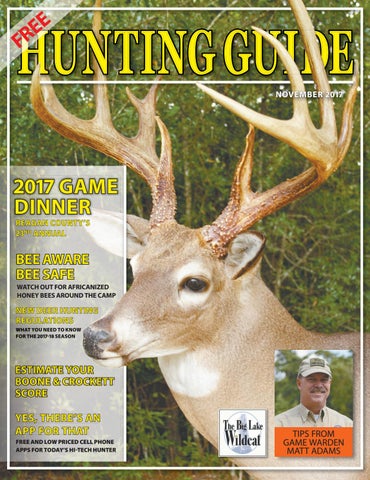
HUNTING GUIDE NOVEMBER 2017
2017 GAME DINNER REAGAN COUNTY’S 23 ANNUAL
BEE AWARE BEE SAFE
WATCH OUT FOR AFRICANIZED HONEY BEES AROUND THE CAMP
NEW DEER HUNTING REGULATIONS WHAT YOU NEED TO KNOW FOR THE SEASON
ESTIMATE YOUR BOONE & CROCKETT SCORE
YES, THERE’S AN APP FOR THAT FREE AND LOW PRICED CELL PHONE APPS FOR TODAY’S HITECH HUNTER
TIPS FROM GAME WARDEN MATT ADAMS
! s U e e S e m o C l l a Y’
THE BIG LAKE WILDCAT | HUNTING GUIDE
e r t ’ a t LIQUOR s house
BEER, WINE, SHINE & FINE SPIRITS Hunting/Fishing License Fine Cigars and Tobaccos Snacks & Nostalgic Candies Ice, Ice Baby!!!
WE SELL WILD GAME SUPPER TICKETS!
From US 67, South 1/2 Mile on TX137
2 • NOVEMBER 2017
HUNTING GUIDE | THE BIG LAKE WILDCAT
23 Annual Wild Game Supper rd
Nov. 25th 100+ Quality Guns Doors Open 5 p.m. Meal Starts 6:30 Prize Drawing Tickets Available Now
$1 Per Prize Ticket
It’s that time of year again! The time when businesses, individuals, countless volunteers and a whole bunch of hungry hunters come together to be a part of a special event to benefit the youth of our area. The 22nd annual Reagan County Wild Game Supper, the Saturday after Thanksgiving, November 25, 2017 at the Reagan County Community Building in Big Lake, Texas. The doors will open at 5:00 p.m. and serving will begin at 6:30 p.m. General admission (includes meal) is $10 per person. Attendees are fed a meal of fried venison, elk, axis, homemade deer and pork sausage, fried turkey, deer chili, brisket and all the trimmings. To claim firearm prizes you must have proper identification. A physical address must be on your driver’s license or ID. If a physical address is not on your ID, then you must present your voter registration card or your hunting license with a 911 address along with your driver’s license.
Door prize tickets are available at Tator’s House, Big Lake Bank, Big Lake Pump and Supply or any of the RCWGS Board members at the cost of $1 per ticket. The Reagan County Wild Game Supper, now in its twenty
second year, has been tremendously successful, making it the largest annual event in Big Lake, impacting hundreds of youth in our area. Since our beginning in 1995 the RCWGS (501 c-3 NonProfit) has donated more than $150,000 to local youth organizations and has helped students further their education through over $150,000 in scholarship money, totaling $300,000 in total contributions to date. Some of the youth organizations the RCWGS has contributed to are: Boy Scouts, Project Graduation, Methodist Youth Fellowship, DARE Program, RCHS Band, Girls of Faith, Girl Scouts, Cub Scouts, First Baptist Youth, Assembly of God Youth, RCES Library, RC Little League, Reagan County 4H, Reagan County Ambassadors, Big Lake Youth Alliance, Catholic Youth and Liturgical Dance, Industrial Arts, RC Pee Wee Football, Boys Ranch, Girl’s Softball, Volunteer Fire Dept., Josh Mitchell Remembrance Assoc., American
Legion and many more. The 2017 recipients of the RCWGS Scholarships are: Timothy Adams, Tyler Aguero, Hannah Armstrong, Tyler Bastin, David Botello, Eddie Cemental, Sydney Hernandez, Tyler Rardin and Turner Stark . All monies are raised from generous donations, sale of door prize tickets and admission fees. Among the prizes given away this year will be 100 quality guns, gift certificates, hunting items, Polaris Ranger, and numerous other prizes. Without your help, none of this would be possible We humbly ask that you consider donating to this great cause so that we may continue to “pay it forward”. All contributions are tax deductible and documentation for tax purposed will be provided. The address is PO Box 53 Big Lake, Texas 76932. We look forward to yet another successful year and continuing to contribute to the success of the youth in our area.
Show Us Your Big Buck! Bring your Big Buck by The Big Lake Wildcat office for a photo! Selected photos will be published in The Wildcat as well as the 2018 edition of this Hunting Guide.
NOVEMBER 2017 • 3
IN CASE OF EMERGENCY CALL 9-1-1
1300 N Main Ave • Big Lake, TX 76932 • 325-884-2561
IN CASE OF EMERGENCY CALL 9-1-1
Hospital • Emergency Room • Family Clinic • Radiology • Laboratory • Wellness Center All Together in a New State of the Art Facility Located on the North Edge of Big Lake
HICKMAN RURAL HEALTH CLINIC CALL 325-884-3743 NEW RETAIL PHARMACY CALL 325-884-5622
We hope you have a safe and successful season. However, if and when the need arises, you can rest assured that we are here 24-7.
HUNTING GUIDE | THE BIG LAKE WILDCAT
Deer Hunting Regulations for 2017-18
DEFINITIONS A “buck deer” is a deer with a hardened antler protruding through the skin. An “unbranched antlered deer” is a buck with an antler having no more than one antler point. All other deer are antlerless deer. A buck must be tagged with a buck deer tag from the hunter’s hunting license tag or applicable permit. White-tailed Deer - Except for deer taken under MLDP tag, no person may take more than five white-tailed deer or more than three bucks (all seasons combined) in one license year. Bag limits in individual counties may be less. STATEWIDE BAG LIMITS Except for deer taken under MLDP tag, no person may take more than five white-tailed deer or more than three bucks (all seasons combined) in one license year. Bag limits in individual counties may be less. SPECIAL ANTLER RESTRICTIONS Antler restrictions apply in certain counties. In these counties, the bag limit is two legal bucks, but only ONE may have an inside spread of 13 inches or greater. Find your county to determine if there are antler restrictions. DEFINITION OF LEGAL BUCK In antler restricted counties, a legal buck deer is defined as a buck deer with: • a hardened antler protruding through the skin AND;
Legal
At least 13 inch inside spread
Legal
At least one unbranched antler
Illegal
Meets no criteria
• at least one unbranched antler; OR • an inside spread measurement between main beams of 13 inches or greater (does not apply to a buck that has an unbranched antler). To determine if a buck has an inside spread measurement of at least 13 inches, look at the distance from ear-tip to ear-tip on a buck with ears in the “alert” position. It is unlawful to take more than one buck with an inside spread of 13 inches or greater in a county where antler restrictions are in effect. Does not apply on properties enrolled in the MLDP and for which MLDP buck tags have been issued. SEE REGULATIONS ON PAGE 6
HAPPINESS IS HUNTING
325-650-3665 • 325-650-8652 T.J. Hill
Tommy L. Hill
Big Lake, Texas
EMERGENCY DIAL NOVEMBER 2017 • 5
THE BIG LAKE WILDCAT | HUNTING GUIDE
Deer Hunting Regulations for 2017-18 CONTINUED FROM PAGE 5
During the Special Late Season, take is restricted to antlerless and “unbranched antlered” deer. An unbranched antlered deer is a buck deer with at least one antler that has no more than one point. DEFINITION OF A POINT A point is a projection that extends at least one inch from the edge of a main beam or another tine. The tip of the main bea is also a point.
Legal Point
Not a Point
YOUTH-ONLY REGULATIONS Hunter education requirements apply to all youth hunters. Age Restriction: Only licensed hunters 16 years of age or younger are eligible to participate in youth-only deer seasons. Youth Hunting License required. Hunter education requirements apply (Type 169). Early Youth-Only Season: Oct. 28 - Oct.29, 2017. All legal
hunting means and methods are allowed, except in Collin, Dallas, Grayson and Rockwall counties, where lawful means are restricted to archery only (no crossbows except for youth with upper limb disability). Late Youth-Only Season: Jan. 8-21, 2018. The season is open in all counties where there is a general open season for white-tailed deer. All legal hunting means and methods are allowed, except in Collin, Dallas, Grayson and Rockwall counties, where lawful means are restricted to lawful archery equipment and crossbows. Bag limits, take of antlerless deer, and special requirements: • In Bell (E. of I-35), Delta, Ellis, Falls, Fannin, Franklin, Freestone, Hopkins, Hunt, Kaufman, Limestone, Milam, Navarro, Rains, Smith, Titus, Upshur, Van Zandt, Williamson (E. of I-35) and Wood counties, the bag and permit requirements are the same as the period Nov. 23-26, 2017 for each respective county (see County Listings); and • For the remainder of the state, the bag, tag, and permit requirements are the same as for the first two days of the general season in the county (see County Listings). • In a county where antlerless deer may be taken only by tag or permit, a tag or permit is required to take antlerless deer during the youth seasons. Antlerless deer may be taken without a tag or permit on all USFS lands during youth-only deer seasons. Does not apply to properties in the MLDP program enrolled SEE REGULATIONS ON PAGE 7
WELCOME HUNTERS BLEDC’s MISSION: To Improve the Quality of Life of the Community, for the Citizens of the Community, by bringing in new business to Big Lake and supporting existing businesses. www.biglaketexas.org • 325-884-2288 6 • NOVEMBER 2017
Big Lake Economic Development INVESTING IN OUR COMMUNITY
HUNTING GUIDE | THE BIG LAKE WILDCAT
Deer Hunting Regulations for 2017-18 CONTINUED FROM PAGE 6
under the Conservation Option, or in counties where there is no open general season for white-tailed deer. CWD CHECK STATIONS Chronic Wasting Disease (CWD) is a fatal deer disease that has been discovered in white-tailed deer and mule deer in localized portions of Texas. In order to detect and manage this disease, the department has designated CWD zones within which the intact, unfrozen head of any white-tailed or mule deer harvested by a hunter must be presented at a TPWD-designated check station within 48 hours of harvest. Current CWD zones exist in all or portions of the following counties: Bandera, Culberson, Dallam, Deaf Smith, El Paso, Hartley, Hudspeth, Medina, Moore, Oldham, Parmer, Potter, Randall, Sherman and Uvalde Additional regulations may apply and additional zones may be established without prior notice anywhere in the state upon discovery of CWD. The department will make every effort to publicize the designation and location of CWD zones and check stations, as well as any special regulations that may be adopted following the publication of this notice. For additional or updated information visit the CWD informational page, call any TPWD office or call 1-800-792-1112. AFTER KILLING A DEER (Also applies to pronghorn, except for License Log) After a deer or pronghorn antelope is killed and before the deer is field dressed or moved, the appropriate hunting license tag must be immediately filled out and dates cut out. Additionally, if a hunting license tag is used, then the Hunting License Harvest Log (White-tailed deer only) must be legibly completed. A hunter may transport a deer or pronghorn antelope to a final destination, provided it is tagged and proof of sex accompanies the deer or pronghorn antelope.
PROCESSING After a deer is killed and before the deer is field dressed or moved, the appropriate hunting license tag must be immediately filled out and date cut out. If a deer is taken under MLDP tag, the tag must be attached to the deer. A hunter may transport a deer to a final destination, provided the deer is tagged and proof of sex accompanies the deer. A hunter may skin and quarter a deer or pronghorn antelope (two forequarters, two hindquarters, and two backstraps) and possess for transport, provided the quartered deer is tagged and proof of sex accompanies the deer. See Cold Storage or Processing Facility for exceptions. A deer or pronghorn antelope may not be processed any further than four quarters and two backstraps (example, steaks, hamburger, chili meat, etc.) until the deer or pronghorn antelope reaches a final destination, except for immediate consumption in camp. The four quarters and two backstraps are the only parts of a deer or pronghorn antelope required by law to be kept in edible condition. Texas Parks and Wildlife Department encourages all hunters to continue to keep other portions of the deer or pronghorn antelope (trimmings from the neck and rib cage) in edible condition. Edible condition does not include any portion of a game animal, game bird, or fish that is: bruised by bullet, shot, SEE REGULATIONS ON PAGE 8
Have a Great Season!
405 E. 2nd Street | 325.884.2551 www.mysbank.com MEMBER FDIC
NOVEMBER 2017 • 7
THE BIG LAKE WILDCAT | HUNTING GUIDE
Deer Hunting Regulations for 2017-18 CONTINUED FROM PAGE 7
or arrow, or otherwise destroyed as a result of harvest; decayed or rotting at the time of harvest; or obviously infected or diseased at the time of harvest. The tag must remain with the portion of a deer or pronghorn antelope the hunter possesses. If any portion is transferred to another person before it reaches a final destination, then the transferred portion must be accompanied by a Wildlife Resource Document (PDF). WHITE-TAILED DEER HARVEST RESTRICTIONS (Schleicher County) Bag Limit 5 deer, no more than 2 bucks, all seasons combined. MLDP If MLDP buck tags have been issued for a property, harvest is by MLDP tag only and all bucks must be tagged with a MLDP tag. If MLDP antlerless tags have been issued for a property, harvest is by MLDP tag only and all antlerless deer must be tagged with a MLDP antlerless tag. The landowner or designated agent are responsible for providing MLDP tags to the hunters on MLDP properties. Archery Only Sept. 30 - Nov. 3, 2017; General Seaon Nov. 4, 2017 Jan. 7, 2018; Youth-Only - Early Youth-Only Season Oct. 28 - 29, 2017; Late Youth-Only Season Jan. 8 - 21, 2018; Special Late Jan. 8 - 21, 2018. Special Late Season During the Special Late Season, harvest is restricted to antlerless deer and unbranched antlered bucks. An unbranched antlered buck is any buck deer with an antler having no more than one point
The source for all your real estate needs in Texas
Janet Wilburn Local Agent and Appraiser 325-650-3611
MANAGED LANDS DEER PROGRAM TAGS MLDP tags issued to landowners participating in the Managed Lands Deer Program. All deer taken on a property for which MLDP tags have been issued must be tagged with the appropriate type of MLDP tag. NOTE: No license log entry or tag from a hunting license is required for deer killed under a MLDP tag (see license log requirement). For more information about the MLDP program, landowners should call TPWD at (512) 389-4505. For information about antlerless deer permits on National Forest lands, please call the U.S. Forest Service in Lufkin at (936) 639-8501. NOTICE: The Landowner Assisted Managment Program (LAMPS) has been discontinued. PROCESSING IN CAMP You are allowed to quarter a deer or antelope in camp, but tagging and proof-of-sex requirements continue to apply until the wildlife resource reaches a final destination (see Definitions). Deer or antelope may not be processed beyond quarters in camp unless the camp qualifies as a final destination. While in camp you may remove and prepare a part of a wildlife resource if the removal and preparation occur immediately before the part is cooked or consumed; however, all tagging and proof of sex regulations apply to remaining parts and those parts may be transported to a final destination.
Great Hunting Trips begin at Lowe’s, we have everything you need under one roof. Hunting and Fishing Licenses, Propane Cylinders, Ice, Beer, Charcoal, Lighter Fluid, Deer Corn, Feeders and Camouflage Gear
Roy Raney & Jay Garrett San Angelo (325) 942-0769 http://www.stephensranchrealestate.com/ 8 • NOVEMBER 2017
505 E 2nd Street Big Lake, Texas
HUNTING GUIDE | THE BIG LAKE WILDCAT
Daylight Saving Time Ends November 5, 2017
NOVEMBER 2017 1 2 3 4 5 6 7 8 9 10 11 12 13 14 15 16 17 18 19 20 21 22 23 24 25 26 27 28 29 30
RISE A.M.
SET P.M.
7:57 7:58 7:59 8:00 7:00 7:01 7:02 7:03 7:04 7:05 7:05 7:06 7:07 7:08 7:09 7:10 7:11 7:11 7:12 7:13 7:14 7:15 7:16 7:16 7:17 7:18 7:19 7:20 7:21 7:21
6:55 6:54 6:53 6:52 5:51 5:51 5:50 5:49 5:49 5:48 5:47 5:47 5:46 5:46 5:45 5:45 5:44 5:44 5:43 5:43 5:42 5:42 5:42 5:41 5:41 5:41 5:41 5:41 5:40 5:40
JANUARY 2018 1 2 3 4 5 6 7
DECEMBER 2017 1 2 3 4 5 6 7 8 9 10 11 12 13 14 15 16 17 18 19 20 21 22 23 24 25 26 27 28 29 30 31
RISE A.M.
SET P.M.
7:22 7:23 7:24 7:25 7:25 7:26 7:27 7:28 7:28 7:29 7:30 7:31 7:31 7:32 7:33 7:33 7:34 7:34 7:35 7:35 7:36 7:36 7:37 7:37 7:38 7:38 7:39 7:39 7:39 7:40 7:40
5:40 5:40 5:40 5:40 5:40 5:40 5:40 5:41 5:41 5:41 5:41 5:41 5:42 5:42 5:42 5:43 5:43 5:43 5:44 5:44 5:45 5:45 5:46 5:46 5:47 5:47 5:48 5:49 5:49 5:50 5:51
Whitetail Deer Season in Reagan County GENERAL SEASON Nov. 4, 2017 - Jan. 7, 2018 Late Antlerless and Spike Jan. 4 - 17, 2016 YOUTH-ONLY Early Youth-Only Season Oct. 28-29, 2017 Late Youth-Only Season Jan. 8 - 21, 2018 BAG LIMIT 5 deer - no more than 2 bucks, all seasons combined.
ANTLERLESS DEER No permit is required to hunt antlerless deer unless MLDP antlerless permits have been issued for the tract of land. ARCHERY ONLY Sept. 30 - Nov. 3, 2017 Archery Only either sex. No permit is required to hunt antlerless deer unless MLDP permits have been issued for the property.
Stay warm out there
What happens to your body when the mercury falls? Temperature Fahrenheit 5
10
SET P.M.
7:40 7:40 7:41 7:41 7:41 7:41 7:41
5:51 5:52 5:53 5:53 5:54 5:55 5:56
15
20
25
30
35
40
45
50
5
-5
1
3
13
19
25
31
36
45
48
10
-10
-4
3
9
15
21
27
34
40
46
15
-13
-7
0
6
13
19
25
32
38
45
20
-15
-9
-2
4
11
17
24
30
37
44
25
-17
-11
-4
3
9
16
23
29
36
43
30
-19
-12
-5
1
8
15
22
28
35
42
35
-21
-14
-7
0
7
14
21
28
35
41
40
-22
-15
-8
-1
6
13
20
27
34
41
45
-23
-16
-9
-2
5
12
19
26
33
40
50
-24
-17
-10
-3
4
12
19
26
33
40
55
-25
-18
-11
-3
4
11
18
25
32
40
60
-26
-19
-11
-4
3
10
17
25
32
39
Eyeballs don’t freeze because they are protected by the head, which your body works very hard to keep warm. Also Tears are salty, which reduces the freezing point.
Ears:
At the greatest risk because there are no major muscles to provide heat.
Why does your nose run when it’s cold?
While trying to warm up cold air on the way to the lungs, extra blood flow within the nostrils leads to more mucus production.
Cheeks:
DANGER
BUNDLE UP
Skin can freeze in 10-30 minutes.
AT RISK
RISE A.M.
Eyes:
Wind Chill
Wind Speed MPH
Sunrise/Sunset for Big Lake, Texas
Risk of frostbite or hypothermia.
Be sure to wear warm clothing.
EXTRA LAYER
Wear an extra layer of thermal protective clothing.
What is frostbite? • Severe condition: both skin and underlying tissue (fat, muscle, bone) are frozen. • Skin appears white and waxy; is hard to the touch. • No sensation — the area is numb.
Turn red when surface blood vessels dilate as skin temperature drops below 15º F.
Fingers, Toes
50º F is the critical air temperature for good manual dexterity. 45º F is the point at which fingers lose sensitivity to touch.
Mild hypothermia Body temperature drops. Being cold over a prolonged period of time can cause a drop in body temperature to below 97º F.
Why do we shiver?
Moderate hypothermia Being cold over a prolonged period of time can cause a drop in body temperature to 95º F.
You’ve Gotta Go:
What is hypothermia? Being cold over a prolonged period of time can cause a drop in Severe hypothermia body temperature. Normal body Being cold over a prolonged period of time can cause a drop in temperate is 98.6º F body temperature below 90º F.
Muscle contractions produce heat, so when we get cold we shiver. You need to urinate more when you get cold. Exposure to cold causes reduction in blood flow to the surface of the skin, which reduces overall blood volume. The body’s response is to reduce fluid volume by urinating.
NOVEMBER 2017 • 9
THE BIG LAKE WILDCAT | HUNTING GUIDE
Grandma’s Kitchen 404 2nd Street • Big Lake, Texas
325 884-2853
Nicholson’s
MEAT COMPANY HWY 67 • MERTZON, TEXAS 325-835-2611 • 325-835-2336 fax QUALIT Y DEER PRO CESSING with competitive pricing!
SELF DROP OFF AFTER HOURS “Award-Winning” Recipes Used To Make Your: Dried Sausages • Summer Sausages Link Sausages • Jerky
We Provide Shipping via FedEx Family Owned & Operated for Over 45 Years
Serving of of Servingthetheoilfields oilfields West Texas since 1981
West Texas since 1981
Serving the oilfields of West Texas since 1981
Oilfield Maintenance and Construction Sr. & H.T. Sanchez, Jr. "Put our ,,37 of expertise and Sr. years & H.T. Sanchez, Jr. experience in oilfield construction and maintenance to work for you!" , Sr. & H.T. Sanchez, Jr.
H.T. Sanchez, Sr. & H.T. Sanchez, Jr. 325.277.1549 | 903.279.1821 | ht.sanchez@yahoo.com
EMERGENCY DIAL 10 • NOVEMBER 2017
WELCOME HUNTERS!
HUNTING GUIDE | THE BIG LAKE WILDCAT
Operation Orphans, Inc.
Making it Possible for Underprivileged Kids to Go Hunting The Board of Directors of Operation Orphans, Inc. has selected four dates for doe hunts during the forthcoming whitetail season. They are the following Saturdays: October 28 November 18, December 2 and January 6. The October date will be an all girls’ hunt, while the remaining dates will be all boys’ hunts. This is the 58th year of the “Take a Child Hunting” program. To date, Operation Orphans, Inc. has hosted 18,474 youngsters with a total game harvest of 18,268 animals. Interested individuals are encouraged to check the Operation Orphans, Inc. web-site for information and videos of the program (www. operationorphans.org). During this program, landowners from the surrounding hill country allow children from child care facilities to harvest deer from their property. Ranchers use the “Take a Child Hunting” program as a means to reduce the over population of does and feral hogs and to get buck to doe ratios in order. Landowners and hunters also participate in this program to help educate youngsters about the outdoors and provide a worthwhile outdoor adventure field trip. A summer fishing program was added in 2004. Thus far, 867 kids have participated. The hunting and fishing programs are offered free of charge to the children’s homes. Operation Orphans, Inc. provides the children, guides, and food for the activity. The guides which Operation Orphans, Inc. provides have successfully completed the Hunter Safety Course. Some landowners wish to provide their own guides. One guide is assigned to each child. During the girl’s hunt, a woman or
a man/woman team serves as guides. All guides will have a background check. The meat which the childcare facilities receive from these hunts helps to relieve some of the burden of their rising food costs for the year. Some facilities use the meat in their outreach programs. It all began when the late Gene Ashby, a State Game Warden, realized the Hill Country, primarily Mason and Llano counties, had an excessive deer population and needed a means to reduce the deer numbers. He approached some local ranchers with the idea of allowing orphans to harvest antlerless deer. They liked the idea, and Operation Orphans, Inc. came into being. Housing the young hunters was a problem, so another idea was realized. With backing from sportsmen’s clubs throughout Texas, and other concerned individuals, a 320 acre tract of land on the North bank of the Llano River in Mason County was purchased from a generous landowner at a fraction of its market value. Through donations, a kitchen/ dining hall, three dormitories, showering facility, and basketball court were built. In 1994 an orientation and recreational building, The Milton & Janie Jordan Building, was constructed. It includes a clothing room which allows the kids to obtain boots, coats, jeans, and other clothing items that are donated by concerned individuals. The camp is managed by a supervisor who resides at the camp. Camp Gene Ashby, named in honor of the founder of Operation Orphans, is today a beautiful facility capable of housing and feeding 250 visitors. During the first 20 years of the program only boys were
allowed to hunt. In 1980 a girl’s hunt was added to the program. Boys and girls fishing days were started in 2004. It has been a pleasure offering additional opportunities for disadvantaged children to enjoy the outdoors. Many volunteer organizations assist with the hunting and fishing programs. Several service organizations and caring individuals prepare the Friday evening meals. Mason Girl Scout troops, 4-H, church groups, and others prepare the sack lunches which the children and guides enjoy Saturday during the hunts. Members of the Mason Boy Scouts and the Mason Volunteer Fire Department prepare the early Saturday breakfast. The Directors of Operation Orphans, Inc. hope to make participation in the forthcoming hunts the best ever; however, this is dependent upon the number of ranchers who participate. Individuals who lease property for hunting may also participate by hosting a child and thus give up one day and one deer for the benefit of allowing more children to partake in the outdoor activity. The children will arrive at Camp Gene Ashby from homes throughout Texas on the Friday preceding the Saturday hunt. The youngsters will attend an orientation and safety meeting and will be given an opportunity to visit the “Clothing Room” where they can obtain boots and other clothing which will be theirs to keep. They will be housed, fed, and transported to the host ranches before daylight the following morning by guides from various Texas sporting clubs and other interested individuals.
Beginning in 1994, in an effort to maintain the highest safety standards, all individuals who wish to serve as guides with Operation Orphans, Inc. must show verification of successfully completing the Hunter Safety Course. All guides will also have a background check performed. To further assist children who have participated with Operation Orphans, Inc., the Eddie Argo Scholarship was established. Boys and girls who participate with the hunting and fishing programs are able to apply to receive financial assistance with their education. Eddie Argo had attended the Operation Orphans, Inc. hunts as a child from a children’s home and then later became a director and volunteer of Operation Orphans, Inc. Operation Orphans, Inc. is a non-profit organization made up of a board of directors whose sole purpose is to serve less fortunate youngsters by offering them a positive outdoor experience. Any persons who are interested in assisting with the “Take a Child Hunting” program, please contact camp supervisors, Jerry or Lyla Crouch, at (325)347-6745, or write Operation Orphans, Inc., P.O. Box 535, Mason, Texas, 76856, e-mail: operationorphans@yahoo.com. Persons interested in guiding, please contact director Bob Moore, (903)258-4366, e-mail: fiddler22243@juno.com. The Operation Orphans, Inc. website: www.operationorphans. org. Please contact Jerry or Lyla Crouch if you wish to donate used coats, boots or hunting clothing for children ranging from 10 to 18 years of age. NOVEMBER 2017 • 11
THE BIG LAKE WILDCAT | HUNTING GUIDE
112 West College Avenue San Angelo, TX 76903 Phone: (325) 659-7000 (325) 655-7307
Toll Free: (866) 655-7307 Fax:(325) 655-7308
Mason Surber 432-631-4572
Hugo Hernandez 325-650-1744
Stoney Harris 325-650-1777
Jesse Bustamante 325-206-3209
WELCOME TO BIG LAKE! BIG LAKE CHAMBER OF COMMERCE The Big Lake Chamber of Commerce would like to extend a special welcome to the out of town hunters in Reagan County. Feel free to visit our office for information on local attractions and services available in Big Lake such as churches, restaurants, lodging and much more! On behalf of the Big Lake Chamber of Commerce, welcome to Reagan County! Chamber Office Located at 120 N. Main Avenue Big Lake, Texas
325-884-2980
Big Lake,Texas - Where believing “The Impossible” is “Possible”! 12 • NOVEMBER 2017
HUNTING GUIDE | THE BIG LAKE WILDCAT
Yes, There’s an App for That! Hunting has gone hi-tech. While the thrill of the hunt is a primitive pleasure, advancements in technology allow for better precision and efficiency. If you are looking to enhance your hunt but don’t have the budget for big-ticket gadgetry, look no further than your own smartphone — the newest must-have hunting device. Here are six smartphone applications that will enhance any hunt. All are available on both Apple and Android phones. You don’t need all the apps, so consider how you would like to develop your hunt before choosing. SCOUTLOOK HUNTING Cost: FREE but has in-app purchases ScoutLook is a standard navigational app with weather features and a scent tracking system. Weather forecast details include temperature, cloud cover, barometric pressure and wind activity. And the Scentcone Wind Map feature lets you see where your scent will blow hour by hour. SAS SURVIVAL GUIDE Cost: $5.99 You know what they say: Safety first. This application provides essential information to survive any situation. The app includes photo galleries of plants that are edible, medicinal and poisonous, knots and animal tracks. The first aid
section is comprehensive and user-friendly. SHOOTING HOURS Cost: 99¢ This app performs a very basic function extremely well: calculating the times of sunrise and sunset using your GPS location — allowing you to always shoot legally. POWDERHOOK Cost: FREE Need a place to hunt? This app will help you find one. The app includes free maps of public lands in all 50 states, with thousands of depth contours for lakes and rivers. It also populates listings of outdoor events near you.
The City of Big Lake welcomes Hunters for the 2016-17 Hunting Season! We invite you to explore all that Big Lake offers by visiting our local restaurants, retail businesses and our website at: www.cityofbiglaketx.com. We hope your visit to our City is a pleasant and trophy winning experience!
DEER CALLS & TACTICS Cost: $1.99 This is one of the best and most comprehensive resources for learning and interpreting deer tactics and calls. The app provides tips on how and when to use each of the deer calls to maximize your chance of a successful hunt. WHITETAIL FREAKS PROPERTY MANAGEMENT Cost: $2.99 One of the best organizational hunting tools available from your phone, the app allows you to mark your property and pin the locations of your tree stands, trail cameras and food plots. You can even attach notes to each pin. NOVEMBER 2017 • 13
THE BIG LAKE WILDCAT | HUNTING GUIDE
Let’s BEE Safe Out There Experts say that all honey bees in Texas have been africanized to one extent or another. That means they are more aggressive than in the past and pose a greater risk to humans and animals when they are distrubed. Hunters should be aware that cabins and camps, which remain vacant for much of the year, offer transient bees a tempting place to build a hive. There are things you need to know if and when you encounter a hive of honey bees. WHAT IS A HONEY BEE? • Honey bees are not native to the North America • Honey bees currently pollinate about 90 agricultural crops (accounting for 80% of the pollination in the US): ~ $10 billion pollination business, $150 million honey industry • Bees forage over large expanses of area: 8,000-25,000 acres • US honey bees originated in Europe (European honey bees = EHB) and were brought to the US to pollinate insect-pollinated crops originating in Old World countries • EHB (Apis mellifera mellifera) were also imported in the 1660-1700s to make candles used by emerging churches • Honey bees are not likely to sting when foraging for nectar and pollen in the back yard • Honey bees are not likely to sting when swarming (looking for a new home) • Honey bees are most docile when carrying out their daily chores • Honey bees are most likely to sting when their home (the hive) is threatened or they are accidentally crushed • Honey bees swarm (move in large numbers to establish new hives) in spring and fall and are most likely to be aggressive in those seasons. • Honey bees sting to protect their hive but each bee can sting only once, and then it dies • Stings are usually not serious unless there are an large number of them or you are systemically allergic to the venom WHAT IS AN AFRICANIZED HONEY BEE? • In 1957, honey bees (Apis mellifera scutellata) were imported from Africa to Brazil • African bees escaped and became feral (wild) • As feral African bees mated with EHBs they produced a hybrid called an “Africanized honey bee” (AHB) • AHBs look like European bees to the eye
LARRY WILLIAMS Bee Removal 2276 U.S. Hwy 190 W. Ozona, TX 76943
• They are, on average, slightly smaller than EHBs, but can only be separated by molecular techniques or morphometric computer analysis • Africanized honey bees are less fussy in their choice of nesting sites: building nests in the ground, in tree cavities, in the walls of a home, and where ever they find a small hole through which to enter • Africanized honey bees will “abscond” (leave a location when conditions are not suitable) more often than European honey bees • The impulse to sting in AHBs is 10 times greater than that of European honey bees, and attacks last longer and involve more bees • AHBs have been known to follow victims as much as a 1/4 of a mile from the hive whereas EHBs will pursue only about 50 yards • AHB venon is same chemical found in EHBs • AHB have been moving north from South America at a rate of 100-300 miles per year • Once disturbed AHBs may remain aggressive for as long as 24 hours • The “killer bee” reputation of AHBs is highly exaggerated, AHB do not hunt for people to attack and they do not attack unless they feel threatened WHAT CAUSES AN AHB STINGING INCIDENT? • Load noise • Vibrations of equipment, lawn mowers, moving vehicles etc., even up to 100 feet or more from a hive • Pedestrian activity up to 50 feet from the hive: the hive does not have to be touched to provoke AHBs SEE BEE ON PAGE 16
ADKINS Septic Services
"Servicing Sonora and surrounding areas for over 50 years!" • Septic Tank Cleaning Service • Septic Tank Installation
• Stock Tank Clean Outs • Sight Evaluation • Porta Potty Rentals
Licensed Aerobic Maintenance Provider Russell Adkins Lic # OS0005022 & OS0021158, Thomas Adkins Lic# MP002063
LARRY
325•650•5930
14 • NOVEMBER 2017
ELAINE
325•226•0227
325 387-3154 311 W College Street, Sonora, TX 76950-8432
HUNTING GUIDE | THE BIG LAKE WILDCAT
Determining the Age of a White-Tailed Deer Tooth wear and replacedentine material, noticeable ment is one of several methods distinctions in tooth wear for aging white-tailed deer. occur between each age class. Texas Parks and Wildlife Deer are aged in year and half biologists have been using increments, such as 1 1/2, 2 this deer aging technique 1/2, 3 1/2, etc., since fawns are to manage deer on ranches, born from late May through wildlife management areas July and are not harvested and by county since 1965. until the fall hunting season. Although this method is not Biologists, landowners Deer Teeth used Parts for perfect, it has been or land managers may be the yearsonin the sucinterested in deer ages from Cusp: past a point 35 or projection a tooth Back Cusp: very last cusp on tooth 6 on cheek-side of the jaw cessful management of deer a deer management standLingual Crest: tooth ridge adjacent to the tongue Enamel: hard, white, outer coating of are a toothaged herds in Texas. Deer point. Age data provides Dentine: soft inner core of a tooth, dark brown color Infundibulum: crescent-shaped depression in the central information about deer herd by examining the wear and crown of a tooth between the enamel ridge or crest replacement of the premolars characteristics, hunting or Lingual Crests and molars of the lower jaw. mortality pressure on a parEnamel Dentine As a deer grows older, its ticular age class, and progress 6 teeth continue to wear. As of the wildlife management 5 4 1 3 2 Back the program. Age data becomes a Cuspenamel begins to wear Infundibulum1 1/2 years away, and exposes the dark valuable piece of information
when used with other data such as antler characteristics, dressed body weights or lactation in females. Deer herd trends can thus be monitored if enough data are collected over time. Often these trends can be related to a particular management style, climatic conditions or any other factors affecting deer. Dressed body weights, age and antler measurement data should be collected every year and from every deer harvested. Collecting partial data, only occasionally during a season, or every couple of years may result in land managers making uninformed decisions about deer management.
Tooth 3 (3rd premolar) has 3 cusps. Tooth 6 has erupted and is slightly visible just above the gum line.
Fawn (1/2 year)
Aging fawns should not be difficult. For more clarification, 3-Cusp Tooth inspection of the lower jaw will indicate Fawns have 5 or Heavyage. Wear less teeth present and the third premolar (tooth 3) has 3 cusps. Tooth 6 has not yet erupted. In younger fawns tooth 5 has not erupted and only 4 teeth will be visible.
Aging deer using the wear and replacement method is not difficult, but it does require practice. When aging a deer, it is helpful to cut the skin along the edge of the jaw to allow better inspection of the teeth. Do not cut the skin if planning to mount the deer. Taxidermists will cape out the deer head and save the lower jaw if asked. A jaw spreader and small flashlight may also be used to prop open the jaw while examining the teeth, especially when the skin is not to be cut. Be sure to remove any food particles or debris to maintain a clear view of the teeth along the jaw. Inspect teeth on both sides of the jaw to confirm that wear is consistent. 1 1/2 years
Deer Teeth Parts Cusp: a point or projection on a tooth Back Cusp: very last cusp on tooth 6 on cheek-side of the jaw Lingual Crest: tooth ridge adjacent to the tongue Enamel: hard, white, outer coating of a tooth Dentine: soft inner core of a tooth, dark brown color Infundibulum: crescent-shaped depression in the central crown of a tooth between the enamel ridge or crest Lingual Crests
Tooth 3 (3rd premolar) has 3 cusps. Tooth 6 has erupted and is slightly visible just above the gum line. 3-Cusp Tooth Heavy Wear
Enamel Dentine
3 1/2 years Lingual crest on tooth 4 is blunt. The dentine is as wide or wider than the enamel in2tooth 4. The back cusp on tooth 6 is 1/2 years forming a concavity. Lingual crest on all molars are sharp and pointed. Tooth 3 now has 2 cusps. Back cusp of tooth 6 is sharp and pointed. Enamel is wider than the dentine in tooth 4, 5 and 6.
Cusp Worn To Concavity
Permanent 2-Cusp Tooth Dentine Wider Than Enamel
Pointed Cusp
5 1/2 years
6 Back Cusp
5
4
3
2
1
3 1/2 years
Infundibulum
Fawn (1/2from year) A simple jaw spreader can be made 1/4 inch rebar and welded into a similar Aging should not be difficult. For more clarification, shape asfawns the above photo. inspection of the lower jaw will indicate age. Fawns have 5 or lessjaw teeth presentinto andmouth the third premolar (tooth 3) has 3 cusps. Insert spreader as shown Tooth 6Be hassure not spreader yet erupted. In younger fawns tooth 5 has not in photo. is pushed erupted and onlythe 4 teeth will Rotate be visible. completely through mouth. jaw spreader downward as shown. Teeth are now visible for inspection. A small light may be helpful for viewing teeth.
4 on 1/2tooth years Lingual crest is worn away 4 and rounded in tooth 5. Lingual crest in tooth 6 is blunt. Dentine in tooth 6 is now wider Lingual on tooth 4 are almost rounded off and lingual than the crest enamel. crest in tooth 5 are blunt. The dentine in tooth 4 is twice as wide as the enamel. The dentine in tooth 5 is wider than the Dentine Twice As Wide enamel. The back cusp on toothAs 6 is worn so badly that it Enamel slopes downward towards the cheek. Blunt Crests
Dentine Wider Than Enamel
Lingual crest on tooth 4 is blunt. The dentine is as wide or wider than the enamel in tooth The back cusp on tooth 6 is 2 1/24.years forming a concavity.
Lingual crest on all molars are sharp and pointed. Tooth 3 now has 2 cusps. Back cusp of tooth 6 is sharp and pointed. Enamel is wider than the dentine in tooth 4, 5 and 6.
Cusp Worn To Concavity
Pointed Cusp
Small Enamel Dentine Wider Ridge Than Enamel
Cusp Slopes Downward
Tooth 4 is worn completely smooth; no enamel ridge should be visible in the center of tooth 4. Small enamel ridge will be present in center of tooth 5 and tooth 6. Lingual crest on tooth 5 is almost worn away and rounded in tooth 6. Worn Smooth “Dished Out” Appearance
7 1/2 years
Tooth 4 and tooth 5 are worn 5 1/2smooth; years no enamel ridges are present in the center of these teeth. Lingual crest is gone from tooth 6.crest Infundibulum in tooth 6 years is a4narrow crescent shape. 4 on 1/2tooth Lingual is worn away and rounded in tooth 5. Lingual crest in tooth 6 is blunt. Dentine in tooth 6 is now wider than the crest enamel. Lingual on tooth 4 are almost rounded off and lingual WorninSmooth crest in tooth 5 are blunt. The dentine tooth 4 is twice as “Dished Out” wide as the enamel. The dentine inTwice tooth As 5 isWide wider than the Dentine Appearance enamel. The back cusp on toothAs 6 is worn Enamelso badly that it slopes downward towards the cheek.
Dentine Twice As Wide As Enamel
6 1/2 years
Permanent 2-Cusp Tooth Dentine Wider Than Enamel
N O T I C E Texas Parks and Wildlife receives federal financial assistance from the U.S. Fish and Wildlife Service. Under Title VI of the Civil Rights Act of 1964, Section 504 of the Rehabilitation Act of 1973, Title II of the Americans with Disabilities Act of 1990, the Age Discrimination Act of 1975, and Title IX of the Education Amendments of 1972, the U.S. Department of the Interior and its bureaus prohibit discrimination on the basis of race, color, national origin, age, disability or sex (in educational programs). If you believe that you have been discriminated against in any Texas Parks and Wildlife program, activity, or facility, or if you desire further information, please call or write: The U.S. Fish and Wildlife Service, Office for Diversity and Civil Rights Programs - External Programs, 4040 N. Fairfax Drive, Webb 300, Arlington, VA 22203, (703) 358-1724.
7 1/2 years
Tooth 4 and tooth 5 are worn smooth; no enamel ridges are present in the center of these teeth. Lingual crest is gone from tooth 6. Infundibulum in tooth 6 is a narrow crescent shape. Texas Parks and Wildlife 4200 Smith School Road Austin, Texas 78744 www.tpwd.state.tx.us
PWD BK W7000-755 (07/03) Worn Smooth Dispersal of this publication conforms with Texas State “Dished Out” Documents Depository Law, and it is available at Texas State Publications Clearinghouse and/or Texas Appearance Depository Libraries. Printed on recycled paper.
Blunt Crests
Dentine Twice As Wide As Enamel
Cusp Slopes Downward
8 1/2 years 6 1/2 years Tooth 4, 5 and 6 are completely dished out and no enamel
ridges are showing in the center of these teeth. Tooth 4 is worn completely smooth; no enamel ridge should be visible in the center of tooth 4. Small enamel ridge will be present in center of tooth 5 and tooth 6. Lingual crest on tooth 5 is almost worn away and rounded in tooth 6. Worn Smooth “Dished Out” Appearance
Small Enamel Ridge In Center of Teeth
Small Enamel Ridge
Teeth 4, 5 & 6 Worn Completely Smooth Small Enamel Ridge In Center of Teeth
NOVEMBER 2017 • 15
THE BIG LAKE WILDCAT | HUNTING GUIDE
BEE AWARE, BEE SAFE! CONTINUED FROM PAGE 14
• Animal breath attracts bees to the face. Animals (e.g. horses) that cannot breath through their mouths are vulnerable to suffocation if stings cause swelling of the nasal passages • Smaller pets and small children are more impacted. On average, 8-10 stings per pound of body weight can be lethal. 100 stings is considered to be potentially life threatening. Some individuals are very sensitive to bee venom, and in this case, even one or a few stings can be life threatening (see below). • AHBs are attracted to hair, dark colors, new mown grass, citrus-scented candles and perfume
How to Prevent a Stinging Incident • Bees need two basic things to colonize your property: water and a place to build a hive. Prevent access to these where possible • Repair dripping leaks in and around the yard and in irrigation systems • Be alert for the presence of colonizing bees around the home • Listen for bees in walls and abandoned building before approaching • Patrol yards periodically to look for signs of bee colonies. Colonies can set up residence in as little as 24-48 hours • Prevent bees from colonizing the yard or home: fill cracks in the house, remove refuse (bees can establish in discarded cans), discard used tires, plug holes in open pipes and swing sets, move abandoned vehicles, check stock tanks and irrigation pump housings • Properly cover chimney openings • Place screens over drains, attic vents, irrigation control
Welcome Hunters! We wish you a happy and safe hunting season!
325.223.6300 3001 S. Jackson St. San Angelo, TX 76904
boxes etc. • Close and lock doors to sheds and out buildings • Education is central to the issue. South Americans have lived with AHB for decades with a minimum of impact. Teach children and others respect for, and avoidance of, honeybees WHO IS MOST VULNERABLE? • Those that are allergic to bee stings. Only about ~1% of the population has a systemic allergy to bee stings. Symptoms: within 20 minutes the tongue or throat swell, hives may develop, dizziness may occur and there may be difficulty breathing or loss of consciousness. • Pets which are tied so they cannot exit the area WHAT TO DO WHEN A STINGING INCIDENT OCCURS Remember that “ACE” is the best action (Alert, Cover, Exit) • Alert = Warn others in the area to flee • Cover = cover your head; pull a shirt over your face. Stings to the head and neck are more dangerous than those to the body • Exit the area. Get into a car or a house immediately. If bees follow, tolerating those stings is preferable to trying to swat bees away from an open doorway. • Stingers are left in the skin by the bees after an attack and continue to deliver venom (for up to 10 min.) due to attached pulsating muscles of the stinger. When the situation has stabilized, remove the stingers as quickly as possible by scraping, do not remove with forceps • Above all, stay calm. Fear can cause accidents if bees get in cars or clothing. • If you observe a serious stinging incident call 911. • Bee attacks can disorient and if you attempt to aid an attack victim protect yourself first then call them toward you and lead them to safety • If a pet is involved seek veterinary attention • If you are seriously stung seek medical attention • If you are allergic, carry a bee sting kit prescribed by your personal physician WHAT NOT TO DO • Don’t tie or pen animals near bee hives as they will have nowhere to go if stung • Do not try to remove bee hives yourself if you find them. Fire departments, bee keepers and pest management operators are best equipped to remove bee colonies • Do not try to fog or spray colonies with insects bombs or sprays • Do not swat at bees. Swatting bees causes the release of an alarm signal and only increases the intensity of an attack by stimulating other bees to attack • Do not count on insect repellents sprayed on the skin to deter bees • Do not provoke bees by spraying the hive with a garden hose • Don’t place certain veterinary salves and creams on your pet. Some are made with bees wax and can increase the severity of AHB attacks to pets and livestock. Check with your vet before using salves and creams. • Don’t use meat tenderizer on bee-sting wounds, as this could lead to a secondary infection • Do not hike with your dog off-leash, if the dog encounters a hive and provoke the bees it may bring the attackers back to you For identification of honey bees: Samples (50 bees or more) can be collected and sent to the Texas Honey Bee Identification Lab at Texas A&M. Forms are available on the Texas Agrilife Extension Service website (http://lubbock.tamu.edu/ahb)
16 • NOVEMBER 2017
HUNTING GUIDE | THE BIG LAKE WILDCAT
Gun Safety Rules for Everyone at Deer Camp You love to hunt and your kids are starting to get to the age where they would like to try hunting. You appreciate their interest and have enrolled them in the appropriate education course to obtain a license. You also plan to teach them the ropes yourself, starting first with gun safety. To ensure you don’t forget anything, familiarize yourself with these dos and don’ts of gun safety. DO... • Treat every gun as though it were loaded. • Read the owner’s manual for your gun and learn how to operate it properly. • Use the correct ammunition for your gun. • Carry your gun with the muzzle pointing toward
the ground. • Keep your finger off the trigger until shooting. • Look at the target and the area beyond it before pulling the trigger. • Keep your gun unloaded when not in use. • Store ammunition away from your gun and out of the reach of young children. • Clean your gun and keep it free of obstructions. • Make sure your gun is unloaded be fore cleaning it. DON’T... • Point your gun at anyone. • Modify your gun. • Run with your gun. • Climb with your gun. • Jump with your gun. • Shoot at a hard, flat surface. The bullet will
ricochet. • Shoot at water. The bullet will deflect and travel a few inches above the water. • Go hunting when you are overly tired. • Drink alcohol when hunting. • Do drugs when hunting. After you have familiarized yourself with these rules, find a time to discuss them with your kids. Stress to them the importance of following the rules of gun safety and the consequences of ignoring them. Point out, for example, how many people are killed each year in accidents involving guns that were stored loaded. Rent a video or take your kids to a demonstration on
gun safety. Kids learn best by example, so make sure you follow the rules of gun safety. More importantly, make sure you enforce the rules. Should a situation arise in which your kids forget or abandon a safety rule, take the steps necessary to correct the situation immediately. It could mean the difference between life and death. Do your kids a favor. Teach them the rules of gun safety, enforce the rules when necessary and help your kids mature into safe, responsible hunters. Also, go over these gun safety rules with anyone at your hunting camp that you do not know. It NEVER hurts to review gun safety rules.
WELCOME HUNTERS ELKINS LAW FIRM, PLLC ★ Oil Field Injuries ★ Truck Accidents ★ Probate ★ Civil Litigation ★ Debt Collection ★ Real Estate ★ Governmental Entities
325-651-8702 www. elkins-lawfirm.com • chad@elkins-lawfirm.com
410 W. Concho • San Angelo, Texas 76903 300 N. Plaza Ave • Big Lake, Texas 76932 Not Board Certified by the Texas Board of Legal Specialization
NOVEMBER 2017 • 17
THE BIG LAKE WILDCAT | HUNTING GUIDE
Estimating Your Boone & Crockett Score The Boone & Crockett Scoring system has become the “gold standard” for measuring white-tailed deer antlers. Although many people have tried, no scoring system has surpassed the Boone & Crockett (B&C) system for recognition and popularity. Even if you’re not familiar with how the scoring system works, you are likely familiar with the B&C scores that represent trophy animals. For example, a B&C score of 170 inches for a typical white-tailed deer would make the all-time record book, and a score of 160 inches would make the buck eligible for the 3-year award. Similarly, for non-typical white-tailed deer, a buck scoring 195 inches would make the alltime record book, and a score of 185 inches would receive 3-year award recognition. If you or a friend has been lucky enough to harvest or find a buck that comes close to these minimum scores, you should locate an official Boone & Crockett measurer in your area. The Boone and Crockett website provides a list of official measurers located in each state. But what if you want a simple estimate of B&C score without taking all the necessary measurements? Often times this scenario occurs among hunters or deer herd managers that wish to have an approximate score, or in many deer management programs, a manager may wish to monitor the average B&C score of
harvested bucks to determine the condition of the herd and if management activities are effective. Is the habitat management program working? Did the average size of antlers increase after reducing the deer herd to below carrying capacity? The Mississippi State University Deer Lab developed a few equations that may help. Please keep in mind, this only an estimate of B&C score — to determine the true score, the antlers must be measured by someone familiar with the B&C scoring system. The MSU Deer Lab developed four equations using the sum of both main beams (inches), number of antler points, sum of both basal circumferences, and the inside spread. There’s an equation that uses only the sum of both main beams, but this is the least accurate equation. The more measurement you can enter, the better. So, the best equation uses the sum of both main beams, number of points, sum of basal circumferences, and the inside spread. The best results occur when the user enters the average antler measurements for a group of bucks. For example, if a manager was examining the harvest data from the previous hunting season they could take the average of all the main beams, circumferences, spread, and number of points from all the bucks harvested to determine the average B&C score. Or, a manager may want
to estimate average B&C score by age class — for all the 3.5 year, 4.5-year, and 5.5-year bucks. In this context, the equations are most accurate. If you have these antler measurements, visit the
website listed below, enter the boxes at the bottom of the page, click on the calculate button and an estimate of your B&C score will be produced. Remember — this is only an estimate. 5 6
4
7
3
8
2
1
7 9
8
6
12
4
13
11
5
14 15
INSIDE SPREAD 16
3
10
2
1
Estimate Boone & Crockett Score from Simple Antler Measurements www.msudeer.com/estimateboonecrockettscore.asp LEAST ACCURATE EQUATION
Estimated B&C Score
115 Estimated B&C Score
109 Estimated B&C Score
113
= = =
Main Beams
36 Main Beams
36 Main Beams
36
Number of Points
8 Number of Points
8
MOST ACCURATE EQUATION
Estimated B&C Score
Conservation Work • Individual Plant Treatment Fencing • Water Facility • Pipeline Installation Jason Porter • 325.226.4616 Eldorado, TX 18 • NOVEMBER 2017
Vaden Aldridge • 325.226.0904 Consultant/Sales
118
=
Main Beams
36
Number of Points
8
Circumferences
9
Circumferences
9
Inside Spread
16
Main Beams = Sum of left and right main beams in inches Number of Points = Total number of antler points 1 inches or longer. Includes typical and non-typical points. Circumferences = Sum of left and right basal circumferences in inches. Inside Spread = Inside spread on main beams in inches.
HUNTING GUIDE | THE BIG LAKE WILDCAT
texas
parks
and
wildlife
TEXAS TRACKS Do you know them?
Can you identify these tracks? You may know Texas wildlife, but do you know their tracks? Some like the rabbit and opossum are easily recognized. Others such as the coyote, collared peccary and bobcat may be confused with their domestic look-alikes the dog, pig and house cat. Tracks are easily followed in snow or loose sand. Prints made in soft mud are best for study. (Answers at the bottom of page.)
1
4
FORE
2"
7
1 1/2"
2" FORE
FO
1 3/4"
HIND
1 1/2" 1 3/4"
2 3/4" FORE
1 1/4" 2 3/4"
HIND
5
2 1/4" HIND
HIND
8
RACCOON
FORE
FOX SQUIRR
FORE 2 3 /4 "
FORE
1 /" HIND 1
2
2
HIND
HIND
COYOTE
FORE
2"
HIND
9
6
3
FORE
HIND
1"
HIND
FORE
2"
HIND
FORE
WHITE-TAILED DEER DEWCLAWS SHOW WHEN RUNNING
4200 Smith School Road Austin, Texas 78744 1-800-792-1112 www.tpwd.state.tx.us
© 2001 Texas Parks and Wildlife Department PWD LF K0700-001 (3/01) In accordance with Texas Depository Law, this publication is available at the Texas State Publications Clearinghouse and/or Texas Depository Libraries.
4. Collared Peccary
HIND
3. Raccoon
3 3/4"
FORE HIND
2. Opossum
5. Skunk
6. Fox Squirrel
7. Bobcat
8. Coyote
9. Ringtail
Why Operation Game Thief Is Important Texas, as we all know, is a vast State with an already huge, ever burgeoning population. There are over 24 million people inhabiting 254 counties that encompass 262,017 square miles of land area, and over 3 million surface acres of water. Currently, approximately 530 wardens, including supervisory personnel, are responsible for patrolling this vast area for the purposes of enforcement of our states hunting and fishing laws. It is evident from these figures that the wardens need all the eyes and ears they can get to assist in the intervention of the ever increasing, money driven, exploitation of the wildlife resources of this state. Numerous examples of this exploitation exist. Mature white-tailed bucks are killed on
midnight runs, then beheaded, leaving the meat behind, in anticipation of selling the bragging-sized rack to a well-to-do, unsuccessful hunter. Various freshwater and saltwater fish, including white bass, crappie, striped and hybrid striped bass, catfish, redfish, specked trout, flounder, black drum and others are being taken through the use of illegal nets in large quantities, and without regard for size or bag limits. Shrimp and oysters are often harvested in illegal quantities and from areas closed to harvest. The product is then sold, both in and out of state, to select restaurants, wholesale and retail fish dealers, even to individuals from vacant city lots located in high traffic metropolitan areas. Even birds, snakes, BOBCAT turtles, mussels, and protected FORE plants fall prey to these unscruHINDoperators. pulous Unlike the opportunist poacher who shoots a deer from the roadside after an unanticipated encounter on his way home, or the twice a year crappie fisherman who justifies his over the bag limit FORE harvest to himself as “making up for the times he can’t get off work to fish,” these perpetrators are no more than thieves who steal all they can get while RINGTAIL they can get it, all in the name of making money. And the best of them apply their trade with a skill steeped in years of experience, often using tricks of the trade passed on from one generation to the next. How large is the scope of this illegal SKUNK commerce? No one knows for sure. While most of us tend to think of what is in our immediFORE ate area, the fact is that illegal operations routinely cross HIND lines, and ample evidence state exists that many operations
1. White-tailed Deer
Operation Game Thief is Texas’ wildlife Crime-stoppers program, offering rewards of up to $1,000.00 for information leading to the arrest and conviction for a wildlife crime. Begun in 1981 as a result of laws passed by the 67th Legislature to help curtail poaching, the program, a function of the law enforcement division of Texas Parks and Wildlife, is highly successful. In the last ten years OGT has provided over $600,000 in grants to the Texas Parks and Wildlife Department (TPWD) for the purchase of specialized and technologically advanced equipment for Texas game wardens. Privately funded, the program is dependent on financial support from the public through the purchase of OGT memberships and merchandise, donations, sponsorships, and gifts.
before the warden can get there, there may be critical evidence, or even other witnesses with important information, that can be used to make a case in court. Make the poachers know that you won’t sit idly by while they exploit our resources. Pick up the phone and call 1-800-792-GAME. Remember YOU can make a difference! The reward hotline is manned 24 hours a day, seven days a week. Over the life of the program, more than 28,000 calls have been received and investigated. For more information on the Operation Game Thief program, contact Lt. Jason Jones at 512-565-3963.
have global contacts. What can you do to help resolve this problem? Get involved at your own level. Alert observation by concerned citizens such as yourself, followed by immediate reporting of the suspected violation, gives the local warden a much-needed edge in catching the bad guys. Operation Game Thief is the mechanism that allows you to get immediately involved and quickly get that information to the warden. Receiving a tip on illegal activity while it is occurring can make a significant difference in whether or not the violator is apprehended. Even if the offender has left the scene
NOVEMBER 2017 • 19
THE BIG LAKE WILDCAT | HUNTING GUIDE
ANITA B. HUDSON, BROKER 215 E. Main Street Sonora, Texas 76950
325-387-6115 info@msr-hp.com
E IC PR
ED UC D RE
3246+/- ACRES – SAWYER-JONES RANCH SUTTON COUNTY, TX
3,934 ACRES - SAWYER-CAMPBELL RANCH, SUTTON CO., TX - $4,307,730
Located 12 miles Southeast of Sonora on approx. 3246 acres, this long-time family owned ranch is a true one-of-a-kind! The Sawyer-Jones Ranch features beautiful rolling hills which previously served as a resort/ family meeting destination. This property features 3 houses, barn, shearing shed, shop with concrete flooring, large swimming pool, covered cooking pavilion, volley ball pit, putting green, and much more! The ranch features numerous wells, fences and abundant wildlife. Paved private road!!
Family owned property consists of 3,934 acres of native ranch land, low fenced and partially cleared which offers beautiful views of the rolling hills and abun-dance of wildlife. Ranch would be perfect for raising a variety of livestock or the hunting enthusiast. Game includes whitetail deer, turkey, dove, and quail. 3BR/1B home nestled among many large trees ideal for a ranch home or hunting camp centrally located on the ranch along with 6 water wells, 2 barns, numerous pipe working pens, livestock feeders and a shooting range. Can be divided. Some minerals are included!
Tracts available from 200 to 1000 acres. This property is located in Northern Val Verde County near the corner of Sutton, Crockett and Val Verde Counties. It features diverse topography with high bluffs and has many large live oak trees. Native and exotic wildlife includes White-tail deer, axis, aoudad, turkey, dove and quail. Call for de-tails and pricing.
LIVE OAK VALLEY RANCH OZONA CAMP VAL VERDE AND CROCKETT COUNTIES
ROLLING OAKS RANCH S/D – SUTTON CO. TX CALL FOR PRICING
794 ACRES – CROCKETT COUNTY, TEXAS $1,192,500
The Rolling Oaks Ranch offers hunting and ranching tracts ranging from just over 100 acres up to nearly 600 acres. These tracts are highlighted by their beau-tiful live oak cover, free ranging axis deer, and the active oil/gas production which creates an instant cash flow on your property. Water and electricity access are readily available and the road systems around this property are excellent. Don’t miss out on this unique offering located just 20 minutes outside of Sonora, TX.
This 794 acre ranch on HWY 163 is a great oppor-tunity to own property only 6 miles from Ozona. The property consists of 2 pastures and 1 trap, 2 water wells, 2 sets of working pens, shop and a barn with a 750 sq ft apartment. The apartment consists of a living room, kitchen, 1 bedroom and bathroom. A ca-liche pit is also located on the property and the mate-rial is currently producing income for the owner. This is an excellent livestock or hunting ranch with commercial potential. No restrictions!
Tracts available from 300 acres and up. The Southern half of this property is located in Val Verde County with the Northern half in Crock-ett County. Water and electricity available on all tracts. Native and exotic wildlife includes White-tail deer, axis, aoudad, black buck antelope, fallow deer, turkey, dove and quail. Prices from $850 to $ 995 per acre.
LIVE OAK VALLEY RANCH SUTTON CAMP VAL VERDE COUNTY, TX
ACREAGE Sutton County 24.397 Acres - Adjoining City Limits, Unimproved. $100,000 Rolling Oaks Ranch S/D - Tracts from 100 – 600 acres. Call for pricing 105.38 Acres - N. Service Rd. to IH-10, Unimproved. 144,897 24+/- Acres - 3BR/2B Home, 2 Water Wells, Barn. $239,500 150.01 Acres - Rolling Hills Ranch S/D (Tract 5), Water, Electricity. PENDING 184.80 Acres - Rolling Hills Ranch S/D (Tract 4), Electricity. $300,000 178.86 Acres - Rolling Hills Ranch S/D (Tract 6), Double-Wide Home. PENDING 600 Acres - S. Service Rd. to IH-10, Near City Limits. $957,000 2424 Acres - FM 1691 (Bond Rd), 4 Water Wells, 3 Ponds & House. $3,600,000 3242 Acres - PR 44123, Homes, Barn, Shop, Pool. $3,950,000 3934 Acres - PR 4412, Minerals and Improvements. $4,307,730 Crockett County 30 Acres - Hwy 137, Frontage, Unrestricted. $150,000 99.5 Acres - Texas West Ranch S/D Tract 49, House, Water, Electric. $179,000
794 Acres - HWY 163, 2 Wells, Shop, Barn, Pens, $1,192,500 2004 Acres - CR 101, House, Barn, Pens. $2,104,935 Val Verde County 5.46 Acres (Rough Canyon at Lake Amistad), Commercial Lot. $85,000 26.27 Acres (Juno Rd), Rock House, Log Cabin. SOLD 1660 Acres (Juno Rd), High Fenced, 2 Houses, Exotics. SOLD Live Oak Valley Ranch - Sutton CampTracts from 200 Acres to 1000 Acres. Call For Pricing Live Oak Valley Ranch - Ozona CampTracts from 300 Acres and up. $850$995/ac Other Areas 996 Acres - Schleicher Co., TexasHouse, 3 Water Wells, Minerals. $2,200,000 2440+/- Acres - Edwards County, Texas, 3 Water Wells, 4 Dirt Tanks. $4,880,000
View all listings at www.msr-hudsonproperties.com 20 • NOVEMBER 2017
HUNTING GUIDE | THE BIG LAKE WILDCAT
Be Smart about First Aid
In an emergency, there is no substitute for medical attention. Locally, the Reagan County EMS serves as the first responder. Likewise, the Reagan Memorial Hospital located at the north edge of Big Lake on Main Street, has a fully-staffed trauma hospital with a 24-hour emergency department. The Family Clinic is open five days a week for routine visits. However, there are those times when first aid must be administered and a wellstocked first aid kit is an essential item at any campsite. Commercially available first aid kits suck. But, it’s cheap and easy to build your own, creating something that might just save your life. Here’s how. According to the Center for Disease Control, around 213,000 people are treated in emergency rooms each year for injuries that result from outdoor recreation. The most common injuries (27.4 percent of them), are fractures, followed by muscle strain and sprains (23.9 percent), bruises and abrasions (15.9 percent), lacerations (14.81 percent) and dislocations (3.81 percent). The CDC also lists concussions, burns, crushing, dental injuries, skin inflammation and poisoning as other common injuries experienced in the outdoors. The good news is, pretty much all of that is stuff you can do something about. No, you’re not going to fix a broken leg in the field, but you could make the potentially very long trip to the hospital much more comfortable and reduce the chances of further injury in the process. Quick, effective treatment can also reduce the severity of burns and cuts. To avoid these injuries, the CDC makes the following recommendations: • Maintain fitness and don’t exceed skill levels or experience. • Checking and maintaining equipment. • Alert others about travel plans. • Carrying a first-aid kit. Let’s look at those most-common injuries and discuss how we can treat them ourselves. Typically, all it takes is a little preparation. FRACTURES — broken bones — are no fun. The Mayo Clinic’s first aid advice for treating a fracture is to stop bleeding, immobilize the injured area, apply ice packs to limit swelling and reduce pain, and to treat the person for shock by laying them down with their trunk and legs slightly higher than the head. Supplies you can add to your first aid kit to help with that are: • SAM Splints, which quickly and
easily mold themselves to any shape you require, then provide stability for the fracture or joint in a comfortable, padded way. • ACE Bandage to wrap around the splint and injured limb. • Instant Ice Packs • Quick Clot to rapidly stop any major bleeding • Pain Killers STRAINS AND SPRAINS — These commonly occur around major joints like the ankle and knee when the ligaments connecting those joints are ripped or torn. These hurt like hell and can massively limit your mobility. The Mayo Clinic recommends resting the joint in question, applying ice to limit swelling, compressing the muscles and elevating the injured body part. Supplies you need to achieve that are: • ACE bandage • Instant Ice Packs • Ibuprofen or prescription strength muscle relaxants BRUISES AND ABRASIONS — Fall down go boom, get scraped up in the process. Doesn’t sound like a big injury, but bruises and scrapes can be painful and you need to prevent infection. Supplies that can help with that are: • Instant Ice Pack • Ibuprofen or stronger prescription meds • Hydrogen Peroxide or Iodine • Neosporin • Bandages • Medical Tape (to hold the bandages on) LACERATIONS — Cuts big and small. Your first concern is blood loss, followed by infection. To treat them, the Mayo Clinic recommends you first stop the bleeding by elevating and compressing the wound, then rinsing the wound with clean water to remove any debris. Tweezers may help you pick out any foreign debris that remains in the wound after washing. You’ll then need to cover or seal the wound and keep it clean and dry. Supplies that can help with that are: • A 60cc medical syringe (for wound irrigation) • Tincture of Iodine 2% to disinfect water • Quickclot • Superglue • Safety Pins • Needle and Thread (fishing line will work in a crunch) • Wound Closure Strips • Bandages • Medical Tape
DISLOCATION — The end of a bone moves out of its joint. If you don’t know how to set a dislocated bone, don’t try to. The Mayo Clinic recommends stabilizing or immobilizing the joint and applying ice to reduce swelling. Supplies you’ll need are: • SAM Splint • ACE Bandage • Instant Ice Pack • Pain Killers OTHER INJURIES — Burns, blisters, poison ivy, allergic reactions, all the non life-threatening, but still painful or irritating stuff that happens often when you’re outside. Your first aid kit will most often be called on to help with the little things, so keep plenty of these supplies in it: BandAids; Mole Skin;Duct Tape; Neosporin; Benadryl (works for dogs, too); Calamine Lotion; Visine; Gel Blister pads; ACE Bandages; Anti-Diarrhea Pills; Laxatives; Extra supplies of any prescription medicines you might need; Soap; Small multitool with needlenose pliers and wire cutters. And, some general supplies kept in your first aid kit will come in handy too: shears or scissors; a small LED flashlight w/spare lithium battery; nitrile gloves; emergency space blanket or bivvy sack; propane lighter; safety razor; aloe vera; first aid instruction manual; and a A positive attitude. Don’t panic, you can fix it and you will be fine. In general, think about the trips you take, identify any particularly high risks and pack some extra supplies to deal with those. If you’re several days from your car, then you’re several days from real medical care. Obtaining prescription pain killers and keeping them fresh can be a big help if you’re forced to self rescue or even if your buddies are just carrying you out. The further you’re going, the more supplies you’ll need too, as the time throughout which you’ll need to treat an injury before reaching hospital could be hours or days long. Obviously factor that into your risk taking too. And, any first aid supplies are only as good as your ability to use them. Study before you go and consider taking a course. Knowledge is the best first aid kit there is.
EMERGENCY DIAL NOVEMBER 2017 • 21
THE BIG LAKE WILDCAT | HUNTING GUIDE
TIPS FROM LOCAL GAME WARDEN MATT ADAMS • the location of the violation • the name and/or description of the violator • a description of any vehicle or boat involved in the violation • any other important information which will assist in apprehending the violator If you wish to remain anonymous, a code number will be assigned to you. You do not have to give your name if you do not want to. The more information you can provide at the earliest opportunity will increase the probability of arrest and conviction.
LANDOWNER RELATIONS COUNT
Matt Adams Texas Game Warden IV Texas Parks and Wildlife Game Warden for Reagan & Upton County 325-226-4353 CALL BEFORE SPOTLIGHTING
Hunters doing night surveys or varmint shooting should give a courtesy call to local Game Warden Matt Adams by phone or text (Matt Adams 325-226-4353). If no answer leave the following information on voicemail or text. - your name - date and time hunting - where your hunting - vehicle description - your phone number in case we need to contact you.
OPERATION GAME THIEF
Help stop the illegal hunting and fishing in Texas. If you have information which will assist game wardens in apprehending persons who are violating the hunting and fishing regulations of this state, Operation Game Thief needs your help! Call immediately! Dial toll-free, 1-800792-GAME (4263), any time, day or night and provide the following information to the Texas Parks and Wildlife police communications officer: • the nature of the violation
22 • NOVEMBER 2017
Landowners who are leasing land to hunters and receiving money to hunt are required by law to obtain and make available by posting a copy of the Hunting Lease Lic. at their camps or give a copy to the hunters using the land so the documents can be accessed quickly if requested by a Game Warden. Lessors should make an effort to know and talk with neighbors in case a wounded deer jumps the fence. Always gain permission to follow a deer into a neighboring place BEFORE you follow it. If you go without permission you violate the law and are subject to criminal action. Lessors and landowners should also work with neighbors on hunting stand location, especially when placing a stand near a perimeter fence. NOTE: If your bullet crosses the fence, it is a criminal offense.
HUNTER SAFETY CERTIFICATION
Important Facts about your certification • Certification is good for life. • Texas certification is honored by other states and provinces requiring hunter education. • You must carry proof of certification or deferral on your person while hunting. • Proof of certification is NOT required to purchase a license. Who needs to take Hunter Education? Every hunter (including out-of-state hunters) born on or after Sept. 2, 1971, must successfully complete hunter education. Minimum age for certification is 9 years and cost is $15. If you were born on or after September 2, 1971 and you are: • under 9 years of age, you must be accompanied*. • age 9 through 16, you must successfully complete hunter education, OR you must be accompanied. • age 17 and over, you must successfully complete hunter education; OR purchase a “Hunter Education Deferral,” and you must be accompanied.
PROOF OF CERTIFICATION
Proof of certification or deferral is required
to be on your person while hunting. Note: Certification is not required to purchase a hunting license.
HUNTER EDUCATION DEFERRAL
Cost: $10 - Allows a person 17 years of age or older who has not completed a hunter education program to defer completion for up to one year. A deferral may only be obtained once and is only valid until the end of the current license year. A person who has been convicted or has received deferred adjudication for violation of the mandatory hunter education requirement is prohibited from applying for a deferral
FILLING OUT THE TAG FOR ATTACHING TO DEER
Except for deer killed by MLD permit, LAMPS permit, TPWD Special Drawn Legal Deer Tag, U.S. Forest Service antlerless permit, or Big Time Texas Hunt, all deer must be tagged IMMEDIATELY upon kill in a secure manner anywhere on the deer, with an appropriate license tag with the month and date CUT OUT. If required, the tag from the hunting license of the person who killed the deer must be correctly and legibly completed (including name of property and county) and must: • be used on a specific type of deer (for example, buck tags must be used only on buck deer, antlerless tags on antlerless deer, etc.). • have the month and date of kill CUT OUT. It is against the law to use: • a tag taken from the license of another person or allow your tag to be used by another person. • a tag more than one time (or on more than one deer). • an incorrect tag on a deer (example: mule deer tag used on a white-tailed deer, etc.).
TAGS & HUNTER ED
Hunters may only hunt with their own tags. Hunters should keep their hunter education cards with them.
MOST COMMON HUNTING VIOLATIONS
The most common hunting violation in Reagan County is improper tagging or failure to update the hunter’s log. Keep that in mind. Failing to have Hunters Education Certification is also another common violation. Other common hunting violation is shooting from a public road or road shoulder. It is not legal even if you are shooting into your own place.
THANK YOU REAGAN COUNTY
Thanks to the landowners and lease hunters I have had the privilege of working with. I hope to continue that positive relationship with the community in the future. Happy hunting.
HUNTING GUIDE | THE BIG LAKE WILDCAT
GOING FOR THE KILL SHOT Importance of a Well-Placed Shot to a Vital Organ
When taking a shot at a game animal, the goal of the hunter should be to deliver a well placed shot to the vital organs. Knowing the anatomy of your quarry will allow you to place the shot in the most vital spot. This insures a quick, clean kill, which minimizes the suffering of the animal and maximizes the chance of retrieving the downed animal. The angle that the animal is standing in relation to the hunter is the shot angle. If the animal does not present a good shot angle to the hunter, it’s best to wait for the shot angle to improve.
let us take care of all your printing needs
MAGAZINES • CATALOGS • POSTCARDS CALENDARS • BROCHURES
4954 Space Center Dr., San Antonio, TX 78218 210.480.0860 | www.shweiki.com
The Broadside Shot The Broadside Shot presents the largest target area to strike the heart and lungs. For the novice hunter this is the best shot to take. It is just behind the shoulder bones. Properly placed, the bullet will strike the ribs and probably pass completely through the chest cavity. To find the best shot placement, look at the front leg facing you, along a line on the back side of this leg, come up one third of the way into the body. This is the place you want your bullet or arrow to impact. The broadside shot for turkey is the best for bowhunters. With a firearm, the head and neck are the best place to aim. Most of the meat on a turkey is in the breast. By aiming for the head with a rifle or grouping for the head and neck with a shotgun, you won’t damage the breast meat. Quartering-Toward Quartering-Toward is a shot angle from the front of the animal when their body
is angled towards you. This angle still affords a shot to the vital area, however, there is a greater chance of hitting bones in the shoulder. Since the animal is facing you, it can easily detect any movements. Bowhunters should avoid taking this shot because of the added density of the shoulder bones that the arrow must penetrate. Also, many times the animal can see the arrow in flight. Quartering-Away Quartering-Away is a shot angle where the animal’s body is angled away from you. You still have a shot at the vital areas and should aim behind the shoulder. You must be confident of your accuracy with your firearm as misplacement of the shot can result in a “gutshot,” a shot to the stomach and intestines. Not only does the animal suffer when gutshot but it can still travel a great distance and there is a good chance you may lose it. Head-On Head-On means the animal is standing directly facing you. The vital organs can still be hit but there is a good chance the bullet will damage a good deal of meat. Depending on the velocity of the bullet, it could also pass through and hit the stomach, even continuing into one of the rear legs, ruining even more meat. Bowhunters should not take this shot. Rear-End Rear-End is exactly that, an angle directly behind the animal. No large vital area is presented. Never take this shot with firearm or bow. Wait for a better shot or pass.
NOVEMBER 2017 • 23
23nd Annual Reagan County
WILD GAME SUPPER November 25, 2017 (Saturday after Thanksgiving)
100+ Quality Guns Prize Tickets Now Available! $1.00 Per Ticket HIGH ROLLER TICKETS AVAILABLE SPECIAL PRIZES FOR CHILDREN DRAWN FROM ADMISSION TICKETS
Reagan County Community Building Big Lake, Texas Doors Open at 5 p.m. Meal Starts at 6:30 p.m.
2018 Polaris Ranger Do not have to be present to win. All prizes must be picked up no later than January 1, 2018. Proper Identification required to claim firearms. A physical address must be on your drivers license. If a physical address is not on your ID, then you must present your Voters Registration Card or your Hunting License with a 911 address with your drivers license.