PROVIDING RESOURCES FOR MEDICAL PRACTICES AND THE PEOPLE BEHIND THEM
BEYOND NOV - DEC 2026 - ISSUE 21.6
INSPECTION DAY
BUILDING A CULTURE OF CONTINUOUS CLINIC READINESS
The Imperative of Documentation Integrity: Addressing the Healthcare Data Crisis Four Coding Myths of FQHC Coding & Reimbursement
Beyond the Code: Rethinking Integrity in Risk Adjustment
EDITOR’S NOTE
A Changing Industry, but Our Purpose Remains the Same From the CEO | November/December 2026
immune to scrutiny.
As we approach the end of another year, I find myself reflecting on just how much our industry continues to change. After more than two decades of publishing BC Advantage Magazine, one thing has become very clear: healthcare billing, coding, and compliance professionals never really get a chance to stand still.
You'll also find important discussions about Medicare Advantage risk adjustment, the No Surprises Act, fraud and abuse enforcement, and the growing role of AI in medical coding.
And 2026 has certainly been no exception. Artificial intelligence continues to make its way into nearly every corner of healthcare. From automated coding to AI-generated clinical documentation, technology is changing how we work. But as several articles in this issue remind us, technology is only as reliable as the information behind it. Accuracy, accountability, and professional judgment remain just as important today as they were twenty years ago. Our cover feature, Beyond Inspection Day: Building a Culture of Continuous Clinic Readiness, delivers a message I particularly like. Compliance shouldn't be something we scramble to achieve when an inspection is approaching. It should be part of what we do every single day. The same principle applies to accurate documentation, ethical billing, and responsible coding practices. Inside this issue, we also explore the FY 2027 ICD10-CM updates, challenge common misconceptions surrounding FQHC reimbursement, and examine an interesting question: Could the CPT coding system eventually change? It's a reminder that even the systems we've relied on for decades aren't necessarily
Editorial Article, magazine, and editorial: nichole@billing-coding.com
What connects all these subjects is something I believe strongly: the value of knowledgeable, welltrained professionals has never been greater. Technology can help us work faster. New regulations can change the rules. But it's people like you who interpret those rules, question inconsistencies, protect patients, and ensure healthcare organizations operate responsibly. As we prepare to enter 2027, I also want to take a moment to thank you. Whether you've been reading BC Advantage for twenty years or have only recently joined us, your continued support means a great deal. We're proud to provide the articles, continuing education opportunities, webinars, and resources that help you stay informed and confident in your profession. From all of us at BC Advantage Magazine, thank you for being part of our community. I hope you enjoy this issue, and I wish you and your families a wonderful holiday season and a successful, healthy, and happy New Year. Storm Kulhan CEO, BC Advantage Magazine
Subscriptions Help, renewal questions, member access, address changes: subscriptions@billing-coding.com BC Advantage Magazine
General Contact (864) 228 7310 info@billing-coding.com
www.billing-coding.com
3
CONTENTS NOVEMBER | DECEMBER 2026 VOLUME 21 | ISSUE 6
06
The Imperative of Documentation Integrity: Addressing the Healthcare Data Crisis
12
Is the CPT Coding System About to Change?
16
The FY 2027 ICD-10-CM Update: Small Code Changes, Big Questions for Coders
18
Four Coding Myths of FQHC Coding & Reimbursement
22
Rewriting Internal Guidelines: What We Kept, What We Killed
34
Spotlight on Fraud, Waste, & Abuse
40
Beyond the Code: Rethinking Integrity in Risk Adjustment
44 46
4
Beyond Ambient AI: Why Medical Coding Automation May Be Healthcare’s Most Important Operational AI Investment No Surprises Act Update
BC Advantage Magazine
www.billing-coding.com
COVER STORY
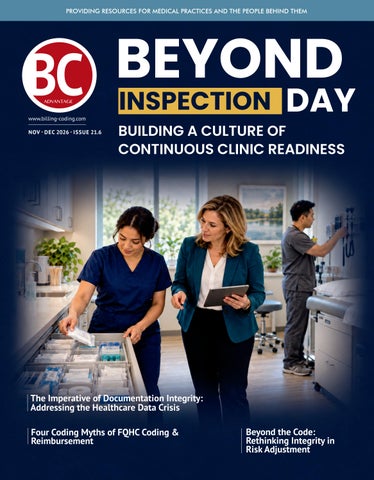
26 Beyond Inspection Day Building a Culture of Continuous Clinic Readiness Checklists provide structure and consistency, but true readiness goes further. Learn how to build a culture of continuous clinic readiness that strengthens compliance, improves operations, and prepares your practice every day - not just for inspection day.
EXPERT CONTRIBUTORS THIS ISSUE Joanne Byron, BS, LPN, CCA, CHA, CHCO, CHBS, CHCM, CIFHA, CMDP, COCAS, CORCM, OHCC, ICDCT-CM/PCS, is an executive educator with the American Institute of Healthcare Compliance, a licensing/certification non-profit partner with CMS. She shares her experience of over 40 years as a nurse, consultant, auditor, and investigator in the healthcare field. www. aihc-assn.org Paul Ferrazza is Vice President at Nivaran, formerly CodeEMR, the human-in-the-loop healthcare workflow company that connects clinical documentation, coding, revenue cycle management, and virtual operations in one accountable model, helping healthcare organizations protect provider time, reduce revenue leakage, and keep care moving. https://www.nivaran.ai Alexis Isom, CPC, CPMA, CRC, CHONC, AAPC Approved Instructor, is an experienced healthcare professional specializing in medical coding, risk adjustment, auditing, compliance, and hematology and oncology coding. Her broad range of expertise gives her a wellrounded perspective on the relationship between clinical documentation, accurate code assignment, regulatory requirements, and reimbursement. Misty Kelly, OHCC, HPOC, serves as Compliance and Privacy Officer for InnovaCare Health and has more than 23 years of experience in healthcare compliance, privacy, auditing, regulatory affairs, and risk management. Misty serves as an AIHC Education Volunteer and project manager for this article. AIHC Education Volunteer contributors to this article include Corliss Collins, BSHIM, RHIT, CRCR, CCA; Nancie Lee Cummins, CFE, CHA, CIFHA, OHCC, CHCM, CHCO CORCM, CRAS; Joy Rose, MSA, RHIA, CCS, CHA, CHPS; and Lorianne Sainsbury-Wong, Esq.
Suhas Nair is Executive Director of Product Management at AGS Health. Great performance starts with everything working together. AGS Health brings expertise, technology, and operating discipline tuned to you. Working as one team, we capture more revenue, strengthen margins, and keep improving over time. https://www.agshealth.com/ Sonal Patel, BA, CPMA, CPC, CMC, ICDCM, is CEO and Principal Strategist of SP Collaborative, LLC. Sonal has over 13 years of experience understanding the art of business medicine as a nationally recognized thoughtleader, speaker, author, creator, and consultant to elevate coding compliance education for the business of medicine. www.spcollaborative.net Rachel V. Rose, JD, MBA, advises clients on compliance, transactions, government administrative actions, and litigation involving healthcare, cybersecurity, corporate, and securities law, as well as False Claims Act and Dodd-Frank whistleblower cases. She also teaches bioethics at Baylor College of Medicine in Houston. Rachel can be reached through her website: www.rvrose.com Stephanie Thebarge, CPC, CPCO, CPMA, CPPM, CPB, CEMC, CHONC, is an experienced healthcare professional specializing in medical coding, auditing, compliance, billing, and practice management. Her extensive background gives her a comprehensive understanding of the challenges that healthcare organizations face in maintaining accurate documentation, compliant coding, and effective revenue cycle processes.
BC Advantage Magazine
www.billing-coding.com
5
THE IMPERATIVE OF DOCUMENTATION INTEGRITY
ADDRESSING THE HEALTHCARE DATA CRISIS The information in this article primarily applies to providers recording patient encounters in their office or other places of service. Content is for educational purposes only and is not intended as consulting or legal advice.
Introduction Clinical documentation represents the foundational pillar of modern healthcare, ensuring patient safety, care continuity, accurate reimbursement, and the ethical use of medical data for research. However, the healthcare industry is currently grappling with a severe data crisis driven by the proliferation of historical documentation errors. The transition from paper-based charts to Electronic Health Records (EHRs), while designed to streamline operations and reduce medical errors, has inadvertently introduced systemic vulnerabilities that compromise the integrity of clinical data. The modern healthcare data crisis is not simply a matter of lost or misplaced files; it is a systemic degradation of data quality caused by the cumulative effect of historical documentation errors. At the center of this crisis is the phenomenon known as “chart lore” or “note bloat,” where inaccuracies and redundancies are perpetuated across multiple patient encounters.
6
BC Advantage Magazine
www.billing-coding.com
Several structural & behavioral factors drive this crisis Overuse of Copy/Paste and Cloning: The implementation of EHRs introduced time-saving functionalities such as the “copy-forward” or copy/ paste features. Studies have revealed that over 50% of the text in inpatient and outpatient notes is duplicated. This practice often results in carrying over outdated, irrelevant, or entirely incorrect clinical information (e.g., documenting an allergy that was proven false years prior), creating information overload and increasing the risk of adverse events. Template and Drop-Down Menu Errors: The reliance on pre-populated templates and dropdown menus can lead to “mouse-click errors,” where a provider accidentally selects a normal finding for an abnormal condition. These errors obscure the true “patient story” and result in contradictory or missing clinical context.
Artificial Intelligence & Patient Matching and Interoperability Failures: Poor data entry and fragmented system integration contribute to patient misidentification. Industry surveys indicate that up to 20% of patients may not be correctly matched to their records, leading to scenarios where providers make treatment decisions based on another individual’s medical history. Defensive and Billing-Driven Documentation: Because healthcare systems rely on Evaluation and Management (E/M) codes and reimbursement structures, clinicians are often pressured to document excessively to satisfy complex billing requirements, rather than focusing purely on clinical utility. This return-on-investment approach distorts the clinical record and leads to defensive medicine. In light of E/M guidelines allowing time or medical decision-making for many codes, providers must remember that when time is used, the complexity of the visit must be reflected to support longer visit times (higher reimbursed codes). Payors will question when high levels of service are billed but the note does not reflect the amount of work to support reimbursement.
the Physician/Provider Burden Ironically, the tools intended to make documentation easier, EHR systems, have become a leading driver of clinician stress and burnout. The “cognitive load” of navigating drop-down menus and templating systems detracts from face-to-face patient time. And now, with artificial intelligence (ambient scribes) being integrated into clinical documentation, the burden can become overwhelming due to the time required to ensure there are no errors in the record. AI is being built with historical information that is peppered with errors, inaccuracies, and omissions. Despite promised efficiency gains, a large multi-center study found that AI ambient scribes saved a relatively modest 16 minutes of documentation time per eight hours of care. Because physicians are ultimately responsible for the accuracy of their medical records, they are forced to shift cognitive effort from typing to auditing—carefully reviewing AI-generated text to ensure no critical data has been omitted or misstated. Integrating AI as ambient scribes in clinical settings reduces documentation time but yields distinct error profiles. Studies from the National Library of Medicine indicate that up to 70% of AI-generated notes contain at least one error, with an average of two to three BC Advantage Magazine
www.billing-coding.com
7
errors per note. Omissions are the most common mistake, accounting for 71% to 83% of all errors.
Breakdown of AI Errors Research shows that the types & frequencies of errors vary widely by system: •
Omissions: Occurring in roughly 70-80% of recorded mistakes, this happens when AI leaves out critical details. Studies note that over 40% of these omissions carry moderate to significant clinical importance (e.g., omitting comorbidities or medication side effects).
•
Additions: Representing 4% to 11% of errors, this occurs when the AI fabricates or inserts information that was never discussed.
•
Hallucinations and Wrong Outputs: Fabricated or severely misidentified medical terminology.
•
Misplacements: Occurring in 6% to 25% of errors, where the AI correctly transcribes the information but places it in the wrong section of the chart.
Documentation Integrity & Accuracy Metrics While traditional self-documentation by doctors can also be fragmented, ambient AI drafts often capture a much higher volume of the spoken interaction. However, this can sometimes lead to an inverse problem of information overload for the physician reviewing notes for accuracy.
8
BC Advantage Magazine
www.billing-coding.com
Patient Safety and Clinical Continuity The primary purpose of any clinical note is to support continuous, high-quality patient care. Outpatient practices frequently treat patients across extended timelines and involve diverse clinical staff.
Therefore, documentation integrity is critical for multiple interconnected reasons: •
Preventing Diagnostic and Medication Errors: When previous providers fail to update active problem lists, or when notes contain contradictory information, the risk of adverse events skyrockets. Accurate documentation ensures that allergy lists, historical diagnoses, and ongoing treatment regimens are clear, preventing medication interactions and duplicative testing.
•
Facilitating Coordinated Care: In an era of teambased care and interoperability, patient notes are often referenced by external specialists, primary care physicians, and allied health professionals. Complete, up-to-date clinical notes give care teams a holistic view of a patient’s health journey, allowing them to make informed, data-driven decisions.
Financial Sustainability and Revenue Cycle Documentation dictates reimbursement and an organization’s ability to support compliant billing and reimbursement. In outpatient settings, practices rely on E/M coding guidelines established by the Centers for Medicare and Medicaid Services (CMS) and the American Medical Association (AMA).
These guidelines help in •
Reducing Claim Denials: Payors use automated systems to verify that documented services match the billed codes. Incomplete or vague documentation leads to high rates of claim denials, requiring expensive and time-consuming rework for billing staff.
•
Combating the “Cloning” Risk: EHRs offer timesaving features like “copy-and-paste,” “carryforward,” and auto-fill. While efficient, these features frequently lead to documentation cloning, where notes contain outdated or clinically irrelevant information. Payors increasingly view cloned notes as a compliance risk, which can lead to delayed payments or allegations of upcoding, leading to allegations of violating the False Claims Act.
The Clinical & Legal Repercussions The accumulation of these errors across vast databases has severe, real-world consequences for patient safety and institutional liability. Regulatory bodies, including the Department of Health and Human Services (HHS) Office of Inspector General (OIG), heavily scrutinize outpatient billing.
•
Patient Harm and Medication Errors: Data integrity issues directly impact diagnostic accuracy and treatment planning. Studies indicate that a significant percentage of EHR-related events— sometimes cited as over one-third of cases—have life-threatening potential. When providers are forced to skim through bloated records, critical changes in a patient’s condition or medication history are frequently missed.
•
Artificial Intelligence and Big Data Limitations: The current push toward integrating artificial intelligence and machine learning into healthcare relies entirely on the premise of data accuracy. However, because a high percentage of EHR records contain documentation errors, predictive models are frequently built on flawed or “missing” data indicators, which compromises their clinical reliability and introduces unconscious biases into algorithmic decision-making.
•
Malpractice Liability: Legal teams increasingly scrutinize EHR metadata and documentation errors during litigation. Many EHR-related malpractice liabilities stem directly from documentation errors and omissions, making inaccurate record-keeping a major risk management concern.
Ensuring documentation integrity limits the financial and reputational damage of audits: •
Demonstrating Medical Necessity: Every medical service must be justified by documented medical necessity. Documentation must clearly demonstrate why a course of action was taken and what alternatives were considered. Without this, practices are vulnerable to recoupment during post-payment audits.
•
Combating Fraud, Waste, and Abuse: Accurate charting protects both the provider and the organization. Attempting to add missing information or diagnoses to a chart after an audit has been initiated is a serious legal violation that carries civil and criminal penalties. Maintaining real-time, tamper-evident documentation is the best legal defense for providers. BC Advantage Magazine
www.billing-coding.com
9
Strategies for Restoring Documentation Integrity
•
Structured Data Capture: Shifting from unstructured narrative notes to standardized, structured data formats allow for better data reuse, less error-prone information exchange, and more effective clinical decision support systems.
Addressing the healthcare data crisis requires a fundamental shift in how documentation is viewed, created, and audited. Organizations must move beyond billing-centric metrics and prioritize true Clinical Documentation Integrity (CDI). We simply need more documentation professionals, specifically in the outpatient setting where most care is rendered.
•
Patient Engagement as a Verification Tool: Opening up EHRs to patients—allowing them to access their own health records and actively report discrepancies—has proven to be an effective strategy for identifying and resolving embedded “EHRrors” before they cause harm.
Restoring documentation integrity involves •
Implementing Continuous CDI Programs: Healthcare facilities must establish dedicated CDI teams that routinely review and audit charts for clarity, completeness, and clinical accuracy. However, it is important that auditors and those training providers in CDI have structured training themselves first. Not all coding and billing auditors are qualified to conduct a documentation integrity audit. By educating all those involved on best practices and modern documentation guidelines, organizations can ensure that the patient’s medical history accurately reflects their current clinical state. Engage with organizations for online CDI training to improve the basic understanding of a compliant medical record. Registering qualified staff and/or providers with an organization that is a licensing/certification partner with CMS is recommended, such as the American Institute of Healthcare Compliance, which offers online training with the option to certify as a medical documentation professional.
•
EHR Usability and Design Overhaul: Software vendors and IT departments must collaborate to redesign EHR interfaces. This includes implementing strict limits on copy-paste functionalities, utilizing anomaly detection tools to flag duplicated or contradictory text, and enhancing interoperability to reduce patient matching errors.
10
BC Advantage Magazine
www.billing-coding.com
Conclusion The historical degradation of healthcare data integrity poses a significant public health threat, turning patient records from life-saving tools into repositories of perpetuated errors. To mitigate this crisis, the healthcare ecosystem must prioritize actionable, systemic reforms. By investing in enhanced EHR design, responsible implementation of integrating AI, rigorous auditing and compliance, and a culture of clinical clarity, the industry can restore trust in medical data and safeguard patient lives. Outpatient practices can no longer treat clinical documentation as a mere administrative byproduct. Documentation integrity is the structural backbone of patient safety, financial compliance, and legal protection. By actively investing in CDI processes, ongoing provider education, and optimized EHR workflows, outpatient practices can safeguard patient outcomes, reduce audit vulnerabilities, and restore clinician satisfaction. Joanne Byron, BS, LPN, CCA, CHA, CHCO, CHBS, CHCM, CIFHA, CMDP, COCAS, CORCM, OHCC, ICDCT-CM/PCS, is an executive educator with the American Institute of Healthcare Compliance, a licensing/certification nonprofit partner with CMS. She shares her experience of over 40 years as a nurse, consultant, auditor, and investigator in the healthcare field. www.aihc-assn.org
American Institute of Healthcare Compliance www.aihc-assn.org
AIHC is a licensing/certification partner with CMS offering in-person training and online certification courses The American Institute of Healthcare Compliance is a national organization for Healthcare Professionals with over 30,000 members & subscribers. We are recognized as a healthcare education organization with the Internal Revenue Service (IRS) operating as a Section 501(c)(3) nonprofit corporation. Revenue generated by AIHC is reinvested in the organization to pursue its educational purpose and benefit its members.
We maintain an A+ Rating with the Better Business Bureau by providing quality Contact us today! online courses and live events to train and credential healthcare administrators. Call: 330-241-5635 email us: Info@aihc-assn.org Contact us today!
Call: 330-241-5635
BC Advantage Magazine
www.billing-coding.com
11
IS THE ® CPT CODING SYSTEM ABOUT TO CHANGE? HHS QUESTIONS THE COST AND CONTROL OF CPT CODES The Current Procedural Terminology (CPT®) code set has served as the common language of medical services and procedures for decades. Physicians, hospitals, medical coders, insurers, clearinghouses, and healthcare technology companies rely on CPT codes every day to report services and process claims. However, the federal government is now asking whether the healthcare system’s dependence on a privately owned and licensed code set continues to be the best approach. As part of the proposed 2027 Medicare Physician Fee Schedule, the Centers for Medicare and Medicaid Services (CMS) issued a Request for Information seeking public comments (through September 14, 2026) about the cost, administration, and future of the CPT coding system. 12
BC Advantage Magazine
www.billing-coding.com
Kennedy Calls Attention to CPT Licensing Costs In a video released by the Department of Health and Human Services (HHS), Secretary Robert F. Kennedy Jr. encouraged patients, physicians, hospitals, healthcare companies, and other interested parties to participate in the public comment process. Kennedy focused heavily on the American Medical Association’s ownership and licensing of CPT codes. He stated that healthcare organizations paid the AMA more than $300 million in 2025 for the right to use the code set. The $300 million figure should be understood as a claim made by Kennedy and HHS. It has not been independently confirmed through publicly available, itemized AMA licensing records. Nevertheless, his message has brought national attention to a cost that many medical practices may not realize they are paying.
The AMA maintains that the fees are neither excessive nor a significant driver of healthcare costs. It says licensing revenue supports the continued maintenance and development of a code set used throughout the healthcare system. CPT is updated annually to reflect changes in medical practice, technology, procedures, and services. The AMA also notes that the CPT Editorial Panel operates at no direct cost to the federal government.
What Is CMS Asking? The request goes well beyond asking how much practices pay for CPT licenses. CMS is seeking information about several major issues, including:
A practice may encounter CPT licensing charges through its electronic health record, practice management system, coding software, clearinghouse, billing company, or other technology vendor. Those costs may be incorporated into a subscription or service agreement rather than appearing as a separate charge labeled “CPT licensing.” As a result, a practice could effectively pay CPT-related fees through several different vendors.
What Does a CPT License Cost? In an October 2025 letter to Senator Bill Cassidy, MD, AMA CEO John Whyte, MD, MPH, stated that CPT licensing fees were $18.50 per user annually. Health plans were charged 24 cents per member per year. Although $18.50 per user may not appear excessive when viewed individually, the cost can grow across a large healthcare organization. It may also apply to multiple clinicians, coders, billers, administrators, and other employees who access CPT content electronically.
•
The costs and administrative burdens associated with obtaining and maintaining CPT licenses.
•
Whether licensing requirements delay or discourage healthcare innovation.
•
Whether the present system limits competition.
•
Whether private organizations could develop competing or supplemental code sets.
•
Whether there are viable alternatives to the CPT Editorial Panel and the AMA/Specialty Society Relative Value Scale Update Committee.
•
Whether physician procedural services could eventually be reported or paid using an alternative system, such as ICD-10-PCS.
•
How any change would affect healthcare providers, payors, patients, and technology developers.
CMS also raised concerns about the federal government relying on a private organization that owns the coding system and may have a financial interest in its continued use. Importantly, CMS has not proposed eliminating CPT codes. This portion of the 2027 proposed rule is a Request for Information. It does not establish a replacement code set, create a transition schedule, or require CMS to take further action. Its purpose is to collect information that could inform future policy decisions. BC Advantage Magazine
www.billing-coding.com
13
Could ICD-10-PCS Replace CPT? One of CMS’s most significant questions is whether ICD-10 procedure codes could provide an alternative basis for paying physician services. That possibility would require careful examination. ICD-10-PCS is currently used primarily to report inpatient hospital procedures. It was not designed as a direct replacement for the CPT system used by physicians and other healthcare professionals in outpatient settings. Moving physician services to ICD-10-PCS—or developing another coding system entirely— would be an enormous undertaking. The change would reach nearly every part of the revenue cycle. Practices could face: •
EHR and practice management system reconfiguration
•
Charge master and fee schedule revisions
•
Changes to coding software and claim edits
•
New documentation requirements
•
Staff education and coder retraining
•
Revisions to payor contracts
•
Increased denials during the transition
•
Disagreement among Medicare and commercial payors over implementation
CPT codes are also embedded in coverage policies, authorization rules, payment systems, quality measures, contracts, and data reporting programs. Replacing them would involve considerably more than issuing a new codebook.
The Cost of Change Must Also Be Considered The debate is not simply about whether the present CPT licensing structure is fair. Any alternative would also carry substantial costs. Even relatively small annual coding changes require medical practices to update systems, revise internal materials, educate employees, and monitor claims for unexpected denials. A nationwide move away from CPT could multiply those challenges across every medical specialty and payor. Smaller and rural practices could be especially affected because they generally have fewer compliance, information technology, and training resources available to manage a major conversion. That does not mean the current system should be protected from scrutiny. It means policymakers must compare the ongoing costs of CPT licensing with the operational and financial consequences of replacing or significantly restructuring the system.
The AMA’s Position The AMA describes CPT as the healthcare industry’s uniform language for reporting medical services and procedures. It argues that the CPT Editorial Panel provides an open, collaborative process that incorporates input from physicians, specialty societies, payors, hospitals, federal agencies, and other stakeholders. CMS, the Centers for Disease Control and Prevention, and the Food and Drug Administration have nonvoting liaison positions in the panel’s process. According to the AMA, panel meetings are open to stakeholders, meeting agendas are published in advance, and summaries of panel decisions are released following the meetings. The AMA also says purchasing a CPT codebook does not authorize an organization to reproduce or electronically distribute CPT content. Electronic use generally requires a separate license, whether obtained directly from the AMA or through an authorized vendor.
14
BC Advantage Magazine
www.billing-coding.com
Why Medical Practices Should Have Responded The comment period gave practices an opportunity to provide CMS with real operational information—not merely opinions about the AMA. Before submitting comments, practice managers should have review agreements with their: •
EHR and practice management vendors
•
Coding and billing software companies
•
Clearinghouses
•
Revenue cycle vendors
•
Outsourced billing companies
•
Clinical documentation and artificial intelligence vendors
Could ICD-10-PCS What Happens Next? Comments must have been submitted under the 2027 Medicare Physician Fee Schedule proposed rule, file code CMS-1848-P, by September 14, 2026. The associated docket is CMS-2026-2377. CMS will review the comments as it develops future policy, but there is currently no formal proposal or timetable for replacing CPT. For medical coders and billers, the immediate message is not that CPT is disappearing. The more accurate conclusion is that federal officials are conducting an unusually serious examination of who controls the nation’s dominant medical procedure code set, how much healthcare organizations pay to use it, and whether another approach could work.
Practices should have determined whether CPT royalties are separately disclosed, incorporated into other fees, or charged according to the number of users or clinicians.
The answers received by September 14 could influence the direction of medical coding and reimbursement for years to come.
The most useful comments will likely include specific examples, such as:
Sources: CMS CY 2027 proposed rule and comment
•
The practice’s total annual CPT-related expenses.
information, and the AMA’s response to Senator Cassidy.
•
The number of employees or clinicians covered.
•
Whether the same practice appears to pay through multiple vendors.
•
Problems obtaining or expanding a license.
•
Whether licensing restrictions have delayed a technology project.
•
The likely cost and disruption of transitioning to another code set.
•
Recommendations for improving transparency,
deadline, CMS proposed-rule fact sheet, AMA CPT licensing
BC Advantage Magazine
www.billing-coding.com
15
The FY 2027 ICD-10-CM Update
Small Code Changes, Big Questions for Coders October 1 has a way of arriving faster than a coding team expects. One day, a familiar diagnosis code is sitting in an encoder favorite list; the next, it has been replaced by a more specific choice. The FY 2027 ICD-10-CM update brought that kind of change across several specialties. The challenge was not simply learning new numbers. It was recognizing when the documentation now supports a more precise code—and when it does not. The new code set applies to encounters and discharges from October 1, 2026, through September 30, 2027. Among the areas worth a closer look are foot conditions, cardiac arrhythmias, pregnancy, toxic exposures, and veterans’ exposure histories. 16
BC Advantage Magazine
www.billing-coding.com
A Clearer Distinction for Foot Conditions Plantar fasciitis and plantar fascial fibromatosis sound similar, and older code references did not always make the distinction easy to follow. FY 2027 gives plantar fasciitis its own code family, M67.A, with choices that identify the affected foot. Plantar fascial fibromatosis remains under M72.2, with laterality options of its own. For a coder, the practical question comes before the code search: Which condition did the provider diagnose? A note describing plantar fasciitis should not be treated as interchangeable with one documenting plantar fascial fibromatosis. Teams that keep diagnosis shortcuts in templates or favorite lists should review both entries so an old selection does not carry forward unnoticed. The musculoskeletal changes also add more site and laterality detail for other osteomyelitis. When the record identifies the location and side, the updated codes can capture information that a broader choice would miss. That makes complete provider documentation especially useful, but the added specificity should never be assumed when it is absent from the chart.
Cardiac Diagnoses Move Beyond a Catch-All Several arrhythmias now have more distinct coding options, including catecholaminergic polymorphic ventricular tachycardia, Brugada syndrome, and ventricular bigeminy. A general arrhythmia code that once appeared on a practice’s cheat sheet may no longer be the best match for a documented diagnosis. This is a good place to review more than the code number. Check the current Tabular List for any instructions tied to the selected code, including whether another documented condition or symptom should also be reported. An updated encoder helps, but it cannot resolve an unclear diagnosis in the medical record.
Pregnancy Coding Asks for More Detail The pregnancy chapter adds choices for ectopic pregnancies that distinguish where the pregnancy is located and whether an intrauterine pregnancy is also present. Those details matter. An interstitial ectopic pregnancy, for example, is not adequately described by a code selected solely because it appears under the broad heading of tubal pregnancy. There are also codes for a continuing pregnancy following vanishing twin syndrome, with trimesterspecific choices. For obstetric coders, this is a reminder to read the complete diagnosis and the chapter instructions before assigning a code. A short phrase pulled from a problem list may leave out the very detail the new code structure is designed to capture.
to identify certain substances more specifically, including alkenes, cycloparaffins, and hexamethylene diisocyanate. Code assignment still depends on what happened and what the provider documented. An exposure, a toxic effect, and an adverse effect are different coding situations; the substance name alone does not settle the question. The update also provides more specific ways to report documented contact with or suspected exposure to burn pits and Agent Orange in a war theater. These codes make exposure history more visible in the record. They do not, by themselves, establish that an exposure caused a patient’s current illness. Coders should preserve that distinction and report the conditions supported by the documentation.
Be Sure to Review A useful update review starts with the diagnoses a practice actually sees. Look at frequently used codes, encounter forms, EHR picklists, encoder favorites, and internal coding guides. Then compare them with the FY 2027 Tabular List, Addendum, and Official Guidelines. Pay particular attention to deleted codes, new laterality choices, and changes to instructional notes. A code can still look familiar, while the directions around it have changed. The goal is not to memorize every addition as the new fiscal year begins. It is to know where the changes affect your work, ask for clarification when the clinical detail is missing, and verify the final selection against the current code set. That is how an annual update becomes accurate coding on the next patient encounter. Source: CMS FY 2027 ICD-10-CM Files and Official Guidelines
Exposure History Deserves Attention Changes to toxic-effect codes make it possible BC Advantage Magazine
www.billing-coding.com
17
Four Coding Myths of FQHC Coding & Reimbursement Federally Qualified Health Centers (FQHCs) operate under an encounterbased payment model. That structure has quietly bred a set of beliefs that cost health centers real money. Beyond compliance, coding accuracy and maximizing reimbursement should be viewed more as a financial strategy than a back-office chore. Nevertheless, here are four common myths that may be impeding effective reimbursement and coding processes.
Myth 1 Reimbursement Is a Flat Rate, So E/M Level Selection Doesn’t Matter Because FQHC visits are paid through an encounterbased model, it is easy to assume that E/M level selection has little bearing on reimbursement. The reality is more consequential. E/M levels influence the cost per visit that supports the PPS rate, because each CPT code carries an associated cost that flows into the 18
BC Advantage Magazine
www.billing-coding.com
annual cost report. When a health center reports $5 million in allowable costs across 25,000 billable visits, the resulting average cost per visit is $200; Medicare then layers a base rate and Geographic Adjustment Factor on top of that cost report data. Medicaid methodology varies by state, with some states requiring separate Medicaid cost reports and others using Medicare as a baseline with inflation updates or full recalculation. But the operational risk is consistent: If complex visits are routinely coded at lower levels, the health center artificially suppresses reported cost per visit, lowering the PPS rate across every visit rather than only the miscoded encounter. Commercial reimbursement adds a more immediate consequence,
because downcoding can create a direct payment gap between codes such as 99212, 99213, and 99214. Audit findings show what this looks like in practice. One FQHC audit found 245 down-coded encounters that represented lost reimbursement opportunity and 32 up-coded encounters that created compliance concerns. The better approach is to validate E/M levels against the documentation and monitor patterns that suggest recurring under-coding or unsupported upcoding.
Myth 2 Chart Review Alone Is Sufficient; Validating E/M Levels Isn’t Necessary The misconception is that checking provider-selected codes is equivalent to coding the encounter. In reality, reviewing codes and coding from documentation are fundamentally different processes; a coder clearing 200 encounters a day is validating, not abstracting. A limited chart review can support clean-claim workflow, but it is not the same as coding the encounter from the full record. Review usually means checking whether the provider-selected code appears reasonable; full coding means deriving the code independently from the documentation, including the HPI, assessment and plan, problem list, orders, results, and supporting clinical context. That difference matters because a high-volume review process can miss comorbidities, secondary conditions, and documentation inconsistencies that a complete abstraction process would surface. The risk is not merely technical. Limited review can produce revenue leakage, under-reported patient complexity, overlooked documentation gaps, and chart inconsistencies that trigger denials or audit findings. Community health centers should still use targeted validation where it fits, but they should pair it with periodic full abstraction audits to identify missed complexity and documentation trends.
BC Advantage Magazine
www.billing-coding.com
19
Myth 3 The EHR Assigns the Correct E/M Level Automatically
auditors target, degraded quality measure tracking, and under-reported patient acuity. In the FQHC model, ICD coding may not increase per-visit payment directly but helps ensure visits qualify as billable encounters, avoid denials, and count toward quality and supplemental funding programs.
The misconception is that EHR checkbox calculators can reliably assign the correct E/M level without professional review. In reality, they replace documentation-based coding logic with a simplified algorithm.
Audit evidence reinforces the point. Across one engagement, coders added 1,117 ICD codes, removed 870 unsupported codes, and rearranged 346 codes to protect medical necessity linkage that might otherwise have generated denials.
EHR calculators can create the appearance of consistency, but they are only as reliable as the selections entered into them. A checkbox-driven tool may produce an E/M level, yet it cannot fully evaluate whether those inputs are supported by the narrative documentation or whether the medical decisionmaking complexity is reflected accurately. In that sense, the tool can replace coding judgment with a simplified algorithm.
Taken together, these myths reveal a larger operational issue: Coding is often treated as claim cleanup rather than financial governance. A stronger coding process connects documentation, reimbursement, compliance, and quality reporting before errors become denials, audit exposure, or lost revenue.
The result can be more variability, not less. Some - If you are out of state temporarily (e.g., vacation), then the providers under-select, others over-select, and both Medicare rules do not apply. You should still investigate the patterns create risk when no one validates the medical-legal aspect of state licensure in that circumstance. assigned level against documentation, payor rules, and medical decision-making. Here are some examples using a hypothetical practice located in Massachusetts: The better practice is to treat the EHR-generated level as a starting point for review rather than the final • You work and live in Massachusetts; you may read and creanswer.
ate final reports from home. • You work in Massachusetts but live in New Hampshire; you may create final reports from home if you have a New Hampshire license and notify the billing team of the reading address. You may create preliminary reports from home if the final is signed off from the hospital. • You live and work in California reading exams done in Massachusetts; you must have a license in both California and Massachusetts and notify the billing team of your readThe time concern is understandable but, in many ing address. encounters, the chronic and comorbid conditions are • You work and live in Massachusetts but are on vacation in already documented; they simply need to be reflected Cape Cod, MA; you may create final reports. There is no need accurately in the coding. Capturing those conditions is to notify billing. not extra clinical work when they support treatment • You work and live in Massachusetts but are on vacation in decisions, adjustment, Florida;medical you may necessity, create final risk reports but check onquality the legal reporting, or supplemental payment It is aspect of licensure. There is no need toprograms. notify billing.
Myth 4 Capturing All Chronic Conditions at Each Visit Takes Too Long
representation of the record.
Some practice systems might automatically capture reading
When chronic conditions are left out, the cost shows location, but in the end, it is the physician’s responsibility to notiup in multiple places. These include lower Risk fy the practice about their work location. Making them aware of Adjustment Factor (RAF)asscores, weaker risk-adjusted these guidelines, especially they relate to medical licensure, payment support, documentation-to-coding gaps that 20
BC Advantage Magazine
www.billing-coding.com
Payment Locality Reporting for Radiology Professional Services
Why Coding Matters Beyond the Claim
will help to ensure that the practice is in full compliance.
Accurate coding matters because it sits at the Conclusion intersection of revenue integrity, compliance,
operations, and reporting. It reduces denials,
The easy availability of and remote readingpayment and the post-pandemic rejections, rework, delayed while shift to off-site work has renewed the need for practices to be lowering exposure to audit findings and recoupment. aware of the Medicare rules for reporting the place of service It also strengthens the data health centers rely on in order to be compliant. After-hours reading by radiologists in for UDS reporting, quality programs, supplemental distant locations will produce a reimbursement rate different funding, grant justification, care gap analysis, and than the one in effect at the imaging center or hospital. In some strategic planning. cases, this can be used strategically to move interpretations to a location with higher reimbursement rates. The first step is Complete coding turns the medical record into to develop a system that allows the billing team to know the operational intelligence, supporting quality measures, location of the reading services, so they can be sure to apply the risk adjustment, supplemental funding, and better rules properly.
population health decisions.
Table 1: See below
Paul Ferrazza is Vice President at Nivaran, formerly CodeEMR, the human-in-the-loop healthcare workflow Sandy Coffta is Vice President of Client Services with Healthcare company that connects clinical documentation, Administrative Partners. In this role, Sandy oversees the team coding, revenue cycle management, and virtual responsible for achieving and maintaining the company’s conoperations one accountable model, helping sistently high in retention and referral rates. Ms. Coffta has over 17 healthcare organizations protect provider time, reduce years of experience in client relationship management, including revenue leakage, andworkflow keep care moving.and compliance reimbursement analysis, optimization, education. She specializes in business intelligence and reporting https://www.nivaran.ai development, is a subject matter expert in radiology practice billing, and has deep expertise in resolving payor disputes and contract issues. www.hapusa.com
SUPPORTING HEALTHCARE FROM PRACTICE TO PROFESSIONAL
Flexible revenue cycle solutions designed to support healthcare organizations where they need it most. Billing, AR & Denials Coding & Audits Contracting & Credentialing RCM Staffing & Support
WHERE COULD YOUR REVENUE CYCLE USE SUPPORT?
Practical education designed to help healthcare professionals build skills, strengthen knowledge, and grow their careers. Certification Readiness On-Demand Learning One-on-One Tutoring
READY TO TAKE THE NEXT STEP?
MedCycleSolutions.com
MedAcademy.courses
YOUR FULL SERVICE RADIOLOGY RCM PROVIDER www.hapusa.com info@hapusa.com BC Advantage Magazine
www.billing-coding.com
21
REWRITING INTERNAL GUIDELINES WHAT WE KEPT, WHAT WE KILLED In my line of work, I’m always looking at the bigger picture. As auditors and compliance professionals, we spend our days identifying risk, questioning processes, and challenging assumptions. One phrase, however, has never belonged in a successful compliance program: “We’ve always done it this way.” Healthcare is constantly evolving; regulations change, payor scrutiny shifts, technology advances, enforcement priorities move from one area to the next. Yet many organizations continue operating under internal guidelines that were written to address yesterday’s risk, not today’s. Private practices like mine are facing an increasingly complex compliance landscape. Targeted payor audits, pre-payment reviews, artificial intelligence, data analytics, and heightened scrutiny of medical necessity are no longer isolated events; they’re becoming the new normal. Waiting until an audit letter arrives is no longer a compliance strategy; it’s damage control. 22
BC Advantage Magazine
www.billing-coding.com
It’s time to rewrite our internal guidelines with intention. Not because a regulation requires another policy—and boy, we love our policies—but because our compliance programs should reflect the risks our organizations face today. Every policy, audit plan, and educational initiative should answer one simple question: Does this help us identify, reduce, or prevent meaningful risk? Sometimes strengthening a compliance program isn’t about adding more; it starts by deciding what to keep, what to revise, and what to let go. In looking at my “big picture” scenario, you can’t just jump into the deep end without a life preserver. Twenty years ago, many compliance plans focused on meeting the seven elements of an effective compliance program.
Today, the strongest programs still include those elements, but they also ask: •
Where are we financially vulnerable?
•
What are payors denying today?
•
What is the OIG focusing on?
•
Where is AI introducing new risk?
•
Which internal processes create the greatest compliance exposure?
From there, you can rewrite your internal guidelines to align with your initiatives. Below are some examples.
What we kept •
Medical necessity
•
Risk adjustment accuracy
•
Drug administration documentation
•
Financial risk
•
OIG priorities
•
Patient safety documentation
Depending on your industry, the principles that never go out of style are medical necessity, documentation integrity, and ethical billing. In my field of oncology, auditing medical necessity is key since it is an identified risk area. We cross-reference administered drugs against FDA-approved labeling and the NCCN Clinical Practice Guidelines in Oncology (NCCN Guidelines) and verify that the clinical chart documentation substantiates the patient’s diagnosis and stage.
What we killed
Outdated policies feel like playing a Rick Astley song on repeat, “Never Gonna Give You Up.” They lost their meaning 10 years ago; the original reason for the rule is gone—it’s time to drop the fluff. Stop meaningless audits, redundant education, and checking boxes instead of evaluating risk. If you take one thing away from this, it is that your compliance plan should be relevant to now. Stop auditing every provider the same way; risk-based auditing is much more sophisticated. Monitor your payor trends before the payor recoups or refuses to pay for the services rendered (i.e., uptick in external audits on modifier 25, vial size wastage audits). Perform data analytics on denials to understand where the deficiency lies (i.e., prior authorization, off-label usage). Provide education to providers that focuses on why instead of what. Since oncology revenue cycle management is heavily scrutinized due to high-cost therapeutics, we need to refocus our lens to identify compliance issues early. Compliance has matured, and so should your audits.
Instead of “Every provider gets 10 E/M audits annually,” audit based on: •
New providers
•
High utilization patterns
•
Outlier billing
•
New service lines
•
New regulations
•
Prior audit findings
•
External payor focus
Retire outdated policies instead of reviewing 200 policies every three years simply because the calendar says so. Does the policy still solve a problem?
Retire policies because:
•
“Gotcha” audits
•
Point deductions for insignificant errors
•
They reference obsolete regulations.
•
Chasing 100% perfection
•
They duplicate another policy.
•
Outdated policies
•
They exist only because “we’ve always had one.”
•
Metrics that are checking a box BC Advantage Magazine
www.billing-coding.com
23
Having metrics within your organization will help you achieve results as long as they are meaningful. For example, we ask providers to tell the patient’s story in their documentation to support the cancer diagnosis, stage, intent, and drug ordered. I could have a metric for 100% staging on all cancer patients; however, that’s only checking a box. The new mindset is to be clinically meaningful to an outside oncologist reading the note rather than be checkbox-driven.
Can another oncologist understand: Why treatment changed
•
Why therapy continues
•
Why a high-cost drug remains medically necessary
•
Why supportive medications are needed
•
Disease response
•
Toxicities
•
Treatment intent
Most providers don’t think in coding terms; we must teach them the why behind change. Education should become collaborative instead of punitive. I recommend providing education, utilizing real-world cases, reviewing medical necessity, and incorporating peer reviews. Kill the phrase, “Because CMS says so.”
Providers respond much better when they understand: •
Why documentation protects them
•
Why diagnoses must be supported
•
Why medical necessity matters
•
Why payors deny claims
BC Advantage Magazine
•
Instead of “Is the note signed?” ask “Does this documentation make clinical sense?”
•
Instead of “Is there an ICD-10 code?” ask “Does the documentation support this diagnosis?”
•
Instead of “Was chemotherapy billed correctly?” ask “Should chemotherapy have been administered at all based on what’s documented?”
Those questions uncover the issues that truly matter for your organization and can drive your work plan.
•
24
Keep curiosity, as this catches more compliance issues than checklists:
www.billing-coding.com
The strongest compliance programs aren’t the ones with the thickest policy manuals or the longest audit checklists; they’re the ones willing to edit themselves. Every outdated policy retired, every meaningless metric abandoned, and every unnecessary rule removed creates room to focus on what matters most: accurate documentation, ethical billing, patient care, and meaningful compliance. Sometimes the most important thing a compliance leader can do isn’t write another policy; it’s having the courage to delete one. Stephanie Thebarge, CPC, CPCO, CPMA, CPPM, CPB, CEMC, CHONC, is an experienced healthcare professional specializing in medical coding, auditing, compliance, billing, and practice management. Her extensive background gives her a comprehensive understanding of the challenges that healthcare organizations face in maintaining accurate documentation, compliant coding, and effective revenue cycle processes. With multiple industry credentials spanning coding, auditing, compliance, evaluation and management, billing, practice management, and hematology/ oncology, Stephanie brings a well-rounded perspective to healthcare education. She is passionate about helping professionals better understand complex coding and compliance requirements and translating industry guidance into practical information they can apply in their day-to-day work.
BC Advantage Magazine
www.billing-coding.com
25
BEYOND INSPECTION DAY BUILDING A CULTURE OF CONTINUOUS CLINIC READINESS
Checklists provide structure and consistency, but they should not become the inspection itself. The true value of an inspection lies in validation, observation, and determining whether a process is actually working as intended.
26
BC Advantage Magazine
www.billing-coding.com
Inspection Readiness Is Not an Event Many organizations begin preparing for an inspection only after learning that a regulator, accrediting body, payor, auditor, or other external reviewer is scheduled to visit. Policies are reviewed, binders are updated, logs are checked, and last-minute reminders are received by staff. While preparation is important, true readiness cannot be built in the days or weeks leading up to an inspection. A successful clinic inspection program is not measured solely by how well a site prepares for a scheduled visit. It is measured by how consistently compliant processes are maintained when no inspection is expected. Organizations that embed compliance into daily operations are better positioned to respond when outside reviewers arrive because readiness has become part of the culture rather than an event on the calendar. Corliss Collins noted, “A clinic cannot inspect its way into quality/compliance. Quality/compliance has to be built into daily operations. Audit readiness should be a daily practice, not event-based.” This statement reflects one of the most important lessons I have learned through years of conducting clinic inspections: an inspection can evaluate readiness, but it cannot create it. Readiness is created through the work that occurs every day between inspections.
Define What Readiness Means in Your Organization Before developing or enhancing an inspection program, compliance professionals should clearly define its purpose and scope. This may seem obvious, but organizations vary considerably in how compliance responsibilities are assigned. In some organizations, compliance oversees a broad range of operational, regulatory, privacy, safety, and accreditation functions. In others, responsibilities such as infection control, medication management, employee safety, credentialing, and medical records may be owned by separate departments.
She explained that an observation may overlap with more than one department, but the organization’s structure and assigned responsibilities should guide how that concern is evaluated, communicated, and followed through.
The inspection scope should answer several basic questions •
What requirements will the inspection evaluate?
•
Which areas are owned by compliance?
•
Which findings require collaboration with another department?
•
Can the clinic readily produce the records, documentation, and evidence upon request?
•
Who is responsible for correcting each type of deficiency?
•
How will corrective actions be documented, escalated, and validated?
•
What evidence will demonstrate that the correction was sustained?
A clearly defined scope prevents gaps, reduces duplication, and helps ensure the right department is accountable for the right process. Just as important, clinics need to understand what readiness looks like before compliance arrives. Nancie Cummins stated, “A process needs to be in place for individuals to be able to follow guidelines. Some individuals have a background in compliance, and it may be easier. I have found most need guidelines for structure to be able to come up with an effective plan.” In my experience, inspection success rarely comes from surprise. It comes from providing clear expectations, practical tools, and sufficient opportunity for clinics to assess themselves before the inspection occurs. I often describe our program as an open-book test. The purpose is not to surprise the clinic; it is to determine whether expectations have been understood, implemented, and maintained.
Lorianne Sainsbury-Wong emphasized the need to understand “what you own and what you don’t own.” BC Advantage Magazine
www.billing-coding.com
27
A Clean Clinic Does Not Always Mean a Compliant Clinic Visible readiness is important. Clean exam rooms, organized records, current postings, and completed logs all contribute to a safe and professional environment. However, appearances do not always tell the whole story. Corliss Collins captured this distinction well: “A clinic may have clean exam rooms, completed logs, and organized binders, but still have weak processes.” A clinic can appear inspection-ready while still having significant gaps beneath the surface. Staff may be completing a task without understanding its purpose. A log may be present but completed inconsistently. A policy may be accessible but not reflected in actual practice. A correction may have been made after the prior inspection but never incorporated into the daily workflow. Corliss Collins also noted that many clinics are prepared to “look inspection-ready,” but not necessarily prepared to “prove process control.” She identified recurring concerns such as policy-to-practice gaps, training-to-competency gaps, repeat findings, document-control problems, weak recordkeeping, siloed departments, and limited leadership support. That is why meaningful inspections need to evaluate more than what is visible on inspection day.
Move Beyond Documents and Evaluate Process Effectiveness Document review is an important part of the inspection process. Policies, logs, licenses, certifications, training records, and required postings provide evidence that key compliance activities have occurred. However, the existence of a document does not necessarily demonstrate that the underlying process is effective.
28
BC Advantage Magazine
www.billing-coding.com
Consider the difference:
Inspection Element
Question to Ask
Documentation
Does the required record exist?
Implementation
Is the process actually being followed?
Knowledge
Can employees explain their responsibilities?
Effectiveness
Is the process producing its intended result?
Sustainability
Is the process being maintained between inspections?
This distinction appears frequently in actual clinic inspections. For example, a clinic may perform its required monthly crash cart review, but replacement pull-tag numbers may not be consistently documented. In that situation, activity is occurring, but the documentation does not fully demonstrate control of the process. Similarly, a clinic may complete routine safety checks but be unable to produce the related monitoring log. The missing document does not automatically mean the activity never happened, but it does mean the organization cannot verify that the process was performed consistently or reviewed appropriately. The same issue arises when required employee records are incomplete. During recent inspections, clinics generally demonstrated strong operational knowledge, yet findings still occurred because required consents or declination forms were not available. These are often correctable findings, but they also illustrate a broader compliance principle: If an organization cannot demonstrate that a required activity occurred, the strength of the underlying practice becomes more difficult to defend. Corliss Collins mentioned, “There is a big difference between a checklist and an audit. Always investigate, vet, verify, and validate everything based on evidence. Do not confuse activity with effectiveness.” Checklists provide structure and consistency, but they should not become the inspection itself. The true value of an inspection lies in validation, observation, and determining whether a process is actually working as intended.
BC Advantage Magazine
www.billing-coding.com
29
Readiness Extends Beyond Formal Regulatory Surveys When people hear the phrase “clinic inspection,” they often think first about a governmental, licensing, certification, or accreditation review. Actual clinic readiness is much broader. Payor visits, managed care audits, credentialing reviews, complaint investigations, privacy inquiries, and other external evaluations may all expose weaknesses in daily operations. Lorianne Sainsbury-Wong emphasized that these visits should be approached with the same level of care given to formal regulatory or accreditation surveys. She also made an important observation, “What they see, what they hear, what they observe” matters from the moment a visitor enters the facility. That observation extends beyond inspection preparation. It includes whether required postings are visible, whether conversations protect patient privacy, whether staff know how to respond to questions, whether restricted areas are appropriately secured, and whether daily operations reflect the organization’s written expectations. External reviewers do not experience a clinic through its policies alone. They experience it through its people, environment, documentation, and processes.
A balanced inspection model may include •
Routine self-audits
•
Scheduled educational or readiness activities
•
Focused reviews of higher-risk processes
•
Periodic unannounced validation
•
Timely feedback and corrective-action support
•
Follow-up monitoring to confirm sustained improvement
The combination provides both preparation and a realistic assessment of day-to-day readiness.
employee make a mistake?” The organization should also ask, “Why did this process fail again?” Joy Rose noted that many compliance challenges are not rooted in a lack of knowledge but in a failure to consistently execute established processes. That resonated with me because it mirrors what we frequently encounter during clinic inspections. Most clinics understand the expectations. The greater challenge is maintaining those expectations consistently between inspections.
Repeat findings may indicate •
An unclear or impractical workflow
•
Inadequate training or competency validation
•
Insufficient resources
•
Competing operational priorities
•
Unclear accountability
•
A lack of leadership reinforcement
•
Poor document control
•
A corrective action that addressed the immediate finding but not its cause
Recent inspection trends within our organization demonstrate why this matters. Many clinics performed extremely well, with 17 achieving scores of 95% or higher and three achieving perfect scores. However, lower-scoring clinics frequently showed evidence that a meaningful self-audit had not been completed. Many deficiencies could have been identified and corrected before the onsite review. Documentation remained the most common category of findings, and the issues generally reflected inconsistent execution rather than an absence of guidance or resources.
These results reinforce two important points •
First, the standards are attainable.
When Findings Repeat, Look Deeper
•
Second, providing information does not guarantee that it will be consistently applied.
An isolated mistake may require a straightforward correction. A recurring finding demands a different conversation.
Corrective action should therefore extend beyond fixing the immediate item. It should determine why the requirement was missed, who owns the ongoing process, and what evidence will demonstrate that the correction has become part of normal operations.
When the same type of finding continues to appear, the question should not be limited to, “Why did this 30
BC Advantage Magazine
www.billing-coding.com
Corliss Collins advised that compliance professionals should “implement root cause thinking early.”
Keep Inspections Educational, Not Punitive Inspections should never feel like a “gotcha” exercise. Employees who perceive inspections as punitive may become defensive, provide limited responses, or avoid asking questions. None of those reactions improve compliance. A supportive approach does not mean lowering standards or overlooking deficiencies. It means conducting the review professionally, explaining the reason behind the requirement, acknowledging areas of strong performance, and helping the clinic understand what must happen next.
An educational inspection should include •
Clear expectations
•
Objective observations supported by evidence
•
Recognition of areas that are working well
•
Explanation of identified risks
•
Specific corrective-action requirements
•
Access to appropriate tools and resources
•
Follow-up to confirm completion and sustainability
The site should leave the inspection understanding what needs to improve, why it matters, and who is responsible for the next step. Our clinic administrator survey provides helpful support for this approach. Their feedback was overwhelmingly positive. Respondents consistently described the inspection process as professional, supportive, educational, and valuable in helping them better understand compliance expectations. Survey results reinforce that accountability and partnership can coexist within the same inspection program. Those results matter because a rigorous inspection and a positive experience are not mutually exclusive. Compliance can hold clinics accountable while still treating the people involved with professionalism and respect. There is value in both announced and unannounced inspection activities. Scheduled reviews give clinics time to gather records, coordinate with supporting BC Advantage Magazine
www.billing-coding.com
31
departments, complete thoughtful self-audits, and address questions before the inspection. Unannounced or “pop-in” inspections more closely reflect the conditions a clinic may face if an outside agency arrives without advance notice. Our program evolved from scheduled inspections to pop-in reviews after clinics had received preparation tools, checklists, guidance, and ongoing education. The purpose was not to create anxiety or catch employees off guard. It was to determine whether established expectations were maintained under normal operating conditions. At the same time, an inspection should account for the realities of the clinical environment. Staff members are managing patient care, urgent operational needs, and competing responsibilities. Lorianne Sainsbury-Wong recommended: “Advance communication, planning, team collaboration efforts to maintain consistent messaging and reduce stress levels as many staff fear being put on the spot if questioned during an onsite inspection.” The goal should be realistic validation without unnecessary intimidation. When arriving for a pop-in inspection, I remind staff that compliance understands the process can feel stressful. We are not there to act as the police. We are there to help identify and correct vulnerabilities before an external regulator identifies them under far less forgiving circumstances.
Leadership & Operational Ownership Matter The compliance department may design the inspection process, perform the review, report deficiencies, and monitor corrective actions. It cannot single-handedly maintain readiness at every clinic. Readiness lives in daily operations. Clinic and department leaders help determine whether self-audits are meaningful, whether required records are maintained, whether staff receive sufficient time and support, and whether corrective actions remain in place after the inspection closes. When expectations are repeatedly communicated but the same findings continue to appear, additional training may not be the 32
BC Advantage Magazine
www.billing-coding.com
only answer. The organization may need to examine whether leaders are reinforcing the requirements, reviewing completion, removing operational barriers, and holding the appropriate individuals accountable. Lorianne Sainsbury-Wong emphasized the value of “Proactive communications, structured planning regulatory compliance oversight, and organizational alignment are essential components of effective inspection readiness. Leadership should focus on equipping team with clear guidance and consistent messaging so that inspections serve as an objective assessment of compliance, quality, and operational performance, not a disruptive event in daily work.” That partnership is essential. Compliance provides oversight and an independent perspective. Operations own the daily processes. Supporting departments provide subject-matter expertise and maintain records within their areas. Leadership ensures identified risks receive the attention and resources necessary for sustainable correction. Continuous readiness depends on all of them.
Questions Every Compliance Professional Should Ask Before concluding a clinic is inspection-ready, consider: • Are policies current, approved, and accessible? • Can staff explain the responsibilities? • Does documentation support actual practice? • Are self-audits identifying concerns before compliance does? • Are corrective actions addressing root causes? • Would the clinic perform the same way tomorrow if an external inspector arrived unexpectedly? The answers often reveal more about organizational readiness than any score or checklist alone.
Conclusion Meaningful clinic inspections are not simply about finding deficiencies. They are about determining whether written expectations have become part of daily operations. Organizations that embrace continuous readiness spend less time preparing for inspection day and more time maintaining effective processes. Employees understand their responsibilities, leaders reinforce expectations, and corrective actions become operational improvements rather than temporary fixes. A strong inspection program provides structure, identifies risk, validates effectiveness, and creates education opportunities. It also recognizes when a finding reflects more than an isolated mistake and requires a closer examination of leadership, workflow, resources, or accountability. Ultimately, the best measure of readiness is not how a clinic performs while the inspector is standing in the building. It is how the clinic performs every day when no inspection is expected. Misty Kelly, OHCC, HPOC, serves as Compliance and Privacy Officer for InnovaCare Health and has more than 23 years of experience in healthcare compliance, privacy, auditing, regulatory affairs, and risk management. Misty serves as an AIHC Education Volunteer and project manager for this article. AIHC Education Volunteer contributors to this article include Corliss Collins, BSHIM, RHIT, CRCR, CCA; Nancie Lee Cummins, CFE, CHA, CIFHA, OHCC, CHCM, CHCO CORCM, CRAS; Joy Rose, MSA, RHIA, CCS, CHA, CHPS; and Lorianne Sainsbury-Wong, Esq. https://aihc-assn.org
BC Advantage Magazine
www.billing-coding.com
33
SPOTLIGHT ON FRAUD, WASTE, & ABUSE
The following cases highlight fraud, waste, and abuse (FWA) and serve as a reminder to uphold high ethical standards when providing patient care and services.
Medicare Advantage Provider Complete Health to Pay $14,100,000 to Settle False Claims Act Suit Complete Health Partners Holdings, headquartered in Jacksonville, Florida, has agreed to pay $14,100,000, to resolve allegations that they violated the False Claims Act by causing the submission of false diagnosis codes to increase payments that they received from the Medicare Advantage program. Under the Medicare Advantage (MA) Program, also known as Medicare Part C, Medicare beneficiaries may 34
BC Advantage Magazine
www.billing-coding.com
opt out of traditional Medicare and enroll in private health plans offered by insurance companies known as Medicare Advantage Organizations, or MAOs. The Centers for Medicare and Medicaid Services (CMS) pays the MAOs a fixed monthly amount for each Medicare beneficiary enrolled in their plans. CMS adjusts these monthly payments to account for various “risk” factors that affect expected health expenditures for the beneficiary. In general, CMS pays MAOs more for sicker beneficiaries expected to incur higher healthcare costs and less for healthier beneficiaries expected to incur lower costs. To calculate the payment amounts, CMS uses a health-based risk adjustment model—the Hierarchical Conditions Category (HCC) model—that takes into account diagnoses reported by healthcare providers. In general, the more severe the diagnosis or costly the associated
treatment, the higher the risk score and the higher the corresponding payments to the MAO.
only and there has been no determination of liability.
Complete Health Partners Holdings (Complete Health) is a management services organization that manages, owns, or otherwise operates affiliated provider groups operating out of Florida, Alabama, and Colorado. Under the contracts, the MAOs agreed to pay Complete Health a percentage of the payments they received from CMS. This “risk sharing” compensation arrangement gave Complete Health a financial incentive to submit additional diagnosis codes to increase its patients’ risk scores and the corresponding payments made by CMS.
Source: Medicare Advantage Provider Complete Health to Pay $14,100,000 to Settle False Claims Act Suit. (2026, August 3). www.justice.gov
The settlement resolves allegations, from 2020 to 2023, Complete Health submitted diagnosis codes within Hierarchical Condition Code (HCC) 55 (Drug and Alcohol Dependence) and HCC 59 (Major Depressive, Bipolar, and Paranoid Disorders) that were not clinically valid, not properly supported by the beneficiary’s medical records, and/or not considered in the care, management, or treatment of the beneficiary. The United States contends that Complete Health disseminated incorrect coding guidance to its coders and physicians regarding diagnosis codes within HCC 55 and HCC 59. The United States further contends that Complete Health coders reviewed its beneficiaries’ medical records and identified additional diagnosis codes for chronic conditions, including diagnoses within HCC 55 and HCC 59. Complete Health then prompted doctors to add those diagnosis codes, even when the diagnosis codes were unsubstantiated or not clinically justified. As a result, the doctors added those diagnosis codes, which were not accurate. These diagnoses resulted in an increase in payment from CMS to the MA Plans in which the beneficiaries were enrolled, and the MA Plan then passed along a portion of the increased payment to Complete Health. The civil settlement resolves claims brought under the qui tam or whistleblower provisions of the False Claims Act. Under those provisions, a private party can file an action on behalf of the United States and receive a portion of any recovery. The whistleblower will receive approximately $2,467,500 as her share of the federal recovery. The claims resolved by the settlement are allegations
Nevada Doctor Charged with $95M Wound Care Fraud on Medicare A federal grand jury in the District of Nevada returned an indictment yesterday charging a 74-year-old M.D., of Henderson, Nevada, with a $95 million scheme to defraud Medicare by billing for medically unnecessary amniotic wound allografts that he and others applied to elderly Medicare patients. According to court documents, the medical doctor and sole owner of Dubin Medical Consultants, Inc. (also known as Wound MD) caused Medicare to be billed over $95 million for expensive amniotic allografts that he procured through illegal kickbacks and bribes. He allegedly applied these allografts to elderly patients— including vulnerable patients in hospice care—without medical necessity. Medicare paid over $54 million based on his false and fraudulent claims. As alleged in the indictment, the doctor received illegal kickbacks, bribes, and rebates from two different allograft distributors. Some of these illegal payments were falsely structured to appear as legitimate “Rebate Agreements” while concealing their true nature and illegal payments. These purported rebates substantially reduced the doctor’s true net cost of acquiring the allografts. He allegedly submitted claims to Medicare seeking reimbursement for the price listed on sham full-price invoices, instead of the actual price he paid for the allografts. The doctor and others allegedly kept as profit the difference between Medicare’s reimbursement and the price paid for the allografts.
BC Advantage Magazine
www.billing-coding.com
35
The indictment also alleges that the man received illegal kickbacks from one allograft distributor through payments from a pass-through bank account held in the name of a shell company in exchange for purchasing allografts from the distributor. Induced by these illegal kickbacks, bribes, and rebates, the doctor and his co-conspirators applied allografts without regard to medical necessity, including by applying allografts to infected wounds; to wounds that were not responding to allograft treatment; without first attempting, completing, or confirming conservative wound care treatment as required by Medicare; and in quantities that far exceeded the size of wounds. He allegedly selected allografts that would maximize his profit, not based on the patient’s need. To conceal the lack of medical necessity, he falsified patient medical records to make it appear as though the application of allografts was medically reasonable and met Medicare requirements. He used the proceeds of his alleged offenses to fund a lavish lifestyle, including having multi-million-dollar yachts built for him. He is charged with conspiracy to commit healthcare fraud and five counts of healthcare fraud. If convicted, he faces a maximum penalty of 10 years in prison for each count. An indictment is merely an allegation. All defendants are presumed innocent until proven guilty beyond a reasonable doubt in a court of law. Source: Nevada Doctor Charged with $95M Wound Care Fraud on Medicare. (2026, August 5). www.justice.gov
Veloxis Pharmaceuticals Agrees to Pay Over $46M to Resolve Criminal and Civil Liability for Kickback Schemes Veloxis has entered into a deferred prosecution agreement and will pay the largest Sunshine Act recovery in history. As part of the government’s resolution with Veloxis, 36
BC Advantage Magazine
www.billing-coding.com
the company entered into a deferred prosecution agreement (DPA) in connection with a criminal information filed in the District of Massachusetts charging Veloxis with conspiracy to commit violations of the federal Anti-Kickback Statute by paying for, among other things, lavish meals, alcohol, and luxury resort stays, to induce healthcare providers to recommend or prescribe Envarsus. As part of the DPA, Veloxis has agreed to pay a criminal penalty of more than $10 million. The resolution also includes a civil settlement of allegations that Veloxis caused the submission of false claims to federal healthcare programs by paying kickbacks to hospital personnel and specialty pharmacies, in violation of the False Claims Act. Veloxis has agreed to pay $34.45 million to the United States and certain states to resolve those civil allegations. In addition, Veloxis agreed to pay a $1.55 million civil penalty to the Centers for Medicare and Medicaid Services (CMS) to resolve allegations that Veloxis knowingly failed to report to CMS certain payments to physicians under the Open Payments Program (also known as the “Sunshine Act”). This is the largest Sunshine Act recovery since the law was passed in 2010. As part of the criminal resolution and the Corporate Integrity Agreement with the U.S. Department of Health and Human Services Office of Inspector General, Veloxis has agreed to implement a significant corporate compliance program, including adoption of an enhanced system of policies, procedures, and internal controls designed to deter and detect violations of the Anti-Kickback Statute, and implementation of enhanced oversight, reporting, and enforcement mechanisms. The Anti-Kickback Statute prohibits offering, paying, soliciting, or receiving remuneration to induce referrals of items or services covered by Medicare, Medicaid, and other federally funded healthcare programs. It seeks to ensure that medical providers’ judgments are not compromised by improper financial incentives and are instead based on the best interests of their patients. Similarly, Congress created the Open Payments Program to provide greater transparency and protection to consumers by requiring drug manufacturers and others to publicly disclose certain payments and other transfers of value to physicians, with the goal of discouraging the development of inappropriate relationships and potentially unnecessary healthcare costs that can arise from such conflicts. According to admissions and court documents filed
in the District of Massachusetts, from October 2016 and continuing through in or around June 2023, Veloxis and its employees engaged in a scheme to pay kickbacks to transplant healthcare providers (HCPs) to induce them to prescribe, order, or recommend or arrange for prescribing or ordering Envarsus for kidney transplant recipients. During the relevant time, Veloxis manufactured and sold a single drug, Envarsus, for use as an immunosuppressant in adult kidney transplant recipients. Envarsus, a drug taken once a day for the life of the kidney transplant recipient, competed against the generic form of the same drug, which was taken only once a day. To gain market share for Envarsus against a cheaper generic drug, Veloxis engaged in an aggressive marketing strategy pursuant to which it promoted Envarsus to HCPs at and tied to transplant centers and hospitals who could influence the placement of Envarsus on the formulary and/or protocol of their respective facilities. These marketing efforts included various tactics that violated the federal Anti-Kickback Statute, including but not limited to taking HCPs and, at times, their spouses or guests, to lavish dinners and on expensive trips and retreats under the guise of “advisory boards,” providing gifts and expensive alcohol to HCPs, and making purported consulting payments to HCPs for work that was not actually performed. In many of these instances, Veloxis employees submitted falsified company expense reports to conceal their illegal marketing efforts, including by falsely adding names to the list of attendees at dinners and events (to decrease the apparent cost per attendee of the meals) and omitting the names of physicians who attended the meals (to avoid Sunshine Act reporting requirements). This false reporting resulted in Veloxis’ failure to properly report the sums it paid to physicians, which further obscured its illegal activities. Veloxis admitted that it intended the improper remuneration it provided to HCPs to result in increased Envarsus prescriptions, as demonstrated, in part, by communications between Veloxis employees and certain HCPs. For example, in connection with a surgeon’s request to attend a speaker program, a Veloxis employee told the surgeon that the Veloxis employee “need[ed] scripts. Lots of them.” Several months earlier, the Veloxis employee had told the surgeon that he was “over sales” and needed the surgeon “more than ever,” and instructed the surgeon that it was “time to open your Rolodex and make things happen.” The statement of facts filed with the BC Advantage Magazine
www.billing-coding.com
37
DPA details additional examples of Veloxis’ kickbacks and related efforts to disguise and conceal its unlawful conduct. The resolution also resolves allegations that Veloxis violated the False Claims Act by knowingly causing the submission of claims to Medicare, Medicaid, and TRICARE for Envarsus prescriptions written by HCPs or filled by pharmacies to which Veloxis had knowingly and willfully paid kickbacks in violation of the Anti-Kickback Statute. In connection with the civil settlement agreement, Veloxis admitted that from 2016 to 2023, it paid kickbacks to HCPs in the form of lavish meals, alcoholic beverages, expensive trips, resort stays, gifts, and purported consulting fees to induce prescriptions of Envarsus. Veloxis admitted that it concealed those kickbacks by falsifying company expense reports and business records as to the recipients, amounts, and purpose of the payments; and creating consulting agreements for purported consulting work that was not actually performed. With respect to Veloxis’ obligation to report physician payments under CMS’s Open Payments Program, Veloxis admitted that because its reports to CMS were based on falsified expense reports, Veloxis underreported, or failed to report, the true amounts of its payments or transfers of value to those physicians. In addition, Veloxis admitted that from 2017 to 2023, it paid kickbacks to specialty pharmacies in the form of per-patient and per-month payments to induce those pharmacies to begin or continue purchasing Envarsus instead of competitor drugs, including a cheaper generic drug. Veloxis admitted that it disguised the unlawful purpose of the kickback payments to the pharmacies by falsely describing the payments in written contracts as being for “enhanced services” such as data collection or adherence services. In fact, Veloxis admitted that it paid the pharmacies regardless of whether they provided any data, provided the specified data fields, or provided the data in the specified format, and without confirming whether any adherence services were provided. Under the civil settlement agreement, Veloxis will pay $21,211,251 to the United States to resolve the False Claims Act allegations and an additional $13,238,749 to certain states for claims settled by certain State Medicaid programs. Veloxis also agreed to pay a civil penalty of $1.55 million to resolve allegations that it knowingly failed to report the amounts of its payments to physicians under the CMS’s Open 38
BC Advantage Magazine
www.billing-coding.com
Payments Program. In connection with the civil settlement, Veloxis entered into a five-year Corporate Integrity Agreement (CIA) with the HHS-OIG. The CIA requires, among other compliance provisions, that Veloxis implement a compliance program to identify and address the Anti-Kickback Statute risks associated with other financial arrangements and retain an independent compliance expert to perform a review of the effectiveness of the compliance program. Veloxis received credit under the Department of Justice’s guidelines for accounting for disclosure, cooperation, and remediation in False Claims Act cases. Among other things, Veloxis admitted liability and accepted responsibility for the misconduct, proactively disclosed inculpatory evidence not known to the government, and facilitated interviews with current and former employees and the collection of evidence from third parties. Veloxis also received credit for taking timely and remedial measures, including terminating employees responsible for the misconduct, updating and revising policies and procedures related to the Anti-Kickback Statute, adopting enhanced training, reporting, compliance, disciplinary, and internal investigations programs, and terminating agreements and relationships with third parties involved in the offense conduct. The claims resolved in the settlement include certain claims that were brought under the qui tam or whistleblower provisions of the False Claims Act. Source: Veloxis Pharmaceuticals Agrees to Pay Over $46M to Resolve Criminal and Civil Liability for Kickback Schemes. (2026, August 10). www.justice.gov
Attorney General Raoul Seeks to Intervene in False Claims Act Lawsuit Against Chicago-Area Medical Practice and Billing Company Over Fraudulent Medicaid Claims Attorney General Kwame Raoul and the U.S. Department of Justice (DOJ) filed a joint complaint in intervention alleging that the Foot & Ankle Health
Care Center Ltd.; European Foot & Ankle Surgical Care Ltd.; their owner, a doctor, and billing company Atlantic Wave Holdings LLC and Atlantic Wave II LLC knowingly submitted fraudulent claims to Medicaid for podiatry services performed by the doctor using the names and national provider identifiers (NPIs) of other physicians, despite his termination from the Illinois Medicaid program. In their complaint filed in U.S. District Court in Chicago, Raoul and the DOJ allege that the defendants carried out an unlawful billing scheme through their billing vendors, first PhysicianDS (PDS) and later Atlantic Wave. The defendants also failed to advise Medicare of the doctor’s termination. These schemes resulted in more than $5 million in false claims paid by Medicare and Medicaid. Medicare later revoked the doctor’s privileges effective September 2022, after eventually learning of his Medicaid exclusion. According to the complaint, the Illinois Department of Healthcare and Family Services Office of Inspector General terminated the doctor’s participation in the Medicaid program in May 2019. To get around the termination and continue to bill Medicaid, the defendants allegedly directed billing personnel to submit his claims under other providers’ NPIs, including podiatrists who did not render the services. Billing personnel allegedly used fake service locations inside their electronic medical records and billing system to track which services were actually performed and by which physicians while submitting claims to Medicaid and other insurers under other physicians’ names. Defendants also allegedly billed for services performed by new physicians under established providers’ NPIs to avoid credentialing costs.
provisions of the False Claims Act. After acquiring PDS, Payrhealth learned of the fraudulent conduct, terminated the doctor’s entities as clients, and notified the government. The complaint from Raoul and the DOJ seeks treble damages and civil penalties under the federal False Claims Act, the Illinois False Claims Act, and commonlaw claims for payment by mistake and unjust enrichment. The federal and Illinois False Claims Acts permit private individuals to sue for false claims on behalf of the government and to share in any recovery. The acts also allow the government to intervene or take over the lawsuit, as it has done in this case, and to recover three times its damages plus civil penalties. The public is reminded that civil allegations are accusations only, and there has been no determination of liability. Source: Attorney General Raoul Seeks to Intervene in False Claims Act Lawsuit Against Chicago-Area Medical Practice and Billing Company Over Fraudulent Medicaid Claims. (2026, August 18). http://illinoisattorneygeneral.gov
Sonal Patel, BA, CPMA, CPC, CMC, ICDCM, is CEO and Principal Strategist of SP Collaborative, LLC. Sonal has over 13 years of experience understanding the art of business medicine as a nationally recognized thoughtleader, speaker, author, creator, and consultant to elevate coding compliance education for the business of medicine. www.spcollaborative.net
Raoul and the DOJ allege that Atlantic Wave leadership was repeatedly notified of the fraudulent billing practices after acquiring PDS in 2020, but continued processing and submitting claims that masked the identity of the rendering providers. The complaint asserts that Atlantic Wave executives were aware that this practice was illegal but allowed it to continue, including schemes designed to avoid credentialing new physicians by billing under the NPIs of other doctors. On July 2, 2026, Raoul’s office and the DOJ notified the court that they were intervening in a lawsuit originally filed under seal by Payrhealth LLC, a successor billing company, under the whistleblower
www.billing-coding.com/ceus BC Advantage Magazine
www.billing-coding.com
39
BEYOND THE CODE RETHINKING INTEGRITY IN RISK ADJUSTMENT
For many healthcare professionals, today’s conversations surrounding Medicare Advantage risk adjustment are increasingly shaped by a news cycle of RADV audits, Department of Justice (DOJ) settlements, Office of Inspector General (OIG) findings, and heightened Centers for Medicare and Medicaid Services (CMS) oversight. Read enough headlines, and it’s easy to conclude that risk adjustment has become little more than a hunt for overpayments. I Would Argue That Perspective Misses the Larger Story Risk adjustment was designed to account for differences in disease burden because patients with greater healthcare needs often require more intensive management, closer monitoring, and a greater coordination of care. Diagnoses submitted to CMS become part of the clinical picture used to describe a population’s chronic disease burden. Hierarchical Condition Categories (HCCs) are the mechanism through which qualifying diagnoses are incorporated into the risk-adjustment model, contributing to risk scores used in risk-adjusted 40
BC Advantage Magazine
www.billing-coding.com
payment. The code, then, is not the endpoint. It becomes data, and that data is a representation of the population being served.
Therefore, Payment Integrity Must Run in Both Directions Much of today’s regulatory attention and compliance infrastructure surrounding risk adjustment is conditioned to detect unsupported diagnoses and disproportionately focuses on the risk of overpayment. An unsupported diagnosis may overstate disease burden, while a clinically supported condition that is missed, inadequately documented, or reported without sufficient specificity may understate it. In either direction, the data may no longer accurately represent the patient’s health status and expected healthcare needs that the model is intended to reflect. If we’re serious about Medicare risk-adjustment program integrity, it has to mean more than finding money that shouldn’t have been paid. For coding professionals, technical proficiency has always been the floor, but this broader perspective expands the lens from coding accuracy to documentation integrity.
It is necessary to know the code and understand the “why,” as shown in the table. Knowing the Code
Understanding the “Why”
Applying ICD-10-CM guidelines to the documented diagnosis.
Recognizing when accurate coding may still leave chronic conditions underrepresented.
Applying the specificity supported by documentation.
Recognizing when clinical indicators or unclear severity may warrant a query for clarification.
Verifying that CMS requirements for risk-adjustment reporting are met.
Understanding that both over- and under-reporting can compromise model integrity.
Completing an accurate code assignment.
Understanding how coded data represents chronic illness and informs reimbursement and resource planning.
BC Advantage Magazine
www.billing-coding.com
41
Technically Accurate Coding Can Coexist with Incomplete Documentation A provider may document, “Patient in today for followup of chronic kidney disease.”
For organizations developing coding teams in this environment, that standard should influence how we educate, audit, and measure performance: •
Teach beyond the guideline. Risk adjustment coding professionals should understand what happens after a diagnosis is coded and reported and be equipped to translate that knowledge into meaningful provider education. Complete and specific documentation does more than support code assignment; it contributes to how the patient is represented within the risk-adjustment model and, ultimately, informs risk-adjusted payment intended to account for differences in expected healthcare costs.
•
Audit for what is missing, not only what is wrong. Compliance programs must identify unsupported diagnoses, but documentation integrity also requires attention to clinically supported complexity that the medical record fails to fully communicate.
•
Measure more than productivity. Charts per hour and turnaround times matter, but so does a coder’s ability to recognize documentation gaps, query appropriately, and exercise sound judgment when the record warrants a closer look.
A coder focused solely on code assignment may report N18.9, chronic kidney disease, unspecified, as documented. On that statement alone, the assignment is accurate. Now consider that the record also contains an eGFR consistent with advanced renal disease. Although coders cannot independently interpret laboratory values and assign a CKD stage, we can recognize the opportunity for greater specificity and query the provider for clarification when clinically appropriate. Without that clarification, the severity reflected elsewhere in the chart may never be represented in the diagnosis reported to CMS. Under CMS-HCC V28, N18.9, chronic kidney disease, unspecified, does not map to an HCC. Greater diagnostic specificity, when clinically supported and documented by the provider, can materially change how the patient’s CKD is represented within the risk-adjustment model and ultimately affect risk-adjusted payment. Nothing was necessarily coded incorrectly, yet the data leaving the encounter may still describe a less complex patient than the record itself suggests.
Consequences That Have Teeth In May 2026, the OIG reported that CMS potentially overpaid Medicare Advantage organizations $462 million based on certain unsupported acute stroke diagnosis codes reported during the 2020 service year. The finding illustrates the opposite failure: Instead of clinically supported complexity being insufficiently represented, diagnoses were reported without corresponding evidence in the medical record. The direction of the error is different, but the integrity standard remains the same: The data should not represent patients as sicker or healthier than the medical record supports.
42
BC Advantage Magazine
www.billing-coding.com
Together, these practices strengthen the riskadjustment lifecycle from the clinical encounter to the data ultimately submitted to CMS. As regulatory scrutiny intensifies, the opportunity is not simply to identify errors after they occur, but to build documentation and coding processes that preserve integrity at every stage.
Alexis Isom, CPC, CPMA, CRC, CHONC, AAPC Approved Instructor, is an experienced healthcare professional specializing in medical coding, risk adjustment, auditing, compliance, and hematology and oncology coding. Her broad range of expertise gives her a wellrounded perspective on the relationship between clinical documentation, accurate code assignment, regulatory requirements, and reimbursement.
Beyond Ambient AI
Why Medical Coding Automation May Be Healthcare’s Most Important Operational AI Investment Healthcare’s Artificial Intelligence (AI) conversation continues to center largely on clinical applications. Ambient documentation, generative AI assistants, and clinical decision support systems have captured headlines and investment dollars alike. These innovations are important, but they are overshadowing one of healthcare’s key operationally impactful uses of AI: medical coding automation. Coding lacks the visibility and excitement of patientfacing AI applications. Yet, it has quietly become one of the most compelling proving grounds for operational AI because it intersects several of healthcare’s most pressing challenges, including chronic workforce shortages, documentation complexity, denial pressures, and financial performance. These pressures are not temporary. Coding requirements have become more nuanced as payor policies evolve, value-based reimbursement models expand, and documentation expectations rise. At the same time, provider organizations struggle to recruit and retain experienced coding professionals. The result is a strain on the health information management and revenue cycle teams tasked with delivering accuracy and quick turnaround times with limited resources. This has accelerated interest in AI-powered coding 44
BC Advantage Magazine
www.billing-coding.com
technologies; however, today’s coding platforms bear little resemblance to the early generations of computer-assisted coding (CAC) tools that merely suggested codes for human review. Current coding automation technologies leverage clinical AI to interpret physician documentation, identify diagnoses and procedures, recommend or assign ICD-10, CPT, and HCPCS codes, and apply increasingly sophisticated coding knowledge. These systems also identify documentation gaps, support hierarchical condition categories and risk adjustment factor capture, and assist with billing workflows by validating documentation against coding requirements and payor rules. More importantly, health systems are starting to view these technologies differently. Coding automation is not being evaluated solely as a productivity tool to help coders process more charts but rather as a foundational workflow infrastructure that can make revenue cycles more resilient, scalable, and responsive to necessary change. The benefits are already evident. Organizations deploying advanced coding technologies are reducing turnaround times, improving clean claim rates, increasing productivity without proportional increases in staffing, and gaining greater visibility into
documentation patterns and coding performance. Equally important, these technologies are helping organizations manage variability and create more consistency in coding practices across departments, facilities, and teams. However, one of the most important lessons emerging from early adoption efforts is that the future of coding automation is not standalone, fully autonomous coding, but autonomy with human oversight—hybrid intelligence. Healthcare has occasionally fallen into the trap of viewing AI as a replacement technology. The reality is considerably more nuanced. AI and human expertise possess different strengths; most successful implementations leverage both. AI excels at processing high volumes of structured and semi-structured information, applying coding rules consistently, identifying patterns across datasets, and routine, low-complexity encounters. Human coding professionals remain indispensable when documentation is ambiguous, clinical scenarios are unusually complex, or regulatory and compliance considerations require judgment and interpretation. In practice, the most effective model is one in which AI handles the work it does best, while experienced professionals focus on higher-value activities, such as exception management, auditing, compliance oversight, and complex case review. This approach allows coding professionals to operate at the top of their skill sets. The hybrid intelligence model creates another advantage that is usually overlooked. It establishes a continuous feedback loop. Human corrections become training data for AI systems. Audit findings refine algorithms and improve future performance. Specialtyspecific nuances are incorporated over time. The result is a system that continuously evolves and becomes increasingly effective. This distinction is important because it reframes the conversation around coding automation. The objective is not to eliminate human involvement but to orchestrate the interaction among technology, people, and processes to produce better outcomes than any single component could achieve independently.
leaders are beginning to grapple with strategic questions. What does responsible autonomous coding actually look like? Where should human expertise be focused? How should organizations govern AIgenerated coding? Which workflows are sufficiently standardized and repeatable to support greater levels of automation? What levels of explainability and auditability should organizations require from coding technologies? These questions reflect the growing realization that coding automation is no longer simply a technology discussion. It is an operational strategy discussion. Organizations that approach coding AI solely as another software implementation risk missing the opportunity. The greater value lies in using coding automation to build more resilient revenue cycle operations that can adapt to ongoing workforce constraints, increasing documentation requirements, and evolving reimbursement models. The healthcare organizations that derive the greatest benefit from operational AI will likely be those that focus less on replacement and more on orchestration. They will recognize that the future of coding lies not in choosing between humans and machines, but in deliberately designing systems that allow each to contribute its unique strengths. While ambient documentation and clinical AI applications will certainly continue to draw attention, some of healthcare’s most significant and measurable returns on AI investment may emerge from less visible areas of the enterprise. Medical coding automation offers an important reminder that the most transformative uses of artificial intelligence are not always the most glamorous. Sometimes they are the technologies that quietly strengthen operations, boost financial performance, and help organizations build a more sustainable future. Suhas Nair is Executive Director of Product Management at AGS Health. https://www.agshealth.com/
As coding automation capabilities mature, healthcare BC Advantage Magazine
www.billing-coding.com
45
No Surprises Act Update Enacted as part of the Consolidated Appropriations Act of 2021, Pub. L. 116-260 (Dec. 27, 2020), the No Surprises Act (NSA)’s fundamental purpose is to protect consumers— patients—from surprise medical bills arising out of three scenarios.
These include •
Most emergency services from out-of-network providers, or out-of-network emergency facilities;
•
Non-emergency services from out-of-network providers with respect to a patient’s visit to certain types of in-network healthcare facilities; and
•
Air ambulance services from out-of-network (OON) air ambulance service providers.
As stated on the Federal Trade Commission (FTC)’s website “Under Section 109 of the [NSA], the Secretary of Health and Human Services (HHS), in consultation with the FTC and the Attorney General, must conduct a study by January 1, 2023, and annually thereafter for each of the following 4 years, on the effects of the Act on any patterns of vertical or horizontal integration of health care facilities, providers, group health plans, or health insurance issuers; overall health care costs; and access to health care.” In early 2026, HHS released the “No Surprises Act Third Report to Congress” (“NSA Report”). This report focuses on claims data trends for the first year, postNSA implementation. The NSA Report also includes an initial analysis of data on completed federal Independent Dispute Resolution (IDR) disputes related to OON payment rates between providers and private health plans and issuers. In 2023, providers 46
BC Advantage Magazine
www.billing-coding.com
prevailed in approximately 80% of IDR determinations related to OON claims and approximately 85% of IDR determinations related to air ambulance services. Relatedly, the Centers for Medicare and Medicaid Services (CMS) published a No Surprises Act Consumer Advocate Toolkit on its website. This tool enables the user to identify when consumers have protections and how to assist them in resolving relevant medical billing issues. One area that has dominated NSA litigation is the IDR process. Texas Medical Association, et al. v. United States Department of Health and Human Services, et al., Case No. 6:22-cv-450 (E.D. Tex. Aug. 24, 2023) (Lead Consolidated Case), is a U.S. District Court case that centers around the plaintiff’s challenge to HHS regulations that govern how the qualifying payment amount (QPA) is calculated by insurers. In its Opinion on a motion for summary judgment and a related cross-motion for summary judgment, the District Court held that “certain challenged portion of the July 1, 2021, Rule and subsequent guidance conflict with the Act and must be set aside under the APA. Specifically, all but one regulation pertaining to the calculation of the QPA violate the plain text of the Act.” Unsurprisingly, this led to an appeal by the plaintiffs to the U.S. Court of Appeals for the Fifth Circuit (“Fifth Circuit”). On appeal, the plaintiffs challenged three aspects of HHS and two other government agencies’ rulemaking, alleging that the agencies’ rules were arbitrary and capricious and ran contrary to the NSA. In 2024, the Fifth Circuit reversed and granted an en banc rehearing. See Tex. Med. Ass’n v. HHS, 120 F.4th 494 (5th Cir. 2024), reh’g en banc granted, opinion
vacated,138 F.4th 961 (5th Cir. 2025). On August 12, 2026, the Fifth Circuit issued a per curiam opinion in Texas Medical Association v. HHS, Case Nos. 23-40605 and 23-40217 (5th Cir. Aug. 12, 2026). The remainder of this article provides a synopsis of the Fifth Circuit’s opinion (“Opinion”).
August 12, 2026, Fifth Circuit Opinion As stated at the beginning of the Fifth Circuit’s Opinion, “This case concerns the methods used to calculate the QPA. The Act provides that the QPA is ‘the median of the contracted rates recognized by’ an insurance plan ‘as the total maximum payment … for the same or a similar item or service that is provided by a provider in the same or similar specialty and provided in the geographic region in which the item or service is finished’ Id. 300gg-111(a)(3)(E)(i)(I)” (Case No. 23-40605, p. 2-3). Stated another way, “The QPA is the median of the total maximum rates in an insurer’s contract for an item or service that a provider provides and furnishes, sorted by specialty and geographic region” (p. 3). The
NSA expressly enables HHS and two other government agencies (“agencies”) to refine the QPA calculation methods. (See § 300gg-111[a][2][B]).
Plaintiffs raised three issues, and the Fifth Circuit broke down the Opinion into four parts: •
Part I: Whether insurers can include “ghost rates” in the QPA.
•
Part II: Whether insurers may exclude bonus and incentive payments from the QPA.
•
Part III: Whether insurers may exclude from the QPA one-off agreements for certain items (i.e., air ambulances).
•
Part IV: Proper remedy.
The Court majority of the en banc Court agreed with the plaintiffs on Parts I and II; however, they disagreed on Part III.
BC Advantage Magazine
www.billing-coding.com
47
Part I Part I highlights a critical instruction in the July 2021 Rule (86 Fed. Reg. 36,872 [Jul. 13, 2021]), which was promulgated without the notice and comment period under the Administrative Procedures Act (APA). Specifically, “This rule required that insurers treat ‘each contracted rate for a given item or service’ as a ‘single data point when calculating a median contracted rate … regardless of the number of claims paid at that contracted rate.’ Id. at 36,889” (p. 4). Meaning that the QPA calculation should have included each rate that appeared on the face of an insurer’s contracts with providers. This is because, in part, oftentimes, these contracts include a default fee schedule for all covered services. The example of a “ghost rate” (i.e., a rate for a service that providers do not actually provide) that the Opinion utilized was an OB/GYN electing not to deliver babies. In turn, the fee schedule may include an unnegotiated “ghost rate” for various obstetrical services (in some cases as low as $0) because there is no economic incentive to negotiate a rate for a service that will never be provided. Subsequently, a 2022 August FAQ directed insurers to exclude $0.00 ghost rates. Notably, the Court honed in on, “If a $0 ghost rate must be excluded because it’s obvious that a particular provider did not contract to provide anything for free, the same must be true for a below-market non-$0 (e.g., $1) ghost rate. Either the provider contracted for the rate, or he did not.” In sum, the Court found the agencies’ arguments unpersuasive because they shirked the APA’s notice and comment period.
Part II Part II focused on the QPA calculation’s exclusion of certain bonus and incentive payments. The Court explained the agencies’ error and agreed with the plaintiffs. “The NSA requires that each contracted rate in the QPA calculation reflect the ‘total maximum payment’ ‘under such plans or coverage’ for an item or service. 42 U.S.C. § 300gg-111(a) (3)(E)(i)(I). Translated to plain English, that means that each contracted rate that factors into the QPA calculation is the highest possible amount in a provider-insurer contract for an item or service” (p. 10). The providers’ bonuses, incentives, or other adjudgments must be included in the QPA, and the agencies’ exclusion of these types of payments “means that the providers are receiving less than the ‘total maximum payment’ specified by the statute” (p. 11). 48
BC Advantage Magazine
www.billing-coding.com
Part III In Part III, the Court sided with the agencies on the question of the exclusion of one-off, case-specific agreements from the “contracted rates” utilized in the QPA calculation. In essence, the plain text of the NSA requires insurers to calculate the QPA based on the “‘contracted rates recognized’ by a health plan ‘under such plans or coverage’ within an insurance market. 42 U.S.C. § 300gg-111(a)(3)(E)(i)(I)” (p. 12). Only the air ambulance companies briefed the issue. Overall, the NSA does cover single-case agreements (i.e., air ambulance bills).
Part IV Now, Part IV—the remedy. As the Court explained, their default remedy is vacatur, pursuant to the APA’s provision that the “reviewing court shall … hold unlawful and set aside an agency action … not in accordance with law. 5 U.S.C. § 706” (p. 17). The earlier 2024 Fifth Circuit panel largely upheld the challenged rules and the agencies’ QPA assumptions and mostly reversed the District Court’s 2023 ruling, which held the rule unlawful. As stated herein, the en banc Court held that more aspects of the rule were unlawful and affirmed in part and reversed in part, holding that the agencies violated the APA with numerous aspects of how they constructed rules governing the IDR process. The next step for the litigants? Back to the District Court for further proceedings consistent with the Fifth Circuit Opinion.
Conclusion From a practical standpoint, IDRs that utilized what the Fifth Circuit deemed unlawful applications of the QPA could give rise to numerous appeals. From the outset, the IDR and other aspects of the NSA have been hotly litigated. For providers, consumers, and insurers alike, this is an area in which to stay abreast and consider potential appeals.
Rachel V. Rose, JD, MBA, advises clients on compliance, transactions, government administrative actions, and litigation involving healthcare, cybersecurity, corporate, and securities law, as well as False Claims Act and DoddFrank whistleblower cases. She also teaches bioethics at Baylor College of Medicine in Houston. Rachel can be reached through her website: www.rvrose.com
BC Advantage Magazine
www.billing-coding.com
49
50
BC Advantage Magazine
www.billing-coding.com
BC Advantage Magazine
www.billing-coding.com
51
BC
Magazines | CEUs | Webinars www.billing-coding.com
ADVANTAGE
New subscriptions www.billing-coding.com/subscribe Renewals (Keep your rate for life*) www.billing-coding.com/renewals
www.billing-coding.com
We have provided over 790,000 CEUs to Billers, Coders, and Office Professionals over the past 20 years and counting... 52
BC Advantage Magazine
www.billing-coding.com