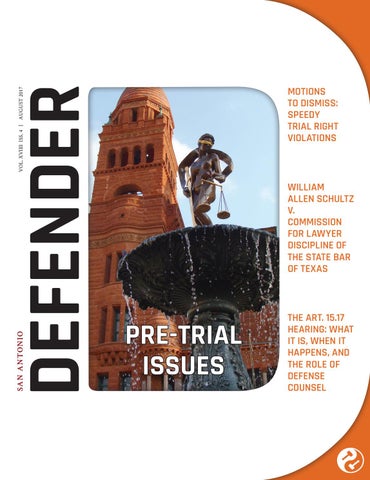
DEFENDER SAN ANTONIO
VOL. XVIIII ISS. 4 | AUGUST 2017
MOTIONS TO DISMISS: SPEEDY TRIAL RIGHT VIOLATIONS
WILLIAM ALLEN SCHULTZ V. COMMISSION FOR LAWYER DISCIPLINE OF THE STATE BAR OF TEXAS
PRE-TRIAL ISSUES
THE ART. 15.17 HEARING: WHAT IT IS, WHEN IT HAPPENS, AND THE ROLE OF DEFENSE COUNSEL
SACDLA OFFICERS
Michael McCrum
Loraine Efron
Trisha Morales Padia
President
Secretary
Editor-in-Chief, DEFENDER
Don Flanary
Christine Del Prado
Jennifer Zarka
Vice President
Treasurer
Executive Director
John “Bud” Ritenour Adam Kobs George Taylor Stephanie Stevens Jim Greenfeld Michael S. Raign John A. Convery
Ernest Acevedo, III Ronald P. Guyer Mark Stevens George Scharmen Cynthia Hujar-Orr
Joseph Esparza Justin Fischer John Fox Ray Fuchs Roland J. Garcia Paul Goeke Juan Carlos Hernandez John Hunter Blakely Mohr
Angela Moore Kristen Mulliner Miguel Najera Trisha Morales Padia Joel Perez Christopher Simpkins Robin Teague Chad Van Brunt Michael Young
PAST PRESIDENTS Patricia Jay Warren Wolf Robert Featherston Jorge Aristotelidis Jay Norton Michael Gross Jeff Mulliner
BOARD OF DIRECTORS Matthew Allen Robert Barrera Philip Bozzo Anne Burnham John Carroll Karen Corby Adam Crawshaw Andrew del Cueto Mario Del Prado
DIRECTORS EMERITUS Charles Butts (Deceased)
Anthony Nicholas (Deceased)
EDITOR-IN-CHIEF, DEFENDER Trisha Morales Padia
If you would like to submit an article to be considered for publication in The Defender, or see about how you can help or become involved with and contribute as an Associate Editor, please email Padia.Trisha@gmail.com.
DEFENDER SAN ANTONIO
04 07
22
LETTER FROM THE PRESIDENT Michael McCrum
Eva Perez
THE ART. 15.17 HEARING: WHAT IT IS, WHEN IT HAPPENS, AND THE ROLE OF DEFENSE COUNSEL
24 25 35
Michael Young
11 13 18
MENTAL/BEHAVIORAL/MEDICAL TREATMENT AS A DIVERSION IN THE PRE-TRIAL PHASE
NEW SACDLA MEMBERS
MOTIONS TO DISMISS: SPEEDY TRIAL RIGHT VIOLATIONS Jodi Soyars
2017 - 2018 COMMITTEE MEMBERS
PRETRIAL JUDICIAL SURVEY Introduction by Steven Barnett
SCHULZ V. COMMISSION FOR LAWYER DISCIPLINE JUDGMENT ON APPEAL Preamble by Chad Van Brunt
BRIEF IN SUPPORT OF MOTION FOR DISMISSAL FOR LACK OF SPEEDY TRIAL Jeanette Sullivan
49
CASE LAW UPDATE Stephanie Stevens
ASSOCIATE EDITORS, DEFENDER Steven Barnett Adrian Flores John Fox Roland Garcia Arlene Gay
John Hunter Pat Montgomery Angela Moore RC Pate Tiffany Shockley
Jodi Soyars Robin Teague Chad Van Brunt
The San Antonio Criminal Defense Lawyers Association P.O. Box 831 206, San Antonio, Texas 78283 210.501.2916 | sacdla.com
Letter From the President Michael McCrum
dent John Convery and other lawyers at the recent Rusty Duncan seminar. Present were a couple of elHe was renowned for his guile, self-restraint, in- ders as well as several younger lawyers. The subject tellectual brilliance and diplomatic skills. So, it was turned to Texas legends of our profession who no no wonder that thousands stood frozen as they longer walk our hallways of justice, but who conwatched him slowly climbing the steps. Only each tinue to live on through stories retold. Stories about labored step and the single flame at top betrayed the Warren Burnett and Doug Tinker were a few that existence of life. Reaching the end, Odysseus lifted graced our gathering. Burnett, you might recall, and lit his torch, turned, and ignited Achilles’ altar. was described in the New York Times as “a whiskeyswigging, Shakespeare-quoting Texas lawyer who achieved near-legendary status by winning big If they ever tell my story, let them say that I walked jury awards, taking on seemingly impossible murwith giants. Men rise and fall like the winter wheat, but these names der cases and defending the powerless ... In a state where sensational trials are high sport, the angular will never die. Mr. Burnett—with his size 14 shoes and stentorian Let them say I lived in the time of Hector, tamer oratory owing not a little to the King James version of horses. of the Bible—cut a striking figure.” Let them say I lived in the time of Achilles. Legends and Heroes
Homer’s Iliad describes Achilles as a hero, extraordinarily strong, courageous and loyal. Hector, “tamer of horses,” is remembered not only for his courage, but for being noble and “a hero ready to die for the precious imperfections of ordinary life.” What is it that ignites passion for legends and heroes? I had the opportunity to gather with TCDLA Presi-
4
I watched the younger lawyers as they seemed to soak in each re-created moment, as well as the elders’ eyes whose spirit seemed lifted with each opportunity to share another anecdote. Walking away, I thought about the value that legends and heroes hold in sustaining our spirit as lawyers. Some may dismiss this type of thing as yet another session of war stories. But I don’t. Memories of legends and
heroes bring something different ... something intangible yet very valuable. In an article in Psychology Today, an expert acknowledged that heroes actually improve our lives, evoking a unique emotional response called elevation –a warm, open feeling, similar to that drawn from awe, reverence, or admiration. The term “hero” originated in ancient Greece for mortals who accomplished something beyond the normal scope of human experience and thereby having left an immortal memory. Yet it is the retelling of stories of legends that often help define the limits of our aspirations and demonstrate qualities we may want to possess or ambitions we may want to satisfy. Henry Thoreau once wrote that “[t]here are nowadays professors of philosophy, but not philosophers.” I guess that’s what I felt when I walked away the other day. Storytelling provides a map to those who not only exercised their license to practice law, but seemed to have truly captured and embraced the passion of being a defender ... a value that is hard to pinpoint, but unmistakably effectual. Our ListServe offers a small opportunity to tell stories of courage, honor and integrity in the battles we fight and the adversities we face. This is a good thing, not to be underestimated. But it’s the sharing around the mythical camp fire that holds a unique value that should never die. One expert commented
that the greatest obstacle to the appreciation and adoption of heroes in our society is the pervasive and corrosive cynicism and skepticism that bleeds through current-day veins. I would add to that list the impact of electronic communication on meaningful and robust conversation. We would be wellserved to resist the age of electronics and the soundbite, Twitter-led mentality that urges us to forget the value of sitting together and telling tales of legends. In our time-honored profession of lawyering for the criminally accused, who are your legends or heroes? Meaning no disrespect, are we satisfied with these legends of old? Who will be the legends or heroes of tomorrow who will be talked about long after today’s elder storytellers are gone? Who will rise up and take her or his rightful place at this valuable table? In the movie Troy, Achilles astutely says, “Greece got along fine before I was born. And Greece will remain Greece long after I am gone.” True enough ... there will be warriors who will continue battling with hyperzealous or unsympathetic prosecutors and will continue advocating into the hearts and consciences of jurors long after current-day elders are gone. Will they have new stories to tell of those who are no longer there? Will their hearts and vision be lifted as ours are today? I hope so.
JOIN OUR RANKS! Looking to team up with the San Antonio Criminal Defense Lawyers Association’s merry band of legends and heroes? Find the SACDLA Membership Application Form on page 12 of this issue of The Defender.
5
UPCOMING CLE
Best Practices
August 10th - Primer on Investigation September 14th - Primer on Sentencing Issues October 12th - Developing the Plea, Finding Mitigation, Art of Posture & Position November 9th - Developing Your Theme December 14th - Crossing the Witness
Trial Strategies
Every 1st and 3rd Friday at Liberty Bar
Third Thursday Happy Hour TBD
The Art. 15.17 Hearing: What It Is, When It Happens, and the Role of Defense Counsel Michael Young
C
riminal defense attorneys are usually familiar with the daily processes that occur in the trial courts in which they zealously represent their clients. However, many of us are less familiar with the magistration process provided by article 15.17 of the Texas Code of Criminal Procedure in which magistrate judges routinely make decisions that can have far reaching impact on how the case is ultimately resolved. Competent representation requires an understanding of the complex rules, procedures, and case law that apply to this critical stage. Given that admissions made in front of a judge or in the presence of a prosecutor can carry grave consequences, no competent attorney, either retained or appointed, should allow their client to appear before—or be questioned by—a court without her attorney being present. However, given the timing of when an
attorney is typically appointed or retained in most cases, the magistration process is a stage at which an accused must appear before a judge, often in the presence of a prosecutor, without the benefit of counsel. In Texas, this process is called “the art. 15.17 hearing,” “the bond hearing,” or simply “magistration.” The hearing is governed by article 15.17 of the Texas Code of Criminal Procedure, entitled: “Duties of Arresting Officer and Magistrate.” In Bexar County, the authorities rarely, if ever, allow defense attorneys to participate in these proceedings; so few of us have much understanding of what occurs in this process, who is involved, and how the outcome of the hearing can impact later disposition of the case. What Article 15.17 Requires The person making the arrest, or the person having
7
custody of the accused, must have the person taken before a magistrate without unnecessary delay. This must be done within forty-eight hours after the person is arrested.1 State law does not define “unnecessary delay” in terms of any particular period of time.2 If the arrest is made without a warrant, the arrestee may be brought before any magistrate of the county where the arrest is made. In Texas, the list of who can be a magistrate is quite extensive. That list ranges from judges of the Court of Criminal Appeals down to justices of the peace, and even mayors of incorporated towns or cities.3 In select Texas Counties, including Bexar, the term also includes the magistrates who are formally appointed by the district court judges.4 At the Art. 15.17 hearing, the magistrate must advise the arrested person of: (1) the nature of the accusation; (2) her right to be represented by counsel, either retained or appointed; (3) her right to remain silent; (4) her right to terminate any interview at will; and (5) that any statement given could be used against her.5 Additionally, if the case is a felony, the accused must be advised that she has the right to an examining trial. The magistrate will also: (1) determine if there is probable cause to support the charges; (2) set or deny a bond; and (3) inform the accused of her right to request appointment of counsel and inquire if she does want to make such a request.6 Central Magistration in Bexar County Article 15.17 requires that whoever makes an arrest must take that person before a magistrate within 48 hours. In some Texas counties, this means an arrested person may be detained in a lo1 Tex. Code Crim. Proc. Art. 15.17(a) 2 Grissam v. State, 403 S.W.2d 414, 415–416 3 Tex. Code Crim. Proc. Art. 2.09 4 Tex. Code Crim. Proc. Art. 2.09 5 Tex. Code Crim. Proc. Art. 15.17(a) 6 Tex. Code Crim. Proc. Art. 15.17(a)
8
cal municipal jail and later transported to a county detention facility. It is not unusual for individual city judges or justices of the peace to perform the duties detailed in Article 15.17 while the arrestee is still physically in the municipal jail prior to being transported to the county’s detention facility. Bexar County has an interlocutory [inter-local?] agreement with the City of San Antonio to operate a central booking and magistration facility, which is located downtown at 401 South Frio Street. This facility is often referred to as CMAG. Regardless of whether a defendant was arrested by the San Antonio Police Department, Bexar County Sheriff’s Office, Alamo Heights Police Department, or any other police agency in Bexar County, the arrested person will be brought to the CMAG facility.7 Also located at CMAG are representatives of the Bexar County District & County Clerk’s Offices, the Bexar County District Attorney’s Office, Bexar County Mental Health Department, Bexar County Sheriff’s Office, and Bexar County Pretrial Services. The detention staff are employed by the San Antonio Police Department. CMAG operates twenty-four (24) hours per day, seven (7) days a week. When an arrested person arrives at CMAG, the person is held temporarily while the case is reviewed by the District Attorney’s Office. The arresting officer presents his report to the Assistant District Attorney on duty. The Assistant District Attorney then makes a charging decision on the case and files a complaint with the appropriate Clerk’s office. This creates the “night mag” or “NM” number for the case, which is temporarily assigned to the case. In the felony cases, this assignment will continue until the case is indicted. For misdemeanors, the “NM” num7 It is also possible for arrested persons to be processed at one of the satellite offices of the Sheriff’s Office or at the main jail on Comal Street, but this does not occur frequently.
ber remains until the case is assigned to a particular court. Once the complaint is filed, the case is presented to the magistrate under its NM number for review. The magistrate determines if there is sufficient probable cause to support the arrest. After reviewing both the complaint and the arrested person’s criminal history, the magistrate will determine the amount of the bond, if any, that will be set in the case. The arrested person is then brought before the magistrate on duty who provides the admonishments contained in Tex. Code Crim. Proc. Art. 15.17, advises the arrested person of the amount of their bond, and inquires if the defendant wants court-appointed counsel. 8 If the arrested person does request court-appointed counsel, the magistrate will then direct Bexar County Pretrial Services to interview the person and determine if she meets the financial qualifications necessary for such appointment. When the person is deemed indigent, Pretrial Services then appoints counsel using a computerized system known as the “attorney rotation wheel”. The system is completely automated and appoints the next attorney on a list compiled by either the Criminal District or County Court at Law Judges. The standards for indigency and the mechanics of the attorney appointment process are all contained in the indigent defense plans adopted by judges of the criminal district and county courts of Bexar County.9
the CMAG facility. If an arrested person is able to secure a bond as set by the magistrate, the person will be released from the CMAG facility. Those who cannot post a bond to secure their release are transported to the Bexar County Jail. Right to Counsel at Art. 15.17 Hearings Art. 15.17 specifically states, “[T]he magistrate shall allow the person arrested a reasonable time and opportunity to consult counsel.”10 In addition, any court before which an accused is brought for an art. 15.17 hearing is subject to the “open courts” provision of the Texas Constitution, which should allow counsel to be present if requested and retained by the arrestee.11 Whether an indigent accused has a right to appointed counsel at the art. 15.17 hearing is currently being debated at both legislative and constitutional levels.
CMAG is a temporary holding facility. Arrested persons do not spend more than eighteen hours at
The Sixth Amendment to the United States Constitution provides that an accused shall have the right to assistance of counsel.12 Since the 1963 decision in Gideon v. Wainwrigh, 13 this right means that if an accused cannot afford counsel, the state must provide counsel at government expense during all “critical” stages of a criminal proceeding.14 The latest case from the United States Supreme Court to address the right to bail, procedures for appointment of counsel, and the initial appearance before a magistrate is Rothgery v. Gillespie County, Texas.15 Rothgery specifically analyzed art. 15.17 of the Texas Code of Criminal Procedure and whether the right to counsel “attaches” during such a hearing. The Supreme Court held that it did, but then failed to
8 The list of current magistrates at CMAG can be accessed at http://home.bexar.org/dc/Magistrate.html 9 The full text of the Bexar County Criminal District Courts Plan and the Bexar County Court Plan can be accessed at http://tidc.tamu.edu/public.net/Reports/ IDPlanNarrative.aspx
10 Tex. Code Crim. Proc. Art. 15.17(a) 11 Tex. Const. Art. I, § 13 12 U.S. Const. Amend. VI. 13 Gideon v. Wainwright, 372 U.S. 335 (1963) 14 Missouri v. Frye, 132 S. Ct. 1399 (2012) 15 554 U.S. 191 (2008)
9
specify whether a bail hearing is a “critical stage,”16 defined by the Court as any proceeding between an individual and the State that amounts to “triallike confrontations” in which the accused requires counsel “in coping with legal problems or meeting his adversary.”17 Given this definition, an argument can be made that an art. 15.17 hearing is a “critical stage” at which an accused should be afforded the right to assistance of counsel. Constitutional arguments aside, overcrowding of local jails has also created impetus for pretrial reform.18 Several groups, both liberal and conservative, have realized the importance of representation at an art. 15.17 hearing and have taken the position that everyone accused should be represented by counsel at an initial bail hearing, and not simply those with means to afford retained counsel.19 Representation of Indigent Defendants at Art. 15.17 Hearings in Bexar County In April 2015, the Texas Public Policy Foundation noted that, “[N]o county in Texas currently provides indigent clients counsel at the initial hearing at which bail and other pretrial conditions are set.” In 16 If it is determined that the 15.17 hearing is a critical stage, indigent accused would have the right to have counsel appointed and present at this hearing. 17 United States v. Wade, 388 U.S. 218 (1967), United States v. Ash, 413 U.S. 300 (1973). 18 According to the Bureau of Justice Statistics, about 6 in 10 of those held in local jails across the nation at midyear 2012 were unconvicted and awaiting court action, and this rate has held true since 2005. 19 “Don’t I Need a Lawyer” Pretrial Justice and the Right to Counsel at First Judicial Bail Hearing, The Constitution Project, March 2015; Bringing Balance to Pretrial Proceedings: Solutions for Early Representation of Indigent Defendants, Texas Public Policy Foundation April 2015.
10
May 2015, with the support of local Criminal District and County Court judges, the Texas Indigent Defense Commission awarded the Bexar County Public Defender’s Office a grant to begin representing indigent arrested persons who suffer with mental illness at the Art. 15.17 hearing. The judges have also entered standing orders making clear this appointment is limited to the purpose of magistration.20 This program was the first of its kind in Texas to provide representation for indigent defendants such hearings.21 Assistant Public Defenders gather and present information to the court in support of releasing appropriate clients on a personal recognizance bond. The public defenders will contact family members, verify employment and residential status, and research any other information necessary to provide the court with a sound basis for releasing the accused. When appropriate, the public defenders will also review the State’s complaint for probable cause and make arguments accordingly to the magistrate. Currently, there are three [3] assistant public defenders assigned to represent indigent defendants with mental illness at bond hearings. The attorneys work in rotating shifts to cover the full 24-hour cycle at CMAG. The Public Defender’s Office is also in early discussions with the San Antonio Criminal Defense Lawyer’s Association to devise a system that would allow private attorneys to staff the public defender’s CMAG operation on a part-time basis. The hope of this cooperation is to provide the private defense bar an opportunity to observe and understand the CMAG operation first hand, and for 20 The judges of the Criminal District Courts entered special order no. 67606 dated 7/15/15 and the County Court judges hearing criminal matters entered special order no. 2015 SO 03 dated 6/22/15. 21 Since that time other Texas counties have begun similar programs including Cameron County, Harris County and Collin County.
the Public Defender’s Office to gain insight from the private defense bar on how to better represent clients at the art. 15.17 hearings. Conclusion Given the constitutional and other public policy considerations that exist, a working understanding of the magistration process is critical. The outcome of a criminal case often depends on whether a defendant is able to obtain pretrial release. In misdemeanors and felonies alike, it’s all too common that innocent people will enter a guilty plea just to get
out of jail.22 Even if an accused can later seek a reduction in bond, the bond initially set creates the baseline for that reduction. Without counsel present, no one is there to advocate for a lower bond or to recognize when a case lacks probable cause. Worse, any protestations made by the accused can easily result in incriminating statements. That only the State would have competent counsel at this critical stage of the criminal process is unconscionable. 22 When the Innocent Plead Guilty, Innocence Project, January 2009; Why Innocent People Plead Guilty, Jed S. Rakoff, November 2014.
Michael Young
Welcome New SACDLA Members Sandra Casias
William Kessler
Dennis McKnight
Eduardo Garcia
Shane Keyser
Rebecca Smith
Pauline Garza
Tim Mahoney
Rolando Arguelle
11
The San Antonio Criminal Defense Lawyers Association P.O. Box 831206 San Antonio, Texas 78283-1206 Telephone: (210) 501-2916 Facsimile: (210) 885-7714
MEMBERSHIP APPLICATION *NAME: Mr. Mrs. Dr. Professor Other _________________________________________________________________________________________ First Name Last Name MI MAILING ADDRESS: _____________________________________________________________________ Street Address/Suite Nbr./PO Box _________________________________________________________________________________________ City State ZIP County TELEPHONE: ___________________________
FAX: _________________________________________
*EMAIL ADDRESS: _______________________________________________________________________ *TEXAS BAR CARD NO.: ________________________ DATE OF BIRTH: _________________________ Certified Criminal Law Specialist? YES NO Member of TCDLA? YES NO NACDL? YES NO Do you want a Membership Certificate? YES NO CATEGORY OF MEMBERSHIP: Contributing ($150 per year)
St. Mary’s Law Student / First Year Lawyer ($30)
St. Mary’s Crim. Law Assn. ($0, Volunteer 5 hours)
Regular ($75 per year)
(Attorneys:) I am a member in good standing of the State Bar of Texas. I am actively engaged in the defense of criminal cases in the State, County or Municipal Courts in Bexar County or the surrounding contiguous Counties, or in the Federal Courts of the Western District of Texas. I do not hold a full time or elected Judicial or Prosecutorial Position. *SIGNATURE: _____________________________________________ DATE: ________________ PLEASE MAIL APPLICATION TO: SACDLA, P.O. Box 831206, San Antonio, Texas 78283-1206 *Required Information (Bar Card No. not required for student membership application)
12
Motions to Dismiss: Speedy Trial Right Violations Jodi Soyars
W
hen advocating for a dismissal based off speedy trial right violations, the burden is initially on the Defendant to show “[w]hether the delay was long enough to trigger a speedy trial analysis”, otherwise referred to as the “the threshold inquiry” (see below). Once the Defendant satisfies “the threshold inquiry”, the issue then becomes who will bear the burden to prove or disprove actual prejudice to the Defendant because of the delay. Courts rely on the Barker factors (see below) to determine who has the burden of proof. Shifting the burden of proof onto the Government is the key to succeeding on a Motion to Dismiss when the defendant cannot prove or will have a difficult time proving actual prejudice to the defendant caused by the delay. Every speedy trial motion starts with a threshold inquiry regardless of whether you are asking for an actual trial on the merits or asking for the case to
be dismissed because of speedy trial right violations. Threshold Inquiry The threshold inquiry for a speedy trial motion is “Whether the delay was long enough to trigger a ‘speedy trial’ analysis?” Caselaw tells us that if the delay reaches the threshold level of one year, the delay is “presumptively prejudicial” and requires the court to engage in the speedy trial analysis.1 Once the threshold inquiry is resolved the court is to proceed with balancing the remaining Barker Factors.
1 See U.S v. Cardona, 302 F. 3d 494, 497 (5th Cir. 2002) quoting Robinson v. Whitley, 2 F. 3d 562, 568 (5th Cir. 1993), cert. denied; Doggett v. U.S., 505 U.S. 647, 651-652 (1992).
13
Secondary Inquiry—Barker Analysis Next, the length of the delay, the reason for the delay, and the defendant’s diligence in asserting his or her rights is weighed against the prejudice to the defendant.2 Depending on how heavily the first three factors weigh for or against the defendant, prejudice is presumed in some cases, relieving the defendant of any burden to show actual prejudice.3 These four factors are referred to as the Barker Factors4 and should be incorporated into your PowerPoint presentation or memo to the court: (1) Length of Delay (2) Reason for Delay (3) Defendant’s Assertion Speedy Trial Right (4) Prejudice to the Defendant Length of Delay The presumption that a pretrial delay has prejudiced the accused intensifies over time.5 One lesson from Doggett is that the longer the delay, the greater the presumption of prejudice and the more likely it is that this factor will weigh in the defendant’s favor.6 Courts have routinely held that a delay of 5 years or more is an exceptional delay. Such long delays will weigh so heavily in Defendant’s favor that upon showing a timely assertion of the defendant’s speedy trial right and absent proof that the government diligently pursued the Defendant, the burden 2 U.S. v. Bergfeld, 280 F. 3d 486, 488(5th Cir. 2002). See also Cardona at 497. 3 Id. 4 Barker v. Wingo, 407 U.S. 514, 530-533, (1972). 5 Doggett v. U.S., 505 U.S. 647, 652 (1992). 6 Id.
14
will shift to the State to prove the Defendant was not actually prejudiced by the delay. When evaluating the length of the delay, a key factor to consider is whether the defendant acquiesced in the delay and/or had knowledge of the pending charges. Cases that are “filed at large”, where the defendant has no reason to know of the pending charges, and the defendant upon learning of the charges promptly asserts his speedy trial rights are going to have the best chance of winning motions to dismiss based off speedy trial right violations. Cases that have not reached the 5 year delay mark are more likely to require the defendant to show actual prejudice. This is not to say that you cannot or should not pursue a motion to dismiss based off speedy trial right violations for cases with less than a five year delay…just be aware that absent a showing that the government intentionally delayed to gain an impermissible advantage at trial, the defendant will still likely carry the burden to prove the defendant was prejudiced by the delay. Reason for Delay After Defendant satisfies the threshold inquiry, “[t] he State bears the initial burden of justifying the delay. The primary burden is on the State and the Trial Court to ensure that defendants are afforded their right to a speedy trial.”7 Different weights are assigned to different reasons for delay. “If the government diligently pursues a defendant from indictment to arrest, a speedy trial claim will always fail without a showing of actual prejudice.”8 “On the other hand, if Government intentionally held back in its prosecution “to gain 7 State v. Rangel, 980 S.W. 2d. 840, 842 (Tex. App. San Antonio 1998). 8 Bergfeld, 280 F3d at 489.
some impermissible advantage at trial,” that fact weighs heavily against the Government.9 The middle ground between diligent prosecution and badfaith delay is government negligence in bringing an accused to trial.10 “A more neutral reason such as negligence ... should be weighted less heavily [against the Government than bad faith] but nevertheless should be considered since the ultimate responsibility for such circumstances [as judicial delay or negligence] must rest with the government rather than with the defendant.”11 However, “[i]f the government diligently pursues a defendant from indictment to arrest, a speedy trial claim will always fail without a showing of actual prejudice.” 12 Defendant’s Assertion of Speedy Trial Right When a Defendant timely raises his right to a speedy trial, higher courts have held it to be error to not weigh this factor in the defendant’s favor.13 The sooner a defendant asserts his right the better. Asserting the right just over a month after defendant’s initial appearance has been found to weigh strongly in defendant’s favor.14 Under this factor the court also looks at whether the defendant knew of the charges against him prior to his arrest.15 Defendant “is not to be taxed for invoking his speedy trial right only after his arrest” where Government introduced no evidence challenging testimony that defendant did not know of the indictment and Defendant’s lack of knowledge of the indictment until after it was unsealed meant this factor weighed exclusively 9 Doggett, 505 U.S. at 656. 10 Doggett, 505 U.S. at 656. 11 Barker, 407 U.S. at 531. 12 Bergfeld, 280 F3d at 489. 13 Cardona, 302 F3d at 498. 14 See Cardona citing Barker, 407 U.S. at 531–32. 15 See Doggett, 505 U.S. at 653–54.
in defendant’s favor.16 Prejudice to Defendant: Burden of Proof Under Doggett and Bergfeld, the first three factors “should be used to determine whether the defendant bears the burden to put forth specific evidence of prejudice (or whether it is presumed).”17 “Depending on how heavily the first three factors weigh for or against the defendant, prejudice is presumed in some cases, relieving the defendant of any burden to show actual prejudice.”18 If the prejudice is presumed, then the burden shifts to the Government to try and rebut the presumption of prejudice. The following cases all found that the weight of the facts warranted a presumption of prejudice and the cases were dismissed for speedy trial right violations. U.S. v. Cardona, 302 F.3d 494(2002) Cardona was indicted in Texas on cocaine conspiracy and related charges on April 23, 1995. A warrant was issued for his arrest the next day. Over five years later, on October 28, 2000, Cardona was arrested on the warrant in Connecticut. On January 8, 2001 he moved to dismiss for speedy trial right violations. Fifth Circuit found the “extraordinary delay of over five years” to weigh heavily in Cardona’s favor. Doggett v. U.S., 505 U.S. 647 (1992) The delay in Doggett was eight years, the defendant was unaware of the indictment, and the government was negligent in failing to diligently pursue the defendant.19 Based on these facts, the Doggett Court 16 See id. and Bergfeld, 280 F.3d at 489. 17 Bergfeld, 280 F.3d at 490. 18 Id. 280 F. 3d at 488. 19 Id. citing Doggett, 505 U.S. at 658 (footnotes and citations omitted).
15
held that the defendant’s failure to demonstrate actual prejudice was not fatal, as the weight of these facts warranted a presumption of prejudice.20 In so holding, the Court emphasized that “to warrant granting relief, negligence unaccompanied by particularized trial prejudice must have lasted longer than negligence demonstrably causing such prejudice.”21 “When the Government’s negligence thus causes delay six times as long as that generally sufficient to trigger judicial review, and when the presumption of prejudice, albeit unspecified, is neither extenuated, as by the defendant’s acquiescence, nor persuasively rebutted, the defendant is entitled to relief.”22 U.S. v. Bergfeld, 280 F. 3d 486 (5th Cir. 2002) Bergfeld was convicted of interstate transportation of misbranded devices. Court held that five-year delay caused by government’s negligence entitled defendant to presumption of prejudice. “Between diligent prosecution and bad-faith delay, official negligence in bringing an accused to trial occupies the middle ground. While not compelling relief in every case where bad-faith delay would make relief virtually automatic, neither is negligence automatically tolerable simply because the accused cannot demonstrate exactly how it has prejudiced him.”23 Bergfeld made clear that a court must use the first three factors to determine whether defendant bears the burden to put forth specific evidence of prejudice (or whether it is presumed)…a court cannot use the absence of specific evidence of prejudice to reduce the weight of the other three factors.24 20 Id. at 657–58. 21 Id. at 657. 22 Doggett, 505 U.S. at 658 (footnotes and citations omitted). 23 Bergfeld, 280 F. 3d at 489. 24 See id at 490.
16
U.S. v. Molina-Solorio, 577 F.3d 300 (5th Cir. 2009) Molina was an illegal immigrant and charged with escaping federal custody. The court found that nearly ten years passed between defendant’s indictment and his trial, the last eight of which occurred after Molina had been back in state and federal custody. At no point during which was Molina served with notice of the pending charge. The court also found that the delay was largely due to authorities’ negligence and that Molina promptly and timely asserted his speedy trial right upon learning of the pending charge. Ultimately, the factors warranted a presumption of prejudice and relieved defendant of burden of demonstrating actual prejudice. The following cases were found to be insufficient to shift the burden to the Government and as a result they were not dismissed. U.S. v. Hernandez, 457 F.3d 416 (5th Cir. 2006) Hernandez was charged with conspiracy in connection with a multi-million dollar drug trafficking operation. Hernandez filed a motion to dismiss for speedy trial rights violations post-trial. Court found that 14 month delay did not violate defendant’s constitutional speedy trial rights. The Court noted, “the fourteen-month delay here-though long enough to prompt a full Barker analysis-is far too short to weigh in favor of presuming prejudice.” Hernandez’ failure to assert his right until after conviction also weighed heavily against him. U.S. v. Bishop, 629 F.3d 462 (5th Cir. 2010) Bishop was found guilty on three counts of false statements on her 2000, 2001, and 2002 tax returns. Bishop was indicted in March 2007 after a six-year long investigation and arraigned in January 2009. The court distinguished pre-indictment delays
which are considered under the 5th Amendment and post-indictment claims which are considered under the 6th Amendment. In this case, Bishop failed to assert a claim of unreasonable pre-indictment delay and it was held to be waived. The court held that the post-indictment delay did not trigger the presumption of prejudice and required Bishop to show actual prejudice. The court also noted, “this court has generally held that delays of less than five years are insufficient, by duration alone, to give rise to a presumption of prejudice and relieve the defendant of satisfying Barker’s fourth prong.”25 Goodrum v. Quarterman, 547 F. 3d 249 (5th Cir. 2008) 25 United States v. Bishop, 629 F.3d 462, 466 (5th Cir. 2010). See United States v. Parker, 505 F.3d 323, 328–29 (5th Cir.2007) (delay of 17 months insufficient to presume prejudice); see also United States v. Serna–Villarreal, 352 F.3d 225, 233 (5th Cir.2003) (delay of three years and nine months insufficient).
Goodrum convicted of aggravated assault with a deadly weapon. Court held that a 2 ½ year delay with no explanation for the delay by the Government coupled with a persistent invocation by Goodrum of his speedy trial right to be insufficient to shift the burden to the Government to show defendant was not actually prejudiced. This court addressed the various forms of prejudice alleged by Goodrum and noted that when a defendant is already in custody on unrelated charges, his anxiety and concern over the pending charges and the use of prior charges to enhance the current one will not weigh heavily on the court’s analysis, the court is “mainly concerned with whether or not [his] ability to defend himself was prejudiced by the delay.”26 The court also confirms that exceptional delays of 5 years or more are generally subject to the Doggett presumption.27
26 Goodrum, 547 F.3d at 254. 27 See id. at 260.
Jodi Soyars
17
BRIEF IN SUPPORT OF MOTION FOR DISMISSAL FOR LACK OF SPEEDY TRIAL Special thanks to Jeanette Sullivan for granting permission for publication of this brief. Minimal changes have been made by Editorial Staff. STATE OF TEXAS vs. ACCUSED CITIZEN
NO. 2017-CR-12345 § § § § §
IN THE DISTRICT COURT 999th JUDICIAL DISTRICT BEXAR COUNTY, TEXAS
BRIEF IN SUPPORT OF MOTION FOR DISMISSAL FOR LACK OF SPEEDY TRIAL TO THE HONORABLE JUDGE OF SAID COURT: Now comes defendant, Accused Citizen, by and through her undersigned counsel, and moves the Court for a dismissal in her case, and for good cause shows why the case should be dismissed for lack of a speedy trial. I. Facts Accused Citizen was indicted for Welfare Fraud by a Texas Grand Jury in 1998. Her very first scheduled court appearance was in this court, February 20, 2009. II. Speedy Trial is Required A speedy trial is a constitutional right that must not be ignored. The Sixth and Fourteenth Amendments of the United States Constitution guarantee it to all accused citizens of this country, and it is further supported by Article I, § 10 of the Texas Constitution, and article 1.05 of the Texas Code of Criminal Procedure. III. Four-Prong Test In the leading U.S. Supreme Court case of Barker v. Wingo, 407 U.S. 514 (1972), the Court laid down a four-prong test for determining whether this right has been violated by the State. The four factors include: 1. 2. 3.
18
The length of the delay, measured from the time the defendant was accused; The government’s reasons for the delay; Effort of the defendant to obtain a speedy trial; and
4.
Prejudice to the defendant.
It does not constitute a violation of the defendant’s right to a speedy trial where the defendant fails to show prejudice from the delay. Knox v. State, 934 S.W.2d 678 (Tex.Crim.App.1996). Because of the delay and its consequent prejudice, the accused is entitled to have any further proceedings arising out of the charges dismissed. Dickey v. Florida, 398 U.S. 30 (1970) (a delay of seven years caused actual prejudice to the accused as a result of the deaths of two potential witnesses, the unavailability of another potential witness, and the loss of police records). IV. The Burden is On the State The Barker Court also expressly rejected the notion that an affirmative demonstration of prejudice was necessary to prove a denial of the constitutional right to a speedy trial: “We regard none of the four factors identified above [length of delay, reason for delay, defendant’s assertion of his right, and prejudice to the defendant] as either a necessary or sufficient condition to the finding of a deprivation of the right of speedy trial. Rather, they are related factors and must be considered together with such other circumstances as may be relevant. In sum, these factors have no talismanic qualities; courts must still engage in a difficult and sensitive balancing process. But, because we are dealing with a fundamental right of the accused, this process must be carried out with full recognition that the accused’s interest in a speedy trial is specifically affirmed in the Constitution.” 407 U.S., at 533 (footnote omitted). Accord: Moore v. Arizona, 414 U.S. 25 (1973) (three-year delay was unacceptable). V. Many Younger Cases are Dismissed The following Texas case have been reversed for speedy trial violations, employing the four-prong test from Barker: (1) Hull v. State, 699 S.W.2d 220 (Tex.Crim.App.1985) (delay of two years, three months; state repeatedly asked for trial, but trial was not set by court; defendant “actively and persistently sought to get his case tried;” and prejudice arose from difficulty in proving insanity defense after lapse of time). (2) Phillips v. State, 650 S.W.2d 396 (Tex.Crim.App. 1983) (delay of 17 months; state was negligent in not finding defendant; no proof that defendant deliberately failed to move for speedy trial because of tactical reasons; and prejudice arose because defendant was deprived of his right to have federal sentence run concurrent, and he could not talk to defense witness, who subsequently died before trial). (3) Thompson v. State, 804 S.W.2d 577, (Tex.App.–Houston [14th Dist.] 1991) (two year, 11 day delay; state claimed delay due to crowded docket; defendant asserted his right at every opportunity; prejudice arose from death of a witness, and destruction of audio tape). (4) Green v. State, 760 S.W2d 50 (Tex.App.–El Paso 1988, no pet.) (two and a half year delay; state presented
19
no evidence as to cause of delay; defendant filed motion to dismiss; prejudice arose from death of witness). (5) Branscum v. State, 750 S.W.2d 892 (Tex.App.–Amarillo 1988, no pet.) (22 year delay; delay caused by prosecutor’s failure to monitor defendant’s circumstances; defendant had no duty to assert speedy trial right during 14 year period it was dismissed; ipso facto prejudice simply because of length of delay). (6) In Chapman v. Evans, 744 S.W.2d 133 (Tex.Crim.App. 1988), the court was not asked to dismiss, but instead to order a speedy trial, and it did so, threatening mandamus. In arriving at this conclusion, the court considered the four Barker factors. The delay was more than two years and six months. The crowded trial docket was not a good enough reason for the delay. Defendant asserted his right to a speedy trial. Defendant was prejudiced because he is losing the possibility of concurrent sentences, and the detainer caused him to lose certain prison rights and privileges. VI. Other Speedy Trial Issues Support Defendant The state does not violate the defendant’s Sixth Amendment right to a speedy trial where there is a seventeen month delay, there was a valid reason for the delay being ongoing plea negotiations for which the defendant was in part responsible, there was no assertion by the defendant of his right to a speedy trial and any prejudice to the defendant was minimal. Delay caused by good-faith plea negotiations is not the result of negligence or a deliberate attempt to delay the trial. State v. Munoz, 991 S.W.2d 818 (Tex.Crim. App. 1999). Barker and its Texas progeny are concerned with post-indictment delay, which is addressed under the Sixth Amendment. If pre-indictment delay caused substantial prejudice to a defendant’s rights to a fair trial, and if it was an intentional device to gain tactical advantage, the Due Process Clause of the Fifth Amendment would require dismissal of the indictment. United States v. Marion, 404 U.S. 307 (1971); Spence v. State, 758 S.W.2d 597 (Tex.Crim.App. 1988). No precise length of delay automatically constitutes a violation of the rights to a speedy trial; however, delays ranging anywhere from fifteen months to five years have been held not violative of speedy trial rights. Grayless v. State, 567 S.W.2d 216 (Tex.Crim.App. 1978); Harris v. State, 489 S.W.2d 303 (Tex.Crim. App. 1973). Givens v. State, 749 S.W.2d 954 (Tex.App.–Fort Worth 1988). Negligence on the part of the District Attorney’s office does not “justify excessive delay.” Branscum v. State, 750 S.W.2d 829 (Tex.App.– Amarillo 1988). The length of delay is measured from the time the defendant was accused. An accused need not show actual prejudice, only some possibility of prejudice. Once presumption of prejudice arises, the burden switches to the prosecution to show that no serious prejudice occurred beyond that which ensued from ordinary and inevitable delay. Green v. State, supra. See also: Gonzalez v. State, 435 S.W.3d 801 (Tex.Crim.App. 2014). In State v. Williams, 938 S.W.2d456 (Tex.Crim.App. 1997) the Court reviewed the speedy trial requirements
20
and dismissal provisions contained in the Interstate Agreement on Detainers Act (IADA) and found that they do not infringe on the constitutional powers of trial courts. The Interstate Agreement on Detainers Act provides that a trial must be commenced within 120 days of the arrival of the prisoner in the receiving state and a defendant is entitled to discharge with prejudice on a failure to comply. Article 51.14 of the Texas Code of Criminal Procedure, Article IV (c) provides that for good cause shown, the court having jurisdiction may grant any necessary or reasonable continuance. Paragraph (e) provides that if the trial is not commenced, then the court shall enter an order dismissing the same with prejudice. A community interest in a speedy trial exists, but there is not a community right to a speedy trial. Johnson v. State, 954 S.W.2d 770 (Tex.Crim.App. 1997). A three and a half year delay did not violate the defendant’s right to a speedy trial where the issue was not raised until a day before trial. The Court concluded that three and a half years was an excessive delay, and found the fact that the defendant waited to assert his speedy trial rights dispositive. Although the delay was “presumptively prejudicial,” the presumption of prejudice was “extenuated by appellant’s longtime acquiescence in the delay” and the fact that the defendant presented no evidence to the trial court showing that his defense was prejudiced. Drago v. State, 96 S.W.3d 308 (Tex.Crim.App. 2002). CONCLUSION For the reasons cited above, and pursuant to the authorities cited herein, the Defendant moves this honorable court dismiss the present case with prejudice. Respectfully submitted: /s/ JEANETTE BURNEY SULLIVAN 5170 Broadway, Suite 8 San Antonio, Texas 78209 Phone: 210-226-0007 Fax: 210-226-6333
Attorney for Defendant
21
Mental/Behavioral/Medical Treatment as a Diversion in the Pre-Trial Phase Eva Perez
T
here can be a variety of treatment issues in pretrial and diversion settings. Identifying those who could benefit from substance abuse treatment or a sexual offender program can fall to the wayside for “swift” justice, lack of restorative justice resources, or even a criminal defense lawyer’s lack of awareness of options available for their client’s health issues. The prevailing attitude for individuals with a drug offense, a DUI, or a sex offense is the person is bad and must be punished. This message is repeated throughout the legal process possibly giving the individual no heightened motivation to seek treatment, and has not decreased recidivism as so many studies have shown. Habitual abusers of alcohol remain largely unaffected by stiff criminal penalties and public awareness campaigns to stop drunk driving because they have a disease. Make no mistake, arrest can be that “bottom” that
22
so many need to admit they have a problem making them willing to enter into treatment given the opportunity to do so. Connections between the criminal justice and chemical/process disorders treatment system is critical to ensure these individuals get the help they need. Treatment in lieu of prosecution is a diversion widely used today. The New York Times recently published an article, Jail Isn’t the Place to Treat Drug Addiction, so that more can understand that addiction is a health issue and deserving of more than just punishment. Judges have some concerns though when considering release of someone arrested for a chemical or sexual offense that criminal defense lawyers should be prepared to answer: • If someone is released for treatment, what are the chances of discharging from that
facility and the court being notified immediately? • What makes this treatment different if they have been in treatment before? • What is the length of stay? And how does the length of stay affect the outcomes? • Can you provide a specific program description including step down programming or continuum of care (i.e. intensive outpatient program, sober living, outpatient therapy, recovery meetings, ongoing UA tests)? • Is the facility dual-diagnosis? This is big. Most substance use disorders are accompanied by some type of undiagnosed mental health issue that should be treated along with the disorder. Identifying and treating both increases the likelihood of long-term recovery. • Are urine analysis tests consistent? Can a polygraph be used for sexual offenses? • What is the system in place for ongoing and reliable communication with the court, probation department, and legal team? • What sets this program apart from others? Are they licensed? Do they have international accreditation, like CARF (Commission for Accreditation of Rehabilitation Facilities)? • Can the facility comply with all required court reporting needs? • Will a recovery Case Manager be available for court appearances?
In the early years, problematic sexual behavior treatment was based on confrontation, blaming and shaming. Dr. M. Deborah Corley notes in Reflections on the History of the Sex Addiction Field that it was not until the belief that most sex offenders committed their offense in a manner consistent with the sex addiction model that relapse prevention measures for sexual offenders began to follow relapse prevention of addicts, a good fit philosophically and clinically with sexual offenders. Few facilities work with sex offenders in a residential setting yet many families and lawyers seek treatment for their family member or client that might improve sentencing outcomes. In many instances, given that many persons with sex offending behaviors also misuse alcohol and other drugs, the ability to work with dual diagnosis and comorbid conditions becomes even more important. It is essential to note that most facilities will not admit registered sex offenders, but will work with individuals with offender type behaviors in pretrial for a sex offense that would require them to register as a sex offender in the future. These facilities also work with attorneys and families to enter the individual into treatment prior to having to register. Diverting individuals with co-occurring disorders can be difficult because the prevailing action is to send people with some type of mental disorder to jail rather than a hospital. The National Alliance of Mental Illness of Texas has published Texas Criminal Procedure & the Offender with Mental Illness: 5th Edition outlining myriad issues surrounding persons with mental illness charged with crimes. Integrated treatment is critical and more effective than trying to address the prevailing disorder of the moment. Restorative Justice is defined as a system of criminal justice that focuses on the rehabilitation of offenders through reconciliation with victims and the community at large. I volunteer my time at Bexar
23
County Drug Court and ReEntry Center, another great diversion of supervision in lieu of the detention option. Each individual participates in some of various treatments and activities, while efforts are monitored for compliance. As each individual completes requirements of the program, they “level-up” providing them more opportunities to be examples to their peers new to Drug Court. I have seen the changes in people personally. When you see someone sick and tired of being sick and tired, you know they are ready to change. When you tell people they are not bad people but good people with a bad disease, they start to have confidence in their efforts to change.
ABOUT THE AUTHOR: Eva Perez is the Outreach Coordinator for Santé Center for Healing, a dual-diagnosis residential treatment facility located in Argyle, Texas outside of Ft. Worth/ Dallas specializing in drug/alcohol abuse and addiction, all eating disorders, sex love relationship issues and addiction, chronic relapse, cross/poly addiction, and any accompanying mental health issues. She is more than a decade sober and the daughter of Justice Rudy Esquivel, 4th Court of Appeals (1980-1988). She can be reached at evap@santecenter.com
Arresting people out of an addiction has failed. It is time to treat them for all their health needs and watch the difference it can make.
2017 - 2018 SACDLA Committee Chairs Bylaws Michael McCrum Michael@mccrumlegal.com
Defender Magazine Trisha Morales Padia Padia.Trisha@gmail.com
Strike Force Michael Gross lawofcmg@gmail.com
CLE Blakely Mohr Blakely@TheMohrLawFirm.com
Membership George Taylor GeoTaylor101@aol.com
Tech Bud Ritenour Ritenourlaw@gmail.com
Chad Van Brunt VanBruntLaw@gmail.com
SACDLA Room Phil Bozzo pbozzo@sbcglobal.net
Robert Featherston Robert@rhflaw.net
CMAG Program Michael Young Michael.Young@bexar.org
24
Social Trey Porter trey@rradc.com
Voucher John Robertson jrobertson@brylaklaw.com
PRETRIAL JUDICIAL SURVEY T
he following are answers to a questionnaire, focusing on pretrial issues, provided to each court in Bexar County with a criminal docket. We appreciate the time and effort the judges took by responding, and hope members of SACDLA benefit from the insights found herein. The questions are listed below; their answers follow afterward. -Steven Barnett
with inadequate time, in relation to a pending trial, to incorporate the evidence into their defense?
8
Do you have observations you can share that you think might improve communication between defense lawyers and prosecutors?
9
What advice do you have for lawyers to improve their performance and/or success rate in motions to suppress?
1 2
10
3 4 5 6
11
Do you prefer to run pre-trial motions with trial or have a separate hearing? Why?
How soon do you want pre-trial issues/motions presented by defense counsel prior to the trial phase? What do you often find lawyers (new or old) are missing when arguing for a bond reduction? What issue do you find defense lawyers frequently overlook when practicing in your court?
What advice do you have for defense counsel when approaching the bench with the goal of modifying their clients’ pretrial conditions of bond? This could include travel restrictions or conditions imposed by pretrial services rather than order of the Court. What should defense counsel do to obtain a pretrial evidentiary hearing in your Court (such as a motion to suppress, 702 Gatekeeping Hearing, etc.)?
How should defense lawyers ensure the State’s compliance with 39.14 in your courtroom?
12
In the event there is a dispute over whether material should be provided pursuant to 39.14, how would you prefer defense counsel handle the dispute in your court?
13
7
What advice do you have for defense counsel in an instance where 39.14 material is turned over
Is there one thing you wish lawyers understood that did not occur to you until after you took the bench?
Include any advice or observations that lends itself to effective pretrial representation of defendants. This can include any thoughts you want to share about pretrial representation that don’t necessarily pertain to the questions above.
25
Judge Robert (Bob) Behrens County Court 15
1. Separate hearing. (1) to give the defense a fair opportunity to have a full hearing and fair consideration of their motion without a jury, (2) so we don’t waste resources and jurors’ time going through selection and having to hear a case that might not need to be heard, and (3) to provide both sides the opportunity to obtain a transcript if desired. 2. Since we have separate hearings in my court, it isn’t really an issue. My Court Coordinator asks if the case needs a motion hearing and sets it for such if necessary. All motions deemed necessary should be filed as soon as possible once the attorney is appointed or hired. All non-evidentiary matters preferably should be worked out with the State as soon as the matters are filed but at least a week in advance of hearing or trial so the Court can resolved any matters not agreed to by the parties. 3. I haven’t had much of an issue in my Court, probably because we have only misdemeanors. The ole “LASSO” factors are appropriate. (Likelihood of appearance, Ability to make bond as set, Severity of the offense, Safety of the victim and community, and Oppressiveness of bail as set. 4. I wouldn’t say it happens frequently, but knowledge of the Rules of Evidence seems lacking at times. Also, preparedness for trial as in having all pretrial matters timely heard and exhibits marked ahead of time. 5. By obtaining a discovery acknowledgment prior to trial and comparing it for accuracy against the State’s file. 6. Simply bring it to the Court’s attention at the ear-
26
liest possible time. 7. The State is under obligation to provide evidence before, during, and even after trial. When they provide new evidence, case law on 39.14 so far seems to indicate a continuance, or a recess if during trial, is adequate in all but an egregious case of actual withholding of evidence. 8. As stated above, working out non-evidentiary matters at the earliest time possible, reviewing the State’s file and having a meaningful consultation with the State each appearance in Court. Leave personal things out of the analysis and your work. Bravado, ego, bombastic behavior, and anger are counterproductive to the efficient administration of justice. 9. More research. Don’t rely on just your general knowledge of 4th Amdt and Art I, Sec. 9 law; look for cases that match your particular facts but don’t restrict yourself to caselaw. I had a lawyer bring in the Texas Uniform Manual on Traffic Control Devices and use it to cross examine an officer very effectively and show something I was unaware of prior to that hearing; needless to say, he prevailed. 10. Simply ask. I generally have no issue with modifying conditions of bond to fit an accused’s particular circumstances. Travel permits are almost always granted, unless the pretrial or probation officer recommends against it, in which case you can have a hearing. 11. You may schedule evidentiary motions with my Court Coordinator. 12. FTA on a trial docket (obviously out of your control) has a ripple effect on the rest of the docket so try to maintain frequent contact with your client. Often we are left waiting to see if a client is going to
appear and have to put the rest of the docket on hold. Lack of preparation in exhibit marking or scheduling witnesses in your case leaves us with awkward pauses in trial. Make sure your Motions in Limine are filed and heard before trial. During trial, minimize requests to approach the bench; normally, a proper objection and accompanying brief argument from both sides is all that is necessary. Timely file a self-executing Request of Notice of State’s Intent to Offer Evidence of Extraneous Offenses (per CCP), listing all the potential witnesses you may sponsor to prevent surprises and unnecessary approaches/ out-of-jury hearings. 13. If you have questions, feel free to ask the Court for assistance and I will do whatever I can to help. Also, my Court Coordinator spent 16 years in various departments of BCSO and 11 years as a clerk. If your question involves sheriff’s office or county clerk procedures, there is a great likelihood she can answer your questions and if she can’t, she knows who to call to find out. Regarding objections, in my 20+ years trial practice, I learned to make it a point not to object just because I could. For example, if it doesn’t hurt your defense, it’s ok to let in hearsay to move the trial along (i.e., not all objectionable evidence is harmful). Remember the jury is watching, listening, and waiting. Use objections sparingly for issues that are substantively significant to your case, and where you know the law supports your position. Objecting on a losing issue can result in the objected to evidence being highlighted in the juror’s mind. Constant objections interrupt the flow of trial and can give the jury the impression you have something to hide. Learn to properly preserve error.
Judge Steven C. Hilbig
187th District Court
1. I prefer a separate hearing on evidentiary motions. I don’t like to take time away from the jury during a trial. 2. At least two weeks. 3. Nothing. 4. Issues surrounding admissibility of evidence and a defendant’s rights to have the judge act as a “gatekeeper” before certain evidence is admitted before a jury. 5. Seek the court’s help to ensure compliance through an appropriate motion. 6. Seek the court’s help to ensure compliance through an appropriate motion. 7. Defense attorneys need to remember that they cannot make a request and then simply wait for the State to comply. I tend not to grant continuances when there was time for a defense attorney to bring to the Court’s attention the State’s failure to provide evidence previously requested. For example, if a request is made two months before trial but no intervening requests are made and no help is sought from the Court, any request for continuance may not be granted for lack of due diligence. If a deadline is ordered by the Court and the State fails to comply with the deadline, I may rule that the State cannot present such evidence before the jury. If the matter involves Brady material, a continuance may be appropriate. 8. No. 9. Know the facts and be prepared on the law.
27
10. I do not recognize bond conditions not authorized by the magistrate or the Court. 11. Schedule a hearing with my coordinator at least two weeks before the trial setting. 12. No answer. 13. No answer.
Judge Jefferson Moore
186th District Court
1. A separate hearing pre-trial is my preference. Why? Two reasons. I think it helps both sides clarify their cases which can lead to better plea bargains. The second reason is I loathe having the jury wait around for hearings that could have/should have been handled pre-trial. 2. The sooner the better. In the 186th, I set a case on the trial docket once it is indicted. I then let the case pass for the first three trial settings before I start placing it on the line-up for jury trial (meaning by the fourth trial setting you could be selecting a jury for trial). Those first three trial settings are for you to hammer out discovery issues, request incompetency/ sanity evaluations, issue subpoenas, and … request hearings on motions to suppress. If a hearing is necessary, then let the court coordinator know and he will refer it to the criminal magistrate to schedule and conduct the hearing. I don’t like to have motions to suppress in the middle of a jury trial. I think it is unfair to the members of the jury to sit around while the judge and lawyers handle a proceeding that could have/should have
28
been handled pretrial. I get a little testy when we are about to pick a jury and the attorney says that he/ she can’t properly voir dire the panel because a motion to suppress has not been heard. My response is, “Why hasn’t it been heard after three trial settings?” Those three trial settings are for you to do the necessary maneuvers to get your case ready for trial. Waiting until the case is called for jury selection to bring me your motions and requests for pretrial hearings is a bad plan. 3. Lawyers often request a bond reduction or modification based on some assertion the defendant made to the defense lawyer. The lawyer then turns around and vouches for the defendant’s assertion to me without any sort of cursory investigation as to the truth of the claim. In other words, there is no documentary proof of the defendant’s contention. If your client has a valid reason for a bond reduction or modification of a condition, bring me something that proves it. If not, then I am either going to deny the request, or I may refer the bond reduction to the criminal magistrate to conduct a hearing for you to bring in the proof on the record. As you know, hearings have to be scheduled and noticed which causes a delay for you to get a ruling. 4. Many times when we are about to select a jury and before we call in the panel, I go over with the parties the sentencing range and eligibility for probation. Oftentimes, I see defense lawyers learn that their clients are not eligible for probation to the jury or that they miscalculated the sentencing range to the detriment of the defendant. Usually, when that happens the defense attorney asks to confer once more with the defendant and we get a plea agreement. The client’s sentencing liability should be deter-
mined by the defense attorney prior to announcing “Ready.” You are not ready if you do not know the true sentencing implications. 5. Diplomacy can go a long way (and that is true for any endeavor in life, not just criminal discovery). If you know of discovery that should be handed over, let the State know about it. Realize that many times the prosecuting attorney assigned to your particular case changes before the case is resolved. The new prosecutor may not have read the file yet and may be unaware of the discovery that you know exists. If you come to me to complain about missing discovery, the first question from me is likely going to be, “Did you ask the State about it?” If you have not, then I will ask you to confer with the State first before I take any action. 6. In the event there is a dispute over whether material should be provided pursuant to 39.14, how would you prefer defense counsel handle the dispute in your court? See the above answer to question number 5, but if there truly is a dispute, approach the bench or the chambers with the ADA to inform me of the dispute. It may just be a communication issue that I can mediate. 7. What advice do you have for defense counsel in an instance where 39.14 material is turned over with inadequate time, in relation to a pending trial, to incorporate into their defense? I see this issue mostly where the State hands over “jail calls” to the defense the night before trial. Oftentimes, the State has not listened to the calls, but in compliance with CCP 39.14, they hand over whatever has been generated in the last few days before trial. Each case is different, but what I usually do is tell the State that they cannot use the last minute jail calls as evidence in the trial. Then I hear from the Defense
that these jail calls may contain Brady information so they ask for a continuance to listen to the calls. I deny the Defense continuances in those instances. If the defendant is the one making the calls, then the defendant knows the content of the calls and he should be able to tell his own attorney the nature of the Brady information. Then I hear from the defense something along the lines of, “Well, Your Honor, we just don’t know if Brady material exists unless we listen to the new jails calls.” True, but I say that we will proceed with trial anyway and the Defense can listen to the jail calls post-trial. If the calls contained Brady material after all, then I will grant a new trial. In the meantime, the trial proceeds. Finally, in regard to late discovery due to jail calls, recognize that no trial could ever go forward if we delayed each time to review last minute jail calls. This is because the defendant has a right to make all the calls he wants. Each time the case comes up for trial, more jail calls are generated (usually the defendant talks to family about plea offers and the like). We could never pick a jury if we always delayed a trial due to newly generated up-to-the-minute jail calls made by the defendant on the eve of trial. So let’s say the material that is turned over by the State is not a last minute jail call, but something else; it depends on what the evidence is and what your defense is going to be. You will have to show me that the material is relevant to your defense (if need be, I can hold a closed hearing without the State so you can tell me your defense without the State listening in prior to trial). If you can’t articulate how the new material is going to have a positive impact on your defense, then I am likely to proceed to trial. Again, it depends on the material and on your defense.
29
8. Do you have observations you can share that you think might improve communication between defense lawyers and prosecutors? I used to be a prosecutor and I used to be a defense attorney before I moved to the bench. I know the issues and concerns for both sides. Be aware that the prosecutors have bosses too and that they have to justify dismissals or generous plea offers. The prosecutor may agree with you about your contentions, but she may still have to get approval first. Help them help you; give them information that they can bring to the higherups that tip the case in your favor. I remember back when I was a prosecutor, I just wanted to slog through the docket and move cases. Defense attorneys who were business-like, diplomatic, and got to the point had my ear. The ones who would stomp into court in high dudgeon over some perceived injustice, not so much. They would expect me to fix problems immediately, make loud accusations against law enforcement (or even me), or expect me to wilt in the face of an unlikely demand such as an on-the-spot dismissal. I am a fan of diplomacy. If, when I was a defense attorney, I had an advantage over the State, I would simply lay it out to them and let them mull it over. Often, they could come to the same conclusions I had about my information and they would adjust their offers accordingly (or even dismiss). If not, I simply asked to go make my case to their supervisors. The more experienced supervisors could see the issues a little better and often agree with me. I know that when I was a prosecutor I was not impressed with opposing counsel who perceived themselves to be “gunslingers” and that their brashness would somehow win the day. Let me ask you, do you like working with prosecutors who act like that? Treat the prosecutors how you want to be treated and you will find that they will return the
30
favor. I like to think that I negotiated good deals for my clients over the years not due to the strength of the case or due to my legal acumen, but to the fact that I treated the prosecutors as colleagues and not as an enemy. We are professionals and we should act like it. 9. Two part answer: write an easy-to-read motion and adopt an effective courtroom persona. I wrote an article recently for SACDLA on how to get a judge to grant your motion. Essentially, I argued to give the judge enough information to make a favorable decision, but not so much that the judge won’t read the motion. If you want to win a motion to suppress based on a brief, spend the time and effort to write a readable motion. Your courtroom performance is even more important. I often see attorneys who know that they should file a motion to suppress, but have no idea of how to do one. They fumble around with exhibits, have completely ineffective questions for the witnesses, over dramatize a favorable issue, waste everyone’s time, and end up hurting their credibility with the presiding judge. The ADA now knows, after watching the motion hearing disaster, that the defense attorney is no threat for a jury trial and the plea offer goes up. If you have a viable motion to suppress issue, don’t play hide-the-ball with the ADA about it. Lay it out for him/her and the ADA may agree with you. That’s the gold standard in a motion to suppress; you get the ADA to agree with you. That’s good lawyering. If there is not an agreement, then set it for a hearing, but don’t walk in unprepared. A motion to suppress is not a fishing expedition and you are likely to get the ire of the judge if you are not getting to
the point. Quickly establish the points you want to make with the witness and stop. And don’t think that slamming the witness is a way to win the motion. Many times, if you simply ask the right questions, the witness is going to agree with you and you are going to produce favorable facts for your motion. The judge is not interested in watching you do your best Perry Mason or Matlock impressions. Save the theatrics for the jury trial. Get to the point and the judge will love you. 10. See my answer to Number 3. Plus, in my court, I have a form that I require the attorneys to fill out with some basic questions regarding the bond. I find that it makes the process go faster for you and for me. 11. File the motion and then approach the court coordinator. He will refer the case to the criminal magistrate. If you want me to hear it, you are going to have to approach with the ADA and justify to me why I should personally hear the motion. I’ve presided over motions to suppress personally, but if I think your motion is more suited for the magistrate (I am thinking of a run-of-the-mill traffic stop or other routine motion), then the hearing will be referred to the criminal magistrate. 12. Yes. Get to the point. Ask yourself: why are you coming to me and what do you want me to do? Most lawyers are very good at that, but there are a few here and there who dawdle and beat around the bush before they get to whatever it is they approached me for in the first place. They seem unsure as to their own requests. Believe me, I am likely to give you what you want if you tell me what it is that you are looking for and why I should do it. 13. Just work up your case. I sometimes see attorneys who spend more time trying to reset and reschedule easy cases rather than showing up ready to
talk to the ADA. Busy work is not real work. Don’t kid yourself that you checked off the block on tasks that did not actually move a case. You could spend the entire week filing and petitioning for motions to continue and requesting resets and recalls. At the end of the week, you have not done anything to resolve any of your cases. Quit spinning around on menial tasks and you will find that you have the time to walk into court “ready for trial.”
Judge Lorina Rummel
144th District Court
1. I generally run non dispositive Motions to Suppress with trial. However, if the ruling on a Motion to Suppress will be dispositive, i.e., if State loses, they will dismiss the case or if Defense loses, their client intends to enter into a plea; those will be heard pre-trial. I hold separate hearings on Discovery Issues prior to trial. 2. I would like discovery issues addressed by the second post indictment setting so that all parties are ready for trial by the third post indictment setting. I would suggest filing Motions to Suppress / Quash immediately to put prosecutors on notice. 3. It would be helpful if lawyers asking for bond reductions to simply confer with the state prior to asking the Court. If there is an agreement with the State and Defense counsel regarding a bond reduction, I will sign and honor their agreement. I have found that the State often agrees to reductions when approached. 4. I would love for attorneys to approach the Court if they have any issues with E-Discovery and to please approach the Court early on; i.e., before the 2nd setting. It is an issue that is often easily dealt with when
31
there is ample time given to the State to re-upload materials, print out materials or put DVD’s on disc for defense. But if it is not addressed until the court wants to actually try the case, it causes unnecessary delays that could have been avoided. 5. A defense lawyer simply needs to approach the bench and let the Court know they are having discovery issues. I have been blessed with great prosecutors these past three years, who always provide whatever discovery has been missing or unable to be down loaded. I just need the defense attorneys to bring it to the Court’s attention. Again, it is appreciated if all these issues are handled prior to the third post indictment setting. 6. To handle 39.14 issues, an attorney needs only to approach the bench and ask. I don’t even need or reequire a formal motion filed. However, the court will always rule on Filed Motions for Discovery. 7. I try to avoid the issue of inadequate notice. In my Court, I ask if there are any discovery issues during the Trial Docket call on Friday mornings. I address discovery issues on every trial setting if they are brought to the Court’s attention. If there is late notice by the State, the Court has the option of not allowing the State to use those particular items of evidence in trial or giving the defense a continuance during trial if necessary. But again, I do whatever I can to avoid that particular issue. 8. I believe the easiest way to get things done is to approach the other side in a friendly and courteous manner. This is the easiest way to ensure you have amply discovery notice and often avoids unnecessary hearings because both sides often agree on issues and sign off on pretrial motions. 9. I believe preparation is the key.
32
10. I handle pretrial modifications constantly. It is easiest if the defense counsel has the file from the clerks and the cause number so that the Court can easily verify whether or not there have been any prior modifications or violations. Also, have an order ready to sign or simply the computer printout of the clients name and case number so the Court has something on which to write the modification. 11. All pretrial hearings and all matters heard by the Court are scheduled by the coordinator. Simply make a phone call to Marti Stiles and she will coordinate a time to come to court and discuss the matter. 12. No answer. 13. I have learned that many pretrial issues, whether they are bond reductions, legal issues or discovery matters, can be handled by simply addressing the concern with the prosecutors. I often am in the position of signing Agreed Orders because attorneys take the time to address the prosecutors prior to approaching the Court.
Judge Melisa Skinner 290th District Court
1. Once a motion is filed it is incumbent upon Defense counsel to bring it to the attention of the Judge for the order to be signed or for the motion to be set for a hearing. In most cases, the State and Defense will go over the motion together. The State will initial and date the motion if they are in agreement. If there is a dispute or a partial dispute with the motion the Judge will review the motion and make a determination or set the motion for a hearing. MTS are generally run with trial.
2. The sooner the better – Pretrial motions should be filed by the time a trial is requested. 3. I rarely have requests for bond reductions! Lawyers old and new are missing the boat by not requesting bond reductions or asking for PR bonds. I cannot recall having any written requests for a bond reduction since taking the bench. 4. In misdemeanor cases I have found defense counsel to underutilize : 17.151 T.C.C.P. Release Because Of Delay: Sec.1. A defendant who is detained in jail pending trial of an accusation against him must be released either on personal bond or by reducing the amount of bail required, if the State is not ready for trial of the criminal action for which he is being detained within: (2) 30 days from the commencement of his detention if he is accused of a misdemeanor punishable by a sentence of imprisonment in jail for more than 180 days; (3) 15 days from commencement of his detention if he is accused of a misdemeanor punishable by a sentence of imprisonment for 180 days or less. Frequently the State has not filed an Information within the prescribed time limits in Sec. 2 or 3 and thus cannot be ready for trial. This typically occurs in DWI cases awaiting blood results or possession of CS PG 3 cases. Additionally, I urge Defense counsel to acquaint themselves with the bond issues Harris County is facing involving indigent defendants in custody who are unable to make bond. In light of this, Defense counsel should approach the Court and request a PR bond immediately.
5. File discovery request and if the State does not comply bring to the attention of the Court and set it for a hearing regarding noncompliance. 6. Refer to #5 - Bring dispute to the attention of the court for a ruling/hearing. 7. Notify the court when the evidence is received and request additional time to prepare. Do not wait until the day of trial to notify the court. 8. No answer. 9. Know the distinguishable facts and bring copies of the case law to back it up. 10. Approach with applicable verification or documentation and/or an alternative plan, such as proof of non-ownership or access to a vehicle and request for handheld device in lieu of ignition interlock pending a DWI charge. 11. File a motion and request a hearing. 12. Please fill out plea paperwork correctly and completely! 13. Learn and discuss collateral consequences with your client before accepting a plea agreement involving a conviction for possession of marijuana, DWI, etc.
Judge Jason Wolff County Court 2
1. I generally prefer to run motions with trial. However, I will entertain setting a suppression hearing separate from trial after having both the State and Defense confer and approach to indicate the basis of
33
the suppression and the merits of the motion. 2. I would prefer the request is made prior to the first trial setting, or at the very least, at the first trial setting. 3. What I’m generally concerned with other than the defendant’s ability to pay, is if there have been any prior failures to appear and the defendant’s prior criminal history. 4. It is always a good idea to let the Court know if you are running late or held up at another setting. I also encourage the attorneys to feel free to approach the bench and ask any questions they may have. If I can answer them, I will. 5. Don’t just file your motions. Approach the State, confer as to which requests they can (or should) agree to, and whatever is left, approach the bench with a representative of the State and have the Court settle disputes and sign the order.
stop or just one? These motions often come down to the credibility of the witnesses. At the hearing, does the report match the testimony of the officer/ witness? Is there a glaring hole in the report that is followed by a logical testimonial explanation? Calling witnesses and/or the Defendant may shed light on whether the explanation is to be believed or not. (But you guys knew this stuff already.) 10. Have a good understanding of what has occurred during or prior to the pretrial conditions. Have there been any issues along the way? Is there a “happy medium” that may ease the burdens on your client, yet keep the Court comfortable that the defendant is being monitored appropriately? As for travel restrictions, as long as the client is in compliance with the conditions, I have never denied travel. If there are conditions set by pretrial services without the approval of the Court, attorneys may approach the Court. 11. See #1 above.
6. See above.
12. No answer.
7. It has become increasingly frustrating for both the Defense and the Court when these issues continue to arise due to the tardiness of the State. Each case may be different, but I will always try to allow the Defense the time they need to prepare.
13. No answer.
8. Maintaining professionalism and common courtesy can be difficult in certain instances, but holding oneself to a higher standard, even in the face of hostility and irrationality, will serve us all better in the end. 9. Be calculated in determining whether or not there is a viable opportunity to win a motion to suppress. Compare what you are being told to what the State’s evidence alleges. Were there multiple bases for the
34
THE SCHULTZ OPINION WITH PREAMBLE Chad Van Brunt Our system of justice espouses itself as beacon of fairness, equity, and impartiality. Therefore, our State Bar creates standards that mandate attorney behavior in line with these notions. This is why the duty of a defense attorney is not on a one to one ratio to that of a prosecutor. We as defense lawyers owe a duty of zealous advocacy to our clients. Within that duty is the responsibility to withhold, at times, inculpatory evidence and to always hold the state to its burden on every element of the charged offense. In contrast, the prosecutor is held to a duty of justice. It requires an impartiality that is often difficult to maintain. The urge to win a case in the adversarial system takes a back seat to making sure that the right person is convicted for the right offense. In theory, a prosecutor should be just as satisfied in dismissing a case where the evidence is poor as they are in hearing that one word verdict at trial. Sadly, the history of Texas criminal justice has not exactly lived up to that spirit. Many of my more seasoned colleagues tell of horrific behavior of prosecutors who practiced with a “win at all costs” attitude. At times, I am abhorred by the complacency with which these stories are relayed to me. And yet, I have also seen it firsthand and failed to do anything about it. Prosecutors so wound up in promotion, stats, or blind righteous indignation that they would turn a blind eye, spin, or just plain hide evidence on their way to a conviction. This is not to say that there hasn’t been precedent set to avoid this. Everyone in the practice of criminal law has at least a working understanding of Brady v. Maryland and its progeny. The problem is that in
its application, it has failed to completely live up to its spirit. I find that there will always be an inherent flaw in placing the responsibility for determining the materiality of favorable evidence to the accused with the very group that does the accusing. The incentives rarely seem to align in such a fashion to allow this ideal to bear fruit. Cognitive bias is a powerful poison in highly stressful and competitive professions and I believe even the prosecutor or law enforcement officer with the most applaudable intentions may fall victim to its blinding effect. With the passage of the Michael Morton act, there has begun a hopeful effort to confront the poker games of days past. The prosecution is now required to provide just about every piece of evidence it gets it hands on, good or bad. However, Article 39.14 of the Texas Code of Criminal Procedure has a fatal flaw. How does one ensure compliance? It should not go unnoticed that the act provides no sanction for failing to meet the heavy burden it places upon the State. Perhaps this was a bargained for exchange when the legislation was being developed? It seems too glaring a failure for it to be left out. Thankfully, on December 17, 2015, the State Bar of Texas took this important issue to the Board of Disciplinary Appeals to reconcile a prosecutor’s duties under our system of ethics with this new momentum towards an honest and open system of criminal justice. We commonly refer to it as the Schultz Opinion. It is so important to completely understand that the editorial committee of the Defender has decided to publish the complete unabridged opinion so that everyone in our organization understands how powerful of a tool this is to your efforts in seeking justice for your clients. Schultz provides notice to
35
prosecutors that they are not the gatekeepers of the evidence any longer. They simply should disclose everything they have. I encourage to keep a copy with you in every case. Even better, attach it to every discovery request in every case. Mind you, this should not be used as threat but simply a reminder about the real reason we all are in this field of law: justice. I for one do not advocate a sea of grievances for every little piece of evidence not provided to the defense but I would remind you that that your ethics under Rule 8.03(a) requires a lawyer to report ethics violations if that lawyer believes the violation, “raises a substantial question as to that lawyer’s honesty, trustworthiness or fitness as a lawyer in other respects.” What that
WILLIAM ALLEN SCHULTZ V. COMMISSION FOR LAWYER DISCIPLINE OF THE STATE BAR OF TEXAS JUDGMENT OF PROBATED SUSPENSION AFFIRMED Opinion and Judgment Signed and Delivered December 17, 2015. BEFORE THE BOARD OF DISCIPLINARY APPEALS APPOINTED BY THE SUPREME COURT OF TEXAS No. 55649 On Appeal from the Evidentiary Panel 14-3 (Denton) for the State Bar of Texas District 14 Grievance Committee SBOT Case No. D0121247202 Opinion and Judgment on Appeal
36
means is ultimately up to you but you now have a way to make your discovery requests have teeth.For a look into what the other side has to say, I encourage everyone to go the following links published on the TDCAA (Texas District and County Attorneys Association) website. It may provide vital insight that can help you communicate your position to opposing counsel without starting fires: -www.tdcaa.com/journal/just-disclose-it -www.tdcaa.com journal/schultz-eliminates-all-shadesgray -www.tdcaa.com/journal/deeper-discussionboda%E2%80%99s-schultz-decision Please read the following opinion carefully. Enjoy!
COUNSEL: R. Ritch Roberts, Robert R. Smith, Fitzpatrick Hagood Smith & Uhl, LLP, Dallas, Texas, for Appellant William Allen Schultz. Linda A. Acevedo, Chief Disciplinary Counsel, Laura Bayouth Popps, Deputy Counsel for Administration, Cynthia Canfield Hamilton, Senior Appellate Counsel, Office of the Chief Disciplinary Counsel of the State Bar of Texas, Austin, Texas, for Appellee Commission for Lawyer Discipline of the State Bar of Texas. OPINION In this attorney discipline case of first impression, we must determine whether the Texas Disciplinary Rules of Professional Conduct Rule 3.09(d) codifies the constitutional duty to disclose exculpatory evidence imposed under Brady v. Maryland, 373 U.S. 83 (1963).1 No Texas appellate court has yet determined whether the ethical duty of a prosecutor to disclose
to the defense information that “tends to negate the guilt of the accused” pursuant to Rule 3.09(d) is limited to the scope of “materiality” in Brady. Based on the plain language of Rule 3.09(d) and significant differences between the purpose and application of the duty under the disciplinary rule and the constitutional duty under Brady, we hold that Rule 3.09(d) is broader than Brady.
Rule 3.04(a) requires that:
The evidentiary panel found that William Allen Schultz violated Rules 3.09(d) and 3.04(a), Tex. Disciplinary Rules Prof ’l Conduct, reprinted in Tex. Gov’t Code Ann., tit. 2, subtit. G, app. A (West 2013) (“Rule(s)”), and imposed a six-month fully probated suspension. 2 Rule 3.09(d) requires a prosecutor in a criminal case to:
Schultz, Assistant District Attorney for Denton County, admitted during the underlying criminal proceedings and during the disciplinary hearing that he did not disclose to the defense the limited ability of the state’s key witness to identify her attacker because he did not think it was either exculpatory or material. He relied on his interpretation of what was required under Brady in his own defense that disclosure of this information was not legally required. Schultz later conceded at the disciplinary hearing that the information should have been disclosed. Further, the District Attorney’s office stipulated during the criminal proceeding that the information should have been disclosed. The trial judge in the criminal case found that Schultz’s failure to disclose the information violated Brady and granted a mistrial to which double jeopardy attached.
make timely disclosure to the defense of all evidence or information known to the prosecutor that tends to negate the guilt of the accused or mitigates the offense, and, in connection with sentencing, disclose to the defense and to the tribunal all unprivileged mitigating information known to the prosecutor, except when the prosecutor is relieved of this responsibility by a protective order of the tribunal.
1 The United States Supreme Court has issued numerous opinions modifying or clarifying the original holding in Brady v. Maryland. This opinion will refer to those cases collectively simply as “Brady,” mindful that the prosecutor’s ethical duty to disclose impeachment evidence is specifically discussed in Giglio v. United States, 405 U.S. 150 (1972). 2 Schultz completed the six-month probation prior to submission of this appeal. He does not challenge the disciplinary sanction imposed but only the findings of misconduct.
a lawyer shall not unlawfully obstruct another party’s access to evidence; in anticipation of a dispute unlawfully alter, destroy or conceal a document or other material that a competent lawyer would believe has potential or actual evidentiary value; or counsel or assist another person to do any such act.
Schultz argues that he did not violate Rule 3.09(d) because the evidence in question was not material or exculpatory; therefore, his ethical duty under Rule 3.09(d) cannot exceed the legal obligations of Brady. He further asserts that any failure to disclose information would violate Rule 3.09(d) only if there were a reasonable probability that the information or evidence withheld would be admissible and make a difference in the outcome of the trial. Schultz also argues that he lacked actual knowledge of some of the information in question. Moreover, as to Rule 3.04(a) he argues that the rule prohibits only intentional destruction of evidence and he did not intend to conceal evidence. Finally, for the first time on
37
appeal, Schultz challenges the term “unlawfully” in Rule 3.04(a) as unconstitutionally vague. The Commission for Lawyer Discipline (“Commission”) argues that the disciplinary judgment should be affirmed based on the evidence in the record that Schultz knew and failed to disclose to the defense that the state’s key witness had only assumed her assailant to be her husband, i.e. the identification was based on indirect factors as opposed to actually seeing his face. The Commission also argues that limiting Rule 3.09(d) to the constitutional duty to disclose exculpatory, impeaching, and mitigation evidence under Brady is not supported by the plain language or purpose of the rule. The Commission further contends that Schultz argues for an intent element not found in Rule 3.04(a). Finally, the Commission urges that we should affirm the judgment because there is substantial evidence in this record that Schultz violated Brady. 3
We hold that the materiality standard under Brady does not apply to Rule 3.09(d). We further hold that failure to disclose information otherwise required by law to be disclosed, regardless of intent, constitutes unlawfully obstructing another party’s access to evidence in violation of Rule 3.04(a). Finally, there is substantial evidence in this record to support the findings that Schultz failed to make timely disclosure of all evidence known to him that tended to negate the accused’s guilt and, in so doing, unlawfully obstructed another party’s access to evidence. 3 The Commission for Lawyer Discipline is a permanent committee of the State Bar of Texas that exercises all rights characteristically reposed in a client in lawyer disciplinary and disability proceedings. Tex. Rules Disciplinary P. R. 1.06D and 4.06A, reprinted in Tex. Gov’t Code Ann., tit. 2, subtit. G, app. A-1 (West 2013). The Chief Disciplinary Counsel of the State Bar of Texas represents the Commission in disciplinary proceedings.
38
Therefore, we affirm. I. Background A. Underlying criminal prosecution This disciplinary case arises out of the Denton County District Attorney’s prosecution of Silvano Uriostegui for aggravated assault with a deadly weapon of his estranged wife, Maria Uriostegui. She was attacked and stabbed in the bedroom of her apartment at night. The only light in the apartment was from a TV in another room. When interviewed, Maria told the police that Silvano had attacked her. She later testified in a hearing on a protective order that Silvano had attacked her. Maria’s primary language is Spanish. During the various interviews and hearings made a part of this record, most of the questions to her were translated into Spanish, and her statements and testimony were translated into English. Appellant Schultz was assigned to prosecute the Uriostegui case in 2011 when he became the head of the family violence section of the Denton County District Attorney’s office. He was the second assistant district attorney assigned as the lead prosecutor. Schultz was licensed to practice law in Texas in 1995 and had been a state and federal prosecutor for over 16 years. Victor Amador was appointed to defend Silvano in March 2011. He was Silvano’s third defense attorney. Amador requested and received the initial production of discovery from Mike Shovlin, the original prosecutor. In June, 2011 Amador requested additional discovery, including broad requests for all evidence favorable to the defendant. He met with Schultz several times to discuss discovery. In January 2012, one month before the case was set for trial, Schultz and several other people from his
office met with Maria. During the interview, Maria disclosed that she thought the person who attacked her was Silvano Uriostegui based on his smell, the sole of his boot, and his stature as seen in his shadow. Maria, through a translator, said “I couldn’t see his face.” Schultz did not believe that any of this information was exculpatory. Schultz did not disclose Maria’s statements to the defense. B. Sentencing hearing and mistrial On February 13, 2012 Silvano entered a plea of guilty to the indictment, but exercised his right to have a jury determine his sentence. On February 14, 2012, after a jury was selected, the State began its case-inchief at sentencing. Schultz called Maria as a witness. Maria testified that she did not see her attacker’s face and that she did not know whether her attacker was Silvano. Maria also testified that she had told the prosecutor earlier that she did not see who had attacked her. She explained that she had testified at the protective order hearing that Silvano was her attacker because she had assumed it was him from his smell and boot. Schultz told the trial court that Maria had told him that she had identified Silvano by his smell, boot, and stature, but that he did not think that the information was exculpatory. Schultz believed her statement that she did not see her attacker’s face was at most a prior inconsistent statement. Counsel for Schultz makes a similar argument on appeal. Both the evidentiary panel and this Board reject this argument based on Schultz’s own actions: during his investigation, Schultz had enough concern that Maria’s attacker might be Alvero Malagon, a man who had previously assaulted her that he investigated and confirmed that Malagon was incarcerated on the date of the attack. The defense attorney was unaware of any of this until the testimony during the sentencing trial. Based on Maria’s testimony, defense counsel
moved for a mistrial. The court found that the undisclosed information was exculpatory and granted the mistrial. C. Habeas corpus hearing Defense counsel filed an application for writ of habeas corpus seeking to have double jeopardy attach to Silvano’s mistrial (thereby preventing a retrial)4 because the evidence was exculpatory, violated Brady, and was intentionally suppressed. The district judge who had presided at the criminal trial heard the habeas application. Two assistant district attorneys representing the state at the habeas hearing stipulated that the manner in which the victim had identified her assailant could have been useful to the defendant and should have been disclosed.5 Schultz was called as a witness at the hearing on the writ of habeas corpus. Schultz testified that he did not directly ask Maria during the January interview whether she actually saw her attacker’s face. He knew before trial that Maria had not seen her attacker’s face but did not disclose it to the defendant because “I had no doubts that she was telling me that he [Silvano] is the attacker.” It never occurred to Schultz that this could be Brady material. In hindsight, though, Schultz said that he should have told the defense how Maria arrived at the conclusion that Silvano was her attacker. Forest Beadle was Schultz’s co-counsel in the Urio4 Double jeopardy may attach where a defendant’s mistrial was “necessitated primarily by the State’s ‘intentional’ failure to disclose exculpatory evidence.” Ex parte Masonheimer, 220 S.W.3d 494, 507-08 (Tex. Crim. App. 2007). 5 The state also stipulated that neither Shovlin nor Schultz had disclosed the lack of direct identifying information to either of Silvano’s former attorneys.
39
stegui case. He testified at the hearing that he first learned that Maria had not seen her attacker’s face during the January interview when he heard the statement from the translator. He knew he had information favorable to the defense before the plea but told no one. In retrospect, he agreed that the information should have been disclosed.6 The court granted the habeas relief and allowed Silvano to withdraw his guilty plea. The court further held that double jeopardy attached because the state had purposefully withheld exculpatory information and intentionally goaded the defense into pleading and seeking a mistrial. Thereafter, the Denton District Attorney reported Schultz’s conduct to the State Bar of Texas but excused it as unintentional. Amador obtained a copy of the letter sent to the State Bar by the District Attorney after receiving an opinion from the Texas Attorney General that the letter should be released. Amador then filed a grievance against Schultz with the State Bar that is the basis of this disciplinary proceeding. II. Standard of review This case requires BODA to review both legal issues interpreting the substantive rules of professional conduct and the evidentiary panel’s fact findings of misconduct. BODA reviews the legal conclusions of the evidentiary panel de novo. In re Humphreys, 880 S.W.2d 402, 404 (Tex. 1994) (questions of law are always subject to de novo review); Comm’n for Lawyer Discipline v. A Texas Attorney, 2015 WL 5130876 *2 (Texas Bd. Disp. App. 55619, August 27, 2015; no appeal); Weir v. Comm’n for Lawyer Discipline, 2005 WL 6283558 at *2 (Texas Bd. Disp. App. 32082, June 30, 6 According to the record on appeal, a disciplinary case against co-counsel was opened but ultimately dismissed.
40
2005; no appeal). BODA reviews the evidence supporting the findings of fact leading to the conclusion that an attorney committed professional misconduct under a substantial evidence standard. Tex. Gov’t Code Ann. § 81.072(b)(7) (West Supp. 2014); Tex. Rules Disciplinary P. R. 2.24; Wilson v. Comm’n for Lawyer Discipline, 2011 WL 683809 *2 (Tex. Bd. Disp. App. 46432, January 30, 2011; aff’d March 3, 2012). BODA is not subject to the Texas Administrative Procedure Act, Tex. Gov’t Code Ann. §§ 2001.001—2001.092, but cases construing substantial evidence under the Act are instructive. In re Humphreys, 880 S.W.2d at 404. “At its core, the substantial evidence rule is a reasonableness test or a rational basis test.” City of El Paso v. Pub. Util. Comm’n of Tex., 883 S.W.2d 179, 185 (Tex. 1994). BODA must affirm a judgment “if it may be upheld on any basis that has support in the evidence under any theory of law applicable to the case.” Vickery v. Comm’n for Lawyer Discipline, 5 S.W.3d 241, 252 (Tex. App.—Houston [14th Dist.] 1999, pet. denied). Under the substantial evidence standard, the reviewing court focuses on whether there is a reasonable basis in the record for the decision below rather than on the correctness of the decision. City of El Paso v. Pub. Util. Comm’n of Tex., 883 S.W.2d at 185. “The findings, inferences, conclusions, and decisions of an administrative agency are presumed to be supported by substantial evidence, and the burden is on the contestant to prove otherwise.” Id. Showing the record lacks substantial evidence is a difficult burden for the appellant to meet: Although substantial evidence is more than a mere scintilla, Alamo Express, Inc. v. Union City Transfer, 158 Tex. 234, 309 S.W.2d 815, 823 (1958), the evidence in the record actually may preponderate against the decision of the agency and nonetheless amount to substantial evidence. Lewis v. Metropoli-
tan Savings and Loan Association, 550 S.W.2d 11, 13 (Tex. 1977). [...] A reviewing court is not bound by the reasons given by an agency in its order, provided there is a valid basis for the action taken by the agency. Railroad Commission v. City of Austin, 524 S.W.2d 262, 279 (Tex. 1975). Thus, the agency’s action will be sustained if the evidence is such that reasonable minds could have reached the conclusion that the agency must have reached in order to justify its action. Suburban Utility Corp. v. Public Utility Commission, 652 S.W.2d 358, 364 (Tex. 1983). Texas Health Facilities Comm’n v. Charter Med.-Dallas, Inc., 665 S.W.2d 446, 452-53 (Tex. 1984). III. Duty to disclose under Texas Disciplinary Rules of Professional Conduct Rule 3.09(d) Schultz asks BODA to limit the scope of the ethical duty to disclose information under Rule 3.09(d) to the due process requirement to disclose exculpatory evidence under Brady. Schultz’s main justification for limiting the duty to disclose information under Rule 3.09(d) to material evidence under Brady is to avoid multiple confusing standards for prosecutors that could result in an unfair sanction when no constitutional violation of the right to a fair trial has occurred. He argues that expanding Rule 3.09(d) beyond the materiality standard of Brady would result in strict liability for prosecutors. We do not find this argument persuasive, particularly because of the recent amendment to Texas criminal procedure that now mandates the same standard for disclosure as Rule 3.09(d): Notwithstanding any other provision of this article, the state shall disclose to the defendant any exculpatory, impeachment, or mitigating document, item or information in the possession, custody, or control of the state that tends to negate the guilt of
the defendant or would tend to reduce the punishment for the offense charged. Tex. Code Crim. Proc. Ann. art. 39.14(h) (West Supp. 2014) (effective January 1, 2014). Although art. 39.14 is not dispositive in this case, its promulgation refutes Schultz’s position that imposing a broader duty on prosecutors to disclose information to the defense than Brady creates an unworkable burden. That “unworkable burden,” if there is one, already exists. A. Rule 3.09(d) is unambiguous The disciplinary rules are treated like statutes, O’Quinn v. State Bar of Texas, 763 S.W.2d 397, 399 (Tex. 1988). A fundamental rule of statutory construction is to ascertain and give effect to the drafter’s intent. City of San Antonio v. City of Boerne, 111 S.W.3d 22, 29 (Tex. 2003). Rule 3.09(d) is identical to the American Bar Association Model Rule 3.8(d). Model Rules of Prof’l Conduct 3.8(d) (2015). The goal of Rule 3.09(d) is to impose on a prosecutor a professional obligation to “see that the defendant is accorded procedural justice, that the defendant’s guilt is decided upon the basis of sufficient evidence, and that any sentence imposed is based on all unprivileged information known to the prosecutor.” Tex. Disciplinary Rules Prof’l Conduct R. 3.09(d) cmt. 1. Unlike Brady, the rule imposes this obligation on the prosecutor without regard for the anticipated impact of the information on the outcome of a trial. ABA Comm. on Ethics and Prof’l Responsibility, Formal Op. 09-454 (2009). Ethically, under Rule 3.09(d) the prosecution must turn over any information that “tends to negate the guilt” or mitigate the offense. There is no materiality requirement. No analysis is necessary to determine whether disclosure would probably have led to a different outcome of the trial. The information need not be admissible at trial, and the information must be disclosed “timely,” that is, “as soon as reasonably
41
practicable so that the defense can make meaningful use of it.” ABA Formal Op. 09-454. In addition, unlike Brady, Rule 3.09(d) limits the information to that actually known by the prosecutor. Under the disciplinary rules, actual knowledge may be inferred from circumstances. Tex. Disciplinary Rules Prof’l Conduct Terminology; Cohn v. Comm’n for Lawyer Discipline, 979 S.W.2d 694, 699 (Tex. App.—Houston [14th Dist.] 1998, no pet.). The ethics rules acknowledge that a prosecutor shall not make a determination of materiality in his ethical obligation to disclose information to the defense. In an adversarial system, it is the role of both parties to develop arguments why certain evidence is irrelevant, immaterial, and inadmissible. It is the prosecutor’s role to disclose impeachment information, the defense lawyer’s role to present the impeaching information as evidence, and the trial court’s role to determine whether the information is admissible evidence. Rule 3.09(d) is specifically intended to advise—and prevent—a prosecutor from making an incorrect judgment call, such as that Maria’s “inconsistent statements” did not rise to the level of Bradymandated disclosure. The clarity of Rule 3.09(d) is a safeguard for prosecutors and citizens alike: if there is any way a piece of information could be viewed as exculpatory, impeaching, or mitigating—err on the side of disclosure. B. Distinct and independent duty from Brady The goal of Brady and its progeny, on the other hand, is to ensure that a criminal conviction is not tainted by the failure of the justice system to provide constitutional due process. Rather than demanding individual accountability, as does Rule 3.09(d), Brady holds that “suppression by the prosecution of evidence favorable to an accused upon request violates due process where the evidence is material either to guilt or to punishment, irrespective of the good faith
42
or bad faith of the prosecution.” Brady v. Maryland, 373 U.S. 83, 87 (1963). Whether the prosecutor deliberately withheld evidence or negligently failed to disclose it is irrelevant: “inadvertent nondisclosure has the same impact on the fairness of the proceedings as deliberate concealment.” Strickler v. Greene, 527 U.S. 263, 288 (1999). The state is not required under Brady to turn over evidence that is only “generally useful” to the defense. Iness v. State, 606 S.W.2d 306, 311 (Tex. Crim. App. 1980). For nondisclosure to result in a due process violation, the evidence in question must be “material.” Evidence is material “if there is a reasonable probability that, had the evidence been disclosed to the defense, the result of the proceeding would have been different.” Kyles v. Whitley, 514 U.S. 419, 433 (1995); Hampton v. State, 86 S.W.3d 603, 612 (Tex. Crim. App. 2002). A “reasonable probability” is probability sufficient to undermine confidence in the outcome of the trial. United States v. Bagley, 473 U.S. 667, 678 (1985). Materiality applies to suppressed evidence “collectively, not item by item.” Kyles v. Whitley, 514 U.S. at 436. The question is not whether the defendant would have received a different verdict with the disclosed evidence, but “whether in its absence he received a fair trial, understood as a trial resulting in a verdict worthy of confidence.” Kyles v. Whitley, 514 U.S. at 434. A Brady violation is established by showing “that the favorable evidence could reasonably be taken to put the whole case in such a different light as to undermine confidence in the verdict.” Kyles v. Whitley, 514 U.S. at 435. “Harmless error analysis does not apply.” Id. “Brady applies equally to evidence relevant to the credibility of a key witness in the state’s case against a defendant.” Graves v. Dretke, 442 F.3d 334, 339 (5th Cir. 2006) (citing Giglio v. United States, 405 U.S. 150 (1972)).
Thus, Brady seeks to protect the integrity of the outcome of a trial without regard for any individual prosecutor’s culpability. The ethics rule and disciplinary proceedings serve an entirely different purpose: protection of the public. The ethics rule protects the public, in part, because prosecutors have absolute immunity from suit, regardless of malicious or dishonest action, under 42 U.S.C. § 1983, Imbler v. Pachtman, 424 U.S. 409, 427 (1976), or under state law. Charleston v. Allen, 420 S.W.3d 134, 137-38 (Tex. App.—Texarkana 2012, no pet.). The ethical standard’s independent purpose of protecting the public is further apparent in this case where the withheld information came to light during the proceeding. Determining the materiality of undisclosed evidence by applying a Brady test in the context of an aborted prosecution is speculative. Therefore, limiting the ethical duty, as opposed to the constitutional duty, to disclose information would limit prosecutors’ accountability to the public because the failure to disclose would only arise if a conviction had occurred. Courts and commentators have recognized that the ethical obligation to disclose is more extensive than the constitutional duty. The United States Supreme Court has acknowledged that the ethical duty to turn over information to the defense is broader than the Brady requirements: “[t]he rule in Bagley (and, hence, in Brady) requires less of the prosecution than the ABA Standards for Criminal Justice, which call generally for prosecutorial disclosures of any evidence tending to exculpate or mitigate.…” Kyles v. Whitley, 514 U.S. at 437 (also citing ABA Model Rule 3.8(d)). “[T]he obligation to disclose evidence favorable to the defense may arise more broadly under a prosecutor’s ethical or statutory obligations.” Cone v. Bell, 556 U.S. 449, 470 n. 15 (2009) (citing ABA Model Rule 3.8(d)). The ABA has explained in detail that the Model Rule does not codify Brady: “Rule 3.8(d) is more demand-
ing than the constitutional case law, in that it requires the disclosure of evidence… without regard to the anticipated impact of the evidence or information on a trial’s outcome. The rule thereby requires prosecutors to steer clear of the constitutional line, erring on the side of caution.” ABA Formal Op. 09-454. The drafters of Model Rule 3.8(d) deliberately made no attempt to codify the evolving constitutional law. Id. “A prosecutor’s timely disclosure of evidence and information that tends to negate the guilt of the accused or mitigate the offense promotes the public interest in the fair and reliable resolution of criminal prosecutions.” Id. The opinion also notes that the requirement that the prosecutor have actual knowledge of the evidence or information “limits what might otherwise appear to be an obligation substantially more onerous than [the] prosecutor’s legal obligations under other law.” Id. The ABA opinion further explains that the ethical obligation’s usefulness to the defense in plea bargaining is a key difference from the duty under Brady. “Among the most significant purposes for which disclosure must be made under [the rule] is to enable defense counsel to advise the defendant regarding whether to plead guilty.” Thus, timely disclosure requires a prosecutor to disclose information under the rule prior to a guilty plea proceeding. Id. “[T]he ethical duty of disclosure … also requires disclosure of favorable information [t]hough possibly inadmissible itself … [that] may lead a defendant’s lawyer to admissible testimony or other evidence or assist him in other ways, such as in plea negotiations.” Id. The ABA opinion also emphasizes that evaluating the usefulness of the information is up to the defense. “Nothing suggests a de minimus exception to the prosecutor’s disclosure duty where, for example, the prosecutor believes that the information has only a minimal tendency to negate the defendant’s guilt, or that the favorable evidence is highly unreliable.”
43
Id. “The rule requires prosecutors to give the defense the opportunity to decide whether the evidence can be put to effective use.” Id. In a disciplinary proceeding against a prosecutor arising from a criminal case similar to the one here, the D.C. Court of Appeals held that the “retrospective materiality analysis” of Brady does not apply to Rule 3.08(e).7 In re Kline, 113 A.3d 202, 208 (D.C. Cir. 2015). The reliability of the state’s eyewitness was the principal issue at trial. The victim had originally told police that he did not know who shot him. The police made Kline aware of this statement but Kline told the defense only that he did not have any truly exculpatory evidence. Kline defended his disciplinary case by testifying that he did not believe that the evidence was Brady material and that the “gist” of the undisclosed evidence was in the police reports turned over to the defense. The trial court challenged Kline that his assumptions prevented him from recognizing exculpatory evidence: “Because you are sure you have the guy, no one could conjure up a Brady argument? … That is why Brady doesn’t leave it up to the prosecutor, for that very reason. You are always sure you have got the right guy or you wouldn’t be prosecuting.” Id. at 205. The court affirmed the disciplinary judgment, holding that where the prosecutor consciously decided that information was not exculpatory and therefore did not have to be produced, he had acted deliberately and therefore intentionally. Id. at 214. The North Dakota Supreme Court emphasized the 7 District of Columbia Rules of Professional Conduct Rule 3.8(e) prohibits a prosecutor in a criminal case from intentionally failing to disclose to the defense any evidence or information that the prosecutor knows or reasonably should know tends to negate the guilt of the accused. In re Kline, 113 A.3d 202, 204 (D.C. Cir. 2015).
44
plain wording of the disciplinary rule and the fundamentally different purposes of the underlying criminal action and the disciplinary proceeding in holding that its rule 3.8(d)8 did not require a materiality element. In re Disciplinary Action Against Feland, 2012 ND 174, ¶ 14, 820 N.W.2d 672 (2012). The court was not persuaded by that respondent’s argument that interpreting North Dakota’s Rule 3.8(d) in a “wholly separate way from the well-established discovery doctrine” of Brady would result in an “unworkable system.” Id. at ¶ 12. The court also stated that potential prejudice to the defendant might affect the sanction imposed but should not affect the initial determination whether a violation had occurred. Id. at ¶ 13. The court further held that Rule 3.8(d) could be violated negligently, noting that the plain language of the rule does not create an exception for unintentional violations. Id. at ¶¶ 18-19. Schultz has attempted to minimize during this appeal whether his conduct violated Brady, despite the trial judge’s determination that there was a Brady violation and the relief granted as a result of the Brady violation. The judge, who was in the best position to determine whether the information was material and whether nondisclosure was intentional, found the prosecutors so “evasive” and “disingenuous” that he banned Schultz and his co-counsel from appearing in his court.9 A Brady violation—which requires a finding of materiality—is a higher evidentiary standard and carries with it significant legal relief. On the contrary, 8 North Dakota Rule of Professional Conduct 3.8(d) provides that a prosecutor in a criminal case shall “disclose to the defense at the earliest practical time all evidence or information known to the prosecutor that tends to negate the guilt of the accused or mitigates the offense ...” In re Disciplinary Action Against Feland, 2012 ND 174, ¶ 11, 820 N.W.2d 672 (2012).
a prosecutor’s Rule 3.09(d) violation alone provides no legal relief for a criminal defendant and would not have prevented Silvano from being re-tried absent a Brady violation. IV. Texas Disciplinary Rules of Professional Conduct Rule 3.04(a) Tex. Disciplinary Rules Prof’l Conduct R. 3.04(a) requires that a “lawyer shall not unlawfully obstruct another party’s access to evidence; in anticipation of a dispute unlawfully alter, destroy or conceal a document or other material that a competent lawyer would believe has potential or actual evidentiary value; or counsel or assist another person to do any such act.” Schultz argues that (1) he did not violate Rule 3.04(a) because he did not intentionally commit an affirmative act to obstruct a party’s access to evidence, (2) at most he acted negligently, and (3) Rule 3.04(a) is unconstitutionally vague on its face. We hold that the evidentiary panel correctly construed the rule to apply to the situation where a prosecutor failed to disclose information tending to negate the guilt of the accused as required by Rule 3.09(d) or other law, regardless of intent. We also hold that the plain language of Rule 3.04(a) is not vague. Therefore, we overrule Schultz’s challenges to whether he violated Rule 3.04(a). 9 At the conclusion of the habeas hearing the judge remarked: I can’t fathom how they do not understand this is a Brady violation only in retrospect. My jaw dropped to the ground when Mrs. Uriostegui testified the way that she did. I was shocked. And for the state to actually know this and not disclose it…, the only good thing I can say from this miserable hearing is at least Forrest Beadle told the truth and was not evasive and was straightforward. I don’t particularly like his answers, but he at least was honest. I can’t fathom how somebody who’s been to law
A. Justiciability At no prior point during the disciplinary process has Schultz argued that Rule 3.04(a) is vague, let alone that the Rule should be declared unconstitutional and stricken altogether. Schultz did not challenge the rule either on its face or as applied to him during the evidentiary hearing, and he has not cited to any authority that would permit him to raise the issue for the first time on appeal. The Court of Criminal Appeals has spoken clearly that a facial challenge to a statute or rule cannot be raised for the first time on appeal. In re Karenev, 281 S.W.3d 428 (Tex. Crim. App. 2009); Sony v. State, 307 S.W.3d 348, 353 (Tex. App.—San Antonio, 2009, no pet.). Statutes are presumed to be constitutional until it is determined otherwise. Flores v. State, 245 S.W.3d school, let alone practiced law for this period of time, doesn’t understand Brady, doesn’t understand the law. And based upon their answers, the way they were answered – the questions were answered, the original conduct in trial, I can only find that they intentionally goaded the defense into having to make a motion for mistrial, that they purposefully withheld Brady material. And how disingenuous it is to get up here and testify that you don’t think that it’s Brady that the victim can’t identify by face or by anything other than smell and a boot who the attacker is, to indicate, as I hear indicated in the original trial that the state even had some doubt as to who the attacker was because she – because the victim could not identify the face, because she had previously been assaulted, but that individual was in prison at the time that this assault occurred. I don’t know what’s going on. And on the basis of my ruling, I’m going to have to ban both Mr. Beadle and Mr. Schultz from my courtroom. They’re not allowed to appear in this courtroom until I rule otherwise.
45
432, 438 (Tex.Crim.App.2008); Doe v. State, 112 S.W.3d 532, 539 (Tex. Crim. App. 2003). Similarly, the Texas Supreme Court requires that a constitutional claim be raised in the trial court before it may be considered on appeal. Wood v. Wood, 159 Tex. 350, 357, 320 S.W.2d 807, 812 (1959); Dreyer v. Greene, 871 S.W.2d 697, 698 (Tex. 1993). We hold that the analysis in Karenev and Wood similarly applies in a facial challenge to the Texas Disciplinary Rules of Professional Conduct. This standard has been consistently applied throughout the courts of appeals. See, e.g., State Bar v. Leighton, 956 S.W.2d 667, 671 (Tex. App.— San Antonio 1997), (constitutional due process claim can be waived if not presented to trial court), pet. denied per curiam, 964 S.W.2d 944 (1998); Hernandez v. State Bar of Texas, 812 S.W.2d 75, 78 (Tex. App.—Corpus Christi 1991, no writ) (failure to assert constitutionality arguments to the trial court); compare Brown v. Comm’n for Lawyer Discipline, 980 S.W.2d 675 (Tex. App.—San Antonio 1998) (court went to some length to find that the constitutional issue was raised and preserved for appeal.10) Having failed to raise his vagueness challenge to Rule 3.04(a) to the evidentiary panel, Schultz may not now do so for the first time on appeal. B. “Unlawfully” is not unconstitutionally vague But even if Schultz had raised his challenge the constitutionality of the term “unlawfully” in Rule 3.04(a) before the evidentiary panel, we find that the Rule is 10 The appellate court in Brown decided that reference in Brown’s closing argument to “most of those [provisions], when challenged, as applied to specific facts, have been held to be unconstitutionally vague and unenforceable under both Texas law and federal law” was sufficient to preserve the point for appeal. Brown v. Comm’n for Lawyer Discipline, 980 S.W.3d at 681.
46
not unconstitutionally vague. “To survive a vagueness challenge, a statute need not spell out with perfect precision what conduct it forbids.” Comm’n for Lawyer Discipline v. Benton, 980 S.W.2d 425, 437 (Tex. 1998) (discussing, inter alia, whether Tex. Disciplinary Rules Prof’l Conduct R. 3.06(d) prohibiting certain contact with jurors post-trial was unconstitutionally vague). “[I]n scrutinizing a disciplinary rule directed solely at lawyers we ask whether the ordinary lawyer, with ‘the benefit of guidance provided by case law, court rules and the lore of the profession,’ could understand and comply with it.” Id. “Disciplinary rules need not satisfy the higher degree of specificity required of criminal statutes.” Id. at 438.11 A facial challenge is difficult to sustain because the individual advancing the challenge must establish that no set of circumstances exists under which the statute is valid. Brown v. State, 468 S.W.3d 158, 17374 (Tex. App.—Houston [14th Dist.] 2015, pet. filed July 30, 2015); Pak-a-Sak, Inc. v. City of Perryton, 451 S.W.3d 133, 138 (Tex. App.—Amarillo 2014, no pet.); Shaffer v. State, 184 S.W.3d 353, 364 (Tex. App.–Fort Worth 2006, pet. ref’d). A complainant who engages in some conduct that is clearly proscribed “cannot complain of the vagueness of the law as applied to the conduct of others.” Hoffman Estates v. Flipside, Hoffman Estates, Inc., 455 U.S. 489, 495 (1982); Pak-a-Sak, Inc. v. City of Perryton, 451 S.W.3d at 138. “A court should therefore examine the complainant’s conduct before analyzing the other hypothetical applications of the law.” Hoffman Estates v. Flipside, Hoffman Estates, Inc., 455 U.S. at 495; Pak-a-Sak, Inc. v. City of Perryton, 451 S.W.3d at 138. Schultz has conceded that a violation of the duty to disclose material evidence under Brady would violate Rule 3.04(a). Therefore, he has not met 11 See discussion under Intent below that “unlawfully” can readily be defined as failure to disclose or concealment contrary to a legal obligation to disclose, whether under law, a court order, or applicable rules of practice or procedure.
his burden of showing that there are no circumstances under which the rule can be valid. C. Intent not required Finally Schultz argues for an interpretation of Rule 3.04(a) to require an intentional affirmative act of concealment or destruction of evidence. Again, we start with the plain and unambiguous language of the rule. The rule contains no intent mens rea but requires only that the attorney “unlawfully obstruct a party’s access to evidence.” Schultz’s interpretation of “unlawful” as “illegal” or “criminally punishable” is too narrow. “Unlawfully” in this context means to conceal or fail to disclose contrary to a legal obligation to disclose, whether under law, a court order, or applicable rules of practice or procedure. 48A Robert P. Schuwerk and Lillian B. Hardwick, Texas Practice Series: Handbook of Lawyer and Judicial Ethics § 8:4 (2015 ed.) (The predecessor to Rule 3.04(a), Texas Code of Professional Responsibility DR-7-102(A)(3), provided that a lawyer shall not “conceal or knowingly fail to disclose that which he is required by law to reveal.”). We have already determined that Schultz had a duty to disclose the information under both Rule 3.09(d) and Brady. Because he failed to do so, he violated Rule 3.04(a). At least two jurisdictions with counterparts identical to Rule 3.04(a) have held that the rule carries no culpable mental state. People v. Head, 332 P.3d 117, 131 (O.P.D.J. Colo. 2013); State of Oklahoma ex rel. Okla. Bar Assn v. Miller, 2013 OK 49, 309 P.3d 108, 121 (Okla. 2013) (prosecutor violated 3.4(a) by failing to disclose to the defense attempts to assist one of the state’s witnesses with his own criminal proceedings). Professor Robert P. Schuwerk, one of the drafters of the Texas rules, concurs: “a lawyer need only be negligent to violate this Rule. A lawyer need not have known of the evidentiary value of the materials or even recklessly disregarded the possibility that they
might have such value, if a competent lawyer would have recognized that fact. Thus, under this rule, a lawyer cannot ‘escape liability … by closing his eyes to what he saw and could readily understand.’ ” 48A Robert P. Schuwerk and Lillian B. Hardwick at § 8:4. We note that although Rule 3.04(a) does not require intent, the record here contains substantial evidence that Schultz acted intentionally as it pertains to Schultz’s “as-applied” challenge.12 First, Schultz evaluated the information that Maria could identify her attacker only indirectly and decided that it was not exculpatory. This is at least some evidence that his decision not to reveal the information to the defense was deliberate. Second, Schultz understood the significance of the deficiencies of Maria’s identification confirming that Alvero Malagon, another possible suspect, was incarcerated on the date of the attack. Third, and most importantly, there is substantial evidence that Schultz then affirmatively represented to the defense that he had disclosed all exculpatory evidence when he had not. By misrepresenting that he had provided full discovery, Schultz perpetuated the defense’s mistaken belief that it had received all exculpatory evidence. See, State v. Doyle, 2010 UT App. 351, 245 P.3d 206, 211, cert. denied, 251 P.3d 245 (Utah 2011) (prosecutor’s failure to disclose key witness’s plea deal in response to defense counsel’s request for all exculpatory evidence was “serious misconduct” and violated Utah counterpart to Rule 3.04(a)).13 V. Conclusion Tex. Disciplinary Rules Prof’l Conduct R. 3.09(d) imposes a duty to disclose any information that tends to negate the guilt of the accused without regard to 12 While intent is not required to violate Rule 3.04(a), intent could be considered in assessing the appropriate sanction. See, Tex. Rules Disciplinary P. R. 2.18; 48A Robert P. Schuwerk and Lillian B. Hardwick at § 8:4, fn. 17.
47
whether the information is material under the stan dard imposed by Brady v. Maryland and subsequent cases. This result is consistent with the language and purpose of the disciplinary rule to protect the public and is now codified by Texas Code Crim. Proc. Ann. art. 39.14. Accordingly, we find that there is substantial evidence in the record that (1) Schultz had actual knowledge that the state’s key witness could not identify her attacker directly and that he failed to disclose it to the defense and (2) that Schultz’s failure to disclose the limited nature of the witness’s ability to identify her attacker constituted material evidence under Brady. We affirm the finding that Schultz violated Rule 3.09(d). Tex. Disciplinary Rules Prof ’l Conduct R. 3.04(a) encompasses failure to disclose evidence contrary to a duty under other law to do so and does not require intent to conceal or destroy evidence. Accordingly, 13 State v. Doyle illustrates how a prosecutor’s failure to disclose information to the defense can be professional misconduct absent a Brady violation.
Schultz’s failure to disclose evidence to the defense required by Rule 3.09(d) constitutes a violation of Rule 3.04(a). We affirm the finding that Schultz violated Rule 3.04(a). The Judgment of Partially Probated Suspension is AFFIRMED in all respects. IT IS SO ORDERED. David N. Kitner, Chair George A. Taylor Ramon Luis Echevarria II, Vice Chair Jeanne C. “Cezy” Collins Roland K. Johnson Katherine A. Kinser David M. González Wendy Adele Humphrey Mike Mills Board Members Robert A. Black, John J. McKetta III, and Deborah Pullum not sitting.
CALL FOR SUBMISSIONS The San Antonio Defender is always looking for content that serves to inspire, educate and excite our membership. If you would like to contribute, please contact a member of the Defender staff.
48
CASE LAW UPDATE Stephanie Stevens FOURTH COURT OF APPEALS Parental Objection to Search Home Trumps Minor Consent to Search IN THE MATTER OF S.C. No. 04-16-00567-CV (Tex. App. – San Antonio May 31, 2017) (unpublished) The juvenile S.C. was adjudicated for burglary of a habitation. The Fourth Court reversed the cause for an unreasonable search of his home. Based on an eyewitness to the burglary, SAPD went to the home of S.C. S.C. was placed in handcuffs in a patrol car, but was told he was not under arrest. S.C. lived with his mother in his grandmother’s home. The officer asked S.C.’s mother for consent to search. She refused again and again. The police told his mother that the burglary victim would not prosecute if all the property was returned. Officer Perez told S.C. that if he did not return the property and property was found in his grandmother’s house, his grandmother could be arrested. S.C. then agreed to show the police where the property was hidden in his bedroom. S.C. complained that his statement was inadmissible. The appellate court overruled this point of error because S.C. was not in custody at the time. On the other hand, the Fourth Court did hold the warrantless search of S.C.’s home was unreasonable. S.C. seemed to have consented, but his mother clearly objected to the search. When a “disputed
consent” exists, the courts look at the “recognized hierarchy” of the home. Parents’ rights are superior to the rights of the children who live with them. Thus, it was unreasonable for an officer to rely on a minor’s consent to search the home when the parent was present and objected. Procedure When Greater Offense of Aggravated Sexual Assault Is Not Supported by Evidence and Lesser Included Offense of Indecency by Contact Is Possible MARTINEZ V. STATE S.W.3d , No. 04-16-00468-CR (Tex. App. – San Antonio, April 12, 2017) Appellant was charged with aggravated sexual assault of a child (two counts) and sexual contact by touching the child (two counts). He waived a jury and had a bench trial. The trial court found appellant guilty of the two counts of aggravated sexual assault by penetration of the child’s sexual organ, but found that the other two counts were lesser included offenses and were subsumed by counts one and three. The State and Appellant agree that the evidence was legally insufficient to support the penetration element of aggravated sexual assault on count one. They disagreed, however, on the appropriate remedy. The State urged the appellate court to reform the judgment to the lesser-included offense and reverse for a new sentencing hearing. Appellant urged the appellate court to render a judgment barring further prosecution for the lesser-included offense
49
of indecency by contact due to double jeopardy protections. The appellate court looked to the evidence to see if 1) there was every element of the lesser found by the judge when in the course of convicting on the greater offense; and 2) after conducting an evidentiary sufficiency analysis on the lesser was there sufficient evidence to support a conviction for that offense. Because the Fourth Court found the answer to both questions to be ‘yes,’ the Court was required to reform the judgment to on count one to conviction of the lesser-included offense and remand the case for a new sentencing hearing. Consensual Encounters With Police WARDEN V. STATE S.W.3d , No. 04-16-00099-CR (Tex. App. – San Antonio, May 17, 2017) Appellant was driving in a field near a home belonging to a recently-released from prison, known drug user. Police observed the driving and conversed with the Appellant and the home owner. The conversation took place over a fence separating the police from the known drug user’s home. No lights or sirens were used and no one was told they had to speak to the police. The police asked what was dumped behind the house. Appellant volunteered to show them. Before he got into the patrol car, an officer patted him down and noticed a syringe. Appellant grabbed it out of his pocket and shot the liquid into the ground. He was charged with tampering with physical evidence. His motion to suppress was denied. The Fourth Court noted that three types of encounters exist: “1) consensual encounters which require no objective justification; 2) investigative detentions, which require reasonable suspicion; and
50
3) arrests, which require probable cause.” The encounter was considered consensual and required no objective justification. Appellant’s case was affirmed. Insufficient Evidence in Indecency with Child Case ARROYO V. STATE No. 04-15-00595-CR (Tex. App. – San Antonio, May 24, 2017) (unpublished) Appellant was charged with six counts of indecency with a child by contact. Appellant asserted, among other things, that the evidence was insufficient to support the verdict. The Fourth Court agreed that the evidence was insufficient on some of the counts and therefore reversed and rendered in part. The child testified that Appellant touched her “chest.” She did not say her breasts were touched. A child complainant is not required to use the specific technical term from the statute, but should communicate to the jury that a touching of her breasts or genitals occurred even if different language was used. Here the child witness was 18 at the time she testified. She was not an unsophisticated child and the state failed to clarify what she meant when she said “chest.” Police Expert Opinion as Accident Reconstructionists RHOMER V. STATE S.W.3d , No. 04-15-00817 (Tex. App. – San Antonio, April 12, 2017) Rhomer was convicted of felony murder, intoxication manslaughter, and manslaughter. The charges arise out of a fatal crash between Appellant’s car and the decedant’s motorcycle. Appellant, a repeat of-
fender, was sentenced on count one to seventy-five years in prison. Appellant complained that Detective Doyle was allowed to testify as an expert that Appellant drove into the motorcyclist’s lane of traffic. Doyle did not have any motorcycle reconstruction training, but had attended three different crash investigation courses totaling more than two hundred hours of class time. He also claimed to have received specialized training in motor-vehicle-pedestrian accidents. He believed that motorcycle reconstruction was somewhat similar to this. The appellate court applied the test from Nenno v. State, 970 S.W.2d 549 (Tex. Crim. App. 1998) be-
cause Doyle’s testimony was not based upon scientific theory. Rather, it was based on his experience and training. Thus, under Nenno, the trial court did not abuse its discretion in admitting his expert opinion. Likewise, the Fourth Court found a second officer’s testimony as to how the accident occurred was admissible. Stephanie Stevens is a Clinical Professor at the Criminal Justice Clinic at St. Mary’s University School of Law, supervising law students representing indigent clients in criminal cases. She is Board Certified in Criminal Law. Prior to joining St. Mary’s full time, she practiced criminal law in San Antonio with the law office of Mark Stevens.
LIFE IS
BETTE R
IN COLOR
let us take care of all your printing needs
MAGAZINES | CATALOGS | POSTCARDS CALENDARS & BROCHURES
4954 Space Center Dr., San Antonio, TX 78218 210.804.0390 | www.shweiki.com
51