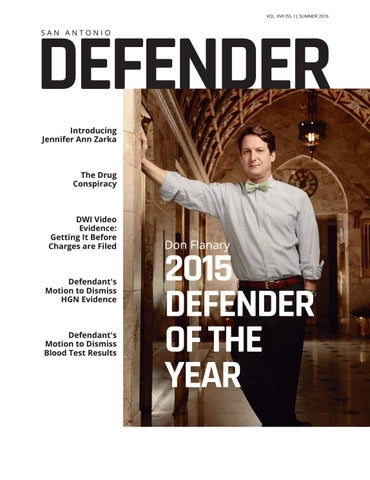
VOL. XVII ISS. I | SUMMER 2016
SAN ANTONIO
DEFENDER Introducing Jennifer Ann Zarka
The Drug Conspiracy
DWI Video Evidence: Getting It Before Charges are Filed
Defendant's Motion to Dismiss HGN Evidence
Defendant's Motion to Dismiss Blood Test Results
Don Flanary
2015 DEFENDER OF THE YEAR
DEFE
NDER
SACDLA Officers Patricia Jay
Don Flanary
Christopher Simpkins
President
Secretary
Editor, The Defender
Michael McCrum
Loraine Efron
Jennifer Zarka
Vice President
Treasurer
Executive Director
Anne Burnham
Loraine Efron
Pat Montgomery
Robert Barrera
Joseph Esparza
Blakely Mohr
Edward Bartolomei
Don Flanary
Angela Moore
Philip Bozzo
John Fox
Joel Perez
Deborah Burke
Paul Goeke
Robin Teague
John Carroll
Julie Hasdorff
Chris Simpkins
Mario Del Prado
Juan Carlos Hernandez
Aissa Strickland
Richard Dulany
Brandon Hudson
Chad Van Brunt
Board of Directors
Directors Emeritus Charles Butts
Anthony Nicholas
Past Presidents Warren Wolf
John “Bud� Ritenour
John A. Convery
Robert Featherston
Adam Kobs
Ernest Acevedo, III
Jorge Aristotelidis
George Taylor
Ronald P. Guyer
Jay Norton
Stephanie Stevens
Mark Stevens
Michael Gross
Jim Greenfeld
George Scharmen
Jeff Mulliner
Michael S. Raign
Cynthia Hujar-Orr
If you would like to submit an article to be considered for publication in The Defender, or see about how you can help or become involved with and contribute as an Associate Editor, please email chris@csimpkinslaw.com.
SAN ANTONIO
DEFENDER Editor-in-Chief Christopher Simpkins
Associate Editors Trisha Morales Padia John Fox Pat Montgomery Angela Moore Chad Van Brunt John Hunter Robin Teague RC Pate Roland Garcia Arlene Gay Tiffany Shockley
5 7 9 13
Letter From the Editor
6
President's Message
Introducing Jennifer Ann Zarka Jennifer Ann Zarka
The Drug Conspiracy Kathryn M. Kase
DWI Video Evidence: Getting It Before Charges are Filed Ed McClees & Gary Trichter
Adrian Flores Jodi Soyars
The San Antonio Criminal Defense Lawyers Association
P.O. Box 831206 San Antonio, TX 78283 (210) 501-2916 sacdla.com
29 33 41
Ex Parte Ronald Thompson: The Epic Tale of Donnius Flanarious A.K. Growling
Defendant's Motion to Dismiss HGN Evidence Gary Trichter
Defendant's Motion to Dismiss Blood Test Results Gary Trichter
LETTER FROM THE EDITOR Christopher Simpkins
As we move into a new phase at The Defender, I want
The Defender Editorial Board
to take this opportunity to thank outgoing Associate editors, Adam Kobs, Robert Featherston, Loraine
Trisha Morales Padia
Efron, and Warren Wolf, as well as remaining
John Fox
Associate Editor, Trisha Morales Padia, for their
Pat Montgomery
service to the magazine since I took over as Editor-
Angela Moore
in-Chief of The Defender several years ago. Their
Chad Van Brunt
contributions were essential to the continued
John Hunter
success of the magazine and I wanted to publicly
Robin Teague
acknowledge and thank each one of them for their
RC Pate
time and effort. As to the new Associate Editors, I
Roland Garcia
look forward to working with you as we continue to
Arlene Gay
build this magazine, with the goal of being the best
Tiffany Shockley
publication of any local criminal defense lawyers
Adrian Flores
association in Texas, and beyond. The Defender has
Jodi Soyars
been built on a great tradition of members helping members and if you would like to contribute by either to writing an article to be considered for publication or wish to discuss becoming involved with the magazine, we would love to hear from you.
6
PRESIDENT'S MESSAGE
Patricia Jay
Members, Friends, and Colleagues:
spearheaded Robin Teague, and will continue to pair new lawyers with mentors for guidance
I am humbled, honored, and privileged to
and training.
begin my term as President of the San Antonio Criminal Defense Lawyer's Association. I am
We are always looking for members to
deeply grateful to my predecessor, Warren
contribute either by presenting at a continuing
Wolf and all other members of our Board of
education program, writing an article for the
Directors and past presidents. I am now and
defender, mentoring a young lawyer, or by
have always been inspired by the commitment,
sharing your ideas regarding
achievement, and dedication of our board and
services SACDLA can provide to its
our membership. The strength and growth of
membership. Please do not hesitate to reach
our organization has been propelled
out to me or any of our officers or directors if
collectively by our board and membership and
would like to participate in any of our
I look forward to continuing this important
programs or have ideas that you would like to
work. My goal for the next year is to work
share about the needs of membership.
diligently towards fulfilling the mission of our
organization and to ensure
This organization has always been a beacon of
that our organization continues to provide
success, but that success would be impossible
meaningful services and support to our
without the active support of our members
members.
and board of directors. I thank all of you for your prior and continued membership and
We have a number of programs and events
service to this organization. I look forward to
scheduled for 2016, including the "Against All
continuing our tradition of success
Odds" seminar on August 28, 2016 and the
and working to meet the needs of our
"Nuts and Bolts" Seminar on November 18,
membership and organization for the
2016. SACDLA will continue to publish the
upcoming year.
Defender Magazine, which is now supported by a new editorial board. SACLDA will continue its Mentor/Mentee program, which is
INTRODUCING JENNIFER ANN ZARKA Jennifer Ann Zarka aka “Jenny” is the new Executive
guidance of Professors Anne Burnham, Stephanie
Director of SACDLA. She is excited to serve this
Stevens, and Mark Stevens changed the direction of
organization and to work among the esteemed
her career forever. The very first court appearance
members each day. Jenny was licensed to practice
in a criminal misdemeanor court for a hearing on a
law in the State of Texas on November 1, 2013. She
Motion to Dismiss for Lack of Speedy Trial (which
graduated from St. Mary’s University School of Law in
was promptly granted) showed Jenny her passion for
May of 2013. Before law school, Jenny worked in
defending people in criminal courts of law.
various positions with several companies. She
Fortunately, some doctors still need Jenny’s services
worked in doctors’ offices, retail companies, life
from time to time with the practice that she has
insurance, outside (traveling) sales and many other
created (family law and criminal defense).
jobs for years. Jenny created a solo practice right out of law school. While in law school, Jenny was active in several
She then partnered with Matthew Allen about a year
organizations on campus. She was elected Vice
after starting her practice. They now have a
President of the Women’s Law Association and also
booming firm that focuses on helping clients
served as Social Chair her final year in school. Jenny
navigate the legal system in criminal defense and
competed with the Negotiations Team while at St.
family law.
Mary’s. Jenny also served as a student attorney in the Criminal Justice Clinic her entire third year of law
Jenny has been married to Tony, a Lt. Colonel and
school.
doctor in the United States Air Force, for 24 years. They have 4 cats and a puppy at their home in
Jenny’s plan when entering law school was to start a
Helotes. They plan to stay in Helotes when Tony
civil practice to focus on physicians and their legal
retires in the near future.
needs. However, the Criminal Justice Clinic and the
8
THE DRUG CONS RACY
She was skin-and-bones, almost emaciated, with dark circles under her eyes and desperation in her voice as she spoke of her need to gain bond so that she could go home to care for her two small children. We met at arraignment in the U.S. Magistrate’s courtroom. It was my first federal criminal case and my first as CJA counsel. I tried to hide my inexperience. I also tried to hide my emotional response to her plight. I was relieved when the
G SPI Y Kathryn M. Kase
magistrate accepted her mother-in-law’s house as property guaranteeing her release. The facts at arraignment didn’t change much in the march to trial: the feds had her on audiotape purchasing one pellet of crack for a man she had met at a bar. The delivery of that miniscule foil-wrapped package to an informant two years earlier was enough to tie her to the larger drug conspiracy, enough to have her charged with distribution, enough to expose her to an effective life sentence. Her brothers, arrested with her in the feds’ early morning sweep of their flyspeck Catskills town, were alleged to be big dealers, moving large quantities of powder and crack cocaine into the economically depressed region. She, however, was a little fish, addicted to the poison her brothers sold and willing to do almost anything to get the money to buy that poison, small dose by small dose. Just before trial the feds offered the inevitable deal: plea and get 30 months in return for testifying against her brothers. That was why they had indicted her: to get at her brothers through her. No, she said firmly, while her children played at her feet and her husband held her hand on their worn sofa. Her brothers, meanwhile, accepted plea bargains. Because they were sufficiently big fish they did not have to agree to testify against her. They did have to testify against Mr. Big, who was going to trial.
We tried the case in the cavernous ceremonial
women were required to be naked during the
courtroom that every federal courthouse in
re-packing so that overseers could be sure
upstate New York courthouse seems to have.
they weren’t stealing the product, and how
Even with six defendants, their defense
they were paid in cash, virtually all of which
counsel, two AUSA’s, a case agent, one judge,
they then used to purchase drugs from the
his clerks, and 12 jurors, the wood-paneled
dealer. From my far-away seat in the
place still felt too large. Due to the number of audiotapes and witnesses, we had three solid weeks of work ahead of us. My client and I sat as far from the jury box and the other defendants as possible. If we were far enough away, I thought, maybe the jurors would forget about us. The Assistant U.S. Attorney spent 23 seconds of his 30-minute opening statement on my client. I used an old-fashioned stopwatch to time it. And then I showed it to the jury in my brief opening, which barely did more than repeat my theory and theme: She was not a drug dealer, she was a drug user. The feds had charged her to get to her brothers, who had accepted responsibility for their misdeeds, as jurors would hear. At trial, no more than a half-hour of testimony, if that, from the informant directly focused on her supposed drug distribution. On cross, he agreed that she (much to her embarrassment at trial) had offered to perform a sexual act in return for a hit of crack. He had agreed to that proposal, on the condition that she purchase the drug with the money he gave her. One of her brothers, there to testify against Mr. Big, said her addiction, and her attempts to get clean, were well-known in their community. He described his efforts to keep her away from the drugs he sold, to prevent her from going to the bars on the weekend to feed her need, but noted that others in the community were happy to exploit her addiction for their own
courtroom, I could see the female jurors
ends.
starting to examine my client closely. The problem was: on paper – and certainly
Another informant described on cross how Mr.
according to the jury instructions – she looked
Big used female addicts to break kilos into
guilty as charged. Her actions amounted to
smaller packages for distribution, how the
distribution and placed her firmly within the
12
drug conspiracy. What could I possibly say at
was trying to further the distribution of cocaine
closing that would put her actions into greater
in her Catskills community? Of course not.
perspective?
Her actions weren’t evidence of acting in conspiracy, but of addiction. When I go to
I began the intentionally short closing by
McDonald’s to buy a hamburger, I said, it
repeating my theory and theme: she was a
doesn’t mean I’m in a conspiracy with McDonald’s to sell hamburgers; it means I’m hungry – and that’s exactly what her actions meant. I don’t remember how long the jury was out – about four hours, I think – but just before they returned, the Marshall’s Service stationed deputies at all the exits, reminders that the judge intended to take the guilty into custody after the verdict. As jurors filed in, my client passed me a note. “Not guilty,” it read. I nervously returned her assured smile. Later, after the judge announced she was free to go, she hugged me, and said she had had faith she would be acquitted. How, I wanted to know. Because you got to know me, because you worked so hard for me, she said. See, she said over her shoulder as she left the courtroom with her husband, it all worked out.
I’ve never heard from her again. I hope sincerely it all worked out.
Kathryn M. Kase is Executive Director of Texas Defender Service. A graduate of St. Mary’s University School of Law, she has been licensed to practice in Texas for more than 25 years and briefly practiced law in upstate New York for eight years.
drug addict, not a dealer. The feds had indicted her because they wanted to stop her brothers’ drug operation. Well, now the feds had the brothers, so why were we still here, I asked? Did anyone really believe that when she was traded one sexual favor for crack she
DWI
VIDEO
EVIDENCE: GETTING BEFORE ARE Ed McClees
IT
CHARGES FILED Gary Trichter
14
INTRODUCTION The post arrest but pre-formal charges period We have all been there. Your new DWI client gets arrested in a county were the prosecutor steadfastly declines to provide any discovery, including audio/video electronic recordings, until formal charges are filed. The prosecutor cites the recent decision in In re the State of Texas ex rel. Michael Munk, __ S.W.3d ___, 2015 WL 6121390 (Tex.App. – Eastland 2015) (not yet released for publication) (standing for the limited proposition that district courts lack jurisdiction to compel discovery production until the case has been indicted). Of course, that filing process can take months, but, you would like to get ready now because you are that kind of lawyer. You have also requested an ALR and would like to get ready for that, too. Regrettably, you know that ALR hearing will likely happen before formal charges are filed by the criminal prosecutor, and as such, you will not have the benefit of preparing your cross examination by reviewing the arresting officer’s audio/video electronic recording. Feeling frustrated and defeated that the criminal prosecutor is not going to do the right thing and allow you access to the electronic recording, you feel boxed in and accept the fact. Accordingly, you accept that you are not going to have the benefit of the video to get ready to defend either the ALR or DWI until formal charges are filed and temporarily close your file.
Do you know that it doesn’t have to be that way? For good lawyers, who think out of the box, it doesn’t have to be that way at all! In fact, for the good lawyers, the video is there for the asking and it doesn’t matter whether it is before or after formal criminal charges have been filed. In fact, it doesn’t matter even if your client was not arrested. All that does matter is that the client was stopped and an electronic recording was made. What follows is what you need to know.
DISCOVERY METHODS MICHAEL MORTON ACT (“MMA”) The Michael Morton Act (MMA), Art. 39.14(a), Texas Code of Criminal Procedure, requires the State to produce discovery “as soon as practicable after receiving a timely request from the defendant.” Because Article 39.14(a) provides the directory language “the State shall produce,” its production duty is not discretionary and nor can it be limited by any prosecutor “policy”. Applying The Code Construction Act, Tex.Gov’t.Code, we know that “[w]ords and phrases shall be read in context and construed according to the rules of grammar and common usage.” Tex.Gov’t.Code Sec. 311.011(a). We also know that when words or phrases have a technical meaning, whether by the legislature or otherwise, those words shall be “construed accordingly.” Tex.Gov’t.Code. Sec. 311.011(b). Finally, we know that “unless a different construction is expressly provided by statute... ‘shall’ imposes a duty.” Tex.Gov’t.Code 311.016(2).
Recently, one appellate court took a unique approach to the MMA when it issued the controversial opinion In re the State of Texas ex rel. Michael Munk, __ S.W.3d ___, 2015 WL 6121390 (Tex.App. – Eastland 2015) (not yet released for publication). Simply put, this is a horrible decision based on a limited reading of the MMA that runs completely contrary to the spirit of that act and shows a failure to read and properly interpret the Code Construction Act.
Munk was a murder case where the trial judge granted the defendant’s MMA motion to compel discovery. The State filed a writ of mandamus, where it asserted that the trial court did not have jurisdiction to issue an order compelling the pre-indictment production of discovery.1 The Eastland Court of Appeals agreed with the state, and said “[i]n the absence of express language in Article 39.14(a) authorizing the trial court to issue an order compelling the State to produce discovery prior to indictment, we conclude that the statute does not alter the well-settled requirement that an indictment is essential to the district court’s jurisdiction in a criminal case.” The court went on to note that the judge, therefore, did not have jurisdiction to compel the state to comply with 39.14. Interestingly and curiously, the opinion never even addresses the MMA language stating “as soon as practicable after receiving a timely request from the defendant that state shall produce...” Tex. Code Crim. P. Art. 39.14(a). This failure to discuss MMA’s “as soon as practicable” makes the opinion appear as if it were result oriented.2
So, does Munk control? We think not and here is why. There are several distinguishing factors in Munk. First, the Munk Eastland Court of Appeals opinion is not published, and as such, has no precedent value and is not binding. It also has no weight or force outside that district. Second, the Munk Court did not rule that the
1
It is worth noting that the State’s theory presented in Munk is not shared by all district attorney’s offices in the State. The
Harris County District Attorney’s Office, for example, takes the position that “as soon as practicable” does not mean post indictment. Indeed, their routine practice is to provide a copy of the offense report and video once they receive it. Likewise, the Tarrant County District Attorney’s Office makes items available to defense counsel through their “tech share” system as soon as they receive it. While the production of discovery in these counties may still be unduly delayed, it is not because of this renegade interpretation of the MMA. In fact, the Texas District and County Attorney’s Association recently published an article
discovery could not be compelled. Rather, it simply said that the district court lacked pre-indictment jurisdiction to compel the State to produce the discovery. Its theory was that the district court was merely acting in its capacity as a magistrate until there was an indictment, and that the magistrate could not compel the discovery. Clearly such a holding violates both the spirit of the MMA and legislative intent.3 If the State cannot be compelled to produce discovery, then the MMA has no teeth making its promise to promote justice hollow. Here, it is beyond peradventure that this was not the legislative intent that went into drafting one of the most widely praised criminal discovery bills in history. Third, nothing in the opinion addresses misdemeanor cases involving county courts or misdemeanor cases where the case will proceed to trial without indictment.
APPLICATION OF THE CODE CONSTRUCTION ACT TO THE MMA When the MMA is read under the microscope of the Code Construction Act (“CCA”), codified under Section 311 of the Texas Government Code, focusing on “as soon as practicable, after receiving a timely request” and applying the CCA’s directives, it is not debatable that the State has a pre-indictment duty to produce discovery to the defendant. Looking back, the facts that gave rise to the MMA’s passage, are instructive that MMA discovery is amazingly broad and includes DWI audio/video electronic recordings.
TEXAS CODE OF CRIMINAL PROCEDURE ART 2.139 What could be better for discovery than the MMA? For DWI defendants, the answer is, like icing on the MMA cake, is Article 2.139 Tex.Crim.Pro. which became effective September 1, 2015. It provides that:
a person stopped or arrested on suspicion of an offense under Section 49.04 (Driving While Intoxicated), 49.045 (Driving While Intoxicated with a Child Passenger), 49.07 (Intoxication Assault), or 49.08 (Intoxication Manslaughter), Penal Code, is entitled to [an electronic video recording if the person was stopped and a recoding was made].
Interestingly, Article 2.139’s 2015 legislative history is instructive that audio/video electronic recordings must be produced even before the filing of formal charges and that the duty to produce is not dependent on the filing of criminal charges.4 In crafting the production duty, the legislature recognized a previous production problem, and noted that “persons arrested for certain intoxication offenses under the Penal Code [were] not entitled to a copy of all video recordings of the arrest.” House Committee Report, HB 3791(HB), Engrossed. Recognizing the problem and wanting to remedy it, the legislature asserted “that a person [stopped or] arrested for certain intoxication offenses should be entitled to a copy of all video recordings made during the arrest.” House Committee Report, HB 3791 (emphasis added).
entitled “Just Disclose It,” where it discusses the ethical implications of not producing discovery to the defense, and it concludes that “if there is any conceivable way in which information or evidence could be considered favorable to the defense for exculpation, impeachment, or mitigation purposes, don’t stop to wonder whether the evidence is material and admissible. Just disclose it.” http://www.tdcaa.com/print/13384. Further, you may want to remind the prosecutor of the opinion in Schultz v. The Board of Disciplinary Appeals, No. 55649 (Tex. Dec. 17, 2015), http://www.txboda .org/sites/default/files/Schultz55649%20Opinion .pdf., where failure to produce mitigating discovery was held to be a violation
Tex.Code Crim. P. Art. 2.139 (emphasis added) now provides:
A person stopped or arrested on suspicion of an offense under Section 49.04, 49.045, 49.07,or 49.08, Penal Code, is entitled to receive from a law enforcement agency employing the peace officer who made the stop or arrest a copy of any video made by or at the direction of the officer that contains footage of:
(1) the stop; (2) the arrest; (3) the conduct of the person stopped during any interaction with the officer, including during the administration of a field sobriety test; or (4) a procedure in which a specimen of the person’s breath or blood is taken.
To understand the mandatory production nature and broadness of 2.139, the reader must focus on the phrase “is entitled,” as defined by Tex.Gov’t.Code Sec. 311.016(4). It leaves no doubt that said language: “Is entitled to" creates or recognizes a right. Thus, the plain meaning of Art. 2.139 is that a person who is arrested or stopped for Driving While Intoxicated, Driving While Intoxicated Child Passenger, Intoxication Assault, or Intoxication Manslaughter has a right to any video recording of the stop, the arrest, conduct of the person during any interaction with the officer (including but not limited to the administration of the standardized field sobriety tests) and any procedure in which a specimen of that person’s blood or breath is taken. Clearly, since the statute provides the alternative “or stopped”, it was designed to mandate production upon request even for individuals who were not arrested but only stopped.5
To yet further illustrate the mandatory nature of this production requirement, we need only to look at the Texas Attorney General’s 2016 Public Information Handbook. There, it is clearly stated that its transparency purpose is to “promote an open and inclusive system of government in Texas that benefits all of our citizens.” The Handbook provides detailed analysis regarding information that the government must disclose, may disclose, and must not disclose. Importantly, Art. 2.139 is specifically referenced in the handbook, and its language reprinted there in its entirety. This section of the Handbook has little commentary on Art. 2.139 other than noting the statute’s effective date and noting that there is no current case law or formal opinions regarding the statute. Of even greater import there is the fact that there is no commentary suggesting, that under any circumstances, these video records not be produced. This is to be contrasted with other sections in the Handbook where the Attorney General has offered clear commentary on items that the government does not have to produce. Such commentary was not offered on Art. 2.139 because the answer is clear – a copy of any
of Texas Disciplinary Rules of Professional Conduct 3.09(d) and 3.04(a), which is broader that the prosecutor’s legal, constitutional duty of disclosure imposed by Brady v. Maryland.
2
The “as soon as practicable” language was recently addressed by Justice Alcala in a concurring opinion of the Texas Court of
Criminal Appeals in In re Castillo, 2015 WL 4776080 (not designated for publication) (Tex.Crim.App. 2015). This was a murder case where the prosecutors refused to comply with the MMA until after indictment, and the defendant filed petition for writ of
video relating to a stop or arrest for an intoxication offense must be given to the person what was the subject of that stop or arrest. Again, there is no condition precedent that formal charges are filed in order for the State’s mandatory production duty to arise.
Where a police agency refuses to provide a copy of the relevant video recordings upon request, or where it attempts to create undue delay by requesting an attorney general decision on the issue, the Texas Public Information Act (“TPIA”) provides a remedy to compel immediate production. Specifically, TPIA provides for a suit under a Writ of Mandamus to compel the wrongfully resistant governmental agency to release the requested information. Tex. Gov’t. Code Sec. 552.321; Thomas v. Cornyn, 71 S.W.3d 473, 483 (Tex.App. – Austin 2002, no pet.) (“A requestor may bring a mandamus action regardless of whether an attorney general's opinion has been requested or despite the issuance of an adverse attorney general's opinion that favors the withholding of the information.”) This mandamus action is statutorily created, and is different from the “traditional” mandamus that applies to decisions made by trial courts. A mandamus under the TPIA is filed in a district court of the county in which the main offices of the governmental body (in this situation, the police agency) are located. Further, in certain situations in which a suit for a writ of mandamus is needed to compel the agency to comply with the law, the TPIA allows for recovery of attorney’s fees by the party who brought the action. See Tex. Gov’t. Code sec. 552.323.
PUTTING IT ALL TOGETHER: DEMAND LETTER TO THE ARRESTING AGENCY AND MOTION TO COMPEL PRODUCTION AND REQUEST FOR SANCTIONS THE DEMAND So now we know the law and here is how we suggest defense practitioners use it. First, a demand letter should be sent to the head of the law enforcement agency responsible for the stop or arrest of your client and it should be done in a way that shows timely receipt of it. A fax receipt, hand delivery, or registered mail with a return receipt are appropriate and can be used as future evidence of timely receipt. A suggested demand letter follows:
[CHIEF OF POLICE ] [POLICE DEPARTMENT ADRESS]
RE: Video Recording of Arrest for Intoxication Offense: [CLIENT]
Dear Chief [
]:
mandamus to force the state to provide the discovery as required by the MMA. Justice Alcala wrote that “the Legislature’s broad use of the phrase ‘any matter involved in the action’ cannot reasonably be interpreted as applying only to those actions for which a formal indictment has been filed because that phrase plainly contains no such limitation.” Id. at 2 (emphasis added). Justice Alcala went on to say that, “by delaying a defendant’s access to discovery until after grand-jury proceedings and indictment, the district attorney has effectively read an additional provision into the statute that changes the ‘as soon as practicable’ language into ‘as soon as practicable after return of indictment by the grand jury.’” Id. Ultimately, the Texas Court of
I have been retained to represent [CLIENT] as a result of an arrest for an Intoxication Offense, as that term is used in Texas Code of Criminal Procedure 2.139. As you are likely aware, the Eighty-fourth Legislature passed House Bill 3791, which became effective on September 1, 2015, amends Article 2.139 of the Code of Criminal Procedure and provides as follows: A person stopped or arrested on suspicion of an offense under Section 49.04, 49.045, 49.07, or 49.08, Penal Code, is entitled to receive from a law enforcement agency employing the peace officer who made the stop or arrest a copy of any video made by or at the direction of the officer that contains footage of:
(1) the stop; (2) the arrest; (3) the conduct of the person stopped during any interaction with the officer, including during the administration of a field sobriety test; or (4) a procedure in which a specimen of the person’s breath or blood is taken.
This letter is specifically referencing the second Art. 2.139. As per this second article 2.139, this is an invocation of the entitled right noted therein for all electronic digital video/audio recordings by the officers in regard to the stop, arrest, and all interactions with the officers with [CLIENT]. Note, this demand also includes, any video/audio electronic recording of the procedure by which [CLIENT’S BREATH/BLOOD] was taken as per 2.139. In addition, I have attached to the original of this letter a blank DVD and a self-addressed stamped envelope so that DVD could be returned to me at no cost to your agency. Importantly, you are noticed that the Texas Attorney General has already spoken on this issue in its 2016 Texas Public Information Handbook were it is clearly approvingly stated that the transparent purpose of the act is to “promote an open and inclusive system of government in Texas that benefits all of our citizens”.
In closing, please note that as per Article 2.139, this request establishes an absolute right by [CLIENT] to have this electronic recording at this time. The statute does not allow a law enforcement agency to treat this invocation of an entitled right as discretionary production. Rather, the statute makes it a mandatory production. Please be aware that if this electronic recording is not produced, we will have no choice but to bring law suit pursuant to Tex. Gov’t. Code sec. 552.321, and that this would allow our client to recover attorney’s fees from your agency. That said, I thank you in advance for your professionalism and courtesy in promptly addressing invocation, and for following the law.
Sincerely,
Criminal Appeals denied the Defendant’s petition for a writ of mandamus because of the limited reason that the Defendant failed to show that “he lacks any adequate remedy at law.” Id. at 3. In discussing other potential remedies, Justice Alcala suggests that the Defendant “may seek to challenge the State’s failure to comply with Article 39.14 in the trial court by filing a motion to exclude evidence at the appropriate time,” and that the Defendant “may challenge the State’s failure to comply with discovery requirements during the course of his direct appeal.” Id. Based on Justice Alcala’s opinion, we suggest that you ask the court to exclude any evidence derived from material that was not timely produced pursuant to the MMA.
SO WHAT HAPPENS IF THE LAW ENFORCEMENT AGENCY REFUSES? In the event that the stopping/arresting agency fails to produce the electronic recording, the next step is to file a Motion to Compel Production and Request for Sanctions with the court that the DWI will or might be pending. In jurisdictions where a court is not yet assigned, then a Writ of Mandamus can be filed in a district court. See Tex. Gov’t. Code sec. 552.321. Our suggested motion to compel is as follows:
CAUSE NO. __________
STATE OF TEXAS
§
IN THE COUNTY CRIMINAL
§ VS.
§
COURT AT LAW NO. ______
§ ________________
§
__________ COUNTY, TEXAS
DEFENDANT’S MOTION TO COMPEL PRODUCTION OF VIDEO EVIDENCE, OR ALTERNATIVELY, TO SUPPRESS ALL EVIDENCE ASSOCIATED WITH THAT EVIDENCE
TO THE HONORABLE JUDGE OF SAID COURT:
COMES NOW, Defendant in the above entitled and numbered cause, though the undersigned attorney, and presents this Motion to Compel Production of Video Evidence. In support hereof, Defendant will show:
I. SUMMARY OF ARGUMENT
The video of a DWI stop and arrest, and all video electronic audio/video recordings related to that stop/arrest, is discoverable under Tex. Code Crim. P. Articles 39.14(a) (the Michael Morton Act (“MMA”)) and 2.139 (effective Sept. 1, 2015).
II. AUTHORITY TO COMPEL DISCOVERY
A. MICHAEL MORTON ACT
The Michael Morton Act, codified within Texas Code of Criminal Procedure Art. 39.14, requires the State to
3
Indeed, such a reading likely also violates the Texas Rules of Professional Conduct. The Professional Ethics Committee of the
State Bar of Texas has said that the MMA requires an “open file policy” and that “prosecutors would violate [Texas Rule of Professional Conduct] 8.04(a)(12) if they attempted to impose conditions not found in [the MMA] before making the required disclosures.” Tex.Comm. on Prof’l Ethics, Op. 646 (2014).
produce discovery “as soon as practicable after receiving a timely request from the defendant.” Tex.Code.Crim.Pro. Art. 39.14(a). The State’s duty to do this is neither discretionary nor dependent upon any “policy,” because this section clearly uses the word “shall.” Id.
The Code Construction Act found in the Texas Government Code dictates how statutory words and phrases are to be construed. In general, “[w]ords and phrases shall be read in context and construed according to the rules of grammar and common usage.” Tex.Gov’t.Code sec. 311.011(a) (emphasis added). However, when words or phrases a technical meaning, whether by the legislature or otherwise, those words shall be “construed accordingly.” Tex.Gov’t.Code. sec. 311.011(b).
The Code Construction Act states that “unless a different construction is expressly provided by statute . . . ‘shall’ imposes a duty.” Tex.Gov’t.Code 311.016(2) (emphasis added). Thus, when the Michael Morton Act is to be read and interpreted according to the mandates of the Code Construction Act meaning that the State has a duty to produce discovery to the defendant. The discovery contemplated under the Act is amazingly broad, and includes any audio/video recordings of a DWI related stop, arrest, blood draw, or breath test. See Tex.Code.Crim.P. Art. 39.14(a).
B. Texas Code of Criminal Procedure 2.139
Notwithstanding that the Michael Morton Act production’s duty “as soon as practicable” for DWI audio/video recordings, Tex.Code Crim. Pro. Article 2.139 (effective Sept. 1, 2015) is equally instructive to the legislature further intended that audio/video electronic recordings be produced even before the filing of formal charges. The legislature recognized a previous production problem, and noted that “persons arrested for certain intoxication offenses under the Penal Code are not [automatically and/or] clearly entitled to a copy of all video recordings of the arrest,” House Committee Report, HB 3791, Engrossed, and provided a remedy. The legislature asserted “that a person [stopped or] arrested for certain intoxication offenses should be entitled to a copy of all video recordings made during the [stop or] arrest.” House Committee Report, HB 3791.
The Eighty-fourth Legislature passed House Bill 3791, became effective September 1, 2015, and added an additional Article 2.139 to the Code of Criminal Procedure. It provided6:
A person stopped or arrested on suspicion of an offense under Section 49.04, 49.045, 49.07, or 49.08, Penal Code, is entitled to receive from a law enforcement agency employing the peace officer who made the stop or arrest a copy of any video made by or at the direction of the officer that contains footage of:
4
Of import here, on a Motion to Compel Production, is that a failure to timely produce, as measured by the “as soon as
practicable” standard, will result in the prosecutor being a volunteer witness to be cross examined as to why it was not practicable to produce the requested discovery.
5
Texas Code of Criminal Procedure 2.139 already existed before this Bill was passed. Due to an oversight, the duplicate Article
number was not corrected, so there are two Articles 2.139 until this error is corrected in the next legislative session. Note that
(1) the stop; (2) the arrest; (3) the conduct of the person stopped during any interaction with the officer, including during the administration of a field sobriety test; or (4) a procedure in which a specimen of the person’s breath or blood is taken. (emphasis added).
The mandatory production nature and broadness of Art. 2.139’s phrase “is entitled,” as defined by Tex. Gov’t. Code Sec. 311.016(4), leaves no doubt that said language: “is entitled to" creates or recognizes a right. Thus, the plain meaning of Art. 2.139 (effective Sept. 1, 2015) is that a person who is arrested or stopped for a charge involving Driving While Intoxicated, Driving While Intoxicated Child Passenger, Intoxication Assault, or Intoxication Manslaughter, has an entitlement right to any video recording of the stop, the arrest, conduct of the person during any interaction with the officer (including but not limited to the administration of the standardized field sobriety tests) and any procedure in which a specimen of that person’s blood or breath is taken. Clearly, since the statute provides the alternative “or stopped”, it was designed to mandate production, upon request, even for individuals who were not arrested, but only, stopped. Importantly, the court is asked to notice that the Texas Attorney General has already spoken on this issue in its 2016 Texas Public Information Handbook were it is clearly approvingly stated that the transparent purpose of the act is to “promote an open and inclusive system of government in Texas that benefits all of our citizens”.
C. Suppression of Evidence Not Produced
In In re: Castillo, 2015 WL 4776080 at p.3 (not designated for publication) (Tex.Crim.App. 2015), Justice Alcala suggested that suppression may be an appropriate remedy when a prosecutor’s office does not timely produce evidence in response to a timely discovery request. The State’s failure to timely produce discovery, such as the electronic video and audio recordings discussed above, will produce irreparable harm to the defendant.
Prompt discovery production is material and crucial to future proceedings and to due process. By obtaining this discovery, the Defendant is in a better position to do the following:
1. Discover the exact location of where the alleged offense occurred and preserve any exculpatory evidence at that location; 2. Assess the road conditions that can quickly change and will disappear long before trial; 3. Obtain other private electronic recordings such as business security surveillance which are typically preserved only for a short amount of time; and
even though there are two Articles 2.139, because these Articles are not irreconcilable, both articles have full effect of law. See Tex.Gov’t.Code Sec. 311.025.
6
Texas Code of Criminal Procedure 2.139 already existed before this Bill was passed. Due to an ostensible oversight, the
duplicate Article number was not corrected, so there are two Articles 2.139 until this error is corrected in the next legislative session. Note that even though there are two Articles 2.139, because these Articles are not irreconcilable, both articles have full
4. Discovery potential witnesses, whose memories will fade over time.
Any delay by the State in producing such evidence will cause irreparable harm, and will require the exclusion of any video or audio electronic recordings, and any evidence derived from those recordings.
III. RELIEF REQUESTED
1. Because [DEFENDANT] was [ARRESTED/STOPPED] by a peace officer employed by [AGENCY] for [DWI, DWI CHILD PASSENGER, INTOX ASSAULT, INTOX MANSLAUGHTER], this Court should ORDER [HEAD OF THE POLICE AGENCY] to produce all electronic audio video recordings relating to the [STOP OR ARREST].
2. Alternatively, if the State elects not to produce the recordings, the Court is requested to issue an Order suppressing all video or audio electronic recordings of the Defendant, and any evidence that is derived from any video or audio electronic recordings of the Defendant.
Respectfully submitted,
By: _____________________ [ATTORNEY FOR DEFENDANT]
CERTIFICATE OF SERVICE
I hereby certify that a true and correct copy of the above and foregoing Motion has been furnished to the Assistant District Attorney presently assigned to this case on this ______th day of ____________, 2016.
____________________________________ [ATTORNEY FOR DEFENDANT]
effect of law. See Tex.Gov’t.Code Sec. 311.025.
7 Texas Code of Criminal Procedure 2.139 already existed before this Bill was passed. Due to an ostensible oversight, the duplicate Article number was not corrected, so there are two Articles 2.139 until this error is corrected in the next legislative session. Note that even though there are two Articles 2.139, because these Articles are not irreconcilable, both articles have full effect of law. See Tex.Gov’t.Code Sec. 311.025.
CAUSE NO. ____________
STATE OF TEXAS
§
IN COUNTY COURT AT LAW
VS.
§
NUMBER ____
________________
§
__________ COUNTY, TEXAS
ORDER ON DEFENDANT’S MOTION TO COMPEL PRODUCTION OF VIDEO EVIDENCE
On this day came on to be heard Defendant's Motion to Compel Production of Video Evidence, and the Court having considered the same, it is hereby GRANTED/DENIED.
I.
It is therefore ORDERED that [AGENCY HEAD] produce to Defendant an electronic digital DVD copy of any audio video recording made by or at the direction of the officer who made the stop/arrest that contains electronic audio/video recording of:
(1) the stop; (2) the arrest; (3) the conduct of the person stopped during any interaction with the officer, including during the administration of a field sobriety test; or (4) a procedure in which a specimen of the defendant’s breath or blood is taken.
It is further ORDERED that all items mentioned above must be provided to [DEFENSE COUNSEL] at [DEFENSE COUNSEL’S OFFICE ADDRESS] by the ____ day of _________, 2016.
II.
It is ORDERED that any electronic video or audio recordings as described above, along with any evidence derived from those recordings is SUPRESSED if those recordings are not produced to [DEFENSE COUNSEL] as described above.
DONE and SIGNED this
day of
, 2016.
________________________________________ JUDGE PRESIDING
A suggested Exparte Application on a Writ of Mandamus is as follows:
CAUSE NO. ______________
In Re [CLIENT NAME]
§
IN THE COUNTY COURT
§
AT LAW OF
§
_________ COUNTY, TEXAS
APPLICATION FOR WRIT OF MANDAMUS FOR THE [POLICE AGENCY CHIEF] TO PRODUCE ALL AUDIO/VIDEO ELECTRONIC RECORDINGS MADE BY THE ARRESTING OFFICER OF [THE DEFENDANT]
TO THE HONORABLE JUDGE OF THIS COURT:
I.
The Applicant, under the authority of Texas Government Code § 552.321 and Texas Code of Criminal Procedure Art. 2.139 (effective Sept. 1, 2015), requests immediate production of the audio/video electronic recordings made of the Defendant made by the stopping/arresting officer in this case.
II.
The Eighty-fourth Legislature passed an additional Article 2.139 (effective Sept. 1, 2015) to the Code of Criminal Procedure which provides7:
A person stopped or arrested on suspicion of an offense under Section 49.04, 49.045, 49.07, or 49.08, Penal Code, is entitled to receive from a law enforcement agency employing the peace officer who made the stop or arrest a copy of any video made by or at the direction of the officer that contains footage of:
(1) the stop; (2) the arrest; (3) the conduct of the person stopped during any interaction with the officer, including during the administration of a field sobriety test; or (4) a procedure in which a specimen of the person’s breath or blood is taken. (emphasis added).
The mandatory production nature and broadness of 2.139’s phrase “is entitled,” is defined by Tex.Gov’t.Code Sec. 311.016(4). That definition leaves no doubt that said language: “Is entitled to" creates or recognizes a right. Thus, the plain meaning of Art. 2.139 is that a person who is arrested or stopped for a charge involving Driving While Intoxicated, Driving While Intoxicated Child Passenger, Intoxication Assault, or Intoxication Manslaughter has a right to any video recording of the stop, the arrest, conduct of the person during any interaction with the officer (including but not limited to the administration of the standardized field sobriety tests) and any procedure in which a specimen of that person’s blood or breath is taken. Clearly, since the statute provides the alternative “or stopped”, it was designed to mandate production upon request even for individuals who were not arrested but only stopped.
III.
On [DATE], Applicant was stopped and arrested by [OFFICER’S TITLE AND NAME] of the [POLICE AGENCY] for an offense under [TEXAS PENAL CODE SECTION 49.04, 49.045, 49.07, or 49.08]. Various electronic recordings, including audio/video recordings, were made of the stop, arrest, conduct of the Applicant during interactions with the office (including standardized field sobriety tests), and the procedure in which the Applicant’s [BREATH/BLOOD] was taken.
IV.
A letter demand dated _______ was delivered/faxed to the Agency head ___________. (Letter and proof of receipt are attached hereto and incorporated herein for all purposes). The letter provided _____________ days for compliance. Said production time was reasonable and certainly within the meaning of “as soon as practicable”. Unexplainably, the date came and went without the Agency even responding. Ostensibly, the demand was purposely ignored
V.
Absent providing an electronic recording at this time, the Applicant has no adequate remedy at law to obtain the aforementioned electronic audio/video recordings. As such, the recording must be produced now.
VI. Immediate production of the electronic recording will not be tedious, burdensome, inconvenient, inappropriate, or a hardship on the State.
VII.
Accordingly, this Honorable Court is asked to order the head of the [POLICE AGENCY CHIEF] in compliance with Texas Code of Criminal Procedure Art. 2.139 (effective September 1, 2015), to immediately produce the electronic recording(s). Hence, the Court is respectfully requested to issue the order in the form of a writ of mandamus ordering the [CHIEF OF THE POLICE AGENCY] to do so.
Respectfully Submitted,
[COUNSEL FOR APPLICANT]
IV. GO GET ‘EM !
So now your liberty arsenal just got stronger! Constitutionally speaking, there is no question that our constitutional calling requires we defenders to do our absolute best in any case we have. The answers to some cases come easy while others come with great difficulty. Good lawyers don’t take “no” from the government, rather, they push to get things done. Great lawyers don’t just push, but, take! Moreover, because you are great lawyers and think out of the box, what we have for you here is absolutely out of the box. We provide these tools to you both as aids to help you better protect your client’s rights and as food for thought to be a true champion of liberty. And so, we invite you to take these suggestions, run with them, improve them, and most importantly ask that you share your suggestions, improvements and experiences with all of us so that we might also benefit from them. Happy viewing!
Ed McClees
Ed McClees is an attorney with the law firm Trichter & Murphy, P.C. Ed is the former Chief of the Organized Crime Section of the Harris County District Attorney’s Office, where he routinely provided advice to federal and state law enforcement agencies, including the FBI, IRS, Joint Counterterrorism Task Force, United States Secret Service, Houston Police Department, Harris County Sheriff’s Office, and many others. He currently represents individuals charged with various DWI related crimes, Murder, Sexual Assault, Aggravated Assault, and other crimes.
J. Gary Trichter
J. Gary Trichter is the senior lawyer with the Houston & Bandera, Texas Law Firm of Trichter & Murphy, P.C. Known as “The Cowboy Lawyer”, he has been in practice for approximately 35 years and represents clients throughout Texas. Gary is co-author of the two-volume treatise entitled Texas Drunk Driving Law (4th Edition) and is author of over forty journal articles ranging from DWI, grand jury, drug couriers, aviation, to the StarSpangled Banner. Gary is “AV” rated by Martindale-Hubbell and has been voted by his peers the past 13 years as a Texas Monthly Magazine “Super Lawyer”. He is also “Board Certified” as a DWI Specialist. This rating comes from the National College for DUI Defense whose rating has been approved by both the American Bar Association and Texas Board of Legal Specialization. Gary is Founder and Past-President of Texas DWI Lawyers (formerly Texas DWI Defense Lawyers Association), past President of the Texas Criminal Defense Lawyers Association and past Dean and Regent for the National College for DUI Defense. He is a former Director and former DWI co-chair for the DWI Committee for the Texas Criminal Defense Lawyers Association and past chairman of NACDL’s Drunk Driving Committee.
EX PARTE RONALD THOMPSON: THE EPIC TALE OF DONNIUS FLANARIOUS A.K. Growling
30
Once upon a time in a little office high in the sky there was a little young lawyer. His name was Donnius Flanarious. This lawyer, though meek in stature, was full of big ideas. However, Little Donny was always in the shadow of his step-sister, Cynthia Ohratious, who was known as the greatest lawyer in the land by the Great Knights of SACDLA. Their father, the widely beloved King Rumpelgoldstein, constantly doted upon Cynthia and spoiled her with lavish gifts of edible arrangements and the like.
One day, Little Donnie had a client who was in trouble for taking pictures. These weren’t just any pictures though. These pictures were taken of the forbidden nether regions of the children of the enchanted waterpark of the land of Bexar County. The Evil District Attorney Reedious the Eater of Souls found out about these forbidden photos and sought to put Little Donny’s client in prison. Little Donny thought and thought about how to help his client but the facts just weren’t on his side. The pictures of the children’s nether regions were going prove the case against little Donny’s client and he just couldn’t find a way to save him.
Donny was on the verge of collapse, he looked in every law book and read every rule of evidence but nothing would save his client. He decided to end it all by jumping in the Enchanted Kiddie Pool of Flanarious Reach. Just as he was about to jump in, the Lady of the Enchanted Kiddie Pool of Flanarious Reach rose up from the water and handed him a magical sword. Little Donny asked, “Oh great and awesome Lady of the Enchanted Kiddie Pool of Flanarious Reach. What hast though bestowed upon
me? A sword? How am I to prevail upon this case
meant by free the body. He looked high and low and
with a sword?” The lady answered, “It isn’t just any
searched and searched to no avail. Then one night
sword young Donnius, you must read the
while sleeping a spirit called unto him. The spirit said,
inscription.” Donnius took the sword from the Lady
“Habeas Corpus! Habeas Corpus! Habeas Corpus!
of the Enchanted Kiddie Pool of Flanarious Reach
STULTUS EST SICUT STULTUS FACIT!.” Donnius woke
and read the inscription. It said, Congress shall make
in a sweat and wrote down the words.
no law respecting an establishment of religion, or prohibiting the free exercise thereof; or abridging
The next day, Donnius was set to face judgment in
the freedom of speech, or of the press; or the right
front of the Great Ranghellious of the 379th District
of the people peaceably to assemble, and to petition
Court. Ranghellious was prepared to put Little
the government for a redress of grievances.
Donny’s client to trial by combat against the dreaded champion of Evil District Attorney Reedious the Eater
“Oh wait! I see oh fair and awesome Lady of the
of Souls, Patrickous Ballantinious. Armed with the
Enchanted Kiddie Pool of Flanarious Reach, you have
pictures taken of the forbidden nether regions of the
provided me with exactly what I need to save my
children of the enchanted waterpark of the land of
client from the Evil District Attorney Reedious the
Bexar County, Patrickous would be impossible to
Eater of Souls. But great, fair and awesome Lady of
defeat. Just when the trial was to begin, Donnius
the Enchanted Kiddie Pool of Flanarious Reach, how
exclaimed, “Habeas Corpus!” and lifted the sword of
am I to wield it? It will not make the pictures go
The Lady of the Enchanted Kiddie Pool of Flanarious
away.” The Lady of the Enchanted Kiddie Pool of
Reach up high. Like a storm, a great wind drew in the
Flanarious Reach replied, “You must first free the
courtroom and a light formed in the ceiling. In the
body Donnius. Free the body and swing the sword all
middle of the light, a beam shown down upon
the way to High-Austin. You are destined to take it to
Donnius and his client. In an instant Donnius was
the Ascendant Masters of the Court of Criminal
whisked away into the light along with his client.
Appeals and there you shall save your client.” Then she faded back into the Enchanted Kiddie Pool of
Donnius then fell into a deep sleep. When he awoke,
Flanarious Reach. And thus began Little Donny’s epic
he found himself upon an altar before the Fourth
journey to the Ascendant Masters of the Court of
Court of Appeals where the Dread Specters sit in
Criminal Appeals in High-Austin.
judgment of the living from their dark and terrible void. Donnius looked around him upon the heaped
The path was treacherous. Donnius had to first free
skulls of those who had been judged unworthy, but
the body from grasps of the Great Ranghellious of
was not afraid. “I have with me the sword of The
the 379th District Court. The problem was that Little
Lady of the Enchanted Kiddie Pool of Flanarious
Donnius had not quite realized exactly what the Lady
Reach!” exclaimed Donnius, and the Specters eyes’
of the Enchanted Kiddie Pool of Flanarious Reach
widened and they retreated to the void to judge
32
Donnius. For many moons, Donnius waited before
looked upon the inscription of the sword and were
the Specters returned. Grudgingly, they extended to
aghast. Ascendant Master Kellerious inquired, “From
Donnius an ornate scroll saying, “Take this Judgment
whence camest thou with thine sword?” To which
to Ranghellious, he must free the body.”
Donnius replied, “This noble blade was granted unto me by The Lady of the Enchanted Kiddie Pool of
When Donnius returned to Ranghellious bearing the
Flanarious Reach,” and by his words they knew him
Judgment and the sword of The Lady of the
to be the Chosen One, but one test remained of
Enchanted Kiddie Pool of Flanarious Reach in hand,
Donnius. Ascendant Master Kellerious proclaimed,
Donnius’ client was nearly freed for Ranghellious was
“There shall be a trial by combat!”
bound by the Specters’ Judgment. But just as Ranghellious was about to set the client free, District
Donnius faced off against District Attorney Reedius’
Attorney Reedius’ Champion Patrickous Ballantinious
Champion Patrickous Ballantinious and his infamous
struck with his infamous Mace known as the Petition
Mace known as the Petition for Discretionary Review.
for Discretionary Review and took the Judgment
He raised the sword of The Lady of the Enchanted
from Donnius and escaped to the Ascendent
Kiddie Pool of Flanarious Reach as the two
Masters of the Court Criminal Appeals of High-
combatants charged at each other. Letting forth a
Austin. Donnius could do not but follow and
great roar the combatant’s met with a deafening
challenge District Attorney Reedius’ Champion,
crash and a blinding flash that culminated in an
Patrickous Ballantinious, before the Ascendant
explosion. When the dust had settled, Donnius
Masters for all the land to witness.
stood triumphant and District Attorney Reedius’ Champion, Patrickous Ballantinious, lay fallen. The
The Ascendant Masters were perched high above
Ascendant Masters proclaimed victory in his name
the gentrified hills of High-Austin, sipping overpriced
for all the land to see.
coffee and eating the most cutting edge fusion cuisine when District Attorney Reedius’ Champion
Donnius Flanarious returned home, a hero. There
Patrickous Ballantinious burst into the court with the
was much pageantry and rejoicing upon his return.
Judgement from the Specters of the Void of the
The Great Knights of SACDLA proclaimed him
Fourth Court of Appeals along with the pictures that
Defender of the Year. When Donnius returned to his
were taken of the forbidden nether regions of the
little office high in the sky he found the most
children of the enchanted waterpark of the land of
beautiful edible arrangement ever made with a note
Bexar County. He exclaimed, “Donnius seeks to free
from his Father, King Rumplegoldstein proclaiming
the body of his vile and wicked client, this cannot
him his rightful heir. He lived happily ever after.
stand!” At that moment, Donnius arrived, holding aloft the sword of The Lady of the Enchanted Kiddie Pool of Flanarious Reach. The Ascendant Masters
The End.
DEFENDANT'S MOTION TO SUPPRESS HGN EVIDENCE J. Gary Trichter
34
In many DWI cases, law enforcement improperly administer the Horizontal Gaze Nystagmus Test (HGN). The following HGN Motion to Suppress addresses common scenarios where officers misrepresent facts and poorly administer the HGN test where it becomes based upon non National Highway Traffic Safety Administration (NHTSA) criteria and false statements. In regard to HGN evidence admissibility, understanding the HGN and common potential problems with its administration, a defendant making a proper objection can make all the difference between a guilty and not guilty verdict or a successful or unsuccessful appeal. Accordingly, the below motion is provided to you as food for thought to help you better represent your respective clients.
CAUSE NO.
STATE OF TEXAS
§
IN COUNTY COURT
VS.
§
OF
WILLIAM BARRET TRAVIS
§
BANDERA COUNTY, TEXAS
DEFENDANT’S MOTION TO SUPPRESS HGN EVIDENCE
TO THE HONORABLE JUDGE:
1. REQUEST FOR HEARING OUTSIDE THE PRESENCE OF THE JURY The Defendant is on notice that the State intends to present law enforcement officer testimony on the subject of the Horizontal Gaze Nystagmus (HGN) Test on the Defendant. Before such HGN testimony is permitted, the Defendant requests a voir dire examination of each State’s HGN witnesses outside the presence of the jury in accordance with Tex. R. Ev. 705(b). Defendant submits the following information in support of this motion. The Texas Court of Criminal Appeals, in Emerson v. State, 880 S.W.2d 759, 763 (Tex. Crim. App. 1994), held that the Horizontal Gaze Nystagmus test only, when performed under the standardized rules and procedures established by the National Highway Traffic Safety Administration (NHTSA), constitutes scientific evidence subject to the requirements of Texas Rule of Evidence 702.1 Accordingly, before the jury is permitted to hear HGN scientific facts or data, the Defendant must be permitted, under Texas Rule of Evidence 705(b), to examine the proponent of the scientific evidence on the subject of the facts or data propounded with regard to HGN.
2. FAILURE TO COMPLY WITH NATIONAL HIGHWAY AND TRAFFIC SAFETY ADMINISTRATION (NHTSA) STANDARDS AND PROCEDURES /FAILURE TO COMPLY WITH TEXAS RULES OF EVIDENCE 702 & 705
The Texas Court of Criminal Appeals has held that Horizontal Gaze Nystagmus Test results constitute scientific or technical evidence subject to the requirements of Texas Rule of Evidence 702.2 Emerson v. State, 880 S.W.2d 759, 763 (Tex. Crim. App. 1994). In order for scientific or technical evidence to be admitted at trial, the proponent of the evidence is required to prove to the trial court by clear and convincing evidence that the evidence is both relevant and reliable. Hartman v. State, 946 S.W.2d 60, 62 (Tex. Crim. App. 1997). If scientific evidence is found to be reliable, it may nonetheless still be determined unhelpful for some other reason and therefore, be inadmissible. The evidence may be unhelpful, even though reliable, if it is probative value is substantially outweighed by e.g., the risk of unfair prejudice, confusion of the issues, misleading the jury, undue delay, or the presentation of cumulative evidence. Emerson, at 763. Kelly v. State, 825 S.W.2d 568, 572 (Tex. Crim. App. 1992). Tex. R. Ev. 4033. In such cases the evidence is not admissible.
The showing of both relevance and reliability must be by the “clear and convincing” evidentiary standard. Jackson v. State, 17 S.W.3rd 664, 670 (Tex. Crim. App. 2000). This inquiry into reliability of scientific information is three pronged, and the Court must determine, in turn, whether each of the three following requirements are proved by the proponents by clear and convincing evidence:
(a) The underlying theory must be valid; (b) the technique applying the theory must be valid; and, (c) the technique must have been properly applied on the occasion in question. Kelly v. State, 824 S.W.2d 568 (Tex. Crim. App. 1992); Campbell v. State, 910 S.W.2d 475, 478 (Tex. Crim. App. 1995); Hartman v. State, 946 S.W.2d 60, 62 (Tex. Crim. App. 1997).
In the instance of HGN test results, the Texas Court of Criminal Appeals holds that only “the technique employed in the HGN Test, as designed and promoted by the National Highway Traffic Safety Administration (NHTSA), is reliable pursuant to Rule 702.” Emerson, at 768. No other technique is approved! Absent the following the NHTSA standardized procedures, the HGN test techniques employed by the officer does not enjoy the scientific validity of NHTSA’s research and findings and nor does it have the judicial notice of reliability and accuracy by the Texas Court of Criminal Appeals. Accordingly, the technique used by the State’s HGN witness on the HGN Test here in issue did not comport with the NHTSA HGN test procedures, and therefore, it must be suppressed absent clear and convincing evidence by the State that meets the requisites of Emerson and Kelly.
3. NO EMERSON SCREENING QUESTIONS The arresting officer failed to ask the necessary screening questions to eliminate the possibility that any nystagmus observed was not the residual effect of some other non-alcoholic and innocent cause. The Texas
36
Court of Criminal Appeals in Emerson, 880 S.W.2nd at 768, stated that officers were “require[d]… to screen for factors other than alcohol that could potentially contribute to, or cause, nystagmus such as other drugs, neurological disorders and brain damage prior to administering the HGN test”.
4. NO CERTIFICATION The Emerson Court held that the first two Kelly admissibility prongs Supra, (that the proponent of the evidence must prove by clear and convincing evidence that:
(a) the HGN underlying theory is valid, and (b), that the technique applying the theory is valid) can be waived where the officer “is certified”.
Specifically, the Court said:
For testimony concerning a defendant’s performance on the HGN test to be admissible, must 4 be shown that the witness testifying is qualified as an expert on the HGN test, specifically concerning its administration and technique. In the case of a police officer with other law enforcement officials, this requirement will be satisfied by proof that the officer has received practitioner certification by the State of Texas to administer the HGN. (emphasis added). 880 S.W.2d at 769.
Of import to the issue of HGN admissibility in this case, that as a matter of law, is the fact that the administering officer was not certified at the time of testing and will not be certified at the time of testifying herein. Here, this court is asked to notice that HGN certification authority arose from Rule §221.9 of the Texas Administrative Code. In particular, authority and power to certify came from Title 37, Part 7 (PUBLIC SAFETY AND CORRECTIONS, TEXAS COMMISSION ON LAW ENFORCEMENT OFFICER STANDARDS AND EDUCATION), Chapter 221 (PROFICIENCY CERTIFICATES AND OTHER POST-BASIC LICENSE), Rule §221.9 (Standardized Field Sobriety Testing (SFST) Proficiency) was repealed July 14, 2011. Further import is the fact that no other power base for certification was passed, authorized or legislated, and as such, there has not been SFST certification since the 2011 repeal.
Equally important to this “officer not certified” issue is the fact that certification, was never permanent. Rather, it was conditional and only lasted for a 2 year period. As proof hereof, in pertinent part the Court is asked to notice the operative language of §221.9:
(a) To qualify for a standardized field sobriety testing proficiency certificate, an applicant must meet all proficiency requirements including: (3) two years of experience administering SFST, (4) completion of SFST Practitioner Course, SFST Practitioner Update, DRE Update, SFST instructor, or DRE instructor within past 24 months, (5) demonstrated proficiency in administration of SFST before a certified SFST Instructor or NHTSA representative, and (6) submission of completed application, in the format currently prescribed by the commission, and any required fee.
(b) An SFST proficiency certificate will be valid for two (2) years from date of issue. After that time period, the applicant must re-qualify. (Copy of repealed §221.9 is attached hereto). (emphasis added).
5. QUANTIFICATION The Defendant respectfully requests the Court to preclude the State from presenting any evidence attempting to use Horizontal Gaze Nystagmus (HGN) test results to:
a. quantify Defendant’s breath or blood alcohol content: b. quantify a number of alcoholic beverages consumed; or, c. quantify alcohol consumed as “a little” or “a lot”, or, as “a low” or “a high” does, or, as any degree more than a mere presence.
The Texas Court of Criminal Appeals in Emerson v. State, 880 S.W.2d 759 (Tex.Crim.App. 1994), has held that HGN results are admissible only for probable cause purposes. Further, that said results, when admissible, are only for qualitative purposes, i.e., it showed alcohol consumption, and not for quantitative purposes, i.e., an alcohol concentration. See also, Richardson v. State, 766 S.W.2d 538 (Tex.App. – Houston [14th Dist.] 1989).
6. BREATH TEST CONFIRMATION Lastly, the Court is asked to suppress any evidence of officer HGN training that makes reference to performing 35 field tests that were confirmed/ verified by Intoxilyzer results on the basis that such testimony would imply a relationship between HGN performance and a quantitative breath alcohol result. The Texas Court of Criminal Appeals in Emerson v. State, 880 S.W.2d 759 (Tex.Crim.App. 1994) has held that HGN results are admissible only for probable cause purposes. Further, that said results, when admissible, are only for qualitative purposes, i.e., it showed the presence of alcohol consumption, and not for quantitative purposes, i.e., an alcohol
38
concentration or an amount of alcohol consumed. See also, Richardson v. State, 766 S.W.2d 538 (Tex.App. – Houston [14th Dist.] 1989). Lastly, absent meeting the scientific evidence predicate of Hartman v. State, 946 S.W.2d 60 (Tex.Crim.App. 1997); Harrell v. State, 725 S.W.2d 208 (Tex.Crim.App. 1986)), and, the requirements of the Department of Public Safety Breath Test Regulation §19.7(b) and §724.016 of the Texas Transportation Code, Intoxilyzer evidence is not admissible. Indeed, Texas courts have held that absent meeting the predicate of admissibility, even an officer’s observations of the Intoxilyzer’s digital display were hearsay and error. May v. State, 784 S.W.2d 494 (Tex.App. – Dallas, 1990) and Boss v. State, 778 S.W.2d 594 (Tex.App. – Austin, 1989)
PRAYER
WHEREFORE, PREMISES CONSIDERED, the Defendant respectfully requests this Honorable Court Order the State to suppress all HGN evidence.
Respectfully submitted,
__________________________ J. GARY TRICHTER SBN: 20216500 8777 FM 2828 BANDERA, TEXAS 78003 Tel: (713) 524-1010 Fax: (713) 524-1010
Attorney for Defendant, WILLIAM BARRET TRAVIS
CERTIFICATE OF SERVICE
This is to certify that a true and correct copy of the attached and foregoing document has been served on the County Attorney on this ___ day of ______________, 2015.
__________________________ J. GARY TRICHTER
CAUSE NO.
STATE OF TEXAS
§
IN COUNTY COURT
VS.
§
OF
WILLIAM BARRET TRAVIS
§
BANDERA COUNTY, TEXAS
ORDER ON DEFENDANT’S MOTION TO SUPPRESS HGN EVIDENCE
On this day came on to be heard the Defendant’s Motion to Suppress HGN Evidence, and the Court having heard argument of counsel and reviewed the Motion itself ORDERS that the State: 1. shall not introduce any HGN evidence.
SIGNED and ENTERED this _________ day of ___________________________, 2015.
.
_________________________________ JUDGE PRESIDING
ALTERNATIVE LIMITATION ORDER
In the event the Court does not grant total suppression, the following is ordered: 2. shall not quantify Defendant’s breath or blood alcohol content, quantify a number of alcoholic beverages consumed; or, quantify alcohol consumed as “a little” or “a lot”, or, as “a low” or “ a high” does, or, as any degree more than a mere presence; 3. shall not introduce evidence that during the officer’s HGN training that he had his findings confirmed by Intoxilyzer tests; 4. shall not introduce any evidence of HGN training, the HGN Test, HGN Test results, or that a HGN result equates to a percentage of accuracy for identifying a person as intoxicated. 5. shall not introduce any evidence that the administering officer is now certified or was at the time of testing.
SIGNED and ENTERED this _________ day of ___________________________, 2015.
_________________________________ JUDGE PRESIDING
40
J. Gary Trichter
J. Gary Trichter is the senior lawyer with the Houston & Bandera, Texas Law Firm of Trichter & Murphy, P.C. Known as “The Cowboy Lawyer”, he has been in practice for approximately 35 years and represents clients throughout Texas. Gary is co-author of the two-volume treatise entitled Texas Drunk Driving Law (4th Edition) and is author of over forty journal articles ranging from DWI, grand jury, drug couriers, aviation, to the StarSpangled Banner. Gary is “AV” rated by Martindale-Hubbell and has been voted by his peers the past 13 years as a Texas Monthly Magazine “Super Lawyer”. He is also “Board Certified” as a DWI Specialist. This rating comes from the National College for DUI Defense whose rating has been approved by both the American Bar Association and Texas Board of Legal Specialization. Gary is Founder and Past-President of Texas DWI Lawyers (formerly Texas DWI Defense Lawyers Association), past President of the Texas Criminal Defense Lawyers Association and past Dean and Regent for the National College for DUI Defense. He is a former Director and former DWI co-chair for the DWI Committee for the Texas Criminal Defense Lawyers Association and past chairman of NACDL’s Drunk Driving Committee.
Defendant's Motion to Supress Blood Test Results J. Gary Trichter
In many DWI cases, law enforcement oversteps its boundaries and unconstitutionally coerces a citizen into blood/breath test submission. The following Blood Test Motion to Suppress addresses a common scenario where officers misrepresent facts to the citizen and obtain his acquiescence and submission. Constitutionally speaking, acquiescence or submission do not equate to constitutional consent. Accordingly, the below motion is provided to you as food for thought to help you better represent your respective clients.
42
CAUSE NO.
STATE OF TEXAS
§
IN THE COUNTY COURT
§ VS.
§
OF
§ WILLIAM BARRET TRAVIS
§
BANDERA COUNTY, TEXAS
MOTION TO SUPPRESS BLOOD TEST RESULTS AS A PRODUCT OF UNCONSTITUTIONAL COERCION AND INVALID CONSENT
TO THE HONORABLE JUDGE OF SAID COURT: The Defendant, under the authority of Article 38.23, Texas Code of Criminal Procedure, and of the Due Process and Unreasonable Search and Seizure Provisions of the Federal and State Constitutions, moves this Honorable Court to suppress the State’s blood test result in this case. In support hereof, Defense Counsel would show:
1. In pertinent part, Article 38.23 provides:
(a) No evidence obtained by an officer or other person in violation of any provisions of the Constitution or laws of the State of Texas, or of the Constitution or laws of the United States of America, shall be admitted in evidence against the accused on the trial of any criminal case.
2. In this case a blood sample was taken of the Defendant after his arrest and which was subsequently reported as a .23 BAC. This blood sample was a product of illegal coercion. Further, the Defendant only provided the blood sample because he acquiesced, cooperated, and submitted to law enforcement officers who threatened him with violence and a 100% guaranteed of a compulsory taking of blood sample if he did not provide it. The violence would have occurred by physically restraining him and forcibly removing blood from him.
The officers went on to trick/deceive/and misrepresent him into consent by saying that he had NO right to refuse providing the blood specimen, that he was required by statute to do so, and that a warrant would be obtained automatically as it was pre-approved and pre-authorized, i.e, there was no discretion by the issuing magistrate as it would be a pocket warrant. It is the Defendant’s contention herein that there was not true consent to provide the sample taken.
3. In State v. Fienen, 390 S.W3.d 328, (Tex.Crim.App.), at 332-333 the Texas Court of Criminal Appeals said: “A driver’s consent to a blood or breath test must be free and voluntary, and it must not be
the result of physical or psychological pressures brought to bear by law enforcement.”
4. The Fienen Court further held, at 336, that it was the State’s burden of proof by “clear and convincing evidence” to show that [a defendant] made a conscious and voluntary decision to consent to [a blood] test [and that this issue was to be decided under the Totality of Circumstances Doctrine]”
5. Here, it is important to acknowledge the court cited, with approval, Beaupre v. State, 526 SW2d 811(Tex.Crim.App., 1975) wherein a sheriff said he was going to obtain an automobile search warrant but did not. The Court nevertheless found that the subsequent consent to search the vehicle was voluntary. Beaupre is distinguishable from the case at bar for the following reasons:
(a. The officers told Defendant herein that the blood test was mandatory by statute and by preapproved warrant;
(b. The officers did not tell Defendant herein that he had a right to refuse consent.
(c. The United States Supreme Court in Missouri v. McNeely, 133 S. Ct. 1552 (2013) held that, absent a warrant, per se mandatory blood draws are unconstitutional. Of import here is that, McNeely was decided on April 17, 2013. This is important because the arrest in this case occurred approximately 10 months later on February 2, 2014. Beaupre was decided in 1976, approximately 38 years before McNeely.
(d. As per the dates of McNeely and the date the arrest herein, there can be no debate that the arresting officers in this case misrepresented the mandatory taking of a blood specimen statute. There also can be no debate that the officer’s threats of a mandatory blood draw included the use of violence to take the sample. Moreover, the officer’s actions included both trickery and deceit representing that the mandatory blood test statute was still valid as applied to this case even where there were no exigent circumstance and no warrant.
6. McCambridge v. State, 698 S.W.2d 390 (Tex.App.—Houston [1st Dist.], 1985) also reaffirms that “an [a]ccused ‘consent’ to take a test is ineffective unless voluntarily given…Turpin, 606 SW2d at 914”. That said, the defendant avers that his blood consent herein was ineffective as it was involuntarily obtained.
7. In Bumper v. North Carolina, 391 U.S. 543, 88 S. Ct., 1791, (1968) the issue presented to the Court there was “whether a search can be justified as lawful on the basis of consent when ‘consent’ has been given only after the official conducting the search has asserted he possesses a warrant.” “The Court held there can be no consent
44
under such circumstances”. 391 U.S. at 548; 88 S. Ct. 1792.
8. Here, it is of import to note, at 391 U.S. 550, 88 S. Ct. at 1792 , the Bumper Court said: “a search conducted in reliance upon a warrant cannot be later justified of the basis of consent if it turns out that the warrant was invalid. The result can be no different when it turns out that the State does not even attempt to rely on the validity of the warrant, or fails to show that there was, in fact, any warrants at all”.
That being the case here, there was not an effective or valid waiver by the Defendant because he was tricked into thinking that a warrant had already been pre-approved or pre-authorized, and that his cooperation, was not discretionary but required as per statute. This non-consent notion is bolstered where it is premised upon a threat of illegal violence to take a blood specimen by force and where documents provided and words used say “mandatory”.
9. Finally, in Bumper, at 391 U.S. 550, 88 S. Ct. 1792 the Court acknowledged, “[W]hen a law enforcement officer claims authority to search…under a warrant, he announces in effect that the occupant has no right to resist the search. The situation is instinct with coercion…. Where there is coercion there cannot be consent (emphasis added).” Applying that Bumper acknowledgement in the case at bar, the officer here was really telling the Defendant he had no right to resist or refuse because he was compelled to cooperate both by a mandatory blood draw statute and under the authority of the search warrant that would inevitably follow.
PRAYER WHEREFORE, PREMISES CONSIDERED, the Defendant requests this Honorable Court to find that the consent herein was ineffective and illegally derived, and as such, to suppress the blood test result as a “Fruit of the Poisonous Tree Doctrine.” Wong Sun v. U.S., 83 U.S. 407 (1963)
Respectfully submitted, __________________________ J. GARY TRICHTER SBN: 20216500 8777 FM 2828 BANDERA, TEXAS 78003 Tel: (713) 524-1010 Fax: (713) 524-1010
Attorney for Defendant, WILLIAM BARRET TRAVIS
CERTIFICATE OF SERVICE
This is to certify that a true and correct copy of the attached and foregoing document has been served on the County Attorney on this ___________ day of ______________________________, 2015.
_________________________________ J. GARY TRICHTER
CAUSE NO.
STATE OF TEXAS
§
IN THE COUNTY COURT
§ VS.
§
OF
§ WILLIAM BARRET TRAVIS
§
BANDERA COUNTY, TEXAS
ORDER ON DEFENDANT’S MOTION TO SUPPRESS BLOOD TEST RESULTS AS A PRODUCT OF UNCONSTITUTIONAL COERCION AND INVALID CONSENT
On this day came to be heard the Defendant`s Motion To Suppress Blood Test Results as a Product of Unconstitutional Coercion and Invalid Consent, and the Court having considered the same, it is hereby, in all things,
GRANTED/DENIED SIGNED and ENTERED this ________ day of ___________________________, 2015.
_________________________________ JUDGE PRESIDING
46
J. Gary Trichter
J. Gary Trichter is the senior lawyer with the Houston & Bandera, Texas Law Firm of Trichter & Murphy, P.C. Known as “The Cowboy Lawyer”, he has been in practice for approximately 35 years and represents clients throughout Texas. Gary is co-author of the two-volume treatise entitled Texas Drunk Driving Law (4th Edition) and is author of over forty journal articles ranging from DWI, grand jury, drug couriers, aviation, to the StarSpangled Banner. Gary is “AV” rated by Martindale-Hubbell and has been voted by his peers the past 13 years as a Texas Monthly Magazine “Super Lawyer”. He is also “Board Certified” as a DWI Specialist. This rating comes from the National College for DUI Defense whose rating has been approved by both the American Bar Association and Texas Board of Legal Specialization. Gary is Founder and Past-President of Texas DWI Lawyers (formerly Texas DWI Defense Lawyers Association), past President of the Texas Criminal Defense Lawyers Association and past Dean and Regent for the National College for DUI Defense. He is a former Director and former DWI co-chair for the DWI Committee for the Texas Criminal Defense Lawyers Association and past chairman of NACDL’s Drunk Driving Committee.