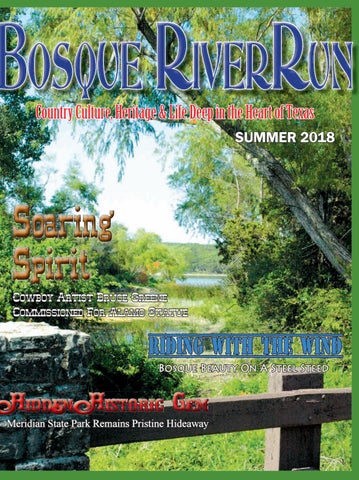
BOSQUE RIVER RUN
BOSQUE RIVERRUN Country Culture, Heritage & Life Deep in the Heart of Texas
SUMMER 2018
Soaring Spirit Cowboy Artist Bruce Greene Commissioned For Alamo Statue
SUMMER 2018
RIDING WITH THE WIND Bosque Beauty On A Steel Steed
HIDDEN HISTORIC GEM Meridian State Park Remains Pristine Hideaway
�assio� WE SELL RANCHES B E C A U S E W E H AV E A
FOR LAND AND THE PEOPLE WHO ARE I T S S T E WA R D S .
D AV I D B U R G H E R
H A R L A N R AY
c: 214.213.8715 | dburgher@briggsfreeman.com
c: 214.908.7770 | hray@briggsfreeman.com
B U R G H E R R AY R A N C H S A L E S . C O M
|
RANCH.BRIGGSFREEMAN.COM
RANCH & LAND DIVISION | 2913 Fairmount, Suite 200, Dallas, Texas 75201 | ranch.briggsfreeman.com | View All Properties: LandsofAmerica.com/member/57415
BOSQUE RIVE IVERRRUN Volume 2, No. 2
5
LETTER FROM THE EDITOR Law & Order Western-Style
SUMMER 2018
SPIRIT 24 SOARING Cowboy Artist of America
by BRETT VOSS
6
THE ROAD, JILL 47 HIT Rose-Mary Rumbley speaks
Bruce Greene commissioned for Alamo renovation
at BAC Ladies Luncheon
by SIMONE WICHERS-VOSS
& SIMONE WICHERS-VOSS
AUTHENIC ART ILLUSTATES THE WEST
by DEB PHINNEY
STITCH A STORY 51 EVERY Marvel of creative diversity
Clifton’s BAC hosts 33rd Annual Bosque Art Classic
at 4th Annual BAC Quilt Show
by SIMONE WICHERS-VOSS
by DEB PHINNEY & SIMONE WICHERS-VOSS
WITH THE WIND 34 10 RIDING Bosque County natural beauty beheld on a motorcycle
by SIMONE WICHERS-VOSS
18 EXPLORE, CONNECT & CREATE
A LASTING PLACE OF REMEMBRANCE
Cemeteries provide connections to the past by RUTH CRAWFORD
HISTORIC GEM 42 HIDDEN Meridian State Park remains
Bosque Museum adds educational value
pristine outdoor hideaway
by SIMONE WICHERS-VOSS
& SIMONE WICHERS-VOSS
by BRETT VOSS
& ABOUT 55 OUT Area Event Happenings by SIMONE WICHERS-VOSS
EDITOR’S NOTE
5
LETTER FROM THE EDITOR BOSQUE RIVERRUN
“
We’ve come a long way since the late 1800s when pioneers began to settle the Bosque River Valley area.
”
When the much-anticipated ribbon-cutting ceremony officially opened the state-ofthe-art Bosque County Law Enforcement Center June 29, it marked the beginning of a new era for the men and women who protect and serve us. We’ve come a long way since the late 1800s when pioneers began to settle this area. When it comes to thinking of the Bosque County, Texas and the rest of the Wild West of the late 19th century in America, most of us conjure up images of cowboys and Indians, gunfights, gold prospectors, ghost towns, saloons, outlaws, desert landscapes, wagon trains, and much, much more. But most of us don’t realize those images aren’t based in reality, but the creations of the golden age of the American western movie. As a new and somewhat unsettled place, law and order remained to be established. In fact, without a sheriff and a decent deputy or two fast on the draw, anarchy prevailed. The west offered a land for independent pioneers, tough, devious and smart enough to become a successful farmer, gold prospector, cattle rancher, or small town businessman. If you wanted to see the last of America’s natural landscapes, it was time to “go west, young man.” But historically, the real west looked quite a bit different than the typical Hollywood depiction. The story of the true American west does not rely on heroic cowboys taking on bad guys and Indians out on the plains or in a one-street town. It’s a much less glamorous story of industrial mining operations ran by corporations, cowboys with hemorrhoids,
physical abuse of prostitutes, farting cows, and spontaneous gunfights where someone gets shot in the back and dies slowly. In fact, most Native Americans tribes were victims of expansion rather than impediments to it. Gunfights were spontaneous acts of ugly violence rather than glorified duels in the middle of the street. Over time, the independent gold prospectors, “open range” cowboys, and family farmers became less common, replaced by mining companies, large cattle ranches enclosed by barbed wire, and big commercial farms. So why did we all buy into the classic Hollywood images of the west? It all began with the western dime novels of the late 19th century. Americans loved them for one basic reason, these western stories seemed to be the polar opposite of their lives in the east. Don’t forget, the late 19th century proved to be a time when urban, corporate, industrial America began to truly take hold, with a growing number of Americans finding themselves living in crowded, unsanitary cities, while working in horrific factory conditions and watching most of the profits go to corporate tycoons. The idea of escaping to a place with wide-open spaces where the independent pioneers could still thrive remained very appealing. In the west, real men dominated, surviving on their toughness and their wits. The iconic figure of the American cowboy, more than anything else, demonstrates the degree to which the realities of the Old West evolved into myth and legend. Indeed, we’ve come a long way.
BRETT VOSS
Publisher & Editor-In-Chief
BOSQUE RIVER RUN
Country Culture, Heritage & Life Deep in the Heart of Texas
SUMMER 2018
Soaring Spirit Cowboy Artist Bruce Greene Commissioned For Alamo Statue
RIDING WITH THE WIND Bosque Beauty On A Steel Steed
HIDDEN HISTORIC GEM Meridian State Park Remains Pristine Hideaway
Publisher & Editor-In-Chief Brett Voss Associate Editor Simone Wichers-Voss Business Manager Joyce Riney Advertising Designers Alyson Stanley Laura Yeakey Contributing Writers Ashley Abel Ruth Crawford Bryan Davis Nathan Diebenow Debra Evans Andrea Hikel Paige Key Deb Phinney Simone Wichers-Voss Contributing Photographers Nathan Diebenow Simone Wichers-Voss BOSQUE RIVER RUN is published quarterly by Bosque County Publishing, LP., 310 West Fifth Street, Clifton Texas 76634-1611. (254) 675-3336 NOTICE TO THE PUBLIC: All editorial and advertising materials are copyrighted by Bosque County Publishing, LP. The entire content of each issue of the Bosque River Run is protected under the Federal Copyright Act. Reproduction of any portion of any edition will not be permitted without written permission from Bosque County Publishing. Bosque River Run, as well as any reasonable derivative of this name, are trademarks of Bosque County Publishing, LP and use of these trademarks without the express written consent of Bosque County Publishing, LP is strictly prohibited.
ON THE COVER: Historical Hideaway by Simone Wichers-Voss
SUMMER 2018
BIGGER AND BETTER BY THE YEAR: 33rd Annual Bosque Art Classic Delivers Quality Original Representational Art Every step takes you to a whole different world; every step teleports you to a different place. Exquisite places with big skies and endless plains or a garden scented by delicate blooms; unfamiliar worlds in gilded frames. As you wander through the gallery, each painting, each sculpture grabs the imagination and transports you to another world. The Roland Jones Memorial Gallery houses the permanent collection of the Bosque Arts Center. A gathering of beautiful representational artwork from the past decades, the gallery alone is definitely worth a trip to Clifton. Nationally renowned artists as well as artists coming into their own are represented in the collection, which grows each year with purchases from the Bosque Art Classic show and sale. And over the years, the annual juried and judged art show and sale art show has grown and thrived thanks to the dedication of its art
patrons to support the work of talented artists. And thanks to the never-abating enthusiasm and dedication of the Bosque Arts Center Art Council. The Arts Center has hosted the annual art show since its founder, Joan Spieler, launched the show and sale in 1986. Currently in its 33rd year, the national show that has become synonymous with outstanding original art — especially western art — is open to all artists who create realistic and representational art. “This is a great show for artists to come up through the ranks,” 2017 show judge and Cowboy Artist of America Teal Blake said of the Classic, which helps promote new and lesser known artists. Blake juried 170-plus pieces of art by over 100 artists. In addition to receiving the acclaim of art patrons and fellow artists, winning a coveted award
at the Bosque Art Classic also comes with cash; over $15,500 in prizes is awarded. And additionally, winning an award increases the chances of the art being sold right after the awards. “We want to present a show the BAC can be proud of, but more importantly a show for those who entered it to be proud to have been in,” Bosque Art Council’s Joyce Jones said. She and her husband Roland provide the coveted John Stevens Jones Purchase award in memory of their son. It is the most prestigious award of the show. Each year in September, the show presents a $5,000 John Steven Jones Purchase Award and an Art Patrons Purchase Award in the amount of $1,000 in addition to the price of the artwork. The winners of those two awards are also awarded a place in the gallery’s permanent collection. The first and second places in each category are awarded in each medium, with prizes of
Authentic Art Illustrates The West Visitors can view hundreds of original, realistic art pieces during the Bosque Arts Center Bosque Classic art show and sale (above); Jane Scott and Betty Murdoch assist with the art sale (right).
$1,000 and $500, respectively. Categories include: Drawing, Oil/Acrylic, Pastel, Sculpture, and Water Media. The Boren-Selvidge Award ($1,000), sponsored by the family of the late James Boren, CA. Named for the artist and his wife, Mary Ellen (nÊe Selvidge), the Boren-Selvidge Award in the amount of $1,000 will be given in addition to any other awards that an artist may receive. There is also a $1,000 New Entrant Award. Past winners of the John Steven Jones Purchase Award include Herman Walker, Randy Meador, Matt Atkinson, Jim House, Mikel Donahue, William Schneider, Jeff Segler, Don Weller, Romel de la Torre, Xiang Zhang. Summer is the time of waiting for the artists that entered their digital files in contest by the end of May. There are as many as 600-900 entries to the contest. By mid-July the artists will know whether their artwork was selected for judging. Artwork is
article &
photographs by
SIMONE WICHERS-VOSS
ART
9
The 2017 John Steven Jones Purchase Award winner Herman Walker and his wife, with the painting Quittin’ Time (top left); Art Council President Dana Ferguson and 2017 judge Cowboy Artist of America Blake Teal (top right); The Bosque Arts Center Art Council organizes plans and executes the annual renowned Bosque Classic Art Show and Sale (above).
received in late August for the judge to view the works and judge in person. Awards are announced and presented at the opening reception held in September each year. After the reservations-only Preview September 8, the show and sale will remain open to the public with no admission Sept. 9 - 22: Monday-Friday 9 a.m. - 5 p.m.; Saturday 10 a.m. - 4 p.m.; Sunday 11 a.m. - 2 p.m. To purchase tickets for the opening ceremony Sept. 9, call 254-675-3724. For more information about the Bosque Art Classic, visit www.BosqueArtsCenter.org. This year’s Bosque Art Classic Judge is Jason Rich, who was invited to be a member of the Cowboy Artists of America in 2011. With childhood summers spent on cattle drives and spare moments spent drawing horses, Rich had been more or less preparing for that moment all his life. According to his mother, Jason has been drawing horses “since he could pick up a pencil.” “Every painting starts with the horse for me,” Rich said. “The way the light catches its
gesture and movement.” At Utah State University, Rich studied art under a talented artist/instructor who encouraged traditional and representational art in a department that primarily emphasized the abstract and contemporary. After graduation Rich made the decision to pursue art full-time. He and his wife lived in a basement; their first baby slept in a closet. “But we knew art was what we wanted to do.” Honors soon rewarded the dedication. Rich received the Arts for the Parks Grand Prize in 1997 and Founders Favorite Award in 1998. That year also saw him win Best New Auction Artist Award at the C.M. Russell Auction. He was the featured cowboy artist at the National Cowboy & Western Heritage Museum’s National Day of the American Cowboy event celebrating John Wayne’s 100th birthday. He was selected as the 2014 Western Artist of the Year by the Academy of Western Artists. Rich’s Cowboy Artists of America honors include winning the Silver Medal Oil in the
BOSQUE RIVER RUN
2012 and 2013 shows and the 2012 TCAA Award for Best Portrayal of a Cowboy Subject, as well as being voted the Stetson Award by active CAA members for best overall exhibition at the 2015 CAA Exhibition and Sale. Rich currently lives with his wife, three children, and three horses in the foothills of northern Utah. “I never want to get too content and let my work stand still,” Rich said “I hope people are still excited about my paintings and seeing new ideas expressed twenty years from now.” Taking that philosophy into his judging, art patrons from across the state and nationwide can expect to see exciting paintings and sculpture in this year’s show, that will withstand the test of time, that will captivate and thrill, and transport the viewer to a different world, a different place; a place of sweeping landscapes, exquisite detail, and vibrant colors so real they can nearly smell the flower perfume in the air or the dust kicked up by the horses on the trail.
SUMMER 2018
Behold Bosque Beauty On A Bike
RIDING WITH
e
article &
photographs by
SIMONE WICHERS-VOSS Bosque County is a hidden gem of natural beauty in the Heart of Texas, best enjoyed at close hand, on a steed, or on a motor cycle – which will allow you to cover more miles and see more scenery. Being farming and ranching county, there are no big towns, no congested highways, only pastures, rolling hills, beautiful vistas. And the roads have enough twists and turns for even for the more seasoned motorcycle rider to enjoy. But the curves are not to the extent that a novice rider would feel out of depth. There are many, many excursions worth taking, in a pack or as a lone wolf, but this “Tour de Bosque” bike route sort of covers it all. Without stops it would take about five hours to cover. Start on Highway 6 in Valley Mills, going northwest, take 217 on the left –- just north of town. A winding road past white picket fences, ranchitos and pastures filled with livestock to the near-ghost town Mosheim. After Bosque County was established, by 1896, Mosheim had an estimated population of fifty, a Methodist church, and several businesses. The number of residents reached a peak of 200 until the late 1960s and has since dwindled back to the original number of 50 inhabitants. The ruins of the former school are its most prominent feature today. For Phil and Steve Macasil, it is the perfect meeting place midway
THE WIND
12
SUMMER 2018
RECREATION
BOSQUE RIVER RUN
RECREATION
13
There are plenty biker-friendly stops along the way in Bosque County, such as the Horny Toad Bar & Grill in Cranfills Gap.
between both their residences for a Thursday afternoon ride. The brothers moved to Central Texas from Los Angeles where they were born and raised, and are loving the open, empty roads and the natural beauty. They turned east – right – on CR2602 towards Clifton, past the lime gravel pit, hitting Highway 6 again just south of Clifton. On the left is the best BBQ joint around – Bunkhouse BBQ. Just up the road is the Red Caboose Winery, selling locally grown and bottled full-bodied temperanillos, syrah-cabernet blends and lenoirs, but also fun sweet rose Hobo Hooch. At the light in the center of town, they took FM 219 towards Cranfills Gap. On the left is the former Clifton College, now the Bosque Arts Center home to an impressive collection of western art and well worth the visit. The road took them through the historic Norse district. Bosque County was largely settled by Norwegian and German immigrants during the 1850s, encouraged by the state of Texas’ offer of 320 acres to each family. The brothers ended up in “The Gap” at
the Horny toad Bar and Grill for the best hamburger and quesadilla before heading home. We on the other hand, took the long way round, taking FM 217 West towards Jonesboro, taking in a bit of Coryell County to get to the junction with FM 182 North. Twelve miles down the road – past the historic homestead Norway Mills, seeing a yak and a mule along the way - you also end up deep in the heart of Texas Norway -Norse. The next important junction is where FM 182 intersects with FM 219. Beginners might want to go left on FM 219 to Cranfills Gap. The more adventurous rider might continue on FM 182 to where it merges into back roads CR 4150 and 4145. These roads pass two iconic churches in the county, the Our Savior’s Lutheran – where the Father of Norwegian Immigration to Texas Cleng Peerson lies buried, and by the St Olaf ’s Kirke, a legacy from the Norwegian settlers. The roads are paved, but bumpy and avoiding a pothole here and there is necessary. CR 4145 intersects with Highway 22, just east of Cranfills Gap. Turn left towards town. Stop at the convenience store or Gap Ranch
BOSQUE RIVER RUN
Supply – the trendiest feed store - for a snack. Take FM 219 West to Fairy, past the town’s ever-growing murals and “The Toad” to take in pastoral scenes of sheep and other livestock standing in the shade by a stock pond. At the junction with FM 1238, go north towards Iredell. For a longer loop, turn left on Highway 6 towards Hico. Hico has a quaint Main Street and is home to a Billy the Kid museum and the Popcorn Works. Also renowned is the Koffee Kup Kafe pie and home cookin’ and the Wiseman chocolates. You can call it a day after 80 miles and head south on Highway 6 – which never sees excessive traffic and is scenic enough – back to Clifton for the evening. But, if your butt is not saddle-worn, take FM 927 towards Walnut Springs, and then detour north on Highway 144 towards GlenRose to the Texas Parks and Wildlife Dinosaur Valley Park for the million-yearold dinosaur footprints by the Paluxy River. GlenRose is also home to the Fossil Rim Wildlife Park. The park’s goal is promoting the preservation and procreation of threatened/en-
SUMMER 2018
14
RECREATION
dangered species, environmental awareness, and a recreational and educational experience for people of all ages. The first facility of its kind to have been accredited by the Association of Zoos and Aquariums (AZA), Fossil Rim Wildlife Center participates in a worldwide network of wildlife conservation organizations working to restore the delicate balance between people, animals and the environment. Over the past two years, the facility has worked with other agencies to reintroduce the scimitar horned oryx back to their natural habitat in Chad, a Sahel country in north central Africa. The scimitar horned oryx has been extinct in the wild for 25 years. Just west of Glenrose is the well known Loco Coyote Grill – with saw dust on the floor and massive portions. Don’t expect to be served quickly, be laid back and relaxed - like the sign says at the front door into the establishment, “if you are in a hurry or have an attitude, you are in the wrong place”. When back in Walnut Springs, seeing the dilapidated main streets, it is hard to imagine that in their heyday – when the railroad came through town - , Walnut Springs and Morgan were the largest towns in Bosque County, boasting race tracks, opera houses, a league baseball field and general stores. Walnut Springs downtown now is experiencing a bit of a biker-friendly revival and is earning the name “Saloon City” with Blackies Bait Shop, the Rattle Snake Ballroom and The Yellow Dog Saloon, each regularly offering live music entertainment on the weekends. From Walnut Springs continue on FM 927 to Morgan and Lakeside Village. Bosque County’s eastern border is for the most part made by Lake Whitney and the Brazos River. Take FM56 – part of the Texas Lakes Trail – south, and follow it all the way back to Valley Mills, passing the Whitney Dam at Laguna Park on the way. Take one of the roads to Lake Whitney and enjoy a stop along the waterside, like at the Army Corps of Engineers Steele Creek Park South of Lakeside Village, Walling Bend Park just north of Laguna Park or Soldiers Bluff Park with a view of the Whitney Dam. There is no better way to experience the outdoors than on the open road, taking in the scenery, stopping of for a snack and to stretch the legs. Along the way, don’t expect any fancy schmancy eateries or coffee shops. There are good-old fashioned convenience stores that offer a range of snacks, cold drinks and even bait. Do the tour in a day, or take a bit longer, breaking the loops in smaller parts, spending the night – The Screen door Inn or the Cell Block – a one-room refurbished city jail - in Clifton are both unique bed and breakfasts - and trying some back roads the next day. Like FM 2136 and have some German delights at the Zur Autobahn restaurant on HWY 22 and visit the Meridian State Park. Highway 22 in itself toward Hamilton is a pretty and interesting drive; and going to Hamilton to Storm’s for a burger or to visit the Red Wing Dove Winery is worth the drive. Or take the FM 1991 from Clifton to Meridian, to see the Courthouse Square and shop for some antiques. One last thought before hitting the road on a motorcycle. The Texas Department of Transportation’s “Share the Road: Look Twice for Motorcycles” campaign is urging drivers to watch for motorcycles, as crashes killed 501 and seriously injured another 2,101 motorcyclists in Texas last year. TxDOT’s campaign is part of National Motorcycle Safety Awareness Month every May. “Nobody wants to take a life in a crash or lose a loved one,” said TxDOT Executive Director James Bass. “Motorcycles are small, they’re hard to see, and it can be difficult to judge their speed and distance. That’s why it’s critical that drivers take extra precautions to look twice for motorcycles, especially at intersections.”
SUMMER 2018
BOSQUE RIVER RUN
RECREATION
15
Brothers Phil and Steve Macasil live in Waco, but enjoy motorcycle trips in Bosque County (right); By crossing the Bosque County line into Somervell County, Loco Coyote near Glen Rose represents a popular biker pit stop (above); The iconic St. Olaf’s Kirke in Norse is worth a bumpy ride on CR 4145 (top left); Characteristic Texas images, like this barn north of Valley Mills are abundant along the county roads, ideal for motorcyclists (bottom left).
BOSQUE RIVER RUN
SUMMER 2018
EXPLORE, CONNE
Dedicated and knowledgeable docents assist in the Bosque Museum educational tours throughout the year.
photographs by SIMONE WICHERS-VOSS &
NA T HA N D IEB ENOW
NECT
& CREATE
Bosque Museum seeks added educational value with new program, CPE certification & virtual reality Who doesn’t remember the thrill and excitement of piling into that yellow school bus with all your classmates, off to a field trip? Even if that high school trip to that modern art museum was “oh soooo boring” at the time, in later years you thought back, remembering a fact here and there on what you saw that day, right? Like that one lace collar in that Rubens painting that looked like you could touch it, it was so realistic. Or the time your hair stood up because of static electricity at the science museum? Or that you marveled at a fossilized gingko leaf from the Permian era, dating back 270 million years, and that is the same as the gingko biloba tree today? The impact of the field trip is not empirically testable, but that experience of excitement and recollection alone makes
article by
SIMONE WICHERS-VOSS
18
EDUCATION
Teachers from around the county and beyond visit and learn about the learning possibilities at Bosque Museum during Educator Night.
SUMMER 2018
BOSQUE RIVER RUN
EDUCATION
19
them important. But there are many other benefits to a museum visit: pleasant social time with class mates, museums give students access to culture, history, and art that may be left out of the regular curriculum, the students pick out what they want to learn that day – it is not teacher or curriculum-driven -, the learning is enriched with different sensory and intellectual inputs besides just text and abstract ideas. And the sensory, physical, and social aspects of field trips enrich learning experiences. The unique exposure provides the foundation for creativity, critical thinking, and opens their eyes to different ideas and perspectives in connection to the world around them, integral to future success. Planning field trips to museums is particularly important that schools serving economically disadvantaged students – and in Bosque County that is usually over 60 percent of the student population at elementary school level – to provide culturally enriching field trip experiences. This group’s families just cannot afford to pay entrance fees to museums, how reasonable those might be. “It is so important to introduce children to museums because museums open up a world of imagination and exploration. It is even more important to introduce children to museums at a young age because our youth is our future and museums broaden our knowledge of the world.” —Jennifer Peters, Director of Exhibits and Education, Muncie Children’s Museum. It is therefore such a loss that school finances and resources nowadays curb the possibilities of taking a day out of the classroom. Additionally, the No Child Left Behind (2001) has been blamed for declining numbers of field trips in the last decade. The American Association of Museums believes that out-of-class excursions—along with art, science, and social studies classes—were being squeezed out by added emphasis to math and literacy instruction and standardized testing. But in Bosque County, students do not have to go far to experience a multi-facetted field trip. Right in their own back yard, just around the corner is the award-winning, nationally recognized Bosque Museum, home to the Cleng Peerson Research Library, the Jacob Olson Log Cabin, the Horn Shelter Exhibit, and local history exhibits. Established in 1924, the Bosque Museum is dedicated to protect and preserve Bosque County’s historic and prehistoric resources for the use, education, enjoyment and economic benefit of present and future Bosque Citizens. With extensive expansions, renovations, and regular temporary exhibits, the museum aims to bring history and people together for experiences that delight, inform and inspire. In the past few years, the museum has developed a working association with other museums and local universities including the Smithsonian Museum in the development of its displays. Museum Director Barbara Aars explained the museum’s present focus after the recent expansion is to bring regular, changing exhibits besides the permanent exhibits, and to offer educational programs aiding the area school districts. Over 1,000 students visited the museum last year through school field trips, and are bringing their parents back for a visit. The museum docents – all volunteers – work overtime to accommodate area schools visiting the museum. Chatter and laughter fills the otherwise more quiet halls as he students learned about blacksmithing in the mid 1800s; side saddle riding for ladies – amazed that women did not wear trousers back then; the early settlers ways of preserving food; the history of the Norwegian and German settlers. They imagined how difficult it would be to pack all your beloved belongings into one travel trunk when immigrating to a new land. In the new atrium, docent Dr. Mimi Wright explained the wildlife habitat of Bosque County to a group of students, while other students explored the cabinets with fossils with much interest. The guns in the
BOSQUE RIVER RUN
SUMMER 2018
20 civil war exhibit also drew a lot of attention. According to Aars, fourth grade teachers and students are becoming aware of the museum’s Horn Shelter exhibit through the Texas Reader that includes the discovery of the paleo-american archeological site on the banks of the Bosque River. The Paleo American site found in Bosque County and called the Horn Shelter has been replicated at the museum for visitors. The 600 square foot exhibit depicts a portion of the Horn Shelter and portrays the burial of a man and small girl as it took place 11,200 years ago. A second section of the exhibit is a facsimile of the excavation of the Horn Shelter complete with the tools used at the site and a plat of the excavation area. What makes the Horn Shelter find so significant is the fact that there are only three Paleo American sites in America with skeletal remains and burial goods. The Smithsonian’s Dr. Margaret (Pegi) Jodry, principal researcher on the Horn Shelter burial goods and co-author of Chapter 30 in the new book “Kennewick Man”, returned to the Bosque Museum, giving a lecture about her most recent findings shedding new light on the mysteries of the Horn Shelter Double Burial. Also present at the lecture was the avocational archeologist Albert Redder who together with Frank Watt discovered the singular burial site. The Paleo-American exhibit – the museum’s prize and most unique exhibit ties into seventh grade history about the earliest Texas inhabitants; comparing ancient shelters to modern day homes; third graders learn about culture and tradition, forming communities and adapting to environment; and understanding the impact of ancient civilization helps us understand the present. Aars also pointed out that a field trip to the museum allows for TEKS credits. TEKS is the Texas Essential Knowledge Skills system for curriculum standards. The museum is using this to advertise their exhibits to schools. The dedicated education committee with former and current educators is always on the look out to enhance the museum’s value for educators. Promoting the educational value for area schools, the museum hopes to show the educators that their exhibits and enrichments activities are aligned to National Science Foundation and Texas Education Agency student standards. “We hope to help the educators realize the resources meeting TEKS and STEM goals they have at their local museum; right in their own backyard,” Aars said. For example in the Nature Exhibits, first grade science teaches the interdependence among living organisms; learning about
SUMMER 2018
EDUCATION animals and their habitat; third grade science teaches animal ecosystems. At the pioneer exhibit including the Jacob Olson log cabin, fifth graders can learn how people adapted and modified their environments to meet their needs and analyze cultures and the daily lives of people – both social studies. The Norwegian exhibit ties into immigration to America, and teaches about family – including ancestry, traditions and culture. It could also help show art forms like rosmaling and wood carving for art class. The local history exhibit could help students learn about American citizenship, how people contribute to society, how technology has changed over the years – going from gas lanterns to electricity for example. “You couldn’t just go to the store,” Docent Linda McDowell said to a group of visiting students as she explained different cooking utensils in the 1850s kitchen. “This is a butter churn, to make butter out of milk. And this is to make candles. The homes had cellars to store fruits and vegetables.” The museum hopes to create a learning laboratory that explores and connects the history of Bosque County with the teachers and students of today, coordinating academic needs to museum enrichment experiences through school site visits and museum field trips. Each educator has to complete a certain number of continuing professional education hours; usually 150 hours over the course of five years. The museum – after an extensive and detailed application - has recently been certified by the Texas Education Agency as a facility that offers these valuable CPE hours for area educators. Historical empathy is the ability to understand and appreciate what life was like for people who lived in a different time and place. This is a central purpose of teaching history, as it provides students with a clearer perspective about their own time and place. Helping with that is another recent addition to the museum, the Explore, Connect and Create area – an educational hands-on experience specifically aimed at children. The simple but very effective activities are aligned to a permanent or temporary exhibit. For example, during a World War I exhibit, the youth could learn the significance of the poppies and to make a couple of their own; or they could build a parachute. Tying into the natural history exhibits is the chance to hunt for fossils or engage in weaving. Thanks to the museum’s staff inspiration and particularly to the creative mind of Dawn Nowell, the exhibits are modern, effective, accessible and a pleasure to explore. Also aimed at a younger audience, in the spring and summer breaks, the museum offers
BOSQUE RIVER RUN
Kenn Cornett, museum camp volunteer, tie a knot on American Science and Technology Camp at the Bosq Children compete in sack races during the Pioneer C useu olunteer enn Cornett shows how to ake toy during the ioneer Ca p abo e left oung stud e tract colors for painting abo e right .
EDUCATION
21
not on an A-frame shelter at the Native e Bosque Museum March 14 (top left); oneer Camp June 7 (top right); Bosque ake a odified ball-and-cup wooden g students gather rocks with which to
BOSQUE RIVER RUN
SUMMER 2018
22
le entary school students
SUMMER 2018
EDUCATION
ar el at the fossil collection at the Bosque
useu
BOSQUE RIVER RUN
during a field trip.
EDUCATION three-day Native American camps under the name NASTUMLA - Native American Science & Technology Using Materials, Land, and Art. The camps, led by master gardener Eric Vanderbeck and master naturalist Kathy Cash, teach youth how to make fire without a match, hunting with an atlatl, archery, building a shelter, flint knapping, making cords from yucca strands, painting with natural ingredients and pottery – skills used by our ancestors to survive thousands of years ago. A family nature day brings in the rest of the family to participate and practice some of the survival skills. “Parents who have lived in Bosque County all their lives, and maybe have visited the museum in their youth, now say ‘I had no idea how it has changed, and what the museum offers,’” Aars said. “They now realize the importance of the museum, showing where the Bosque County roots are.” This summer, the museum is adding a Pioneer Camp, in a similar format, offering the frontier skills of spinning and weaving, making wooden toys and period log cabin games – there was no television back then remember? Another illustration of how the staff and board are always on the look-out for things that tie into Bosque County is the inclusion of the book The Dala Horse by Lissa Johnston. The mystery for young adults features 10-year-old Kaya Olson who lives on the frontier in a small Norwegian immigrant settlement in post-Civil War Texas when things were anything but simple – the settlement is Norse in Bosque County. As Kaya tries to uncover the secrets her family is keeping to solve the mystery surrounding her mother’s death, the author gives a lot of interesting history based from the view of a Norwegian population still finding their way in a new country. The book is filled with speech and phrases from this perspective giving a unique feel to the story. Connecting to a modern audience, and moving with the times the museum has purchased ten virtual reality head sets. Museum patrons Tom and Patricia Chambers came up with the original idea. Through the Chambers Family Foundation, they have funded through the Bryan Museum of Galveston, a Texas Education Production filmed at the Bryan Museum. That production will be showcased through ten virtual reality headsets. Participants will be able to experience, through virtual reality, elements of Texas history that come alive. The program is expected to be up and running by the next school year. An annual update will be made, to keep the Texas history
23 “ F amilies come to the Vermont H istory M useum to get a glimpse of d if f erent times and places, helping the child ren gain a broad und erstand ing of the past. L if elong learning begins at a young age and museums are a great place to spark an interest in history, art, and science.” VICTORIA HUGHES, Education Coordinator Vermont Historical Society materials continued, refreshed, and added to each year. Museum patrons of the Museum can participate in this VR experience, as well as students. The VR headsets may also be taken out to different schools for use with students, usually fourth and seventh grades that concentrate on Texas history. On a more scholarly level, the museum is recognized as having the largest repository of all things relating to Texas Norwegian immigration in the American Southwest. The library’s collection of rare books contains published material dating back to 1685. The rare books are in Norwegian, Danish, Swedish, German, Latin, Greek, Hebrew as well as in English. Many of these books were in the personal libraries of the Norwegians arriving in Bosque County in 1854. These families gave their books to the Clifton Lutheran College in the 1900’s. When the College merged with Texas Lutheran College in 1954, the books were given to the Bosque Museum. Those books now form a nucleus of rare and antique books collected by the Cleng Peerson Research Library. The library is recognized by Norwegian historians as containing original material not found in Norway and draws people from all over the world, many in search of their Norwegian heritage. A major artifact in the museum’s collection is Cleng Peerson’s handmade chair, which he made and used in his later years. Cleng Peerson (1782-1865) is well known in Norway as the “Trailblazer to America.” He is buried in Norse Cemetery. The log cabin on the museum grounds was moved to its present location and reconstructed in 1985. It had been the home of the Joseph Olson family, a Norwegian immigrant family. The cabin was first constructed in 1859 and was located near Gary Creek in
BOSQUE RIVER RUN
the Norse Community. It is furnished with early Texas furniture. The Texas Historical Commission awarded a historical marker to it in 1986. King Olaf V of Norway visited the museum in 1982 to see its collections. Not only history is highlighted in temporary exhibits and lectures. They include the annual Wildflower art show and sale, a Quanah Parker traveling photo exhibit, the construction of the Whitney Dam, the Chisholm Trail and the birth of the cowboy, art exhibits celebrating the many Bosque County artists, and most recently the Lonesome Dove photography exhibit. An upcoming exhibit this summer will feature immigration to America through Galveston Island, a route taken by many German immigrants who eventually ended up in Bosque County, settling in the Womack area. In conjunction with the annual Archeology Day in October the museum hosts programs specifically on archeology - children’s archeology program and one for adults. Even the museum’s Christmas exhibits by candlelight can be seen as a learning experience. Themes like Contemporary Scandinavian Christmas, German Christmas, Victorian Christmas all help visitors connect with culture, heritage, customs, folklore and food from the different lands and eras – many that can be found in present day Christmas celebrations. During an Educator Night last year, Clifton Special Ed aide Julie Davis looked at her local museum in a different light. She knows the museum from her youth and through her work, but this was the first time she saw it after the extensive renovation. For her special needs students, the local museum is very conveniently close by and it has become more “user-friendly” and accommodating with ample space for walkers and wheelchairs. She saw her students being very interested in the nature exhibit and the prehistoric exhibit; and she saw some possibilities in the “old kitchen” to translate it to her life skills class. She also thought the museum had gotten more attractive for younger people, especially with the newly created kids activity room. If it has been a while since a visit to a museum, why not take a family field trip to the local museum? To see Cleng Peerson’s rocking chair in which he sat and crocheted scarves and told the children in his settlement stories of his travels on foot through Texas in search of the perfect place for Norwegian settlers, or to marvel at the fossils found on Bosque County soil, or imagine cooking in a kitchen without running water, refrigeration and only a wood-burning stove?
SUMMER 2018
Soaring
Spirit Cowboy Artist of America Bruce Greene commissioned for Alamo renovation sculpture
article &
photographs by
SIMONE WICHERS-VOSS
Soaring Spirit “ I can’t imagine giving up painting. Sc ulpting these large pieces is physically hard. But they are the real release of my abilities and pas sion though.” Bruce Greene For those without a creative mind, it is hard to imagine transforming mere paint into an exquisite piece of art that evokes emotion or taking a humble building material like clay and create a three-dimensional figure that translates strength and movement. For Bosque County’s Cowboy Artist of America Bruce Greene, doing that is all in a day’s work; just like us mere mortals go our jobs on a daily basis. Showing his incredible versatility, he enjoys going back and forth between two-dimensional and three-dimensional work. And even in his painting he will switch from oils to charcoal to using water color, switching from more controllable studio work to the quick capture of plein air painting – just to get in the groove. “It keeps me from getting bored,” Greene said in his studio behind his home in Norse, wearing his signature jeans tucked in his boots, a red fleece vest, plaid shirt and white cowboy hat. “It gives me the opportunity to keep the excitement fresh.” Both in his realistic paintings and sculp-
tures, his style is impressionistic giving the piece a lightness, a vibrancy, a fluidity. But also strength, clear and pure emotion. The last couple of years have been exceptional for Greene, with several very special recognitions, awards and a few prestigious commissions. In Oct. 2017 he was inducted into the Texas Trail of Fame with his star located next to artist, Charles M. Russell. In Jan. 2018 he received the Texas Cowboy Hall of fame Rick Smith “Spirit of Texas” award. In 2018 he received two huge – literally, in size and in importance – commissions. One for a larger-than-life Sarah Dickenson sculpture for the new multi-million dollar Alamo Park in San Antonio and a life-size buffalo for a bank in Fort Worth, across from AT&T Stadium. Greene had done a study of pioneer women many years ago including Dickenson. According to his research findings, Sarah was not a talkative woman. In one of the rare instances she revealed her thoughts, she recalled Davie Crockett running into the baptistery, dropping
to his knees, making his peace with God and going back into battle to die. As she stepped across the rivers of blood, she saw Crockett’s coon skin cap in the dirt. Greene’s Dickenson depicts her as she leaves the Alamo - released by General Santa Anna carrying a letter of warning intended for Sam Houston. She is holding her child Angelina, to her chest, protecting her head, walking over battle field debris, the wind whipping her wrap and dress out, looking back at the spot her husband lost his life. “I have her walking,” Greene said, maybe remembering her account of stepping across the rivers of blood. “But in real life she probably would have gotten a horse.” Sarah will be part of a sculpture walk with 20 other sculptures. Before the renovations are done, she will patiently be waiting in a spot in the garden behind the chapel. The clay sculpture left for the foundry just weeks before Greene finished the life-sized six foot tall, 10 foot long mighty buffalo, exuding majestic strength and power of the Monarch
More often than not, Bosque County artist Bruce Greene CA uses local friends, family and acquaintances and his own livestock as his models Two high school seniors, Emma Guillory and Bailey Barrett stood model for the Alamo renovation commission for “The Lady of the Alamo,” a statue of Sarah Dickenson (far left); Greene’s completed clay sculpture Lady of the Alamo before leaving his studio to the foundry where it will be cast (above). (Courtesy Photos)
28
ART
Bosque County artist Bruce Greene CA gives a demonstration of how he works to a group of art patrons from Arizona
SUMMER 2018
BOSQUE RIVER RUN
ART
29
of the plains. That massive undertaking - starting with visits to the Diamond Tail Ranch in North Colorado for measurements and research material on buffalo, and ending in a 3,000 pound sculpture - took about four months to complete. It all started with someone that forgot to inform him of the commission. He had just 48 hours to come up the preliminary sketch and quote for the bank’s board to consider. “I can’t imagine giving up painting,” Greene said. “But sculpting these large pieces is physically hard. But they are the real release of my abilities and passion though.” He compares working with clay, trying to get the most motion into the piece, kneading the clay, smoothing out a curve, touching up a wisp of hair, just creating, “like eating ice cream.” Greene’s first life-size sculpture can be admired near his home in Clifton, the cowboy on horseback at Heritage Plaza called “On the Banks of the Bosque.” As he started doing more life-size and larger than life statues, Greene and his apprentice/helper Jeff Gottfried have developed a “crazy good system” for the first armature and the spray foam for the foundation. “If you don’t lay a good foundation, and get the proportions right in the foam, you keep fighting the piece,” Greene said. “And that is a time-consuming mess.” More often than not, local friends, family and acquaintances and his own livestock are his models. Two high school seniors, Emma Guillory and Bailey Barrett stood model for “The Lady of the Alamo.” Tom Fry had approximately the same build as the Texas Ranger baseball fan sculpture at the home base entrance of Globe Life Park in Arlington. ` Greene had the honor of creating the sculpture of the Brown-
wood firefighter who fell to his death at the ball park. Shannon Stone died less than an hour after he fell about 20 feet from the left field stands while trying to catch a ball tossed his direction by outfielder Josh Hamilton. Stone’s six-year-old son, Cooper, was seated next to his father when the accident occurred July 7, 2011. Knowing the Greene’s had suffered the loss of a grandson – coincidentally also named Cooper – former Texas Ranger Nolan Ryan felt the Greene’s would have a heart for this family, and make the statue the best it could be. The finished work is pretty much like the first sketch Greene drew, except the calves were toned down after a comment from Stone’s widow. Greene wanted to honor the relationship between father and son and their love for baseball; he hoped to capture their “play by play” talk after a game, smiling, enjoying each other. And as with all his pieces, Greene has a touching story to tell about it. When Cooper came to see the completed clay figure a year after the incident, Greene felt he had to put the young boy at ease, and chatted with him about the biggest, most beautiful buck he had recently seen. When the two glanced out the window, there it was in the middle of the day, very close to the house. And that, while the buck had never been spotted during the day. Also, it never moved as Cooper went out to get a closer look at it. “That was just a God thing,” Greene said. When Cooper was ready to see the statue, he wanted Greene to accompany him. Together they put his thumb print in the clay over his dad’s heart and Cooper signed his name underneath the arm. The greatest question is of course whether the ball is in the glove Shannon is holding. It’s there, tucked away. And all this was talked through with the family. This is at least the second time Greene has been chosen to create
BOSQUE RIVER RUN
SUMMER 2018
30
a work commemorating a sport-related tragedy. His 2007 sculpture ”Immortal Ten,” was installed on the Baylor University campus on the 80th anniversary of a bus crashed that killed 10 people, including fans, coaches and members that college’s men’s basketball team. Showing his quality of work and diversity, Greene is a regular award winner at the annual Cowboy Artists of America show at the National Cowboy and Western Heritage Museum in Oklahoma City, in all three categories – painting, sculpture and drawing. His most recent awards were in 2017 - a Gold medal for his drawing “Calgary Mud” and the Buyers Choice Award for “Old Friends and Fine Horses,” an oil on canvas. In the heat of the Texas summer, the multi-dimensional artist is again getting ready for the prestigious, show and sale in Oklahoma City in October, working on paintings, drawings and a smaller buffalo – inspired by his life-size statue, called “The Charge of the Monarch.” The Ray Swanson Memorial Award honors longtime CAA member, Ray Swanson. The award is given for a work of art that best communicates a moment in time and captures the emotion of that moment. Greene received that illustrious award in 2007 and again in 2012 for ”In the Brazos de Dios,” a depiction of a cowboy baptism. This piece is close to Greene’s heart and of course, has a special story attached to it. A Cowboy Artists of America father – son spring gathering at the 4-F Ranch in Palo Pinto culminated in a Sunday church service under a tree, as the gatherings always do. This particular day, a young man with a limp walked up and began to sing. “It was staggering to hear,” Greene said. “He was like Andrea Bocelli.” Following the vocal tribute to God, the congregation decided to go to the river to baptize three generations – the ranch foreman, his son and his grandson. As the young man sang again- “How Great Thou Art,” filled the air and three Canadian geese flew over really low. Greene turned to his dear friend Red Steagall and said “That’s a painting,” and so it became one. But that is not all to the story. A fourth man, a stranger happened to be at the river and came forth, also to be baptized. Greene later heard Will was a young man who suffered greatly because of his role in his nephew’s death during a hunting accident near the river. Greene had not intended to add Will to the painting, but it just did not work without him. For Greene, a spiritual man, a man of faith, a believer, a Christian, the painting shows that “God is still with us in tragic, hard times,” and he never tires of telling the story of how God has his hand in the biggest and smallest of moments. In 2018, Greene went on to win the Donald Teague Memorial Award for the best work of art on paper at the 2018 Prix de West show for his drawing “Cowboy Cadillacs,” three saddles horses waiting for their “drivers,” and start the daily cowboy commute. The Prix de West is an exhibition of more than 300 paintings and sculpture by the finest contemporary Western artists in the nation at the National Cowboy and Western Heritage Museum. . This premier art exhibition features works ranging from historical pieces that reflect the early days of the West, to more contemporary and impressionistic works of art. Landscapes, wildlife art, and illustrative scenes are always highlighted in the exhibition. And using some of Greene’s titles of his works to paint the picture of his soaring spirit: the saddle remains the best seat in the house either in the soft light of an early morning mount or a dusty evening trail with good friends and fine horses, out on the range,
SUMMER 2018
ART
retelling tales as they ride exposed to the elements whatever they may be. And he feels honored and humbled to depict a lifestyle tied hard to tradition, because life on the range is living in nature, in God’s creation. As his star and spirit soar on his successes, Greene recalls the exact day and situation when his parents realized their son had a God-given, exceptional talent. He was six years old, visiting with a great aunt in San Antonio who was a hobby painter. As the adults conversed, the young boy who had always loved to draw, sat at his aunt’s French easel with paints and canvas and drew a tree in the garden, still bare from the winter. “The light came on,” Greene said. “That moment took me to a whole other level.” And his parents enrolled him in art classes at the Children’s Museum of Fine Art in Dallas. After that he took every art class there was in the area, choosing to get an art degree, not really sure if he could make any money with his art. His first commercial success came on an art sale in Rockwall County, selling six paintings, taking home $132.50 to Janie his wife and their one-year-old baby. There are a few constants in his work – Greene depicts the present day cowboy, their horses and their cattle, the interaction between man and beast or between humans, the beauty of the landscape - , capturing the emotion, the spirit of the moment in time out on the range or after a hard day’s work. Another light came on after visits to the historic Burnett Four Sixes Ranch and Charles Goodnight’s JA Ranch, completely changing his life. As his friend Steagall put it, Greene got the “dust in his nose.” Now, every year he makes a trip to the state’s large ranches –near the Palo Duro Canyon – spending his time rounding up cattle, soaking in and experiencing the lifestyle of the iconic cowboy fraternity. The trips give him inspiration, subject matter and a hands-
BOSQUE RIVER RUN
ART
31
Western props in Bruce Greene’s studio (far left); Bruce Greene’s sculpture “Along the Banks of the Bosque” at Heritage Plaza in Clifton (above left); Greene’s sculpture of Shannon Stone and his son Cooper at the Home Plate gate at Globe Life Park in Arlington (above right).
BOSQUE RIVER RUN
SUMMER 2018
32
SUMMER 2018
ART
BOSQUE RIVER RUN
ART
33
Bosque County artist Bruce Greene CA with his completed clay sculpture of a majestic buffalo before leaving his studio to the foundry where it will be cast (Courtesy Photo).
on knowledge of the day-to-day difficulties and simple pleasures of a cowboy life. “I build a box of memories, that are such a treasure for me,” Greene said. With the Chisholm Trail - the major route out of Texas for longhorn cattle from 1867 to 1884 - the iconic cowboy was born – independent, rugged, hard-working, dependable, proud of their occupation. “I try to document this segment of society that still goes on today,” Greene said at a lecture at the Bosque Museum commemorating the 150th anniversary of the infamous Chisholm Trail. “There is some mystique involved, an air, an attitude, but not in an ugly fashion. What I see, cowboys and their families have impeccable manners, are
courteous and considerate of others.” Back in the day, cattle driving was an even more grueling and lonely affair. On top of being exposed to the elements, there were hostile settlers, outlaws and native American attacks to be dealt with. Rounding up cattle from the range still holds many dangers of severe weather, prairie fires, predatory animals and stampedes. A river or creek crossing, even at low water levels harbors unseen dangers like quick sand. And all a cowboy needs, then and now, is a couple of trusty horses, a wide-brimmed hat, boots, spurs, a good saddle, a lasso, the iconic yellow slicker, leather chaps to protect his legs, maybe tampaderos on the stirrups and a rolled mattress. The only
BOSQUE RIVER RUN
thing Greene has that not exist at the time of the Chisholm Trail is a cowboy teepee for some protection from wind and weather in the night. Greene feels that without the intrinsic experience of the life on the range, a western painting can be pretty, but would lack the depth of feeling he seeks. The harder his experiences, the more real the emotion in his artwork, as he believes the best artwork comes from the deepest depths. With his depictions of life on the range, Greene hopes to show people 50, 100, 150 years from now what it was like for the families that chose to ranch in remote areas. And his scope of work is his legacy to the next generations of Greenes. They will know him, his spirit through his work.
SUMMER 2018
article by
RU T H CRA WF ORD
photographs by SIMONE WICHERS-VOSS
A Place Remembrance Providing connections to the past makes a cemetery special
Sometimes visiting in graveyard is part of vacationers sightseeing itinerary – going to see beautiful old, cemeteries shaded by ancient trees, where famous people lie buried with elaborate mausoleums or tombstones. Perhaps the most star-studded cemetery of them all, is Paris’ Cimitière du Père Lachaise, a where you can be inspired by the ghostly presence of Jim Morrison, Honoré de Balzac, Marcel Proust, Gertrude Stein, Oscar Wilde, Sarah Bernhardt, Maria Callas, Frédéric Chopin, Camille Pissaro, Georges Seurat, Amedeo Modigliani, Eugène Delacroix, Molière and Edith Piaf Or movie buffs that visit the Lafayette cemetery in New Orleans because it has been featured in several films or the Hollywood Forever Cemetery to visit the graves of the vintage movie greats like Cecil B. DeMille, Johnny and Dee Dee Ramone, Rudolph Valentino and Mel Blanc. Military cemeteries whether in the United States or in Normandy are often part of the tours people make, to honor those who sacrificed the ultimate for our freedom.
But right around the corner, without being ghoulish or sad, visiting a local cemetery can be as special and a strangely educational experience. What makes a cemetery special? They are a touchstone, so to speak; a way to connect with loved ones and friends that have passed. They can be a memorial, a place set aside to honor the memory of special people in our lives. One sad grave – a lamb on the marker, the date of birth and death just months apart - may be the only reminder of a life lived on this earth. And tombstones can be a valuable genealogical resource, helping those researching their family history and ancestry. Besides being touching, tombstones reveal whether the deceased were mother or father, when and where they were born. Data obtained from gravesites can be immensely varied; for instance you can learn what area the deceased lived near, someone’s religion, an armed service history, whether they were part of a society or union, a profession. In the Womack area, several headstones are written in German, indicative of the heritage in that
36
SUMMER 2018
HISTORY
BOSQUE RIVER RUN
HISTORY
37
Ruth Crawford reads a head stone at the Kopperl Cemetery (left) The alleged “Hanging Tree”in the Meridian Cemetery.
part of the county. On the western side of the Bosque River, more Norwegian names and inscriptions will be found. I discovered an entire family once, with all graves surrounded by a concrete border. Several small children’s stones were inscribed with “yellow fever” on the bottom. After checking all the dates of death, a sad fact was established. The mother, who had a husband and ten children, had outlived them all. This one woman had experienced the Civil War, a great depression, different epidemics, two world wars, and the grief of burying her entire family. Besides the factual information, the sheer presence of a tombstone speaks volumes. Some are elaborate, such as Texas Ranger Buck Barry’s carved lamb atop a huge pedestal, some are simple rocks. At the Fulton Cemetery, a headstone without inscription, in the form of a peanut makes you wonder what lies buried there. Many gravestones have Bible scripture or beautiful poetry; some simply state, “Not dead, but sleeping” or “Asleep in Jesus,” or “Known only to God,” in the case of an unidentified grave. Located in Spring Creek is a rock that marks the grave of Belle Barton Rosing, who died in a tragic auto accident at the age of forty. A beautiful dark granite rock has her name carved in it and the image of a spider. Bosque Historical Commission members Allen and Betty Johannes were curious about the spider and investigated. Belle was a master Navajo-style weaver, and the spider – nature’s master weaver - is the symbol of a weaver. This goes back to the Greek weaver Arachne, who challenged Athena to a contest. Athena lost, but in revenge turned Arachne into an eight-legged creature. In 1983, the Bosque County Historical Committee began a survey of Bosque County cemeteries, including single graves. The
volunteers did an incredible job locating and documenting every grave known. With several cemeteries on private property, completely overgrown by years of neglect, that was not always an easy task. These discoveries are preserved in two huge volumes, housed in the Bosque Collection and a copy in the Bosque County clerk’s office. In 2002, another committee surveyed and documented where county veterans were buried. The BCHC works under the recommendations of the Texas Historical Commission, who are urging counties to make current updates of all cemeteries. Cemeteries inside towns and communities, or attached to rural churches are easier to document, as most have public access. There are twenty- five documented public access cemeteries in Bosque County, such as Clifton, Kopperl, Oak Grove, Riverside and Morgan. However, Bosque County is rural, and many plots are smack dab in the middle of ranches which today might not be owned by original family members. Cedron Cemetery is an open access or public cemetery, but is located on a large ranch. The ranch owner wanted to close the public access road to the cemetery, however family members fought back. Fortunately, the owner and family came to an agreement, and the owner graciously repaired the road and fence and keeps it maintained. Not all access issues come to such a beneficial end. In 1950, when Lake Whitney was impounded, several cemeteries inside the flood plain had to be moved. Walling Bend and Schuler cemeteries were moved to Whitney Memorial. Kimball Cemetery was moved two miles south, now located on Hwy. 174. Powell and Allen Bend cemeteries were moved to Kopperl. Unfortunately, some ex-slave graves were lost due to neglect or lack of
BOSQUE RIVER RUN
SUMMER 2018
38
SUMMER 2018
HISTORY
BOSQUE RIVER RUN
HISTORY
access Land for the original Kimball Cemetery was donated by Jose and Rebecca De Cordova. The De Cordovas were instrumental in developing the northern area along the Brazos River. Jose and Rebecca were moved from the Kimball Cemetery in 1938 to the State Cemetery in honor of their influence on the growth of early Texas. Jose was “the man who sold Texas.” He travelled all over the United States and even England, singing the praises of the cheap, fertile and abundant land in Texas. He served as land agent for New York based attorney Richard Kimball, who purchased over 14,000 acres. Three other settlers were influenced to come to Texas from New York. Samuel S. Nichols bought much land in the Morgan area along Steele Creek. The others were brothers, two attorneys who settled in Meridian. Samuel and Henry Fossett became well respected and valuable members of the community. Henry Fossett developed East Meridian, which was meant to boom when the railroad came. He served as interim County Judge from 1858 to 1860. Henry donated land for a small family burial plot, with about twelve graves. Through the years the property has
changed hands, and the little cemetery was split, with the graves on different land owner’s property. The Fossett Family Cemetery has some of the unique problems that can happen to a cemetery on private land. When the land was sold the boundary lines divided the cemetery. Private land owners for one half have granted permission for fencing and clean up; however owners of the other half will not grant permission. The Fossett family has applied for an historical designation. This will help protect the land that they have access for. The Womack-White Cemetery Association was more fortunate. The private land owners on which the cemetery rests were extremely helpful, allowing easement, helping with fencing and repairing tombstones that had fallen and cracked. The marker unveiling was quite a celebration, with over one hundred in attendance. Two graves were honored by the Daughters of the Republic of Texas, and several graves were honored by the Sons of the Confederacy, which received a gun salute followed by the firing of a cannon. Ninety- eight rural cemeteries or single graves on private land have been verified. Since private property rights are important, it is becoming increasingly more difficult to
BOSQUE RIVER RUN
39
obtain permission to survey or visit these. Captain Jack Cureton owned the land that is now Flat Top Ranch. He chose a beautiful overlook on top of the mountain for his family burial plot. Charles Petitt and Louis Beecherl, jr. late owners of the ranch were aware of the historical value of this spot and make special arrangements for the care and upkeep of these graves. Now cow herds peacefully grazing around the fenced in graves. Hanna Cemetery has an interesting beginning. The land was owned by John Hanna who served as third Bosque County sheriff. In 1858, a Comanche County man named Peter Johnson was headed to Waco for supplies and to have his corn ground. He travelled with his eight -year- old son. Raiding Indians attacked the wagon, brutally killing Johnson. The son escaped and wondered around naked until a Texas Ranger discovered him. He led the Ranger to the wagon, and Johnson’s body was taken to the sheriff ’s office. The boy was returned home, but his father’s remains were in such a state as to require immediate interment. John Hanna volunteered to bury him on his property, which was the birth of Hanna Cemetery. Daniel Morgan was the earliest to settle in the Rural Grove - also known as the
SUMMER 2018
40
HISTORY
“Hier ruhet in Gott...”” is evidence of German ancestry in Bosque County (left) J.J. Cureton’s gravesite on Flat Top Ranch.
Footout - area. As more families moved in, Morgan saw the need for a public burial plot, so he donated land for this purpose. When the Morgan family moved the land was sold to the Fulton family, including the plot set aside for burials. The cemetery name later was changed from Morgan to Fulton. The Morgan and Fulton families formed an association to ensure the protection of their heritage. In another humanitarian act, C. A. Mitchelll of Iredell, donated land to Bosque County “for citizens of Iredell who cannot buy a plot for burial.” Around 1853, the Gary family moved to Bosque County, along current Hwy 6. William Gary was one of the Locating Commissioners. He had sons Isaac, Mathias, Govy and Andrew Jackson. All were early leaders in the new county. William Gary died in 1855 and was buried on the family property, and the land was set aside as a cemetery. His grave is most likely the oldest in the new county of Bosque. Neighbors were allowed to use the burial plot. The Gary Cemetery was one of the first to receive a historic designation. It is located behind Clifton Cattle Company. Some interesting graves in Bosque County are: The Father of Norwegian immigration to Texas, Cleng Peerson at the Our Savior’s Lutheran Cemetery, Veteran of The Battle of San Jacinto and Texas Ranger William Berry Smith lies buried in Smith-Pitts; Another veteran of the Battle of San Jacinto Roden T. Crane is buried in Valley Mills; special ranger attached to the Santa Fe Expedition Thomas Hunt rests in peace at the Kopperl cemetery; John Dees, trail boss on Chisholm Trail who was shot and killed by a cowboy was buried on Greenwade Ranch property; Gideon Jones, thrown by a horse on the Chisholm Trail, lies buried in Davis Cemetery; Cowboy Pete, another Chisholm Trail cowboy, was buried on private property; unknown little girl who died in a covered wagon, buried on the side of the road near Walnut Springs. Cemeteries that are split by county lines or are in other counties, but are used by both counties are McCullough, Goodall, Post Oak, R. B. Camp Ranch, and Rock Springs. In the 1870’s, the state of Texas ordered the boundary between Hamilton and Bosque to be resurveyed. The state then ordered
SUMMER 2018
Bosque County to give up land to Hamilton. Bosque County sued the state, but lost and had to resurvey and correct the boundary, losing land from Erath to Coryell County. The early town of Cranfills Gap was already established on this land, including the cemetery. The post office and many other buildings were moved, but the cemetery was left in Hamilton County. Cemeteries are protected by law and these laws may be found on the THC’s website. The THC has recently changed the way cemeteries can be honored and preserved. Firstly, the organization wants to know that there is a group to be responsible for the maintenance; this requires an association be organized and their charter be filed with the county clerk. The association then may file an application including a history with proofs and a deed. The cemetery must be in use fifty years or more. After approval, the cemetery is awarded as a Texas Designated Cemetery. This recognition by law as a historical site gives a cemetery association rights to care for and preserve the cemetery, especially when on private land. An historical marker can then be applied for. Cemeteries which have been awarded historical markers are Scrutchfield, Barry, Womack-White, Fuller, and recently the new Valley Mills cemetery. The Scrutchfield Cemetery has graves of some of the earliest county settlers, many who were instrumental in the formation of the county. The first county judge, Lowry Hampton Scrutchfield is buried here. Each of the cemetery associations realizes the importance of honoring and preserving family and community history through a cemetery designation and a historical marker and will go through the paperwork, red tape and extensive application requirements, including geomapping of the sites. So next time you’re cruising the beautiful Bosque County country side and pass a cemetery, why not stop, breath in the peace there and read an inscription or two, even if they are not from family or friends. Just connect with past souls, think of the time period the deceased lived in, and feel grateful to be alive until your time on this earthly realm is done.
BOSQUE RIVER RUN
HISTORY
41
BOSQUE RIVER RUN
SUMMER 2018
HIDDEN HISTORIC GEM Me r i d i a n St at e P ar k Re m ia n s P r i s t i n e Ou t d o r Hi d e aw ay
article by
&
B RET T VOSS SIMONE WICHERS-VOSS
Lush, pristine and a sanctuary to solitude year-around, Meridian State Park remains one of the best kept secrets in the Texas Parks System. But it’s the park’s historical significance that makes it stand out as truly special. From the depths of the Great Depression came one of the greatest investments in the American landscape. The Civilian Conservation Corps was one of President Franklin D. Roosevelt’s New Deal work programs. It enlisted unemployed men to work on land conservation and park development projects. More than 50,000 CCC enrollees served in Texas. They worked six days a week under National Park Service and Army supervision. The CCC constructed parks from the ground up across the state, creating the Texas State Park system. One of those historic parks with the distinctive cabins, bridges and refectory is the Meridian State Park built by CCC Company 1827, comprised of World War I veter-
ans. In 1933, the enrollees also constructed the rock and earthen dam across Bee Creek that impounded the lake. They developed the park using local limestone and timber, primarily oak and cedar. The small, but gem of a park is located along the 98th meridian on the edge of a natural transitional zone between prairies and hill country. According to Park Supervisor Joseph Allen, the Meridian State Park ranks as a mini piece of peace and quiet - an easy drive from Austin or the Dallas-Fort Worth Metroplex, easy to find, and close to town for groceries or other amenities. The park won the 2017 Region 7 Park of
photographs by SIMONE WICHERS-VOSS
44
OUTDOORS
Meridian State Park offers great boating, kayaking, canoeing and paddle boarding right urrounded by cattail, bulrush, water willow and fields of erican lotus, the predo inant fish species are arge outh bass, Channel catfish, Crappie and unfish. ach year in anuary, the lake is also stocked with rainbow trout pre ious page The li estone cliffs and ca es offer great hiking possibilities abo e iddle e bers of the Co pany , co prised of eterans fro orld ar , gathered near the end of their ti e at the park in ept. top The construction of the da on Bee Creek that created the eridian tate ark lake top right The steps up to the eridian tate refectory abo e .
SUMMER 2018
BOSQUE RIVER RUN
OUTDOORS
45 the Year award for its management and facilities, but the park management wants to receive that award again, and they are doing everything in their power to improve facilities and services. And with each project, the management and staff hold the Texas Parks and Wildlife Department mission statement and goals in mind: to manage and conserve the natural and cultural resources of Texas and historic site, provide recreational and educational opportunities and foster and understanding of the diversity of Texas’ lands and heritage for all generations. Within the 505-acre park, features include a 72-acre lake, a five-mile scenic drive along with the characteristic limestone and timber buildings nestled among the natural surroundings. The park’s 72-acre lake offers fishing in addition to swimming and no-wake boating. Surrounded by cattail, bulrush, water willow and fields of American lotus, the predominant fish species are Largemouth bass, Channel catfish, Crappie and Sunfish. Each year in January, the lake is also stocked with rainbow trout. The park loans out fishing gear for use in the park and recently added solar lights on the fishing pier. Last year, rental kayaks and paddle boards were added to the park’s inventory, and the rangers offer kayaking 101 lessons. Besides the extensive brochures available, the camp store merchandise was expanded to include basic camping supplies, marshmallow sticks, games, sun screen, bait, walking sticks, t-shirts, mugs and water bottles and bottled water. Also increasingly popular is the 24/7 available firewood vending. The last couple of years the park has seen record years in attendance and revenue. From Sept. 1 – Aug. 31, 2017 the park welcomed 42,000 visitors. “We want to be welcoming and accessible for everybody in everything we do,” Allen said. Most activities therefore are accessible to all ages, are family and children friendly. The camp has added several new geo-caching sites for those interested in combining modern technology with nature hikes. And for those who simply cannot do without, there are now three locations where open access Wifi is available. In addition to campsites for tents and RVs, the park also has screened shelters, group facilities, group cabins and primitive camp sites. Several new camp sites have been created at the northwest side of the lake, and some of the cabins have been converted with air conditioning and heat and bunk beds – making them usable year-round. Other cabins have received removable screens to shelter from possible wind and weather. And the signs and interpretative panels have been upgraded or replaced. An Eagle Scout project brought a “grab a book, leave a book” library to the park. Besides improving the camp facilities, the MSP is expanding its ranger team’s knowledge – each staff member is now certified to teach a specific interest - and its educational events. “Everybody has had a lot of fun expanding and diversifying their jobs,” Allen said. It is also expanding its partnerships with other educational facilities like the Texas Aquatic Sciences, Texas Stream Team, Texas naturalists and the Texas Ornithology program. For example, during Spring break, Texas Master Naturalist Aaron offered bird walks, and park rangers offered programs about things like fishing and aquatic science, spring birds, flowers, or the CCC history. Bird-watching is excellent and there is a good chance of seeing the rare and endangered golden-cheeked warbler. Last year, a bird blind was added to the facilities thanks to a grant. The first Golden Cheeked Warbler of the season was already spotted just east of the bird blind. “The park has the very unique position that it has many different habitats and breeds within a relatively small area,” Allen said. The park also partnered with Connected Texas in providing distance learning programs for schools that cannot make it out to the park. In October, the park offered a “Leave no Trace” program about stewardship of the natural resources and outdoor ethics. The programs for second, third and fifth graders, complete with worksheets are aligned with the Texas Essential Knowledge and Skills requirements. Other popular activities include camping, picnicking and bicycling on park roads. The Bosque Hiking Trail encircles Lake Meridian and features limestone outcroppings with fossils, a scenic overlook and aquatic vegetation.
BOSQUE RIVER RUN
SUMMER 2018
ENTERTAINMENT
47
article by
&
D EB P HINNEY SIMONE WICHERS-VOSS
Dr. Rose-Mary Rumbley engaging and entertaining anecdotes has ladies doing lunch laughing and chuckling May 31 at the BAC.
Hit the road, Jill Rose-Mary Rumbley returns to BAC
It was “Hit the Road…Jack” or in this case Jill, as legendary speaker, storyteller and funny lady, Dr. Rose-Mary Rumbley, returned to the Bosque Arts Center on as guest speaker at the Bosque Arts Center Ladies Luncheon. By the way, just to be clear, Jack...guys were welcome too. Lunch featuring a classy and delicious chicken salad with farfalle pasta, fanciful fruit with lemon-lime minted syrup, served with savory and blueberry muffins and
a punchbowl lemon trifle for desert was prepared and served by the members of the Bosque Culinary Club – very fitting for “ladies who do lunch.” This year, Rumbley’s presentation was a humorous take on travel, highlighting the towns along the nation’s highways like the Old Spanish road, the Bankhead Highway and Route 66 through Texas and the New Jersey Turnpike, interspaced with a myriad of topics as is her trademark. The presentation was inspired by a book written by
BOSQUE RIVER RUN
former First Lady Laura Bush and her daughter Jenna Bush Hagar of road trips during the summer. The book was written to commemorate the one hundredth anniversary of the National Park Service. “Moving right along,” weaving facts with humorous anecdotes Rumbley’s comic timing, Southern drawl here and there, and dramatic interludes had the ladies giggling, laughing and nodding with recognition. “She is just so darn funny,” luncheon guest JJ Frambes said on why she enjoys
SUMMER 2018
48 Rumbley’s presentations every time she has seen one. “She’s so brilliant, how she puts it all together, how she presents the stories.” “I bet we could listen to her every day, and still hear something new,” guest Carolyn Cotton said. Before Rumbley took her spot behind “the pulpit,” joking about her sparkly cane and the need to “rise, stabilize and mobilize,” the ladies enjoyed a summer fashion show provided by Albrecht’s Pharmacy – it’s all white trousers, corals, florals, and blues, preferably with lace and fringe accents. Rumbley, masterful at her speaking engagements, provides historical, informative and humorous information on her selected topic of the day. An octogenarian, Rumbley regularly performs speaking engagements, book reviews, and tours daily in her hometown of Dallas where she was born and raised. Doesn’t matter the topic, talking about her husband, her family or her interests, she has been entertaining audiences since her youth. From Rumbley’s previous appearances at the Bosque Arts Center, we’ve learned that as an only child her ambition was to be a comedienne. Her mother wasn’t comfortable with this avocation and didn’t feel it was suitable for a southern girl. Instead she took elocution lessons and as many young women of the day was steered towards acting and reviewing. As one of the most sought-after humorous speakers in North Texas. Rumbley has embraced a number of careers including author, historian, humorist, actress and former chair of the Dallas Baptist University Drama Department. Rumbley was born 86 years ago and raised in Dallas, the city of her many anecdotes. She studied at the University of North Texas receiving both a bachelor’s degree in drama in 1952 and a master’s degree in education in 1953. A life-long learner she made the school her three-time alma mater as she earned a Ph.D. in communication in 1970. She had joined the initial faculty of Dallas Baptist College in 1965 and taught communication arts for the next 12 years. She is also an actress, lecturer, author, columnist, Member SAG-American Federation television and Radio Artists, Actors Equity and honorary professor for DBU. Often referred to as the “rock star” of the senior set, she has numerous credits to her name including authoring six books, stage and movie appearances which include appearing in the movie Paper Moon with Ryan and Tatum O’Neal. As an author, her book titles include Dear Santa, Thanks for the Piano, What! No Chili as well as “The Unauthorized History of Dallas,” “Dallas. Too,” “Strolling Through the Park,” and “A Century of Class: Public Education in Dallas, 1884-1984.”
SUMMER 2018
ENTERTAINMENT
Bosque Arts Center Culinary Club member Bryan Davis serves guests at the Bosque Arts Center Ladies Luncheon May 31 (top), Rose-Mary Rumbley continues drawing laughter at the table during lunch (above).
photographs by SIMONE WICHERS-VOSS BOSQUE RIVER RUN
ENTERTAINMENT
49
BOSQUE RIVER RUN
SUMMER 2018
50
HOBBIES
www.lawsonfuneralhome.net
“A funeral home serving Bosque and surrounding counties since 1928”
Larry & Beverly Lawson Ryan Nieuwenhuis
Lawson Funeral Home
(254) 435-2792 803 N. MAIN, MERIDIAN, TX
“Our Reputation is our Most Valued Asset & Our Families are Our Most Important Priority”
115 N Avenue D Clifton, TX 76634 (254) 675-3720
SUMMER 2018
BOSQUE RIVER RUN
HOBBIES
51
Every Stitch A Story
Ma r v e l o f c r e a t i v e d i v e r s i t y a t 4 t h A n n u a l B A C Q u i l t Sh o w article by
&
D EB P HINNEY SIMONE WICHERS-VOSS
Each quilt has its own story – each piece of fabric, each pattern, each square, each stitch adding to the story. And in the fourth annual Bosque Arts Center Quilt Show and Competition, each of the 56 quilts’ stories was included in the program. For example, Molly Culp said of her Starburst quilt – which received Best in Show and Special Artist Recognition – “I have a love of stars. I also need to be challenged. I like piecing and appliqué; this had both of each world.” Out of all the category winners the judge selects the Best in Show, decided by a set criteria. The Screen Door Inn Bed and Breakfast in downtown Clifton sponsors this prestigious award and provides the winner with $500 in winnings. The judges for the SAR award are two area artists selected to determine their personal favorite as the winner at the quilt show. Citizens State Bank underwrites the winnings for the SAR award providing $300 in prize money. “Asking artists from other mediums provides a different set of eyes and a totally different attitude towards the selection of the winner in this category,” stated Lundberg. Past judges in for this award have included, Mary Ellen Boren, Tony Eubanks, Kathy Tate, George Boutwell, Betty Graham and Robert Fobear.
The quilt show might not be the biggest show around, but it has a dedicated, focused group of people that come and visit – about 300 – and it is starting to attract some talented and gifted quilters from further out. “Since our first year in 2015 we’ve managed to attract more quilt entries to the competition,” stated Cheryll Lundberg, committee chair. “We’ve also managed to increase our attendance and the amount of prize money and prizes offered since our first show.” This year, Carlisle carried on a legacy left by Mildred Morrison, who well into her nineties entered quilts in the Houston Livestock Show and Rodeo Quilt Competition. Morrison passed away in 2017. By entering a quilt in competition, Bosque County participates in the program to procure scholarship money for Bosque County graduating seniors. Sixty-eight quilts were judged based on overall appearance, workmanship, suitability/color, originality and design. Carlisle’s “Crazy Quilt” entry won a blue ribbon in its class and Best Of Division: Hand, Mixed Media. “This Cathedral Quilt may be longest running UFO in quilt history,” Sidney Carlisle said of the quilt she entered in the BAC Quilt Show. “It was started in May 1978 and finished in May 2018. All the squares were made by measuring six inches and pulling a thread in the muslin to keep the pieces completely square. Thank goodness it is done!”
BOSQUE RIVER RUN
SUMMER 2018
52
HOBBIES
Quilter Sidney Carlisle created a quilt that won in the 2018 Houston Livestock Show and Rodeo competition (Courtesy Photo); An usher during the 4th Annual Bosque Arts Center Quilt Show carefully inspects the stitching on a quilt with gloves on (previous page).
photographs by SIMONE WICHERS-VOSS
SUMMER 2018
BOSQUE RIVER RUN
HOBBIES The quilt received a second place. Another of Carlisle’s quilts received “best hand quilted, non-professional.” “I enjoy my Koi fish pond,” Katherine Dossman about her “And then there were two” quilt. “this quilt represents my brother and me.” It received the Carlisle Real Estate and NQA judge Connie Silber-NACQJ Award of Merit $150 prize. Not only does this award received prize money but is selected to appear on the NACQJ website and awarded a special ribbon provided by the organization. The Judge’s Choice prize is awarded by the judge and determined by the judge’s personal favorite in the competition and not on the strict judging guidelines used for other winners. Ollie and Robert Evinger provide the prize money funding for this award at $150. “This was my challenge quilt for 2018,” Teresa Nickell said of her Pixell which won Judges Choice. “I had a lot of fun picking all the fabric out.” This year’s people’s choice award went to Jud Baskow’s “Crossing the Brazos.” “This is not a panel,” Baskow said. “I made this quilt by appliquéing the cowboys and the cows to depict a scenic roundup – cattle drive. I used about 25 different fabrics and
53 then thread painted to add detail.” Vendor Sandy Hammons went a step further saying “Quilts are our heritage. They were carried in the wagons on the trek West, with the family history in the squares.” Illustrating this history aspect was Marie Sanders’ 100-year-old “Tobacco Sack Quilt” on display at the show. The quilt has 372 Old Bull Durham tobacco sacks in it. The quilt was pieced together by Betty Sicbo – Clifton’s Henry Sanders mother – cross stitching by Marie’s mother Emma Wiese and Gladys Anz. Another historic quilt on display was Martha Bergman Anz’ “The Berman Nine Patch,” the quilt top of which was hand-pieced by her mother Blanche Anderson Bergman in the 1930s. According to Hammons the quilts were also used to teach family history to the next generation, math, English, colors and shapes to the little ones. And there are all kinds of folklore and history attached to the quilt patterns. In the log cabin pattern, the center square traditionally was red, symbolizing the center of the family home, the burning hearth – safety, security, food and light. It was not all about viewing other people’s work. Demonstrations during the show included “Quilt Rules and Why They Matter,” “Paper piecing,” and “How to make YoYos,” “Beginning Wool Applique,” “No
BOSQUE RIVER RUN
Pin Quilts,” and “Cut the AccuQuilt way. A scissor and knife sharpener was also on site Friday-Saturday and in the “Passport to Prizes,” visitors collected stamps from the vendors for a prize drawing. A beautiful red, black and white quilt was raffled off to the lucky winner Eveline Hackney. This special quilt featuring the colors of red, white, black and grey is entitled Allisyn’s Wondered Land. The pattern was designed by Judy and Brad Niemeyer, nationally recognized quilters, donated and machine pieced by Cheryll Lundberg with quilting done by Maria Hall of Charming Prints, Flower Mound, TX. A new feature this year was a Bed Turning by quilter and quilt collector Judith Stone and her husband Fred, informing visitors of interesting facts of each quilt turned over from a bed stacked with quilts. The oldest was from the 1830s and ending with a 1970s quilt. According to Stone, quilting waned with the arrival of blankets after World War I, but had a resurgence in the 70s. If you enjoy materials, colors, patterns or sewing, and are interested in quilting, the BAC is offering a six-week beginners quilt course on Wednesday afternoons, starting Aug. 8. For information call the BAC at 254-675-3724.
SUMMER 2018
BOSQUE RIVE IVERR VALLEY CALENDAR
OUT & ABOUT: HAPPENING EVENTS SUMMER
June – October Bosque Farmers Market, every Saturday from 8 a.m.–noon, River Street Park, Meridian This year the market is introducing a theme “Do you know your local…..?” First responders the Library, civic organizations and churches will be on hand as well as the vendors with fresh produce, cheese, arts, crafts, baked goods, jellies and pickles. June – October Clifton Farmers Market, every Saturday, 9–11 a.m. The vendors with fresh seasonal produce, cheese, arts, crafts, baked goods, jellies and pickles are on Clifton Classic Chassis parking lot, across from the Clifton Post Office. For info, deb@debtolman.com. June – August Summer Move Nights, Santa Fe Park, Valley Mills – 8 p.m. Bring your lawn chair and picnic basket to enjoy the Movie Ferdinand at the park. The chamber will be selling popcorn and drinks. The movies for July and August will be announced at a later date. For information, call Jennifer Pliscott at the Chamber office at 254-855-6132.
JUNE June 23 Lutheran Sunset Ministries Community Pet Show – 9 a.m. Lutheran Sunset Ministries residents will be judging the LSM Community Pet show on June 23 at 9 a.m. There is no entry fee, just a request for up-to-date shots for leashed pets or in a pet carrier. If pets cannot behave properly, they will kindly be asked to withdraw from the show to ensure the safety of our residents, staff and other participants. Unique pets are encouraged; however,
article &
photographs by
SIMONE WICHERS-VOSS A family enjoys summer water activities at the Meridian State Park.
those applications will be reviewed by our staff prior to the show to determine if it’s safe to bring into our retirement community. There is a huge variety of categories from best bark to owner/pet look-alike, longest-shortest tail and best dressed to name a few. June 23 Clifton Volunteer Fire Department fish fry - Hermann Sons Life, Womack Lodge on 1145 CR 3405, Clifton - 5 - 7 p.m. The immensely popular annual Clifton Volunteer Fire Department Fish Fry fundraiser is one of the volunteer fire department’s largest fund-raising efforts of the year. Proceeds fuel the department’s fleet of vehicles, keep equipment maintained, and supplies stocked. The Fish Fry benefit is on June 23 at the Hermann Sons Life, Womack Lodge, 1145 CR 3405, Clifton, with serving starting at 5 and ending at 7 p.m.
BOSQUE RIVER RUN
The scenic drive alone is worth the effort, but the fish, the fries and the fellowship are what it’s all about. June 23 Bosque Valley Golf Course night golf and free fireworks – 6 p.m. It might not be the Fourth of July yet, but the Bosque Valley Golf Course will have a family fun fireworks celebration with night golf and food trucks on June 23. The event will start with a four-man scramble at 6 p.m. with Bosque County’s premier pyrotechnician Andy Sadler’s fireworks by dark – about 9:30. After the fireworks there will be a night golf four man scramble. Bring your own picnic, but Cruz’s food truck and a sno cones truck will also be on site. The proceeds of the scrambles directly benefit the event and the golf course. To reserve a spot call 254-435-2692.
SUMMER 2018
56
CALENDAR
Instant Summer fun for children, just add water (left); Iredell’s Field of Flags commemorates Bosque County’s fallen soldiers and veterans on Memorial Day, Fourth of July and Veterans Day. (right).
June 23 Legacy Park 5k Glow Fun Run – Clifton City Park – 9 p.m. The family friendly fun run fourth Annual Legacy Park 5K Glow is a fundraiser for Clifton Main Street, with proceeds going to preserving the historic Fair and Auction Barn at Legacy Park. Participants of all fitness levels are welcome. Strollers are welcome. No inline skates; skateboards or pets allowed during the event. Check in starts at 7:30 p.m. with the start at 9 p.m. Food, drinks and family friendly activities available before and during race. There will be a prize for craziest costume. June 23 National Championship Barbecue Cookoff fundraiser – 5 p.m. Since its inception, the National Championship Barbecue Cookoff has raised funds for local volunteer organizations, medical facilities and scholarships for Bosque County graduating seniors. The byob fried fish fundraiser dinner – co-hosted by the Meridian Chamber of Commerce - is planned for Saturday, June 23 at the Meridian Civic Center, starting with a social hour at 5 p.m. followed by the dinner at 6 and
SUMMER 2018
the live auction starting at 7:30 p.m. There will also be a silent auction. This year’s proceeds are designated for BARK and North Bosque Helping Hands food pantry. June 28 Imagination Factory public presentation, Bosque Arts Center – 3 p.m. The Bosque Arts Center starts off the summer camp season June 25-28. Open to students completing first-fifth grades, the fun-filled day camp engages students in creative activities from 9 a.m. - 3:30 p.m. At the end of the camp, parents and community are invited to see the products of the children’s artistic endeavors in a presentation that begins at 3 p.m. on Thursday, June 28. June 29 Ribbon cutting new jail facility – 266 FM 2840, outside Meridian – 11 a.m. The Honorable Bosque County Judge Don Pool, the Bosque County Commissioner’s Court, and Bosque County Sheriff Anthony Malott cordially invite the public to the ribbon cutting ceremony for the new Bosque County Law Enforcement Center in Meridian. The ceremony will take place on-site. A tour of the new facility will be possible between 1 -3 p.m.
BOSQUE RIVER RUN
JULY July 4 Bosque Civic Music Association’s Red, White, & Proud VII, Bosque Arts Center – 2 p.m. The Bosque Civic Music Association will host its popular patriotic variety show, “Red, White, and Proud VII,” on Wednesday, July 4, at 2 p.m. in the Tin Building Theatre at the Bosque Arts Center. The hour-long program will showcase local talents and include a traditional singalong. Admission is free but a collection will be taken to benefit the CMA. Concessions will be available. July 4 The annual July 4th Parade in Valley Mills - 9 a.m. The parade is followed by the Santa Fe Park celebration with prizes for best floats, Little Miss/Mr. Firecracker “ages 0-2, 3-5, 6-8” and all sorts of other activities. The day in Valley Mills concludes with the best fireworks show around at “dark:30” at the little league ball fields north of town.
CALENDAR
July 13-14 67th Annual Clifton Rodeo with parade and carnival – Clifton Fair Grounds It’s time to cowboy up, either as spectator or as participant in the 67th annual Clifton Rodeo. The event also brings a big carnival to town on the grounds next to the arena. The much-enjoyed event kicks off with a parade on July 13 at 6 p.m. in down town Clifton, followed by the fun stick horse race for the youngest competitors in the six and under age category. For the young ones, there is also mutton bustin’ both nights. The entry fee is $25 and the youth’s weight must be under 55 pounds. Please call Pam Hicks to register at 254-326-3905. Other rodeo events which start at 8 p.m. to be enjoyed are bull riding, mini bronco riding, tie down roping, team roping and three-person steer saddling, barrel racing, junior barrel racing for Bosque County and surrounding county girls 17 years of age and under. The qualifying meet for the Bosque County team roping will be on June 24.
AUGUST August 2 Bosque Civic Music Association Music Camp Public Presentation - noon Students are part of the Carnival of Animals this year and will listen to Saint-Saen’s humorous orchestral suite and create their own carnival of musical animals as well as learn about pitch, rhythm and movement through singing, playing instruments and composing. This exciting camp ends with a public presentation. August 3 End of Summer Bash – Santa Fe Park, Valley Mills – 5 p.m.
57
Mutton bustin’ draws youth participants at one of the summer rodeos in Bosque County.
For the second time, the Greater Valley Mills Chamber of Commerce is hosting a End of Summer Bash as a fundraiser. There will be Food Trucks, Snow Cones, Bounce House, Gaming Trailer, Live music, Art and crafts vendors, Games and activities August 11 Bosque County Historical Commission preservation luncheon – Clifton Civic Center - noon The Bosque County Historical Commission announces the annual Preservation Lunch will be held Saturday, Aug. 11 at noon at the Clifton Civic Center. The program this year is “The important history of Meridian.” The BCHC serves as the official organization for carrying out the State preserva-
BOSQUE RIVER RUN
tion program at the local level. The funds raised help the BCH to preserve, mark, and encourage appreciation of the historical in Bosque County and promote preservation through education and advocacy. Tickets are $20 per person, and can be purchased at the Bosque Collection or reserved by calling 254-435-6182, please no later than Aug. 9. The lunch will be catered by Bunkhouse Barbecue from Clifton. August 14 North Bosque Helping Hands Food pantry fundraiser – FUMC Meridian Life Center – 11 a.m. – 1 p.m. The North Bosque Helping Hands Food Pantry is having its popular baked potato luncheon fundraiser Aug. 14. The delicious warm spuds with all the fixin’s and a
SUMMER 2018
58
CALENDAR
scrumptious dessert will be served from 11 a.m. – 1 p.m. at the First United Methodist Church Family Life Center, so make sure you mark that day in the calendar to show your support of the food pantry and its important work in the community. Every month the pantry serves over 175 families who struggle to get enough food on the table by offering supplemental supplies. The food pantry runs on donations from its generous community. This baked potato luncheon and the November Central Texas food drive are the food pantry’s main fundraiser.
SEPTEMBER September 1 “Texas’ Largest Fish Fry,” West Shore Volunteer Fire Department – 5 p.m. The West Shore Volunteer Fire Department 39th Annual Labor Day Fish Fry will be held on Labor Day. Serving begins at 5 p.m. and the minimum donation is $10 per plate. The WSVFD operates almost solely on donations and the fish fry is its major annual fundraiser. All proceeds are used for the fire department equipment upkeep and operation. Without the support of those who attend the fish fry, the department could not provide the fire protection, rescue and emergency help it does now.” There will be live entertainment and a concrete floor is available for dancing. September 8 Walnut Springs Historical Association Fundraising Fish Fry, Walnut Springs Community Center – 5:30 – 7:30 p.m. The annual Walnut Springs Historical Association Fish Fry benefits scholarships, building projects and education. This year the fish fry at the Walnut Springs Community Center is set for Sept. 8 from 5:30 – 7:30 p.m. There is also a live auction and a
SUMMER 2018
The Bosque area farmers’ markets offer locally grown fresh produce and preserves.
50-50 raffle. You have to be present to win. People come from all over the county and beyond to attend and sample the plates with the delicious fish fried by Durwood and Ricky Koonsman amd all the fixin’s at just $10. Children under five go free. September 8 Bosque Art Classic opening reception, Bosque Arts Center – 7 p.m. The Bosque Art Classic is an annual juried and judged representational art show & sale hosted by the BAC Art Council. Over the years, it has become a national show which includes entries from international artists as well. The opening reception is Sept. 8, with the show open to the public Sept. 10-22. Cowboy Artist of America Jason Rich will be judging the 33rd edition that will open with an art patron’s reception. There can be as many as 600-900 entries to the prestigious show, which is nationally renowned for the quality of the works selected. The show is open to all artists who create realistic/representational art. Categories include: Drawing, Oil/Acrylic, Pastel, Sculpture, and Water Media. Past winners of the John Steven Jones Purchase Award include Herman Walker, Randy Meador, Matt Atkinson, Jim House, Mikel Donahue, William Schneider, Jeff Segler, Don Weller,
BOSQUE RIVER RUN
Romel de la Torre, Xiang Zhang and many others. September 11 Patriots Day Celebration – Bosque County Courthouse lawn, Meridian - noon Patriot Day is an annual observance on September 11 to remember the 2,977 killed or those injured during the terrorist attacks in the United States on September 11, 2001. It also honors those valiant first responders who lost and risked their lives trying to save others. Annually Bosque County commemorates 9/11 and first responders. Bosque County Judge Don Pool invites everybody to a Patriot’s Day service at the Courthouse Square in Meridian on Sept. 11 at noon. After the ceremony, there will be hotdogs and refreshments served. Those attending are encouraged to wear red, white and blue. September 15 Meridian Family Fun Fest – Meridian Courthouse Square – 9 a.m. – 1 p.m. Hosted by the Meridian Police Department a Family Fun Fest coinciding with the Bosque Farmers Market hopes to bring the community together, and showcase the town’s assets through its civic organizations. The event will be from 9 a.m. – 1 p.m. on the Courthouse Square in Meridian.
�assio� WE SELL RANCHES B E C A U S E W E H AV E A
FOR LAND AND THE PEOPLE WHO ARE I T S S T E WA R D S .
D AV I D B U R G H E R
H A R L A N R AY
c: 214.213.8715 | dburgher@briggsfreeman.com
c: 214.908.7770 | hray@briggsfreeman.com
B U R G H E R R AY R A N C H S A L E S . C O M
|
RANCH.BRIGGSFREEMAN.COM
RANCH & LAND DIVISION | 2913 Fairmount, Suite 200, Dallas, Texas 75201 | ranch.briggsfreeman.com | View All Properties: LandsofAmerica.com/member/57415
BOSQUE RIVER RUN
BOSQUE RIVERRUN Country Culture, Heritage & Life Deep in the Heart of Texas
SUMMER 2018
Soaring Spirit Cowboy Artist Bruce Greene Commissioned For Alamo Statue
SUMMER 2018
RIDING WITH THE WIND Bosque Beauty On A Steel Steed
HIDDEN HISTORIC GEM Meridian State Park Remains Pristine Hideaway