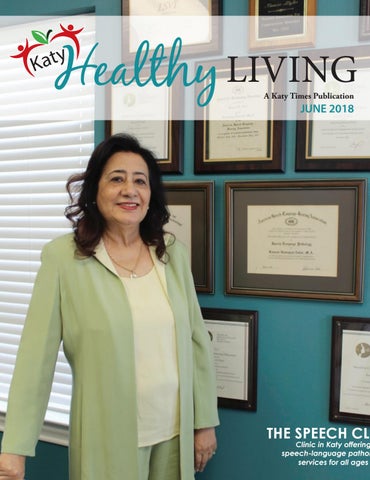
Healthy LIVING
y t a K
A Katy Times Publication
JUNE 2018
THE SPEECH CLI
Clinic in Katy offering speech-language pathol services for all ages
The Preferred Institution for Speech Pathology Services The clinic offers speech-language pathology services for all ages. Thorough evaluation and treatment are provided for a variety of conditions and disorders, including: ◆ Articulation Disorders ◆ Oral-Motor Disorders ◆ Developmental Language Delay ◆ Learning Disabilities ◆ Fluency Disorders including Stuttering and Cluttering ◆ Voice Disorders ◆ Aphasia and dysarthria resulting from stroke or other neurogenic conditions ◆ Parkinson’s Disease - Lee Silverman Voice Training (LSVT) ◆ Dysphagia or swallowing disorders ◆ Memory or cognitive decline secondary to head injury, stroke, dementias, and Alzhiemer’s ◆ Accent Reduction and communication enhancement
Our clinicians are licensed and are certified by the American Speech-Language-Hearing Association. They are highly trained and competent, and have many years of experience providing therapy to both children and adults.
Our Mission The Speech Clinic is to be the preferred institution for speech pathology services. Clients will choose us because of our result oriented and cost-effective services provided with caring and compassion to maximize the potential of our clients.
8:00 a.m. to 5:00 p.m. Monday through Friday Evening and weekend appointments are also available TheSpeechClinic@hotmail.com
2
The Speech Clinic was established in January 2000, by Kausar Zafar. It is conveniently located between Fry Road and Mason Road in West Houston. The clinic is comfortably furnished to acommodate both adult and pediatric clients. The atmosphere is calm, friendly and professional. The office staff is very courteous, efficient and knowledgeable.
The Speech Clinic 430 Park Grove Lane • Katy, TX 77450
218-579-1515 FAX: 281-579-1524
www.TheSpeechClinic.net
KATY HEALTHY LIVING
8
4
10
Table of Contents The Speech Clinic
4
Cleaning Out Your Medicine Cabinet
7
Strategies to Build a Strong Immune System
8
Brain-healthy Habits to Embrace
9
Having a Pet Means Having a Healthier Child
10
Katy Healthy Living a supplement of the Katy Times. 5319 E 5th St. • Katy, TX 77493 (281) 391-3141 // www.katytimes.com
Looking for a Doctor – You’re one call away!
NEW PATIENTS WELCOME
• We care for ages 18 and above
• We accept private and Medicare insurances* • Call for Same day appointments
Working for the citizens of District 28 in Austin.
• We treat all adult medical problems
(Diabetes, Hypertension, Arthritis, High Cholesterol etc)
• We offer several in house testing
Visit www.JohnZerwas.com to subscribe to Dr. Zerwas’ electronic Newsletter
(Ekg. Echo, Cardiac Nuclear/Stress Testing, Bone Density, Dopplers)
Dr. Laxman Kalvakuntla, M.D. Board certified in Internal Medicine
830 S. Mason Rd., Suite A4 • Katy, Texas 77450 Office 281-392-2222 • Fax 281-392-4861
Political Ad Paid for by Friends of John Zerwas P.O. Box 852, Fulshear, Texas 77441
JUNE 2018
3
4
KATY HEALTHY LIVING
The Speech Clinic
ZAFAR’S SPEECH CLINIC LOOKS TO LEAVE LASTING IMPRESSION ON PROFESSION
Since coming to America seeking the promise of a new life and career, Kausar H. Zafar set her feet on the ground and has never looked back. Zafar is a speech language pathologist and owner of The Speech Clinic, located at 430 Park Grove Lane in Katy. While the business thrives, it was a long and winding road that led Zafar to this place where she now calls home. “I was born in Pakistan and I had a masters in psychology when I came here,” Zafar said. “I had never seen a speech pathologist. When I went to look for a job, I was unable to work as a psychologist unless I had a degree from America. As an immigrant, I didn’t come from a very impoverished background but my husband bought a $500 car in an auction so we didn’t have a whole lot when we came here,” Zafar said. “America has given a lot to me. I went to school with two children so this is my way to give back to America.” Unable to find work, Zafar decided to pursue her PhD in psychology. At the urging of her neighbor at the time that was a personnel counselor, he recommended Zafar look into the speech pathology field. “I didn’t know what a speech pathologist did at that time,” Zafar said. Living and attending school in Wichita, Kan., Zafar was allowed to do the practical and theory in school. “It took them a month to realize what my strengths were and they didn’t realize I spoke English the way I do,” Zafar said. “It took them a while but by the time they became comfortable with me, they realized how hard it is for somebody who is not a native speaker on English to work in this field. But I stuck with it and was voted one of the best clinicians in the class.” Still Zafar faced another roadblock when her professors believed because of her accent she wouldn’t be able to find work in the field. When she graduated in 1986, the Zafars moved to
Houston and she went to Houston ISD to apply for a job at the district. She was instantly hired and started for the salary of $19,000 a year. “I took the job and I never looked back,” Zafar said. From there, Zafar worked for private schools and even had a stint with Katy ISD before branching out and working for adult nursing homes and rose up to become the director of rehab for Living Centers of America. But something was missing for Zafar. “When I was working for the schools I wasn’t happy because you could only treat this and that,” Zafar said. “I wanted to work in an environment where I would not be tied down by red tape and do what was good for the patient. It was very frustrating for me to be held back.” So in 1999, when Medicare changes started to flood the market, Zafar became even more frustrated and her husband urged her to open her own office “and I never looked back.” When Zafar opened The Speech Clinic, she saw it as an opportunity to help adults and children of all ages by providing speech therapy that was would tailored for their needs and their lifestyles. “We provide speech therapy for children and adults of all ages and want to help people communicate better and part of my mission is to educate the public about the profession,” Zafar said. People seem to think that speech therapy is only for children. I wanted a place where I could train the parents and train the family members and I wanted to do more things my way.” The business has flourished over the years and Zafar is now planning on adding occupational therapy. “This is a place where we can provide training to the family members,” Zafar said. “It was extremely important to me to have a place where we could help adults and children because most of the speech therapy clinics are just pediatric.”
JUNE 2018
5
Kausar H. Zafar is pictured with DeAnna Bartolini, office manager and Vanessa Ramirez, administrative assistant
Zafar also sought out a speech clinic where the treatment was the center of the practice. “When you go to a hospital, you have a big physical therapy center,” Zafar said. “You will have an occupational therapy gym but the speech therapist is working in a patient’s room with all the distractions of the room. I wanted to provide a place where you could close the door with no distractions and here I can set my own rules.” Zafar said she has one basic rule that is followed by all the clinicians that work for The Speech Clinic. “The basic rule is that people should get better,” Zafar said. “The bottom line is the patient. We are committed to results. When I hire people, making progress is a given, everything else we can talk about but if you want to work
6
here, then we want progress with the patients. We strive our best to make sure our clients make progress. It is a no-no if a patient doesn’t make progress.” She added that it is also important that family members learn what is being taught in the sessions as well. “We also want to encourage our family members to sit in on the sessions,” Zafar said. “We want to involve everyone so that the patient is getting treatment from all sides. We want that continuity of care with our patients. We are heavy on training and want to try and will not take no for an answer. We want to see our patients make excellent progress. This is my way to give back to this profession. I want to leave this profession a little bit better because I am in it.”
KATY HEALTHY LIVING
CLEAN OUT THE
Medicine Cabinet
Spring cleaning takes on an entirely new meaning when getting ride of expired or unsafe medicines. Even though people may be quick to toss out expired foods or even clean closets of ill-fitting clothing, few individuals exercise such diligence with their medicine cabinets. The U.S. Food and Drug Administration says the medicine expiration date is critical when determining if a product is safe to use and will work as intended. Medications past their expiration date may not be as strong as intended, and even their chemical composition may change, making them risky to keep around. Furthermore, keeping too many medications in a home - particularly pain prescriptions can lead to misuse and abuse, as the U.S. Drug Enforcement Administration says that rates of prescription drug abuse in the United States have risen considerably in recent years. Some old medications, such as children’s cough and cold products, may no longer be recommended for certain ages. Having such medications in the house could prove harmful. Taking inventory and cleaning out medicine cabinets frees up space and creates a safe home environment.
• Toss away any expired products, whether they are prescription or over-the-counter medicines. The best way to do so is to bring the medication to a pharmacy for disposal rather than throwing it in the garbage or flushing medicines down the toilet. • Discard any unmarked containers or pill foils that are not in their original packaging. • Test any medical devices, such as a nebulizer, blood pressure monitor and glucose testing equipment to ensure they are in working order. • Replenish commonly used items, such as fever reducers or headache medicines. Make sure there is a supply of bandages and first aid equipment on hand at all times. • Relocate medical supplies to an area that isn’t high in humidity, as steam from showers can speed up the expiration of medication. Storing medicines in the refrigerator won’t help, as that is a high-humidity area, too.
JUNE 2018
Checking medications and removing expired products from the house can prevent accidents related to medications and ensure that all medicines in the house are as effective as possible.
7
STRATEGIES THAT CAN HELP BUILD
Strong Immune Systems
A strong immune system can go a long way toward ensuring one’s overall health. But bolstering one’s immune system is no small task, as even medical researchers admit there is still much to learn about the links between lifestyle and immune function. The Harvard Medical School notes that a strongly functioning immune system requires balance and harmony. So it stands to reason that a highly unhealthy lifestyle will compromise the immune system, but it’s also worth noting that pushing the body too hard in the other direction also can adversely affect immune function. Researchers continue to study the potential links between immune response and variables such as diet, exercise, age, and psychological stress. Though studies are ongoing, the Harvard Medical School notes that the immune system is bolstered by various strategies associated with healthy living. •DON’T SMOKE. Smoking is linked to a host of diseases and ailments, so it’s no surprise that it also compromises the immune system. The National Cancer Institute notes that cigarette smoke contains high levels of tar and other chemicals, which compromise the immune system’s ability to effectively combat infections. The effects of smoking on the immune system are both immediate and long-term. Smokers’ immune systems may not be able to fend off common infections like the common cold as effectively as the immune systems of nonsmokers. And over time, as smokers keep smoking, their immune systems will continue to weaken, which the NCI says makes them more vulnerable to autoimmune diseases such as rheumatoid arthritis and multiple sclerosis. •EAT A HEALTHY DIET. There is no magical food or foods that can strengthen the immune system to a point where infection is impossible. However, the Cleveland Clinic notes that a balanced, healthy diet that includes a mix of vitamins and minerals plays a role in strengthening the immune system. Fresh fruits and vegetables contain a bevy of vitamins and antioxidants that help the immune system fight off potential infections. Many people bemoan the
8
absence of fresh fruits and vegetables at their local grocery stores during certain times of the year. But the Cleveland Clinic notes that manufacturers typically free frozen fruits and vegetables at peak ripeness. That means frozen fruits and vegetables provide similar nutrition to fresh fruits and vegetables during those times of year when foods are not in-season. •EXERCISE REGULARLY. Like a healthy diet, routine exercise provides a host of benefits, and one such benefit is its impact on the immune systems. The U.S. National Library of Medicine notes that the precise relationship between exercise and immune system function remains a mystery. Some researchers suspect that physical activity may flush bacteria out of the lungs and airways, reducing one’s risk of getting a cold, flu or other illness. Another theory suggests that exercises causes changes in white blood cells, which the immune system uses to fight disease. These exercise-related changes may make it possible for the cells to detect illnesses earlier than they would if the body was not exercised regularly. While it’s important to note that these are just theories, the Harvard Medical School suggests that it’s reasonable to consider moderate regular exercise an important component of a healthy, immune-boosting lifestyle. •DON’T BUY THE HYPE. Men and women interested in boosting their immune systems will no doubt find many products claiming to do just that. The Harvard Medical School urges consumers to be skeptical of such products, many of which make dubious claims that are not rooted in recognized scientific research. The immune system remains a mystery in many ways. But several healthy strategies may help people bolster their immune systems and potentially reduce their risk of infection.
KATY HEALTHY LIVING
Brain-healthy habits to embrace Cognitive decline is a condition that is often associated with aging, but even middle-aged people can experience memory loss or cognition issues. The Alzheimer’s Association says that more than five million Americans are living with Alzheimer’s disease and other dementias. By 2050, that number could rise to as high as 16 million people. More than 747,000 Canadians are living with Alzheimer’s or another dementia, says the Canadian Alzheimer’s Association. Although there is no definitive way to prevent dementia, living a long, vibrant life may be possible by encouraging some healthy habits for the brain. It is never too late or too early to begin health and lifestyle changes. EXERCISE Becoming more active can improve brain volume, reduce risk for dementia and improve thinking and memory skills. The journal Neurology found that older people who vigorously exercise performed better on cognitive tests than others of the same age, placing them at the equivalent of 10 years younger. Increased blood flow that occurs with physical activity may help generate new neurons in the hippocampus, an area of the brain involved with learning and memory. The Harvard Medical School says aerobic exercise may help improve brain tissue by improving blood flow and reducing the chances of injury to the brain from cholesterol buildup in blood vessels. QUIT SMOKING The Alzheimer’s Association indicates that evidence shows smoking increases the risk of cognitive decline. Smoking can impair blood flow to the brain and cause small strokes that may damage blood vessels. EAT HEALTHY FOODS Foods that are good for the heart and blood vessels also are good for the brain. These include fresh fruits and vegetables, whole grains, fish-based proteins, unsaturated fats, and foods containing omega-3 fatty acids. Neurologists state that, while research on diet and cognitive function is limited, diets, such as Mediterranean and MediterraneanDASH (Dietary Approaches to Stop Hypertension), may contribute to a lower risk of cognitive issues. CONSUME CAFFEINE Caffeine may help boost memory performance and brain health. A Journal of Nutrition study found people ages 70 and older who consumed more caffeine scored better on tests of mental function than those who consumed less caffeine. Caffeine may help improve attention span,
cognitive function and feelings of well-being. Information from Psychology Today also indicates caffeine may help in the storage of dopamine, which can reduce feelings of depression and anxiety. In addition, compounds in cocoa and coffee beans may improve vascular health and help repair cellular damage due to high antioxidant levels. WORK THE BRAIN Engaging in mentally stimulating activities can create new brain connections and more backup circuits, states Dr. Joel Salinas, a neurologist at Harvard-affiliated Massachusetts General Hospital. Working the brain through puzzles, reading and participating in social situations can stimulate the release of brain-derived neurotrophic factor (BDNF), a molecule essential for repairing brain cells and creating connections between them. A good way to combine these lifestyle factors is to take an exercise class with friends, mixing the social, stimulation and exercise recommendations together. Cognitive decline can come with aging, but through healthy habits, people can reduce their risk of memory loss and dementia.
JUNE 2018
WE ARE NOW ACCEPTING NEW PATIENTS AT OUR NEW LOCATIONS! DANI S. BIDROS, MD, FACS, FAANS American Board of Neurological Surgery MAIN OFFICE: 2222 Greenhouse Rd, Ste 1100A Houston, TX 77084
SATELLITE LOCATION: 915 Gessner Rd, Ste 300 Houston, TX 77024
PHONE: 281.529.6626 FAX: 832.288.5967
WestHoustonBrainandSpine.com 9
WANT HEALTHIER KIDS? If youngsters have been eyeing fuzzy kittens or boisterous puppies at nearby shelters or pet stores, parents may want to give in to those cries for a family pet. Pets are added responsibilities, but the health benefits associated with pet ownership may be well worth the investment of time and effort. Caring for a pet is sometimes viewed as a childhood rite of passage, but there’s much more to the experience than just learning responsibility. Experts say a child’s emotional, cognitive, physical, and social development can be enhanced through interaction with a family pet. Studies continue, but the effects of family pets on children was heavily researched by developmental psychologist Gail F. Melson in 2003. Melson looked at literature on childanimal relationships and found that children who had pets were better able to understand biology and children who could turn to pets for unconditional emotional support were less anxious and withdrawn than their peers without family pets to turn to. Data from a small study conducted by researchers at the Cummings School of Veterinary Medicine at Tufts University reported that adolescents who had animal experience were more likely to see themselves as important contributors to communities and more likely to take on leadership roles. Pets also can help children develop into well-rounded individuals. Playing with a pet requires children to engage in physical activity and can help stimulate motor skills.
10
Get a Pet
An English study conducted in 2010 and published in the American Journal of Public Health found that children from dog-owning families spent more time in light or moderate to vigorous physical activity and recorded higher levels of activity counts per minute than kids whose families did not own a dog. Pets may help with allergies and respiratory ailments as well. A 2012 study by the American Academy of Pediatrics discovered that children who have early contact with cats and dogs have fewer respiratory infections and ear infections and need shorter courses of antibiotics than children who have not had contact with pets. A study from Dennis Ownby, MD, a pediatrician and head of the allergy and immunology department of the Medical College of Georgia, found that having multiple pets decreases a child’s risk of developing certain allergies. He found that the children who were exposed to two or more dogs or cats as babies were less than half as likely to develop common allergies as kids who had no pets in the home. Pets also may foster social interactions, which can benefit children who are shy. Inviting others over to meet pets can help children make friends and find others with similar interests. Children may also confide in pets and develop their self-esteem. Studies have indicated that the type of pet a family has, whether it’s horses, dogs, snakes, etc., does not matter, as all companion animals have the potential to benefit children.
KATY HEALTHY LIVING
If youngsters have been eyeing fuzzy kittens or boisterous puppies at nearby shelters or pet stores, parents may want to give in to those cries for a family pet. Pets are added responsibilities, but the health benefits associated with pet ownership may be well worth the investment of time and effort. Caring for a pet is sometimes viewed as a childhood rite of passage, but there’s much more to the experience than just learning responsibility. Experts say a child’s emotional, cognitive, physical, and social development can be enhanced through interaction with a family pet. Studies continue, but the effects of family pets on children was heavily researched by developmental psychologist Gail F. Melson in 2003. Melson looked at literature on childanimal relationships and found that children who had pets were better able to understand biology and children who could turn to pets for unconditional emotional support were less anxious and withdrawn than their peers without family pets to turn to. Data from a small study conducted by researchers at the Cummings School of Veterinary Medicine at Tufts University reported that adolescents who had animal experience were more likely to see themselves as important contributors to communities and more likely to take on leadership roles. Pets also can help children develop into well-rounded individuals. Playing with a pet requires children to engage in physical activity and can help stimulate motor skills. An English study conducted in 2010 and published in the American Journal of Public Health found that children from dog-owning families spent more time in light or moderate to vigorous physical activity and recorded higher levels of activity counts per minute than kids whose families did not own a dog. Pets may help with allergies and respiratory ailments as well. A 2012 study by the American Academy of Pediatrics discovered that children who have early contact with cats and dogs have fewer respiratory infections and ear infections and need shorter courses of antibiotics than children who have not had contact with pets. A study from Dennis Ownby, MD, a pediatrician and head of the allergy and immunology department of the Medical College of Georgia, found that having multiple pets decreases a child’s risk of developing certain allergies. He
found that the children who were exposed to two or more dogs or cats as babies were less than half as likely to develop common allergies as kids who had no pets in the home. Pets also may foster social interactions, which can benefit children who are shy. Inviting others over to meet pets can help children make friends and find others with similar interests. Children may also confide in pets and develop their self-esteem. Studies have indicated that the type of pet a family has, whether it’s horses, dogs, snakes, etc., does not matter, as all companion animals have the potential to benefit children.
JUNE 2018
Heath Bryan Coleman of Texas, DDS, PLLC and Associates – General Dentistry Blake Lindsey, DDS & Chris Kimmel, DDS
Turn Your Discomfort Into a Brand New Smile
Full Dentures * in Just One Day! *in most cases
Katy | 23225 Kingsland Blvd #300, Katy, TX
CALL TODAY! (281) 990-3370 11
12
KATY HEALTHY LIVING