INSIDE
FEBRUARY/MARCH 2018 Vol. 11, No. 1 VEINTHERAPYNEWS.COM
ACP’s ‘Case of the Month’ 8 American Vein promotes 5, hires 2 10 Microsoft ends HealthVault research 13 Human error is biggest IT threat 18 Fat-shaming drives away patients 21
An ACP recognized resource for news and information for and about the phlebology community
16th IVC to host 800+ vein care specialists in April Attendees will learn from vascular experts about latest advances in venous disease management By Larry Storer The International Vein Congress (IVC) will host its 16th annual meeting April 19-21 in Miami Beach, Fla., at the Loews Miami Beach Hotel in collaboration with the Society for Vascular Surgery (SVS). Jose I. Almeida, MD, FACS, RPVI, RVT, who founded the conference and has directed it through since its inception, will return alongside course co-directors, Edward G. Mackay, MD, FACS, RPVI,RVT, and Lowell S. Kabnick, MD, RPhS, FACS, FACPh. “The vein care field is evolving – mostly for the better – but we have some issues that need cleaning up,” Dr. Almeida said. “Each year, it is our goal to bring the most relevant topics to attendees so they walk away with the tools to take better care of their patients and improve their practice immediately.” IVC 2018 will offer a three-day powerhouse program brimming with clinical updates, controversy, innovation and consensus. The conference agenda focuses on a variety of deep and superficial venous disease management topics, while also covering the practical, business, and governance aspects of healthcare from insurance coverage to practice management. IVC 2018 provides physicians the opportunity to earn up to 21 AMA PRA Category 1 Credits. The conference will also provide continuing education credits for nurses, physician assistants and ultrasound techs. IVC 2018 also qualifies for Part 2 of the American Board of Surgery MOC program. The course content will be of immense value to vascular surgeons, general surgeons, interventional cardiologists, interventional radiologists, cardiologists, cardiothoracic surgeons, phlebologists and other physicians, nurses, and technologists. Both veterans and beginners alike will come away from the meeting with tips to apply to their practices right away. For the first year in IVC history, the Journal of Vascular Surgery: Venous and Lymphatic Disorders (JVSVL) will be
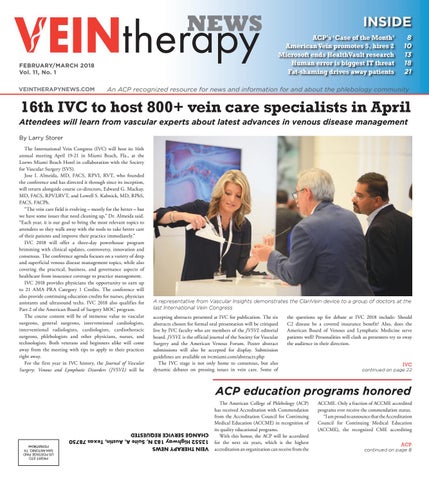
A representative from Vascular Insights demonstrates the ClariVein device to a group of doctors at the last International Vein Congress accepting abstracts presented at IVC for publication. The six abstracts chosen for formal oral presentation will be critiqued live by IVC faculty who are members of the JVSVL editorial board. JVSVL is the official journal of the Society for Vascular Surgery and the American Venous Forum. Poster abstract submissions will also be accepted for display. Submission guidelines are available on ivcmiami.com/abstracts.php The IVC stage is not only home to consensus, but also dynamic debates on pressing issues in vein care. Some of
the questions up for debate at IVC 2018 include: Should C2 disease be a covered insurance benefit? Also, does the American Board of Venous and Lymphatic Medicine serve patients well? Personalities will clash as presenters try to sway the audience in their direction.
IVC
continued on page 22
ACP education programs honored The American College of Phlebology (ACP) has received Accreditation with Commendation from the Accreditation Council for Continuing Medical Education (ACCME) in recognition of its quality educational programs. With this honor, the ACP will be accredited for the next six years, which is the highest accreditation an organization can receive from the
ACCME. Only a fraction of ACCME accredited programs ever receive the commendation status. “I am proud to announce that the Accreditation Council for Continuing Medical Education (ACCME), the recognized CME accrediting ACP
continued on page 8
VEIN THERAPY NEWS 13552 Highway 183 N, Suite A, Austin, Texas 78750 CHANGE SERVICE REQUESTED
PRSRT STD US POSTAGE PAID SAN ANTONIO, TX PERMIT#244
Your trusted compounding provider
Serving physicians and patients for over four years.
855-332-2855
http://totalveinpharmacy.com
totalveinpharmacy.com
http://totalvein.com
USP 795 and 797 Compliant. Independently Tested for Sterility, Potency and Quality.
* Commonly Requested Medications
NEWS Disclaimer and Liability Statement The information contained in this publication, including text, graphics and images, is for informational purposes only, and is not intended to be a substitute for professional medical advice. Publications & Communications LP (PCI), Publications and Communications LP, and Vein Therapy News, via its Editors, Publisher, Editorial Board members, or staff, accept no responsibility for any injury or damage to persons or property occasioned through the implementation of any ideas or use of any product described herein. In consideration that great care is taken by the Publisher, Editors, staff, and Editorial Board to ensure all information is accurate, we recommend each reader seek independent verification of all product or drug usage, surgical techniques and clinical processes prior to their use or implementation. The opinions expressed in this publication and all related marketing or sales material of this publication are those of the authors and are not attributable to the publication, Publisher, Editor, staff, Editorial Board, advertisers, or sponsors. References made in articles may indicate uses of medical equipment or medical procedures, or of drugs at dosages, for periods of time, and in combinations not included in the current prescribing information. Inclusion of advertising material in this publication, or in reproduction of articles and pages, or in supplemental materials, does not constitute any representation or guarantee by Publications & Communications LP (PCI), Publications and Communications LP, and Vein Therapy News, via its Editors, Publisher, Editorial Board members, or staff, of the quality of such products, or of the claims made by the manufacturers. Trademarks are used in an editorial fashion with no intent to infringe. Reproduction in whole or in part of this publication is strictly prohibited.
Reader Services SUBSCRIPTIONS To subscribe or to purchase back issues of the magazine, please call 800-678-9724 ext. 344 or e-mail Beth Chorba at bethc@pcinews.com. For more information, please visit veintherapynews.com and click on the Subscribe link. ADVERTISING INFORMATION If you are interested in advertising in Vein Therapy News magazine, online or in our Marketplace, please contact our account executive: Gary Pittman, Jr., 512-637-0373, garypjr@pcinews.com. EDITORIAL SUBMISSIONS Doctors, nurses, clinics, managers, vendors, patients, professors and others are encouraged to submit abstracts, white papers, writings, and ideas for editorial consideration. If you have a paper or story idea to submit, please e-mail larrys@pcinews.com UPCOMING EVENTS AND PRESS RELEASES Vein Therapy News would like to hear about your organization’s upcoming event, product launch, or announcement. Please e-mail press releases or event listings at least two months in advance to larrys@pcinews.com.
Volume 11, Number 1
Editor Larry Storer lstorer@hot.rr.com 254-399-6484
Art Director Lisa Gouveia lisag@pcinews.com
Executive Vice President of Sales and Operations Gary Pittman, Jr. 512-637-0373 garypjr@pcinews.com
Accounting Beth Chorba bethc@pcinews.com
Web and Network Manager Joel Nosal joeln@pcinews.com
President Gary L. Pittman garyp@pcinews.com
Publications & Communications, LP 13552 Highway 183 N, Suite A Austin, TX 78750 512-250-9023 • 512-331-3950 fax Vein Therapy News is published bimonthly by Publications & Communications, LP, Gary L. Pittman, President, 13552 Highway 183 N., Suite A, Austin, TX 78750 512-250-9023. Subscriptions are available for $45 per year. Payment must accompany orders. Copyright 2017 by Publications & Communications, LP. All rights reserved. Reproduction in any form without written consent from the publisher is strictly prohibited. Postmaster: Send changes to Vein Therapy News Circulation Department, 13552 Highway 183 N., Suite A, Austin, TX 78750. ADVERTISING 512-637-0373 CIRCULATION 512-637-0344 EDITORIAL 254-399-6484
VEIN THERAPY NEWS < FEBRUARY/MARCH 2018
NEWS 1 IVC details 16th meeting
More than 800 vein specialists from around the world are expected to descend upon Miami Beach, Fla., April 19-21 for the 16th International Vein Congress (IVC) in collaboration with the Society for Vascular Surgery (SVS). The center for the action will be the Loews Miami Beach Hotel.
1 ACCME lauds ACP education
The Accreditation Council for Continuing Medical Education has granted the American College of Phlebology the highest accreditation an organization can receive in recognition of its quality educational programs. With this honor, the ACP will be accredited for the next six years.
12 9th VS expects more than 400
The 9th Annual Venous Symposium, April 5-7 at the Sheraton New York Times Square, is preparing for more than 400 physicians, scientists, researchers, allied health professionals and industry professionals representing more than 40 states and 30 countries.
THE PRACTICE 16 Flying over a ‘Sea of Sameness’
Vein treatment offerings are beginning to sound more and more alike. What may seem like a differentiator to the provider has become an assumed requirement of the patient. So, how do we escape the trap of becoming a commodity?
SECOND LOOK 20 Help with the heavy lifting
With two-thirds of patients overweight or obese, getting a good ultrasound window with transverse and longitudinal views of the saphenous femoral junction and proximal great saphenous vein while fighting the downward drift of a huge abdominal pannus or FUPA is becoming a problem. The abdominal binder provides help you need for the heavy lifting while not embarrassing the patient.
24 Joe Biden’s right to ask
For the second year in a row, former Vice President Joe Biden came to the StartUp Health Festival during J.P. Morgan Week in San Francisco and made an impassioned plea for change. He said he had a list of questions he’d like to ask, but just can’t.
PRODUCT NEWS 29 SuperHarmonic imaging
The Terason uSmart3300 NexGen Ultrasound System will be one of the hundreds of products on exhibit at the International Vein Congress. Terason spokesmen say the 3300 NexGen’s new SuperHarmonic imaging provides enriched detail, clarity, contrast and border definition.
DEPARTMENTS
The Practice 16 Product News 25 3
In collaboration with:
Redefining Vein Care April 19-21, 2018 Miami Beach, FL
http://www.veinglobal.com http://www.veinglobal.com
The 16th annual meeting will explore: ♦ clinical updates ♦ controversy ♦ innovation ♦ consensus
Course Directors
Jose I. Almeida, MD, FACS, RPVI, RVT Lowell S. Kabnick, MD, RPhS, FACS, FACPh Edward G. Mackay, MD, FACS, RPVI, RVT
For more information as it becomes available, visit IVCmiami.com
Watchmailto:info@veinglobal.com the entire 2017 meeting and more on VeinGlobal.com MANAGED AND PRODUCED BY:
4
POWERED BY:
ACCME & ANCC ACCREDITED BY: FEBRUARY/MARCH 2018 < VEIN THERAPY NEWS
Not actual patients.
The essential NTNT choice.
Offer a comprehensive GSV system solution for above and below the knee. Varithena® (polidocanol injectable foam) 1% reaches veins that others can’t—treating a wide range of sizes and any vein shape including tortuous truncal veins above and below the knee. Varithena’s UDSS formulation—uniform density, size and stability—results in a long dwell time and thorough cohesion with the vein wall. Most importantly it addresses underlying venous incompetence, improves vein appearance and shows significant PRO improvements with an established safety profile. Now, with two dedicated CPT codes, treating patients with Varithena® is easier than ever.
Now with dedicated CPT codes 36465 and 36466.
Now with CPT Codes
www.varithena.com
For more information on treatment, visit Varithena.com INDICATIONS Varithena® (polidocanol injectable foam) is indicated for the treatment of incompetent great saphenous veins, accessory saphenous veins and visible varicosities of the great saphenous vein (GSV) system above and below the knee. Varithena® improves the symptoms of superficial venous incompetence and the appearance of visible varicosities. IMPORTANT SAFETY INFORMATION The use of Varithena is contraindicated in patients with known allergy to polidocanol and those with acute thromboembolic disease. Severe allergic reactions have been reported following administration of liquid polidocanol, including anaphylactic reactions, some of them fatal. Observe patients for at least 10 minutes following injection and be prepared to treat anaphylaxis appropriately. Intra-arterial injection or extravasation of polidocanol can cause severe necrosis, ischemia, or gangrene. Patients with underlying arterial disease may be at increased risk for tissue ischemia. If intraarterial injection of polidocanol occurs, consult a vascular surgeon immediately. Varithena® can cause venous thrombosis. Follow administration instructions closely and monitor for signs of venous thrombosis after treatment. Patients with reduced mobility, history of deep vein thrombosis or pulmonary embolism, or recent (within 3 months) major surgery, prolonged hospitalization, or pregnancy are at increased risk for developing thrombosis. The most common adverse events observed were pain/discomfort in extremity, retained coagulum, injection site hematoma or pain, common femoral vein thrombus extension, superficial thrombophlebitis, and deep vein thrombosis. Physicians administering Varithena® must be experienced with venous procedures, possess a detailed working knowledge of the use of the duplex ultrasound in venous disease, and be trained in the administration of Varithena® © 2017 Biocompatibles, Inc., a BTG International group company All rights reserved NA-VAR-2016-0786(2) 01/18 Varithena is a registered trademark and Varithena Solutions Center is a trademark of Provensis Ltd, a BTG International group company BTG and the BTG roundel logo are registered trademarks of BTG International Ltd btg-im.com
INDICATIONS AND USAGE Varithena® (polidocanol injectable foam) is indicated for the treatment of incompetent great saphenous veins, accessory saphenous veins and visible varicosities of the great saphenous vein (GSV) system above and below the knee. Varithena® improves the symptoms of superficial venous incompetence and the appearance of visible varicosities.
In Varithena®-treated patients, 80% of pain events in the treated extremity resolved within 1 week.
DOSAGE AND ADMINISTRATION Varithena® is intended for intravenous injection using ultrasound guidance, administered via a single cannula into the lumen of the target incompetent trunk veins or by direct injection into varicosities.
Proximal symptomatic venous thrombi occurred in <1% of patients treated with Varithena®. Approximately half (49%) of patients with thrombi received treatment with anticoagulants.
Physicians administering Varithena® must be experienced with venous procedures, possess a detailed working knowledge of the use of the duplex ultrasound in venous disease, and be trained in the administration of Varithena®. CONTRAINDICATIONS The use of Varithena® is contraindicated in patients with: • known allergy to polidocanol [see Warnings and Precautions] • acute thromboembolic disease WARNINGS AND PRECAUTIONS Anaphylaxis Severe allergic reactions have been reported following administration of liquid polidocanol, including anaphylactic reactions, some of them fatal. Observe patients for at least 10 minutes following injection and be prepared to treat anaphylaxis appropriately. Tissue Ischemia and Necrosis Intra-arterial injection or extravasation of polidocanol can cause severe necrosis, ischemia or gangrene. Patients with underlying arterial disease, such as marked peripheral arteriosclerosis or thromboangiitis obliterans (Buerger’s Disease) may be at increased risk for tissue ischemia. If intra-arterial injection of polidocanol occurs, consult a vascular surgeon immediately. Venous Thrombosis Varithena® can cause venous thrombosis [see Adverse Reactions]. Follow administration instructions closely and monitor for signs of venous thrombosis after treatment. Patients with reduced mobility, history of deep vein thrombosis or pulmonary embolism, or recent (within 3 months) major surgery, prolonged hospitalization, or pregnancy are at increased risk for developing thrombosis. ADVERSE REACTIONS Clinical Trials Experience Because clinical trials are conducted under controlled but widely varying conditions, adverse reaction rates observed in clinical trials of Varithena® cannot be directly compared to rates in the clinical trials of other drugs or procedures and may not reflect the rates observed in practice. A total of 1333 patients in 12 clinical trials were evaluated for safety when treated with Varithena® at dose concentrations of 0.125%, 0.5%, 1.0% or 2.0%, including 437 patients treated with Varithena® in placebo-controlled clinical trials. Adverse reactions occurring in 3% more patients receiving Varithena® 1% than receiving placebo are shown in Table 1.
In the 1333 patients treated with Varithena®, the following venous thrombus adverse events occurred: common femoral vein thrombus extension (2.9%), proximal deep vein thrombosis (DVT) (1.7%), distal DVT (1.1%), isolated gastrocnemius and soleal vein thrombosis (1.4%).
Since Varithena® induces thrombosis in the treated superficial veins, D-dimer is commonly elevated post-treatment and is not useful diagnostically to assess patients for venous thrombus following treatment with Varithena®. Neurologic adverse events (cerebrovascular accident, migraines) have been reported in patients following administration of physician compounded foam sclerosants. None of the 1333 patients in the Varithena® trials experienced clinically important neurological or visual adverse events suggestive of cerebral gas embolism. The incidence of neurologic and visual adverse events within 1 day of treatment in the placebo-controlled studies was 2.7% in the pooled Varithena® group and 4.0% in the placebo groups. Skin discoloration adverse events were reported in 1.1% of the pooled Varithena® group and 0.7% of the placebo group in the placebo-controlled studies. DRUG INTERACTIONS No specific drug interaction studies have been performed. There are no known drug interactions with Varithena®. USE IN SPECIFIC POPULATIONS Pregnancy Pregnancy Category C. There are no adequate and well-controlled studies of Varithena® in pregnant women. Do not use Varithena® during pregnancy. Labor and Delivery The effects of Varithena® on labor and delivery in pregnant women are unknown. Nursing Mothers It is not known whether polidocanol, the active pharmaceutical ingredient in Varithena®, is excreted in human milk. Because many drugs are excreted in human milk and because of the potential for serious adverse reactions in nursing infants, avoid administering Varithena® to a nursing woman. Pediatric Use Safety and effectiveness in pediatric patients have not been established. Geriatric Use Of the 1333 subjects in clinical studies treated with Varithena®, 9.1% (n=121) were ≥65 years of age. No clinically important differences in safety or efficacy were observed between older and younger patients in all studies. OVERDOSAGE There are no known cases of overdosage with Varithena®. In clinical studies, total volumes of up to 60 mL of Varithena® per treatment session have been administered.
Table 1: Treatment-emergent adverse reactions (3% more on Varithena® 1% than on placebo) through Week 8 (n=588)
Manufactured for Provensis Ltd by: Biocompatibles UK Ltd Chapman House, Weydon Lane, Farnham, UK, GU9 8QL. Distributed by: Biocompatibles, Inc. Five Tower Bridge, Suite 810 300 Barr Harbor Drive West Conshohocken, Pennsylvania 19428 USA a Includes Varithena® 0.125%, 0.5%, 1.0%, and 2.0% from the placebo-controlled trials. b Retained coagulum. c Common femoral vein thrombus extension (non-occlusive thrombi starting in the superficial vein and extending into the common femoral vein).
Provensis Ltd, Biocompatibles UK Ltd, and Biocompatibles, Inc. are BTG International group companies Varithena is a registered trademark of Provensis Ltd. BTG and the BTG roundel logo are registered trademarks of BTG International Ltd
NEW MICROFIBER SHADES
MINI-STRIPES CLASSIC LOOK WITH A MODERN TOUCH F E AT U R E S • 100% microfiber next to skin for softness and excellent moisture management • Double-covered inlay yarns for easy donning and doffing BEST SUITED FOR • Management of venous insufficiency • Long-distance travel
COMPRESSION LEVELS
• Tired, heavy, restless, aching legs
• 15–20mmHg Women’s 143, Men’s 183 (three easy-to-shop sizes) • 20–30mmHg Women’s & Men’s 830 (six measured sizes) F I B E R S ( Latex-Free) • 87% Nylon • 13% Spandex
www.sigvarisusa.com
For sizing and colors, please visit sigvarisusa.com
TO ORDER:
1.800.322.7744 (US)
www.sigvaris-online.com
sigvaris-online.com
SIGVARIS is a registered trademark of SIGVARIS AG, CH-9014 St.Gallen/Switzerland, in many countries worldwide. © Copyright 2018 SIGVARIS, Inc. All rights reserved.
NEWS
Lidocaine resistance studied in ACP ‘Case of the Month’ By Amanda Godwin A radiofrequency ablation patient recently reported that her procedure was painful and that she experienced no relief from the 0.1% lidocaine tumescent anesthesia she received prior to the procedure. The patient was a 52-year-old, red-haired female hairstylist with complaints of leg cramps, leg aches and restless leg symptoms. Further questioning revealed that she had not responded to lidocaine at her d e n t i s t ’s o f f i c e either. Why did she not respond to the lidocaine? Case studies like the one mentioned above are a regular part of the online educational content provided exclusively by the American College of Phlebology (ACP) to serve as a free educational resource for its members. These case studies, or “Case of the Month,” are submitted by medical practitioners to provide education scenarios reflective of the types of issues that venous and lymphatic medical professionals may encounter. The cases often highlight a particular venous or lymphatic disease state, treatment options, possible complications, and even non-clinical scenarios such as the medico-legal aspects of
CASE STUDY
ACP
continued from page 1
authority in North America, has accredited the American College of Phlebology’s education program for six years, with commendation,” ACP President Neil Khilnani, MD, said. “The ACP is the only ACCME accredited CME provider that is focused only on venous disease, and attaining commendation status is a tremendous honor.” According to the ACCME, the purpose of accreditation with commendation is to highlight
The ACP is the only ACCME accredited CME provider that is focused only on venous disease, and attaining commendation status is a tremendous honor. –Neil Khilnani, MD 8
compounding. Participating in and submitting a case is not limited to practicing physicians. Ultrasound technologists, nurses, mid-level providers, fellows, residents and students are encouraged to take part. The overall goal of the Case of the Month is to be an avenue for learning, a source of continuing medical education and selfassessment, and a forum to share interesting and educational cases with colleagues. In the case of the lidocaine-resistant patient,
the physician learned that a mutation in the melanocortin 1 receptor protein (MC1R) may have a secondary effect on lidocaine resistance. This mutation often is found in individuals with red hair. For the patient’s second treatment, the physician used Marcaine (bupivacaine) tumescent anesthesia. The patient reported no pain or discomfort with the second procedure. To read the full case and complete the course for credit, ACP members may go to the Online Education Center at http://education.
phlebology.org. While the Case of the Month is available only to ACP members, a variety of other certified courses are available through the ACP Online Education Center to everyone. If you have an interesting case that you would like to submit as a Case of the Month, you can download the Case Guidelines and Submission Form at http://phlebology.org/case-submission. thoraco-lumbar . VTN
CME providers who are implementing the best practices across their association in teaching, engaging and evaluating. The distinction also serves to recognize the achievements of organizations that are advancing their respective field and its effect on healthcare professionals and patients. The ACP identified becoming an accredited provider of continuing medical education for physicians as a high priority after conducting surveys with its membership several years ago. In response, the leadership of the ACP created a goal to not only become an accredited CME provider, but also to attain commendation status. “The culmination of this effort to achieve our membership and leadership goals is finally upon us,” Dr. Khilnani said. “I would like to thank our staff, especially Stephen Moss, director of CME, as well as the volunteers in the CME-related committees for their tireless efforts to elevate the standards of the ACP’s CME program to commendation status across our educational offerings.” In order to continue to best serve its membership, the ACP already has plans to grow its educational offerings in 2018 through both courses and online educational content. The ACP’s Annual Congress will be adding a new track for lymphedema therapists in 2018, in addition to continuing to provide content
on the latest advances in the field of venous and lymphatic medicine, according to ACP Executive Director Dean Bender. The 2018 Annual Congress will be Nov. 8-11 in Nashville at the Gaylord Opryland Resort and Convention Center. “This is incredible news as it clearly represents the commitment of the American College of Phlebology as a leading source of continuing education for our membership and the field in general in the treatment and management of venous and lymphatic disease,” Bender said. “The timing of this achievement is instrumental as the College plans to expand our continuing medical education program in 2018 and beyond.” Comprised of nearly 2,000 members, the ACP is the largest association for physicians and allied health professionals concerned with the diagnosis and treatment of venous and lymphatic disorders, such as varicose and spider veins, venous ulcers and DVT. The ACP is a forum to exchange medical knowledge, best practices and the latest treatment options, as well as offering continuing live and online education and training aimed at improving the quality of patient care. For nearly 30 years, the ACP has been an advocate for the advancement of vein care through education, resources and research. VTN READ MORE: phlebology.org
ElastiMed raises $2M in funding Israeli medical startup ElastiMed has raised $2 million from a strategic investor, existing investors – The Trendlines Group and Pix Vine Capital – new private investors, and the Israeli Innovation Authority. ElastiMed, which was founded in 2015, has developed a wearable medical device improving circulation in the legs for the treatment of venous and lymphatic diseases. Omer Zelka, founder and chief executive officer of ElastiMed, said that based on new proprietary technology and utilizing innovative “smart” materials, ElastiMed’s device compresses and massages the legs when stimulated by an electric pulse. ElastiMed’s product rhythmically expands and contracts, mimicking calf muscle contraction for improved circulation, combating venous insufficiency, lymphedema, deep vein thrombosis and various sports injuries. “The smart sock provides patients with a comfortable, easy-to-wear, highly effective, and affordable treatment option to prevent symptoms such as swelling, blood clots, leg ulcers, and sports injuries,” he said. VTN READ MORE: elastimed.com
FEBRUARY/MARCH 2018 < VEIN THERAPY NEWS
One handshake. Ten risk-free units. 1
Everything changes with Customer First. Because we want to do business the way that you want to do business.
Call Customer Service at (203) 446-5711 to connect with your local representative for program details. 1. If you are not satisfied with the first 10 ClariVein速 devices during this three-month period, we will refund your purchase price.
sigvarisusa.com
1 Pine Hill Drive, Two Batterymarch Park Suite 100, Quincy, MA 02169 | (203) 446-5711 | www.clarivein.com ClariVein速 and Vascular Insights速 are registered trademarks of Vascular Insights速 in the United States. M-131
sigvaris-online.com
NEWS
Promotions include: (above left to right) Cyndie Gelroth , Angie Higgs, and (left) Brittany Kristan.
American Vein hires two, promotes five American Vein & Vascular Institute recently promoted five employees and hired two employees to roles representing human resources, clinic functions, business management and patient care centers. The following employees were promoted: • Cyndie Gelroth, promoted to director of revenue cycle from her previous position of clinic manager; • Angie Higgs, promoted to director of compliance from her previous position of practice director; • Brittany Kristan, promoted to vice president of business services from her previous position of director of business services; • Beth Mizer, promoted to human resources coordinator from her previous position of administrative assistant; and • Ed Priem, promoted to vice president of finance from his previous position of director of finance. Also, the company welcomed new hires Caitlin Casner and Megan Ziegler as scheduling specialists/benefits coordinators. Erin Gibbs, cofounder and CEO of American Vein & Vascular Institute said the staffing changes are the result of our team’s high performance and laser focus on mission, vision and values. “The new responsibilities in these roles will lead to enhanced patient experiences and business process efficiencies,” Gibbs said. “I’m also excited for Caitlin and Megan to bring their skills and talent to the American Vein team, and share their expertise and enthusiasm with our patients.” American Vein & Vascular Institute is an award-winning network of vein and arterial diagnosis and treatment centers in Colorado and Texas. Gordon F. Gibbs, MD, and his wife, Erin Reilly Gibbs, opened the first American Vein & Vascular Institute in 2009 located in Pueblo, Colo. , and today have more than 50 employees. VTN READ MORE: americanvein.com
10
MedPAC considers repeal of MIPS
Tech transforms medical training
The Medicare Payment Advisory Commission (MedPAC) considered options to repeal and replace the Merit-Based Incentive Payment System (MIPS), the centerpiece of the U.S. government’s initiative to promote value-based healthcare. The discussion arose in an Oct. 5, 2017, meeting in response to concerns that some physicians cannot access Advanced Alternative Payment Models (A-APMs), which are key to the MIPS program. The commission considered ways to repeal MIPS and either replace it with a population-based “voluntary value program” or by substantially changing the rules applied to A-APMs. MedPAC reviewed draft recommendations for the MIPS repeal and policy alternatives at its December 2017 meeting; and it voted on recommendations at its January 2018 meeting for inclusion in its March 2018 report. The MIPS program adjusts Medicare Physician Fee Schedule (MPFS) payments up or down based on clinician performance, using Medicare quality and electronic health record program measures, according to MedPAC. The measures are • Quality • Resource Use/Cost • Clinical Practice Improvement • Meaningful Use of EHR technology But the MIPS program is too burdensome for clinicians, MedPAC presenters Kate Bloniarz and David Glass, said. The U.S. Centers for Medicare and Medicaid Services (CMS) estimated that it will cost more than $1 billion to meet MIPS reporting requirements this year. In addition, MIPS is extremely complex and its measures aren’t necessarily associated with high-value care, according to Bloniarz and Glass. “MIPS is structured to maximize clinician scores, which leads to score compression and a limited ability to detect performance,” Bloniarz said. “Clinicians can choose their own measures, thus the resulting MIPS score is inequitable across clinicians.” Glass said MIPS will not achieve the goal of identifying and rewarding high-value physicians. But there should be a value component in the MPFS framework. As such, an alternative to MIPS could consist of a new voluntary value program in which all clinicians would have a portion of fee schedule payments withheld (for example, 2 percent). According to Bloniarz, Physicians could elect to be measured with a sufficiently large group of clinicians and be eligible for value payment, elect to join an advanced APM and receive withheld funds, or make no election and lose the withheld funds. “Entities would be collectively measured on population-based measures that assess clinical quality, patient experience, and value. VTN
Technological innovations, such as the all-in-one B-Hive broadcasting studio from The Florida Hospital Nicholson Center, are transforming medical training and could help ease a global shortage of healthcare professionals. Steven Thekan, co-creator of the B-Hive and digital services supervisor of the Florida Hospital Nicholson Center, described the B-Hive as a remotely operated, bi-directional, mobile broadcast studio. The B-Hive can accept almost any video feed that is common in an O.R., including medical robots, C-Arms, ultrasound imaging devices and laparoscopic cameras. “Here, we provide direct surgeon-to-learner communication capabilities using multiple vantage points to make sure every moment is captured,” Thekan said. “This unique and customized learning experience increases the level of interaction available to remote learners.” Another example is Shafi Ahmed, a British colorectal surgeon who last year used Snap Inc.’s high-tech spectacles and the Snapchat photo-sharing app to broadcast a real-time hernia operation to doctors and millions of curious viewers, is another example, according to Bloomberg Technology. Dr. Ahmed, who connected with more than two million viewers for that Snapchat surgery, said he sees the social media platform as a promising way to help train the next generation of doctors. And such efforts could help ease a projected global shortage of 15 million healthcare workers by 2030. Researchers are studying the effectiveness of digital learning to see if it is equivalent to traditional modes of education as medical schools and other organizations experiment with tech-driven tactics. Additionally, Stanford Medicine is using a new software system that combines imaging from MRIs, CT scans and angiograms to create a three-dimensional model for physicians and patients to see and manipulate like a virtual reality game. “Medical education is ripe for disruption,” Marc M. Triola, MD and associate dean for educational informatics at NYU Langone Health in New York, told Bloomberg. “Cutting-edge technologies such as virtual and augmented reality may quickly become standard-of-care and mainstream.” But live-streaming surgeries has its critics. John Quinn, a vascular surgeon in Brisbane, Australia, and the executive director of surgical affairs with the Royal Australasian College of Surgeons, told Bloomberg it puts patient privacy at risk and isn’t a substitute for interacting with real patients. But researchers say the medical education system needs to keep pace with the latest technology and analytics tools to prepare
physicians for an increasingly data-driven industry. VTN
Hospital’s B-Hive System packs full medical broadcast system into one unit A great deal of advanced medical training involves witnessing surgeries and listening to the guidance, suggestions, and recommendations of the people performing them. Typically, this is done on-site, which often involves costly travel expenses plus a lot of time wasted simply getting to the lesson. There are alternatives available, such as hiring a video crew to film and broadcast a surgery, but this is an expensive and often not very practical in small operating theaters. The Florida Hospital Nicholson Center, having its own production crew, decided that they can cut educational costs while making it easy for clinicians to broadcast from the O.R. Their new B-Hive system is an all-in-one product that includes cameras and microphones, as well as a device which can take inputs from fluoroscopes and other imaging tools, and an easy way to transmit all the data to remote media. Currently the B-Hive is being used for medical device companies to train doctors on new products, and for medical conference broadcasting, but applications in business, government and education are obvious. Steven Thekan, co-creator of the B-Hive and digital services supervisor of the Florida Hospital Nicholson Center, described the B-Hive as a remotely operated, bi-directional, mobile broadcast studio. “Here, we provide direct surgeon-to-learner communication capabilities using multiple vantage points to make sure every moment is captured,” Thekan said. “This unique and customized learning experience increases the level of interaction available to remote learners.” The B-Hive can accept almost any video feed that is common in an O.R., including medical robots, C-Arms, ultrasound imaging devices and laparoscopic cameras. He said the key differentiator between the B-Hive and existing platforms like Skype is that this hardware comes with a service element, in which a remote engineer controls the video feeds and provides technical support and troubleshooting. “The output is a fully produced broadcast with multiple pictures in pictures, lower third graphics and even playback for graphics and commercials. Similar to Skype, you would be able to access this broadcast from a desktop, laptop, tablet or cell phone.” READ MORE: http://events.nicholsoncenter. com/b-hive
FEBRUARY/MARCH 2018 < VEIN THERAPY NEWS
Come join one of the most dynamic practices in the country and we can...
NEWS
Work Better Together!
Authors of recent groundbreaking studies! Stop by our booth to get a copy!
“Individuals play the game, but teams, beat the odds.” – SEAL Team motto
CVR is seeking Board-Certified Physicians to join our team! Joining CVR means letting us do the heavy lifting, freeing you of administrative responsibilities unrelated to hands-on patient care.
Stop by and see us at the AVF Annual Meeting – Booth #211 If you are a practice looking to partner with a larger organization, or if you’re a physician looking to join one of the most dynamic practices in the country, contact us.
Contact us at:
centerforvein.com/WeAreCVR or give us a call at
(240) 965-3900 Board certified physicians specializing in the treatment of venous and lymphatic disorders of the legs.
VEIN THERAPY NEWS < FEBRUARY/MARCH 2018
11
NEWS
9th Annual VS will welcome 400+ to Times Square By Larry Storer The 9th Annual Venous Symposium, directed by Drs. Antonio Gasparis and Nicos Labropoulos, will convene April 5-7 at the Sheraton New York Times Square in New York City. More than 400 physicians, scientists, researchers, allied health professionals and industry professionals representing more than 40 states and 30 countries are expected. The Venous Symposium (VS) attracts vascular surgeons, interventional radiologists, interventional cardiologists, phlebologists, general surgeons and other medical professionals currently treating venous disease or who wish to expand into this arena. Co-course directors – Drs. Steve Elias, Mark Meissner, Peter J. Pappas, and Apostolos Tassiopoulos – will integrate a widely known and respected faculty of 37 from around the world in addressing the most pressing venous treatment educational issues of the day. In 2018, VS will once again provide essential scientific programming, complimented by an exhibit hall showcasing the latest developments in the VS arena. “The Venous Symposium Welcome Reception is like no other you’ve ever attended,” Dr. Gaspris said. “Music, great food, drinks and, most importantly, lots of dancing (for those who dare)! The VS Welcome Reception offers a unique opportunity to network and socialize with colleagues in a relaxed atmosphere.” Fedor Lurie, MD, and Carl Fastabend, MD, will moderate “The Venous Consult,” which will be followed by case presenters Drs. Labropoulos and Gasparis, and a panel discussion consisting of Drs. Tom Maldonado, Marc Passman, Joseph Raffetto and Harold Welch. The session will focus on the exam, using CEAP in the clinical practice, evaluating the patients with recurrent disease, identifying swelling with a venous origin, diagnosis of venous reflux and factors other than reflux and obstruction influencing venous function. The second session, “Critical Issues in Venous Thromboembolism,” is in collaboration with the American Venus Forum and is moderated by Drs. Elna Masuda and Welch. The discussion will include calf deep vein thrombosis, impact of the first episode DVT, facts about iliofemoral thrombosis, anticoagulation duration for the DVT and critical issues with IVC filters. A first panel will include Anthony Comerota, Gasparis, Meissner and Passman. A second panel will discuss how to treat superficial venous therapies, and will include Drs. Elias, Pappas, Alun Davies, Ellen Dillavou, and Paul Pittaluga. “Deep Venous” is the third session, moderated by Drs. Steve Black and Akhilesh Sista. The session will cover detecting pelvic venous insufficiency and the VS protocol, detailing the IVUS exam, tools used in deep venous interventions, determining which patients will benefit from venous stenting, technical issues for post- thrombotic Iliac obstruction and compressive lesions, lessons from the VIDIO trial, and factors associated with contralateral deep venous thrombosis after iliocaval venous stenting. Drs. Labropoulos and Gasparis will lead a discussion on live imaging. Drs. Davies and Dillavou will moderate the “Management of Superficial Vein Disease, followed by a panel discussion by Drs. Welch, Ignacio Escotto Sanchez, Pittaluga and Eberhard Rabe. A VS question panel, moderated by Dr. Elias, will include Drs. Black, Dillavou, Welch and Gerard O’Sullivan. Topics in the session include recognizing different patterns on superficial vein reflux, telling patients about progression of CVD, thermal
12
10 Objectives for Attendees 1. Perform a focused physical exam on a venous patient 2. S ummarize the clinical impact of deep vein thrombosis 3. Differentiate the causes of leg swelling 4. Identify the technical issues during venous stenting 5. Recognize the different patterns of superficial vein reflux 6. Explain the important clinical issues on lymphatic disease 7. D ecide how to manage complications during venous interventions 8. C ompare imaging modalities used to evaluate venous pathology 9. Outline the treatment options for pulmonary embolism 10. A ssess the different treatment options for superficial vein disease ablation, using guided sclerotherapy in a practice, ultrasound guided vein stripping and non-thermal ablation. “Important Clinical Issues on Lymphatic” moderated by Dr. Labropoulos will discuss a clinical case of a swollen limb, action on the clinical and socioeconomic burden of lymphedema, a clinical case of lymphedema and important clinical developments on lymphatic disease. Discussing the issues will be a panel of Drs. Maldonado, Peter Mortimer and Stanley Rockson. “Deep Venous Clinical Cases,” a breakfast session moderated by Drs. Efthimios Avgerinos and Robert Lookstein, will detail venous ulcers with deep reflux, iliofemoral DVT, difficult IVC filter retrieval, and IVC thrombosis. A panel – Drs. Kush Desai, Elias, Mark Garcia and Nick Sikalas – will follow. Drs. Dillavou and Meissner will lead a session on “What I Learned from Cases That Went Wrong.” Problems include losing a venous stent, sclerotherapy gone wrong, VTE after ablation, deep vein access complications, worsening leg symptoms after superficial treatment. The panel will include Drs. O’Sullivan, Tassiopoulos, Luis Leon and Nick Morrison. The session in collaboration with the American College of Phlebology, moderated by Drs. Neil Khilnani and Morrison, will be “Case-based Practical Advice for Patients with Superficial Venous Disease Along with…” deep venous disease, pelvic venous disease, leg ulcer, and non-venous disease. Staffing the panel are Drs. Elias, Gaspari, Gibson and Meissner. Live imaging will be discussed by Drs. Elias and Labropoulos. The keynote address, “Lessons I Learned from Recent Epidemiological Vein Studies,” will be delivered by Dr. Rabe. That will be followed by a debate regarding “Swelling with 50 percent Area Reduction in the Iliac Vein” moderated by Dr. O’Sullivan. Live Imaging presented by Drs. Gasparis and Labropoulos will precede a VS question time moderated by Dr.
Elias with a panel consisting of Drs. Pappas, Comerota, Lowell Kabnick, Luis Leon and Pappas. “Practical Advice for Your Vein Practice,” moderated by Drs. Black and Pappas, will cover accessing superficial and deep veins, identifying pathology on IVUS, optimal sizing of various stents, how many veins should be ablated per patient and per limb, when and how to treat perforator veins, managing patient expectations and complications, and building your vein practice. Panelists discussing the topics include Kabnick, Khilnani, Morrison, Paul Gagne, Peter Gloviczki and Arjun Jayaraj. Drs. Meissner and O’Sullivan will moderate the session “Pelvic Venous Insufficiency.” Topics include clinical and anatomic relations, venography evaluation of the pelvic veins, renal vein compression, ovarian reflux and iliac vein compression, and treatment of pelvic reflux. Leading the discussion will be a panel made up of Drs. Gagne, Gloviczki, Jayaraj, Parag Patel and Mahmood Razavi. The Saturday breakfast session “The Pulmonary Embolism (PE) Challenge” will be moderated by Drs. Avgerinos and Gregory Piazza, and will include presentations about what’s new in the diagnosis of PE, algorithms in the management of PE, catheter interventions for PE and the aftermath of PE. The panel will consist of Drs. Desai and Sista. The three best posters will be presented, following by voting under the direction of Drs. Gloviczki and Raffetto. The best papers from the Journal of Vascular Surgery and from Phlebology Journal. The session “In Collaboration with the Society of Interventional Radiology: Deep Venous Disease – Advanced Techniques for Challenging Venous Occlusions” will be moderated by Drs. Desai and Suresh Vedantham. Panelists will include Drs. Garcia, Razavi and Sista. Session 17, “Venous Thromboembolism (VTE),” will be moderated by Drs. O’Sullivan and Vendantham. The panel, consisting of Drs. Caprini, Kabnick, Piazza and Rabe, will discuss management of superficial vein thrombosis, analysis of the ATTRACT Trial, management of PASTE, balancing VTE treatment and risk of bleeding, and extended anticoagulation therapy. Drs. Davies and Piazza will moderate a presentation of “More Venous Therapies and New Trials.” The discussion will be generated by panelists Drs. Caprini, Elias, Lookstein and Raffetto. Dr. Tassiopoulos will moderate a debate of “Symptomatic Saphenous Vein Reflux,” touching on the saphenous veins that can be preserved, and no point in saving the saphenous vein. Following the arguments of Drs. Pittaluga and Dillavou, there will be a VS question time with a panel made up of Drs. Davies, Khilnani, Rabe and Piazza with Dr. Elias moderating. “Small Vein Session,” moderated by Drs. Dillavou and Gibson, will cover reticular veins, matting, corona phlebectatica, small varicose veins, small veins with underlying problems and failed treatment. The final session, “Appropriate Vein Care – Interactive Cases” will be moderated by Drs. Black and Raffetto, and followed by a panel discussion by Drs. Ignacio Escotto Sanchez, Fastabend, O’Sullivan, Pappas and Piazza. Closing remarks will be made by course directors Drs. Gasparis and Labropoulos. In addition to the program, the Venous Symposium 5k run, for all pace groups, will be three-mile course along beautiful Central Park. VTN
FEBRUARY/MARCH 2018 < VEIN THERAPY NEWS
NEWS Microsoft shutters its HealthVault research program
EVLA KIT
Do you remember in 2017 when Microsoft announced HealthVault, an initiative to produce apps to offer analysis and user insights based on personal health records? Microsoft decided in January that it wasn’t such a good idea or maybe that it wasn’t self-supporting, so it has been shut down. It is removing the apps associated with HealthVault Insights from iOS, Android and Windows app stores. But the data that users collected will still be available on the HealthVault website. Actually, we don’t know why Microsoft decided to shut it down. A statement on Microsoft’s website offered no explanation for the move, except to say that HealthVault Insights was merely a research project launched last year and that it had come to an end:
99
$
95
Regularly $229 00
“I cut procedure costs by more than half with one phone call.” Single-use Fiber P0063 EX
Introducer Kit SlimCath LPA
“We launched HealthVault Insights as a research project last year, with the goal of helping patients generate new insights about their health. Since then, we’ve learned a lot about how machine learning can be used to increase patient engagement and are now applying that knowledge to other projects. As part of this progression, we’ve made the decision to remove HealthVault Insights from the iOS, Android and Windows stores effective later this month [January]. This change will have no impact on the data users generated in HealthVault Insights which will continue be accessible via the HealthVault website.” In 2016, Microsoft stopped offering an app for Windows mobile phones supporting HealthVault over what it said were compatibility problems in a letter to users. It has been speculated that the research gathered from these apps could be applied to Microsoft’s Healthcare NExT projects, run by the company’s AI + Research Group. Microsoft officials have said HealthCare NExT’s mission is to provide personal health and wellness information to make healthcare “more proactive and holistic.” VTN READ MORE: healthvault.com/ en-us/healthvault-insights/
Procedure Pack TVS 4600
One call does it all with TVS... http://totalvein.com ®
888-868-8346
VEIN THERAPY NEWS < FEBRUARY/MARCH 2018
Lowest EVLA supply cost EVER! 13
NEWS
A powerhouse in venous education
A p r i l 5 - 7, 20 18
N e w Yo r k , N Y
S h e r Ato n n e w Yo r k t i m e S S q uA r e h ot e l
Attend VS to eArn up to 25.75 of the required 60 Self-ASSeSSment creditS towArdS pArt 2 of the ABS moc progrAm. In collaboration with:
Provided by:
14
Course DIreCtors
Antonios P. Gasparis Nicos Labropoulos
Course Co-DIreCtors
Steve Elias Mark Meissner Peter J. Pappas Apostolos Tassiopoulos
v e n oFEBRUARY/MARCH us-symPo s I<uVEIN m .THERAPY Co m NEWS 2018
THEPRACTICE
Treat BELOW THE KNEE and meet your patients’ needs ABOVE ALL ELSE
Leading innovation of venous disease treatment for more than 20 years VenaCure-EVLT.com Visit VenaCure-EVLT.com for more information or contact your local AngioDynamics representative.
Indicated to treat in the Great Saphenous Vein and the lower extremity, VenaCure EVLT laser ablation system features multiple fiber lengths and types, audible tracking of pullback rate, variable aiming beam modes/laser brightness for enhanced visibility, and a Fiber Recognition System with pre-set parameters, allowing you to tailor each procedure to the individual needs of your patients. Refer to Directions for Use provided with products for indications, complete instructions, warnings, and precautions. INDICATION FOR USE: AngioDynamics VenaCure EVLT Laser Ablation Treatment System is indicated for use in the treatment of varicose veins and varicosities with superficial reflux of the Greater Saphenous Vein, and in the treatment of incompetent refluxing veins in the superficial venous system in the lower limb. CONTRAINDICATIONS: The VenaCure EVLT Laser Ablation Treatment System is contraindicated for patients with thrombus in the vein segment to be treated; patients with an aneurysmal section in the vein segment to be treated; patients with peripheral artery disease as determined by an Ankle-Brachial Index < 0.9. Other contraindications may be raised by the individual physician at the time of treatment. CAUTION: Federal (USA) law restricts the sale of these devices by or on the order of a physician. AngioDynamics, the AngioDynamics logo, VenaCure EVLT and the VenaCure EVLT logo are trademarks and/or registered trademarks of AngioDynamics, Inc., an affiliate or a subsidiary. Š 2017 AngioDynamics, Inc. ANGAD 560 Rev 01 11/17
15
THEPRACTICE
16
FEBRUARY/MARCH 2018 < VEIN THERAPY NEWS
THEPRACTICE By James R. Williams and Tracy Thirion Imagine shopping for a new car. You approach the largest dealership in town. The lot is packed with new cars. However, as you draw closer, you notice they are the same brand, same model, equipped with the same options and even share the same color. Before becoming the prey of the approaching salesperson, you speed off – confused. Down the street is another dealership. With a quick glance you notice the same thing – all identical cars, and even the salesperson looks the same. How do you make a choice? Do you even have a choice? There must be something that differentiates one car from another or at least one dealer from the next, right? Maybe. Maybe not. Obviously, an exaggerated example, but can you see the treatment of chronic venous insufficiency (CVI) falling victim to this scenario and being tagged a commodity like grain, precious metals, electricity, oil or natural gas? I’d argue it’s not only possible, but it’s already begun to take place. Vein treatment offerings are sounding more and more alike. Words like “no surgery, no hospitalization, virtually pain-free and back on your feet the same day” are peppered into every vein specialist’s website. These words are true, and they are important, but their importance is diminished when every practice promotes this same message. What may seem like a differentiator to the provider has become an assumed requirement of the patient. “Covered by most insurance and specializing in varicose veins as well as cosmetic spider veins” are also a given and not a mark of distinction. With good outcomes becoming almost ubiquitous, some attempt to differentiate based on the patient experience they create. However, these attempts to promise a better patient experience often fail to put space between competitors, due to a lack of credible data points that are meaningful to prospective patients. To further complicate things, we are all targeting the same patient segment. Estimates suggest there are more than 30M people in the United States with CVI – yet only about 1.9M people at any given time are seeking treatment. Arguably, most, if not all vein specialists are targeting this 1.9M segment because it’s comprised of people who mostly understand they have CVI, recognize the effect it has on their quality of life and as such, are most prepared to receive treatments. In short, it’s easier going after this segment than the less motivated 28.1M. So, not only are we promoting the same message, we are all targeting the same prospective patient and as an industry we look more like the fictitious car dealer above than not.
DISRUPTIVE INNOVATION As vein specialists, how do we step out of the commodity trap? How do we create a sustainable point of differentiation in a “Sea of Sameness”? How do we reach beyond the small segment who are looking for treatment? How do we create messaging that resonates with them? How do we elevate awareness amidst the noise and complication of healthcare? How do we get past the fear or ambivalence of treatment? How do we balance the importance of vein disease treatment with the allure of cosmetic benefits? What is the right business model? How do we innovate on the medical experience? How do we elevate the patient experience? These are questions many don’t ask themselves if they’re comfortable with their business and not feeling the pain (yet). You might not have a sense of urgency to break your own business apart and shake things up. These are easier questions
RED OCEAN STRATEGY
BLUE OCEAN STRATEGY
Red with bloody, cut-throat competition.
Blue with depth of opportunity and growth.
Existing markets with defined industry boundaries.
Unknown, unexplored markets with no competition.
Beat competition. Steal market share.
Create new demand. Competition is irrelevant.
Make the value-cost trade-off.
Break the value-cost trade-off.
for those feeling the inertia of a cluttered category, where it’s hard to stand out and there is no desire to be part of the Sea of Sameness. There are no easy answers. It’s not about working harder, longer or smarter. That just won’t do. Not enough. What is required is innovation, specifically disruptive innovation. The Department of Commerce Advisory Committee on Measuring Innovation in the 21st Century Economy defines innovation as “the design, invention, development, and/or implementation of new or altered products, services, processes, systems, organizational structures, or business models for creating new value for customers and financial returns for the firm.” Innovation can extend beyond improved products, services or processes. It can also include new organizational models, methods of service delivery, ways of relating to customers and approaches to marketing.
When all think alike, then no one is thinking. –Walter Lippman Not too long ago we saw the single greatest disruptive innovation to hit the treatment of CVI ever. In 1999, the FDA approved RFA, VNUS Closure for the treatment of varicose veins. Not only did it replace surgical stripping as the gold standard, but its quality outcomes helped bring needed credibility to the disease state as well as the industry. Insurance companies began to cover the treatment that over time created a groundswell of demand. The number of vein specialists proliferated to meet this demand and within 10 years there were multiple companies with more than 30 centers each throughout the country. U.S. healthcare in general has a long-standing record of innovation focused on diagnostic procedures, therapies, drugs and devices. However, we’ve done little to innovate the way we package, deliver and talk about our care. As we look forward, especially in the treatment of CVI, innovation will likely come from: • Strategically integrated organizational platforms • Further advancement of operating models that can maximize economic scale • Sophisticated research to better understand what triggers a patient to receive treatment • Increased use of technology to enhance patient communication • Streamlined care plans with an emphasis on patient experience • Greater use of big data and analytics to manage our business.
VEIN THERAPY NEWS < FEBRUARY/MARCH 2018
LATERAL THINKING The concept of innovation is relatively easy to understand: New ideas that change a product or service so much so that it changes a consumer perception, behavior and expectation. But how does one actually innovate? You can innovate by looking at your problem statements head-on, or you can meander sideways for inspiration. This might sound daunting, but consider the small steps that can lead to big ideas. Southwest Airlines (SWA) went into a competitive industry, and instead of playing in the red ocean1 of big city hubs, they went to B and C markets and tapped into a much bigger, underserved population. They considered their competition not to be other airlines, but cars, trains and buses. They were selling “freedom” and they built their experience, pricing and messaging accordingly. They innovated by eliminating industry “must haves” to support their brand promise of freedom. No seat assignments, no change fees, no bag fees, no first class. They innovated by adding simple elements that cost the same or less than other airlines, adding FUN, with casual uniforms and peanuts as well as entertaining and happy flight attendant announcements. They did NOT break the most important industry rules, like having seatbelts, or maintaining high safety standards. They were renowned for their employee happy hours and gregarious CEO, and they were proud that while they didn’t pay the best in the industry, they had more than 20 years without layoffs of their employee family.
Vulnerability is the birthplace of creativity, innovation, and change. –Brene Brown That cultish mindset of being “different” was contagious to customers, who wear the SWA brand badge with pride. Now, SWA is an airline that flies from A to B using planes with no major differences in technology. However, their hub and spoke approach helps them reach an underserved population, and their unique brand voice gives them a competitive edge. The SWA brand stands out amidst every stuffy airline charging thousands for business class seats, building trust with a loyal customer base who chooses SWA because of its unique brand experience, policies and culture.
COMMODITY TRAP
continued on page 18
17
THEPRACTICE COMMODITY TRAP
continued from page 17
SO, WHAT DOES ALL THIS MEAN TO VEIN SPECIALISTS? The way to disrupt our own business is to look outside of it, take our blinders off and break our own rules. • What are all the rules of how a vein treatment business is built? • What are the rules about treatment? About cost? About payment? • What assumptions do we make about what patients know, understand and care about? What if we’re wrong — how would we speak to them differently? • What rules are we following just because that’s how we’ve always done it, or because that’s what the industry does or that’s what patients expect? • What could we add to the experience that
A mind that opens to a new idea never returns to its original size. –Albert Einstein would surprise and delight them? • What labels, descriptions or attributes do we use simply because it makes sense to us as providers but not to the patients? • What could we get rid of that is not providing added value, or is a nuisance? • What could we easily add or modify that could surprise or delight patients or employees? • What industry outside of healthcare had the same challenges, were similarly commoditized, but managed to break free from the Sea of Sameness? How can we lift and shift that thinking to our own industry? • What other industry could we learn from? For instance, and staying with our automobile theme, what could we learn from a Formula 1 pit crew about how we intake, treat and follow up with patients to make the best use of their time? In a category that has been commoditized, where players are chasing the same segment of customers, with near-parity experiences and playing by the rules of the status quo, we are ripe for disruption. So, what can you do? Of course, you can do nothing, sitting comfortably in the business you’re in, with the hopes that some new medical technology will come along that can be your “new news” that will give you your next bump. Or, you can plan for your own disruption. Because the question
18
around disruption is not IF it will happen, but WHEN. Would you rather be like Southwest, who found blue ocean1 where the other airlines weren’t looking? Or would you rather be like the taxi companies who had captive consumers, but ignored consistent customer pain points, then got disrupted by Uber? Or like Kodak who got blindsided by digital? Or how similar hotel brands were disrupted by Airbnb? They all took their customers for granted, myopically focused on the rules and the norms of their businesses, and limited themselves from imagining how they would put themselves out of business. Like our fictitious car dealer, the opportunity for us to create something fresh and resonant is right in front of us. By going outside of our industry to collect inspiration, by challenging the industry norms that we follow, by looking through a lateral lens, we can elevate the patient experience and change our businesses for the ultimate win-win and leave this Sea of Sameness behind. VTN
Comfortable in Your Bubble?
FOOTNOTE 1
A phrase coined by W. Chan and Renee Mauborgne in their best-selling book of the same name, which depicts new, uncontested market space, that makes competitors irrelevant, as opposed to “red ocean,” which is derived from the image of bloody waters because of an abundance of aggressive competition. James R. Williams has more than 30 years of experience building regional/national healthcare companies and executing successful exit strategies. His primary focus is disruptive outpatient spaces including LASIK, Varicose Vein Disease, Proton Therapy and other Cancer Treatment modalities. As president of Miller Vein, he is leading the development of a rapid growth strategy combined with a strong, supporting operational infrastructure. Additionally, he is an advisor to numerous healthcare companies and private equity investors. Tracy Thirion has 20 years of experience in brand strategy and innovation. She helps clients take a new perspective to problem solving by bringing in outside inspiration and tools. As CEO of innovation agency Bamboo Worldwide, Thirion leads a team of experts in “white space” innovation, who help brands such as Yellow Tail wine, Starbucks, YUM!, Wrigley, Perrigo Pharmaceuticals and Miller Vein identify new territories to expand their offerings. As a mentor to startup incubators, she also loves to help visionaries’ big ideas take root.
Most common cause of data breaches in 2017 was human error The most common cause of data breaches in 2017 doesn’t involve malicious hackers but simple human error. More than 40 percent of healthcare data breaches were the result of unintended disclosures, according to a report released by the Beazley Group, which provides cyber liability insurance. Previous Beazley reports show that ransomware incidents are up in 2017 compared to previous years. The second most common data breach cause was hacking or malware at 19 percent, while 15 percent involved an insider. Beazley’s data shows that incidents related to unintended disclosure – like health data sent to the wrong patient or a cloud server left open to the public — have increased over the last three years after accounting for 30 percent of breaches in
2015. But unintended disclosure is far easier to prevent compared to hacking or malware. Analysts discovered recently that more than 316,000 blood tests were exposed by a home monitoring company after a cloud repository was misconfigured to allow public access. Those statistics diverge from an analysis of breaches reported to the Department of Health and Human Services that shows hacking incidents against healthcare entities have increased in recent months and insiders are mostly to blame for breaches in 2017. Another notable trend is a nine-fold increase in social-engineering attacks, also known as “spear phishing,” in which attackers target employees by impersonating a trusted party such as a hospital executive. Both of these issues, the Beazley report notes, can be resolved through better employee training. Beazley points out that there has also been a slow and steady increase in investigations and resolutions through the Office for Civil Rights, along with larger settlements. VTN
FEBRUARY/MARCH 2018 < VEIN THERAPY NEWS
NEWS THEPRACTICE
Introducing
NormaTec Via Series Our next generation pneumatic compression pumps have arrived with a sleek, lightweight design, and simple on-screen controls.
Intuitive Digital Controls Patented Technology Unparalleled Ease-of-Use http://www.NormaTecMedical.com
www.NormaTecMedical.com
VEIN THERAPY NEWS < OCTOBER/NOVEMBER FEBRUARY/MARCH 2018 2017
19
SECONDLOOK
ABDOMINAL BINDER
A little help with the heavy lifting We have all been there, attempting to get a good ultrasound window with transverse and longitudinal views of the saphenous femoral junction and proximal great saphenous vein while fighting the downward drift of a huge abdominal pannus or FUPA. Now that two-thirds of American residents are overweight or obese, a whole new language has sprung up to describe various fatty body parts. Panniculus is a medical term fairly well known. FUPA is less well known. FUPA stands for fat upper pubic area or fat upper pelvic area. The medical term panniculus is derived from the word “pannus,” which refers to a flap, or apron, of hanging tissue. Unwanted tissue can grow over corneas, joints (in rheumatoid arthritis) and artificial heart valves. When a pannus is present on the lower abdomen, it’s called a panniculus. People afflicted with a panniculus are either currently obese, or the abdomen has shrunk several sizes post-pregnancy or after weight loss with residual excess skin. The tissue itself is made up of skin and fat and is graded by degree of severity: • Grade 1: the panniculus reaches the pubic hair but not the genitals • Grade 2: the panniculus lies over the genitals down to the thigh crease • Grade 3: the panniculus reaches down to the upper thigh (Illustration 1) • Grade 4: the panniculus hangs down to mid-thigh level • Grade 5: the panniculus reaches the knees Yes, in severe cases this apron of skin and fat can reach the knees and beyond. Search Google on the terms “pannus” and “panniculus” and one will find examples. In the past during ultrasound review, our office requested that the patient hold the abdominal pannus and FUPA upward to allow exposure of the inguinal region. This positioning sometimes proved difficult with the patient in a reverse Trendelenburg position to allow for maximum venous distension for best venous ultrasound review of the lower extremities. Requesting the patient complete manual retraction of their pannus is often awkward and not very dignified. During surgical procedures the patient is not able to manually retract the pannus; thus awkward taping techniques were used to retract and hold the excess tissues cephalad. We have all used multiple rolls of two-inch Silk tape extending from the patient’s abdominal skin hoisting the pannus with tape extending up and over to finally attach to the bottom of the operative table under tremendous tension forces (Illustration 2). Only to hear a loud “pop” sound in the middle of the surgical procedure followed by an avalanche of excess tissue falling down over the surgical field. Talk about undignified! In search for predictable, reliable retraction of the panniculus during procedures; our office has found that a three-panel abdominal binder is perfect to retract the excess tissue exposing the inguinal regions for ultrasound review. The abdominal binder retracts and holds the panniculus for the duration of the operation, freeing the surgeon’s hands and those of the staff to better care for the patient. Most women are familiar with a griddle and most men are familiar with a lumbar support. The abdominal binder is accepted by high BMI patients who will think this is a normal part of any procedure. Application and removal are both quick and easy and will not damage the patient’s skin.
TECHNIQUE The abdominal binder is placed with the patient in a supine, Trendelenburg position (Photo 2). The binder is placed on the table and the patient then placed on the table in a supine position. Trendelenburg table position is used to assist
By Casi White, RDMS, and James E. White, MD, FACS, RVPI
20
FEBRUARY/MARCH 2018 < VEIN THERAPY NEWS
SECONDLOOK retraction of the abdominal pannus by the patient and staff. The binder is positioned opened to the front. The binder is placed high over the thoracolumbar region, extending over the iliac crest with the opening to the front. Velcro closure is completed with manual retraction of the pannus by the patient in a safe, dignified environment with staff assistance. (Illustration 3). Appropriate outer cover can then be utilized. Final adjustments can be completed when the patient is placed in a supine reverse Trendelenburg position on the operative table. (Photo 3). The three panel abdominal binder is provided as a single patient use. Our office uses a system where the binder is used during initial ultrasound examination. At that end of the procedure, the binder is stored in a zip lock bag with appropriate identification information tying that binder to the specific patient. A single binder can be used multiple times for each individual patient. Our office has found that use of the abdominal binder has greatly reduced patient preparation time, decreased staff fatigue, eliminated the need for abdominal wall taping and provided a more dignified patient experience. Surgical and ultrasound exposure are noted to be increased; eliminating the need for manual retraction and freeing hands for procedures. We have found that use of the three-panel abdominal binder is less humiliating than tape
Photo 2
Photo 3
or straps; and with reduced prep time and clinician involvement, high BMI patients will think this is a normal part of any procedure. Application and removal are both quick and easy and will not damage the patient’s skin. The binder costs range from $9-$15 depending on the manufacturer. The binder is reproducible, can be adjusted and is readily covered by sterile drapes, thus decreasing the risk of contamination during a surgical procedure. VT N
James E. White, MD, FACS, who is board certified in general surgery, phlebology and cosmetic surgery, owns Advanced Surgical Concepts, in Chattanooga, Tenn., a practice in phlebology and cosmetic surgery. He was graduated Magna Cum Laude from the Medical College of Georgia in 1990. He then completed a General surgery residency at the University of Tennes-see, Chattanooga in 1996. He is a Diplomat with the American Board of Phlebology and the American Academy of Cosmetic Surgery.
Casi White, RDMS, is the office administrator at Advanced Surgical Concepts. She has degrees in radiologic technology with credentials: RT-Registered Radiologic Technologist, RT-M– Registered in Mammography, RDMS-Registered Diagnostic Medical Sonographer, as well as, CPC-Certified Professional Coder.
Curbing obesity requires ending med bias
Illustration 1
Illustration 2
Illustration 3
A new study homes in on a tactic to help curb obesity: eliminating physician bias against patients who are overweight. An educational initiative at Touro University College of Osteopathic Medicine in California reduced medical students’ negative attitudes toward people with obesity, according to research published in The Journal of the American Osteopathic Association. Researchers hope the finding will translate into better outcomes for patients struggling with weight issues, especially with U.S. obesity rates exceeding 37 percent of the population. Physicians’ bias regarding weight has an effect on patients, and those who pick up on fat-shaming attitudes are less inclined to go to the doctor. In addition, physicians can miss serious conditions when they assume patient symptoms are attributed to their weight. Educators at the osteopathic school initiated a new curriculum on obesity, which reduced physician bias by 7 percent. The researchers hope that shifting physicians’ attitude that patients’ obesity is due to individual responsibility to seeing it as a treatable condition could slow decades of rising obesity rates. They drew a parallel to the medical community’s changing attitude about mental illnesses and hope that translates to obesity. The school plans to expand its curriculum to
VEIN THERAPY NEWS < FEBRUARY/MARCH 2018
an online platform so it is available to other medical schools and residency programs. The medical school launched the curriculum in 2012 and measured medical students’ attitudes about obesity on the Fat Phobia Scale, which identifies biased beliefs in stereotypes, such as that obese people are lazy or have poor self-control. Students then received education about the causes of and
Fat-shaming drives some patients away It can be tough for patients who are overweight to visit a doctor’s office. But that experience gets worse if the patient is fat-shamed by his or her physician. “Fat-shaming is everywhere -- in the comments section [of websites], in our workplaces, on the street, and yes, in our doctor’s offices,” according to Revelist.com. The website published comments from patients who were fat-shamed by their doctors. “My doctor suggested bariatric surgery so that I’d have ‘better luck with the fellas.’ I was in for an ear infection,” wrote one patient.
treatments for obesity, with follow-up testing on their knowledge and attitudes toward obesity for each year of medical school. Those who completed the program significantly reduced their bias by an average of 7 percent. Patients who pick up physicians’ negative attitudes can feel embarrassed and unwelcome, so they can stop following medical advice and even stop doctor visits, Clearfield said. VT N
Another wrote that any time an overweight patient goes to the doctor, whatever is wrong is blamed on his or her weight. Rebecca Hiles is one example. She wrote about her experience when doctors failed to diagnose her lung cancer because they were so focused on her weight. Another patient complained about her doctor asking about her diet. “Before I could open my mouth, [my] doctor gives me the side eye and snorts ‘not good,’” the woman tweeted. Another said she delays visits to the doctor because she can’t stand another lecture about her weight. FAT SHAMING
continued on page 30
21
SECONDLOOK IVC
continued from page 1
In addition to lectures, live cases will be broadcast from the Miami Vein Center’s AngioSuite and O.R. to the conference’s educational ballroom. As the physicians in the operating room show how a technique is done, the panel in IVC’s educational ballroom will explain to the audience why it’s done. This year’s agenda features more than five hours of exciting live cases involving: deep and superficial venous ultrasound mapping, thermal ablation with radiofrequency and laser, non-thermal ablation with Varithena, VenaSeal, and ClariVein, venography and IVUS-guided balloon angioplasty – iliocaval stent and phlebectomy. “Live cases give attendees the opportunity to see the procedures in real-time,” course co-director Dr. Mackay said. “Watching experienced surgeons work through procedures is invaluable, especially at IVC, where attendees can step up and ask questions of the surgeons at any point during the procedure.” IVC 2018’s keynote address, titled “Data is King: To Measure Clinical Outcomes, To Shape Policy, For Payer Negotiations, For Peer Oversight and Governance,” will be given by Jack L. Cronenwett, MD, vascular surgeon at Dartmouth-Hitchcock Medical Center. IVC will also offer a multitude of other venous governance-related sessions to keep health policy in the minds of attendees throughout the conference.
22
On Saturday, attendees can look forward to the crowd-favorite, ask-the-experts session, the V2 Symposium. This 90-minute session led by Steve Elias, MD, gives IVC attendees the chance to ask conference faculty challenging questions regarding emerging techniques, new technology, reimbursement, professionalism and more. Anything is fair game, and faculty welcome challenging questions. This year’s panel includes course director Dr. Almeida; course co-director Dr. Kabnick; Alan Dietzek, MD, FACS; Peter Gloviczki, MD, FACS; Neil M. Khilnani, MD; Peter F. Lawrence, MD; Nick Morrison, MD; and Paul McNeill, MD. “We do our best to cover all aspects of vein care and the business of vein care in the conference agenda,” Dr. Kabnick said. “The V2 Symposium gives attendees the chance to seek clarification of IVC content as well as answers to issues that might be unique to them and their practice.” Other IVC 2018 session highlights include: Venous Diagnostics, moderated by William A. Marston, MD and chief of vascular surgery at the University of North Carolina, will explore image optimization with venous duplex, structured imaging workup for deep venous obstruction, iliac vein measurement using IVUS planimetry for May-Thurner Syndrome, correlating venous duplex with clinical exams, and the value of air plethysmography. Truncal Ablation, moderated by course co-director Dr. Kabnick, will cover saphenous preservation, wavelength and fiber consideration when performing GSV ablation, a year in review of endothermal ablation,
Course director Jose I. Almeida, MD, FACS, RPVI, RVT, has been leading IVC since he founded the conference 16 years ago.
William Marston, MD and chief of Vascular Surgery at the University of North Carolina, will moderate Session II: Venous Diagnostics and the first session of live cases at IVC 2018.
the status of reimbursement and current data on polidocanol endovenous microfoam, problematic treatment with below the knee saphenous incompetence, data-driven decision making for superficial venous interventions, and cyanoacrylate ablation. Venous Quagmires, moderated by course co-director, Dr. Mackay, will tackle the diagnosis and treatment of lipedema/ lymphedema/venous edema and how to differentiate these from obesity, perforator treatment, and treatment of C6 disease. Tributaries and Spider Veins will be moderated by Dr. Morrison, general surgeon/ phlebologist at Morrison Vein Institute in
Scottsdale, Ariz. Topics include neurological complications of sclerotherapy, whether to use foam or liquid for telangiectasia and reticular veins, the effectiveness of lasers for spider veins, technical steps for phlebectomy and sclerotherapy, vulvar varicosities with pregnant patients, and C1 disease and concomitant truncal incompetence. Femoro-Iliocaval Interventions, moderated by Mark Meissner, MD and vascular surgeon at University of Washington, gives an update on the VQI venous stent registry, looks at the endovascular deep venous valve on the horizon, the challenges of the common femoral vein in deep vein thrombosis,
FEBRUARY/MARCH 2018 < VEIN THERAPY NEWS
SECONDLOOK the roles of compression hoses and nonelastic bandages in severe post-thrombotic syndrome, and all available outcome data for dedicated venous stent clinical trials. Thromboembolic Is sues , <moderated by Timothy K. Liem, MD, MBA, FACS and vascular surgeon at Oregon Health and Science University, will examine massive and submassive pulmonary embolism management, technical tips for retrieving inferior vena cava filters, vacuumassisted venous thrombectomy, novel oral anticoagulants and direct-acting oral anticoagulants, and ATTRACT trial data for acute DVT and ACCESS trial data for chronic DVT. Venous Practice Management/ Insurance Issues will be moderated by course director Dr. Almeida. Topics include MIPS/MACRA as it relates to venous reimbursement, tactful marketing strategies, role of the office manager and doctor, the process of submitting proper documentation for insurance pre-authorization, and the dilemma of non-plastic surgeons offering aesthetic procedures. In between sessions, attendees and faculty can browse the exhibit hall, which will feature companies in the vascular care field. Industry exhibitors will showcase their products and services, which include everything from medical devices to website and brand management for physicians. Though IVC 2018 will pack a wealth of information into three days, venous education is a year-round need. In response to this, IVC created Vein Global, an educational website providing clinical case videos, panel discussions and other valuable content. The goal of Vein Global is to be an educational resource for vascular experts outside of the concentrated three-day agenda of IVC. Everyone who attends IVC receives one year of free access to VeinGlobal.com. Additionally, vascular experts with interesting imaging, superficial and deep vein videos may also contribute to Vein Global. If accepted, contributors will see their work published on VeinGlobal.com. For more information on Vein Global and contributing to the website, see VeinGlobal. com/contribute. IVC 2018 will carry on the 16-year tradition of quality education with expert teachers at a beautiful venue. Please join us April 19-21 in Miami Beach for another excellent meeting. Save on meeting registration by signing up early at https://ivcmiami.com/ register.php. For any other inquiries, please contact the conference’s general manager, Lindsay Oppedisano, by email at loppedisano@cine-med.net or call 203-263-0006. VTN
®
EVERYDAY LOW PRICES from MicroMAX™ PACK
Laser, RF and Perforators
29
$
95
TUMESCENT SYRINGE DELIVERY KIT
5
$
ULTRASOUND PROBE COVERS 48” length
3
$
95
95 TVS PUMP TUBING
5
$
95
HYDROPHILIC COATED NITINOL GLIDEWIRES
29
$
95
REPEL H2O™ LIMB PROTECTOR
3 95
$
One call does it all!
http://totalvein.com
888-868-8346
Best case pricing applies. See 2018 Product Catalog for details.
VEIN THERAPY NEWS < FEBRUARY/MARCH 2018
23
SECONDLOOK
What Joe Biden has earned the right to say about our healthcare system but can’t
By Arundhati Parmar, MedCity News Service For the second year in a row, former Vice President Joe Biden came to the StartUp Health Festival during J.P. Morgan Week in San Francisco and made an impassioned plea for change. On Jan. 9, he asked for the change that would bring what he described as an antiquated health system into the modern era where the scourge of cancer has been wiped out, where data flows unrestricted and where collaboration is the order of the day. As one who has endured a surfeit of loss in his life — the latest of which was the untimely passing of his 46-year-old son, Beau, in May 2015 — it was no surprise that Biden brought the room to tears. And shed some himself. [So did I – I lost my 44-year-old brother to Stage 4 kidney cancer a mere two months ago, and Biden’s emphasis on finding purpose to be able to live each day struck a chord.] But aside from the grief, his plea for change comes also from a palpable sense anger and frustration at how broken the healthcare system truly is. Biden shared a story about the lack of data fluidity, a story he shared last year. But this year, he listed a litany of things — peppered through his 90-minute address and brief on-stage interview at the conference — that he wished he could say about the nation’s healthcare apparatus, but just can’t. The list is notable for the breadth of what Biden’s vision is for a healthcare system that works for all. Here is that list. It speaks for itself. • I’d like to be able to say that the affordability of cancer treatment is getting better and not worse, but I can’t. It’s getting worse. • I’d like to say that there are widely distributed applied techniques and mechanisms to share data among researchers, clinicians, and patients, but I can’t. • I’d like to be able to say that a cancer diagnosis in St. Louis is seconded by another doctor in Memphis in the case of a patient who moved or seeks for a second opinion, but I can’t say that. I heard of a physician who said that because of a lack of uniform standards that exist in taking biopsies,
they would not trust a pathology report from another institution let alone in their own hospital. • I’d like to be able to say that since there was the idea that Barack [Obama] and I had when we did the [American Recovery and Reinvestment Act] where we put in $35 billion because we were told that what would save money and improve outcomes was electronic medical recordkeeping that could be instantaneously shared. Five companies came up and got $6 billion apiece. They can’t talk to one another. It’s all siloed. • I’d like to say that your doctor in Bemidji, Minnesota has all the tools needed to take care of a cancer he may have just diagnosed … just as a doctor from Dana Farber, Sloan Kettering or MD Anderson, but I can’t say that. • I’d like to say that people in every zip code are getting tested for detectable cancers before they progress to the fatal degree, but I can’t. • I’d like to say that that government will be able to quickly modernize our approach to funding research that prioritizes progress, not credit, but I can’t. But amidst the anger and frustration, hope springs eternal. In that spirit, Biden painted a glorious future ahead if true collaboration is achieved. • I see the day when medicine is more effective when each and every community has access to it so that no one dies from treatable cancers that were discovered much too late. It’s within our grasp, it’s real. • I see the day when those of you in the room take your children or grandchildren to their pre-school physical where they will be vaccinated against certain cancers, just the way they are vaccinated against the HPV now. [Human Papillomavirus that causes cervical cancer, penile cancers among other cancers] now. That’s on the horizon. • I see the day when we can identify through markers in the blood, cancers that haven’t yet developed. • I see the day when care is personalized and more effective with less harmful side effects.
As one who has endured a surfeit of loss in his life — the latest of which was the untimely passing of his 46-year-old son, Beau, in May 2015 — it was no surprise that Biden brought the room to tears. And shed some himself. 24
• I see the day we understand why an immunotherapy drug works for one patient but not another. • I see the day when patients don’t have to decide between keeping their home and affording life-saving treatment. • I see the day when cancer survivors have few long-term side effects. “There is so much hope and promise, but we aren’t there yet,” Biden said. VTN Arundhati Parmar is a vice president and editorial director at MedCity News. Previously she was senior editor at UBM’s Medical Device + Diagnostic Industry. Parmar has three degrees from three continents - a bachelor of arts in English from Jadavpur University, Kolkata, India; a masters in English Literature from the University of Sydney, Australia and a masters in Journalism from Northwestern University in Chicago.
Physicians beginning to confront patient bias Doctors take a lot of abuse at the hands of patients, including offensive remarks about gender, age, race and ethnicity, according to a new study. Some 59 percent of doctors said they confront bias from patients. And many doctors aren’t taking the abuse sitting down. Four in 10 doctors said in the survey that when faced with patient prejudice they take action to report it or address it, either by documenting the bias in a patient’s medical record or reporting it to an authority. When it comes to patient bias, young, female, AfricanAmerican and Asian healthcare professionals experience bias more frequently, the survey found. The survey included more than 800 doctors, as well as registered nurses, nurse practitioners and physician assistants. Nearly six in 10 doctors said they experience bias most often related to their physical characteristics. Forty-seven percent said a patient requested a different doctor. However, only 9 percent of physicians have refused to care for a patient who expressed bias toward them. VTN
FEBRUARY/MARCH 2018 < VEIN THERAPY NEWS
PRODUCTNEWS Medrio ePRO captures patient outcomes, shares in real-time Patient reported outcomes (PRO) help to assess quality of life (QOL), efficacy and patient safety around the clock, and have become a staple in modern clinical research. However, it can be challenging to set up an electronic patient reported outcomes (ePRO) platform that is compliant, simple to use, adaptable to any device and region and able to sync directly with your electronic data capture (EDC). Medrio ePRO, an ePRO application available via tablet or web browser, handles all the complexities of PRO data, from flexible automated notifications and data collection to the construction of popular QOL formats. It allows rapid setup and deployment of surveys across the globe. The combination of these functionalities leads to a simpler, more affordable process for running clinical trials, providing you more control over costs, timelines and patient safety. It streamlines in-clinic data collection: • Accelerate the collection of PRO in-clinic with a straightforward tablet app. • Eliminate the need to print, manage and store paper. • Support common PRO formats such as: EQ5D, Bristol Stool Scale, CREST.BD, and more (subject to copyright). The functions also improve the patient experience: • Collect data at home, in-clinic, at work or anywhere with an Internet connection. • Improve compliance through data collection at regular intervals, without the need for a clinic visit. • Automate reminders with relative or absolute time-based triggers. Incorporate PRO into database for immediate monitor access. Easily segment and deploy region-specific content, improve patient safety and AE detection with real-time monitoring, and lock databases faster without paper SDV processing. Though EDC has been around a long time now, it only recently became established as essentially standard in clinical data management. Strong support services have helped to humanize the process of adopting the technology and overcome some of the resistance that has often hindered that process. VTN READ MORE: medrio.com/ Core_Sound_Imaging_Ad.indd 1
Vascular Reporting Made Simple.
Call today to schedule an online demo!
866-209-3393 x3
Core Sound Imaging, Inc. info@corestudycast.com 866.209.3393 www.corestudycast.com
VEIN THERAPY NEWS < FEBRUARY/MARCH 2018
25
7/27/
SECONDLOOK
Earn CME credit any time, any place
American College of Phlebology
ONLINE EDUCATION CENTER
www.education.phlebology.org
advancing vein care
26
FEBRUARY/MARCH 2018 < VEIN THERAPY NEWS
PRODUCTNEWS Adhesys-Medical gets CE for surgical skin adhesive Adhesys Medical, a surgical adhesive company, has received a CE mark for its MarCutis Flix topical skin adhesive for surgical use. The adhesive is a polyurethane-based technology that Chief Scientific Officer Klaus-Dieter Langner said is an innovative alternative to traditional wound closing techniques that features bonding strength, fast sealing and high flexibility. Adhesys was a U.S.-based medical device startup that was acquired by Germany’s Grünenthal Group in April of 2017. “Having obtained the CE-Certification, we are now looking forward to further developing our technology platform and expanding the possible fields of application,” Langner said. Grünenthal is a pharmaceutical and medical device R&D company with subsidiaries and affiliates in Europe, the U.S. and Latin America and about 5,500 employees. VTN READ MORE: adhesys-medical.com
Surmodics gets FDA OK to sell Telemark microcathetheter The U.S. Federal Food and Drug Administration has given Surmodics clearance to sell its Telemark .014-inch coronary and peripheral support microcatheter. The 510(k) approval allows Surmodics to start shipping a device designed for use in the treatment of peripheral lesions and complex coronary and peripheral lesions. Telemark brings together two Surmodics’ technologies: Xtreme composite shaft and Pristyne hydrophilic coating. Surmodics CEO Gary Maharaj said this gives the microcatheter properties that will make it a valuable tool for doctors. “Our Telemark microcatheter incorporates advanced technology that enables an exceedingly low crossing profile, excellent trackability and resistance to kinking, even in complex coronary and peripheral lesions, where there is still a great market need,” Maharaj said. Securing the approval sets Surmodics up to embark on the next stage of the lifecycle of the device. He said Surmodics plans to make the product available for U.S. distribution in the coming months. And he has previously discussed entering into deals covering the device. VTN READ MORE: surmodics.com
Why Buy when you can Rent or Lease an Ultrasound Machine?
United Medical Instruments, Inc. (UMI) Your Ultrasound Partner Who is United Medical Instruments? For nearly 2 decades, health care professionals have relied on UMI as their Ultrasound Products and Services provider. Offering new and factory refurbished equipment from all major manufacturers and across all models, UMI is your go-to resource for quality ultrasound solutions customized to your practice and budget.
What you can expect from your San Francisco Bay Area Ultrasound Provider: • • • •
Ultrasound Equipment Rental and Leasing Options Multi-vendor Ultrasound Systems, Parts and Probe Sales Ultrasound Service, Repair and Maintenance Support from Experienced Ultrasound Experts for the Duration of your Ownership/Rental
Contact us today to learn more!
www.umiultrasound.com 832 Jury Court • San Jose, CA 95112 Toll Free: 877.490.7036 • Office: 408.278.9300 • Fax: 408.278.9797
VEIN THERAPY NEWS < FEBRUARY/MARCH 2018
27
REGISTRATION NOW OPEN
SECONDLOOK
30 Annual Meeting th
Tucson, AZ
February 20-24, 2018
Discounted room rate: $239 per night.
J.W. Marriott Tucson Starr Pass Resort & Spa 3800 West Starr Boulevard; Tucson, AZ 85745
DAY OF INNOVATION & SCIENCE Tue, Feb 20, 2018
AVF ANNUAL CONFERENCE Wed, Feb 21 - Sat, Feb 24, 2018
http://www.veinforum.org
28
Visit veinforum.org forOCTOBER/NOVEMBER more info! 2018 FEBRUARY/MARCH 2017
< VEIN THERAPY
NEWS
PRODUCTNEWS
Terason uSmart3300 Ultrasound System
NexGen
Terason to exhibit uSmart 3300 NexGen US at IVC The Terason uSmart3300 NexGen Ultrasound System will be one of the hundreds of products on exhibit at the International Vein Congress. Terason has been a sponsor of the IVC for more than 10 years. Spokesmen say the 3300 NexGen’s new SuperHarmonic imaging provides enriched detail, clarity, contrast and border definition. Additional features that make Terason preferred by many vein care professionals include: • Color and Spectral Doppler Sensitivity • Triplex Imaging (Simultaneous Mode) • Intuitive Interface • Portability • uConnect remote capabilities. Jose I. Almeida, MD, FACS, RPVI, RVT and founder of Miami Vein uses them in his vein practice. “I believe that it has excellent image quality and is very simple to use,” Dr. Almeida said. “The company is responsive and supportive of me as a customer.” The Terason uSmart 3300 NexGen Ultrasound System will be on display in the exhibit hall at the International Vein Conference in April. VTN READ MORE: terason.com
Bard enhances BD’s portfolio Becton, Dickinson (BD) has completed the acquisition of C.R. Bard, creating a new healthcare company with approximately $16 billion in annualized revenue. Vincent A Forlenza, chairman and CEO, said the combined company builds on BD’s position in medication management and infection prevention with an expanded offering of solutions across the care continuum. BD hopes to increase opportunities in fastgrowing clinical areas. VTN
Only EHR interfaced with the American College of Phlebology Pro Venous Registrywhich automatically collects both physician and patient reported outcome data
Achieve Meaningful Use Stage 2– 2014 ONC Certified
Vein specific templates – Consults, Follow ups, Ablations, U/S, Phlebectomy, cosmetic procedures
iPad Clipboard Application & Patient Portal
Endovascular specific templates – DVT treatment, Iliac Stent placement, IVC Filter, Internal Iliac Embolization, Gonadal Vein Embolization
Ideal for Start-up clinics, help with Insurance credentialing & graduated scale billing pricing
PQRS and ICD-10 ready
Templates auto-calculate CEAP & VCSS
Nurses Notes for pre, intra and post op
Advanced Scheduling capabilities – Auto reminder calls
Before & After Leg Photographs – interfaced with Appworx
Structured Reporting Interfaces with Ultrasound Equipment
Integrated PACS and DICOM viewer
No money down, financing available
Integrated inventory management
MIPS/MACRA guidance, monitoring and data submission
VEIN THERAPY NEWS < FEBRUARY/MARCH 2018
A PRC Medical Company
866.406.2224 Sales@streamlinemd.com
www.streamlineMD.com
29
PRODUCTNEWS Hologic unveils new fluoroscopy system Hologic Inc. unveiled its Fluoroscan InSight FD Mini C-Arm extremities imaging system in early December 2017 at the 2017 Radiological Society of North America (RSNA) annual conference in Chicago. Equipped with the recently released InSight 6.1 software, the system offers a variety of capabilities, including superior positioning, enhanced imaging and easy handling, for meeting the needs of extremity surgeons. “We are further improving the imaging experience for the orthopedic extremity surgeons,” Rajesh Sivakumar, associate product director for fluoroscan skeletal marketing at Hologic, said. “We are now providing a high-resolution mode that enables the surgeons to see the microfractures and trabecular details in the bone very clearly. We are introducing a low-dose mode that enables physicians to reduce the radiation dosage by 50 percent, compared to our auto mode, mostly aimed for intraoperative imaging.” The system consists of an easy-to-use, intuitive touchscreen interface along with a
manual work list entry feature and an autosave option. The high-resolution imaging option enables the use of full-detector resolution, while the low-dose mode allows users to reduce dose rates and still obtain clinically equivalent images. Fluroscan InSight FD is equipped with a rotating flat detector panel, the position of which can be optimized to allow physicians to image long bones while keeping radiation at a minimum. Additional features include a redesigned monitor arm and rail for easy transportation, an integrated keyboard and reduced OR workspace interruptions. Using the system, physicians can also provide a continuum of care by assessing bone quality to determine if further evaluations, such as for body composition or bone densitometry, are required. “Fluoroscan InSight FD enables Hologic to provide surgeons with a comprehensive tool to detect and treat extremities fractures,” Sivakumar said. “It is all about enabling patients to live stronger, healthier lives.” The software is FDA approved and was released in October 2017. The hardware is also FDA approved, with its release planned tentatively for February or March. VTN READ MORE: hologic.com
let us take care of all your printing needs MAGAZINES CATALOGS POSTCARDS CALENDARS BROCHURES & MORE
30
Access Vascular HydroPICC cath raises $4 million
Centerline Biomedical’s IntraOperative Positioning System (IOPS).
Centerline Biomed ends study on IOPS surgical navigation at Cleveland Clinic Endovascular navigation startup Centerline Biomedical has successfully completed a fifth preclinical study at Cleveland Clinic facilities to see how its surgical navigation system, the Intra-Operative Positioning System (IOPS), will perform in the marketplace. The study demonstrated its ability to track IOPS instruments precisely and efficiently with enhanced three-dimensional (3D) visualization and without frequent exposure to cancer-causing ionizing radiation associated with current standard of care. Endovascular surgeries often rely on X-ray fluoroscopy for stenting, a technology that provides limited two-dimensional visualization, leading to long procedure times while exposing surgeons and patients to damaging radiation. IOPS, originally developed at Cleveland Clinic, uses a 3D model of a patient’s vascular system to track instruments precisely without ionizing radiation, with the goal of reducing procedure times, complication rates and overall costs. The mathematical algorithms used to generate the 3D model are currently being used in minimally invasive surgery, with future applications in surgical training and clinical decision support. VTN READ MORE: centerlinebiomedical.com
Medical device developer Access Vascular has raised $3.7 million to support its HydroPICC catheter designed to reduce thrombotic risk. The HydroPICC is a peripherally inserted central catheter which the Bedford, Mass.based company claims can significantly reduce the accumulation of platelets and the risk of thrombosis. AngelMD Access Vascular syndicate co-lead Arun Jagannathan, MD, said the firm was impressed with the expertise and dedication of the team, as well as Access Vascular’s novel approach to addressing a critical unmet need in venous access. “By leveraging its bulk hydrophilic biomaterial, Access Vascular’s devices have the potential to eliminate thrombosis and the cascade of complications that arise with the currently available devices,” Dr. Jagannathan said. VTN READ MORE: accessvascularinc.com/
FAT SHAMING
continued from page 21
“The doctor’s office should be a safe place; we put our lives in their hands. But rude comments and stereotypical diagnoses can make it feel like anything but,” Jessica Torres, the article’s author, wrote on Revelist.com. Instead of shaming obese patients, doctors need to provide a safe space for patient care. For physicians, it can be a balancing act. While they don’t want to harp on a patient’s weight, it can be a disservice to patients not to talk about obesity and to treat it as a chronic disease. Another part of the problem for doctors is that, despite the development of guidelines for weight management, not many weight loss programs use them. This creates an issue for clinicians looking to refer obese patients to an effective weight-loss program. Successful treatment requires patient education and, more importantly, a plan to follow up and ensure patients actually act on recommended changes. But ironically, fat-shaming can make patients, who may need help from doctors the most to improve their health, fear those visits. VTN
FEBRUARY/MARCH 2018 < VEIN THERAPY NEWS
PRODUCTNEWS Drawbridge blood device draws, tests, stabilizes in one step Drawbridge Health is looking for a better way to get blood. Funded by General Electric’s entrepreneurial arm, GE Ventures, the company is working on a device that draws blood without the associated pain and anxiety and chemically stabilizes it for transport. The business believes this friendlier approach will increase patient compliance and simplify the diagnostic workflow. “Drawbridge has taken blood chemistry stabilization technology from GE, and that is the heart of the device,” CEO Lee McCracken said. “Our handheld device is applied to the upper arm. Two buttons are pushed, the device pricks the skin and a few drops of blood flow into the device. It draws the blood,
collects it into the chamber and allows it to go onto the strip of paper.” The paper stabilizes the blood, eliminating the need for refrigeration and significantly extending the sample’s shelf life. Drawbridge Health and Thorne Research’s subsidiary WellnessFX entered a collaborative agreement in December 2017 to enable wellness testing, anytime and anywhere, in the health and wellness market. The strategic collaboration will provide Thorne Research and WellnessFX access to Drawbridge Health’s proprietary technology solution to integrate blood draw, collection and sample stabilization into a single device. Through the collaboration agreement, the companies will partner to develop solutions for improving the blood collection experience for health and wellness customers. “The blood draw experience has long been the Achilles’ heel in the health and wellness
market and we believe the Drawbridge solution has the potential to both improve the customer experience and provide health insights to more patients than ever before,” Thorne Research CEO Paul Jacobson said. The Drawbridge device eliminates much
GE’s blood chemistry stabilization technology is the heart of the device. of the inconvenience associated with blood diagnostics. The procedure could be done in a doctor’s office or even a patient’s home. The pain could be greatly reduced: McCracken describes a slight pinch. Thorne Research and WellnessFX are leaders in the health and wellness industry, providing health diagnostics technology platforms to
their healthcare consumers – enabling them to take control of their wellbeing. “That cartridge can go in the regular mail” McCracken said. “It does not need to be Fed Ex’d, it does not need to be in cold storage. There’s none of that required because of the blood chemistry stabilization. “Our strategic collaboration with Thorne brings tremendous value and validation to the Drawbridge platform,” McCracken said. “Partnering with a proven leader in the health and wellness industry opens the door to significant opportunities within this important and rapidly growing market segment.” Drawbridge is not the only company looking to improve blood draws. Seventh Sense Biosystems markets a painless system. Velano Vascular has a needle-free approach. But Drawbridge believes their stabilization technology gives them an edge. VTN
Your Best Protection Against Penalties All physicians who applied for incentive money using VeinDraw have received full payments.
VeinDraw Works For Phlebologists • • • • •
Organization Efficiency Ease of Use Excellent Customer Service and Support Complete EHR Certified for Stage 2 Meaningful Use in 2014
VeinDraw
™
EMR
software built exclusively for Phlebologists
To see how VeinDraw can work for you, schedule a live demo by calling 877.990.VEIN or visit our website atwww.veindraw.com www.VeinDraw.com This VeinDraw EMR is 2014 Edition compliant and has attained Complete Ambulatory EHR Certification from the ICSA Labs ONV Health IT Certification (ONC-HIT) Program. It has been certified by an ONC-ACB in accordance with the applicable certification criteria adopted by the Secretary of Health and Human Services. This certification does not represent an endorsement by the U.S. Department of Health and Human Services. Certificate number: 140319R00. Certified on November 3rd, 2014.
VEIN THERAPY NEWS < FEBRUARY/MARCH 2018
31
PRODUCTNEWS
Less pain than RF... at a Fraction of the Cost! The TVS ™ Radial Fiber ONLY
99
$
95*
• 360° beam for effective closure of vein • 400 micron core for maximum flexibility • Easy navigation through 4F short sheath
Pain scores VNUS vs Radial EVLA 2.5 2 1.5 1 0.5 0
Day 1
Day 2
Day 3
VNUS
Day 7
Day 10 Day 14
Radial
CJ van Vlijmen, SA Gauw, P Pronk, MC Mooij, MTW Gaastra, JA Lawson. Randomized study Endovenous Laser Ablation versus RF VNUS ClosureFAST of Incompetent Great Saphenous Vein Using Tumescent Anesthesia Saphenous Vein: One year results. Veldhoven, Netherlands 31 May 2013
1
®
888-868-8346 32
http://totalvein.com
Your complete vein FEBRUARY/MARCH surgery supply 2018 <source VEIN THERAPY NEWS * Limited time offer.