JANUARY 2018
First Ladies' Lone Star Tour The First Lady of Texas, Cecilia Abbott, hosts the First Lady of the United States, Melania Trump, and the Second Lady of the United States, Karen Pence, as they tour the Texas Gulf Coast’s efforts to recover from Hurricane Harvey. Members of the Texas Military Department joined local first responders from Corpus Christi to explain how Texas Guardsmen are continuing to help their fellow Texans rebuild after the storm. (Photo Courtesy of the Blog of the First Lady of Texas)
Governor Greg Abbott
The Adjutant General Maj. Gen. John F. Nichols
Public Affairs Officer Lt. Col. Travis Walters
Deputy Public Affairs Officer Maj. Joshua Amstutz
Public Affairs Staff
JANUARY
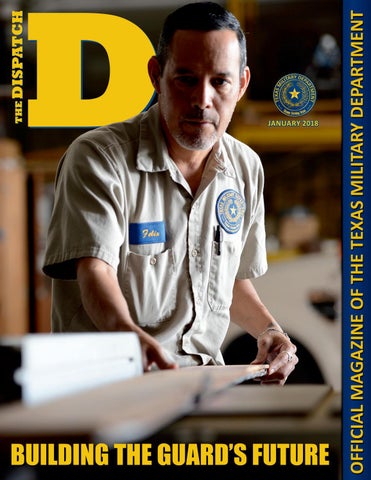
DISPATCH 4 From the Top 6 Life-Saving Partnership 8 Fixer Upper 10 Building the Guard 12 And the Army Goes Rolling Along 14 Off We Go 16 Going Green 20 Our Force 23 Key Leaders ON THE COVER: Felix Maldonado, Maintenance Specialist V for the Texas Military Department, prepares to trim boards for a maintenance project at Camp Mabry, in Austin, Texas. (U.S. Army National Guard Photo By: Mark A. Otte)
Capt. Martha Nigrelle 2nd Lt. Caitlin Rourk Master Sgt. Michael Leslie Sgt. Kyle Burns Sgt. Mark Otte Sgt. Orrin Spence John Gately Laura Lopez John Thibodeau Dispatch Development Bob Seyller
Contributing Writers & Photographers
The Texas Military Department Public Affairs Office would like to thank all the contributing writers and photographers who generously share their work with us. Without the hard work and dedication of Guardsmen and civilians, we would not be able to tell your TMD story. * The Dispatch is an authorized publication for members of the Texas Military Department and the Department of Defense. Contents of The Dispatch are not necessarily the official views of, or endorsed by, the U.S. Government, the National Guard Bureau, or the State of Texas. * The editorial content of this publication is the responsibility of the Texas Military Department Public Affairs Office. * The appearance of advertising in this publication, including inserts or supplements, does not constitute endorsement of the products or services advertised by the U.S. Army or the Texas Military Department. * Everything advertised in this publication will be made available for purchase, use, or patronage without regard to race, color, religion, sex, national origin, age, marital status, physical handicap, political affiliation, or any other factor of the purchaser, user, or patron. If a violation or rejection of this equal opportunity policy by an advertiser is confirmed, the publisher will refuse to print advertising from that source until the violation is corrected. * Content is edited, prepared and provided by the Texas Joint Military Department Public Affairs Office, Bldg. 10, 2200 W. 35th Street, Camp Mabry, Austin, Texas. 78703.*
TEXAS MILITARY DEPARTMENT
FROM THE TOP
COMMENTARIES FROM TEXAS MILITARY DEPARTMENT LEADERS
SUCCESS FAVORS THOSE WHO PREPARE CSM JOHN SAMPA
TEXAS MILITARY DEPARTMENT SENIOR ENLISTED ADVISOR
Greetings and Happy New Year to all Texas Guardsmen and civilian employees of the Texas Military Department, It’s my hope that you had a great holiday season and were able to spend some quality time with your family and friends. The holiday season is a time where we all reflect back on the past and create new plans for the upcoming year. These plans can also include your career plans and your roles and responsibilities in the Texas Military Department. No matter what your position or status is in the Texas Military Department, it is imperative that you always set new goals and prepare for the next step in your career. That next step could be a promotion to a higher rank, to the next higher managerial position or to a new position in a different department within the organization. No matter what that next step is for you, you should be ready at all times to take that next step. There are times when you can predict an opportunity in your near future, but many rare opportunities are sudden. They come when you least expect them and many times, catch you off guard because you were not prepared. Those sudden opportunities are the ones you need to prepare for in advance, so that you are ready in order to capitalize for the success of your military or civilian career. I’m always speaking about standing at the station and being ready for the right train (opportunity) to board, whenever it arrives unexpectedly. My philosophy is that there are many trains (opportunities) traveling in every direction each and every day. Although many of those opportunities present themselves to
you each day, they still may not be the right one for you at that given time. When the right one presents itself, you want to be ready and standing on the platform to board that train (grasp that opportunity). The question I have for you is: “Have you been issued your ticket that will allow you to be standing on the platform to board that train?” Your ticket can only be issued once you have completed all the required training, schools, certifications and personal fitness requirements for that next career step. My most recent selection to be the 12th Command Sergeant Major for the Army National Guard is an example about my philosophy in being prepared for the next unexpected opportunity. My readiness for that unexpected opportunity has allowed me to achieve the next level of success in my career. I was afforded the opportunity because I was standing on the platform with a ticket that verified I met all the required training, schools, certifications and personal fitness requirements to be the 12th Command Sergeant Major for the Army National Guard. I challenge all Texas Guardsmen and civilian employees of the Texas Military Department to acquire their ticket as soon as possible, so that they too can be standing on the platform waiting for their next career path opportunity when it arrives; be it planned or unexpected. The strength of the Texas Military Department is found in the highly trained, skillful and educated professional men and women in the Texas Military Department. This is why it is important that everyone continue to prepare himself or herself in order to be ready for the next personal and professional career opportunity. I will soon move on to my next career position as the 12th Command Sergeant Major of the Army National Guard. I personally thank you, your family and the employers of Texas Guard for the support of my leadership throughout my years in the Texas Military Department. I also thank you for your loyal and dedicated service to the Texas Military Department. As the 12th Command Sergeant Major of the Army National Guard, I will continue to serve you, your family and the traditional service members’ civilian employers in order to maintain, while continuously building on, the long and globally recognized proud legacy of the Texas Military Department and Army National Guard. “ALWAYS READY – ALWAYS THERE”
"DUTY – HONOR - TEXAS"
- FROM THE TOP -
"Don't let an unexpected opportunity pass you by because you were not prepared" 4 TheDISPATCH January 2018
BLENDED RETIREMENT BEGINS! The U.S. Uniformed Services Blended Retirement System The Fiscal Year 2016 National Defense Authorization Act provides our military force with a modernized
Reserve Component
Effective Date: January 1, 2018 Retirement System Selection
retirement plan built for retirement savings. Beginning in 2018, Reserve Component service
Reserve Component members with more than 4,320 retirement points will remain under the legacy retirement system.
members can get automatic and matching Thrifts Savings Plan contributions, a mid-career
Reserve Component members with less than 4,320 retirement points as of December 31, 2017, will have the choice of whether to opt into the new Blended Retirement System or remain in the legacy retirement system.
compensation incentive, and if they obtain 20 years of service, monthly retired pay for life starting at age 60.* All service members under
New accessions after January 1, 2018, will automatically be enrolled in the new Blended Retirement System.
the current system are grandfathered into today’s retirement system.
Reservists and Guardsmen While Serving Thrift Savings Plan Contributions
Continuation Pay
Received at the mid-career point
You Contribute
DoD Auto Contribution
DoD Matches
Total
0% 1% 2% 3% 4% 5%
1% 1% 1% 1% 1% 1%
0% 1% 2% 3% 3.5% 4%
1% 3% 5% 7% 8.5% 10%
The DoD automatically contributes 1% of your basic pay or Inactive Duty Pay to your Thrift Savings Plan after 60 days of service. You’ll see matching contributions at the start of 3 years through the completion of 26 years of service, and...
At the mid-career mark, you may receive a cash payment in exchange for additional service.
You’re fully vested − it’s yours to keep − after completing 2 years of service and it goes with you if you leave.
Retired Reservists and Guardsmen Eligible for Retirement Pay Monthly Annuity for Life
2%
x
OPTION
x Years Served
Collecting Your Retired Pay
1 Retired Pay Base
Calculate your retired pay base by averaging the highest 36 months of basic pay. You’ll gain this monthly annuity for life after completing 20 qualifying years of service and attaining age 60* *or earlier based on qualifying active service.
Full retired pay annuity beginning at age 60 or earlier based on credited active service
or OPTION
2 Lump sum
with
Reduced retired pay as monthly annuity
25% or 50% lump sum and reduced monthly annuity at age 60* Monthly annuity bumps back up to 100% at full retirement age (67 in most cases).
You can find additional information at http://militarypay.defense.gov/BlendedRetirement Sources: Fiscal Year 2016 National Defense Authorization Act, sections 631,632, 634, and 635
Created: 8/2016
TEXAS MILITARY DEPARTMENT
Story by: Sgt. Mark A. Otte
Texas Military Department Public Affairs State Partnership Program partners, the Chilean Army and the Texas National Guard, joined the Georgetown Fire Department in Georgetown, Texas, Nov. 14, 2017, for collaborative searchand-rescue training. During the training event, Soldiers from both countries and the Texas-based firefighters demonstrated the techniques each group uses to execute rescue missions in their most common environments. While the Chilean Army brought along a group of mountain warfare specialists, some of their most highly trained soldiers, Chil-
6 TheDISPATCH November 2017
ean Army Lt. Commander Felipe Schaffhauser said there was a lot to be learned from the civilian firefighters, whose job is search and rescue rather than warfighting. “When we need civilian search and rescue, we are taking combat systems and processes and using them for those situations,” said Schaffhauser. “We don’t have a technical or detailed training for that, but that is what these firefighters train for.” But the learning wasn’t one-sided according to Georgetown Fire Department Battalion Chief Craig Krienke. “We’re getting a lot of information on using minimal equipment to do the same job,” said Krienke. “They generally hike in, so they don’t carry anything heavy. We don’t have to do that a lot, but
TEXAS MILITARY DEPARTMENT
Members of the Texas Army National Guard watch as a firefighter with the Georgetown Fire Department begins his ascent of a rock face. (Texas Military Department Photo By: Bob Seyller)
should we need to, they have given us good practices for doing that.” The language barrier that many states struggle to overcome as part of the State Partnership Program is a challenge the Texas Military Department, and now the Georgetown Fire Department, have easily overcome, as both agencies employ large numbers of Spanish speakers. “We have 10 or 12 of our guys here that are bilingual,” said Georgetown Fire Department Assistant Chief Jeff Davis. “Not being able to communicate while you are dangling from a rope isn’t a good situation, so we wouldn’t have been able to do it without them.” As Soldiers and firefighters discussed the environments each operate in it became apparent that both Texas and Chilie provide a broad range of terrain where search-and-rescue missions occur. A focus on how to change tactics in differing locations helped expand the lesson between both groups. Schaffhauser attempted to explain the varying extremes that the South American nation contends with. “We have the driest desert in the world and the largest saltwater reserve with the glaciers,” Schaffhauser said about Chile’s varying terrain. The State Partnership Program began in 1991 and has evolved into a highly valuable, yet low-cost, initiative, administered by the National Guard Bureau and executed by state adjutants general. The program facilitates broader interagency and corollary engagements that span military, government and economic realms. The program now links National Guard units with around 79 other nations from across the globe. Texas has partnered with Chile since 2008 and the Czech Republic since 1993. -D
Soldiers with the Chilean Army explain their method of rigging a harness to members of the Georgetown Fire Department during a joint training exercise in Georgetown, Texas on Nov. 14, 2017 (Texas Military Department Photo By: Bob Seyller)
www.tmd.texas.gov 7
TEMPLE ARMORY
Story & Photo by: Sgt. Mark A. Otte
Texas Military Department Public Affairs
TEXAS MILITARY DEPARTMENT The renovation of the National Guard Armory in Temple, Texas, is in full swing and will increase force protection at the facility as well as modernize the aging building. Each of the upgrades, conducted by local civilian contractors, is required to either protect the life, health and safety of the occupants or modernize the facility for new and emerging requirements to fulfill a mission. The nearly $6 million budget for the much-needed upgrades came as part of the State of Texas Armory Revitalization program that uses federal dollars to pay for as much as 75 percent of the overall renovation costs, depending on the building’s use. Those matching funds come from National Guard Bureau's Installation Division. Local contractors will complete all of the renovations, providing a stimulus to the local economy. One of the most anticipated enhancements to the Temple readiness center is the addition of 12 female showers and 12 male showers. This ratio closely reflects the gender diversity of the nearly 250 citizen-Soldiers who work and train in the facility. "Before, we had one female shower," said Maj. Aimie Tibbetts, the officer in charge of logistics for the 36th Sustainment Brigade of the 36th Infantry Division which is housed in the Temple Armory. "Now we won't have to do crazy workarounds for simple things like getting cleaned up after a physical fitness test." Because the building is also home to local recruiters and family support services, the entryway will be modified to continue accepting visitors from the community into a common area but will now restrict access to the more sensitive areas of the armory. Those restrictions will include bulletproof glass and controlled access points for improved Soldier security.
Plumbing contractors rough in drain lines for new showers being included in the renovation plan of the Temple Texas Army National Guard Armory. These renovations will increase health and hygiene facilities for the 250 Guardsmen who utilize the armory for drill. The Temple Armory is one of 27 readiness centers, out of 63 owned by the Texas Military Department, slated to be revitalized. Current plans call for all 27 construction projects to be completed by 2020; however, the federal matching dollars for the projects are contingent on state money being allocated first. Updating readiness centers around the state, like the Temple armory, helps keep the Texas Military Department ready, should a natural disaster strike or a national security threat call Texas Guardsmen to duty, said Lt. Col. John Davis, director of the Texas Construction and Facilities Management Office "STAR will address much-needed repair, modernization and improvements that will bring our readiness centers back to a sustainable condition," Davis said. "Improvements will address life, health and safety code compliance issues, as well as modernize the space to maximize its usefulness to the organization.” While the work to the Temple Armory is being completed, the 36th Sustainment Brigade will move to a location near Austin-Bergstrom International Airport in Austin. Project planners anticipate the Temple project will be completed in early 2019. -D
www.tmd.texas.gov 9
TEXAS MILITARY DEPARTMENT
Maj. Sean Johnson, recruiter for the Texas State Guard, explains what service with the Texas Military Department will include to potential recruit Bryan Nya during a preliminary interview.
BUILDING THE GUARD TEXAS STATE GUARD RECRUITER LEADS NEW GUARDSMEN TO A LIFE OF SERVICE Story & Photo by: Sgt. 1st Class John Gately
Texas Military Department Public Affairs The Texas State Guard is ready to grow and leading that effort is Maj. Sean Johnson, the newly hired recruitment and marketing specialist. Johnson will work fulltime to find people interested joining the force and help explain what their roles will be in the organization after enlistment. Members who enlist in the Texas State Guard volunteer one weekend per month to drill with a local unit and train in specialized skills required to respond to domestic incidents. As an all-volunteer force state Guardsmen don’t receive pay for a drill weekend but Johnson's recruits are not enlisting for money.
10 TheDISPATCH January 2018
“What makes the State Guard unique is that at our core is a spirit to serve others and put the people of Texas first, even before ourselves,” said Johnson. According to Johnson this Texans serving Texas mentality is what he looks for when approaching a potential recruit, and the special make up of Texans helps him find the best the lone star state has to offer. “The Texas State Guard is full of members ready to serve and to do so with a fervor like I’ve never seen.” said Johnson. “In any formation, office or building, you will find a multitude of selfless team members who have the heart to protect, to care for and to support those in need.”
TEXAS MILITARY DEPARTMENT This heart of service is coupled with the recruit’s available skillset to determine how they can best serve in the Texas State Guard. New recruits can choose to join the Air, Army, Maritime or Medical Forces and from there begin working in a military specialty needed by the organization. To best place each applicant, new recruits are asked about their interests and skills to locate the right fit in the force. “As unpaid members it is important that these guardsmen stay engaged and challenged in their position so they can grow into organizational leaders.” Said Johnson. According to Col. Joe Jelinski, Texas State Guard deputy chief of staff for support, it’s those incoming leaders who will take an active role in the organization's future.
TEXAS STATE GUARD ENLISTMENT INFORMATION Resident of Texas For At Least 180 Days Between The Ages Of 18 & 70 Reasonably Good Health Pass Criminal Background Check Valid Texas Drivers License
“Our strength is in our people. By recruiting the best, most talented force possible the Texas State Guard can continue to grow,” Said Jelinski.
No Prior Military Service Required
The recruitment pool for the Texas State Guard is highly inclusive allowing Johnson to find talented members throughout the state.
Honorable Discharge Required For Prior Service Members
“What I love most about the Texas State Guard is its wide inclusiveness of the citizenry for membership.” said Johnson “Most 18 to 69 year old residents in generally good health with a clear background check can join.” Johnson is uniquely qualified to explain different military options to interested recruits. In 1990 he enlisted in the US Army Reserves as an intelligence analyst with the 11th Special Forces Group (Airborne). He served there until he transferred into the active duty 1994 where he would go on to commission as an infantry officer. After 24 years of service Johnson retired from active duty and continues his services with the Texas State Guard and the texas Military Department. -D
Schedule an appointment with Maj. Sean Johnson at
EDUCATION INFORMATION High School Diploma Home School Certificate GED College Transcripts Educational and age requirements exist for officer commissioning
tmd.texas.gov/join-the-state-guard
www.tmd.texas.gov 11
TEXAS MILITARY DEPARTMENT
Maj. Gen. John F. Nichols, The Adjutant General of Texas, Brig. Gen. Tracy Norris, Deputy Adjutant General - Army, and Commander of the Texas Army National Guard, Command Sgt. Maj. John Sampa, State Command Enlisted Leader and Command Sgt. Maj. Kristopher L. Dyer pose with the Soldiers of Delta Company, 3/141st IN BN at Fort Hood, Texas, where the unit was conducting TOW live fire operations and CROW firing system familiarization.
THE ARMY GOES ROLLING ALONG Story by 1st Lt. Jolene Hinojosa
Texas Army National Guard Public Affairs Last December, Brig Gen. Tracy Norris received the call of a lifetime: Governor Greg Abbott had appointed her the Deputy Adjutant General for Army and Commander of the Texas Army National Guard. She immediately recognized the great responsibility that came with the new position. Now, a year into her role, Norris sat down to reflect on her experiences.
DISPATCH: What has your first year in the job been like? NORRIS: I am so proud of our Service Members. I came to my position knowing that the Texas Army National Guard is the biggest and best National Guard in the nation, and my Soldiers have never let me down. 2017 has been a very busy year for us, but our service members have always answered the call and have proven that we are an operational force. DISPATCH: The Texas Army National Guard participated in so many diverse missions in 2017. That included overseas mobilizations to Africa and Afghanistan, overseas
12 TheDISPATCH January 2018
training missions to Chile and the Czech Republic, state responses to natural disasters like Hurricane Harvey and Hurricane Irma and countless training exercises, inspections and routine actions that keep the organization running smoothly. What are some of the highlights of the past year from your perspective?
NORRIS: Our Soldiers did a phenomenal job this year. We responded to hurricanes, overseas mobilizations, community support, training missions - I could go on, but the bottom line is that whatever the mission, we get the job done and we do it right. DISPATCH: Even though you have more than 30 years of service in the National Guard, what are some of the things you’ve learned in your new role? NORRIS: We have such a dynamic and professional group of leaders across the organization that are experts at their craft. Their knowledge provides me ability to employ their skills and expertise and use our resources efficiently. I still learn something every day, as I believe that we all should. That is the only way that we can improve and keep ourselves from becoming complacent.
TEXAS MILITARY DEPARTMENT DISPATCH: How do you proactively get out and learn new things about the organization, and how can leaders do the same? NORRIS: The best part of being a Commander is spending time with Soldiers. I am constantly impressed with the talent and experience that we have across our citizen Soldier formations and have been so honored to meet them all. Visiting Soldiers, hearing their perspective and just getting to know them re-energizes me and keeps me going. I continuously expand my knowledge firsthand by conducting visits throughout the year to training centers across the state and participating in annual training events, conferences and weapons ranges. Some highlights include being given the opportunity to experience firing the M777 artillery weapon, seeing rotary-wing aircraft capabilities and witnessing heavy-drop aerial resupply. DISPATCH: Reflecting on the gains and triumphs of the year is important, but it is equally important to remember the losses that are an unfortunate and difficult part of our profession as Soldiers. How can our organization honor the loss of our comrades? NORRIS: That is a role I don’t take lightly. We have lost a lot of great Americans this year, and their absence still weighs on us and their families. We must allow ourselves the opportunity to mourn while also remembering to celebrate life. In times of loss, we need to be there for each other, and work through our sorrow. In doing so, we truly honor our battle buddy's memory and build an even stronger team.
DISPATCH: You’ve said in the past that teamwork is the key to maintaining the health and resiliency of the force. How can service members take care of themselves, their co-workers and their families? NORRIS: You – our Soldiers – are our most important resource, and we want you to be healthy mentally, physically and spiritually. Don't be afraid to ask for help, and look out for each other. Also, don't forget to thank your family for all they do to support you. They might not wear the uniform, but they serve because we serve. We couldn't do it without them. DISPATCH: Looking forward to 2018, the readiness of our force continues to remain vital to the growth of the Texas Army National Guard. The force is forecasted to grow by two infantry battalions and includes the possibility of adding armor assets back into the formations. How are you preparing for that? NORRIS: We are going to build our readiness by maintaining routine business. With the help of my Command Sergeant Major, we are going to empowering our NCOs to help guide our Soldiers and keep our internal motors and processes running. I am excited about our future and know that no matter what the challenge, we will be always ready! Lonestar! -D
Brig. Gen. Tracy Norris, Deputy Adjutant General - Army and Commander of the Texas Army National Guard, participates in an After Action Review with Soldiers from the 1-112th Cavalry Regiment after completing a medical evacuation training lane under nuclear, biological and chemical conditions at Fort Hood, Texas.
www.tmd.texas.gov 13
TEXAS MILITARY DEPARTMENT
OFF WE GO
TEXAS AIR GUARD PREPARES FOR FUTURE MISSION SET
149th Fighter Wing aircraft positioned at Joint Base Pearl Harbor-Hickam, Hawaii, for Sentry Aloha, a large-scale fighter exercise hosted by the Hawaii Air National Guard. (U.S. Air National Guard photo by Tech. Sgt. Rebekkah Jandron)
Story by: Sgt. Mark A. Otte
Texas Military Department Public Affairs Hurricane Harvey put the Texas Air National Guard on the national stage in 2017, demonstrating a decade of preparation for just such an event. But the highly publicized domestic operations during the subsequent flooding only scratched the surface of the organization’s capabilities and readiness.
The entire nation was watching as the Texas Military Department swung into action after one of the most destructive natural disasters hit Texas’ shores in August. At the right hand of the Dual Status Commander of Domestic Operations in charge of rescue and recovery missions was Texas Air National Guard Brig. Gen. Dawn Ferrell, who prepared to receive missions in the hectic days following Harvey’s landfall. Ferrell, who has served as the deputy adjutant general for air since 2015, said that Air Guard’s response to Harvey was only one example of the force's readiness. “When Texas needed us, we were able to respond with speed and effectiveness and I couldn’t be prouder of the Airmen that made that happen,” Ferrell said. “But we haven’t been resting on our laurels, we are continuing to build and maintain a force that can serve both domestic operations and national security missions.” Senior Airman Austin Kirwin, 147th Attack Wing, Texas Air National Guard, receives awards and recognitions from Brig. Gen. Dawn Ferrell, Deputy Adjutant General for Air, during the Texas Military Department Best Warrior Competition Awards Ceremony, held May 13 at the Texas Military Forces Museum in Austin, Texas. (U.S. Army National Guard photo by 1st Sgt. Daniel Griego)
14 TheDISPATCH January 2018
TEXAS MILITARY DEPARTMENT Part of that effort was refitting the 147th Attack Wing at Ellington Field Joint Reserve Base in Houston with the MQ-9 Reaper. The new unmanned aircraft replaced the venerable but aging MQ-1 Predator. The new airframe comes with critical technology that makes the ship more suitable for local flights, like ‘see and avoid’ software that prevents mid-air collisions. Maj. Gen. David M. McMinn, commander of the Texas Air National Guard, visited with members of the Emergency Operations Center to recognize them for their service during Hurricane Harvey at Ellington Field Joint Reserve Base, Houston, Texas, Sept. 4, 2017. (Air National Guard Photos by Senior Airman Kara Additon)
With the MQ-9 the 147th will be able to operate the aircraft from their home station in Houston, something that wasn’t allowed by the FAA or the FCC with the Predator. With that capability, the unit will be able to provide civil authorities with an overhead view of a disaster area for around 20 hours at a time. The aptly named Reaper also comes with an ability to carry enough Hellfire missiles to strike fear into the hearts of terrorists from across the globe, should the 147th be called on for overseas duty. The 149th Fighter Wing at Joint Base San Antonio also made additions to its hangers in 2017 with the addition of six F16s, bringing their fleet to 18 of the fast movers. Commander of the Texas Air National Guard Maj. Gen. David McMinn said that it is the dedicated Airmen who make his leadership efforts so successful in times of crisis, like Hurricane Harvey. “The Texas Air National Guard has continued to embody the spirit of the Minutemen,” McMinn said. “We are still made of farmers, teachers, police and professionals, who when called, serve either here at home in Texas or overseas, and it is those people who have continued to make this a great organization." 2017 marked the first time the Texas Air National Guard deployed a Cyber Protection Team. The tech savvy Texas Airmen
from the 273rd Cyber Operations Squadron were sent to NORAD U.S. Army North Command to assess critical systems for potential weakness from advanced threats. Throughout the year, the Air Guard provided nearly 500 personnel for deployments that spanned 20 locations around the world. The 136th Airlift Wing at Naval Air Station Fort Worth JRB played a crucial role do the Harvey response, carrying nearly 400,000 pounds of life-saving cargo, and continued the effort in Puerto Rico as Hurricane Maria ravaged the island. While hurricane Harvey was certainly the largest operation of 2017, the readiness of the Texas Air National Guard when disaster struck the Gulf coast was the culmination of nearly ten years of planning and training according to Lt. Col Teekell, the officer in charge of planning for the force. “When you talk about being able to serve Texas, it hasn’t just been this last year, but over the last ten years that we have training, planning and preparing for an event like Harvey,” Teekell said. “When the test finally came, we were able to step up and execute in a way that made the most of our resources.”-D
The 147th Attack Wing's first MQ-9 Reaper is assembled, August 4, 2017, at Ellington Field Joint Reserve Base. The wing is converting from the MQ-1B Predator to the MQ-9. (U.S. Air National Guard Photo By Master Sgt. Sean Cowher)
www.tmd.texas.gov 15
TEXAS MILITARY DEPARTMENT
Going Green TMD ENVIRONMENTAL EFFORTS HAVE AN EYE TOWARD THE FUTURE
Airmen from the 136th Airlift Wing, Texas Air National Guard, stationed at the Naval Air Station Fort Worth Joint Reserve Base, helped clean up the community during the annual Tarrant Regional Water District’s Spring Trash Bash, May 21, 2016. During the Trash Bash, more than 3,100 volunteers took part in picking up trash along the Trinity River. (Air National Guard photo by Senior Master Sgt. Elizabeth Gilbert)
16 TheDISPATCH January 2018
TEXAS MILITARY DEPARTMENT Story & Photo by: 2nd Lt. Caitlin Rourk
Texas Military Department Public Affairs The U.S. military has made environmental protection an increasing priority in recent years, spearheading new initiatives that minimize environmental impact while accomplishing the military mission. As these efforts filter down to both the active and reserve components, the Texas Military Department is proving to be a leader in environmental protection. In October 2017, The Adjutant General of Texas, Maj. Gen. John F. Nichols, published a directive outlining the Texas Military Department’s environmental statement. As Robin Howard of the Construction and Facilities Management Office Sustainability Division explains, the new directive has “more teeth” and underscores TMD’s strong commitment to environmental priorities. The directive also requires all organizations within the TMD to “implement, maintain, and communicate” the statement to their employees and – most importantly – do their part to comply. Howard adds that it’s a good time for every Texas Guardsman to pay close attention to TMD’s environmental statement. The Environmental Management System, or EMS, is the overarching framework by which TMD runs its environmental program. Howard explains the EMS originated as a mandate from the Army National Guard, “but TMD chose to continue using EMS voluntarily because it has proven to be very effective.” For Texas Army National Guard installations and units, CFMO uses the EMS framework to ensure compliance with local, state and federal environmental requirements, while leading forward-thinking programs that keep an eye toward the future.
Howard highlights one of these forward-thinking programs as the Army Compatible Use Buffer program, which ensures modernization and sustainment for the future. At Camp Swift in Bastrop, Texas, ACUB has helped the Texas Army National Guard acquire buffer land around the installation, allowing for better management of extreme growth and encroachment that can undermine units’ ability to conduct training. ACUB also allows TMD to plan for demographic changes and sprawl – an increasing reality in many Texas communities – which puts pressure on installations and, as a result, the military mission. Dr. Linda Brown, TMD’s Natural Resource Program Manager, leads a team that works to make TMD facilities healthy habitats, while sustaining mission capability. In many cases, conservation efforts go hand-in-hand with military objectives. Integrated Training Area Management, for instance, allows TMD to utilize its funding most effectively in coordinating brush and invasive species management, prescribed burns and erosion control, all of which can help or hamper the Texas Army National Guard’s ability to train and remain mission capable. “Invasive species management helps with land navigation and infantry maneuvers. We keep drop zones open with prescribed burns and manage endangered species that use these areas when our troops aren’t using them,” said Dr. Brown. “Our work also preserves facilities’ natural beauty and facilitates many leisure activities, like fishing, hiking and even hunting, so our service members and members of the local community can enjoy Texas Army National Guard installations for years to come.”
Texas A&M Forest Service firefighters conduct a prescribed burn of 500 acres on Camp Swift, near Bastrop, Texas, on March 23rd, 2017. This fire mitigation technique removes hazardous fuel buildups from fallen branches or other potential fuel sources. (Photo Courtesy of: Texas A&M Forest Service)
www.tmd.texas.gov 17
TEXAS MILITARY DEPARTMENT
Staff Sgt. Seferino Soliz, crew chief assigned to the 149th Aircraft Maintenance Squadron, Texas Air National Guard, performs a pre-flight inspection on an F-16 Fighting Falcon at Joint Base San Antonio Lackland, Texas, Feb. 1, 2017. Proper maintenance allows aircraft to operate at optimal efficiency and reduce pollution or contamination from faulty components. (U.S. Air Force photo by Senior Airman Keith James)
Texas installations have even won accolades for their conservation work. Camp Bowie in Brownwood, Texas, was recently named the top small installation for natural resource conservation in the National Guard Bureau and is now taking part in an Army-wide competition. At the Fredericksburg Armory in Fredericksburg, Texas, land experienced significant erosion when units stopped using vehicles. TMD, alongside AmeriCorps volunteers, have undertaken extensive erosion control and are delivering native seeds and plants to the facility, making the ground more ideal for training. Martindale Army Air Field in San Antonio, Texas, had a significant portion of land whose habitat had brought in large birds that can pose a crash risk for helicopters. TMD’s efforts converted this land to a short-grass pollinator habitat, thus minimizing the risk to helicopters that depend on the facility. To help Texas Army National Guard units and facilities manage environmental requirements, members of CFMO’s environmental training team visit Texas Army National Guard sites throughout the year. Patricia Griffith, an Environmental Training Specialist, says TMD's proactive approach to environmental training makes Texas a leader among other states. Griffith and her team assist installations and units as they prepare for assessments by providing the necessary tools to adhere to regulations. “Some units think we are here to slap your hand when you do something wrong. But in reality, we are here to help ensure you don’t have problems,” said Griffith. “The compliance toolkit we bring along is a one-stop shop that holds all the key documents required for an assessment.
18 TheDISPATCH January 2018
If the day ever comes that EPA or TCQ pay you visit, I can guarantee our efforts will make sure they’re there for a lot less time.” As CFMO works to manage Army and TMD facilities, the Texas Air National Guard maintains its own environmental program. Each wing follows the EMS of the installation on which it operates, largely driven by the operating branch’s environmental requirements. For instance, the 136th Airlift Wing in Ft. Worth, Texas, follows the Navy’s EMS since the wing is located at Naval Air Station Joint Reserve Base Fort Worth, a Navy-operated facility. Hector Martinez, an Environmental Protection Specialist with the 149th Fighter Wing in San Antonio, Texas, explains that – in addition to the wing’s installation EMS – the Texas Air National Guard has its own environmental program whose priorities center on the component’s chief environmental disruptor: aircraft. The Air Guard also looks for creative ways to comply with local, state and federal environmental requirements and maintains a long-term strategic focus to ensure the organization stay out ahead. Today, the Texas Air Guard is mainly focused on reducing air emissions because, as Martinez explains, programs that reduce air emissions make the biggest impact. As the Air Guard has seen an increase in the number of its aircraft used for training missions, it has also seen an increase in the amount of ground equipment and fuel required to support these missions – all of which have environmental consequences. The Air Guard also works to
TEXAS MILITARY DEPARTMENT minimize community impact as part of its environmental program, Martinez explains, since aircraft can be loud. In addition, the Air Guard has moved to use more environmentally friendly solvents and to eliminate hazardous waste streams. Martinez adds that all three wings are always looking for ways to get in front of potential hot spots. “The military has had to answer and address environmental considerations, especially as communities grow around bases. The military has become very environmentally aware and conscious, and the Texas Air National Guard strives to be a leader in this area alongside other components of the Texas Military Department,” said Martinez. “The more we’re in compliance, the better we can accomplish our mission.” Martinez points to the collaboration between TMD components, as well as the agency’s overall dedication to environmental protection, as one reason for Texas’ environmental leadership. Within the Air Guard, environmental evangelism has created a culture of good stewardship. “From Airmen Basic, all the way up to General, all Texas Airmen know the Texas Air National Guard has a policy and that they need to be environmentally aware in their jobs,” said Martinez. Dr. Brown offers another explanation for why Texas has proven itself as a key environmental leader among states and across the military, noting TMD’s work in climate adaptation management with its Chilean partners and endangered species management as two high points. She attributes Texas’ leadership to having so many different ecoregions across the state, requiring proactive planning and management. Dr. Brown also says she and her colleagues are constantly anticipating new environmental considerations that could impact service members and looking for ways to manage and mitigate them. This is a sentiment Howard and Griffith share, noting that managing environmental issues today allows TMD training to move forward in the future. They also point to the good work of individual units and service members, who now have an even greater mandate to balance environmental concerns with their military mission following the publication of the environmental directive in October. “We are watching, and we appreciate that our service members and employees are such good environmental stewards,” said Griffith. “Don’t be afraid to ask for help.” -D
Doe found feeding on the grounds of Camp Mabry, the Texas Military Department Headquarters located in the middle of Austin, Texas. (U.S. Army Photo by: Sgt. Mark A. Otte)
www.tmd.texas.gov 19
TEXAS MILITARY DEPARTMENT
1ST LT. SEAN PAYTON 3rd Battalion, Texas Medical Brigade Texas State Guard Chaplain “It’s my Godly duty to serve the Guardsmen of Texas and their families.”
20 TheDISPATCH January 2018
New Key Leadership Positions Col. Thomas M. Suelzer Commander, 136th Airlift Wing
EXPERIENCE: Colonel Suelzer graduated from the United States Air Force Academy in 1990 and completed undergraduate pilot training at Williams AFB, Arizona. His flying assignments include C-5 aircraft commander and T-37 instructor pilot and evaluator. During his ten years of Active Duty service and seven years in the Air Force Reserve, Colonel Suelzer served in various operational and staff assignments to include Presidential Airlift Mission Planner, Flight Commander, Operations Group Chief of Standardization and Evaluation and Deputy Liaison Director for the United States Air Force Academy. In 2007, Colonel Suelzer joined the Texas Air National Guard where he served as the first Homeland Defense Officer. He went on to plan and execute several major disaster response operations in Texas, served on Operation Jump Start and helped stand up the nation’s third Homeland Response Force. He served as the Chief of Staff of two joint-missioned Army National Guard brigades: the 71st Troop Command (JTF-71) and the 136th Maneuver Enhancement Brigade (JTF-136). Colonel Suelzer served as Director of Operations, Headquarters Texas Air National Guard until March of last year when he became the Vice Commander, 136th Airlift Wing. EDUCATION: Suelzer holds a Bachelor of Science from the United States Air Force Academy and a Master of Aeronautical Science from Embry-Riddle Aeronautical University. DID YOU KNOW: The inscription on the inside of his USAFA class ring reads, “NUTS!”. It is a reference to General Anthony McAuliffe’s response to the German ultimatum to surrender during the Battle of the Bulge (December 22, 1944). The inscription is a personal reminder that victory is often borne from perseverance and the absolute refusal to give up. IN HIS WORDS: I am humbled and proud to lead the extraordinary men and women of the 136th Airlift Wing. Together we will carry on the wing’s tradition of excellence in an environment that fosters trust, promotes teamwork, and enables every Airman to achieve their full potential. “Nulli Secundus!” – Second to None!
Col. Jerald K. Williams Vice Commander, 136th Airlift Wing
EXPERIENCE: Colonel Williams is the 136th Air Commander as well as the 136th Vice Wing Commander. Col Williams enlisted into the 136AW in 1987 and was trained as a Command Post Controller. Upon earning his Bachelor’s degree from East Texas State University in 1991 he was selected to be commissioned to become a C-130 Navigator. In May of 1993 upon graduation from the Academy of Military Science, McGhee-Tyson AFB, Tennessee, 2nd Lt Williams entered undergraduate navigator training at Randolph AFB, Texas, and graduated with his wings in March of 1994. As an operational flier, all of his 5,000 plus flight hours have been on the variants of the C130H aircraft. Throughout his 30 years of service Col Williams has served as the 181st Airlift Squadron Chief Navigator, the 774th Expeditionary Airlift Squadron Director of Operations, the 136th Operations Support Squadron Commander, the 737th Expeditionary Airlift Squadron Commander, the 136th Operations Group Commander, and the 136th Vice Air Commander. During this period Col Williams also played a leadership role in supporting the State’s domestic operations during hurricane response efforts and multiple state exercises to include commanding the Lower Rio Grande Valley Expeditionary Group Air Evacuation exercise which was a fusion of Air and Army National Guard, active duty Air Force and multiple civilian agencies in a realistic mass civilian population evacuation disaster response. Col Williams has deployed numerous times in multiple roles in support of Joint Forge, Joint Guard, Coronet Oak, Operation Enduring Freedom and Operation Iraqi Freedom. EDUCATION: Col Williams holds a Bachelor of Business Administration with a concentration in Finance from East Texas State University, Commerce, Texas (now Texas A&M – Commerce). DID YOU KNOW: In 1976 a law was passed to make George Washington the highest ranking U.S. officer of all time: General of the Armies of the United States. Nobody will ever outrank him. When Washington died, he was a lieutenant general. But as the centuries passed, this three-star rank did not seem commensurate with what he had accomplished. He established the framework for how American soldiers should organize themselves, how they should behave, and how they should relate to civilian leaders. Almost every big decision he made set a precedent. General George Washington was the father of the US military as well as the US itself. (Source: Air Force Magazine) IN HIS WORDS: I am the luckiest guy on the planet. I have a family that I love, and a job that brings me great satisfaction. I get to lead men and women who perform missions all over the world advancing the cause of freedom and liberty. I can think of no better thing than to serve in the Texas Air National Guard, operating the C-130 Hercules aircraft in support of my community, state, and country. Texans serving Texans!
Twitter.com/ TXMilitary
Instagram.com/ TexasMilitary Department
Facebook.com/ TexasMilitaryDepartment
JOIN OUR GROWING SOCIAL MEDIA COMMUNITIES