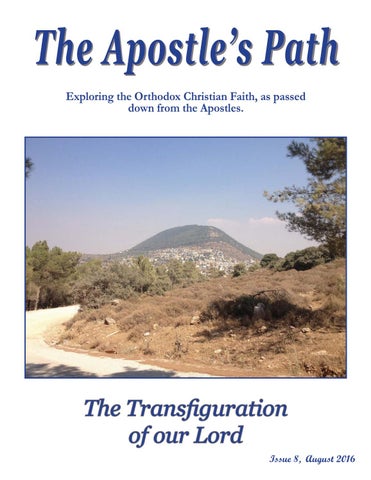
The Apostle’s Path Exploring the Orthodox Christian Faith, as passed down from the Apostles.
7KH 7UDQV¿JXUDWLRQ RI RXU /RUG Issue 8, August 2016
IOCC
Helping Others Help Themselves
I N T E R N A T I O N A L
O R T H O D O X
C H R I S T I A N
C H A R I T I E S
Roadways collapsed under the force of torrential floodwaters, swallowing up vehicles and homes in a West Virginia mining town. Record rains have claimed at least 23 lives and left hundreds of families homeless. IOCC is in contact with local partners and Orthodox Church parishes to determine the most appropriate emergency response. photo: Kara Lofton/West Virginia Public Broadcasting
IOCC Responds To Communities Drenched By Deadly West Virginia Floods Baltimore, MD (IOCC) - In the aftermath of record-breaking rains and destructive flooding in West Virginia that have left least 23 people dead and hundreds of families homeless from storm damage, International Orthodox Christian Charities (IOCC) has been in contact with Orthodox Church parishes in the most impacted areas of West Virginia, and with local ecumenical partners to determine the best emergency response for families in distress. Members of the IOCC Emergency Response Network, known as Frontliners, living in the affected area have been called on for possible deployment as the needs emerge. HOW YOU CAN HELP Assemble emergency kits. IOCC also anticipates the need for Emergency Clean-Up Buckets which are in low supply. For directions on how to assemble Emergency Clean-Up Buckets, please visit iocc.org/kits. Make a donation. You can help the victims of disasters in the United States, like the West Virginia floods, by making a financial gift to the United States Emergency Response Fund. Your support will provide immediate relief as well as long-term support through emergency aid, recovery assistance and other support to help those in need. To make a gift, please visit iocc.org, call toll free at 1-877-803-IOCC (4622), or mail a check or money order payable to IOCC, P.O. Box 17398, Baltimore, MD 21297-0429. ABOUT INTERNATIONAL ORTHODOX CHRISTIAN CHARITIES IOCC is the official humanitarian aid agency of the Assembly of Canonical Orthodox Bishops of the United States of America. Since its inception in 1992, IOCC has delivered $580 million in relief and development programs to families and communities in more than 50 countries. IOCC is a member of the ACT Alliance, a global coalition of churches and agencies engaged in development, humanitarian assistance and advocacy. To learn more about IOCC, please visit our website at iocc.org. Media contact: Rada K. Tierney, IOCC Media Relations, 443-823-3489, rtierney@iocc.org.
The Apostle’s Path 2
Cover Photo
Mount Tabor -XVWLQ ZZZ ÂżYHKROOHV FRP MXVWLQ,VUDHO
The Apostle’s Path Short Stories
Issue 8, August 2016
The Apostle’s PathŽ magazine is published with the blessing of His Grace, ArchBishop Peter, The Diocese of Chicago and Mid-America (ROCOR). EDITOR Randall Gibbons THEOLOGICAL CONTENT ADVISOR Fr. John Whiteford CONTRIBUTING WRITERS
Fr. John Whiteford David Withun Saint Nikolai Velimirovic via www.westsrbdio.org www.orthodoxwiki.org PHOTOGRAPHS
Poetry Collections Author R. C. Gibbons www.rcgibbons.com
Justin-www.ďŹ veholles.com, www.BiblePlaces.com, www.BibleAtlas.org The Apostle’s Path, ISSN 2168-6807, is published monthly in Tomball, Texas by RNG Publishing, a non-proďŹ t organization. Copyright Š 2016 RNG Publishing. All rights reserved. No part of this publication may be reprinted in any way without permission from the publisher. Just ask!
To advertise in The Apostle’s Path, call 346-444-2711
The Apostle’s Path 3
Why I’m An Orthodox Christian by David Withun I’m naturally a very skeptical person; I question everything there’s hardly a thing I read or hear that I don’t source-check - and then source-check the sources. My incredulous nature has always been both a blessing and a curse for me. It’s always made it hard for me to trust people and it certainly made my journey to Christianity - and then Orthodoxy - a much longer one than it might have otherwise been. But, once I reach a conclusion, I tend to have a firm conviction that I’ve arrived at the truth, if for no other reason than that I’ve exhausted every possible objection I could raise to it. So… Of course, I applied my principles as I learned about the Orthodox Church. The Orthodox Church said it was the ancient Church, so I learned about the ancient Church, reading every bit of the source texts - even the Gnostics’ gibberish; the Orthodox Church said it had never changed the Faith in the last 2000 years, and everybody else has, so I read everything I could get my hands on about Church history - from every perspective possible; the Orthodox Church said it was the True Church - so I source-checked it. And, of course, you all know the conclusion I reached. I want to share with everyone the three “methods” I used when I was “source-checking” the Church’s claims, and I hope they’ll help someone who reads this to make an informed decision, even if it’s not the one I made: First, I started in AD 33 with Pentecost and followed the Church to today. This involved reading lots of histories and pretty much all of the early Fathers and quite a bit of the later Fathers (and even the various heretics). The question that I kept asking myself the whole way through is “who is changing? who is innovating?” The reason this is important is because any departure, however slight, from the Faith of the Apostles is a betrayal of that Faith; it’s basically saying that the Apostles had things wrong or didn’t have everything, that Christ left them incomplete. And this is obviously wrong. Scripture tells us to “cling to the Faith which was once for all handed down to the saints” (Jude 1:3 open in Logos Bible Software (if available)) and so I knew that’s what I had to look for along the way: who is clinging, as Scripture commands us to do, and who is changing. And I followed that through to today. I ended up in Moscow, Damascus, Alexandria, Bucharest, Sofia - in short, I ended up in the Orthodox Church. Second, I then did the reverse; I started with today and worked my way back. I knew it was impossible to look at each and every individual Christian group and trace each individually back, as there are several thousand. So, what I decided to do was divide them into five umbrella groups: 1. Orthodox Christian Church 2. Roman Catholic Church The Apostle’s Path 4
3. “Traditional” Protestantism (Lutherans, Anglicans, Presbyterians, etc.) 4. “Low-church” Protestantism (Baptists, Pentecostals, “Evangelicals,” etc.) 5. Restorationists (Mormons, Jehovah’s Witnesses, SeventhDay Adventists, etc.) Starting with these five basic “movements” in Christianity, I traced each back to their roots from today. I found the roots of the Restorationists in the 1700’s and 1800’s, mostly in America. I found the roots of the “Low-church” Protestants in the 1600’s and 1700’s in the Anabaptist movement and, in the case of the Pentecostals, in the early 1900’s in America. I found the roots of the “Traditional” Protestants in Germany with Martin Luther, England with King Henry VIII, and Switzerland with John Calvin. The Roman Catholic Church was a little harder, as I certainly find its roots in the ancient Church, but I also saw a single Patriarch, the Pope of Rome, split from the four other Patriarchs (Constantinople, Alexandria, Jerusalem, and Antioch) in 1054 to go and form his own Church, the Roman Catholic Church of today. And so it was only the Orthodox I was able to trace all the way back, through time, to the first century in Palestine with the 12 holy men called Apostles. And the third way I took was to take everything I had learned about what the ancient Christians believed and practiced, especially those of the first and second centuries, as they are the closest to the Apostles, and compared it with those five groups of Christians I gave above. I compared even the minutest details. I made columns in a notebook for each group and marked wherein they agreed or disagreed with the Christianity of the year 100 or so; early Christians fasted on Wednesdays and Fridays – check; early Christians believed in the Real Presence – check; early Christians baptized via triple immersion - check; early Christians used incense in worship - check. And, when I had finished, I found only one “group” whose column was filled top to bottom with my little checks - the Orthodox Church. So that’s a little bit about how I reached my conclusions. It’s not the full story by any means - as I said, I’ll share that when I have the time to tell it. Of course, there was a lot more prayer and tears involved than the dry mathematical equations I give above - not enough, but there was quite a bit of it. I don’t know if I’d recommend my methods to others - many people would probably get tired after a while; it’s a long, often mind-boggling process, and I’m sure many would find it a little too calculated for religious matters. I understand the objections to my methods, but that’s how I did it - and I’m certain that anyone who does the same will reach the exact same conclusion as I did. David Withun is a History teacher at a classical school and a graduate student in the Master of Letters in Humanities program at Faulkner University.
This Month In Orthodoxy 7KH 7UDQV¿JXUDWLRQ 2I 2XU /RUG *RG $QG 6DYLRU -HVXV &KULVW From the Prolog by Saint Nikolai Velimirovic
dead and remained that way, lying in fear, until the Lord came near to them and said: “Arise and be not afraid” (St. Matthew In the third year of His preaching, the Lord Jesus often spoke 17:7). to His disciples of His approaching passion, but at the same time of His glory following His suffering on the Cross. So that His Why did the Lord take only three disciples on Tabor and not all? impending passion would not totally weaken His disciples and Because Judas was not worthy to behold the divine glory of the that no one would fall away from Him. He, the All-wise, wanted Teacher, Whom he will betray and the Lord did not want to leave to partially show them His divine glory before His passion. For him [Judas] alone at the foot of the mountain so that the betrayer that reason, He took Peter, James and John with Him and with would not, by that, justify his betrayal. them, went out at night to Mt. Tabor and there was transfigured before them: “And His face shone as the sun and His garments Why was our Lord transfigured on a mountain and not in a became white as snow” (St. Matthew 17:2). There appeared along valley? So as to teach us two virtues: love of labor and godlyside Him, Moses and Elijah, the great Old Testament prophets. thoughts. For, climbing to the heights required labor and height And, seeing this, His disciples were amazed. Peter said: “Lord, represents the heights of our thoughts, i.e., godly-thoughts. it is good for us to be here: if You will, let us make here three tabernacles; one for You, one for Moses and one for Elijah” (St. Why was our Lord transfigured at night? Because, the night Matthew 17:4). rather than the day is more suitable for prayer and godly-thoughts and because the night, by its darkness, conceals all the beauty of the earth and reveals the beauty of the starry heavens. Why did Moses and Elijah appear? In order to destroy the error of the Jews, as though Christ is one of the prophets; Elijah or Jeremiah or some other, that is why He appears as a King above the prophets and that is why Moses and Elijah appear as His servants. Until then, our Lord manifested His divine power many times to the disciples but, on Mt. Tabor, He manifested His divine nature. This vision of His Divinity and the hearing of the heavenly witness about Him as the Son of God, should serve the disciples in the days of the Lord’s passion, in strengthening of an unwavering faith in Him and His final victory. HYMN OF PRAISE THE TRANSFIGURATION OF OUR LORD GOD AND SAVIOR JESUS CHRIST
While Peter still spoke, Moses and Elijah departed and a bright cloud overshadowed the Lord and His disciples and there came a voice from the cloud saying: “This is my beloved Son in whom I am well pleased; hear Him” (St. Matthew 17:5). Hearing the voice, the disciples fell to the ground on their faces as though
There, where Israel defeated Sisar There also condescended, the Heavenly King Prayer, to go and to nightly vigils, The glory of His Transfiguration, to manifest, And the faith of His followers, to confirm In the eternal victory of Him the Victor. There, divine light from Himself, He released Dispels the thick darkness, and illuminated Tabor; The Light, for a long time, which in Himself contained From which, to the world, a little at a time dispensed Abundant rays, now released, Jubilant rays, sweet rays. The glow of humanity, to reveal to heaven, To earth and to men, the Divine Truth. Let the firmament, its Representative see, Let the earth recognize God, the Savior. (continued on page 11) The Apostle’s Path 5
THE ORTHODOX CHURCH CREED “I believe in One God, Father Almighty, Maker of heaven and earth and of all things visible and invisible. And in One Lord, Jesus Christ, the only-begotten Son of God, begotten of the Father before all ages. Light of Light, true God of true God, begotten, not created, of one essence with the Father, through whom all things were made. For us and for our salvation He came down from heaven and was incarnate by the Holy Spirit and the Virgin Mary and became Man. He was crucified for us under Pontius Pilate, and He suffered and was buried. On the third day He rose according to the Scriptures. He ascended into heaven and is seated at the right hand of the Father. He will come again with glory to judge the living and the dead. His kingdom will have no end. And in the Holy Spirit, the Lord, Giver of Life, who proceeds from the Father, who together with the Father and the Son is worshipped and glorified, who spoke through the prophets. In one, holy, catholic, and apostolic Church. I acknowledge one baptism for the forgiveness of sins. I expect the resurrection of the dead; and the life of the age to come. Amen.
How You Can Help Support This Evangelical Effort 1. Pick up copies and distribute them wherever you feel they need to be placed. If you need more copies, feel fee to contact us at RNG Publishing, 345-444-2711. 2. Sponsor an ad for your business in our magazine. 3. Sponsor an ad space as an individual for photos, a commemoration, or whatever appropriate content you wish to insert. 4. Sponsor an ad space and ask us to fill it with edifying content, or just make a donation if you desire. 5. Sponsor an entire issue of the magazine. Remember, as a supporter, you are participating in this evangelical effort. Your support is what allows us to print and distribute this magazine. Be a part of this effort to share God’s word and the Orthodox Faith. The Apostle’s Path 6
The Church Fathers “I saw the snares that the enemy spreads out over the world and I said groaning, “What can get through from such snares?” Then I heard a voice saying to me, “Humility.”
A brother said to Abba Anthony, “Pray for me.” The old man said to him, “I will have no mercy on you, nor will God have any, if you yourself do not make an effort and if you do not pray to God.” -- St. Anthony the Great, 251 - 356, Egypt
What is the Eucharist? Eucharist, or eucharistia, meaning thanksgiving or giving thanks) is a holy mystery (or sacrament) that is celebrated during the Divine Liturgy within the Orthodox Church where the consecrated bread and wine, through the power of the Holy Spirit becomes the Precious Blood and Body of Jesus Christ, that is consumed by prepared Orthodox Christians. Other names for the Eucharist include: the Holy Gifts, Communion, and the Body and Blood of our Lord Jesus Christ. Orthodox Christians believe that the Real Presence of God (not merely a sign) is present after the consecration of the Gifts. Roman Catholics and some Protestants also hold this view.
§§§§§§§§§§§§§§§ “Those who have truly decided to serve the Lord God should practice the remembrance of God and uninterrupted prayer to Jesus Christ, mentally saying: Lord Jesus Christ, Son of God, have mercy on me, a sinner.” “Acquire a peaceful spirit, and around you thousands will be saved.” “Where there is God, there is no evil. Everything coming from God is peaceful, healthy and leads a person to the judgment of his own imperfections and humility.” -- St. Seraphim of Sarov, 1754 - 1833, Russia
The Eucharist is the center of life in the Orthodox Church because the Church is primarily a eucharistic community. The Eucharist is the completion of all of the Church’s other sacraments and the source and the goal of all of the Church’s doctrines and institutions. The Orthodox Church uses leavened bread, for according to the Gospel of Saint John, Last Supper and Passion took place during the evening, night, and day time of Passover Day, therefore leavened bread was eaten in Last Supper.
§§§§§§§§§§§§§§§ “Beguiling and deceptive is the life of the world, fruitless its labor, perilous its delight, poor its riches, delusive its honors, inconstant, insignificant; and woe to those who hope in its seeming goods: because of this many die without repentance. Blessed and most blessed are those who depart from the world and its desires.” -- St. Nazarius of Valaam, 1735 - 1809, Russia
According to the synoptic Gospels, Last Supper, Lord’s trial, and crucifixion took place during next day, the first Day of Unleavened Bread feast, but according to Lev 23:7, any work on that Day was forbidden. Clearly, the synoptic Gospels are in error on the day of Last Supper and Passion. The Eucharist is both symbolic and mystical. Also, the Eucharist in the Orthodox Church is understood to be the genuine Body and Blood of Christ, precisely because bread and wine are the mysteries and symbols of God’s true and genuine presence and his manifestation to us in Christ.
§§§§§§§§§§§§§§§
Do all in your power not to fall, for the strong athlete should not fall. But if you do fall, get up again at once and continue the contest. Even if you fall a thousand times because of the withdrawal of God’s grace, rise up again each time, and keep on doing this until the day of your death. For it is written, ‘If a righteous man falls down seven times’ - that is, repeatedly throughout his life - ‘seven times shall he rise again’ [Prov. 24:16]. -- St. John of Karpathos, 7th century, Island of Karpathos
The mystery of the Holy Eucharist defies analysis and explanation in purely rational and logical terms. For the Eucharist, as Christ himself, is a mystery of the Kingdom of Heaven which, as Jesus has told us, is “not of this world.” The Eucharist, because it belongs to God’s Kingdom, is truly free from the earth-born “logic” of fallen humanity. From John of Damascus: “If you enquire how this happens, it is enough for you to learn that it is through the Holy Spirit ... we know nothing more than this, that the word of God is true, active, and omnipotent, but in its manner of operation unsearchable”. from orthodoxwiki.com
To advertise in The Apostle’s Path, call 346-444-2711
The Apostle’s Path 7
Fr. John’s Corner Theosis
of Theosis, unlike the odd teachings of groups like the Mormons, who actually do believe that men can be gods by nature (see, for example, Mormons and Patristic Studies, by Chris Welborn). For more information:
Question: “Does the Orthodox Church Theosis: The True Purpose of Human Life, by Archimandrite believe Christians are gods in an embryo George of St. Gregorios Monastery, Mt. Athos. form? I am troubled by this notion, because The Illumined Heart: God: Essence and Energies it is a fundamental concept of Spiritualism.” We believe that there is only one God in Trinity -- the Creed should be clear enough on that. God is alone God by nature. However, we do believe that we can become divine, or like God, by grace. This is well founded in both Scripture and Tradition.
Fr. John Whiteford is the Pastor of St. Jonah Orthodox Church (ROCOR) in Spring, Texas. He is the author of ‘Sola Scriptura: An Orthodox Analysis of the Cornerstone of Reformation Theology’, published by Conciliar Press, and the General Editor of the ‘St. Innocent Liturgical Calendar’.
We are told in Scripture that we will be like God, in some sense: “Beloved, now are we the sons of God, and it doth not yet appear what we shall be: but we know that, when he shall appear, we shall be like him; for we shall see him as he is” (1 John 3:2). And we are told that we can become partakers of the divine nature: “Whereby are given unto us exceeding great and precious promises: that by these ye might be partakers of the divine nature” (2 Peter 1:4). And Scripture speaks of men as being “gods” in some sense (Psalm 81[82]:6; John 10:34-36). St. Irenaeus (who reposed in 202 A.D., and was taught by St. Polycarp, who was in turn a disciple of the Apostle John), wrote that Christ became “what we are, that He might bring us to be even what He is Himself ” (Against Heresies, Book V, preface (ANF, p. 526)). This is almost identical to the better known statement from St. Athanasius the Great: “For He was made man that we might be made God” (On the Incarnation, 54, NPNF2, p. 65). Many similar quotes from other Fathers could be cited. This teaching is called “Theosis” or “Divinization.” Metropolitan Kallistos (Ware) sums up what this does and does not mean very well: “Since, then, the union between God and the human beings that he has created is a union neither according to essence nor according to hypostasis, it remains thirdly that it should be a union according to energy. The saints do not become God by essence nor one person with God, but they participate in the energies of God, that is to say, in his life, power, grace and glory” (The Orthodox Way (Crestwood, NY: SVS Press, 1979), 168). One cannot read what the Fathers have to say on this subject and conclude that they believed that man could become God in the same sense that the Trinity is God. Mainstream Protestant theologians have generally recognized that there is nothing objectionable in the Patristic understanding The Apostle’s Path 8
You Can Subscribe The Apostle’s Path® magazine is a monthly, free distribution magazine. If however, you desire to have a copy mailed to your residence or place of business within the continental U. S., a subscription option is available. The yearly subscription price is $27.00 (USD). You can subscribe at our website, www.theapostlespath.com, or by mail. By Credit Card: Visit our website at www.theapostlespath.com By Mail: Please mail a check for $27.00 along with delivery mailing address including name, address, city, state, and zip. Make checks payable to RNG PUBLISHING. Mailing address: RNG Publishing P. O. Box 1945 Tomball, Texas 77377
'RQW¶ IRUJHW WR WHOO RXU DGYHUWLVHUV WKDW \RX VDZ WKHP KHUH
Orthodox Living Why A Prayer Corner? I can remember as a young person, having grown up in a Protestant environment, viewing images on the television of Roman Catholic homes, or so I generalized, with pictures of Jesus and/or Mary with candles burning, and usually with a cross hanging on the wall. I didn’t think much of it one way or the other, but I do remember thinking how different it was from the way I was taught to do things, and how wrong it was. The thought never entered my mind that I would ever have anything like that in my home, and I didn’t, not even a cross hanging on the wall. I didn’t that is, until just a few years ago! So why the change now, this late in the game, so to say? The reason is that I recently converted to the Orthodox faith, and one of the traditions of the Orthodox faith is having a Prayer Corner in your home. At this point, I do want to make one thing clear though, my recent conversion to the Orthodox faith was not a spur of the moment decision, as have been many of the decisions I have made in the past when I changed from one Protestant church to another. No, this decision was made very slowly, and with much thought, prayer, and theological study of the Orthodox Faith. As a matter of fact, it was roughly a four year process. That is another story though, and I will get back to the subject matter of this post. My study of Orthodox theology exposed me to many traditions of the faith that were new and/or contradictory to some things that I had been taught all of my life in the Protestant church, and I didn’t swallow them well at first, so I decided to find out why the Orthodox practiced each one that I was not familiar with, and for most of them I have. I read the theology and the history behind the particular practice, and surprisingly, I never found fault with either one. I discovered that having a Prayer Corner in your home was a way to reverence Jesus Christ, and the physical act of maintaining that Prayer Corner, i.e., the daily maintenance of keeping a flame going continuously, was all done in reverence and as a small sacrifice of ourselves in remembrance of the great sacrifice that Jesus made on the cross. All of a sudden, tt all seemed so clear and correct to bring this tradition into my home and raise my family in a manner consistent with this. The Orthodox faith is full of acts, events, and traditions that are not dictated by the Bible, the Prayer Corner being one, and this gives reason to so many to discount them, but why? In a recent moment of clarity, it became crystal clear to me why there are so many traditions like this in the Orthodox Faith. Simply put, they are there to bring more of God into our lives. There are there to train us, through repetition, to constantly be
in communion with God. They are traditions which can keep us busy throughout each day, and they exist for one reason and one reason only, to bring us closer in our spiritual walk to God. Consider the following for example. Simple repetitive tasks require a time frame of approximately 21 days to condition. Here is a familiar example: When you walk into your bedroom you “automatically” reach for the light switch on the left side as you enter. Then you move to a new home where the light switch is located on the right side as you enter. You will find that it will take you about 21 days to stop reaching for that light switch on the left side (that is not there). The simple act of walking through the room where your Prayer Corner is, and seeing it there with the icons and the candle burning continually, brings our mind back to Jesus Christ. If we walk past it 30 times a day, and if each time we do, it takes our mind off the things of this life that are bogging us down and brings them back to the reason for our Salvation and the joy of our life, then it has served it’s purpose. When we wake in the morning, go to our Prayer Corner, say our morning prayer, perform maintenance on the candle, and start our day in the same fashion every day, how uplifting it is to begin your day with fellowship with God. If we train ourselves to cross ourselves each time we walk by the Prayer Corner during the day, and say a simple prayer as we are walking, how much more does this bring us into the presence of God than if we did not have it there as a reminder. I can easily answer that question! Without a constant visual reminder of our Lord Jesus Christ, I could easily go all day without my faith, or even God ever crossing my mind. I know, I have done it for too many years. Now that I have this reminder in my life, along with many others that I have instilled, I can and do have constant fellowship and thoughts of my faith and my Savior. These tools have helped me reach this point. So why would any Christian discount something like a Prayer Corner? Why would anyone suggest that something such as a picture or a table, or a candle, be anything but good if it contributes to our spiritual walk? I think this tradition should cross any denominational line. If it is your desire to grow closer to God, then a Prayer Corner should be an integral part of your home, regardless of what denomination you are.
To advertise in The Apostle’s Path, call 346-444-2711
Randall Gibbons The Apostle’s Path 9
The Apostle’s Path® magazine is a trademarked publication of RNG Publishing. Reader correspondence and editorial contributions are welcome, but we reserve the right to edit or reject all submissions. Advertisers assume all liability for content of their advertising. Publisher assumes no responsibility should false or misleading advertising appear. The Apostle’s Path magazine is distributed freely, but subscriptions are available if there is a desire to have a single copy of the magazine delivered to your home or business. The magazine’s primary objectives are: 1. To share the Gospel of our Lord and Savior Jesus Christ. 2. To introduce the public to the Orthodox Christian Faith. 3. Provide exposure for local Orthodox Churches. Advertising inquiries should be made to: publisher@theapostlespath.com or 346-444-2711
let us take care of all your printing needs
MAGAZINES | CATALOGS POSTCARDS | CALENDARS & BROCHURES
4954 Space Center Dr., San Antonio, TX 78218 210.480.0860 | www.shweiki.com
,¶YH 1HYHU +HDUG 2I 7KH 2UWKRGR[ &KXUFK %HIRUH It is not surprising that many Americans think they have never heard of the the Orthodox Church before, but if you really stop and think about it, it is possible that you have driven by one, not knowing what it was. The United States was founded by Protestants who brought their various Protestant denominations with them to this new land. They started churches and and the Protestant denominations began to spread across the country, and for a short time, they formed the dominant faith base. The Orthodox Church was not a part of this initial religious heritage, and was therefore, later in making it’s way to the United States. It was also introduced by immigrants, but mostly by immigrants from parts of the world not associated with the first founders, such as the Mediterranean, Middle Eastern, and Asian countries, including Russia. It is likely that you have heard of the Greek Orthodox Church, or the Russian Orthodox Church, because the names of these churches have began to spread throughout our culture through movies, community church based events, and more recently, the internet. If you have heard one of these names before, or one of the many others, or if you have passed one in your daily travels, then you have at least come into contact with the Orthodox Church, even if it was in passing. The Orthodox Church is growing rapidly in the United States and they are popping up everywhere. There are fourteen Orthodox Churches here in the Houston area alone, as the map near the back portrays, so while the Orthodox Church is not as popular as the Protestant denominations yet, it is growing, and it is here to stay. It would be worth your while to stop in and visit one sometimes.
The Apostle’s Path 10
'RQW¶ IRUJHW WR WHOO RXU DGYHUWLVHUV WKDW \RX VDZ WKHP KHUH
(The Transfiguration... continued from page 5)
Church (and now, a greater part) is to be found in heaven, while the other part is still on earth.
REFLECTION Why did our Lord not manifest His divine glory on Tabor before all the disciples instead of before three of them? First, because He Himself gave the Law through the mouth of Moses: “At the mouth of two witnesses or at the mouth of three witnesses, shall the matter be established” (Deuteronomy 19:15). Therefore, three witnesses are sufficient. These three witnesses represent three main virtues: Peter, Faith, for he was the first to confess his faith in Christ as the Son of God; James, Hope, for, with faith in the promise of Christ, he was the first who laid down his life for the Lord, being the first to be slain by the Jews; John, Love, for he reclined on the bosom of the Lord and remained beneath the Cross of the Lord until the end.
Further, the Church of Christ is “exalted above the hills”, i.e., above all earthly and human greatness. Human philosophy and art and all the cultures of people as well as all earthly values represent only the low hills in comparison to the infinite heights of Christ’s Church. For it was not difficult for the Church to create all of those hills, while neither one of them, nor all of them together, in the course of many thousands of years, was able to create the Church.
Finally, the prophet says: “all nations shall flow into it.” To what, truly, up to now, have all the nations flowed if not into the Church of Christ? The Temple of Jerusalem was inexcessible to the Gentiles under the penalty of death. The Church, however, from the beginning called all nations on earth, obedient to the God is not called the God of many but rather the God of the command of the Lord: “Go ye therefore and teach all nations” chosen. “I am the God of Abraham, the God of Isaac and the (St. Matthew 28:19). God of Jacob” (Exodus 3:6). God often valued a faithful man more than an entire nation. Thus, on many occasions, He wanted This is the vision of Isaiah, the son of Amos, a vision from afar, a to destroy the entire Jewish nation, but because of the prayers of vision truthful and wonderful. righteous Moses, spared that nation to live. God listened more to the faithful Prophet Elijah than to the entire unbelieving O Wonderful Lord, we give You unceasing thanks that You have kingdom of Ahab. Because of the prayers of one man, God towns made us worthy to be the children of Your Holy and True Church and people. Thus, the sinful town of Ustiug was to be destroyed that is exalted above all the worldly heights. by fire and hail had it not been saved by the prayers of the one and only righteous man in it, St. Procopius, the “fool for Christ” TO YOU BE GLORY AND THANKS ALWAYS. AMEN. (July 8). Source: http://www.westsrbdio.org CONTEMPLATION To contemplate the Providence of God, which rewarded the virtue of Ruth and Boaz (The Book of Ruth): 1. How Ruth, being left a widow, remained faithful to Naomi, her aged mother-in-law and, by her labors, fed both, Naomi and herself; 2. How the wealthy Boaz was merciful and helped these two poor women; 3. How Boaz and Ruth entered into marriage from whom was born Obed, the father of Jesse, who was the father of David. HOMILY About The Exaltation Of The Church Of God “And it shall come to pass in the last days, that the mountain of the lord’s house shall be established in the top of the mountains and shall be exalted above the hills; and all nations shall flow into it” (isaiah 2:2). This prophecy pertains to the Church of Christ. However much of this prophecy could seem to be mysterious to the Jews before Christ, so much more is it completely clear for us today. Mountain or height: the house of the Lord is truly established “in the top of the mountains”, i.e., in the heights of the heavens, for the Church of Christ, first, is not sustained by the earth but rather by the heavens and finally, one part of the members of the
7KLQJV <RX 6KRXOG .QRZ :KHQ 9LVLWLQJ $Q 2UWKRGR[ &KXUFK 1. We really do like visitors, and we want you to be comfortable. You are welcome in our church. 2. If you are from a Protestant background, there will be many things that are different, but if you pay attention and read along with the service, you might be surprised by the amount of similarities in our theologies. 3. We have services on Saturday evening and Sunday morning, and they are really different. Some say the Saturday evening service is the easiest service for visitors to understand, but it is worth taking a look at both. 4. Yes, the Orthodox are “Bible believing” Christians. Almost everything within Orthodox worship comes directly from the Bible, both Old and New Testaments. There is probably more Bible read on a single Sunday morning in Orthodox worship than in an entire year in many other churches. 5. Visit the different Orthodox Churches in your area and see which one feels right to you. The cultural influences of the different churches make the services different.
The Apostle’s Path 11
A Bit Of History 0RXQW 7DERU Also known as Har Tavor, Itabyrium, Jebel et-Tur, Mount of Transfiguration From the west Mt. Tabor sits at the eastern end of the Jezreel Valley, 11 miles (17 km) west of the Sea of Galilee. Its elevation at the summit is 1,843 feet (575 m) high. It is used in Scripture as a symbol of majesty. Jeremiah 46:18 (NASB) “‘As I live,’ declares the King Whose name is the Lord of hosts, ‘Surely one shall come who looms up like Tabor among the mountains, Or like Carmel by the sea’” (cf. Ps 89:12). Deborah’s Battle The Israelite tribes gathered on Mount Tabor in the days of Deborah. The Canaanites were assembled at Harosheth Haggoyim (likely on the opposite side of the Jezreel Valley) and Barak led the Israelite charge of 10,000 men against Sisera’s army. It seems that the Lord’s intervention on behalf of the Israelites was in the form of a rainstorm, such that the Kishon River flooded and made chariot travel for the Canaanites impossible (Judges 4-5). Tradition Early Church fathers believed that the Transfiguration took place on Mt. Tabor, including Cyril of Jerusalem (in 348), Epiphanius, and Jerome. Eusebius was uncertain if it took place on Mt. Tabor or on Mt. Hermon. One reason for this identification was a misunderstanding of Matthew 17:1. This verse was taken to mean that Jesus took the disciples up a mountain “by itself,” rather than that he took the disciples up a mountain “by themselves.” The Apostle’s Path 12
Basilica of the Transfiguration The date of the earliest churches on Mt. Tabor is unknown. The Anonymous Pilgrim of Piacenza saw three basilicas in 570. Willibaldus, in 723, mentions only one church dedicated to Jesus, Moses, and Elijah. There may have been three chapels joined together into one building, as in the present building. The current church was built in 1924 and belongs to the Franciscans. The Transfiguration Mt. Tabor is possibly not the location for the Transfiguration: (1) Jesus and his disciples are in the region of Caesarea Philippi just prior to the Transfiguration. (2) The general location of the mountain is not isolated. Much traffic passed by through the Jezreel Valley below. (3) A military fort was located on top of the mountain and was clearly in use during the Hasmonean period and the time of the Jewish Revolt, and likely would have been in Jesus’ day as well. above text and photos compliments of BiblePlaces.com www.BibleAtlas.org
Another August Feast 'RUPWLRQ RI 2XU /DG\ 7KH 7KHRWRNRV
+ Medicine Cabinet + I went to the fights, and a hockey game broke out. -------------------------------------
The Dormition (Falling Asleep) of the Theotokos is one of the Great Feasts of the Orthodox Church, celebrated on August 15. For those churches using the Julian Calendar, this feast falls on August 28 in the secular calendar. The Feast of the Dormition, which is also sometimes called the Assumption, commemorates the death, resurrection and glorification of Christ’s mother. It proclaims that Mary has been “assumed” by God into the heavenly kingdom of Christ in the fullness of her spiritual and bodily existence.
One night a wife found her husband standing over their baby’s crib. Silently she watched him. As he stood looking down at the sleeping infant, she saw on his face a mixture of emotions: disbelief, doubt, skepticism. Touched by this unusual display and the deep emotions it aroused, with eyes glistening she slipped her arm around her husband. “A penny for your thoughts,” she said.
According to Orthodox Tradition, Mary died like all humanity, “falling asleep,” so to speak, as the name of the feast indicates. She died as all people die, not “voluntarily” as her Son, but by the necessity of her mortal human nature which is indivisibly bound up with the corruption of this world. The feast was added to the Roman calendar in the seventh century as the Dormitio. In the eighth century, the title was changed to the Assumptio (Assumption).
“It’s amazing!” he replied. “I just can’t see how anybody can make a crib like that for only $46.50.”
The Apostles were miraculously summoned to this event, and all were present except Thomas when Mary passed from this life. She was then buried.
“You’re being unreasonable,” Adam responded. “You’re the only woman on earth.” The quarrel continued until Adam fell asleep, only to be awakened by someone poking him in the chest.
Thomas arrived a few days later, and desiring to see her one more time, convinced the others to open her tomb. Upon doing so, the Apostles discovered that her body was no longer present. This event is seen as a firstfruits of the resurrection of the faithful that will occur at the Second Coming of Christ. The event is normally called the Dormition, though there are many Orthodox parishes in English-speaking countries with the name Assumption. In Greek, Dormition is Koimisis - falling asleep in death - from which the word cemetery derives.
It was Eve. “What do you think you’re doing?” Adam demanded.
As with the nativity of the Virgin and the feast of her entrance to the temple, there are no biblical or historical sources for this feast. The Orthodox Church teaches that Mary is without personal sin, as well that Mary truly needed to be saved by Christ as all human persons are saved from the trials, sufferings, and death of this world. She truly died and was raised up by her Son as the Mother of Life and participates already in the eternal life of paradise. This life of paradise is prepared and promised to all who “hear the word of God and keep it.” (Luke 11:27-28) The dormition of the mother of the Theotokos, the Righteous Anna, is celebrated on July 25
------------------------------------As long as there are tests, there will be prayer in public schools. ------------------------------------If we aren’t supposed to eat animals, why are they made with meat? ------------------------------------Sometimes women are overly suspicious of their husbands. When Adam stayed out very late for a few nights, Eve became upset. “You’re running around with other women,” she charged.
“Counting your ribs,” said Eve. ------------------------------------In a Catholic school cafeteria, a nun places a note in front of a pile of apples, “Only take one. God is watching.” Further down the line is a pile of cookies. A little boy makes his own note, “Take all you want. God is watching the apples.” ------------------------------------A man and wife rushed into a dentist’s office. The wife said, “I want a tooth pulled. I don’t want gas or numbing cream or anything because I’m in a terrible hurry. Just pull the tooth as quickly as possible.” “You’re a brave woman,” said the dentist. “Now, show me which tooth it is.” “The wife turns to her husband and says, “Open your mouth and show the dentist which tooth it is, dear.”
www.orthodoxwiki.org The Apostle’s Path 13
The Apostle’s Path 14
'RQW¶ IRUJHW WR WHOO FKXUFKHV WKDW \RX VDZ WKHP KHUH
St Cyril of Jerusalem Orthodox Church
St Anthony the Great Orthodox Church Saint Jonah Orthodox Church St Sava Serbian Orthodox Church
St Mary Magdalene's St Joseph Orthodox Christian Church
St Vladimir Russian Orthodox Church
St. Paul Orthodox Christian Church
Annunciation Greek Orthodox Cathedral Saint George Orthodox Church St Basil the Great Greek Orthodox Church St. Andrew Orthodox Mission
Holy Forty Martyrs of Sebaste Antiochian Orthodox Church
St John the Theologian Greek Orthodox Church
In the Houston area, we have parishes under seven different general jurisdictions. ORTHODOX CHRISTIAN PARISHES IN THE GREATER HOUSTON AREA ARRANGED BY JURISDICTION: The Antiochian Orthodox Christian Archdiocese of North America
The Orthodox Church in America
Holy Forty Martyrs of Sebaste Antiochian Orthodox Church St. Anthony the Great Antiochian Orthodox Church St. George Antiochian Orthodox Christian Church St. Joseph Antiochian Orthodox Church St. Michael Antiochian Orthodox Church St. Paul Antiochian Orthodox Church St. Silouan Orthodox Church
St. Cyril of Jerusalem Orthodox Church
The Greek Orthodox Archdiocese of America
Life Giving Spring Orthodox Church St. Jonah Orthodox Church St. Vladimir Russian Orthodox Church
Annunciation Greek Orthodox Cathedral Assumption of the Virgin Mary Greek Orthodox Church St. Basil the Great Greek Orthodox Church St. George Greek Orthodox Church St. John the Theologian Greek Orthodox Church St. Paraskevi Greek Orthodox Monastery
The Orthodox Church in America - Romanian Episcopate St. Andrew Orthodox Mission St Mary of Magdala Romanian Orthodox Mission The Russian Orthodox Church Outside Russia
The Serbian Orthodox Church in America Ss. Constantine & Helen Serbian Orthodox Church St. Sava Church
Orthodox Houston Clergy Association The Apostles Path 15
www.orthodoxhouston.org
The Apostles Path 15
The Apostles Path 16