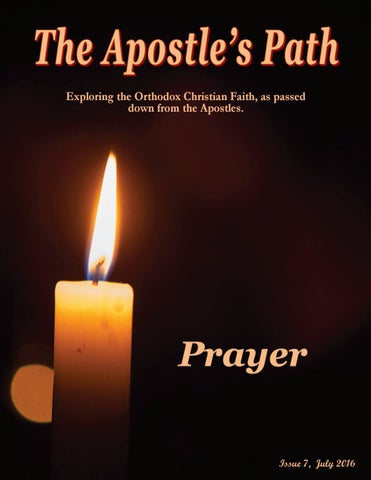
The Apostle’s Path Exploring the Orthodox Christian Faith, as passed down from the Apostles.
Prayer Issue 7, July 2016
Romanian soldiers during an Orthodox service prayer before mission. Laghman, Afghanistan, April 22, 2009 The Apostles Path 2
Cover Photo
Candle in the Dark Jason Parrish, www.arctic productions.net
Short Stories
The Apostle’s Path Issue 7, July 2016
The Apostle’s Path® magazine is published with the blessing of His Grace, Bishop Peter, Administrator of The Diocese of Chicago and Mid-America (ROCOR). EDITOR Randall Gibbons THEOLOGICAL CONTENT ADVISOR Fr. John Whiteford CONTRIBUTING WRITERS Fr. John Whiteford Fr. Brendan Pelphrey
Poetry Collections Author R. C. Gibbons www.rcgibbons.com
PHOTOGRAPHS Jason Parrish, Constantin Mireanu, St. Nicholas Center, Saint Petersburg Theological Academy, Royaldoors.net, Patricia Whiteford, www.bible.ca, www.orthodoxresource.co.uk, Ted The Apostle’s Path, ISSN 2168-6807, is published monthly in Tomball, Texas by RNG Publishing, a non-profit organization. Copyright © 2016 RNG Publishing. All rights reserved. No part of this publication may be reprinted in any way without permission from the publisher. Just ask!
To advertise in The Apostle’s Path, call 346-444-2711
The Apostles Path 3
From the Publisher
have possibly let it get out of control! Where is the line between good and too much?
CONTENTMENT
Like I said, I don’t have all of the answers yet, but I am searching, and seeking God’s guidance and will for me. I know that life is No matter the circumstance we find ourselves in, or the place in a journey, and that we will never achieve a point of complete life where we currently are, we must learn to understand that this success in mastering the traits that God demonstrated in His is the place God has for us at this particular time, and that there walk here on earth, and has prescribed for us in His Word, but is a reason for it. seeing some success in our progression along the way would be comforting. I am a pilgrim on a journey, and each day is a new “We must begin with thanksgiving for everything. The stretch of road that I have not traveled. Each day holds it’s own beginning of joy is to be content with your situation.” dangers and comforts. I have to just keep moving forward, toward the goal, taking in directions and information to reach the next –St. Ambrose of Optina waypoint as I receive them. For the most part, I am a soft-spoken person, although at times my wife may not agree. I would rather stay in the background than be thrust into a position of attention. I do however, possess a creative motivation that continually drives me, and is often hard for me to control. It works on me continually, and prevents me from being able to get comfortable in one place for too long. Change is exciting to me, and I am always seeking new challenges, and, as a result, it is hard for me to accept circumstances as they are. I am always trying to make changes for the better. Granted, my efforts are not always rewarded with success, but my failures are not for a lack of trying, and I am always trying. The energy flows through me day and night. My mind is always in motion, and I am always ready and on the lookout for the next adventure, even if I have to create it. I have traveled the world, and have never been afraid to step into unknown situations. Risk taking has never been scary for me, regardless of what it was. Be it a business venture, traveling to a foreign country with no reservations, sailing out into the ocean in a boat that had not been proven to be seaworthy, or just taking on new responsibilities in a day to day environment, I was, and am always up for the challenge, and honestly, being like I am, I don’t know how to describe myself! I have characteristics that jump across the typical personality classifications, and I have been referred to as everything from adventurous and reckless, to entrepreneurial and visionary. So, are these traits, that make up who I am, reflective of a Christian, and are they setting the example that I should be setting for others? For some of them, probably not, others, I can’t say for sure! I do however, believe God made me the way that I am, and that He made me this way for a reason. That being said, my personality, and the inner drive that I feel, doesn’t leave much room for contentment, and this leads back to the point. How do I replace this driving motivation of mine with contentment, or do I need to do it only some times and not others? I don’t know, but, even not knowing the extent of what I should do, I feel I have made some progress. All too often though, when I am not paying attention, that aggressive spirit takes control again. I routinely find it difficult to differentiate between good motivation for change, and contentment with my current circumstance. It is a struggle that I am constantly having to deal with, and I have more questions than answers. For example, why did God make me this way, and instill this adventurous spirit in me from birth, if it is not good? Maybe it is a good trait, but, I The Apostles Path 4
Contentment in our present circumstances, and faith that this is where God wants me right now, is the desired goal. Achieving this level of contentment and trust is the struggle. Prayer and petitions to God to grant us this contentment, and for strength to contain our passions, are tools to help us along the way. Understanding that we cannot achieve this level of piety alone, without the grace and strength of God, is knowledge that supplements our individual efforts. 11 Not that I speak in regard to need, for I have learned in whatever state I am, to be content: 12 I know how to be abased, and I know how to abound. Everywhere and in all things I have learned both to be full and to be hungry, both to abound and to suffer need. 13 I can do all things through Christ who strengthens me. Philippians 4:11-13 NKJV 6 Now godliness with contentment is great gain. 7 For we brought nothing into this world, and it is certain we can carry nothing out. 8 And having food and clothing, with these we shall be content. 9 But those who desire to be rich fall into temptation and a snare, and into many foolish and harmful lusts which drown men in destruction and perdition. 10 For the love of money is a root of all kinds of evil, for which some have strayed from the faith in their greediness, and pierced themselves through with many sorrows. 1 Timothy 6:6-10 NKJV Randall Gibbons
Orthodox Living Create a Quiet Place For Prayer www.orthodoxprayer.org The first thing an Orthodox Christian should do when moving into a new apartment or house is determine a place for prayer. Some say this should be a conspicuous place where everyone can see it. Some say in needs to be in a corner. What is most important is that it provides a place where you can be in private for personal prayer.
families burn wax votive candles before the icons; however, the tradition is to burn olive oil. Electric lights are not appropriate for use as the light to burn before icons. The traditional oil lamps require an amount of attention which electricity does not, thereby directing our physical services and thoughts to God several times a day when we are required to trim the wick and refill the lamp with oil. It is an important and very old tradition to burn beeswax To determine this place may require some creativity depending candles and olive oil lamps for God and the saints! Be sure to take on the living situation you find yourself in. In a large home you cautions to avoid a fire danger to your residence. can designate a spare room. In a smaller home you you can create a space in one of the closets. In a small apartment a corner in There are a number of different kinds of utensils designed for the bedroom or the living room may be the best you can do. In burning oil before icons. A very common one is the wick-float a dorm room you will probably need to use your desk. In some which utilizes cork to keep the wick and flame floating on the oil. cases you may have to locate a quite space outside of your living The burning of oil before icons, its care and practice is described area such as a nearby chapel. You can also make good use of a below: self standing screen to create a private space. A creative use of a bookcase can also help to create a private nook. It is something 1. The Glass. Any low, wide-mouth glass may be used for the that requires serious thought as this space becomes a sacred space lamp. In Greece, most of the lamps are of clear glass, but colors in the midst of your living space. such as red, blue or milk-colored are also used. [It is advisable to use a large enough glass so that the oil will last at least 10 to 12 Once you have determined the space, then you can create the hours.] home altar or icon stand as it is often called. It is best to have a small table to hold a cross, prayer books, a hand censer, blessed 2. The Oil. The use of olive oil for the lamps is a tradition which items such as the palms from Palms Sunday or a flower from the we have received even from the time of our father Moses. The Epitaphio on holy Friday, holy water from Theophany, and other olive oil will burn best if left open and allowed to age (or even religious items. become rancid). Home altar icons can be placed on the wall above your altar table or if this is not possible place them on stands on the table. The tradition is the your icon stand or corner should be on an eastern wall so you are facing east when you pray just like you do in Church. But, this may not be possible. East is preferred when praying because that is the direction of sunrise. Sunrise is seen as an “icon in nature” of the resurrection. Also, when Christ returns for the Second Coming He will appear in the east. But if have a space that would be perfect for a prayer space, but doesn’t face east, I wouldn’t worry too much. What is important is that you create a space that is conducive to your prayer during the times you pray.
3. The Wick. To make a wick, use cotton string about one foot in length. Do not use coated or waxed string. Cotton string of about 6 ply will be thick enough. If the wick is soaked in vinegar it will burn brighter and cleaner. If this is done, the wick should be allowed to dry thoroughly before being used. 4. The Flame. The Fathers of the Holy Mountain [Athos] have taught us to use a very low flame which they call apathes, passionless. The flame should burn steadily, not flickering. The lamp will burn six to twelve hours, depending mainly on the oil, but also on the size of the flame, the weather, etc. Before relighting the lamp, remove the excess carbon from the wick and twist the string slightly to shape the wick into a point.
With regard to placement of icons, there is no set rule but you can follow the general order seen on your church iconostasis (Christ 5. Cleaning. The glass should be washed periodically, and the oil to the immediate right, the Theotokos to the immediate left, and replaced anew. other saints in decreasing rank). If, however, you have one icon in used with permission from www.orthodoxprayer.org the center, Christ or the Cross is naturally going to be placed preeminently there. Take care in arranging them. An assemblage of icons hung without a sense of symmetry, without a well thought“He who is able to pray correctly, even if he is the poorest out arrangement, evokes a constant sense of dissatisfaction with of all people, is essentially the richest. And he who does the arrangement. Try to remember the principle of hierarchy: for not have proper prayer, is the poorest of all, even if he sits example, do not put an icon of a locally venerated saint above the on a royal throne” icon of the Holy Trinity, the Savior, the Mother of God, or the Apostles. - St John Chrysostom In front of the icons an oil lamp should perpetually burn. Some The Apostles Path 5
THE ORTHODOX CHURCH CREED “I believe in One God, Father Almighty, Maker of heaven and earth and of all things visible and invisible. And in One Lord, Jesus Christ, the only-begotten Son of God, begotten of the Father before all ages. Light of Light, true God of true God, begotten, not created, of one essence with the Father, through whom all things were made. For us and for our salvation He came down from heaven and was incarnate by the Holy Spirit and the Virgin Mary and became Man. He was crucified for us under Pontius Pilate, and He suffered and was buried. On the third day He rose according to the Scriptures. He ascended into heaven and is seated at the right hand of the Father. He will come again with glory to judge the living and the dead. His kingdom will have no end. And in the Holy Spirit, the Lord, Giver of Life, who proceeds from the Father, who together with the Father and the Son is worshipped and glorified, who spoke through the prophets. In one, holy, catholic, and apostolic Church. I acknowledge one baptism for the forgiveness of sins. I expect the resurrection of the dead; and the life of the age to come. Amen.”Ec rentem is se pra? Eterfex se audam constia equitiam iam praret rei iliam, num quo es endi potio, escribulviri con
How You Can Help Support This Evangelical Effort 1. Pick up copies and distribute them wherever you feel they need to be placed. If you need more copies, feel fee to contact us at RNG Publishing, 345-444-2711. 2. Advertise your business in our magazine. 3. Sponsor an ad space as an individual for photos, a commemoration, or whatever appropriate content you wish to insert. 4. Sponsor an ad space and ask us to fill it with edifying content, or just make a donation if you desire. 5. Sponsor an entire issue of the magazine. Remember, as a supporter, you are participating in this evangelical effort. Your support is what allows us to print and distribute this magazine. Be a part of this effort to share God’s word and the Orthodox Faith. The Apostles Path 6
The Church Fathers “Examine yourself to see whether you have within you a strong sense of your self importance, or negatively, you have failed to realize that you are nothing. This feeling of self-importance is deeply hidden, but it controls the whole of our life. Its first demand is that everything should be as we wish it, and as soon as this is not so, we complain to God and we are annoyed with people.
-- St. Theophan the Recluse, 1815 - 1894, Russia §§§§§§§§§§§§§§§ “Before anything else we need humility. Humility protects the soul from all the passions and also from every temptation. In the mercy of God, the little thing done with humility will enable us to be found in the same place as the saints who have labored much and been true servants of God.” -- Father Dorotheos of Gaza, 6th century, Egypt §§§§§§§§§§§§§§§ “The man who endures accusations against himself with humility has arrived at perfection. He is marveled at by the holy angels, for there is no other virtue so great and so hard to achieve.” “What is the sign that a man has attained to purity of heart, and when does a man know that his heart has entered into purity? When he sees all men as good and none appears to him to be unclean and defiled, then in truth, his heart is pure.” -- Saint Isaac the Syrian, 7th century, Iraq §§§§§§§§§§§§§§§
Poemen said, “Do not give your heart to that which does not satisfy your heart.” He also said, “If you are silent, you will have peace wherever you live.” “Malice never wipes out malice. If someone does evil unto you, do them good. Your good will conquer their evil.” A brother asked Abba Poemen, “If I see my brother sin, is it right to say nothing about it?” The old man replied, “whenever we cover our brother’s sin, God will cover ours; whenever we tell people about our brother’s guilt, God will do the same about ours.”
A Sample Prayer Rule A prayer rule is the outline of our daily prayer routine. It is important to have a thought out rule. Casually going to your place for prayer and simply talking with God is not the best way to begin to develop your prayer life. We will find that we end up babbling in front of our God. We can take advantage of the centuries of wisdom and being by using proven prayers that will lift us up in our way of communicating with God. A prayer rule should first specify the place and time of prayer. Then it should outline the sequence of your prayers and the specific prayers you will say. Below is an example of a beginners prayer rule. Always consult with your spiritual father about your prayer rule. He will help you develop one that fits your level of prayer. Outline for Morning and Evening Prayer • Place: In the icon stand in the spare bedroom • Time: 6:30am and 11:00pm for 20 minutes each time • Begin by lighting a candle, and making three prostrations and then stand quietly to collect yourself in your heart • Introductory Prayers - Prayer to Holy Spirit, Trisagion Prayer and Lord’s Prayer • One of six Psalms, Morning: 3, 38, 63, 88, 103, 143 Evening: 70 and 143 - alternate • Intercessions for the living and the dead • Psalm 51 and confession of your sinfulness • Doxology and the morning or evening prayer • Personal dialogue with God • Jesus prayer - repeat 100 times.* • Reflect quietly on the tasks of the day and prepare yourself for the difficulties you might face asking God to help you or in the evening reflect on the day and the difficulties you ecountered and how you dealt with them. • Dismissal prayer Remember to stop mid-morning, noon, and mid-afternoon to say a simple prayer. Offer a prayer before and after each meal thanking God and asking for His blessing. * Repeat the Jesus Prayer in your mind whenever you can throughout the day.
“Keep silence and do not always be comparing yourself with others.” -- Abba Poemen, 4th century, Egypt
for more clarification and full texts to the items listed above, visit http://www.orthodoxprayer.org/Prayer Rule.html
To advertise in The Apostle’s Path, call 346-444-2711
The Apostles Path 7
In order to find that balance, you need to inform your conscience by regularly studying the Scriptures, the writings of the saints, and other edifying books. You need to keep the fasts of the Church. You should also pray that God will guide you, and go to How Much is Too Much? confession regularly. And remember the words of St. Poemen the Great: “Everything that goes to excess comes from the demons” Question: “In this world where we are taught (Saying 129 of St. Poemen, from the Alphabetical Collection of to enjoy ourselves and seek pleasure, where, the Sayings of the Desert Fathers). even as Christians, we want to glorify God’s creation, how are we to know when we have Fr. John Whiteford is the Pastor of St. Jonah Orthodox Church reached a level of overly enjoying the pleasures (ROCOR) in Spring, Texas. He is the author of ‘Sola Scriptura: An of the earth or of God’s creation? I mean to say, Orthodox Analysis of the Cornerstone of Reformation Theology’, if we are relaxing on the beach, or walking in wood, or gazing at published by Conciliar Press, and the General Editor of the ‘St. the heavens, how do we know when enough is enough? It seems Innocent Liturgical Calendar’. obvious we could or should all be working continuously for the Lord by praying or doing good works. But then it seems almost sinful to not enjoy the beauties of the world and God’s creation as well. Is there a formula mentioned or something to help us know when enough is enough?”
Fr. John’s Corner
There is not a simple formula. When you learn how to ride a bike, you have to learn how to balance your weight on the bike, while you peddle, but how do you do that? You do that by trying to do it, and when you fall down, you get back on the bike, and try it again. There are some things that are inherently evil, and so there is no question but that we should abstain from such things. But it is not a sin to enjoy a good meal, or enjoy the company of another person. These are good things, but most good things can be taken to excess, and then it can become sinful.. but the sin is in the excess, not in the thing itself. It can be an even better thing to abstain from such pleasures, if you are doing so out of love for God and a desire to draw closer to Him and to remove things that distract from that desire. But even asceticism can become sinful if it is seen as an end in itself or used as a means to vainglory. It is also sinful if you abstain from things that are good, because you find them abominable. Canon 51 of the Holy Apostles says: “If any Bishop, or Presbyter, or Deacon, or anyone at all on the sacerdotal list, abstains from marriage, or meat, or wine, not as a matter of mortification, but out of an abhorrence thereof, forgetting that all things are exceedingly good, and that God made man male and female, and blasphemously misrepresenting God’s work of creation, either let him mend his ways or let him be deposed from office and expelled from the Church. Let a layman be treated similarly.”
You Can Subscribe The Apostle’s Path® magazine is a monthly, free distribution magazine. If however, you desire to have a copy mailed to your residence or place of business within the continental U. S., a subscription option is available. The yearly subscription price is $27.00 (USD). You can subscribe at our website, www.theapostlespath.com, or by mail. By Credit Card: Visit our website at www.theapostlespath.com By Mail:
So marriage is good. Eating meat is good. Drinking wine is good. However, if you abstain from these out of true asceticism, that is also good. But if you view these things as sinful in and of themselves, this view is itself sinful, and if not repented of will separate you from the Church.
Please mail a check for $27.00 along with delivery mailing address including name, address, city, state, and zip. Make checks payable to RNG PUBLISHING.
So the key here is to find a balance. And what the right balance is will be different for different people.
RNG Publishing P. O. Box 1945 Tomball, Texas 77377
The Apostles Path 8
Mailing address:
Dont’ forget to tell our advertisers that you saw them here!
Saint Theophan the Recluse Beginning To Pray HOMILY 1
1. Always begin praying with at least a little preparation; 2. Do not pray carelessly, but with attention and feeling; and 3. Do not go on to ordinary work immediately after prayer.
...The work of prayer is the first work in Christian life. If in Even if prayer is common for us, it always demands preparation. everyday affairs the saying: “live and learn” is true, then so much What is more common for those who can read and write than more it applies to prayer, which never stops and which has no reading and writing? However, sitting down to read or write, limit. we do not immediately begin, but we calm ourselves before beginning, at least to the point that we can read or write in a Let me recall a wise custom of the ancient Holy Fathers: when peaceful state. Even more so preparation for the work of prayer greeting each other, they did not ask about health or anything is necessary before praying, especially when what we have been else, but rather about prayer, saying “How is your prayer?” The doing before praying is of a totally different nature from prayer. activity of prayer was considered by them to a be a sign of the spiritual life, and they called it the breath of the spirit. If the body Preparing For Prayer has breath, it lives; if breathing stops, life comes to an end. So it is with the spirit. Thus, when beginning to pray, in the If there is prayer, the soul lives; without morning or in the evening, prayer, there is no spiritual life. ...stand for a moment, or sit, or walk, and However, not every act of prayer is prayer. strive in this time to focus your thoughts, Standing at home before your icons, or casting off from them all earthly activities here in church, and venerating them is not and objects. yet prayer, but the “equipment” of prayer. Reading prayers either by heart or from a ...call to mind the One to Whom you are book, or hearing someone else read them is praying, Who He is and who you are, as not yet prayer, but only a tool or method you begin this prayerful petition to Him. for obtaining and awakening prayer. ...awaken in your soul the feeling of Prayer itself is the piercing of our hearts humility and reverent awe of standing by pious feelings towards God, one after before God in your heart. another - feelings of humility, submission, gratitude, doxology, forgiveness, heart-felt As you stand piously before God, all prostration, brokenness, conformity to the of this preparation may seem small and will of God, etc. All of our effort should insignificant, but it is not small in meaning. be directed so that during our prayers, these feelings and feelings This is the beginning of prayer and a good beginning is half the like them should fill our souls, so that the heart would not be work. empty when the lips are reading the prayers, or when the ears hear and the body bows in prostrations, but that there would be some Beginning Your Prayer qualitative feeling, some striving toward God. ...stand before your icons, make a few prostrations, and begin When these feelings are present, our praying is prayer, and when with the usual prayers: “Glory to Thee, our God, glory to Thee. O they are absent, it is not yet prayer. Heavenly King Comforter, Spirit of Truth, come abide in us…” It seems that nothing should be simpler and more natural for us than prayer in which the heart is turned toward God. But in fact it is not always like this for everyone. One must awaken and strengthen a prayerful spirit in oneself, that is one must bring up a prayerful spirit. The first means to this is to read or listen to prayers. Pray as you should, and you will certainly awaken and strengthen the ascent of your heart to God and you will come into a spirit of prayer. Three Simple Instructions I will give here three very simple instructions:
Do not read hurriedly; pay attention to every word and let the meaning of each word enter into your heart... understand what you are reading and feel what you are understanding. No other rules are necessary. These two - understanding and feeling - have the effect of making prayer fitting, and fruitful. For example, you read: “cleanse us from every stain” - feel your stain, desire cleanliness, and ask it from the Lord with hope. When you read: “forgive us our debts as we forgive our debtors” - forgive all in your soul, and having forgiven everyone everything in your heart, ask for forgiveness for yourself from the Lord. (continued on page 11)
To advertise in The Apostle’s Path, call 346-444-2711
The Apostles Path 9
The Apostle’s Path® magazine is a trademarked publication of RNG Publishing. Reader correspondence and editorial contributions are welcome, but we reserve the right to edit or reject all submissions. Advertisers assume all liability for content of their advertising. Publisher assumes no responsibility should false or misleading advertising appear. The Apostle’s Path magazine is distributed freely, but subscriptions are available if there is a desire to have a single copy of the magazine delivered to your home or business. The magazine’s primary objectives are: 1. To share the Gospel of our Lord and Savior Jesus Christ. 2. To introduce the public to the Orthodox Christian Faith. 3. Provide exposure for local Orthodox Churches. Advertising inquiries should be made to: publisher@theapostlespath.com or 346-444-2711
What Do We Mean When We Refer To Church Jurisdictions? There is only one Orthodox Church. The different jurisdictions of the Orthodox Church reflect the differing nations of origin, but in many cases in the west, such churches have become much more widely dispersed. Across all the Orthodox Churches you will find consistent worship, belief, practice and ministries. Only the languages used with local cultural and musical traditions are different. The jurisdictions are not denominations but rather refer to the oversight (jurisdiction) of a bishop within a larger church family. The diagram below explains this visually; an explanation follows:
let us take care of all your printing needs
MAGAZINES | CATALOGS POSTCARDS | CALENDARS & BROCHURES
4954 Space Center Dr., San Antonio, TX 78218 210.480.0860 | www.shweiki.com
The Apostles Path 10
Dont’ forget to tell our advertisers that you saw them here!
(continued from page 9)
well during his prayers. One should recognize that tasting this sweetness of prayer is the very goal of praying, and if praying leads to a prayerful spirit, then it is exactly through such a tasting.
When you read: “Thy will be done” - completely give up your own will to the Lord in your heart, and honestly be prepared to If you will follow these few rules, then you will quickly see the meet everything that the Lord is well-pleased to send to to you fruit of prayerful labor. And he who fulfills them already without with a good heart. this instruction, of course, is already tasting this fruit. If you read each verse of your prayers in this way, then you will be truly praying. Developing True Prayer To facilitate the development of true prayer, take these steps:
All praying leaves prayer in the soul, Continual prayer in this manner gives it root, Patience in this work establishes a prayerful spirit. May God grant this to you by the prayers of our All-pure Mistress, the Theotokos!
1) ...keep a prayer rule according to the blessing of your spiritual I have given you initial basic instruction in the ways of raising father - not more than you can read unhurriedly on a normal day; up in yourselves a prayerful spirit, that is, how to pray in a way appropriate to the meaning of prayer - at home in the morning 2) ...become familiar with the prayer in your rule, fully take in and the evening, and in the church. But this is not yet everything... each word and feel it, so that you would know in advance what should be in your soul as you read. It will be even better if you St. Theophan the Recluse, 1815 - 1894, Russia learn the prayers by heart. When you do this, then all of your prayers will be easy for you to remember and feel... 3) ...keep your attention focused on the words of your prayer, knowing in advance that your mind will wander. When your mind does wander during prayer, bring it back. When it wanders again, bring it back again. Each and every time that you read a prayer while your thoughts are wandering (and consequently you read it without attention and feeling,) then do not fail to read it again. Even if your mind wanders several times in the same place, read it again and again until you read it all the way through with understanding and feeling. In this way, you will overcome this difficulty so that the next time, perhaps, it will not come up again, or if it does return, it will be weaker. This is how one must act when the mind wanders. 4) ...a particular word or phrase might act so strongly on the soul, that the soul no longer wants to continue with the prayer, and even though the lips continue praying, the mind keeps wandering back to that place which first acted on it. In this case: stop, do not read further, but stand with attention and feeling in that place, and use the prayer in that place and the feelings engendered by it to feed your soul. Do not hurry to get yourself out of this state. If time cannot wait, it is better to leave your rule unfinished than to disturb this prayerful state. Maybe this feeling will stay with you all day like your guardian Angel! This sort of grace-filled action on the soul during prayer means that the spirit of prayer is becoming internalized, and consequently, maintaining this state is the most hopeful means of raising up and strengthening a spirit of prayer in your heart. 5) ...when you finish your prayers, do not immediately go off to any sort of work, but remain and think at least a little about what you have just finished and what now lies before you. If some feeling was given to you during prayer, keep it after you pray. If you completed your prayer rule in the true spirit of prayer, then you will not wish to quickly go about other work; this is a property of prayer. Thus our ancestors said when they returned from Constantinople: “he who has tasted sweet things does not desire bitter things”. So it is with each person who has prayed
Things You Should Know When Visiting An Orthodox Church
1. While all have the same theology, utilize the same service structure, and sing many of the same songs, there are styles that will be different and these are inherited from the cultural traditions of that particular jurisdiction. 2. First, and foremost, understand that you may find different languages spoken. If you visit an Orthdox Church from the Greek jusrisdiciton, you may very well find that they speak some, a lot, a little, or no Greek during the service. This is an individual church perogative. The same applies to the other jurisdictions as well. 3. Expect something different. You will not find a typical Protestant style worship service. The service that you will find in an Orthodox Liturgy (service) was created in the 3rd century. Yes, that is correct, 1700 years ago, and short of some tweeking, has remained the same since. It is the same Liturgy that is practiced in Orthodox Churches throughout the world. 4. Some churches sit, and some stand! Some have pews, and some don’t. If they have pews, there will likely be short periods when they stand. Just follow along. If they don’t have pews, there will typically be seating around the perimeter walls for those who cannot stand for long periods of time, or for those who choose not to. Feel free to use them if you wish. 5. Unless you are a member of an Orthodox Church, you are not supposed to participate in taking of communion. 6. Follow along in the service books so you will know what is being said and what is happening, and enjoy. The Apostles Path 11
A Bit Of History What is the Apostles Fast?
Apostles. On the Sunday of All Saints, we remember and celebrate the lives of all those who have gone before us in the faith: our by Fr. Brendan Pelphrey fathers, forefathers, the apostles, preachers, evangelists, teachers, hierarchs and martyrs. The readings which are appointed for that Orthodox Christians around the world observe four fasting day (Hebrews 11:33-40, 12:1-2, and Matthew 10:32-33, 37-38, seasons during the year. Two of these - the Great Fast for the 19:27-30) remind us that countless worshippers of God have forty days of Lent, and the Dormition Fast during the first fifteen sacrificed their lives for the faith which we have inherited. days of August - are considered “strict” fasts. The other two are generally observed as “lesser” fasts: the so-called “Christmas Lent” Following Jesus’ admonition recorded by St. Matthew, the or fast during the forty days before the Feast of the Nativity, and Apostles left behind their parents, their children, and their the Fast of the Apostles which occurs in June. possessions in order to bring the Good News of Jesus Christ to people who did not know Him. Christian missionaries around the In America, the Fast of the Apostles is probably the least well world are still doing this today. During the Fast of the Apostles known, but is among the oldest of Christian traditions. It is we are reminded to pray for them all, and for Orthodox missions mentioned by St. Athanasius in the fourth century, and there are everywhere. other testimonies to its existence very early in the history of the Church. The fast begins on the day after the observance of All The Fast is also an occasion to remember that in Christ, we have a Saints’ Sunday, which falls one week after Pentecost. unity that goes far beyond our personal opinions, likes or dislikes. The Acts of the Apostles tells us that the Today the fast ends with the observance Apostles themselves recognized this very of the Feast of Sts. Peter and Paul. In early. The occasion was an argument earliest practice, however, the fast was which took place regarding whether the probably not connected with the Feast followers of Christ needed to continue of Peter and Paul. Rather, it was a to observe the Law of Moses. At first, time for fasting after the celebration of Peter and Paul took different sides in the Pentecost and/or All Saints. Apparently, discussion. different traditions prescribed different lengths of the fast—whether for one Both Peter and Paul were Jews, but week, several weeks, or even only one their personalities and backgrounds were day. Today, the fast still has a variable very different. Peter, who was formerly length because of its connection to the a fisherman, was among the first of the date of Pentecost, and therefore of All disciples to follow Jesus. Presumably Saints. he was uneducated and probably spoke only Aramaic in the local Galilean The date of Pentecost varies with the dialect. Paul, on the other hand, was date of Holy Pascha (Easter), falling very well educated under Gamaliel, the fifty days after Pascha. Therefore, the most famous rabbi (teacher) of his time, date of the Sunday of All Saints varies and spoke several languages. accordingly. This means that the length of the Fast of the Apostles also varies Moreover, Paul - originally named Saul each year. For those churches which - was not among the Twelve Disciples. follow the Old Calendar, the Fast can He even led a deadly persecution of be very long (as long as 42 days) or very short (8 days), depending Christians until he received an astounding vision of Christ while upon when Holy Pascha falls. For Orthodox Churches which on the way to Damascus (Acts 9). The blinding vision changed use the New Calendar, there are some years in which there is no his life forever. Thereafter he became an ardent witness to the Apostles’ Fast at all. risen Christ. But because of his former life, it was very difficult at first for the disciples to forgive and accept him. There are different traditions regarding how strictly to follow the Fast. In most Orthodox traditions, the fast is not as severe Before very long, Peter and Paul became involved in the dispute as that during Great Lent. Fish, wine and oil are permitted on about keeping the Law. Paul, who was preaching among Gentiles, all days except Wednesday and Friday, which are strict fast-days taught that it was no longer necessary to keep the Law, because throughout the year except immediately following the Great Feasts the purpose of the Law was to point to the death and resurrection of the Lord. In other traditions, fish, wine and oil are permitted of Christ. Paul even proclaimed that the Law had been nailed to on Saturdays and Sundays during the Fast of the Apostles. the cross with Christ, for now we are justified by faith and not by following the Law (see Romans 10 and Galatians 3). Peter, however, For faithful Orthodox today, the Fast of the Apostles can be an was drawn towards the opinion of some Jews that although occasion for reflection upon the lives and example of the Holy Jesus was indeed the promised Messiah, the Law nevertheless The Apostles Path 12
should continue to be observed for all time. Paul journeyed to Jerusalem to meet with Peter and the other disciples in order to settle the matter. Paul says that he opposed Peter to his face (Galatians 2:11 ff.). After some discussion it was agreed that Christians would no longer follow the Law, including practices like circumcision and the complex dietary laws given in the Books of Moses. However, they would continue to observe some of the restrictions of the Law regarding moral principles, and the eating of blood. It is significant that Peter did not simply decide to agree with Paul on these matters. Rather, he was given a vision from God in which it was declared that foods which were formerly declared to be “unclean” for all Jews, were now “clean” or acceptable (Acts 10). Thus, Peter realized that God was instituting a new order and way of life, and that to agree with Paul was a matter of obedience to Christ himself. These events remind us to seek God when we have disagreements within the Church. This requires humility on our part, and the willingness to accept others even when we might not have agreed with them before. We let go of our own personal wishes or demands, and pray for the good of the Church and for a recognition of the will of God for all of us together. At the conclusion of the Fast, therefore, we celebrate Peter and Paul together. The icon of the Feast depicts the two men standing side-by-side, holding the Church together in their hands. This is a powerful symbol of the supernatural love for one another which is given by the Holy Spirit. In the Holy Spirit we have agreement and new life. For this reason, Orthodox Christians today can regard the Fast of the Apostles as one of the most important times of the year, a time to humble ourselves and pray for genuine love and unity in the Church around the world. Fr. Brendan Pelphrey, a former Protestant pastor and missionary, has been a priest in the Greek Archdiocese since 2000. He has taught in a number of universities in different parts of the world, including Hellenic College in Brookline, MA. His academic degrees and publications are in the fields of Philosophy, Comparative Cultures, Christian Dogmatic Theology and Patristics, New Testament, Christian Medieval Mysticism and Christian Mission. Posted by the Orthodox Christian Network. You can find the Orthodox Christian Network on Google+.
+ Medicine Cabinet + The most effective way to remember your wife’s birthday is to forget it once. ------------------------------------After a talking sheepdog gets all the sheep in the pen, he reports back to the farmer: “All 40 accounted for.” “But I only have 36 sheep,” says the farmer. “I know,” says the sheepdog. “But I rounded them up.” ------------------------------------10 Facts About You: 1. You’re reading this now. 2. You’re realizing that this is a stupid fact. 4. You didn’t notice I skipped number 3. 5. You’re checking now. 6. You’re smiling. 7. You’re still reading this even though it is stupid. 9. You didn’t realize I skipped number 8. 10. You’re checking again and smiling because you fell for it again. 11. You’re enjoying this. 12. You didn’t realize I said 10 facts not 12. ------------------------------------Student: “Should I get in trouble for something I didn’t do?” Teacher: “No.” Student: “Good, because I didn’t do my homework.” ------------------------------------A child asked his father, “How were people born?” So his father said, “Adam and Eve made babies, then their babies became adults and made babies, and so on.” The child then went to his mother, asked her the same question and she told him, “We were monkeys then we evolved to become like we are now.” The child ran back to his father and said, “You lied to me!” His father replied, “No, your mom was talking about her side of the family.” ------------------------------------A man approached a very beautiful woman in a large supermarket and said, “I’ve lost my wife here in the supermarket. Can you talk to me for a couple of minutes?” “Why do you want to talk to me?” she asked puzzled. “Because every time I talk to a beautiful woman, my wife appears out of nowhere.” ------------------------------------In a Catholic school cafeteria, a nun places a note in front of a pile of apples, “Only take one. God is watching.” Further down the line is a pile of cookies. A little boy makes his own note, “Take all you want. God is watching the apples.” The Apostles Path 13
The Apostles Path 14
Dont’ forget to tell churches that you saw them here!
St Cyril of Jerusalem Orthodox Church
St Anthony the Great Orthodox Church Saint Jonah Orthodox Church St Sava Serbian Orthodox Church
St Mary Magdalene's St Joseph Orthodox Christian Church
St Vladimir Russian Orthodox Church
St. Paul Orthodox Christian Church Saint George Orthodox Church St Basil the Great Greek Orthodox Church
Annunciation Greek Orthodox Cathedral
St. Andrew Orthodox Mission
Holy Forty Martyrs of Sebaste Antiochian Orthodox Church
St John the Theologian Greek Orthodox Church
In the Houston area, we have parishes under seven different general jurisdictions. ORTHODOX CHRISTIAN PARISHES IN THE GREATER HOUSTON AREA ARRANGED BY JURISDICTION: The Antiochian Orthodox Christian Archdiocese of North America
The Orthodox Church in America
Holy Forty Martyrs of Sebaste Antiochian Orthodox Church St. Anthony the Great Antiochian Orthodox Church St. George Antiochian Orthodox Christian Church St. Joseph Antiochian Orthodox Church St. Michael Antiochian Orthodox Church St. Paul Antiochian Orthodox Church St. Silouan Orthodox Church
St. Cyril of Jerusalem Orthodox Church
The Greek Orthodox Archdiocese of America
Life Giving Spring Orthodox Church St. Jonah Orthodox Church St. Vladimir Russian Orthodox Church
Annunciation Greek Orthodox Cathedral Assumption of the Virgin Mary Greek Orthodox Church St. Basil the Great Greek Orthodox Church St. George Greek Orthodox Church St. John the Theologian Greek Orthodox Church St. Paraskevi Greek Orthodox Monastery The Apostles Path 15
The Orthodox Church in America - Romanian Episcopate St. Andrew Orthodox Mission St Mary of Magdala Romanian Orthodox Mission The Russian Orthodox Church Outside Russia
The Serbian Orthodox Church in America Ss. Constantine & Helen Serbian Orthodox Church St. Sava Church
Orthodox Houston Clergy Association www.orthodoxhouston.org
The Apostles Path 15
The Apostles Path 16