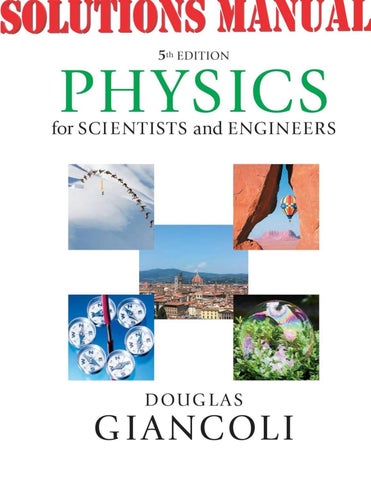
Physics for Scientists & Engineers with Modern Physics 5th Edition by Douglas C. Giancoli.
TABLE OF CONTENTS CHAPTER 1 Introduction, Measurement, Estimating CHAPTER 2 Describing Motion: Kinematics in One Dimension CHAPTER 3 Kinematics in Two or Three Dimensions; Vectors CHAPTER 4 Dynamics: Newton’s Laws of Motion CHAPTER 5 Using Newton’s Laws: Friction, Circular Motion, Drag Forces CHAPTER 6 Gravitation and Newton’s Synthesis CHAPTER 7 Work and Energy CHAPTER 8 Conservation of Energy CHAPTER 9 Linear Momentum CHAPTER 10 Rotational Motion CHAPTER 11 Angular Momentum; General Rotation CHAPTER 12 Static Equilibrium; Elasticity and Fracture CHAPTER 13 Fluids CHAPTER 14 Oscillations CHAPTER 15 Wave Motion CHAPTER 16 Sound CHAPTER 17 Temperature, Thermal Expansion, and the Ideal Gas Law CHAPTER 18 Kinetic Theory of Gases CHAPTER 19 Heat and the First Law of Thermodynamics CHAPTER 20 Second Law of Thermodynamics
CHAPTER 21 Electric Charge and Electric Field CHAPTER 22 Gauss’s Law CHAPTER 23 Electric Potential CHAPTER 24 Capacitance, Dielectrics, Electric Energy Storage CHAPTER 25 Electric Current and Resistance CHAPTER 26 DC Circuits CHAPTER 27 Magnetism CHAPTER 28 Sources of Magnetic Field CHAPTER 29 Electromagnetic Induction and Faraday’s Law CHAPTER 30 Inductance, Electromagnetic Oscillations, and AC Circuits CHAPTER 31 Maxwell’s Equations and Electromagnetic Waves CHAPTER 32 Light: Reflection and Refraction CHAPTER 33 Lenses and Optical Instruments CHAPTER 34 The Wave Nature of Light: Interference and Polarization CHAPTER 35 Diffraction CHAPTER 36 The Special Theory of Relativity CHAPTER 37 Early Quantum Theory and Models of the Atom CHAPTER 38 Quantum Mechanics CHAPTER 39 Quantum Mechanics of Atoms CHAPTER 40 Molecules and Solids CHAPTER 41 Nuclear Physics and Radioactivity CHAPTER 42 Nuclear Energy; Effects and Uses of Radiation CHAPTER 43 Elementary Particles CHAPTER 44 Astrophysics and Cosmology
CHAPTER 1: Introduction, Measurement, Estimating Responses to Questions 1.
(a) A particular person’s foot. Merits: reproducible. Drawbacks: not accessible to the general public; not invariable (could change size with age, time of day, etc.); not indestructible. (b) Any person’s foot. Merits: accessible. Drawbacks: not reproducible (different people have different size feet); not invariable (could change size with age, time of day, etc.); not indestructible. Neither of these options would make a good standard.
2.
The distance in miles is given to one significant figure, and the distance in kilometers is given to five significant figures! The value in kilometers indicates more precision than really exists or than is meaningful. The last digit represents a distance on the same order of magnitude as a car’s length! The sign should perhaps read “7.0 mi (11 km),” where each value has the same number of significant figures, or “7 mi (11 km),” where each value has about the same % uncertainty.
3.
The number of digits you present in your answer should represent the precision with which you know a measurement; it says very little about the accuracy of the measurement. For example, if you measure the length of a table to great precision, but with a measuring instrument that is not calibrated correctly, you will not measure accurately. Accuracy is a measure of how close a measurement is to the true value.
4.
If you measure the length of an object and you report that it is “4,” you haven’t given enough information for your answer to be useful. There is a large difference between an object that is 4 meters long and one that is 4 km long. Units are necessary to give meaning to a numerical answer.
5.
You should report a result of 8.32 cm. Your measurement had three significant figures. When you multiply by 2, you are really multiplying by the integer 2, which is an exact value. The number of significant figures is determined by the measurement.
6.
The correct number of significant figures is three: sin 30.0º = 0.500.
7.
Useful assumptions include the population of the city, the fraction of people who own cars, the average number of visits to a mechanic that each car makes in a year, the average number of weeks a mechanic works in a year, and the average number of cars each mechanic can see in a week. (a) There are about 800,000 people in San Francisco. Assume that half of them have cars. If each of these 400,000 cars needs servicing twice a year, then there are 800,000 visits to mechanics in a year. If mechanics typically work 50 weeks a year, then about 16,000 cars would need to be seen each week. Assume that on average, a mechanic can work on 4 cars per day, or 20 cars a week. The final estimate, then, is 800 car mechanics in San Francisco. (b) Answers will vary. But following the same reasoning, the estimate is 1/1000 of the population.
© 2023 Pearson Education, Ltd. All rights reserved. This material is protected under all copyright laws as they currently exist. No portion of this material may be reproduced, in any form or by any means, without permission in writing from the publisher.
1
Physics for Scientists & Engineers with Modern Physics, 5e, Global Edition
Instructor Solutions Manual
Responses to MisConceptual Questions 1.
(c) As stated in the text, scientific laws are descriptive – they are meant to describe how nature behaves. Since our understanding of nature evolves, so do the laws of physics, when evidence can convince the community of physicists. The laws of physics are not permanent, and are not subject to political treaties. In fact, there have been major changes in the laws of physics since 1900 – particularly due to relativity and quantum mechanics. The laws of physics apply in chemistry and other scientific fields, since those areas of study are based on physics. Finally, the laws of physics are man-made, not a part of nature. They are our “best description” of nature as we currently understand it. As stated in the text, “Laws are not lying there in nature, waiting to be discovered.”
2.
(e) The first product is 142.08 m, which is only accurate to the 10’s place, since 37 m/s has only two significant figures. The second product is 74.73 m, which is only accurate to the 1’s place, since 5.3 s has only two significant figures. Thus the sum of the two terms can only be accurate to the 10’s place. 142.08 + 74.73 = 216.81, which to the 10’s place is 220 m.
3.
(a) The total number of digits present does not determine the precision, as the leading zeros in (c) and (d) are only place holders. Rewriting all the measurements in units of meters shows that (a) implies a precision of 0.0001m, (b) and (c) both imply a precision of 0.001 m, and (d) implies a precision of 0.01 m. Note that since the period is shown, the trailing zeros are significant. If all the measurements are expressed in meters, (a) has 4 significant figures, (b) and (c) each have 3 significant figures, and (d) has 2 significant figures.
4.
(b) The leading zeros are not significant. Rewriting this number in scientific notation, 7.8 10−3 , shows that it only has two significant digits.
5.
(b) When you add or subtract numbers, the final answer should contain no more decimal places than the number with the fewest decimal places. Since 25.2 has one decimal place, the answer must be rounded to one decimal place, or to 26.6. Thus the answer has 3 significant figures.
6.
(b) The word “accuracy” is often misused. If a student repeats a measurement multiple times and obtains the same answer each time, it is often assumed to be accurate. In fact, students are frequently given an “ideal” number of times to repeat the experiment for “accuracy.” However, systematic errors may cause each measurement to be inaccurate. A poorly working instrument may also limit the accuracy of your measurement.
7.
(a) Quoting the textbook, “precision” refers to the repeatability of the measurement using a given instrument. Precision and accuracy are often confused. “Accuracy” is defined by answer (b).
8.
(d) This addresses misconceptions about squared units and about which factor should be in the numerator of the conversion. This error can be avoided by treating the units as algebraic symbols that must be cancelled out.
9.
(e) When making estimates, the estimator may frequently believe that their answers are more significant than they actually are. This question helps the estimator realize what an order-ofmagnitude estimation is NOT supposed to accomplish.
10. (d) This addresses the fact that the generic unit symbol, like [L], does not indicate a specific system of units. © 2023 Pearson Education, Ltd. All rights reserved. This material is protected under all copyright laws as they currently exist. No portion of this material may be reproduced, in any form or by any means, without permission in writing from the publisher.
2
Chapter 1
Introduction, Measurement, Estimating
Solutions to Problems 1.
2.
(a) 777
3 significant figures
(b) 81.60
4 significant figures
(c)
7.03
3 significant figures
(d) 0.03
1 significant figure
(e)
0.0086
2 significant figures
(f)
6465
4 significant figures
(g) 8700
2 significant figures
(a) 5.859 = 5.859 100 (b) 21.8 = 2.18 101 (c)
0.0068 = 6.8 10−3
(d) 328.65 = 3.2865 102
3.
(e)
0.219 = 2.19 10−1
(f)
444 = 4.44 102
(a) 8.69 105 = 869, 000 (b) 9.1103 = 9100 (c)
2.5 10−1 = 0.25
(d) 4.76 102 = 476 (e) 3.62 10−5 = 0.0000362 0.35 m
4.
% uncertainty =
5.
(a) % uncertainty =
3.25 m
(b) % uncertainty =
100% = 11%
0.2 s 4.5s
100% = 4.444% 4%
0.2 s
100% = 0.4444% 0.4% 45s (c) The time of 4.5 minutes is 270 seconds. 0.2 s % uncertainty = 100% = 0.0741% 0.07% 270 s
© 2023 Pearson Education, Ltd. All rights reserved. This material is protected under all copyright laws as they currently exist. No portion of this material may be reproduced, in any form or by any means, without permission in writing from the publisher.
3
Physics for Scientists & Engineers with Modern Physics, 5e, Global Edition
6.
Instructor Solutions Manual
To add values with significant figures, adjust all values to be added so that their exponents are all the same. ( 9.2 103 s ) + ( 6.3 104 s ) + ( 0.008 106 s ) = ( 9.2 103 s ) + ( 63 103 s ) + (8 103 s ) = ( 9.2 + 63 + 8 ) 103 s = 80.2 103 s = 8.0 104 s
When adding, keep the least accurate value, and so keep to the “ones” place in the last set of parentheses. 7.
When you multiply, the result should have as many digits as the number with the least number of significant digits used in the calculation.
( 4.079 10 m )(0.057 10 m ) = 2.325m 2.3 m 2
−1
2
2
8.
The “best value” uncertainty is taken to be 0.01 m. 0.01m 2 % uncertainty = 100% = 0.787% 0.8% 1.27 m 2
9.
(radians) 0 0.10 0.12
sin( ) 0.00 0.10 0.12
tan( ) 0.00 0.10 0.12
0.20 0.24 0.25
0.20 0.24 0.25
0.20 0.24 0.26
Keeping 2 significant figures in the angle, and expressing the angle in radians, the largest angle that has the same sine and tangent is 0.24 radians . In degrees, the largest angle (keeping 2 significant figure) is 12 .
10. (a) To find the number of students, multiply the sample size times the percentage. ( 215 students )( 0.372 ) = 79.98 students But the number of students must be an integer, so the number is 80 students . (b) The original statement gave the percentage with too many significant figures. The calculation is 80 / 215 = 0.372093023… , but that result should only have 2 significant figures, since the value of 80 (as an integer, and not an estimate) has only 2 significant figures. The percentage should have been quoted as 37%. That would still give the correct number of students. ( 215 students )( 0.37 ) = 79.55 students, which rounds to 80 students. 11. We calculate what fraction 9 seconds is of an entire year. 1yr 9s −5 −5 1yr 3.156 107s 100% = 2.85 10 % 3 10 % 12. In order to find the approximate uncertainty in the area, calculate the area for the specified radius, the minimum radius, and the maximum radius. Subtract the extreme areas. The uncertainty in the area is then half this variation in area. The uncertainty in the radius is assumed to be 0.1 104 cm .
(
2 Aspecified = rspecified = 5.1 104 cm
) = 8.17 10 cm 2
9
( ) = 7.85 10 cm = ( 5.2 10 cm ) = 8.49 10 cm
2 Amin = rmin = 5.0 104 cm
2
9
2
2 Amax = rmax
2
9
2
4
2
© 2023 Pearson Education, Ltd. All rights reserved. This material is protected under all copyright laws as they currently exist. No portion of this material may be reproduced, in any form or by any means, without permission in writing from the publisher.
4
Chapter 1
Introduction, Measurement, Estimating
(
)
A = 12 ( Amax − Amin ) = 12 8.49 109 cm 2 − 7.85 109 cm 2 = 0.32 109 cm 2
Note that the last value above has only 1 significant figure. Thus the area should be quoted as
A = (8.2 0.3) 109 cm2 . 13. In order to find the approximate uncertainty in the volume, calculate the volume for the minimum radius and the volume for the maximum radius. Subtract the extreme volumes. The uncertainty in the volume is then half of this variation in volume. 3 3 Vspecified = 43 rspecified = 43 ( 0.64 m ) = 1.098 m3 3 Vmin = 43 rmin = 43 ( 0.60 m ) = 0.905 m 3 3
3 Vmax = 43 rmax = 43 ( 0.68 m ) = 1.317 m 3 3
(
)
V = 12 (Vmax − Vmin ) = 12 1.317 m3 − 0.905 m3 = 0.206 m3
Note that the last value above has only 1 significant figure. Thus the percent uncertainty is V 0.206 m 3 = 100 = 18.6 20 % . Vspecified 1.098 m 3 14. (a) 286.6 mm
286.6 10−3 m
0.286 6 m
(b) 74 V
74 10−6 V
0.000 074 V
(c)
430 mg
430 10 −3 g
0.43g (if last zero is not significant)
(d) 47.2 ps
47.2 10−12 s
0.000 000 000 047 2 s
(e)
22.5 nm
22.5 10−9 m
0.000 000 022 5 m
(f) 2.50 gigavolts
2.5 109 volts
2, 500, 000, 000 volts
Note that in part (f) in particular, the correct number of significant digits cannot be determined when you write the number in this format. 15. (a) 3 106 volts
3megavolt = 3 Mvolt
(b) 2 10−6 meters
2 micrometers = 2 m
(c) 5 103 days
5 kilodays = 5 kdays
(d) 18 102 bucks
18 hectobucks = 18 hbucks or 1.8 kilobucks
(e)
−7
9 10 seconds
900 nanoseconds = 900 ns or 0.9 s
16. Assuming a height of 5 feet 10 inches, then 5'10" = ( 70 in )(1 m 39.37 in ) = 1.8 m . Assuming a weight of 165 lbs, then (165 lbs )( 0.456 kg 1 lb ) = 75.2 kg . Technically, pounds and mass measure two separate properties. To make this conversion, we have to assume that we are at a location where the acceleration due to gravity is 9.80 m/s2.
© 2023 Pearson Education, Ltd. All rights reserved. This material is protected under all copyright laws as they currently exist. No portion of this material may be reproduced, in any form or by any means, without permission in writing from the publisher.
5
Physics for Scientists & Engineers with Modern Physics, 5e, Global Edition
17. (a)
(b)
SA Earth SA Moon
=
2 4 REarth 2 4 RMoon
=
4 3
( 6.38 10 km ) = 13.4 = (1.74 10 km ) ( 6.38 10 km ) = 49.3 = (1.74 10 km )
2 REarth
3
2
2 RMoon
3
2
3 3 REarth REarth = 4 = 3 3 RMoon VMoon 3 RMoon
VEarth
Instructor Solutions Manual
3
3
3
3
18. To answer this question, convert 15 m/s to mi/h, and compare to the speed limit. 1 mi 3600s 15 m s = 33.56 mi h 34 mi h 1609 m 1h Since the conversion only gives about 34 mi/h, the driver is not exceeding the speed limit . We could also change 35 mi/h to m/s, and find that 35 mi/h is more than 15 m/s. 19. (a) 14 billion years = 1.4 1010 years (b)
3.156 107s = 4.4 1017s ) 1yr
(
1.4 1010 yr
(
)
20. (a) 93 million miles = 93 106 miles (1610 m 1 mile ) = 1.5 1011 m (b) 1.5 1011 m = (1.5 1011 m )(1km 103 m ) = 1.5 108 km 21. To add values with significant figures, adjust all values to be added so that their units are all the same. 1.90 m + 142.5cm + 6.27 105 m = 1.90 m + 1.425 m + 0.627 m = 3.952 m 3.95 m When you add, the final result is to be no more accurate than the least accurate number used. In this case, that is the first measurement, which is accurate to the hundredths place when expressed in meters.
(
)
22. (a) 1.0 10−10 m = 1.0 10−10 m ( 39.37 in 1 m ) = 3.9 10 −9 in (b)
(1.0 cm )
1 m 1 atom 8 = 1.0 10 atoms −10 100 cm 1.0 10 m
23. (a)
(1km h )
(b)
(1m s )
(c)
(1km h )
0.621 mi
= 0.621mi h , so the conversion factor is 1 km 3.28 ft
= 3.28 ft s, so the conversion factor is 1m
0.621mi h 1km h
3.28 ft s 1m s
.
.
1000 m 1 h
0.278 m s . = 0.278 m s, so the conversion factor is 1km h 1 km 3600 s
Note that if more significant figures were used in the original factors, such as 0.6214 miles per kilometer, then more significant figures could have been included in the answers.
© 2023 Pearson Education, Ltd. All rights reserved. This material is protected under all copyright laws as they currently exist. No portion of this material may be reproduced, in any form or by any means, without permission in writing from the publisher.
6
Chapter 1
Introduction, Measurement, Estimating
(
)
(
2
24. (a) 1 ft 2 = 1 ft 2 (1 yd 3 ft ) = 0.111 yd 2, and so the conversion factor is (b) 1 m = 1 m 2
2
) ( 3.28 ft 1 m ) = 10.8 ft , and so the conversion factor is 2
2
0.111 yd 2 1 ft 2
10.8ft 2 1m 2
.
.
25. (a) Find the distance by multiplying the speed by the time.
(
)(
)
1.00 ly = 2.998 108 m s 3.156 107 s = 9.462 1015 m 9.46 1015 m (b) Do a unit conversion from ly to AU. 9.462 1015 m 1 AU 4 (1.00 ly ) = 6.31 10 AU 11 1.00 ly 1.50 10 m 26. One mile is 1609 m, according to the unit conversions in the front of the textbook. Thus it is 109 m longer than a 1500-m race. The percentage difference is calculated here. 109 m 100% = 7.3% 1500 m 27. From Example 1–6, the thickness of a page of this book is about 6 10−5 m. The wavelength of orange krypton-86 light is found from the fact that 1,650,763.73 wavelengths of that light is the definition of the meter. 6 10−5 m 1, 650, 763.73 wavelengths 1page = 99 100 1m 1page 28. The original definition of the meter was that 1 meter was one ten-millionth of the distance from the Earth’s equator to either pole. The distance from the equator to the pole would be one-fourth of the circumference of a perfectly spherical Earth. Thus the circumference would be 40 million meters:
C = 4 107 m . We use the circumference to find the radius. C = 2 r → r =
C
=
4 107 m
= 6.37 106 m 2 2 The value in the front of the textbook is 6.38 106 m. Since the circumference and the radius are proportional to each other, the % error would be the same in both cases. We calculate it for the radius. R 0.01 106 m = 100 = 0.1567 0.2 % R 6.38 106 m
29. The value of 12 liters per km can also be expressed as 1 km per 12 liters. We convert the units of km per liter to miles per gallon.
1km 3.785 L 0.6214 mi
12 L 1gal
1km
mi
mi
= 0.196 gal 0.20 gal
30. Since the meter is longer than the yard, the soccer field is longer than the football field. 1.094 yd Lsoccer − Lfootball = 100.0 m − 100.0 yd = 9.4 yd 1m © 2023 Pearson Education, Ltd. All rights reserved. This material is protected under all copyright laws as they currently exist. No portion of this material may be reproduced, in any form or by any means, without permission in writing from the publisher.
7
Physics for Scientists & Engineers with Modern Physics, 5e, Global Edition
Instructor Solutions Manual
1m
Lsoccer − Lfootball = 100.0 m − 100.0 yd
= 8.6 m 1.094 yd Since the soccer field is 109.4 yd compared to the 100.0-yd football field, the soccer field is
9.4 % longer than the football field.
3.156 107s 7 = 3.16 10 s 1 yr 7 3.156 10 s 1 109 ns (b) # of nanoseconds in 1.00 yr: 1.00 yr = (1.00 yr ) = 3.16 1016 ns 1yr 1 s 1 yr = 3.17 10−8 yr 1.00 s = (1.00 s ) (c) # of years in 1.00 s: 7 3.156 10 s 1.00 yr = (1.00 yr )
31. (a) # of seconds in 1.00 yr:
10−15 kg 1 proton or neutron = 1012 protons or neutrons −27 10 kg 1 bacterium −17 1 proton or neutron 10 kg (b) = 1010 protons or neutrons −27 10 kg 1 DNA molecule 2 10 kg 1 proton or neutron (c) = 1029 protons or neutrons −27 10 kg 1 human 41 10 kg 1 proton or neutron 68 (d) = 10 protons or neutrons −27 1 galaxy 10 kg
32. (a)
33. The surface area of a sphere is found by A = 4 r 2 = 4 ( d 2 ) = d 2 . 2
(
) = 7.478 10 m 2
(a)
2 = 4.879 106 m AMercury = DMercury
(b)
2 DEarth REarth 6.38 106 m DEarth = = = D =R = 6.84 2 6 AMercury DMercury Moon Mercury 2.4395 10 m
2
AEarth
13
2
2
2
34. The radius of the ball can be found from the circumference (represented by “c” in the equations below), and then the volume can be found from the radius. Finally, the mass is found from the volume of the baseball multiplied by the density ( = mass/volume) of a nucleon.
cball = 2 rball → rball =
c 3 ; Vball = 43 rball = 43 ball 2 2
cball
3
mnucleon m mnucleon V = Vball nucleon = ball 3 3 4 4 1 Vnucleon 3 rnucleon 3 ( 2 d nucleon )
mball = Vball nucleon = Vball
3 0.23m c mnucleon c = ball = mnucleon ball = (10−27 kg ) 3 (10−15 m ) 2 43 ( 12 d nucleon ) d nucleon 3
3
4 3
= 3.9 1014 kg 4 1014 kg
© 2023 Pearson Education, Ltd. All rights reserved. This material is protected under all copyright laws as they currently exist. No portion of this material may be reproduced, in any form or by any means, without permission in writing from the publisher.
8
Chapter 1
Introduction, Measurement, Estimating
35. (a) 3200 = 3.28 103 1 103 = 103 (b) 86.30 103 = 8.630 104 10 104 = 105 (c)
0.076 = 7.6 10−2 10 10−2 = 10−1
(d) 15.0 108 = 1.5 109 1 109 = 109 36. The textbook is slightly smaller than 25 cm deep and 5 cm wide. With books on both sides of a shelf, the shelf would then need to be about 50 cm deep. If the aisle is 1.5 m wide, then about 1/4 of the floor space is covered by shelving. The number of books on a single shelf level is then 1 4
= 1.3 10 books. With 8 shelves of books, the total number of ( 6500 m ) ( 0.25 1mbook )( 0.05 m ) 2
5
books stored is as follows: 1.3 105 books 8 shelves = 1.04 106 books 1 106 books ) ( shelf level 37. The distance across the U.S. is about 3000 miles.
( 3000 mi )(1 km 0.621 mi )(1 hr 10 km ) 500 hr
Of course, it would take more time on the clock for a runner to run across the U.S. The runner obviously could not run for 500 hours non-stop. If he or she could run for 5 hours a day, then it would take about 100 days to cross the country. 38. A commonly accepted measure is that a person should drink eight 8-oz. glasses of water each day. That is about 2 quarts, or 2 liters of water per day. Approximate the lifetime as 70 years.
( 70 y )( 365 d 1 y )( 2 L 1 d ) 5 104 L 39. To determine an estimation for the number of cells in the human body we will make several assumptions. First, we assume that the cell is spherical, so we can find its volume using the formula for the volume of a sphere, V = 43 r 3. And then we will assume that the mass of an “average” human is 65 kg, which corresponds to a weight of about 140 lbs. We can use the given density to find the volume of our typical human, and then compare that to the volume of a cell. kg 1m3 1cell cells 65 = 1.24 1014 3 6 − human 1000 kg 43 5 10 m human
(
)
So for an order-of-magnitude estimate, we would say there are about 1 1014 cells in a human . 40. An NCAA-regulation football field is 360 feet long (including the end zones) and 160 feet wide, which is about 110 meters by 50 meters, or 5500 m2. We assume the mower has a cutting width of 0.5 meters and that a person mowing can walk at about 4.5 km/h, which is about 3 mi/h. Thus the distance to be walked is as follows: area 5500 m 2 d= = = 11000 m = 11 km width 0.5 m 1h 2.5 h to mow the field. At a speed of 4.5 km/h, it will take about 11km 4.5 km
© 2023 Pearson Education, Ltd. All rights reserved. This material is protected under all copyright laws as they currently exist. No portion of this material may be reproduced, in any form or by any means, without permission in writing from the publisher.
9
Physics for Scientists & Engineers with Modern Physics, 5e, Global Edition
Instructor Solutions Manual
41. There are about 3 108 people in the U.S. Assume that half of them have cars, that they drive an average of 12,000 miles per year, and that their cars get an average of 20 miles per gallon of gasoline. 1 automobile 12, 000 mi auto 1 gallon 11 3 108 people 20 mi 1 10 gal y 2 people 1 y
(
)
42. In estimating the number of dentists, the assumptions and estimates needed are: • the population of the city • the number of patients that a dentist sees in a day • the number of days that a dentist works in a year • the number of times that each person visits the dentist each year We estimate that a dentist can see 10 patients a day, that a dentist works 225 days a year, and that each person visits the dentist twice per year. (a) For San Francisco, the population is approximately 800,000 (according to the U.S. Census Bureau). The number of dentists is found by the following calculation: 2 visits 1 yr 1 dentist year 8 105 people 700 dentists 1 person 225 workdays 10 visits workday (b) For Marion, Indiana, the population is about 30,000. The number of dentists is found by a similar calculation to that in part (a), and would be about 30 dentists . There were about 40 dentists listed in a recent “yellow pages” phone book.
(
)
43. Make the estimate that each person has 1.5 loads of laundry per week, and that there are 300 million people in the United States. loads week 52 weeks 0.1kg kg kg = 2.34 10 2 10 ( 300 10 people ) 1.5 1person 1 yr 1load yr yr 6
9
9
1/ 3
3V . For a 1000-kg rock, 44. The volume of a sphere is given by V = r , so the radius is r = 4 3
4 3
which weighs about 2200 lb, the volume is calculated from the density, and then the diameter from the volume. 2200 lb 1ft 3 3 V = (1T ) 186 lb = 11.8ft 1T 3 1/3 3V = 2 3 (11.8ft ) = 2.82 ft 3ft d = 2r = 2 4 4 1/3
45. The covering of 49 km in two and a half days can be used to convert km into days. They have 270 km – 49 km = 221 km remaining. 2.5days 221km = 11.3days 11days 49 km
© 2023 Pearson Education, Ltd. All rights reserved. This material is protected under all copyright laws as they currently exist. No portion of this material may be reproduced, in any form or by any means, without permission in writing from the publisher.
10
Chapter 1
Introduction, Measurement, Estimating
46. The person walks 4 km h , 12 hours each day. The radius of the Earth is about 6380 km, and the distance around the Earth at the equator is the circumference, 2 REarth. We assume that the person can “walk on water,” so we ignore the existence of the oceans. 1 h 1 day = 835days 800 days 2 ( 6380 km ) 4 km 12 h 47. We approximate the jar as a cylinder with a uniform cross-sectional area. In counting the jelly beans in the top layer, we find about 25 jelly beans. Thus we estimate that one layer contains about 25 jelly beans. In counting vertically, we see that there are about 20 rows. Thus we estimate that there are 25 20 = 500 jellybeans in the jar. 48. The maximum number of buses would be needed during rush hour. We assume that a bus can hold 50 passengers. (a) The current population of Washington, D.C. is about 660,000 as of 2014 statistics. We estimate that 10% of them ride the bus during rush hour. 1bus 1driver 66, 000 passengers = 1320 drivers 1000 drivers 50 passengers 1bus (b) For Marion, Indiana, the population is about 30,000. Because the town is so much smaller geographically, we estimate that only 5% of the current population rides the bus during rush hour. 1bus 1driver 30 drivers 1500 passengers 50 passengers 1bus 49. Consider the diagram shown (not to scale). The balloon is a distance h = 300 m above the surface of the Earth, and the tangent line from the balloon height to the surface of the Earth indicates the location of the horizon, a distance d away from the balloon. Use the Pythagorean theorem. ( r + h )2 = r 2 + d 2 → r 2 + 2rh + h 2 = r 2 + d 2
d
r
h
r
2 rh + h 2 = d 2 → d = 2 rh + h 2
(
)
d = 2 6.4 106 m ( 300 m ) + ( 300 m ) = 6.20 10 4 m 6 10 4 m ( 40 mi ) 2
50. At $1000 per day, you would earn $30,000 in 30 days. With the other pay method, you would get $0.01 2t −1 on the tth day. On the first day, you get $0.01 21−1 = $0.01. On the second day, you get
( ) ( ) $0.01( 2 ) = $0.02. On the third day, you get $0.01( 2 ) = $0.04. On the 30th day, you get $0.01( 2 ) = $5.4 10 , which is over 5 million dollars. Get paid by the second method. 2 −1
30 −1
3 −1
6
51. Assume that the tires last for 5 years, and so there is a tread wearing of 0.2 cm/year. Assume the average tire has a radius of 40 cm, and a width of 10 cm. Thus the volume of rubber that is becoming pollution each year from one tire is the surface area of the tire times the thickness per year that is wearing. Also assume that there are 1.5 108 automobiles in the country – approximately one automobile for every two people. And there are 4 tires per automobile. The mass wear per year is given by the following calculation. © 2023 Pearson Education, Ltd. All rights reserved. This material is protected under all copyright laws as they currently exist. No portion of this material may be reproduced, in any form or by any means, without permission in writing from the publisher.
11
Physics for Scientists & Engineers with Modern Physics, 5e, Global Edition
Instructor Solutions Manual
mass surface area thickness wear year = ( density of rubber )( # of tires ) tire year 2 ( 0.4 m )( 0.1m ) 0.002 m 1200 kg 8 8 1yr 1m3 ( 6.0 10 tires ) = 4 10 kg y 1 tire
=
52. In the figure in the textbook, the distance d is perpendicular to the radius that is drawn approximately vertically. Thus there is a right triangle, with legs of d and R, and a hypotenuse of R + h. Since h R, h 2 2 Rh. d 2 + R 2 = ( R + h ) = R 2 + 2 Rh + h 2 → d 2 = 2 Rh + h 2 → d 2 2 Rh → 2
R=
d2 2h
( 4400 m ) = 6.5 106 m 2 (1.5 m ) 2
=
A better measurement gives R = 6.38 106 m. 53. For you to see the Sun “disappear,” your line of sight to the top of the Sun must be tangent to the Earth’s surface. Initially, your eyes are a distance h1 = 20 cm above the sand and you see the first sunset at a (very small) angle of 1 relative to perfectly horizontal. Then you stand up, elevating your eyes to the height h2 = 130 cm. When you stand, your line of sight is tangent to the Earth’s surface at a slightly different angle 2 , so that is the direction to the second sunset. The change in angle 2 − 1 is the angle through which the Sun appears to move relative to the Earth during the time to be measured. The distance d is the distance from your eyes to a point on the horizon where you “see” the sun set. d1
d2
h1
h2
To 2nd sunset
To 1st sunset
R
R
R
R
1
2
Earth center
Earth center
Use the Pythagorean theorem for the following relationship: 2 d 2 + R 2 = ( R + h ) = R 2 + 2 Rh + h 2 → d 2 = 2 Rh + h 2 The distance h is much smaller than the distance R, so h 2 2 Rh which leads to d 2 2 Rh. We also have from the same triangle that d R = tan , so d = R tan . Combining these two relationships gives d 2 2 Rh = R 2 tan 2 , so R =
2h tan 2
.
The change in angle, = 2 − 1 , can be found from the two heights and the radius of the Earth. The elapsed time between the two sightings can then be found from the change in angle, because we know that a full revolution takes 24 hours. © 2023 Pearson Education, Ltd. All rights reserved. This material is protected under all copyright laws as they currently exist. No portion of this material may be reproduced, in any form or by any means, without permission in writing from the publisher.
12
Chapter 1
Introduction, Measurement, Estimating
R=
2h tan 2
2 = tan −1
2h1
→ 1 = tan −1 2h2
= tan −1
R t sec = o 3600 s 360 24 h 1h
R
2 ( 0.20 m )
= tan −1
2 (1.5 m ) 6.38 106 m
6.38 10 m 6
(
= 3.93 10 −2
(
= 1.43 10 −2
)
o
) ; = − = ( 2.50 10 ) o
−2
2
o
1
→
−2 o 3600 s ( 2.50 10 ) 3600 s 24 h 24 h t = = = 6.0 s o o 1h 360 1h 360
54. Density units =
M = 3 . SI units for density are kg m 3. volume units L mass units
55. (a) For the equation v = At 3 − Bt , the units of At 3 must be the same as the units of v. So the units 4 of A must be the same as the units of v t 3 , which would be L T . Also, the units of Bt must
be the same as the units of v. So the units of B must be the same as the units of v t , which would be L T 2 . (b) For A, the SI units would be m s4 , and for B the SI units would be m s2 . 56. (a) The quantity vt 2 has units of ( m s ) ( s 2 ) = m s, which do not match with the units of meters for x. The quantity 2at has units ( m s 2 ) ( s ) = m s , which also do not match with the units of meters for x. Thus this equation cannot be correct .
(b) The quantity v 0 t has units of ( m s )( s ) = m, and 12 at 2 has units of ( m s 2 )( s 2 ) = m. Thus, since each term has units of meters, this equation can be correct .
(c) The quantity v 0 t has units of ( m s )( s ) = m, and 2at 2 has units of ( m s 2 )( s 2 ) = m. Thus, since each term has units of meters, this equation can be correct . 57. We consider the “Planck time.”
(a) tP =
(b) tP =
Gh c5
L3 ML2 3 2 5 5 MT 2 T = L L T M = T = T 2 = T 5 MT 3 L5 T 3 L T
→ units of t P =
( 6.67 10 m kg s )( 6.63 10 kg m s ) = 1.35 10 s 10 s = c ( 3.00 10 m s )
Gh 5
−11
3
−34
2
2
−43
−43
5
8
© 2023 Pearson Education, Ltd. All rights reserved. This material is protected under all copyright laws as they currently exist. No portion of this material may be reproduced, in any form or by any means, without permission in writing from the publisher.
13
Physics for Scientists & Engineers with Modern Physics, 5e, Global Edition
58. The percentage accuracy is
2m
Instructor Solutions Manual
100% = 1 10−5% . The distance of 20,000,000 m needs to
2 10 m be distinguishable from 20,000,002 m, which means that 8 significant figures are needed in the distance measurements. 7
59. Divide the number of atoms by the Earth’s surface area.
# atoms m
2
=
6.02 1023 atoms 4 R
2 Earth
=
6.02 1023 atoms
(
4 6.38 10 m 6
)
2
= 1.18 109
atoms m2
This is more than one billion atoms per square meter. 60. Multiply the number of chips per wafer by the number of wafers that can be made from a cylinder. We assume the number of chips per wafer is more accurate than 1 significant figure.
750 chips 1 wafer 250 mm = 6.25 105 6.3 105 chips wafer 0.300 mm 1 cylinder cylinder 61. We assume that there are 40 hours of work per week and that you type 50 weeks out of the year. (Everybody deserves a vacation!) 1char 1min 1hour 1week 1year 1.0 1012 bytes = 5.556 104 years 1byte 150 char 60 min 40 hour 50 weeks
(
)
56, 000 years 62. The volume of water used by the people can be calculated as follows: 3
L day 365day 1000 cm 1km 3 −3 ( 4 10 people ) 1200 1 y 1L 105cm = 4.38 10 km y 4 people 3
4
The depth of water is found by dividing the volume by the area. 5 V 4.38 10−3 km3 yr −5 km 10 cm 7.3 10 d= = = = 7.3cm yr 7 cm yr 60 km 2 yr 1 km A 63. We do a “units conversion” from bytes to minutes, using the given CD reading rate. 8 bits 1sec 1min 783.216 106 bytes = 74.592 min 75 min 6 1byte 1.4 10 bits 60 sec
(
)
10−10 m 1nm −9 = 0.10 nm 1Å 10 m
64. (a) 1.0Å = (1.0Å )
10−10 m 1fm 5 10−15 m = 1.0 10 fm 1Å
(b) 1.0Å = (1.0Å )
1Å = 1.0 1010 Å −10 10 m 9.46 1015 m 1Å 25 (d) 1.0 ly = (1.0 ly ) −10 = 9.5 10 Å 1 ly 10 m (c) 1.0 m = (1.0 m )
© 2023 Pearson Education, Ltd. All rights reserved. This material is protected under all copyright laws as they currently exist. No portion of this material may be reproduced, in any form or by any means, without permission in writing from the publisher.
14
Chapter 1
Introduction, Measurement, Estimating
65. Assume that the alveoli are spherical and that the volume of a typical human lung is about 2 liters, which is 0.002 m3. The diameter can be found from the volume of a sphere, 43 r 3. 4 3
r = ( d 2) = 3
3
4 3
d3
d3 6
( 3 10 ) 6 = 2 10 m 8
−3
3
6 ( 2 10−3 ) 3 → d= m 8 3 10
1/ 3
= 2 10 −4 m
66. A pencil has a diameter of about 0.7 cm. If held about 0.75 m from the eye, it can just block out the Moon. The ratio of pencil diameter to arm length is the same as the ratio of Moon diameter to Moon distance. From the diagram, we have the following ratios. Pencil
Moon
Pencil Distance
Moon Distance
Pencil diameter
=
Pencil distance
Moon diameter =
Moon diameter
→
Moon distance Pencil diameter
Pencil distance The actual value is 3480 km.
( Moon distance ) =
7 10−3 m
( 3.8 10 km ) 3500 km 0.75 m 5
67. To calculate the mass of water, we need to find the volume of water and then convert the volume to 2 mass. The volume of water is the area of the city 35 km times the depth of the water (1.0 cm).
(
)
2 5 10−3 kg 1 metric ton 2 10 cm 5 5 35 km 1.0 cm ( ) ) 1 km ( 1 cm3 103 kg = 3.5 10 4 10 metric tons
To find the number of gallons, convert the volume to gallons. 2 5 1 L 1 gal = 9.26 107 gal 9 107 gal 2 10 cm ( 35 km ) (1.0 cm ) 3 3 1 10 cm 3.78 L 1 km
68. We assume that the amount the ocean rises will be very small compared to the radius of the Earth. With this assumption, we calculate the volume of the water melted and set it equal to the volume of a thin “shell” of water, whose volume is 2/3 of the Earth’s surface area, times the water thickness. 2 Volume of Greenland ice = 23 4 REarth water thickness, 3
2 m = 23 4 ( 6.38 106 m ) t → (1.7 10 km ) ( 2.5 km ) 1000 1km 6
2
3
m (1.7 10 km ) ( 2.5 km ) 1000 1km = 12.46 m 12 m t= 2 2 4 ( 6.38 106 m ) 3 6
2
© 2023 Pearson Education, Ltd. All rights reserved. This material is protected under all copyright laws as they currently exist. No portion of this material may be reproduced, in any form or by any means, without permission in writing from the publisher.
15
Physics for Scientists & Engineers with Modern Physics, 5e, Global Edition
Instructor Solutions Manual
69. A cubit is about a half of a meter, by measuring several people’s forearms. Thus the dimensions of Noah’s ark would be 150 m long, 25 m wide, 15 m high . The volume of the ark is found by multiplying the three dimensions.
V = (150 m )( 25 m )(15 m ) = 5.625 104 m 3 6 104 m 3 70. The volume of the oil will be the area times the thickness. The area is r = ( d 2 ) . 2
2
3
V = ( d 2) t → d = 2 2
V
t
=2
1m 100 cm = 3 103 m −10
1000 cm 3
( 2 10 m )
This is approximately 2 miles. 71. Utilize the fact that walking totally around the Earth along the meridian would trace out a circle whose full 360° would equal the circumference of the Earth. 3 1o 2 6.38 10 km 0.621mi (1minute of arc ) = 1.15mi 360o 60 minutes of arc 1km
(
)
72. (a) Note that sin15.0o = 0.259 and sin15.5o = 0.267, so sin = 0.267 − 0.259 = 0.008.
0.5o 100 = 15.0o 100 = 3%
8 10−3 sin 100 = 0.259 100 = 3% sin
(b) Note that sin 75.0o = 0.966 and sin 75.5o = 0.968, so sin = 0.968 − 0.966 = 0.002.
2 10−3 sin 100 = 0.966 100 = 0.2% sin
0.5o 100 = 75.0o 100 = 0.7%
A consequence of this result is that when you use a protractor, and you have a fixed uncertainty in the angle ( 0.5o in this case), you should measure the angles from a reference line that gives a large angle measurement rather than a small one. Note above that the angles around 75° had only a 0.2% error in sin , while the angles around 15° had a 3% error in sin . 73. Consider the diagram as shown in the text. Let l represent 85 strides that he walks upstream. Then from the diagram find the distance d across the river. d → tan 60o = l 0.8 m o d = l tan 60o = ( 85 strides ) tan 60 = 117.8m 120 m stride But since the problem asks for an estimate, we might just keep 1 significant figure, and call the distance 100 meters. 74. Consider the body to be a cylinder, about 170 cm tall ( 57 ) , and about 12 cm in cross-sectional radius (which corresponds to a 30-inch waist). The volume of a cylinder is given by the area of the cross section times the height.
V = r 2 h = ( 0.12 m ) (1.7 m ) = 7.69 10−2 m 3 8 10 −2 m 3 2
© 2023 Pearson Education, Ltd. All rights reserved. This material is protected under all copyright laws as they currently exist. No portion of this material may be reproduced, in any form or by any means, without permission in writing from the publisher.
16
Chapter 1
Introduction, Measurement, Estimating
75. According to census data, there are about 800,000 people in San Francisco. We then approximate each household as having 4 people, that each household needs 1 plumber visit per year, that a plumber can make 4 visits per day, and that a plumber works 250 days each calendar year. 1 visit 1 household 1 plumber 1year year 8 105 people = 4 people 1 household 4 visits 250 work days work day
(
)
200 plumbers 76. We use values from Table 1–3. mhuman 102 kg = −17 = 1019 mDNA 10 kg molecule
77. The units for each term must be in liters, since the volume is in liters.
units of 4.1 m = L → units of 4.1 =
L m
units of 0.018 year = L → units of 0.018 =
L year
units of 2.7 = L 78. The density is the mass divided by volume. There will be only 1 significant figure in the answer. mass 6g density = = = 2.118 g cm 3 2 g cm 3 3 volume 2.8325cm 79. Multiply the volume of a spherical universe times the density of matter, adjusted to ordinary matter. The volume of a sphere is 43 r 3 .
(
m = V = 1 10−26 kg m 3
) (13.0 10 m ) ( 0.04 ) 25
4 3
3
= 3.68 1051 kg 4 1051 kg
© 2023 Pearson Education, Ltd. All rights reserved. This material is protected under all copyright laws as they currently exist. No portion of this material may be reproduced, in any form or by any means, without permission in writing from the publisher.
17
CHAPTER 2: Describing Motion: Kinematics in One Dimension Responses to Questions 1.
A car speedometer measures only speed. It does not give any information about the direction of motion, and so does not measure velocity.
2.
If the velocity of an object is constant, the speed must also be constant. (A constant velocity means that the speed and direction are both constant.) If the speed of an object is constant, the velocity CAN vary. For example, a car traveling around a curve at constant speed has a varying velocity, since the direction of the velocity vector is changing.
3.
If the velocity of an object is constant, the speed and the direction of travel must also be constant. If that is the case, then the average velocity is the same as the instantaneous velocity, because nothing about its velocity is changing. The ratio of displacement to elapsed time will not be changing, no matter the actual displacement or time interval used for the measurement.
4.
There is no general relationship between the magnitude of speed and the magnitude of acceleration. For example, one object may have a large but constant speed. The acceleration of that object is then 0. Another object may have a small speed but be gaining speed, and therefore have a positive acceleration. So in this case the object with the greater speed has the lesser acceleration. Or consider two objects that are dropped from rest at different times. If we ignore air resistance, then the object dropped first will always have a greater speed than the object dropped second, but both will have the same acceleration of 9.80 m/s2.
5.
The accelerations of the motorcycle and the bicycle are the same, assuming that both objects travel in a straight line. Acceleration is the change in velocity divided by the change in time. The magnitude of the change in velocity in each case is the same, 10 km/h, so over the same time interval the accelerations will be equal.
6.
Yes, for example, a car that is traveling northward and slowing down has a northward velocity and a southward acceleration.
7.
The velocity of an object can be negative when its acceleration is positive. If we define the positive direction to be to the right, then an object traveling to the left that is slowing down will have a negative velocity with a positive acceleration. The velocity of an object can also be positive when its acceleration is negative. If again we define the positive direction to be to the right, then an object traveling to the right that is slowing down will have a positive velocity and a negative acceleration.
8.
If north is defined as the positive direction, then an object traveling to the south and increasing in speed has both a negative velocity and a negative acceleration. Or, if “up” is defined as the positive direction, then an object falling due to gravity has both a negative velocity and a negative acceleration (if air resistance is ignored).
9.
If the two cars emerge side by side, then the one moving faster is passing the other one. Thus car A is passing car B. With the acceleration data given for the problem, the ensuing motion would be that car A would pull away from car B for a time, but eventually car B would catch up to and pass car A.
© 2023 Pearson Education, Ltd. All rights reserved. This material is protected under all copyright laws as they currently exist. No portion of this material may be reproduced, in any form or by any means, without permission in writing from the publisher.
18
Chapter 2
Describing Motion: Kinematics in One Dimension
10. Yes. Remember that acceleration is a change in velocity per unit time, or a rate of change in velocity. So, velocity can be increasing while the rate of increase goes down. For example, suppose a car is traveling at 40 km/h and one second later is going 50 km/h. One second after that, the car’s speed is 55 km/h. The car’s speed was increasing the entire time, but its acceleration in the second time interval was lower than in the first time interval. Thus its acceleration was decreasing even as the speed was increasing. Another example would be an object falling WITH air resistance, but with a speed less than its terminal velocity. Let the downward direction be positive. As the object falls, it gains speed, and the air resistance increases. As the air resistance increases, the acceleration of the falling object decreases, and so it gains speed less quickly the longer it falls. 11. If there were no air resistance, the ball’s only acceleration during flight would be the acceleration due to gravity, so the ball would land in the catcher’s mitt with the same speed it had when it left the bat, 120 km/h. Since the acceleration is the same through the entire flight, the time for the ball’s speed to change from 120 km/h to 0 on the way up is the same as the time for its speed to change from 0 to 120 km/h on the way down. In both cases the ball has the same magnitude of displacement. 12. (a) If air resistance is negligible, the acceleration of a freely falling object stays the same as the object falls. The object’s speed increases, but since it increases at a constant rate, the acceleration is constant. (b) In the presence of air resistance, the acceleration decreases. Air resistance increases as the speed increases. If the object falls far enough, the acceleration will become zero and the velocity will become constant. That velocity is often called the terminal velocity. 13. Average speed is the displacement divided by the time. Since the distances from A to B and from B to C are equal, you spend more time traveling at 70 km/h than at 90 km/h, so your average speed should be less than 80 km/h. If the distance from A to B (or B to C) is x km, then the total distance traveled is 2x. The total time required to travel this distance is x/70 h plus x/90 h. Then 2x 2(90)(70) d v= = = = 78.75 km/h 79 km/h. t x 70 + x 90 90 + 70 14. Yes. Consider an object thrown straight up in the air. It has a nonzero acceleration due to gravity for its entire flight (neglecting air resistance). However, at the highest point it momentarily has a zero velocity. A car, at the moment it starts moving from rest, has zero velocity and nonzero acceleration. 15. Yes. Any time the velocity is constant, the acceleration is zero. For example, a car traveling at a constant 90 km/h in a straight line has nonzero velocity and zero acceleration. 16. A rock falling from a cliff has a constant acceleration if air resistance is neglected. An elevator moving from the second floor to the fifth floor making stops along the way does NOT have a constant acceleration. Its acceleration will change in magnitude and direction as the elevator starts and stops. The dish resting on a table has a constant (zero) acceleration. 17. The two conditions are that the motion needs to be near the surface of the Earth, and that there is no air resistance. An example where the second condition is not even a reasonable approximation is that of parachuting. The air resistance caused by the parachute results in the acceleration not being constant, and having values much different than 9.8 m s 2. © 2023 Pearson Education, Ltd. All rights reserved. This material is protected under all copyright laws as they currently exist. No portion of this material may be reproduced, in any form or by any means, without permission in writing from the publisher.
19
Physics for Scientists & Engineers with Modern Physics, 5e, Global Edition
Instructor Solutions Manual
18. The slope of the position versus time curve is the velocity. The object starts at the origin with a constant velocity (and therefore zero acceleration), which it maintains for about 20 s. For the next 10 s, the positive curvature of the graph indicates the object has a positive acceleration; its speed is increasing. From 30 s to 45 s, the graph has a negative curvature; the object uniformly slows to a stop, changes direction, and then moves backwards with increasing speed. During this time interval its acceleration is negative, since the object is slowing down while traveling in the positive direction and then speeding up while traveling in the negative direction. For the final 5 s shown, the object continues moving in the negative direction but slows down, which gives it a positive acceleration. During the 50 s shown, the object travels from the origin to a point 20 m away, and then back 10 m to end up 10 m from the starting position. 19. Initially, the object begins with a speed of 14 m/s, moving in the positive direction with a constant acceleration, until t = 45 s, when it has a velocity of about 37 m/s in the positive direction. The acceleration then decreases, reaching an instantaneous acceleration of 0 at t = 50 s, when the object has its maximum speed of about 38 m/s. The object then begins to slow down, but continues to move in the positive direction. The object stops moving at t = 90 s and stays at rest until t = 108 s. Then the object begins to move in the positive direction again, at first with a larger acceleration, and then a lesser acceleration. At the end of the recorded motion, the object is still moving to the right and gaining speed.
Responses to MisConceptual Questions 1.
(d) It is a common misconception that a positive acceleration always increases the speed, as in (b) and (c). However, when the velocity and acceleration are in opposite directions the speed will decrease.
2.
(d) Since the velocity and acceleration are in opposite directions, the object will slow to a stop. However, since the acceleration remains constant, the object will only momentarily stop before moving toward the left.
3.
(c) Since the distances are the same, a common error is to assume that the average speed will be halfway between the two speeds, or 40 km/h. However, it takes the car longer to travel the 4 km at 30 km/h than to travel the other 4 km at 50 km/h. Since more time is spent at 30 km/h the average speed will be closer to 30 km/h than to 50 km/h.
4.
(d) From Eq. 2–12(c), for an object with constant acceleration starting from rest, the final speed is given by v = 2ad . Thus if aB = 4aA, then v B = 2v A.
5.
(a) A common misconception is that the acceleration of an object in free-fall depends upon the motion of the object. If there is no air resistance, the accelerations is the same throughout the flight, even at the top. If the acceleration were 0 at the top, the object would not move since it also has a velocity of 0 at the top. The velocity is constantly changing throughout the flight.
6.
(c) A common misconception is that the acceleration of an object in free-fall depends upon the motion of the object. If there is no air resistance, the accelerations for the two balls are the same magnitude and direction throughout both of their flights.
7.
(a) Since the distance between the rocks increases with time, a common misconception is that the velocities are increasing at different rates. However, both rocks fall under the influence of gravity, so their velocities increase at the same rate.
© 2023 Pearson Education, Ltd. All rights reserved. This material is protected under all copyright laws as they currently exist. No portion of this material may be reproduced, in any form or by any means, without permission in writing from the publisher.
20
Chapter 2
Describing Motion: Kinematics in One Dimension
8.
(e) Both objects experience the same acceleration, so the rock that is dropped first always has a higher speed than the second rock. Since the first rock is always moving faster, it is always getting farther away from the second rock.
9.
(b, c) Each of the given equations are based on Eq. 2–12(a–d). Answer (a) has the acceleration replaced properly with –g, but the initial velocity is downward and as such should be negative. Answer (d) is incorrect because the initial velocity has been inserted for the average velocity. Answers (b) and (c) have the correct signs for each variable and the known values are inserted properly.
10. (a) Increasing speed means that the slope must be getting steeper over time. In graphs (b) and (e) the slope remains constant, so these are cars moving at constant speed. In graph (c), as time increases x decreases. However the rate at which it decreases is also decreasing. This is a car slowing down. In graph (d) the car is moving away from the origin, but again it is slowing down. The only graph in which the slope is increasing with time is graph (a). 11. (c, e) The two lines have different slopes at point A, so they don’t have the same instantaneous velocity or speed. The object represented by the dashed line has traveled more distance, since it has traveled “forward and back” to get to the point represented by A. But they are both at the same position after the same amount of time, and so they have the same average velocity.
Solutions to Problems 1.
The distance of travel (displacement) can be found by rearranging Eq. 2–2 for the average velocity. Also note that the units of the velocity and the time are not the same, so the speed units will be converted. 1h v = x t → x = vt = ( 85 km h ) ( 2.0s ) = 0.0472 km 47 m 3600 s
2.
The average speed is given by Eq. 2–1, using d to represent distance traveled.
v = d t = 235 km 2.85 h = 82.5 km h 3.
The average velocity is given by Eq. 2–2. x 8.5 cm − 5.2 cm 3.3cm v= = = = 0.61cm s 3.4 s − ( −2.0 s ) 5.4 s t The average speed cannot be calculated. To calculate the average speed, we would need to know the actual distance traveled, and it is not given. We only have the displacement.
4.
(a) The speed of sound is intimated in the problem as 1 mile per 5 seconds. The speed is calculated as follows. distance 1mi 1610 m speed = = = 322 m s 300 m s time 5s 1 mi (b) The speed of 322 m s would imply the sound traveling a distance of 966 meters (which is approximately 1 km) in 3 seconds. So the rule could be approximated as 1 km every 3 s .
© 2023 Pearson Education, Ltd. All rights reserved. This material is protected under all copyright laws as they currently exist. No portion of this material may be reproduced, in any form or by any means, without permission in writing from the publisher.
21
Physics for Scientists & Engineers with Modern Physics, 5e, Global Edition
5.
Instructor Solutions Manual
The time for the first part of the trip is calculated from the initial speed and the first distance, using d to represent distance. d d 210 km v1 = 1 → t1 = 1 = = 2.211h t1 v1 95 km h The time for the second part of the trip is now calculated. t2 = t total − t1 = 4.5 h − 2.211h = 2.289 h The distance for the second part of the trip is calculated from the average speed for that part of the trip and the time for that part of the trip. d v 2 = 2 → d 2 = v2 t2 = ( 65 km h )( 2.289 h ) = 148.8 km 150 km t2 (a) The total distance is then d total = d1 + d 2 = 210 km + 148.8 km = 358.8 km 360 km . (b) The average speed is NOT the average of the two speeds, and so is NOT 85 km/h. Use the definition of average speed, Eq. 2–1. d 358.8 km v = total = = 79.73 km h 80 km h t total 4.5 h Note that the result has 2 significant figures, and so could be expressed as 8.0 101 km h.
6.
The distance traveled is 38 m + 12 ( 38 m ) = 57 m, and the displacement is 38 m − 12 ( 38 m ) = 19 m. The total time is 7.4 s + 1.8 s = 9.2 s. distance 57 m (a) Average speed = = = 6.2 m s time elapsed 9.2 s (b) Average velocity = vavg =
7.
displacement time elapsed
=
19 m 9.2 s
= 2.1m s
The distance traveled is 3200 m ( 8 laps 400 m lap ). That distance probably has either 3 or 4 significant figures, since the track distance is probably known to at least the nearest meter for competition purposes. The displacement is 0 because the ending point is the same as the starting point. 3200 m 1 min d (a) Average speed = = = 3.68 m s t 14.5 min 60 s (b) Average velocity = v = x t = 0 m s
8.
The average speed is the distance divided by the time. d 1 109 km 1yr 1 d 5 5 v = = = 1.141 10 km h 1 10 km h t 1yr 365.25 d 24 h
9.
Both objects will have the same time of travel. If the truck travels a distance xtruck , then the distance the car travels will be xcar = xtruck + 310 m. Use Eq. 2–2 for average speed, v = x t , solve for time, and equate the two times. x x xtruck x + 310 m t = truck = car = truck 75 km h 95 km h v truck vcar
© 2023 Pearson Education, Ltd. All rights reserved. This material is protected under all copyright laws as they currently exist. No portion of this material may be reproduced, in any form or by any means, without permission in writing from the publisher.
22
Chapter 2
Describing Motion: Kinematics in One Dimension
Solving for xtruck gives xtruck = ( 310 m )
( 75 km h )
( 95 km h − 75 km h )
= 1163m.
1163 m 60 min = 0.9304 min = 55.82 s 56 s . v truck 75000 m h 1h x 1163 m + 310 m 60 min Also note that t = car = = 0.9303 min = 56 s. vcar 95000 m h 1h The time of travel is t =
xtruck
=
ALTERNATE SOLUTION: The speed of the car relative to the truck is 95 km h − 75 km h = 20 km h. In the reference frame of the truck, the car must travel 310 m to catch it. 0.31 km 3600 s t = = 56s 20 km h 1 h 10. The distance traveled is 560 km (280 km outgoing, 280 km return). The displacement ( x ) is 0 because the ending point is the same as the starting point. (a) To find the average speed, we need the distance traveled (560 km) and the total time x x 280 km elapsed. During the outgoing portion, v1 = 1 and so t1 = 1 = = 2.947 h. 95 km h v1 t1 During the return portion, v 2 =
x 2 t 2
, and so t2 =
x2 v2
=
280 km 55 km h
= 5.091h. Thus the
total time, including lunch, is ttotal = t1 + tlunch + t2 = 2.947 h + 1h + 5.091h = 9.038 h. v=
xtotal
=
560 km
= 61.96 km h 62 km h t total 9.038 h (b) To find the average velocity, use the displacement and the elapsed time. The displacement is 0 since the person returns to their starting point.
v = x t = 0
11. Since the locomotives have the same speed, they each travel half the distance, 4.75 km. Find the time of travel from the average speed. x x 4.75 km 60 min v= → t = = = 0.03065 h = 1.839 min 1.8 min v 155 km h t 1h 12. (a) The area between the concentric circles is equal to the length times the width of the spiral path. R22 − R12 = w l →
l =
( R22 − R12 ) w
( 0.058 m ) − ( 0.025 m ) 2
=
2
−6
1.6 10 m
= 5.378 103 m 5400 m
1s 1min = 74.69 min 75 min 1.2 m 60 s
(b) 5.378 103 m
© 2023 Pearson Education, Ltd. All rights reserved. This material is protected under all copyright laws as they currently exist. No portion of this material may be reproduced, in any form or by any means, without permission in writing from the publisher.
23
Physics for Scientists & Engineers with Modern Physics, 5e, Global Edition
Instructor Solutions Manual
13. (a)
(b) The average velocity is the displacement divided by the elapsed time.
v=
x ( 3.0 ) − x ( 0.0 )
27 + 10 ( 3.0 ) − 2 ( 3.0 )3 m − ( 27 m ) = = −8.0 m s
3.0s − 0.0s 3.0s (c) The instantaneous velocity is given by the derivative of the position function.
v=
dx
(
)
= 10 − 6t 2 m s
10 − 6t 2 = 0 → t =
5
s = 1.3s dt 3 This can be seen from the graph as the “highest” point on the graph. 14. The average speed for each segment of the trip is given by v = For the first segment, t1 =
d1
=
v1
For the second segment, t2 =
1900 km 720 km h
d2 v2
=
d t
, so t =
d v
for each segment.
= 2.639 h.
2700 km 990 km h
= 2.727 h.
Thus the total time is ttot = t1 + t2 = 2.639 h + 2.727 h = 5.366 h 5.4 h . The average speed of the plane for the entire trip is d 1900 km + 2700 km v = tot = = 857.2 km h 860 km h . t tot 5.366 h Note that Eq. 2–12d does NOT apply in this situation. The numeric average of the two speeds is 855 km/h. 15. In order for the two ships to meet “in the middle,” they must both have the same average velocity (ignoring their different directions). We can find the time for each segment of the trip using d d , so t = for each segment. Both ships travel 600 km + 800 km + 600 km = 2000 km. v= t v d d d 600 km 800 km 600 km + + = 80 h First ship: t = 1 + 2 + 3 = v1 v 2 v3 20 km h 40 km h 20 km h Second ship: v =
d t
=
2000 km 80 h
= 25 km h
© 2023 Pearson Education, Ltd. All rights reserved. This material is protected under all copyright laws as they currently exist. No portion of this material may be reproduced, in any form or by any means, without permission in writing from the publisher.
24
Chapter 2
Describing Motion: Kinematics in One Dimension
16. Slightly different answers may be obtained since the data comes from reading the graph. (a) The instantaneous velocity is given by the slope of the tangent line to the curve. At t = 10.0s, 3m − 0 the slope is approximately v (10 ) = 0.3 m s . 10.0 s − 0 (b) At t = 30.0s, the slope of the tangent line to the curve, and thus the instantaneous velocity, is 20 m − 8 m = 1.2 m s . approximately v ( 30 ) 35 s − 25 s (c) The average velocity is given by v = (d) The average velocity is given by v = (e) The average velocity is given by v =
x ( 5.0 ) − x ( 0 ) 5.0 s − 0 s
=
1.5 m − 0
x ( 30.0 ) − x ( 25.0 ) 30.0 s − 25.0 s x ( 50.0 ) − x ( 40.0 ) 50.0 s − 40.0 s
5.0 s = =
= 0.30 m s .
16 m − 9 m 5.0 s
= 1.4 m s .
10 m − 19.5 m 10.0 s
= −0.95 m s .
17. Slightly different answers may be obtained since the data comes from reading the graph. (a) The indication of a constant velocity on a position-time graph is a constant slope, which occurs from t = 0 s to t 18s . (b) The greatest velocity will occur when the slope is the highest positive value, which occurs at
t 27 s . (c) The indication of a 0 velocity on a position-time graph is a slope of 0, which occurs at
t 38s . (d)
The object moves in both directions . When the slope is positive, from t = 0 s to t 38 s,
the object is moving in the positive direction. When the slope is negative, from t 38 s to t = 50 s, the object is moving in the negative direction. 18. The v vs. t graph is found by taking the slope of the x vs. t graph. Both graphs are shown here.
19. The average speed of sound is given by vsound = x t , and so the time for the sound to travel from the end of the lane back to the bowler is tsound =
x vsound
=
16.5 m 340 m s
= 4.85 10 −2 s. Thus the time for
the ball to travel from the bowler to the end of the lane is given by tball = ttotal − tsound = © 2023 Pearson Education, Ltd. All rights reserved. This material is protected under all copyright laws as they currently exist. No portion of this material may be reproduced, in any form or by any means, without permission in writing from the publisher.
25
Physics for Scientists & Engineers with Modern Physics, 5e, Global Edition
Instructor Solutions Manual
2.75s − 4.85 10 −2 s = 2.7015s. And so the speed of the ball is as follows.
v ball =
x tball
=
16.5 m 2.7015 s
= 6.1077 m s 6.11m s
20. For the car to pass the train, the car must travel the length of the train AND the distance the train travels. The distance the car travels can thus be written as either d car = vcar t = ( 95 km h ) t or
d car = l train + v train t = 1.50 km + ( 75 km h ) t. To solve for the time, equate these two expressions for
the distance the car travels.
( 95 km h ) t = 1.50 km + ( 75 km h ) t → t =
1.50 km 20 km h
60 min = 4.5 min 1h
= 0.075 h
Note that this is the same as calculating from the reference frame of the train, in which the car is moving at 20 km/h and must travel the length of the train. The distance the car travels during this time is d = ( 95 km h )( 0.075 h ) = 7.125 km 7.1km . If the train is traveling in the opposite direction from the car, then the car must travel the length of the train MINUS the distance the train travels. Thus the distance the car travels can be written as either d car = ( 95 km h ) t or d car = 1.50 km − ( 75 km h ) t. To solve for the time, equate these two expressions for the distance the car travels. ( 95 km h ) t = 1.50 km − ( 75 km h ) t →
t=
1.50 km 170 km h
3600s = 31.8s 32 s 1h
= 8.824 10−3 h
The distance the car travels during this time is d = ( 95 km h ) ( 8.824 10−3 h ) = 0.84 km . 21. (a) The average acceleration of the sprinter is a =
v t
=
9.00 m s − 0.00 m s 1.48 s
= 6.08 m s 2 .
(b) We change the units for the acceleration. 2
1km 3600s a = ( 6.08 m s ) = 7.88 104 km h 2 1000 m 1h 2
22. The initial velocity is v0 = 15 km h, the final velocity is v = 65 km h, and the displacement is x − x0 = 4.0 km = 4000 m. Find the average acceleration from Eq. 2–12c.
v 2 = v02 + 2a ( x − x0 ) → 2
a=
v 2 − v02
2 ( x − x0 )
1m s ( 65 km h ) 2 − (15 km h ) 2 3.6 km h = 3.9 10−2 m s 2 = 2 ( 4000 m )
23. The initial velocity of the car is the average velocity of the car before it accelerates. x 120 m v= = = 24 m s = v0 5.0 s t The final velocity is v = 0, and the time to stop is 3.7 s. Use Eq. 2–12a to find the acceleration. © 2023 Pearson Education, Ltd. All rights reserved. This material is protected under all copyright laws as they currently exist. No portion of this material may be reproduced, in any form or by any means, without permission in writing from the publisher.
26
Chapter 2
Describing Motion: Kinematics in One Dimension
v = v0 + at → a =
v − v0 t
=
0 − 24 m s 3.7 s
= −6.486 m s 2
(
) 9.801 mg s = 0.66 g’s .
Thus the magnitude of the acceleration is 6.5m s2 , or 6.486 m s 2
2
24. We assume that the speedometer can read to the nearest km/h, and so the value of 120 km/h has three significant digits. The time can be found from the average acceleration, a = v t.
t =
v a
=
120 km h − 65 km h 1.8 m s 2
=
1m s 3.6 km h = 8.488s 8.5s
( 55 km h )
1.8 m s 2
25. (a) The average velocity is the displacement divided by the elapsed time. x 385 m − 25 m v= = = 21.2 m s t 20.0 s − 3.00 s (b) a =
v t
=
45.0 m s − 11.0 m s 20.0 s − 3.00 s
= 2.00 m s 2
26. The acceleration is the second derivative of the position function. dx d 2x dv 2 x = 4.8t + 7.3t → v = = 4.8 + 14.6t → a = 2 = = 14.6 m s 2 dt dt dt 27. (a) Since the units of A times the units of t must equal meters, the units of A must be m s . Since the units of B times the units of t 2 must equal meters, the units of B must be
m s2 . (b) The acceleration is the second derivative of the position function. dx d 2x dv x = At + Bt 2 → v = = A + 2 Bt → a = 2 = = 2B m s2 dt dt dt (c)
v = A + 2 Bt → v ( 5 ) = ( A + 12 B ) m s
a = 2B m s2
(d) The velocity is the derivative of the position function. dx x = At + Bt −3 → v = = A − 3Bt −4 dt
© 2023 Pearson Education, Ltd. All rights reserved. This material is protected under all copyright laws as they currently exist. No portion of this material may be reproduced, in any form or by any means, without permission in writing from the publisher.
27
Physics for Scientists & Engineers with Modern Physics, 5e, Global Edition
Instructor Solutions Manual
28. To estimate the velocity, find the average velocity over each time interval, and assume that the car had that velocity at the midpoint of the time interval. To estimate the acceleration, find the average acceleration over each time interval, and assume that the car had that acceleration at the midpoint of the time interval. A sample of each calculation is shown. From 2.00 s to 2.50 s, for average velocity: 2.50 s + 2.00 s tmid = = 2.25 s 2 x 13.79 m − 8.55 m 5.24 m vavg = = = = 10.48 m s 2.50 s − 2.00 s 0.50 s t From 2.25 s to 2.75 s, for average acceleration: 2.25 s + 2.75 s = 2.50 s tmid = 2 v 13.14 m s − 10.48 m s 2.66 m s = = aavg = t 2.75 s − 2.25 s 0.50 s
= 5.32 m s 2
6
25
5
20
4
v (m/s)
2
a (m/s )
30
15
3
10
2
5
1
0
0
0
1
2
3
4
5
6
t (s)
0
1
2
3
4
5
6
t (s)
29. We call the location where the cars are initially next to each other x0 = 0. The position of the first
car can be written as x = x0 + v0t + 12 at 2 = 25.0t − 12 ( 2.0 ) t 2 . The position of the second car can be written as x = x0 + v0t + 12 at 2 = 12 ( 2.0 ) t 2 . We equate the two position equations and solve for the time.
25.0t − 12 ( 2.0) t 2 = 12 ( 2.0) t 2 → 25.0t = 2.0t 2 → t = 0 or 12.5 s
The value of 0 is the time when the cars were initially next to each other, so the “next” time they are next to each other is t = 12.5s 13s .
© 2023 Pearson Education, Ltd. All rights reserved. This material is protected under all copyright laws as they currently exist. No portion of this material may be reproduced, in any form or by any means, without permission in writing from the publisher.
28
Chapter 2
Describing Motion: Kinematics in One Dimension
30. Slightly different answers may be obtained since the data comes from reading the graph. (a) The greatest velocity is found at the highest point on the graph, which is at t 48 s . (b) The indication of a constant velocity on a velocity–time graph is a slope of 0, which occurs from t = 90 s to t 108 s . (c) The indication of a constant acceleration on a velocity–time graph is a constant slope, which occurs from t = 0 s to t 42 s , again from t 65 s to t 83 s , and again from t = 90 s to t 108 s . (d) The magnitude of the acceleration is greatest when the magnitude of the slope is greatest, which occurs from t 65 s to t 83 s .
31. Slightly different answers may be obtained since the data comes from reading the graph. We assume that the short, nearly horizontal portions of the graph are the times that shifting is occurring, and those times are not counted as being “in” a certain gear. v 2 24 m s − 14 m s = = 2.5 m s 2 . (a) The average acceleration in 2nd gear is given by a2 = 8 s−4 s t2 (b) The average acceleration in 4th gear is given by a4 =
v 4 t4
=
44 m s − 37 m s 27 s − 16 s
= 0.6 m s 2 .
32. (a) The train’s constant speed is v train = 5.0 m s, and the location of the empty box car as a
function of time is given by xtrain = vtrain t = ( 5.0 m s ) t. The fugitive has v0 = 0 m s and a = 1.4 m s 2 until his final speed is 6.0 m s . The elapsed time during the acceleration is
tacc =
v − v0
=
6.0 m s
= 4.286 s. Let the origin be the location of the fugitive when he starts a 1.4 m s 2 to run. The first possibility to consider is, “Can the fugitive catch the empty box car before he reaches his maximum speed?” During the fugitive’s acceleration, his location as a function of time is given by Eq. 2–12b, xfugitive = x0 + v0t + 12 at 2 = 0 + 0 + 12 1.4 m s 2 t 2 . For him to catch
(
)
( 5.0 m s ) t = 12 (1.4 m s 2 ) t 2 . The solutions of this
the train, we must have xtrain = xfugitive →
are t = 0s, 7.1s. Thus the fugitive cannot catch the car during his 4.286 s of acceleration. Now the equation of motion of the fugitive changes. After the 4.286 s of acceleration, he runs with a constant speed of 6.0 m s . Thus his location is now given (for times t 4.286s ) by the following. 2 xfugitive = 12 1.4 m s 2 ( 4.286s ) + ( 6.0 m s )( t − 4.286s ) = ( 6.0 m s ) t − 12.86 m
(
)
So now, for the fugitive to catch the train, we again set the locations equal. xtrain = xfugitive → ( 5.0 m s ) t = ( 6.0 m s ) t − 12.86 m → t = 12.86 s 13s (b) The distance traveled to reach the box car is given by the following. xfugitive ( t = 12.86s ) = ( 6.0 m s )(12.86s ) − 12.86 m = 64 m 33. The acceleration can be found from Eq. 2–12c.
v 2 = v02 + 2a ( x − x0 ) → a =
v 2 − v02
2 ( x − x0 )
=
0 − ( 26 m s ) 2 ( 88 m )
2
= −3.8 m s 2
© 2023 Pearson Education, Ltd. All rights reserved. This material is protected under all copyright laws as they currently exist. No portion of this material may be reproduced, in any form or by any means, without permission in writing from the publisher.
29
Physics for Scientists & Engineers with Modern Physics, 5e, Global Edition
Instructor Solutions Manual
34. The acceleration can be found from Eq. 2–12a. v − v0 0 − 28 m s v = v0 + at → a = = = −4.4 m s 2 t 6.3s 35. By definition, the acceleration is a =
v − v0
=
22 m s − 13 m s
= 1.38 m s 2 1.4 m s 2 . t 6.5 s The distance of travel can be found from Eqs. 2–8 and 2–9. v +v 13 m s + 22 m s x − x0 = vt = 0 t = ( 6.5s ) = 114 m 110 m 2 2 It can also be found from Eq. 2–12b.
(
)
x − x0 = v0t + 12 at 2 = (13 m s )( 6.5s ) + 12 1.38 m s 2 ( 6.5s ) = 113.7 m 110 m 2
It can also be found from Eq. 2–12c.
v = v + 2a ( x − x0 ) → x − x0 = 2
2 0
v 2 − v02 2a
( 22 m s ) − (13 m s ) 2
=
(
2 1.38 m s 2
)
2
= 114.1m 110 m
There are slight differences in the answers because of rounding the acceleration. 36. The sprinter starts from rest. The average acceleration is found from Eq. 2–12c.
(11.5 m s ) − 0 = = 3.674 m s 2 3.67 m s 2 v = v + 2a ( x − x0 ) → a = 2 ( x − x0 ) 2 (18.0 m ) 2
2 0
2
v 2 − v02
Her elapsed time is found by solving Eq. 2–12a for time. v − v0 11.5 m s − 0 v = v0 + at → t = = = 3.13s a 3.674 m s 2 37. The words “slowing down uniformly” imply that the car has a constant acceleration. The distance of travel is found from combining Eqs. 2–8 and 2–9. v +v 28.0 m s + 0 m s 2 x − x0 = 0 t = ( 8.60 sec ) = 1.20 10 m 2 2 38. The final velocity of the truck is zero. The initial velocity is found from Eq. 2–12c with v = 0 and solving for v 0. Note that the acceleration is negative.
v 2 = v02 + 2a ( x − x0 ) → v0 = v 2 − 2a ( x − x0 ) = 0 − 2 ( −6.00 m s 2 ) ( 45 m ) = 23m s 39. For the baseball, v0 = 0, x − x0 = 3.5 m, and the final speed of the baseball (during the throwing motion ) is v = 43 m s. The acceleration is found from Eq. 2–12c.
v 2 = v02 + 2a ( x − x0 ) → a =
( 43 m s ) − 0 = 264 m s 2 260 m s 2 2 ( x − x0 ) 2 ( 3.5 m ) v 2 − v02
2
=
© 2023 Pearson Education, Ltd. All rights reserved. This material is protected under all copyright laws as they currently exist. No portion of this material may be reproduced, in any form or by any means, without permission in writing from the publisher.
30
Chapter 2
Describing Motion: Kinematics in One Dimension
40. The final velocity of the driver is zero. The acceleration is found from Eq. 2–12c with v = 0 and solving for a. 2
a=
v 2 − v02
2 ( x − x0 )
1000 m 1h 0 − ( 95 km h ) 1km 3600 s = = −435.2 m s 2 2 ( 0.80 m )
Converting to “g’s”: a =
435.2 m s 2
( 9.80 m s ) g 2
= 44 g’s .
41. (a) The final velocity of the car is 0. The distance is found from Eq. 2–12c with an acceleration of a = −0.50 m s 2 and an initial velocity of 85 km h . 2
1000 m 1h 0 − ( 85 km h ) 2 2 1km 3600 s v − v0 x − x0 = = = 557 m 560 m 2
(
2 −0.50 m s
2a
)
(b) The time to stop is found from Eq. 2–12a.
t=
v − v0 a
1000 m 1h 1km 3600 s = 47.22 s 47 s
0 − ( 85 km h ) =
( −0.50 m s ) 2
(c) Take x0 = x ( t = 0 ) = 0 m. Use Eq. 2–12b, with a = −0.50 m s 2 and an initial velocity of 85 km h . The first second is from t = 0 s to t = 1s, and the fifth second is from t = 4 s to t = 5s.
1m s 2 (1s ) + 12 ( −0.50 m s 2 ) (1s ) = 23.36 m → 3.6 km h
x ( 0 ) = 0 ; x (1) = 0 + ( 85 km h ) x (1) − x ( 0 ) = 23 m
1m s 2 ( 4 s ) + 12 ( −0.50 m s 2 ) ( 4 s ) = 90.44 m 3.6 km h
x ( 4 ) = 0 + ( 85 km h )
1m s 2 ( 5s ) + 12 ( −0.50 m s 2 ) ( 5s ) = 111.81m 3.6 km h
x ( 5 ) = 0 + ( 85 km h )
x ( 5 ) − x ( 4 ) = 111.81m − 90.44 m = 21.37m 21m
42. The origin is the location of the car at the beginning of the reaction time. The initial speed of the car
1000 m 1h = 26.39 m s . The location where the brakes are applied is 1km 3600s
is ( 95 km h )
found from the equation for motion at constant velocity. x0 = v0 t R = ( 26.39 m s )( 0.40 s ) = 10.56 m This is now the starting location for the application of the brakes. In each case, the final speed is 0.
© 2023 Pearson Education, Ltd. All rights reserved. This material is protected under all copyright laws as they currently exist. No portion of this material may be reproduced, in any form or by any means, without permission in writing from the publisher.
31
Physics for Scientists & Engineers with Modern Physics, 5e, Global Edition
Instructor Solutions Manual
(a) Solve Eq. 2–12c for the final location. v 2 = v02 + 2a ( x − x0 ) → x = x0 +
v 2 − v02 2a
= 10.56 m +
0 − ( 26.39 m s )
(
2 −2.5 m s 2
2
= 149.84 m 150 m
)
(b) Solve Eq. 2–12c for the final location with the second acceleration.
x = x0 +
v 2 − v02 2a
= 10.56 m +
0 − ( 26.39 m s )
(
2 −5.5 m s 2
2
)
= 74 m
43. Calculate the distance that the car travels during the reaction time and the deceleration. x1 = v0 t = (18.0 m s )( 0.380 s ) = 6.84 m
v = v + 2ax2 → x2 = 2
2 0
v 2 − v02 2a
=
0 − (18.0 m s )
(
2 −3.65 m s 2
2
)
= 44.38 m
x = 6.84 m + 44.4 m = 51.22 m ( only 3 significant figures ) Since she is only 24.0 m from the intersection, she will NOT be able to stop in time. She will be 27.2 m past the intersection. 44. The average velocity is defined by Eq. 2–2, v =
x
=
x − x0
. Compare this expression to t t Eq. 2–12d, v = 12 ( v + v0 ) . A relation for the velocity is found by integrating the expression for the acceleration, since the acceleration is the derivative of the velocity. Assume the velocity is v0 at time t = 0. v t dv a = A + Bt = → d v = ( A + Bt ) dt → d v = ( A + Bt ) dt → v = v0 + At + 12 Bt 2 dt v 0 0
Find an expression for the position by integrating the velocity, assuming that x = x0 at time t = 0.
v = v0 + At + 12 Bt 2 = x
t
x0
0
dx
(
)
→ dx = v0 + At + 12 Bt 2 dt →
dt
(
)
x − x0
to 12 ( v + v0 ) .
2 2 3 dx = v0 + At + 12 Bt dt → x − x0 = v0t + 12 At + 16 Bt
Compare v= 1 2
t x − x0 t
=
( v + v0 ) =
v0 t + 12 At 2 + 16 Bt 3
t v0 + v0 + At + 12 Bt 2 2
= v0 + 12 At + 16 Bt 2 = v0 + 12 At + 14 Bt 2
They are different, so v 12 ( v + v0 ) . 45. Use the information for the first 180 m to find the acceleration, and the information for the full motion to find the final velocity. For the first segment, the train has v0 = 0 m s, v1 = 18 m s, and a displacement of x1 − x0 = 180 m. Find the acceleration from Eq. 2–12c. © 2023 Pearson Education, Ltd. All rights reserved. This material is protected under all copyright laws as they currently exist. No portion of this material may be reproduced, in any form or by any means, without permission in writing from the publisher.
32
Chapter 2
Describing Motion: Kinematics in One Dimension
v12 = v02 + 2a ( x1 − x0 ) → a =
(18 m s ) − 0 = 0.90 m s 2 2 ( x1 − x0 ) 2 (180 m ) 2
v12 − v02
=
Find the speed of the train after it has traveled the total distance (total displacement of x2 − x0 = 180 m + 85 m = 265 m ) using Eq. 2–12c.
v22 = v02 + 2a ( x2 − x0 ) → v2 = v02 + 2a ( x2 − x0 ) = 2 ( 0.90 m s 2 ) ( 265 m ) = 22 m s 46. Calculate the acceleration from the velocity–time data using Eq. 2–12a, and then use Eq. 2–12b to calculate the displacement at t = 2.0s and t = 6.0s. The initial velocity is v0 = 85 m s. a=
v − v0 t
=
162 m s − 85 m s 10.0 s
= 7.7 m s 2
x = x0 + v0t + 12 at 2 →
(
x ( 7.0 s ) − x ( 2.0 s ) = x0 + v0 ( 7.0 s ) + 12 a ( 7.0 s )
2
) − ( x + v ( 2.0 s ) + a ( 2.0 s ) ) 0
1 2
0
(
= v0 ( 7.0 s − 2.0 s ) + 12 a ( 7.0 s ) − ( 2.0 s ) = ( 85 m s )( 5.0 s ) + 12 7.7 m s 2 2
2
2
)( 45s ) 2
= 598.25 m 6.0 102 m 47. During the final part of the race, the runner must have a displacement of 1200 m in a time of 180 s (3.0 min). Assume that the starting speed for the final part is the same as the average speed thus far. 8800 m x v= = = 5.432 m s = v0 t ( 27 60 ) s The runner will accomplish this by accelerating from speed v0 to speed v for t seconds, covering a
distance d1 , and then running at a constant speed of v for (180 − t ) seconds, covering a distance d 2 . We have these relationships from Eq. 2–12a and Eq. 2–12b. v = v0 + at d1 = v0t + 12 at 2 d 2 = v (180 − t ) = ( v0 + at )(180 − t )
1200 m = d1 + d 2 = v0t + 12 at 2 + ( v0 + at )(180 − t ) → 1200 m = 180v0 + 180at − 12 at 2 →
(
)
(
)
1200 m = (180 s )( 5.432 m s ) + (180 s ) 0.20 m s 2 t − 12 0.20 m s 2 t 2 → 0.10t − 36t + 222.24 = 0 → t = 2
36 362 − 4 ( 0.10 )( 222.24 ) 2 ( 0.10 )
= 353.7 s, 6.28s
Since we must have t 180 s, the solution is t = 6.3s . 48. For the runners to cross the finish line side-by-side means they must both reach the finish line in the same amount of time from their current positions. Take Mary’s current location as the origin. Use Eq. 2–12b. For Sally:
22 = 5.0 + 5.0t + 12 ( −0.40 ) t 2 → t 2 − 25t + 85 = 0 → t=
25 252 − 4 ( 85 ) 2
= 4.059 s, 20.94 s
© 2023 Pearson Education, Ltd. All rights reserved. This material is protected under all copyright laws as they currently exist. No portion of this material may be reproduced, in any form or by any means, without permission in writing from the publisher.
33
Physics for Scientists & Engineers with Modern Physics, 5e, Global Edition
Instructor Solutions Manual
The first time is the time she first crosses the finish line, and so it is the time to be used for the problem. Now find Mary’s acceleration so that she crosses the finish line in that same amount of time. 22 − 4t 22 − 4 ( 4.059 ) 22 = 0 + 4t + 12 at 2 → a = 1 2 = = 0.70 m s 2 For Mary: 2 1 t 4.059 ) 2 2( 49. Define the origin to be the location where the speeder passes the police car. Start a timer at the instant that the speeder passes the police car, and find another time that both cars have the same displacement from the origin. For the speeder, traveling with a constant speed, the displacement is given by the following. 1m s xs = vs t = (135 km h ) ( t ) = ( 37.5 t ) m 3.6 km h For the police car, the displacement is given by two components. The first part is the distance traveled at the initially constant speed during the 1 second of reaction time. 1m s xp1 = v0p (1.00 s ) = ( 95 km h ) (1.00 s ) = 26.39 m 3.6 km h The second part of the police car’s displacement is that which occurs during the accelerated motion, which lasts for ( t − 1.00 ) s. So this second part of the police car displacement, using Eq. 2–12b, is given as follows. Note that this part of the displacement is NOT VALID for t < 1.00 s. 2 2 xp2 = v0p ( t − 1.00 ) + 12 ap ( t − 1.00 ) = ( 26.39 m s )( t − 1.00 ) + 12 ( 2.60 m s 2 ) ( t − 1.00 ) m So the total police car displacement is:
(
xp = xp1 + xp 2 = 26.39 + 26.39 ( t − 1.00 ) + 1.30 ( t − 1.00 )
2
)m
Now set the two displacements equal, and solve for the time. 26.39 + 26.39 ( t − 1.00 ) + 1.30 ( t − 1.00 ) = 37.5 t 2
t=
10.55
(10.55 ) − 4.00
→ t 2 − 10.55t + 1.00 = 0
2
2
= 9.57 10 −2 s, 10.5s
The first answer from the quadratic formula is a “fake” answer, because the equation for the police car’s displacement while accelerating, which was used to find that solution, was not valid for times t < 1.00 s. Thus we may ignore that answer. The answer of 10.5 s is the time for the police car to overtake the speeder. As a check on the answer, the speeder travels xs = ( 37.5 m s ) (10.5 s ) = 394 m, and the police car travels xp = 26.39 + 26.39 ( 9.5) + 1.30 ( 9.5 ) m = 394 m.
2
50. Define the origin to be the location where the speeder passes the police car. Start a timer at the instant that the speeder passes the police car. Both cars have the same displacement 8.00 s after the initial passing by the speeder. But the police car only is accelerating for 7.00 s. For the speeder, traveling with a constant speed, the displacement is given by xs = vs t = ( 8.00vs ) m. For the police car, the displacement is given by two components. The first part is the distance traveled at the initially constant speed during the 1.00 s of reaction time. 1m s xp1 = v0p (1.00 s ) = ( 95 km h ) (1.00 s ) = 26.39 m 3.6 km h © 2023 Pearson Education, Ltd. All rights reserved. This material is protected under all copyright laws as they currently exist. No portion of this material may be reproduced, in any form or by any means, without permission in writing from the publisher.
34
Chapter 2
Describing Motion: Kinematics in One Dimension
The second part of the police car displacement is that during the accelerated motion, which lasts for 7.00 s. So this second part of the police car displacement, using Eq. 2–12b, is given by the following. 2 2 xp 2 = v0p ( 7.00 s ) + 12 ap ( 7.00 s ) = ( 26.39 m s )( 7.00 s ) + 12 ( 2.60 m s 2 ) ( 7.00 s ) = 248.43 m Thus the total police car displacement is xp = xp1 + xp2 = ( 26.39 + 248.43) m = 274.82 m. Now set the two displacements equal, and solve for the speeder’s velocity. 3.6 km h ( 8.00vs ) m = 274.82 m → vs = 34.35 m s = ( 34.35 m s ) = 124 km h 1m s 51. From the given information, we can break the race up into three segments: Segment # 1: Time of 0.15 seconds, no displacement. Segment # 2: Starting speed of 0, final speed v, constant acceleration a, displacement 30.0 m, elapsed time t2 . Thus v = at 2 and 30 m = 12 at 22 . Segment # 3: Constant velocity v, displacement of 370 m, elapsed time t3 . Thus 370 m = v t3 . We also know that t2 + t3 = 54.85s. So we have 4 relationships defining the 4 unknowns of
v , a, t2 , and t3. We solve that system of 4 equations. v = at 2 ; 30 = 12 at 22 ; 370 = vt3 ; t2 + t3 = 54.85
Substitute the 1st equation into the 3rd.
30 = 12 at 22 ; 370 = at 2t3 ; t2 + t3 = 54.85
Divide the 2nd equation by the 1st.
at t 2t = 1 2 32 = 3 ; t2 + t3 = 54.85 30 at 2 t2 2
Substitute the 1st equation into the 2nd.
370 370 30
60
=
2t3 t2
→ t2 =
60 370
t3 ;
60 370
t3 + t3 = 54.85
54.85
= 47.20 s → t2 = 54.85 − t3 = 7.65s 1.162 v 7.839 m s 370 m 370 m v= = = 7.839 m s ; a = = = 1.025 m s 2 t3 t2 47.20 s 7.65s 370
t3 + t3 = 1.162t3 = 54.85 → t3 =
Solve for t3 .
The requested results are v = 7.8 m s ; a = 1.0 m s 2 . 52. Choose downward to be the positive direction, and take y0 = 0 at the top of the cliff. The initial velocity is v0 = 0, and the acceleration is a = 9.80 m s 2. The displacement is found from Eq. 2–12b, with x replaced by y. 2 y = y0 + v0t + 12 at 2 → y − 0 = 0 + 12 ( 9.80 m s 2 ) ( 3.25s ) → y = 51.8 m 53. Choose downward to be the positive direction, and take y0 = 0 to be at the top of the Empire State Building. The initial velocity is v0 = 0, and the acceleration is a = 9.80 m s . (a) The elapsed time can be found from Eq. 2–12b, with x replaced by y. 2
y − y0 = v0t + 12 at 2
→
t=
2y a
=
2 ( 380 m ) 9.80 m s 2
= 8.806 s 8.8 s
© 2023 Pearson Education, Ltd. All rights reserved. This material is protected under all copyright laws as they currently exist. No portion of this material may be reproduced, in any form or by any means, without permission in writing from the publisher.
35
Physics for Scientists & Engineers with Modern Physics, 5e, Global Edition
Instructor Solutions Manual
(b) The final velocity can be found from Eq. 2–12a. v = v0 + at = 0 + ( 9.80 m s 2 ) ( 8.806 s ) = 86 m s 54. Choose downward to be the positive direction. The initial velocity is v0 = 0, the final velocity is
1m s 2 v = ( 55 km h ) = 15.28 m s , and the acceleration is a = 9.80 m s . Solve Eq. 2–12a 3.6 km h for the time.
v = v0 + at → t =
v − v0 a
=
15.28 m s − 0 9.80 m s 2
= 1.6 s
55. Choose upward to be the positive direction, and take y0 = 0 to be the height from which the ball was thrown. The acceleration is a = −9.80 m s 2. The displacement upon catching the ball is 0, assuming it was caught at the same height from which it was thrown. The starting speed can be found from Eq. 2–12b, with x replaced by y. y = y0 + v0t + 12 at 2 = 0 →
v0 =
y − y0 − 12 at 2
(
)
= − 12 at = − 12 −9.80 m s 2 ( 2.6 s ) = 12.74 m s 13 m s
t The height can be calculated from Eq. 2–12c, with a final velocity of v = 0 at the top of the path.
v = v + 2 a ( y − y0 ) → y = y 0 + 2
2 0
v 2 − v02 2a
= 0+
0 − (12.74 m s )
(
2 −9.80 m s 2
2
)
= 8.3 m
56. Choose upward to be the positive direction, and take y0 = 0 to be at the height where the ball was hit. For the upward path, v0 = 22 m s, v = 0 at the top of the path, and a = −9.80 m s 2. (a) The displacement can be found from Eq. 2–12c, with x replaced by y.
v 2 = v02 + 2a ( y − y0 ) → y = y0 +
v 2 − v02 2a
=0+
0 − ( 22 m s )
(
2
2 −9.80 m s 2
)
= 25 m
(b) The time of flight can be found from Eq. 2–12b, with x replaced by y, using a displacement of 0 for the displacement of the ball returning to the height from which it was hit. y = y0 + v0t + 12 at 2 = 0 → t ( v0 + 12 at ) = 0 →
t = 0, t =
2v0
=
2 ( 22 m s )
= 4.5s − a −9.80 m s 2 The result of t = 0 s is the time for the original displacement of zero (when the ball was hit), and the result of t = 4.5 s is the time to return to the original displacement. Thus the answer is t = 4.5 seconds. (c) This is an estimate primarily because the effects of the air have been ignored. There is a nontrivial amount of air effect on a baseball as it moves through the air – that’s why pitches like the “curve ball” work, for example. So ignoring the effects of air make this an estimate. Another effect is that the problem says “almost” straight up, but the problem was solved as if the initial velocity was perfectly upwards. Finally, we assume that the ball was caught at the same height as which it was hit. That was not stated in the problem either, so that is an estimate.
© 2023 Pearson Education, Ltd. All rights reserved. This material is protected under all copyright laws as they currently exist. No portion of this material may be reproduced, in any form or by any means, without permission in writing from the publisher.
36
Chapter 2
Describing Motion: Kinematics in One Dimension
57. Choose downward to be the positive direction, and take y0 = 0 to be at the maximum height of the kangaroo. Consider just the downward motion of the kangaroo. Then the displacement is y = 1.45 m, the acceleration is a = 9.80 m s 2 , and the initial velocity is v0 = 0 m s . Use Eq. 2–12b to calculate the time for the kangaroo to fall back to the ground. The total time is then twice the falling time. y = y0 + v0t + 12 at 2 = 0 ttotal = 2
2y a
=2
→
y = 12 at 2 → tfall =
2 (1.45 m )
( 9.80 m s ) 2
2y a
→
= 1.09 s
58. Choose upward to be the positive direction, and take y0 = 0 to be at the floor level, where the jump starts. For the upward path, y = 1.2 m, v = 0 at the top of the path, and a = −9.80 m s 2. (a) The initial speed can be found from Eq. 2–12c, with x replaced by y. v 2 = v02 + 2a ( y − y0 ) →
v0 = v 2 − 2a ( y − y0 ) = −2ay = −2 ( −9.80 m s 2 ) (1.2 m ) = 4.8497 m s 4.8 m s (b) The time of flight can be found from Eq. 2–12b, with x replaced by y, using a displacement of 0 for the displacement of the jumper returning to the original height. y = y0 + v0t + 12 at 2 = 0 → t ( v0 + 12 at ) = 0 → t = 0, t =
2v0
=
2 ( 4.897 m s )
= 0.99 s −a 9.80 m s 2 The result of t = 0 s is the time for the original displacement of zero (when the jumper started to jump), and the result of t = 0.99 s is the time to return to the original displacement. Thus the answer is t = 0.99 seconds.
59. Choose upward to be the positive direction, and y0 = 0 to be the height from which the stone is thrown. We have v0 = 18.0 m s , a = −9.80 m s 2 , and y − y0 = 11.0 m. (a) The velocity can be found from Eq, 2–11c, with x replaced by y. v 2 = v02 + 2a ( y − y0 ) = 0 →
v = v02 + 2ay =
(18.0 m s ) + 2 ( −9.80 m s 2 ) (11.0 m ) = 10.4 m s 2
Thus the speed is v = 10.4 m s . (b) The time to reach that height can be found from Eq. 2–12b. 2 (18.0 m s ) 2 ( −11.0 m ) y = y0 + v0 t + 12 at 2 → t 2 + t+ =0 2 −9.80 m s −9.80 m s 2
t − 3.6735t + 2.245 = 0 → t =
3.6735
→
( 3.6735 ) − 4 ( 2.2449 ) 2
= t = 2.90 s, 0.774 s 2 (c) There are two times at which the object reaches that height – once on the way up ( t = 0.774 s ) , 2
and once on the way down ( t = 2.90 s ).
© 2023 Pearson Education, Ltd. All rights reserved. This material is protected under all copyright laws as they currently exist. No portion of this material may be reproduced, in any form or by any means, without permission in writing from the publisher.
37
Physics for Scientists & Engineers with Modern Physics, 5e, Global Edition
Instructor Solutions Manual
60. Choose downward to be the positive direction, and take y0 = 0 to be the height from which the object is released. The initial velocity is v0 = 0, and the acceleration is a = g . Then we can calculate the position as a function of time from Eq. 2–12b, with x replaced by y, as y ( t ) = 12 gt 2 . At the end of each second, the position would be as follows. 2 2 y ( 0 ) = 0 ; y (1) = 12 g ; y ( 2 ) = 12 g ( 2 ) = 4 y (1) ; y ( 3 ) = 12 g ( 3 ) = 9 y (1) The distance traveled during each second can be found by subtracting two adjacent position values from the above list. d (1) = y (1) − y ( 0 ) = y (1) ; d ( 2 ) = y ( 2 ) − y (1) = 3 y (1) ; d ( 3 ) = y ( 3 ) − y ( 2 ) = 5 y (1) We could do this in general. Let n be a positive integer, starting with 0. y ( n ) = 12 gn 2
y ( n + 1) = 12 g ( n + 1)
2
(
d ( n + 1) = y ( n + 1) − y ( n ) = 12 g ( n + 1) − 12 gn 2 = 12 g ( n + 1) − n 2 2
(
2
)
)
= 12 g n 2 + 2n + 1 − n 2 = 12 g ( 2n + 1)
The value of ( 2n + 1) is always odd, in the sequence 1, 3, 5, 7, …. 61. Choose downward to be the positive direction, and the origin to be at the location of the plane. The 2 parachutist has v0 = 0, a = g = 9.80 m s , and will have y − y0 = 3800 m − 450 m = 3350 m when she pulls the ripcord. Eq. 2–12b, with x replaced by y, is used to find the time when she pulls the ripcord.
2 ( y − y0 ) a =
y = y0 + v0t + 12 at 2 → t =
(
)
2 ( 3350 m ) 9.80 m s 2 = 26.147 s 26.1s
The speed is found from Eq. 2–12a.
v = v0 + at = 0 + ( 9.80 m s 2 ) ( 26.147 s ) = 256.24 m s 256 m s 3.6 km h 922 km h 1m s
( 256.24 m s )
This is well over 550 miles per hour! 62. Choose downward to be the positive direction, and y0 = 0 to be at the start of the pelican’s dive. The pelican has an initial velocity is v0 = 0, an acceleration of a = g , and a final location of y = 16.0 m. Find the total time of the pelican’s dive from Eq. 2–12b, with x replaced by y. y = y0 + v0 t + 12 at 2 → y = 0 + 0 + 12 at 2 → tdive =
2y a
=
2 (16.0 m ) 9.80 m s 2
= 1.81 s.
The fish can take evasive action if he sees the pelican at a time of 1.81 s – 0.20 s = 1.61 s into the dive. Find the location of the pelican at that time from Eq. 2–12b. 2 y = y0 + v0t + 12 at = 0 + 0 + 12 9.80 m s 2 (1.61 s ) = 12.7 m
(
)
Thus the fish must spot the pelican at a minimum height from the surface of the water of 16.0 m − 12.7 m = 3.3m .
© 2023 Pearson Education, Ltd. All rights reserved. This material is protected under all copyright laws as they currently exist. No portion of this material may be reproduced, in any form or by any means, without permission in writing from the publisher.
38