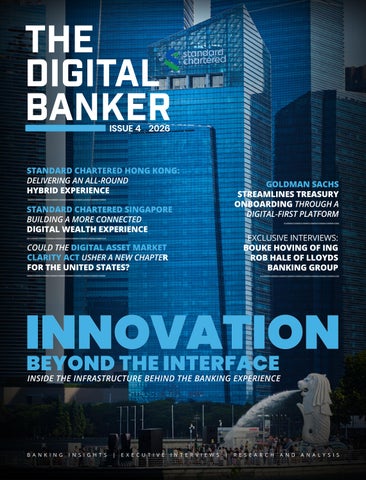
THE DIGITAL BANKER ISSUE 4 2026
STANDARD CHARTERED HONG KONG: DELIVERING AN ALL-ROUND HYBRID EXPERIENCE
GOLDMAN SACHS STREAMLINES TREASURY ONBOARDING THROUGH A DIGITAL-FIRST PLATFORM
STANDARD CHARTERED SINGAPORE BUILDING A MORE CONNECTED DIGITAL WEALTH EXPERIENCE
EXCLUSIVE INTERVIEWS: BOUKE HOVING OF ING ROB HALE OF LLOYDS BANKING GROUP
COULD THE DIGITAL ASSET MARKET CLARITY ACT USHER A NEW CHAPTER FOR THE UNITED STATES?
INNOVATION BEYOND THE INTERFACE INSIDE THE INFRASTRUCTURE BEHIND THE BANKING EXPERIENCE
B A N K I N G
I N S I G H T S
|
E X E C U T I V E
I N T E R V I E W S
|
R E S E A R C H
A N D
A N A L Y S I S
Published by: The Digital Banker (A brand of Coeus Intelligence Group) 22 Cross Street #02-112 Singapore 048421 : info@TheDigitalBanker.Com
2 The Digital Banker | Issue 4 | 2026
Managing Editor’s Note Banking has spent much of the past decade talking about transformation. The language such as digital, intelligent, seamless, embedded and automated has become familiar. Yet as these capabilities become more deeply integrated into financial services, the nature of innovation itself is beginning to change. The most significant advances are difficult to see. They are found in the systems that make an application take minutes rather than days, in the data that allows a lender to make a better-informed decision, in the infrastructure that enables a payment to move without intervention, and in the technology that allows a customer to interact with a bank without having to think about the complexity behind the experience. What appears simple on the surface often reflects considerable change underneath. This is an important moment for the industry. Technology is no longer being introduced simply to demonstrate what is possible. It is becoming part of how banks operate, compete and serve their customers. That places a different responsibility on financial institutions. The question is no longer whether they can adopt new technologies, but whether they can translate them into better decisions, stronger relationships and more effective ways of working. It also changes how innovation should be understood. A sophisticated interface is not necessarily a sophisticated banking experience. An AI application is not necessarily useful simply because it uses AI. And greater automation has little value if it merely moves complexity from one part of the organisation to another. The measure of progress increasingly lies in what technology enables rather than in the technology itself. The stories brought together in this issue reflect that shift. They point to an industry becoming more deliberate about the relationship between technology and outcomes, between what happens on the screen and what happens behind it. They also reveal that meaningful transformation rarely rests on a single breakthrough. It is built through better data, stronger infrastructure, thoughtful design, effective governance and an understanding of where technology can genuinely make a difference. In this issue, we examine that difference through the institutions, leaders and ideas helping to shape the next chapter of financial services. Their experiences offer a reminder that transformation is not an endpoint, nor is it defined by any single technology. It is an ongoing process of making banking more responsive, more connected and, ultimately, more useful to the people and businesses it serves. As always, we extend our sincere gratitude to the executives, contributors, partners and members of our judging panels whose expertise and openness continue to enrich our coverage. Their perspectives help ensure that the conversation around innovation remains grounded in the realities of the industry. Thank you for your continued support of The Digital Banker. We remain committed to examining the ideas behind the industry’s transformation, recognising meaningful progress and bringing our readers closer to the people and institutions shaping the future of banking.
Nirav Patel Managing Editor The Digital Banker
The Digital Banker | Issue 4 | 2026 3
Contents
08
China taps Deutsche Bank for RMB internationalisation
20
Deutsche Bank’s appointment as Europe’s first RMB clearing bank strengthens China-Europe financial links while supporting wider cross-border use of the renminbi.
11
Eurozone banks tighten lending as geopolitical risks persist
Standard Chartered Hong Kong combines digital tools, AI-powered advisory and personalised human support to deliver a seamless hybrid banking and wealth experience.
24
Eurozone banks maintained tighter lending standards as geopolitical and energy risks persisted, despite modest improvement in corporate credit demand.
14
Beyond Products: building a more connected digital wealth Standard experience Chartered connects investing, advisory, protection and wellbeing into a more integrated digital wealth experience for afÒuent clients.
16
Could the Digital Asset Market CLARITY Act usher a new chapter for the United States? The CLARITY Act seeks clearer US digital asset rules by defining regulatory responsibilities while balancing innovation, investor protection and global competitiveness.
4 The Digital Banker | Issue 4 | 2026
Standard Chartered Hong Kong delivers an all-round hybrid experience
UOB TMRW Vietnam drives stronger customer engagement through a personalised mobile banking experience UOB TMRW Vietnam combines intuitive design, analytics and machine learning to deliver personalised banking experiences that strengthen engagement and financial management.
26
HSBC Hong Kong puts 13 million customers on a single global app HSBC migrated over 13 million customers onto a unified global mobile platform, improving personalisation, engagement, resilience and speed of digital innovation.
Contents
28
ING’s Bouke Hoving on scaling AI: “It’s crucial to get the AI basics right first”
39
ING scales AI across wholesale banking by combining modernised core platforms, strong governance and globally reusable use cases spanning trading, lending and operations.
32
34
Standard Bank’s Money Reels transforms financial data into personalised storytelling
Lloyds sees tokenisation, real-time settlement and AI reshaping collateral management by improving liquidity, capital efÏciency and risk monitoring.
42
FNB leverages technology to streamline card delivery process
Standard Bank’s Money Reels turns financial data into personalised, social-style stories that improve financial awareness, engagement and adoption of money-management tools.
FNB digitised card ordering, setup and tracking through its banking app, improving delivery success, lowering costs and giving customers greater control.
HSBC turns sustainability priorities into investable opportunities for wealth clients
HSBC Orion brings digital bonds into the mainstream
HSBC integrates sustainability preferences, ESG insights and investment solutions into wealth advisory to help clients align portfolios with financial and sustainability goals.
36
Lloyds: Collateral management is entering a ‘genuine structural shift’
44
HSBC Orion enables governments and institutions to issue, settle and manage digital bonds while advancing interoperable, regulated tokenised capital markets.
Taiwan Business Bank transforms customer experience with digital innovation and inclusive banking Taiwan Business Bank combines digital lending, AI-powered voice banking and senior-friendly design to improve efÏciency, accessibility and financial inclusion.
The Digital Banker | Issue 4 | 2026 5
Contents
46
48
Bank of Ceylon’s BOC Flex enables digital banking anytime, anywhere across Sri Lanka
56
Khan Bank expands intelligent banking With DigiBrain and AI assistants Khan Bank applies AI across
Bank of Ceylon’s BOC Flex unifies mobile and
recommendations, advisory and customer
internet banking, accelerating digital adoption
service to deliver faster, hyper-personalised
through seamless onboarding, payments,
banking while improving employee
deposits and lending services.
productivity and digital engagement.
Turning transaction data into credit decisions key to faster SME lending – ANEXT Bank CTO
59
HSBC’s Smart Transact delivers faster global client onboarding
ANEXT Bank uses live transaction data,
HSBC Smart Transact standardises digital
automated credit assessment and embedded
onboarding across markets, reducing
finance to accelerate SME lending while
documentation and implementation times
maintaining robust governance and resilience.
for multinational payment and cashmanagement clients.
52
54
BPI Wealth rebuilds the Filipino investment journey, from first click to portfolio growth
60
Alliance Bank Malaysia sets a new standard for digital businesses with its open embedded banking
BPI Wealth digitises the investment journey
Alliance Bank Malaysia enables digital
from onboarding to portfolio management,
businesses to embed virtual cards, payments
combining behavioural design, personalised
and financing directly into their platforms
advice and real-time portfolio access.
through secure open-banking technology.
Goldman Sachs TxB streamlines treasury onboarding through a digitalfirst platform Goldman Sachs TxB digitises onboarding, KYC, virtual accounts and API connectivity to help corporate treasurers scale banking infrastructure faster and more efÏciently.
6 The Digital Banker | Issue 4 | 2026
Contents
62
64
Razorpay Curlec Sees Borderless Payments Powering Southeast Asia’s Next Growth Chapter
70
MariBank is adapting Sea’s Singapore digital
Razorpay Curlec combines local payment
banking model for the Philippines, targeting
methods, global acceptance and AI-driven
financial inclusion, digital payments and
fraud protection to simplify cross-border
data-driven lending while navigating intense
commerce for Southeast Asian businesses.
competition.
BankPro delivers fully integrated digital banking ecosystem with mobile-first CX
74
corporate workflows and personalised controls into a mobile-first ecosystem designed for seamless cross-border financial management.
Inside Bank SinoPac’s enterprise-wide digital reinvention Bank SinoPac applies AI and automation across onboarding, remittances, fraud prevention, payroll and SME banking to accelerate transactions and improve operational efÏciency.
68
AmBank deepens digital push in transaction banking with API-first platform and supply chain financing AmBank combines API-enabled payments, real-time settlement and supply chain finance to help businesses improve cash management, connectivity and transaction efÏciency.
Patterns Cognitive and CBD transform cheque clearing operations with AI-Powered automation Asialink Finance combines accessible lending, faster approvals and personalised support to expand capital access for MSMEs, women entrepreneurs and underserved communities.
BankPro integrates multi-currency banking,
66
Can MariBank replicate its Singapore success in the Philippines?
76
Faysal Bank sets a benchmark across Islamic banking, digital innovation, and inclusive finance Faysal Bank combines Shariah-compliant products, digital onboarding, inclusive finance and AI-driven innovation across retail, corporate and investment banking.
INDUSTRY UPDATE
China taps Deutsche Bank for RMB internationalisation By Kevin Luarca
Deutsche Bank’s appointment as a renminbi clearing bank marks another step in China’s efforts to expand the international use of its currency. Earlier this week, China has appointed Deutsche Bank as the first European bank to serve as a renminbi clearing bank, giving the German lender a more direct role in processing and settling transactions in China’s currency. The appointment is an important step in the development of the renminbi (RMB) as an international currency and strengthens financial links between China and Europe.
8 The Digital Banker | Issue 4 | 2026
For Deutsche Bank, the role builds on a long relationship with China. The bank has operated in the country since 1872 and has already supported the international use of the RMB through its participation in China’s Cross-Border Interbank Payment System, known as CIPS. The new clearing role gives the bank another way to connect European companies and financial institutions with China’s financial system. The appointment also comes as Beijing steps up its
INDUSTRY UPDATE
efforts to increase the global use of the RMB. In August 2026, the People’s Bank of China said it would expand the use of the currency in international trade and investment while continuing to open China’s financial sector in a careful way.
What does a renminbi clearing bank do? A clearing bank provides the financial infrastructure needed to process RMB payments between banks and businesses. In simple terms, it acts as a bridge between the Chinese financial system and institutions in another market. For European businesses, having a clearing bank in Europe can make RMB payments more direct and easier to manage. Companies trading with China can receive or make payments in RMB without relying as heavily on other financial centres. This can reduce payment friction, improve settlement and make it easier for companies to use the currency in their normal business activities. The role is therefore about more than processing payments. A stronger RMB clearing network can encourage companies to invoice Chinese trade in RMB, allow banks to offer more RMB products and support wider investment and financing activity in the currency.
China’s wider RMB internationalisation plan China has been working for years to increase the international role of the RMB, but the policy has gained fresh momentum in 2025 and 2026. Beijing is not simply trying to make the RMB a currency used for trade. It wants to increase its role in payments, lending, investment and, over time, global reserves. The PBOC’s latest five-year plan says China will expand the international use of the RMB in trade and investment while maintaining a broadly stable exchange rate. The central bank has also said it will continue to support a higher level of opening in the financial sector. In June 2026, the PBOC introduced further measures to support offshore RMB activity. These included a new RMB repo tool that allows foreign central banks and sovereign wealth funds to obtain RMB liquidity using
high-quality Chinese bonds as collateral. The central bank also said it would support greater offshore RMB business through major Chinese banks. China is also expanding the infrastructure that allows the RMB to move across borders. CIPS has become an important part of this effort, while new services such as RMB-denominated international letters of credit are designed to make trade finance easier to conduct in the Chinese currency. The development of offshore RMB markets is another part of the strategy. Hong Kong remains particularly important because it provides an international financial centre through which investors and companies can access RMB products while China retains controls over its domestic capital account. China is also looking beyond traditional banking. In 2025, reports emerged that Chinese authorities were considering yuan-backed stablecoins as another possible way to increase the currency’s use outside China. Although this remains a developing area, it shows how Beijing is considering new forms of payment infrastructure as part of its wider currency strategy.
The RMB has made progress, but the gap remains large There is evidence that the RMB is becoming more important in international finance. The IMF reported that the RMB accounted for 1.99% of global official foreign exchange reserves in the first quarter of 2026, up from 1.95% in the previous quarter. While this remains small compared with the US dollar and euro, it represents gradual progress. The RMB has also become an important currency for trade finance. Recent research based on the 2025 BIS Triennial Survey found that banking links with China are an important factor supporting the growth of RMB foreign exchange trading across different markets. China’s overseas lending in RMB has grown as well. Over the past five years, Chinese banks’ external RMB loans, deposits and bond investments have reportedly increased to more than RMB3.4 trillion. At the same time, the RMB has gained a larger role in global trade finance.
The Digital Banker | Issue 4 | 2026 9
INDUSTRY UPDATE
However, the RMB remains far behind the dollar in international use. The main challenge is not simply getting companies to use RMB for payments. It is convincing investors, central banks and financial institutions to hold large amounts of RMB assets for the long term.
The benefits for China A more international RMB could bring several benefits to China. The first is lower dependence on the US dollar. If more Chinese companies can invoice exports and imports in RMB, they have less need to exchange between RMB and dollars. This can reduce currency risk and make international trade less dependent on the US financial system. Greater RMB use could also help Chinese companies operating overseas. If they can borrow, raise funds and settle transactions in RMB, they can reduce their exposure to movements in other major currencies. A wider international role could also strengthen China’s financial influence. A country whose currency is widely used in trade and investment has greater influence over international financial flows. This is particularly relevant at a time when geopolitical tensions have encouraged governments and companies to consider alternatives to the dollar-based financial system. There is also a benefit for China’s financial markets. Greater international demand for RMB assets could bring more foreign investors into Chinese bonds, equities and other financial products. Deutsche Bank’s own activity provides an example. In June 2026, it issued a RMB3.5 billion Panda bond in China, with strong investor demand and record-low coupons for a foreign issuer in the relevant maturities. For international companies, wider RMB use could provide more choice. A European company that buys goods or services from China may be able to invoice and settle directly in RMB. This could reduce the need for multiple currency conversions and make it easier to manage payments with Chinese suppliers. Companies with significant operations in China could also gain access to RMB funding. Panda bonds, for example, allow foreign companies to raise money in
10 The Digital Banker | Issue 4 | 2026
China’s domestic bond market. Deutsche Bank said it supported RMB9 billion of Panda bond issuance for Henkel, Volkswagen and Mercedes-Benz during 2026, showing how the market can provide an alternative source of funding for multinational companies. For investors, a wider RMB market could provide another source of diversification. Chinese bonds and other RMB assets can give international portfolios exposure to a large economy and a different interestrate cycle.
Opportunities for Deutsche Bank The appointment creates a number of opportunities for Deutsche Bank. As a major European bank with a long history in China, it can position itself as a bridge between European clients and China’s financial markets. The clearing role could support growth in payments, foreign exchange, trade finance, cash management and investment banking. As more European companies use RMB for trade, Deutsche Bank can provide the accounts, payment services and currency management tools needed to support them. There is also an opportunity in capital markets. The bank is already active in China’s Panda bond market and has described itself as a leading foreign bank supporting foreign issuers in the onshore bond market. A larger international RMB market could increase demand for these services. The bank could also benefit from the growth of RMB liquidity management. Multinational companies with operations in China need to manage RMB cash, funding and foreign exchange risk across several countries. A bank with strong RMB clearing and cross-border capabilities is well placed to support this activity. For Deutsche Bank, the timing is favourable. As China seeks to expand the RMB’s international role, the bank’s new clearing position gives it a central place in the financial connection between China and Europe. The success of the wider RMB strategy, however, will depend on whether international businesses and investors see enough value, liquidity and confidence in holding and using the currency over the long term.
INDUSTRY UPDATE
Eurozone banks tighten lending as geopolitical risks persist By Syahirah Syed Jaafar
Eurozone banks remained cautious over lending in the second quarter, keeping standards tight as geopolitical risks and economic uncertainty continued to weigh on credit conditions despite improving demand from businesses. This was despite the pace of tightening having moderated compared to the second quarter of 2026, according to the latest European Central Bank (ECB) Bank Lending Survey. “The outcome of US-Iran negotiations continues to be a source of uncertainty, with banks revising their assessments as talks evolve. Banks remain highly attentive to risks and are continuing to closely monitor
credit risks, especially in the most exposed sectors, with some reporting additional tightening of credit standards because of geopolitical tensions and energy developments in the second quarter,” the report said.
The ECB’s latest lending survey found eurozone banks slowed the pace of credit tightening in the second quarter but continued to maintain stricter lending standards as geopolitical risks and weaker risk appetite persisted.
The Digital Banker | Issue 4 | 2026 11
INDUSTRY UPDATE
The European Commission said the EU economy remains resilient but faces a more challenging outlook as trade tensions, higher US tariffs and persistent geopolitical uncertainty weigh on growth. While domestic demand has been supported by a strong labour market and easing inflation, policymakers warned that weaker global trade, subdued business investment and external risks are likely to keep the recovery modest. The European Central Bank recently announced that it left its benchmark interest rate unchanged at 2.25%, citing concerns over how volatile energy prices could affect inflation. The Commission also cautioned that the outlook remains highly uncertain, with further trade disruptions or geopolitical shocks posing downside risks to growth. In the survey, banks reported a slight increase in demand for corporate loans, driven by financing needs
12 The Digital Banker | Issue 4 | 2026
for inventories, working capital, fixed investment by larger firms and debt refinancing. However, elevated geopolitical risks, lower risk tolerance and concerns over borrowers’ creditworthiness continue to weigh on lending decisions, with banks maintaining stricter approval standards and expecting further tightening in the coming quarter. For loans to enterprises, banks reported a moderate tightening in credit standards although the pace eased from the previous quarter. A net 7% of banks tightened lending standards, down from 10% in the first quarter and well below the 19% tightening they had expected. Higher perceived risks, lower risk tolerance and continued concerns over geopolitical and energy developments remained the main drivers. Banks also reported a further increase in corporate loan rejection rates, while lending terms and conditions continued to tighten, particularly through wider margins on riskier loans.
INDUSTRY UPDATE
Despite tighter lending conditions, demand for business loans edged higher. A net 3% of banks reported an increase in loan demand, reversing the 2% decline recorded in the previous quarter and outperforming expectations for a 10% fall. The modest rise was driven mainly by stronger demand for inventories and working capital, increased fixed investment by large firms, and refinancing and restructuring activities. Looking ahead, banks expect credit standards for corporate lending to tighten further in the third quarter of 2026, the survey noted. For households, banks reported a continued tightening in lending conditions during the second quarter of 2026. Credit standards for housing loans tightened by a net 9% of banks, broadly in line with expectations of 8%, while overall lending terms and conditions tightened by a net 4%, the first tightening since the third quarter of 2023. Rejection rates for mortgage applications also increased further. Demand for housing loans, however, fell sharply, with a net 15% of banks reporting weaker demand, compared with expectations of a 20% decline, as deteriorating consumer confidence, higher interest rates and weaker housing market prospects weighed on borrowing. Meanwhile, credit standards for consumer credit and other household lending tightened by a net 12%, easing slightly from 15% in the previous quarter, while demand declined by a net 2%, a smaller fall
Elevated geopolitical risks, lower risk tolerance and concerns over borrowers’ creditworthiness continue to weigh on lending decisions.
than the 9% decrease banks had expected. Banks expect credit standards to tighten further in the third quarter, by 2% for housing loans and 11% for consumer credit. While credit demand is showing tentative signs of stabilising, the recovery remains fragile as banks continue to prioritise risk management over loan growth. With geopolitical tensions, energy market uncertainty and concerns over borrowers’ creditworthiness still shaping lending decisions, the survey suggests that financing conditions are likely to remain restrictive in the near term. Unless economic and geopolitical risks ease more decisively, tighter credit standards could continue to constrain investment and household spending, potentially slowing the pace of the eurozone’s broader economic recovery.
The Digital Banker | Issue 4 | 2026 13
INSIDE THE INNOVATION
Beyond Products: building a more connected digital wealth experience Affluent clients are no longer thinking about wealth in narrow product categories. Investing, protection, health and long-term resilience are increasingly part of one broader conversation about how they live, plan and prepare for the future. For banks, the challenge is therefore changing. It is no longer enough to digitise individual products. The opportunity lies in creating connected experiences that reflect how clients make decisions across different stages of life. Standard Chartered’s offerings across digital wealth, advisory and bancassurance reflects this shift. Its award-winning propositions point to a broader direction for affluent banking: moving from productled interactions to a more integrated wealth experience that helps clients grow, manage and protect their wealth with greater confidence. This is closely aligned with the bank’s “Today, Tomorrow and Forever” approach, which frames wealth around immediate needs, future goals and legacy planning.
to client goals and risk profiles, and bring greater consistency to the advisory experience. Together, SC Invest and myWealth Advisor showcase how digital and human-led advice can work in tandem: helping clients
One expression of this is SC Invest, the bank’s end-toend digital funds experience on SC Mobile, its mobile banking platform. Designed for clients in Singapore and Hong Kong, SC Invest brings fund discovery, portfolio selection, execution and ongoing monitoring into a single journey. Clients can access curated portfolios aligned to different risk appetites and investment needs, supported by insights from Standard Chartered’s Chief Investment Office and discretionary portfolio management teams. The proposition is designed to make investing simpler, more intuitive and more accessible for digitally active clients, including those who are newer to mutual funds. This sits alongside the bank’s broader advisory capabilities through myWealth Advisor. The platform supports structured portfolio conversations by helping relationship managers and investment advisors visualise recommendations, align portfolios clearly
14 The Digital Banker | Issue 4 | 2026
Samir Subberwal Global Head, Wealth Solutions, Retail Products, Data & Analytics, Standard Chartered
INSIDE THE INNOVATION
engage more easily with investment opportunities while strengthening the quality and consistency of advisory conversations. The same philosophy is visible in the bank’s digital bancassurance proposition. Here, the shift has been more foundational. Standard Chartered has moved from largely partner-led digital journeys to a more bank-orchestrated experience layer embedded within its mobile and online banking platforms. This gives the bank greater ownership of journey design, governance and client engagement, while enabling a more consistent and scalable protection experience across partners, products and markets. It also improves speed to market by reducing the time needed to launch and refine digital insurance journeys. Health and wellness represents the next phase of this evolution. This is not simply a new product category, but a reflection of how affluent clients increasingly define security and wellbeing. Wealth is becoming more closely connected to quality of life, health preparedness, prevention, longevity and everyday resilience. Standard Chartered’s health and wellness proposition, including collaborations with Bupa Global and WHOOP, reflects this broader shift by bringing together protection, medical access, wellness insights and daily engagement in a more client-centric ecosystem. Taken together, these initiatives point to a broader change in banking for affluent clients. SC Invest helps clients grow their wealth with greater ease and confidence. myWealth Advisor strengthens advisory conversations with more structure, consistency and clarity. Digital protection journeys make it easier to safeguard what matters, while health and wellness propositions extend the conversation into prevention, resilience and long-term quality of life. The common thread is a move away from standalone product interactions towards a connected wealth experience – one that is more natural for clients and more scalable for the bank. That integration matters because clients do not experience life through organisational silos. They think about growth, risk, family, health and future security as part of one evolving picture. The banks that respond best will be those that can connect these needs through
Standard Chartered Singapore Headquarters
experiences that are intuitive, relevant and trusted. Standard Chartered’s approach across investing, protection and wellbeing reflects this shift: a digital wealth journey designed not only around transactions, but around the fuller reality of how clients build, protect and sustain the lives they want. Samir Subberwal, Global Head, Wealth Solutions, Retail Products, Data & Analytics, Standard Chartered, said, “Affluent clients are increasingly looking at wealth through a wider lens, one that connects investing, protection, health and long-term resilience. Our focus is to bring these needs together through digital experiences that are simple, relevant and trusted, while still anchored in the strength of our advisory expertise.”
The Digital Banker | Issue 4 | 2026 15
INDUSTRY UPDATE
Could the Digital Asset Market CLARITY Act usher a new chapter for the United States? By Kevin Luarca
For more than a decade, the digital asset industry has developed much faster than the laws designed to regulate it. As cryptocurrencies grew from a niche investment into a market worth more than $2 trillion as reported by Forbes, regulators struggled to decide which rules should apply and which agencies should oversee the sector. This uncertainty has resulted in repeated legal disputes between regulators and digital asset companies, creating an unpredictable environment for investors and businesses alike. The United States has been at the centre of this debate. While it remains home to many of the world’s largest digital asset firms, exchanges and blockchain developers, it has also become known for regulating the industry through enforcement actions rather than through a clear legal framework. The Securities and Exchange Commission (SEC) has argued that many digital assets should be treated as securities, while the Commodity Futures Trading Commission (CFTC) has maintained that many cryptocurrencies function more like commodities. The absence of a clear jurisdictional boundaries between these two agencies has led to overlapping responsibilities, legal challenges and uncertainty for the industry. To address these challenges, lawmakers introduced the Digital Asset Market CLARITY Act, commonly known as the CLARITY Act, the most comprehensive effort to establish a federal regulatory framework for digital assets in the United States. Rather than creating an entirely new regulatory system, the legislation aims to clarify how existing financial laws apply to digital assets and define the responsibilities of the SEC and CFTC. Supporters argue that the bill provides greater regulatory certainty that could encourage
16 The Digital Banker | Issue 4 | 2026
innovation, strengthen investor protection and keep digital asset businesses in the United States instead of pushing them towards overseas markets. Critics, however, believe that some parts of the legislation could weaken investor safeguards or leave gaps in regulatory oversight. The Senate version of the CLARITY Act builds upon earlier market structure proposals and reflects months of negotiations between lawmakers, regulators and industry participants. The legislation recognises the unique characteristics of blockchain technology while maintaining established financial regulatory principles where appropriate. Instead of treating every digital asset in the same way, the bill introduces clearer legal definitions that distinguish securities, digital commodities, payment stablecoins and decentralised networks.
Why the Clarity Act is important One of the Act’s most significant challenges lies in decentralised finance (DeFi). Unlike traditional financial institutions, many DeFi platforms operate through blockchain-based software rather than a central organisation, making it difficult to determine who should be responsible for regulatory compliance and consumer protection.
INDUSTRY UPDATE
The CLARITY Act attempts to address this issue by introducing legal tests to determine whether a blockchain network or protocol is genuinely decentralised. The legislation examines whether a small group of individuals retains special control over the network, whether developers can restrict user access, and whether privileged parties continue to exercise significant influence over the operation of the system. This distinction matters because it could determine how blockchain projects are regulated as they evolve. Developers have long argued that networks operating without a central controlling party should not be subject to the same regulatory requirements as traditional financial institutions. Although the United States remains one of the world’s largest digital asset markets, growth has become increasingly global. Countries in Asia, Europe and
the Middle East have introduced clearer regulatory frameworks that have encouraged exchanges, investment firms and blockchain developers to establish regional headquarters outside the United States. This competition for investment and innovation has intensified the pressure on US lawmakers to create a more predictable legal framework through legislation such as the CLARITY Act.
The global competition Although the United States remains the largest market for digital asset investment, it is no longer the clear leader in regulatory innovation. Over the past year, several countries have introduced legal frameworks that provide greater certainty for digital asset businesses, attracting investment, talent and new financial products.
The Digital Banker | Issue 4 | 2026 17
INDUSTRY UPDATE
The United States continues to dominate institutional investment. It hosts many of the world’s largest asset managers, cryptocurrency exchanges and blockchain companies. The launch of spot Bitcoin and Ethereum ETFs has significantly increased institutional participation, while major banks have expanded their tokenisation and digital asset custody services. However, regulatory uncertainty has remained a concern. Disagreements between the SEC and the CFTC over how digital assets should be classified have led to years of legal disputes. The CLARITY Act is intended to reduce this uncertainty by establishing clearer rules for digital commodities and assigning greater responsibility to the CFTC. Singapore has positioned itself as one of the world’s leading digital asset centres by combining innovation with strong regulatory oversight. Rather than allowing unrestricted growth, the Monetary Authority of Singapore (MAS) has adopted a licensing system that requires firms to meet strict standards for governance, anti-money laundering and consumer protection. This approach has attracted banks, payment companies and institutional investors seeking regulatory certainty while maintaining confidence in the financial system. Singapore has also become a major centre for tokenisation projects involving commercial banks and asset managers. Hong Kong has taken a similar approach by introducing a licensing regime for virtual asset trading platforms and encouraging the development of tokenised financial products. Over the past year, regulators have approved additional cryptocurrency investment products and expanded initiatives that support tokenised bonds and investment funds. Hong Kong’s strategy reflects its ambition to become the leading digital asset hub in Greater China while maintaining close regulatory supervision. The United Arab Emirates has emerged as another major centre for digital assets. Dubai’s Virtual Assets Regulatory Authority (VARA) has created one of the world’s most specialised regulatory systems for virtual assets, providing dedicated licensing for exchanges, custodians and service providers. Abu Dhabi has also strengthened its digital asset ecosystem through the Abu Dhabi Global Market (ADGM), attracting global firms looking for a stable regulatory environment. The
18 The Digital Banker | Issue 4 | 2026
The CLARITY Act attempts to address this issue by introducing legal tests to determine whether a blockchain network or protocol is genuinely decentralised.
UAE’s willingness to introduce clear rules early has helped establish it as one of the fastest-growing digital asset markets in the Middle East. Switzerland continues to benefit from its longstanding reputation for financial innovation. Its legal framework recognises blockchain-based assets and provides clear rules for digital securities, tokenisation and custody services. This has encouraged both traditional financial institutions and blockchain companies to establish operations in the country, particularly in the region known as Crypto Valley. The European Union has taken a different approach by creating a single regulatory framework across its member states through the Markets in Crypto-Assets (MiCA) Regulation. Instead of relying on individual national rules, MiCA establishes common standards for licensing, stablecoins and consumer protection across the EU. This has made it easier for firms authorised in one member state to expand throughout the European market. The CLARITY Act seeks to strengthen the US position by providing clearer rules for market participants while maintaining investor protections. If enacted and implemented effectively, it could make the United States a more attractive destination for digital asset businesses and institutional investors, while reinforcing its influence on global regulatory discussions. Although the CLARITY Act is a domestic piece of legislation, its influence is likely to extend well beyond the United States. The country remains the
INDUSTRY UPDATE
world’s largest capital market and home to many of the largest digital asset firms, institutional investors and technology companies. Changes to US regulation often influence policy discussions in other jurisdictions. The legislation may also influence regulatory developments elsewhere. Policymakers in other countries are likely to study the Act as they consider how to regulate digital commodities, decentralised finance and stablecoins. While few jurisdictions are expected to copy the legislation directly, several may adopt similar approaches to defining digital commodities and allocating responsibilities between financial regulators.
However, the Act is unlikely to create a single global regulatory standard. Different countries continue to have different priorities. As a result, digital asset companies operating internationally will still need to comply with different regulatory frameworks across multiple jurisdictions. The long-term success of the legislation will ultimately depend not only on the legal framework it creates, but also on whether it provides sufficient certainty for innovation while maintaining strong standards for market integrity and consumer protection. Achieving this balance will determine whether the United States can remain a global leader in the next stage of digital asset development.
The Digital Banker | Issue 4 | 2026 19
INSIDE THE INNOVATION
Standard Chartered Hong Kong delivers an all-round hybrid experience In today’s dynamic financial landscape, digitally savvy clients expect seamless, hybrid experiences that not only help them save time, but also provide them with expert guidance whenever required. To address this, Standard Chartered Hong Kong has crafted a hybrid wealth experience that seamlessly integrates cutting-edge technology with personalised human touchpoints. Serving a large base of wealth clients in Hong Kong, Standard Chartered Hong Kong empowers clients to draw insights from market data, up-to-date market commentary and its in-house Chief Investment Office (CIO) outlook, with the aim of supporting them to transact through digital means or with support from specialists. Enabling the transition of client experience from online exploration to offline support and foster strong connection of clients and their relationship managers (RMs), the bank has also established multiple valueadding services and functions that help clients make informed decisions with advisory from specialist teams.
Digitally empowering RMs Standard Chartered Hong Kong has developed a comprehensive digital ecosystem within its Wealth & Retail Banking (WRB) offerings to empower both clients and RMs through seamless, integrated solutions. The myRM platform was introduced to modernise advisory delivery by providing a secure, bankowned communication channel for clients and RMs. It overcomes the limitations of traditional communication methods, such as branch visits and untracked chat apps, by consolidating advisory conversations, quotation sharing and order execution in one secure environment.
20 The Digital Banker | Issue 4 | 2026
Clients benefit from prompt, personalised service and peace of mind knowing their interactions are securely documented. For RMs, myRM streamlines workflows, strengthens professionalism, and reinforces client trust. Strategically, it supports more frequent and structured engagement, accelerating execution cycles and positioning the bank to deliver human advice at digital speed while ensuring compliance and security.
Serving powerful insights and targeted nudges Standard Chartered Hong Kong’s myWealth platform delivers a hybrid advisory experience that combines personalised portfolio insights with clear, actionable nudges to help clients make better investment
Through myWealth Direct and myWealth Advisor, clients can seamlessly transition between self service digital tools and RM assisted advisory.
INSIDE THE INNOVATION
decisions. Through myWealth Direct and myWealth Advisor, clients can seamlessly transition between self service digital tools and RM assisted advisory. myWealth Direct provides clients with instant access to portfolio summaries, health scores and personalised investment ideas. myWealth Advisor complements this with deeper portfolio reviews, customised portfolio construction and advanced analytics supported by the bank’s proprietary algorithms engine. A core differentiator of myWealth is its personalisation engine, which generates targeted insights such as over/under concentration alerts, top asset class ideas, sustainability focused recommendations and real time updates to the ‘Portfolio Strength Score’ tab. Each insight is designed to prompt timely and relevant action. myWealth Advisor further enhances personalisation through both ‘Express’ and ‘Custom’ portfolio building paths tailored to client sophistication. Real time synchronisation between myWealth Direct and myWealth Advisor ensures clients always see updated portfolios and can easily compare them against CIO model allocations. RMs can also push curated ideas directly to clients’ digital carts for seamless execution. Together, these capabilities create an integrated ecosystem that elevates client decision making, increases RM productivity, and delivers a frictionless journey from insight to action.
Guided by client feedback Listening to clients on the need for timely, personalised and easy to understand insights, Standard Chartered Hong Kong introduced a solution that allows clients to learn, explore and act seamlessly within a single digital journey. As clients increasingly adopt mobile first and self directed learning behaviours, it became essential for the bank to evolve the ‘Invest Tab’ into a more personalised, insight driven and intuitive wealth destination.
Standard Chartered Headquarters Office, Hong Kong
into a unified mobile experience where clients can access ideas, understand the market and act instantly, without having to switch channels. Bite sized, easy to digest content and CIO insights are embedded directly at the point of decision, enabling clients to stay informed anytime. Additionally, wealth offers are surfaced based on clients’ profiles and behaviours, addressing the need for customised guidance, elevating relevancy and strengthening client engagement.
Wealth advisory, powered by GenAI Through this, the bank transformed wealth engagement from a fragmented, multi step process
Integrated into myWealth Advisor in H2 2025, GenAI enables RMs and investment advisors to instantly
The Digital Banker | Issue 4 | 2026 21
INSIDE THE INNOVATION
generate personalised client communications with investment ideas, product recommendations and portfolio commentary – dramatically improving the speed, quality and consistency of advisory interactions. By analysing client holdings, risk appetite, market conditions, and CIO views, GenAI transforms complex data into clear, tailored and context relevant messages that help clients understand their portfolios and take confident next steps, enabling more proactive engagement and deeper relationship building.
Bringing innovation to investments In 2025, the bank introduced the new SC Invest platform, in a bid to innovate the mutual fund investment landscape for investment newbies and clients who are new to mutual fund and wealth management products. SC Invest offers a digitised and simplified investment journey, specifically designed to cater to individuals new to mutual fund investments. By providing a digital-only portfolio investment platform, SC Invest aims to reduce the traditional barriers and complexities associated with fund investing, making it more accessible and userfriendly for investment newbies, the younger generations and the emerging affluent client segment.
What sets SC Invest apart is how it leverages cutting-edge innovation to provide a seamless digital client experience. The platform offers unique selling points, such as a streamlined and simplified fund investment process, lower investment threshold to entry, and user-friendly interface integrated within the SC Mobile App. By offering a seamless journey where clients can effortlessly open a unit trust account and subscribe to funds in just three straightforward steps, SC Invest ensures a transparent and user-centric investing experience.
22 The Digital Banker | Issue 4 | 2026
Transforming everyday banking Beyond wealth experience, Standard Chartered Hong Kong also launched the Bonus Saver Campaign to bolster its deposit product portfolio. This innovative payroll campaign enables clients to earn monthly rewards by receiving their salary, completing designated “missions” such as maintaining account balances – with higher balances yielding greater rewards – and achieving spending thresholds on the bank’s credit card, unlocking exclusive cash rebates. In essence, it transforms everyday banking activities such as payroll deposits, savings and spending into a rewarding ecosystem that incentivises client loyalty. Traditionally, clients only earn interest on idle funds. However, the Bonus Saver Campaign allows them to generate additional cash rewards from their day-today cash flow, thereby increasing deposit mobilisation and client engagement. As of September 2025, the bank has continued to deliver strong momentum in its wealth and affluent growth, especially in digital revenue and wealth digital sales revenue thanks to its digital acceleration. Standard Chartered Hong Kong took home 12 titles at the Digital CX Awards 2026, including Best International Retail Bank for Digital CX – Hong Kong SAR, China.
Standard Chartered Hong Kong’s myWealth platform delivers a hybrid advisory experience that combines personalised portfolio insights with clear, actionable nudges to help clients make better investment decisions.
The Digital Banker | Issue 4 | 2026 23
INSIDE THE INNOVATION
UOB TMRW Vietnam drives stronger customer engagement through a personalised mobile banking experience As customer expectations evolve, UOB Vietnam is enhancing how users engage with their finances through its refreshed mobile banking app, UOB TMRW Vietnam. By combining intuitive design, data-driven insights and more context-aware interactions, the app delivers a more relevant and seamless banking experience, supporting stronger engagement and better financial management. This approach has driven significant growth in digital engagement and was recognised at The Digital CX Awards 2026, where the app won the Outstanding Digital CX – Mobile Banking – Vietnam award.
information in a clear and structured way, the app helps users better understand and manage their finances on a day-to-day basis.
Mr. Dennis Tan, Head of Digital Banking at UOB Vietnam, said: “With UOB TMRW Vietnam, we leverage data analytics and machine learning to better understand customer needs and deliver timely insights, relevant recommendations and solutions that support their financial goals.”
Seamless and intuitive user journeys
Launched in May 2025, the app features a simplified and intuitive user experience designed to make everyday banking easier and more engaging.
A more relevant experience for everyday banking
UOB TMRW Vietnam also focuses on making banking simple and effortless. Customers can access a wide range of services through a single platform, including fund transfers, bill payments and card management, alongside tools for budgeting and cash flow tracking. Key features include: • •
At the core of UOB TMRW Vietnam is its ability to make banking more relevant to each user.
• •
From dynamically customised dashboards to contextual product recommendations, the app adapts based on transaction patterns and financial behaviour. This ensures that customers receive information and services that are most useful to them, when they need them. By simplifying complex tasks and presenting
• •
24 The Digital Banker | Issue 4 | 2026
• •
Biometric Authentication Strengthens security while ensuring a smooth and convenient experience Smart Insights & Rewards Delivers data-led insights, targeted campaigns and a centralised rewards ecosystem QR Scan to Pay Enables quick and convenient QR payments directly from the pre-login screen Fixed Deposit Placement Allows customers to place deposits digitally with flexible tenures and competitive rates
INSIDE THE INNOVATION
Together, these features reduce friction across key banking tasks and support a more intuitive experience.
Powered by data and intelligent insights UOB TMRW Vietnam is underpinned by advanced analytics and machine learning capabilities. Through its partnership with Personetics, the app analyses transaction data to generate insights, recommendations and campaigns aligned with customers’ financial habits and goals. This enables a more responsive experience that goes beyond basic banking functions — helping customers make more informed financial decisions. • Tools such as real-time budgeting and integrated rewards management further support users in staying in control of their finances.
100% adoption among existing customers, all of whom successfully onboarded and completed biometric authentication
Driving measurable engagement
These results demonstrate the impact of combining intelligent insights, streamlined design and continuous engagement.
UOB Vietnam’s focus on delivering more relevant and intuitive digital experiences has resulted in strong outcomes.
Recognised for digital excellence
Following the launch of the refreshed app, the bank recorded:
The success of UOB TMRW Vietnam reflects UOB Vietnam’s continued commitment to delivering customer-centric digital solutions.
• •
90% growth in digitally active and engaged customers 14% year-on-year increase in financially engaged customers
By focusing on relevance, usability and data-driven engagement, the app has strengthened customer relationships while setting a new benchmark for mobile banking experiences in Vietnam.
The Digital Banker | Issue 4 | 2026 25
INSIDE THE INNOVATION
HSBC Hong Kong puts 13 million customers on a single global app HSBC Hong Kong’’s redesigned mobile banking app delivers a unified and consistent experience that can now be enjoyed by its customers across the globe. HSBC Hong Kong has migrated more than 13 million customers to a redesigned mobile banking app across Hong Kong, the UK and Singapore, with further markets set to follow in 2026. According to HSBC, the apps were historically developed market by market that were shaped by local technology priorities and funding decisions. As one of the leading international banks operating across Asia, the Americas, Europe, and the Middle East, the Bank recognised the need for a consistently excellent digital experience across all its markets.
Premier banking customers are logging into the app 23% more frequently, and the total volume of in-app transactions has risen by 27%.
26 The Digital Banker | Issue 4 | 2026
An initiative codenamed ‘North Star’ was then launched to establish a single, global codebase that delivers a more consistent and recognisable app experience for customers worldwide, while also reducing deployment costs and improving resilience, the bank explained. It said the platform not only enhances the customer experience but also allows HSBC to deploy updates faster and more safely, enabling the bank to respond swiftly to evolving customer needs and behaviours. The redesigned app introduces a hub-based navigation structure, allowing customers to move
INSIDE THE INNOVATION
Right: Mark Hedges - Former Global Head of Digital Platforms and Business Architecture; Left: Jiju Daniel – Global Head of Digital Experience and Platforms
between their products and services more intuitively. Personalisation features including the ability to favourite accounts, hide balances and customise quick-action shortcuts have proven popular, with UK users most commonly tailoring their payee views and HSBC Hong Kong customers favouriting foreign exchange services. A new enhanced chat function resolves more than 53% of queries without escalating to a human agent. Behavioural data from Hong Kong and the UK suggests meaningful shifts in engagement, the Bank noted. Premier banking customers are logging into the app 23% more frequently, and the total volume of in-app transactions has risen by 27%. Furthermore, app store ratings are climbing and net promoter scores have risen above pre-migration levels, while calls to contact centres have declined. The programme was built on a reusable global codebase spanning 26 markets.
“The refreshed app improves customer experience and enables faster and safer deployment of mobile app change, enabling HSBC to quickly respond to movement in customer priorities and behaviours,” said Amanda McCurrach, Head of Change Adoption at HSBC’s Digital Platforms division. HSBC Hong Kong plans to launch the refreshed app in the UAE and its expat business in the third quarter of 2026, with the US and India markets in planning. New generative artificial intelligence capabilities, including enhanced intent recognition and seamless transitions between bot and agent support are also in development. HSBC HK was recognised at the Digital CX Awards 2026 for Outstanding Use of Digital Channels for Improved CX, and CX Team of the Year (CrossFunctional).
The Digital Banker | Issue 4 | 2026 27
VOICES OF INFLUENCE INTERVIEW SERIES
ING’s Bouke Hoving on scaling AI: “It’s crucial to get the AI basics right first” By Shruti Khairnair
Artificial intelligence is moving from experimentation to execution across banking, but scaling the technology effectively remains a significant challenge. For ING’s wholesale banking business, the approach has been to build the foundations first: modernising its core banking platforms, developing shared technology capabilities and focusing on AI use cases that can deliver value across its global footprint. With the bank operating in more than 35 countries, this scalable operating model has become central to how ING approaches innovation. From machinelearning-powered algorithmic trading and AI-assisted lending to its exploration of agentic AI, the bank is now looking at how emerging technologies can accelerate processes while maintaining appropriate governance and controls.
We operate in more than 35 countries but have a very global operating model, where we build platforms centrally from an engineering perspective, using three main locations around the world. We build platforms with sufficient flexibility so we can serve corporates and financial institutions across our diverse footprint. That’s something we’ve been working on for four decades.
In this interview with The Digital Banker, Bouke Hoving, CIO, Wholesale Banking at ING, discusses the bank’s AI strategy, the evolution from machine learning and generative AI towards agentic AI, and the importance of responsible deployment. He also explores AI’s implications for the banking workforce and how the bank is addressing the energy demands of the technology.
Also, here in Asia, we’ve spent a lot of time, effort and investment modernising our core banking platforms, which were originally put in place 35 years ago. We’re now very well advanced in that process. Out of the nine markets where we had those platforms, we’ve completed the transformation in seven.
How has ING implemented and scaled artificial intelligence across the wholesale banking unit, and what were the key challenges you encountered during this implementation? What were some of the key lessons you learned in the process? When we talk about AI, it’s always a question of how to scale it. Before we get into AI, it’s probably good to spend a bit of time on the overall operating model of the wholesale bank.
28 The Digital Banker | Issue 4 | 2026
In general, we see innovation scaling fairly well across our footprint, and that’s something we benefit from. When it comes to AI, we’ve taken a focused approach, initially looking at use cases where we saw strong proof of concept and where we were equally convinced we could scale them across the footprint. We’ve looked at use cases such as contact centres in our retail franchise. Specifically in wholesale banking, we’ve invested significant time and effort into KYC, lending, and even before generative AI, financial markets and e-trading.
VOICES OF INFLUENCE INTERVIEW SERIES
Here in the region, last year we brought our algorithmic trading business live in Singapore. That capability allows clients to interact with ING digitally when hedging their currency exposure, with much faster execution powered by machine learning. It’s a good example of how innovation travels well on a scalable technology foundation.
As the focus shifts from generative AI to agentic AI, what potential do you see here, and where do you see the opportunities and risks? We see agentic AI as the next step. Lending is a good example. To give some colour on how that evolution has progressed over the past couple of years, we’ve seen a lot of promising AI use cases, even before generative AI through machine learning. We were already implementing automated decisionmaking for lower-risk, smaller-ticket credit requests. For larger wholesale credit applications, credit analysts still need to form their own judgement. There, we’ve been using generative AI as a co-pilot, taking away much of the heavy lifting from the credit analyst by pre-populating documents, searching for data in annual reports, and requesting information from local credit agencies. This helps accelerate the process and enables faster decisions. As the next step, we’re also looking at agentic AI. We’re learning from our retail banking colleagues, who have already successfully brought agentic AI into production. In the Netherlands, we’re using it in the mortgage application process, and that serves as inspiration beyond our current implementations of machine learning and generative AI.
Bouke Hoving CIO, Wholesale Banking, ING
into production, they must follow our governance processes to ensure the appropriate guardrails are in place. What is also specific to our approach is that we’ve built a strong foundation and only focus on use cases that can scale across our footprint. That allows us to spend sufficient time rigorously testing the solutions before bringing them live and only launching those that can scale globally.
How is ING balancing AI innovation with sustainability, given concerns about the energy required to support AI models? When it comes to sustainability, it’s very important for us to first look at whether a more traditional digital approach can solve the problem with lower energy consumption.
How has ING approached responsible artificial intelligence deployment? How do you ensure innovation is balanced with the appropriate levels of control and oversight?
We use AI and generative AI only where they truly add value. For many cases, our existing straight-through digital processing already meets a significant portion of customer demand.
We rely on more traditional governance measures. Before any team is allowed to bring something
Secondly, we’re passionate about our global operating
The Digital Banker | Issue 4 | 2026 29
VOICES OF INFLUENCE INTERVIEW SERIES
model, ensuring innovation travels quickly while focusing only on use cases that truly matter and can scale. That means we don’t waste effort, or energy consumption, on solutions with only marginal benefits. Last but not least, we invest heavily in educating our staff on how to limit unnecessary energy consumption when using AI.
Concerns around workforce disruption continue to grow as AI adoption accelerates. From your perspective, what should banking leaders prioritise to ensure AI investments deliver lasting value? If you look at employability concerns, we do see some impact, particularly on junior roles. There has been some reduction in headcount across the industry, and we’ve seen that within the wholesale bank as well. At the same time, if you look at the medium to long term, every major technology innovation has raised similar concerns. Ultimately, we’ve always found there’s still so much work to be done that some of those negative effects are offset by new opportunities. It’s still a little early to predict exactly how things will develop. We’re cautiously optimistic, while recognising that some junior roles will inevitably be substituted by generative AI. As for ensuring AI investments deliver lasting value, I think every technology leader is trying to make the best use of generative AI despite its promising potential. It’s crucial to get the AI basics right first. Once you’ve established those foundations, revisit your existing work. You’ll find your traditional modernisation challenges can be addressed much more efficiently. Once you’ve mastered that, you can begin reimagining business processes, where there’s phenomenal potential. However, if you approach
30 The Digital Banker | Issue 4 | 2026
AI incrementally while leaving your business transformation and technology modernisation untouched, you’ll struggle to develop sufficient AI maturity to make a meaningful impact. That’s why it’s vitally important to build strong AI capabilities first, then revisit your modernisation and business transformation agenda. It’s easy to say, but still hard to do every day.
Is there anything else you’d like to add before we conclude? I think we’ve covered the overall AI strategy. Perhaps it’s good to round off by touching on our global operating model transformation and how we’ve organised the workforce supporting these initiatives. As I mentioned briefly, we’re going through a major modernisation of our core banking landscape, which is now entering its final phase. In Asia, seven of our nine branches are already operating on the modernised core banking platforms. We’re already seeing tangible customer benefits through a much better and more consistent digital experience across our footprint. It’s also helping us introduce additional capabilities into the region. I mentioned electronic trading and commodity trading, but more broadly, innovation is travelling much faster across our footprint—not only AI innovations, but also products that previously weren’t available in this region. Secondly, as we roll out these global platforms across Asia, Europe and the Americas, we’re also globalising our workforce. Previously, engineering was largely centralised in Europe. Today, we have three global development centres – in Manila, Bucharest and Amsterdam – where these platforms are built. Regional locations such as Singapore then play a crucial role in configuring those platforms for local Asian markets. In essence, our strategy rests on three pillars: a global operating model built on shared platforms, a globalised workforce across our three development centres, and AI powering all of this to help us move into a higher gear.
SUBMISSION DEADLINE
AWARDS GALA
18 DECEMBER 2026
18 MARCH 2027
ABOUT THE PROGRAMME The Global SME Banking Innovation Awards, is the first of its kind assessment program designed to honour and celebrate the world’s preeminent SME banking players. The Global SME Banking Innovation Awards are designed with a view to recognizing the institutional excellence and business achievements of the most pioneering and trail-blazing SME banking players operating in the industry today, while establishing objective global benchmarks for outstanding p erformance and innovation. SME Banks must demonstrate capabilities and competencies, which are unmatched and transformative in nature, redefining customer engagement models with SMEs and providing cutting-edge product portfolio and solution sets to empower SME growth.
WHO CAN APPLY? The SME Banking Innovation Awards program is open to all relevant players within the SME financial services landscape including conventional banks, digital/neo-banks/challenger banks, fintech companies, micro finance institutions and technology solution providers. If you identify your institution as an industry leader that is pushing boundaries and driving unrivalled innovation, we welcome you to send in your nominations for the respective award.
thedigitalbanker.com/awards/global-sme-banking-innovation-awards
ENQ@TheDigitalBanker.Com
INSIDE THE INNOVATION
Standard Bank’s Money Reels transforms financial data into personalised storytelling Standard Bank has turned year-end financial data into a personalised digital storytelling experience, using behavioural science, advanced analytics and social media-inspired design to help customers better understand their finances while deepening engagement across its mobile banking platform. The Standard Bank Group, the largest African bank by assets, launched Money Reels in November 2025 as a limited-time app experience that reimagined personal financial management through a hyper-personalised, year-in-review digital story. The initiative was inspired by social media “recap” culture but grounded in robust analytics and behavioural science. This innovation earned Standard Bank the Best Customer Insights Initiative - South Africa award at The Digital CX Awards 2026. “Money Reels was built on a simple belief: when customers can see their financial story in a way that is personal and engaging, they are more likely to take meaningful action. By combining advanced analytics, behavioural science and human-centred design, we transformed complex financial data into insights that empower customers to make more informed financial decisions.” said Shene Mothilal, Solution Owner, Digital Money Manager at Standard Bank.
Insight-led digital innovation South Africa continues to face significant financial wellbeing challenges, including low household savings, high debt-to-income ratios and limited adoption of structured savings habits. While financial literacy initiatives have expanded over the years, improving knowledge alone has not consistently translated into lasting behavioural change. Recognising this gap, Standard Bank developed
32 The Digital Banker | Issue 4 | 2026
Money Reels to move beyond conventional financial tools and statements, creating a more engaging and emotionally resonant way for customers to understand their financial habits. Strategically, Standard Bank’s Money Reels was designed to democratise advanced analytics by translating complex financial data into intuitive, visual, story-led insights; increase financial selfawareness and stimulate behavioural reflection; create an emotional connection between customers and their financial journeys; strengthen loyalty by delivering meaningful value beyond transactional banking; deepen digital engagement within the mobile app ecosystem; and position Standard Bank as a leader in customer-centric data storytelling.
Difference of Money Reels from competitors With Standard Bank’s Money Reels, the Bank observed that customers were engaging with financial content the same way they consumed social media, in short, visual, story-driven formats, but traditional banking education remained static, generic and under utilised. Using advanced behavioural analytics and first-party data intelligence, Standard Bank identified three critical CX gaps: financial guidance was available but not contextual; customers wanted help but not lectures; and engagement increased dramatically when content mirrored familiar social formats.
INSIDE THE INNOVATION
Unlike competitors who provide static spending reports or budgeting dashboards, Standard Bank’s Money Reels integrated behavioural psychology, social-style UX, human-centred design, advanced data analytics, cloud-based engineering architecture delivered from development to production in approximately three months, and audience amplification through targeted digital marketing.
Personalisation at scale Standard Bank’s Money Reels represents hyperpersonalisation at scale. Each customer received a uniquely generated financial narrative based on their individual spending categories, credit behaviour, budget adherence, income and expense patterns, seasonal financial trends, and personalised “Money Energy” selection to guide future intention. Nearly 450,000 customers engaged, with an exceptional 80% completion rate, demonstrating sustained interaction rather than passive viewing. By seeing trends and patterns in a visual reel format, users could spot areas where they spent more than expected, set intentions for budgeting or saving, and compare yearon-year habits. While highly resonant among the 20-39 demographic, nearly a quarter of engagement came from customers in their 50s, demonstrating crossgenerational digital appeal. Standard Bank’s Money Reels leveraged and connected customers directly with Digital Money Manager (DMM), Standard Bank’s in-house Personal Finance Management (PFM) suite. Outcomes included 175,000 new DMM feature installs. Customers using PFM
Shene Mothilal Solution Owner, Digital Money Manager Standard Bank
features log in 24% more frequently and are 19% less likely to attrite from the channel.
Engagement impact The feature achieved viral engagement at scale within just six weeks: 25 million social media impressions, 875,000 marketing interactions, 447,000 Money Reels views, 175,000 new Digital Money Manager feature installations, and 537 new-to-platform app installs, all within 6 weeks. Customers actively shared screenshots, discussed insights publicly and engaged in light-hearted commentary about their financial habits. This was not transactional engagement but emotional engagement. Standard Bank’s Money Reels transformed a financial insight tool into a cultural conversation moment. Standard Bank’s Money Reels elevated the mobile banking customer experience by reducing cognitive overload associated with financial data, making advanced analytics intuitive and accessible, blending entertainment with empowerment and humanising the financial journey. The feature demonstrated that regulated financial data can be presented in a way that is compliant, insightful and delightful.
Standard Bank’s office in Rosebank
Standard Bank’s Money Reels has established a scalable storytelling capability that will become an asset for the app and other digital platforms, add new dimensions for insights beyond a year in review, and reinvent the way a reel has utility within the financial services context.
The Digital Banker | Issue 4 | 2026 33
INSIDE THE INNOVATION
HSBC turns sustainability priorities into investable opportunities for wealth clients As demand for sustainable wealth solutions grows, HSBC Private Bank helps clients navigate the opportunities through client education, market insights and a broad range of sustainable investment offerings. Investor interest in sustainable investing continues to grow and wealth managers are increasingly embedding Environmental, Social, and Governance (ESG) considerations into client journey. HSBC has been expanding its ESG and sustainable investing infrastructure across multiple fronts, combining product innovation with digital capability building to serve clients ranging from high-net-worth individuals to family offices.
34 The Digital Banker | Issue 4 | 2026
HSBC’s sustainable wealth management proposition has been strengthened through the introduction of sustainability preference questionnaires in key markets and the rollout of ESG-integrated advisory capabilities in selected locations, enabling advisers and relationship managers to better understand and capture clients’ sustainability priorities, incorporate them into investment discussions, portfolio construction and monitoring where appropriate, supported by data-driven analytics.
INSIDE THE INNOVATION
“Clients want clear guidance on how sustainable investing fits into their portfolio, so we make the journey transparent and practical. Partnering across HSBC, we deliver ESG, sustainable and purpose-led investing solutions, alongside investment insights that help clients identify sustainability-related risks and opportunities while staying aligned to their financial goals and risk preferences,” says Peggy Smith, Global Head of ESG Solutions, Wealth and Premier Solutions.
Investor interest in sustainable investing continues to grow and wealth managers are increasingly embedding Environmental, Social, and Governance (ESG) considerations into client journey.
To better support clients making more informed decisions in their sustainability journey, HSBC plans to expand its range of ESG and sustainable investing solutions, enhance digital tools, reporting capabilities and investment insights, and strengthen
transparency, data quality and governance in line with evolving regulatory requirements. HSBC will continue to provide comprehensive ESG insights publications and thought leadership to help investors stay informed about emerging sustainability trends, risks and opportunities. HSBC was recognised at The Digital Banker’s Global Sustainable Finance Awards 2026 for:
Peggy Smith Global Head of ESG Solutions, Wealth and Premier Solutions, HSBC
•
Best Private Bank for Sustainable Finance - Hong Kong SAR, China
•
Best Private Bank for Sustainable Finance - United Kingdom
•
Best Private Bank for Sustainable Finance - North Asia
•
Best Private Bank for Sustainable Finance Western Europe
•
World’s Best Private Bank for Sustainable Finance
•
World’s Best Wealth Manager for Sustainable Finance
•
Private Bank of the Year – Impact Investing
The Digital Banker | Issue 4 | 2026 35
INSIDE THE INNOVATION
Taiwan Business Bank transforms customer experience with digital innovation and inclusive banking Taiwan Business Bank has accelerated lending, expanded voice-enabled banking and improved accessibility for older customers through three in-house digital innovations that streamline operations, strengthen financial inclusion and enhance the customer experience. Taiwan Business Bank (TBB), one of the banks in Taiwan dedicated exclusively to small and mediumsized enterprises, leveraged three key digital initiatives to address operational challenges and the needs of different customer segments. The bank constructed an end-to-end e-Loan platform, an AI voice assistant known as i-Money, and a mobileoptimised programmes for seniors. Yu-Chen Tsai, Senior Vice President and General Manager at Taiwan Business Bank said: “At Taiwan Business Bank, innovation is not driven by technology alone—it begins with understanding real customer needs. By combining AI, automation, and inclusive design, we aim to create digital banking experiences that are secure, intuitive, and accessible for everyone.”
e-Loan Platform: Loan decisions cut from two days to 40 minutes TBB restructured its loan application process to eliminate repeated data entry, branch visits, and slow manual reviews. The bank implemented Design Thinking to the customer journey and broke down the traditional loan process into five stages, which included application, data entry, identity verification, document upload, eligibility review, contract signing, disbursement and repayment: Fill, Upload, Review, Disburse and Repay. The platform integrated OCR document recognition with 99%, MyData identity verification, robotic process
36 The Digital Banker | Issue 4 | 2026
automation or RPA and AI real-time decision system. These variations cut application time from 15 minutes to just 2 minutes. The time to review decreased to 40 minutes from 2 days. By the end of 2024, online personal loan applications had increased by 228% from the previous year. New customer applications improved 14.6 times. RPA saved about 300,000 hours of manual labour, like 138 fulltime employees.
i-Money voice assistant: Transacting transactions with voice TBB developed the i-Money Intelligent Voice Assistant to enable banking through one’s speech. Using deep neural networks and end-to-end automatic speech recognition, the bank integrated speech-to-text technology. The machine was able to process Mandarin and Taiwanese Mandarin accents within 20 to 30 milliseconds. i-Money supported more than 90 services, from local and foreign currency balance inquiries, transaction detail checks, transfers, and bill payments. The assistant made use of multi-turn conversation memory, which gave customers the ability to easily change topics without losing context. When meaning seemed uncertain, however, the system triggered guided responses or related questions. The bank received a utility model patent for the voice setup system of frequently used accounts. i-Money reported 39,000 total sessions with an average of 3,300
INSIDE THE INNOVATION
(L-R) Ying-Che Fang, Executive Vice President; Chia-Hsiang Lee, Chairperson; Yu-Chen Tsai, Senior Vice President and General Manager
monthly sessions in 2025. The amount in voice-activated transfer transactions amounted to NTD83 million (approximately USD2.8 million). Average customer satisfaction was 4.6 out of 5.
geomagnetic sensor and proximity sensor. If a potential fall was detected by the system, an emergency window appeared. If the customer missed a response within 60 seconds, the app automatically sent an SMS to an emergency contact.
App for the senior-friendly: Safety features for inclusive banking TBB estimated that 40% of its customers were aged 55 years and over. According to big data analysis, these users could not tolerate small fonts, too much text and complex workflows for a standard mobile banking app.
The setting against fraud provided the consumer with a threshold for the alert sign of a transfer amount. If a transfer exceeded this one, the system flashed a warning and asked who the recipient was. For unknown consumers, the app provided direct buttons for the 165 Anti-Fraud Hotline or emergency contacts.
To address this pain point, the bank released a seniorfriendly app that had stripped-down interfaces, big fonts, icons and buttons. The objective was to make banking possible for people at different levels of digital literacy.
There were also three daily reminders in the form of proactive care notifications, based on customer context: morning greetings, lunch reminders and evening suggestions for eye protection.
The app featured three patented safety features. The fall detection employed a tri-axis accelerometer,
Users 55 years and older constituted 67 % of the app’s user base. Customer satisfaction for the transaction
The Digital Banker | Issue 4 | 2026 37
INSIDE THE INNOVATION
details feature was 95%. The bank secured four utility model patents for fall detection, anti-fraud verification, proactive care and age-appropriate interface.
Friendly APP into a long-term digital inclusion platform, with future development focused on deeper personalisation, AI-driven assistance, enhanced anti-fraud mechanisms, and integration with health and lifestyle services.
Recognition and future plans
The bank will also expand its e-Loan platform as a scalable digital lending foundation, extending end-to-end coverage across more loan products and customer segments while strengthening AI-driven decisioning, automation, and journey analytics. By leveraging data insights, patented innovations, and user feedback, the bank aims to narrow the digital divide, extend secure services to underserved segments, and deliver sustained improvements in digital customer experience.
The three initiatives became the foundation for TBB’s three awards, including Outstanding Use of Digital Channels for Improved Customer Experience for the e-Loan platform, Best Use of Technology for Customer Experience—Overall for the i-Money voice assistant, and Excellence in Customer Service Innovation for the senior-friendly app. Taiwan Business Bank plans to evolve its Senior-
38 The Digital Banker | Issue 4 | 2026
VOICES OF INFLUENCE INTERVIEW SERIES
Lloyds: Collateral management is entering a ‘genuine structural shift’ By Shruti Khairnair
Collateral management is entering a period of significant change as markets move towards real-time settlement, tokenised assets and increasingly dynamic liquidity management. For banks and market infrastructures, the opportunity is to reduce settlement lags, broaden the pool of eligible collateral and unlock trapped capital, while navigating new challenges around interoperability, regulation and operational risk. The Digital Banker spoke to Rob Hale, Co-Head of Global Markets at Lloyds Banking Group, about the forces reshaping collateral management, the role of AI and distributed ledger technology and why the industry may be entering a genuine structural shift in how liquidity is managed.
Where do you see the biggest pressure points emerging for collateral management over the next few years? The most interesting dynamic is the growing opportunity to close the gap between how fast markets move and how quickly collateral can respond. Today’s model relies on end-of-day valuations and a 24-to-48hour settlement window, and as markets become more active, there’s real value in compressing that lag—both in capital efficiency and in resilience. There’s also a clear opportunity in broadening the collateral base. The eligible universe today is largely cash and government bonds and widening it would unlock new liquidity and strengthen the system. Encouragingly, supervisors are moving in a supportive direction: the regulatory emphasis is shifting toward dynamic rather than static liquidity management. The opportunity, in short, is around speed, breadth of eligible assets, and the capital efficiency that follows – exactly where the technology is now heading.
Tokenisation and distributed ledger technology sound great on paper. However, in practice, what challenges need to be solved before they help digital collateral systems operate at scale? The encouraging news is that much of this is already moving off paper. Earlier this year, we completed a UKfirst, using tokenised money market funds and gilts on the Hedera network as live margin for FX trades. That proved the technology works in real institutional markets. The work now is the rewarding task of turning a successful pilot into infrastructure the whole market can build on. The first priority is interoperability. Institutional participants consistently point to ensuring tokenised assets can move easily across platforms, so liquidity stays connected rather than fragmented. Getting there rests on common data models, smart contract standards and messaging protocols – all very achievable with industry coordination. The second is regulatory capital treatment, and here the foundations are strong: there are no fundamental legal blockers under current UK rules. The further prize comes as regulators update capital rules to reflect the reduced credit exposure that intraday settlement delivers, and we’re optimistic that continued dialogue and evidence will get us there.
The Digital Banker | Issue 4 | 2026 39
VOICES OF INFLUENCE INTERVIEW SERIES
The third is standardisation, alongside client education and trust. These are well-understood, solvable steps, and collectively they form a clear and exciting agenda.
What role do you see AI playing in optimising collateral allocation, liquidity management and risk monitoring in real time? AI and DLT are naturally complementary. If DLT provides the always-on rails for collateral to move in real time, AI adds the intelligence layer that helps decide what moves, when and where. This shows up in three areas. On allocation, AI can move collateral management from static buffering toward dynamic, predictive control across accounts and currencies, forecasting flows, anticipating needs and reallocating balances to unlock trapped capital. On liquidity, the value lies in forecasting and continuously monitoring volatility, counterparty exposures and regulatory thresholds. On risk, intelligent systems can support stress testing and reconciliation on a continuous basis. Realising this well comes down to good foundations. Several treasuries are already exploring AI, with high-quality, well-integrated data the key enabler of strong results. And thoughtful design – building in safeguards so that automated triggers support stability rather than amplify market moves – matters greatly. The sensible path is incremental: pilots under strong governance with explainable models. Approached that way, AI becomes a powerful complement to the infrastructure we’re already building.
How should banks, infrastructures and regulators rethink governance and operational risk in a 24/7 financial system? A 24/7 system is a real step forward, and getting the most from it means thoughtfully evolving how we manage risk alongside it. Tokenisation changes the nature of settlement risk, shifting it toward immediacy and funding precision. Liquidity, then, becomes something to engineer, price and govern
40 The Digital Banker | Issue 4 | 2026
Rob Hale Co-Head of Global Markets, Lloyds Banking Group
deliberately. The institutions that design for that from the start will be well placed. For banks, the opportunity is in real-time liquidity management. Because continuous settlement reduces the role of end-of-day cycles, real-time liquidity management and central bank backstops become more valuable. For infrastructures, it’s about evolving the operating model. Always-on settlement encourages a shift toward continuous infrastructure and follow-the-sun support. For regulators, sound governance of the code itself becomes central, anchored in clear policy frameworks, safe settlement assets, legal certainty and international coordination. The same principle should guide the evolution of tokenised deposits: innovation should advance within the regulated banking system and under its existing protections, allowing markets to modernise while preserving the safeguards that underpin trust.
VOICES OF INFLUENCE INTERVIEW SERIES
Do you think the industry is approaching a genuine structural shift in how liquidity is managed globally, or are we still in the early phase?
regulated systems enabling on-ledger settlement in central bank money and laying the foundation for atomic, programmable transactions.
The direction is a genuine structural shift, and we’re in the early, foundational stretch of building it, which is an exciting place to be.
On the early-phase side, there’s plenty of opportunity ahead. Our own work is progressing steadily from validating transactions toward scaling them, and milestones such as 24/7 settlement in tokenised central bank money are firmly on the roadmap.
On the structural side, this is more than incremental. We’re seeing a fundamental rethinking of how collateral operates and how capital is deployed, with real benefits for systemic resilience, capital efficiency and market liquidity. Collateral and payments are converging on shared digital infrastructure, with
An ecosystem in which tokenised assets, digital money and traditional infrastructure work together seamlessly represents a genuine structural shift, and its foundations are being laid as we speak.
The Digital Banker | Issue 4 | 2026 41
INSIDE THE INNOVATION
FNB leverages technology to streamline card delivery process South African commercial bank FNB has embraced a technological shift to enhance the customer service of its banking app, offering a more seamless experience of its card delivery and giving greater control to the client. As customer expectations for speed, convenience and transparency continue to rise, FNB has accelerated its digital transformation efforts to deliver a smoother customer centric experience for card deliveries. According to the Bank, card delivery in South Africa has traditionally involved dealing with courier call centres, frequent spam calls, and the need to remain available for delivery updates or collections. Dione Sankar, Head of Channel Management at FNB, says customer pain points stemmed from having to be available to take a call from a courier company to
arrange delivery, as well as not knowing where the item was without having to dial in. “We have completely reengineered the card and delivery process from an onerous process to one where the customer is in complete control to order, setup and track. Customers who receive calls for cards being delivered do not answer their calls due to a number of reasons. By allowing this control for the customer to manage, you eliminate the need of doubt and unnecessary calling which often resulted in the card not being delivered.” Sankar said.
The new process has also increased delivery success rates from 80% under the previous method to 96%.
42 The Digital Banker | Issue 4 | 2026
INSIDE THE INNOVATION
Through a new ‘Card Order’ function in the app, a ‘Setup and Track’ feature was implemented to give customers full control over their card delivery journey. Users are now able to choose their preferred order and delivery options including where and to whom the card should be delivered. Customers can also track their card directly within the secure app environment, eliminating the need for SMS or email updates. An in-app status tracker was also implemented to keep customers informed of their card delivery progress in real time as updates are received from the courier. If customers need to change their delivery details, they can conveniently do so through the Secure Chat service within the app. Sankar says the process has resulted in 70% of cards being set up directly through the app, reducing the need for courier calls and significantly improving the overall customer experience. The new process has also increased delivery success rates from 80% under the previous method to 96%. At the same time, delivery costs have been reduced by between ZAR10 million (USD60,058) and ZAR20 million (USD121,917) as more
customers adopt the digital setup process, she notes. Beyond the card delivery process, the Bank has also streamlined its IT system to make all of its functions API-ready, allowing them to reuse the same delivery platform for other products. For example, customers can now arrange for their completed Will, a legal document specifying how a person’s assets and property are distributed after death, to be collected from their home and securely delivered to the bank’s storage facility through the app. By leveraging technology to streamline these processes, the feature has delivered a more seamless and convenient customer experience, strengthening customer trust, says Sankar. FNB’s digitally active customers grew to 7.78 million in 2025, a 9% growth year on year reflecting a meaningful expansion in digital adoption. FNB’s use of technology to improve customer service was recognised at The Digital DX Awards 2026 for the Outstanding Digital CX – Bank Cards award.
Enterprise Transport Capability: Enabling a seamless, scalable fulfilment ecosystem that connects delivery, tracking, and customer experiences across the Group while creating a foundation for future market-facing growth.
The Digital Banker | Issue 4 | 2026 43
INSIDE THE INNOVATION
HSBC Orion brings digital bonds into the mainstream HSBC Orion, the banking group’s enterprise-grade digital assets platform, helps governments and institutions issue, settle and manage digitally native bonds while advancing global digital asset standards. HSBC has built HSBC Orion, its proprietary digital assets platform, enabling the issuance, settlement and servicing of digitally native bonds while demonstrating how tokenisation can deliver measurable benefits for governments, financial institutions and investors.
Building an enterprise-grade platform for digital bond issuance Currently live in Hong Kong and Luxembourg, with expansion to the UK underway, HSBC Orion has been designed to support the full lifecycle of digital bonds, from structuring and issuance to settlement, coupon payments, redemption and secondary market trading. Built on private, permissioned distributed ledger technology (DLT), the platform integrates with existing market infrastructure, allowing issuers and investors to adopt digital assets without fundamentally changing their existing custody or settlement models. HSBC Orion has been developed to complement established financial market infrastructure. In Hong Kong, the platform connects with central securities depositories, including Hong Kong’s Central Moneymarkets Unit Omniclear, and maintains interoperability with settlement networks such as Euroclear, Clearstream and Southbound Bond Connect. It also supports multiple settlement options, including atomic delivery-versus-payment (DvP), tokenised commercial bank money and tokenised central bank money, helping reduce settlement risk while improving operational efficiency. HSBC was awarded the Excellence in BlockchainEnabled Payments and Settlements award as well as
44 The Digital Banker | Issue 4 | 2026
Best Blockchain Initiative award at The Digital Banker’s Global Transaction Banking Innovation Awards 2026. HSBC Orion has supported more than USD5 billion in digital bond issuances, facilitating landmark transactions including the world’s largest digital bond, sovereign green bonds, and the first digital bond issuances in Europe, the Middle East and Luxembourg. The platform is the chosen provider for the British government’s inaugural digital gilt issuance, or DIGIT. A recent milestone was the Hong Kong Government’s HKD10 billion (approx. USD1.28 billion) issuance attracted subscriptions exceeding HKD130 billion (approx. USD16.67 billion) digitally native green bond, which became the world’s largest digital bond issuance and introduced industry-first innovations such as tokenised central bank money settlement, Digital Token Identifiers (DTIs) and the International Capital Market Association’s Bond Data Taxonomy. “HSBC Orion demonstrates how regulated tokenisation can move beyond experimentation to deliver real-world value. By combining enterprise-grade infrastructure with interoperability and trusted market access, we are helping issuers and investors adopt digital assets with confidence while supporting the broader evolution of digital capital markets,” says John O’Neill, Managing Director, Digital Assets and Currencies, Corporate and Institutional Banking, HSBC.
INSIDE THE INNOVATION
Expanding tokenisation beyond digital bonds Beyond bond issuance, HSBC has expanded its digital assets ecosystem with the HSBC Tokenised Deposit Services for institutional clients across six markets, enabling near-instant cross-border payments. The bank has also introduced HSBC Gold Token, allowing retail customers in Hong Kong to purchase fractional ownership of physical gold through the HSBC Hong Kong app. Together, these initiatives reflect HSBC’s broader strategy to build an integrated digital assets ecosystem that extends beyond tokenised securities, supporting regulated digital money, programmable settlement and new investment opportunities across institutional and retail markets.
John O’Neill Managing Director, Digital Assets and Currencies, Corporate and Institutional Banking, HSBC
HSBC Orion has been designed to support the full lifecycle of digital bonds, from structuring and issuance to settlement, coupon payments, redemption and secondary market trading.
The Digital Banker | Issue 4 | 2026 45
INSIDE THE INNOVATION
Bank of Ceylon’s BOC Flex enables digital banking anytime, anywhere across Sri Lanka Established in 1939, the Bank of Ceylon (BOC) stands as Sri Lanka’s largest and most systemically important financial institution, serving nearly half of the nation’s retail banking population. Recognised as Sri Lanka’s No. 1 Brand and ranked among the world’s top 500 banking brands, BOC continues to lead the country’s financial sector through innovation, trust, and customer-centric service. Marking a significant milestone in its digital transformation journey, BOC launched BOC Flex App on 21st March 2025, a next-generation unified mobile and internet banking platform designed to redefine the banking experience for Sri Lankan customers. Developed entirely in-house using an Agile methodology, BOC Flex showcases the Bank’s technological capability and commitment to delivering world-class digital banking solutions. The locally built platform provides a secure, intuitive, and comprehensive banking experience, enabling customers to access a wide range of banking services anytime, anywhere through a single, seamless interface. The response from customers has been remarkable. Within just ten months of its launch, BOC Flex attracted more than 1.2 million registered users and facilitated over 26.5 million transactions, with transaction values exceeding LKR 600 billion (approximately USD2.0 billion). Digital adoption among customers has reached nearly 50%, while customer satisfaction has climbed to 81%, highlighting the platform’s positive impact on both customer experience and operational efficiency. Serving over 16 million customers, BOC developed the platform to deliver a seamless, Omni channel and personalised banking experience, replacing fragmented legacy channels with a single, unified interface.
46 The Digital Banker | Issue 4 | 2026
As a result, digital adoption has accelerated significantly, with 88% of all customer transactions now conducted through digital channels, up from 43% previously. These capabilities have earned BOC recognition for Outstanding Digital CX in Banking App/Platform, Best Digital Bank for CX, and Best Customer Experience via Mobile and Internet Banking at the Digital CX Awards 2026.
INSIDE THE INNOVATION
End-to-end digital journeys BOC Flex enables customers to complete banking activities with minimal branch visits, including onboarding, payments, deposits and loan applications and many new lifestyle features. The platform supports self-registration, multifactor and biometric authentication, real-time account balances, interbank fund transfers, QRbased payments via LankaQR, digital fixed deposit opening, and loan services against fixed deposits, Government payments and including police Fines. Additional features include card management, spending insights, customisable dashboards, digital service requests, and multi-language support in Sinhala, Tamil and English. The bank also introduced SME-specific digital features, including digital loan applications, payment reconciliation and reporting.
Measurable adoption and satisfaction BOC Flex has transformed the customer journey by delivering a frictionless, fast, and personalised digital experience, with Straight-Through Processing (STP) automating account opening, loan approvals, payments and fixed deposits to reduce manual intervention and operational costs. Customers benefit from convenience, inclusivity and real-time control over their financial activities, while the bank gains higher digital adoption, cross-selling opportunities, and measurable growth in customer satisfaction and loyalty. As of today, BOC Flex registered over 2.0 million active users, processing more than 60 million transactions worth over LKR1.42 Trillion (approximately USD4.7 billion). Digital product adoption reached 50% for fixed deposits, 40% for government payments, 20% for loans and 10% for savings accounts opened digitally. Overall digital retail banking users across all channels reached 8.9 million, representing 51.5% of BOC’s total customer base. The bank’s investment in technology and digital transformation grew from LKR1.4 billion (approximately USD4.7 million) in 2023 to an estimated LKR5.8–6.5 billion (approximately USD19–22 million) in 2025.
BOC reported an NPS of 33% and a customer satisfaction score of 81% for digital banking services. Application ratings as of January 2026 reached 3.9 on iOS and 4.5 on Android.
Technology stack and future roadmap The platform leverages biometric authentication, STP, AI and data analytics, cloud infrastructure with API integration, and mobile-first design. STP automates account opening, fixed deposits, payments and loan applications end-to-end. Personalisation is delivered through customised notifications, personalised offers, AI-driven insights and dynamic dashboards. Looking ahead, BOC aims to implement AI-driven conversational banking for 24/7 customer support, expand third-party integrations, and introduce broader Buy Now, Pay Later options virtual cards, wallet services, and Tap & Pay functionality marking a first in Sri Lanka’s banking industry. These innovations aim to maintain BOC Flex at the forefront of Sri Lanka’s digital banking sector, driving higher engagement, loyalty and financial inclusion. The bank’s digital ecosystem also includes Smart Online Banking, Smart Passbook, SmartPay, BOC Connect agent network, Meta Banking via WhatsApp, cardless withdrawal, Gewamu.lk, PIEZE, Smart Remit App, Paperless branches and the legacy B App Mobile Application. BOC aims to increase STP across all product lines, implement AI-driven conversational banking for 24/7 customer support, strengthen personalisation and predictive analytics, expand integration with thirdparty ecosystems including government, utility, and e-commerce platforms, and monitor engagement metrics in near-real-time. As Sri Lanka’s largest and most trusted state-owned bank, BOC continues to drive financial inclusion and digital innovation by seamlessly connecting customers with its comprehensive suite of banking products and services. BOC Flex stands as a key enabler in shaping the future of digital banking in Sri Lanka.
The Digital Banker | Issue 4 | 2026 47
VOICES OF INFLUENCE INTERVIEW SERIES
Turning transaction data into credit decisions key to faster SME lending – ANEXT Bank CTO By Wynndee Alejo
In an interview with The Digital Banker, Jackson Oh, Chief Technology Officer at ANEXT Bank, discusses how live transaction data, embedded lending and automated credit assessment could reduce friction in SME financing while maintaining the governance, security and resilience required of a regulated bank. Singapore’s latest fintech funding push comes as financial institutions accelerate the adoption of artificial intelligence, digital infrastructure and other technologies across financial services. On 31 August, the Monetary Authority of Singapore committed SGD220 million (USD173 million) over three years under the renewed Financial Sector Technology and Innovation scheme, supporting areas including AI adoption, financial infrastructure and innovation.
a document-gathering exercise and treat it as a data problem’, he explains.
For SME banking, one important application of technology sits in credit assessment. Smaller businesses often lack the financial history, documentation or established banking relationships available to larger companies, creating friction when they seek financing.
From paperwork to operating data
ANEXT Bank has taken a data-led approach. Its CreditNow facility uses alternative data and embedded lending across its partner network, reducing application time to as fast as one minute. Selected existing customers can access credit lines of up to SGD300,000 (USD 236,486), subject partly to at least six months of activity with the Bank. For Oh, the opportunity involves more than digitising an existing process. The underlying credit problem needs a different approach. “The core decision was to stop treating the loan application as
48 The Digital Banker | Issue 4 | 2026
That means shifting from historical paperwork towards live signals generated by the business. CreditNow draws on transaction data and automated scoring to assess an SME’s activity, potentially giving the lender a more continuous view of its financial behaviour.
Oh’s career across VMware, Samsung and Bank of America has centred on building complex infrastructure that remains largely invisible to users. At ANEXT, that experience informs his approach to SME banking, where newer businesses can face particular barriers to credit. Traditional underwriting can require businesses to collect, verify and interpret multiple documents before a decision can proceed. CreditNow removes much of that friction by using transaction data, but the engineering work behind the customer-facing oneminute application remains substantial. “The headline number of ‘as fast as one minute’ is really the visible tip of a set of decisions made much further upstream,” Oh says. ANEXT Bank needs reliable transaction feeds from
VOICES OF INFLUENCE INTERVIEW SERIES
partner platforms, while dealing with gaps in data quality, differences in formats and timing issues. Oh describes data access as the easier part of the process; ensuring that the information remains complete and usable presents the harder engineering challenge. The approach also reflects Oh’s view that financial institutions can support SMEs beyond the point of providing credit. He recalls a South African hairdresser who built her business from home before formalising it and seeking financing to open a shop. She hired a consultant to prepare a business plan, recognising the need to establish a credible business profile. Many smaller business owners lack the resources or foresight to take those steps themselves. Technology could help banks provide some of the support that sits around financing, rather than simply assessing an application at the end of the process. “I believe banks, especially digital banks and fintechs, can contribute by being more than just lenders”, Oh explains.
Jackson Oh Chief Technology Officer, ANEXT Bank
emphasis remains on combining automation with governance rather than replacing conventional risk controls.
Faster decisions, without lighter controls Using alternative data does not remove the need for rigorous credit assessment. Instead, Oh argues, it can give lenders more evidence to work with. Transaction behaviour can provide a continuing view of how a business operates, while conventional financial statements offer a historical snapshot. For newer SMEs, that distinction can matter when a limited financial record does not fully capture current business activity. “The instinct people have is that alternative data means lower rigour. Whereas in actual fact it’s the opposite; it actually means more evidence, assessed more consistently.” That model also needs to remain explainable. Automated scoring cannot become a black box, particularly within a regulated banking environment. “A model that risk and regulators can’t interrogate is a non-starter in a MAS-licensed bank’, as Oh points out. ANEXT Bank’s credit modelling team continually validates its models using refreshed datasets, including point-of-sale transactions, banking activity and credit bureau information, according to Oh. The
Building for speed and scale ANEXT Bank’s data-driven approach extends into embedded finance, connecting its infrastructure with third-party platforms such as EPOS systems. Bringing financing into the workflows where businesses already operate can reduce friction, but it also introduces dependencies outside the bank’s direct control. The Bank maintains clear boundaries between its infrastructure and partner environments, with APIs governing data exchanges and controls protecting information in transit and at rest.“We never depend on the partner’s environment being trusted”, Oh says. The same principle applies to engineering speed. Oh argues that compliance and resilience should form part of the development process rather than operate as barriers at the end of it. “Compliance and resilience aren’t the brakes on speed. When done properly, they’re what let you move fast safely.” At ANEXT Bank, compliance checks and security
The Digital Banker | Issue 4 | 2026 49
VOICES OF INFLUENCE INTERVIEW SERIES
scanning form part of the engineering pipeline, while risk and compliance teams remain close to product and engineering decisions. Scale will place greater demands on those controls. Oh says the Bank plans to extend CreditNow to more than 100,000 merchants across multiple ecosystem partners. A larger network means more dependencies, more transaction volume and a wider potential surface for operational and fraud risks. The bank therefore needs systems capable of isolating failures, identifying unusual behaviour and degrading gracefully when individual components encounter problems.
Beyond lending ANEXT Bank’s technology agenda also extends into mobile banking and onboarding, with eKYC and biometric verification forming part of its 2026 customer journey. For Oh, deploying new technology requires looking beyond whether it performs under normal conditions. The more important questions concern who can use it, what happens when it fails and how the bank protects
50 The Digital Banker | Issue 4 | 2026
customers against security and fraud risks. “The question I ask isn’t ‘does the technology work’, but rather it’s ‘does it work reliably for everyone we serve, and does it fail safely when it doesn’t’.” ANEXT Bank has reported more than 22,000 businesses now use its services. The Bank also showed 281% year-on-year growth in total loans disbursed and 207% growth in deposits as of December 2025. For Oh, however, technology ultimately comes back to the people building it. Scaling the infrastructure requires an engineering culture capable of maintaining reliability as complexity grows. “What really keeps me up is how do I continue to build and motivate my team to deliver the best services to our customers.” For ANEXT Bank, the next phase of SME lending will depend not simply on how quickly a business can receive a credit decision, but on whether banks can combine richer data with sound risk management and resilient technology. The shift from paperwork to live transaction data could make lending more responsive, but sustaining that advantage will depend on the systems and people behind it.
SUBMISSION DEADLINE
AWARDS GALA
15 JANUARY 2027
22 APRIL 2027
ABOUT THE PROGRAMME The Digital CX Awards exist to honour and celebrate the world’s preeminent and ground-breaking financial service institutions and their distinguished leadership contribution to digitally based customer experiences and journeys. These awards are accolades of excellence and distinction, attributed to outstanding players; and provides unbiased and objective benchmarks for the global industry. Digital CX Awards is the world’s only assessment program dedicated to recognising excellence in Digital Customer Experience (CX) across the financial services landscape. These awards celebrate the world’s most cutting-edge financial service providers that are pioneering unrivalled standards and capabilities and transforming the industry by setting new milestones in digital transformation to deliver a superior and consistent customer experience across all lines of business.
https://thedigitalbanker.com/awards/digital-cx-awards
WHO CAN APPLY? Now, more than ever, it is imperative that financial service firms deliver exceptional customer experiences through innovative digital-first business models and services. The Digital CX Awards program is open to the financial services landscape across numerous lines of business. We invite nominations from retail banks, SME banks, wealth managers, private banks, wholesale banks, insurance organisations and FinTech companies. If you identify your organisation and/or professionals as industry leaders that are pushing boundaries and championing best in class innovation across Digital CX – we welcome you to send in your nominations.
ENQ@TheDigitalBanker.Com
INSIDE THE INNOVATION
BPI Wealth rebuilds the Filipino investment journey, from first click to portfolio growth BPI Wealth, one of Philippines’ largest stand-alone trust corporation, has spent several years systematically rebuilding how Filipinos access and manage investments — replacing branch-dependent processes with a fully digital ecosystem that spans onboarding, portfolio management, and on-demand advisory support. BPI Wealth, the stand-alone trust corporation subsidiary of the Bank of the Philippine Islands — closed 2025 with PHP1.83 trillion (USD29.68 billion) in assets under management, a 25.86% year-on-year increase, and a client base that expanded 34.75%. Behind those figures were deliberate, multi-year efforts to rebuild how Filipinos open, fund, and manage investments entirely through digital channels.
network allowed clients without an existing BPI deposit account to open one during the investment onboarding flow itself — removing a barrier that had previously excluded new-to-bank investors entirely. The platform also introduced the country’s first fully digital joint investment account opening for Portfolio Management Accounts, enabling families, partners, and co-investors to open and manage shared accounts remotely.
The bank earned three industry awards for digital client experience by rebuilding its investment journey from the ground up — combining frictionless onboarding, behavioral design, and real-time advisory access into a single, scalable ecosystem. The Digital Banker accolades awarded to the bank are Best Digital CX – Account Opening and Customer Onboarding, Outstanding Transformation in Digital CX by a Wealth Manager and Best Wealth Manager for Digital CX Country Awards.
A “Let’s Talk” widget was embedded within the onboarding flow, connecting users to virtual relationship managers via online calls at critical decision points, reducing drop-offs without requiring a branch visit. Enhanced settlement account (SETA) filtering was added to automatically exclude ineligible accounts before processing, improving straightthrough rates and reducing rejection-related delays.
Removing the first barrier with e-Invest
By December 2025, e-Invest had onboarded more than 78,000, accounts in total, with over 26,000 of those being new-to-Wealth clients acquired in 2025 alone, reflecting the platform’s role in broadening access to entry-level investors.
The centre of BPI Wealth’s digital transformation is e-Invest, an end-to-end digital investment onboarding platform that eliminates paperwork and branch visits. Since its launch, the platform has enabled clients to complete account opening, suitability assessment, and initial funding in a single online session.
Sustaining engagement beyond onboarding
In 2025, e-Invest added several capabilities that addressed structural gaps in Philippine wealth onboarding. An integration with BPI’s Agency Banking
BPI Wealth Builder, launched in late 2024 and integrated into e-Invest, targets a fundamental market gap: only 1% of Filipino adults invest in financial assets. The fund allows clients to start investing for as
52 The Digital Banker | Issue 4 | 2026
INSIDE THE INNOVATION
low as PHP 1,000 (USD16.20), with automated top-ups from PHP 100 (USD1.62). Its milestone-based reward system unlocks lifestyle, health, medical, and life protection benefits as clients progress toward investment goals — linking wealth accumulation to personal wellbeing rather than purely financial returns. The fund attracted over 26,000 investors, with Gen Y accounting for 58% of adoption and Gen Z a further 20%. A significant percentage of investors maintained Regular Subscription Plans, indicating disciplined, recurring investment behavior. A companion Investor Personality Quiz and website hyper-personalisation using behavioral segmentation were added to lower the psychological barrier for first-time investors.
Advisory at scale with VIA and Wealth Access Two further launches addressed the post-onboarding experience. The Virtual Investment Advisor (VIA), launched in October 2025, uses behavioral science and data analytics to deliver personalised product recommendations based on each client’s risk profile, goals, and investment horizon — replicating the structure of an in-person advisory session in a webbased, on-demand format.
The centre of BPI Wealth’s digital transformation is e-Invest, an end-toend digital investment onboarding platform that eliminates paperwork and branch visits.
portfolios through a digital portal. Clients can access balance sheets, income statements, transaction histories, and portfolio composition reports at any time. Institutional users — including CFOs and HR leaders managing employee retirement funds — gained daily investment visibility to support audit readiness and regulatory reporting.
Rapid reach through digital channels BPI Wealth’s promoter NPS for wealth management stood at 44, ranking fourth in the Philippine industry, with self-directed account openers registering a 60-point advocacy score — 17 percentage points above the competition on satisfaction with digital resources.
Wealth Access, also launched in 2025, provides clients with secure, real-time visibility into segregated
What comes next BPI Wealth has signaled plans to implement an AIenabled Relationship Manager workbench to surface deeper client insights and drive more relevant, timely investment conversations. Cashflow reporting is planned as an enhancement to Wealth Access. The institution also intends to extend hyperpersonalisation beyond banner-level segmentation into more integrated, behavioral data-driven journeys — and to advance straight-through processing capabilities across the full investment lifecycle, not only at onboarding.
The Digital Banker | Issue 4 | 2026 53
INSIDE THE INNOVATION
Goldman Sachs TxB streamlines treasury onboarding through a digital-first platform From onboarding and KYC to virtual accounts and API connectivity, Goldman Sachs TxB® has helped transform corporate banking for treasurers with a digital-first ecosystem that can deliver the speed, control and flexibility they need as their businesses scale. For corporate treasurers, opening bank accounts, completing know-your-customer (KYC) requirements and establishing API connectivity can become complex as businesses expand across markets, acquire new entities or restructure their operations. Goldman Sachs TxB has addressed this challenge by developing a digital onboarding ecosystem designed to make banking infrastructure more agile and scalable.
Following onboarding, clients can immediately access their TxB® accounts. Leveraging self-service capabilities, clients can open or close virtual accounts in seconds, with instant, externally recognised clearing account numbers and integrated maker-checker controls that support operational efficiency and governance.
A unified digital journey for corporate clients The platform brings together four capabilities: Digital Onboarding, Digital KYC Refresh, Self-Service Virtual Account Opening and Closure and Self-Service API Certificate Management, creating an end-to-end digital journey for corporate clients. At the core is a dynamic, rules-based KYC platform that replaces static forms with adaptive workflows. Rather than requiring clients to navigate lengthy questionnaires, the platform presents only the questions relevant to their specific use case, jurisdiction and entity structure. It can also use publicly available information and data previously provided to Goldman Sachs to pre-populate required fields, with the goal of reducing duplication and manual effort. The same approach extends to periodic KYC refreshes, allowing clients to complete compliance updates through familiar workflows while leveraging previously provided data to minimise the information they need to supply.
54 The Digital Banker | Issue 4 | 2026
Vanessa Lin Global Head of Product Goldman Sachs TxB
INSIDE THE INNOVATION
For API-enabled clients, the platform’s MTLS Certificate Management Console aims to further removes manual processes. Users can generate API applications and certificates directly through the developer portal, accelerating connectivity without relying on lengthy correspondence.
processes, it’s establishing the new standard for how corporate treasuries will scale globally in the years ahead.”
A roadmap for smarter, faster treasury
Building on what has already been delivered, TxB’s 2026-2027 roadmap will focus on extending its selfservice Digital Onboarding and KYC Refresh to its existing branches in Europe, Amsterdam and Frankfurt, with the goal of providing a more consistent experience across markets. It also aims to expand self-service capabilities into product enablement and connectivity, while exploring AI-driven data validation and prepopulation.
The solution is particularly relevant for rapidly scaling and highly acquisitive companies with complex, multientity structures. By enabling banking capabilities to expand on demand, Goldman Sachs TxB is positioning digital onboarding not simply as an operational improvement, but as a strategic capability that helps businesses move at the speed of growth. Vanessa Lin, Global Head of Product, Goldman Sachs TxB said: “Treasury requires dynamic, real-time tools that can move at the speed of business. TxB’s cloudnative, API-first digital infrastructure marks a clear break from legacy systems that dominate the industry. Our new tech stack delivers a unique, digital-first onboarding experience, significantly reducing the onboarding timeline and improving the overall client journey. Our platform doesn’t just optimise legacy
Goldman Sachs TxB was awarded the Best Digital Treasury Management Initiative at The Digital Banker’s Global Transaction Banking Innovation Awards 2026.
Goldman Sachs TxB aims to enhance its Self-Service API Certificate Management Console with new operational features, an ISO validation tool and selfservice ISO certificate management. Together, these upgrades are intended to reduce friction for clients operating across complex markets while strengthening TxB’s digital banking offering and delivering scalable infrastructure for fast-moving global businesses.
The solution is particularly relevant for rapidly scaling and highly acquisitive companies with complex, multi-entity structures.
The Digital Banker | Issue 4 | 2026 55
INSIDE THE INNOVATION
Khan Bank expands intelligent banking with DigiBrain and AI assistants AI is used across the digital advisory and personalisation engine of Khan Bank, one of the largest commercial banks in Mongolia, serving over 3 million customers nationwide. With its “Pure Digital” initiative, the bank has digitised about 99% of all operations and enabled 99.5% of all transactions to be completed through digital channels. The group currently holds 73% of Mongolia’s online and mobile banking markets. To achieve these milestones, part of its strategy was the introduction of the Business AI Assistant in 2025, further accompanied by continued improvement of the DigiBrain intelligent recommendation engine.
56 The Digital Banker | Issue 4 | 2026
Collectively, these projects showcase a transition to high-speed, data-backed guidance and hyper– personalised product offerings.
Business AI Assistant: faster retrieval of information and automatic content The Business AI Assistant integrates expertise across all banking products and services, delivering real-time, sector-specific advice that benefits both customers and employees.
INSIDE THE INNOVATION
It provides targeted insights for priority sectors aligned with Mongolia’s sustainable development agenda—Agriculture (including farming, dairy, meat, and cashmere), trade, services, and construction—while also improving the assessment and recommendation of environmentally sustainable financial products. In 2025, the assistant handled 20,426 queries, organised 7,998 conversations, and scheduled 716 meetings. Information retrieval time dropped by 85%, from 15 to 30 minutes down to just 1-5 minutes, and presentation preparation time fell by 90%, from 2-8 hours to 5-30 minutes. As a result, 82% of the bank’s employees reported improvements in work quality and productivity.
DigiBrain: Accurate personalisation at scale DigiBrain is a completely automated, AI-based recommendation engine with hyper-personalised product offers built on deep behavioural analytics and machine learning multi-model insights.
DigiBrain is a completely automated, AI-based recommendation engine with hyper-personalised product offers built on deep behavioural analytics and machine learning multi-model insights.
Khan suggestion system and DIGI Chatbot and Khan Chatbot Khan Bank rolled out a Gen AI-powered chatbot from 2024 - Khan – Gen AI-powered chatbot which is capable of handling & processing inquiries in Latin, Cyrillic and English.
The bank combines the important analytical engines – Microsegment, Customer Segmentation, Merchant Recommendation and Debt-to-Credit scoring – into an integrated architecture that utilises 213 decision filters to match products to customer needs.
By 2025, DIGI Chatbot had served through over 377,000 customer dialogues and had 88% of these issues correctly resolved by the chatbot and over a direct response to each customer. This led to up 44% increase on the number of customers who accessed information through DIGI Chatbot compared to the previous year.
By 2025, MNT 1.78 trillion (USD1.14 trillion) in loan flows came from DigiBrain-recommended customers, accounting for 23.45% of overall digital loan volume. The engine delivers automated end-to-end campaign execution, driving the right product to the right customer through the best possible channel at the right time.
It has also upgraded the ‘Khan Suggestion System’ with AI-powered automatic assignment and duplicate-proposal detection, improving internal communication flow, flexibility, and employee engagement.
Khan Bank’s CEO Mrs. Munkhtuya R. states: “We believe the future of banking lies in combining technology with a deep understanding of our customers’ needs. Through Digi Brain and our AI-powered assistants, we are transforming data into meaningful financial solutions that are faster, more personalised, and more accessible for every customer across Mongolia. As we continue our digital transformation journey, our focus remains on using artificial intelligence responsibly to empower individuals, support businesses, and contribute to Mongolia’s sustainable economic development.”
Given these achievements, Khan Bank was honoured with the Best Use of Gen AI for Customer Experience and Best Use of AI for Customer Experience at the Digital CX Awards 2026 .
Future outlook Moving forward, Khan Bank will broaden agricultural cluster efforts by combining finance to government programmes and ESG-related initiatives to deliver a wider range, better quality and cheaper product and cut down on credit risk.
The Digital Banker | Issue 4 | 2026 57
INSIDE THE INNOVATION
At the core of this strategy is the bank’s KHAN BUSINESS APP, which will further accelerate personalisation, facilitate greater access to financial and non-financial services, and embed ESG and climate-resilient metrics, including greenhouse gas emissions and pasture utilisation. Meanwhile, The Business AI Assistant will further enhance operational efficiency and client experience in 2026–27. On average, each active user now saves two hours
58 The Digital Banker | Issue 4 | 2026
per week (104 hours per year). For just 400 active users, Khan Bank saves around 41,600 labor hours annually—equivalent to the workload of 15 employees. Meanwhile, the Net Promoter Score rose to 8.7, reflecting higher client satisfaction. Overall, these initiatives will significantly improve Digital CX through faster, personalised, end-to-end advisory and financial solutions, while scaling Khan Bank’s digital capabilities, deepening sector expertise, and advancing Mongolia’s sustainable development goals.
INSIDE THE INNOVATION
HSBC’s Smart Transact delivers faster global client onboarding HSBC’s Smart Transact streamlines account opening and payment solution implementation for multinational businesses, reducing onboarding time from weeks to days through a simple digital experience, including multi-jurisdiction, multi-entity and complex connectivity needs. As HSBC’s clients expand their business across multiple markets, opening bank accounts and activating payment and treasury solutions can become complex. To address this challenge, the bank developed Smart Transact, a digital-first onboarding proposition for core connectivity, payment and cash management solutions.
Standardising onboarding across global markets Built on a globally consistent framework, Smart Transact simplifies documentation requirements and onboarding milestones across jurisdictions while incorporating local regulatory obligations. The
HSBC developed Smart Transact, a digital-first onboarding proposition for core connectivity, payment and cash management solutions.
proposition provides a single digital journey spanning account opening, channel activation, payments, collections, corporate cards, foreign exchange and direct connectivity services, supported by e-signatures and electronic terms. Amber Henderson-Smart, Global Head of Client Connectivity at HSBC, says: “Smart Transact is improving client experience by making onboarding to HSBC’s global payment solutions digital-first, simple and fast”. Clients benefit from fewer manual touchpoints and greater transparency throughout their onboarding and implementation. Average lead-time has reduced to less than 5 days with an 85% reduction in data requested from clients.
Amber Henderson-Smart Global Head of Client Connectivity at HSBC
HSBC received the Outstanding Account Opening and Onboarding Initiative award, as well as Best API Initiative, at The Digital Banker’s Global Transaction Banking Innovation Awards 2026, recognising its efforts to simplify and accelerate client onboarding through digital innovation.
The Digital Banker | Issue 4 | 2026 59
INSIDE THE INNOVATION
Alliance Bank Malaysia sets a new standard for digital businesses with its open embedded banking Alliance Bank Malaysia says it is the first in Malaysia to offer an ‘Open Embedded Banking’ solution enabling e-commerce platforms and mobile apps to plug full-suite financial services. Alliance Bank Malaysia has built an ecosystem that allows third party digital businesses, including those operating e-commerce and mobile service applications, to integrate financial services directly into their own applications. The Malaysian bank said has it built an ‘OpenEmbedded Banking’ solution, first of its kind, which provides paperless and plastic-free virtual credit card (VCC) services such as application processing, QR payments, bill payments and in-app transactions alongside personal financing application services. These services are packaged into a ‘Secure Development Kit (SDK)’ system for straightforward integration by digital business owners, the bank noted, empowering them to extend credit card facilities to their customers on their own platform, as well as provide a credit option payment for the products and services they purchase. The SDK also makes it easy for the partners to enable in-app payments using the bank’s VCC, it said, where secured payments can be made without the typical lengthy steps of keying and storing credit card details. The Bank also has what it calls ‘next level security’ measures in place to ensure the customer’s details are protected as well as allow them to be in control of their security. Such measures include a one-time use dynamic card number for online purchases where no credit card data is stored, or subscription use for payments such as mobile bills, as well as the freezing of accounts if there is a suspicious fraudulent activity. These benefits have contributed to a rise in the number of VCC transactions. To date, the Bank has successfully
60 The Digital Banker | Issue 4 | 2026
integrated its VCC with seven digital business platforms, with three additional integrations forthcoming. “At Alliance Bank, we view innovation as an ongoing process rather than a final outcome. Accordingly, we remain in a continuous state of improvement by engaging our customers at key stages of development and embracing innovative approaches to uncover new opportunities and address challenges,” said Gan Pai Li, Group Chief Consumer Banking Officer. Because of these achievements the bank was recognised as the Best Retail Bank for Digital CX Malaysia, Outstanding Digital CX for Bank Cards, Best Technology Implementation, Best LendTech for Digital CX, Best Digital CX Partner Fintech by a Bank awards at The Digital CX Awards 2026.
Alliance Bank Malaysia has built an ecosystem that allows third party digital businesses, including those operating e-commerce and mobile service applications, to integrate financial services directly into their own applications.
The Digital Banker | Issue 4 | 2026 61
INSIDE THE INNOVATION
Razorpay Curlec Sees Borderless Payments Powering Southeast Asia’s Next Growth Chapter As Southeast Asia’s digital economy grows, Razorpay Curlec is focused on making crossborder payments simpler, faster, and more seamless for businesses and consumers alike. Razorpay Curlec, the payment gateway solutions provider supporting millions of businesses globally and thousands of businesses in Malaysia, continues to evolve the digital commerce landscape through strategic customer-centric solutions. Since 2023, Razorpay Curlec has simplified complex money movement by combining global technology
expertise with deep local market knowledge. The Malaysia-based fintech company caters to homegrown small and medium enterprises (SMEs) as well as market-leading enterprises such as Courts, Aeon, redBus, CTOS, and Axiata. It saw a 67% yearon-year growth in merchant acquisition last year, establishing itself as a leading standard for digital commerce in Malaysia.
Kevin Lee, Country Head and CEO of Curlec by Razorpay
62 The Digital Banker | Issue 4 | 2026
INSIDE THE INNOVATION
To fuel regional growth for this diverse merchant roster, Razorpay Curlec deploys a unified checkout architecture engineered to maximize conversion rates across fragmented local markets. This intuitive interface condenses secure tokenized cards, Apple Pay, and native app-to-app wallet redirections into a single checkout framework. By seamlessly incorporating alternative financing solutions like flexible Buy Now, Pay Later (BNPL) structures and zero-interest installment plans across both Visa and Mastercard, the platform drives industry-leading success rates for expanding Southeast Asian businesses. Razorpay Curlec notably also became the first payment solutions provider in Malaysia in 2025 to enable Unified Payments Interface (UPI) acceptance through a partnership with NPCI International Payments Limited, an initiative that allows merchants to accept instant payments from Indian travellers, settling seamlessly in the Ringgit currency without foreign exchange friction. Expanding this crossborder footprint globally, the company also rolled out a landmark integration with PayPal, empowering Malaysian businesses to seamlessly process international transactions across more than 100 currencies. Together, these native corridors remove
“We want a merchant in Johor to be able to sell to a customer in Jakarta or Mumbai as easily as they sell to a neighbour in Kuala Lumpur, while Razorpay Curlec handles the complex rails of compliance, currency, and settlement in the background.”
standard foreign exchange friction and solidify Razorpay Curlec as an indispensable engine for both intra-Asia and global digital commerce. Cognizant of rising artificial intelligence (AI)driven fraud cases in Malaysia, the company has strengthened its security framework through its Shield AI system, which includes multi-factor authentication and tokenisation. These measures have improved merchant revenue by as much as 10% by accurately detecting fraud, preventing chargebacks, and optimizing transaction approvals. Razorpay Curlec aims to become the one-stop-shop for businesses in Southeast Asia for all their payment needs. “We want a merchant in Johor to be able to sell to a customer in Jakarta or Mumbai as easily as they sell to a neighbour in Kuala Lumpur, while Razorpay Curlec handles the complex rails of compliance, currency, and settlement in the background.” With the Southeast Asian region projected to account for a significant portion of its total revenue by 2030, Razorpay Curlec’s focus remains on leveraging global expertise to solve localised payment challenges.” Recently, Razorpay Curlec won the Best PayTech for Digital CX – Payments at The Digital CX Awards 2026.
The Digital Banker | Issue 4 | 2026 63
INSIDE THE INNOVATION
BankPro delivers fully integrated digital banking ecosystem with mobile-first CX BankPro, a private digital bank offering secure and flexible financial solutions for both individuals and businesses, has built a fully integrated digital banking ecosystem that directly addresses the persistent pain points of cross-border financial management, fragmented banking interfaces, and manual operational overhead. 2025 initiatives directly target client pain points In 2025, BankPro rolled out a series of new initiatives and updates to existing solutions that systematically addressed customer friction points. The introduction of Savings Accounts with a new app design gave clients competitive interest rates while maintaining flexibility and access to funds. A new corporate banking platform was launched, targeting the pain points of business clients who previously juggled multiple banking portals. Bulk payments functionality addressed the operational burden of processing high-volume transactions individually, while Approval Flow directly addresses corporate governance challenges by enforcing strict “maker-checker” controls and custom approval matrices. This eliminates unilateral authority, prevents unauthorised transfers, and maintains immutable, centralised audit trails for compliance.
lack of real-time visibility are solved through a secure web-based Business Hub featuring approval workflows, automated payments, and real-time financial visibility. Paulo Broccardo, CEO of BankPro said “Outstanding digital experiences are built by putting clients first. This award is a testament to our team’s dedication to delivering seamless, intuitive banking that meets the evolving needs of our clients.”
Solving fragmented cross-border finance Traditional banking forces internationally mobile clients to maintain multiple accounts across jurisdictions, incurring high conversion costs and delayed settlements. BankPro directly addresses this by enabling clients to hold, manage, and transact in 20 currencies from a single account. International payments and transfers are fast and secure, facilitating seamless cross-border transactions. For corporate clients, pain points around multi-user access and
64 The Digital Banker | Issue 4 | 2026
Paulo Broccardo CEO, BankPro
INSIDE THE INNOVATION
Personalisation and measurable outcomes
engagement, increased digital adoption, reduced operational complexity, and enhanced scalability.
BankPro delivers highly personalised experiences by giving clients flexibility to tailor card and transaction limits, configure approval workflows, and manage permissions across accounts. Clients can build custom investment portfolios aligned with their financial objectives.
By systematically identifying and eliminating banking pain points through automation, personalisation, and integrated design, BankPro has built a digital CX capability that merits recognition for Outstanding Digital CX in Banking App/Platform.
The bank reports 80% retail and 20% corporate digital activity, with digitally active customers increasing 300% year on year. Channel usage stands at 80% mobile banking and 20% desktop platform. Client validation is reflected in a 4.9 Google Reviews rating, alongside mobile app scores of 4.4 on Google Play and 4.7 on iOS. For clients, the result is greater control, efficiency, and confidence in managing their capital. For the institution, these improvements have strengthened
The Digital Banker | Issue 4 | 2026 65
INSIDE THE INNOVATION
Inside Bank SinoPac’s enterprise-wide digital reinvention Across onboarding, FX remittance, fraud defence, payroll, SME services and public-opinion monitoring, Taiwan’s Bank SinoPac deploys ‘AI Agent Financial Services’ to automate transactions and risk management through a governed system that works in minutes, not days. Bank SinoPac has spent the last year upgrading almost every part of its business. Instead of launching one big product, the bank looked into and improved how customers open accounts, send money abroad, get paid, and stay protected from fraud, with the aim of making the processes more efficient. Starting with onboarding — once a branch-bound process taking one to two days —has been compressed to roughly 15 minutes for eligible cases, following the March 2025 rollout of automated onboarding and the November integration of MyData, which draws on government-verified records to strengthen identity checks. The platform now unifies banking and securities account opening into a single journey, supporting 107,831 cases in 2025, including 19,209 integrated accounts, with Q1 2026 volumes up 26.7% year-onyear.
From account opening to faster crossborder payments The same concept has been applied to Smart FX Remittance, the bank’s end-to-end overhaul of crossborder transfers. Inbound crediting time has fallen from 3.5 hours to about one minute, while generative AI — deployed through an internally built, on-premise integration layer rather than direct cloud exposure — now handles beneficiary name matching, intelligent form filling and document recognition for outbound transfers. The bank reported over 11,300 hours saved in 2025 alone, more than TWD 5.6 million (approx.
66 The Digital Banker | Issue 4 | 2026
USD 178,000) in labor cost savings, and a jump in digital adoption from 31% to 71% of transactions. In terms of speed, the bank now runs more than 70,000 beneficiary-name checks a day, alongside stronger login security, device checks, and SIM verification, catching fraud earlier instead of cleaning it up afterward.
Extending automation to SMEs and payroll Small businesses have gotten similar support. DA BOSS, Bank SinoPac’s one-stop digital platform for small and medium-sized enterprises (SMEs), has grown from a simple banking portal into a platform with 32 partners covering logistics, HR, and e-commerce, helping drive a 35% annual growth rate in new business accounts and TWD 64 billion (approx. USD 2.03 billion) in assets under management. The bank’s related payroll tools, Happy Payroll and One-Click Payroll, let companies pay staff without visiting a branch, adding 324 corporate clients and TWD 1.5 billion (approx. USD 47.6 million) in new deposits in their first full year. Bank SinoPac won six awards at The Digital Banker’s Global Transaction Banking Innovation Awards 2026: Best Digital Payments Initiative, Best Digital Transformation Programme, Best AI Initiative, Outstanding Use of Technology in Cash and Liquidity Management, Outstanding Use of Technology in FX, and Outstanding Account Opening and Onboarding Initiative.
The platform now unifies banking and securities account opening into a single journey.
Jacquelyn Tan Head of Group Personal Financial Services, UOB
The Digital Banker | Issue 4 | 2026 67
INSIDE THE INNOVATION
AmBank deepens digital push in transaction banking with API-first platform and supply chain financing The banking group has deployed Application Programming Interfaces (APIs), real-time payments and structured trade finance to help corporates, SMEs and fintechs move money faster and manage cash more efficiently. AmBank Group, Malaysia’s sixth-largest banking group by assets, is expanding its transaction banking business through a combination of API-driven infrastructure and structured trade finance solutions, as it looks to position itself as a digital enabler for corporates, fintechs and payment ecosystem partners.
It has introduced an API-first, open banking architecture that connects directly into national payment rails such as DuitNow, JomPAY and FPX. The platform covers the full transaction lifecycle from payments, collections, settlement, onboarding and reconciliation, allowing clients to plug banking
The platform covers the full transaction lifecycle from payments, collections, settlement, onboarding and reconciliation, allowing clients to plug banking services directly into their own ERP and treasury systems.
68 The Digital Banker | Issue 4 | 2026
INSIDE THE INNOVATION
services directly into their own ERP and treasury systems. In 2025, the bank rolled out an API-enabled foreign exchange rate inquiry and booking tool, giving highvolume corporates and money services businesses real-time access to FX pricing without manual negotiation. It also broadened its DuitNow QR capabilities, adding merchant onboarding and refund APIs, and expanded its role as a sponsor settlement bank, supporting roughly 70% of third-party acquirers that are direct participants in PayNet’s payment schemes. Remaining participants were shifted from batch-based to near real-time settlement, a move the bank says has improved liquidity management across the ecosystem. Virtual account capabilities were also enhanced to support split settlements for platforms and marketplaces handling multiple sub-merchants. “Transaction banking today is about more than processing payments. It is about creating a connected ecosystem that enables businesses to operate with greater speed, visibility and confidence. At AmBank, we remain focused on making banking simpler, more intuitive and seamlessly integrated into our clients’ day-to-day operations, while continuing to innovate in ways that deliver meaningful value to our customers,” says Datuk Jamzidi Khalid, Managing Director, Wholesale Banking, AmBank Group. AmBank won five awards at the Global Transaction Banking Innovation Awards 2026: • • • • •
Best Bank for Transaction Banking Services – Malaysia Best Real-Time Payments Innovation in Transaction Banking Best Technology Solutions Provider to Transaction/Wholesale Banks Best API Initiative Outstanding Supply Chain Finance Solution
API infrastructure expands real-time transaction capabilities The Bank has also been developing its Supply Chain Financing suite, which brings together vendor
Datuk Jamzidi Khalid Managing Director, Wholesale Banking AmBank Group
payables, receivables purchase and purchase order financing into a single, contract-linked structure. In 2025, the bank extended financing tenures of up to four years for project-based ICT clients and added intercompany financing structures for commodity processors facing sharp price swings — citing cocoa prices as one example, which surged from around USD3,495 to USD10,970 per tonne during the period. As a result, manual intervention was reduced by up to 166% for high-volume corporates using its API tools, while transactional net fee income came in 168% above budget. Digitally active customers within its wholesale banking base stood at just over 50%, and more than 99% of transactions processed through its cash management systems are now straight-through, requiring no manual intervention. AmBank’s 2027 roadmap will focus on expanding cross-border QR payments, consent-based recurring collections and SWIFT transaction tracking via API, alongside continued investment in security and system resilience, as it looks to keep pace with corporate clients’ growing appetite for real-time, embedded financial services.
The Digital Banker | Issue 4 | 2026 69
INDUSTRY UPDATE
Can MariBank replicate its Singapore success in the Philippines? By Kevin Luarca
MariBank is using the Philippines as its first major step towards exporting Sea’s Singapore digital banking model, building on the country’s growing digital payments market and large underbanked population. Its success will depend on how well it can adapt its products to local needs while competing with established digital banks and turning rapid customer growth into sustainable profits. It was recently announced that through MariBank, Sea is seeking to take the experience it has built in Singapore and use it to develop a wider digital banking business across Southeast Asia. The Philippines is the first major test of this plan. MariBank began operations in Singapore in 2023 and is part of Sea’s wider digital ecosystem, which includes Shopee and Monee. The bank was designed to make use of Sea’s large base of digital consumers and the data generated through its online businesses. MariBank chief executive Natalia Goh describes banking as a natural extension of Sea’s existing digital services, as the group already has a strong understanding of how consumers shop, pay and interact online. Rather than exporting the Singapore product exactly as it is, the bank plans to take the knowledge, technology and product ideas it has developed in Singapore and adjust them for the Philippine market. Goh told Fortune that the bank plans to localise its products by lowering ticket sizes and changing features to suit Filipino customers.
A new chapter for MariBank Philippines MariBank entered the Philippine market through Sea’s acquisition of a rural bank, Banco Laguna. It initially
70 The Digital Banker | Issue 4 | 2026
operated as a rural bank while building its digital banking business. In July 2026, the Bangko Sentral ng Pilipinas approved its move to a full digital banking licence. The bank received its certificate of authority on 8 July 2026 and began operating under the digital banking licence on 18 July. This made MariBank the Philippines’ seventh licensed digital bank, joining Maya Bank, GoTyme Bank, Tonik Digital Bank, UnionDigital Bank, UNObank and Overseas Filipino Bank. The BSP currently allows up to 10 digital banks, leaving room for three more institutions.. This change gives MariBank a stronger platform from which to expand its services across the country. The bank has said that the new classification will allow it to continue innovating and reach more Filipinos, while existing customers do not need to take action because their accounts remain in place. MariBank already has a sizeable consumer base. Its Philippine app had passed five million downloads by June 2026, while the bank’s own app description said it had seven million Filipino customers. It offers savings, payments, debit cards and credit products through its mobile platform.
INDUSTRY UPDATE
For context, as of September 2025, the six digital banks operating at the time collectively held around ₱119.5 billion in deposits and served about 20.4 million customers. This was a substantial increase in scale for a sector that was still relatively young. The sector has also grown rapidly in terms of banking resources. BSP data showed that digital banks had ₱130.4 billion in total resources by March 2025, compared with the much larger resource base of the traditional banking sector. The market is divided among banks with different strategies. Maya has built a broad financial ecosystem around payments, savings, credit and other financial services. GoTyme has combined digital banking with physical kiosks and retail partnerships. Tonik has focused heavily on digital savings and consumer lending, while UnionDigital and Overseas Filipino Bank have developed their own niches.
Why the Philippines is attractive The Philippine financial market presents a clear gap between growing digital activity and the number of people who remain outside the formal banking system. The latest Social Weather Stations survey commissioned by the BSP found that 58% of Filipino adults owned a formal financial account in the first quarter of 2026. This was up from 48% in the first quarter of 2025 and 51% in the 2025 BSP Consumer Finance and Inclusion Survey. However, the figures also show that a large part of the population remains outside the formal financial system. The 2025 BSP Consumer Finance and Inclusion Survey also showed progress among younger Filipinos. Account ownership among people aged 15 to 19 rose to 34% in 2025, compared with 27% in 2021. Bank account ownership among women also increased to 25%, from 20% in 2021. Furthermore, BSP’s latest e-payments measurement report found that digital payments accounted for 57.4% of total monthly retail payment volume in 2024. This was up from 52.8% in 2023. Merchant payments were the largest category, accounting for
66.4% of monthly digital payment volume. Personto-person transfers and business-to-business supplier payments were also major contributors. More recent payment data shows that the growth has continued. InstaPay processed 4.7 billion transactions worth ₱11.6 trillion during 2025, up from 1.4 billion transactions worth ₱7.3 trillion in 2024. By December 2025 alone, InstaPay processed 698.1 million transactions worth ₱1.3 trillion. PESONet also continued to grow. In December 2025, it processed 10.6 million transactions worth ₱1.35 trillion. Monthly transaction volumes during 2025 were generally between 9.5 million and 10.6 million. The BSP’s January 2026 research also found a link between the growth of digital payments and lower demand for cash over the longer term. The study found that broader digital payment activity has a negative long-run relationship with cash demand, although the relationship differs depending on the type of payment and denomination of cash. For MariBank, this creates two opportunities. The first is to attract customers who are still outside the banking system. The second is to encourage people who already use e-wallets or digital payment services to move more of their savings, payments and borrowing into a banking relationship.
But the Philippines is not yet cashless Despite the rapid growth of digital payments, cash remains important. Fortune, citing Worldpay’s 2026 Global Payments Report, reported that cash still accounted for 42% of point-of-sale payments in the Philippines. This is one of the clearest differences between MariBank’s home market and its new target market. This illustrates why localisation will be important to MariBank’s strategy. A completely digital bank still needs to connect with a financial system in which physical cash remains part of everyday life. Customers may want to save digitally but receive cash from an employer, family member or customer. Small businesses may accept digital payments but
The Digital Banker | Issue 4 | 2026 71
INDUSTRY UPDATE
still need access to cash. A successful digital bank therefore needs to connect both worlds.
Using Sea’s data to expand lending One of MariBank’s most interesting advantages is its access to data from Sea’s other businesses. Traditional credit scoring can be difficult in the Philippines because many consumers have limited formal credit histories. MariBank is using information from Shopee to help assess the creditworthiness of customers who may not have a long record with banks or formal lenders. Goh told Fortune that the Philippines has a weaker formal credit data environment because many people do not already have credit products. MariBank can therefore use data generated through Shopee to help assess customers. This could become an important part of the bank’s growth strategy. Digital data can allow a bank to understand a customer beyond a traditional credit report. Shopping behaviour, payment activity and other forms of digital activity may help the bank make lending decisions for customers who would otherwise be difficult to assess.
The MariBank already has a sizeable consumer base. Its Philippine app had passed five million downloads by June 2026, while the bank’s own app description said it had seven million Filipino customers.
The bank’s wider strategy also points towards a more complete financial ecosystem. Its current Philippine offering includes savings, transfers, cashback, debit cards and credit. Its Singapore business also serves small businesses, including with a business account that has no transaction fees and allows customers to switch between personal and business banking within one app. This could provide a model for future Philippine products, particularly for micro and small businesses that need simple banking services but may not be well served by traditional banks.
Moving beyond savings and payments MariBank’s next stage is likely to be broader than deposits and payments. The bank currently has room to expand its product range in the Philippines. According to Fortune, it has not yet launched investment and overseas remittance products for its Philippine customers. Goh described the Philippine business as still being in its growth stage. This leaves several areas for future growth. Lending is already part of the bank’s strategy, supported by Sea’s data. Investments could give customers another reason to keep their money within the MariBank ecosystem. Overseas remittances could be particularly important in the Philippines because of the country’s large overseas Filipino population and the strong role of remittances in household finances.
72 The Digital Banker | Issue 4 | 2026
The challenges ahead MariBank’s opportunity is large, but the competitive pressure is equally strong. The first challenge is customer acquisition. Digital banks have already attracted more than 20 million customers collectively, meaning MariBank is competing for users who may already have several banking and e-wallet accounts. High interest rates, cashback and free transfers can attract customers, but these benefits can be expensive if they do not lead to deeper and longer-term relationships. The second challenge is profitability. MariBank Singapore recorded a loss of S$55.6 million in 2025, compared with a S$51.3 million loss in 2024. Sea injected a further S$75 million into the Singapore bank in January 2026 to support its growth.
INDUSTRY UPDATE
The third challenge is trust. Digital banking is growing quickly, but concerns over scams, failed transactions, data security and fraud can discourage people from using digital financial services. The BSP is responding by strengthening the national payment system. In July 2026, it and the Philippine Payments Management, Inc. launched Direct Debit PH,
InstaPay Cash-In and InstaPay for Business, aimed at making digital payments more accessible and useful for consumers and businesses. For MariBank, this improving infrastructure is an advantage. But it also means that customers will increasingly expect digital banking services to be fast, reliable and safe.
The Digital Banker | Issue 4 | 2026 73
INSIDE THE INNOVATION
Patterns Cognitive and CBD transform cheque clearing operations with AI-Powered automation Patterns Cognitive in partnership with Commercial Bank of Dubai (CBD) transforms manually intensive cheque clearing operations through AI-based hyper automation, delivering improvements in operational efficiency, fraud control, and straight-through processing rates. Patterns Cognitive Technologies in partnership with Commercial Bank of Dubai (CBD) have digitally transformed the latter’s outward cheque clearing operations, which were previously manual, error prone, and operationally intensive. The objective was to introduce AI driven image analysis, intelligent feature and pattern recognition, and automated signature verification to improve straight through processing, reduce delays, increase accuracy, and enhance fraud controls.
High-impact clearing automation Patterns’ outward clearing automation initiative, called Dexter, offers end to end straight through processing rather than partial robotic digitization commonly seen in the industry. Through hands-on collaboration between CBD and Patterns, the initiative aimed to modernize clearing processes, increase governance, and strengthen operational resilience.
Approximately 92.04% of outward cheque volumes are processed through the automated workflow.
Dexter’s AI powered signature matching engine, dynamic STP uplift model, and seamless integration with ICCS and Core Banking systems set it apart. Advanced transaction-level audit trails for digital decision making, containerized case management, and real time monitoring provide unmatched transparency and compliance coverage. With this solution, customers now experience significantly faster cheque clearing turnaround times, with fewer processing delays and reduced manual exception handling. Strengthened fraud-prevention controls have further increased customer trust and enhanced the perception of CBD’s cheque-handling quality, supported by high-accuracy validations, including 99.25% signature presence detection and 98.79% MICR capture accuracy.
74 The Digital Banker | Issue 4 | 2026
INSIDE THE INNOVATION
Overall, the joint delivery by CBD and Patterns Cognitive ensures deep clearing-system expertise that competitors typically lack, earning them the Digital Banker’s Best Clearing Technology Initiative award at The Digital CX Awards 2026.
Automation slashes workload, operation dependency The automation uplift with the introduction of the automation initiative improved STP from a 0% baseline toward the targeted 90 95% STP, drastically lowering manual workload and operational dependency. Automation has strengthened risk management through built in validations and enhanced auditability, supporting approximately 1 million outward cheque cases annually with near zero failed cases (approximately 0.01%). Manual checking is now limited to 24% at first checker level, with only 0.99% requiring second checker intervention. With Patterns’ proactive involvement in model refinement, governance design, and Digital AI Worker retraining, CBD now operates with higher scalability,
lower operational costs, and improved processing efficiency. Approximately 92.04% of outward cheque volumes are processed through the automated workflow. For customers of CBD, this transformation means significantly faster cheque clearance, fewer delays, and stronger fraud safeguards, resulting in a markedly improved and more reliable clearing experience.
Future plans “For the bank, Patterns as its innovation partner, delivers substantial material operational uplift, i.e. higher STP, reduced manual effort, lowered operational risk, and a more scalable clearing function strengthened by continuous AI Worker training and optimisation. The Bank also plans to introduce predictive analytics to reduce exceptions and improve fraud detection capabilities. Patterns will continue as CBD’s dedicated technology partner, co-leading the next wave of enhancements and driving sustained innovation across the clearing ecosystem, with a focus on deeper integration, smarter dashboards, and scaling the automation framework across additional operational units.”, says Mr. Sasi Nair, Head of Information Technology at CBD.
Back Row L-R (Gents): Suhail Ahmed S - Senior Software Engineer & Team Lead; Udaya Kumar - Associate Software Engineer; Vigneshwaran K - Associate Software Engineer, Kshitish Dave - Associate Software Engineer; Front Row L-R (Ladies): Lavanya Manimaran - Associate Software Engineer Trainee; Thiruksha G - Associate Software Engineer Trainee
The Digital Banker | Issue 4 | 2026 75
INSIDE THE INNOVATION
Faysal Bank sets a benchmark across Islamic banking, digital innovation, and inclusive finance Faysal Bank sets a benchmark across Islamic banking transformation, spanning corporate finance and project advisory, digital onboarding and mobile banking, inclusive financial models, operational risk governance, and consumer credit solutions. Faysal Bank Limited, Pakistan’s fully converted Islamic bank, has been recognised with 14 Digital Banker awards for excellence spanning Islamic deposits, lending, project finance, inclusion models, digital innovation, client onboarding, investment banking, operational risk management, mobile banking, and credit cards. Faysal Bank’s 14 awards at The Digital Banker’s Middle East and Africa Innovation Awards include: Best Islamic
76 The Digital Banker | Issue 4 | 2026
Deposit Product of the Year, Best New Islamic Product Launch of the Year, Best Islamic Loan Offering of the Year, Best Islamic Project Finance of the Year – South Asia, Dual Award-Winning Islamic Inclusion Models (two awards), Excellence in Digital Innovation, Outstanding Client Onboarding & Account Opening, Best Islamic Investment Bank – Pakistan, Excellence in Operational Risk Management – Islamic, Best Mobile Banking Initiative – Islamic, and Islamic Credit Card of the Year – Pakistan.
INSIDE THE INNOVATION
Shariah-compliant business account that integrates onboarding Launched in September 2025, Bakamaal Karobar is Pakistan’s first Shariah-compliant business account that integrates instant POS and QR payment acceptance at onboarding, converting a standard deposit account into a holistic business growth platform. The Qard-based current account eliminates fragmented processes by combining account opening and merchant acquiring into a single journey. Within 20 days of launch, businesses entrusted $3.59 million (PKR 1 billion) in deposits; by February 2026, more than 10,000 businesses were onboarded, mobilising over $39.48 million (PKR 11 billion) in deposits. Around 40% of customers adopted POS solutions while 60% utilised QR-based payments. The initiative has driven low-cost CASA growth, unlocked fee-based income streams, and positioned Faysal Bank as a market leader, with 2026-27 targets of $143.57 millin (PKR 40 billion) in deposits, 60% POS penetration, and 90% QR deployment.
Leading Pakistan’s largest Islamic financing and data centre projects Faysal Bank participated as Lead Manager in the country’s largest ever Islamic financing – a Syndicated Islamic Long Term Finance Facility under Diminishing Musharaka and a Working Capital Facility under Running Musharaka. The facility supported Engro Connect’s amalgamation with Pakistan Mobile Communications Limited, whereby 10,617 tower assets vested into Engro Connect. The phased consideration of $562.7 million, with a balanced 65:35 debt-equity financing, provides a model transaction structure for
From AI-powered onboarding to Shariahcompliant credit cards, the bank delivers ethical, accessible, and digitally driven financial solutions.
large-scale M&A. Post amalgamation, Engro Connect becomes the 16th largest independent TowerCo globally. Faysal Bank also acted as Mandated Lead Arranger, Investment Agent and Shariah Structuring Advisor for Pakistan’s first large-scale Tier III-certified data centre project financing. Separately, the bank participated in syndicated Islamic Project Finance Facilities of up to $125.62 million to Sky47 Limited, funding 2×5MW Tier III-certified data centres in Karachi and Islamabad, with financial close achieved in December 2025.
Bank’s Islamic inclusion models Faysal Bank has earned two distinctions through a Shariah-compliant women’s business ecosystem and an instant remittance-onboarding solution, directly addressing structural gaps in financial access. Amal Women E (launched 18 November 2025) is Pakistan’s first fully integrated, Shariah-compliant business banking ecosystem for women. It integrates subsidised financing, digital payments, QR-based collection, and a dedicated marketplace. Within three months, it disbursed $323,030 (PKR 90) million to 18 women-led Agri and SME enterprises. The broader Amal ecosystem holds 70,000 accounts with $93.32 million (PKR 26 billion) in deposits. Hamara Pakistan Remittance Account (soft launched 14 August 2025) transforms cash-based remittance recipients into formally banked customers through instant teller counter account opening using only CNIC and an undertaking. It offers seamless integration with domestic and international remittance channels, welcome bonus, cashback, free debit card, and health coverage. Year 1 projections target 20,000 accounts with $7.18 million (PKR 2 billion) in deposits.
Excellence in digital innovation Launched in 2025, the bank’s Instant Card Replacement Kiosk allows eligible customers to replace debit or Noor cards within minutes, contrasting with conventional multi-day delivery. The Self-Serve Digital Kiosk enables card activation, account statements, and balance inquiry via biometric and OTP authentication. WhatsApp Banking expanded its service suite to include Noor Card WHT Certificate, Account Statement
The Digital Banker | Issue 4 | 2026 77
INSIDE THE INNOVATION
for Tax Cycle, access for Passport/POR holders and international mobile numbers, plus an Urdu menu for financial inclusion. Registered customers crossed 1.6 million in 2025 with 40,000 monthly net additions.
AI onboarding, digital banking, and Shariah-compliant credit From AI-powered onboarding to Shariah-compliant credit cards, the bank delivers ethical, accessible, and digitally driven financial solutions. The Burraq App (launched October 2025) is Pakistan’s first Islamic banking platform, achieving 100% StraightThrough Processing for account opening. It integrates AI-powered liveness detection, real-time NADRA biometric verification, and mobile-CNIC pairing, reducing manual data entry from 15 fields to just three. Account opening time dropped from multiple days to under five minutes with no branch visit required. Since launch, Burraq App delivered a 78% increase in devicebased acquisition and a 100% STP rate. Meanwhile, the Investment Banking platform executed six mandates exceeding $323 million (PKR 90 billion) across renewable energy, telecoms, and infrastructure in 2025. Investment banking fees grew to $2.3 million (PKR 642 million) (from $1.02 million or PKR 284 million in 2023), while outstanding financing reached $2.22 billion (PKR 619 billion).
78 The Digital Banker | Issue 4 | 2026
The bank also transformed operational risk management from reactive monitoring to preventive governance, strengthening Amanah (trust) and Shariah compliance. Faysal DigiBank (revamped Q1 2025) processed over 69 million transactions totalling $12.56 trillion (PKR 3.5 trillion) — a 130% year-on-year increase. The bank launched Noor Card, a Shariah-compliant credit card equivalent based on Tawarruq principles, in 2021. Four years later, the group enabled spend-based automated annual fee reversal and widened instalment plans. The bank saw a 14% growth in active card base, $577.87 million (PKR 161 billion) annual spend (24% YoY growth), 79% activation rate, and high adoption of instalment plans. Late payment charges are directed to charity.
Outlook for 2026–2027 Across all categories, Faysal Bank will deepen digital integration and AI-driven personalisation. Enhancements include AI-driven offers on the Noor Card, real-time Shariah-compliant insights, instant reward redemption, and self-serve instalment plans. The bank will pursue $143.57 million (PKR 40 billion) in Bakamaal Karobar deposits, 60% POS penetration, 90% QR deployment. The bank will pursue continued expansion of its inclusion models, reinforcing its leadership in Pakistan’s Islamic banking landscape.
Disclaimer: Please note that we do all we can to ensure accuracy and timeliness of the information presented herein but errors may still understandably occur in some cases. If you believe that a serious inaccuracy has been made, please email awards@digitalbankeronline.com. This report is provided for information purposes only. The Digital Banker accepts no responsibility whatsoever for any direct or indirect losses arising from the use of this report or its contents.
The Digital Banker | Issue 4 | 2026 79
80 The Digital Banker | Issue 4 | 2026