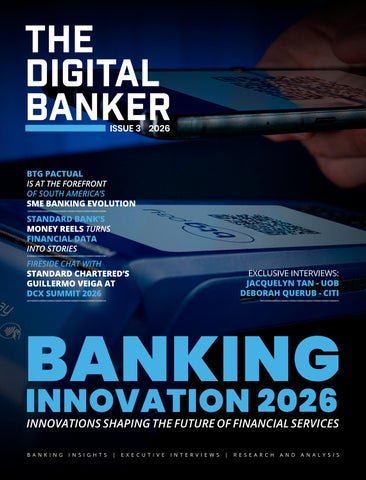
THE DIGITAL BANKER ISSUE 3 2026
BTG PACTUAL IS AT THE FOREFRONT OF SOUTH AMERICA’S SME BANKING EVOLUTION STANDARD BANK’S MONEY REELS TURNS FINANCIAL DATA INTO STORIES FIRESIDE CHAT WITH STANDARD CHARTERED’S GUILLERMO VEIGA AT DCX SUMMIT 2026
EXCLUSIVE INTERVIEWS: JACQUELYN TAN - UOB DEBORAH QUERUB - CITI
BANKING INNOVATION 2026 INNOVATIONS SHAPING THE FUTURE OF FINANCIAL SERVICES B A N K I N G
I N S I G H T S
|
E X E C U T I V E
I N T E R V I E W S
|
R E S E A R C H
A N D
A N A L Y S I S
Published by: The Digital Banker (A brand of Coeus Intelligence Group) 18A Gemmill Lane Singapore 069255 : info@digitalbankeronline.com
2 The Digital Banker | Issue 3 | 2026
Managing Editor’s Note Digital customer experience no longer serves as a competitive advantage alone; it has become the foundation upon which financial institutions build trust, loyalty and long-term growth. As customer expectations continue to evolve, banks must deliver experiences that are intuitive, personalised and secure while keeping pace with rapid technological change. Today, success is no longer measured simply by speed or convenience. Leading institutions distinguish themselves through experiences that anticipate customer needs, remove friction and inspire confidence at every stage of the journey. Whether through AI-powered personalisation, seamless digital onboarding or stronger security, customer experience has become a defining measure of innovation and business performance. Throughout this issue, we explore how banks, fintechs and technology providers are responding to these changing expectations. From digital wealth platforms and embedded finance to seamless payments and next-generation authentication, the stories in these pages demonstrate that meaningful innovation stems not from technology alone, but from a deep understanding of customer needs and a commitment to delivering measurable outcomes. The insights emerging from this year’s Digital CX Awards reinforce many of these themes. Across a record number of submissions from financial institutions worldwide, the strongest organisations demonstrated that removing friction, simplifying complex journeys and embedding security into every interaction have become defining characteristics of digital leadership. They also showed that the future of customer experience will depend on balancing intelligent automation with transparency, trust and responsible innovation. As always, we extend our sincere gratitude to the executives, partners, contributors and members of our judging panel whose insights and expertise continue to enrich our coverage. Their willingness to share experiences, innovations and lessons learned strengthens the dialogue across the global financial services community and helps advance the future of financial services. Whether you are a banking executive, fintech leader, policymaker or technology partner, I hope this Digital CX edition offers valuable perspectives, practical ideas and inspiration to support your own transformation journey. Thank you for your continued support of The Digital Banker. We remain committed to delivering trusted journalism, industry intelligence and thought leadership that celebrate innovation, recognise excellence and highlight the institutions and individuals shaping the future of banking.
Nirav Patel Managing Editor The Digital Banker
The Digital Banker | Issue 3 | 2026 3
Contents
08
20
TG Pactual is at the forefront B of South America’s SME banking evolution
10
24
Re-architecting SME banking in Mexico: Inside Trafalgar’s modern SME banking model
14
26
UOB’s Jacquelyn Tan on scale, integration and execution in ASEAN retail banking
29
Better-informed clients raise the bar for wealth advice – HSBC, Citi executives
Standard Bank and ICBC authorised to operate the Renminbi Clearing Bank of Africa
Standard Bank and ICBC will provide direct RMB clearing across 19 African markets, supporting faster payments, lower costs and stronger China–Africa trade.
The stablecoin revolution is reshaping business payments Stablecoins are transforming crossborder business payments through faster settlement, lower costs and roundthe-clock access, with B2B adoption accelerating worldwide.
Understanding clients better, connecting markets key for digital CX success – Standard Chartered Group CIO Standard Chartered combines client insight, connected platforms and responsible AI to deliver simpler, more secure and consistent digital banking experiences across markets.
18
uilding the operating system B markets now require: How agentic AI is forcing a rethink of markets and securities services HSBC explains how connected data, embedded controls and intelligent orchestration are essential for deploying agentic AI across markets and securities services.
4 The Digital Banker | Issue 3 | 2026
BTG Pactual Empresas combines digital banking, AI-driven lending, APIs and partner services to improve efficiency, access and growth opportunities for SMEs
Trafalgar integrates payments, deposits and AI-powered lending into a digitally native platform designed to expand financial access for Mexico’s underserved SMEs.
UOB combines disciplined integration, data-led personalisation and strategic investment to turn its expanded ASEAN retail franchise into deeper, more valuable customer relationships.
Citi and HSBC executives explain how informed clients, reliable data and AI-supported advisors are raising expectations for personalised and trusted wealth advice.
Contents
32
Maybank Singapore simplifies auto financing with all-in-one dealer platform Maybank Singapore’s myAutoHub digitises the vehicle-financing journey, delivering faster approvals, simpler inventory funding and greater transparency for dealers and customers.
34
How ANEXT Bank’s CreditNow uses live transaction data to approve loans in as fast as one minute
42
RCBC combines digital payments, crossborder banking, inclusive lending and financial education to expand access for Filipinos locally and overseas.
45
Citi’s Deborah Querub on the steady rise of digital assets in wealth management
48
data driven personalisation as part of its customer strategy
ANEXT Bank embeds lending into merchant platforms, using live transaction data to provide small businesses with near-instant, documentfree credit decisions.
36
39
Inside FWD’s AI-driven approach to insurance FWD embeds AI across operations, sales and governance to simple insurance interactions, personalise customer engagement and support responsible innovation across its markets.
RCBC strengthens financial inclusion through digital innovation for Filipinos at home and abroad
Citi’s Deborah Querub examines how digital assets, stablecoins and tokenisation are gradually becoming part of institutional wealth-management conversations and client portfolios.
Akbank places emphasis on
Akbank uses customer micro-profiles, personalised insights and an interactive digital wealth platform to deliver more relevant and engaging banking experiences.
Standard Bank’s Money Reels turns financial data into stories Standard Bank’s Money Reels transforms transaction data into personalised, story-style financial recaps that strengthen engagement and encourage more informed money decisions.
The Digital Banker | Issue 3 | 2026 5
Contents
50
Bank Mandiri’s customer insight and Livin’ super-app deliver personalised banking at scale
58
Bank Mandiri combines customer data and its Livin’ super-app to deliver personalised insights, seamless services and digital banking at scale.
52
AIA Singapore reshapes how
customers manage wellness, health and financials in one integrated superapp ecosystem
60
AIA+ unifies insurance, financial planning, healthcare and wellness services, creating a connected ecosystem that supports continuous customer engagement and healthier outcomes.
54
BOCHK’s digital wealth revamp
56
drives 70% surge in mobile stock trading
BOCHK redesigned its mobile investment experience with simpler trading, expanded market access and real-time data, driving a sharp rise in digital activity.
RBC Insurance platform redesign delivers smarter, faster and more personalized advisor support RBC Insurance redesigned its advisor platform to provide faster navigation, personalised content and easier access to resources, improving advisor and client experiences.
6 The Digital Banker | Issue 3 | 2026
62
Desjardins makes applying for loans a lot easier Desjardins’ omnichannel lending platform enables customers to complete financing applications digitally while moving seamlessly to personalised employee support whenever needed.
Asialink Finance leads the way in inclusive growth through accessible loans
Asialink Finance combines accessible lending, faster approvals and personalised support to expand capital access for MSMEs, women entrepreneurs and underserved communities.
Machine-learning models
and Shari’ah oversight drive Wafra’s risk-adjusted and absolute returns Wafra combines quantitative models, machine learning and Shari’ah oversight to deliver disciplined sukuk selection, benchmark outperformance and effective risk management.
SUBMISSION DEADLINE
21 AUGUST 2026
ABOUT THE PROGRAMME The Global Insurance Innovation Awards exist to recognise the most groundbreaking insurance companies and practitioners internationally. To that end, The Global Insurer welcomes you to participate in the programme to showcase how your institution has been leveraging innovation in maintaining life & non-life solutions through the delivery of superior product & service portfolios as fast changing and uncertain economic conditions coupled with new and emerging risks leave clients seeking enhanced protection solutions. These awards are accolades of excellence and distinction, attributed to outstanding players – they provide objective benchmarks for the global and regional insurance industry. This programmes exists to celebrate the world’s most cutting-edge insurance service providers that are pioneering new standards and capabilities – those that are transforming the industry by setting new milestones by digitally transforming to deliver a consistent insurance experience to clients
AWARDS GALA
5 NOVEMBER 2026
WHO CAN APPLY? The Global Insurance Innovation Awards is open to all institutions operating across the insurance landscape. We welcome submissions from Life and Non-Life Insurance providers, Reinsurers, Takaful operators, Insurtech companies and Technology Service providers. If you identify your organisation as a leader that is pushing the boundaries through pioneering innovation, making the requisite investments in technology platforms, forming alliances with relevant ecosystem partners and providing holistic coverage solutions to elevate client engagement in the insurance industry, then we welcome you to send in your nominations.
thedigitalbanker.com/awards/global-insurance-innovation-awards
ENQ@TheDigitalBanker.Com
INDUSTRY UPDATE
Standard Bank and ICBC authorised to operate the Renminbi Clearing Bank of Africa By Kevin Luarca
Standard Bank and ICBC have been jointly authorised by the People’s Bank of China to operate the Renminbi Clearing Bank of Africa, granting direct RMB clearing rights across 19 African countries and making Standard Bank the first African based bank to hold such status. The move is expected to streamline RMB settlement between China and Africa, deepen financial ties, and advance Beijing’s long term goal of renminbi internationalisation. Standard Bank and the Industrial and Commercial Bank of China (ICBC) have been jointly authorised by the People’s Bank of China to operate the Renminbi Clearing Bank of Africa, a development that the two institutions say will give African markets direct access to China’s onshore financial system and materially ease the flow of renminbi across the continent. The practical effect of the authorisation is to provide market participants in the named African jurisdictions with a direct channel into China’s onshore plumbing, including access to capital markets, liquidity facilities and payments innovations that previously required intermediaries or relied on correspondent banking relationships. Standard Bank has emphasised that the clearing status complements its earlier admission to China’s Cross Border Interbank Payment System, known as CIPS, which the bank secured in November 2025. Whereas CIPS enables interbank payments using the renminbi as the settlement currency, clearing status gives the bank privileged access to onshore liquidity and settlement mechanisms that can shorten payment chains, reduce costs and improve transparency for corporates, banks and sovereign treasuries.
8 The Digital Banker | Issue 3 | 2026
China’s Renminbi Internationalisation The move also sits squarely within Beijing’s long running policy objective of renminbi internationalisation, a gradual process that has combined regulatory liberalisation, the expansion of offshore RMB centres and the development of alternative payment rails such as CIPS. Chinese authorities have repeatedly signalled that they want the RMB to play a larger role in global trade and finance, both to reduce reliance on the US dollar and to give Chinese firms and counterparties more direct access to onshore liquidity. By authorising a clearing bank that explicitly targets Africa, the People’s Bank of China is extending that strategy to a region that is already one of China’s largest trading partners and a major recipient of Chinese investment. For African policymakers and central banks, the new clearing capacity presents both opportunity and choice. On the one hand, the ability to settle trade and service debt in renminbi can reduce currency conversion costs and provide a natural hedge for exporters whose revenues are denominated in RMB. On the other hand, increased use of the renminbi raises questions about reserve management, liquidity provisioning and the need for robust FX risk management frameworks.
INDUSTRY UPDATE
China strengthens its partnerships with African nations China’s expanding financial footprint in Africa has long been a subject of strategic interest for other global powers, and deeper renminbi integration could shift the balance of transactional currency use on the continent. Some observers caution that while the shift away from dollar centric settlement may reduce certain vulnerabilities, it could also increase Africa’s exposure to Chinese financial influence if not managed with diversified counterparties and robust governance. Standard Bank’s status as the first African based bank to receive clearing authorisation is symbolically significant and practically consequential. The bank’s leadership has framed the achievement as consistent with its purpose of supporting the continent’s growth, and it has signalled that the clearing bank will be a central node for RMB business across Africa. In addition to trade settlement, the clearing bank could facilitate RMB denominated lending, bond issuance and cross border investment flows, thereby broadening the range of financial instruments
available to African issuers and investors. Market participants will be watching for the first wave of RMB denominated instruments that leverage the new clearing channel, and for signs that local currency markets and institutional investors begin to incorporate RMB assets into their portfolios. The authorisation also highlights the evolving architecture of global payments. Since the global financial crisis, there has been a steady push by several countries to build alternative rails and reduce single point dependencies in cross border settlement. China’s development of CIPS and its willingness to authorise clearing banks abroad are part of that trend, and Africa’s inclusion as a continent level clearing hub reflects both the scale of Sino African economic ties and China’s strategic interest in deepening those links. For African businesses and financial institutions, the immediate benefits are operational: faster settlement, lower costs and more direct access to onshore liquidity. For policymakers, the benefits must be weighed against the need for sound macroprudential oversight and a clear strategy for managing currency exposure.
The Digital Banker | Issue 3 | 2026 9
INDUSTRY UPDATE
The stablecoin revolution is reshaping business payments By Kevin Luarca
Stablecoins have surged from niche crypto instruments to mainstream payment tools, processing $33 trillion in 2025, more than Visa and Mastercard combined, and reshaping how businesses handle cross-border transactions. Once seen as a niche tool for crypto traders, stablecoins are now processing a staggering $33 trillion in on-chain transactions, overtaking the combined volume of Visa and Mastercard for the first time, according to a study by Artemis Analytics and first reported by Bloomberg. Their use is also expanding in the real economy, especially in businessto-business (B2B) payments.
10 The Digital Banker | Issue 3 | 2026
What are stablecoins, and why do they matter? Stablecoins are digital tokens that aim to keep their value steady, usually by being backed one-to-one by cash or government bonds. Unlike cryptocurrencies Bitcoin or Ethereum, whose prices can swing significantly, stablecoins are designed to be stable. This stability makes them suitable for payments,
INDUSTRY UPDATE
remittances, payroll, and even as a store of value in countries with volatiles currencies. But stablecoins are not limited to functioning as digital cash. They run on public blockchains like Ethereum, Tron, and Binance Smart Chain, which means they can be sent anywhere in the world, 24/7, with near-instant (in most cases) settlement and low fees. For businesses, this creates additional options for cross-border payments: paying suppliers overseas without waiting days for a wire transfer, settling invoices in seconds, and managing treasury operations with a level of transparency and programmability.
Stablecoins overtake card giants In a report by Artemis Anaytics and Dune titled: The State of Stablecoins 2025: Supply, Adoption & Market Trends, they said that in 2025, stablecoins processed $33 trillion in on-chain volume, surpassing Visa and Mastercard combined. By August 2025, monthly transaction volume had crossed $1.25 trillion, with over 30 million active wallets, a 53% jump from the previous year. CoinGecko also reported that the total market capitalisation of stablecoins hit $312 billion by the end of 2025, up from just $5 billion in 2020. But it’s not just about raw volume. When excluding trading, internal transfers, and automated activity, the real-economy use of stablecoins— actual payments for goods, services, payroll, and remittances—has more than doubled in the past year. According to a joint study by McKinsey and Artemis Analytics, true stablecoin payments reached about $390 billion in 2025, with business-to-business (B2B) payments making up $226 billion, or 60% of the total.
B2B stablecoin payments Perhaps the clearest shift has been in businessto-business (B2B). In early 2023, B2B stablecoin payments were under $100 million per month. By mid-2025, they had soared past $3 billion per month. Annualised, that’s $226 billion in B2B flows, now representing the 60% of identifiable real-economy stablecoin activity according to McKinsey.
What’s driving this growth? For many businesses, especially those operating across borders, stablecoins offer a way to reduce reliance on the delays, fees, and complexities of traditional banking rails. International supplier payments that once took days can now settle faster, with fees that can fall below 0.1%, which is a fraction of the 1.5–3% charged by traditional crossborder payment system. It’s important to note that not all stablecoin transaction volume reflects real economic activity. Much of the headline volume includes trading, internal transfers, and automated activity. Leading analytics firms like Artemis, McKinsey, and Chainalysis use a mix of on-chain tagging, transaction size filtering, and cross-referencing with known payment infrastructure to estimate true payment volumes. Analytics firms use on-chain tagging, transaction size filters, and payment infrastructure mapping to distinguish genuine payments from trading activity. For B2B payments, only about 20% of tagged volume is considered genuine business payments, with the rest attributed to trading or internal movements. Card-linked payments are easier to track, as they use dedicated smart contracts. Remittances and peerto-peer flows are estimated using exchange data and adjusted for likely over-reporting. A recent survey by EY-Parthenon found that 41% of corporate stablecoin users reported cost savings of at least 10%, mainly in cross-border supplier payments. Even more telling, 77% of corporate users cited supplier payments as their main use case for stablecoins.
Cost, speed, and simplicity are driving the switch For many companies, the appeal of stablecoins boils down to three things: lower costs, faster settlement, and simpler operations. Traditional cross-border payments can take days, involve multiple banks, and rack up fees at every step. Stablecoins reduce the number of intermediaries, settling payments directly on the blockchain. In the 2025 survey of 350 executives by EY-Parthenon, participants said that their reason for using
The Digital Banker | Issue 3 | 2026 11
INDUSTRY UPDATE
stablecoins are driven by reduced transaction costs (cited by 52% of respondents), faster cross-border payments (45%), and 24/7 settlement and liquidity (34%).
together account for over two-thirds of the market, with USDT leading in retail and emerging markets, and USDC favoured by institutions and regulated platforms.
Supplier payments are the standout use case, with 77% of corporate users naming it as their top reason for adopting stablecoins. Other popular uses include accepting cross-border payments from business partners, managing liquidity and treasury, and even paying employees in regions with volatile currencies.
Tron, Ethereum, and Binance Smart Chain are the main networks for stablecoin settlement. Tron, in particular, has become the workhorse for high-volume, low-cost transfers, especially in Asia and emerging markets, processing over $3.3 trillion in stablecoin transactions in 2025 alone according to reports by CoinMarketCap and Coindesk. Ethereum remains the hub for DeFi and institutional flows, while Binance Smart Chain and newer networks like Aptos and Solana are carving out their own niches. Card-linked stablecoin payments are also on the rise. Visa and Mastercard have both launched pilots and partnerships to enable stablecoin-backed cards, allowing users to spend stablecoins at millions of merchants worldwide. In 2025, card-linked stablecoin payments topped $13.2 billion in annual volume, and Visa’s stablecoin settlement pilot reached a $3.5 billion annualised run rate.
Stablecoin uses in the current landscape •
•
•
•
•
Supplier Payments: Multinational firms are using stablecoins to pay overseas suppliers, especially in regions where access to US dollars is limited or where banking access is constrained. For example, fast-moving consumer goods companies have reported that distributors in Africa and Asia now prefer stablecoins for settling invoices, as they can access them easier than dollars. Treasury Management: Firms like Standard Chartered and MoneyGram are exploring stablecoins to streamline cross-border treasury operations, reduce pre-funding requirements, and manage liquidity more efficiently. Payroll and Gig Economy: Companies such as Scale AI and Bitwage offer overseas contractors the option to be paid in stablecoins, ensuring timely, stable-value payments regardless of local currency swings. Remittances: In remittance-heavy market such as the Philippines, stablecoins are being used to send funds home, bypassing expensive and slow traditional channels. Local wallets like GCash now support USDC, making digital dollars accessible to millions. Merchant Payments: Platforms like Stripe have launched stablecoin financial accounts in over 100 countries, allowing businesses to hold, send, and receive stablecoins alongside traditional currencies.
Behind the scenes, a complex web of blockchains, issuers, and payment platforms powers the stablecoin boom. The two biggest stablecoins by market capitalisation, Tether’s USDT and Circle’s USDC,
12 The Digital Banker | Issue 3 | 2026
The GENIUS Act and MiCA supported stablecoin growth One of the biggest hurdles to mainstream adoption has been regulatory uncertainty. That changed in 2025, when the US passed the Guiding and Establishing National Innovation for US Stablecoins Act (GENIUS Act), and the EU’s Markets in CryptoAssets Regulation (MiCA) came into full force. The GENIUS Act sets out clear rules for who can issue stablecoins in the US, how they must be backed (1:1 with cash or short-term Treasuries), and what disclosures are required. It prohibits issuers from paying interest to holders, brings stablecoins under the Bank Secrecy Act for anti-money laundering compliance, and gives federal and state regulators oversight depending on the size of the issuer. The Act also clarifies that compliant stablecoins are neither securities nor commodities, removing years of legal ambiguity. MiCA, meanwhile, imposes strict requirements on stablecoin issuers in the EU, including full reserve backing, monthly audits, and limits on the scale of large tokens to protect monetary sovereignty. It
INDUSTRY UPDATE
distinguishes between electronic money tokens (EMTs) pegged to a single currency and assetreferenced tokens (ARTs) pegged to baskets of assets, and bans algorithmic stablecoins altogether. While both frameworks aim to protect consumers and ensure financial stability, they differ in key ways. The GENIUS Act is more flexible on reserve composition and allows for state-level regulation of smaller issuers, while MiCA is stricter on reserve segregation, reporting, and cross-border recognition. While both frameworks aim to protect consumers and ensure financial stability, they differ in reserve requirements and oversight, creating a patchwork global compliance landscape. For global businesses, this means navigating a patchwork of rules and often building to the highest common standard. Far from being left behind, banks and financial institutions are jumping into the stablecoin game. In Europe, ClearBank has partnered with Circle to roll out MiCA-compliant stablecoins (USDC and EURC) via the Circle Mint platform, giving clients instant access to regulated digital dollars and euros. Swiss banks are piloting a franc-pegged stablecoin, and major US banks are exploring joint stablecoin projects to compete with fintechs and big techs. Payment giants like Stripe have launched stablecoin financial accounts in over 100 countries, letting businesses hold, send, and receive stablecoins alongside traditional currencies. Visa and Mastercard are integrating stablecoin settlement into their networks, and fintechs like Reap and Rain are building B2B payment platforms around stablecoin rails. For banks, the appeal is clear: stablecoins offer a way to modernise cross-border payments, reduce settlement risk, and tap into new revenue streams. A 2025 survey by Ernst & Young found that 79% of financial institutions plan to leverage third parties for stablecoin infrastructure, and 57% intend to explore new stablecoin offerings in the next year.
Forecasts for stablecoin’s future The future looks even bigger. Morph, a secure settlement layer for global crypto payments, projects that stablecoin settlement volume could exceed $50 trillion by 2026, up from $33 trillion in 2025. Chainalysis forecasts that stablecoin flows could reach $56.6 trillion by 2030 and potentially $1.5 quadrillion by 2035, driven by generational wealth transfer and the rise of AI-driven payments. By 2030, stablecoins could account for 5–10% of all global cross-border payments, with market capitalisation surpassing $1.9 trillion. Citi’s base case projects a $1.9 trillion stablecoin market by 2030, with a bull case of $4 trillion. As more merchants accept stablecoins, and as regulatory clarity spreads, the line between traditional and digital payments will blur. Stablecoins are on track to become a core layer of global financial infrastructure, powering everything from supplier payments and remittances to payroll, treasury, and even AI-driven commerce.
Stablecoins are here to stay Stablecoins have now secured its place as a central player in global payments. With $33 trillion in annual volume, over $6 billion in monthly B2B payments, and forecasts stretching into the quadrillions, stablecoins are now way past the question of “will it last?” For companies, the message is simple: those who build stablecoin capabilities today will hold a cost and speed advantage over those tied to legacy rails. For banks and fintechs, the opportunity lies in bridging the gap between traditional and digital finance, offering clients faster, cheaper, and more transparent payment solutions. As AI agents begin to transact, as regulatory clarity spreads, and as more merchants and suppliers embrace digital dollars, stablecoins are set to become the backbone of the next era of global commerce.
The Digital Banker | Issue 3 | 2026 13
DCX SUMMIT
Understanding clients better, connecting markets key for digital CX success – Standard Chartered Group CIO By Rashmi Kumar
Anticipating client needs, redesigning processes end-to-end and leveraging AI responsibly are critical for banks looking to deliver a solid digitally enabled banking experience to their clients, said Guillermo Veiga, Group Chief Information Officer at Standard Chartered, at the Digital CX Summit 2026 held in Singapore on 23 April. Speaking at the opening fireside chat, Veiga said technology has redefined what is exceptional customer experience for cross-border corporate and institutional clients. Five years ago, the focus was on speed and accuracy. Today, anticipating client needs is key, as is simplifying their banking experience across jurisdictions, channels and products. As a global bank operating across 54 markets spanning Asia, Africa and the Middle East, Standard Chartered is one of the frontrunners in providing top-notch digital CX. At the industry event organised by The Digital Banker, Veiga said having a disciplined, platformled and API-first architecture allows the bank to standardise the core building blocks of banking, while keeping services flexible and scalable. He added that through APIs, capabilities like payments, liquidity management or trade services can be embedded directly in client workflows – leading to less friction, more transparency and a consistent experience across markets. Banks should also focus on redesigning processes endto-end, with a focus on features and applications that might be needed in the future, rather than digitising them in isolation.
14 The Digital Banker | Issue 3 | 2026
“When we redesign processes end-to-end – whether that’s onboarding, payments or trade flows – we can remove manual steps, automate decision-making, improve speed, transparency and predictability for clients,” reckons Veiga. This is crucial for a firm like Standard Chartered, whose clients include individuals, entrepreneurs and families, large corporations, financial institutions, fintechs, governments and development organisations, and breakthrough organisations under its ventures business. That is why its strategy is built around navigating change and supporting clients as their needs evolve, to remain relevant and trusted over the long term.
Trust in focus The importance of customer trust around digital banking was a consistent theme at the summit, which brought together leaders from across retail banking, transaction banking, SME banking, wealth and private banking, insurance, digital challengers, and fintech innovators. Veiga said during the fireside chat that trust is the “foundation of customer experience”.
DCX SUMMIT
(L-R) Marie Bush, Director at Alvarez and Marsal and Guillermo Veiga, Group Chief Information Officer at Standard Chartered
To that end, Standard Chartered has built cybersecurity and operational resilience into the design of its platforms, and has teams that continuously monitor the global threat landscape. This allows it to focus on innovation, while ensuring clients are confident about the bank’s security controls and know their data and transactions are safe, added Veiga. When it comes to artificial intelligence, the CIO said AI brings threats and opportunities, so having the right governance model and frameworks from the outset to use AI responsibly will be a key differentiator for banks. A good data strategy will also be essential. Standard Chartered is already deploying AI to improve customer experience at call centres, and on the wealth front, its AI-powered FX Insights Allen Li tool gives clients real-time, actionable market CEO Precision Fund Services intelligence in a simple, intuitive format.
“Today, we have a human in the loop and believe AI is more about augmentation than replacing people,” said Veiga.
AI supercharges CX On 21 April, Standard Chartered and Singapore’s Agency for Science, Technology and Research (A*STAR) announced a three-year partnership to accelerate AI research and innovation across the financial industry. The bank and A*STAR’s Institute of High Performance Computing will jointly commit SGD15 million (USD11.1) to set up an AI for Banking Innovation Lab, comprising technology scientists and researchers from the two organisations, which will explore topics like portfolio optimisation, fraud detection and natural language processing, according to a press release.
The Digital Banker | Issue 3 | 2026 15
DCX SUMMIT
Veiga said that digital-first banking models have reshaped client expectations across all segments, underscoring the need to enable seamless connectivity with growth opportunities, while equipping our workforce with future-ready skills. He added that industry partnerships like these will help create new business models running on AI – “fundamentally an innovative way of delivering seamless, client-centric
financial services”. “Ultimately, the banks that succeed in the digital CX journey will be those that use technology not just to move faster, but to understand clients better, connect markets more effectively, and build stronger relationships,” he added. “That’s exactly what we’re focused on at Standard Chartered.”
Marie Bush, Director at Alvarez and Marsal asked questions from the audience to Guillermo Veiga
16 The Digital Banker | Issue 3 | 2026
SUBMISSION DEADLINE
28 AUGUST 2026
AWARDS GALA
12 NOVEMBER 2026
ABOUT THE PROGRAMME The Digital Assets Awards exist to honour and celebrate the world’s pre-eminent and ground-breaking digital asset participants and market infrastructure providers that are transforming the digital assets ecosystem. The Digital Assets Awards is the only world-wide assessment program dedicated to recognising excellence in the use of digital assets by market participants. These awards celebrate the most cutting-edge innovation and technologies that have materially impacted and disrupted traditional asset classes and investment frameworks, while dramatically driving innovation efforts within the game-changing paradigm of decentralised finance, blockchain and Web3.
WHO CAN APPLY? The Digital Assets Awards 2026 programme is open to all participants within the digital assets landscape. We invite nominations from banks, buy-side asset management and fund management companies, digital asset / crypto exchanges & trading platforms, digital / crypto wallets, digital asset custodians, non-bank financial institutions, token issuers, gaming companies and digital asset technology companies & service providers.
thedigitalbanker.com/awards/global-insurance-innovation-awards
ENQ@TheDigitalBanker.Com
OPINION
Building the operating system markets now require: How agentic AI is forcing a rethink of markets and securities services This opinion piece is by Allen Li, Global Head of Digital and Distribution, HSBC
Agentic AI has moved rapidly from novelty to an increasingly central capability. KPMG has suggested that agent-based systems could unlock around $3 trillion a year in corporate productivity gains under certain assumptions. McKinsey notes that if banks fail to adapt their operating models, global banking profit pools could shrink by roughly $170 billion over the next decade, pushing returns towards the cost of capital. These figures dominate conference agendas. But they do not answer the question clients are now asking with increasing frequency: what will actually change in how markets and securities services are delivered?
often remains stubbornly familiar: multiple portals, repeated requests for information, inconsistent answers across desks or regions, and slow decisionmaking despite abundant data.
One example of how markets are already changing is in conversational interaction volumes. Since 2019, within HSBC’s AI Markets’ channels, daily AI Markets interactions have risen significantly, from a few hundred to tens of thousands a day, a significant shift that reflects agents becoming part of the operating fabric rather than a side experiment. For global banks, the issue is no longer whether to deploy AI agents. It is whether the underlying infrastructure is capable of supporting them in a way that improves client outcomes rather than adding another layer of complexity. Agentic AI is exposing a structural problem that has existed for years.
From ambition to architecture Survey data shows a widening gap between intent and execution. Almost all firms say they plan to deploy AI agents, yet only a small minority have done so at scale. From the client side, the experience
18 The Digital Banker | Issue 3 | 2026
Allen Li Global Head of Digital and Distribution, HSBC
OPINION
Agentic AI does not automatically fix this. Introduced into fragmented environments, agents can reinforce inconsistency rather than reduce it. The constraint is architectural. Banks have spent decades building systems optimised around products and internal functions. Clients experience banks as single counterparties. AI is making that mismatch increasingly visible.
Context becomes the service
HSBC AI Markets is an AI-powered, natural language processing (NLP) platform that provides institutional investors and corporate clients with instant access to HSBC’s proprietary data, trading analytics, and market liquidity insights. It acts as a conversational, web-based tool for cross-asset research, real-time pricing, and trade execution via the Evolve platform or API.
The same pattern is visible outside banking. Intuit has publicly attributed part of its recent earnings performance to an AI-driven platform that combines proprietary data, domain-specific agents and human expertise. In capital markets, Morgan Stanley has argued in public commentary that embedding advanced AI into data-rich, workflowintegrated franchises raises the competitive bar rather than lowering it.
The more relevant question is no longer which model or agent is being used, but what operating environment those agents run on. In markets and securities services, an AI-era operating system has three defining characteristics. First, it treats proprietary data as institutional memory. Positions, risk, mandates, legal documentation and historical decisions need to be connected and queryable within secure, governed environments that respect client confidentiality, data protection and local regulatory requirements. Without this, agents operate on partial information. With it, insights and decisions can reflect the full context of a client relationship. Second, trust and control are embedded at the platform level. In regulated markets, this means clear entitlements, audit trails and explainability for automated actions as well as human ones, together with robust model risk management and appropriate human oversight. Agentic workflows only become usable at scale when they are auditable, controllable and understood by front-line teams. Third, orchestration matters more than individual tools. Client journeys routinely cut across asset classes, booking centres and regulatory regimes. The operating system coordinates that complexity behind the scenes, so clients see a coherent experience rather than a patchwork of internal systems.
Recent research points to a consistent conclusion: context matters more than raw model power. NVIDIA’s State of AI in Financial Services: 2026 Trends report indicates that the institutions seeing the most impact are those treating proprietary data as a strategic asset rather than relying on generic models.
Across these examples, context becomes a service in its own right. A salesperson who once maintained their own shadow spreadsheets to track client RFQs, research and risk views across desks can now call on an AI agent that pulls a unified view of a client’s recent flows, current exposures and relevant research in seconds. This is not a new portal, but a more coherent operating environment. Such tools are intended to support, not replace, human judgement and do not alter the bank’s regulatory obligations. Seen through this lens, the purpose of an AI operating system is practical. It aims to reduce friction in everyday interactions, improves the timing and relevance of insights, can help to lower operational and regulatory surprises, and frees human time for judgement and negotiation. Relationship managers are not replaced, but rather augmented by systems that are more coherent and transparent. Agentic AI highlights the limits of fragmented infrastructure and forces a deeper rethink of how markets and securities services are built. Over time, clients may increasingly not ask whether agents are being used. That will be assumed. The harder questions will concern integration, confidence and control. Answering those questions will come from the operating system beneath the relationship.
The Digital Banker | Issue 3 | 2026 19
INSIDE THE INNOVATION
BTG Pactual is at the forefront of South America’s SME banking evolution BTG Pactual Empresas is at the forefront of SME banking innovation in Latin America and Brazil, offering a fully digital ecosystem that goes beyond traditional financial services. Through seamless onboarding, integrated tools and advanced AI capabilities, it helps businesses manage finances more efficiently and reduce costs. By enabling fully digital onboarding, the platform also reduces regional barriers, extending access to SMEs beyond major economic hubs, including underserved regions such as the North and Northeast of Brazil, thereby advancing financial inclusion at scale. With a strong focus on APIs, automation and strategic partnerships, the bank delivers secure, flexible solutions that integrate into clients’ daily operations, driving efficiency, growth and a superior customer experience. This operational efficiency also contributes to environmental impact reduction through paperless
20 The Digital Banker | Issue 3 | 2026
processes and reduced need for physical travel and branch interactions.
The makings of a leading SME bank First launched as a supply chain finance platform in 2019, BTG Pactual Empresas has evolved into a full-stack
INSIDE THE INNOVATION
digital platform for SMEs, covering business banking, payments and credit. It now offers a fully integrated digital ecosystem for SMEs, with multiple platforms and services extending far beyond basic banking. Its features include: All-in-one digital banking platform: A unified online and mobile platform where SMEs manage accounts, payments (Pix, transfers), and daily finances, with about 260,000 SME clients as of the end of Q3 2025. The bank leads with a digital-first approach – all SME accounts are opened digitally (over 90% via app or web) and more than 85% SME banking interactions occurring via mobile. The platform also supports SMEs with international operations by integrating foreign exchange, international payments and hedging tools directly into the account environment. Embedded marketplace: Within the platform, the bank has onboarded 200 strategic partners to provide valueadded services to clients, offering SMEs access to thirdparty solutions. These include accounting software: ERP integrations, legal/tax advisory, insurance, e-commerce tools, and more. Digital lending and credit infrastructure: Digitising the entire SME credit journey from application to disbursement, the bank’s AI-led lending platform autoapproves loans instantly, contributing to 96% of SME loan disbursements being completed within 10 minutes – roughly 16x faster than traditional banks. Open banking, APIs and embedded finance: A core pillar of BTG Pactual Empresas’ ecosystem is the API-first architecture that allows clients and partners to integrate BTG’s services into their own systems. With a broad suite of APIs (payments, collections, account info, FX, credit etc.) and a no-code automation platform, the team has effectively created a developer ecosystem around the bank. This no-code capability democratises automation for SMEs, reducing dependence on costly ERP systems and enabling practical use cases such as automated reconciliation, collections, disbursements and financial scheduling without requiring technical expertise. Merchant acquiring and payments (BTG Pay): In 2025, the bank expanded into payments acquiring to complete its SME offering. BTG Pactual acquired Justa, a fintech specialising in POS payments for SMEs, and launched BTG Pay, an integrated merchant payments solution.
BTG Pactual Empresas has evolved into a fullstack digital platform for SMEs, covering business banking, payments and credit.
This brings POS card acquiring, payment terminals and instant receivables into its ecosystem. The integration of Justa’s technology into the bank’s cash management platform is underway, with the goal of offering a fully integrated acquiring solution to its SME clients.
Helping businesses thrive BTG Pactual Empresas provides flexible financing for essential agricultural inputs such as seeds, fertilisers and crop protection products, helping farmers maintain yield and manage cash flow. Beyond that, the bank supports essential supply chains across agribusiness, including distributors, small suppliers and resellers, ensuring liquidity and continuity across the ecosystem. It also supports investment in machinery, irrigation and rural infrastructure like warehouses and storage facilities to improve productivity and efficiency. Its offerings extend to sectors such as sugarcane and livestock, while partnerships with dealers and suppliers enable seamless access to credit at the point of purchase. The bank also provides working capital across the agribusiness value chain, helping distributors and resellers offer favourable payment terms to rural customers. Importantly, BTG Pactual Empresas also plays a growing role as a bridge for SMEs expanding internationally, particularly across Latin America (including Chile, Colombia and Uruguay), facilitating cross-border trade, payments and financial management. Benefits for SMEs include competitive, tailored financing, fast digital onboarding, and end-to-end support from production to market. This is complemented by a hybrid service model that combines a robust digital
The Digital Banker | Issue 3 | 2026 21
INSIDE THE INNOVATION
platform with access to specialists who provide advisory on structured credit, agribusiness financing, foreign exchange and growth strategies for scaling businesses.
An award-winning SME current account BTG Pactual Empresas’ SME current account has delivered tangible benefits, transforming how businesses manage their finances. Through 100% digital onboarding and paperless processes, account opening time has been reduced from days to under 10 minutes, enabling SMEs to begin transacting almost instantly. Zero maintenance fees and unlimited digital transfers have helped reduce costs and improve cash flow. The platform simplifies day-to-day operations by integrating payments, collections, payroll and foreign exchange into a single interface, removing the need for multiple systems. With most interactions conducted via mobile, SMEs benefit from real-time, 24/7 access to their finances, while advanced security features such as biometric authentication and fraud detection ensure safety and compliance. In addition, access to a curated marketplace of services, including accounting, tax advisory and insurance, supports broader business needs and growth.
22 The Digital Banker | Issue 3 | 2026
For the bank, the initiative has driven strong strategic and operational gains. Fully digital onboarding has accelerated customer acquisition and expanded market share, particularly in previously underserved regions, while reduced reliance on paper and physical branches has improved cost efficiency. High levels of straight-through processing have minimised manual intervention and streamlined operations. Digital engagement has strengthened customer relationships and unlocked cross-selling opportunities across lending, foreign exchange and value-added services. At the same time, data generated through digital channels enables more personalised offerings and improved risk assessment, enhancing profitability and portfolio quality.
Leveraging AI across operations The bank’s AI initiative is designed to deliver seamless, behind-the-scenes innovation, enhancing client experience without adding complexity. By embedding AI across key journeys, it enables internal teams to deliver faster, more efficient and higher-quality services. One example is the Electronic Invoice Reader, which converts invoices into payment slips, helping
INSIDE THE INNOVATION
clients save time and improve operational efficiency. In customer service, AI tools have significantly improved performance. A Knowledge Assistant enhances query handling and response accuracy, increasing first-contact resolution and customer satisfaction. Automated case summaries and data entry simplify agent workflows, reduce errors and improve accuracy, while virtual assistants support faster and more efficient responses. Together, these tools have reduced average handling time and steadily improved service accuracy. AI is deeply embedded in the bank’s CRM, which orchestrates sales, credit and post-sales journeys. Advanced data analytics enable next-best-offer recommendations, cross-selling opportunities and proactive risk prevention. AI is also applied to commercial prioritisation, helping relationship managers identify high-potential clients and optimise engagement strategies. Looking ahead, the bank plans to expand AI capabilities with transactional and sales virtual assistants, as well as supervisory tools, further driving efficiency and delivering greater value across customer interactions.
Creating a comprehensive ecosystem BTG Pactual Empresas’ API initiative connects financial services with software and strategic partners – enabling secure, automated and advanced solutions and helping clients streamline financial management. Recognising the limitations of legacy file-based systems, the bank introduced modern API and nocode automation solutions tailored to SME needs. Its extensive API portfolio offers flexible, cost-efficient tools that allow clients to integrate directly or access services through certified software partners. This approach significantly reduces costs and complexity while enabling more advanced use of banking services. The platform has scaled rapidly, offering over 200 API endpoints across products, reports and open finance. It has seen strong adoption, with API usage reaching hundreds of millions of calls monthly, alongside a growing network of integrations and automated workflows. Overall, the initiative has enhanced efficiency, reduced costs and positioned the bank as a leader in digital SME banking solutions. By combining digital innovation with advisory-led engagement, BTG Pactual Empresas differentiates itself from purely digital banks, delivering both scale and depth to SME clients.
The Digital Banker | Issue 3 | 2026 23
INSIDE THE INNOVATION
Re-architecting SME banking in Mexico: Inside Trafalgar’s modern SME banking model Mexico’s SMEs have long faced limited access to modern banking services, with legacy systems and manual processes slowing growth. Trafalgar is seeking to change that through a digitally native platform that integrates payments, deposits, and lending, supported by proprietary technology and AI-driven risk models designed for the realities of SME banking. In Mexico, SMEs underpin the economy but remain underserved by traditional banking. Limited credit access, manual processes, and rigid legacy systems have long constrained their growth. Trafalgar, a digitally native financial institution, is addressing this gap by rethinking SME banking from the ground up. Rather than digitising outdated models, it has built a modern, transparent, and fully integrated platform designed around how businesses operate.
Rebuilding SME banking While SMEs in developed markets benefit from seamless digital credit, real-time services, and integrated financial tools, Mexico’s ecosystem has lagged behind. Trafalgar identified this disparity as an opportunity to redesign SME banking entirely by moving away from fragmented, bureaucratic systems toward a unified, digital-first model. Its platform functions as a “one-stop-shop,” combining: • • • •
Digital checking accounts opened in minutes Real-time transfers via SPEI Time deposits with yield A revolving SME credit line
This integrated approach enables businesses to manage payments, liquidity, and borrowing within a single ecosystem.
24 The Digital Banker | Issue 3 | 2026
Built for how SMEs truly operate A key differentiator is Trafalgar’s in-house technology stack. The company developed both its mobile app and web platform independently, ensuring each is optimised for real-world usage—whether on the move or at a desk. While both channels share core logic, their interfaces are tailored for context, enabling intuitive, low-friction experiences even in lowconnectivity environments. This commitment to building from scratch extends across the entire platform, right from onboarding and payments to credit decisioning, allows Trafalgar to maintain full control over performance and scalability.
A key differentiator is Trafalgar’s in-house technology stack. The company developed both its mobile app and web platform independently, ensuring each is optimised for real-world usage.
AI as an enabler of access and security Artificial intelligence underpins Trafalgar’s model. AIdriven identity verification streamlines onboarding, reducing rejection rates for legitimate businesses, while proprietary risk models expand access to credit by analysing broader data sets. At the same time, advanced fraud detection ensures strong security. This dual focus on accessibility and protection allows Trafalgar to responsibly extend financial services to a historically underserved segment. Since its 2023 beta launch, Trafalgar has onboarded around 6,000 clients and generated approximately $500 million in deposits. This early momentum highlights both the scale of unmet demand and the appeal of a purpose-built SME banking solution.
From fintech origins to full banking capability The founding team’s earlier venture, launched as an IFPE under Mexico’s Fintech Law, reached over $50 million in deposits within a year before being acquired by Walmart - one of Latin America’s notable early fintech exits. Building on this success, Trafalgar Sofipo emerged as a fully licensed institution,
becoming the first SOFIPO approved in nearly a decade. With a Visa Card Issuer license and approval for cross-border transactions, Trafalgar is expanding its capabilities. Its near-term focus includes scaling AIdriven underwriting, growing deposits, and enhancing cross-border offerings, with targets of onboarding hundreds more SMEs and reaching $100 million in deposits.
Recognition and impact Trafalgar’s innovation has earned industry recognition, including eight significant wins at the Global SME Banking Innovation Awards 2026, hosted by The Digital Banker. More importantly, its platform is enabling SMEs to access formal credit, manage finances efficiently, and scale sustainably, while driving broader economic growth. By combining proprietary technology, AI-driven insights, and a deep understanding of business needs, Trafalgar has created a scalable, future-ready model. As it continues to grow, it is set to play a central role in building a more inclusive and efficient financial ecosystem for SMEs.
The Digital Banker | Issue 3 | 2026 25
VOICES OF INFLUENCE INTERVIEW SERIES
UOB’s Jacquelyn Tan on scale, integration and execution in ASEAN retail banking By Wynndee Alejo
UOB’s expansion across Southeast Asia has lifted its retail franchise to more than 8.5 million customers. The challenge now lies in converting scale into sustained returns through execution, data and disciplined investment. In an interview with The Digital Banker, Jacquelyn Tan, Head of Group Personal Financial Services at UOB, outlines how the bank has approached
integration, where it is extracting value from data, and how it is prioritising investment across its retail business.
Jacquelyn Tan Head of Group Personal Financial Services, UOB
26 The Digital Banker | Issue 3 | 2026
VOICES OF INFLUENCE INTERVIEW SERIES
Integration at scale UOB’s acquisition of Citigroup’s consumer banking businesses in Indonesia, Malaysia, Thailand and Vietnam ranks among the most extensive retail banking integrations in the region in recent years. The operational demands extended beyond systems migration to customer experience, product alignment and organisational coordination. “It was a multi-year endeavour involving thousands of staff,” Tan says. “We structured ourselves into multiple workstreams across countries and business units, supported by a central control tower to align and synchronise efforts.” Execution was phased across markets. The bank introduced early data profiling within the integration process to reduce friction when customers accessed digital channels, alongside repeated mock runs to test readiness and clarify roles across teams. Migration was supported by structured customer segmentation, with communications tailored to different personas and potential friction points across touchpoints. Post-migration, a “hypercare” model was established to monitor customer feedback and identify recurring issues. Insights were shared across markets to refine subsequent rollouts, while frontline staff were equipped with scripts to address anticipated queries. A feedback loop allowed new issues to be escalated and addressed in near real time. UOB’s customer base has increased by around 70% to more than 8.5 million. CASA penetration and card spending have strengthened, supported by cross-selling and operational synergies across the expanded network.
Growth conditions and competitive pressure UOB’s expansion comes against a supportive regional backdrop. Southeast Asia’s retail banking market reached approximately USD 119.6 billion in 2025, according to DataCube Research (2024), and is expected to continue expanding over the medium term. Digital financial services continue to expand across Southeast Asia, with gross transaction value
projected to reach around USD 1.5 trillion by 2030, according to Google, Temasek and Bain & Company (2024). Growth is increasingly concentrated in wealth and investment products. These trends are underpinned by demographics, with ASEAN’s population of nearly 700 million remains relatively young and increasingly connected, supporting consumption and financial deepening. Recovery in retail spending across domestic markets has further reinforced momentum, even amid external uncertainty. For incumbent banks, this combination of structural growth and digital adoption creates both opportunity and pressure. Competition is intensifying, not only from regional peers but also from digital banks and FinTechs targeting the same customer segments.
Data, execution and returns Retail banking strategy is often framed as a choice between product breadth and execution quality. Tan rejects that distinction, arguing that product breadth and execution must advance together. “We aim to be the bank of choice for aspiring consumers across ASEAN. That requires both a comprehensive product suite and consistent service delivery,” Tan says. UOB has maintained a broad product offering while extending into lifestyle-led propositions. Its cards strategy, for example, incorporates entertainment partnerships that provide customers with access to international events, reinforcing engagement across retail, travel and dining. At the same time, execution is increasingly driven by data. The bank has invested in artificial intelligence and analytics to anticipate customer needs and deliver relevant insights based on spending and saving behaviour. Over the past year, UOB delivered 530 million “insight cards” to five million customers, with around half engaging with them. These digitally engaged customers hold higher balances, spend
The Digital Banker | Issue 3 | 2026 27
VOICES OF INFLUENCE INTERVIEW SERIES
more on cards and maintain more products than their non-digital counterparts. Data has also informed product positioning. Moving the FX+ currency conversion service to the landing page of the UOB TMRW app resulted in a tenfold increase in click-through rates. The introduction of PayNow and Scan to Pay widgets followed similar analysis of transaction behaviour. In wealth, UOB has combined AI-driven propensity models with digital interaction signals to better identify investment and insurance needs. This has improved conversion rates by up to two times, while digital channels now account for one in two new-towealth clients. More than 60% of wealth transactions are executed through the app, reflecting a shift towards integrated digital advisory and execution.
Ownership, partnerships and long-term discipline For Tan, digital investment requires clarity on what to control and where to partner. “We build in-house what defines our differentiation – customer data, core journeys, risk and compliance,” she explains. These capabilities underpin trust, scale and consistency. Beyond this, UOB adopts a partnership model where specialist capability and speed are required. In fraud detection, external partners enhance real-time behavioural monitoring across digital journeys.
28 The Digital Banker | Issue 3 | 2026
In wealth and customer engagement, FinTech collaborations support the delivery of personalised insights and features. “It’s a hybrid model. We retain control of the client relationship and experience, while leveraging partners to extend capability”, she notes. Investment decisions are not made in isolation. Senior business leaders are involved early through structured processes to ensure initiatives are grounded in customer value, economics and risk considerations. With leadership, Tan describes her role as setting clear goals, supporting execution and ensuring that objectives remain consistent across teams. “Transformation is a collective effort. My role is to provide clarity and ensure that teams are working towards shared objectives.” Decision-making is guided by a long-term perspective, shaping how the bank engages with customers, partners and employees across economic cycles. For Tan, success will be measured by the depth of customer relationships rather than balance sheet growth alone. “If we serve our clients well, we become their main bank,” she says. Stronger relationships generate richer data, enabling more precise engagement and improving retention over time. ASEAN’s growth trajectory supports this ambition. Execution will determine whether it translates into sustained returns.
INSIDE THE INNOVATION
Better-informed clients raise the bar for wealth advice – HSBC, Citi executives By Wynndee Alejo
At the Digital CX Summit 2026 in Singapore, a panel of senior executives from Citi and HSBC set out how expectations in wealth management are changing. Moderated by Raheel Baig, Director at Bank of Montreal, the discussion featured Gourab Kundu, Head of Digital for Citi Wealth in Asia South, and Simon Puckering, Head of Digital Innovation for International Wealth and Premier Banking at HSBC. The conversation pointed to a more demanding client base — one that expects timely, relevant insights and consistent engagement across channels. The emphasis is no longer on access or speed alone, but on the quality of advice and the ability to respond with precision.
This expectation has raised the standard for integration. Advisors are increasingly expected to understand not only a client’s portfolio, but also their recent digital activity, including research and transactions conducted independently.
Foundations endure as expectations rise
Data and AI move into the advisory core
Despite the growing role of technology, the core elements of client experience remain largely unchanged. “Great customer experience hasn’t changed,” said Puckering. “The pillars… trust, simplicity and consistency… have been foundational.”
While artificial intelligence featured prominently, both speakers pointed to data as the underlying constraint. “Everything that is powering… those use cases is correct data,” said Kundu, noting the need to “clean and catalogue your information properly.”
These principles continue to underpin wealth management relationships, particularly where clients are making high-value financial decisions. Trust extends beyond safeguarding assets to include the handling of data and the reliability of advice. At the same time, delivery has become more complex. Clients move between digital platforms and faceto-face interactions with ease, expecting continuity across each touchpoint. “We’re no longer living in a single channel,” Puckering said. “Customers move between digital and physical channels… so consistency across those is absolutely crucial.”
Simon Puckering Head of Digital Innovation for International Wealth and Premier Banking, HSBC
The Digital Banker | Issue 3 | 2026 29
INSIDE THE INNOVATION
Many institutions continue to face challenges in this area. Fragmented systems and inconsistent data structures limit the ability to deliver meaningful personalisation or real-time insights. Where data is structured effectively, however, banks are beginning to respond more quickly to market developments. “Markets move quickly… that information is currency,” Puckering said, referring to the need to deliver insights aligned to individual portfolios. Artificial intelligence is now being integrated more directly into advisory workflows. “From a wealth perspective… that human interaction and human empathy… is absolutely crucial,” Puckering said. “AI is providing… relevant, timely insights to give the best recommendations.” Banks are using these tools to prepare advisors ahead of client engagements, improving the quality and timeliness of discussions. At the same time, AI is
expanding into client servicing. “Most people want to self-serve,” Puckering added. However, both speakers cautioned against overuse. “There’s a risk that the technology becomes the journey,” Puckering said. “Focus on the customer outcome… work backwards from the customer outcome.”
More informed clients, less predictable loyalty One of the clearest changes identified by the panel is the growing level of client knowledge. “Clients are coming in very well informed already,” Kundu said. “They’re asking more technical questions… that wasn’t happening two or three years ago.” Access to investment insights, once largely confined to institutional research, is now widely available. This has reduced the informational advantage held by banks and increased expectations of advisors.
Wealth managers face a more informed and less predictable client base, as banks invest in data and AI to strengthen advisory capabilities while preserving trust
30 The Digital Banker | Issue 3 | 2026
INSIDE THE INNOVATION
The result is a more demanding advisory environment. Clients expect not only information, but interpretation and relevance. At the same time, loyalty is becoming less predictable. Generational wealth transfer is introducing a cohort of younger clients with different expectations and weaker ties to existing providers. “You no longer [stay] with one bank because your parents banked there,” Kundu said. Digital platforms and regulatory developments are making it easier for clients to compare services and move assets, placing greater emphasis on experience as a differentiator.
Trust and execution will define outcomes Despite these changes, trust remains the central organising principle of wealth management. “It comes back to the trust foundation,” Kundu said. “They have to trust that their money and their information is safe and secure.” This extends to data usage, fraud prevention and the application of AI. As digital engagement increases, scrutiny over how client information is handled is also intensifying. Banks are responding with enhanced controls and governance frameworks, though the balance between security and usability remains a challenge. The discussion reflected an industry still in transition. While progress in data integration and AI
Gourab Kundu Head of Digital for Citi Wealth in Asia South
deployment is evident, wealth management continues to lag behind other sectors in delivering fully integrated digital experiences. “There’s a way to go before we catch up with other industries,” Puckering said. Clients, however, benchmark banks against experiences beyond financial services, where journeys are more seamless and responsive. For wealth managers, the challenge is execution. Institutions that can combine reliable data, effective tools and well-prepared advisors are more likely to meet rising expectations. Weblink: https://thedigitalbanker.com/betterinformed-clients-raise-the-bar-for-wealth-advicehsbc-citi-executives/
The Digital Banker | Issue 3 | 2026 31
Maybank Singapore simplifies auto financing with all-in-one dealer platform As one of Singapore’s leading auto financiers, Maybank Singapore is changing the way dealers and customers experience vehicle loans, replacing paper forms and long waits with a single platform handling everything from inventory funding to same day approvals. Maybank Singapore has launched myAutoHub, a digital platform that allows car dealers to submit loan applications, track approvals and manage inventory financing from a single portal, replacing a process that previously relied on manual submissions and multiple disconnected systems.
drawdowns and salesperson onboarding. The platform delivers instant in principle approvals through automated valuations and integrated credit assessments, while same day floor stock disbursements give dealers better control over cash flow and inventory.
myAutoHub enables car dealers to manage the full financing lifecycle digitally, from loan application submission to real time status tracking, floor stock
According to Maybank, it is the first bank in Singapore to introduce a contra feature, allowing floor stock loans to be converted directly into hire purchase
32 The Digital Banker | Issue 3 | 2026
INSIDE THE INNOVATION
myAutoHub enables car dealers to manage the full financing lifecycle digitally, from loan application submission to real time status tracking, floor stock drawdowns and salesperson onboarding.
loans, cutting complexity for dealers. Motor insurance and credit card applications are embedded within the hire purchase journey, and internally, previously fragmented systems have been consolidated into a single processing platform. Built entirely in-house without a third-party vendor, the Bank said that the platform is designed to remove the friction that has long slowed down vehicle financing for dealers, customers and bank staff alike.
All 160 of Maybank’s panel dealers were onboarded within five months of launch, the bank noted, with more than 30% of applications now receiving straight through in-principle approvals with no manual processing required. Maybank customers have benefitted from faster turnaround times and reduced waiting, with dealers gaining greater transparency and control, while the staff’s manual workloads have reduced and see clearer workflows, enabling more consistent and reliable service delivery across touchpoints. Following its successful rollout in Singapore, the platform has since been extended to Malaysia, with plans to introduce deeper analytics-driven service insights, further personalisation of offers and servicing, and expanded ecosystem partnerships. As myAutoHub evolves, Maybank will also continue to raise service standards across markets, reinforcing its commitment to customer service excellence through thoughtful, humancentric digital innovation. Maybank is proud to have won Excellence in Customer Service Innovation - Southeast Asia at the Digital CX Awards 2026, in line with their ROAR30 strategy.
The Digital Banker | Issue 3 | 2026 33
INSIDE THE INNOVATION
How ANEXT Bank’s CreditNow uses live transaction data to approve loans in as fast as one minute ANEXT Bank set out to make banking simpler for small businesses, and 2026 marked a significant step forward. ANEXT Bank’s headline move this year was the launch of CreditNow, an embedded lending service that sits inside the platforms merchants already use. CreditNow went live on the EPOS platform, which means it is working where trade happens, not tucked away in a separate app. It will soon be available to over 100,000 merchants across POS providers, e-commerce platforms, and ecosystem partners. The change is striking in plain terms. Where a typical small and medium enterprise (SME) loan used to take about 30 minutes to apply for, CreditNow cuts that to as fast as one minute, with an instant credit decision and no additional documents required. That speed is made possible by a fundamentally different approach to credit assessment: instead of relying on traditional financial statements, CreditNow uses live transaction data as an alternative signal of creditworthiness, so businesses are assessed based on their operations
34 The Digital Banker | Issue 3 | 2026
rather than on paperwork. For owners juggling stock, staff and customers, that means working capital decisions happen in real time. ANEXT has backed its product push with sustained investment in data integrations via robust application programming interface (API) and automated credit tools. The payoff shows up in customer use and satisfaction. As of the end of 2025 more than 65% of customers were digitally active, 71% of the bank’s local micro SME (MSME) clients are micro businesses, and the bank reports an aggregate digital banking channel satisfaction score of 91%. The bank’s approach is practical. Instead of asking small firms to navigate a separate application process, ANEXT embeds credit access directly into the platforms they already use, whether at the point
INSIDE THE INNOVATION
of sale, in e-commerce workflows, or through other integrated partners. The system draws on real-time transaction data alongside Singpass MyInfo and Credit Bureau Singapore records, and the whole lending flow is straight-through: identity checks, credit decisions and signing happen digitally and immediately. Faster, embedded lending reduces drop-offs and lifts conversion, while automation cuts operating costs. ANEXT’s product range goes beyond CreditNow. The bank offers a multi-currency business account, fixed deposits in major currencies, and business loans from SGD 5,000 (USD 3,861). It also runs an API programme for partners, offering modular integration, cybersecurity checks and risk frameworks so other platforms can embed banking services safely. Recognition has followed the work. ANEXT Bank was honoured with the prestigious Outstanding Digital CX - SME Loans - Digital Bank award at the Digital CX Awards 2026 for the bank’s push for inclusion and speed. The bank has also signalled a fresh focus on mobilefirst design for 2026. That makes sense given the
“For a long time, a small business with healthy daily trade could still struggle to get credit, simply because it didn’t have the financial statements a traditional assessment expects. CreditNow flips that. By using live transaction data as the basis for credit assessment, we’re judging a business on how it actually operates, not on the paperwork it can produce, which also means the owner doesn’t have to stop and dig out documents to apply. That removes the most painful part of applying and brings a credit decision down to as fast as one minute.” Jackson Oh
Chief Technology Officer ANEXT Bank
customer mix and the need for on-the-go access. The team is already using eKYC and biometric checks to speed onboarding and design tools to iterate quickly on the user experience.
Jackson Oh Chief Technology Officer, ANEXT Bank
ANEXT Bank has taken a steady, data-led route to inclusion. It has put technology, partnerships and human-centred design at the heart of its strategy, and the results show up in faster decisions, higher satisfaction and growing reach. For small businesses that need working capital without the usual hassle, ANEXT’s approach looks like a real step forward.
The Digital Banker | Issue 3 | 2026 35
Inside FWD’s AI-driven approach to insurance As FWD looks to scale its insurance business, it turns to artificial intelligence (AI) to simplify customer interactions and modernise the insurance experience. Changing the way people feel about insurance requires more than new products, it demands a fundamental rethink at how insurers engage with customers, and FWD Group understands this. For FWD, this means embedding AI into everyday insurance practices, from streamlining operations and empowering employees to delivering more
36 The Digital Banker | Issue 3 | 2026
personalised and engaging customer experiences. The Hong Kong based life and health insurance business serves approximately 40 million customers across 10 markets. Its regional footprint spans across Hong Kong SAR, Macau SAR, Thailand, Cambodia, Japan, the Philippines, Indonesia, Singapore, Vietnam, and Malaysia.
INSIDE THE INNOVATION
FWD’s customer-led and tech-enabled approach aims to deliver innovative propositions, easy-to-understand products and a simpler insurance experience. “Working alongside regulators and industry peers has helped us translate AI ambition into practical, compliant solutions that deliver real value to customers and the business,” said Ryan Kim, Group Chief Technology and Digital Officer of FWD Group. Guided by the group’s ambition of changing the way people feel about insurance, they went on to launch and implement several key AI dominated initiatives in 2025 that has changed the way FWD operates group wide, as well as how they communicate with their clients. These initiatives include: FWD Opus – cloud-based digital operations and management platform Opus, “Operations Platform for us”, enabled FWD to achieve both localised excellence and scalable efficiency across markets. Conceived as a strategic solution to simplify processes, integrate systems, and deliver a seamless cross-market experience, it turned operational challenges into opportunities for transformation. By replacing legacy infrastructure with a single, unified platform, Opus harmonises claims, purchasing, and servicing—transforming what was once a significant business impediment into a coherent, scalable advantage. The platform also supports paperless operations
FWD’s customer-led and tech-enabled approach aims to deliver innovative propositions, easy-to-understand products and a simpler insurance experience.
through automation and digitisation of core operational processes and enhances straight-through processing outcomes. It integrates FWD’s key platforms such as ‘Cube’, an agent portal and ‘Omne’, a consumer and policy self-service platform into a single, connected ecosystem. FWD Golden Script System – Generative AI (GenAI) powered sales script generator Developed in house, FWD launched the GenAIpowered Golden Script System in 2025 to transform insurance sales calls into more personalised and needs-driven conversations. The solution uses AI, behavioural insights and proven call design practices to generate tailored scripts based on each customer’s tone, life stage and individual needs, while also helping agents handle objections more effectively. The initiative addresses the complexity of insurance sales, where regulatory requirements, trust-building and intricate product structures can make it difficult
FWD AI generated - Cybersecurity team collaborating on work strategies
The Digital Banker | Issue 3 | 2026 37
INSIDE THE INNOVATION
FWD AI generated - eDM young boy playing with VR headsets
for customers to understand their options and for agents to guide decisions effectively, says FWD. By replacing generic sales pitches with adaptive, customer-centric conversations, the system improves customer clarity, enhances engagement and boosts agent productivity. FWD AI Sentinel – AI governance and monitoring structure The structure was launched as a benchmark for ethical governance across the company, ensuring AI is deployed responsibly. It does this by embedding responsible AI governance throughout the entire AI lifecycle through mandatory risk assessments, approval gateways and model reviews, ensuring that risks related to privacy, security, bias, hallucinations and customer impact are proactively addressed before deployment.
To support its presence across 10 diverse markets, FWD also implements culture-specific guardrails that align AI interactions with local languages, customs and social norms, promoting inclusivity and trust. These controls are complemented by enterprise-wide AI registries that provide end-to-end traceability and transparency for more than 300 AI models, enabling effective governance, accountability and regulatory readiness at scale. FWD aims to continue making enhancements to its digital customer experience by positioning itself as future ready platform through FWD Opus, Sentinel and its GenAI golden script system. FWD Group took home three awards at The Digital CX Awards 2026 which are: •
Furthermore, a centralised AI gateway enforces standardised pre- and post-call guardrails including personally identifiable information scrubbing, prompt injection protection, unsafe content filtering and hallucination checks across all GenAI initiatives.
38 The Digital Banker | Issue 3 | 2026
• •
Best Gen AI First CX Transformation Strategy – Hong Kong, SAR, China Best AI Guardrails & Responsible GenAI for CX – Insurance Best Use of Technology for Customer Experience – Overall Insurance
DCX SUMMIT
Standard Bank’s Money Reels turns financial data into stories By Kevin Luarca
“What if understanding your money felt as effortless as watching a story — your own story?” Shene Mothilal asked at the Digital CX Summit 2026. Standard Bank introduced its new Money Reels feature, transforming your 2025 financial activity into a personalised recap. Designed as a highlight reel of your spending, it lets you revisit a year of swipes, taps, and savings, bringing key moments back into focus. Whether it’s memorable purchases at your favourite stores or investments that support your future goals, everything is captured in one place within the app. SB Money Reels also offers useful insights into customerrs past spending, helping them make more informed financial decisions going forward.
The problem they set out to solve Mothilal made it plain that the bank did not lack data; it had more transaction records, credit information
At the Digital CX Summit 2026, Shene Mothilal, Solution Owner for Digital Money Manager at Standard Bank, set out a clear and practical case study of how the bank turned one year of transactional data into a short, personal story that customers wanted to watch, share and act on.
and behavioural signals than ever before. The real problem was that those numbers rarely connected emotionally with customers, and without that connection insights did not lead to lasting change. In South Africa the context was stark, many households carry heavy debt burdens and most people do not save enough for retirement, while financial education is not embedded in the school system. Standard Bank recognised that traditional statements and static dashboards were often too complex or uninspiring, and that customers needed something familiar, simple and emotionally resonant to move from awareness to action.
From digital money manager to money reels The work began with the bank’s in house Personal Financial Management product, Digital Money Manager, which already offered practical features to help customers plan for upcoming payments, understand and improve credit scores, track cash flow and manage budgets. Those PFM features had already driven measurable engagement, with the bank reporting earlier that customers using PFM tools logged in more frequently and interacted more with the app. The team asked how to take that engagement further, and the answer was to package a year of transactional and behavioural data into a short, social media style reel. Money Reels was designed as a year in review for money, delivered inside the mobile banking app in a format inspired by social media. The product converts
The Digital Banker | Issue 3 | 2026 39
DCX SUMMIT
twelve months of transactions and PFM insights into a short, swipeable narrative that highlights spending peaks, savings milestones, credit score changes and meaningful life moments such as buying a home or repaying a loan. The design combined narrative data visualisation, behavioural insight modelling and an emotional design layer so that numbers carried context and meaning rather than reading as dry statistics. The engineering approach prioritised speed and accessibility, using a cloud based architecture to deliver a multimedia experience that worked even on lower end devices common across the bank’s markets, and the team moved from concept to production in roughly three months.
Human-centred design and behavioural science Mothilal emphasised that Money Reels was not a gimmick but a carefully engineered blend of data science, behavioural economics and human centred design. The team deliberately used the data already available from the PFM product so they could move quickly to market, while investing in the behavioural modelling that would nudge customers from insight to action. The reels were tested and refined with customers, and the content blocks were designed to be personally meaningful, showing not only where money went but what those patterns meant for a customer’s life. As Mothilal put it, the aim was to help people “feel seen and understood, not just banked.” Building the feature was only the start; scaling its impact required a coordinated marketing and brand strategy. The launch followed a two phase approach, beginning with an in app feature announcement and then moving to a broader social amplification that shared community level insights and encouraged customers to compare and share their own reels. The campaign leaned into social formats and channels to spark organic sharing and curiosity, and the bank worked closely across product, data engineering and marketing teams to ensure the experience was both technically robust and culturally resonant. The goal was to make Money Reels a conversation starter and to embed financial reflection into popular culture rather than confine it to a static report.
40 The Digital Banker | Issue 3 | 2026
Shene Mothilal Solution Owner: Personalisation, Digital Money Manager at Standard Bank
Measurable outcomes and business impact The results were substantial and measurable across reach, engagement and product adoption. Nearly 450,000 customers engaged with their Money Reels and the completion rate for those journeys was 80%, which showed that once customers started the experience they tended to finish it. The campaign generated over 25 million social media impressions and approximately 875,000 marketing interactions, while more than 400,000 reels were viewed during the campaign window. Crucially, Money Reels drove product adoption: the initiative resulted in roughly 175,000 new installs of the Digital Money Manager PFM features, and customers who used PFM tools logged into the app 24% more frequently and were 19% less likely to attrite from the channel. The launch also contributed to 537 new banking app installs, and almost a quarter of engagement came from customers aged over 50, showing that the format reached demographics not traditionally associated with digital savviness.
Unexpected wins and demographic reach The team observed that Money Reels did not simply show customers numbers; it moved them emotionally and practically. Social posts from customers ranged from surprise to delight, and many users reported a clearer understanding of where their money went and what small changes might free up cash for saving. The campaign’s social reach amplified that effect, turning individual insights into public conversation and
DCX SUMMIT
normalising financial reflection in a way that felt light hearted rather than shaming. One of the most striking outcomes was the breadth of appeal. The team had expected the reels to resonate mainly with younger users, but the format proved popular across age groups. Millennials found the content efficient and relatable, while older customers described it as simple and intuitive. For many people, Money Reels was the first time they could see their financial year reflected back in a way that made sense to them, and that emotional connection helped shift the role of the mobile app from a transaction tool to a place for meaningful engagement. Mothilal framed Money Reels as a capability rather than a one off campaign. The project advanced the bank’s digital maturity in several ways, strengthening data aggregation and analytics pipelines, improving behavioural modelling frameworks and testing a process for creating data driven personalised content blocks that can be reused across channels. The initiative elevated the app’s value proposition by introducing hyper personalisation and blueprinted a new digital capability that will be leveraged in other use cases, including non app platforms. The team also used the launch to collect new data points, such as customers’ self declared “Money Energy” for the coming year, which can feed future personalisation and journey design.
bank and the teams who will build the next wave of innovations. The fact that competitors followed months after the release is taken as validation that the idea tapped into a broader shift in how people expect to consume personalised content.
Humanising finance data “Data becomes experience when it feels familiar, when it is easy to understand and when it connects emotionally”. Money Reels shows that analytics can be empowering rather than overwhelming, and that banking can be part of everyday life in the same way as the apps people already love. The initiative delivered clear business outcomes — high engagement, strong completion rates, significant social reach and measurable increases in PFM adoption — while also changing how customers feel about their money. As Mothilal put it, the bank did not just build a feature; it changed how customers see, feel and understand their money, and that is the kind of change that matters to people and to the future of banking. Weblink: https://thedigitalbanker.com/standardbanks-money-reels-turns-financial-data-into-stories/
The roadmap and what comes next Money Reels is set to evolve beyond the year in review. The bank plans to extend the concept into new dimensions of insight, to use the personalised content blocks for nudges and goal setting, and to embed the reel format into other parts of the customer journey. Mothilal described the reel as “a new mode of communicating data and advanced analytics content blocks to customers,” and the team sees it as a future ready asset that unlocks possibilities for clients, the
Money Reels was designed as a year in review for money
The Digital Banker | Issue 3 | 2026 41
INSIDE THE INNOVATION
RCBC strengthens financial inclusion through digital innovation for Filipinos at home and abroad Rizal Commercial Banking Corporation (RCBC) is expanding access to digital financial services for Filipinos at home and abroad, combining payment innovation, cross-border banking and inclusive lending with targeted financial literacy efforts for migrant workers. Rizal Commercial Banking Corporation (RCBC), through its RCBC Bankard Services Corporation (RBSC), has launched UnliPay, a proprietary feature within the RCBC Pulz app that enables cardholders
42 The Digital Banker | Issue 3 | 2026
to pay bills, transfer funds and make payments directly from their credit card. This innovation earned the institution the Outstanding Digital Customer Experience for Bank Cards award.
INSIDE THE INNOVATION
Beyond credit cards, RCBC Pulz has been recognised with the Digital Banker’s Excellence in Next-Gen Customer Satisfaction award and Best Customer Experience via Mobile and Internet Banking – Philippines, reflecting the platform’s wider role in connecting Filipinos, including those working overseas, to a full suite of financial services. Reggie Cariaso, President and Chief Executive Officer of RCBC, said: “These recognitions reflect the passion, discipline, and customer obsession of the entire RCBC team. They inspire us to continue delivering accessible, relevant, and world class banking experiences that create meaningful impact for every Filipino.” Lito Villanueva, Executive Vice President and Chief Innovation and Inclusion Officer of RCBC, added: “On behalf of RCBC, we are honoured by this global recognition of our vision to redefine customer experience through inclusive, secure, and transformative digital banking. These awards affirm that Philippine banking innovation can compete globally and serve as a benchmark for customer centric and inclusive financial services. More importantly, they inspire us to continue building solutions that empower Filipinos wherever they are in the world.”
Empowering generations through financial innovation RCBC’s digital customer experience strategy is anchored on the vision of empowering generations of Filipinos through financial innovation. Guided by this vision, the institution’s digital channels are designed to be secure, convenient, and the primary platform for all cardholder needs, from application to card management. UnliPay exemplifies this by enabling cardholders to pay for virtually anything, including bank transfers and bill payments, directly from their credit card, removing the friction of fund transfers and thirdparty applications. Traditional credit card payments were limited to select merchants, leaving a gap in the customer journey for everyday obligations such as rent or professional fees. UnliPay addresses this by allowing real-time fund transfers from a credit
RCBC’s digital customer experience strategy is anchored on the vision of empowering generations of Filipinos through financial innovation.
card limit to any local bank account or e-wallet. Arniel Vincent Ong, President and CEO of RCBC Credit Cards, emphasised the strategic importance of this feature: “UnliPay was engineered to deliver genuine financial flexibility. By enabling cardholders to instantly transfer their available credit limit to any local bank or e-wallet, we are redefining the credit card—shifting it from a traditional shopping companion into a versatile financial tool. It seamlessly handles major life expenses like rent, tuition, and professional fees, all backed by uncompromising security.”
Connecting Filipinos worldwide RCBC Pulz extends this customer-first approach to Filipinos living and working abroad. Among its features is a US Dollar Virtual Account, developed in partnership with Meridian, a global leader in instant payments. The pioneering arrangement makes RCBC the first private bank in the Philippines to allow digital banking customers to receive US Dollar transactions and convert them to Pesos in real time, removing the international transaction fees and crediting delays that previously affected Filipinos working remotely for US employers, as well as their families back home. To ensure newly banked Overseas Filipino Workers (OFWs) make full use of these tools, RCBC has partnered with the Department of Migrant Workers (DMW) and the Commission on Filipinos Overseas (CFO) to deliver financial literacy programmes, joining trade fairs organised by both institutions to combine product awareness with digital education.
The Digital Banker | Issue 3 | 2026 43
INSIDE THE INNOVATION
From left to right: Reggie Cariaso, President and Chief Executive Officer, RCBC; Lito Villanueva, Executive Vice President and Chief Innovation and Inclusion Officer, RCBC; and, Arniel Vincent Ong, President and CEO of RCBC Credit Cards
Pulz also offers inclusive, embedded loan solutions, including Personal Loan, Salary Loan, Payday Now and Digital Personal Loan, designed to meet the differing needs of OFWs and Filipinos based in the country, extending credit access to segments historically underserved by traditional lending channels.
Standing out in the crowd UnliPay is available anytime, anywhere through the RCBC Pulz app. Unlike competitors that restrict credit card payments to partner merchants or specific billers, UnliPay allows customers to transfer funds, pay bills and settle obligations to any local bank account or biller. Advanced security features, including OTP verification and real-time transaction notifications, accompany every transaction. The RCBC Pulz app reached 62% enrolment among eligible RCBC Credit Card customers as of October 2025, with 38% of the enrolled base performing transactions such as FastBills payment, Unli Installment for on-demand purchase conversion, and UnliPay for fund transfers.
44 The Digital Banker | Issue 3 | 2026
Measurable impact The execution of UnliPay has brought significant benefits to both the customer journey and the organisation’s business. Customers can now make payments, transfer funds and settle bills directly from their credit card via the RCBC Pulz app, removing the need for multiple platforms or branch visits. For RCBC, the resulting digital experience has strengthened customer retention while increasing transaction volumes and card usage. RCBC Credit Cards’ Net Promoter Score reached 60% in the first half of 2025, and its Customer Satisfaction Score reached 4.35 out of 5 by December 2025.
Looking ahead RCBC synchronises digital channels—mobile, web, email and customer support—ensuring customers enjoy a consistent journey regardless of how they interact with the bank. RCBC continues to enhance digital customer experience across every touchpoint.
VOICES OF INFLUENCE INTERVIEW SERIES
Citi’s Deborah Querub on the steady rise of digital assets in wealth management By Wynndee Alejo
Summary • Digital assets are moving from experimentation to institutional discussion as wealth clients seek clarity on their role in portfolios. • Stablecoins and other forms of digital money are prompting banks and regulators to reconsider how payments and settlement infrastructure may evolve. • For leaders entering emerging areas of finance, curiosity, mentorship and disciplined innovation remain essential As global banks examine how digital assets may influence the future of financial markets, Deborah Querub finds herself at the centre of the conversation. Speaking with The Digital Banker as part of its International Women’s Month series highlighting leaders shaping the industry, the head of digital assets for Citi Wealth reflected on how blockchain infrastructure, stablecoins and tokenisation are gradually entering institutional finance. Querub’s path into digital assets, however, began well before the topic entered mainstream banking discussions.
From crisis-era risk to the digitisation of trading She began working in risk management during the Global Financial Crisis of 2008, gaining a close view of the resilience and complexity of global markets. “That period gave me an early understanding of how markets behave under stress”, she recalls. “I was hooked.” She soon realised she wanted to move closer to clients and the evolution of markets themselves. That transition led her into electronic foreign exchange sales at a time when FX trading was undergoing
structural change. Voice-driven transactions were steadily giving way to electronic execution platforms that improved transparency, speed and access to liquidity. “Helping transform FX from a voice-driven business into one powered by electronic execution was formative,” she says. “It showed me how technology can fundamentally reshape both efficiency and access.”
Discovering digital assets Even as trading technology accelerated, other parts of financial infrastructure moved far more slowly. Settlement processes remained operationally heavy and time-consuming.That contrast prompted Querub to begin exploring digital asset technologies. “Around 2012 or 2013, I began exploring Bitcoin and saw the possibility of value moving as quickly as information,” she says. “That realisation stayed with me.” Over the following years she became involved in digital asset initiatives across the financial industry before eventually joining Citi’s wealth division to
The Digital Banker | Issue 3 | 2026 45
VOICES OF INFLUENCE INTERVIEW SERIES
focus on the subject full time. Today her role brings together three themes that have shaped her career: financial markets, technology and client advisory. “My journey has been driven by curiosity about how markets function and how technology may create more efficient, accessible and robust financial ecosystems,” she says.
The emergence of digital money Among the developments attracting increasing attention across the industry is the rise of digital forms of money, particularly stablecoins and central bank digital currencies (CBDCs). Interest has grown alongside the rapid expansion of the digital asset market. According to data from CoinGecko, the total cryptocurrency market capitalisation exceeded USD 2 trillion at several points in 2024, reflecting increasing institutional participation and market maturity. Stablecoins, the digital tokens designed to maintain a stable value, have expanded beyond cryptocurrency trading and are increasingly used for payments, remittances and liquidity management. Their potential lies in combining programmable infrastructure with familiar monetary references such as the US dollar. “We are still in the early stages of what could become a meaningful evolution in digital money,” Querub says. Their development is encouraging institutions, regulators and market participants to reconsider how payments, settlement and broader market infrastructure may operate in the years ahead. CBDCs remain at an earlier stage globally. While several central banks are exploring pilot programmes, their design and role will vary across jurisdictions. According to the Bank for International Settlements, more than 90% of the world’s central banks are researching or experimenting with CBDCs. “What we can say today is that the broader category of digital money — whether public or
46 The Digital Banker | Issue 3 | 2026
Deborah Querub Head of Digital Assets Citi Wealth
VOICES OF INFLUENCE INTERVIEW SERIES
private — is encouraging institutions and regulators to consider new operating models,” she notes.
Building institutional capabilities As digital assets move further into institutional discussions, banks face the task of developing the capabilities needed to support clients responsibly. For Querub, success will depend less on any single technology and more on building durable institutional foundations. Banks must invest in infrastructure, talent and governance frameworks that allow innovation to develop within clear regulatory and risk management structures. Equally important is cross-functional collaboration across the bank. “Digital assets do not sit neatly within one business line,” she explains. “It requires coordination across markets, services, institutional businesses and wealth.” Clients, she adds, expect global banks to combine innovation with disciplined implementation. “They look to banks not only for access to innovation, but for strong governance, risk management and continuity.”
Why wealth clients are paying attention Within Citi, wealth management has become a natural entry point for many digital asset conversations. Private clients increasingly want to understand how emerging technologies may influence portfolio construction, liquidity and longterm investment strategies. “Wealth clients today are more informed and more purposeful in how they approach digital assets,” Querub says. “They seek clarity around the potential opportunities and risks.” For global banks, the role is not simply to provide access but to offer structured guidance within trusted frameworks. “At Citi Wealth, our role is to help clients navigate this space with discipline, education and a
commitment to regulatory alignment and awareness of risks.” Over time, she believes digital assets may sit alongside traditional financial instruments rather than replacing them. “We are preparing for a future where digital assets exist seamlessly alongside other asset classes.”
Leadership in emerging fields For Querub, leading teams in a rapidly developing area of finance requires balancing ambition with stability. Her leadership philosophy emphasises empowering teams, encouraging continuous learning and maintaining strong governance frameworks. A formative experience early in her career continues to influence how she leads today. After making a mistake on a foreign exchange trade that had real profit-and-loss implications, she expected criticism from her manager. Instead, he framed it as a learning opportunity. “That experience shaped my leadership philosophy profoundly,” she says. “It taught me to focus on development rather than blame.” Today, she aims to create an environment where team members have the autonomy, support and trust needed to grow.
Leadership and mentorship As more women step into leadership roles across global finance, Querub believes mentorship and sponsorship remain essential. Her advice to women leaders is to remain ambitious, stay curious and continue stepping beyond familiar territory. “Growth often happens in the moments that feel most challenging,” she says. Equally important, she adds, is investing in the development of others. “By elevating the women around us through mentorship, sponsorship and advocacy, we strengthen the entire ecosystem and create a more inclusive, innovative industry.”
The Digital Banker | Issue 3 | 2026 47
Akbank places emphasis on data driven personalisation as part of its customer strategy Akbank’s data-driven customer engagement strategy and innovative digital wealth platform have transformed personalised banking experiences, driving strong customer adoption and interaction which earned the bank three awards at the Digital CX Awards 2026. Akbank, one of Turkey’s largest private banks has made data-driven personalisation and digital intelligence central to its customer strategy. The bank launched two major initiatives in 2025 namely the Micro Profile-Based Customer Insights programme and the Akbank Live Markets experience to show how the bank is shifting beyond
48 The Digital Banker | Issue 3 | 2026
transactional banking toward a model centered on relevance and engagement. The Micro Profile-Based Customer Insights initiative builds on an existing ecosystem of around 60 datadriven insights delivered through Akbank’s mobile app. Customers are assigned to interest-based
INSIDE THE INNOVATION
micro profiles with categories such as “Tech Lovers, Coffee Lovers, Sports Lovers, Pet Owners, Car Owners, Travellers” to name a few, with the aim to make financial insights more personally relevant for the consumer. Rather than delivering uniform messages, the system activates profile-relevant content enriched with interactive elements such as mini quizzes and contextual prompts that direct users toward relevant in-app features or products, said Akbank. While performance tracking is still in the early stages, the bank noted that around 485,000 micro-profilebased insights have been generated and delivered to customers via the mobile app since the launch. The bank has also reported that customers’ like rate per insight has doubled. Meanwhile, the Akbank Live Markets initiative consolidates investment tools into a single real-time mobile experience. It features a unified dashboard which consolidates live data across Turkish stocks (BIST), mutual funds, currencies and global markets, eliminating the need for third party apps. There is also a detailed ticker page combining price performance, relevant news, financial indicators and related indices, as well as a new search function covering stocks, funds and currencies. The platform also delivers artificial
intelligence (AI) generated insights for global stocks, alerting users to how past events have influenced price movements. For users who don’t have time to manage their portfolio, the bank’s ‘Digital Portfolio Management’ provides access to professionally managed, fully trackable portfolios with a relatively low minimum entry point of 100,000 TL or 3,000 USD. With a vision to be the “Financial Intelligence at Your Fingertips”, the bank said it saw a recorded 500,000 unique users using the markets function and over seven million interactions within one month of the launch, with transaction funnel rates rising by an average of 10%. These projects were developed by leveraging Akbank’s in-house data,analytics and technology capabilities, together with the support of technology and service partners where needed. They reflect the bank’s broader digital trajectory where 87.4% of its customer base is now digitally active. For these achievements Akbank was honoured at the Digital CX Awards 2026 for its outstanding achievements in customer experience and digital innovation, winning three prestigious accolades: Best Wealth Manager for Digital CX – Turkey, Best Wealth Manager for Digital CX – Eastern Europe, and Best Customer Insights Initiative – Turkey.
With a vision to be the “Financial Intelligence at Your Fingertips”, the bank said it saw a recorded 500,000 unique users using the markets function and over seven million interactions within one month of the launch.
The Digital Banker | Issue 3 | 2026 49
INSIDE THE INNOVATION
Bank Mandiri’s customer insight and Livin’ super-app deliver personalised banking at scale Bank Mandiri, which serves more than 39 million customers through 2,153 branches and extensive digital channels, strengthened its market leadership by leveraging a Customer Data Platform for insight-driven personalisation and the Livin’ by Mandiri super-app for seamless digital experiences. Bank Mandiri is one of Indonesia’s largest stateowned bank and one of the country’s leading financial institutions in terms of assets, loans, and deposits. Established with a strong mandate to support national economic growth, the bank serves a broad spectrum of customers, from individual retail clients to large corporations and MSMEs, positioning it as a key pillar of Indonesia’s financial system.
50 The Digital Banker | Issue 3 | 2026
As of the third quarter of 2025, Bank Mandiri recorded total assets of $142.9 million (IDR 2,563 trillion), reflecting a 5.61% increase compared with the figure in December 2024. Guided by its ambition to become the best financial Institution in Southeast Asia, the bank continues to strengthen its operational foundations, advance digital capabilities, and foster a culture of continuous innovation.
INSIDE THE INNOVATION
Personalising app homescreen and insight-driven banking The Customer Data Platform (CDP) was launched as a centralised platform that integrates customer data from multiple sources, including transactions, service interactions, digital behaviour, and demographic information, to create a 360-degree customer view. The CDP is designed to enhance customer experience across front-end channels through insight-driven personalisation and real-time decision-making, enabling each channel to deliver more relevant, consistent, and valuable interactions. A major enhancement introduced in 2025 was the implementation of the CDP within the Livin’ by Mandiri Homescreen, transforming it into a fully personalised digital interface where each customer receives a customised homescreen experience tailored to their preferences, financial behaviour, and lifecycle needs. The strategic objectives of the CDP are to provide structured and ready-to-consume data modules that support more informed decision-making, to deliver highly personalised services based on unified customer profiles, and to drive sustainable business outcomes by increasing cross-selling, upselling, and customer retention – securing Bank Mandiri the Best Customer Insights Initiative award.
Flagship platform powers retail ecosystem with integrated banking Livin’ by Mandiri is Bank Mandiri’s flagship mobile banking platform, built to support customers across their everyday financial needs. Since its launch in October 2021, Livin’ has evolved into the main entry point to Bank Mandiri’s retail ecosystem, offering more than 150 features as of December 2025. Designed around the Save, Move, Borrow, Grow Money framework, Livin’ brings together core banking, payments, lending, investments, lifestyle services, and loyalty in a single mobile experience. As of 2025, Livin’ has reached 37.2 million registered users, growing 27% year-on-year from 22.8 million in 2023. Transaction frequency reached 4.7 billion transactions, increasing 21% year-on-year, while total transaction value reached $248.1 million (IDR 4,448 trillion).
Approximately 93% of new-to-bank customers are onboarded digitally and 99% of retail transactions are conducted through digital channels, demonstrating strong adoption and trust – earning Bank Mandiri the Outstanding Digital CX – Mobile Banking award.
Key features and measurable achievements in 2025 Livin’ delivers simple, accessible onboarding with instant digital account opening using face recognition, including for Indonesians in 120 countries using local or overseas phone numbers. UI/UX excellence across the end-to-end journey includes pre-login e-money top-up reducing steps to just three, driving a four times uplift in transactions. Fast-approval lending flows give customers access to 500 housing projects and leading auto brands, with fully digital journeys and 30-minute approvals for Livin’ Auto and Livin’ Mortgage. Multi-currency accounts in 14 foreign currencies let customers pre-hold FX and reduce exposure to exchange-rate volatility. The platform now serves as the primary engine for Mandiri’s investment business, with 90% of mutual fund and 100% of government bond transactions executed via Livin’. A multi-layer security architecture combines device binding, biometric authentication, transaction verification, and advanced fraud-prevention rules, supported by a dedicated CISO Office of approximately 200 certified specialists and a 24/7 Security Operations Center.
Future plans Bank Mandiri will continue to evolve the Customer Data Platform by expanding real-time personalisation capabilities, leveraging advanced analytics and artificial intelligence, and extending integration across additional channels and use cases. Livin’ will further strengthen its position as a financial super-app embedded in customers’ daily lives, with ongoing enhancements to lifestyle integration, crossborder capabilities, and AI-powered personalisation to deliver even more intuitive, seamless, and value-driven digital banking experiences. The Digital Banker | Issue 3 | 2026 51
INSIDE THE INNOVATION
AIA Singapore reshapes how customers manage wellness, health and financials in one integrated superapp ecosystem AIA Singapore consolidates wellness, healthcare and financial planning into a single digital platform, shifting customer engagement from episodic transactions to continuous interaction, supported by rising usage, stronger health and wellness outcomes, and measurable business growth. Fragmentation has long defined the customer experience in insurance, health and wellness – from multiple logins, disconnected services, and limited visibility across policies, benefits and wellbeing tools. With a focus on customer-centricity and an aim to reshape customer experience, AIA Singapore took a unique, first-in-market approach with AIA+, a superapp designed to bring wellness, health and wealth into a single digital environment, positioning the platform not just as a servicing channel but as an everyday interface for managing life, finances and wellbeing.
52 The Digital Banker | Issue 3 | 2026
In 2025, AIA Singapore merged its corporate AIA eBenefits platform with its retail app. Now, individuals and corporate clients can view employee benefits and personal policies on a single dashboard on AIA+. Customers also gain access to AIA Vitality, one of the most comprehensive wellness programmes in Singapore, which guides, motivates, and supports members toward better health. By bringing claims, coverage, financial data, and wellness tracking into one place, the superapp replaces occasional transactions with more meaningful, daily engagement.
INSIDE THE INNOVATION
Building an integrated ecosystem for meaningful, daily engagement Extending beyond insurance, the platform integrates SGFinDex and AIA Plan360 so that users can consolidate their financial information across institutions and access planning tools that identify protection and financial gaps while recommending next steps to help close these gaps. Healthcare services follow the same logic: find providers, book appointments, submit claims and track outcomes within one seamless system. Moreover, the integration of corporate benefits into AIA+ adds another layer of utility, allowing employees to view employer-provided benefits alongside personal coverage for improved visibility and more informed financial and healthcare decision-making. To deliver personalisation at scale, data and customer insights sit at the centre of the platform experience. Usage patterns, health indicators and engagement signals inform a dynamic interface that adapts to each user. The app surfaces relevant prompts – health screening reminders, policy updates and financial insights – at the point of need, reducing reliance on intermediaries and improving decision clarity.
AIA Singapore Team (from left to right): Joshua-J Saputra, Consultant, Digital Technology; Chen Suk Yee, Consultant, Business Transformation, Corporate Solutions; Rani Saravanan, Associate Director Digital Technology; Low Kim Hian, Senior Manager Sales & Marketing (Agency), Corporate Solutions; Lee Yee Ling, Associate Director, Operations Transformation, Corporate Solutions; Christine Thamrin, former UX Lead; Kenneth Tan, Chief Corporate Solutions Officer; Timothy Tan, Principal, Vitality Business Solutions; Sng Kairong, Associate Director, Digital Design & Solutions, Technology
At a functional level, AIA+ changes how insurance is experienced and managed across adviser, web and mobile channels.
Driving engagement, outcomes, and commercial growth Since its launch in June 2024, AIA+ has attracted more than 1.3 million customers and app ratings achieved 4.7. Among AIA Vitality users, health indicators including blood pressure, glucose, and cholesterol indicators have also shown tangible improvement – reinforcing the role digital engagement can play in driving behavioural change and preventive health outcomes. The business impact has also been significant. In FY2025, AIA Singapore reported double-digit growth across distribution channels, with a 14% increase in value of new business and a 23% rise in annualised new premium. These outcomes suggest that deeper engagement, supported by integrated digital infrastructure, contributes directly to growth. At a functional level, AIA+ changes how insurance is experienced and managed across adviser, web and mobile channels. Customers can move seamlessly between touchpoints without losing continuity, while administrative processes such as claims, enrolment and updates require fewer manual interventions. The initiative was recognised at The Digital CX Awards 2026 as Best Insurance Provider for Digital CX – Singapore, Excellence in Wellness and Prevention Engagement, and Outstanding Digital CX – Life Insurance (Highly Acclaimed), reflecting remarkable execution across customer experience, engagement design, and product integration.
The Digital Banker | Issue 3 | 2026 53
INSIDE THE INNOVATION
BOCHK’s digital wealth revamp drives 70% surge in mobile stock trading Stock trading volume through BOCHK’s mobile app soared after it launched a comprehensive upgrade, attracting more users to engage online. Bank of China (Hong Kong) (BOCHK) made a major revamp to its digital investment platform that was so lucrative, it saw a 70% year-on-year increase in stock trading volume through its mobile banking app.
securities trading and fund subscription experience within its mobile app, citing an outdated interface and low awareness of mobile investment tools as key barriers it set out to address.
The bank has run its ‘Digital Wealth’ programme since 2025, a redesign of the investment function including
As part of the app upgrade, the trading interface was redesigned to simplify the steps between opening
54 The Digital Banker | Issue 3 | 2026
INSIDE THE INNOVATION
2025 while mobile stock trading volume jumped 70% year-on-year after the launch.
The “5A’s Engagement by Agentic AI” framework unifies customer engagement, frontline advisory, omnichannel service, awareness analytics and AI accountability across product, service and customer experience.
the app and placing a trade. The bank also scrapped fees on real-time Hong Kong stock quotes, making live market data freely available to all app users for the first time. While US stock trading hours were extended to include pre-market and after-hours sessions.
Overall, the programme has delivered measurable gains for the bank across engagement, revenue and digital adoption, drawing more customers into active investing through the app and driving higher transaction volumes and greater penetration of digital channels. Additionally, the AI digital persona has further boosted engagement by making market information easier to consume. A ‘fund assistant’ is currently in development and expected to launch in the near term. The tool will allow customers to describe their risk appetite and investment goals through a conversational interface, receive automated fund recommendations, and complete a subscription without leaving the chat flow. The bank took home the following awards at the Digital CX Awards 2026: •
BOCHK also introduced the “5A’s Engagement by Agentic AI” framework, which unifies customer engagement, frontline advisory, omnichannel service, awareness analytics and AI accountability across product, service and customer experience. The framework powers frontline copilot tools, multilingual content production, personalised promotional messaging and social listening, helping improve service quality and speed to market. These capabilities enable the bank to better anticipate customer needs, personalise services at scale and deliver seamless journeys across mobile, contact centre and branch touchpoints. Together, these capabilities strengthened the bank’s digital wealth management journey with more timely investment insights and more personalised customer engagement across key touchpoints.
• • • •
Outstanding Digital CX – Mobile Banking – Hong Kong Best Retail Bank for Digital CX – Hong Kong SAR, China Best Wealth Manager for Digital CX – Hong Kong SAR, China Best AI Guardrails & Responsible GenAI for CX – Hong Kong Highly Acclaimed: Outstanding Digital CX Strategy – Overall – Hong Kong
BOCHK’s digital ecosystem, which spans mobile banking, internet banking, and in-branch self-service terminals, saw monthly active users grew 19% in
The Digital Banker | Issue 3 | 2026 55
INSIDE THE INNOVATION
RBC Insurance platform redesign delivers smarter, faster and more personalised advisor support RBC Insurance has redesigned its Sales Resource Centre to give advisors faster access to relevant content, simpler navigation and more personalised support, helping them spend less time searching for information and more time serving clients. At RBC Insurance, advisors are far more than distribution channels. They are trusted partners in their clients’ financial futures, guiding families through some of life’s biggest decisions, from protecting loved ones to planning for retirement. Yet for years, advisors were constrained by an outdated platform that forced them to navigate dense content, complex pathways and fragmented information sources. This friction came at a cost: time spent searching was time not spent serving clients. Recognising that advisor success is client success, RBC Insurance made a strategic decision in 2025. As part of a series of advisor-focused improvements, the organisation completely redesigned its Sales Resource Centre (SRC), transforming it into a modern, intelligent platform purpose-built to empower advisors. Working towards this frictionless experience demonstrates
56 The Digital Banker | Issue 3 | 2026
RBC Insurance’s unwavering commitment to putting advisors and clients first.
Prioritising user experience The redesign started with a fundamental principle: listen to advisors, then build with them in mind. Historically, the SRC suffered from challenges endemic to aging systems: dense, unstructured content; weak calls-to-action; poor discoverability; and a cluttered visual language. More critically, it didn’t reflect how advisors actually work. So the team conducted extensive user research and analysed real advisor workflows to understand pain points and opportunities. Navigation was simplified so advisors no longer needed to memorise complex pathways, and content was surfaced according to role and behaviour to make each session more relevant. An Artificial Intelligence-powered metadata extraction transformed our global search, making content
INSIDE THE INNOVATION
instantly accessible. Curated resources and familiar terminology mean advisors can spend less time searching and more time with clients, strengthening relationships and driving business growth. The metrics quickly showed the redesign resonated with advisors. Traffic to the SRC jumped by 46% and page views increased by 175%. Advisors consistently said the redesign showed care for their needs and increased ease‑of‑use.
Updating SRC to meet the bank’s standards and goals A core focus for the SRC’s redesign is to enable rapid updates and system improvements. A modular design system creates a consistent, adaptable visual language that supports rapid change. The new customisable content management system (CMS) gives internal teams control and reduces reliance on external suppliers, increasing speed and significantly lowering cost. The project was not just a facelift but a full re platforming effort aimed at simplifying the advisor experience and reinforcing brand cohesion, ensuring that every interaction reflects the trust and stability that RBC Insurance is known for.
Built for tomorrow The redesign is not a destination but a milestone in RBC Insurance’s digital transformation journey. Looking ahead, the SRC is set to evolve even further. Plans include dynamic thought leadership content, highly personalised dashboards, datadriven optimisations and seamless access to internal wholesalers for collaboration and support. These innovations will continue to deepen RBC Insurance’s position as a forward thinking, people first, digital organisation, ensuring that advisors remain supported, equipped and empowered to deliver exceptional client experiences. For these achievements, RBC Insurance’s Sales Resource Centre (SRC) was awarded the Outstanding Use of Digital Channels for Improved CX - Insurance, and Outstanding Digital CX Transformation in Insurance - North America awards at The Digital Banker’s Digital CX Awards 2026.
The project was not just a facelift but a full re-platforming effort aimed at simplifying the advisor experience and reinforcing brand cohesion.
The Digital Banker | Issue 3 | 2026 57
Desjardins makes applying for loans a lot easier Requesting loans and credit lines at Desjardins is now easier than ever and can be done from the comfort of one’s home, at any time, with just a few clicks. The Canadian financial services group has enhanced its omnichannel experience with a new loan origination platform, enabling members to easily apply for and manage financing in self-service mode, creating a seamless financing experience across its channels. Desjardins Group is the largest cooperative financial
58 The Digital Banker | Issue 3 | 2026
group in Canada and the eighth largest in the world, with assets of $524.3 billion as at March 31, 2026. According to Desjardins, members can initiate and complete an online financing request on their own. If they need assistance at any point, they can immediately connect with an employee for personalised support through the channel of their
INSIDE THE INNOVATION
choice, and that person can continue processing the application without interruption. Furthermore, enhancements such as reduced form completion time, as well as Desjardins’s new omnichannel financing platform, which makes credit simpler and faster, have directly contributed to an improved overall customer experience while reinforcing trust and cooperative values. To add to that, a major improvement has been the integration of insurance directly into the loan process, ensuring it is systematically offered as part of the customer journey. Since the transformation, the platform has seen exceptional adoption rates, with approximately 85% of loan and line of credit applications now completed online. This represents a significant improvement compared to pre-transformation levels, when digital capabilities were more limited, particularly for lines of credit.
The transformation aimed to improve the experience for both members and employees, simplify the borrowing journey across channels, and modernise the caisse’s technology platform. Previously, loan and credit line applications relied on multiple disconnected systems, with online applications being limited to loans, and processing times often fell short of member expectations. Looking ahead, Desjardins indicated that additional enhancements are expected to be launched in the coming months. For instance, members will soon benefit from an online counteroffer when their initial request is not approved, without having to take any action or interact with a Desjardins employee. Desjardins also intends to bring about the same kind of transformation for mortgage financing. Desjardins was recognised at The Digital CX Awards 2026 for Best Technology Implementation for Digital CX – Canada as well as Excellence in OmniChannel Customer Experience – Canada.
Since the transformation, the platform has seen exceptional adoption rates, with approximately 85% of loan and line of credit applications now completed online.
The Digital Banker | Issue 3 | 2026 59
INSIDE THE INNOVATION
Asialink Finance leads the way in inclusive growth through accessible loans The achievements of Asialink in recent years speak volumes about its leadership in the sector. It became the first non-bank financial institution in the country to receive international credit ratings, earning a Ba2 from Moody’s and a BB from S&P Global. In February 2026, the Asialink Group of Companies secured a PHP5 billion (USD81.1 million) corporate notes facility, including a PHP1.25 billion (USD20.3 million) allocation for Asialink Finance Corporation through partnerships with UnionBank, EastWest, and LandBank, further strengthening the company’s financial foundation. Its Women’s Access to Inclusive Support (WAIS) Loan Programme has
been a standout success, disbursing PHP1.61 billion (USD26.1 million) to 3,322 women entrepreneurs in just six months, while overall loan disbursements reached PHP16.7 billion (USD270.8 million) in 2025. Since inception, Asialink has supported more than 1.5 million clients, including 34,611 MSMEs nationwide and over 3,000 women-led enterprises between 2025 and early 2026.
From L-R: Morris Huang, First Commercial Bank, Manila Branch - Deputy Manager; I Ching (Kimo), Chou, Hua Nan Commercial Bank Manila Branch - Deputy Manager; Ruben Lugtu II, Asialink Finance Corporation - Chairperson; Michaelangelo Kho Samson, CEO and Head of Coverage, Philippines; Robert Jordan, Jr., Group CEO; Jacky Chou, Chang Hwa Commercial Bank, Manila Branch - VP and General Manager; Liu Shuai, Managing Director, Bank of China (Hong Kong) Manila Branch
60 The Digital Banker | Issue 3 | 2026
INSIDE THE INNOVATION
From L-R: Morris Huang, First Commercial Bank, Manila Branch - Deputy Manager; I Ching (Kimo), Chou, Hua Nan Commercial Bank Manila Branch - Deputy Manager; Ruben Lugtu II, Asialink Finance Corporation - Chairperson; Michaelangelo Kho Samson, CEO and Head of Coverage, Philippines; Robert Jordan, Jr., Group CEO; Jacky Chou, Chang Hwa Commercial Bank, Manila Branch - VP and General Manager; Liu Shuai, Managing Director, Bank of China (Hong Kong) Manila Branch
Recognition has followed these milestones, with Asialink receiving prestigious honours such as the ACES Awards 2025 for Most Influential Companies in Asia, alongside accolades from International Finance, Global Economics, and Asian Banking & Finance. The company has also maintained its ISO 9001:2015 certification, underscoring its commitment to operational excellence. What sets Asialink apart is not only the scale of its numbers but the tangible impact on people’s lives. Clients benefit from faster loan approvals, sometimes in as little as three days, simplified digital applications, and personalised support that prioritises relationships over rigid requirements. This approach has enabled business expansion, job creation, and improved financial stability for countless entrepreneurs. One WAIS Loan client shared, “Asialink WAIS Loan truly helped me grow my business. I was able to purchase more stock for my retail products. This not only improved my sales but also allowed me to serve more customers and meet their needs consistently.” Driven by its belief that “no one should be denied capital because of where they live or who they are,” Asialink combines empathy and inclusivity with innovation. Initiatives such as Asialink TV, which shares real client success stories, highlight
how financial services can be transformed into human impact. Looking ahead, Asialink is determined to scale its impact further. Plans are in place to expand services and the WAIS programme to reach more Filipinos, strengthen its role as a conduit between global capital and local entrepreneurs, and continue its regional expansion to set a benchmark for inclusive finance across Asia. The company envisions evolving into a holistic ecosystem that not only provides funding but also equips clients with the tools and support needed for long-term success.
Driven by its belief that “no one should be denied capital because of where they live or who they are,” Asialink combines empathy and inclusivity with innovation.
The Digital Banker | Issue 3 | 2026 61
INSIDE THE INNOVATION
Machine-learning models and Shari’ah oversight drive Wafra’s risk-adjusted and absolute returns With $29 billion in assets, Wafra’s systematic, Shari’ah-compliant Global Sukuk Strategy uses quantitative models and machine learning to consistently outperform benchmarks while efficiently managing risk. Wafra, a global alternative investment manager headquartered in New York with approximately $29 billion in assets under management (AUM), launched its Global Sukuk Strategy in 2018. The Global Sukuk Strategy serves as the firm’s dedicated Shari’ah-compliant public markets fixedincome-like offering, designed to consistently outperform its benchmark through disciplined quantitative allocation and security selection frameworks.
Shari’ah governance and compliance The Global Sukuk Strategy operates under the supervision of an independent Shari’ah Board, which reviews and approves investment activities to ensure full compliance with Islamic principles. The Board follows a formal charter that includes an annual self-evaluation system and a compliance audit led by the chairman. Wafra encodes investment guidelines into its risk management systems, leverages thirdparty compliance software, and utilises proprietary screening tools to monitor adherence.
Systematic investment process The Global Sukuk Strategy employs proprietary quantitative allocation and security selection models supported by advanced machine-learning techniques, including long short-term memory forecasting frameworks. Real-time trade optimisation and systematic execution processes enhance capital allocation efficiency. The investment philosophy applies a top-down and bottom-up quantitative process to generate risk-adjusted returns from a combination of duration, allocation and selection decisions. The systematic, model-driven investment process enables efficient capture of idiosyncratic risk while minimizing unintended factor exposures. The Strategy’s scalability, supported by disciplined execution infrastructure, has allowed it to deliver consistent excess returns while maintaining limited exposure to higher-risk segments of the sukuk market.
62 The Digital Banker | Issue 3 | 2026
Ronald Solenske Portfolio Manager, Head of Fixed Income, Wafra
INSIDE THE INNOVATION
2025 performance metrics In calendar year 2025 the Global Sukuk Strategy delivered a return of 8.15%, outperforming both its benchmark and peer group. The Strategy has demonstrated the ability to navigate episodic market disruptions and elevated inflation risks through its data-driven approach that enables dynamic positioning and effective volatility management to drive outperformance versus its benchmark and relative to peers. Since its inception, the Strategy’s Sharpe ratio consistently ranks in the top percentile of its category. Qualitatively, clients benefit from disciplined volatility management, enhanced liquidity access in global sukuk markets, institutional-grade governance, and Shari’ah oversight.
Enhancements and operational impact During 2025, Wafra continued to enhance the Global Sukuk Strategy through refinement of proprietary
quantitative models informed by machine-learning techniques. These advancements strengthened the Global Sukuk Strategy’s ability to efficiently identify and capture idiosyncratic investment opportunities while maintaining a low-volatility, risk-efficient profile consistent with Shari’ah principles. The firm participated in approximately 71 sukuk issuances across 14 countries, contributing to total issuance of over $124.5 billion. The execution of the Global Sukuk Strategy has enhanced Wafra’s operational efficiency through scalable, quantitative infrastructure and systematic trading processes that allow for disciplined, repeatable decision-making across market cycles. These capabilities have supported increased trading volumes and sustained growth in Shari’ahcompliant assets under management. “Our innovative investment philosophy, rooted in the systematic implementation of quantitative frameworks, has enabled us to design Shari’ahcompliant solutions that broaden investors’ access to global markets while helping to mitigate a common pitfall: the pitfall whereby limited Shari’ah-compliant fixed-income-like solutions inadvertently push investors into higher equity allocations and thus greater risk,” says Wafra’s director and portfolio manager Elias Schecker Da Silva.
Future developments Wafra intends to continue strengthening the Global Sukuk Strategy through further refinement of its quantitative forecasting models and deeper integration of artificial intelligence-driven allocation techniques to enhance predictive accuracy and performance durability.
Elias DeScheker Portfolio Manager, Director, Wafra
Ongoing enhancements to machine-learning frameworks, including time-series modeling and real-time optimisation capabilities, are expected to further improve capital efficiency and risk-adjusted outcomes. The firm will focus on enhancing portfolio construction tools, execution analytics, and risk attribution frameworks to improve transparency and decision-making precision.
The Digital Banker | Issue 3 | 2026 63
Disclaimer: Please note that we do all we can to ensure accuracy and timeliness of the information presented herein but errors may still understandably occur in some cases. If you believe that a serious inaccuracy has been made, please email awards@digitalbankeronline.com. This report is provided for information purposes only. The Digital Banker accepts no responsibility whatsoever for any direct or indirect losses arising from the use of this report or its contents. 64 The Digital Banker | Issue 3 | 2026