Readers reflect on being Americans
By David Trinko dtrinko@limanews.com
It’s beautiful for spacious skies, for amber waves of grain and for purple mountain majesties above the fruited plain.
It’s also a target of other countries’ criticisms on foreign policy, social divisions
and political instability.
As the United States of America celebrates its semiquincentennial on July 4, 2026, newspapers across Ohio owned by AIM Media Midwest asked their readers to reflect on what it meant to be an American today. Their responses showed both the divide and the
unity that highlight what makes the nation special.
“Living abroad has made me appreciate how unusual Americans can be, in both good and frustrating ways,” wrote Craig Hoffman, 50, a former Lima resident now living in Japan.
“We are often loud,
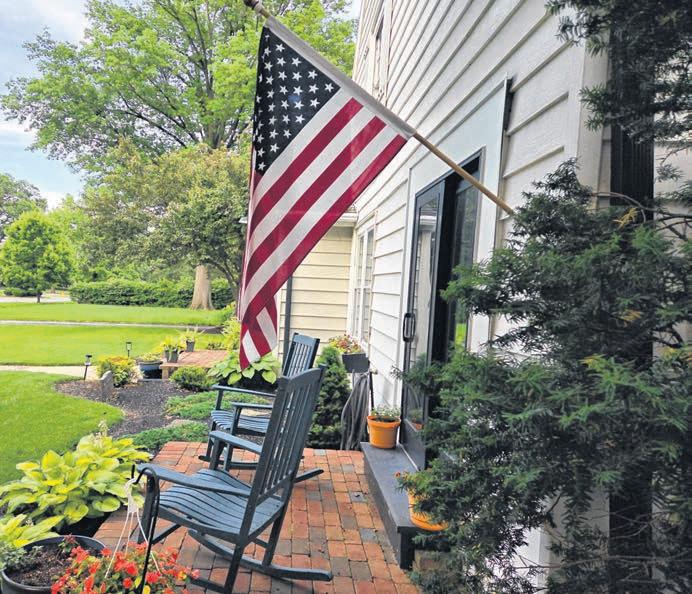








David Trinko | The Lima News
opinionated, optimistic, generous, stubborn and deeply individualistic. We argue constantly, sometimes too much. But we also have a habit of questioning things instead of simply accepting them. I think that spirit, the restless refusal to settle, is what built the country in the first place.”
Jo Muether, 74, of Celina, also sees that as a strength for the country.
“Founded in dissent, we have always been a work in progress,” she
wrote. “As a nation, when we know better, we do better. We are a country dedicated in freedom to all.”
David Warren, of Dayton, answered the question with a poem, describing scenes across the land, such as a jazz procession following a casket in New Orleans’ French Quarter, rowdy high school kids with painted faces awaiting a high school football kickoff and a buffalo roaming free as you approach mountains near Aspen, Colo.
“It’s an imperfect collection of unique and diverse people, inspiring monuments, beautiful
scenery and fascinating towns, both big and small,” he wrote. “Every day I am thankful that America is a source of pride and a source of inspiration for so many. Most of all I’m thankful that it is my home. As the saying goes, ‘The best thing about a home is the people in it.’ That’s what makes America so imperfectly perfect, and that’s why I’m blessed to live here.”
Chad Hollinger, the fire chief in Sidney, agreed that being an American means “that I am blessed!”
“We enjoy freedoms and rights that many around the globe
can only dream of,” Hollinger wrote. “The opportunities that are afforded us, both on the homeland and abroad, are without comparison. Throughout our history as a nation, we have seen prosperity and growth unparalleled on the globe. The foresight of our founding fathers, preserved in our founding documents, has provided the foundation and framework that safeguard our way of life.”
There’s always room for improvement, wrote Logan Rex, 30, of Wapakoneta, who urged citizens to
“reflect and rededicate ourselves to the great truths confirmed in our Declaration of Independence.”
“Even with a strong framework, centuries of existence formed and revealed fated cracks and decay,” Rex wrote.
“But neither the rot of slavery nor the fires of war brought lasting division to the Union. Protest and dissent proved not as signs of weakness but as protected benefits to a free society.”
The core principal is to remember where we came from as Americans, wrote Aaron Rode, the police chief in Sidney.
“Being an American in 2026 is not entirely different from being an American in 1776,” Rode wrote. “We remain steadfast in our commitment to recognizing diversity, upholding our constitutional rights and ensuring every person has an opportunity for freedom and happiness. My perception of being an American remains one of pride, integrity and constant evolution, both personally and professionally.”
SHAINA TAUB
CreatorandstaroftheBroadway musical, Suffs
OCTOBER1|7:30 P.M.
ThomasB. and KathleenM. Donnell Theatre WolfeCenterforthe Arts
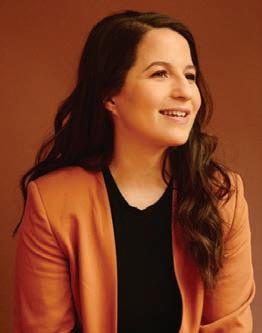
Shaina Taub reignited public dialogue about women’s rights, political power, and unfinished progress with Su s, thelandmarkBroadway musicalaboutAmerican su ragists The show won her two Tony Awards,a Grammy nomination,and a devotedfollowing acrossgenerations.
She created andstarred in acclaimed musical adaptations of TwelfthNight and As You Like It at Free Shakespeareinthe Park.Shewrote the lyricsfor The Devil Wears Prada, with Sir EltonJohn,whichopened inthe WestEndin2024.Her musical theaterwriting hasearnedhertheASCAP RichardRodgersNew Horizons Award, JohnathanLarson Grant,KlebanPrize, and FredEbb Award bgsu.edu/arts
To individualswithdisabilities,pleaseindicateif youneedspecialservices, assistanceorappropriatemodificationstofullyparticipateinthis event by contactingAccessibilityServicesataccess@bgsu.eduor419-372-8495. Pleasenotifyuspriortothe event.

Reach David Trinko at 567242-0467 or on Twitter/X @ Lima_Trinko.
“250 Years United”
is a special commemorative edition to mark the semiquincentennial of the United States, marking the 250 years since signing the Declaration of Independence on July 4, 1776. Newspapers throughout Ohio within the AIM Media Midwest family worked together on this section. Our local communities offer color and depth to the unique tapestry that is America. As the nation celebrates 250 years of independence, we examine how we fit into America’s past, present and future.

Honoring American icon Neil Armstrong
By Scott Giebel sgiebel@limanews.com
WAPAKONETA —
Space exploration stands among America’s greatest achievements in its 250year history, and without the courage and curiosity of Neil Armstrong, it might have remained only a dream. Armstrong came from humble beginnings, born on Aug. 5, 1930, near Wapakoneta. His early years were full of curiosity, and he flew in his first airplane at age 6 and, at 16, earned his student pilot’s license.
“I always like to emphasize his humble roots because, at one point, he was the most famous person in the world, and he came from a town of less than 10,000 people, grew up in a normal setting, in a normal neighborhood and was not from a big family, which made him have a normal upbringing like a lot of us,” said Logan Rex, curator and communications director at the Armstrong Air and Space Museum. “I think because of his humble roots, his story really resonates
Happy250th Birthday
with people because he was just a kid with a dream, and that passion took him to the moon.”
The Armstrong Air and Space Museumdetailed how, after he became the first man on the moon, the attention of the nation and the world focused in part on Wapakoneta, where news media flocked to his parents’ house. Once he returned home, he was thrown a parade and a huge celebration where thousands, including celebrities, gathered.



“His story really goes to show that if you have that passion, have that curiosity, apply yourself, and have that dream, you can accomplish some truly amazing things, and that is one of the great things about America, that we have this real ability to follow our dreams, and so many Americans have been able to be successful in that, which seems to be unique to the American spirit,” Rex said.
Before he was the first man on the moon, he
on a Navy scholarship, studying aeronautical engineering, and as part of his scholarship, the Navy trained Armstrong as a fighter pilot in Florida. His studies were interrupted by the Korean War, where Armstrong flew 78 combat missions.
John Norberg worked at Purdue as a speech writer and director of development communications. He also knew Armstrong, interviewed him, wrote


Armstrong
From page 6
about him and for a time took his media calls.
“Every Boilermaker takes special pride in Neil Armstrong because he was such a special person and because he was one of us. He loved Purdue, returned to campus regularly and enjoyed talking to fellow alumni. No one on campus will ever forget the times they met and talked to Neil Armstrong,” Norberg said.
He also talked about how humble Armstrong was. Even though
people considered him a hero, he was always very humble about it. He showed that humility when a statue of him was placed in front of the Purdue engineering hall named for him, he decided not to attend the statue dedication, thinking it would appear vain.
According to NASA’s website, in his final semester of college, Armstrong applied for a research pilot position with the NACA, which led him to an immediate offer for the job, where he frequently co-piloted the lab’s F-82 Twin Mustang and C-47 Skytrain. After
participating in the Man in Space Soonest and Dynasoar projects, Armstrong joined NASA’s September 1962 astronaut class, leading to him becoming the first man on the moon.
“Born in Wapakoneta, a small Ohio community, Neil Armstrong went on to undertake one of humanity’s greatest leaps – becoming the first person to walk on the Moon. As our nation reflects on 250 years of independence, explorers like Neil Armstrong remind us that all things are possible with the American spirit, bravery, and resilience,” NASA said via a spokesperson.
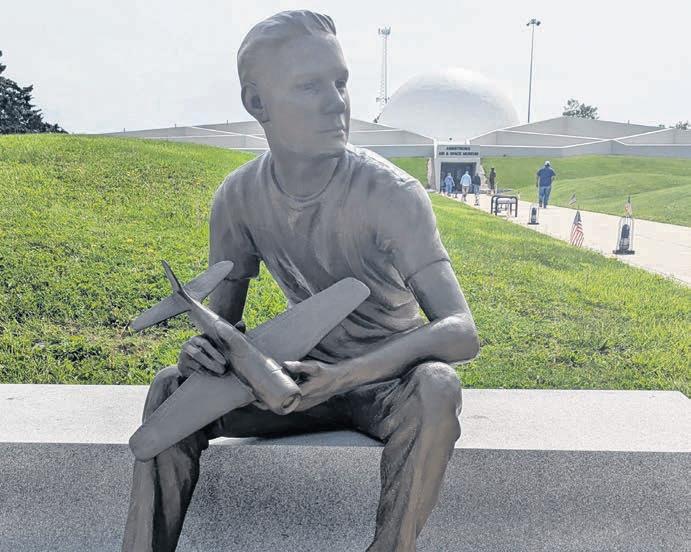

Scott Giebel | The Lima News
A statue of Neil Armstrong as a child with a toy airplane can be seen in front of the Armstrong Air and Space Museum in Wapakoneta.
A history of the Declaration of Independence
By Marie Thomas-Baird mthomas@aimmediamidwest.com
BOWLING GREEN — The Declaration of Independence is a unique document not just in the history of the United States but in the world.
It doesn’t just sit by itself but was a response to a series of events which started in 1689 with the Declaration of Rights in England.
Within those rights was the right of trial by jury, according to Wood County Common Pleas Court Judge Matt Reger.
Reger provided a history of the declaration earlier this year
250th anniversary celebration.
The Declaration of Independence was adopted by the second Continental Congress in 1776; the first Congress was held in 1774.
How did they come up with the idea of coming together, he asked.
The Albany Congress in 1754 discussed the incursion of the French during the French and Indian War. One of the largest debates was over Benjamin Franklin’s proposal that the colonies come together as a unit, Reger said. While the Congress approved it, the colonies, who did not want to disassociate
The congress met in 1775 and sent the Olive Branch petition to King George III as a final attempt to avoid war. In it was a protest of taxation by England without representation from the colonies and another request for the right to trial by jury, which was an important aspect to freedom, he said.
In January 1776, “Common Sense,” written by Thomas Paine in the common language for readers knowing only the Bible and the Book of Common Prayer, was published. He proposed separating from England.
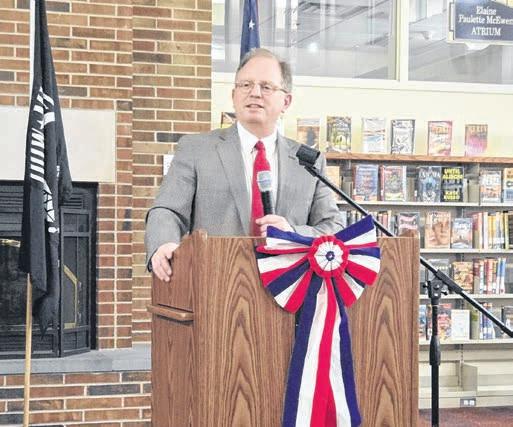

Marie Thomas-Baird | Sentinel-Tribune Wood County Common Pleas Court Judge Matthew Reger provided

Declaration
page 8
That led to the popular will of people in favor of separation from Great Britain, he said.
“There is so much discord in our country today,” Reger said, “but 1776 was filled with discord. There were loyalists, people who were loyal to the king for good reason.”
Families were divided over whether or not to sever ties with Great Britain, he said.
During the second Continental Congress, the Lee Resolution, proposed on July 2, 1776, formerly declared the colonies independent from Great Britain.
The Declaration of Independence, signed on July 4, 1776, stated, “When, in the course of human events, it becomes necessary for one people to dissolve the
political bands which have connected them with one another, and to assume, among the powers of the earth, the separate and equal station to which the laws of nature and of nature’s God entitle them, a decent respect to the opinions of mankind requires that they should declare the causes which impel them to the separation.”
Reger explained what the congress was talking about was that when government was no longer able to provide what is needed, then collective separation is necessary.
“We hold these truths to be selfevident, that all men are created equal, that they are endowed by their Creator with certain unalienable rights, that among these are life, liberty, and the pursuit of happiness. That, to secure these rights, governments are instituted among men, deriving their just powers from the consent of the governed,” they wrote.

“Even an absolute dictator is reliant on the consent of the people,” Reger said.
He continued to read the Declaration: “Whenever any form of government becomes destructive of these ends, it is the right of the people to alter or to abolish it, and to institute new government, laying its foundation on such principles, and organizing its powers in such form, as to them shall seem most likely to affect their safety and happiness.”
Reger read the 18 accusations against the king, as outlined in the Declaration, which included forbidding his governors to pass laws of immediate and pressing importance, obstructing the laws for naturalization of foreigners, making judges dependent on his will alone, sending swarms of bureaucrats to administer rules and laws, keeping
standing armies in times of peace, imposing taxation without consent, depriving them of the benefit of trial by jury, and for waging war against us.
“In every stage of these oppressions, we have petitioned for redress, in the most humble terms. Our repeated petitions have been answered only by repeated injury. A prince, whose character is thus marked by every act which may define a tyrant, is unfit to be the ruler of a free people,” Reger said. “By authority of the good people of these colonies, solemnly publish and declare, that these United Colonies are, and of right ought to be free and independent states, that they are absolved from all allegiance to British crown.”
On that day, they put in motion an idea that has continued to live throughout the world as a symbol of freedom, Reger said.




County names
By Lucas Bechtol lbechtol@bryantimes.com
BRYAN — Several counties in northwest Ohio owe their names to a group of people who helped bring down the most notorious traitor in American history.
John Paulding, Isaac Van Wart and David Williams were hailed as heroes for their part in discovering Benedict Arnold’s treasonous plan to hand West Point over to the British. Later, they were called brigands.
Treason of Arnold
Arnold was a “great general” who loved the country but felt “disused” by the
son, assistant director for the Williams County Public Library.
“He was divided in his loyalties,” Henderson added. “His wife, Mrs. (Peggy) Shippen, was a loyalist, he was hanging out with loyalists, so he had divided loyalties, and I don’t think he thought the revolution could be won.”
By this time, British Gen. William Howe had taken over New York, the largest city in the colonies at the time.
The war wasn’t going well, and Arnold was the commander of West Point, a military stronghold at the time. So, he decided to conspire to hand it over to the
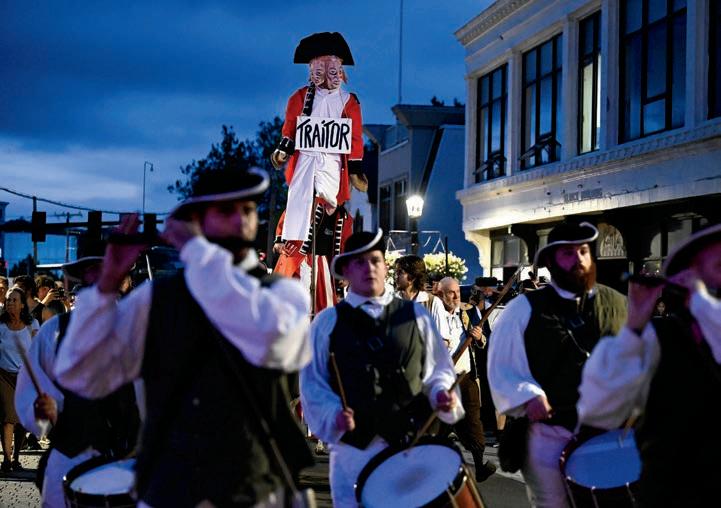

Jessica Hill | AP
People in period costume carry an effigy of Benedict Arnold to be burned during the annual Burning of Benedict Arnold Festival in 2023 in New London, Conn. The burning of Arnold marks the anniversary of the day in September 1781 that the Connecticut native led British troops into the city
Names
British.
“His contact with Gen. Howe was Major Andre, Major John Andre,” Henderson said. “(Andre) was charming, he was intelligent, he was the very model of a gentleman.”
Andre and Arnold met in West Point to make the plans for the British takeover of West Point.
As Andre was returning to Howe with the plans from Arnold, seven militiamen went on patrol. Henderson said Paulding, Van Wart and Williams were among those militiamen and, at one point, continued on patrol while the others stopped.
“A detail you need to know is Paulding is wearing a Hessian officer’s uniform jacket,” he said. “He had been released from British prison and been helped by a loyalist who gave him this jacket, we think.”
Hessians were German soldiers serving as auxiliaries to the British Army.
“Andre is only 20 miles from New York. He was within half a day’s ride of getting away,” Henderson said. “He sees these three men, he sees the Hessian uniform… so he hails them as if they were loyalists.”
Although Andre tried to backtrack, the three men got him off his horse and began searching him.
While Andre was trying to bribe Paulding, Van Wart and Williams to let him go, they took off his shoes and found the documents from Arnold.
“Of course, they don’t know what to do,” Henderson said. “They talk amongst themselves, and they turn him over to — and remember this name because it will be important later— Major Benjamin Tallmadge.”
That happened on Sept. 23, 1780.
Shortly thereafter, Arnold heard about the treason and fled to New York before
making his way to England and never stepped foot in America again.
“That’s when his name became synonymous with treachery and treason,” Henderson said.
Andre was interrogated and kept prisoner.
“They don’t want to hang Andre; he’s a genuinely nice guy, he’s charming, he’s an officer and a gentleman,” Henderson said. “Unfortunately, the British by this time has hanged Nathan Hale (a soldier and spy for the Continental Army). So, it was decided if they can hang a patriot, we can hang an officer.”
On Oct. 2, 1780, Andre was hanged.
Two stories
Paulding, Van Wart and Williams were initially treated as heroes, Henderson said, for capturing Andre and uncovering Arnold’s treason.
They were given farmland and a pension.

“The Continental Congress strike three silver medals that say ‘Fidelity,’ loyalty, on it and give them to these gentlemen,” he said.
In 1803, Ohio became a state, and eventually three counties needed names, becoming Williams, Paulding and Van Wert (Henderson said he was unsure how Van Wart became Van Wert) counties.
In 1817, Paulding, Van Wart and Williams wanted to increase their pension and petitioned Congress.
“There’s basically two stories,” Henderson said. “Ask yourself, why did they take off Andre’s boots? Why did they search him? Why were they talking amongst themselves? They knew he was a traitor, why were they trying to decide what to do with him? Why, really, was Paulding wearing a Hessian coat?”
Tallmadge, who was a congressman at the time, spoke against the three men.
Names
From page 12
“Tallmadge gets up and says we’re not going to give them any more money,” Henderson said. “These men were brigands, they were playing both sides of the coin. The only reason they turned Andre in is because he wasn’t offering them enough money, and the only reason you would take a gentleman’s boots off is to see if he had a coin purse in it.”
Tallmadge believed the government had given them enough money. They did the right thing, but it wasn’t their intention to save the American cause, Henderson said.
“There’s the two stories,” he
said. “Williams, Van Wart and Paulding inadvertently became American heroes. Now there are people who defend them for being true patriots, Paulding knew what the documents were, knew they were important. And then there are others like Tallmadge who say they lucked into being heroes.”
In his opinion, Henderson said they lucked into being heroes.
If Andre offered a large enough amount of money, he believes Paulding, Van Wart and Williams would have let him go.
“I think eventually Paulding did realize how important it was and turned him in, but I’m sure if there was a sack of gold Major Andre would have made his way to New York, and who knows
what would have happened,” Henderson said. “I still admire what Van Wart, Paulding and Williams did, I still admire them. I mean, it was a very difficult time. We didn’t know we were going to win.”
These men were poor, he continued, and thinking of them as common thieves is wrong.
Instead, they were looking out for their well-being.
“When we talk about history, we need to remember that everyone in history is just like us — they were flawed, fallen creatures that if they get it right 51% of time in the day, that’s a success,” Henderson said. “I don’t think they need to be mythologized; I think they need to be seen as human beings who, in the end, did something extraordinary.”

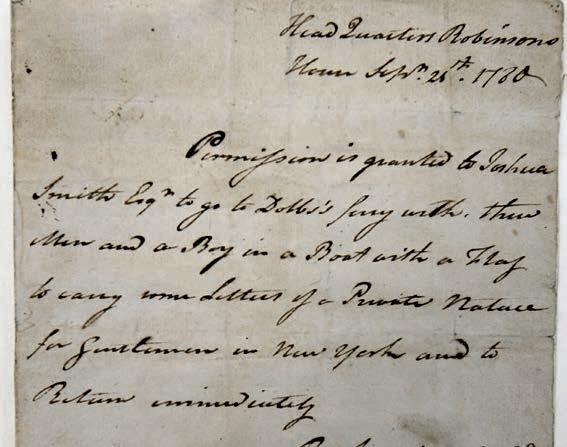
McKnight | AP A 2005 photo taken in the New York State Archives in Albany, N.Y., shows a handwritten pass dated Sept. 21, 1780 that Major General Benedict Arnold scrawled for Joshua Smith, who accompanied John Anderson, also known as John Andre, a British spy, which allowed him to pass to Dobbs Ferry. This is one of the most treasured items amid the thousands of Revolutionary War letters, maps, records, relics and other artifacts in the collections of the state library and archives, located in the New York State Museum in downtown Albany.

















Jim
TheresaGavarone, OhioSenate, 2ndDistrict
Hon. MollyMack, CommonPleasJudge
Hara zGhanbari, OhioHouse of Representatives, 75thDistrict
Hon. David Woessner, Probate/JuvenileJudge
Dr.DorisHerringshaw, Commissioner
Dr.DouglasHess, Coroner
Craig LaHote, Commissioner JohnMusteric, Engineer
Dr.ThedoreBowlus, Commissioner
PaulDobson, Prosecutor
MatthewOestreich, Auditor
Connor Rose, Recorder
DouglasCubberley, Clerk of Cour ts
Mark Wasylyshyn, Sherif
Hon. MatthewReger, CommonPleasJudge
Rober tL at ta, U.S. Houseo f Representatives, 5thDistrict
JaneSpoerl, Treasurer
Ohio’s magic ‘elixir’
“One of the big things back in that day was salt, so they thought they found a salt deposit.”
By Craig Kelly ckelly@limanews.com
LIMA — It is an image synonymous with America: a couple riding down an asphalt highway in their convertible along a wheat field in the countryside.
More than just the gas in the fuel tank, much of that image, from the asphalt on the highway to to the rubber on the tires to components in the engine to the plastic on the steering wheel to the makeup on the woman’s face, can be traced back to the oil and gas sector, part of what has made America, including Ohio, a dominant power
on the world stage.
While many Americans liken the oil and gas boom with states like Texas and Alaska, Ohio played a significant role in the development and growth of the oil industry in the United States.
The Buckeye State’s connection with the oil industry goes back, literally, to its beginnings.
“It goes back all the way to 1814 in Noble County when a couple of guys named (Silas) Thorla and (Robert) McKee saw a deer licking the ground,” Ohio Oil and Gas Association External Affairs Director Mike Chadsey said.

Thorla and McKee eventually found salt brine in that well in southeastern Ohio, but it was mixed with a black substance that they used wool blankets to soak up and separate from the more valuable salt. They even bottled the substance as a “cure all” elixir. Little did they know at the time that they created the first oil well in North America, a well that still produces limited quantities of oil, gas and salt water to this day, according to the Noble County Convention and Visitors Bureau.
That was not the only first in Ohio when it came to the oil and gas sector. The first offshore oil drilling took place not off the Gulf coast nor in the waters off Alaska, but instead in the vast reservoir that became Grand Lake St. Marys. What had started as oil wells dug on either side of Grand Lake in Celina and
St. Marys became offshore wells when major storms and rains in 1887 resulted in the wells covered with water as the water levels in Grand Lake rose. Those wells continued to operate even while underwater.
It was in that same decade when the oil boom spread to other parts of northwest Ohio, including in Lima when paper mill owner Benjamin Faurot struck oil in May 1885 as he drilled along the Ottawa River in search of natural gas. That discovery led to the development of oil refineries in the area, as the Lima oilfield was the most productive in the world in the early 1900s.
That expansion included the construction of the Standard Oil refinery in 1886 by the company owned by John Rockefeller and the establishment of the Ohio Oil Company a year later, a com-









pany that would later become Marathon Oil, after Rockefeller’s Standard Oil purchased the company two years later, moving its corporate headquarters to nearby Findlay.
“Rockefeller and Standard Oil used some sharp practices,” Ohio Northern University history professor Russ Crawford said. “They had a sweetheart deal with the railroad that the little producers could not take advantage of because they didn’t produce enough oil. They had the capital behind them that could build refineries and that could build pipelines, another expensive thing, so they were able to exploit this oil boom.”
Now owned by Canadian oil company Cenovus Energy, that same refinery is the oldest continually operating oil refinery in the world, employing 450
people and featuring a refinement capacity of 183,000 barrels per day.
In 2024, that output contributed to a record-high oil production statewide of almost 37 million barrels, making Ohio the top oil producer east of the Mississippi River, according to the U.S. Energy Information Administration, as other oil booms in areas such as Morrow County continued into the 1960s.
Ohio’s energy production has also expanded beyond oil, as natural gas extraction continued to rise, making Ohio one of the top 10 natural gas-producing states in the nation as of 2024.
Ohio was also the seventh-largest producer of ethanol in the country as of 2023, with companies such as POET Bioprocessing in Leipsic and Guardian Energy in Lima producing, respectively, 90 million gallons and 75 million gallons of corn-based ethanol each year. With Ohio continuing to serve as a major energy producer and distributor,

PROGRAMS &INITIATIVES



thanks to its series of oil and natural gas pipelines throughout the state, the Buckeye State continued to be a major driver of American transportation and innovation for more than 200 years.
“Oil is probably irreplaceable, and natural gas, in the growth of the United States,” Crawford said. “The United States is characterized by car culture, and without oil, there’s no cars. … An abundant, cheap energy is the key to the growth of the United States, whether it be the ability to go out and drive 10 hours wherever you want or to get groceries and other food shipped in through trucks and trains. It is the foundation of the United States in many ways.”


he Democracy and Public Policy

Net ork (DePo) brings together scholars, students, and community members to advance citizenship, innovation, and the public good Learn more at bgsu.edu/DePo








PollingLab
PublicEngagementLab
Eventsandforums,suchasthe DayofDialogue andLeadershipLuncheon,promotecivicliteracy andcivildiscourse.
PodcastLab
TheDemocracyExchange, astudent-runnonpartisan politicalnewspodcast,connectsideasandaction.
TheBGSUPollprovidesnonpartisan datadesignedtoincreasepublic knowledgeand awareness.
Civics 250Scholars
K-12teachersreceiveyear-long expert trainingwith afocusonournation’s foundationalprinciples.














File Photo | The Lima News
The Cenovus Lima Refinery, shown here in 2022, is the oldest continually operating oil refinery in the world, with its roots going back to the Standard Oil Company in 1886.

Holgate graduate broke barriers in U.S. Navy
By Jen Lazenby jenl@northwestsignal.net
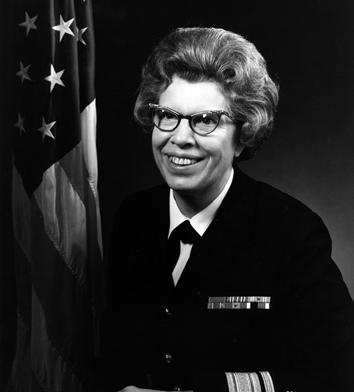
HOLGATE — The first woman to be promoted to admiral in the U.S. Navy grew up in the Village of Holgate in Henry County.
Rear Admiral Alene B. Duerk was a veteran of World War II, Korean War and Vietnam War and, in 1972, she 1941.
According to the Veterans Administration Veterans Legacy Program, which featured Duerk in 2018, the American Red Cross needed nurses during World II and frequently contacted Duerk because of her education. She quickly grew a desire to want to help during the war, which prompted
planned invasion took place. At that time, the mission of the USS Benevolence changed; the ship docked in Tokyo Bay and evacuated two prisoner of war camps in August 1945.
For the first 36 hours, Duerk and her shipmates processed nearly 1,000 American prisoners of war before transferring them onto other ships going back to the United States. Duerk remained on the ship in Japan, which served as a hospital for the fleet until November 1945.
In 1946, Duerk left active service and attended Case Western Reserve University in Cleveland, earning her







































See HOLGATE | 19
Courtesy of Naval History and Heritage Command Rear Admiral Alene B. Duerk, USN, is pictured in 1972.
Holgate
degree in ward management and teaching, medical and surgical nursing in 1948. She then began teaching nurses at Highland Park General Hospital and joined a Naval Reserve unit in Detroit.
The Navy called her back into active service in 1951 during the Korean War. She was assigned to the Naval Hospital Corps School in Portsmouth, Virginia, where she trained hospital corpsmen for about five years. In 1956, Duerk became an education coordinator at Naval
Hospital in Philadelphia and then served at the Naval Recruiting Station in Chicago until 1961.
For the next 10 years, Duerk served at multiple locations and held many different positions in the Navy. In May 1970, the Navy appointed Duerk as the director of the Navy Nurse Corps. She helped push the recruiting effort to draw more women into the Navy and became a symbol of opportunity for women.
Duerk’s continuous climb in the Navy served as an example to other women showing what they could accomplish in a military career.
On April 26, 1972,
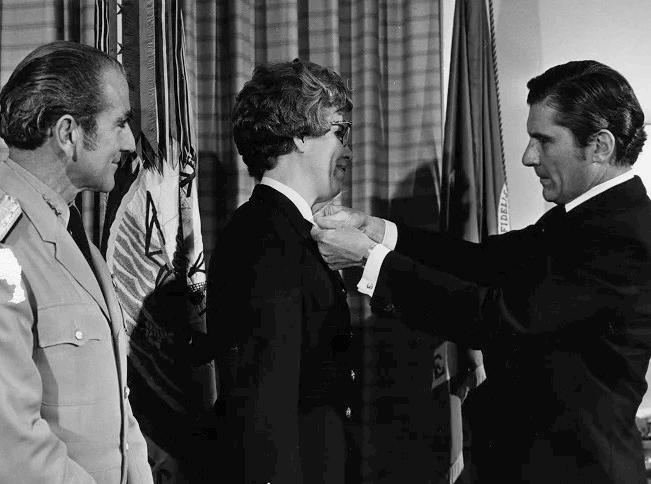
President Richard Nixon approved her selection to Rear Admiral. She was promoted on June 1, 1972, and became the first woman selected to flag officer in the Navy.
As quoted in her obituary prepared by Baldwin-Fairchild Oaklawn Chapel & Oaklawn Cemetery in 2018: “Being the first of anything has its responsibilities,” she told the New York Post in 1972. “I’m more than an officer. I’m a symbol, for women in the Navy and the military. Women thinking of careers like mine can know that … the ultimate is possible.”
Duerk continued to serve as the director of


the Navy Nurse Corps for the remainder of her career. She retired from the Navy in 1975. She was awarded the Naval Reserve Medal, American Campaign Medal; Asiatic-Pacific Campaign Medal with bronze star;
World War II Victory Medal; Navy Occupation Service Medal, Asia Clasp; and the National Defense Service Medal with bronze star.
Duerk passed away on July 21, 2018, at the age of 98. She is interred at
Cape Canaveral National Cemetery in Mims, Florida.
In 2010, the William F. Helmke American Legion Post #340 in Holgate honored her for her
See HOLGATE | 20

File photo | Northwest Signal
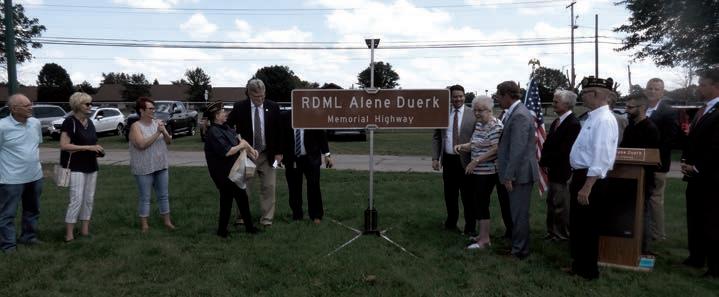
In August 2021, a ceremony was held for new signs marking parts of State Route 108 in Henry County as RDML Alene Duerk Memorial Highway.
Holgate
From page 19
service to the country and made her a fully paid member of the post.
In 2021, part of State Route 108 in Henry County was designated as RDML Alene Duerk Memorial Highway. That ceremony brought local and state officials to Henry County, where then-Napoleon Mayor Jason Maassel shared Duerk’s story, including when the USS Benevolence’s mission changed from treating casualties to treating American POWs.
“No longer were they treating the war wounded, now they had to treat the war scarred,” Maassel said. “And those moments take the ability to persevere, those moments reveal character, those moments are markers in one’s life, and I think it inspired Adm. Duerk later in her career.”
Former Ohio Lt. Gov. Jon Husted, who is now a U.S. Senator who hails from northwest Ohio’s Montpelier, said sacrifice in service of the country needs to be honored.
“It’s never easy in the Navy, but being a woman in the Navy in that time (1943-1972) must have been really hard,” Husted said. “What a trailblazer she was for others.”
Ohio Rep. James Hoops, R-Napoleon, who sponsored the legislation in the Ohio House that got the ball rolling on the naming, credited Randy Germann of the Napoleon Disabled American Veterans.
“We worked on this since she passed away (July of 2018),” Germann said. “We contacted Jim, and he worked with us to get the sign legislation.”

The Veterans Administration’s Veterans Legacy Program contributed to this article.
Courtesy of U.S. Navy Alene B. Duerk was promoted to rear admiral in the U.S. Navy in 1972 and was the first woman to hold the position.
Toledo War argued over Ohio’s border
By Brian Koeller bkoeller@bryantimes.com
BRYAN — A border dispute over a 468-square mile strip of land between what is now Ohio and Michigan had only one minor casualty but ended in victory for both parties.
assistant director at the Williams County Public Library.
He explained when officials gathered in 1802 to begin the process of statehood for Ohio, they used the bottom of what was then considered Lake Michigan.
officials Lake Michigan was larger than they thought. The boundary was reconfigured, much to the chagrin of Ohio officials.
“It took out Toledo, and it was an economic disaster for Ohio,” Henderson said.
FAMOUS NAMES IN THE TOLEDO WAR
The Toledo War involved several historical gures important to the history of Ohio: Edward Ti n: He was surveyor general as Michigan began the process of applying for statehood. He was the rst governor

Toledo War
“Now, here’s one of the controversies,” Henderson said. “Edward Tiffin had served as the first governor of the state of Ohio, so they (Michigan) didn’t really trust this.”
However, Ohio wasn’t happy with the end result as it took away Toledo. Ohio officials said the boundary was set in its state constitution and that anyone from Michigan was an intruder in the area. Ohio politicians also blocked Michigan’s attempts for statehood.
Michigan territory Gov.
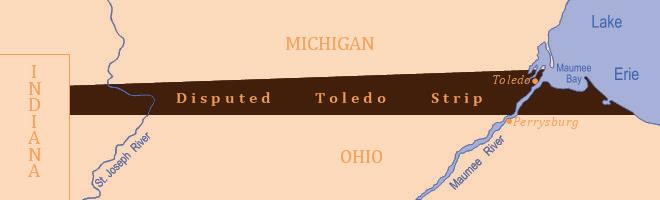
Stevens Mason and Ohio Gov. Robert Lucas, for whom Lucas County is named, each dispatched militias to the area.
State and territory officials appealed for federal intervention, but the situation provided a political problem for President Andrew Jackson.
“Andrew Jackson wanted nothing to do with this, and he definitely didn’t want to offend Ohio,” Henderson said. “Ohio was a state that had 25 electoral votes, and Michigan was a territory and as a territory had no electoral votes.”
Henderson said the election of 1836 was coming




Map courtesy of Wikimedia Commons
A map shows the portion of the Michigan Territory claimed by Ohio.
See TOLEDO WAR |24

















Toledo War
From page 22
up, and Martin Van Buren, Jackson’s pick to succeed him, was going to need all the votes he could get.
Ohio also had 19 representatives in the House at the time and two senators.
Meanwhile, the legislatures for Ohio and the territory of Michigan each passed laws that citizens of the other side couldn’t be under the authority of the other.
“People in Ohio were voting in Michigan elections, and people in Michigan were voting in Ohio elections,” Henderson said.
While militias were raised, there was only one “conflict”
in the Toledo War, which occurred at Phillips Corners.
“There was actually no fighting,” Henderson said.
He explained an Ohio man named Two Pinckney used a pen knife to stab a Michigan sheriff who had come to arrest Pinckney’s family for illegally voting in Michigan elections.
“It’s the only bloodshed in the entire war,” Henderson said.
Eventually, a compromise was offered that gave Toledo to Ohio, and Michigan received the Upper Peninsula.
“(Michigan) thought at the time they got this terrible deal, but the UP had some of the best copper ore in the country, some of the best shipping and some of the best
timber,” Henderson said.
“We got Toledo and part of Fulton and Williams counties,” Henderson said.
Henderson showed on a map where the four northernmost townships in Williams County — Northwest, Bridgewater, Madison and Millcreek — would be in Michigan if the lines had not changed.
He also said there are roads in Williams and Fulton counties that jog to this day due to the dispute.
Henderson said technically the Toledo War lasted until 1919, when Ohio Gov. Frank B. Willis and Michigan Gov. Woodbridge N. Ferris met at the border, shook hands and
See TOLEDO WAR |25






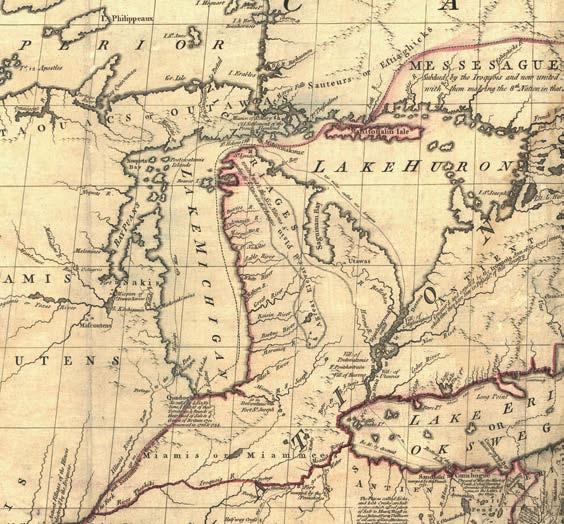
























Map courtesy of Wikimedia Commons
A map of the region from the late 18th century used to create the Ordidance Line of 1787 shows the southern tip of Lake Michigan being farther north than Lake Erie.
Toledo War
From page 24
made a truce at some markers at the border of the two states.
Until then, border shenanigans continued.
“Ohio would put up a border marker, and Michigan would move it, and that went on for decades,” Henderson said, adding there is a small island, Turtle Island, in Lake Erie that is still divided to this day.
For the region and the country, the dispute had several important ramifications.
“It impacted this area because we now have a Great Lakes port in Toledo, so all of our produce and farm equipment and then manufacturing (were helped) because railroads could go to a port, and then the goods could go out into
Lake Erie and then make its way to the east, so it had a major impact and opened up the easter part of the country to our industry,” Henderson said, adding those in Williams County would have had to send their goods to Cleveland for such a port access.
Michigan received the Upper Peninsula and its vast resources.
It had implications for the nation, as well.
“It made us consider geography more, particularly as we went westward,” Henderson said.
The Toledo War may also be the genesis of the biggest rivalry in college sports.
“They say that this is the beginning of the hated rivalry between the two (Ohio and Michigan, played out each year on a football field in November),” Henderson said. “And it’s still going on.”


Railroads helped Ohio grow
By J Swygart jswygart@limanews.com
LIMA — An oft-noted truism in the transportation world is that nothing moves more economically than steel-on-steel. Hence the boom of railroads, which played a significant role in the development of the United States and were key in the early 1900s to the economic stability of Ohio in general and Lima in particular.
In 1827, the state of Maryland chartered the Baltimore and Ohio Railroad to connect the port of Baltimore with the Ohio River. It
is considered to be America’s first railroad. Upon the completion of the first 13 miles of track in 1830, the B&O became the first American railroad to offer regularly scheduled passenger services.
Lima’s introduction to the rails began two decades later, in 1853, when the Ohio and Indiana Railroad opened from Crestline to Fort Wayne, Indiana, according to The Lima News archives. The east-west Ohio and Indiana was joined by the north-south Dayton & Michigan in 1858. The railroads intersected just north
of downtown. At its peak in the 1920s, Lima saw some 30 passenger trains in and out daily, the newspaper said.
The ‘loco works’
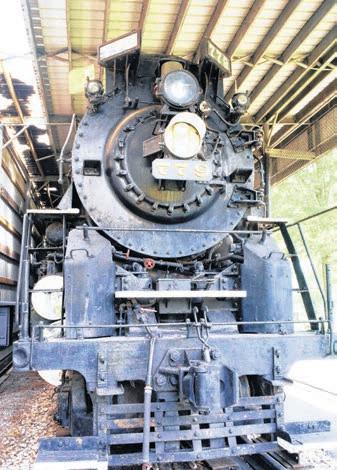
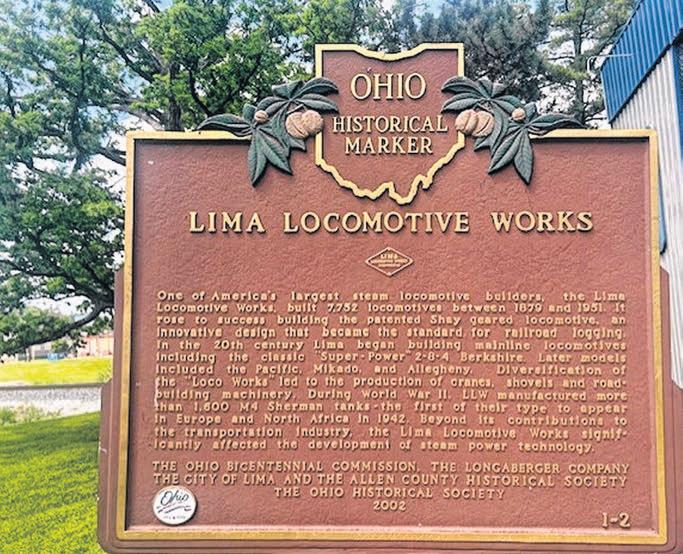
Crucial to the growth of the emerging transportation mode was the Lima Locomotive Works, which produced 7,752 steampowered locomotives between 1879 and 1951. The manufacturing plant and corporate headquarters were located on a 70-acre complex on South Main Street.
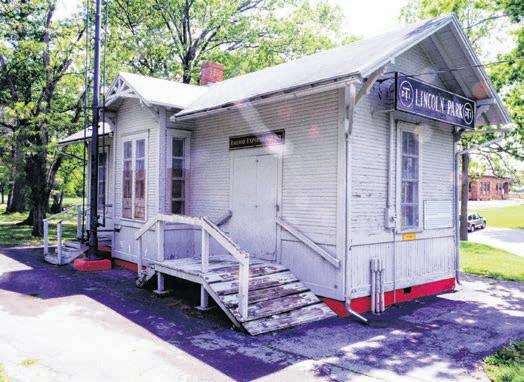












Swygart | The Lima News
early railroad station is on display at Lima’s Lincoln Park.

Railroads
From page 26
The original production facility and office buildings were demolished in the late 1990s, according to various historical accounts. One of the last steam engines built at the plant, Nickel Plate Road No. 779, is currently on display at Lincoln Park on South Shaw nee Street in Lima.
accounts focused on the city of Lima, the “loco works” served as a melting pot of sorts, employing workers of many nationalities and foster ing a legacy of ethnic diversity in Lima.



Boom and bust
departed Lima for Chicago on far and wide. Farmers benefit
J Swygart | The Lima News Murals depicting Lima’s rich locomotive history are on display throughout the city.
ing to original renderings of the project

Fulton County second-to-last county organized in Ohio
By Jen Lasenby jenl@northwestsignal.net
WAUSEON —
While the country is celebrating its 250th birthday, Fulton County recently marked its 175th anniversary, as it was the secondto-last county to be established in Ohio. The county is named after Robert Fulton, who is credited for developing the first commercial steamboat, and formed by by combining territory from Henry, Lucas and Williams counties, according to the Fulton County Chapter of the Ohio Genealogical Society.
While the boundaries of Fulton County were officially set Feb. 28, 1850, by the state legislature, settlements reportedly began almost 20 years earlier when Eli Phillips and Joseph Bates arrived in the early 1830s.
On April 1, 1850, voters elected the first officers of the county. That included
Mortimer D. Hibbard of Dover for auditor; George B. Brown of Royalton was chosen sheriff; C. C. Allman of Delta was chosen recorder; Nathaniel Leggett of Swan Creek was chosen treasurer; and William Sutton of Gorham, Christopher Watkins of Fulton and Jonathon Barnes were chosen as commissioners.
More settlements began and, according to Fulton County Chapter
See FULTON |32

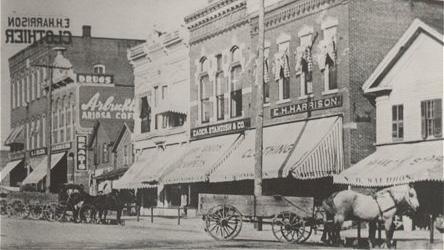

Courtesy of the Spiess Research Room and Archives, Museum of Fulton County, and Fulton County Genealogical Society
While the country is celebrating its 250th birthday, Fulton County recently marked its 175th anniversary, as it was the second-to-last county to be established in Ohio. Pictured is a historic view from the east side of South Fulton Street in Wauseon.


From page 30
of the Ohio Genealogical Society, the townships were formed as follows: York and Swan Creek, 1836; Amboy, Chesterfield and Royalton, June 4, 1837; Clinton, March 5, 1838; Gorham, March 6, 1838; German, March 4, 1839; Franklin, Fulton and Pike, March 1, 1841; and Dover, June 5, 1843. Fulton County now also has seven incorporated villages, including Archbold, Delta, Fayette, Lyons, Metamora, Swanton and Wauseon, which was named the county seat in 1872.
The 175th celebration of
the county was celebrated in 2025 and included a proclamation to the Fulton County commissioners by Tim Schneider, presenting on behalf of Sen. Bernie Moreno.
“This is a time to celebrate the accomplishments of the past and bright hopes for the future. Reaching this milestone is a testament to the enduring spirit and resilience of Fulton County residents,” Schneider said. “This remarkable community continues to be shaped by the people who call it home and have made it such a special place to live, work and raise a family.”
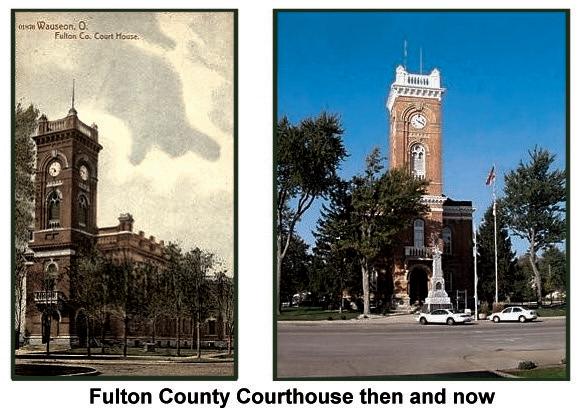











Courtesy of the Spiess Research Room and Archives, Museum of Fulton County, and Fulton County Genealogical Society Pictured are the former and current Fulton County Courthouse located in Wauseon.
Schimmoler left mark on aviation
By Joshua Keeran jkeeran@aimmediamidwest.com
GALION — When it comes to female pilots, one name usually comes to mind first, Amelia Earhart. While Earhart’s contributions to American history are well-documented, one of her closest friends, Lauretta Schimmoler, certainly left her own mark on American aviation history.
Born in 1900 in Fort Jennings, Ohio, Schimmoler would become well-known in Crawford County by the end of the 1920s. By that point, she was just getting started in the aviation field.
The Ohio Department of Veterans Services, which inducted Schimmoler into its Hall of Fame as part of the Class of 1993, writes, “The trajectory
of her life was forever changed when she witnessed a test flight in Dayton. Lauretta began to learn how to fly by working various jobs with the United States Air Mail, Lockheed Aircraft where she studied the manufacture of aircraft, and the U.S. Weather Bureau.”
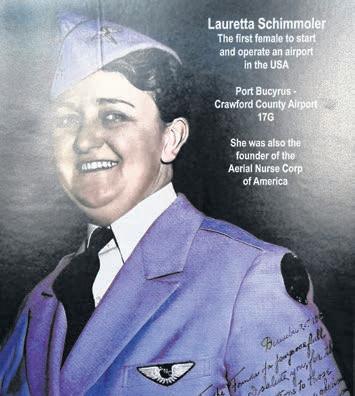
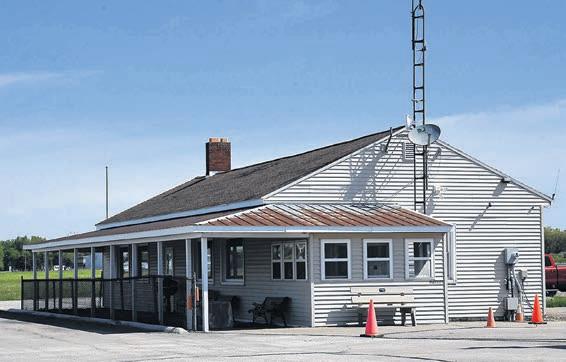
Schimmoler’s aviation career took off with the opening of Port Bucyrus airport on Nov. 24, 1929. Known today as the Port Bucyrus-Crawford County Airport, it was founded by Schimmoler, making it the first airport in the country to be acquired, established, and managed by a woman.
An early member of The 99s, a national organization of licensed women pilots, the Ohio History Connection noted Schimmoler’s impact on the field



Michelle Evans
519W.Wooster Street #1 BowlingGreen,Ohio 43402
OFFICE :419-353-3223
EMAIL :michelle@evanshli.com Call o iceorapplyonline at evanshomeloans. zipforhome.com evansinsurancecompany.com
of aviation was of such importance that she was inducted into the Ohio Women’s Hall of Fame in 1985.
According to the OHC, “In 1930, Schimmoler recognized a need for air nursing personnel and formed the Emergency Flight Corps, later renamed the Aerial Nurses Corps of American (ANCOA). Although her efforts to incorporate aerial nurses into the armed services were not originally supported, Schimmoler’s ANCOA provided an early model for the U.S. Air Force Flight Nurses Corps.”
The Ohio Department of Veterans Services noted that in 1944, Schimmoler was officially




Don Tudor | AIM Media Midwest
This photo of Lauretta Schimmoler is part of a display located inside the terminal at Port Bucyrus-Crawford County Airport.
See SCHIMMOLER | 34
Schimmoler
From page 33
commissioned into the Women’s Army Corps, and after the war, Lauretta became the first post commander of the American Legion’s Amelia Earhart Post 127 of Glendale, California.
The OHC added that in 1966, “she was recognized by the Air Force as a pioneer in air evacuation and was awarded the gold wings of the flight nurse.”
Author Judith Barger writes on her website, judithbarger, that “as the first female pilot in Crawford County, Ohio, Schimmoler was a ‘favorite daughter’ of the local press.
‘From Chickens to Flying: Lauretta Schimmoler Quit


Poultry
Raising to Pilot Planes’ began one account typical in its admiration for her achievements. After chronicling Schimmoler’s career, the reporter concluded:
“It is not hard to understand why Miss Schimmoler has risen so rapidly in the flying world. Her extraordinary capacity for activity, her quick movement, her orderly mind and her keen
sense of values are outstanding. She never is too busy to help a student flyer. She isn’t afraid to climb into overalls and to find out what causes an unnatural knock in an engine. She keeps her head when at the controls and so far has not had a crackup.”
Schimmoler, who died in 1981, is buried in the Holy Trinity Cemetery in Bucyrus.
In 2014, the Bucyrus Historical Society installed a new monument at her gravesite. The headstone reads: “Nationally recognized as the founder of the Aerial Nurse Corps. She foresaw the importance
of removing wounded by airplane, saving countless lives during WWII. A pioneer of early aviation and close friend of Amelia Earhart. Lauretta




















Don Tudor | AIM Media Midwest
Pictured are some of the hangers at Port Bucyrus-Crawford County Airport.
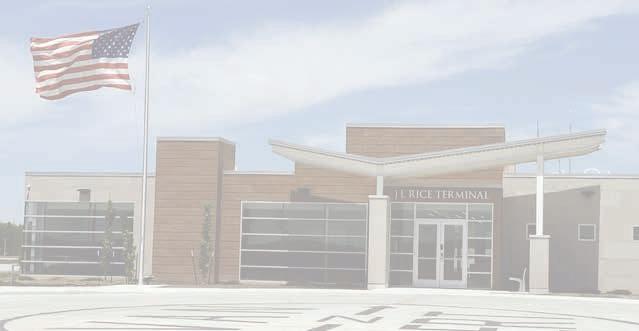
Don Tudor | AIM Media Midwest The terminal at Port Bucyrus-Crawford County Airport is shown.
Schimmoler
From page 34
founded the Bucyrus Airport and was the only female manager in the nation.”
In Crawford County, a local nonprofit has established the Lauretta Schimmoler Museum Inc.
While there is not a physical location for the museum, those wanting to learn more about Schimmoler can visit a display about her at the Bucyrus Historical Society, 202 S. Walnut St., Bucyrus. To learn more about the museum,


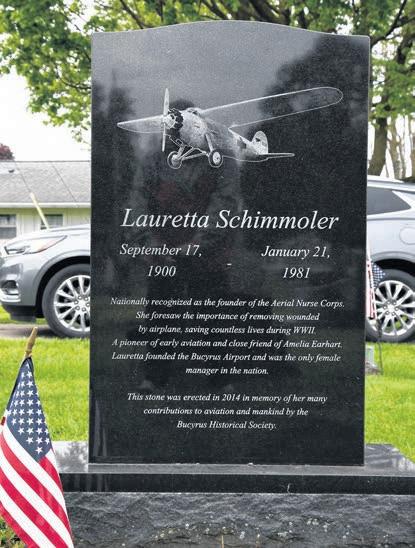

Don Tudor | AIM Media Midwest Pictured is Lauretta Schimmoler’s headstone in the Holy Trinity Cemetery in Bucyrus.
Don Tudor | AIM Media Midwest Pictured is the new terminal under construction at Port Bucyrus-Crawford County Airport.
Committee continues work to honor Hayes
By Glenn Battishill gbattishill@aimmediamidwest.com
DELAWARE —
Ten years ago, the Rutherford B. Hayes Heritage Committee began a project that would result in a bust at Hayes High School in Delaware, new learning materials at local schools and a statue downtown honoring the 19th president of the United States. To this day, the committee continues its work honoring Hayes.
In 2016, then-Delaware resident Gene Buckingham spoke at a Delaware City Council meeting about the
lack of local recognition of Hayes, who was born in Delaware. Buckingham went on to form the committee, which spent three years raising money and commissioning Ohio sculptor Alan Cottrill to create the landmark before finally dedicating the statue on what would be Hayes’ 197th birthday, Oct. 4, 2019.
Retired social studies teacher Bill Reitz was the chair of the committee at the time and said the statue was made possible by a variety of funds, including initiatives at local schools
and donations from the community and businesses.
“When you think of 250 years of American history under the Constitution, that’s saying something. That just blows my mind,” Rietz said in October 2019 of Delaware being the birthplace of a United States president. “Even if you double that, Delaware would be one of less than 100 communities (to be home to a president) in 500 years since the country was created after the Constitution.”
At the time, Rietz told

The Delaware Gazette that the statue’s unveiling was not the end of the committee’s mission, adding it would shift its focus to educating people about Hayes and his impact within the city and nation.
Now, seven years later, Rietz said the committee has done just that. He said the committee has provided educational materials at every grade level to Delaware City Schools and said it created a coloring book about Hayes for young students. The group has regu-
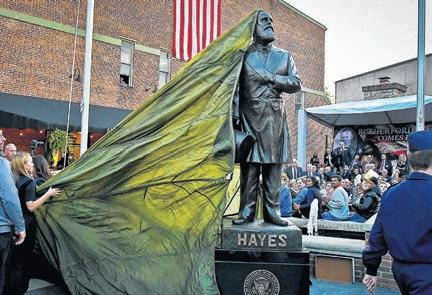
The project to erect the statue began three years earlier with the formation of the Rutherford B.
Committee, who spent years raising funds and creating plans for the statue as well as a bust and different commemorative markers at Hayes High School. See HAYES |38

D. Anthony Botkin | Delaware Gazette Gazette
A statue of President Rutherford B. Hayes is unveiled at a ceremony on Oct. 4, 2019, at the corner of William Street and Sandusky Street in Delaware.
Hayes Heritage
Sincera Palliative Care and HospiceofNor thwestOhio
Whenselectin gap al liativ ec ar eo rh ospic e provider,i ti si mport an tt oa skquestionsto assur ey ou ar er eceivin gt hebestcar ep os sible .
HOWLONGHAVEYOUBEENPROVIDINGCARE?
HospiceofNorthwestOhiowasthearea’sfirst hospice.Foundedin1981,wearetheonlylocal, independent,non-profit agencythatdedicatesallofits resourcesexclusivelyto hospiceand palliativecare.Sincerapalliativecarewasstartedin 2008tomeetthepainandsymptommanagementneedsofpatientswithseriousillnesswhoarenoton ahospiceprogram
WHEREDO YOUPROVIDE PALLIATIVECARESERVICES?
To bestmeetthe needsofseriously ill patientsacrossthecommunity, Sincera’scareistypically providedinoneofouroutpatient clinic spaces convenientlylocatedinMaumee,Oregon,Sylvania, ToledoandWauseon,Ohio.And inAdrianandLambertville, Michigan.Ifmedicallynecessary,considerationwillbemadefor ahomevisit.
HOWWELLDOYOUMANAGE PAINANDOTHERSYMPTOMS?
Ourpainandsymptommanagementexpertise is unmatchedin this region. We strive to managepainwithin48hoursof admissionto our program.
DO YOUHAVEA FREESTANDINGINPATIENT CENTER?
Yes, wehavethree!Designedtomeettheunique needsofpatientsandtheirfamilies at theend oflife,ourEbeid, Edward andMarionKnightandVirginiaCli ordHospiceCentersprovide beautiful,home-likeenvironmentsforpatientswho require closemedicalmonitoring,orwhose conditionscan no longerbemanagedat home.
DO YOUPROVIDEBEREAVEMENTSERVICES?
Yes. Hospice ofNorthwest Ohioprovidesthearea’s mostcomprehensive rangeofgrief support services.These include counseling,supportgroupsandspecialworkshops,whicharefreeand open toanyoneinthecommunity WHATABOUTPATIENTSWHOAREUNABLETO PAYFOR SERVICES?

Medicare,MedicaidandmostcommercialinsuranceplanswillcoverthecostofHospice or Sincera. As anot-for-profitagency, we receivesubstantial supportfromavarietyofcommunitysources. We carefor everyonewho requestsour services, regardless oftheir abilityto payorcomplexityof care




Hayes
larly brought in reenactors to play Hayes and his wife, Lucy, to speak at schools and community events, and the committee holds a program every year on Oct. 4 at the statue to commemorate “Hayes Day.”
“As a social studies teacher, I taught about the guy. I taught at Hayes and graduated from Hayes High School, but I never got into the weeds with his life and the impact he had on our country,” Rietz said in May. “That’s what you do as a teacher, you try to spark that little interest and give them a tidbit that maybe somebody will research and dig into, and that’s what we’re trying to do
in K-12 is keep his name in front of them.”
Rietz said the committee actively maintains rbhayesheritage.com/ and has more events planned for the future, including a dedication once again this year on Oct. 4 in front of the statue.
Looking back on the journey to the statue and to the present day, Rietz said “it means a lot” to him to be part of the story.
“It was the work of a tremendous committee,” Rietz said. “(They asked me to chair.) I said, ‘I’d be honored.’”
Rietz said the project was “more involved” than anyone on the committee realized at first and said the City of Delaware was “very helpful” throughout the process.
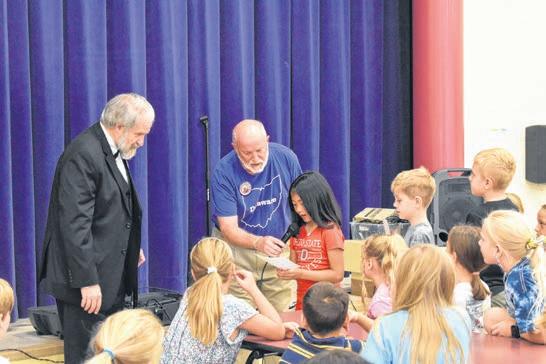
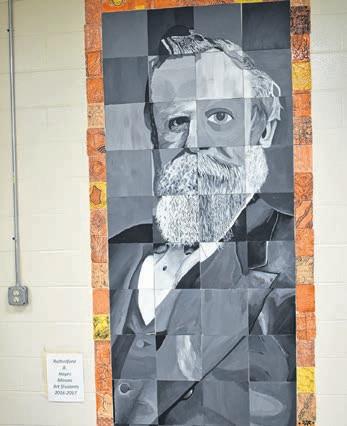
“It’s been a pleasure,” Rietz said. “They’ll say ‘Bill, you did this,’ but I was part of a group that did this. We wanted proper recognition for Hayes, and we wanted to educate the community.”
Glenn Battishill can be reached at 740413-0903.

A mosaic of President Hayes hangs in the hall at the high school and was created by art students during the 2016-2017 school year. Then-Principal Dr. Ric Stranges said that when he started at Hayes High School, there was very little commemorative material about the school’s namesake, which is something he worked to change during his time at Hayes.

Glenn Battishill | Delaware Gazette
Glenn Battishill | Delaware Gazette
Hayes Heritage Committee Chairman Bill Rietz holds the microphone to allow then-third grader Koleen Gambal to ask Rutherford B. Hayes (played here by reenactor Paolo DeMaria) a question about his life on Oct. 4, 2023 during a Hayes Day presentation at Schultz Elementary School.
Glenn Battishill | Delaware Gazette
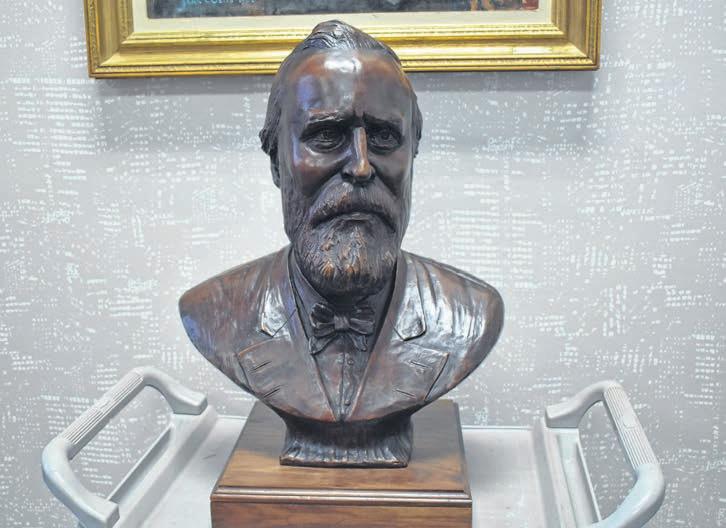
The bust of Rutherford B. Hayes, the 19th president of the United States, sits in an office at Rutherford B. Hayes High School awaiting installation in the rotunda in October 2019. The bust was installed the same day the statue of Hayes arrived in downtown Delaware.


President Harding has ties to two counties
By Gary Budzak gbudzak@aimmediamidwest.com
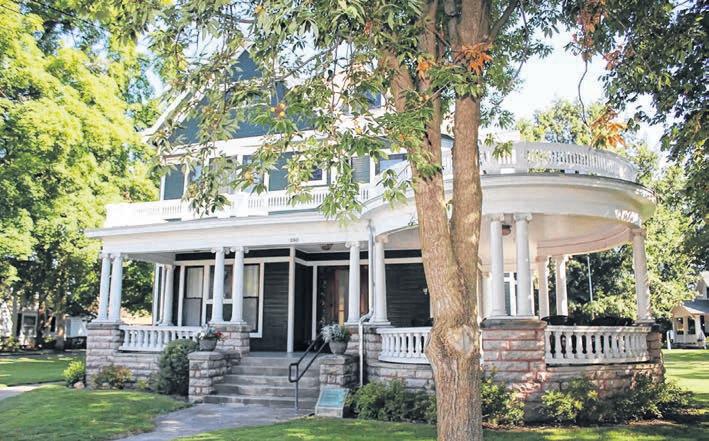
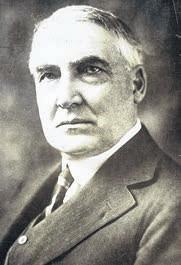
GALION — Most locals know that one former president of the United States is associated with the city of Marion, Ohio. What some may not know is that Warren Harding was actually born in Morrow County. While some political or historical wags note that native son Rutherford Hayes’ birth home is no longer around, the same can be said for Harding, the most recent of Ohio’s eight U.S. presidents.
There is a historical marker near the site, though, in Blooming Grove, which was placed in 1963. Blooming Grove is between Galion and Lexington, with Google Maps saying the Harding Birthplace is “In Blooming Grove on Ohio Route 97, 0.2 miles east of Williamsport-Bloomingrove Road (County Route 20).” Those so inclined to make a Harding field trip could take U.S. Route 42 northeast to cut over to the historical marker, reach Galion, then take
the Harding Highway (state Route 309) through Caledonia (where Harding is said to have spent most of his youth) and drive 24 miles southwest over to his beloved Marion.
The Supreme Court of Ohio’s website has succinct biographies of “notable Ohioans who shaped our past and present.” Here’s what it says about Harding:
“Warren Gamaliel Harding (Nov. 2, 1865–Aug. 2, See HARDING | 41


Harding
1923). Warren G. Harding was born near Blooming Grove, Ohio. He served two terms in the Ohio Senate and was lieutenant governor from 1904 to 1906. In 1914, the first year in which U.S. senators were directly elected, Harding was elected to the U. S. Senate. In 1920, he was elected the 29th president of the United States. Three years later, while still in office, Harding suffered a heart attack, bronchial pneumonia and a cerebral hemorrhage, resulting in his death. He is buried in Marion, Ohio.”
The National Portrait Gallery’s biography of Harding is on the Historical Marker Data-
base website.
“The first two decades of the 20th century had been marked by American involvement in a world war and a host of progressive reforms in the country’s economic and social institutions,” the database shared. “By 1920, voters wanted a rest from all this change and ferment and were ready for a brand of White House leadership that did not threaten the status quo.
‘normalcy’ the keynote of his campaign. Although the meaning of the newly coined term was uncertain, it at least promised no unsettling changes.
In Warren G. Harding, that year’s Republican presidential candidate, they found what they wanted. A convivial onetime newspaper editor (of The Marion Star), Harding made
“Harding’s administration was marked by scandals. A trusting individual, he appointed cronies to his administration who proved all too ready to use their offices for private gain. Harding, however, escaped having to face the corrupt behavior of his appointees. Just as stories of their wrongdoing were coming to light, he collapsed and died.”
The most famous of these scandals was Teapot Dome,
which some people may remember from their high school’s American History class.
In Marion, there are three Harding Presidential Sites, all
managed by the Ohio History Connection:
• The Harding Home, where he conducted his “front porch


Courtesy | Ohio History Connection
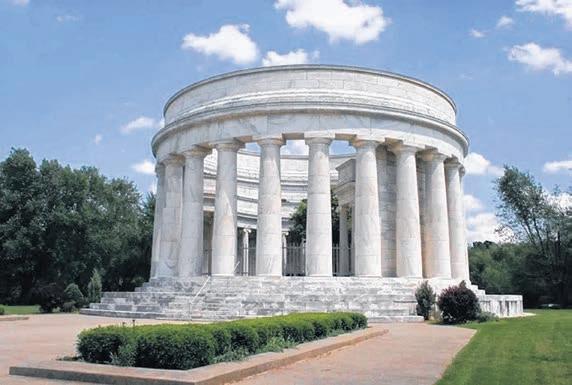
The Harding Memorial is on Delaware Avenue in Marion.
Harding
Harding
From page 40
campaign” for the presidency. The home, at 380 Mt. Vernon Ave., can be toured. Harding was married in the home to Florence Kling in 1891, and they lived there for 30 years. The home has been open to the public for 100 years and was restored in 2020. The Press House, used by
Presidential Library and Museum is adjacent to the Harding Home. It was built in 2019 and opened to the public in 2021. The building includes more than 5,000 historical objects and a gift shop.
• The Harding Memorial gravesite is at 966-870 Delaware Ave. Following Harding’s death, there was debate whether to bury the popular president
visit the 10-acre site during the daylight hours.
The Presidential Sites website said:
“The Harding Memorial and grounds are extremely visible to the Marion community and are a source of pride for our residents,” it wrote. “Marionites, therefore, are protective of it. We encourage visitors to take photos and enjoy the setting. Partisan political gatherings
on usually has a Harding Symposium, but it is on hiatus this year. However, the OSUMarion website said there were two Harding events of note tied in with America 250:
• Marion County’s America 250 Community Picnic, 4-8 p.m., Friday, July 17, at the Harding Presidential Sites.
• Annual Presidential Wreath laying, 10:30 a.m., Saturday July 18, Harding Memorial Presidential Grave.

Assistant Editor Gary Budzak covers the eastern half of Delaware County and surrounding areas. He can be reached via Webex at 1-740363-1161 or on X @GaryBudzak.
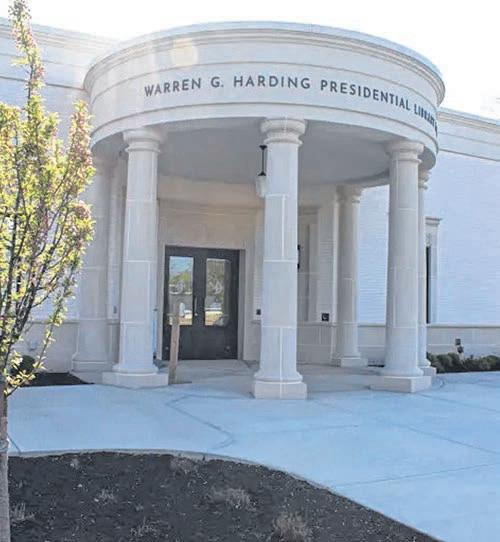

Courtesy | Ohio History Connection
The Presidential Library and Museum is the newest of the Harding Presidential sites.
Aviation history begins in Greene County
By Gery Deer For Greene County News
FAIRBORN — Long before air travel became routine and jetliners stitched continents together in a matter of hours, two bicycle makers from Dayton stood in a cow pasture in Greene County trying to solve a problem no one else had mastered: how to truly control human flight. Today, that same stretch of land — Huffman Prairie Flying Field — remains one of the most important sites in aviation history, though many Ohioans drive past it without realizing what happened there. For families looking for affordable summer destinations close to home, the Dayton Aviation Heritage National Historical Park offers one of the region’s most overlooked experiences. Spread across several
sites in Dayton and Greene County, the park preserves the story of Wilbur and Orville Wright, poet Paul Laurence Dunbar and the birth of powered flight.
While Kitty Hawk, North Carolina, may claim the Wright brothers’ famous first flight in 1903, it was Greene County where aviation truly became practical.
The brothers returned to Ohio after their experiments at Kitty Hawk, searching for a place where they could continue refining their aircraft. Dayton banker Torrence Huffman offered them use of a pasture northeast of the city, with only one request: close the gates behind them so the livestock would not wander off. That field became Huffman Prairie.
Bordered at the time by the Urbana Electric Railway, the site gave the Wrights
easy access to transportation for tools and equipment. More importantly, it gave them room to experiment, fail, rebuild, and try again.
Between 1904 and 1905, the Wright brothers transformed their invention from a short-hop curiosity into the world’s first practical airplane. At Huffman Prairie, they mastered controlled turns, figure eights, longer sustained flights and reliable takeoffs and landings.
On Oct. 5, 1905, Wilbur Wright flew more than 24 miles in 39 minutes — an astonishing achievement for the era and a major turning point in aviation history. Visitors today can stand near the same field where those flights took place.
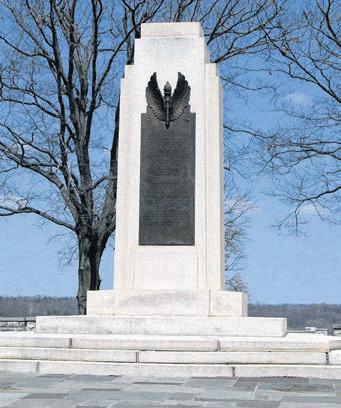


By Gery Deer | For Greene County News A monument in Fairborn acknowledges the Wright brothers and their impact on aviation. See AVIATION |44
The Huffman Prairie Flying Field is now located within Wright-Patterson Air Force Base, adjacent to one of the busiest military aviation complexes in the world, a fitting continuation of the Wright brothers’ legacy. Modern cargo aircraft and military jets routinely pass over the same ground where the first practical airplane once struggled against unpredictable winds and rough terrain.
Nearby, atop Wright Brothers Hill, stands the Wright Memorial. The memorial overlooks the prairie where the brothers perfected powered flight and serves as one of the area’s most scenic and historically significant viewpoints. Dedicated on Aug. 19, 1940 — Orville Wright’s 69th birthday — the
site features a 17-foot pink granite obelisk constructed from the same North Carolina quarry used for the Wright Brothers National Memorial at Kitty Hawk. The hill itself carries a history even older than aviation.
Several Adena burial mounds remain on the property, evidence of Native American activity in the region dating back more than 2,000 years. In 1974, the Wright Brothers Hill Mound Group was added to the National Register of Historic Places for its archaeological significance.
The adjacent Huffman Prairie Flying Field Interpretive Center offers exhibits detailing the Wright brothers’ experiments, the development of their flying school, and the continuing role of Wright-Patterson Air Force Base in aviation innovation. The center also includes a theater presentation and historical displays connecting the early days of flight to modern aerospace research.
The interpretive center is located at 2380 Memorial Road, Wright-Patterson Air Force Base, Ohio 45433. Current National Park Service hours are 9 a.m. to 4 p.m. Monday through Friday, though visitors are encouraged to check ahead for updated schedules or base-related closures.
Other Wright-related attractions throughout the Dayton region include the Wright-Dunbar Interpretive Center, the Wright Cycle Company complex, Carillon Historical Park’s Wright Brothers Aviation Center, and Hawthorn Hill, Orville Wright’s former home.
Most of the sites are free or low-cost to visit, making them ideal for day trips and weekend outings.
More information is available through the National Park Service Dayton Aviation Heritage website — www. nps.gov/daav — or by calling 937-3450433.
56 YearsHelpingtoMake BowlingGreen Great

1970 RickMetzjoinswith Rick Faulktoform H&HPainting
1972 H&Hconstructs rstnewhomein B.G.
1974 Rick formsRickMetz Builder, constructsnumerous homesinandaround B.G.
1980 Rickdevelops rstsubdivision, Fore MeadowsPlanned Development
1990 Rickdevelops AshburyHillsPlanned Development
1993 RickdevelopsPheasantRun, Development
2000 RickdevelopsSlipperyElm Hollow, Subdivision
2001 RickandJackiebegin AFirm Foundation; RickandJackie broadcastfromaroundthe U.S.,the WhiteHouse,and14 foreign countries
2015 AFirm Foundationbecomes AFirm Foundation forLife, advocating forseniorsandhealthyliving for22years
2023 RickandJackie ”Joyful AgingMessages”WLMB weeknights8:28pmrickandjackie.com
2023 RickMetz, Developer over325homes constructed
2025 Over 200 TV segmentsproduced
2026ReportingonthehealthofourPlanet,fromAntarctica Our7th Continentvisited,Antarctica
• Wright-Patterson Air Force Base sits on 8,145 acres outside of Fairborn and Dayton, encompassing Hu man Prairie.
• The base started out as three military installations during World War I, with Wilbur Wright Field, on what is now Area A, hosting a pilot training school, an aviation mechanics’ school and an aviation armorers’ school.
• Before that, the Wright Brothers ran a ying school at the prairie, teaching Army Air Forces commander Henry “Hap” Arnold and H. Roy Brown, who took down the Red Baron.
• Following World War II, Wright Field and Patterson Field merged as a uni ed installation known as Wright-Patterson Air Force Base, soon to become a signi cant location during the Korean War.
• In 1995, the base hosted peace talks between the parties of the Balkans con ict. The Dayton Peace Accords saw the presidents of Serbia, Bosnia and Croatia meet to agree to end the Bosnian War and establish the state of Bosnia and Herzegovina.
• Today, over 30,000 employees work at the base, making it the largest single-site employer in Ohio. It averages 11,000 aircraft operations every year.
• Popular legends claim that the government took the wreckage from the 1947 Roswell crash to the base for safekeeping.

RickandJackiejoinWLMB TV

Darke County’s Annie Oakley breaks stereotypes
By Ryan Berry rberry@aimmediamidwest.com
GREENVILLE — Was Annie Oakley a fictional character developed for the theater, movies and television and used to sell merchandise?
If all you ever saw was “Annie Get Your Gun,” the answer is yes. That version of Oakley was definitely fictional. The real Oakley was much more than her rifle and her ability to entertain. She is definitely a person who changed the roles of women and broke stereotypes over the past
150 years.
She has been portrayed by some of the greatest names in entertainment, including Barbara Stanwyck, Ethel Merman, Bernadette Peters, Reba McEntire, Susan Lucci, Gail Davis and many others, but the person they portrayed wasn’t Oakley. The only truths from the fictionalized version of Oakley are she was from Darke County, she could shoot a rifle, and she was an entertainer. The rest of it was fantasy. It was far from fantasy for Phoebe Ann Moses
during her early life. She was born to Jacob and Susan Moses on Aug. 13, 1860, in a log cabin near Willowdell, in Darke County. She was around 6 years old when her father passed away from complications due to pneumonia. With the breadwinner gone, the family was in dire straits.
Two or three years after her father’s passing, Annie, as she was known to her sisters, was sent off to the Darke County Infirmary. She went to work for a local family around the age of 10, where she was supposed

to be paid and educated. By Annie’s account, she was treated cruelly and was, more or less, put in a position of servitude. In later years, she referred to them as “the wolves.”
Her mother remarried in 1866, and her second husband died four years later, which continued the financial strain for the family. Her third marriage was to Thomas Shaw in 1874. It is believed Annie returned to northern Darke County to live with her family shortly after that.
One might be able to
argue this is when things began to turn for the future superstar.
She learned to shoot when she was 8 years old and provided food for the family, but after being sent off to the infirmary and then to live with “the wolves,” it wasn’t until she returned home that she was able to refine her skill with a gun. She became proficient enough to not only provide for her family but also take the game into Greenville to be sold. She was able to make enough money to pay
See ANNIE OAKLEY |47

Annie Oakley
From page 46
off the mortgage on her family’s farm.
Her game was highly sought after because of her ability to make clean shots, which meant those preparing the food would not have to clean buckshot out of their dinners.
Her life took a dramatic turn when she met Frank Butler, a traveling exhibition shooter, and her future husband, in Cincinnati. Still a teenager, Annie proved her skill to Butler.
Although there is no concrete evidence as to where she came up with the stage name Oakley, many believe it came from the Oakley neighborhood of Cincinnati. There is currently a mural of Annie in Oakley.
Butler and Annie went on to form the shooting act of “Butler and Oakley.”
Butler, understanding the world of business and making money, eventually dropped himself from the act and promoted Annie. His inclination proved to be the correct move.
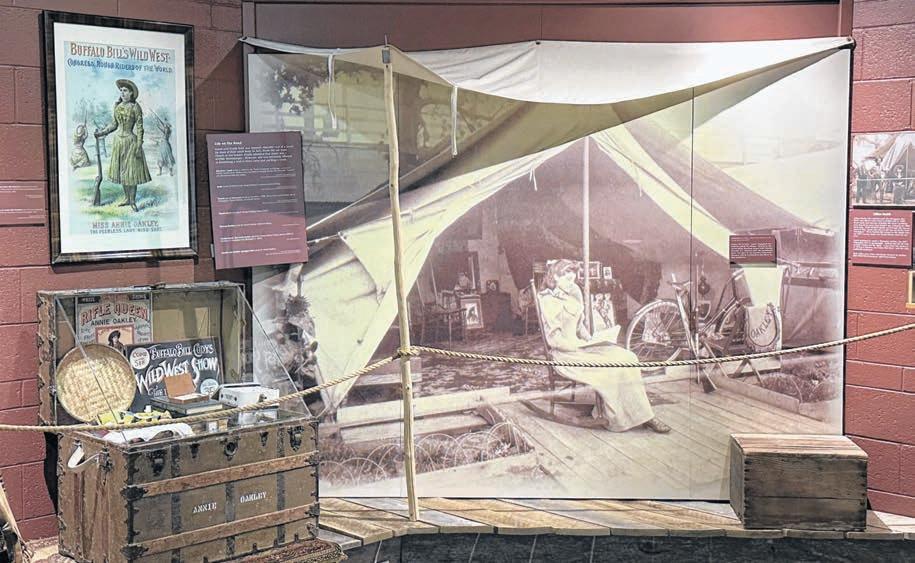
First on the vaudeville circuit, then with a couple of circus circuits and ultimately with Buffalo Bill’s Wild West Show, she performed across the world for ordinary people, as well as for heads of state and nobility. She was one of the highest-paid performers of her era. It was also during this time that she met Chief Sitting Bull. The two were great friends, with Sitting Bull unofficially adopting her. Sitting Bull paid her the ultimate
compliment by giving her the moniker Little Sure Shot.
Although she never aligned herself with the feminist movement, Annie was fiercely supportive of women. She was a staunch supporter of equal pay for women and understood a woman was capable of more than they were given credit for. She taught thousands of women how to shoot and defend themselves, and she even offered the government her services to train women for service in the Spanish-American War and World War I. The government declined her offer.
Maybe there was some truth to one of the songs in Annie Get Your Gun: “Anything you can do, I can do better.”
Darke County will recognize

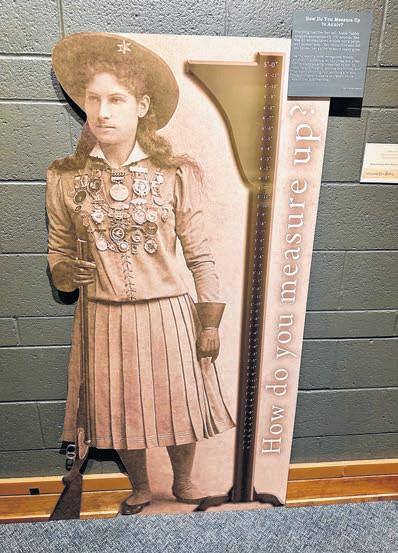

Although very athletic, Annie Oakley stood 5-feet tall

Annie Oakley
From page 46
the 100th anniversary of Oakley’s death this year. Just as she had done many times before, Annie came home to Greenville and Darke County to live her final days. On Nov. 3, 1926, Annie died at a boarding house in downtown Greenville. Her husband, Frank Butler, died a couple weeks later. Both were buried, side-byside, in Brock Cemetery, just a few miles from where she was born and learned to shoot.
Darke County continues to honor its most famous daughter every year with
the Annie Oakley Days Festival. A statue of the legendary sharpshooter stands in Annie Oakley Park, located at the corner of Washington Ave., Martin Street and South Broadway. A mural of Annie can also be found on the Sure Shot Tap House. In addition, the National Annie Oakley Center is located at Garst Museum. The museum houses hundreds of artifacts from Little Miss Sure Shot’s life, including some of her guns, clothing, personal mementos, and more. Garst Museum is located at 205 N. Broadway, Greenville. Visit garstmuseum.org for more information.

Photos courtesy of Garst Museum
Annie Oakley spent a good portion of her life traveling the world to entertain ordinary people, heads of state and nobility.
Treaty of Greene Ville opened westward expansion
By Ryan Berry rberry@aimmediamidwest.com
GREENVILLE — The celebration for America 250 has been a multi-year celebration of America and the people and events who called this country home or helped shape who we are.
Looking at Darke County and Greenville today, it is hard to imagine how the largest stockade of its time was built on approximately 50 acres in an area
fortified encampment literally shaped the country. The United States was trying to move westward into the Northwest Territory, land claimed by the United States government. They had plenty of land to sell to individuals wanting to settle. For the government, it was ultimately a way to replenish its cash flow from money spent on the Revolutionary War. However, there were about 45,000 Native
eral Anthony Wayne established a fortified encampment at GreeneVille, named for General Nathaniel Greene. It became part of a line of forts and encampments designed to push colonization westward. It started with Fort Washington (Cincinnati) moved north to Fort St. Clair (Eaton), up to Fort Jefferson (a supply depot south of Greenville) to GreeneVille and then further north to
encampments carried the title fort, General Wayne never referred to GreeneVille as a fort.
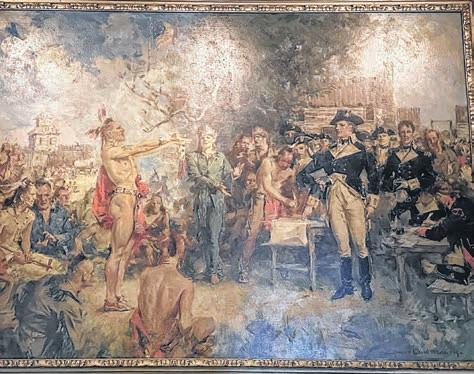
Two years after GreeneVille’s encampment was established, and 19 years after the signing of the Declaration of Independence, America was finally able to move forward with westward expansion with the signing of the Treaty of GreeneVille. On Aug. 3, 1795, 12 Native American tribes were present for the sign-

See GREENVILLE |50

Ryan Berry | Daily Advocate
An early version of Howard Chandler Christy’s Treaty of GreeneVille painting hangs in Garst Museum in Greenville. The state’s commissioned piece that measures 17x22-feet hangs in the Ohio Statehouse Rotunda.
Greenville
ing. For the tribes, it was more or less a surrender. They had been thoroughly defeated in the Battle of Fallen Timbers, with much of the leadership among the casualties. For America, it was the opportunity to move into areas Native Americans occupied and were not previously willing to surrender. Some believe Greenville could be considered the original gateway to the west.
The GreenVille Treaty Line was established, which moved the Native Americans further west and north. Because of the treaty, the line literally shaped America’s footprint.
In the 231 years since it was
established, remnants of that line are still in place, with roads called Greene Ville Treaty Line Road, but for the most part the line has been forgotten. Farms and buildings are now built on that line in many areas.
Over the past few years, engineers from across Ohio re-surveyed the line. According to Darke County Engineer Jim Surber, although the Greene Ville Treaty Line bears the name of where the treaty was signed, very little of the line runs through Darke County. Less than a two-mile stretch runs through the northwest portion of the county that stretches from the Ohio-Indiana line to the Darke-Mercer County line.
According to Surber, “The line began at the confluence of the Kentucky and Ohio Riv-
ers, which is now in the state of Indiana and runs about 13 degrees east of north to what is now Ft. Recovery in Mercer County. From there it turns southeast and runs to Ft. Loramie and then continues northeast to Tuscarawas County, then turns north and runs to Lake Erie.”
Since 1.944 miles of the line is in Darke County, Surber said his role was much easier than some of the other engineers. However, Surber explained, “In Indiana and many counties in Ohio, roads were built on the line, preserving its location. Additionally, it has been preserved in many places since it was used as property lines in Indiana and Ohio.”
He added, “This is not the case in Darke County. Within a

few years after the Treaty Line was surveyed and marked, the First Principal Meridian (now the Ohio-Indiana Line) was surveyed and marked (about 1799) and its location was ref-
erenced to the existing Treaty Line. Later on, when what is now Darke County was subdivided into mile sections east of



See GREENVILLE |51
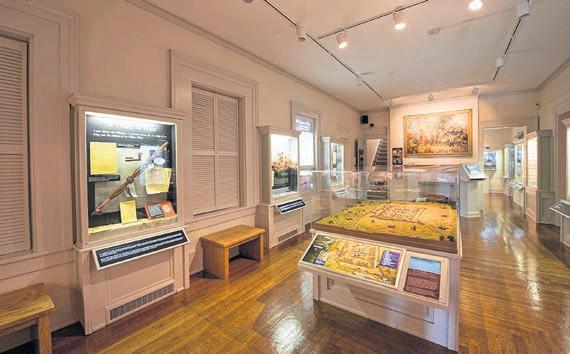
Ryan Berry | Daily Advocate Garst Museum in Greenville exhibits a replica of General Anthony Wayne’s fortified encampment in Greenville. The exhibit is part of the Crossroads of Destiny wing.
Greenville
From page 50
the principal meridian, the Treaty Line was referenced again. (Known as the Old Indian Boundary.)”
Surber said he used old survey records that were available and was able to re-establish its location in Darke County at four separate locations: where it crosses the State Line Road, Peters Road, New Weston-Ft. Loramie Road and the Darke-Mercer County Line Road. Unlike some of the counties, the line has never been preserved in
never used as a property line. It currently runs through farmland, and buildings have been built on top of the line. Unlike some counties, there are no markers for the line that runs through the northwestern edge of Darke County.
The Greene Ville Treaty Line was short-lived. The War of 1812 pushed the Native Americans further west, even though a second treaty signed in Greenville in 1814 sought to secure the original Greene Ville Treaty Line. You can learn more about the Treaty of Greene Ville by visiting Garst Museum. Their
exhibit looks at who was in Greene Ville and what life was like in the late 1700’s in this region of the nation. You may be surprised to learn that some of America’s most notable names were part of Greenville’s Class of 1795, including General Wayne, future president Lt. William Henry Harrison, and two names that would further shape America’s westward expansion, Meriwether Lewis and William Clark. It is believed the duo met in Greenville. Visit www. garstmuseum.org for more information.
To contact Daily Advocate Editor Ryan Berry, email rberry@

Seeds of a nation: How A.B. Graham cultivated Ohio’s future
By Holly McKellop UDCeditor@aimmediamidwest.com
URBANA — In the quiet fields and school houses of west central Ohio, one man planted ideas that would grow far beyond the boundaries of Champaign County.

Albert Belmont Graham, better known as A.B. Graham, left an enduring legacy in agriculture and education that continues to shape communities across the region and the nation.
Born in 1868, Graham began his career as a school superintendent in Springfield, where he quickly recognized a disconnect between rural students and the agricultural knowledge they needed to thrive.
At a time when farming was the backbone of the local economy, Gra-
ham believed education should extend beyond textbooks and into the fields.
In 1902, while working in Clark County, Graham organized what is widely considered the first youth agricultural club in the United States. Known as the “Tomato Club” or “Boys’ and Girls’ Experimental Club,” it encouraged young people to learn by doing – planting crops, conducting experiments, and sharing their results. This hands-on approach laid the foundation for what would later become 4-H.
Graham’s vision spread quickly into Champaign County and neighboring rural communities, where families embraced the idea that education
See GRAHAM |53

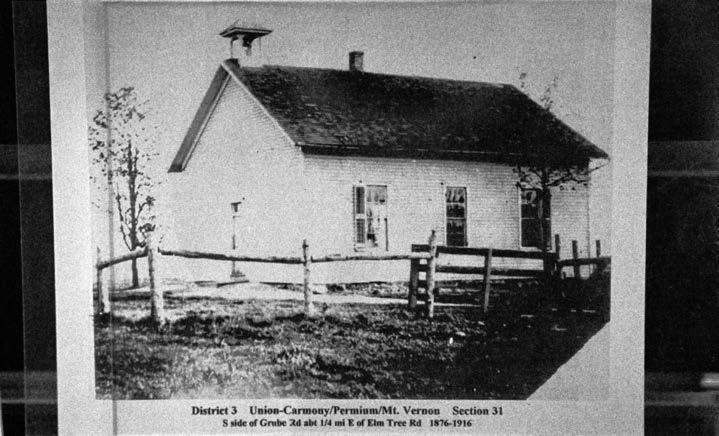

Holly McKellop | HMphotography
A photo of A.B. Graham’s school house is on display at the Champaign County Historical Society. The caption notes the school house was located east of Elm Tree Road on Grube Road in Champaign County.
Graham
From page 52
could directly improve farm productivity and quality of life.
His work bridged the gap between schools and agriculture, helping young people develop practical skills, responsibility and leadership.
The principles Graham championed — learning by doing, community involvement and youth
with local communities to share research-based knowledge.
As the nation celebrates the United States semiquincentennial, Graham’s contributions resonate more than ever.
His work not only enriched agriculture in Champaign and surrounding counties but also redefined what education could achieve when rooted in real-world experience.
Today, the legacy of A.B. Graham lives on in every 4-H project,
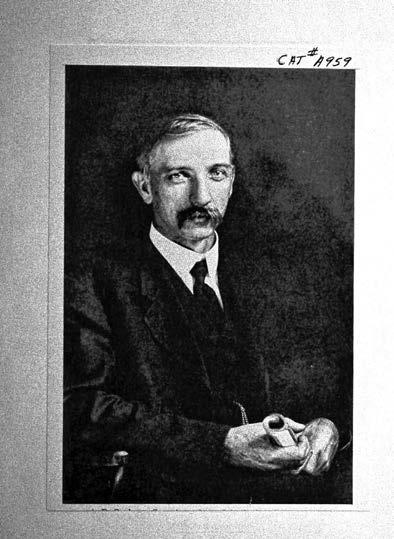
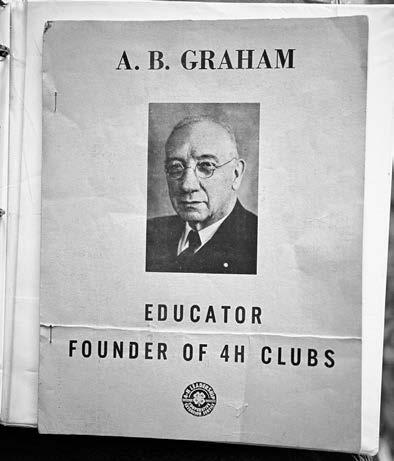

Holly McKellop | HMphotography
A photo of a young A.B. Graham is on display at the Champaign County Historical Society.
Holly McKellop | HMphotography A report written by Fannie Bosler, former Graham Local Schools teacher, in March 1968 can be seen, courtesy of Connie (Zerkle) Crocker and her brother, John Zerkle. A.B. Graham is pictured on the cover. Graham Local Schools District in St. Paris is named in honor of A.B. Graham.
Clinton County’s Revolutionary Roots
By Serena Hall shammond@wnewsj.com
WILMINGTON — As the United States prepares to celebrate its 250th anniversary in 2026, communities across the country are reflecting on the events, people and sacrifices that shaped the nation’s beginnings. In Clinton County, that story does not simply trace back to the American Revolution. It grows directly out of it.
According to materials provided by the Clinton County History Center as part of its America250 exhibit, the county’s roots are deeply tied to the nation’s founding, westward
of the Ohio wilderness into settled communities.
Long before Clinton County was established in 1810, the land that would eventually become Wilmington and the surrounding communities was part of the vast Northwest Territory, land transferred from Great Britain to the United States following the Treaty of Paris in 1783.
At the time, the region was covered by dense forests and connected by indigenous trails rather than roads. Native nations including the Miami, Shawnee, Delaware, Wyandot, Ottawa, Seneca and Potawatomi lived
before European American settlement arrived.
The Northwest Ordinance of 1787 established a framework for organizing the territory and eventually admitting new states into the Union. The ordinance also guaranteed protections including freedom of religion, trial by jury and inheritance rights, while prohibiting slavery in newly formed states.
After the costly Revolutionary War, the federal government used portions of the Northwest Territory to help pay veterans for their wartime service. Surveyors moved into the rugged Ohio wilderness using little more than

chains and compasses to divide land into parcels for settlement.
“In 1785, the area that was to become Ohio was part of the Virginia Military District, land being used as payment to military veterans from Virginia for their service during the American Revolution,” one exhibit panel explains.
When settlers began arriving in Clinton County between 1797 and 1799, they encountered fertile soil, massive forests and tangled undergrowth. Three men — Morgan Van Meter, Amos Wilson and David Sewell — are credited by historians



Roots
From page 54
as among the county’s earliest settlers.
Many of the county’s earliest residents were Quakers, or members of the Society of Friends, whose influence became deeply woven into the area’s identity. According to the exhibit materials, Quaker communities later played important roles in the Underground Railroad and eventually helped establish Wilmington College in 1870.
One of the exhibit’s central figures is Preserved Fish Dakin, a Revolutionary War soldier and Quaker whose life reflected
the tensions many Americans faced during the Revolution.
Born in New York in 1749, Dakin was raised in the Quaker faith but chose to serve in the Revolutionary War despite the religion’s pacifist beliefs. After the war, he was removed from the Society of Friends before later regaining standing within the community. Dakin eventually moved west to Ohio, where he claimed land near present-day Oakland and Chester Township and became part of Clinton County’s early development.
The exhibit also highlights how ordinary life continued during the Revolutionary era through objects preserved
See ROOTS |57




Photo courtesy of Clinton County History Center
Artifacts and historical displays featured in the Clinton County History Center America 250 exhibit, “Clinton County’s Revolutionary Roots,” help illustrate how the American Revolution and westward expansion shaped the early history of Clinton County and the surrounding region.
Roots
From page 56
by local families and collectors.
Among those artifacts is an embroidered pocketbook dating to 1772, years before the Declaration of Independence, which was used to carry money, letters and personal items.
Other items on display include pewter chargers from the late 1700s, bone china cups dating to approximately 1775, early spoon molds used for casting utensils and a gourd made in 1810 bearing references
to what may have been one of Clinton County’s first brick homes.
A blue silk ribbon commemorating the 100th anniversary of George Washington’s birth in 1832 also helps illustrate how early Americans viewed the nation’s founding generation. The exhibit notes that even decades after his death, Washington remained a powerful symbol of patriotism and national unity.
Another major focus of the exhibit is the connection between Clinton County and Revolutionary War veterans buried
locally. Historians estimate more than 50 Revolutionary War veterans are buried throughout Clinton County cemeteries.
Recent research tied to the Clinton County Infirmary Project also uncovered two Revolutionary War veterans believed to be buried on infirmary grounds.
Walter “Barton” Roberts, a veteran from Maryland, moved to Clinton County in 1807 and later entered the Clinton County Poor House after reportedly being abandoned by
See ROOTS |58


Roots
From page 57
family members. Roberts died in 1840 at age 93 and became the first documented resident buried at the infirmary cemetery.
George Wright, who served in both the Revolutionary War and the War of 1812, immigrated from Ireland and later settled in Ohio around 1813. Historical accounts described Wright as physically active well into his 90s, often walking from the infirmary into Wilmington to retrieve his newspaper. He died in 1857 at age 98.
Shelby Boatman, director of the Clinton County
History Center, said the exhibit is designed to help residents understand how national history and local history remain closely connected.
“America 250 is an opportunity for communities like Clinton County to reflect on where we began and how those early decisions continue to shape us today,” Boatman said.
“Through Clinton County’s Revolutionary roots, we’re helping visitors understand that the legacy of the Revolution lives on right here, in our landscapes, our families and even in the final resting places of those who fought for independence,” Boatman said.
Boatman said the exhibit
encourages visitors to see Clinton County as part of a much larger American story.
“What makes Clinton County’s Revolutionary story so unique is how visible and tangible it still is today,” Boatman said. “Visitors aren’t just learning about history. They’re standing in it.”
The Clinton County History Center’s America 250 exhibit, “Clinton County’s Revolutionary Roots,” runs through December 2026 and features historical artifacts, genealogy research, local records and interactive displays exploring how the Revolutionary era helped shape Clinton County and the surrounding region.


Photo courtesy of Clinton County History Center Artifacts and historical displays featured in the Clinton County History Center America 250 exhibit, “Clinton County’s Revolutionary Roots,” help illustrate how the American Revolution and westward expansion shaped the early history of Clinton County and the surrounding region.


A museum, within a public school
By Jacob Clary jclary@aimmediamidwest.com
GREENFIELD — “This is a school?”
”This is a museum!”
When someone reads that phrase, they might immediately conjure up images of a school in Los Angeles, New York City or possibly even Paris.
However, those words came from Matt Shelton, principal of McClain High School in Greenfield, when he responded to a question asking how people react when they walk into the school for the first time.
McClain High School contains more than 180 pieces of artwork, including
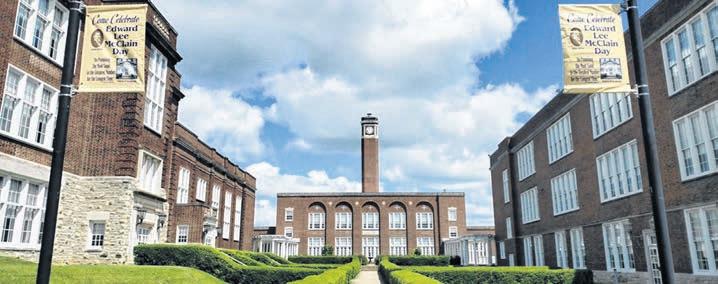
paintings, sculptures, photographs, drinking fountains with Rookwood pottery backgrounds, several large

murals and four Latin-inscribed Moravian panels on the exterior of the high school.
Shelton said the school was donated to the village by Edward and Lulu McClain. He said the McClains were originally looking for the school to be constructed on a budget of $80,000 in 1912, but it ended up costing about $250,000 in 1915, which is when the school was dedicated.
When the school was dedicated, the governor of Ohio was present to give a speech, and the founder of The Columbus Dispatch attended the dedication to take photographs. According to the Greenfield Historical Society, in later years

Photo courtesy of McClain High School Pictured is the courtyard of McClain High School.



Workingas one team for your cancer care.
Merc yHealth –St. Rita’s CancerCenterispar tofThe JamesCancer Network, apowerful collaboration that lets ourpatients keep theircancercareclose to home whilegiving themaccess to theadvancedtreatments and nationallyrecognizedexper tiseofThe Jamesat Ohio Statewhen they need it .

Scan theQRcodetolearn moreabout Maryann’sjourney andthe collaborationwith The JamesCancer Network.




Museum
From page 60
the McClains expanded the original building with a vocational building, including a natatorium as well as land for athletic fields.
Shelton said one of the highestprofile pieces of artwork the school has is “Ginevra,” an original sculpture donated to the school by William G. Moler, a former principal of schools in Greenfield, with the artwork donated in 1928.
A wide, winding marble stepway that students are not supposed to walk on until after graduation is another highlight.
“The kids are unbelievable about respecting it,” Shelton said. “They do not go on those steps. I mean, I could
See MUSEUM |65


Photo courtesy of McClain High School
Pictured is the marble staircase in McClain High School, which students are not supposed to use until they graduate.
Museum
From page 64
be standing on them and say, ‘Come here. I want to show you something.’ And then the kids will freeze and say like, ‘Mr. Shelton, I can’t walk up there.’ It’s like ingrained. It’s a tradition.”
He said another noteworthy piece of artwork is a statue of Athena located on the first-floor corridor. Shelton said the piece of artwork was purchased and donated by multiple African-American members of the community, including C.R. Patterson, the only Black automobile manufacturer in the United States whose business was located in Greenfield. Before producing automobiles, Patterson made buggies.
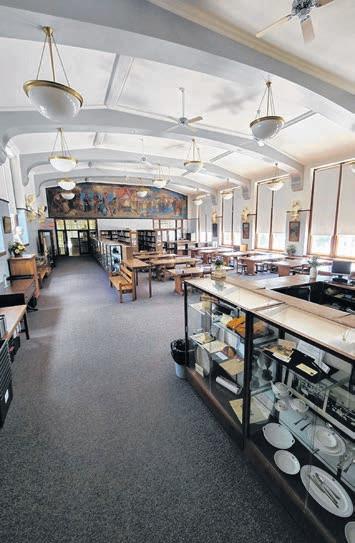


Photo courtesy of McClain High School
Pictured is the library on the third floor, which

Museum
From page 65
Patterson and many others donated the statue to the school, Shelton said.
“It’s really neat, the community support behind the school. It’s the heart of the community,” Shelton said. “It sits in the middle of the town, and it’s locally funded through the art restoration fund and a ton of local scholarships. So, when you have a locally funded museum of a school, it’s just a really neat thing, and as an alumnus myself, there’s just a lot of pride.
“I guess we’re appreciative of the gift that Mr. McClain gave and of the continued support from the community over the last 111 years.”
McClain High School was dedicated in September 1915, and soon after the
first students filed into its hallways and classrooms.
In his speech during the 2015 centennial celebration of the school, former superintendent Terry Fouch said the McClains “had the vision of a great institution designed to train the heart and head and hand of the youth of the community, and through them and its civic activities, to touch the lives of every man and woman in this community.”
Current Greenfield Superintendent Quincey Gray said, “Edward Lee McClain, an outstanding leader and innovator, gave such a wonderful gift to our community that so many people have worked diligently to maintain. It is only fitting to pause and recognize him for his contribution that has stood the test of time.”
Reach Jacob Clary at 937-402-2570.


Photo courtesy of McClain High School
Pictured is a second-floor corridor.