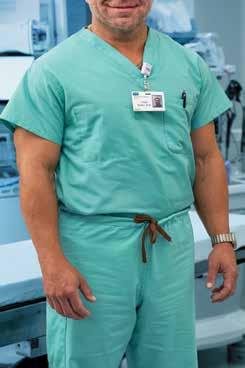
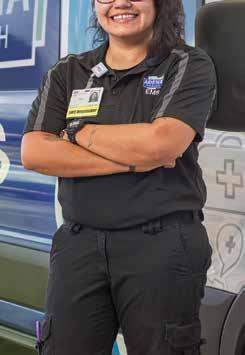
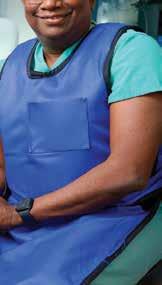
We of fer comprehensive eye health exams and vision screenings, custom lenses, contact lenses, fashion frames, treatment of common eye conditions including glaucoma, macular degeneration, diabetic retinopathy,cataracts, eye misalignment, dr yeye screenings, and Advanced Dr yEye Treatments.
We have alarge selection of frames including designerssuch as Lafont, Kate Spade, Liz Claiborne, TedBaker, Claiborne for Men, Carrera, RayBan, Flexon, Oakley,Maui Jim, All Saints, FYSH, and GX by Gwen Stefani.
1,755
PK-12
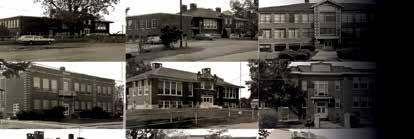
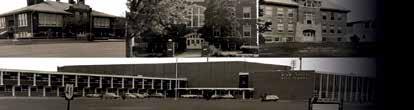
Cherry Hill PrimarySchool (GradesPK–2)
BelleAireIntermediateSchool (Grades3–5)
Washington Middle School (Grades6-8)
Washington High School (Grades9-12)
13 students
PurpleStar Designation:
$125,600 scholarships
Lyndyn Gibbs(2025)
Firstnationallyranked women’s wrestler in BlueLionand University ofRio Grande history (NAIA Top20)
Boys Varsity Bowling(2024)
Firstteam in school history to qualifyfor State; finished8th in OHSAADivision II
BlueLion Baseball
JeffShaw(1984)
BlueLionHall of Famer and4-season MLB pitcherwith the Dodgers; son Travis Shaw(2008) played for theBlueJays
Mason Mullins (2025)
Named2025National USBC Male Youth Ambassador ofthe Year andOhioUSBCYouth Bowler ofthe Year
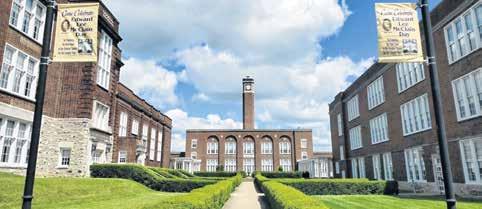
A museum, within a public school
By Jacob Clary jclary@aimmediamidwest.com
GREENFIELD — “This is a school?”
”This is a museum!”
When someone reads that phrase, they might immediately conjure up images of a school in Los Angeles, New York City or possibly even Paris.
However, those words came from Matt Shelton, principal of McClain High School in Greenfield, when he responded to a question asking how people react when they walk into the school for the first time.
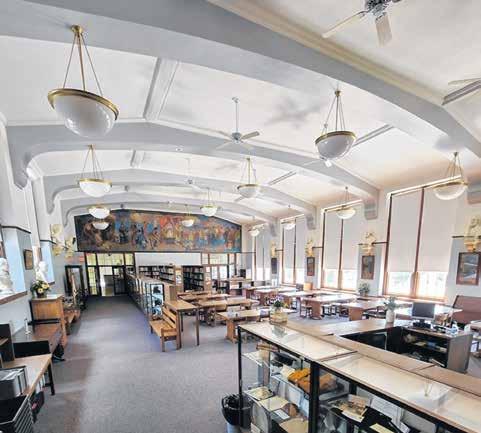
McClain High School contains more than 180 pieces of artwork, including paintings, sculptures, photographs,
drinking fountains with Rookwood pottery backgrounds, several large murals and four Latin-inscribed Moravian panels on the exterior of the high school.
Shelton said the school was donated to the village by Edward and Lulu McClain. He said the McClains were originally looking for the school to be constructed on a budget of $80,000 in 1912, but it ended up costing about $250,000 in 1915, which is when the school was dedicated.
When the school was dedicated, the governor of Ohio was present to give a speech, and the founder of The Columbus Dispatch attended the dedication to take photographs.
According to the Greenfield His-
torical Society, in later years, the McClains expanded the original building with a vocational building, including a natatorium as well as land for athletic fields.
Shelton said one of the highestprofile pieces of artwork the school has is “Ginevra,” an original sculpture donated to the school by William G. Moler, a former principal of schools in Greenfield, with the artwork donated in 1928.
A wide, winding marble stepway that students are not supposed to walk on until after graduation is another highlight.
“The kids are unbelievable about respecting it,” Shelton said. “They do not go on those steps. I mean, I could be standing on them and say, ‘Come here. I want to show you something.’ And then the kids will freeze and say like, ‘Mr. Shelton, I can’t walk up there.’ It’s like ingrained. It’s a tradition.”
He said another noteworthy piece of artwork is a statue of Athena located on the first-floor corridor. Shelton said the piece of artwork was purchased and donated by multiple AfricanAmerican members of the community, including C.R. Patterson, the only Black automobile manufacturer in the United States whose business was
located in Greenfield. Before producing automobiles, Patterson made buggies.
Patterson and many others donated
Photo courtesy of McClain High School
Pictured is the courtyard of McClain High School.
Museum
From page 3
the statue to the school, Shelton said. “It’s really neat, the community support behind the school. It’s the heart of the community,” Shelton said. “It sits in the middle of the town, and it’s locally funded through the art restoration fund and a ton of local scholar-
ships. So, when you have a locally funded museum of a school, it’s just a really neat thing, and as an alumnus myself, there’s just a lot of pride.
“I guess we’re appreciative of the gift that Mr. McClain gave and of the continued support from the community over the last 111 years.”
McClain High School was dedicated in September 1915, and soon after, the first students filed into its hallways
and classrooms.
In his speech during the 2015 centennial celebration of the school, former superintendent Terry Fouch said the McClains “had the vision of a great institution designed to train the heart and head and hand of the youth of the community, and through them and its civic activities, to touch the lives of every man and woman in this community.”
Current Greenfield Superintendent Quincey Gray said, “Edward Lee McClain, an outstanding leader and innovator, gave such a wonderful gift to our community that so many people have worked diligently to maintain. It is only fitting to pause and recognize him for his contribution that has stood the test of time.”
Reach Jacob Clary at 937-402-2570.
Photo courtesy of McClain High School
Pictured is the marble staircase in McClain High School, which students are not supposed to use until they graduate.
Pictured is the library on the third floor, which features multiple pieces of art.
Patriot Rupert honored with grave-marking ceremony
By Gail Allen Record-Herald Correspondent
WASHINGTON
COURT HOUSE
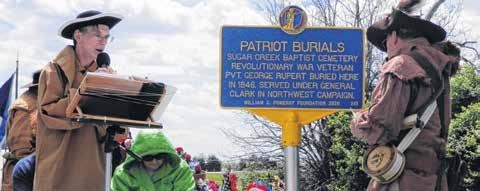
— The Ohio Society of the Sons of the American Revolution held a grave marking ceremony the afternoon of April 19 at Sugar Creek Baptist Cemetery to honor patriot George Rupert.
Centennial Chapter OHSSAR President James L. Cooper opened the ceremony, followed by the presentation of colors led by Assistant Commander Kevin Driesbach.
Lynda K. Cooper, a descendant of George Rupert, read a biography of the patriot. Former Lt. Col. Jeremiah I. Rupert, a retired Marine, spoke regarding George Rupert’s military legacy. Rupert served under Gen. George Rogers Clark.
Rupert’s journey to Fayette County
was unconventional. Born in December 1758 near Hanover in what is now Germany, he originally arrived in America in September 1778 as a private in the 3rd English Waldeck Regiment.
His British-aligned unit was posted to Pensacola, Florida, and later to a fort near Baton Rouge, Louisiana.
In September 1779, Rupert became a prisoner of war after the fort was surrendered to the Spanish army. To avoid being sent to Cuba, Rupert joined the Spanish forces in 1780, leading his original regiment to list him as a deserter.
In July 1781, Rupert escaped the Spanish army and traveled upriver to Kaskaskia in the Illinois Territory. It was there that he joined the American cause, enlisting in Clark’s forces in August 1781. He served as a private
in Capt. Bailey’s company under Col. Crittendon through the end of the war. During his campaigns with Clark, Rupert was involved in the rescue of Elizabeth Pursley near present-day Piqua. Pursley had been captured by
Native Americans in 1780 at Ruddles Station, Kentucky. Rupert and Pursley married in 1786, and she is buried alongside him in Sugar Creek Baptist
Gail Allen | Record-Herald photos
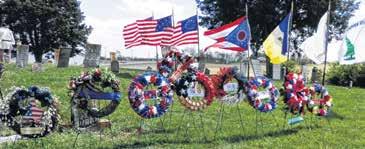
Shawn Cox, left, announces the presentation of wreaths during a grave marking ceremony for patriot George Rupert at Sugar Creek Baptist Cemetery on Sunday, April 19, 2026. Rupert began his military service in 1778 with the 3rd English Waldeck Regiment.
Honored
From page 5
Cemetery. The couple had 10 children. Following the war, Rupert was granted a 200-acre land warrant for his service. He lived his later years in Fayette County, where he was awarded a federal pension in 1832. At the time of his death on Sept. 2, 1846, he was receiving $80 per year for his military service.
Ohio Senate President Rob McColley was unable to attend but sent a letter from the statehouse. The letter was read by Ethan Rupert, son of Jeremiah Rupert. Following the reading, Jeremiah Rupert unveiled the patriot plaque.
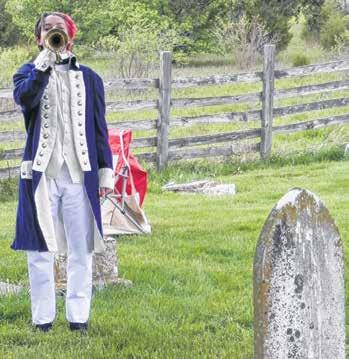
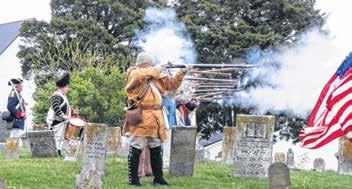
Shawn Cox, past president of the Arthur St. Clair Chapter of OHSSAR, led the presentation of wreaths dedicated by various SAR chapters. Members in uniform provided a 21-gun salute led by Driesbach, and Reagan Baird of the Camp Charlotte Chapter played taps.
The regiment formation included fifer Rob Pruitt of the Dayton-area chapter and drummer Bart Hendershot of Cincinnati. Hendershot was also a participant in the Veterans of 1776 Festival held over the weekend at Gardner Park Field.
Robert Grim offered special thanks to the Sugar Creek Baptist Church, participating SAR chapters and the Union Township trustees for coordinating the ceremony.
Gail Allen | Record-Herald photos Wreaths from several chapters of the Sons of the American Revolution sit at the gravesite of patriot George Rupert during a ceremony at Sugar Creek Baptist Cemetery on Sunday, April 19.
Members of the Sons of the American Revolution provide a 21-gun salute for patriot George Rupert at Sugar Creek Baptist Cemetery on Sunday, April 19, 2026.
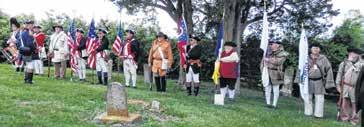
Members of the Sons of the American Revolution post colors during a ceremony at Sugar Creek Baptist Cemetery on Sunday, April 19, 2026. The event featured the unveiling of a historical marker for patriot George Rupert, who died in 1846.
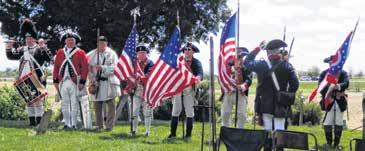
Members of the Sons of the American Revolution stand in formation during a ceremony for patriot George Rupert at Sugar Creek Baptist Cemetery on Sunday, April 19, 2026. Rupert, a longtime veteran, died in
Reagan Baird, a member of the Camp Charlotte Chapter of the Children of the American Revolution, plays taps during a ceremony at Sugar Creek Baptist Cemetery on Sunday, April 19, 2026. The event honored patriot George Rupert with the placement of a burial plaque.
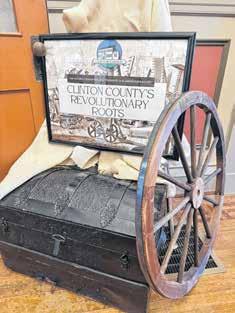
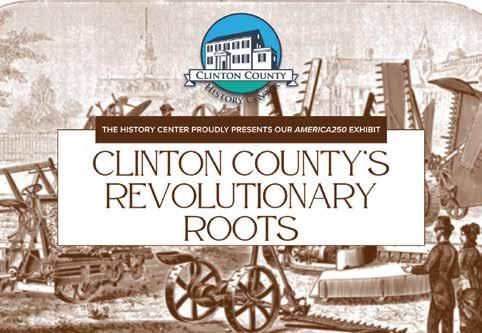
Clinton County’s Revolutionary Roots
By Serena Hall shammond@wnewsj.com
WILMINGTON — As the United States prepares to celebrate its 250th anniversary in 2026, communities across the country are reflecting on the events, people and sacrifices that shaped the nation’s beginnings. In Clinton County, that story does not simply trace back to the American Revolution. It grows directly out of it.
According to materials provided by the Clinton County History Center as part of its America250 exhibit, the county’s roots are deeply tied to the nation’s founding, westward expansion and the transformation of the Ohio wilderness into settled communities.
Long before Clinton County was established in 1810, the land that
would eventually become Wilmington and the surrounding communities was part of the vast Northwest Territory, land transferred from Great Britain to the United States following the Treaty of Paris in 1783.
At the time, the region was covered by dense forests and connected by indigenous trails rather than roads. Native nations, including the Miami, Shawnee, Delaware, Wyandot, Ottawa, Seneca and Potawatomi, lived throughout the Ohio Country long before European American settlement arrived.
The Northwest Ordinance of 1787 established a framework for organizing the territory and eventually admitting new states into the Union. The ordinance also guaranteed protections, including freedom of religion, trial
by jury and inheritance rights, while prohibiting slavery in newly formed states.
After the costly Revolutionary War, the federal government used portions of the Northwest Territory to help pay veterans for their wartime service. Surveyors moved into the rugged Ohio wilderness using little more than chains and compasses to divide land into parcels for settlement.
“In 1785, the area that was to become Ohio was part of the Virginia Military District, land being used as payment to military veterans from Virginia for their service during the American Revolution,” one exhibit panel explains.
When settlers began arriving in Clinton County between 1797 and 1799, they encountered fertile soil, massive forests and tangled undergrowth. Three men — Morgan Van Meter, Amos Wilson and David Sewell — are credited by historians as among the county’s earliest settlers.
Many of the county’s earliest residents were Quakers, or members of the Society of Friends, whose influence became deeply woven into the area’s identity. According to the exhibit materials, Quaker communities later played important roles in the Underground Railroad and eventually helped establish Wilmington College
in 1870.
One of the exhibit’s central figures is Preserved Fish Dakin, a Revolutionary War soldier and Quaker whose life reflected the tensions many Americans faced during the Revolution.
Born in New York in 1749, Dakin
Photo courtesy of Clinton County History Center Artifacts and historical displays featured in the Clinton County History Center America 250 exhibit, “Clinton County’s Revolutionary Roots,” help illustrate how the American Revolution and westward expansion shaped the early history of Clinton County and the surrounding region.
was raised in the Quaker faith but chose to serve in the Revolutionary War despite the religion’s pacifist beliefs. After the war, he was removed from the Society of Friends before later regaining standing within the community. Dakin eventually moved west to Ohio, where he claimed land near present-day Oakland and Chester Township and became part of Clinton County’s early development.
The exhibit also highlights how ordinary life continued during the Revolutionary era through objects preserved by local families and collectors.
Among those artifacts is an embroidered pocketbook dating to 1772, years before the Declaration of Independence, which was used to carry money, letters and personal items.
Other items on display include pewter chargers from the late 1700s, bone china cups dating to approximately 1775, early spoon molds used for casting utensils and a gourd made in 1810 bearing references to what may have been one of Clinton County’s first brick homes.
A blue silk ribbon commemorating the 100th anniversary of George Washington’s birth in 1832 also helps illustrate how early Americans viewed the nation’s founding generation. The exhibit notes that even decades after his death, Washington remained a
powerful symbol of patriotism and national unity.
Another major focus of the exhibit is the connection between Clinton County and Revolutionary War veterans buried locally. Historians estimate more than 50 Revolutionary War veterans are buried throughout Clinton County cemeteries.
Recent research tied to the Clinton County Infirmary Project also uncovered two Revolutionary War veterans believed to be buried on infirmary grounds.
Walter “Barton” Roberts, a veteran from Maryland, moved to Clinton County in 1807 and later entered the Clinton County Poor House after reportedly being abandoned by family members. Roberts died in 1840 at age 93 and became the first documented resident buried at the infirmary cemetery.
George Wright, who served in both the Revolutionary War and the War of 1812, immigrated from Ireland and later settled in Ohio around 1813. Historical accounts described Wright as physically active well into his 90s, often walking from the infirmary into Wilmington to retrieve his newspaper. He died in 1857 at age 98.
Shelby Boatman, director of the Clinton County History Center, said the exhibit is designed to help residents understand how national history and local history remain closely connected.
“America 250 is an opportunity for communities like Clinton County to
reflect on where we began and how those early decisions continue to shape us today,” Boatman said.
“Through Clinton County’s Revolutionary roots, we’re helping visitors understand that the legacy of the Revolution lives on right here, in our landscapes, our families and even in the final resting places of those who fought for independence,” Boatman said.
Boatman said the exhibit encourages visitors to see Clinton County as part of a much larger American story.
“What makes Clinton County’s
Revolutionary story so unique is how visible and tangible it still is today,” Boatman said. “Visitors aren’t just learning about history. They’re standing in it.”
The Clinton County History Center’s America 250 exhibit, “Clinton County’s Revolutionary Roots,” runs through December 2026 and features historical artifacts, genealogy research, local records and interactive displays exploring how the Revolutionary era helped shape Clinton County and the surrounding region.
Photo courtesy of Clinton County History Center
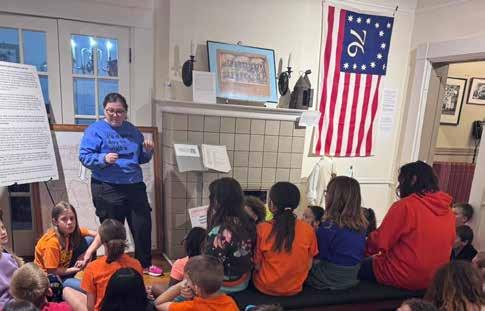
Artifacts and historical displays featured in the Clinton County History Center America 250 exhibit, “Clinton County’s Revolutionary Roots,” help illustrate how the American Revolution and westward expansion shaped the early history of Clinton County and the surrounding region. Executive Director, Shelby Boatman, sharing exhibit with the Wilmington City Schools fourth grade students. This opportunity allowed them to reflect on their knowledge about the American Revolution, and helping them to learn about their own community and its past.
250 lost graves: Researcher opens new firm
By Rusty Groves For The Connector
WILMINGTON — Rusty Groves will tell you that every dead end is just a story waiting for a different path. He has walked Civil War battlefields, pulled ledgers from county archives and used historical aerial photographs to make the case for a lost cemetery a county had never officially recognized. Now he does it professionally. Buckeye Genealogy & Research, LLC, The Grave Guy, is open for business, serving clients in Clinton, Highland, Fayette, Greene, Warren and surrounding counties.
What The Grave Guy Does
The Grave Guy specializes in cases that online searches cannot solve. The records that break open a deadend case are often sitting in a county archive, rolled onto microfilm or tucked inside a ledger that was never digitized. Groves goes after them.
The firm offers three levels of service: a record pull for targeted document retrieval; a forensic reconstruction for tangled family lines requiring DNA analysis or deep archival work; and a deep investigation for the hardest cases — missing ancestors, unmarked graves and histories erased by time. Investigating the location of a specific grave — including unmarked or lost burials — is the firm’s signature
service. Outcomes depend on what the records and the terrain still preserve.
Groves is available to work with individuals and families, historical organizations, and governmental and regulatory bodies across the United States, with most fieldwork concentrated in Ohio and the surrounding region.
Every engagement begins with the grave survey, a free intake form at thegraveguy.com, followed by a complimentary 20-minute Case Review and a clear, written proposal with all fees and retainer terms listed before work begins.
“I approach every inquiry as a unique case,” Groves said. “Partial dates, family rumors and ‘what grandma said’ are often where the truth hides.”
Case files, such as family submissions and research findings, are treated as confidential. Personal details and identifying photographs are never published on the firm’s blog, Stories UnEarthed, without the client’s explicit written permission. General research patterns and methods may be shared for educational purposes, with all identifying details removed.
The Clinton County Infirmary Project
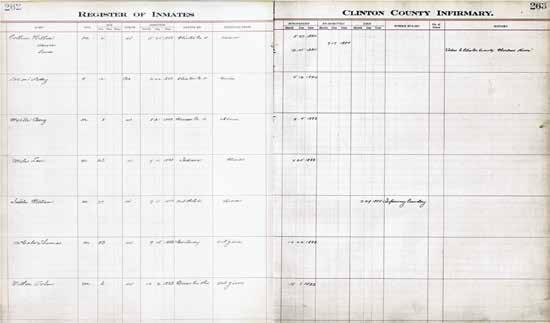
The firm’s most visible recent work began with a personal question: Where was Groves’ fourth-great-grandfather, William Suttles of Vernon Township, buried? That search led him to the original handwritten registers of the Clinton County Infirmary — first transcribed by volunteers at the
Clinton County Genealogical Society beginning in 2011 — documenting men, women, and children buried on the infirmary farm between 1840 and 1902.
Renewed interest sparked by Groves’ family search prompted a fresh review of the registers in 2025 and 2026. CCGS volunteers revised the documented count from 216 to at least 250 burials. Groves logged more than 175 hours of independent investigation on top of that foundation and presented his research in person to the Clinton County Board of Commissioners in February 2026.
Following that presentation, the commissioners authorized a $15,000 archival and mapping study by Gray & Pape Heritage Management to help define the cemetery’s boundaries. Groves subsequently provided an independent Executive Summary documenting his six-month investigation to the commissioners, the Clinton County Engineer’s Office, and the Clinton County History Center. The Gray & Pape study is ongoing. Clinton County’s GIS cemetery map currently documents 89 burial sites across the county. When this project concludes and the Infirmary Cemetery receives official recognition, it will become the 90th.
Photos courtesy of Rusty Groves
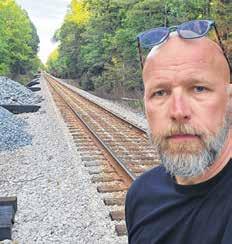
Section L at Chattanooga National Cemetery, Tennessee, where Rusty Groves walked among the graves of soldiers from his third-great grandfather’s regiment — the 31st Ohio Infantry — while searching for the burial site of Samuel B. Suttles, killed in action in 1864 and believed reinterred at Chattanooga among the unknowns. The gray marker in the foreground identifies the section.
The Veterans of the Obscure Lot
Among the documented burials are at least two military veterans. The first is Walter (Barton) Roberts, a Revolutionary War veteran from Maryland whose service Groves is still researching.
The second is George Wright, an Irish immigrant who served in the Ohio Militia during the War of 1812 and died at the infirmary in 1857 at age 98. Wright’s War of 1812 service entitled him to two federal land warrants in Illinois, secured in the 1850s with the assistance of a Wilmington attorney who also edited the local newspaper. Wright assigned those warrants to Clinton County to help offset the cost of his care at the Infirmary. That same editor later wrote Wright’s obituary, which states that he also served in the Revolutionary
War and voted for George Washington twice. The presence of these men matters all the more as America approaches its 250th anniversary.
Groves is writing and self-publishing a full-length history of the infirmary titled “The Obscure Lot.” The book traces the institution from its founding in 1835 to its closing in 1989 — a history that touched nearly 3,000 lives, yet left at least 250 of them buried in a cemetery the county had never officially recognized. It follows the elected officials, court officers, charity workers, church leaders, and state and federal agencies whose decisions shaped their lives and determined how they were remembered. Archival access and post-publication support are provided by the Clinton County History Center. Technology that goes beyond the database
Some of the records Groves needs were handwritten 150 years ago in penmanship no computer can read. New AI tools are starting to change
service of
third-great-grandfather.
that. AI-powered Handwritten Text Recognition (HTR) allows him to transcribe — with improving degrees of accuracy — aged county ledgers, military records, and court documents that standard search engines cannot read. AI also helps Groves move through
large document sets quickly — analyzing and synthesizing records to surface family connections, social and civic roles, business histories and patterns across multiple archives that would take weeks to identify by hand. As a registered researcher with the National Archives and Records Administration (NARA), he can remotely request federal records collections unavailable through commercial genealogy platforms. He also partners with a network of independent researchers for on-site record retrievals.
“AI handles the volume,” Groves said. “I focus on the evidence that actually matters.”
About Groves Rusty Groves is a professional researcher and founder of Buckeye Genealogy & Research, LLC. He spent more than 30 years in technology and regulatory compliance before turning those same skills toward historical
Photos courtesy of Rusty Groves Rusty Groves can be seen at the site of the 1864 Battle of Resaca, Georgia, where he conducted field research into the Civil War
his
Lost
From page 14
investigation. That work demands the same careful reading, precision, and attention to detail that genealogical research requires at the highest level.
He has photographed more than 2,000 gravestones for Find a Grave. He also worked with the U.S. Department of Veterans Affairs to secure a family memorial marker for his third-great-grandfather — a Civil War soldier whose grave was lost among the battlefield dead at Resaca, Georgia, and whose father, William Suttles, lies among the unmarked burials at the heart of the infirmary project. Groves is a member of the genealogical societies of
Clinton, Greene, and Ross counties, and the Civil War lineage societies for Clinton and Ross counties.
The work is personal for another reason. A search for his own biological father — assisted by a volunteer search angel working in CeCe Moore’s genetic genealogy network — ultimately ended with the answer he had long been seeking. No dead end, he learned, is truly final.
“I’ve lived this work,” Groves said. “Every grave has a story waiting to be told. My job is to go find it.”
Grounded by deep regional roots in Clinton County, Ohio, reaching back to the 1840s, Groves is a proud father and grandfather dedicated to preserving family legacies for future generations.
Two combined pages from the Clinton County Infirmary Register of Inmates, show the entry for William Suttles — Rusty Groves’ fourth-great-grandfather — admitted Sept. 11, 1883, and recorded as having died on Feb. 29, 1884, and buried in the Infirmary Cemetery. The same page records the admissions of a 4-year-old child, a 12-year-old girl, a 23-year-old man, and others into their 80s — a snapshot of who the Infirmary housed across the full range of age and circumstance. The register, held at the Clinton County Records and Archives, is among the primary sources driving the effort to locate and protect the burial ground.
Photo courtesy of Rusty Groves/Clinton County Records and Archives
Battle of Chillicothe set stage for westward expansion
By Jacob Espinosa editor@xeniagazette.com
XENIA — As the American Revolution raged, the Ohio Country and even the Miami River Valley became the site of significant conflicts that set the stage for events to come that would shape much of the United States of America.
Greene County, named after General Nathanael Greene, marks the 1779 Battle of Chillicothe outside of Xenia with Ohio’s newest state park, Great Council State Park.
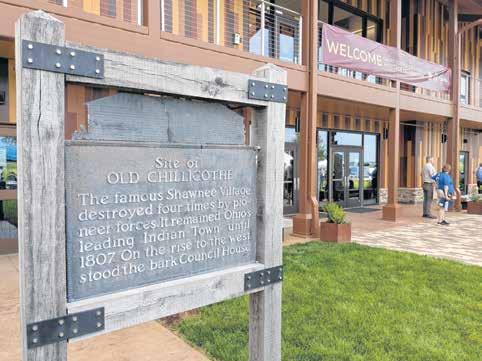
“We sit on the site of Oldtown, a historic Shawnee village,” Cultural Resources & Tribal Engagement Administrator for the park, Andrew Zelina, said. “Chillicothe (what the Shawnee called villages where the chief of the Chalahgawtha division lived) means ‘capital city,’ and from 1777 to 1780, Oldtown was the largest grouping and population of Shawnee anywhere in Ohio.”
A group of Shawnee under Chief Blackfish established the site as the Revolutionary War broke out.
It was during that period that the story escalated.
“On Nov. 10, 1777, Chief Cornstalk was murdered by a group of white settlers,” Zelina shared.
The murder of Cornstalk, who led a faction of Shawnee that wished to
remain neutral in the burgeoning conflict, resulted in little resistance to war and encouraged his Chillicothe settlement on the Scioto River move to Oldtown.
Leaders like Blackfish took up the fight against American expansion.
“Blackfish was unhappy with the peace treaty that separated the Shawnee from their lands in Kentucky,”
reads the Ohio Department of Natural Resources website. “Cornstalk favored a moderate approach, but Blackfish refused to accept Virginia’s claims.”
“During that Revolutionary War period, there were a lot of frontiersmen, too,” Zelina said. “Oldtown was where raiding parties and others could be based out of to attack settlements
around the Ohio River. This was a settlement of people who were trying to get by after being pressured further and further west.”
The settlement was so significant that figures like Tecumseh and Daniel Boone passed through at various points, although not by choice for the latter.
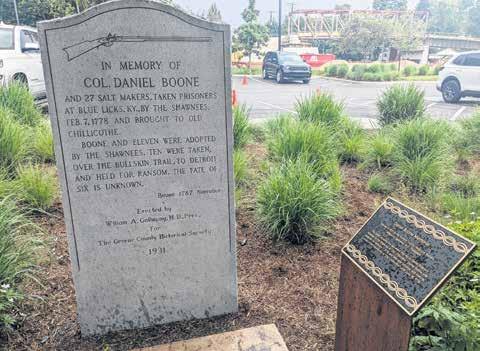
“Boone was captured in 1778 with saltmakers by the Shawnee and
brought to Oldtown as a hostage,” Zelina said. “He was adopted by villagepeople because he proved himself to be handy, trustworthy and respectful.”
Local legends abound about Tecumseh, including a popular but false tale that he was born in Xenia.
“We don’t know where he was born,
Travis Rains photos | Greene County News
A historical marker explains Old Chillicothe, the Shawnee settlement that once stood on the grounds of what is now Great Council State Park.
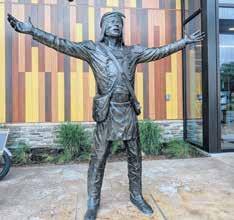
A statue of Tecumseh stands in front of Great Council State Park outside of Xenia.
Battle
From page 16
but we do know he and his family were here at some point,” Zelina said.
Boone, however, managed to escape when he found out a Shawnee attack on his settlement, Boonesborough, in Kentucky, was imminent in 1778.
“Boone escaped in June and prepared Boonesborough for the coming attack,” the DNR said. “In September 1778, Blackfish appeared with hundreds of men. He reminded Boone of his promise to surrender the fort, which Boone didn’t do. The siege lasted 11 days before the Shawnee retreated.”
With the raids came greater interest from the newly formed American government. “It was a place where they thought militia presence should be increased and white settlers should be protected,” Zelina said. “Col. John Bowman was tasked with leading militia members with Benjamin Logan and they attacked the site of Oldtown.”
The Bowman and Logan Raid, as Zelina referred to it, took place May 29, 1779, and saw between 150 and 300 militia members split off into two sections on the Little Miami River and on the ridge of Oldtown.
“Of these two, the division by the river was near where the Shawnee staged their horses,” Zelina said. “They made off with about 160 horses from this little settlement, which is little to us but not to the gathering.”
The raid would have been known as a
at Great Council State Park note when
Chillicothe.
failure but for one fact.
“Blackfish was wounded and eventually died,” Zelina said. “That was the largest outcome because it created a large vacuum, and in the next year, 1780, Gen. George Rogers Clark put the final nail in the settlement. The residents of Oldtown razed the village and escaped north to Piqua.”
At first, journals of the day saw the raid as a defeat that was repelled.
“But when news came out that Chief Blackfish died, it flipped and became a more serious event,” Zelina said. “We can look at where people down the line saw the same thing.”
Zelina cited sources such as Teddy Roosevelt, comparing the battle to Clark’s 1781 attack, the Battle of Piqua, calling it more influential.
The battle also got the attention of people such as Thomas Jefferson. The DNR quotes a letter from him to Clark in 1780, calling to clear the area for white settlers.
“On the other hand, the Shawanese, Mingoes (Seneca-Cayuga), Munsies and the nearer Wiandots are troublesome thorns in our sides,” the quote reads. “However we must leave it to yourself to decide on the object of the campaign. If against these Indians, the
end proposed should be their extermination, or their removal beyond the lakes or Illinois River. The same world will scarcely do for them and us.”
Zelina said the park’s goal is to share the story of the land and the tribes that lived on it even if it is not always an easy topic to talk about.
“The tribes are informing us every step of the way, and we couldn’t do this without them,” he said. “Our site really represents this as a complicated history, but there are a lot of hard topics to confront when talking about the formation of our nation. It’s not something we should shy away from because there’s no historical topic that is just straightforward.”
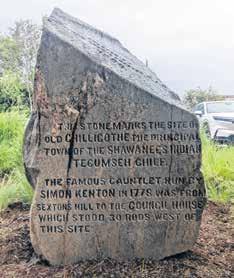
A stone marks the appearance of two notable figures at Oldtown: Tecumseh and Simon Kenton.
Travis Rains photos | Greene County News
Markers
the Shawnee held Daniel Boone as a hostage at Old
Greene County college towns bear trailblazers
By Jacob Espinosa editor@xeniagazette.com
GREENE COUNTY — Three institutions of higher learning in eastern Greene County date back to before the Civil War, and they and their communities have a history of famous firsts. Wilberforce University and Central State University in Wilberforce have a shared history as historically black colleges and universities, while Antioch College in Yellow Springs started as the first coeducational, nonsectarian college in the United States.
“Nobody really cares anymore, but it was a pretty big deal,” said Scott Sanders, Antioch’s archivist. “From the beginning, the college has had a progressive footing.”
The school changed its founding date multiple times, but several things are facts: education pioneer Horace Mann was the first president, and he was so invested in co-education that he employed his niece, Rebecca Pennell, as the first female college professor to receive the same pay and rank as her male colleagues.
“A lot of people who founded the school were not happy, so Mann had to fend off attempts to turn it into a seminary. Faculty were not as on board with co-education, but he had to deliver on the promises to students,”
Sanders said. “He was the founding force that kept us open. He was a very famous person, so he was an attraction by himself, and he was regarded as someone morally above reproach, so parents felt comfortable sending their kids off from under their watchful eyes.”
And Pennell was by no means a nepotism case or a sideshow.
“She taught six courses, so she was the hardest-working member of the faculty,” Sanders said.
Almost 100 years later, Antioch started calling itself “The Laboratory of Democracy” as a nod to this history and more recent practices of including campus governance and cooperative education, something students such as Rod Serling used to discover his passion for broadcasting.
“He came in as a physical education major and discovered writing as a way to cope with PTSD from World War II,” Sanders said. “Part of that experience helped him get jobs at WLW and a newspaper job in Cleveland.”
Serling would go on to create “The Twilight Zone.”
“It is an inventive place willing to try and experiment that goes with that and you have to have fearlessness to do that,” Sanders said. “The United States needs a place like Antioch that does these alternative things and puts a significance on free expression that isn’t always available at other schools, so people are free to reinvent themselves.”
Wilberforce notables
Wilberforce University is one of three Historically Black Colleges and Universities established before the Civil War and is the nation’s oldest private one, but it has also been at the center of the debate between the separation of church and state in education. The school grew out of a seminary
established by the African Methodist Episcopal Church, forming in 1856 and naming Bishop Daniel Alexander Payne its president in 1863, the first African-American college president in the country.
Among the names to pass through the school was civil rights leader W.E.B. Du Bois, who taught between 1894 and 1896, becoming friends with fellow professor Charles Young, one of the first African-American West Point graduates and the first to be ranked colonel in the U.S. Army.
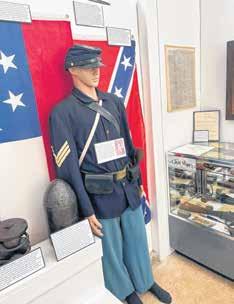
A Civil War uniform stands on display at the Miami Valley Military History Museum in Fairborn.
Submitted photos from the Miami Valley Military History Museum
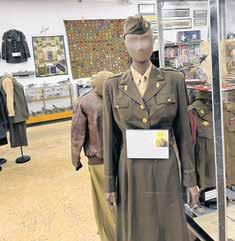
6888th Central Postal Directory Battalion stands on display at the Miami Valley Military History Museum.
Trailblazers
From page 20
Martin R. Delany, an abolitionist who served as the first African-American major in the U.S. Army, also came through Wilberforce when his children enrolled, dying of tuberculosis in 1885 and being buried in nearby Cedarville.
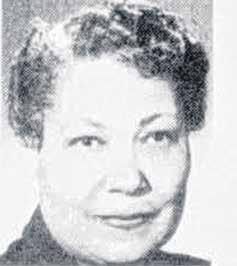
Bernice Hughes came out of Xenia and enlisted in the Army’s Women’s Army Corps during World War II, becoming the highest-ranking Black woman to serve during the war when she achieved second lieutenant.
According to the Miami Valley Military History Museum, she was promoted to major in 1951 and taught at Wilberforce after the end of her service.
Bernice Hughes came out of Xenia and enlisted in the Army’s Women’s Army Corps during World War II, becoming the highest-ranking Black woman to serve during the war when she achieved second lieutenant.
Submitted photo from the Miami Valley Military History Museum
Aviation history begins in Greene County
By Gery Deer For Greene County News
FAIRBORN — Long before air travel became routine and jetliners stitched continents together in a matter of hours, two bicycle makers from Dayton stood in a cow pasture in Greene County trying to solve a problem no one else had mastered: how to truly control human flight.
Today, that same stretch of land — Huffman Prairie Flying Field — remains one of the most important sites in aviation history, though many Ohioans drive past it without realizing what happened there.
For families looking for affordable summer destinations close to home, the Dayton Aviation Heritage National
Historical Park offers one of the region’s most overlooked experiences. Spread across several sites in Dayton and Greene County, the park preserves the story of Wilbur and Orville Wright, poet Paul Laurence Dunbar and the birth of powered flight.
While Kitty Hawk, North Carolina, may claim the Wright brothers’ famous first flight in 1903, it was Greene County where aviation truly became practical.
The brothers returned to Ohio after their experiments at Kitty Hawk, searching for a place where they could continue refining their aircraft. Dayton banker Torrence Huffman offered them use of a pasture northeast of the city, with only one request: close the gates behind them so the livestock would
not wander off. That field became Huffman Prairie.
Bordered at the time by the Urbana Electric Railway, the site gave the Wrights easy access to transportation for tools and equipment. More importantly, it gave them room to experiment, fail, rebuild, and try again.
Between 1904 and 1905, the Wright brothers transformed their invention from a short-hop curiosity into the world’s first practical airplane. At Huffman Prairie, they mastered controlled turns, figure eights, longer sustained flights and reliable takeoffs and landings.
On Oct. 5, 1905, Wilbur Wright flew more than 24 miles in 39 minutes — an astonishing achievement for the era and a major turning point in aviation history. Visitors today can stand near the same field where those flights took place.
The Huffman Prairie Flying Field is now located within Wright-Patterson Air Force Base, adjacent to one of the busiest military aviation complexes in the world, a fitting continuation of the Wright brothers’ legacy. Modern cargo aircraft and military jets routinely pass over the same ground where the first practical airplane once struggled against unpredictable winds and rough
See AVIATION | 24
WPAFB
• Wright-Patterson Air Force Base sits on 8,145 acres outside of Fairborn and Dayton, encompassing Huffman Prairie.
• The base started out as three military installations during World War I, with Wilbur Wright Field, on what is now Area A, hosting a pilot training school, an aviation mechanics’ school and an aviation armorers’ school.
• Before that, the Wright Brothers ran a flying school at the prairie, teaching Army Air Forces commander Henry “Hap” Arnold and H. Roy Brown, who took down the Red Baron.
• Following World War II, Wright Field and Patterson Field merged as a unified installation known as Wright-Patterson Air Force Base, soon to become a significant location during the Korean War.
• In 1995, the base hosted peace talks between the parties of the Balkans conflict. The Dayton Peace Accords saw the presidents of Serbia, Bosnia and Croatia meet to agree to end the Bosnian War and establish the state of Bosnia and Herzegovina.
• Today, over 30,000 employees work at the base, making it the largest single-site employer in Ohio. It averages 11,000 aircraft operations every year.
• Popular legends claim that the government took the wreckage from the 1947 Roswell crash to the base for safekeeping.
Aviation
From page 22
terrain.
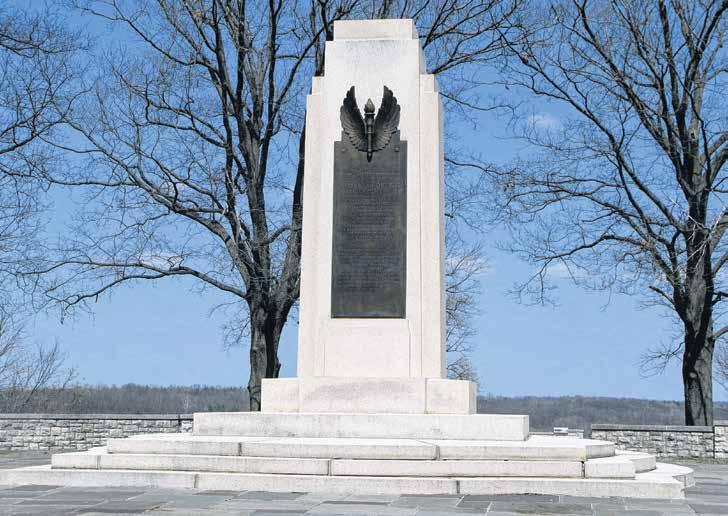
Nearby, atop Wright Brothers Hill, stands the Wright Memorial. The memorial overlooks the prairie where the brothers perfected powered flight and serves as one of the area’s most scenic and historically significant viewpoints. Dedicated on Aug. 19, 1940 — Orville Wright’s 69th birthday — the site features a 17-foot pink granite obelisk constructed from the same North Carolina quarry used for the Wright Brothers National Memorial at Kitty Hawk. The hill itself carries a history even older than aviation.
Several Adena burial mounds remain on the property, evidence of Native American activity in the region dating back more than 2,000 years. In 1974, the Wright Brothers Hill Mound Group was added to the National Register of Historic Places for its archaeological significance.
The adjacent Huffman Prairie Flying Field Interpretive Center offers exhibits detailing the Wright brothers’ experiments, the development of their flying school, and the continuing role of Wright-Patterson Air Force Base in aviation innovation. The center also includes a theater presentation and historical displays connecting the early days of flight to modern aerospace research.
The interpretive center is located at 2380 Memorial Road, Wright-Patterson
Air Force Base, Ohio 45433. Current
National Park Service hours are 9 a.m. to 4 p.m. Monday through Friday, though visitors are encouraged to check ahead for updated schedules or baserelated closures.
Other Wright-related attractions
throughout the Dayton region include the Wright-Dunbar Interpretive Center, the Wright Cycle Company complex, Carillon Historical Park’s Wright Brothers Aviation Center, and Hawthorn Hill, Orville Wright’s former home. Most of the sites are free or low-cost
to visit, making them ideal for day trips and weekend outings. More information is available through the National Park Service Dayton Aviation Heritage website — www.nps.gov/daav — or by calling 937-345-0433.
By Gery Deer | For Greene County News
A monument in Fairborn acknowledges the Wright brothers and their impact on aviation.
Since1951the United WayofFayetteCounty has been dedicatedtoimproving thelives of localresidentsbysupporting essential health, education andfinancialstability programs. In 2019 we broughtthe Dolly Parton Imagination LibrarytoFayetteCountyand we nowhave67% of ageeligiblechildren receiving booksinthe mail each month. 2026 marks75yearsofserving the residents of Fayette Countyand we lookforward to serving another 75 yearswith your support!
Way11thAnnual Scarecrow Run 5k/10k 2026 Registerat www.TriStateRacer.com search: Scarecrow5k/10k or pick up aregistration form at 111E.EastSt., WashingtonCH, OH
Readers reflect on being Americans
By David Trinko dtrinko@limanews.com
It’s beautiful for spacious skies, for amber waves of grain and for purple mountain majesties above the fruited plain.
It’s also a target of other countries’ criticisms on foreign policy, social divisions
and political instability.
As the United States of America celebrates its semiquincentennial on July 4, 2026, newspapers across Ohio owned by AIM Media Midwest asked their readers to reflect on what it meant to be an American today. Their responses showed both the divide and the
unity that highlight what makes the nation special.
“Living abroad has made me appreciate how unusual Americans can be, in both good and frustrating ways,” wrote Craig Hoffman, 50, a former Lima resident now living in Japan. “We are often loud,
REFLECT | 31
David Trinko | The Lima News
Honoring American icon Neil Armstrong
By Scott Giebel sgiebel@limanews.com
WAPAKONETA — Space exploration stands among America’s greatest achievements in its 250-year history, and without the courage and curiosity of Neil Armstrong, it might have remained only a dream. Armstrong came from humble beginnings, born on Aug. 5, 1930, near Wapakoneta. His early years were full of curiosity, and he flew in his first airplane at age 6 and, at 16, earned his student pilot’s license.
“I always like to emphasize his humble roots because, at one point, he was the most famous person in the world, and he came from a town of less than 10,000 people, grew up in a normal setting, in a normal neighborhood and was not from a big family, which made him have a normal upbringing like a lot of us,” said Logan Rex, curator and communications director at the Armstrong Air and Space Museum. “I think because of his humble roots, his story really resonates with people because he was just a kid with a dream, and that passion took him to the moon.”
The Armstrong Air and Space Museum detailed how, after he became the first man on the
moon, the attention of the nation and the world focused in part on Wapakoneta, where news media flocked to his parents’ house. Once he returned home, he was thrown a parade and a huge celebration where thousands, including celebrities, gathered.
“His story really goes to show that if you have that passion, have that curiosity, apply yourself, and have that dream, you can accomplish some truly amazing things, and that is one of the great things about America, that we have this real ability to follow our dreams, and so many Americans have been able to be successful in that, which seems to be unique to the American spirit,” Rex said.
Before he was the first man on the moon, he attended Purdue University on a Navy scholarship, studying aeronautical engineering, and as part of his scholarship, the Navy trained Armstrong as a fighter pilot in Florida. His studies were interrupted by the Korean War, where Armstrong flew 78 combat missions.
John Norberg worked at Purdue as a speech writer and director of development communications. He also knew Armstrong, interviewed him, wrote
Scott Giebel | The Lima News
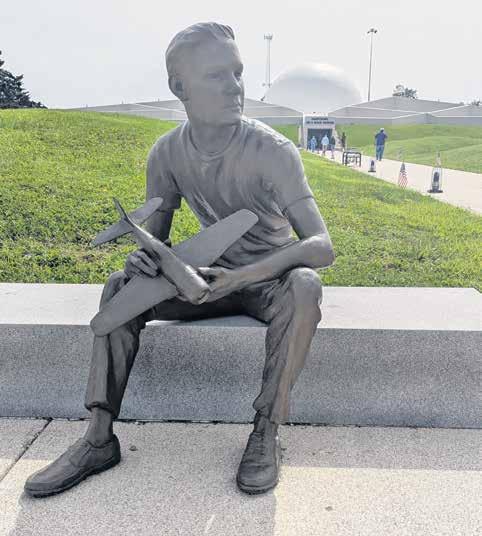
A statue of Neil Armstrong as a child with a toy airplane can be seen in front of the Armstrong Air and Space Museum in Wapakoneta.
opinionated, optimistic, generous, stubborn and deeply individualistic. We argue constantly, sometimes too much. But we also have a habit of questioning things instead of simply accepting them. I think that spirit, the restless refusal to settle, is what built the country in the first place.”
Jo Muether, 74, of Celina, also sees that as a strength for the country.
“Founded in dissent, we have always been a work in progress,” she wrote. “As a nation, when we know better, we do better. We are a country dedicated in freedom to all.”
David Warren, of Dayton, answered the question with a poem, describing scenes across the land, such as a jazz procession following a casket in New Orleans’ French Quarter, rowdy high school kids with painted faces awaiting a high school football kickoff and a buffalo roaming free as you approach mountains near Aspen, Colo.
“It’s an imperfect collection of unique and diverse people, inspiring monuments, beautiful
scenery and fascinating towns, both big and small,” he wrote. “Every day I am thankful that America is a source of pride and a source of inspiration for so many. Most of all I’m thankful that it is my home. As the saying goes, ‘The best thing about a home is the people in it.’ That’s what makes America so imperfectly perfect, and that’s why I’m blessed to live here.”
Chad Hollinger, the fire chief in Sidney, agreed that being an American means “that I am blessed!”
“We enjoy freedoms and rights that many around the globe
can only dream of,” Hollinger wrote. “The opportunities that are afforded us, both on the homeland and abroad, are without comparison. Throughout our history as a nation, we have seen prosperity and growth unparalleled on the globe. The foresight of our founding fathers, preserved in our founding documents, has provided the foundation and framework that safeguard our way of life.”
There’s always room for improvement, wrote Logan Rex, 30, of Wapakoneta, who urged citizens to
“reflect and rededicate ourselves to the great truths confirmed in our Declaration of Independence.”
“Even with a strong framework, centuries of existence formed and revealed fated cracks and decay,” Rex wrote.
“But neither the rot of slavery nor the fires of war brought lasting division to the Union. Protest and dissent proved not as signs of weakness but as protected benefits to a free society.”
The core principal is to remember where we came from as Americans, wrote Aaron Rode, the police chief in Sidney.
“Being an American in 2026 is not entirely different from being an American in 1776,” Rode wrote. “We remain steadfast in our commitment to recognizing diversity, upholding our constitutional rights and ensuring every person has an opportunity for freedom and happiness. My perception of being an American remains one of pride, integrity and constant evolution, both personally and professionally.”
Reach David Trinko at 567242-0467 or on Twitter/X @ Lima_Trinko.
Armstrong
From page 30
about him and for a time took his media calls.
“Every Boilermaker takes special pride in Neil Armstrong because he was such a special person and because he was one of us. He loved Purdue, returned to campus regularly and enjoyed talking to fellow alumni. No one on campus will ever forget the times they met and talked to Neil Armstrong,” Norberg said.
He also talked about how humble Armstrong was. Even though people considered him
a hero, he was always very humble about it. He showed that humility when a statue of him was placed in front of the Purdue engineering hall named for him, he decided not to attend the statue dedication, thinking it would appear vain.
According to NASA’s website, in his final semester of college, Armstrong applied for a research pilot position with the NACA, which led him to an immediate offer for the job, where he frequently co-piloted the lab’s F-82 Twin Mustang and C-47 Skytrain. After participating in the Man in Space Soonest and Dynasoar projects,
Armstrong joined NASA’s September 1962 astronaut class, leading to him becoming the first man on the moon.
“Born in Wapakoneta, a small Ohio community, Neil Armstrong went on to undertake one of humanity’s greatest leaps – becoming the first person to walk on the Moon. As our nation reflects on 250 years of independence, explorers like Neil Armstrong remind us that all things are possible with the American spirit, bravery, and resilience,” NASA said via a spokesperson.
A history of the Declaration of Independence
By Marie Thomas-Baird mthomas@aimmediamidwest.com
BOWLING GREEN — The Declaration of Independence is a unique document not just in the history of the United States but in the world.
It doesn’t just sit by itself but was a response to a series of events which started in 1689 with the Declaration of Rights in England.
Within those rights was the right of trial by jury, according to Wood County Common Pleas Court Judge Matt Reger.
Reger provided a history of the declaration earlier this year when Bowling Green kicked off its 250th anniversary celebration.
The Declaration of Independence was adopted by the second Continental Congress in 1776; the first Congress was held in 1774.
How did they come up with the idea of coming together, he asked.
The Albany Congress in 1754 discussed the incursion of the French during the French and Indian War. One of the largest debates was over Benjamin Franklin’s proposal that the colonies come together as a unit, Reger said. While the Congress approved it, the colonies, who did not want to disassociate themselves from England, did not.
The congress met in 1775 and sent the Olive Branch petition to King George III as a final attempt to avoid war. In it was
a protest of taxation by England without representation from the colonies and another request for the right to trial by jury, which was an important aspect to freedom, he said.
In January 1776, “Common Sense,” written by Thomas Paine in the common language for readers knowing only the Bible and the Book of Common Prayer, was published. He proposed separating from England.
That led to the popular will of people in favor of separation from Great Britain, he said.
“There is so much discord in our country today,” Reger said, “but 1776 was filled with discord. There were loyalists, people who were loyal to the king for good reason.”
Families were divided over whether or not to sever ties with Great Britain, he said.
During the second Continental
Congress, the Lee Resolution, proposed on July 2, 1776, formerly declared the colonies independent from Great Britain.
The Declaration of Independence, signed on July 4, 1776, stated, “When, in the course of human events, it becomes necessary for one people to dissolve the political bands which have connected them with one another, and to assume, among the powers of the earth, the separate and equal station to which the laws of nature and of nature’s God entitle them, a decent respect to the opinions of mankind requires that they should declare the causes which impel them to the separation.”
Reger explained what the congress was talking about was that when government was no longer able to provide what is needed, then collective separation is necessary.
“We hold these truths to be selfevident, that all men are created equal,
that they are endowed by their Creator with certain unalienable rights, that among these are life, liberty, and the pursuit of happiness. That, to secure these rights, governments are instituted among men, deriving their just powers from the consent of the governed,” they wrote.
St. Catherine’s of Washington Cour tHouse Cour tHouse Manor
Skilled Nursing Ser vices Provided:
•Private Rehab Suites
•MemoryCare Wing
•Ventilator Care
•PT, OT &ST – 7daysa week
•OutpatientTherapy
•Pre-Surgery Registration
•Comprehensive Wound Care
St. Catherine’s of Washington Cour tHouse
Pulmonar yand Ventilator
Ser vices Provided:
•Ventilator –weaning and chronic
•Tracheostomy
•C-Pap &Bi-Pap
• Management of Chronic Conditions such as COPD, pneumonia and Chronic Emphysema
•Medical Director
•Respiratory Therapist –7days aweek
•Trained Therapists: PT,OT&ST
•Registered Nurses
Skilled Nursing Ser vices Provided:
• RehabSuites
• Person CenteredCare
• PT,OT&ST– 7 daysaweek
• OutpatientTherapy
• Pre-Surgery Registration
• Comprehensive WoundCare
Cour tHouse Manor Assisted Living
Amenities:
•All utilities
•Medication Management
•24-hour in-house staffing
•Transportation Assistance
•Life Enrichment and fitness activities
•Personal Pendant for added security
•Laundry accommodations
•Weekly housekeeping services
•Respite Stay available
Declaration
From page 34
“Even an absolute dictator is reliant on the consent of the people,” Reger said.
He continued to read the Declaration: “Whenever any form of government becomes destructive of these ends, it is the right of the people to alter or to abolish it, and to institute new government, laying its foundation on such principles, and organizing its powers in such form, as to them shall seem most likely to affect their safety and happiness.”
Reger read the 18 accusations against the king, as outlined in the Declaration, which included forbidding his governors to pass laws of immediate and pressing importance, obstructing the laws for naturalization of foreigners, making judges dependent on his will alone, sending swarms of bureaucrats to
administer rules and laws, keeping standing armies in times of peace, imposing taxation without consent, depriving them of the benefit of trial by jury, and for waging war against us.
“In every stage of these oppressions, we have petitioned for redress, in the most humble terms. Our repeated petitions have been answered only by repeated injury.
A prince, whose character is thus marked by every act which may define a tyrant, is unfit to be the ruler of a free people,” Reger said.
“By authority of the good people of these colonies, solemnly publish and declare, that these United Colonies are, and of right ought to be free and independent states, that they are absolved from all allegiance to British crown.”
On that day, they put in motion an idea that has continued to live throughout the world as a symbol of freedom, Reger said.
t Happy 250th Birthday America!
Marie Thomas-Baird | Sentinel-Tribune Wood County Common Pleas Court Judge Matthew Reger provided history of the Declaration of Independence.
Celebrating 70 Yeas! PeaceLutheranChurch
Peace Lutheran Church marksamajor milestone in 2026 as it celebrates 70 years of ministry,ser vice, and communit yinthe Beavercreek area. Since its founding in 1956,the congregationhas grown from a small group of 69 char termembers into avibrantfaith communit ycommit tedtoworship,ser vice,and deep communit yconnection.
The church will hosta70thAnniversar y CelebrationSer vice on Sunday, August9at 10:00 a.m.,featuring Bishop Susanne Dillahunto f the Southern Ohio Synod as guestpreacher.The ser vice is open to thepublic,and all are invited to at tend this meaningful celebrator yevent.
THE LLOYDC.LUDWICK CHAPTER 123
DISABLED AMERICAN VE TERANS HILLSBORO,. OHIO
Wishes to express our appreciation to all who have served andare currently ser ving. Celebrating
Railroads helped Ohio grow
By J Swygart jswygart@limanews.com
LIMA — An oft-noted truism in the transportation world is that nothing moves more economically than steel-onsteel. Hence the boom of railroads, which played a significant role in the development of the United States and were key in the early 1900s to the economic stability of Ohio in general and Lima in particular. In 1827, the state of Maryland chartered the Baltimore and Ohio Railroad to connect the port of Baltimore with the Ohio River. It is considered
to be America’s first railroad. Upon the completion of the first 13 miles of track in 1830, the B&O became the first American railroad to offer regularly scheduled passenger services.
Lima’s introduction to the rails began two decades later, in 1853, when the Ohio and Indiana Railroad opened from Crestline to Fort Wayne, Indiana, according to The Lima News archives. The east-west Ohio and Indiana was joined by the north-south Dayton & Michigan in 1858. The railroads intersected just north of
downtown. At its peak in the 1920s, Lima saw some 30 passenger trains in and out daily, the newspaper said.
The ‘loco works’
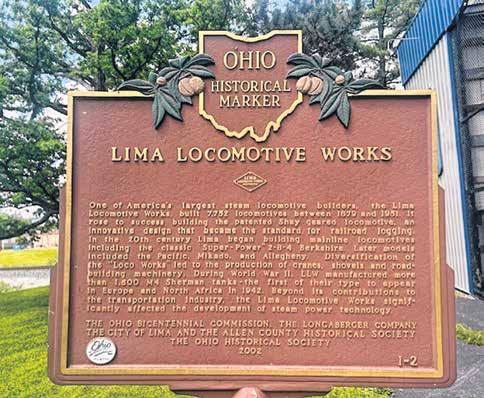
Crucial to the growth of the emerging transportation mode was the Lima Locomotive Works, which produced 7,752 steam-powered locomotives between 1879 and 1951. The manufacturing plant and corporate headquarters were located on a 70-acre complex on South Main Street.
J Swygart | The Lima News
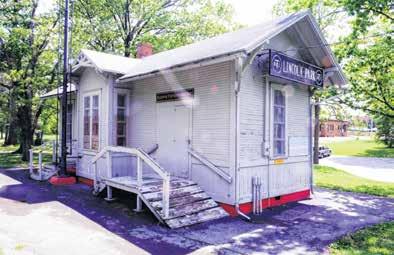
An early railroad station is on display at Lima’s Lincoln Park.
Leesburg Office
45 E. Main Street
Leesburg, OH 45135 (937) 780-2431
Greenfield Office
134 N. Washington Street
Greenfield, OH 45123 (937) 981-3685
Hillsboro Office
310 N. High Street
Hillsboro, OH 45133 (937) 402-4008
Lynchburg Office
223 N. Main Street
Lynchburg, OH 45142 (937) 364-2861
Railroads
From page 40
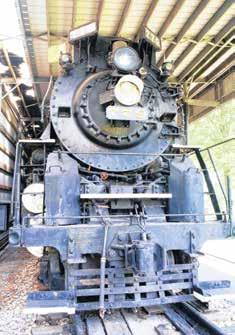
The original production facility and office buildings were demolished in the late 1990s, according to various historical accounts. One of the last steam engines built at the plant, Nickel Plate Road No. 779, is currently on display at Lincoln Park on South Shawnee Street in Lima.
According to historical accounts focused on the city of Lima, the “loco works” served as a melting pot of sorts, employing workers of many nationalities and fostering a legacy of ethnic diversity in Lima.
Boom and bust
The interstate highway sys-
tem introduced by President Dwight D. Eisenhower in 1953, along with the public’s increasing embrace of domestic air travel, led to a decline in prosperity for railroads. Following decades of downgrading redundant lines, the last Amtrak passenger train departed Lima for Chicago on Nov. 11, 1990.
Rail traffic in Lima today consists entirely of interstate commerce. Trains still pass through the city with great frequency on the Chicago, Fort Wayne and Eastern, Indiana and Ohio, CSX and Norfolk Southern lines, hauling freight of all sorts to and from ports far and wide. Farmers benefit greatly
from the railroads, relying on trains to haul their products to markets hundreds of miles away.
Looking ahead
As America prepares to celebrate its 250th birthday, the
See RAILROADS | 44
Locomotive No. 779, built by the Lima Locomotive Works in 1949, is the last steam locomotive manufacturedin Lima. The engine was retired in 1958 after logging 677,095 miles and is currently on display in the Lincoln Park Train Exhibit.
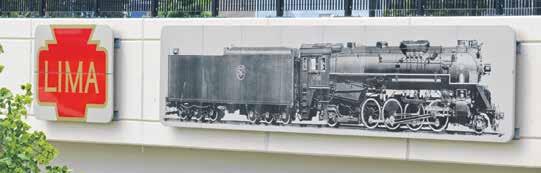
J Swygart | The Lima News Murals depicting Lima’s rich locomotive history are on display throughout the city.
Railroads
revival of passenger rail service throughout the Midwest appears to be gaining steam, in a manner of speaking. In late 2023 Lima was part of a regional initiative that secured federal planning and design funds as part of a proposed Midwestern passenger train route.
As envisioned, the Midwest Connect corridor would span from Chicago to Pittsburgh via passenger rail, with major stops such as Fort Wayne and Columbus. The project would total nearly 550 miles of rail and be accessible to 14.7 million people.
In addition to the four main cities of Chicago, Fort Wayne, Columbus and Pittsburgh, a dozen smaller municipalities would also comprise Midwest Connect, including Valparaiso, Gary, Plymouth and Warsaw, Indiana as well as Lima, according to original render-
ings of the project from 2023.
Fort Wayne was the lead applicant and was awarded a Corridor ID grant from the Federal Railroad Administration for the Midwest Connect Corridor in the amount of $650,000. Fort Wayne officials are partnering with the MidOhio Regional Planning Commission and the Southwestern Pennsylvania Commission.
“Stakeholders along the route, including multiple cities, have been engaged in meetings and advocacy efforts,” according to Jessica Begonia, public information officer for the city of Lima. “Representatives from Lima, specifically current mayor Sharetta Smith, former Mayor David Berger and Chief of Staff Shane Coleman have participated in events with Fort Wayne, MORPC and others as part of the effort to bring back passenger rail.”
Perhaps the golden age of railroads will see a revival as America begins its next chapter in history.
J Swygart | The Lima News
A historical marker at Lincoln Park informs visitors of the history of the Lima Locomotive Works, described as “one of Americ’s largest steam locomotive builders.”