























By Steve Stout UDCeditor@aimmediamidwest.com
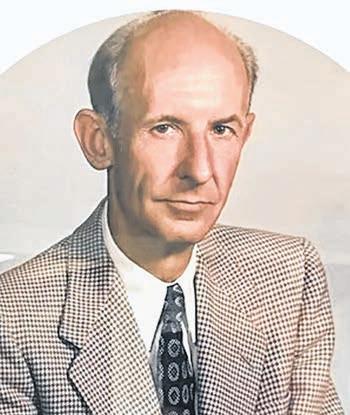
URBANA — The late Paul (Pete) Dye Jr. is known to many as the father of modern golf course design. He was born in Urbana on Dec. 29, 1925, to Paul Frances “Pink” Dye and Elizabeth Johnson Dye.
Pete Dye’s lifelong career in golf began as a youngster, pulling weeds and caddying at Urbana Country Club, which was then a nine-hole course his father built in 1923 on the Johnson family farm.
Dye won a state golf championship while he was a student at Urbana High School. Upon graduating high school, he enlisted in the U.S. Army during World War II, serving in the 82nd Airborne Parachute Infantry. After his honorable discharge from the Army, he continued his education at Rollins College and Stetson University in Florida.
Dye met Alice Holliday O’Neal, the love of his life, at Rollins College, where they were both golf team captains. He and Alice married on Feb. 2, 1950.
Settling with Alice in Indianapolis, Pete Dye became one of the youngest members of the insurance industry’s prestigious Million Dollar Round Table. In 1959, he left insurance and, with Alice, embarked on a career in
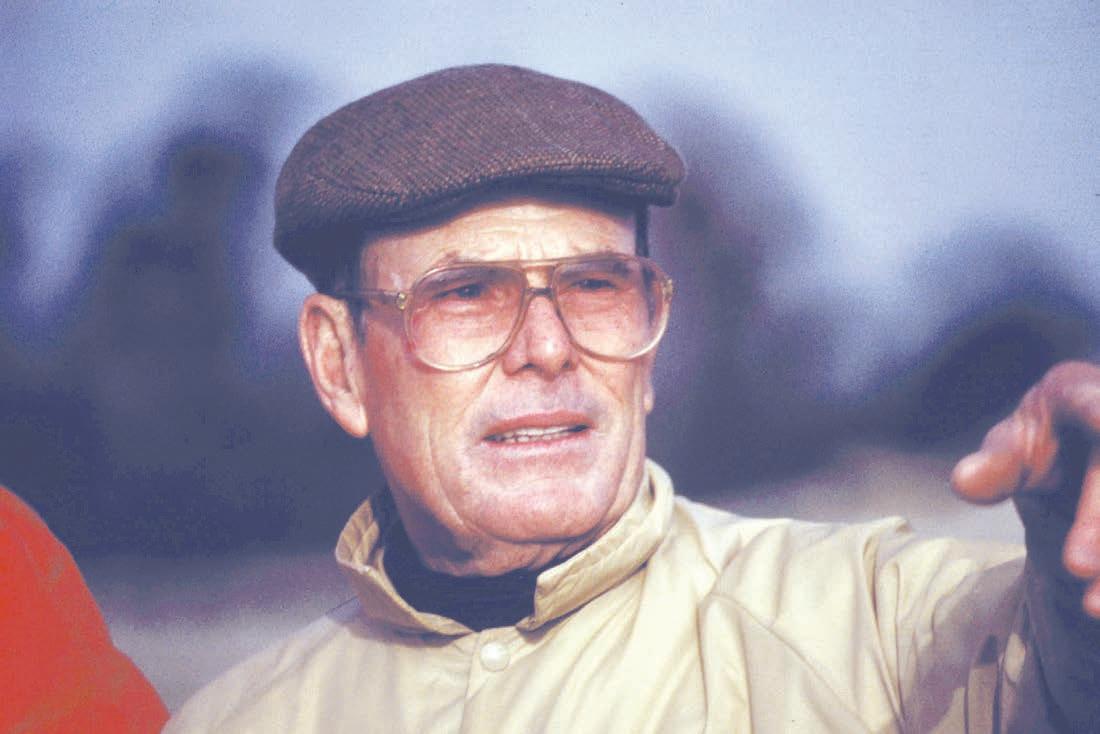
working on his Kiawah Island golf course in South Carolina.
golf course architecture.
Although told at the time that the economic rewards of the

profession were not encouraging, he and his wife pursued their dream together, and in 1960 they began







Indianapolis now known as Dye’s Walk, which was soon followed by their first 18-hole course, Maple Creek.
In 1963, a trip to Scotland with Aliceprofoundly influenced his subsequent designs and career. Touring the great Scottish courses, he was influenced by the features he saw — small greens, pot bunkers, undulating fairways, wooden bulkheads — and began incorporating them into his own work.
Early course designs in Dye’s new signature style included Crooked Stick Golf Club in Carmel, Ind., The Golf Club in New Albany, Ohio, and Harbour Town Golf Links in Hilton Head, South Carolina, a collaboration with Jack Nicklaus that propelled Pete’s career to the next level.
The decades that followed saw Dye build some of the greatest courses of the modern era, several of which have hosted major championships and The Ryder Cup.
Oak Tree in Edmund, Oklahoma, TPC Sawgrass in Ponte Vedra Beach, Florida, The Ocean Course in Kiawah Island, South Carolina, and Whistling Straits in Kohler, Wisconsin, all challenged the world’s top golfers. Casa de Campo resort in the Dominican Republic, where Dye built 90 holes including the world-renowned Teeth of the Dog, was a project he was especially proud of and where he had a vacation home for decades.
Dye was a mentor to
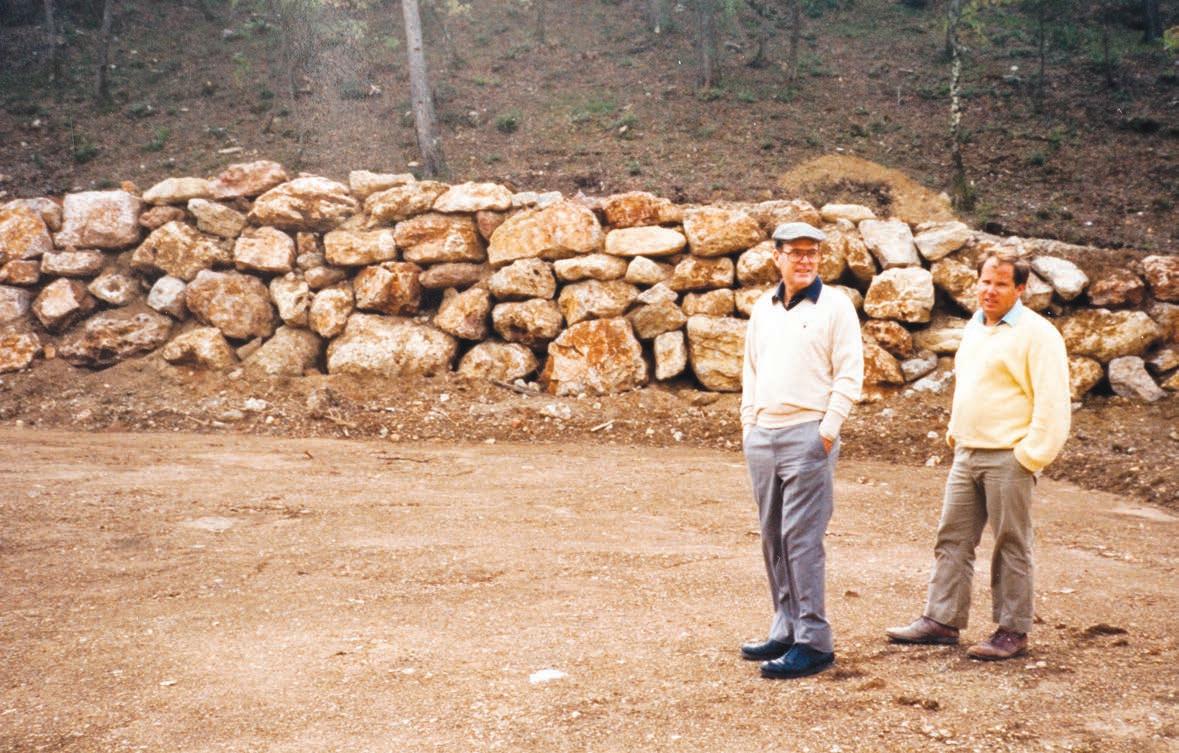
hundreds in the golf industry, and his influence continues through their work in golf architecture, building practices and course maintenance.
Dye was also an accomplished amateur golfer. He was a medalist in the Ohio Amateur, qualified for the U.S. Amateur five times, won the Indiana State Amateur, competed in a British Amateur and played in the U.S. Open at Inverness where he famously finished ahead of Arnold Palmer and Nicklaus.
Dye received dozens of honors throughout his career, including the Donald Ross Award from the American Society of Golf Course
Architects, the Old Tom Morris Award from the Golf Course Superintendents Association and the Sagamore of Wabash from the State of Indiana.
He is one of only five golf course architects in the World Golf Hall of Fame. He was awarded honorary doctorates from Purdue University, Rollins College and the University of South Carolina.
PGA Tour Commissioner Jay Monahan called Dye “one of the most important course architects of this or any generation.”
Nicklaus first met Dye in the summer of 1957 when they both played in an exhibition golf match
with Sam Snead and local standout Bob Ross at Urbana Country Club. Nicklaus was 17 at the time, and Dye was 31.
Nicklaus would go on to become arguably the greatest golfer ever, while Dye would go on to become arguably the greatest golf course designer ever.
“We became friends; we played a lot of golf together; and we designed courses together,” Nicklaus said after Dye’s death at the age of 94 on Jan. 9, 2020. “It was Pete who inspired me to start designing courses more than 50 years ago, and so in many ways I owe my second career to him.
“I think Pete Dye was the
most creative, imaginative and unconventional golf course designer I have ever been around,” Nicklaus added. “Pete would try things that nobody else would ever think of doing or certainly try to do, and he was successful at it. If there was a problem to solve, you solved it Pete’s way. In the end, Pete’s way usually turned out to be the right way.”
Dye’s son, noted golf course designer P.B. Dye, owns a home near the course at Urbana Country Club, which is listed on the National Register of Historic Places. In 1992, P.B. Dye designed the second nine holes at UCC, which is today known as the Dye Original.


By Holly McKellop UDCeditor@aimmediamidwest. com
URBANA — In the quiet fields and school houses of west central Ohio, one man planted ideas that would grow far beyond the boundaries of Champaign County.
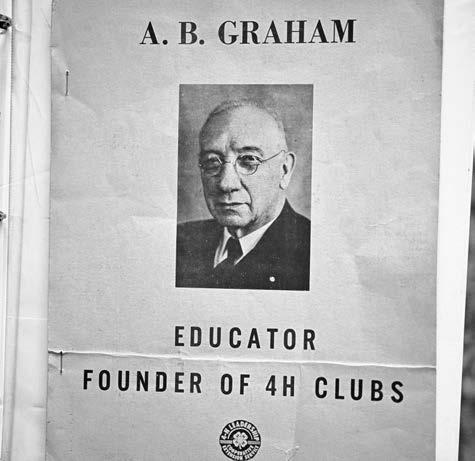
Albert Belmont Graham, better known as A.B. Graham, left an enduring legacy in agriculture and education that continues to shape communities across the region and the nation.
Born in 1868, Graham began his career as a school superintendent in Springfield, where he quickly recognized a disconnect between rural students and the agricultural knowledge they needed to thrive.
At a time when farming was the backbone of the local economy, Graham believed education should extend beyond textbooks and into the fields.
In 1902, while working in Clark County, Graham organized what is widely considered the first youth agricultural club in the United States.
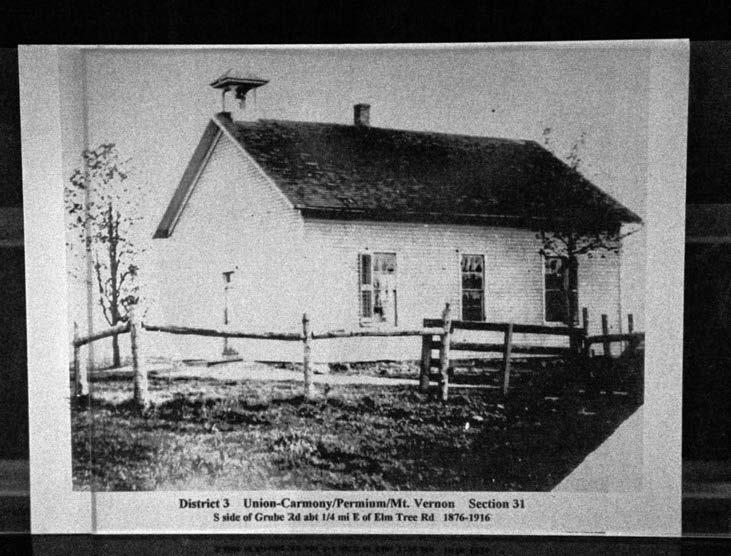
Known as the “Tomato Club” or “Boys’ and Girls’ Experimental Club,” it encouraged young people to learn by doing – planting crops, conducting experiments, and sharing their results. This handson approach laid the foundation for what would later become 4-H.
Graham’s vision spread quickly into Champaign County and neighboring rural communities, where families embraced the idea that education could directly improve farm productivity and quality of life. His work bridged the gap between schools and agriculture, helping young people develop practical skills, responsibility and leadership. The principles Graham championed — learning by doing,
community involvement and youth empowerment — became cornerstones of agricultural education throughout Ohio. Extension programs, school partnerships and youth clubs flourished, bringing innovation to farms and strengthening rural economies.
His influence also helped shape the broader cooperative extension system, connecting universities with local communities to share research-based knowledge.
As the nation celebrates the United States semiquincentennial, Graham’s contributions resonate more than ever.
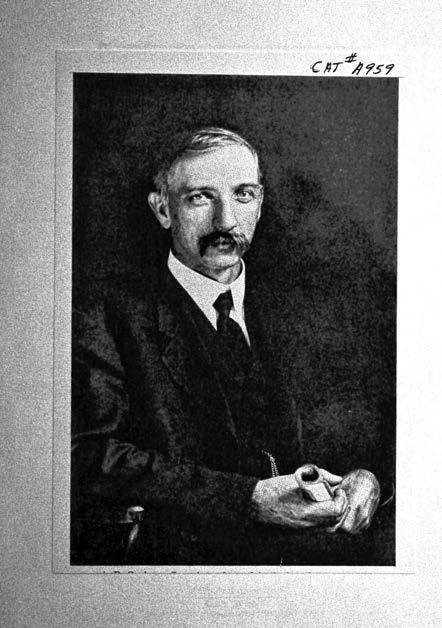
His work not only enriched agriculture in Champaign and surrounding counties but also redefined what education could achieve when rooted in realworld experience.
Today, the legacy of A.B. Graham lives on in every 4-H project, every county fair exhibit, and every young person who learns the value of hard work and curiosity.
From humble beginnings in Ohio’s heartland, his ideas grew into a movement that continues to nurture generations, proving that even the smallest seeds can yield a harvest that shapes a nation.
By Brenda Burns UDCeditor@aimmediamidwest.com
URBANA – Gaze upward into the night sky and behold the legacy of an Urbana inventor and entrepreneur who played an illuminating role in air travel.
Warren G. Grimes was born in 1898, ultimately landing a spot in history as the “Father of Aircraft Lighting” with his work in the 1930s, just before World War II began.
Grimes founded Grimes Manufacturing Company in Urbana and became a significant community economic builder and civic leader once his invention helped aviation progress from the middle 20th century all the way to the current aerospace program.
Grimes, a posthumous 2010 National
Aviation Hall of Fame enshrinee, patented the electric-powered retractable landing light in 1936, created wing-tip navigation lights and designed countless other interior and exterior aircraft lighting.
He earned the coveted Army-Navy “E” Award for production excellence, an award given to less than 5 percent of plants involved in war work during World War II.
A major contributor to his Urbana community, Grimes served two terms as mayor of Urbana and as chairman of the State Aviation Board.
His legacy persists, and lighting he invented can be found in aircraft such as the B-2 Spirit stealth bomber and the Boeing 777 airliner.


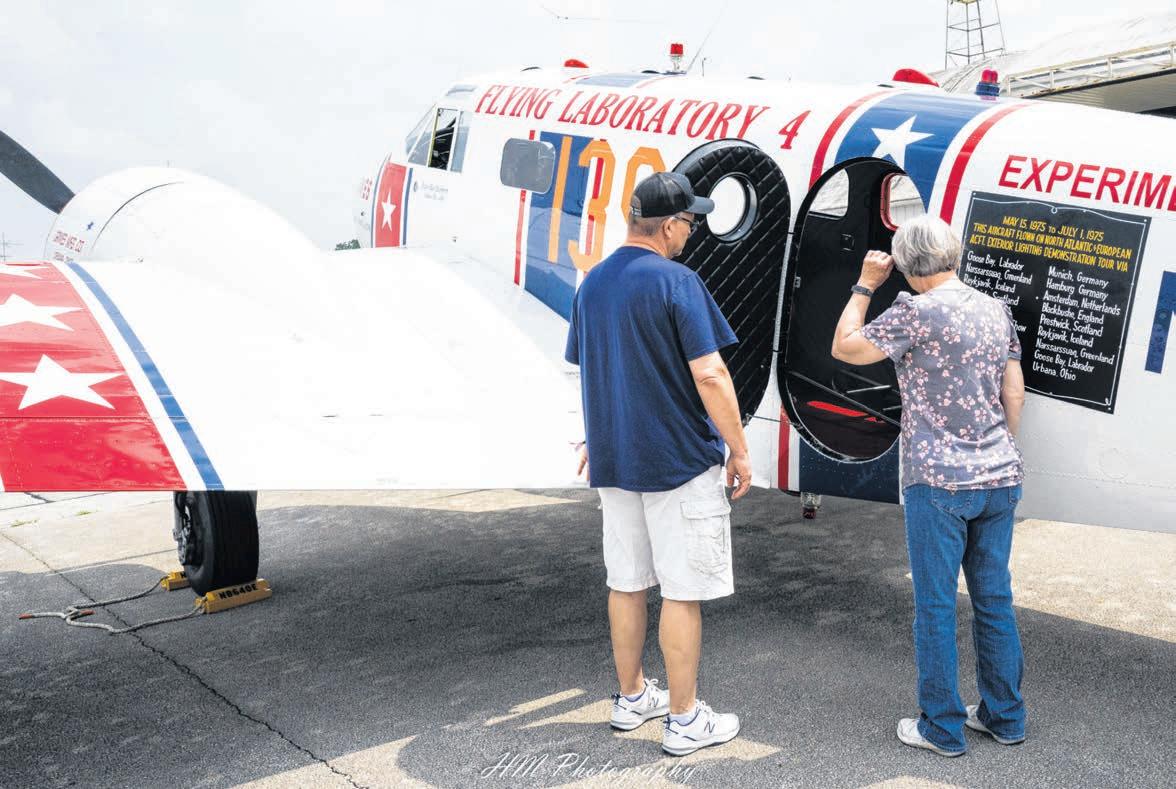
The airplane that was used to test Grimes’ lights, called the Grimes Flying Lab, survives today in Urbana at an airfield named for Grimes, which serves as Urbana’s ever-growing municipal airport.
The Flying Lab is a Beech aircraft preserved and maintained by The Grimes Flying Lab Foundation, a 501(c)(3) non-profit organization dedicated to preserving the historic airplane located at 1636 N. Main St. in Urbana.
“The best way to test a newly-invented light was to put it on an aircraft and fly it up to altitude to make sure it performed correctly,” according to an excerpt on the Grimes Flying Lab Foun-

From page 9
dation website. “They’d fly over to Boeing and show them the different combinations of lights available. It currently has over 75 lights on it! We love to fly it for special events for everyone to see.”
According to the Flying Lab Foundation website, Grimes was born in Montgomery County close to where the Wright brothers lived and worked. As a child, he would ride his bicycle down to Huffman Prairie to watch the Wrights test their airplanes.
Grimes began his career in aviation designing lights for the Ford TriMotor “Tin Goose.” Until the 1920s, airplanes and airports were not equipped with lighting. Pilots relied on bonfires or firepots to guide them or land them.
Grimes quickly realized he could make more money working for himself and started his own company in Urbana developing lighting, and the rest is history.
Grimes Manufacturing Company is now owned by Honeywell and continues to design and manufacture lighting systems for the aerospace and transportation industries.
The Grimes Flying Lab Foundation is funded completely by donations. It is open Saturdays from 10 a.m. to 1
p.m. April through October or by special appointment. Its website can be accessed via bit.
ly/3SqwZBk.
The foundation can also

be found on social media. On Facebook the page is called The Grimes Flying Lab Foundation; on Instagram it is located @ thegrimesflyinglabmuseum.
The foundation posts regular updates on Facebook, and the event schedule for Flying Lab appearances is posted on Facebook.

By Charlotte Caldwell ccaldwell@aimmediamidwest.com
SIDNEY — To celebrate the 250th anniversary of the United States, it is a state and local mission to document and restore Revolutionary War veterans’ gravesites. For one Sidney man, this has turned into an effort to bring a whole cemetery back to its former glory after the discovery of a Revolutionary War veteran relative. At a previous Memorial Day event, the Shelby County Historical Society asked Dan Cecil, a retired 30-year Air Force veteran, to speak about the 21 Revolutionary War veterans buried in Shelby County. As he looked through
the list, a veteran stood out who shared his last name: Zachariah.
Further research revealed that Zachariah is Cecil’s five-times greatgrandfather, buried less than five miles from his house in Carey Cemetery north of Hardin. That led him to the discovery of Cecil Cemetery in Washington Township, near the intersection of Miami Conservancy Road and Fair Road, with more of his family buried there, including Zachariah’s nephew, William, who was a Washington Township justice of the peace, a Shelby County associate judge and a Shelby
See RESTORE |12

“Aimat ahighmarkand youwillhitit. No,notthe rsttime,northesecondAnd maybenotthethird.Butkeeponaiming andkeep on shootingForonly practice will make youperfect.Finallyyouwillhitthe bull’s eyeof success” -AnnieOakley
JULY24,25,& 26,2026
MissAnnieOakleyShootingContest &CostumeContest -July22 &23,2026
Deadlineforentry – July7,2026at6:00pm
Gotowebsite,www.annieoakleyfestival.org forapplicationandrules
Little MissAnnieOakley &LittleMrBu aloBillContest – July21,2026
Gotowebsite,www.annieoakleyfestival.org forapplicationandrules
AnnieOakleyMemorialShoot – July24,2026
Gotowebsite,www.annieoakleyfestival.org forapplicationandrules VENDORSANDCONCESSIONERSNEEDED!!!


From page 11
County commissioner. He also found that Zachariah’s father, Samuel, and brother, Thomas, fought in the Revolutionary War.
“Soon after I found out about those Revolutionary War soldiers, I visited every grave that I could find, and some of the stones were in bad shape,” Cecil said. “… So that’s another thing we want to do is to put those in a more dignified state, preserve them better. We had the War of 1812, the Civil War, so why not start finding and marking and recognizing all of those? So it kind of grows. So I found my hobby for the rest of my life.”
Cecil hasn’t found Zachariah’s exact burial spot yet. The current plan is to honor the six Revolutionary War veterans buried at Carey Cemetery with a marker listing all of their names.
Cecil Cemetery is Cecil’s current focus. No known Revolutionary War veterans are buried there. As it was dilapidated and located in a wooded area on private property, his first few attempts to find the See RESTORE |14


Proudlybuildingour re gion as America marks250 years.
Forovera century,Ferguson Construction hashelpe db usin es se sgrow, communitiesexpand, an dp eoplegotowork.
Th ep roje ctsm ay ch an ge. Th erespon sibility wo n’t.





cemetery failed using coordinates he found online, until he spotted a standing headstone.
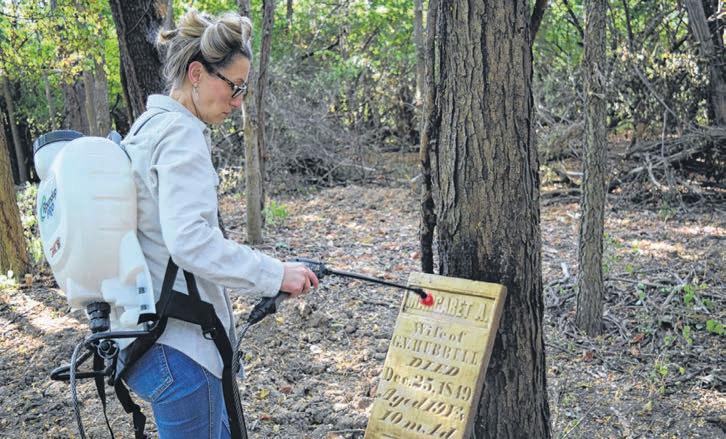
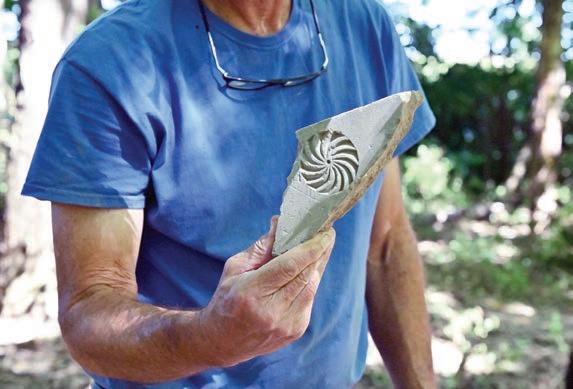
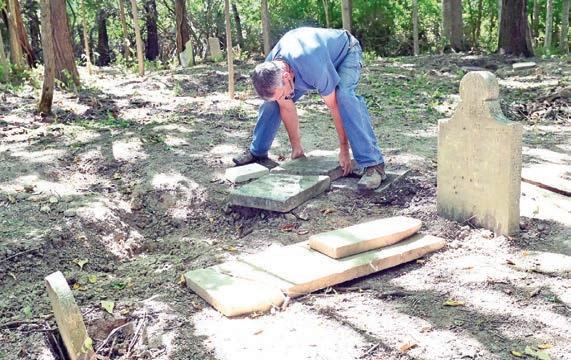
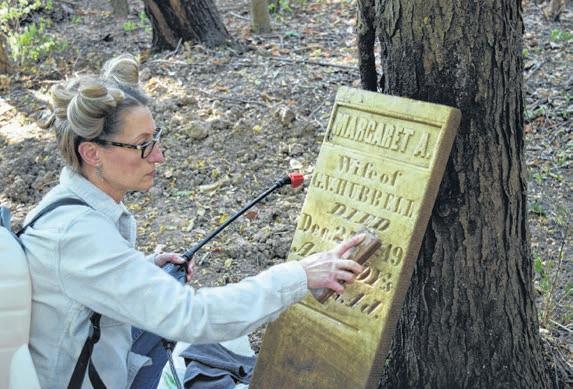
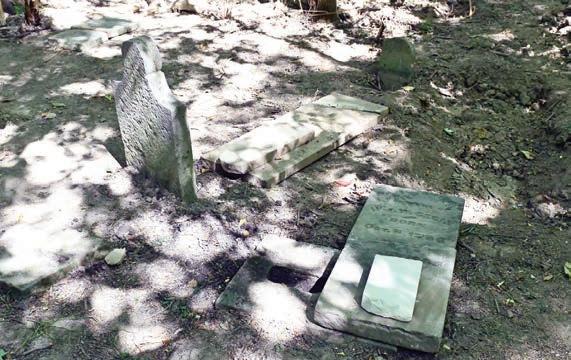
Only two headstones of the more than 20 graves still stood, while the rest leaned against trees, lay flat on the ground or were buried between an inch and almost a foot deep in the ground. Cecil found the covered headstones to be more readable, and it mattered what material the markers were made from, such as sandstone vs. marble. Portions of all but one headstone for the people buried there have been found. The puzzle to determine where they are buried unraveled itself, with clues such as footstones with engraved initials, for example.
and cleaning headstones.
The same crew worked on cleaning up Medaris Cemetery on DingmanSlagle Road.
“It’s kind of addictive when you’re hunting for the headstones; you want to get back out there and see if you can find that last three or four or five of them,” he said. “So that was part of it; it was almost like doing an Easter egg hunt for headstones.”
In the future, he would like to see a long-term care plan for the Shelby County cemeteries that have been neglected over the years. For Cecil Cemetery, his goals include putting a sign on the nearby Buckeye Trail and a trail leading to the graves, and maybe a parking lot.
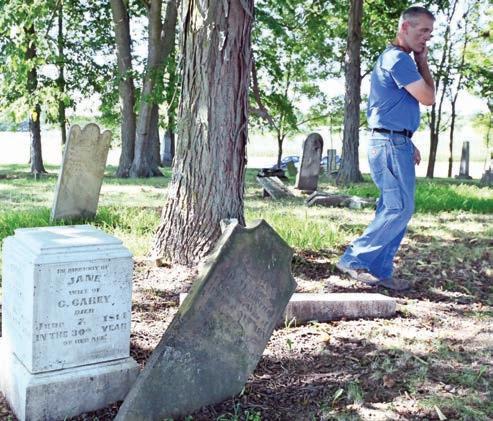
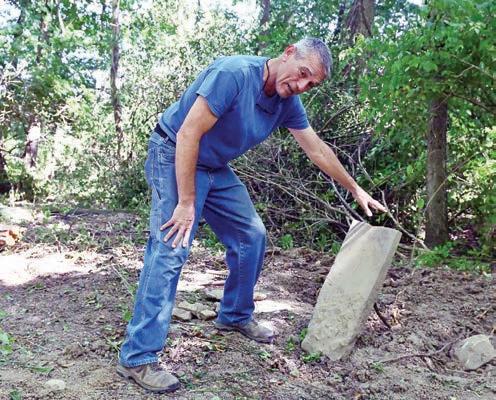
Dan Cecil looks around Carey Cemetery, where his five-times greatgrandfather,
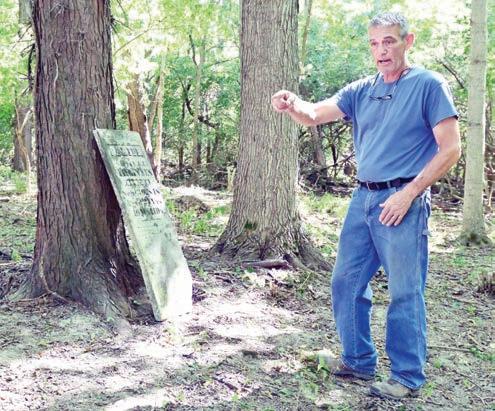
Cecil estimated he’s spent 400 to 500 hours at the cemetery with others helping occasionally, doing work such as clearing fallen trees, digging for headstones
It is estimated there are more than 7,000 Revolutionary War veterans buried in Ohio, according to the America 250 Ohio website. For more information on the statewide effort to document Revolutionary War veterans’ gravesites, visit bit. ly/4vz7zjg. From page 12





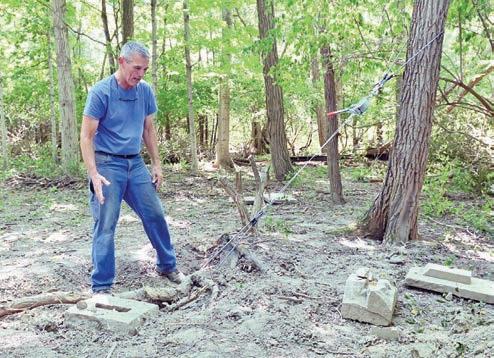
Dan
over a grave that had been buried and crushed to pieces by the roots of the tree next to it.
has found that much of the damage caused to the gravestones in Cecil Cemetery is from tree roots knocking them over, then moving them and crushing them underground.










































































































By Jane Bailey Shelby County Historical Society
SIDNEY — What makes a location historic and worth saving? Is it the style and design of its buildings? Or is it the time in which it was founded? Perhaps it was the people who called the place their home?
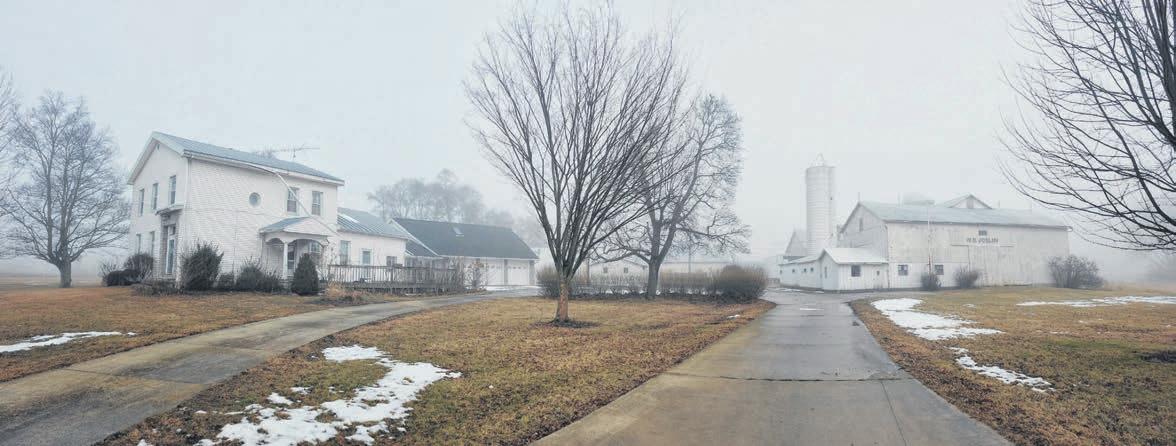
These are all things to consider when thinking about the Joslin Farm, which has been sold to make way for a data center.
Since the property located at 2388 W. Millcreek Road in Clinton Township, Shelby County, became a popular subject in early 2026, it seemed proper to give a little insight into part of its history, namely its previous owners. Many citizens of Sidney and even Shelby County can remember the Joslin family owning a good portion of that property, not just because their name is written on the roof of the barn but because of the impact the Joslin family made in the lives of others through multiple generations.
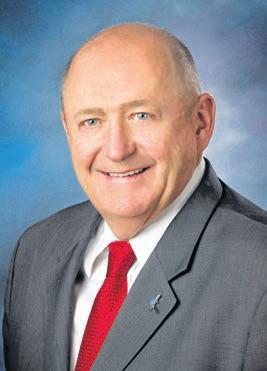
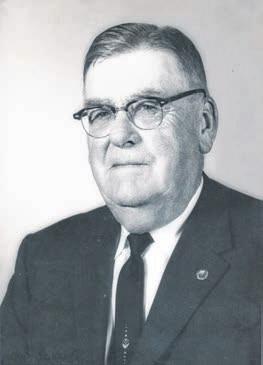
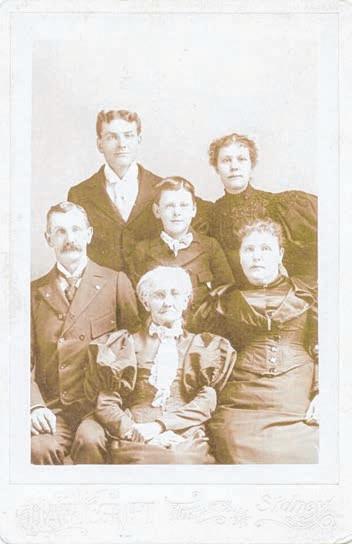
Robinson Joslin is featured in the People of Impact gallery at the Wallace Family Learning and Innovation Center along with his grandfather, William Robinson Joslin, and greatgrandfather, Byron Joslin. While these names may not be commonplace, their work touched the lives of many within their lifetimes.
Robinson Joslin was known across the state by many in the agricultural community, not just for his work with the Ohio Farm Bureau, but also for his work with the American
Soybean Association. During his term as president of the ASA, he lobbied Congress on its behalf for important policy issues such as conservation and sustainability, and he received the ASA lifetime achievement award after his death in 2016.
Robinson Joslin was dedicated to agriculture, spending more than 40 years as a farmer cultivating the Joslin Farm. He was an advocate for improvements in agricultural practices, adopting newer methods and techniques as they originated, including the use of conservation tillage and no-till methods. In addition to working with agriculture-minded organizations, he was also active in the local 4-H community, serving as an advisor for 20 years. He also worked with the local zoning board to help plan housing and industrial developments so that they interfered as little as possible
with the local agricultural community.
One of William R. Joslin Sr.’s biggest accomplishments in his lifetime was the successful integration of electricity across rural America. He was instrumental in local efforts, serving as the first president of the Pioneer Rural Electric Cooperative from 1935 to 1961, as well as aiding with the Ohio Rural Electric Cooperative and the National Rural Electric Cooperative. He flipped the switch that illuminated the first rural home in Shelby County to receive electricity.
The Joslin Farm was one of the few locations within Shelby County that received electricity from both Pioneer and DP&L (now AES). Among his other accomplishments were leading in the development of a hybrid corn seed (which awarded him a director emeritus status by the Ohio Seed Improvement Association),
organizing the Wapakoneta Production Credit Association, serving as director for both Ohio Wool Growers (now Mid States Wool Growers) and the Central Breeders Association, as well as being a member of many local agricultural-oriented organizations such as the Farm Bureau Advisory Council and the Shelby County Soil and Water Conservation Association.
Byron Joslin is still revered by history-minded men and women for his work in aiding early veterans within Shelby County. He was born in Shelby County on March 22, 1845, and attended the first classes held at the Union School in Sidney. His family lived on Miami Avenue across from the First Presbyterian Church, which his father aided in the design of when the present building was rebuilt in the 1880s.
After receiving his educa-
tion, Byron Joslin first joined the juvenile military company and later the National Guard. During the Civil War, he served in Company K of the 134th Ohio Volunteer Infantry, which was comprised predominantly of Ohio National Guard members from Champaign and Shelby counties. He joined his father and brother in a construction business venture in Sidney after being honorably discharged in 1865.
He married Elizabeth Doering, sister to Sarah Jennie Haslup (wife of William Haslup, who built the Ross Historical Center) in June 1871. They lived in a house on North Main Avenue until 1885, when he purchased the farm, selling two of his properties in town on Elm Street to his aunt, D. Maria Conover, and her daughter, Agnes. Byron Joslin took over the duties of farm life and
From page 16
lived on the property until the early 1900s, when he and his wife moved back into town, and his son, William R. Joslin, took control of the farm. As he got older and his health started to decline, he moved in with his son on the family farm, where he died in 1943.
At the time of his death, Byron Joslin was Shelby County’s last living veteran who fought in the Civil War. He took part in nearly every patriotic event held in Sidney during his lifetime, always holding a special place in his heart for Memorial Day, in which
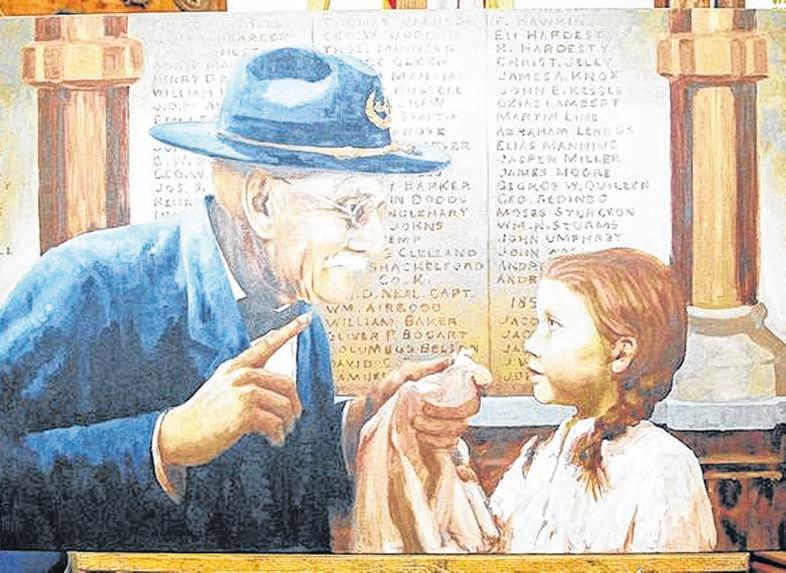
he participated for nearly 70 years while wearing full military dress. Many recalled how once a week he traveled to downtown Sidney on the interurban railway to the Monumental Building, where he would clean and polish the marble tablets with the names of his comrades in arms who never made it home from the Civil War.
In 2017, a painting titled “Polishing their Memory” by Alex Ross depicting Byron Joslin speaking with a young child while cleaning the tablets was commissioned by the Monumental Building Board of Trustees. It currently stands on display in the memorial room beside the tablets he was so fond of preserving.
Before the property was owned by Byron Joslin, it was under the care of his uncle, Benjamin D. Conover. When digging for property records older than 1860, the most valuable resources are
the deed transfers on file at the Shelby County Recorder’s Office, where it was learned that property owners included John Van Eaton,
See JOSLIN |18



























From page 17
Simon Carey, George Carey (son of Ezra Carey), Edward Cromley, Richard Moore and Peter Hall.
One name in particular of the Joslin Farm property owners stands out more than all the rest. Hall is one of several Revolutionary War veterans who made Shelby County his home for a short time. Although he didn’t own the property very long, his story is still important to tell as one of the early inhabitants of Shelby County. Hall was born in Monmouth County, New Jersey, and it’s possible that he and Benjamin Conover were somehow acquainted.
Hall lived in Shelby County during the early 1830s, and it was during this time that he received the property from the state of Ohio and applied for his pension from the government
for his service during the American Revolution. According to his pension application, Hall enlisted with the New Jersey Militia in 1779 at the age of 15 as a substitute for his brotherin-law, Joseph Perry. He served as a private for four months near Squan Beach in New Jersey, not far from his home, before serving for another 2 1/2 years.
After the war, Hall remained in New Jersey for around nine years and married a woman named Catherine and had four children. From there, he moved around to locations in Pennsylvania, New Jersey, Virginia, Kentucky and Indiana before finally settling down in Ohio, first in Warren County, then in Shelby County. Hall’s final resting place is unknown, but it is known that Shelby County was the last recorded place he called home.
The author is the curator of the Shelby County Historical Society.









By Rhys Patrykus rpatrykus@aimmediamidwest.com
SIDNEY — A local family discovered ties to the American Revolution and Shelby County while exploring their ancestry, although their ancestors weren’t originally from the area.
Jewel Ike, whose maiden name is Holloway, was born in 1944 in Jellico, Tennessee, just over four hours south of Sidney. In the 1950s, her family relocated from Tennessee to Ohio in search of work after the coal mines had run dry.
“Ralph Stolle (founder of Stolle Corporation in Sidney) brought a bus down to Jellico, and they encouraged people to come here (to Sidney) and work,” Ike said.
Ike and her son, Darrin, share an
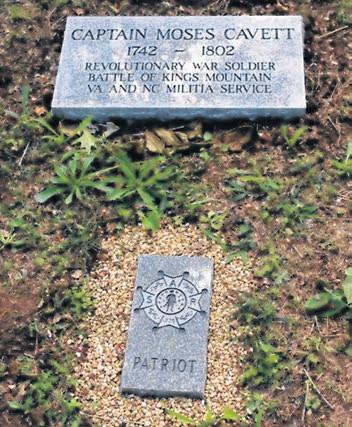
interest in uncovering their family tree, so Darrin started researching online. That search led the family to Moses Cavett, one of the Minutemen who fought to rid America of British control.
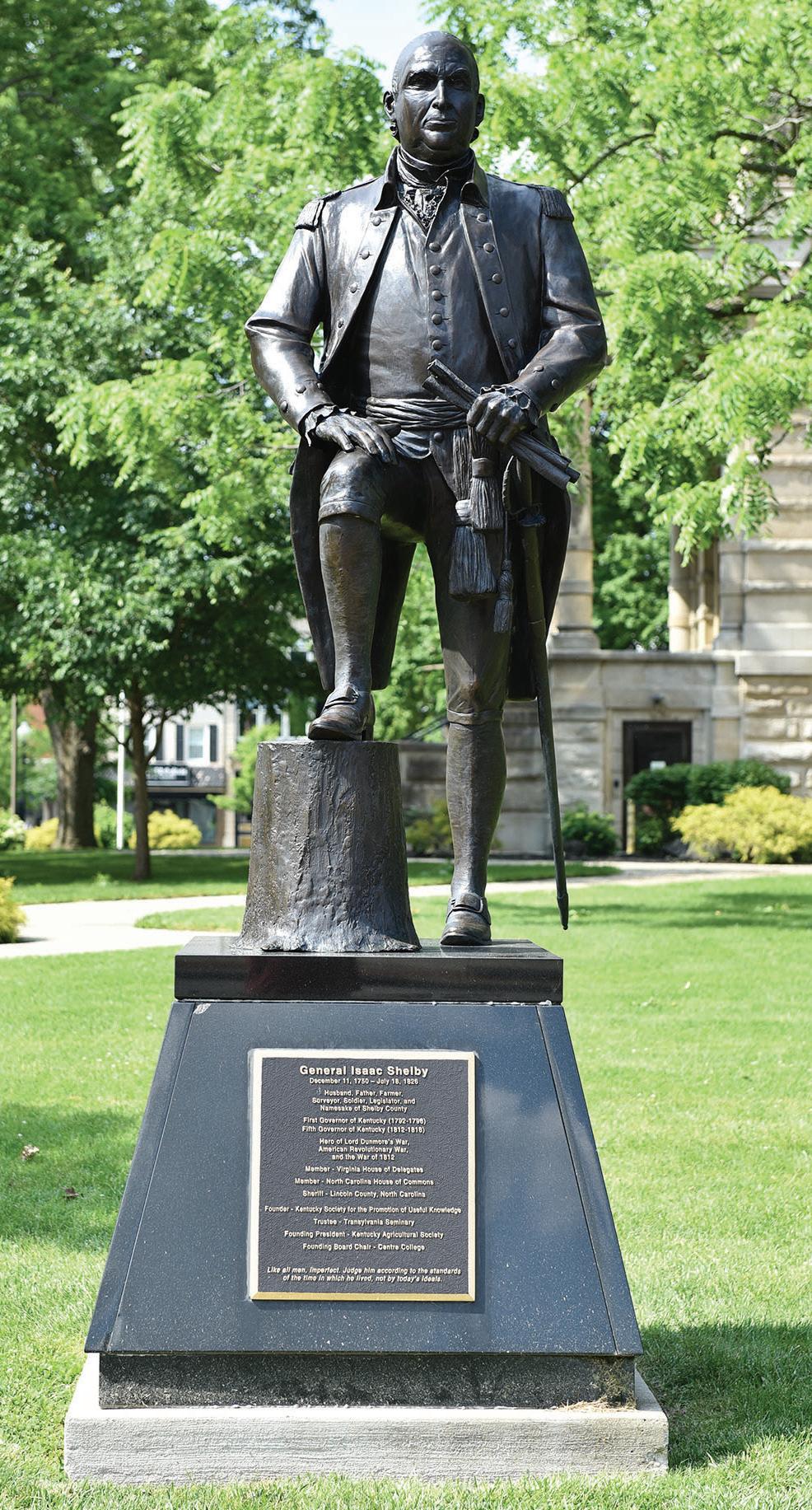
Cavett fought at the Battle of Kings Mountain in 1780 as a member of the Overmountain Men, who were frontiersmen from west of the Blue Ridge Mountains who helped fight in the Revolutionary War as Patriots. Isaac Shelby, whose likeness is used by nine different counties across the country, including Ohio, was Cavett’s commander and a colonel in the army. Cavett earned the rank of captain under Shelby.
Despite being outnumbered by more than 200 men, the Patriots prevailed
over Patrick Ferguson’s Loyalist army. Former presidents Thomas Jefferson and Theodore Roosevelt called the battle a “turning point,” and that it was “the turn of the tide of success.”
After his military service, Cavett settled along the South Holston River in what is now Kingsport, Tennessee, near the Tennessee-Virginia border and about 90 minutes northeast of Knoxville, as one of the first settlers of Tennessee. Cavett and his family settled the area roughly 16 years before the state’s founding in June 1796.
He opened his own iron mill along the river in 1789 before selling it to a group of people, including future Tennessee governor and fellow Kings








From page 20
Mountain veteran, John Sevier. Cavett also operated a hemp farm for rope making.
Cavett’s daughter, Rebecca, married John Holloway Jr. in 1788, which led to Ike 156 years later.
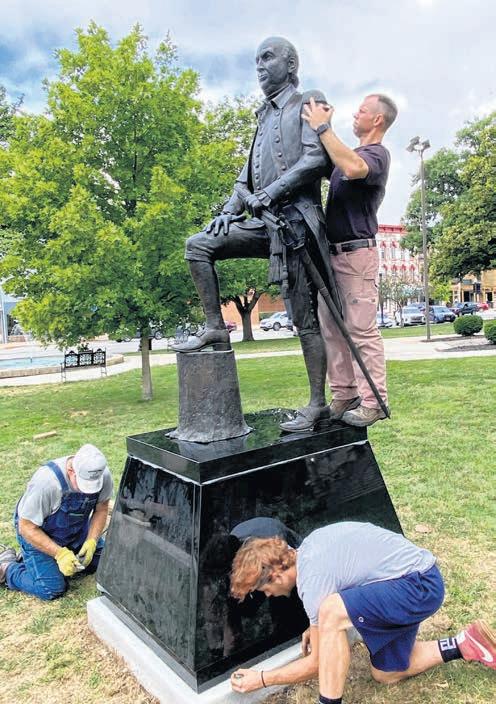
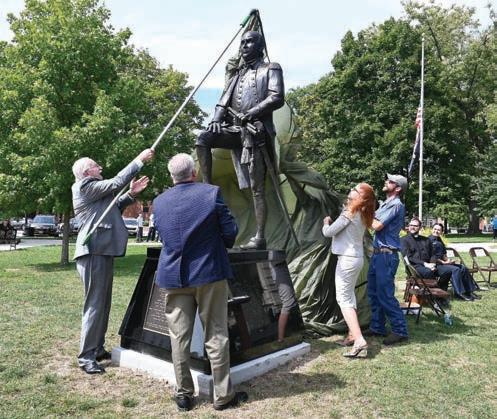
After Sidney’s unveiling of the Col. Shelby statue in 2022, Ike realized just how big of a coincidence it was.
“That’s what I thought when they put up that statue of him (Shelby), and then I remembered it from my papers that I have,” she said. “I thought, ‘How did we end up in this place?’ That’s really a thing; we all ended up here, and Col. Shelby’s statue’s here.”
Outside of Cavett, Ike said her family has a long history of military service. Her husband served in the Air Force, her brother served in Vietnam, one uncle fought in Korea and another in Germany. She also had relatives who fought in the SpanishAmerican War and one who was part of Tennessee’s volunteer militia.
Cavett died in 1802 at age 59 or 60 and is buried with his wife at Mars Hill Cemetery in Knoxville, alongside his brother and his brother’s family, who were killed by Chickamauga War Chief Doublehead at the massacre at Cavett’s Station.
By Ryan Berry rberry@aimmediamidwest.com
GREENVILLE — The celebration for America 250 has been a multi-year celebration of America and the people and events who called this country home or helped shape who we are.
Looking at Darke County and Greenville today, it is hard to imagine how the largest stockade of its time was built on approximately 50 acres in an area that was nothing more than forest and grasslands 233 years ago. But that fortified encampment literally shaped the country.
The United States was trying to move westward into
the Northwest Territory, land claimed by the United States government. They had plenty of land to sell to individuals wanting to settle. For the government, it was ultimately a way to replenish its cash flow from money spent on the Revolutionary War. However, there were about 45,000 Native Americans standing in the government’s way.
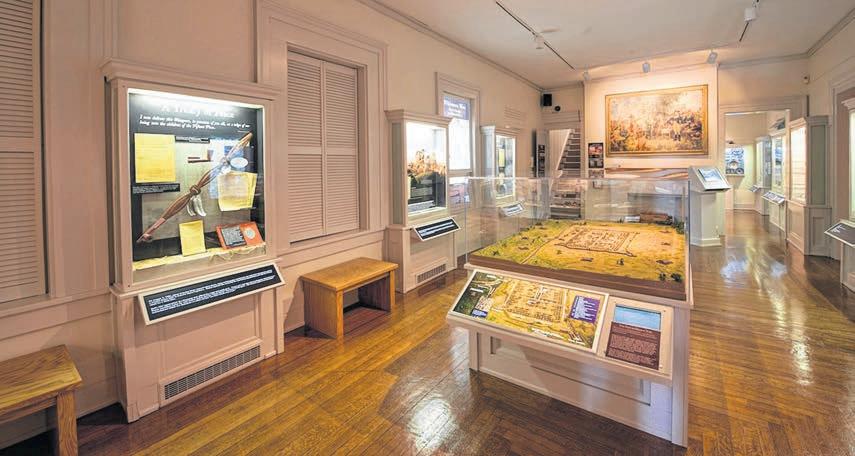
In late 1793, General Anthony Wayne established a fortified encampment at GreeneVille, named for General Nathaniel Greene. It became part of a line of forts and encampments designed to push coloniza-
See GREENVILLE |24

From page 23
tion westward. It started with Fort Washington (Cincinnati) moved north to Fort St. Clair (Eaton), up to Fort Jefferson (a supply depot south of Greenville) to GreeneVille and then further north to Fort Recovery, and Fort Wayne, to name a few. Although all of the other encampments carried the title fort, General Wayne never referred to GreeneVille as a fort.
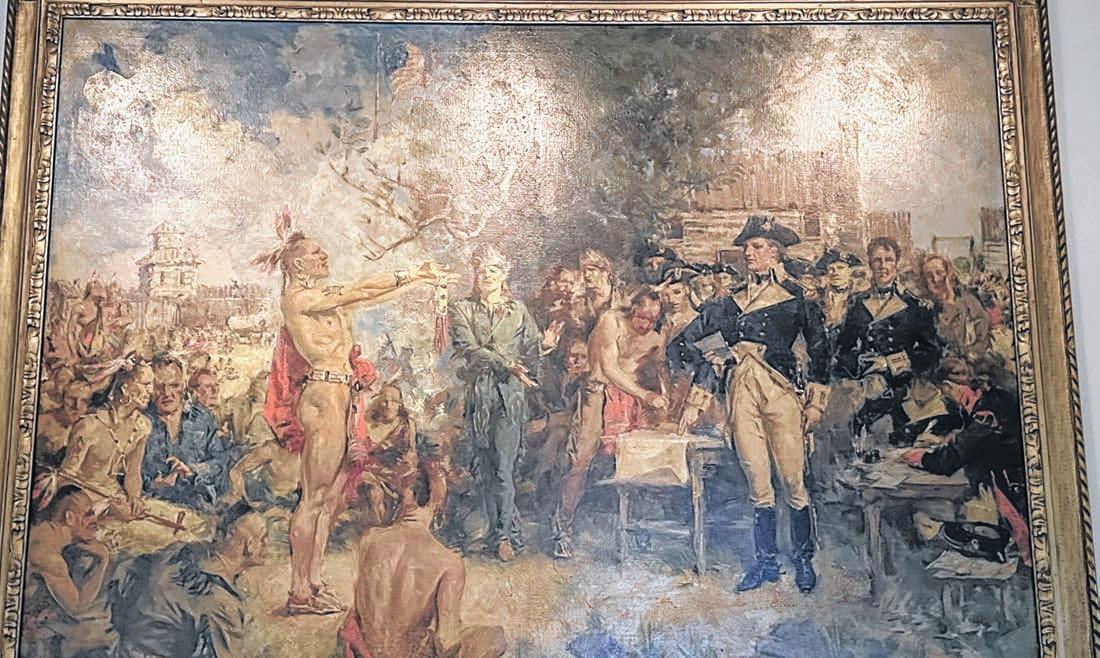
Two years after GreeneVille’s encampment was established, and 19 years after the signing of the Declaration of Independence, America was finally able to move forward with westward expansion with the signing of the Treaty of GreeneVille. On Aug. 3, 1795, 12 Native American tribes were present for the signing. For the tribes, it was more or less a surrender. They had been thoroughly defeated in the Battle of Fallen Timbers, with much of the leadership among the casualties. For America, it was the opportunity to move into areas Native Americans occupied and were not previously willing to surrender. Some believe Greenville could be considered the original gateway to the west.
The GreenVille Treaty Line was established, which moved the Native Americans further west and north. Because of the treaty, the line literally shaped America’s footprint.
In the 231 years since it was established, remnants of that line are still in place, with roads called Greene Ville Treaty Line Road, but for the most part the line has been forgotten. Farms and buildings are now built on that line in many areas.
Over the past few years, engineers from across Ohio re-surveyed the line. According to Darke County Engineer Jim Surber, although the Greene Ville Treaty Line bears the name of where the treaty was signed, very little of the line runs through Darke County. Less than a two-mile stretch runs through the northwest portion of the county that stretches from the Ohio-Indiana
line to the Darke-Mercer County line.
According to Surber, “The line began at the confluence of the Kentucky and Ohio Rivers, which is now in the state of Indiana and runs about 13 degrees east of north to what is now Ft. Recovery in Mercer County. From there it turns southeast and runs to Ft. Loramie and then continues northeast to Tuscarawas County, then turns north and runs to Lake Erie.”
Since 1.944 miles of the line is in Darke County, Surber said his role was much easier than some of the other engineers. However, Surber explained, “In Indiana and many counties in Ohio, roads were built on the line, preserving its location. Additionally, it has been preserved in many places since it was used as property lines in Indiana and Ohio.”
He added, “This is not the case in Darke County. Within a few years after the Treaty Line was surveyed and marked, the First Principal Meridian (now the Ohio-Indiana Line) was sur-
veyed and marked (about 1799) and its location was referenced to the existing Treaty Line. Later on, when what is now Darke County was subdivided into mile sections east of the principal meridian, the Treaty Line was referenced again. (Known as the Old Indian Boundary.)”
Surber said he used old survey records that were available and was able to re-establish its location in Darke County at four separate locations: where it crosses the State Line Road, Peters Road, New Weston-Ft. Loramie Road and the Darke-Mercer County Line Road.
Unlike some of the counties, the line has never been preserved in Darke County and was never used as a property line. It currently runs through farmland, and buildings have been built on top of the line.
Unlike some counties, there are no markers for the line that runs through the northwestern edge of Darke County.
The Greene Ville Treaty Line was short-lived. The War of 1812 pushed the Native Americans further west, even though a second treaty signed in Greenville in 1814 sought to secure the original Greene Ville Treaty Line. You can learn more about the Treaty of Greene Ville by visiting Garst Museum. Their Crossroads of Discovery exhibit looks at who was in Greene Ville and what life was like in the late 1700’s in this region of the nation. You may be surprised to learn that some of America’s most notable names were part of Greenville’s Class of 1795, including General Wayne, future president Lt. William Henry Harrison, and two names that would further shape America’s westward expansion, Meriwether Lewis and William Clark. It is believed the duo met in Greenville. Visit www.garstmuseum.org for more information.
To contact Daily Advocate Editor Ryan Berry, email rberry@aimmediamidwest.com.



















































By Ryan Berry rberry@aimmediamidwest.com
GREENVILLE — Was Annie Oakley a fictional character developed for the theater, movies and television and used to sell merchandise?
If all you ever saw was “Annie Get Your Gun,” the answer is yes. That version of Oakley was definitely fictional. The real Oakley was much more than her rifle and her ability to entertain. She is definitely a person who changed the roles of women and broke stereotypes over the past 150 years. She has been portrayed by some of the greatest names in entertainment, including Barbara Stanwyck, Ethel Merman, Bernadette Peters, Reba McEntire, Susan Lucci, Gail Davis and many others, but the person they portrayed wasn’t Oakley. The only truths from the fictionalized version of Oakley are she was from Darke County, she could shoot a rifle, and she was an entertainer. The rest of it was fantasy. It was far from fantasy for Phoebe Ann Moses during her early life. She was born to Jacob and Susan Moses on Aug. 13, 1860, in a log cabin near Willowdell, in Darke County. She was around 6 years old when her father passed away from complications due to pneumonia. With the breadwinner gone, the family was in dire straits. Two or three years after her father’s passing, Annie, as she was known to


her sisters, was sent off to the Darke County Infirmary. She went to work for a local family around the age of 10, where she was supposed to be paid and educated. By Annie’s account, she was treated cruelly and was, more or less, put in a position of servitude. In later years, she referred to them as “the wolves.”
Her mother remarried in 1866, and her second husband died four years later, which continued the financial strain for the family. Her third marriage was to Thomas Shaw in 1874. It is believed Annie returned to northern Darke County to live with her family shortly after that.
One might be able to argue this is when things began to turn for the future superstar.
She learned to shoot when she was 8 years old and provided food for the family, but after being sent off to the infirmary and then to live with “the wolves,” it wasn’t until she returned home that she was able to refine her skill with a gun.
She became proficient enough to not only provide for her family but also take the game into Greenville to be sold. She was able to make enough money to pay off the mortgage on her family’s farm.
Her game was highly sought after
See ANNIE OAKLEY |30





4 S N S 9 3 7- 6 5 3 - 3 9 0 0


1 R N S

From page 29
because of her ability to make clean shots, which meant those preparing the food would not have to clean buckshot out of their dinners. Her life took a dramatic turn when she met Frank Butler, a traveling exhibition shooter, and her future husband, in Cincinnati. Still a teenager, Annie proved her skill to Butler.
Although there is no concrete evidence as to where she came up with the stage name Oakley, many believe it came from the Oakley neighborhood of Cincinnati. There is currently a mural of Annie in Oakley. Butler and Annie went on to form the shooting act of “Butler and Oakley.”
Butler, understanding the world of business and making money, eventually dropped himself from the act and promoted Annie. His inclination proved to be the correct move.
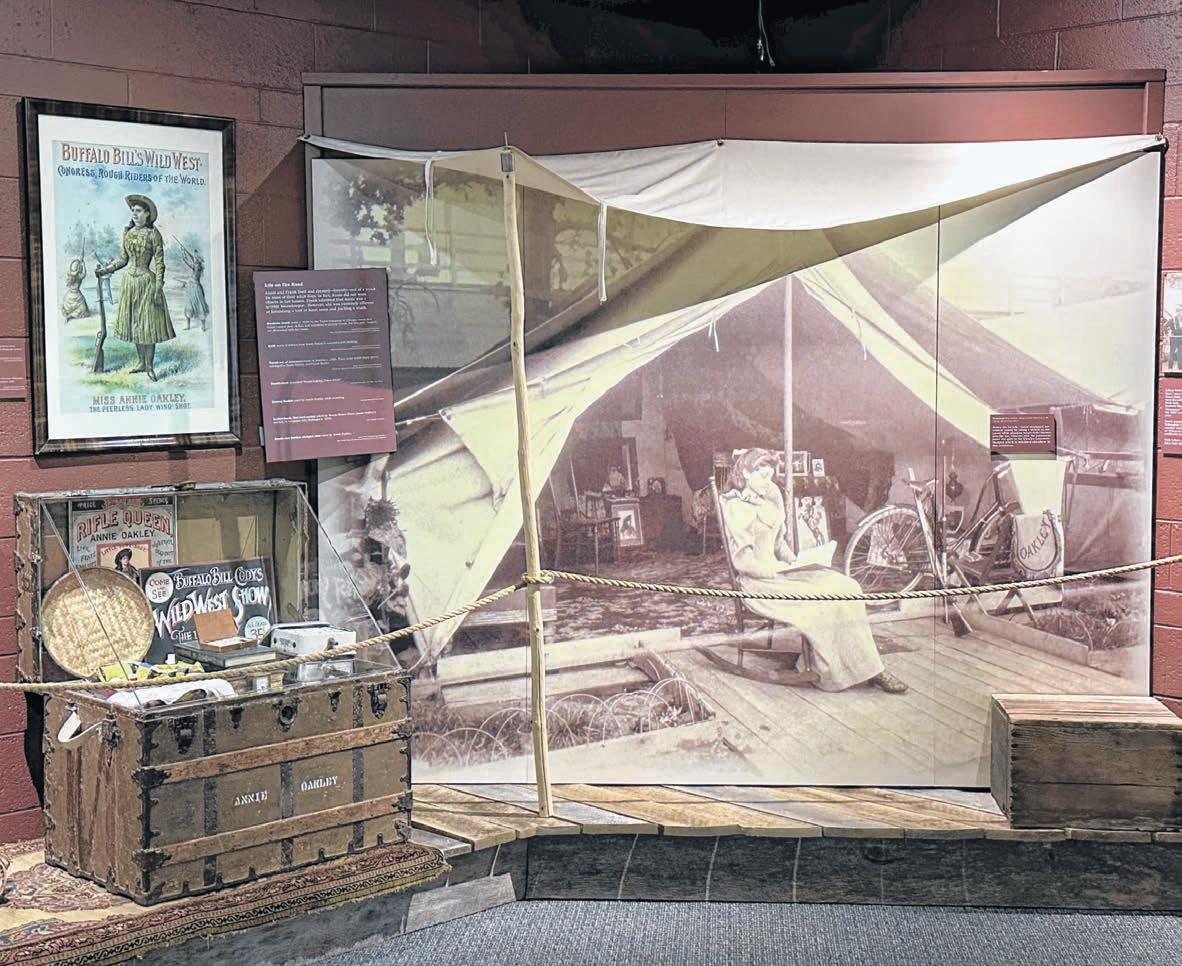
First on the vaudeville circuit, then with a couple of circus circuits and ultimately with Buffalo Bill’s Wild West Show, she performed across the world for ordinary people, as well as for heads of state and nobility. She was one of the highest-paid performers of her era. It was also during this time that she met Chief Sitting Bull. The two were great friends, with Sitting Bull unofficially adopting her. Sitting Bull paid her the ultimate compliment by giving her the moniker Little Sure Shot. Although she never aligned herself with the feminist movement, Annie was fiercely supportive of women. She was a staunch supporter of equal
pay for women and understood a woman was capable of more than they were given credit for. She taught thousands of women how to shoot and defend themselves, and she even offered the government her services to train women for service in the Spanish-American War and World War I. The government declined her offer.
Maybe there was some truth to one of the songs in
Annie Get Your Gun: “Anything you can do, I can do better.”
Darke County will recognize the 100th anniversary of Oakley’s death this year. Just as she had done many times before, Annie came home to Greenville and Darke County to live her final days. On Nov. 3, 1926, Annie died at a boarding house in downtown Greenville. Her husband, Frank Butler, died a couple
weeks later. Both were buried, side-by-side, in Brock Cemetery, just a few miles from where she was born and learned to shoot.
Darke County continues to honor its most famous daughter every year with the Annie Oakley Days Festival. A statue of the legendary sharpshooter stands in Annie Oakley Park, located at the corner of Washington Ave., Martin Street and South Broadway. A mural
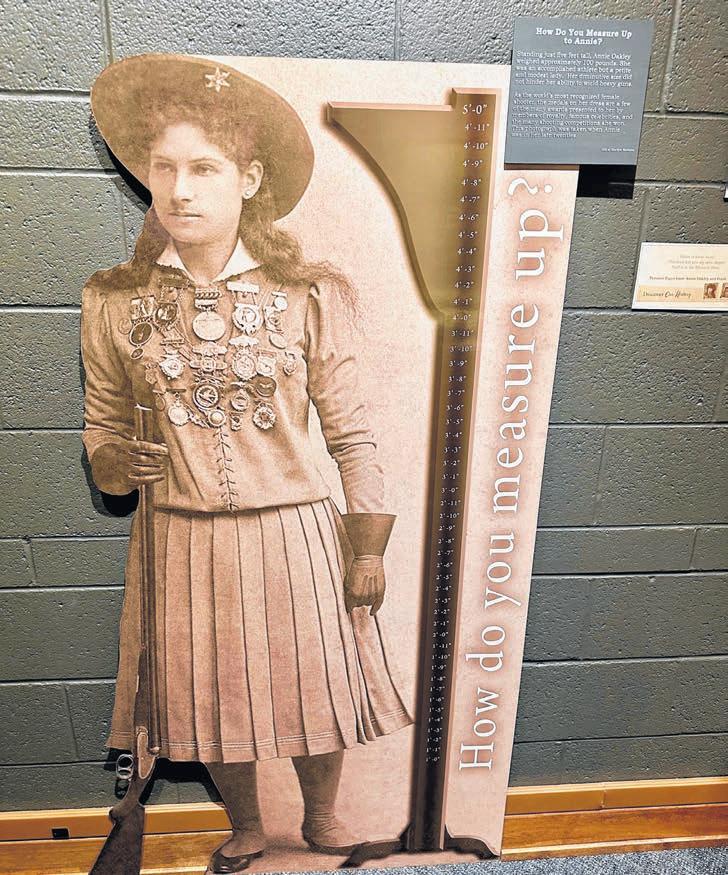
of Annie can also be found on the Sure Shot Tap House. In addition, the National Annie Oakley Center is located at Garst Museum. The museum houses hundreds of artifacts from Little Miss Sure Shot’s life, including some of her guns, clothing, personal mementos, and more. Garst Museum is located at 205 N. Broadway, Greenville. Visit garstmuseum.org for more information.
By Eddie Mowen Jr. emowen@aimmediamidwest.com
PREBLE COUNTY — Historians in Preble County are shining a spotlight on an important part of the county’s past, highlighting its role in the Underground Railroad and the local residents who risked their lives to help enslaved people find freedom.
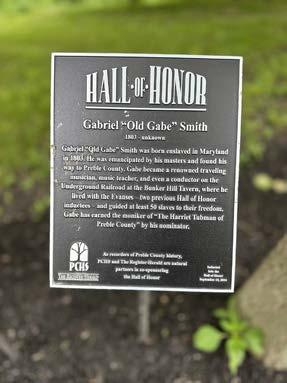
Long before the Civil War, Preble County served as an active route on the Underground Railroad, with churches, private homes and local conductors quietly assisting freedom seekers traveling north toward Canada. Among the most recognized figures connected to that effort is Gabriel Smith, commonly known as “Old Gabe,” a formerly
enslaved man who became one of the few specifically identified Black conductors associated with the Underground Railroad in southwestern Ohio.
Born enslaved in Maryland in 1803, Smith later gained his freedom and eventually settled in the Fairhaven area of southern Preble County. Historical accounts connect him to Hopewell Church, a congregation founded by settlers opposed to slavery and widely recognized as part of the region’s Underground Railroad network. Smith is believed to have worked alongside other anti-slavery supporters to guide escaping enslaved people through Preble
See PREBLE |34

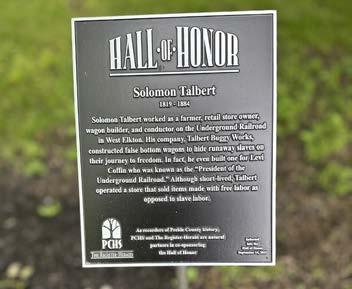
A Hall of Honor plaque recognizes Solomon Talbert (1819-1884) for his contributions as a West Elkton farmer, wagon builder and conductor on the Underground Railroad. Talbert Buggy Works constructed false-bottom wagons used to help freedom seekers escape slavery, including one reportedly built for noted abolitionist Levi Coffin. The plaque also highlights Talbert’s support of free-labor goods in opposition to slave labor.





County on their journey north.
Much of Smith’s documented history centers around the historic Bunker Hill House in Fairhaven. Historical markers and preservation records indicate the property served as a refuge for freedom seekers traveling secretly along Four Mile Creek. Accounts describe a small concealed room beneath a staircase in the home’s summer kitchen where escaping enslaved people could hide safely while continuing northward. Today, the site is recognized as a Historic Ohio Underground Railroad Site and is included in the National Park Service’s Underground Railroad Network to Freedom listings.
Local historians note that much of the surviving information about Smith and other Underground Railroad participants comes from oral histories, church records, historical markers and preservation research rather than extensive written documentation. Because Underground Railroad operations were conducted in secrecy, many details were intentionally left unrecorded. Even so, multiple independent historical sources consistently identify Smith as an important figure in Preble County’s abolitionist history.
Interest in preserving and sharing those stories has expanded in recent years as part of local America 250 efforts. In December 2025, the Preble County
Civil
County served as an active route on the Underground Railroad, with churches, private homes and local conductors quietly assisting freedom seekers traveling north toward Canada. Among the most recognized figures connected to that effort is Gabriel Smith, commonly known as “Old Gabe,” a formerly enslaved man who became one of the few specifically identified Black conductors associated with the Underground Railroad in southwestern Ohio. Smith is honored with a plaque at the PC Historical Society and The Register-Herald’s Hall of Honor.
Historical Society dedicated a historical marker at the Jesse Stubbs House in West Elkton, recognizing the property’s role in the Underground Railroad. The marker dedication was part of a countywide historical plaque initiative created in preparation for America 250, the nationwide observance of the 250th anniversary of the founding of the United States.
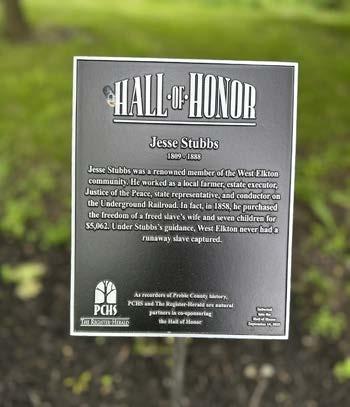
According to Preble County Historical Society Director of History and Collections Brittany Corwin, the Jesse Stubbs House traces its origins to 1805. Stubbs, who was born on the property in 1809, later became known for helping freedom seekers traveling through the area.
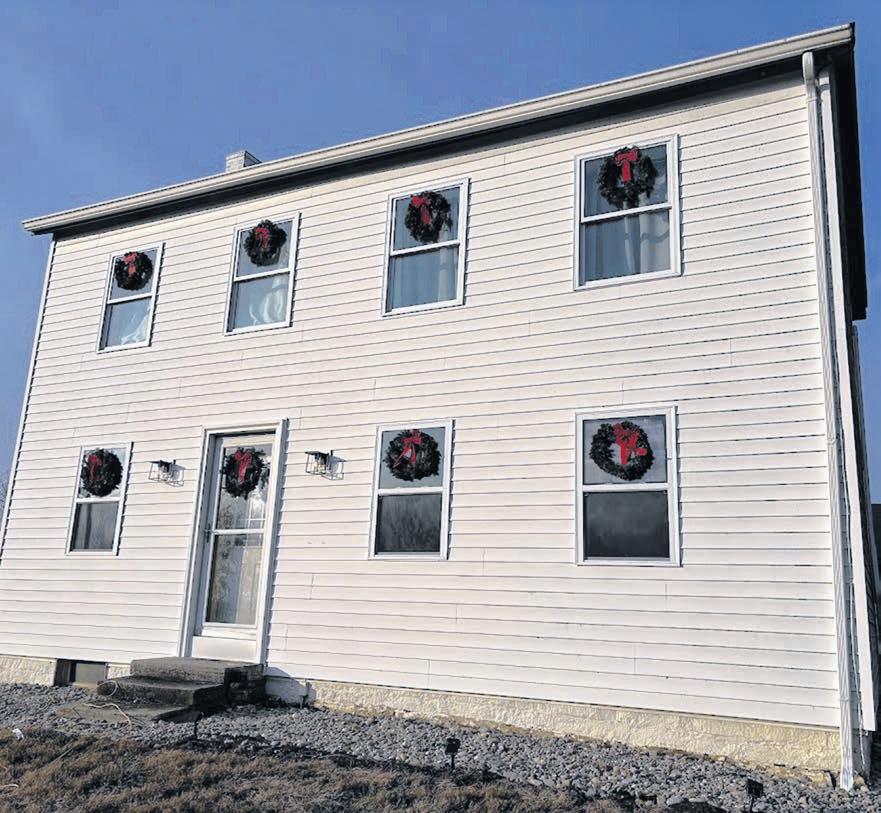
Historical accounts indicate Stubbs and his wife, Mary, provided food, shelter and concealment for escaping enslaved people despite the personal risk involved.
One of the most notable stories tied to Stubbs occurred in 1858, when he reportedly traveled to Kentucky to secure the freedom of the wife and seven children of Craig Langford, a formerly enslaved man.
Historical accounts estimate the effort cost more than $5,000 at the time — the equivalent of nearly $200,000
today — demonstrating what historians describe as an extraordinary moral and financial commitment to the anti-slavery movement.
The county’s effort to preserve Underground Railroad history continued earlier this year when the Preble County Historical Society unveiled a new exhibit dedicated to the Underground Railroad in Preble County. The exhibit, named in honor of Smith, opened Feb. 28 at the historical society museum on Swartsel Road in Eaton.
Executive Director Lisa White credited researchers
Walt Mast, Amanda Dowler, Brittany Corwin and the organization’s research team for helping bring the exhibit to life.
As America 250 approaches, local historians say the effort is about more than preserving buildings and artifacts. It is also about ensuring the stories of courage, sacrifice and the pursuit of freedom remain part of the county’s shared history for future generations.


othe heartofEaton —wherehistory,communityandsmall-townch DowntownEatonis avibrantdestinationfilledwithuniqueshops,c eventsandwelcomingbusinessesthat make our communityspecialyear-round. Whether you’re visitingforoneofoursignatureevents,exploringlocalhistory,shoppingsmall, enjoying adrinkor mealwithfriendsorsimplytaking astrollthroughourhistoric downtown,there’ssomethingforeveryonein DowntownEaton. Scan



By Eddie Mowen Jr. emowen@aimmediamidwest.com
EATON — Long before Eaton became known for its small-town charm, historic downtown and events such as the Pork Festival, the land surrounding Fort St. Clair stood on the edge of the American frontier — a place shaped by conflict, survival and the early expansion of the United States.
As the nation prepares to celebrate its 250th anniversary in 2026, the story of Fort St. Clair serves as one of Preble County’s strongest connections to the founding era of the country itself.
Constructed in March 1792 during the Northwest Indian War, Fort St. Clair was established as part of a chain of military outposts stretching north from present-day Cincinnati into the Northwest Territory. The fort was ordered by Gen. James Wilkinson following the devastating defeat of Gen. Arthur St. Clair’s forces in 1791, still considered the worst loss ever suffered by the U.S. military at the hands of Native American forces.
Built near a natural spring along what would eventually become Eaton, the fort served as a supply depot and defensive position between Fort Hamilton and Fort Jefferson. The site also has ties to future President William Henry Harrison, who reportedly assisted in constructing the fort while serving in the Army as a young officer. (Harrison also visited Eaton on July 25, 1840, during his 1840 presidential campaign. He reportedly stayed in Eaton for two days and two nights, lodging at his friend Cornelius Van Ausdal’s home on 122 E. Main Street, an historic downtown building currently
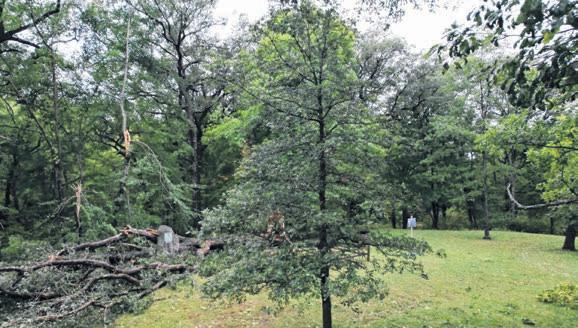
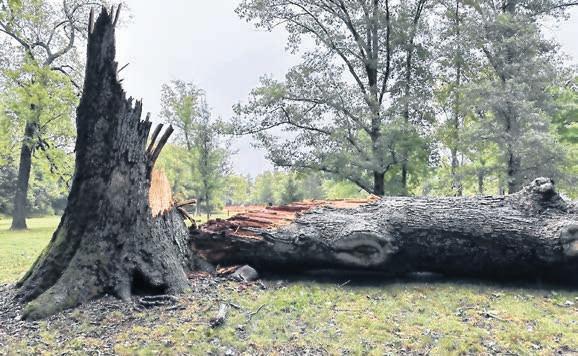
The centuries-old tree which stood in witness of history at Eaton’s Fort St. Clair fell victim to the harsh winds of the remnants of Hurricane Helene during the storm on Friday, Sept. 27, 2024.
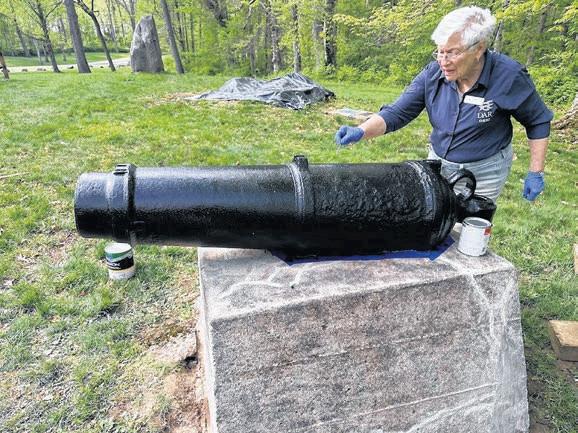
A piece of Eaton’s early history received new life in early May 2026 as restoration work wrapped up on the 1822 British cannon at Fort St. Clair Park, a project led by the Commodore Preble Chapter of the Daughters of the American Revolution. No one knows exactly how the British cannon made its way to the fort, according to Preble Daughters of the American Revolution members.
being revitalized.)
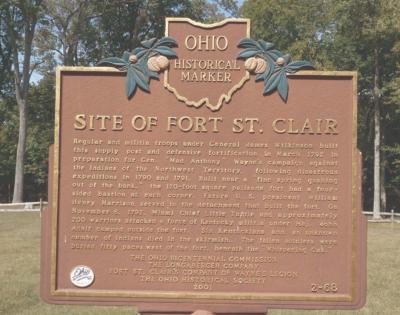
The fort quickly became part of the violent struggle for control of the Northwest Territory. On Nov. 6, 1792, Miami Chief Little Turtle led approximately 200 warriors in an attack on Kentucky militia forces camped outside the fort. Several militia members were killed in the skirmish and later buried near the site beneath what became known locally as the “Whispering Oak.”
For generations, the Whisper-
ing Oak was one of the most recognizable symbols of Fort St. Clair, a massive white oak tree believed to have stood watch over the site since the Revolutionary War era. Located near the graves of six soldiers killed during the Nov. 6, 1792, battle at Fort St. Clair, the centuries-old tree became deeply woven into Eaton’s local history and folklore. Legend held that when the wind rustled through the oak’s leaves, visitors could hear
whispers telling the story of the battle and the events the tree had witnessed over more than two centuries. Beneath its branches rest Lt. Job Hale, Sgt. Matthew English and Privates Robert Bowling, Joseph Clinton, Isaac Jett and John Williams, all killed during the frontier conflict.
The Whispering Oak gained national recognition during the country’s bicentennial celebration. In 1976, the tree was designated a Bicentennial Tree by the
National Arborists’ Association and the International Society of Arboriculture for having lived during the American Revolutionary period. A marker placed at the site in 1977 recognized the tree as a living witness to the nation’s earliest years. At the same time, the Eaton Current Events Club planted “Whispering Oak II” nearby to continue the legacy of the historic tree for
See FORT ST. CLAIR |38

future generations.
After surviving for centuries, the original Whispering Oak finally fell during the remnants of Hurricane Helene on Sept. 27, 2024, as powerful winds swept through the region. The loss of the tree was widely felt throughout the community, where it had long served as both a historic landmark and a symbol of Eaton’s connection to the nation’s frontier past.
Rather than removing the fallen oak from history entirely, city officials and community leaders worked to preserve portions of the historic tree through commemorative projects. Wood salvaged from the Whispering Oak has since been transformed into park benches, a decorative clock displayed in Eaton City Council chambers and other memorial pieces designed to preserve the legacy of the tree
and the history it represented.
Though the original fort disappeared long ago, the site remained an important landmark in local memory. In the early 1920s, community members organized efforts to preserve the historic property, leading to the creation of Fort St. Clair State Memorial in 1923. The park eventually came under the ownership of the City of Eaton in 1992 and has since evolved into one of the community’s most recognizable public spaces.
Today, visitors to Fort St. Clair Park find far more than historical markers. The park includes hiking trails, picnic shelters, cabins used for events, memorials honoring veterans, open greenspace, a large playground, an 18-hole disc golf course and the site’s famous Whispering Christmas light display, which has become a regional holiday attraction since its founding in 1987.
In recent years, the City of Eaton has continued investing in the park while also emphasizing its historic significance.

Restoration work on the park’s historic British cannon was recently completed by the local Daughters of the American Revolution group, while other improvements to park facilities have helped renew interest in the site ahead of the nation’s semiquincentennial celebration.
The city’s broader America 250 efforts have also placed Fort St. Clair at the center of Eaton’s historical identity. In late 2025, Eaton was officially designated as an America 250-Ohio Community, joining municipalities across the state preparing programs and events tied to the country’s 250th birthday.
Local officials have said the designation provides an opportunity not only to celebrate American history, but also to highlight the local stories that shaped Ohio and the nation.
Among those stories is the role western Ohio played during the Northwest Indian War, a conflict that helped determine control of the Ohio Territory and paved the way for future settlement and statehood.
Fort St. Clair stood directly in the middle of that transformation.
Today, as families walk the trails, attend community events or drive through the park during Whispering Christmas, many may not realize they are standing on ground tied to the earliest years of the United States. For local historians, that connection is exactly what makes Fort St. Clair important during America’s 250th anniversary celebration.
While major cities often dominate discussions of early American history, sites like Fort St. Clair remind visitors that the nation’s story was also written in frontier forts, wooded battlefields and small communities that helped shape the country long before Ohio achieved statehood in 1803.
And more than 230 years after soldiers first constructed the frontier outpost, Fort St. Clair continues to serve as both a gathering place for families and visitors and a living reminder of the region’s role in America’s first chapters.





ars



















By Kathleen Leese
For Miami Valley Today
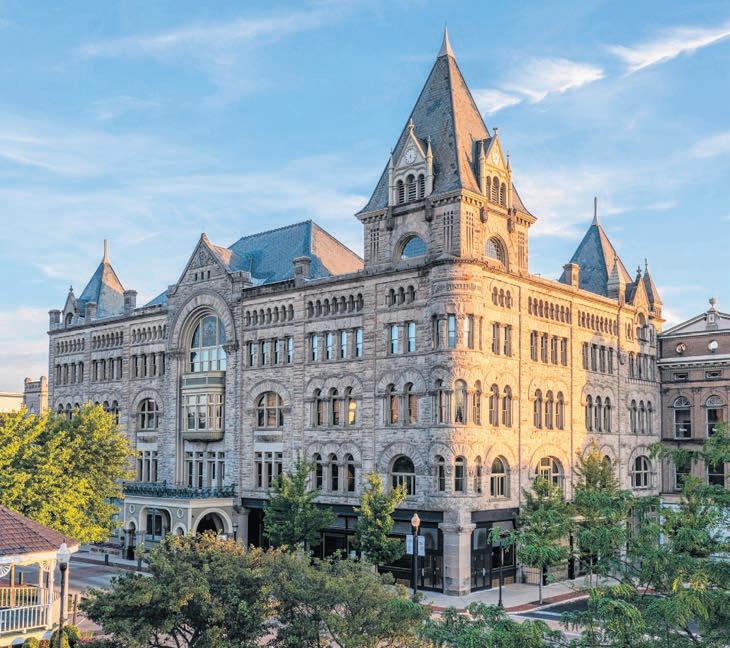
PIQUA — Fort Piqua Plaza has hosted presidents and presidential hopefuls, as well as other well-known Americans. It also played a role in bringing about restaurant desegregation in Piqua. As the 250th birthday of the United States approaches, it is a time to look back at the role a small midwestern town played in hosting those who would help shape American history.
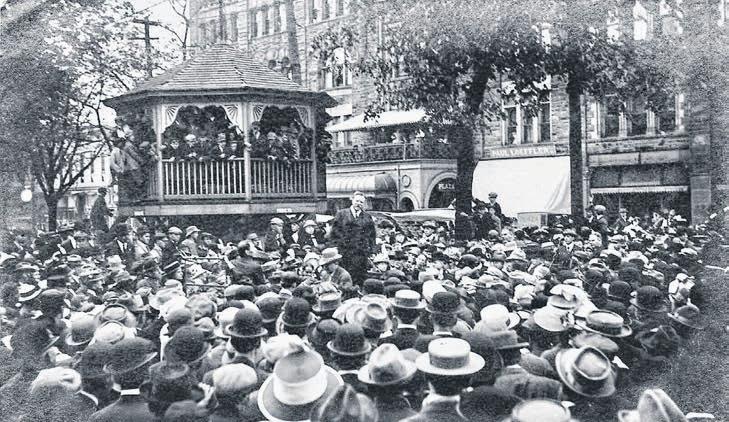
Among the presidents who visited Fort Piqua Plaza and their party affiliation were Teddy Roosevelt, who was a member of the Bull Moose Party at the time; William Howard Taft, Republican; Warren G. Harding, Republican; William McKinley, Republican, and
Rutherford B. Hayes, Republican. All of these men stayed at Fort Piqua Plaza before, during or after their presidencies.
Other presidential candidates who came to Piqua but did not stay at Fort Piqua Plaza and their party affiliation and the year(s) they visited were William Henry Harrison, a Whig, in 1812, 1837 and 1840; John C. Fremont, a Republican, in 1863; Benjamin Butler, a Greenback, in 1884; Grover Cleveland, a Democrat, in 1887; Benjamin Harrison, a Republican, in 1889; William Jennings Bryan, Democrat, 1896, 1915, and 1919; Eugene V. Debs, Socialist, 1910; Woodrow Wilson, Democrat, 1912; James Cox, Democrat, 1912 and
See FORT PIQUA |40

250yearsago, ericanschose independence. We didtoo. Since1892,thatindependencehas kept our focus exactywhereitbelongs: onthe customersand communityweserviceright hereinChampaign County.
1920; Harry Truman by train, Democrat, 1948; Ronald Reagan by train, Republican, 1996; and George W. Bush, by bus, Republican, 2004.
Andy Hite, local historian for the Piqua Public Library, spoke about Fort Piqua Plaza’s role in local history.
“The hotel has been the focal point of the downtown since its opening. In addition to its architectural grandeur, the hotel has a rich history of providing shelter to presidents and other famous people, including (in addition to those previously listed) John Philip Sousa and Harry Houdini,” Hite said. “It (Fort Piqua Plaza) was a meeting place for the Women’s Christian Temperance Union and (the) Anti-Saloon League during Prohibition. Later, it became the site of a 1947 NAACP-staged sit-in at the lunch counter (that) resulted in the end of restaurant segregation in the entire city.”
Hite explained in addition to the presidents and presidential candidates, having Sousa, who wrote the National Anthem, and Houdini visit Fort Piqua Plaza was special.
“John Philip Sousa was a guest in the hotel (Fort Piqua Plaza) in September 1912 as he and his band played a concert at Mays Opera House on the 21st. It would be likely that his entire group stayed at the hotel at that time,” he said.
“Harry Houdini is also listed as a guest at the hotel as well, although no date or reason for his stay is available,” Hite noted. “In 1916, he (Houdini) had performed in Dayton, so perhaps his stay in Piqua coincided with that.” Hite explained there was a reason that presidential candidates were drawn to Piqua.
“Piqua and Miami County have always been Republican strongholds, and in the late 19th and 20th centuries, were Ohio’s time in the White House,” he said. “It would have been logical for candidates to stop in Piqua while on the campaign trail. Later, presidential
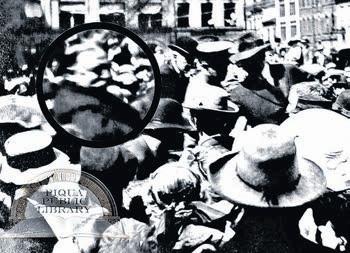
President William Howard Taft visited Piqua in 1912, riding through the crowd as they looked on. Taft can be seen circled in the photo, which appears to have been taken as he came down what is now High Street, facing east.
American history may be overlooked because of modernization.
candidates seemed to have maintained the tradition of a local stop. As mass media grew in importance, the old traditional campaign seemed to take a back seat.”
While Col. John Johnston, who lived at the location of what is now Johnston Farm and Indian Agency, 9845 N. Hardin Road, Piqua, was a federal Indian Agent with political connections, Hite said, “Johnston’s role in presidential politics rose and fell with the fortunes of the old Whig Party. He was a staunch Henry Clay and William Henry Harrison (supporter). After Harrison’s short presidency, we don’t see much from Johnston politically as his government service ceased after 1842.”
Hite said Fort Piqua Plaza’s role in
“Today, with the proliferation of hotels along the interstates, people probably do not realize the role of hotels such as our building.,” he said. “Since Piqua was a mid-to-late 19th century crossroad location, people needed a place to stay during their travels. This grand hotel was in its heyday during those years.”
Hite added, “It was a masterpiece of both architecture and engineering when it opened in 1891. The hotel had its own electric dynamo as well as the first indoor plumbing in Piqua on opening day. With 100 rooms and all of the amenities of the best hotels, it was the centerpiece of downtown Piqua.”
Hite explained the highways helped lead to the demise of Fort Piqua Plaza.
“Just as transportation made the hotel, transportation on the growing U.S. highway system and hotels along the highway in the 1950’s onward
began to sound the demise of hotels like the Piqua Hotel (Fort Piqua Plaza),” he said. “The hotel did a slow transition to a residential hotel, and the last rooms were rented in the early 1980s. It was not long before a slow decline in the building took place.”
Hite noted it was not the end for Fort Piqua Plaza.
“Early on, however, there had been plans put forward to return the hotel to its former glory. Finally, by the early 2000s, a viable project was (started) and culminated in the 2008 reopening of the hotel as a mixed-use facility that exists today.”
But what is particularly interesting is the fact that Fort Piqua Plaza grew out of a dispute with Troy, Hite explained.
“When Piqua was established and began to grow in the very late 18th and 19th centuries, the village fathers envisioned Piqua becoming the county
seat of Miami County. However, the Ohio General Assembly had established the precedent of locating county seats as close to the center of a county as possible for the ease of travel to do business there for as many residents as possible,” he said.
Hite continued, “As a result, the first courthouse was in Staunton (in Miami County) but was soon moved to Troy, where three courthouses were built to meet the needs of the growing county. Even though the City Hall in Piqua was envisioned to be enlarged to serve as the county courthouse, that never happened. Thus, the seeds of the rivalry were sown. When Miami County commissioners hired J.W. Yost to design the fourth and present courthouse, not to be outdone, folks in Piqua decided to hire Yost to design a new hotel in
downtown Piqua, and as is said, the rest is history.”
Another Ohio native and Piqua resident who would become a U.S. Representative was William McCulloch, who served from 1947 to 1973. McCulloch, a Republican, was known for his work on the Civil Rights Act of 1964 and was honored when the area between Market and High Streets in downtown Piqua was named McCulloch Square. The area is located in front of Fort Piqua Plaza and near the gazebo. McCulloch was a founding partner of McCulloch, Felger, Fite & Gutmann Law Firm in Piqua. A marker in honor of his work is located near the gazebo in Piqua.
Hite invites residents who would like to learn more about Fort Piqua Plaza and its place in history to stop by the Piqua Public Library, 116 W. High St.
“There is a publication called ‘Poem in Stone’ that tells the story of the hotel that is available in the local history


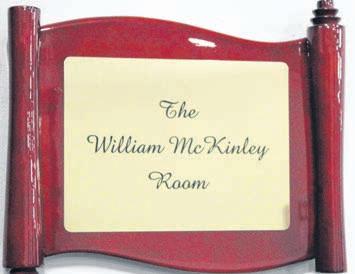
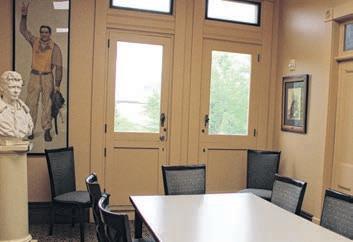
A room on the second floor of the Piqua Public Library is called the President’s Room, one of many ways Fort Piqua Plaza recognizes its place in American history as a city and hotel at the time when presidents and presidential candidates visited the Piqua area.
department. I can also answer many questions about our building when people visit,” Hite said.
Hite is glad to help residents learn more about Fort Piqua Plaza and how it and the city of Piqua contributed
to American history. Hite is in the local history department and available to help with questions on Mondays through Thursdays from 10 a.m. to 3:30 p.m. and said he is “always happy to share stories.”
Hite can also be reached by email at ahite@piqualibrary.org or by calling him at 937-773-6753 extension 231.










By Carly Rose crose@aimmediamidwest.com
MIAMI COUNTY —
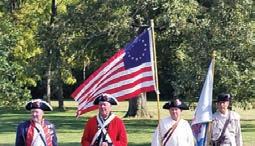
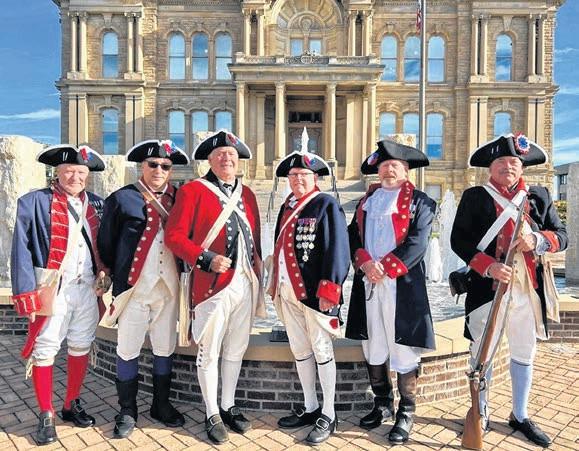
As America prepares to celebrate its 250th anniversary, the Sons of the American Revolution (SAR) continues to participate in events throughout the community.
Although the chapter is based in Montgomery County, it participates in many events in Miami and adjacent counties.
Recently, the SAR members has participated in events such as Little Known Signers of the Declaration of Independence at the TroyHayner Cultural Center on May 21, presenting “It is only Treason if you lose” to the Tipp City Historical Society. They also took part in a cemetery walk in Tipp City on June 7 at Maple Hill Cemetery.
They will participate in a touch-a-truck event on Saturday, July 18, at the block of J R Clarke Library and Covington-Newberry Historical Society Museum from 10 a.m. to 2 p.m.
SAR President Steve Kaplan is a proud member of the organization, along with his wife Patty, a member of the Daughters of the American Revolution.
“We do a lot of patriotic events like parades, color guard duty, Patriot grave markings, service to veterans and youth projects, including teaching history lessons in schools,” Kaplan said.
Kaplan, the past president of the local SAR Chapter (Richard Montgomery) and
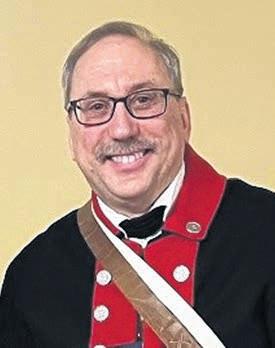
the Ohio SAR, and Patty, past president of the local DAR Chapter (Piqua-Lewis Boyer) and current registrar, are helping new members with their applications to join.
“We have been tagged as the Miami Valley’s Colonial Power Couple,” Kaplan said.
Kaplan said one of the most important points the SAR and DAR would like to make is that most people think of America 250 as the 250th anniversary of the signing of the Declaration of Independence.
“While that is true, and the Fourth of July will be the biggest celebration, there is much more to America-250,”
Kaplan said. “It is a 10-year celebration of the birth of our great nation.”
“Two years ago, we celebrated the 250th anniversary of the Boston Tea Party. Last year was the 250th anniversary of Paul Revere’s ride and the Battles at Lexington and Concord. 2026 marks the anniversary of the declaration,” Kaplan said.
“But it doesn’t end there. The war continued until the Treaty of Paris in 1783. So this ‘Decade of America 250’ goes on until 2033. There will be anniversaries of Washington Crossing the Delaware (Battle of Trenton), Battle of Saratoga, Valley Forge, Battle of Monmouth, Kings Mountain, Battle of Cowpens, the Surrender at Yorktown, and the treaty, to name just a few.”
Kaplan said its been great to feel in increase in patriotism associated with the America 250 anniversaries.
”I hope it is that this spirit of patriotism continues,” Kaplan said. “I personally enjoy putting on a Continental Army uniform or my militia clothing and interacting with the public. By far, the uniforms are our most recognizable public-
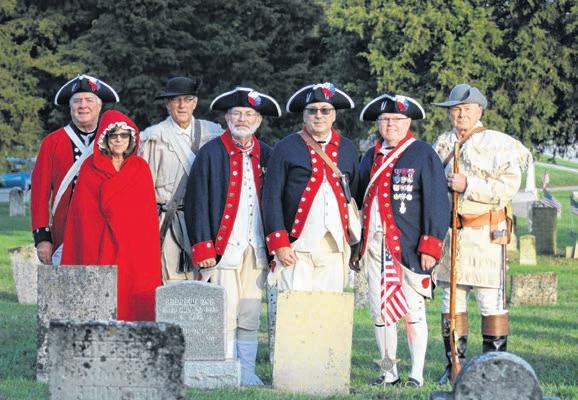
relations tools. People often ask to take their picture with us. It is a great chance to briefly talk to people about the uniform and our Patriots.”
For more information, contact Steve Kaplan at skpk1984@aol.com or visit their website sonsoftheamericanrevolution. us. To visit the DAR website, go to www.dar.org/nationalsociety/.

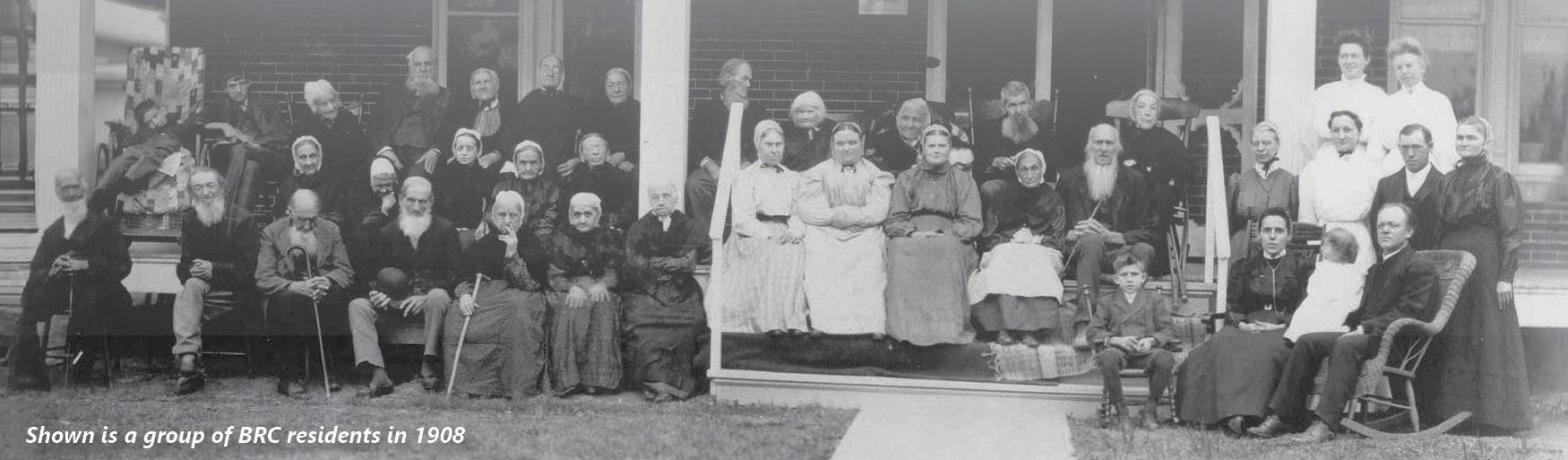

By Gery Deer For Greene County News
FAIRBORN — Long before air travel became routine and jetliners stitched continents together in a matter of hours, two bicycle makers from Dayton stood in a cow pasture in Greene County trying to solve a problem no one else had mastered: how to truly control human flight. Today, that same stretch of land — Huffman Prairie Flying Field — remains one of the most important sites in aviation history, though many Ohioans drive past it without realizing what happened there.
For families looking for affordable summer destinations close to home, the Dayton Aviation Heritage National Historical Park offers one of the region’s most overlooked experiences. Spread across several sites in Dayton and Greene County, the park preserves the story of Wilbur and Orville Wright, poet Paul Laurence Dunbar and the birth of powered flight. While Kitty Hawk, North Carolina, may claim the Wright brothers’ famous first flight in 1903, it was Greene County where aviation truly became practical.
The brothers returned to Ohio after their experiments at Kitty Hawk, searching for a place where they could continue refining their aircraft. Dayton banker Torrence Huffman offered them use of a pasture northeast of the city, with only one request: close the gates behind them so the livestock would not wander off. That field became Huffman Prairie.
Bordered at the time by the Urbana Electric Railway, the site gave the Wrights easy access to transportation for tools and equipment. More importantly, it gave them room to experiment, fail, rebuild, and try again.
Between 1904 and 1905, the Wright brothers transformed their invention from a short-hop curiosity into the world’s first practical airplane. At Huffman Prairie, they mastered controlled turns, figure eights, longer sustained flights and reliable takeoffs and landings.
• Wright-Patterson Air Force Base sits on 8,145 acres outside of Fairborn and Dayton, encompassing Hu man Prairie.
• The base started out as three military installations during World War I, with Wilbur Wright Field, on what is now Area A, hosting a pilot training school, an aviation mechanics’ school and an aviation armorers’ school.
• Before that, the Wright Brothers ran a ying school at the prairie, teaching Army Air Forces commander Henry “Hap” Arnold and H. Roy Brown, who took down the Red Baron.
• Following World War II, Wright Field and Patterson Field merged as a uni ed installation known as Wright-Patterson Air Force Base, soon to become a signi cant location during the Korean War.
• In 1995, the base hosted peace talks between the parties of the Balkans con ict. The Dayton Peace Accords saw the presidents of Serbia, Bosnia and Croatia meet to agree to end the Bosnian War and establish the state of Bosnia and Herzegovina.
• Today, over 30,000 employees work at the base, making it the largest single-site employer in Ohio. It averages 11,000 aircraft operations every year.
• Popular legends claim that the government took the wreckage from the 1947 Roswell crash to the base for safekeeping.
On Oct. 5, 1905, Wilbur Wright flew more than 24 miles in 39 minutes — an astonishing achievement for the era and a major turning point in aviation history. Visitors today can stand near the same field where those flights took place.
The Huffman Prairie Flying Field is now located within Wright-Patterson Air Force Base, adjacent to one of the busiest military aviation complexes in the world, a fitting continuation of the Wright brothers’ legacy. Modern cargo aircraft and military jets routinely pass over the same ground where the first practical airplane once struggled against unpredictable winds and rough terrain.
Nearby, atop Wright Brothers Hill, stands the Wright Memorial. The memo-
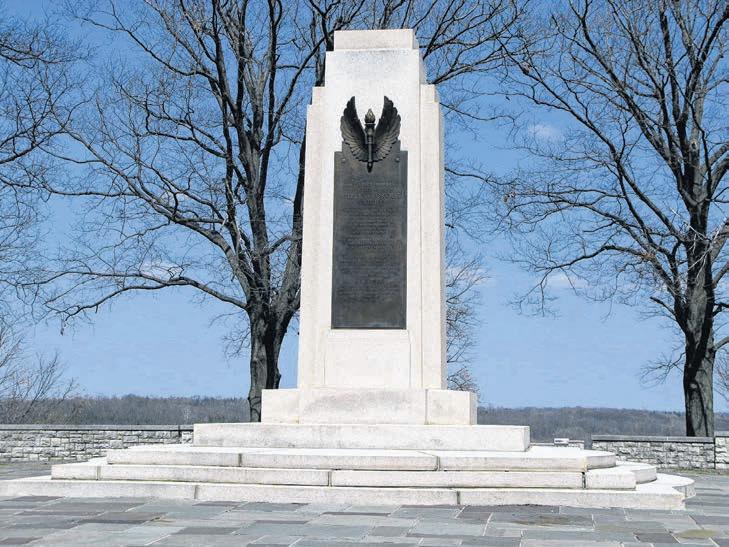
rial overlooks the prairie where the brothers perfected powered flight and serves as one of the area’s most scenic and historically significant viewpoints. Dedicated on Aug. 19, 1940 — Orville Wright’s 69th birthday — the site features a 17-foot pink granite obelisk constructed from the same North Carolina quarry used for the Wright Brothers National Memorial at Kitty Hawk. The hill itself carries a history even older than aviation.
Several Adena burial mounds remain on the property, evidence of Native American activity in the region dating back more than 2,000 years. In 1974, the Wright Brothers Hill Mound Group was added to the National Register of Historic Places for its archaeological significance.
The adjacent Huffman Prairie Flying Field Interpretive Center offers exhibits detailing the Wright brothers’ experiments, the development of their flying school, and the continuing role of WrightPatterson Air Force Base in aviation
innovation. The center also includes a theater presentation and historical displays connecting the early days of flight to modern aerospace research.
The interpretive center is located at 2380 Memorial Road, Wright-Patterson Air Force Base, Ohio 45433. Current National Park Service hours are 9 a.m. to 4 p.m. Monday through Friday, though visitors are encouraged to check ahead for updated schedules or base-related closures.
Other Wright-related attractions throughout the Dayton region include the Wright-Dunbar Interpretive Center, the Wright Cycle Company complex, Carillon Historical Park’s Wright Brothers Aviation Center, and Hawthorn Hill, Orville Wright’s former home.
Most of the sites are free or low-cost to visit, making them ideal for day trips and weekend outings.
More information is available through the National Park Service Dayton Aviation Heritage website — www.nps.gov/ daav — or by calling 937-345-0433.
By Scott Giebel sgiebel@limanews.com
LIMA — Space exploration stands among America’s greatest achievements in its 250-year history, and without the courage and curiosity of Neil Armstrong, it might have remained only a dream.
Armstrong came from humble beginnings, born on Aug. 5, 1930, near Wapakoneta. His early years were full of curiosity, and he flew in his first airplane at age 6 and, at 16, earned his student pilot’s license.
“I always like to emphasize his humble roots because, at one point, he was the most famous person in the world, and he came from a town of less than 10,000 people, grew up in a normal setting, in a normal neighborhood and was not from a big family, which made him have a normal upbringing like a lot of us,” said Logan Rex, curator and
communications director at the Armstrong Air and Space Museum. “I think because of his humble roots, his story really resonates with people because he was just a kid with a dream, and that passion took him to the moon.”
The Armstrong Air and Space Museum detailed how, after he became the first man on the moon, the attention of the nation and the world focused in part on Wapakoneta, where news media flocked to his parents’ house.
Once he returned home, he was thrown a parade and a huge celebration where thousands, including celebrities, gathered.
“His story really goes to show that if you have that passion, have that curiosity, apply yourself, and have that dream, you can accomplish some truly amazing things, and that is one of the great things about America, that we have this real ability to
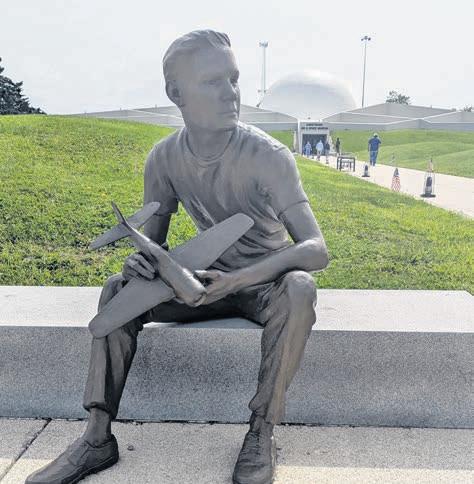
follow our dreams, and so many Americans have been able to be successful in that, which seems to be unique to the American spirit,” Rex said.
Before he was the first man on the moon, he attended Purdue University on a Navy scholarship,


studying aeronautical engineering, and as part of his scholarship, the Navy trained Armstrong as a fighter pilot in Florida. His studies were interrupted by the Korean War, where Armstrong flew 78 combat missions.
John Norberg worked at
Purdue as a speech writer and director of development communications. He also knew Armstrong, interviewed him, wrote about him and for a time took his media calls.
“Every Boilermaker takes special pride in Neil Armstrong because he was such a special person and because he was one of us. He loved Purdue, returned to campus regularly and enjoyed talking to fellow alumni. No one on campus will ever forget the times they met and talked to Neil Armstrong,” Norberg said. He also talked about how humble Armstrong was. Even though people considered him a hero, he was always very humble about it. He showed that humility when a statue of him was placed in front of the Purdue engineering hall named for him, he decided not to attend the statue dedication, thinking it would appear vain.
According to NASA’s website, in his final semester of college, Armstrong applied for a research pilot position with the NACA, which led him to an immediate offer for the job, where he frequently co-piloted the lab’s F-82 Twin Mustang and C-47 Skytrain. After participating in the Man in Space Soonest and Dynasoar projects, Armstrong joined NASA’s September 1962 astronaut class, leading to him becoming the first man on the moon.
“Born in Wapakoneta, a small Ohio community, Neil Armstrong went on to undertake one of humanity’s greatest leaps – becoming the first person to walk on the Moon. As our nation reflects on 250 years of independence, explorers like Neil Armstrong remind us that all things are possible with the American spirit, bravery, and resilience,” NASA said via a spokesperson.
By Ben Stroup bstroup@aimmediamidwest.com
DELAWARE — Whether it’s Muhammad Ali floating like a butterfly and stinging like a bee, the Bambino calling his own shot or a guy named Joey stuffing as many hot dogs down his throat as humanly possible on a hot and sticky Independence Day afternoon, Americans sure do love their athletes — even the four-legged ones.
Secretariat, widely considered one of the best racehorses ever, swept the 1973 Triple Crown, setting track records in the Kentucky Derby (1:59.40) and Belmont Stakes (2:24.00), a race he won by an eyepopping 31 lengths.
In harness racing, Niatross, foaled in
1977 in Hanover, Pennsylvania, won 37 of his 39 starts en route to capturing the Pacing Triple Crown and became the sport’s first million-dollar earner on his way to becoming an American icon back in 1980. Niatross was so dominant, he was named the New York Post’s Athlete of the Year, beating out Ali and Jack Nicklaus.
Legends are born on the biggest stages, and America, now 250 years old, simply wouldn’t be America without the legends and the stages.
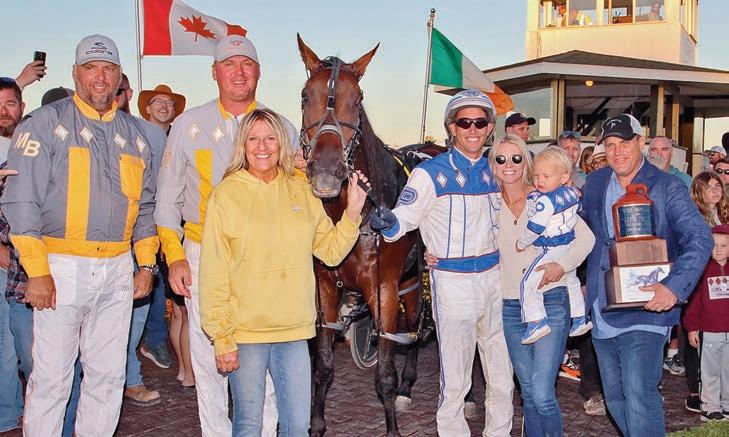
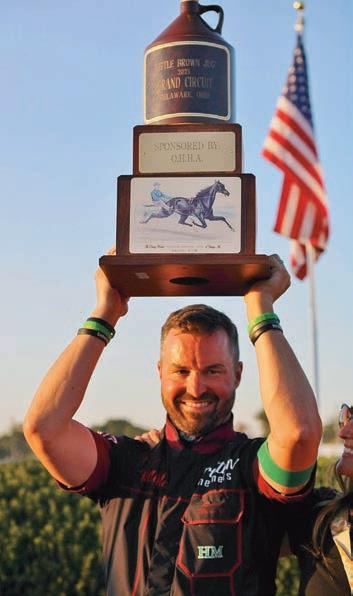
One of the biggest in harness racing, older than the Super Bowl and the same age as the NBA championship, is the Little Brown Jug, raced annually in mid-September at the Delaware County See LITTLE BROWN JUG |48







Fairgrounds.
Last year’s 80th edition saw Louprint take the title, following in the hoof prints of the greats like Niatross.
The Jug has offered a little bit of everything — wire-to-wire wins, photo finishes, heartbreak, hysteria and everything in between — over the years.
The event, at least conceptually, got its start in 1937 when the Delaware County Agricultural Society’s members voted to move the Delaware County Fair from Powell to a tract of land on the northern edge of Delaware. Two years later, a half-mile track, designed and built by local contractor R.K. McNamara, was ready for action.
Attorney Joe Neville and Henry C. “Hank” Thomson entered the picture shortly after that. Neville, whose family had been tied to the standardbred sport for many years, successfully obtained Grand Circuit dates for the new Delaware track.
With the lightning-fast track in place and a clear vision to go with it, the Little Brown Jug Society was formed to stage the Grand Circuit meeting. Neville headed up the organization and named Thomson, the sports editor of The Delaware Gazette, the secretarytreasurer.
With that, the Little Brown Jug — which got its name from a newspaper contest — was born. It had a couple previews in 1944 and 1945 before the real deal burst onto the scene in 1946.
Parking areas were packed by midmorning for that first race, which saw Ensign Hanover (driven by local legend Wayne “Curly” Smart) take the $35,358 purse. Smart, a successful trainer-driver on the Grand Circuit, later became an integral part of the Jug as the track’s superintendent.
The Jug’s done nothing but grow over the years, eventually becoming the final jewel of the Grand Circuit’s Triple Crown of Pacing along with The Cane Pace at Yonkers (New York) Raceway
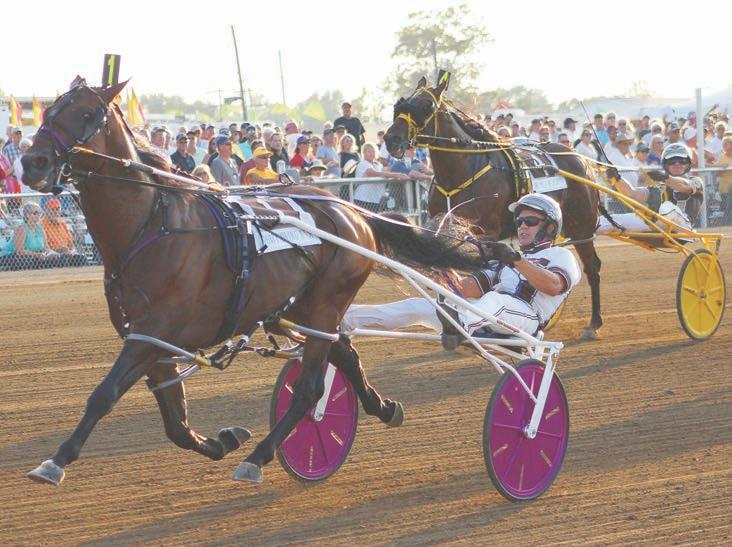
and the Messenger Stakes, which got its start at Roosevelt Raceway in Westbury, New York.
Tar Heel, driven by Del Cameron, authored the first two-minute mile at the Jug in 1951. Adios Butler later broke the two-minute threshold with an effort of 1:59.2 in 1959, and went on to become the first triple crown winner.
Bret Hanover, with Frank Ervin in the sulky, added to Jug lore in 1965. After Smart-directed track maintenance crews scraped the racing surface following days of rain, Bret Hanover won in the sensational time of 1:57 — a mark which stood until 1977, when Governor Skipper, driven by John Chapman, won in 1:56.1.
Hot Hitter was the 1979 victor in 1:55.3, Niatross won in 1980 in 1:54.4, and Lonestar Legend became the first sub-1:50 performer in 2008 with his 1:49.3 mile.
Even the 2020 race — smack dab in the middle of a global pandemic — went off without a hitch, minus the
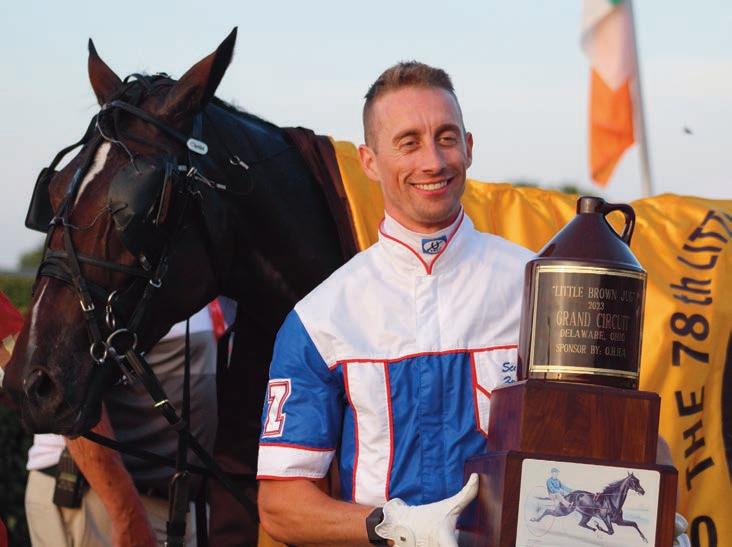
spectators, of course.Captain Barbossa won that one in 1:49.1.
Since, the Little Brown Jug has done nothing but get bigger, with the largest
purse ever ($1 million) awarded at the 78th edition a few years ago. Like America, the Little Brown Jug is here to stay.
By Gary Budzak gbudzak@aimmediamidwest.com
GALION — Most locals know that one former president of the United States is associated with the city of Marion, Ohio. What some may not know is that Warren Harding was actually born in Morrow County.
While some political or historical wags note that native son Rutherford Hayes’ birth home is no longer around, the same can be said for Harding, the most recent of Ohio’s eight U.S. presidents. There is a historical marker near the site, though, in Blooming Grove, which was placed in 1963.
Blooming Grove is between
Galion and Lexington, with Google Maps saying the Harding Birthplace is “In Blooming Grove on Ohio Route 97, 0.2 miles east of WilliamsportBloomingrove Road (County Route 20).”
Those so inclined to make a Harding field trip could take U.S. Route 42 northeast to cut over to the historical marker, reach Galion, then take the Harding Highway (state Route 309) through Caledonia (where Harding is said to have spent most of his youth) and drive 24 miles southwest over to his beloved Marion.
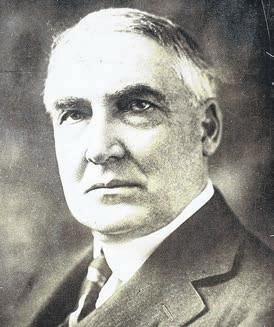
The Supreme Court of Ohio’s website has succinct biographies of “notable Ohioans who shaped our past and present.” Here’s what it says about Harding: “Warren Gamaliel Harding (Nov. 2, 1865–Aug. 2, 1923).

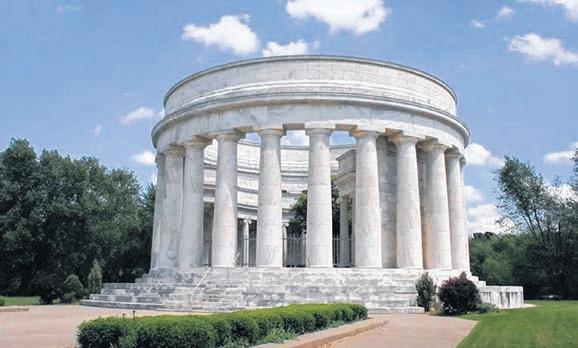
Warren G. Harding was born near Blooming Grove, Ohio. He served two terms in the Ohio Senate and was lieutenant governor from 1904 to 1906. In 1914, the first year in which U.S. See HARDING |50



senators were directly elected, Harding was elected to the U. S. Senate. In 1920, he was elected the 29th president of the United States. Three years later, while still in office, Harding suffered a heart attack, bronchial pneumonia and a cerebral hemorrhage, resulting in his death. He is buried in Marion, Ohio.”
The National Portrait Gallery’s biography of Harding is on the Historical Marker Database website.
“The first two decades of the 20th century had been marked by American involvement in a world war and a host of progressive reforms in the country’s economic and social institutions,” the database shared. “By 1920, voters wanted a rest from all this change and ferment and were ready for a brand of White House leadership that did not threaten the status quo. In Warren G. Harding, that year’s Republican presidential candidate, they found what they wanted. A convivial onetime newspaper editor (of The Marion Star), Harding made ‘normalcy’ the keynote of his campaign. Although the meaning of the newly coined term was uncertain, it at least promised no unsettling changes.
“Harding’s administration was marked by scandals. A trusting individual, he appointed cronies to his administration who proved all too ready to use their offices for private gain. Harding, however, escaped having to face the corrupt behav-
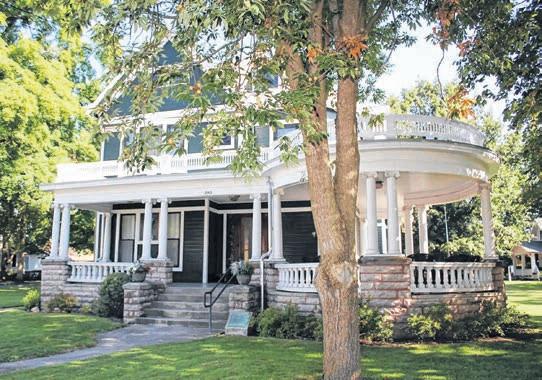
ior of his appointees. Just as stories of their wrongdoing were coming to light, he collapsed and died.”
The most famous of these scandals was Teapot Dome, which some people may remember from their high school’s American History class.
In Marion, there are three Harding Presidential Sites, all managed by the Ohio History Connection:
• The Harding Home, where he conducted his “front porch campaign” for the presidency. The home, at 380 Mt. Vernon Ave., can be toured. Harding was married in the home to Florence Kling in 1891, and they lived there for 30 years. The home has been open to the public for 100 years and was restored in 2020. The Press House, used by newspaper reporters covering the 1920 campaign, sits behind the Harding Home. For tour tickets, visit hardingpresidentialsites.org or call 800-
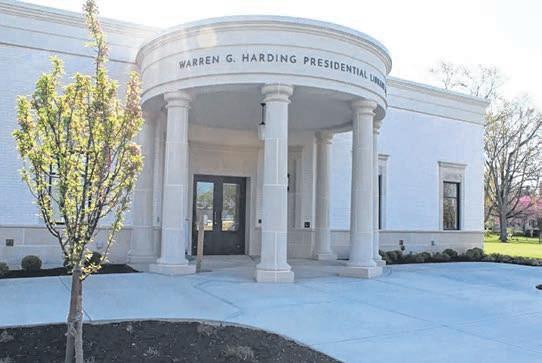
600-6894.
• The Harding Presidential Library and Museum is adjacent to the Harding Home. It was built in 2019 and opened to the public in 2021. The building includes more than 5,000 historical objects and a gift shop.
• The Harding Memorial gravesite is at 966-870 Delaware Ave. Following Harding’s death, there was debate whether to bury the popular president in Washington, D.C., or Marion. His hometown won out, and he and his wife were buried there in 1927, with President Herbert Hoover dedicating the memorial in 1931. The public can visit the 10-acre site during the daylight hours.
The Presidential Sites website said:
“The Harding Memorial and grounds are extremely visible to the Marion community and are a source of pride for our residents,” it wrote. “Marionites,
therefore, are protective of it. We encourage visitors to take photos and enjoy the setting. Partisan political gatherings are not permitted; participants are asked to exercise their rights to free speech only on the public sidewalks near the street.”
The Ohio State University branch at Marion usually has a Harding Symposium, but it is on hiatus this year. However, the OSU-Marion website said there were two Harding events of note tied in with America 250:
• Marion County’s America 250 Community Picnic, 4-8 p.m., Friday, July 17, at the Harding Presidential Sites.
• Annual Presidential Wreath laying, 10:30 a.m., Saturday July 18, Harding Memorial Presidential Grave.































3G Wednesday, June 24, 2026