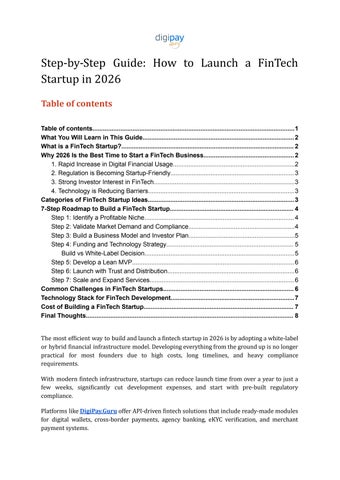
Step-by-Step Guide_ How to Launch a FinTech Startup in 2026
This allows founders, CTOs, and compliance teams to focus on growth, customer acquisition, and revenue generation instead of building complex backend systems
This guide outlines a practical, real-world roadmap used by fintech companies, banks, and payment operators to successfully launch and scale in 2026
What You Will Learn in This Guide
● Why 2026 is a strong year to start a fintech venture
● Step-by-step strategy to define your niche and business model
● Cost and time comparison: build vs white-label approach
● Execution roadmap from MVP to full-scale launch
● Scaling strategies for long-term growth
What is a FinTech Startup?
A fintech startup is a technology-focused company that builds digital financial services such as mobile wallets, remittance platforms, lending solutions, payment gateways, or embedded finance products.
These companies rely on APIs, cloud infrastructure, and digital compliance systems to deliver faster, more affordable, and more accessible financial services compared to traditional banking systems.
Why 2026 Is the Best Time to Start a FinTech Business
The global financial ecosystem is rapidly shifting toward digital-first payments, with massive growth in cross-border transactions and mobile financial services.
1. Rapid Increase in Digital Financial Usage
● Mobile wallets and digital accounts are expanding across developing and developed markets
● Smartphone adoption and internet penetration are enabling real-time financial services
● Users now expect instant, seamless, app-based financial experiences
● Emerging markets are growing faster than traditional banking systems
2. Regulation is Becoming Startup-Friendly
Governments worldwide are encouraging fintech innovation through:
● Regulatory sandbox environments
● Digital identity and eKYC frameworks
● Open banking and API-based financial ecosystems
● Cloud-friendly compliance structures
3. Strong Investor Interest in FinTech
Investors are actively funding fintech startups that show:
● Fast execution capability
● Clear monetization models
● Compliance-ready infrastructure
● Scalable business architecture
Funding is especially growing in regions like Africa, Southeast Asia, and the Middle East.
4. Technology is Reducing Barriers
Modern technologies are reshaping fintech development:
● AI improves fraud detection and automation
● Blockchain and stablecoins support instant cross-border settlement
● Cloud infrastructure reduces operational costs
● API-based platforms speed up product launches
Categories of FinTech Startup Ideas
Successful fintech companies usually focus on high-demand financial problems: Category Examples
Payments Digital wallet platforms, payment gateways
Lending Credit platforms, micro-lending apps
InsurTech Digital insurance distribution systems
Choosing the right category early helps define licensing requirements, development cost, and go-to-market strategy
7-Step
Roadmap to Build a FinTech Startup
Step 1: Identify a Profitable Niche
Start by selecting a focused problem area that has strong demand and clear revenue potential.
Popular opportunities include:
● Cross-border remittance services
● Digital wallets for low-connectivity regions
● Merchant payment and agency banking systems
● Embedded finance solutions for platforms
● Alternative lending models for underserved users
Key questions to evaluate:
● Can we generate revenue within 6–12 months?
● What licenses are required in target regions?
● Can we launch an MVP quickly?
Step 2: Validate Market Demand and Compliance
Before building anything, validate your idea:
● Study competitor apps and customer feedback
● Analyze transaction fees and UX gaps
● Interview real users or merchants
● Understand regional compliance requirements
Regional considerations:
● Africa: Mobile money and agent networks dominate
● MENA: Strict compliance and licensing rules
● Europe: Open banking and data protection laws
● Asia: QR payments and super-app ecosystems
Step 3: Build a Business Model and Investor Plan
A strong fintech business plan should include:
● Revenue model (fees, commissions, SaaS, FX margins)
● Growth stage: venture capital and strategic investors
● Scaling stage: debt financing or revenue-based funding
Build vs White-Label Decision
White-label solutions are usually the fastest and most cost-effective option for early-stage fintech startups
Step 5: Develop a Lean MVP
Your MVP should focus only on essential features:
● Secure onboarding with KYC
● Basic wallet or payment functionality
● Transaction history and reporting
● Admin dashboard
● Payment integrations
Avoid overbuilding Focus on stability, security, and compliance first
Step 6: Launch with Trust and Distribution
Successful launches depend on more than just technology:
● Clear pricing and transparency
● Strong customer support systems
● Regulatory visibility and trust signals
● Regional distribution partnerships
Channels vary by region:
● Africa: agents and telco networks
● Middle East: partnerships and influencer marketing
● Global: digital marketing and app ecosystems
Step 7: Scale and Expand Services
After launch, focus on optimization:
● Monitor CAC, LTV, and retention
● Improve onboarding conversion rates
● Reduce fraud and transaction failures
● Expand into new payment corridors
● Add services like cards, lending, or merchant tools
Common Challenges in FinTech Startups
Challenge
Solution
Regulatory complexity Use compliant, pre-built infrastructure
Security risks Adopt certified systems and audits
Customer trust issues Provide transparency and fast support
Technology Stack for FinTech Development
A modern fintech system includes:
● Real-time transaction ledger
● KYC and AML automation
● Payment routing engine
● Fraud detection system
● Analytics and admin dashboard
Estimated early-stage costs:
Marketing $5K – $30K
Using white-label infrastructure can significantly reduce these expenses
Final Thoughts
Building a fintech startup in 2026 is more accessible than ever, but success depends on speed, compliance readiness, and execution strategy.
Instead of spending years building infrastructure, modern founders are focusing on ready-to-use fintech platforms that allow them to launch faster and scale globally
With the right approach, startups can move from idea to revenue in a fraction of traditional timelines while staying fully compliant and investor-ready.
This content is originally posted on - Step-by-Step Guide: How to Start a FinTech Startup (2026)
Reach Us Today
Email - hello@digipay.guru Social
Contact Number - +91 9662923845, +1 (302) 305-4336