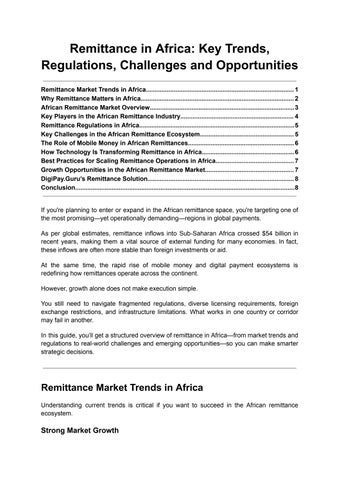
Remittance in Africa - Key Trends, Regulations, Challenges and Opportunities
Remittance in Africa: Key Trends, Regulations, Challenges
If you're planning to enter or expand in the African remittance space, you're targeting one of the most promising yet operationally demanding regions in global payments
As per global estimates, remittance inflows into Sub-Saharan Africa crossed $54 billion in recent years, making them a vital source of external funding for many economies In fact, these inflows are often more stable than foreign investments or aid
At the same time, the rapid rise of mobile money and digital payment ecosystems is redefining how remittances operate across the continent
However, growth alone does not make execution simple
You still need to navigate fragmented regulations, diverse licensing requirements, foreign exchange restrictions, and infrastructure limitations What works in one country or corridor may fail in another.
In this guide, you’ll get a structured overview of remittance in Africa from market trends and regulations to real-world challenges and emerging opportunities so you can make smarter strategic decisions.
Remittance Market Trends in Africa
Understanding current trends is critical if you want to succeed in the African remittance ecosystem
Strong Market Growth
The African remittance sector has shown consistent upward momentum, fueled by migration, urban expansion, and reliance on overseas income.
Countries such as Nigeria, Ghana, and Kenya continue to attract large inflows, especially from the US, Europe, and Gulf regions
Shift from Cash to Digital Channels
Traditional agent-based remittance models are gradually being replaced by digital-first platforms
This shift is not just about convenience it improves speed, reduces costs, and enhances transparency
Growth of Mobile Money
Mobile money has become a cornerstone of financial activity in Africa.
With high mobile penetration and limited banking access, digital wallets are now the primary channel for receiving and using remittances in many regions
�� Expert Tip
If you're entering this market, adopt a mobile-first strategy from the beginning In many African countries, mobile wallets outperform traditional banking channels in both adoption and reach.
Why Remittance Matters in Africa
Remittances are more than just financial transfers they play a crucial role in economic stability and development
Economic Impact of Remittances
Impact Area
Role of Remittances
GDP Contribution Significant in several economies
Household Support Funds education, healthcare, and daily needs
Foreign Exchange Strengthens national reserves
Financial Inclusion Entry point into formal finance
Key Insights
● GDP Contribution: In multiple countries, remittances account for a notable share of GDP, making them a policy priority
● Household Stability: These funds are often used for essential expenses, ensuring steady transaction volumes
● FX Stability: Governments depend on remittances to support foreign reserves, influencing currency policies
● Financial Inclusion: Remittances often introduce users to formal financial systems, especially via mobile wallets.
African Remittance Market Overview
To truly understand the market, you need to look beyond growth figures and focus on flow dynamics and cost structures
Africa is already a high-volume remittance destination, with total inflows nearing $100 billion annually.
Key Market Insights
● In 19 out of 54 countries, remittances contribute over 4% of GDP
● Remittances often exceed foreign direct investment (FDI) and aid
● Africa remains the most expensive region for remittances, with average costs around 8–8 5% �� This means the real opportunity lies in improving efficiency reducing costs, speeding up transfers, and optimizing corridors
South Africa → Zimbabwe Intra-Africa Labor movement
Gulf → East Africa International Employment migration
�� Expert Tip
Avoid treating Africa as a single market Success depends on optimizing individual corridors, each with unique regulations, costs, and payout methods
Key Players in the African Remittance Industry
The ecosystem is shaped by three major categories:
1. Traditional Money Transfer Operators (MTOs)
● Strong in cash-based economies
● Extensive agent networks
● Higher costs and slower processing
2. Banks and Financial Institutions
● High trust and regulatory stability
● Limited flexibility and slower innovation
3. Digital Platforms & Mobile Money Providers
● Fast-growing segment
● Mobile-first, cost-efficient, and transparent
● Real-time transaction tracking
Traditional vs Digital Comparison
Access Agent-based Mobile-first
Transparency Limited Real-time
Remittance Regulations in Africa
Regulation plays a central role in how remittance businesses operate and scale
Key Regulatory Areas
Area Description
Licensing Central bank approvals
AML/KYC Identity verification requirements
FX Controls Currency conversion rules
Transfer Limits Caps and reporting obligations
Each country has its own framework, which adds complexity to expansion strategies
�� Expert Tip
Being compliance-ready from the start is a major advantage Using pre-built compliance infrastructure can significantly speed up market entry
Key Challenges in the African Remittance Ecosystem
Scaling in Africa comes with several operational and regulatory hurdles
Major Challenges
● High Costs: Transaction fees remain among the highest globally
● Regulatory Fragmentation: Different rules across countries slow expansion
● Currency Volatility: FX fluctuations impact pricing and margins
● Agent Dependency: Heavy reliance on agents limits scalability
�� These factors directly affect cost efficiency, speed, and long-term growth
The Role of Mobile Money in African Remittances
Mobile money is central to how remittances are delivered and used across Africa
Bank vs Mobile Money Transfers
Feature Bank Transfer Mobile Money
Accessibility
Why Mobile Money Matters
● Expands access to unbanked populations
● Enables faster transactions
● Reduces dependency on intermediaries
● Improves reach in rural areas
How Technology Is Transforming Remittance in Africa
Technology is solving many of the long-standing inefficiencies in the market
Key Innovations
API-Driven Platforms
Allow seamless integration with banks, wallets, and partners across multiple corridors
Real-Time Processing
Enables instant transfers and full transaction visibility.
Automated Compliance
Reduces manual effort through built-in AML/KYC checks.
Smart Routing
Optimizes transaction paths to reduce cost and improve success rates.
Mobile Wallet Integration
Ensures faster last-mile delivery.
Best Practices for Scaling Remittance Operations in Africa
To scale effectively, you need a strategy aligned with local realities.
Proven Strategies
● Build corridor-specific approaches
● Partner with local banks and mobile operators
● Prioritize mobile wallet integration
● Use API-first infrastructure
● Automate compliance and monitoring
● Optimize FX and settlement flows
● Design for cost efficiency
● Plan for regulatory diversity
�� Expert Tip
Scaling in Africa is not about rapid expansion. A well-optimized single corridor often delivers better results than multiple poorly managed ones
Growth Opportunities in the African Remittance Market
The market is evolving rapidly, creating multiple growth avenues
Key Opportunities
● Intra-Africa Corridors: Less competitive and high-growth potential
● Mobile Money Expansion: Access to millions of unbanked users
● Digital-First Platforms: Growing demand for faster, transparent services
● SME Payments: Increasing need for business remittances
● Cross-Border Bill Payments: Value-added services boost retention
● Cost Optimization: Lower fees can drive market share
DigiPay.Guru’s Remittance Solution
To succeed in Africa, you need infrastructure that simplifies complexity
DigiPayGuru offers a comprehensive cross-border remittance platform designed for banks, fintechs, and payment providers
Key Capabilities
● Multi-currency and multi-corridor support
● Flexible FX and commission management
● Integrated payout networks
● Agent management module
● Smart routing engine
● Built-in AML and compliance tools
● Cross-border bill payment support
● Real-time tracking and reporting
Conclusion
Remittance in Africa presents a massive opportunity but it requires a precise and well-informed approach
The market is driven by strong inflows, rapid mobile adoption, and expanding digital ecosystems At the same time, regulatory diversity, high costs, and infrastructure challenges make execution complex
Your success depends on:
● Understanding corridor-level dynamics
● Ensuring compliance across regions
● Building scalable and flexible infrastructure
The institutions that succeed are not just early entrants they are the ones that execute efficiently.
With a platform like DigiPayGuru, you can simplify operations, reduce costs, and scale confidently across multiple markets using a unified, API-driven system
If you're planning to enter or expand in Africa, the right foundation will ultimately determine how far and how fast you grow This content is originally posted