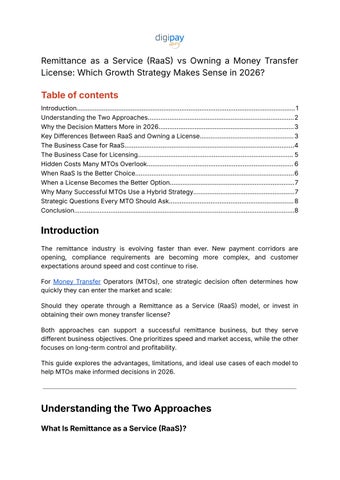
Remittance as a Service RaaS vs Owning a Money Transfer License:WhichGrowthStrategyMakesSensein2026?
Tableofcontents
Introduction
The remittance industry is evolving faster than ever New payment corridors are opening, compliance requirements are becoming more complex, and customer expectationsaroundspeedandcostcontinuetorise.
For Money Transfer Operators MTOs, one strategic decision often determines how quicklytheycanenterthemarketandscale:
Should they operate through a Remittance as a Service RaaS model, or invest in obtainingtheirownmoneytransferlicense?
Both approaches can support a successful remittance business, but they serve differentbusinessobjectives.Oneprioritizesspeedandmarketaccess,whiletheother focusesonlong-termcontrolandprofitability.
Thisguideexplorestheadvantages,limitations,andidealusecasesofeachmodelto helpMTOsmakeinformeddecisionsin2026
RemittanceasaServiceisabusinessmodelthatallowsMTOstolaunchcross-border money transfer services using the regulatory infrastructure, compliance framework, andpaymentnetworkofanexistinglicensedprovider.
Instead of spending years obtaining licenses and building compliance operations, businessescanleverageanestablishedecosystemandfocusoncustomeracquisition andmarketgrowth.
TypicalRaaSofferingsinclude:
● Regulatorycoverage
● KYCandAMLprocesses
● Paymentprocessinginfrastructure
● Settlementmanagement
● White-labelremittanceplatforms
● APIintegrations
WhatDoesOwningaMoneyTransferLicenseInvolve?
Amoneytransferlicenseauthorizesacompanytoprovideremittanceservicesdirectly underitsownregulatoryapproval.
Thebusinessbecomesfullyresponsiblefor:
● Regulatorycompliance
● AMLmonitoring
● Reportingobligations
● Riskmanagement
● Partnerrelationships
● Customerprotectionrequirements
This approach provides complete operational independence but requires significant investmentandregulatorycommitment.
WhytheDecisionMattersMorein2026
Theremittancemarketisbecomingincreasinglycompetitive
Businessesarenolongercompetingsolelyontransferfees.Successnowdependson:
● Speedtomarket
● Corridorexpansion
● Regulatoryadaptability
● Customerexperience
● Operationalefficiency
Choosing the wrong operational model can delaygrowthopportunitiesorlimitfuture scalability.
TheBusinessCaseforRaaS
1.FasterMarketEntry
LaunchingthroughaRaaSprovidercansignificantlyreducethetimerequiredtoenter newmarkets
Businesses can begin testing customer demand and transaction flows while competitorsarestillnavigatinglicensingprocedures.
2.ReducedRegulatoryComplexity
RegulatorycomplianceremainsoneofthelargestbarriersfornewMTOs
RaaS providers often manage critical compliance functions, allowing operators to focusongrowthratherthanregulatoryadministration.
3.LowerFinancialRisk
Obtaininglicensesoftenrequires:
● Regulatoryapplicationfees
● Compliancepersonnel
● Legaladvisors
● Capitalreserverequirements
RaaSeliminatesmuchofthisupfrontburden.
4.EasierCorridorTesting
Beforecommittingsignificantresources,businessescanevaluate:
● Customerdemand
● Transactionvolume
● Pricingcompetitiveness
● Operationalfeasibility
Thisreducesexpansionrisk.
TheBusinessCaseforLicensing
Licensedoperatorscanindependentlymanage:
● Pricingstrategies
● Customerexperience
● Compliancepolicies
● Partnernegotiations
Thislevelofcontrolbecomesincreasinglyvaluableatscale.
2.ImprovedMarginRetention
RaaSproviderstypicallychargetransaction-basedfees.
Astransactionvolumesincrease,thesecostscanimpactprofitability.
Owningalicenseenablesbusinessestoretainalargerportionoftransactionrevenue
3.GreaterStrategicFlexibility
LicensedMTOscan:
● Enternewmarketsindependently
● Negotiatedirectlywithbankingpartners
● Createcustomcomplianceworkflows
● Developproprietaryserviceofferings
4.StrongerEnterprisePositioning
Institutional partners often prefer working with directly licensed entities due to governanceandcomplianceconsiderations.
HiddenCostsManyMTOsOverlook
When evaluating RaaS versus licensing, businesses frequently focus on direct expenses
However,indirectcostsoftenhaveagreaterimpact.
HiddenLicensingCosts
● Delayedmarketentry
● Lostcustomeracquisitionopportunities
● Extendedcomplianceimplementationtimelines
● Capitaltiedupinregulatoryrequirements
HiddenRaaSCosts
● Revenuesharingarrangements
● Dependencyonthird-partyinfrastructure
● Limitedcustomization
● Reducednegotiationleverage
Astrategicassessmentshouldaccountforbothvisibleandhiddencosts.
WhenRaaSIstheBetterChoice
RaaSisoftenidealwhen:
● Launchinganewremittancebusiness
● Testingnewpayoutcorridors
● Expandinginternationally
● Operatingwithlimitedcomplianceresources
● Validatingproduct-marketfit
Theprimaryobjectiveisspeedandmarketvalidation.
WhenaLicenseBecomestheBetterOption
Licensingoftenbecomesmoreattractivewhen:
● Monthlytransactionvolumesareconsistentlyhigh
● Compliancecapabilitiesareestablished
● Multipleinternationalcorridorsareactive
● Enterpriseclientsrequiredirectregulatoryoversight
● Long-termprofitabilitybecomesapriority
Atthisstage,operationalcontroltypicallyoutweighslicensingcosts.
An increasing number of remittance businesses no longer view the decision as either-or.
Instead,theyadoptaphasedapproach:
Phase1LaunchThroughRaaS
Quickmarketentrywithminimalregulatorybarriers.
Phase2ValidateGrowth
Buildtransactionvolumeandcustomerbase
Phase3BeginLicensingProcess
Useoperationaldatatosupportexpansionplans.
Phase4TransitionSelectOperations
Graduallymoveselectedcorridorsunderdirectlicensing
Thisapproachcombinesspeed,learning,andlong-termcontrol.
StrategicQuestionsEveryMTOShouldAsk
BeforechoosingbetweenRaaSandlicensing,consider:
● Howquicklydoweneedtolaunch?
● Havewevalidatedcorridordemand?
● Canwesupportongoingcomplianceobligations?
● Whattransactionvolumedoweexpectwithinthenextthreeyears?
● Areoperationalcontrolandmarginoptimizationcriticalpriorities?
Theanswersoftenrevealwhichpathismostappropriate.
Conclusion
ThedebatebetweenRemittanceasaServiceandowningamoneytransferlicenseis notaboutdeterminingwhichmodelisuniversallybetter
Itisaboutselectingtherightmodelforthecurrentstageofyourbusiness.
RaaS enables faster entry, reduced risk, and quicker validation. Licensing provides greatercontrol,strongermargins,andlong-termindependence.
For many MTOs in 2026, the most effective strategy is not choosing one over the other itisknowingwhentotransitionfromonetothenext
Businesses that align their regulatory strategy with their growth stageareoftenbest positionedtocompeteintheincreasinglydynamicremittancelandscape.
This content is originally posted on - Remittance as a Service RaaS vs Owning a MoneyTransferLicense:AStrategicDecisionforMTOs2026
ReachUsToday
Email-hello@digipay.guru