How to Handle High Transaction Volume in Remittance Software
How to Handle High Transaction Volume in Remittance Software
Global remittance flows have reached new highs, crossing $879 billion and continuing to grow as cross-border trade, migration, and digital payments expand
For banks, fintechs, and remittance providers, this growth creates a major challenge how to process high transaction volumes without affecting speed, compliance, or reliability
When your system struggles under load, the impact is immediate: delayed payments, slower compliance checks, and a poor customer experience
Transaction spikes are common in remittance and usually occur during:
● Salary cycles
● Festive and holiday periods
● Sudden corridor demand surges
● Currency fluctuations
If your platform cannot handle scale, it can lead to failed settlements, compliance delays, customer churn, and lost revenue.
That’s why building a scalable remittance platform is no longer optional it’s essential
What High Transaction Volume Means in Remittance
High transaction volume refers to a system’s ability to process thousands or even millions of cross-border transfers within a short timeframe without downtime, delays, or errors.
But it’s not just about numbers
Each transaction involves multiple backend processes such as:
● AML and KYC checks
● FX calculations
● Routing decisions
● Settlement updates
When these processes run simultaneously at scale, your system must be designed to handle both volume and complexity
A robust remittance platform should support:
● Scalable infrastructure
● Fast transaction processing
● Automated compliance checks
● Real-time monitoring and reconciliation
Why Traditional Remittance Systems Struggle at Scale
Many legacy systems were built for moderate transaction loads and fail when volumes increase Common Limitations
A monolithic setup means one bottleneck can slow down the entire system Combined with manual workflows and rigid logic, this makes scaling difficult.
�� Expert Tip
Analyze peak transaction patterns across corridors. Most spikes are predictable planning for them improves performance without overloading resources.
Core Architecture for High-Volume Remittance
To manage large-scale transactions, you need a modern, flexible system architecture
A microservices approach allows each function like FX, compliance, or routing to scale independently, improving overall system performance
Optimizing Transaction Flow
Even with strong infrastructure, workflows must be optimized for speed.
Scalable Transaction Flow
1 API request enters via load balancer
2. Compliance checks run in parallel
3. FX rates are fetched (cached + live)
4 Smart routing selects the best partner
5 Ledger updates instantly
6. Settlement is recorded automatically
7 User receives real-time confirmation
Parallel processing and queue management help absorb traffic spikes without slowing down the system.
Smart Routing and Load Distribution
High-volume platforms must distribute transactions across multiple partners and corridors
A smart routing engine selects the best payout path based on:
● Cost efficiency
● Processing speed
● Corridor availability
● Partner reliability
This prevents overloading a single network and ensures consistent performance
FX Optimization for High Volume
Foreign exchange processing is one of the most resource-intensive tasks
To improve performance, modern systems use a hybrid approach:
● Cached exchange rates
● Scheduled updates
● Real-time validation
This ensures fast processing while maintaining pricing accuracy and protecting margins.
Compliance and Monitoring at Scale
Compliance is critical but can slow down operations if not automated.
● Automated AML screening
● Sanctions checks
● Real-time transaction monitoring
● Risk scoring engines
Integrating compliance directly into the transaction flow ensures security without delays.
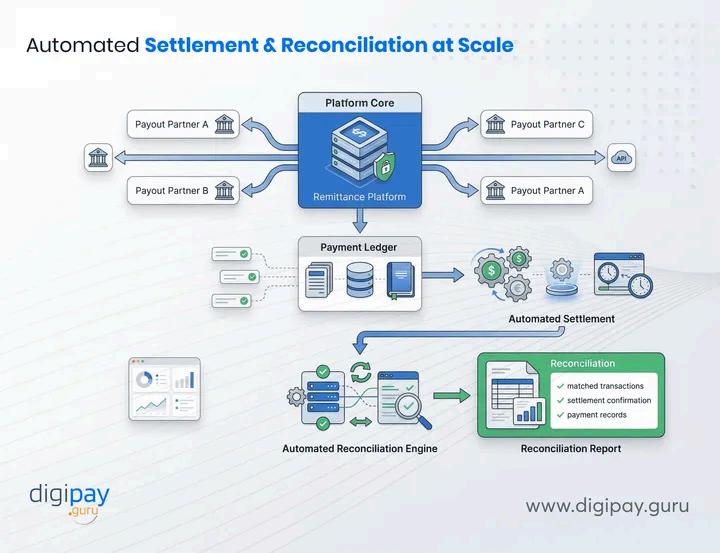
Automated Settlement and Reconciliation
Manual reconciliation does not work at scale.
Modern platforms use automation for:
● Transaction matching
● Settlement tracking
● Exception handling
● Reporting
This reduces operational workload and improves financial accuracy
Performance Monitoring and Uptime
Continuous monitoring ensures your system remains stable during peak loads
Key Metrics to Track
● Transaction latency
● API response time
● System uptime
● Server utilization
Real-time alerts help detect and resolve issues before they impact users
Common Mistakes to Avoid
When scaling remittance systems, avoid these pitfalls:
● Scaling databases without fixing architecture
● Ignoring FX processing delays
● Skipping stress testing
● Relying on manual compliance
● Using manual reconciliation processes
These mistakes often lead to performance issues under high load
Build vs Scalable Platform
Expansion Complex
Configurable
While custom builds offer control, scalable platforms are better suited for high-volume environments
Conclusion
Handling high transaction volume is now a core requirement for any remittance business
As global payments continue to grow, your system must be able to process large volumes without delays, compliance issues, or downtime.
This requires more than just adding capacity it demands a well-designed architecture with:
● Scalable infrastructure
● Intelligent routing
● Automated compliance
● Real-time monitoring
When these elements work together, high transaction volume becomes an opportunity rather than a challenge
Platforms like DigiPayGuru are built to support this scale, helping financial institutions manage large transaction loads with speed, reliability, and full control
With the right setup, you can turn transaction growth into a strong competitive advantage in the remittance space
This content is originally posted on - Handling High Transaction Volume in Remittance Software