International remittances have always played a key role in helping people send money to family and friends living overseas. With rising global migration for education and employment, cross-border payments have become a daily necessity
Now, the industry is evolving further
What if your customers could directly pay bills for their loved ones abroad instantly and securely without sending money separately?
That’s exactly what cross-border bill payments make possible.
In this blog, you’ll learn:
● What cross-border bill payments are
● How the process works
● Key use cases
● Benefits for remittance platforms
● Challenges to consider
● How DigiPayGuru supports this capability
Let’s start with the basics.
What Are Cross-Border Bill Payments?
Cross-border bill payments allow users to directly pay bills such as utilities, tuition, or rent for someone living in another country
Instead of transferring money to a recipient and relying on them to make the payment, funds go straight to the service provider
This approach adds convenience, control, and transparency to the international remittance platform.
Key Difference from Traditional Remittance
● Traditional remittance: Send money → recipient pays bills
● Cross-border bill payments: Pay bill directly to the provider
This ensures funds are used for their intended purpose and reduces dependency on intermediaries
How Cross-Border Bill Payments Work
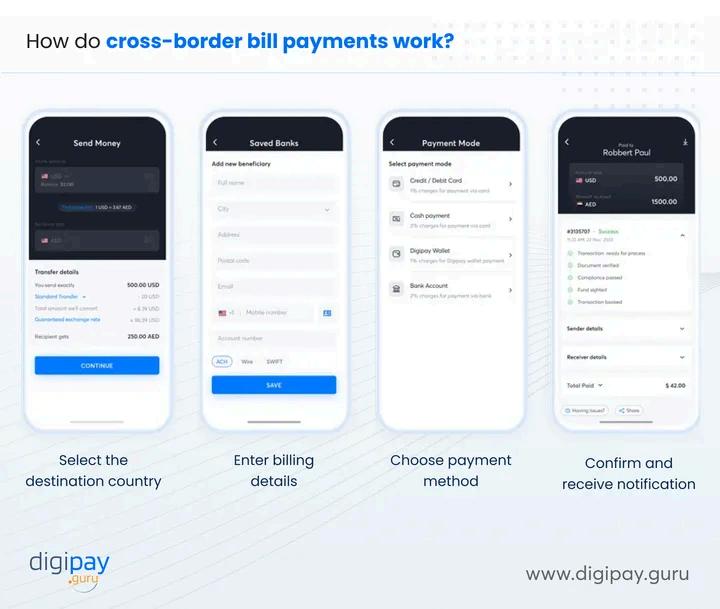
Here’s a simple breakdown of how the process works:
Step 1: Select Destination Country
The user chooses the country where the bill needs to be paid.
Step
2: Enter Billing Details
They provide account or biller information to ensure accurate payment
Step 3: Choose Payment Method
Users select their preferred option bank transfer, card, or digital wallet
Step 4: Confirm Payment
After reviewing details, the payment is confirmed and a real-time notification is sent.
This streamlined process ensures speed, accuracy, and full visibility
Common Use Cases of Cross-Border Bill Payments
Cross-border bill payments are highly versatile and solve real-life financial needs
Some common examples include:
● Paying electricity, water, or gas bills for family abroad
● Covering tuition fees for students studying overseas
● Settling hospital or medical expenses
● Paying rent or home loan EMIs in another country
● Managing subscriptions like insurance or streaming services
These use cases highlight how practical and valuable this feature is in today’s global economy
Benefits of Cross-Border Bill Payments for Remittance Platforms
Adding this feature to your remittance platform offers both customer and business advantages
Enhanced Customer Experience
Customers prefer simplicity and reliability.
● Direct bill payments save time
● Real-time confirmations improve transparency
● Reduced risk of fund misuse
New Revenue Streams
This feature opens up additional earning opportunities
● Transaction fees on payments
● FX margins on currency conversion
● Premium services for faster processing
Stronger Customer Retention
Offering more value keeps users engaged
● Builds long-term loyalty
● Encourages repeat transactions
● Improves trust through reliable services
Expanded Service Offering
A broader product portfolio strengthens your market position
● Encryption and authentication enhance protection
● Safer transactions increase user confidence
Improved Financial Inclusion
● Helps unbanked users access essential services
● Expands reach in emerging markets
● Supports economic participation
Competitive Advantage
● Positions your platform as innovative
● Strengthens brand perception
● Helps you stay ahead in a crowded market
Challenges of Cross-Border Bill Payments
While the benefits are strong, there are some challenges to address
Integration Complexity
Integrating multiple billers and payment systems across countries can be technically demanding.
Regulatory Compliance
You must comply with strict KYC, AML, and cross-border regulations in each jurisdiction
Currency Conversion Risks
Exchange rate fluctuations and hidden fees can affect transparency and customer trust
To overcome these challenges, you need robust infrastructure and clear pricing mechanisms.
How DigiPay.Guru Supports International Bill Payments
DigiPay.Guru offers a powerful cross-border bill payment feature as part of its remittance platform, helping businesses simplify global bill payments
Key Features
● Multi-currency support - Pay bills in local currencies across different corridors
● Automated reconciliation - Match transactions accurately across systems
● Scheduled & recurring payments - Enable automated bill payments for convenience
● Configurable corridors - Customize routes based on country regulations
● Multiple payment options - Support cards, wallets, and bank transfers
● Support for various bill types - Utilities, education, healthcare, and more
Core Platform Capabilities
● Seamless API integration
● Real-time payment processing
● Secure transaction handling
● User-friendly interface
● Cost-efficient operations
● AML and sanctions screening
● Real-time analytics and tracking
● Smart routing for faster transfers
These capabilities help businesses deliver efficient and scalable cross-border payment services
Conclusion
Cross-border bill payments are transforming how people support their families abroad Instead of just sending money, users can now directly manage essential expenses from anywhere in the world
For remittance businesses, this feature creates a strong opportunity to increase revenue, improve customer loyalty, and stand out in a competitive market
With solutions like DigiPayGuru, you can offer seamless, secure, and efficient international bill payment services helping your customers pay for utilities, education, healthcare, and more without friction
As global payments continue to evolve, adding cross-border bill payments to your platform is no longer optional it’s a strategic advantage.
This content is originally posted on - Cross-Border Bill Payments: How It Works, Use Cases, Benefits & Solutions