Fintech Kenya 2026_ Market Trends, Opportunities, Challenges, and Future Outlook

Page 1


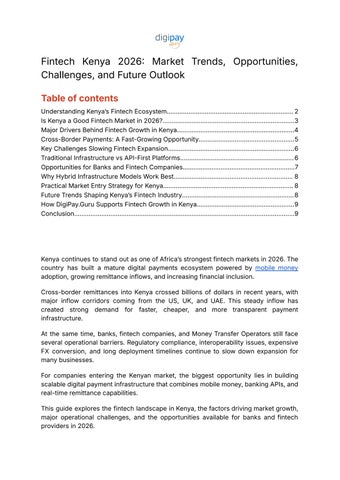
KenyacontinuestostandoutasoneofAfricaʼsstrongestfintechmarketsin2026 The country has built a mature digital payments ecosystem powered by mobile money adoption,growingremittanceinflows,andincreasingfinancialinclusion.

Cross-border remittances into Kenya crossed billions of dollars in recent years,with major inflow corridors coming from the US, UK, and UAE This steady inflow has created strong demand for faster, cheaper, and more transparent payment infrastructure.

At the same time, banks,fintechcompanies,andMoneyTransferOperatorsstillface severaloperationalbarriers Regulatorycompliance,interoperabilityissues,expensive FX conversion, and long deployment timelines continue to slow down expansion for manybusinesses.

For companies entering the Kenyan market, the biggest opportunity lies in building scalabledigitalpaymentinfrastructurethatcombinesmobilemoney,bankingAPIs,and real-timeremittancecapabilities.

ThisguideexploresthefintechlandscapeinKenya,thefactorsdrivingmarketgrowth, major operational challenges, and the opportunities available for banks and fintech providersin2026

UnderstandingKenyaʼsFintechEcosystem

Kenyaʼs fintech environment has evolved into one of the most connected digital finance ecosystems in Africa Mobile money services are deeply integrated into everydaytransactions,fromutilitypaymentstobusinesstransfers

Theecosystemisbuiltaroundseveralkeysegments: Segment

MobileWallets Daily financial transactions Drivesfinancialaccessibility

DigitalLending Consumer and SME credit Expandstransactionactivity

Payment Infrastructure Merchantcollections Supportsdigitalcommerce

RemittancePlatforms Internationaltransfers Generates high transaction volume

BankingAPIs Financialconnectivity Acceleratesfintechinnovation

The real strength of Kenyaʼs fintech sector comes from how these systems interact withoneanother.

Mobile wallets simplify payments for consumers. Digital lending solutions provide faster access to credit. Payment gateways help merchants accept money from multiplechannels,whilebankingAPIsconnecttraditionalbankingsystemswithnewer fintechproducts.

Together, these components create a strong foundation for digital financial services acrossthecountry.

IsKenyaaGoodFintechMarketin2026?

Kenya offers strong expansion potential for fintech companies,remittanceproviders, and banks, especially those focused on cross-border payments and mobile-first services

Severalfactorsmakethemarketattractive:

RemittanceInflows High Strong diaspora-driven demand

MobileMoneyUsage VeryHigh Large digital payment adoption

Regulatory Environment Moderate Structuredbutmanageable

Cross-Border Payments High Large opportunity for innovation

FinancialInclusion Strong Expandingdigitaluserbase

For companies planning to enter the Kenyan market, success depends on offering services that are affordable, fast, compliant, and easy to integrate with existing paymentsystems.

MobilemoneyremainsthebackboneofKenyaʼsdigitaleconomy.Millionsofusersrely on mobile wallets for transfers, bill payments, merchant purchases, and savings activities.

The combination of smartphone applications and USSD accessibility allows financial servicestoreachbothurbanandruralpopulationsefficiently.

This widespread adoption creates an ideal environment for fintech companies launchingnewdigitalpaymentproducts

2.RisingCross-BorderRemittances

InternationalremittancescontinuetofuelfinancialactivityacrossKenya.

Large diaspora communities regularly send money back home through digital channels These inflows support household spending, education, healthcare, and smallbusinessoperations.

As customers increasingly prefer faster digital transfer methods, the demand for efficientcross-borderpaymentinfrastructurekeepsgrowing.

3.ExpandingFinancialInclusion

Government initiatives and digital banking programs have significantly increased financialaccessacrossKenya.

Agentbankingnetworksandmobilepaymentsystemsnowserveareasthatpreviously hadlimitedaccesstotraditionalfinancialservices.

This wider financial reach has accelerated adoption of fintech solutions among previouslyunderservedcommunities.

4.StartupandInvestmentActivity

NairobicontinuestoattractfintechinvestmentandstartupactivityacrossAfrica.

Local startups are developing innovative payment tools, lending solutions, wallet platforms,andAPI-drivenservicesthataddresspracticalmarketproblems

ThisongoinginnovationcontinuestostrengthenKenyaʼsfintechecosystemyearafter year.

Cross-BorderPayments:AFast-GrowingOpportunity

Cross-border remittances remain one of the biggest growth opportunities in Kenyaʼs fintechsector.

Key corridors such as UAE Kenya, UK Kenya, and USA Kenya continue to generate hightransfervolumes

Area Traditional Systems ModernAPIPlatforms

FXCosts Higherspreads Lower conversion costs

TransferSpeed Delayedsettlement Fasterprocessing

User Experience Fragmented Unifieddigitalflow

Transparency Limitedvisibility Real-timetracking

Modern API-based payment systems help businesses improve settlement speed, optimizeFXrouting,andreduceoperationalcosts.

For fintech companies and banks, this creates strong revenue opportunities in high-frequencyremittancecorridors.

KeyChallengesSlowingFintechExpansion

Despitestronggrowth,Kenyaʼsfintechsectorstillfacesseveralimportantbarriers

RegulatoryComplexity

Licensing and compliance requirements remain challenging for many companies, particularlythoseoperatingacrossborders.

Managing KYC, AML, transaction monitoring, and reporting obligations can significantlyincreaseoperationaloverhead.

LimitedInteroperability

Manyfinancialsystemsstilloperateindependently,makingintegrationsdifficult

This lack of seamless connectivity affects customer experience and slows digital paymentadoptionacrossplatforms.

HighFXConversionCosts

Currencyconversionremainsexpensiveformanybusinessesandcustomers.

Inefficient routing and high FX spreads reduce profitability for remittance providers andincreasecostsforendusers.

InfrastructureLimitations

Internet reliability and payment infrastructure gaps continue to affect some rural regions.

These limitations make consistent real-time financial services harder to deliver nationwide.

TraditionalInfrastructurevsAPIFirstPlatforms

Fintech businesses entering Kenya often face a major decision: build everything internallyorusemodularinfrastructure.

DeploymentTime Long implementation cycles

DevelopmentCosts High engineering investment Lowersetupcosts

CorridorExpansion Slowonboarding Fasterintegrations

Scalability Limitedflexibility Designedforgrowth

Modern API-first infrastructure allows fintech companies to launch faster while reducingoperationalcomplexity.

OpportunitiesforBanksandFintechCompanies

ForBanks

● Modernizeremittanceoperations

● ImproveFXcompetitiveness

● Expanddigitalserviceofferings

● IntegratewithfintechpartnersthroughAPIs

● Improvetransactionvisibilityandautomation

ForFintechProviders

● Buildwallet-basedremittanceexperiences

● Focusonunderservedcorridors

● Offerfasterdigitalonboarding

● Deliverlower-costinternationaltransfers

● Createintegratedpaymentecosystems

Collaboration between banks and fintech companies is becoming increasingly importantforlong-termsuccess.

WhyHybridInfrastructureModelsWorkBest

Hybridfintechinfrastructurecombinesthestrengthsofbanksandfintechproviders.

Bankscontributecomplianceexpertise,liquiditymanagement,andregulatorystability. Fintech companiescontributefastertechnology,betteruserexperiences,andflexible APIs

Thiscombinedmodelallowsbusinessesto:

● Scaleoperationsfaster

● Improvepaymentrouting

● Reduceoperationalcosts

● Expandintonewcorridorsefficiently

● Maintaincompliancewhileinnovating

In Kenyaʼs competitive market, hybrid infrastructure is becoming the preferred operatingmodel.

PracticalMarketEntryStrategyforKenya

Companies entering the Kenyan fintech market should focus on a phased rollout strategy.

RecommendedApproach

1 Startwithahigh-volumecorridor

2 Partnerwithcompliantinfrastructureproviders

3. IntegratepaymentAPIsandmobilewallets

4. ImplementintelligentFXrouting

5. Useexistingagentnetworksfordistribution

6. Expandgraduallyintoadditionalcorridors

Thisapproachhelpsreduceoperationalriskwhileimprovingspeed-to-market.

FutureTrendsShapingKenyaʼsFintechIndustry

Several trends areexpectedtoreshapetheKenyanfintechsectorbetween2026and 2030.

EmbeddedFinance

Financial services are increasingly being integratedintonon-financialplatformssuch aseCommerce,mobility,andagricultureapps

OpenBankingExpansion

API-driven banking services are enabling better connectivity between fintechs and traditionalfinancialinstitutions.

Real-TimeCross-BorderPayments

Fastersettlementsystemsandregionalpaymentnetworksareimprovinginternational transfersacrossAfrica.

SmarterDigitalWallets

Wallet platforms are evolving beyond payments to include savings, lending, investments,andinsuranceservices.

Thesetrendsarepushingtheindustrytowardmoreconnectedandintelligentfinancial ecosystems

HowDigiPay.GuruSupportsFintechGrowthinKenya

DigiPay.Guru provides modular remittance infrastructure built for banks, MSBs, and fintechprovidersoperatinginmarketslikeKenya

Theplatformhelpsbusinesses:

● Integratewithlocalbanksandmobilewallets

● ImproveFXoptimizationandrouting

● Automatecomplianceandtransactionmonitoring

● Supportreal-timeremittanceprocessing

● Scaleacrossmultiplecorridorsfaster

● Reducedeploymenttimelinessignificantly

ItsAPI-firstarchitectureallowscompaniestomaintainfullcontrolovertheiroperations whileacceleratingmarketexpansion.

Conclusion

KenyaremainsoneofAfricaʼsmostpromisingfintechmarketsin2026.

The countryʼs strong mobile money ecosystem, growing remittance activity, and expanding digital financial services continue to create major opportunities for banks andfintechcompanies

However,businessesstillneedtoovercomeregulatorycomplexity,infrastructuregaps, interoperabilityissues,andhighoperationalcoststoscalesuccessfully.

Modern API-first infrastructure and hybrid operating models are helping companies solvethesechallengeswhileimprovingspeed,flexibility,andprofitability.

As fintech adoption continues to expand, Kenya is expected to remain a leading innovationhubfordigitalpaymentsandcross-borderfinancialservicesacrossAfrica.

This content is originally posted on - Fintech Kenya 2026 Landscape Overview, GrowthDrivers,andBarriers ReachUsToday
Email-hello@digipay.guru SocialMedia

Turn static files into dynamic content formats.

Create a flipbook