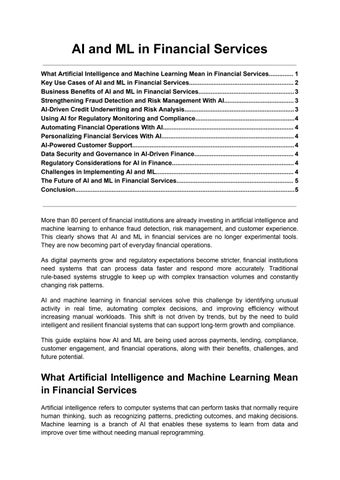
More than 80 percent of financial institutions are already investing in artificial intelligence and machine learning to enhance fraud detection, risk management, and customer experience. This clearly shows that AI and ML in financial services are no longer experimental tools. They are now becoming part of everyday financial operations
As digital payments grow and regulatory expectations become stricter, financial institutions need systems that can process data faster and respond more accurately Traditional rule-based systems struggle to keep up with complex transaction volumes and constantly changing risk patterns
AI and machine learning in financial services solve this challenge by identifying unusual activity in real time, automating complex decisions, and improving efficiency without increasing manual workloads This shift is not driven by trends, but by the need to build intelligent and resilient financial systems that can support long-term growth and compliance.
This guide explains how AI and ML are being used across payments, lending, compliance, customer engagement, and financial operations, along with their benefits, challenges, and future potential
What Artificial Intelligence and Machine Learning Mean in Financial Services
Artificial intelligence refers to computer systems that can perform tasks that normally require human thinking, such as recognizing patterns, predicting outcomes, and making decisions Machine learning is a branch of AI that enables these systems to learn from data and improve over time without needing manual reprogramming
In financial services, AI and ML process massive volumes of transactional, behavioral, and risk-related data. This includes payment activity, spending habits, credit behavior, and fraud signals. Instead of relying only on fixed rules, AI models detect patterns, flag anomalies, and generate predictive insights
For financial institutions, this results in faster analysis, better risk visibility, and more informed decision-making AI does not replace financial expertise It strengthens your ability to operate at digital scale with greater accuracy and confidence
Key Use Cases of AI and ML in Financial Services
AI delivers the most value in environments where transactions are high in volume and risk. Financial services fit this profile perfectly
AI in Payments and Transaction Monitoring
AI systems monitor digital payments in real time to identify suspicious behavior. They can detect unusual patterns such as large transfers, abnormal spending locations, or rapid transaction spikes
For example, if a customer account suddenly starts processing high-value transactions from a new country or device, the system can immediately flag or block the activity, helping prevent fraud before money is lost
AI in Credit Scoring and Lending Decisions
Machine learning allows lenders to evaluate borrowers using more than just traditional credit history Transaction data, income stability, and spending patterns are used to predict repayment behavior more accurately
This makes it possible to approve customers with limited credit history while still controlling risk, enabling financial inclusion without increasing default rates
AI in Compliance and Regulatory Technology
AI automates Anti Money Laundering and transaction monitoring by continuously scanning activity for suspicious patterns Instead of reviewing every alert manually, compliance teams receive prioritized cases based on real risk scores
This helps identify structured transactions, money laundering patterns, and linked accounts more efficiently
AI in Customer Support and Digital Assistance
AI-powered chatbots handle common customer queries such as account balances, payment status, or card limits They also assist with actions like blocking a lost card or tracking a transaction, delivering instant support without waiting for human agents
Business Benefits of AI and ML in Financial Services
AI adoption is driven by measurable improvements across risk management, operations, and customer experience
AI-based fraud detection reduces financial losses by identifying threats in real time and improving accuracy as models learn from new fraud patterns
Machine learning enables faster and more precise decision-making, whether for credit approvals or transaction risk scoring, which improves speed without weakening controls
Regulatory compliance becomes more efficient because AI filters low-risk activity and highlights meaningful alerts, allowing compliance teams to focus on what truly matters
Operational costs decline as AI automates reconciliation, document checks, and dispute handling, improving efficiency without increasing staff.
Customer experience improves through faster service, personalized recommendations, and real-time support, which strengthens engagement and loyalty.
As transaction volumes grow, AI systems scale without requiring proportional increases in human resources, making them a key driver of sustainable digital growth
Strengthening Fraud Detection and Risk Management With AI
Fraud techniques change constantly, making static rule-based systems less effective. AI models adapt to new patterns by analyzing transaction behavior, device data, and historical activity
Unlike traditional systems, AI reduces false positives, ensuring genuine transactions are not incorrectly blocked This protects revenue while keeping customers satisfied
For banks, fintechs, and payment providers, AI-driven risk management creates a more resilient security framework that grows with digital expansion.
AI-Driven Credit Underwriting and Risk Analysis
Traditional lending models rely heavily on limited data and static scoring AI improves this by using predictive analytics to evaluate a broader range of signals, including income flows, transaction patterns, and spending consistency
This allows financial institutions to approve more creditworthy borrowers without raising default risk. It also speeds up loan processing and supports continuous improvement as models learn from repayment outcomes
Using AI for Regulatory Monitoring and Compliance
Compliance today requires continuous monitoring across all transactions AI helps institutions track activity in real time, reduce false alerts, and uncover hidden risk networks
Automated analytics improve reporting accuracy and ensure compliance without slowing customer onboarding or payments
Automating Financial Operations With AI
AI improves operational efficiency by automating reconciliation, dispute management, error detection, and reporting These systems reduce manual intervention, shorten processing times, and increase accuracy, helping institutions scale efficiently
Personalizing Financial Services With AI
AI enables personalized product recommendations based on real customer behavior Spending patterns and transaction history help deliver relevant offers, timely reminders, and tailored financial products.
This increases customer engagement, boosts product adoption, and strengthens long-term relationships
AI-Powered
Customer Support
AI chatbots provide instant, 24/7 support for routine financial queries While human agents focus on complex issues, AI handles high volumes efficiently, improving service quality without raising costs.
Data Security and Governance in AI-Driven Finance
AI systems depend on sensitive financial data, making strong governance essential Encryption, access controls, regulatory compliance, transparency, and bias prevention must all be built into AI frameworks to protect trust and meet legal requirements.
Regulatory Considerations for AI in Finance
Financial regulators increasingly expect transparency, accountability, and fairness in AI-driven decisions. Institutions must ensure their models are explainable, compliant with data laws, and free from bias, especially in lending and risk assessment
Challenges in Implementing AI and ML
AI adoption comes with challenges such as data quality issues, model explainability, evolving regulations, talent shortages, and organizational change. Addressing these early helps ensure responsible and effective AI deployment.
The Future of AI and ML in Financial Services
AI will continue to move from an advantage to a necessity Real-time decisioning, deeper system integration, predictive insights, and stronger regulatory oversight will define the next phase of financial services
Institutions that invest in responsible AI will be better positioned to grow securely and compete in an increasingly digital financial world.
Conclusion
Artificial intelligence and machine learning are no longer optional in modern finance They enhance fraud prevention, credit decisions, compliance, and customer engagement while supporting scalability and efficiency
The key is applying AI where it delivers real value and ensuring strong governance as systems expand. With the right strategy, AI becomes a powerful engine for innovation, trust, and long-term growth
If you are exploring AI-enabled digital payments, wallets, or remittance platforms, DigiPay.Guru provides scalable financial infrastructure designed for banks and fintechs ready to operate intelligently at scale