About this Dictionary
This dictionary defines core terminology of the digital-asset economy: the protocols that record value, the consensus mechanisms that secure them, the cryptographic primitives that protect keys, the wallets and custodians that hold them, the centralized and decentralized venues that price them, and the smart contracts that tokenize real-world property. Entries cover Bitcoin, Ethereum, Stellar, Solana, and Polygon at the protocol layer; advanced infrastructure including Hedera, Hyperledger, Omnibasis, Chainlink, and Fireblocks; and ecosystem references such as Digex, DigiBank, Lumina, the London Blockchain Bridge, MakaChain, and DigiBank's BUCK, DGBP, DBTK, and DIME tokens.
Where useful, definitions distinguish concepts that are often conflated in popular usage — coins versus tokens versus NFTs, hot versus cold storage, CEX versus DEX versus ATS, public versus private markets, and on-chain versus off-chain settlement. Index
AAddress (Blockchain) — Security & Cryptography
A public alphanumeric identifier derived from a public key that designates the destination of an on-chain transaction. Addresses are safe to share publicly; the corresponding private key must never be disclosed. Formats vary by protocol (e.g., Bitcoin Base58/Bech32, Ethereum hex with EIP-55 checksum, Stellar 'G…' account IDs, Solana Base58).
Airdrop — Tokens & Distribution
A distribution event in which tokens or NFTs are sent to qualifying wallet addresses, typically as a marketing strategy, network bootstrapping incentive, or reward to early users or governance participants.
Algorithmic Stablecoin — Stablecoins
A stablecoin whose peg is maintained through on-chain algorithms and supply/demand mechanics rather than collateral reserves. Historically prone to reflexive de-peg events (e.g., TerraUSD collapse, 2022).
Alternative
Trading System (ATS) — Markets & Exchanges
A SEC-regulated trading venue that matches buyers and sellers of securities outside of traditional exchanges. ATSs are increasingly used for tokenized securities and private digital asset markets, providing compliant secondary liquidity for restricted offerings.
AML (Anti-Money Laundering) — Regulation & Compliance
Statutory and procedural controls that detect and prevent the conversion of illicit proceeds into legitimate assets. Crypto businesses implement AML via KYC, transaction monitoring, sanctions screening, and Suspicious Activity Reports (SARs).
API (Application Programming Interface) — Infrastructure
A defined set of endpoints through which software components communicate. In digital-asset infrastructure, APIs expose price feeds, order routing, custody operations, on-chain queries, and KYC/AML services.
Arbitrage — Trading
The simultaneous purchase and sale of the same asset across different venues to profit from price discrepancies. Common in crypto due to fragmented liquidity across CEXs, DEXs, and chains; often executed by automated bots.
Atomic Swap — Cross-Chain
A peer-to-peer exchange of two cryptocurrencies on different blockchains without a trusted intermediary, typically implemented with Hashed Timelock Contracts (HTLCs).
Automated Market Maker (AMM) — DeFi
A smart-contract liquidity protocol that prices assets via a deterministic formula (e.g., x·y=k) and pools of user-deposited tokens, replacing traditional order books. Foundational to DEXs such as Uniswap, Curve, and Balancer.
BBASE (Layer 2) — Blockchains —
Advanced
An Ethereum Layer-2 optimistic rollup incubated by Coinbase and built on the OP Stack. Offers low-fee, EVM-equivalent execution settled to Ethereum mainnet.
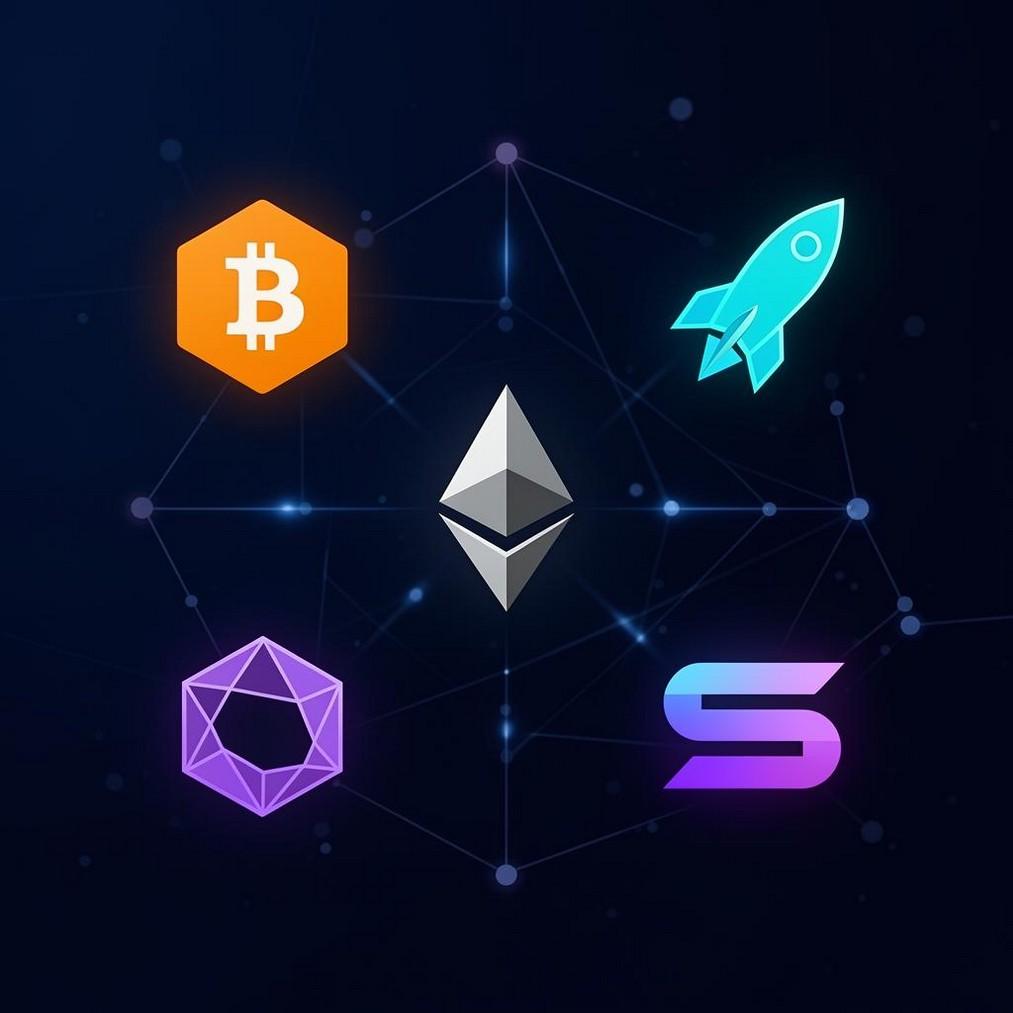
Figure — Major Blockchain Protocols at a Glance
Sources: bitcoin.org/bitcoin.pdf (Nakamoto, 2008); ethereum.org/whitepaper; stellar.org/papers; solana.com/solanawhitepaper.pdf; polygon.technology/papers
Birthchain — Tokenization · Coined Term (Blair, 2026)
Term coined by Bill Blair. A blockchain-anchored civic identity primitive that ties a newborn's birth record to a distributed ledger at the moment of registration. In the proposed implementation, a Birthchain account is provisioned on the Stellar blockchain to receive an initial seed deposit—such as a $1,000 'Birth Distribution' under proposed Trump-administration child investment accounts—creating a lifelong, portable, cryptographically verifiable financial and identity record from day one.
Bitcoin (BTC) —
Protocols
The first decentralized cryptocurrency, introduced in 2008 by Satoshi Nakamoto. Operates on a Proof-of-Work consensus, with a fixed supply cap of 21 million coins and a UTXO transaction model. Primary use cases include store of value and peerto-peer settlement.
Block — Blockchain Fundamentals
A batch of transactions cryptographically linked to its predecessor by a hash pointer, forming the chain. Each block contains a header (parent hash, timestamp, Merkle root, nonce) and a body of transactions.
Blockchain — Blockchain Fundamentals
A distributed, append-only ledger replicated across nodes that agree on state through a consensus mechanism. Records are tamper-evident through cryptographic hashing and chaining, providing trust without a central operator.
Blockchain Bridge — Cross-Chain
A protocol that transfers assets or messages between independent blockchains, typically by locking assets on the source chain and minting wrapped representations on the destination chain. Bridges have been frequent attack targets (e.g., Wormhole, Ronin); examples in production include Chainlink CCIP, AllBridge, MakaChain, Hyperledger-based bridges, and Digex DigiBank's London Blockchain Bridge.
Blockchain Explorer — Infrastructure
A web interface that indexes and displays on-chain data — transactions, addresses, blocks, contracts, tokens — for a given network. Examples: Etherscan, Blockchain.com, Stellar Expert, Solscan, Polygonscan.

Figure — Keys, Wallets & Custody
Sources: NIST SP 800-57 (Key Management); Fireblocks MPC-CMP whitepaper; Ledger Donjon security research; CCSS — CryptoCurrency Security Standard
Bridged Wallet — Wallets
A wallet supporting native multi-chain accounts and cross-chain transactions without forcing the user to convert via a stablecoin. Examples include MetaMask (via Snaps and L2s), Coinbase Wallet's DEX features, and DigiBank's Lumina.
Broker (Digital Asset) — Markets & Exchanges
A licensed intermediary that executes digital-asset trades on behalf of clients, typically against an internal book or via aggregated venue routing. Subject to broker-dealer regulation in jurisdictions such as the United States.
BUCK (DigiBank Token) — Stablecoins
A USD-pegged payment token issued by DigiBank on the Stellar network. Used for on/off-ramp settlement and as a unit of account in DigiBank ecosystem applications.
Burn (Token) — Tokenomics
The permanent removal of tokens from circulation by sending them to an unspendable address or executing a contract method that decrements total supply. Used for deflationary policy, fee mechanisms (e.g., EIP-1559), and buyback-andburn programs.
CCBDC (Central Bank Digital Currency) — Stablecoins
A digital liability of a central bank, denominated in the sovereign unit of account. Distinct from privately issued stablecoins; designs vary across retail vs. wholesale and account- vs. token-based models.
Centralized Exchange (CEX) — Markets & Exchanges
A custodial trading venue operated by a corporate entity that holds user funds, matches orders on internal systems, and provides fiat on/off-ramps. Examples: Coinbase, Binance, Kraken, Gemini.
Chainlink — Oracles — Advanced
A decentralized oracle network that delivers off-chain data (prices, weather, events) and cross-chain messaging (CCIP) to smart contracts via a network of independent node operators with cryptoeconomic guarantees.
Coin — Digital Assets Defined
A native digital asset of a Layer-1 blockchain (e.g., BTC on Bitcoin, ETH on Ethereum, SOL on Solana, XLM on Stellar). Distinct from tokens, which are issued on top of an existing chain. Subcategories include meme coins, stablecoins, and native coins used for gas.
Cold Storage / Cold Wallet — Wallets
A wallet that holds private keys on a device or medium permanently disconnected from the internet (hardware wallets, paper wallets, metal seed plates, air-gapped computers). Provides the strongest practical defense against remote attackers; trade-off is slower access and operational complexity.
END OF PREVIEW END OF PREVIEW
DigiBank | Digex Lexicon
You have viewed a 7-page preview of the Digex Lexicon. The full edition includes 136 cross-linked entries across 28 categories, with figures and appendices.
Purchase the Full Edition
Purchase the Full Edition Visit DigiBank Digex to unlock the complete dictionary.