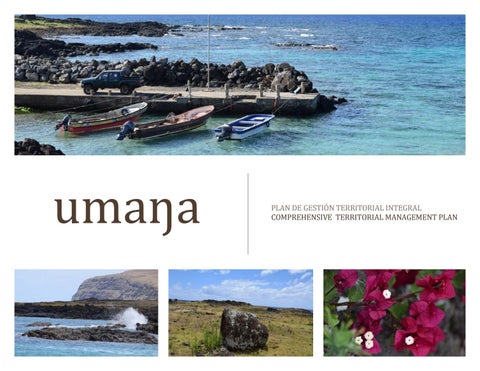
Plan de gestiรณn territorial Integral COMPREHENSIVE TERRITORIAL MANAGEMENT PLAN
Este Plan de gestión territorial, fue realizado en el marco del proyecto
This Territorial Management Plan was carried out within the framework
denominado “Incremento en la competitividad del sector turístico de
of the project entitled “Increase in the competitiveness of the tourism
Isla de Pascua, a través de la creación y oferta de expediciones étnico-
sector of Easter Island, through the creation and offering of ethnic-
culturales, basadas en costumbres ancestrales de mujeres Rapa Nui
cultural expeditions, based on ancestral customs of Rapa Nui women
recolectoras de caracoles marinos”, financiado con aportes del Fondo
collecting marine snails “, funded with funds from the Innovation Fund
de Innovación para la Competitividad del Gobierno Regional de
for Competitiveness of the Regional Government of Valparaiso.
Valparaíso. Its objective is to stimulate the development of sustainable tourism Su objetivo es estimular el desarrollo de emprendimientos de turismo
ventures based on the creation and offer of ethnic-cultural expeditions,
sostenible basados en creación y oferta de expediciones étnico-
considering the different visions, interests and resources available in the
culturales, considerando las distintas visiones, intereses y recursos
territory.
disponibles en el territorio. Professional team in charge of the process of co-development with the Equipo profesionales a cargo del proceso de co-desarrollo con la
community:
comunidad:
Diego Ramírez Cárcamo
Diego Ramírez Cárcamo
Francisca López Campos
Francisca López Campos
Mitzi Acevedo Ejzman
Mitzi Acevedo Ejzman
Pablo Peña Gálvez
Pablo Peña Gálvez
Alejandro Arce Amenábar
Alejandro Arce Amenábar
Anngie Sepulveda Diaz
Anngie Sepulveda Diaz
Fotos de portada: Diego Ramírez C.
Contenidos Contents
Introducción
Introduction
Marco Conceptual
Conceptual Framework
El Territorio: Hanga Ho’Onu
Territory: Hanga Ho’Onu
Nuestra Comunidad
Our Community
El Proceso
The Process
Nuestra Visión
Our Vision
Autodiagnóstico
Autodiagnostic
Ejes y Objetivos
Axes and Objectives
Programas y Proyectos
Programs y Projects
Planificación
Planning
Hanga Ho ‘onu / Plan de Gestión Territorial Integral - Enfoque Ecosistémico HANGA HO ‘UN / Comprehensive Territorial Management Plan – Ecosystem approach
En Hanga Ho‘Onu tu puedes sentir la tierra y el mar. Tu puedes vivir la cultura y tradición Rapa Nui. In Hanga Ho’Onu you can feel the land and the sea. You can Live the culture and tradition Rapa Nui. María Atan Pakarati
Foto por: Diego RamĂrez C.
Hanga Ho ‘onu / Plan de Gestión Territorial Integral - Enfoque Ecosistémico HANGA HO ‘UN / Comprehensive Territorial Management Plan – Ecosystem approach
Foto por: Diego Ramírez C.
Introducción Introduction
Este instrumento tiene como propósito guiar nuestros esfuerzos, para
This instrument is intended to guide our efforts, to reach sustainable
alcanzar con éxito el desarrollo sostenible de Hanga Ho’Onu. En su
development successfully of Hanga Ho’Onu. In its construction, we have
construcción hemos participado todos quienes crecimos en esta tierra y
participated all those who grew up in this land and we believe in the power
creemos en el extraordinario poder de este lugar, con su arqueología, su
extraordinary of this place, with its arqueology, vegetation and its sea.
vegetación y su mar. Hanga Ho’Onu has an important space in the Rapa Nui People History, and Hanga Ho’Onu tiene un importante espacio en la historia del pueblo Rapa
this Plan is the beginning of a challenging road to transform it in
Nui y este Plan es el comienzo de un desafiante camino para transformarlo
sustainable model for the future of Rapa Nui and the rest of the Planet.
a
en un modelo sostenibilidad para el futuro de Rapa Nui y el resto del Planeta. In full consciousness about what we expect to reach and the necessary En plena conciencia de lo que esperamos alcanzar y los medios necesarios
means to make it, we have close our eyes and breathed deeply to think and
para lograrlo, hemos cerrado nuestros ojos e inspirado profundamente para
project the future of Ho’ Onu over the next 10 years.
pensar y proyectar el futuro de Hanga Ho’Onu en los próximos 10 años. This Plan is a reference, a guide, and an invitation too, for those who want Este Plan es una referencia, una guía y también una invitación, a todos
to join us and contribute in the sustainable development of Hanga Ho’Onu.
quienes deseen acompañarnos y contribuir en el desarrollo sostenible de Hanga Ho’Onu.
7
Hanga Ho ‘onu / Plan de Gestión Territorial Integral - Enfoque Ecosistémico HANGA HO ‘UN / Comprehensive Territorial Management Plan – Ecosystem approach
Marco Conceptual
El Plan de gestión territorial se ha construido
El enfoque ecosistémico, entendido como una
considerando algunos conceptos que han estado
de las estrategias para la gestión integrada de
presentes en las decisiones y acciones que la
los recursos presentes en Hanga Ho’Onu, el
comunidad de Hanga Ho’Onu ha impulsado
cual promueve su conservación y la utilización
en este último tiempo y otros, que han sido
sostenible de modo equitativo. El enfoque enfatiza
considerados pertinentes de aplicar de cara a los
la importancia de la aplicación de metodologías
desafíos que impone la visión del territorio. Estos
científicas
lineamientos se enmarcan en los principios del
interacciones entre los organismos y el medio
desarrollo sostenible, el desarrollo endógeno y el
ambiente, y al mismo tiempo, reconoce a la
enfoque ecosistémico.
comunidad con su diversidad cultural, como un
relacionadas
con
las
funciones
e
componente integral del ecosistema. El enfoque El desarrollo sostenible, entendido como el uso
da cuenta además de la necesidad de disponer
racional de los recursos disponibles en Hanga
de un sistema de gestión adaptable, que permita
Ho’Onu, respondiendo a las expectativas de
dar respuesta a la complejidad del territorio en el
la comunidad sin comprometer con ello, la
tiempo.
satisfacción de las necesidades de las futuras generaciones. Bajo este principio se abordan las
Al mismo tiempo, el Plan se elaboró considerando
perspectivas ambientales, sociales y económicas
los últimos antecedentes disponibles relacionados
asociadas al territorio y su comunidad.
con Rapa Nui, desde la imagen destino, hasta aspectos de conservación, manejo sostenible de
El desarrollo endógeno, entendido como la comunidad local protagonista de los procesos y movilizada en función de sus objetivos, haciendo uso de sus propias capacidades y recursos, para utilizar el potencial del territorio e impactar directamente sobre su calidad de vida.
recurso marinos.
Conceptual Framework The
territorial
management
been
The ecosystem approach, understood as one of the
constructed considering some concepts which have
strategy for integrated management for the existing
been present in the decisions and actions that the
resources in Hanga Ho’Onu. Which promote its
Hanga Ho’Onu community has promoted in recent
conservation and the sustainable use in an equitable
times and others, which have been considered
way. The approach emphasizes the importance
relevant to apply in face of challenges imposed
of applying scientific methodologies related to
by the vision of the territory. These guidelines
functions and interactions between organisms and
are framed in the principles of sustainable
the environment, while recognizing the community
development,
with its cultural diversity as an integral component
endogenous
Plan
has
development
and
ecosystemic approach.
of the ecosystem. The approach also counts on the need to have an adaptable management system
The sustainable development, know as the rational
that allows responding to the complexity of the
use of availables resources in Hanga
territory over time.
Ho’Onu,
taking responsability to the expectations of the community whitout compromise with it, the
At the same time, the Plan was developed
satisfaction of the needs of future generations.
considering the last avialiby history related with
Under this principle, the enviromental, social and
Rapa Nui, from the destination image, to aspects
economics perspectives asociated to the territory
of conservation and sustainable management of
and its community are tackles.
marine resources.
Endogenous development, understood as the local community protagonist of the processes and mobilized in function of its objectives, making use of its own capacities and resources, to use the potential of the territory and directly impact on their quality of life. Foto por: Diego Ramírez C.
9
Hanga Ho ‘onu / Plan de Gestión Territorial Integral - Enfoque Ecosistémico HANGA HO ‘UN / Comprehensive Territorial Management Plan – Ecosystem approach
ANAKENA
VOLCÁN TEREVAKA
HANGA HO’ONU
VOLCÁN POIKE
HANGA ROA
S
VOLCÁN RANO KAU
E
O
N
El Territorio: Hanga Ho’Onu
Hanga Ho’Onu o también conocida como bahía La Pérouse, es un
El mar en Hanga Ho’Onu, es protegido en el sector más próximo a la costa
asentamiento humano emplazado en un sector de tierra-mar de
y en la zona de atraque de las embarcaciones. En cambio, hacia el sector
aproximadamente 39 hectáreas, ubicado en el extremo noreste de la Isla,
Oeste es expuesto al oleaje, con rompientes de espuma blanca donde se
colindante al este con volcán Poike y al oeste con el Ahu Te Pito Kura.
asoma la plataforma sumergida tapizada del alga mas conspicua de la Isla conocida como Miritonu. El fondo es de arenas blancas y la transparencia
Distante a 30 kilómetros del sector urbano de Hanga Roa, se conecta vía
del agua en días de sol, proyecta colores turquesa y azul intenso en el mar.
terrestre a través del camino costero que circunda el Parque Nacional Rapa
Grandes extensiones de rocas y piedras de diverso tamaño, conforman un
Nui. Por las condiciones geográficas y obras de infraestructura, la bahía
heterogéneo fondo marino, que en las zonas más profundas supera los 30
permite la operación y resguardo de botes de pequeño calado, ampliando
metros.
su conectividad con otros sectores de la Isla mediante vía marítima. El trabajo cotidiano en Hanga Ho’Onu esta dominado por la pesca artesanal La pendiente del terreno es leve y se pronuncia al llegar a la costa, donde
y la recolección de caracoles. En la bahía atracan de forma permanente 5
la delgada capa vegetal desaparece y la naturaleza volcánica del suelo se
embarcaciones, las que pueden aumentar en periodos de mal tiempo. Los
descubre por la acción del oleaje. Predominan pastizales y formaciones
principales recursos desembarcados son: atún de aleta amarilla, matahuira,
arbóreas de pequeño tamaño y en algunos jardines tradicionales de
nanue, sierra y toremo, entre otros. La recolección se realiza en toda la
piedra, como los Manavai y los Pu, es posible encontrar guayabas, hierbas
costa a profundidades inferiores a un metro y capturando principalmente
medicinales y diferentes tubérculos como el taro y el camote.
el caracol pure y el caracol pipi uri-uri, además, hahaki, caracol takatore, caracol hatuke.
El territorio es abundante en recursos arqueológicos, desde altares (Ahu), moai, crematorios y observatorios astronómicos (Tupa), hasta importantes grabados en plataformas de piedra a nivel de suelo (Papa) y petroglifos.
11
Hanga Ho ‘onu / Plan de Gestión Territorial Integral - Enfoque Ecosistémico HANGA HO ‘UN / Comprehensive Territorial Management Plan – Ecosystem approach
The Territory: Hanga Ho’Onu
Hanga Ho’Onu also known as bahía La Pérouse, is a human settlement
The sea at Hanga Ho’Onu is protected near to the coast and in the berthing
located in a land-sea sector of approximately 39 hectares, located in the
sector of boats. On the other hand, towards the west sector is exposed to the
northeast end of the Island, adjoining the east with Poike volcano and to the
surf, with white foam breakers where the submerged platform upholstered
west with the Ahu Te Pito Kura.
of the most conspicuous seaweed of the island known as Miritonu. The background is of white sands and the transparency of the water in sunny
Distant to 30 kilometers of the urban sector of Hanga Roa, connects
days, projects turquoise and intense blue colors in the sea. Large expanses
terrestrial via the coastal road that surrounds the National Park Rapa Nui.
of rocks and stones of varying size make up a heterogeneous seabed, which
Due to the geographical conditions and infrastructure, the bay allows the
in the deepest areas exceeds 32 meters.
operation and protection of draught small boats, expanding its connectivity with other sectors of the island by sea.
The daily work at Hanga Ho’Onu is dominated by artisanal fishing and the collection of snails. In the bay, 5 boats permanently dock, which can increase
The slope of the terrain is slight and is pronounced when arriving at the
in periods of bad weather. The main landed resources are: yellowfin tuna,
coast, where the thin vegetal layer disappears and the volcanic nature of the
matahuira, nanue, sierra and toremo, among others. The harvest is carried
soil is discovered by the action of the swell. Predominant pastures and tree
out along the entire coast at depths of less than one meter and capturing
formations of small size and in some traditional stone gardens, such as the
mainly the pure snail and the snail pipi uri-uri, in addition, hahaki, snail
Manavai and Pu, it is possible to find guavas, medicinal herbs, and different
takatore, snail hatuke. Traditional shore fishing, which is practiced daily by
tubers such as taro and sweet potato.
families capturing mainly piscis and nanue.
The territory is abundant in archaeological resources, from altars (Ahu), moai, crematories and astronomical observatories (Tupa), to important engravings on stone platforms at ground level (Papa) and petroglyphs.
Foto por: Diego RamĂrez C.
13
Hanga Ho ‘onu / Plan de Gestión Territorial Integral - Enfoque Ecosistémico HANGA HO ‘UN / Comprehensive Territorial Management Plan – Ecosystem approach
Nuestra Comunidad Our Community
En Hanga Ho’Onu, se encuentra la Asociación de Resguardo y Conservación del Patrimonio Cultural y Recolección de Moluscos de Hanga Ho’Onu, cuyo objetivo es proteger la cultura, la tradición y los recursos marinos presentes en dicho territorio, entre otros. Es una agrupación que esta en pleno desarrollo, cuenta con 16 miembros activos los cuales representan a 53 personas que se vinculan e identifican fuertemente con el territorio, a través de su forma de vida y trabajo, donde destacan la pesca, la artesanía y el turismo. In Hanga Ho’Onu is found the Association of Safeguard and Conservation of Cultural Heritage and Collection of Molluscs, its objective is among others, protect the culture, tradition and marine resources present in that territory. This is a group which is in full development, has 16 actives members which represent to 53 people who are strongly linked and identify with the territory, through its life style and work, where fishing, craftwork and tourist are.
Antonio Torres Atan
Bárbara Osorio Riroroko
Cecilia Riroroko
Hetu ´u Rapu
Lindsay Westermeier Tuki
María Atan Pakarati
María Emelina Manutomatoma
Patricia Venegas Riroroko
Rafaela Riroroko Pakarati
Ricardo Castillo
Ruperto Tepano
Tamaru Pakarati
Tera ‘i Atan
Tito Atan
Tavake Hurtado Atan
Juan Hurtado
Priscila Osorio Riroroko
Tanaroa Atan
Veronica Rapu
15
Hanga Ho ‘onu / Plan de Gestión Territorial Integral - Enfoque Ecosistémico HANGA HO ‘UN / Comprehensive Territorial Management Plan – Ecosystem approach
Foto por: Diego Ramírez C.
El Proceso The Process
Este Plan de gestión territorial Integral, se construyó adoptando una
This Comprehensive Territorial Management Plan, was built adopting a
metodología participativa recomendada para comunidades como la nuestra,
participatory methodology recommended for communities such as ours,
permitiéndonos durante todo el camino recorrido, promover la integración,
allowing us all along the way, promoting the integration, legitimacy, and
legitimidad y pertinencia de las distintas miradas sobre el territorio.
relevance of the different views on the territory.
Durante el proceso, la base social de participación fue la “Asociación de
During the process, the social base of participation was the “Association of
resguardo y conservación del patrimonio cultural y recolección de moluscos
Safeguard and Conservation of Cultural Heritage and Collection of Molluscs
de Hanga Ho’Onu”, lo que favoreció la convocatoria, participación y
of Hanga Ho’Onu”, which favored the announcement, participation and
persistencia de la comunidad en el trabajo colectivo que dio origen al Plan.
persistence of the community in the collective work that originated to the Plan.
Durante 6 meses se llevó a cabo un proceso reflexivo y de intenso diálogo
During 6 months, a reflective and intense dialogue process was carried out
al interior de la comunidad. Logramos preparar y llevar a cabo, 5 momentos
within the community. We were able to prepare and carry out 5 moments
de sistematización, conciencia y validación, dando paso a la construcción
of systematization, awareness and validation, giving way to the construction
de los 5 elementos que dan forma y estructura al Plan de gestión territorial
of the 5 elements that give shape and structure to the Comprehensive
Integral.
Territorial Management Plan.
17
Hanga Ho ‘onu / Plan de Gestión Territorial Integral - Enfoque Ecosistémico HANGA HO ‘UN / Comprehensive Territorial Management Plan – Ecosystem approach
Etapas del Proceso 1
2
3
Visión
Auto-Diagnóstico
EJES Y OBJETIVOS
Esta primera etapa se reveló la imagen
En esta segunda etapa, nos dimos
En plena conciencia del autodiagnóstico
futura de nuestro territorio, a través de
cuenta de nuestras mayores virtudes y
territorial, identificamos los principales
los anhelos y sueños más profundos de
fuimos capaces de señalar los problemas
desafíos y construimos a partir de éstos,
la comunidad: Hacia donde queremos
que enfrenta nuestra comunidad y su
los ejes y objetivos estratégicos de
dirigirnos y en que queremos convertir
entorno.
nuestro Plan.
Hanga Ho’Onu.
diagnóstico identificando las principales
Complementamos
nuestro
oportunidades y amenazas, desde la perspectiva ambiental, social, política y económica.
4
5
Programas y Proyectos
Planificación
En esta cuarta etapa, profundizamos el
Finalmente, en el horizonte de 10 años que
trabajo con los ejes y objetivos estratégicos
nos impone nuestra Visión, ordenamos los
y construimos a partir de éstos, un cartera
proyectos en el tiempo considerando las
de proyectos los cuales agrupamos en
prioridades, complejidades y extensión de
programas.
cada iniciativa.
19
Hanga Ho ‘onu / Plan de Gestión Territorial Integral - Enfoque Ecosistémico HANGA HO ‘UN / Comprehensive Territorial Management Plan – Ecosystem approach
Stages of the Process 1
2
3
VIEW
AUTODIAGNOSIS
In this first stage the future image of
In this second stage, we realized our
In
our territory was revealed, through the
greatest virtues and we were able to note
autodiagnosis, we identify the main
deepest desires and dreams of the
the problems facing our community and
challenges and build on these, the
community: Towards where we want
its environment. Under scrutiny of the
strategic axes, and objectives of our Plan.
to go and what we want to turn Hanga
previous perspectives (economic, socio-
Ho’Onu. The construction of the vision
culture and environmental), we recognize
is carried out considering 3 perspectives
and identify the main resources and
on the territory (economic, socio- cultural
capacities available in the territory.
and environmental), to then converge and
We complement our diagnosis identifying
conclude in a single declaration.
the main opportunities and threats under the same perspectives.
CHALLENGE full
awareness
of
the
territorial
4
5
PROGRAMS AND PROJECTS
PlanNING
In this fourth stage, we deepen the work with
Finally, within the 10-year horizon imposed
the strategic axes and objectives and build
by our Vision, we order the projects over time
from them a portfolio of projects which we
considering the priorities, complexity, and
group into programs.
extent of each initiative.
21
Hanga Ho ‘onu / Plan de Gestión Territorial Integral - Enfoque Ecosistémico HANGA HO ‘UN / Comprehensive Territorial Management Plan – Ecosystem approach
Foto por: Diego Ramírez C.
Nuestra Visión Our Vision
Durante esta primera etapa, el trabajo de nuestra comunidad dio
During this first stage, the results obtain for our community work was
como resultado la identificación de distintas visiones complementarias
the identification of different complementary views, structured in three
estructuradas en tres perspectivas: Económica, socio-cultural y ambiental.
perspectives: Economic, socio-cultural and environmental.
Esta construcción se logró en base al reconocimiento multidimensional de
This construction was reachd based on the multidimensional recognition of
la realidad de Hanga Ho’Onu y sus proyecciones futuras en un horizonte de
the reality of Hanga Ho’Onu and its future projections of 10 year horizon.
10 años.
23
Hanga Ho ‘onu / Plan de Gestión Territorial Integral - Enfoque Ecosistémico HANGA HO ‘UN / Comprehensive Territorial Management Plan – Ecosystem approach
Perspectivas de la Visión
Visión Socio-Cultural Un territorio donde exista un sistema social basado en normas propias que nos autoregulen, que permita fortalecernos y vivir en armonía.
Visión Económica
Visión Ambiental
Un territorio donde se desarrollen los trabajos
Un territorio donde existan Planes de manejo
tradicionales de nuestra cultura en armonia con el
para nuestros recursos marinos y de conservación
medio ambiente y respeto a nuestras tradiciones:
para nuestra arqueologia.
•
Pesca artesanal
Donde nuestra forma de vida y tradición estén
•
Recolección de caracoles
en armonía con el medio ambiente. Un territorio
•
Artesanía
zonificado de acuerdo al uso y protección de los
•
Agricultura
ambientes terrestres, marinos y la propia cultura
•
Gastronomía
ancestral. En el cual la forestación permita
•
Turismo
conservar y disponer de Plantas medicinales, alimentarias, y flora para la confección de artesanía.
“
“
Para el 2027, Hanga Ho’Onu será un territorio reconocido en Rapa Nui por el manejo sustentable de sus recursos naturales, arqueológicos y culturales.
Donde formas genuinas de vida, trabajo y expresiones artísticas Rapa Nui, serán cultivadas en armonía, difundidas y traspasadas a las nuevas generaciones. Y en el cual, el desarrollo económico estará basado en las labores productivas tradicionales de la cultura y un turismo sostenible controlado.
25
Hanga Ho ‘onu / Plan de Gestión Territorial Integral - Enfoque Ecosistémico HANGA HO ‘UN / Comprehensive Territorial Management Plan – Ecosystem approach
Perspectives of the View
SOCIO-CULTURAL VIEW A territory where exist a social system, based on self- regulating rules which allow us to strengthen ourselves and live in harmony.
ECONOMIC VIEW
ENVIRONMENTAL VIEW
A territory where the traditional works of our
A territory where management Plans for our
culture are developed in harmony with the
marine resources and conservation for our
environment and respect for our traditions:
archeology exist.
•
Artisanal fishing
Where our life style and tradition are in harmony
•
Collection of Snails
with the environmental. A territory sectioned
•
Handicraft
according to use and protection to land and
•
Agriculture
marine environmental and our ancestral culture.
•
Gastronomy
Where the afforestation allows conserve, and
•
Tourism
have medicinal, food and flora available for handicraft production.
“
“
To 2027, Hanga Ho’Onu will be a recognized territory in Rapa Nui for the sustainable management of its natural, archaeological and cultural resources.
Where genuine forms of life, work and Rapa Nui artistic expressions, will be cultivated in harmony, spread and passed on to the new generations. And in which, economic development will be based on the traditional productive work of culture and controlled sustainable tourism.
27
Hanga Ho ‘onu / Plan de Gestión Territorial Integral - Enfoque Ecosistémico HANGA HO ‘UN / Comprehensive Territorial Management Plan – Ecosystem approach
Foto por: Diego Ramírez C.
El Auto-DiagnĂłstico The Autodiagnosis
En esta segunda etapa, nos dimos cuenta de nuestras mayores virtudes y
In this second stage, we realized our greatest virtues and were able to point
fuimos capaces de seĂąalar los problemas que enfrenta nuestra comunidad
out the problems facing our community and its environment.
y su entorno.
29
Hanga Ho ‘onu / Plan de Gestión Territorial Integral - Enfoque Ecosistémico HANGA HO ‘UN / Comprehensive Territorial Management Plan – Ecosystem approach
A partir de nuestro análisis interno, observamos
que
afloran
muchas
palabras y conceptos que representan lo que para nosotros es Hanga Ho’Onu.
From our internal analysis, we see that many words and concepts that represent what Hanga Ho’Onu is for us.
31
Hanga Ho ‘onu / Plan de Gestión Territorial Integral - Enfoque Ecosistémico HANGA HO ‘UN / Comprehensive Territorial Management Plan – Ecosystem approach
Nuestras Fortalezas
Nuestras Debilidades
Los principales atributos que nos diferencian y nos
Las principales debilidades recaen en nosotros, en los
permiten enfrentar nuestros desafíos y alcanzar
que buscamos dar una proyección a Hanga Ho’Onu,
nuestra Visión son:
en nuestras capacidades personales y colectivas para aprovechar al máximo el potencial del territorio y
1. Numerosas familias comprometidas y con arraigo
enfrentar las amenazas:
al territorio. Aferrada a la tradición Rapa Nui que se traduce en cultura viva en el territorio.
1. Falta de conocimientos y herramientas para proteger y conservar nuestros recursos arqueológicos.
2. Variados conocimientos como pesca, recolección, artesanía y gastronomía.
2. Falta de conocimientos y herramientas para realizar un manejo sustentable de nuestros recursos naturales.
3. Diversa arqueología y presencia de recursos naturales marinos y terrestres.
3. Débil capacidad para direccionar, gestionar y financiar nuestras iniciativas de desarrollo comunitario
4. Entorno natural, nativo y agreste. Distante de la
y conservación.
zona urbana. 4. Ausencia de normas que permitan evitar los 5. Infraestructura y servicios básicos como agua dulce
efectos negativos de los habitantes y turistas, sobre
y apoyo náutico, con conectividad terrestre y marítima.
el territorio.
6. Economía basada en oficios tradicionales, como son la pesca, la artesanía y también el turismo.
OUR STRENGTHS
OUR WEAKNESSES
The main attributes that differentiate us and allow us
The main weaknesses fall in us, in whom we seek to
to face our challenges and reach our Vision are:
give a projection to Hanga Ho’Onu, in our personal and collective capacities to take full advantage of the
1. Numerous families commited and strong local
potential of the territory and face the threats:
identity with the tradition of Rapa Nui, that translates into living culture in the territory.
1. Lack of knowledge and tools to protect and conserve our archaeological resources.
2. Varied knowledge such as fishing, gathering, craftwork and gastronomy.
2. Lack of knowledge and tools to reach sustainable management of our natural resources.
3. Diverse archeology and the presence of marine and terrestrial natural resources.
3. Weak capacity to direct, manage and finance our community development and conservation initiatives.
4. Natural, native and wild environment. Distant from the urban area.
4. Absence of norms that allow to avoid the negative effects of the inhabitants and tourists on the territory.
5. Infrastructure and basic services such as fresh water and nautical support, with terrestrial and maritime connectivity. 6. Economy based on traditional trades, such as fishing, craftwork and tourism too.
33
Hanga Ho ‘onu / Plan de Gestión Territorial Integral - Enfoque Ecosistémico HANGA HO ‘UN / Comprehensive Territorial Management Plan – Ecosystem approach
Nuestras OPORTUNIDADES Ambientales
Sociales
1. Disponibilidad de nuevas tecnologías menos
1. Valorización de la cultura y la tradición Rapa Nui en
contaminantes y más eficientes.
la comunidad local.
2. Creciente preocupación de científicos y la
2. Mayor conciencia ambiental de la comunidad local.
En el análisis externo, con entusiasmo y
gran
optimismo
identificamos
oportunidades en nuestro entorno que debemos aprovechar para lograr
comunidad local por estudiar y proponer medidas de protección respecto al medio ambiente de Rapa Nui.
3. Crecimiento del número de organizaciones sociales y personas de la comunidad Rapa Nui representando
alcanzar nuestra Visión. 3. Paulatino interés de los visitantes por la realidad
los intereses de su territorio.
ambiental de la Isla. Políticas Económicas
1. Propuesta de “Estatuto Especial” que entregaría
1. Disponibilidad de fondos del Estado y privados
mayor autonomía al pueblo Rapa Nui para la
para el desarrollo de iniciativas locales.
administración de la isla y sus recursos.
2. Potencial crecimiento del segmento de “turismo de
2. Propuesta de creación de Parque Marino Rapa Nui.
intereses especiales” visitando Rapa Nui. 3. Administración del Parque Nacional Rapa Nui. 3. Construcción de una nueva “Imagen Destino” para Rapa Nui.
4. Tendencia de líderes políticos y autoridades por escuchar más a la ciudadanía.
OUR OPPORTUNITIES ENVIRONMENTAL
SOCIALS
1. Availability of new, less polluting and more efficient,
1. Valuing Rapa Nui culture and tradition in the local
technologies.
community.
2. Growing concern of scientists and the local
2. Increased environmental awareness of the local
community for studying and proposing measures of
community.
In the external analysis, with enthusiasm and
great
optimism,
we
identify
opportunities in our environment that we must take advantage of to reach our Vision.
protection with respect to the environment of Rapa Nui.
3. Growth of the number of social organizations and people of the Rapa Nui community representing the
3. Gradual interest of the visitors for the environmental
interests of its territory.
reality of the Island. POLITICS ECONOMICS
1. Proposal of “Special Statute” that would entrust
1. Availability of state and private funds for the
greater autonomy to the Rapa Nui people for the
development of local initiatives.
administration of the island and its resources.
2. Potential growth of the “special interest tourism”
2. Proposal to create Rapa Nui Marine Park.
segment visiting Rapa Nui. 3. Administration of Rapa Nui National Park. 3.
Construction of a new “Destination Image” for
Rapa Nui.
4. Tend Tendency of political leaders and authorities to listen more to the citizenship.
35
Hanga Ho ‘onu / Plan de Gestión Territorial Integral - Enfoque Ecosistémico HANGA HO ‘UN / Comprehensive Territorial Management Plan – Ecosystem approach
Nuestras AMENAZAS Ambientales
Sociales
1. Efectos locales del “Cambio Climático”.
1. Reducida valoración de la forma de vida y tradiciones de la cultura Rapa Nui.
Además constatamos las amenazas a las que nuestra comunidad y territorio se
encuentran
expuestos
y
que
esperamos ser capaces de prevenir y mitigar.
2. Incremento de las fuentes de contaminación en el territorio.
2. Fuerte introducción de cultura occidental moderna en la comunidad local.
3. Sobreexplotación de recursos naturales. 3. Problemáticas multidimensionales provocados por Económicas
la alta inmigración que ha sufrido el territorio.
1. Modelo económico basado en un turismo masivo. Políticas 2. Fuertes incentivos por “trabajos no tradicionales”
1. Centralismo en la toma de decisiones.
en el turismo y sector público. 2. Múltiples instituciones realizando la gestión 3. Concentración de la riqueza económica e
territorial y de manera “No Integral”.
incremento en la desigualdad en el territorio. 3. Escasa sensibilidad de los poderes del Estado por los problemas de Rapa Nui.
OUR THREATS ENVIRONMENTAL
SOCIALS
1. Local effects of “Climate Change”.
1. Reduced appreciation of life style and traditions of the Rapa Nui culture.
2. Increased sources of pollution in the territory. In addition we verified the threats to which our community and territory are
2. Strong introduction of modern Western culture into 3. Overexploitation of natural resources.
the local community.
ECONOMICS
3. Multidimensional problems caused by the high
1. Economic model based on massive tourism.
immigration that has suffered the territory.
exposed and that we hope to be able to prevent and mitigate.
2. Strong incentives for “non-traditional jobs” in tourism and public sector.
POLITICS 1. Centralism in decision-making.
3. Concentration of economic wealth and increase in inequality in the territory.
2. Multiple institutions performing the territorial management and in a “non-Integral” way. 3. Lacking sensitivity of the powers of the State by the problems of Rapa Nui.
37
Hanga Ho ‘onu / Plan de Gestión Territorial Integral - Enfoque Ecosistémico HANGA HO ‘UN / Comprehensive Territorial Management Plan – Ecosystem approach
Foto por: Diego Ramírez C.
Ejes y Objetivos Axes and Objectives
A partir del autodiagnóstico, priorizamos y agrupamos nuestros principales
Based on autodiagnosis, we prioritize and group our main challenges,
desafíos, definiendo tres ejes de acción y para cada uno de éstos, señalamos
defining three axes of action and for each one of them, we indicate 3
3 objetivos estratégicos.
strategic objectives.
39
Hanga Ho ‘onu / Plan de Gestión Territorial Integral - Enfoque Ecosistémico
Y
CULTIVA RY LEG CULTU AR RA Y TRA LA F DIC OR M IÓ A N RA P
ES PO IO NAL TE GES R TIO NC TO IO N AR RRI IAR DIC LAS RIQUEZAS DEL TE A LAS R ST ACT YE E IVIDADES PRODUCTIVA IBL LD EN ESA T S O RROLL O DE TURISMO S EN HANGA HO´ONU.
EJE C
EB
Y
EJ
EJ
CO NS EL ER P
, DA VI I. E D NU A
ALES ATUR SN O SO ÓGIC UR EOL EC QU SR NU. AR IO HO´O LO R ON A VA M NG RI A AT E H D
Ejes Estratégicos
EA
HANGA HO ‘UN / Comprehensive Territorial Management Plan – Ecosystem approach
Objetivos Estratégicos A. Cultivar y legar la forma de vida, cultura y tradición Rapa Nui.
B. Conservar los recursos naturales y el patrimonio arqueológico de Hanga Ho’Onu.
A1. Promover el desarrollo de actividades que fortalezcan las tradiciones al interior de la comunidad de Hanga Ho’Onu.
B1. Incrementar el conocimiento disponible respecto a los recursos naturales y el patrimonio arqueológico de Hanga Ho’Onu.
A2. Traspasar a las nuevas generaciones la cultura y tradición Rapa Nui.
B2. Diseñar e implementar medidas de manejo sustentable y protección para los recursos naturales y el patrimonio arqueológico.
A3. Difundir la forma de vida, cultura y tradición Rapa Nui.
C. Gestionar las riquezas del territorio y potenciar las actividades productivas tradicionales y el desarrollo de turismo sostenible en Hanga Ho’Onu.
B3. Difundir la importancia de la conservación de recursos naturales y la protección del patrimonio arqueológico de Hanga Ho’Onu.
C1. Diseñar e implementar un modelo de gestión que equilibre los beneficios de las actividades productivas tradicionales y el turismo sostenible, en favor de la forma de vida y tradiciones de la comunidad de Hanga Ho’Onu. C2. Desarrollar productos turísticos sostenibles a partir de las actividades productivas tradicionales, atractivos naturales y el patrimonio arqueológico de Hanga Ho’Onu. C3. Incrementar la eficiencia de las actividades productivas, manteniendo la ancestralidad y las tradiciones.
41
Hanga Ho ‘onu / Plan de Gestión Territorial Integral - Enfoque Ecosistémico
TO CULT IVAT EA CULTUR E AN ND L E DT RA AVE DI TIO THE L N RA I
AX
RE TO S HE OU RI T
AN D
TO Y ES OR VITI T TO MAN I I AGE ERR CT PR HE T VE A THE RI AN OMO I CHNESS OF T M TE T DT UCT URIS HE TRA HE PROD O L A D N I T O I T DEV E ABL ELOP MENT OF SUSTAIN IN HANGA HO 'ONU.
AXE C
EB AX
E, YL T S UI. FE N PA
RAL ATU L A EN OGIC TH EOL . HA VE 'ONU C ER AR GA HO NS ND N CO S A F HA E O RC GE A
Strategic Axes
EA
HANGA HO ‘UN / Comprehensive Territorial Management Plan – Ecosystem approach
Strategic Objectives A. CULTIVATE AND LEGACY THE WAY OF LIFE, CULTURE AND RAPA NUI TRADITION.
B. CONSERVING THE NATURAL RESOURCES AND THE ARCHAEOLOGICAL HERITAGE OF HANGA HO’ONU.
A1. Promote the development of activities that strengthen traditions within the community of Hanga Ho’Onu.
B1. Increase the knowledge available regarding the natural resources and archaeological heritage of Hanga Ho’Onu.
A2. Transfer to the new generations the Rapa Nui culture and tradition.
B2. Design and implement measures for sustainable management and protection of natural resources and archaeological heritage.
A3. Spreading the life style, culture and tradition Rapa Nui.
C. MANAGING THE WEALTH OF THE TERRITORY AND STRENGTHEN THE TRADITIONAL PRODUCTION ACTIVITIES AND THE DEVELOPMENT OF SUSTAINABLE TOURISM IN HANGA HO’ONU.
B3. Disseminate the importance of the conservation of natural resources and the protection of the archaeological heritage of Hanga Ho’Onu.
C1. Design and implement a management model that balances the benefits of traditional productive activities and sustainable tourism, in favor of Hanga Ho’Onu’s life style and traditions. C2. Develop sustainable tourism products from the traditional productive activities, natural attractions and the archaeological heritage of Hanga Ho’Onu. C3. Increase the efficiency of productive activities, maintaining ancestry and traditions.
43
Hanga Ho ‘onu / Plan de Gestión Territorial Integral - Enfoque Ecosistémico HANGA HO ‘UN / Comprehensive Territorial Management Plan – Ecosystem approach
Foto por: Diego Ramírez C.
Programas y Proyectos Programs and projects
En el marco de los ejes y objetivos estratĂŠgicos, definimos 7 programas de
Within the framework of the axes and strategic objectives, we defined 7
mediano y largo plazo, los cuales se estructuraron sobre 53 proyectos claves
medium and long term programs, which were structured on 53 key projects
para el desarrollo territorial de Hanga Ho’Onu.
for the territorial development of Hanga Ho’Onu.
45
Hanga Ho ‘onu / Plan de Gestión Territorial Integral - Enfoque Ecosistémico HANGA HO ‘UN / Comprehensive Territorial Management Plan – Ecosystem approach
Foto por: Diego Ramírez C.
FORTALECIMIENTO DEL CAPITAL HUMANO
HUMAN CAPITAL STRENGTHENING
Descripción: Programa que permite que las personas habitantes de
Description: Program that allows the inhabitants of Hanga Ho’Onu to
Hanga Ho’Onu puedan adquirir nuevas herramientas, habilidades
acquire new tools, skills and new knowledge, to face the sustainable
y nuevo conocimiento, para enfrentar el desarrollo sostenible de su
development of their territory.
Programa 1
territorio.
Proyectos
PROJECTS
1.
Cursos en artesanía tradicional.
1.
Courses in traditional craftworks.
2.
Talleres de toponímia y arqueología.
2.
Toponymy and archeology workshops.
3.
Talleres de expresiones artistico- culturales: Kai Kai, Ute, Riu y
3.
Artistic-cultural expressions workshops: Kai Kai, Ute, Riu and A
A’ amu tuai, entre otros.
‘amu tuai, among others.
4.
Taller de metodologías de pesca ancestral.
4.
Ancestral fishing methodologies workshops.
5.
Cursos de conservación y gestión del patrimonio cultural.
5.
Conservation and management of cultural heritage courses.
6.
Cursos de energias renovables no convencionales.
6.
Non-conventional renewable energy courses.
7.
Capacitación en el tratamiento de residuos.
7.
Training in waste treatment.
8.
Capacitación en Planes de manejo de recursos marinos.
8.
Marine resource management Plans training.
9.
Intercambio tecnológico con comunidades polinésicas sobre el
9.
Technological exchange with Polynesian communities on the
manejo y cultivo de moluscos marinos. 10. Intercambio tecnológico con artesanos de Chile continental.
management and cultivation of marine molluscs. 10. Technological exchange with artisans from continental Chile.
47
Hanga Ho ‘onu / Plan de Gestión Territorial Integral - Enfoque Ecosistémico HANGA HO ‘UN / Comprehensive Territorial Management Plan – Ecosystem approach
Foto por: Diego Ramírez C.
Programa 2
GESTIÓN DEL PATRIMONIO ARQUEOLÓGICO
ARCHAEOLOGICAL HERITAGE MANAGEMENT
Descripción: Programa que permite identificar, caracterizar, proteger y
Description: Program that identifies, characterize, protect and conserve
conservar el patrimonio arqueológico de Hanga Ho’Onu.
the archaeological heritage of Hanga Ho’Onu.
Proyectos
PROJECTS
1.
1.
Desarrollo de línea base y Plan de gestión del patrimonio arqueológico.
2.
2.
baseline
and
archaeological
heritage
Design and construction of pircas that avoid the entrance of animals and the subsequent deterioration of archeology.
Diseño y construcción de senderos que minimicen el impacto
3.
del tránsito de personas sobre el patrimonio arqueológico. 4.
of
management Plan.
Diseño y construcción de pircas que eviten el ingreso de animales y el subsecuente deterioro de la arqueología.
3.
Development
Design and construction of trails that minimize the impact of traffic on archaeological heritage.
Diseño, construcción e instalación de señaléticas, pertinentes
4.
Design, construction and installation of signage, pertinent to
a la cultura local y el entorno, que favorezcan la protección del
the local culture and the environment, that favor the protection
patrimonio arqueológico y la seguridad de las personas.
of the archaeological heritage and the security of the people.
5.
Restauración de sitios arqueológicos y preservación.
5.
Restoration of archaeological sites and preservation
6.
Hermoseamiento de sitios con pertinencia cultural.
6.
Beautification of sites with cultural relevance.
7.
Instalación
7.
Installation
de
paneles
interpretativos-informativos
patrimonio arqueológico y natural de Hanga Ho’Onu.
del
of
interpretive-informative
panels
of
the
archaeological and natural heritage of Hanga Ho’Onu.
49
Hanga Ho ‘onu / Plan de Gestión Territorial Integral - Enfoque Ecosistémico HANGA HO ‘UN / Comprehensive Territorial Management Plan – Ecosystem approach
Foto por: Diego Ramírez C.
RECUPERACIÓN DE SUELO Y VEGETACIÓN
SOIL AND VEGETATION RECOVERY
Descripción: Programa que busca frenar la degradación del suelo y
Description: Program that seeks to curb soil degradation and propagate
propagar la vegetación más representativa en sistemas de cultivo
the most representative vegetation in systems of traditional crops.
Programa 3
tradicionales.
Proyectos
PROJECTS
1.
Construcción de jardines de roca, Kikiri, Manavai y Pu.
1.
Construction of rock gardens, Kikiri, Manavai and Pu.
2.
Diseño, construcción y operación de vivero que permita la
2.
Design, construction and operation of nursery that allows the
propagación y conservación.
propagation, conservation.
3.
Plantación de yerbas medicinales.
3.
Medicinal herbs Plantation.
4.
Reforestación de flora endémica y naturalizada.
4.
Endemic and naturalized flora reforestation.
5.
Diseño y ejecución de un Plan de control y recuperación de
5.
Design and execution of a Plan for the control and recovery
suelos erosionados. 6.
Reconstrucción
de
of eroded soils. Pu
Vai
o
Haga
Ho’Onu
para
el
6.
Reconstruction of Pu Vai or Ho’Onu for the use of Rainwater.
aprovechamiento de aguas lluvias.
51
Hanga Ho ‘onu / Plan de Gestión Territorial Integral - Enfoque Ecosistémico HANGA HO ‘UN / Comprehensive Territorial Management Plan – Ecosystem approach
Foto por: Diego Ramírez C.
Programa 4
GESTIÓN SOSTENIBLE DE LA PESCA RECOLECCIÓN DE CARACOLES MARINOS
Y
LA
SUSTAINABLE MANAGEMENT OF FISHING AND SEA SNAIL COLLECTION
Descripción: Programa que busca desarrollar de forma sustentable
Description: Program that seeks to develop ancestral fishing and the
la pesca ancestral y la recolección de caracoles marinos, de forma de
collection of marine snails in a sustainable way, in order to ensure the
asegurar los ingresos económicos que contribuyan al sustento de los
economic income that contributes to the livelihood of Hanga Ho’Onu in
habitantes de Hanga Ho’Onu en equilibrio con el medio ambiente.
balance with the environment.
Proyectos
PROJECTS
1.
Plan de manejo sostenible para los caracoles Pipi y Pure.
1.
Sustainable management Plan for Pipi and Pure snails.
2.
Plan de manejo sostenible para los crustáceos Langosta y Rape
2.
Sustainable management Plan for the Lobster and Rape Rape
Rape. 3.
Sistema de control y registro de desembarque y recolección de
crustaceans. 3.
especies marinas.
System for control and registration of landing and collection of marine species.
4.
Programa de manejo sanitario de la caleta Hanga Ho ´Onu.
4.
Health management program for the Hanga Ho’Onu cove.
5.
Centro investigación colaborativa Comunidad-Universidad
5.
Community-University collaborative research center for marine
para la conservación marina en Hanga Ho ´Onu. 6.
Promover y fortalecer la pesca ancestral.
conservation in Hanga Ho’Onu. 6.
Promote the development of ancestral fishing.
53
Hanga Ho ‘onu / Plan de Gestión Territorial Integral - Enfoque Ecosistémico HANGA HO ‘UN / Comprehensive Territorial Management Plan – Ecosystem approach
Foto por: Diego Ramírez C.
Programa 5
NUESTRO ENTORNO
OUR ENVIRONMENT
Descripción: Programa que permite disminuir el impacto de nuestra
Description: Program that allows to diminish the impact of our
comunidad sobre el paisaje y los ecosistemas de Hanga Ho’Onu.
community on the landscape and the ecosystems of Hanga Ho’Onu.
Proyectos
PROJECTS
1.
Proyecto de mejoramiento de fachadas y techumbres.
1.
Improvement project of facades and roofs.
2.
Proyecto de mejoramiento de espacios comunes y áreas de
2.
Project to improve common spaces and transit areas.
tránsito.
3.
Implementation
3.
Implementación de sistemas de energías renovables no convencionales.
4. 5.
Desarrollo e implementación de sistemas de manejo de
systems, including bathroom and kitchen. Supply of drinking water from groundwater.
Abastecimiento de agua bebestible a partir de aguas
6.
Design
Diseño e implementación de normas de construcción, Intercambio de experiencias y buenas prácticas con “Eco-
and
implementation
of
construction
standards
coexistence and use of common spaces. 7.
Exchange of experiences and good practices with “EcoVillages” in other countries.
8.
Design and implementation of accesses and parking lots, that avoid the deterioration of the environment and that promote
Diseño e implementación de accesos y estacionamientos, que eviten el deterioro del entorno y que promuevan el
energy
Development and implementation of waste management
5.
Aldeas” en otros países. 8.
renewable
residuos, incluyendo baño y cocina.
convivencia y uso de espacios comunes. 7.
non-conventional
systems. 4.
subterráneas. 6.
of
the displacement on foot. 9.
Carry out a study of load capacity for the territory.
desplazamiento a pie. 9.
Realizar un estudio de capacidad de carga para el territorio.
55
Hanga Ho ‘onu / Plan de Gestión Territorial Integral - Enfoque Ecosistémico HANGA HO ‘UN / Comprehensive Territorial Management Plan – Ecosystem approach
Foto por: Diego Ramírez C.
CONOCE HANGA HO’ONU
MEET HANGA HO’ONU
Descripción: Programa que permite difundir la forma de vida y
Description: Program that allows to spread the way of life and customs,
costumbres, así como también la riqueza arqueológica y ambiental del
as well as the archaeological and environmental wealth of the territory,
territorio, tanto a la comunidad local, como a visitantes y otros actores
both the local community, visitors and other relevant actors.
Programa 6
relevantes.
Proyectos
PROjects
1.
1.
Diseñar e implementar “Charlas Educativas” orientadas a colegios y visitantes.
2.
Giras e intercambios culturales y tecnológicos con otras
schools and visitors. 2.
comunidades en temas de interés. 3. 4.
Cultural and technological exchanges with other communities in topics of interest.
Diseñar y ofertar recorridos patrimoniales para los adultos
3.
Design and offer patrimonial tours for the elderly.
mayores.
4.
Design and offer patrimonial and environmental tours for
Diseñar y ofertar recorridos patrimoniales y ambientales para estudiantes en gira de estudios.
5.
Design and implementation of “Educational Talks” aimed at
Diseñar y ofertar excursiones acuáticas basadas en atractivos
students on study tours. 5.
Design and offer water excursions based on attractions such as biodiversity and conservation.
como la biodiversidad y la conservación.
57
Hanga Ho ‘onu / Plan de Gestión Territorial Integral - Enfoque Ecosistémico HANGA HO ‘UN / Comprehensive Territorial Management Plan – Ecosystem approach
Foto por: Diego Ramírez C.
Programa 7
TURISMO SUSTENTABLE
sustainable tourism
Descripción: Programa que permite construir ofertas turísticas
Description: Program that allows to build sustainable tourism offers
sostenibles, sobre la base de las tradiciones y la cultura Rapa Nui,
based on Rapa Nui traditions and culture, the natural and archaeological
los atractivos naturales y arqueológicos disponibles en el territorio,
attractions available in the territory, generating economic income that
generando ingresos económicos que contribuyan al sustento de sus
contributes to the livelihood of its inhabitants and the conservation of
habitantes y la conservación de Hanga Ho’Onu.
Hanga Ho’Onu.
Proyectos
PROJECTS
Diseñar e implementar productos turísticos en base a la combinación
Design and implement tourist products based on the combination
de los siguientes atractivos presentes en el territorio (tangibles e
of the following attractions in the territory (tangible and intangibles):
intangibles): 1.
Local gastronomy.
1.
Gastronomía local.
2.
Archeology.
2.
Arqueología.
3.
Ancestral fishing (day and night, from shore, boat or dive).
3.
Pesca ancestral (diurna y nocturna; desde orilla, bote o buceo).
4.
Astronomy.
4.
Astronomía.
5.
Medicinal Plants.
5.
Plantas medicinales.
6.
Music.
6.
Música.
7.
Dance.
7.
Bailes.
8.
Traditional tales.
8.
Cuentos tradicionales.
9.
Craft with fiber, wood and snails.
9.
Artesanía con fibra, madera y caracoles.
10. Lithography of petroglyphs in cloth and coal.
10. Litografía de petroglifos en tela y carbón.
59
Hanga Ho ‘onu / Plan de Gestión Territorial Integral - Enfoque Ecosistémico HANGA HO ‘UN / Comprehensive Territorial Management Plan – Ecosystem approach
Foto por: Diego Ramírez C.
Planificaciรณn Planning
Finalmente, los programas de mediano y largo plazo con sus 53 proyectos,
Finally, the medium and long-term programs with its 53 projects were
fueron priorizados en el tiempo considerando dos periodos, que en suma
prioritized over time considering two periods, which in short reach the
alcanzan el horizonte proyectado de la Visiรณn. Primer Periodo 2017-2020 y
projected horizon of the Vision. First Period 2017-2020 and Second Period
Segundo Periodo 2021-2027.
2021-2027.
61
Hanga Ho ‘onu / Plan de Gestión Territorial Integral - Enfoque Ecosistémico HANGA HO ‘UN / Comprehensive Territorial Management Plan – Ecosystem approach
Planificación 2017 1.
Cursos de conservación y gestión del patrimonio cultural.
2.
Capacitación en el tratamiento de residuos.
3.
Cursos de energías renovables no convencionales.
8.
Hermoseamiento de sitios con pertinencia cultural.
4.
Capacitación en Planes de manejo de recursos marinos.
9.
Diseño y ejecución de un Plan de control y recuperación
5.
Intercambio tecnológico con comunidades polinésicas
6.
7.
Diseño y construcción de pircas que eviten el ingreso de animales y el subsecuente deterioro de la arqueología.
de suelos erosionados.
sobre el manejo y cultivo de moluscos marinos.
10. Construcción de jardines de roca, Kikiri, Manavai y Pu.
Desarrollo de línea base y Plan de gestión del patrimonio
11. Plan de manejo sostenible para los caracoles Pipi y Pure.
arqueológico.
2020 12. Sistema de control y registro de desembarque y recolección de especies marinas. 13. Promover y fortalecer la pesca ancestral. 14. Intercambio de experiencias y buenas prácticas con “EcoAldeas” en otros países. 15. Diseño e implementación de normas de construcción,
17. Proyecto de mejoramiento de espacios comunes y áreas de tránsito. 18. Implementación de sistemas energías renovables no convencionales. 19. Desarrollo e implementación de sistemas manejo de residuos, incluyendo baño y cocina.
convivencia y uso de espacios comunes. 16. Proyecto de mejoramiento de fachadas y techumbres.
63
Hanga Ho ‘onu / Plan de Gestión Territorial Integral - Enfoque Ecosistémico HANGA HO ‘UN / Comprehensive Territorial Management Plan – Ecosystem approach
Planning 2017 1.
Conservation and management of cultural heritage
7.
Design and construction of pircas that avoid the
courses.
entrance of animals and the subsequent deterioration of
2.
Training in waste treatment.
archeology.
3.
Marine non-conventional renewable energy courses.
8.
Beautification of sites with cultural relevance.
4.
Marine resource management Plans training.
9.
Design and execution of a Plan for the control and
5.
Technological exchange with polynesian communities on
6.
recovery of eroded soils.
the management and cultivation of marine molluscs.
10. Construction of rock gardens, Kikiri, Manavai and Pu.
Development of baseline and archaeological heritage
11. Sustainable management Plan for Pipi and Pure snails.
management plan.
2020 12. System for control and registration of landing and collection of marine species. 13. Promote and strengthen ancestral fishing. 14. Exchange of experiences and good practices with “EcoVillages� in other countries.
17. Project to improve common spaces and transit areas. 18. Implementation of non-conventional renewable energy systems. 19. Development and implementation of waste management systems, including bathroom and kitchen.
15. Design and implementation of construction standards, coexistence and use of common spaces. 16. Improvement project of facades and roofs.
65
Hanga Ho ‘onu / Plan de Gestión Territorial Integral - Enfoque Ecosistémico HANGA HO ‘UN / Comprehensive Territorial Management Plan – Ecosystem approach
Planificación 2021 20. Talleres de toponimia y arqueología.
28. Restauración de sitios arqueológicos y preservación.
21. Intercambio tecnológico con artesanos de Chile
29. Diseño, construcción y operación de vivero que permita
continental. 22. Talleres de expresiones artístico- culturales: Kai Kai, Ute, Riu y A’ amu tuai, entre otros.
la propagación y conservación. 30. Reconstrucción de Pu Vai o Haga Ho’Onu para el aprovechamiento de aguas lluvias.
23. Cursos en artesanía tradicional.
31. Plantación de yerbas medicinales.
24. Taller de metodologías de pesca ancestral.
32. Reforestación de flora endémica y naturalizada.
25. Diseño y construcción de senderos que minimicen el
33. Plan de manejo sostenible para los crustáceos Langosta y
impacto del tránsito de personas sobre el patrimonio arqueológico. 26. Diseño, construcción e instalación de señaléticas, pertinentes a la cultura local y el entorno, que favorezcan la protección del patrimonio arqueológico y la seguridad de las personas. 27. Instalación de paneles interpretativos-informativos del patrimonio arqueológico y natural de la Hanga Ho’Onu.
Rape Rape. 34. Programa de manejo sanitario de la caleta Hanga Ho’Onu. 35. Centro investigación colaborativa ComunidadUniversidad para la conservación marina en Hanga Ho’Onu. 36. Realizar un estudio de capacidad de carga para el territorio.
2027 37. Abastecimiento de agua potable a partir de aguas subterráneas. 38. Diseño e implementación de accesos y estacionamientos,
44. Diseñar e implementar productos turísticos en base a la combinación de los siguientes atractivos presentes en el territorio (tangibles e intangibles):
que eviten el deterioro del entorno y que promuevan el
•
Gastronomía local.
desplazamiento a pie.
•
Arqueología.
•
Pesca ancestral (diurna y nocturna; desde orilla,
39. Diseñar e implementar “Charlas Educativas” orientadas a colegios y visitantes. 40. Giras e intercambios culturales y tecnológicos con otras comunidades y temas interés. 41. Diseñar y ofertar recorridos patrimoniales para los adultos mayores. 42. Diseñar y ofertar recorridos patrimoniales y ambientales para estudiantes en gira de estudios. 43. Diseñar y ofertar excursiones acuáticas basadas en
bote o buceo). •
Astronomía.
•
Plantas medicinales.
•
Música.
•
Bailes.
•
Cuentos tradicionales.
•
Artesanía con fibra, madera y caracoles.
•
Litografía de petroglifos en tela y carbón.
atractivos como la biodiversidad y la conservación.
67
Hanga Ho ‘onu / Plan de Gestión Territorial Integral - Enfoque Ecosistémico HANGA HO ‘UN / Comprehensive Territorial Management Plan – Ecosystem approach
Planning 2021 20. Toponymy and archeology workshops.
28. Restoration of archaeological sites and preservation.
21. Technological exchange with artisans from continental
29. Design, construction and operation of nursery that allows
Chile. 22. Artistic-cultural expressions workshops: Kai Kai, Ute, Riu and A ‘amu tuai, among others.
the propagation, conservation. 30. Reconstruction of Pu Vai or Ho’Onu for the use of rainwater.
23. Courses in traditional craftworks.
31. Medicinal herbs plantation.
24. Ancestral fishing methodologies workshops.
32. Endemic and naturalized flora reforestation.
25. Design and construction of trails that minimize the impact
33. Sustainable management Plan for the Lobster and Rape
of traffic on archaeological heritage. 26. Design, construction and installation of signage, pertinent to the local culture and the environment, that favor the protection of thearchaeological heritage and the security of the people. 27. Installation of interpretive-informative panels of the archaeological and natural heritage of Hanga Ho’Onu.
Rape crustaceans. 34. Health management program for the Hanga Ho’Onu cove. 35. Community-University collaborativeresearch center for marine conservation in Hanga Ho’Onu. 36. Carry out a study of load capacity for the territory. 37. Supply of drinking water from groundwater.
2027 38. Design and implementation of accesses and parking lots,
44. Design and implement tourist products based on the
that avoid the deterioration of the environment and that
combination of the following attractions in the territory
promote the displacement on foot.
(tangible and intangibles):
39. Design and implementation of “Educational Talks” aimed at schools and visitors. 40. Cultural and technological exchanges with other
•
Local gastronomy.
•
Archeology.
•
Ancestral fishing (day and night, from shore, boat
communities and topics of interest.
or dive).
41. Design and offer patrimonial tours for the elderly.
•
Astronomy.
42. Design and offer patrimonial and environmental tours for
•
Medicinal Plants.
•
Music.
•
Dance.
•
Traditional tales.
•
Craft with fiber, wood and snails.
•
Lithography of petroglyphs in cloth and coal.
students on study tours. 43. Design and offer water excursions based on attractions such as biodiversity and conservation.
69
Hanga Ho ‘onu / Plan de Gestión Territorial Integral - Enfoque Ecosistémico HANGA HO ‘UN / Comprehensive Territorial Management Plan – Ecosystem approach
71
Iniciativa financiada con aportes del Fondo de InnovaciĂłn para la Competitividad del Gobierno Regional de ValparaĂso.