Issue #103 | June 2019
TED BY
CONOR WALTON
Nicole Alger Linda Tracey Brandon Teresa Brutcher Alex Callaway Julyan Davis Steven DaLuz Alex Dewars Belinda Eaton Jan Esmann Denise Fulton Tina Garrett Dana Hawk
Melissa Hefferlin F. Scott Hess Mark Heine Luke Hillestad John Hyland Jon Johnson Molly Judd Claudia Kaak Francien Krieg Sarah Lacy Rachel Linnemeier Dáire Lynch Susannah Martin
Adam Miller Charlene Mosley James Needham Jan Nelson Serena Potter Marc Scheff Cynthia Sitton Timothy Robert Smith Shawn Sullivan Brooke Walker Daniela Werneck Martin Wittfooth
www.poetsandartists.com GOSS183 PUBLISHING HOUSE 604 Vale Street Bloomington, IL 61701 USA
PUBLISHER | E.I.C. | CURATOR Didi Menendez
EXHIBITION Gormleys Fine Art
INTRODUCTION Conor Walton
EDITOR Jay Menendez
CURATOR Conor Walton
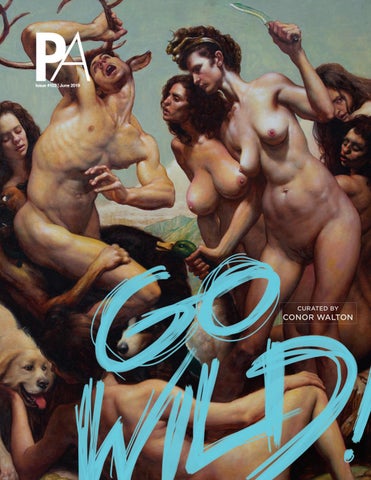
COVER ART Adam Miller
DESIGNER April Carter Grant
POEMS Edward Nudelman
Copyright © 2008-2019. All rights are reserved by PoetsArtists, GOSS183, Didi Menendez, and contributing artists, writers, and poets. All writings, artwork, and images are copyright of the contributors and may not be reproduced without explicit permission. This publication may not be reproduced electronically, digitally, in print or any other form, format, or media without the explicit, written permission and approval of the copyright holders. All images and artwork are used with permission of the authors/creators or their representatives. Unless otherwise noted all sizes are in inches.
CYNTHIA SITTON
She Delighted in hem 18" x 24" oil on linen
Introduction by CONOR WALTON There’s no blank spots on the map anymore, anywhere on earth. If you want a blank spot on the map, you gotta leave the map behind. —Jon Krakauer Inside all of us is… A Wild Thing. —Maurice Sendak
Straight after I agreed to curate this exhibition, I sat down to dinner with my children and asked if they could think of a good title for a show. The first thing my thirteen-year-old son Daniel suggested was “GO WILD!” and I thought, Wow! That’s it! As a title and a theme, “GO WILD!” provides a context tight enough to offer coherence, yet loose enough to give the artists freedom to do what they do best. You can interpret it as targeting Nature in its broadest sense, or simply as an exhortation to take a risk; to unleash one’s talent, express the Dionysian aspect of our natures. Both of these themes (and many more) came through in the work I
have been offered, so I am delighted: Overall, I think a bit of the zeitgeist comes through in this show. In many of these paintings, our relationship with Nature is obviously an underlying issue, but one which presents itself in many forms. In Rachel Linnemeier’s Camera Click, it takes the form of ironical detachment. The subject of the painting stands heroically, camera in hand, apparently seeking Nature and ready to “capture the scene,” and yet the Nature he seeks already appears reduced, processed, flattened. The painting seems to comment upon the way so much of our experience of the world is now packaged and mechanically
mediated. There is humour in this painting, but also melancholy; a sense of lost directness and authenticity in our relationships, both with that which is “other” and with our inner selves. Childhood is a recurring theme, which for many of us appears to stand for a time when we were closer to Nature, more spontaneous and whole, and wilder. Dana Hawk’s Wildlife “is about being a kid immersed and one with nature.” Serena Potter’s Nighttiming depicts adults escaping into an infantile world of spontaneous fun and irresponsibility. For Linda Tracey Brandon in Capture the Flag, childhood represents “that brief juncture where fantasy and innocence intersect with the wild, reckless freedom of living in the present moment.” These words are also appropriate for the child in Cynthia Sitton’s She Delighted in Them: Living in her fantasy, unaware of the approaching storm behind her, it is, according to Sitton, “a love letter to my ill daughter”, and infused with a wistful sense of adult suffering and regret. Some of the artists have used the nude as a way of articulating our animal natures. Susannah Martin’s provocative image Schmetterling (“Butterfly”) is the quintessence of Dionysiac rapture. In Tina Garrett’s Baptism, a female bather evokes the pleasure of skinny-dipping, momentarily shedding inhibitions and finding peace through immersion in watery nature. In Denise Fulton’s Camouflage, the woman hides in plain sight, her form broken up by dramatic shadows. She eyes the viewer like a wild
animal (though it’s not clear whether she is metaphorically prey, or predator waiting in ambush). Sarah Lacy’s exquisite drawing Cygnus finds analogies in human and animal form, in this case between human and swan. As she says: Organic form—the way nature grows and shapes itself—is deeply playful and fractal, and shapes repeat, mirror and metamorphize across forms and species. My model’s bone structure, particularly in the shape of her collarbones, reminded me of the curve of a swan’s outstretched wings. I wanted to bring those shapes to life as a physical manifestation: her daemon, her familiar, an extension of her spirit and power. She is the swan and the swan is her. We are not separate from Nature, we are Nature. In exploring the contested borderlands between human and animal, “civilised” and “primitive,” several of the artists in this show have rediscovered the power of mythology. Adam Miller’s reworking of ancient mythological themes of violence and transgression, suffering and rapture, seems intent on reconnecting us with our deepest natures. For the hunter Actaeon (whose punishment for seeing the Goddess naked is to be turned into a stag and torn apart by his hounds), insight comes at a terrible price. An inevitable consequence of reinvigorating the mythopoeic imagination appears to be the rediscovery of Tragedy, all too apt for the coming age. Indeed, my wager on our dawning epoch is that (contra the superficial optimism of our “official”’
culture) only a sublimely tragic art will do it justice. In these works, I see its first awakening. Like Miller, Luke Hillestad brings continuity of human and natural form in a mythological direction. His Medusa Waiting, half-animal, appears not as an object of terror but of pathos and desire: In its way, it too speaks of our situation in which wild Nature appears less fearsome and monstrous than beautiful and suffering. This Medusa stands like an endangered species, the carrier of an intuitive, poetic wisdom entirely at odds with the technocratic logic of our civilisation. Molly Judd is a young Irish artist snapping at her elders’ heels with whom I seem to have an unwitting relationship of common themes. When I first saw her Raskolnikov, I was so happy she hadn’t called it Flogging a Dead Horse, because I am working on a painting of this title and close enough in theme to hers (which I take to be ecocidal guilt, shame at our criminal treatment of Nature) in Molly’s case is raised to the level of sublime metaphor. I’ve long been fascinated by Martin Wittfooth’s depiction of a post-apocalyptic, post-human world in which a degraded, mutant nature recovers amongst the ruins of our civilisation. Wittfooth’s imagery is striking for its anti-humanism: Ostensibly the human image is banished from his art and animal nature reigns supreme. Yet the physical or metaphorical detritus of our culture is everywhere in his world, and the satirical force of his work is clearly
premised on our species’ collective insanity: Wittfooth’s imagination is wounded, angry and feral. Both directly and indirectly, many of these paintings bear witness to the planetary catastrophe unfolding around us and the need to recover a sense of human identity in which Culture isn’t opposed to Nature but unfolds within it. This is, I think, what gives some of the best contemporary figurative art: naturalistic in technique but using dream, fantasy, metaphor to plumb our psychic depths—its current impetus and urgency. All these artists combine old-master virtuoso techniques with a contemporary sensibility to produce paintings that, in sum, tackle almost every subject, from the painfully or joyfully private to the great public issues of our day: politics, ecology, the fate of our civilization and our planet. If an artist’s job is to give us images through which we can better understand ourselves and the world, this is exactly what these artists are doing. I think there’s a huge appetite today, particularly among the young (and in the context of an often shallow, consumerist pop culture) for an art that isn’t simply brash or slick or clever, but that speaks to our deepest desires and needs: for truth and beauty, and above all, for meaning. There are many treasures to be found in this little collection of works, for those with eyes to find them! Expect to be provoked, teased, caressed with beauty, troubled with insight. You deserve nothing less.
LUKE HILLESTAD Medusa Waiting 44.1" x 31.9" oil on linen
SERENA POTTER Nighttiming 35" x 25" oil on canvas
Nighttiming is part of an ongoing series of paintings that contrasts the stylistic elements reminiscent of the golden age American illustrators (such as Norman Rockwell and J.C. Leyendecker),with a sardonic narrative, which places adults in childlike situations. By pairing contemporary and vintage imagery, the paintings speak to the transitory nature of time, and the relevance of early experience in shaping who we become.
CLAUDIA KAAK he Wolves are at my Door 23.6" x 31.5" oil on canvas
JON HYLAND he Girl with Kaleidoscope Eyes 14" x 11" oil on canvas
his portrait of a colourfully and otherwise glamorously appointed woman inexplicably holding a long-stemmed rose over each eye leads the viewer to confront juxtaposition and surprise on a human and ultimately humorous level. “Who is that woman in the frame?” the viewer may ask. When one realizes the portrait is of the legendary American comic actress Lucille Ball, her hair all ablaze in its trademark orange-red, her lips in their familiar cherry red, the wonder is replaced by a smile. Or so that’s the intention. he title—borrowed from the Beatles’ aptly named “Lucy in the Sky With Diamonds”— is a paean to the comic genius herself.
LINDA TRACEY BRANDON Capture the Flag 24" x 18" oil on linen mounted on wood panel
SHAWN SULLIVAN Still Life with Game 16" x 20" oil on panel
In Saxon history, the irst full moon ater the vernal equinox was called the Ostara, sacred to Eostre, the lunar goddess of fertility. It was a time to celebrate new life, and longer days. My painting on copper is called Ostara from which Easter was derived. It is an ancient gynocentric holiday from the period in which celebrations were more irmly rooted in the gods of place and nature.
NICOLE ALGER Ostara 34" x 14" oil on copper
Recombinant
Forging New Paths
Say this poem’s woven entirely from hidden messages extracted from my genetic code, the four base-pair combinations found in my DNA helix, energetically unfolding. Say each specific enzyme preserves its informational content. And say each letter articulates a near infinite reduction of terms, based on gene transduction, performed by recursive algorithm. So when I express a heartfelt desire to be known, the poem simply wobbles on its alpha backbone, mimicking my thoughts— about a hundred angstroms long, located on my sixth chromosome.
Waking early, as August sun sublimes dew, spreading lighter air like a blanket over creeping things and those with wings, hallowing their green halls of new grass— what is it I expect from this morning, whose fate is to move shadow into light? When will the surprise of it wake me further, into a realm jeweled with wisdom? In this corridor, an interspecies kinship is forged— spring worm and fly, gulls distant notes, ever plaintive, a line of crows on the fence, armored like guardians of a deeper truth. I move through it, tracking the rain-infused grass, in serpentine fashion. But my dog, in her last years, is unfazed by such magic. She noses the gate open, plods to where she last remembers her tennis ball, crouching lower and lower with each anticipated step. Crows scatter as she advances, more like donkey than dog, carrying her load of courage to the very end, as I hope to emulate, kindred under the skin, and in the earth we’ll end in.
EDWARD NUDELMAN Edward Nudelman’s poetry collections include Out of Time, Running (Harbor Mountain Press, 2014); What Looks Like an Elephant (2011, Lummox Press), Second Place, Indie Lit Awards Book of the Year; and Night Fires (2009, Pudding House Press), semifinalist for the OSU Press Journal Award. Over 100 of Nudelman’s poems have appeared in journals, including: Rattle, Cortland Review, 2River, Valparaiso Review, Chiron Review, Evergreen Review, PoetsArtists, Ampersand, Syntax, The Atlanta Review, Mipoesias, Plainsongs, Floating Bridge Press, and The Penwood Review. A recently retired cancer research scientist with over 80 published papers in top tier cancer journals, Nudelman continues to own and operate a rare bookshop in Seattle, which he founded in 1980.
Backyard in April There’s a kingdom in a spoonful of stagnant water, a universe hidden in the super-saturated air. Even this flooded grass, once a cathedral of clover and bee, gives up its wanton ghost of disarray in a curtsy to life, reminding us of Spring, and the mending of tiresome habits. In the very back, a small pool for ducks brims with brownish goo— cupping hands, you collect a palm-load of water bears, teeming like a parade of floats, where countless Jupiters orbit multiple moons, Disneyland’s tea cups, circling their suns. You begin to relax in this familiar place, feeling the imparted mix of inevitable change, as ripples of blissful hesitation run through you— even if the call for dinner has been ordained. You will come back to this yard later this week, or maybe in the very end of your time, rejoicing in the hue of granite and silica, the dripping shed, framed by a hemlock’s green lace.
Survivors is about accepting our own mortality. he growth of a child is profoundly beautiful, but also something sad for me, slightly melancholic. It adds up to what is leeting.
FRANCIEN KRIEG Survivors 39.4" x 31.5" oil on linen
MARTIN WITTFOOTH As Above So Below 29.9" diameter oil on canvas
ALEX CALLAWAY Chance Encounter; Kiwano with Ghost Pumpkin 16" x 20" oil on linen on aluminum composite panel
CYNTHIA SITTON She Delighted in hem 18" x 24" oil on linen
My protagonist lives in her fantasy and can be viewed as unaware of the impending force behind her or is escaping from it.
he painting comes from a body of work created in tandem with a fairy tale I have been writing. My protagonist lives in two realities. Basically, it is my love letter to my ill daughter.
he painting Aurora is an exploration of climactic joy and post-coital delation. his is expressed through a visual narrative structure, but also uses color to tip the emotion of orgasmic exultation towards a ‘souring’ of expectations. he impossibility of an Aurora Borealis over a desert city in the summer, witnessed by an innocent and her spirit animal, is met with the certain knowledge in the viewer’s mind that the return of the male object of desire cannot possibly maintain the aterglow of their sexual union.
F. SCOTT HESS Aurora 30" x 24" oil on canvas
RACHEL LINNEMEIER Camera Click 16" x 20" oil on aluminum
Camera Click is about seeking challenges and being prepared to seize the moment. he igure is relaxed but at the ready with his camera set for a quick *click*. Whether one is in the wild or in their own back yard, the beneits of being present in the moment are paramount.
My painting has two loosely knit narratives or inspirations. he initial one is that of the powerful Atlantic coldly taking the lives of so many ishermen who brave the waters. he lady is lamenting and mourning their loss, and we can see shadows of them within the rolling fog. he other side to it is inspiration of he Stolen Child, by W. B. Yeats: “Come away, O human child! To the waters and the wild With a faery, hand in hand, For the world’s more full of weeping than you can understand.” he faintly painted constellations are that which you will see if you face due west standing on Rosses Point in Sligo.
DÁIRE LYNCH Home in the Dark 47" x 31" oil on canvas
MARC SCHEFF Lauren 16" x 12" x 3" resin over mixed media
TERESA BRUTCHER Is hat You Goldie? 27.5" x 27.5" oil on canvas
TERESA BRUTCHER Is hat You Winnie? 27.5" x 19.5" oil on canvas
ADAM MILLER Diana and Actaeon 36" x 50" oil & tempera on panel
DENISE FULTON Camoulage 20" x 16" oil on panel
SUSANNAH MARTIN Schmetterling 39.4" x 59.1" oil on linen
he word Schmetterling, or butterly in German, is the name that I have chosen for my painting for a number of reasons. he most obvious reason is that she appears to form an Ad hoc butterly form with her barely controlled found or collected objects (in this case magenta Mylar balloons). he Mylar balloons suggest that she is part of some type of a party as does her crude body paint. It is possible that she is under the inluence of recreational drugs as she does not appear to be interested in presenting a cohesive appearance for our audience. Or perhaps, it is a trance of deep concentration. Indeed, she does not appear to be aware that she is being observed at all. his leads us to the second reason why she is like a butterly, namely that she is breaking free from the cocoon that has held her immobilized until now. We may think of this cocoon as being social norms or other restrictions which have held women frozen for centuries. Lastly, I believe that the German word “Schmetterling” suits her better than Butterly. he noun “Schmetterling” stems from the verb “schmettern” which means to smash, to violently destroy or chop into pieces with a rapid lurry of sharp movement. his concept best represents the degree of intensity which is needed for her to free herself from that which has held her captive and to realize her true identity.
I’m fascinated by Appalachian culture and its Scots-Irish roots. My series of paintings based on this region’s ballads and murder ballads (oten originating in the untamed Scottish Borders) is inspired by the way this old “culture of honor” continues to afect present-day America. For that reason, the paintings are set in the contemporary South. he series began by interpreting particular songs but has evolved, as in this pair of studies, into pure symbolism. In Albion’s Seed, historian David Hackett Fisher speaks vividly of a “nescient fatalism” felt by backcountry people. In a culture where violence is accepted, oten embraced, it’s a hard place to be a woman. he protagonist in these studies has fashioned a gentler substitute for herself, a husband made of corn stalks and barbed wire—the result is as comforting as the cold wood stove.
JULYAN DAVIS he Stalk Husband 14" x 18" oil on panel
DANA HAWK Wildlife 6" x 6" oil on panel
Wildlife is about a kid being immersed and one with nature.
hrough bold paint application and simple design, this image is meant to suggest a young boy realizing his vision through possibilities in the form of shape and color. Dreamer is the irst in a series of paintings portraying my son Julian.
JON JOHNSON Dreamer 16" x 11" oil
MARK HEINE Metamorphosis 30" x 48" oil on canvas
MOLLY JUDD Raskolnikov 59" x 55.1" oil on linen
MELISSA HEFFERLIN Sisters in Crime 12" x 6" linoleum print on Japanese paper
Some say there are dimensions that exist alongside our own—ones which we cannot normally perceive with our senses. Here, a woman hovering above the terrain has discovered a rit in the atmosphere; a kind of portal that leads into a passage to such a place. As she reaches into the opening, light begins to surge forth, beckoning her to enter...
STEVEN DALUZ Rip 24" x 24" oil & metal leaf on composite aluminum
CHARLENE MOSLEY Flora 12" x 12" oil on canvas
Flora is a self-portrait that portrays a deep connection to the natural environment and the beauty therein. It is grown on the igure to emphasise that nature is everywhere, we make all we have from it and we live in it, so we need nourish to keep experiencing it.
SARAH LACY Cygnus 20" x 16" graphite
JAN NELSON International Deconstruction #1 54" x 36" photograph
International Deconstruction #1 tells a story of an earlier time in the Olympic Mountains of Washington State, of machines let behind when dreams fade and the efects of the elements and time on those machinations. his image is a closeup photograph of the bed rails of a 1963 International Harvester truck in the rainforest, the bed long rotted away, leaving rusted bolts behind being slowly overcome by fragile-looking mosses that are persistent in their consumption of iron oxides, fueled by maritime rains.
ALEX DEWARS A Misplaced Sense of Belonging 47.2" x 31.5" oil on canvas
DANIELA WERNECK he Hider and the Seekers 20" x 32" watercolor on clay panel
BELINDA EATON Tattoo Man 36.5" x 26.5" acrylic on canvas
TINA GARRETT Baptism 60" x 40" oil on canvas
Baptism is the centre piece of my irst solo show, Pieces Of Me, where visitors were invited to express the narrative that they observed in each of the works. “Baptism” was described with a wide range of comments, but the two narratives I felt were the most interesting are: “Degrading to women.” and “What freedom to love myself looks like.” In fact, the Board Of Trustees where the show was hosted broke out in conlict over allowing my show to remain on exhibit with half of them calling it evil and half calling it art. As an artist it has been such a wonderful experiment to let go of the need to control what art observers are supposed to see in my works and truly be vulnerable to being authentic and accepting their perspectives as valid and real however varied, however diferent from my intentions and, in some ways, however painful it has been.
JAN ESMANN Singing Woman at a Rocky Coast 47.2" x 63" oil on canvas
TIMOTHY ROBERT SMITH Upside Downtown LA 22" x 60" oil (on three panels)
JAN ESMANN Singing Woman at a Rocky Coast 47.2" x 63" oil on canvas
BROOKE WALKER he Blink Moment 20" x 16" oil
SUSANNAH MARTIN
Schmetterling 39.4" x 59.1" oil on linen
ART BY Nicole Alger Linda Tracey Brandon Teresa Brutcher Alex Callaway Julyan Davis Steven DaLuz Alex Dewars Belinda Eaton Jan Esmann Denise Fulton Tina Garrett Dana Hawk Melissa Hefferlin F. Scott Hess Mark Heine Luke Hillestad John Hyland Jon Johnson Molly Judd Claudia Kaak Francien Krieg Sarah Lacy Rachel Linnemeier Dáire Lynch Susannah Martin Adam Miller Charlene Mosley James Needham Jan Nelson Serena Potter Marc Scheff Cynthia Sitton Timothy Robert Smith Shawn Sullivan Brooke Walker Daniela Werneck Martin Wittfooth
POEMS BY Edward Nudelman
www.poetsandartists.com