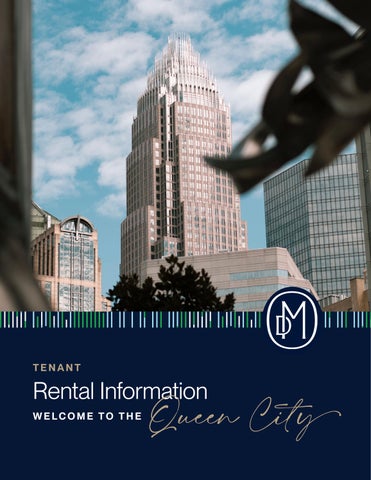
TENANT
Rental Information WELCOME TO THE
Queen City
About Us Who We’re the people you want at your side. Friends at heart. Professionals in practice and mind. We train our agents to be the best. Then we back them up with a world-class team. Every agent of ours must meet a certain experience level and criteria to join us. LO CATI O N
2330 Randolph Road Charlotte, NC 28207 dickensmitchener.com 704.342.1000
Where Charlotte. The Queen City. Our first love. Our home. As agents, we know this city’s neighborhoods like our closest circle of friends. We tend to this relationship as much as we do our connections to you. Place matters. Knowledge counts. How Agents who help more people end up better at their jobs. It’s like going to the gym — the more you go, the better your results. This is why we only have full-time, fully committed agents. We train them constantly on the changing market, new tech, negotiation strategies and people skills. We get to work with top-of-the-line agents. You get what you want, wrapped in the best possible experience.
Rental Stats
Charlotte Region Rental Report – July 2026 A research tool provided by the Canopy Realtor® Association FOR MORE INFORMATION CONTACT A REALTOR®
Activity for the Charlotte Region Includes Alexander, Anson, Cabarrus, Catawba, Cleveland, Gaston, Iredell, Lincoln, Mecklenburg, Rowan, Stanly and Union Counties in North Carolina and Chester, Chesterfield, Cleveland, and York Counties in South Carolina
July
Year to Date
2025
2026
Percent Change
2025
2026
Percent Change
Number of Active Rentals
1,976
1,743
-11.8%
--
--
--
Number of Properties Leased
986
878
-11.0%
6,673
6,633
-0.6%
Average Monthly Lease Price
$2,114
$2,174
+2.8%
$2,093
$2,107
+0.7%
Number of Properties Leased 997
Average Monthly Lease Price
986
$2,070
$2,114
$2,174
+2.1%
+2.8%
Jul-25
Jul-26
878
Jul-24
-1.1%
-11.0%
Jul-25
Jul-26
Jul-24
Number of Active Rentals by Total Finished Square Footage The sum of these segments is not equal to Number of Active Rentals.
728
330
1,500 Sq. Ft. or Less
1,501 - 2,000 Sq. Ft.
127
141
2,001 - 2,500 Sq. Ft.
2,501 Sq. Ft. or More
This report provides a sample/representation of the rental activity that occurred during the time period shown. It is based on limited historical records, and not all information for each rental is complete. Report provided by the Canopy Realtor® Association. Canopy Realtor® Association does not guarantee nor is it responsible for the accuracy of the data provided in this report. Data maintained by Canopy Realtor® Association may not reflect all real estate activity in these areas.
Current as of August 5, 2026. All data from Canopy MLS, Inc. Report provided by the Canopy Realtor® Association. Report © 2026 ShowingTime Plus, LLC.
Charlotte Region Rental Report – July 2026 A research tool provided by the Canopy Realtor® Association FOR MORE INFORMATION CONTACT A REALTOR®
Activity by Area Active Rentals
Properties Leased
Avg Monthly Lease Price
For the Current Time Period
For the 12 Months Ending…
For the 12 Months Ending…
Jul-25
Jul-26
Percent Change
Jul-25
Jul-26
Percent Change
The Charlotte Region
1,976
1,743
-11.8%
10,986
11,127
+1.3%
$2,072
$2,086
+0.7%
Charlotte MSA
1,767
1,537
-13.0%
9,824
9,908
+0.9%
$2,103
$2,124
+1.0%
Jul-25
Jul-26
Percent Change
Alexander County, NC
2
3
+50.0%
18
13
-27.8%
$1,494
$1,425
-4.6%
Anson County, NC
0
4
--
3
5
+66.7%
$1,250
$1,509
+20.7%
Cabarrus County, NC
127
91
-28.3%
1,004
984
-2.0%
$1,949
$1,937
-0.6%
Chester County, SC
2
4
+100.0%
22
10
-54.5%
$1,097
$1,085
-1.2%
Chesterfield County, SC
2
2
0.0%
1
5
+400.0%
$900
$1,152
+28.0%
Cleveland County, SC
10
10
0.0%
70
78
+11.4%
$1,522
$1,577
+3.6%
Gaston County, NC
110
115
+4.5%
776
793
+2.2%
$1,602
$1,674
+4.5%
Iredell County, NC
150
141
-6.0%
845
859
+1.7%
$1,956
$1,893
-3.2%
Lincoln County, NC
31
35
+12.9%
255
268
+5.1%
$1,873
$1,774
-5.3%
1,283
1,124
-12.4%
6,434
6,443
+0.1%
$2,192
$2,212
+0.9% -18.5%
Mecklenburg County, NC Montgomery County, NC
5
2
-60.0%
6
16
+166.7%
$1,850
$1,508
Stanly County, NC
13
19
+46.2%
98
147
+50.0%
$1,474
$1,500
+1.7%
Union County, NC
117
76
-35.0%
647
758
+17.2%
$2,243
$2,313
+3.1%
Lancaster County, SC
25
19
-24.0%
128
115
-10.2%
$2,236
$2,249
+0.6%
York County, SC
49
43
-12.2%
362
318
-12.2%
$2,238
$2,274
+1.6%
1,170
984
-15.9%
5,636
5,635
-0.0%
$2,169
$2,186
+0.8%
Concord, NC
70
52
-25.7%
607
567
-6.6%
$1,937
$1,901
-1.9%
Davidson, NC
13
24
+84.6%
118
111
-5.9%
$2,665
$2,530
-5.1%
Denver, NC
19
12
-36.8%
113
112
-0.9%
$2,252
$2,240
-0.6%
Gastonia, NC
54
61
+13.0%
406
358
-11.8%
$1,527
$1,569
+2.8%
Huntersville, NC
37
53
+43.2%
314
303
-3.5%
$2,332
$2,471
+6.0%
Kannapolis, NC
31
24
-22.6%
232
246
+6.0%
$1,625
$1,619
-0.3%
Lincolnton, NC
5
15
+200.0%
107
128
+19.6%
$1,431
$1,377
-3.7%
Matthews, NC
23
34
+47.8%
236
228
-3.4%
$2,234
$2,307
+3.3%
Monroe, NC
53
24
-54.7%
250
275
+10.0%
$1,994
$1,997
+0.2%
Mooresville, NC
92
89
-3.3%
512
504
-1.6%
$2,082
$2,032
-2.4%
Salisbury, NC
14
15
+7.1%
96
109
+13.5%
$1,489
$1,535
+3.1%
Statesville, NC
30
41
+36.7%
227
249
+9.7%
$1,604
$1,591
-0.8%
Waxhaw, NC
26
25
-3.8%
134
185
+38.1%
$2,799
$2,782
-0.6%
Fort Mill, SC
36
16
-55.6%
182
168
-7.7%
$2,569
$2,492
-3.0%
Rock Hill, SC
5
14
+180.0%
119
87
-26.9%
$1,799
$1,825
+1.4%
Lake Norman
113
94
-16.8%
507
473
-6.7%
$2,374
$2,372
-0.1%
Lake Wylie
30
21
-30.0%
133
140
+5.3%
$2,715
$2,719
+0.2%
Uptown Charlotte
52
61
+17.3%
177
154
-13.0%
$2,120
$2,052
-3.2%
City of Charlotte, NC
This report provides a sample/representation of the rental activity that occurred during the time period shown. It is based on limited historical records, and not all information for each rental is complete. Report provided by the Canopy Realtor® Association. Canopy Realtor® Association does not guarantee nor is it responsible for the accuracy of the data provided in this report. Data maintained by Canopy Realtor® Association may not reflect all real estate activity in these areas.
Current as of August 5, 2026.All data from Canopy MLS, Inc. Report provided by the Canopy Realtor® Association. Report © 2026 ShowingTime Plus, LLC.
Forms
WORKING WITH REAL ESTATE AGENTS (LEASE TRANSACTIONS) (FOR TENANTS) NOTE: This form is designed for use by agents working with tenants. It is similar, but not identical, to the “Working with Real Estate Agents Disclosure (For Buyers)” published by the NC Real Estate Commission (available as NCR Standard Form #520), which must be used by agents working with buyers.
IMPORTANT
This form is not a contract. Signing this disclosure only means you have received it.
PL E
In a real estate lease transaction, it is important that you understand whether an agent represents you. Real estate agents should (1) review this form with you at first substantial contact - before asking for or receiving your confidential information and (2) give you a copy of it after you sign it. This is for your own protection. Do not share any confidential information with a real estate agent or assume that the agent is acting on your behalf until you have entered into an agreement with the agent to represent you. Otherwise, the agent can share your confidential information with others.
Note to Agent: Check all relationship types below that may apply to this tenant.
________ Tenant Agency: If you agree, the agent who gave you this form (and the agent’s firm) would represent you as a tenant agent and be loyal to you. You may begin with an oral agreement, but your agent must enter into a written tenant agency agreement with you before making a written or oral offer for you. The landlord would either be represented by an agent affiliated with a different real estate firm or be unrepresented.
M
________ Dual Agency Dual agency will occur if you lease a property listed by the firm that represents you. If you agree, the real estate firm and any agent with the same firm (company), would be permitted to represent you and the landlord at the same time. A dual agent’s loyalty would be divided between you and the landlord, but the firm and its agents must treat you and the landlord fairly and equally and cannot help you gain an advantage over the other party.* ________ Designated Dual Agency: If you agree, the real estate firm would represent both you and the landlord, but the firm would designate one agent to represent you and a different agent to represent the landlord. Each designated agent would be loyal only to their client.*
SA
*Any agreement between you and an agent that permits dual agency must be put in writing no later than the time you make an offer to lease. ________ Unrepresented Tenant (Landlord subagent): The agent who gave you this form may assist you in your lease, but will not be representing you and has no loyalty to you. The agent will represent the landlord and is required to give the landlord any information about you (even personal, financial or confidential information) that would help the landlord in the lease of their property.
Note to Tenant: For more information on an agent’s duties and services, refer to the NC Real Estate Commission’s “Questions and Answers on: Working With Real Estate Agents” brochure at ncrec.gov (Publications, Q&A Brochures) or ask an agent for a copy of it. ____________________________ Tenant’s signature
___________________________ Tenant’s signature
___________________________ Date
___________________________ Agent’s name
___________________________ Agent’s license no.
____________________________ Firm name
Page 1 of 1 NC REALTORS®
STANDARD FORM 521 Revised 7/2022 © 7/2026
EXCLUSIVE TENANT REPRESENTATION AGREEMENT (Residential Property) This EXCLUSIVE TENANT REPRESENTATION AGREEMENT (“Agreement”) is entered into (Date)_____________________, between_________________________________________________________________________________as Tenant(s) (“Tenant”), and________________________________________________________________________________________________ (“Firm”) as the Tenant's exclusive agent to assist the Tenant in the lease of residential real property on terms and conditions acceptable to Tenant. Tenant represents that, as of the commencement date of this Agreement, the Tenant is not a party to a Tenant representation agreement with any other real estate firm. Tenant has received a copy of the “WORKING WITH REAL ESTATE AGENTS (LEASE TRANSACTIONS)” disclosure and has reviewed it with Firm. Tenant further represents that Tenant has disclosed to Firm information about any properties of the type described in paragraph 1 below that Tenant has visited at any open houses or that Tenant has been shown by any other real estate firm. 1. GENERAL LOCATION:___________________________________________________________________________________.
PL E
2. DURATION OF AGENCY. Firm's authority as Tenant's exclusive agent shall begin __________________________, and subject to paragraph 3, shall expire at midnight, ________________________________, or when Tenant leases residential real property of the type described in paragraph 1, whichever occurs sooner. 3. COMPENSATION OF FIRM. (a) Tenant agrees that Firm’s fee for services hereunder shall be in the amount of _______________________________________ ______________________________________________________________________________________________________(“Fee”) (Insert dollar amount, percentage of lease price, or other method of determining Firm’s compensation. Do not insert N/A or a zero ($0)). The parties agree that Firm shall first seek the Fee from the listing agent. If there is no listing agent, Firm shall first seek the Fee from the landlord. Should the fee so obtained be greater than the Fee listed above, Firm shall be entitled to retain the difference. Should the fee so obtained be less than the Fee listed above, Tenant shall pay Firm the difference upon execution of a lease. The Fee will be due and payable upon execution of a lease. If Tenant defaults in a lease contract, the Fee that would have been due Firm had the transaction been consummated will be due and payable immediately in cash from Tenant.
SA
M
4. FIRM’S DUTIES. During the term of this Agreement, Firm shall promote the interests of Tenant by: (a) performing the terms of this Agreement; (b) seeking property at a price and terms acceptable to Tenant; (c) presenting in a timely manner all written offers or counteroffers to and from Tenant; (d) disclosing to Tenant all material facts related to the property or concerning the transaction of which Firm has actual knowledge; (e) accounting for in a timely manner all money and property received in which Tenant has or may have an interest. Unless otherwise provided by law or Tenant consents in writing to the release of the information, Firm shall maintain the confidentiality of all personal and financial information and other matters identified as confidential by Tenant, if that information is received from Tenant during the brokerage relationship. In satisfying these duties, Firm shall exercise ordinary care, comply with all applicable laws and regulations, and treat all prospective landlords honestly and not knowingly give them false information. In addition, Firm may show the same property to other Tenants, represent other Tenants, represent landlords relative to other properties, or provide assistance to a landlord or prospective landlord by performing ministerial acts that are not inconsistent with Firm’s duties under this Agreement. 5. NON-DISCRIMINATION. THE AGENT (FIRM) SHALL CONDUCT ALL BROKERAGE ACTIVITIES IN REGARD TO THIS AGREEMENT WITHOUT RESPECT TO THE RACE, COLOR, RELIGION, SEX, NATIONAL ORIGIN, HANDICAP OR FAMILIAL STATUS OF ANY PARTY OR PROSPECTIVE PARTY. FURTHER, REALTORS® HAVE AN ETHICAL DUTY TO CONDUCT SUCH ACTIVITIES WITHOUT RESPECT TO THE SEXUAL ORIENTATION OR GENDER IDENTITY OF ANY PARTY OR PROSPECTIVE PARTY. 6. TENANT’S DUTIES. Tenant agrees to cooperate with Firm in leasing real property of the type described in paragraph 1, including but not limited to: (a) working exclusively with Firm during the term of this Agreement; (b) immediately referring to Firm information about any properties Tenant may have an interest in examining; (c) complying with the reasonable requests of Firm to supply any pertinent financial or personal data needed to fulfill the terms of this Agreement; (d) being available for reasonable periods of time to examine properties; (e) examining properties only by appointments made by or through Firm and accompanied by an agent of Firm; (f) conducting all negotiations and communications through Firm; Page 1 of 4 NC REALTORS® Tenant initials _______ _______ Individual agent initials _______
STANDARD FORM 460 Created 7/2020 © 7/2026
(g) conducting all due diligence on property in consultation with Firm; and (h) paying for any products and/or services required in the examination and evaluation of properties.
M
PL E
7. DUAL AGENCY. Tenant understands that the potential for dual agency will arise if Tenant becomes interested in viewing property listed with Firm. Firm may represent more than one party in the same transaction only with the knowledge and informed consent of all parties for whom Firm acts. (a) Disclosure of Information. In the event Firm serves as a dual agent, Tenant agrees that without permission from the party about whom the information pertains, Firm shall not disclose to the other party the following information: (1) that a party may agree to a price, terms, or any lease conditions other than those offered; (2) the motivation of a party for engaging in the transaction, unless disclosure is otherwise required by statute or rule; and (3) any information about a party which that party has identified as confidential unless disclosure is otherwise required by statute or rule. (b) Firm’s Role as Dual Agent. If Firm serves as agent for both Tenant and a landlord in a transaction, Firm shall make every reasonable effort to represent Tenant and landlord in a balanced and fair manner. Firm shall also make every reasonable effort to encourage and effect communication and negotiation between Tenant and landlord. Tenant understands and acknowledges that: (1) Prior to the time dual agency occurs, Firm will act as Tenant’s exclusive agent; (2) In its separate representation of Tenant and landlord, Firm may obtain information which, if disclosed, could harm the bargaining position of the party providing such information to Firm; (3) Firm is required by law to disclose to Tenant and landlord any known or reasonably ascertainable material facts. Tenant agrees Firm shall not be liable to Tenant for (i) disclosing material facts required by law to be disclosed, and (ii) refusing or failing to disclose other information the law does not require to be disclosed which could harm or compromise one party's bargaining position but could benefit the other party. (c) Tenant’s Role. Should Firm become a dual agent, Tenant understands and acknowledges that: (1) Tenant has the responsibility of making Tenant’s own decisions as to what terms are to be included in any lease agreement with a landlord client of Firm; (2) Tenant is fully aware of and understands the implications and consequences of Firm’s dual agency role as expressed herein to provide balanced and fair representation of Tenant and landlord and to encourage and effect communication between them rather than as an advocate or exclusive agent or representative; (3) Tenant has determined that the benefits of dual agency outweigh any disadvantages or adverse consequences; (4) Tenant may seek independent legal counsel to assist Tenant with the negotiation and preparation of a lease agreement or with any matter relating to the transaction which is the subject matter of a lease agreement. Should Firm become a dual agent, Tenant waives all claims, damages, losses, expenses or liabilities, other than for violations of the North Carolina Real Estate License Law and intentional wrongful acts, arising from Firm's role as a dual agent. Tenant shall have a duty to protect Tenant’s own interests and should read any lease agreement carefully to ensure that it accurately sets forth the terms which Tenant wants included in said agreement. (d) Authorization (initial only ONE).
SA
______ ______ Tenant authorizes the Firm to act as a dual agent, representing both the Tenant and the landlord, subject to the terms and conditions set forth in this Paragraph 7. ______ ______ Tenant desires exclusive representation at all times during this agreement and does NOT authorize Firm to act in the capacity of dual agent. If Tenant does not authorize Firm to act as a dual agent, the remainder of this paragraph shall not apply. (e) Designated Agent Option (Initial only if applicable). ______ ______ Tenant hereby authorizes the Firm to designate an individual agent(s) to represent the Tenant, to the exclusion of any other individual agents associated with the Firm. The individual designated agent(s) shall represent only the interests of the Tenant to the extent permitted by law. NOTE: When dual agency arises, an individual agent shall not practice designated agency and shall remain a dual agent if the individual agent has actually received confidential information concerning a landlord client of the Firm in connection with the transaction or if designated agency is otherwise prohibited by law.
Page 2 of 4 Tenant initials _______ _______ Individual agent initials _______
STANDARD FORM 460 Created 7/2020 © 7/2026
(f) Dual Agency Compensation. If the Firm acts as a dual agent (including designated agency), the total fee the Firm expects to receive for its services in representing Tenant and the landlord shall be __________________________________________________ ___________________________________________________________________________________________________________. (Insert dollar amount, percentage of lease price, or other method of determining Firm’s compensation for any property the Tenant may lease). THIS WILL IN NO WAY AFFECT OR MODIFY THE AMOUNT OF THE FEE SET FORTH IN PARAGRAPH 3 ABOVE THAT FIRM EXPECTS TO RECEIVE FOR ITS SERVICES IN REPRESENTING TENANT UNDER THIS AGREEMENT. In the event Tenant is interested in leasing a property where the Firm’s total fee is different from that described in this subparagraph (f), the Firm shall timely disclose the fee to Tenant and confirm it in writing before Tenant makes or accepts an offer to lease any such property. 8. MEDIATION. If a dispute arises out of or related to this Agreement or the breach thereof, and if the dispute cannot be settled through negotiation, the parties agree first to try in good faith to settle the dispute by mediation before resorting to arbitration, litigation, or some other dispute resolution procedure. If the need for mediation arises, the parties will choose a mutually acceptable mediator and will share the cost of mediation equally.
PL E
9. ENTIRE AGREEMENT/CHANGES/TERMINATION. This Agreement constitutes the entire agreement between Tenant and Firm relating to the subject thereof, and any prior agreements pertaining thereto, whether oral or written, have been merged and integrated into this Agreement. This Agreement may be signed in multiple originals or counterparts, all of which together constitute one and the same instrument. No modification of any of the terms of this Agreement shall be valid, binding upon the parties, or entitled to enforcement unless such modification has first been reduced to writing and signed by both Tenant and Firm. Tenant acknowledges and understands that this Agreement constitutes a binding contract between Tenant and Firm. Although Tenant may at any time withdraw from the fiduciary relationship existing between Tenant and Firm, the contract created by this Agreement may not be terminated by Tenant or Firm prior to its Expiration Date without legally sufficient cause. Any such termination shall be by mutually-acceptable written agreement signed by both Tenant and Firm. NOTE: Tenant should consult with Firm before visiting any homes or contacting any other real estate firm representing landlords, to avoid the possibility of confusion over the brokerage relationship and misunderstandings about liability for compensation.
M
10. SURVEILLANCE: Tenant is advised to be mindful of the fact that there could be video/audio/surveillance device(s) located on any property examined by Tenant and that Tenant or Tenant’s representatives may be under surveillance during any such examination. Federal and State laws prohibit the interception of an oral communication through the use of any electronic, mechanical, or other device, whether or not recorded, without the consent of a party to that communication. However, video surveillance without consent is not illegal.
SA
11 PHOTOGRAPHS AND VIDEO: Unless a landlord has notified the public that photography and video recording is prohibited, it is permissible to photograph or video the interior of private property since the landlord 's permission to enter the property implies permission to do so. However, under no circumstances may Tenant take photographs or videos that intrude on a landlord 's reasonable expectations of privacy. Tenant should only photograph or video things that are in "plain view". For example, taking a photo or video of the contents of a medicine cabinet or of financial records in a desk drawer would be impermissible. In addition, any permitted photography or video should be used only in a manner related directly to Tenant’s examination and lease of a property. TAKING IMPERMISSIBLE PHOTOGRAPHS OR VIDEOS OR USING THEM FOR AN IMPERMISSIBLE PURPOSE COULD SUBJECT TENANT TO CIVIL LIABILITY. 12. ADDITIONAL PROVISIONS. ______________________________________________________________________________ ____________________________________________________________________________________________________________ ____________________________________________________________________________________________________________
[THIS SPACE INTENTIONALL LEFT BLANK]
Page 3 of 4 Tenant initials _______ _______ Individual agent initials _______
STANDARD FORM 460 Created 7/2020 © 7/2026
Tenant and Firm each hereby acknowledge receipt of a signed copy of this Agreement. NC REALTORS® MAKES NO REPRESENTATION AS TO THE LEGAL VALIDITY OR ADEQUACY OF ANY PROVISION OF THIS FORM IN ANY SPECIFIC TRANSACTION. Tenant: _________________________________________ Print Name Contact Information:
_____________ Home
______________________________________ Signature
______________ Work
______________ Cell
________________ Date
_________________________________ Email
Mailing Address: ____________________________________________________________________________________________
Tenant: _________________________________________ Print Name _____________ Home
______________ Work
______________ Cell
_______________ Date
_________________________________ Email
PL E
Contact Information:
_______________________________________ Signature
Mailing Address: _____________________________________________________________________________________________ ____________________________________________________________________________________________________________ Entity Tenant: _______________________________________________________________________________________________ (Name of LLC/Corporation/Partnership/Trust/etc.) By:_________________________________________________________________________ Date: __________________________ Name: _____________________________________________________________________Title: __________________________ _____________ Home
______________ Work
M
Contact Information:
______________ Cell
_________________________________ Email
Mailing Address: ____________________________________________________________________________________________ ____________________________________________________________________________________________________________
SA
Firm: _______________________________________________ _____________________ Firm Phone: ____________________ Print Real Estate Firm Name Firm License Number Office Address: ______________________________________________________________________________________________
By: _______________________________________________ Individual Agent Signature
_________________________ Individual License Number
_____________________ Date
Agent Phone: _____________________ Fax: ____________________ Email: __________________________________________
Page 4 of 4 STANDARD FORM 460 Created 7/2020 © 7/2026
RESIDENTIAL RENTAL CONTRACT Landlord agrees to lease the Premises to Tenant on the following terms and conditions. This lease (the “Contract”) will be binding when signed by Tenant and Landlord or Agent, as applicable. “Tenant”: “Landlord”: “Agent”: “Premises”:
Street Address: City:
Zip:
County:
, NC
Apartment Complex: ______________________________________________ Apartment No. Other Description: Premises will include both the inside and outside of any dwelling unit, and any exterior areas such as any front and back yard, in Tenant’s exclusive control. “Initial Term”: Beginning Date: _______________ Ending Date: ________________
PL E
“Rent”: $ ______________________ “Payment Period”: monthly weekly yearly other:
“Security Deposit”: (Choose one) $ _______________ deposited with either Landlord or Agent and held at (Bank Name and Address): ; OR Other Deposit Alternative: “Permitted Occupants” (other than Tenant):
Tenant Emergency Contact (name and information):
Military Status: Tenant is is not in active military service. Termination and Renewal:
Termination at End of Initial Term: Either Landlord or Tenant may terminate the tenancy herein by giving written notice to the other at least days prior to the end of the Initial Term.
b.
Renewal: If no written notice is given as provided in paragraph 1(a), then the tenancy will automatically become a _______________ to _______________ tenancy (“Renewal Period”) on the same terms and conditions in this Contract; provided, however, that Landlord may send written notice to Tenant that informs Tenant of any increase or decrease in Rent due per Renewal Period. Landlord may send written notice about changes in Rent at any time during a Renewal Period, with changes being applicable to the next Renewal Period.
c.
Termination During Renewal: If the tenancy becomes month-to-month after the Initial Term, then Landlord or Tenant may give written notice to terminate at any time during a given month that the tenancy will end at the end of the next month. If the tenancy is renewed on anything other than a month-to-month renewal after the Initial Term, then the tenancy may be terminated by Landlord or Tenant by giving the other days written notice prior to the last day of the Renewal Period, with the termination being effective for the end of that Renewal Period.
M
a.
SA
1.
2.
Rent; Delivery of Possession: Tenant must pay Rent as Landlord or Agent directs. No notice or demand is required by Landlord to require payment. The first Rent payment, which will be prorated if the Initial Term commences on a day other than the first day of the Payment Period, shall be due on __________________________________. After that, all Rent must be paid on or before the FIRST day of each Payment Period. Rent not paid on or before the first day of the Payment Period will be late, and a breach of this Contract. See paragraph 17 for more details. Tenant agrees that Landlord has no duty to deliver possession of the Premises, including any means of access, unless Tenant has both paid Rent and delivered the Security Deposit.
3.
Late Payment Fees and Returned Check Fees: a.
A late payment fee will be assessed if Rent is five days late or more. The late payment fee will be due immediately and automatically added to Rent. Tenant agrees, in addition to any other remedies for dishonored funds, to pay the Returned Check Fee for each check from Tenant that is returned by the financial institution because of insufficient funds or because Tenant did not have an account at the financial institution.
b.
Late Payment Fee: $ ______________ OR ______________ % of rental payment, whichever is greater. State law provides that the late fee may not exceed $15.00 or 5% of the rental payment, whichever is greater.
c.
Returned Check Fee: $ _______________. The maximum processing fee allowed under State law is $35.00. Page 1 of 8 North Carolina Association of REALTORS®, Inc. Tenant Initials _______ _______ _______ _______
STANDARD FORM 410-T Revised 7/2026 © 7/2026
5.
Security Deposit: The Security Deposit must be paid prior to Tenant’s occupancy of the Premises, and shall be administered in accordance with the North Carolina Tenant Security Deposit Act (the “Act”). a.
Once the tenancy in this Contract terminates, Landlord may deduct from the Security Deposit amounts permitted under the Act. If there is more than one person listed above as Tenant, Agent may, in Agent’s discretion, pay any balance of the Security Deposit to any such person, and the other person(s) agree to hold Agent harmless for such action. If Tenant’s address is unknown to Landlord, Landlord may deduct any permitted amounts and shall then hold the balance of the Security Deposit for Tenant’s collection.
b.
THE SECURITY DEPOSIT MAY, IN THE DISCRETION OF EITHER LANDLORD OR THE AGENT, BE DEPOSITED IN AN INTEREST-BEARING ACCOUNT WITH THE BANK OR SAVINGS INSTITUTION NAMED ABOVE. ANY INTEREST EARNED UPON TENANT SECURITY DEPOSIT SHALL BELONG TO LANDLORD OR AS LANDLORD DIRECTS. SUCH INTEREST, IF ANY, MAY BE WITHDRAWN BY LANDLORD OR AGENT FROM SUCH ACCOUNT AS IT ACCRUES AS OFTEN AS IS PERMITTED BY THE TERMS OF THE ACCOUNT.
c.
(Optional) If a portion of Tenant Security Deposit, up to and including $100, is payable to Tenant and remains unclaimed for one year following the termination of the tenancy herein, Tenant directs that such unclaimed funds be paid to the following charitable organization: on Tenant’s behalf. If the unclaimed funds payable to Tenant exceed $100, then Landlord shall hold the funds and escheat them to the State as required by law. During the one year waiting period herein, Landlord and/or Agent agree to use reasonable efforts to locate and inform Tenant of the unclaimed deposit. Landlord and/or Agent should keep written documentation of such efforts.
d.
If Landlord removes Agent or Agent resigns, Tenant agrees that Agent may transfer any Tenant Security Deposit held by Agent to Landlord or anyone Landlord designates. Agent will notify Tenant by mail of the transfer and of the name and address of who has the deposit. Tenant agrees the transfer will relieve Agent of any further liability with respect to Tenant Security Deposit. If Landlord’s interest in the Premises terminates (whether by sale, assignment, death, appointment of receiver or otherwise), Agent will transfer Tenant Security Deposit in accordance with the provisions of North Carolina General Statutes § 42-54.
PL E
4.
Tenant’s Obligations: Unless otherwise agreed upon, Tenant and any guest of Tenant will:
Use the Premises for residential purposes only and in a manner so as not to disturb the other tenants; Use the Premises lawfully and not for any unlawful or immoral purpose or in a way that causes a nuisance on or in the immediate vicinity of the Premises or a common area; c. Keep the Premises in a clean and safe condition, including without limitation all plumbing, facilities, and appliances; d. Cause no unsafe or unsanitary condition in the common areas or around the Premises; e. Comply with all applicable building and housing codes and regulations of the Premises owners’ association, if any; f. Dispose of all ashes, rubbish, garbage, and other waste in a clean and safe manner and comply with all applicable ordinances concerning garbage collection, waste, and other refuse; g. Use in a proper and reasonable manner all electrical, plumbing, sanitary, heating, ventilating, air conditioning, and other facilities and appliances, if any, furnished as a part of the Premises; h. Not deliberately or negligently destroy, deface, damage, or remove any part of the Premises, whether inside or outside any dwelling unit, or permit any person, known or unknown to Tenant, to do so; i. Be responsible for all damage, defacement, or removal of any property inside a dwelling unit in Tenant's exclusive control (including but not limited to all appliances and fixtures) unless the damage, defacement, or removal was due to ordinary wear and tear, acts of Landlord or Landlord's agent, defective products supplied or repairs authorized by Landlord, acts of third parties not invitees of Tenant, or natural forces; j. Pay the costs of all utilities to the Premises, including, but not limited to, water, electric, sewer, and gas services, and others in paragraph 7 below, and keep any such utility services continuously connected and in use; k. Act in a reasonable manner and so as not to disturb other tenants’ peaceful enjoyment of the Premises or any common area; l. Not abandon or vacate the Premises during the Initial Term or any renewal terms. Tenant will be deemed to have abandoned the Premises if Tenant removes substantially all his possessions from the Premises or if Tenant returns their keys; m. Not burn, smoke, or vape any substance, including tobacco, marijuana, or any other material or drug of any kind in any interior portion of the Premises, including any detached structures, and to pay the cost of any abatement, cleaning, ductwork replacement that may be necessary as a result of Tenant’s failure to comply with this obligation; and n. Other:
SA
M
a. b.
Page 2 of 8 Tenant Initials _______ _______ _______ _______
STANDARD FORM 410-T Revised 7/2026 © 7/2026
Landlord’s Obligations: Unless otherwise agreed, Landlord will within a reasonable period of time: a. b. c. d. e.
7.
Comply with the applicable building and housing codes to the extent required by such building and housing codes; Subject to paragraphs 11 and 18 herein, make all repairs to the Premises as may be necessary to keep the Premises in a fit and habitable condition; Keep all common areas, if any, used in conjunction with the Premises in a clean and safe condition; After receiving written notice from Tenant, repair all facilities and appliances, if any, which are furnished by Landlord on the Premises, including electrical, plumbing, sanitary, heating, ventilating, and air conditioning systems; and Based upon the severity of the condition, repair or remedy any imminently dangerous condition on the Premises after acquiring actual knowledge or receiving notice of the condition. Notwithstanding Landlord’s repair or remedy of any imminently dangerous condition, Landlord may recover from Tenant the actual and reasonable costs of repairs that are the fault of Tenant.
Utilities and Services: Landlord and Tenant agree that responsibility for utilities and services will be as follows. Sewer/Septic Landscaping Lawn Maintenance Trash/Dumpster Other: Other:
Landlord Tenant N/A Landlord Tenant N/A Landlord Tenant N/A Landlord Tenant N/A
Electric Landlord Tenant N/A Gas Landlord Tenant N/A Water Landlord Tenant N/A
PL E
6.
Landlord Tenant N/A Landlord Tenant N/A
Landlord and Tenant agree to timely pay for the utilities and services for which they are responsible, including payment for metering, hook-up, or other fees associated with starting, maintaining, and ending the utility or service. Landlord and Tenant also agree that the above utilities and services will be kept in that party’s name during the tenancy. Tenant agrees to ensure that any utility or service above is switched to Tenant’s name on or before the Beginning Date of the Initial Term. Tenant agrees to keep the utilities turned on during the entire tenancy. Smoke and Carbon Monoxide Alarms: Pursuant to North Carolina General Statutes § 42-42, Landlord shall provide operable smoke alarms, either battery-operated or electrical. If the Premises has a fossil-fuel burning heater, appliance, or fireplace, or an attached garage, Landlord shall provide and install a minimum of one operable carbon monoxide alarm per level in the Premises, either batter operated or electrical. Tenant shall notify Landlord, in writing, of the need for replacement of or repairs to a smoke or carbon monoxide alarm. Landlord shall replace or repair the smoke or carbon monoxide alarm within 15 days of receipt of notification if Landlord is notified of needed replacement or repairs in writing by Tenant. Landlord shall ensure that a smoke or carbon monoxide alarm is operable and in good repair at the beginning of the Initial Term of the Tenancy Landlord shall place new batteries in any battery-operated smoke or carbon monoxide alarms at the beginning of the Initial Term of the tenancy and Tenant shall replace the batteries as needed during the tenancy, except where the smoke alarm is a tamper-resistant, 10-year lithium battery smoke alarm.
SA
M
8.
9.
Rules and Regulations: Tenant, Permitted Occupants, and any guest of Tenant must comply with Landlord’s existing rules and regulations and any future reasonable rules and regulations that Landlord may choose to adopt governing the use and occupancy of the Premises and any common areas (the “Rules and Regulations”). Landlord reserves the right to make changes to the existing Rules and Regulations and to adopt additional reasonable rules and regulations at any time; provided however, such changes and additions may not alter the essential terms of this Contract or any substantive rights granted hereunder and shall not become effective until thirty (30) days’ written notice to Tenant. A copy of the existing Rules and Regulations are attached and Tenant acknowledges reading them. The Rules and Regulations are expressly incorporated into this Contract. a.
The Premises is is not subject to regulation by an owners’ association.
b.
Name, address, and contact information for owners’ association, if any:
10. Right of Entry: Landlord, Agent, and their respective agents and representatives reserve the right enter the Premises during reasonable hours to: (1) inspect the Premises and Tenant’s compliance with this Contract; (2) make any repairs, alterations, improvements, or additions they may deem appropriate; (3) show the Premises to prospective purchasers or tenants, including the right to enter and take pictures of the Premises; and (4) display “For Sale” or “For Rent” signs in a reasonable manner upon the Premises. In the case of an emergency, Landlord, Agent, and their agents and representatives may enter the Premises at any hour to repair, preserve, or prevent further damage from occurring, and Tenant agrees to cooperate.
Page 3 of 8 Tenant Initials _______ _______ _______ _______
STANDARD FORM 410-T Revised 7/2026 © 7/2026
11. Payment for repair of Damages: Tenant agrees to pay Landlord for the cost of repairing any damage for which Tenant is responsible upon receipt of Landlord’s demand therefor, and to pay the Rent during the period the Premises may not be habitable as a result of any such damage. Such damage may include, but is not limited to, window panes, shutters, or screens damaged by Tenant, filthy ovens, refrigerators, kitchen floors, cabinets or bathrooms, drink stains on carpet, unauthorized paint colors, and lawn, shrubbery, or tree damage caused by Tenant or Tenant’s animals. 12. Pets: Tenant agrees not to keep or allow anywhere on or about the Premises any animals or pets of any kind, whether on a temporary basis or otherwise and whether belonging to Tenant or anyone else, including but not limited to, dogs, cats, birds, rodents, reptiles, or marine animals, unless permitted under the terms of a Pet Addendum attached to this Contract. Tenant shall be subject to a fine of $ _____________________ for each animal or pet kept or allowed on the Premises in violation of this paragraph or of the terms of any Pet Addendum that may be a part of this Contract, and Tenant agrees to pay any such fine(s) upon receipt of Landlord’s demand. Payment of any such fine(s) shall not permit Tenant to keep any animal or pet for which the fine was imposed, and Landlord retains the right to terminate this Contract if the violation continues following notice given in accordance with paragraph 17.
PL E
13. Alterations: Tenant shall not paint, mark, drive nails or screws into, or otherwise deface or alter walls, ceilings, floors, windows, cabinets, woodwork, stone, ironwork or any other part of the Premises, decorate the Premises, change or remove any existing locks or add any additional locks, or make any alterations, additions, or improvements in, to, on or about the Premises without Landlord’s prior written consent, and then only in a workmanlike manner using materials and contractors approved by Landlord. All such work shall be done at Tenant’s expense and at such times and in such manner as Landlord may approve, and keys for any changed or additional locks shall immediately be provided to Landlord. All alterations, additions, and improvements upon the Premises, made by either Landlord or Tenant, shall become the property of Landlord and shall remain upon and become a part of the Premises at the end of the tenancy hereby created. 14. Occupants: Tenant shall not allow or permit the Premises to be occupied or used as a residence by any person other than Tenant and Permitted Occupants. Tenant shall be subject to a fine of $ _____________________ for each person occupying or using the Premises in violation of this paragraph, and Tenant agrees to pay any such fine(s) upon receipt of Landlord’s demand therefor. Payment of any such fine(s) shall not permit any person for whom the fine was imposed to occupy or use the Premises as a residence, and Landlord retains the right to terminate this Contract if the violation continues following notice given in accordance with paragraph 17.
M
15. Rental Application: In the event Tenant has submitted a Rental Application in connection with this Contract, Tenant acknowledges that Landlord has relied upon the Application as an inducement for entering this Contract and Tenant warrants to Landlord that the facts stated in the Application are true to the best of Tenant’s knowledge. If any facts stated in the Rental Application prove to be untrue, Landlord shall have the right to terminate the tenancy and to collect from Tenant any damages resulting therefrom.
SA
16. Termination; Reasonable Efforts; and Tenant’s Duties: In the event Tenant terminates the Tenancy prior to the end of the term then in effect, Landlord will use reasonable efforts to mitigate damages (whether by re-renting or sale in Landlord’s sole discretion), but Tenant shall remain responsible for the performance of all Tenant’s obligations under this Contract until such time as Landlord may be able to re-rent or sell the Premises, unless Landlord and Tenant agree otherwise in writing. Upon any termination of the Tenancy herein, whether by Landlord or Tenant, and whether for breach or otherwise, Tenant must: a. b. c. d. e.
f. g. h. i.
Pay for any costs or damages incurred by Landlord for Tenant’s breach of this Contract; Pay all utility bills due for services to the Premises for which he is responsible and have all such utility services discontinued; Vacate the Premises removing there from all Tenant’s personal property of whatever nature; Properly sweep and clean the Premises, including plumbing fixtures, refrigerators, stoves, and sinks, removing there from all rubbish, trash, garbage, and refuse; Return the Premises, and any appliances or fixtures furnished in connection therewith, in the same condition as when Tenant took possession of the Premises; provided, however, Tenant shall not be responsible for ordinary wear and tear or for repairs required by law or by paragraph 6 above to be performed by Landlord; Fasten and lock all doors and windows; Return to Landlord any and all keys, other access devices, parking and pool passes, garage door openers and other similar items to the Premises and any amenities; Restore the level of fuel in any fuel tank used by Tenant to its level as of the Beginning Date of the Tenancy; and Notify Landlord of the address to which the balance of the Security Deposit may be returned. If Tenant fails to sweep out and clean the Premises, appliances and fixtures as herein provided, Tenant shall become liable, without notice or demand, to Landlord for the actual costs of cleaning (over and above ordinary wear and tear).
Page 4 of 8 Tenant Initials _______ _______ _______ _______
STANDARD FORM 410-T Revised 7/2026 © 7/2026
17. Tenant Breach; Termination; Demand for Possession; Fees; Death of Tenant: Failure to pay Rent; Criminal Activity: Tenant will be in immediate breach of this Contract if rent is not paid when it is due or if Tenant, Permitted Occupants, or any guest of Tenant engages in criminal activity on or near the Premises or a common area.
b.
Failure to Cure Other Violations: Tenant will be in breach of this Contract if Tenant fails to perform any other obligation in this Contract or imposed by law (except criminal activity), and such failure continues after Landlord provides written notice to cure and the violation is either not cured within 5 days; or if the violation is cured within 5 days, the failure occurs again at any time during any term of this Contract without further required notice from Landlord.
c.
Type of Termination: In addition to any other remedies at law, Landlord may terminate this Contract or terminate Tenant’s right of possession of the Premises upon Tenant’s breach of this Contract.
d.
Demand for Possession: Upon Landlord’s written demand given to Tenant in accordance with paragraph 31, Landlord shall be immediately entitled to possession of the Premises if Landlord terminates this Contract or terminates Tenant’s right of possession or if Tenant is holding over after the term of the Lease has expired. Any demand for possession may be provided contemporaneously with any notice of termination provided under subparagraph (a) above. In the event Tenant fails or refuses to surrender possession of the Premises, Landlord may, in compliance with Article 2A of Chapter 42 of the General Statutes of North Carolina, reenter and retake possession of the Premises through a summary ejectment proceeding.
e.
Fees and Costs in Summary Ejectment: If a summary ejectment proceeding is instituted against Tenant, Landlord shall be entitled to recover from Tenant any fees and costs under North Carolina law, including, but not limited to: (i) filing fees charged by the court; (ii) service of process fees; (iii) reasonable attorneys’ fees actually incurred not to exceed 15% of the amount owed by Tenant, or 15% of the monthly rent stated in this Contract if the summary ejectment proceeding is based on a default other than the nonpayment of rent; and (iv) one of the following under N.C.G.S. § 42-46:
PL E
a.
Complaint Filing Fee: $_________OR ________% of rental payment, whichever is greater (Fee may not exceed $15.00 or 5% of the rental payment, whichever is greater.) Court Appearance Fee: __________% of rental payment (Fee may not exceed 10% of the rental payment.) Second Trial Fee: __________% of rental payment (Fee may not exceed 12% of the rental payment.) Other Fees and Costs: Should Landlord or Agent incur any fees due to Tenant’s failure to comply with this Contract, including without limitation trip fees or municipal fees, Tenant shall be liable for any such fees and costs.
g.
Acceptance of Partial Rent: Tenant understands that, as allowed in N.C.G.S. § 42-26, Landlord’s acceptance of partial rent or partial housing subsidy will not waive Tenant’s breach of this Contract or limit Landlord’s rights to evict Tenant through summary ejectment, whether filed before or after Landlord’s acceptance of any such partial rent or partial housing subsidy.
h.
Termination of Lease: In the event Landlord terminates this Contract, all further rights and duties hereunder shall terminate and Landlord shall be entitled to collect from Tenant all accrued but unpaid rents and any damages resulting from Tenant’s breach, including but not limited to damages for Tenant’s continued occupancy of the Premises following termination.
SA
M
f.
i.
Termination of Possession: In the event Landlord terminates Tenant’s right of possession without terminating this Contract, Tenant shall remain liable for the full performance of all the covenants hereof, and Landlord shall use reasonable efforts to relet the Premises on Tenant’s behalf. Any such rentals reserved from such re-letting shall be applied first to the costs of reletting the Premises and then to the rentals due hereunder. In the event the rentals from such re-letting are insufficient to pay the rentals due hereunder in full, Tenant shall be liable to Landlord for any deficiency. In the event Landlord institutes a legal action against Tenant to enforce the lease or to recover any sums due hereunder, Tenant agrees to pay Landlord reasonable attorney’s fees in addition to all other damages.
j.
Death of Tenant and Personal Property: Should Tenant die while in possession of the Premises, Tenant directs that their personal property be released to ______________________________________________, the emergency contact named herein, the personal representative of the estate, or any executor named in Tenant’s last will and testament. Tenant, on their own behalf on and behalf of any of their heirs or beneficiaries, specifically holds Landlord and their Agent harmless for releasing Tenant’s personal property to the party named in this section. Nothing in this section will prevent any heir or beneficiary from pursuing a cause of action against the party named in this section to recover personal property in the Premises.
18. Landlord’s Default; Remedies; Damages. a.
Notice and Time to Cure: Until Tenant notifies Landlord in writing of an alleged default and affords Landlord a reasonable time within which to cure, no default by Landlord in the performance of any of the promises or obligations herein agreed to by
Page 5 of 8 Tenant Initials _______ _______ _______ _______
STANDARD FORM 410-T Revised 7/2026 © 7/2026
him or imposed upon him by law shall constitute a material breach of this Contract and Tenant shall have no right to terminate this Contract for any such default or suspend his performance hereunder. Rent Due: In no event and regardless of their duration shall any defective condition of or failure to repair, maintain, or provide any area, fixture or facility used in connection with recreation or recreational activities, including but not limited to swimming pools, club houses, and tennis courts, constitute a material breach of this Contract and Tenant shall have no right to terminate this Contract or to suspend his performance hereunder.
c.
Limitation of Damages: In any legal action instituted by Tenant against Landlord, Tenant’s damages shall be limited to the difference, if any, between the rent reserved in this Contract and the reasonable rental value of the Premises, taking into account Landlord’s breach or breaches, and in no event, except in the case of Landlord’s willful or wanton negligence, shall Tenant collect any consequential or secondary damages resulting from the breach or breaches, including but not limited to the following items: damage or destruction of furniture or other personal property of any kind located in or about the Premises, moving expenses, storage expenses, alternative interim housing expenses, and expenses of locating and procuring alternative housing.
d.
Fit and Habitable Remedies: If Landlord determines that the Property is not fit and habitable, Landlord may request that Tenant vacate the Premises temporarily so that Landlord may perform repairs. Upon vacating, this Contract will continue to be in full force and effect, however, Tenant shall be entitled only to a rent credit for each day Tenant is vacated, and Landlord will not be liable to pay for alternative housing.
PL E
b.
19. Bankruptcy: If any bankruptcy or insolvency proceedings are filed by or against Tenant or if Tenant makes any assignment for the benefit of creditors, Landlord may, at his option, immediately terminate the tenancy, and reenter and repossess the Premises, subject to the provisions of the Bankruptcy Code (11 USC Section 101, et. seq.) and the order of any court having jurisdiction thereunder.
M
20. Renter’s Insurance; Release; and Indemnity: Tenant is is not required maintain a renter’s insurance policy during the effectiveness of this Contract. If Tenant is required to maintain renter’s insurance, Tenant must: (a) if possible, name Landlord and Agent as an additional insured; (b) provide a copy of the renter’s insurance policy on request; and (c) make sure the policy additionally covers bodily injury and property damage for which Tenant may be liable in the amount of ________________________________. Whether or not Tenant is required to obtain a renter’s insurance policy, Tenant shall be solely responsible for insuring any of his personal property located or stored upon the Premises upon the risks of damage, destruction, or loss resulting from theft, fire, storm, and all other hazards and casualties. Regardless of whether Tenant secures such insurance, Landlord and his agents shall not be liable for any damage to, or destruction or loss of, any of Tenant’s personal property located or stored upon the Premises regardless of the cause or causes of such damage, destruction, or loss, unless such loss or destruction is attributable to the intentional acts or willful or wanton negligence of Landlord. Tenant agrees to release and indemnify Landlord and his agents from and against liability for injury to the person of Tenant or to any members of his household resulting from any cause whatsoever except only such personal injury caused by the negligent, or intentional acts of Landlord or his agents.
SA
21. Agent: Landlord and Tenant acknowledge that Landlord may, from time to time in his discretion, engage a third party (“Agent”) to manage, supervise and operate the Premises or the complex, if any, of which they are a part. If Agent is managing, supervising, and operating the Premises at the time this Contract is executed, his name will be shown as “Agent” on the first page hereof. Agent may also be specified at a later time. With respect to any Agent engaged by Landlord, Landlord and Tenant hereby agree that: (1) Agent acts for and represents Landlord in this transaction; (2) Agent shall have only such authority as provided in the management contract existing between Landlord and Agent; (3) Agent may perform without objection from Tenant, any obligation or exercise any right of Landlord imposed or given herein or by law and such performance shall be valid and binding, if authorized by Landlord, as if performed by Landlord; (4) Tenant shall pay all rents to the Agent if directed to do so by Landlord; (5) except as otherwise provided by law, Agent shall not be liable to Tenant for the nonperformance of the obligations or promises of Landlord contained herein; (6) nothing contained herein shall modify the management contract existing between Landlord and Agent; however, Landlord and Agent may from time to time modify the management agreement in any manner which they deem appropriate; (7) Landlord, may, in his discretion and in accordance with any management agreement, remove without replacing or remove and replace any Agent engaged to manage, supervise, and operate the Premises. 22. Form: Landlord and Tenant hereby acknowledge that their agreement is evidenced by this form contract which may contain some minor inaccuracies when applied to the particular factual setting of the parties. Landlord and Tenant agree that the courts shall liberally and broadly interpret this Contract, ignoring minor inconsistencies and inaccuracies, and that the courts shall apply the lease to determine all disputes between the parties in the manner which most effectuates their intent as expressed herein. The following rules of construction shall apply: (1) handwritten and typed additions or alterations shall control over the preprinted language when there is an inconsistency between them; (2) the lease shall not be strictly construed against either Landlord or Tenant; (3) paragraph headings are used only for convenience of reference and shall not be considered as a substantive part of this Contract; (4) words in the singular shall include the plural and the masculine shall include the feminine and neuter genders, as appropriate; Page 6 of 8 Tenant Initials _______ _______ _______ _______
STANDARD FORM 410-T Revised 7/2026 © 7/2026
and (5) the invalidity of one or more provisions of this Contract shall not affect the validity of any other provisions hereof and this Contract shall be construed and enforced as if such invalid provision(s) were not included. 23. Amendment of Laws: If after the execution of this Contract any state statute regulating or affecting any duty or obligation imposed upon Landlord pursuant to this Contract is enacted, amended, or repealed, Landlord may, at his option, elect to perform in accordance with such statute, amendment, or act of repeal in lieu of complying with the analogous provision of this Contract. 24. Eminent Domain and Casualties: Landlord shall have the option to terminate this Contract if the Premises, or any substantial part thereof, are condemned or sold in lieu of condemnation or damaged by flood, storm, fire, or other casualty. Landlord shall give Tenant at least thirty (30) days written notice of any such termination. This Contract shall terminate as of the date specified in the notice and the rent will be accounted for between Landlord and Tenant as of that date. 25. Assignment; Waiver; Joint and Several Liability: Tenant may not assign this Contract or sublet the Premises in whole or part. No waiver of any breach of any obligation or promise herein shall be regarded as a waiver of any future breach of the same or any other obligation or promise. If multiple persons are listed as Tenant, their obligations under this Contract are joint and several.
PL E
26. Inspection of Premises: Within _______ days of occupying the Premises, Tenant has the right to inspect the Premises and complete a property assessment and provide it to Landlord in writing. 27. Other Terms and Conditions: Itemize all addenda to this Contract and attach hereto:
Disclosure of Information on Lead-Based Paint and Lead-Based Paint Hazards (form 430-T) (pre-1978 built Premises) Maintenance Addendum (form 440-T) Pet Addendum (form 442-T) Assistance Animal Addendum (form 443-T) Guaranty Addendum (form 445-T) Other Addenda:
M
28. Additional Contract Terms:
29. Tenant Information: Tenant acknowledges and understands that during or after the term of this Contract, Landlord may provide information about Tenant or relating to the Tenancy in accordance with applicable laws, including but not limited to providing such information to a credit reporting agency.
SA
30. Execution; Counterparts; Entire Agreement: Tenant acknowledges they have read and agree to the provisions of this Contract. This Contract is executed in_____________ (number) counterparts with an executed counterpart being retained by each party. This Contract contains the entire agreement of the parties and there are no representations, inducements, or other provisions other than those expressed in writing. All changes, additions, or deletions hereto must be in writing and signed by all parties. 31. Use of Electronic Means; Notice. The parties agree that electronic means may be used to sign this Contract or to make any modifications the parties may agree to, and that any written notice, communication, or documents may be transmitted electronically to any e-mail address, cell phone number or fax number used by the parties to communicate during the course of this Contract. Any notices required or authorized to be given hereunder or pursuant to applicable law may also be mailed or hand delivered to Tenant at the address of the Premises and to Landlord at the address of the Agent.
Page 7 of 8 Tenant Initials _______ _______ _______ _______
STANDARD FORM 410-T Revised 7/2026 © 7/2026
THE NORTH CAROLINA ASSOCIATION OF REALTORS, INC., MAKES NO REPRESENTATION AS TO THE LEGAL VALIDITY OR ADEQUACY OF ANY PROVISION OF THIS FORM IN ANY SPECIFIC TRANSACTION. Landlord: (Signature)
(Date)
Landlord: (Signature)
(Date)
Entity Landlord: (Name of LLC, Corp., Trust, etc.) By: (Name & Title)
(Signature)
Agent: (Firm Name)
(Date)
(Firm Lic. #) ______________ (Phone)
By: (Agent Signature)
(License #)
(Date)
Office Address: Agent Contact: (Phone, Fax, and Email) (Date)
Contact Information (Phone, Email, etc.): Tenant: (Signature)
PL E
Tenant: (Signature)
(Date)
Contact Information (Phone, Email, etc.): Tenant: (Signature)
(Date)
Contact Information (Phone, Email, etc.): Tenant: (Signature)
(Date)
SA
M
Contact Information (Phone, Email, etc.):
Page 8 of 8 Tenant Initials _______ _______ _______ _______
STANDARD FORM 410-T Revised 7/2026 © 7/2026
RESIDENTIAL RENTAL CONTRACT RENEWAL AND/OR AMENDMENT ___________________________________________________________________________________________________(“Tenant”) _________________________________________________________________________________________________ (“Landlord”) _________________________________________________________________________________________________ (“Premises”) This RESIDENTIAL RENTAL CONTRACT RENEWAL AND/OR AMENDMENT renews and/or amends the Residential Rental Contract (referred to hereafter as the “Rental Contract”) entered into by and between the Tenant and the Landlord for the Premises.
Beginning Date of Rental Contract: ____________
Ending Date of Rental Contract: ______________
PL E
Tenant and Landlord agree that the Rental Contract is hereby renewed and/or amended in the manner indicated below (Fill in applicable blanks; enter “N/A” in any blank not used): Renewed and extended until midnight, ___________________________, 20 _____.
Rent shall be changed from $________________________________ to $____________________________________
M
Other amendments: ____________________________________________________________________________________ ____________________________________________________________________________________________________ ____________________________________________________________________________________________________ ____________________________________________________________________________________________________ ____________________________________________________________________________________________________ ____________________________________________________________________________________________________ ____________________________________________________________________________________________________ ____________________________________________________________________________________________________ ____________________________________________________________________________________________________ All terms and conditions of the Rental Contract not specifically amended herein shall remain the same. Tenant and Landlord each hereby acknowledge receipt of a signed copy of this document.
SA
NC REALTORS® MAKES NO REPRESENTATION AS TO THE LEGAL VALIDITY OR ADEQUACY OF ANY PROVISION OF THIS FORM IN ANY SPECIFIC TRANSACTION. TENANT:
LANDLORD:
____________________________________________
_______________________________________________
Date: _______________________________________
_______________________________________________
____________________________________________
By:____________________________________________
Date: _______________________________________
_______________________________________________
____________________________________________
Date: __________________________________________
Date: _______________________________________
Date: _______________________________________
____________________________________________ Page 1 of 1 NC REALTORS®
STANDARD FORM 425-T Adopted 7/2015 © 7/2026
PET ADDENDUM Premises: ___________________________________________________________________________________________________ This Addendum is attached to and made a part of the Residential Rental Contract (“Contract”) between Landlord and Tenant for the Premises. Landlord agrees that Tenant shall be permitted to keep a pet of the type described below on the Premises on the following terms and conditions: 1. Description of Permitted Pet: (insert breed, color, age, weight, name, etc.): ___________________________________ ____________________________________________________________________________________________________________ ____________________________________________________________________________________________________________ ___________________________________________________________________________________________________(the “Pet”) Tenant acknowledges and understands that the terms and conditions of this Addendum apply only to the Pet and not to any other animal of any type except to the extent that Tenant acquires another animal in accordance with paragraph 3 below.
PL E
2. Pet Fee; Damages: Tenant shall pay a nonrefundable pet fee in the amount of $________________ (“Pet Fee”). Tenant acknowledges that the amount of the Pet Fee is reasonable and agrees that the Landlord shall not be required to refund the Pet Fee in whole or in part. Tenant agrees to reimburse Landlord for any primary or secondary damages caused by the Pet, whether the damage is to the Premises or to any common areas used in conjunction with them. 3. Removal of Pet: The Tenant shall remove the Pet within__________ hours of written notification from the Landlord that the Pet, in the Landlord’s sole judgment, creates a nuisance or disturbance or is, in the Landlord’s opinion, undesirable. If the Pet is caused to be removed pursuant to this paragraph, the Landlord shall not be required to refund the Pet Fee; however, the Tenant shall be entitled to acquire and keep another pet of the type previously authorized without the payment of another Pet Fee, but subject to all the other terms of this Addendum. 4. Tenant Representation: Tenant represents that to the extent applicable, the Pet (i) has been properly licensed and inoculated for rabies and other required inoculations for the type of animal; and (ii) has been neutered or spayed.
M
5. Tenant Responsibility for Care and Control of Pet: Tenant agrees to be responsible for feeding, maintaining, providing veterinary care, and promptly cleaning up after the Pet. Tenant also agrees that the Pet will not be tethered, and that when not inside the dwelling, the Pet will at all times be on a leash, or carried, or kept in a secure, fenced-in area. 6. Indemnity: Tenant agrees to take reasonable measures to prevent the Pet from causing damage to the property or person of any individual, and to indemnify and hold Landlord and Landlord’s agents harmless from any liability to third parties which may result from Tenant’s keeping of the Pet.
SA
7. Insurance: If Tenant is required to obtain and maintain a renter’s insurance policy, Tenant understands and agrees that the policy will include coverage for bodily injury and property damage caused by the Pet. NC REALTORS® MAKES NO REPRESENTATION AS TO THE LEGAL VALIDITY OR ADEQUACY OF ANY PROVISION OF THIS FORM IN ANY SPECIFIC TRANSACTION. TENANT: _____________________________________________ (SEAL)
LANDLORD: _________________________________________ (SEAL)
Date:_________________________________________
_________________________________________ (SEAL)
_____________________________________________ (SEAL)
By:______________________________________, AGENT
Date:_________________________________________
_________________________________________ (SEAL)
_____________________________________________ (SEAL)
Date: ____________________________________
Date:_________________________________________ _____________________________________________ (SEAL) Date: ________________________________________ Page 1 of 1 NC REALTORS®
STANDARD FORM 442–T Revised 7/2020 © 7/2026
MAINTENANCE ADDENDUM Premises: ___________________________________________________________________________________________________ PURPOSE. The purpose of this Addendum is to give you, the Tenant, specific examples of things you are responsible for maintaining during the term of your lease so that you will have a better understanding of your obligations under the lease. It does not list everything you are responsible for maintaining. Depending on what type of residence you are leasing (apartment, single-family house, duplex, condominium, etc.) and what kind of improvements it contains, some items on the following list may not apply to you. GOOD HOUSEKEEPING IS EXPECTED OF EVERYONE.
PL E
VEHICLES You and your guests may park only in designated areas and not on the grass Keep driveways free of oil and grease Do not keep inoperable or unlicensed vehicles on the property You and your guests may not work on motor vehicles in the parking lot of the complex ____________________________________________________________________________________________________ LIGHTS, FILTERS, FUSES, ETC. Replace burned-out electric light bulbs and blown fuses Reset tripped circuit breakers and oven timers Leave working light bulbs in all electrical sockets at end of tenancy Relight oil or gas furnaces and hot water heaters Replace heating/air conditioning filters at least every three months Leave new filter in the air return at end of tenancy ____________________________________________________________________________________________________ CARPETS Use a professional carpet cleaning service to steam clean carpets unless you have written permission to clean them yourself ____________________________________________________________________________________________________
SA
M
FIRE SAFETY If you have never used a fireplace before, ask for instruction on how to use it Do not store ashes in trash cans Do not build a wood fire in a fireplace that has connections for gas logs Do not use kerosene heaters Do not use grills within 10 feet (horizontally or vertically) of anything that will burn ____________________________________________________________________________________________________ WATER LINES. To help prevent water lines from freezing and bursting during cold weather: Allow water to trickle and place lights as appropriate If you are going to be away from home, have water turned off and water lines drained or leave sufficient heat in the house Disconnect garden hoses from the outside faucets ____________________________________________________________________________________________________ PEST EXTERMINATION Keep the Premises free from visible infestations of roaches, ants, hornets, bees, mice, bedbugs and other pests ____________________________________________________________________________________________________ LOCKS Do not change or remove any existing locks or add any additional locks without Agent’s written permission Immediately provide Agent keys for any changed or additional locks ____________________________________________________________________________________________________
Page 1 of 2 NC REALTORS®
Tenant Initials _______ _______
STANDARD FORM 440 – T Revised 7/2018 © 7/2026
MOLD AND MILDEW. To help prevent mold and mildew from accumulating in the Premises: Clean and dust the Premises on a regular basis Remove moisture on windows, walls, and other surfaces as soon as possible Immediately notify Agent of any evidence of a water leak or excessive moisture or standing water Immediately notify Agent of the presence of mold, mildew, or similar growth in the Premises after you have attempted to remove it using common household cleaning solutions or anti-microbial products Immediately notify Agent of any malfunction of any part of the heating, ventilation, air conditioning, plumbing, or laundry systems Immediately notify Agent of any inoperable doors or windows ____________________________________________________________________________________________________
PL E
EXTERIOR MAINTENANCE Mow the grass in a timely manner Clean any gutters and trim any shrubs at least semi-annually Keep the porches, patios, balconies, and front and back yards free of clutter, unsightly items, and other personal articles ____________________________________________________________________________________________________ REPAIRS If you do not keep an appointment to be home for maintenance or repair work, the worker’s time will be charged to you If you request repairs and the worker is unable to enter due to extra locks or chains on the door not being removed, the worker’s time will be charged to you You will be charged for any service calls to repair items that you are responsible for maintaining You may not authorize any maintenance or repairs at Landlord’s or Agent’s expense You will not be reimbursed for any unauthorized repairs that Landlord is responsible for ____________________________________________________________________________________________________ NC REALTORS® MAKES NO REPRESENTATION AS TO THE LEGAL VALIDITY OR ADEQUACY OF ANY PROVISION OF THIS FORM IN ANY SPECIFIC TRANSACTION. LANDLORD:
M
TENANT:
____________________________________________(SEAL)
Date: _________________________________________
____________________________________________(SEAL)
SA
______________________________________________(SEAL)
______________________________________________(SEAL)
By:_______________________________________, AGENT
Date: _________________________________________
____________________________________________(SEAL) Date: ________________________________________
Page 2 of 2 STANDARD FORM 440 – T Revised 7/2018 © 7/2026
Renting Residental Real Estate Q & A
Questions and Answers on:
TENANT SECURITY DEPOSITS Each year, hundreds of thousands of North Carolinians rent houses, apartments, mobile homes, and other dwellings as their residences. For the first-time tenant—and some veteran renters—this can be a confusing and somewhat unsettling experience. The more you know about the process of renting residential real estate, the better you will be able to protect your interests and carry out your responsibilities under your rental agreement. This booklet addresses an important aspect of the rental process which generates many questions from tenants—tenant security deposits. How much security deposit can I be charged? Can my landlord charge me a “pet fee”? What happens to my security deposit while I’m a tenant? And what happens to it once my rental term is over? These are some of the questions that this booklet attempts to answer. Although this information focuses on security deposits from your perspective as a tenant, it should also be useful to landlords, property managers and rental agents. The North Carolina Tenant Security Deposit Act (the “Act”) sets out the rights and responsibilities of residential tenants, landlords, and their agents regarding tenant security deposits. (See NC General Statutes Sections 42-50 through 42-56.) The Act applies to all residential properties except single rooms. The Act does not require landlords, or their agents, to collect security deposits, but they usually do in order to assure that they will be reimbursed if certain specified losses are caused by tenants. Landlords also frequently use the services of real estate agents to help them manage and rent their properties. These agents must be licensed by the North Carolina Real Estate Commission and, like the landlord, must comply with the Tenant Security Deposit Act as well as the N.C. Real Estate License Law and various rules adopted by the Real Estate Commission when renting the owners’ properties. Read this booklet carefully! Then, if you still have questions about tenant security deposits, you are encouraged to contact your private attorney. You may call the N.C. Real Estate Commission’s Regulatory Affairs Division (919719-9180) if a real estate broker or firm is managing the rental property or the N.C. Department of Justice (919-7166000) if you are renting directly from an unlicensed landlord.
Q&A Q: How much security deposit can a landlord charge? A: If your agreement with the landlord is to rent his property on a week-to-week basis, your deposit may not
exceed the equivalent of two weeks’ rent. If you’re renting on a month-to-month basis, your deposit cannot be more than 1 1/2 months’ rent. And, if your rental period is greater than month-to-month, your deposit cannot be more than two months’ rent.
Q: Can my landlord charge me a “pet fee”? A: Yes. In addition to the security deposit, your landlord may also charge you a non-refundable fee if you plan to
keep a pet in the property or on the grounds. The “pet fee” can be any “reasonable” amount that the landlord wishes to charge. If your pet damages the property, the landlord may also keep all or a portion of the security deposit as necessary to repair the damage in addition to keeping the pet fee.
Q: What happens to my security deposit while I’m a tenant? A: To ensure that your security deposit is safe during the period of your tenancy, State law requires the landlord or property manager to keep it in a “trust account.” A trust account is simply a bank account designated as “trust” or “escrow” that does not contain any of the landlord’s or broker’s personal funds. The trust account must be maintained in a licensed and insured depository institution authorized in North Carolina. Within 30 days following the beginning of your lease term, the landlord or agent must notify you in writing where your security deposit has been placed (typically, this notification is given in the lease). If your security deposit is moved to a different bank or savings and loan during your tenancy, you must be notified in writing of the new location.
Q: Are there any exceptions to the requirement that my security deposit be placed in a trust account?
A: Yes, there is one exception. If the owner is managing their own property, or the property is being managed by an agent who has agreed for the owner to hold the deposits, the owner may post a bond to cover the security deposits. In such case, the landlord must: (1) notify you and the other tenants of the name of the insurance company providing the bond; (2) purchase the bond from an insurance company licensed to do business in North Carolina; (3) name you and the other tenants as payees under the bond; and (4) assure that the amount of the bond is sufficient to cover all security deposits collected. However, this is uncommon and most landlords require a security deposit.
Q: Can my security deposit be placed in an interest-bearing account? A: Yes, under certain conditions. If a real estate agent is managing property for the owner, they may place your deposit in an interest-bearing account only if they have your written permission and the written permission of the owner. If your lease authorizes the agent to place your security deposit in an interest-bearing account, the authorization in the lease must be stated in a clear and conspicuous manner. The interest may be paid to you, to the landlord, or to the agent, and depends upon your agreement with the landlord.
Q: What will happen to my security deposit at the end of my lease term? A: If you stay for the entire lease term and you have paid all rent due, the landlord (or agent) may deduct from your security deposit only the actual cost of repairing any damage which you have done to the property. You cannot be charged for damage caused by “ordinary wear and tear.” What constitutes “ordinary wear and tear” must be
determined on a case-by-case basis. For example, if you are the most recent tenant in the property, the landlord cannot charge you to replace such items as carpet, plumbing, or appliances which need replacement because they are old and worn out. In fact, you cannot be charged for even contributing to the normal wear and tear of such items. On the other hand, if you caused the item to wear out because of your mistreatment of it, you may be charged for the amount of unusual wear which you caused (but not the entire cost of replacement). Ordinarily, costs for routine cleaning and maintenance (painting, carpet cleaning, etc.) may not be deducted from your security deposit. However, if you leave the property so filthy that unusual or extraordinary measures are necessary to clean or restore the premises, the landlord may deduct the cost of such cleaning from your security deposit.
Q: What will happen to my security deposit if I vacate the property before the end of my lease?
A: In addition to any physical damage which you may have caused to his property, the landlord may also deduct
from your security deposit any actual damages caused by your moving out of the property before the end of your lease term; however, they may not charge you a “termination fee” or impose any other penalty or forfeiture of deposit for your early termination and must use their best efforts to fill the vacancy as soon as possible. For example, your rent is $600 per month and you move out of the landlord’s property two months before the end of your lease. If it takes the landlord one month to re-rent the property, $600 may be deducted from your security deposit as lost rent for the period during which the property was vacant. The landlord may also use the security deposit to recover any reasonable fees or commissions charged by a licensed broker to re-rent the property.
Q: What will happen to my security deposit if, for some reason, I am unable to pay my rent? A: If you fail to fulfill your obligations under the lease, including your obligation to pay rent, the landlord or agent
may evict you from the property. The court proceeding is known as “summary ejectment.” In addition to having you removed from the property, the landlord or agent may recover from you any unpaid rent, late fees, and, of course, the cost of repairing any physical damage which you may have caused to the property—but not damage due to ordinary wear and tear. In addition, if you leave behind any of your personal property (furniture, clothing, etc.), the landlord may also recover from you the cost of storing your property. If your security deposit will not cover the landlord’s damages for unpaid rent, physical damage to the property, and storage of your personal property, you will be liable for payment of any remaining costs. If a civil judgment is entered against you by the court, it could adversely affect your credit rating.
Q: Is there a deadline by which the landlord or agent must return my security deposit? A: Within 30 days after the termination of your tenancy, the landlord or agent must send you either a full refund of
your deposit or a written itemized accounting of any deductions along with any remaining refund amount. Where the full amount of damage cannot be determined within 30 days, the landlord or agent must send you a written interim accounting of deductions claimed, followed by a final accounting no later than 60 days following the end of the tenancy. So, it is important to give your landlord or agent a full forwarding address. If you cannot be located,
the landlord or agent must hold any refund due for at least six months in their trust account. If the landlord or agent fails to refund your deposit or make the required accounting, you can sue for recovery of the deposit and reasonable attorney fees. The failure to make the accounting as required under the Act is a forfeiture of the landlord’s right to retain any portion of the deposit.
Q: What will happen to my security deposit if the ownership or management of the property that I rent is transferred to someone else?
A: If the landlord who collected your security deposit transfers ownership of the property to someone else during
the term of your lease, they must either refund your security deposit to you, or transfer your deposit to the new owner (after making any allowable deductions) and notify you in writing of the new owner’s name and address. In either case, your deposit must be refunded or notice given to you of the new owner’s name and address within thirty days of the transfer. Likewise, if you have paid your security deposit to the landlord’s agent and the agent discontinues managing the property during the term of your lease, the agent must either transfer your deposit to the landlord/owner or, with the owner’s permission, transfer your deposit to the new manager. In either case, the agent to whom you paid your security deposit must notify you of the new location of your deposit and, if your deposit is being transferred to the owner, advise the landlord of their responsibilities to you under the Tenant Security Deposit Act (NC Gen. Stat. § 42-50 et seq.).
THE NORTH CAROLINA REAL ESTATE COMMISSION P.O. Box 17100 • Raleigh, NC 27619-7100 Phone: 919/875-3700 • Website: www.ncrec.gov 00,000 copies of this public document were printed at a cost of $.000 per copy.
REC 3.24 • 7/1/19
Questions and Answers on: RENTING RESIDENTIAL REAL ESTATE The relationship between you (the tenant) and a landlord begins when you enter into a contract—typically a lease. The terms of a lease generally are not dictated by law. However, many of the duties that you owe to each other are controlled by statutory law and cannot be “bargained away.” This pamphlet focuses on questions that frequently arise during the landlord-tenant relationship. Although the term “apartment” is used throughout, you should be aware that the questions and answers apply equally to other types of residential rental properties. For information on tenant security deposits, unlawful discrimination in rental housing, condominiums and townhouses, and other consumer housing issues, contact the North Carolina Real Estate Commission (919/875-3700) and request a free copy of a “Questions and Answers” brochure on any of these topics or visit the Commission’s Web site (www.ncrec.gov) for a pdf version. Other written materials are available from the Consumer Protection Section of the Attorney General’s Office (919/716-6000). If you are a member of the U.S. Armed Forces, you should obtain a copy of the brochure, Questions and Answers on: North Carolina Military Personnel Residential Lease Termination. And for fair housing (discrimination) issues, call the North Carolina Human Relations Commission (919/807-4420) or your local fair housing agency. In addition, you may wish to review Chapter 42 of the N.C. General Statutes and consult a private attorney.
Q: In North Carolina, must a lease agreement be in writing? A: No. An oral agreement can establish a landlord-tenant relationship if it is for a term of less than
three years from the time the agreement is made and includes the • names of the landlord and tenant(s), • location of the property to be leased, • time period of the lease, and • amount of rent to be paid. [Note: If the lease is required to be in writing, the signature of the party against whom you seek to enforce the lease is required.] However, a written lease gives better protection to both parties, especially in the event of a dispute.
Q: I filled out an application to rent an apartment and gave the landlord money to “hold” the apartment for me. Now I have found another place that I like better. Can I get my money back?
A: It depends. If you pay any money before signing a lease, you should ask for a written agreement indicating exactly what the money will be used for and whether it is refundable. Money you give to “hold” an apartment generally can be kept by the landlord. It is the price you pay to ensure that the landlord does not rent the apartment to someone else. Furthermore, if you have already agreed to rent a particular apartment for a particular term at a particular price, you may have created an oral lease; if so, the money may be considered a security deposit which can be retained by the landlord to the extent necessary to compensate him for your failure to pay rent. And, you may have to pay rent until the lease expires or until the landlord re-rents the property, whichever occurs first. If you
have not committed to renting a property, then it is unwise to pay a security deposit because you put this money at risk if you decide not to rent the property.
Q: After I sign a lease, do I have three days to change my mind? A: No. Once you sign a lease, you are obligated to the full term. Q: My landlord gave me a written lease but it does not include his earlier oral promise to replace
worn carpet. Can I rely on his oral promise?
A: No. Do not rely on a prior oral agreement with the landlord. To make it “legal,” have it written
into the lease and initialed by both of you.
Q: Does the landlord have to repaint the apartment or steam clean the carpets before I move in? A: No. The landlord has no obligation to paint an apartment or steam clean the carpets each time
it is rented.
Q: May a landlord refuse to rent to someone who smokes, has a criminal conviction or who is under a certain age?
A: Yes. A landlord may lawfully refuse to rent to anyone for any reason other than those specified
in the Fair Housing Act. However, the landlord should apply his or her selection criteria consistently with all prospective tenants.
Q: Can the landlord charge me more because I have a pet? A: Yes. The landlord may charge extra rent and/or a nonrefundable pet fee in exchange for
allowing you to keep a pet in the apartment. Furthermore, the landlord may charge more for some types or sizes of pets than for others; or, may prohibit pets completely. Any agreement you have with the landlord about pets should be included in the written lease.
Q: If my personal property is damaged by fire or theft while I am a tenant, will the landlord have
to compensate me for my loss?
A: Not necessarily. Many tenants assume that their belongings are protected under the landlord’s insurance. But unless the fire or theft was the result of a negligent act by the landlord, he is not responsible for your loss. Therefore, it is generally a good idea for you to purchase renter’s insurance for your protection.
Q: Can my landlord come into my apartment periodically just to check its condition? A: Maybe. Many leases give the landlord the right to enter the property to inspect it to see if the
tenant is complying with his obligations, to make necessary repairs, to place “for sale” or “for rent” signs on it, or to show it to prospective purchasers or tenants. Still, entry must be at reasonable times and upon reasonable notice. If your lease doesn’t address it, the landlord has no right to enter your apartment during the term of your lease.
Q: Does the landlord have to repair anything in my apartment that breaks down? What if I
signed a lease accepting the apartment “as is”?
A: The landlord is responsible for some repairs, and the tenant for others. For example, The landlord must • Comply with local housing and building codes; • Do whatever is necessary to put and keep your apartment in fit and habitable condition; • Maintain in good, safe working order all electrical, plumbing, sanitary, heating, ventilating, air conditioning and other facilities and appliances which he has provided, and promptly repair them when you notify him in writing they are in need of repair (except in cases of emergencies); • Keep all common areas in safe condition; and • Provide and install smoke detectors and carbon monoxide detectors and replace batteries at the beginning of your tenancy. [Note: After the tenancy begins, the landlord may enter a written agreement with you to pay you or reduce your rent in exchange for repairs.]
The tenant must • Keep the rental unit clean (including toilet, sinks, and baths) and as safe as conditions permit; • Dispose of trash and garbage in a clean and safe manner; • Pay the rent as promised and otherwise comply with the lease; • Not damage (or knowingly let anyone else damage) or remove any part of the property; • Comply with any duties imposed by local building and housing codes; • Replace batteries in smoke detectors and carbon monoxide detectors as needed and tell the landlord if a detector needs to be repaired; and • Leave the unit clean at the end of the lease and in as good condition as when you moved in, except for reasonable wear and tear. [Note: It is important at the beginning of your lease to note the condition of your apartment on a checklist and ask the landlord to initial it. That way, you will not be held responsible for damage that existed when you moved in.]
Q: Can I withhold my rent if the landlord does not do the repairs? A: No, not without a court order or the permission of the landlord. Give the landlord a written
request for repairs, and keep a copy. If a reasonable time passes and the repairs are not properly done, you may seek a rent reduction in Small Claims Court for the decreased value of your apartment. If the landlord ignores your request to fix the problem and your apartment is
uninhabitable, you may be able to vacate the apartment and terminate the lease under a legal theory called “constructive eviction.” Consult a private attorney for advice.
Q: Can the landlord charge a late fee?
A: Yes. If the landlord receives your rent five days or more after it is due, then he may charge a late
fee. The maximum late fee is $15.00 or 5% of the rent, whichever is higher.
Q: Can the landlord evict me for complaining?
A: No. Under North Carolina law, you can do the following things without fear of eviction:
• Complain to the landlord; • Complain to government agencies (such as housing inspectors and health departments); • Assert your rights under the lease; • Organize with other tenants to assert your rights; and • Sue the landlord to enforce the lease. However, a landlord may choose not to renew the lease at the end of the current term.
Q: Can the landlord raise my rent during the term of my lease?
A: No. Unless the lease states otherwise, you are guaranteed the agreed-upon monthly rent for
the agreed-upon term of the lease. However, you also give the landlord your guarantee to pay the agreed-upon rent, on time, for that period.
Q: Can’t I always terminate my lease with a 30-day notice to the landlord? A: No. If your lease provides for a definite termination date, you are typically obligated for the entire
lease term, even if you have a good reason for leaving such as illness or a job transfer. Early termination is only excused due to certain military transfers, foreclosures of the property or, in certain instances where the tenant is a victim of domestic violence, sexual assault, or stalking. So, if you leave early and the landlord is unable to re-rent your apartment, the landlord may sue you for the unpaid rent and costs, and/or file a negative credit report against you. Some leases allow a tenant to terminate the lease early under certain circumstances by giving notice. Check your lease to determine if it permits early termination and the amount of notice it requires. If, for example, your lease allows you to give a 30-day notice to terminate it, typically, you must notify the landlord in writing at least 30 days before the end of the month in which you propose to leave and pay rent through the end of that month.
Q: I’m renting on a month-to-month basis. What notice must I give to terminate my lease? A: Renting month-to-month is a form of “periodic tenancy.” A periodic tenancy often occurs when a tenant remains in the apartment after the expiration of the initial lease term. Periodic tenancies
have no termination date and may be terminated by either the landlord or tenant giving notice to the other. The amount of notice required will usually be set forth in the lease. If there is no written lease, or if the lease does not contain a notice provision, then North Carolina law allows you to terminate a year-to-year tenancy by giving notice to the landlord at least one month before the end of the year; a month-to-month tenancy by giving notice at least seven days before the end of the month; and a week-to-week tenancy by giving notice at least two days before the end of the week.
Q: My one-year lease has expired, but I still live in the property and pay rent on a monthly basis.
Now the landlord says he is increasing my rent. Must I pay the increase?
A: It depends upon the terms of the lease. Most leases provide that when the lease expires, you
automatically become a month-to-month tenant and are no longer guaranteed a particular rental rate. In that case, the landlord can increase the rent by any amount by giving you the same notice of his intent to raise the rent that he would be required to give to terminate your tenancy. You may either stay and pay the higher rent or move out. However, some leases automatically expire at the end of the lease term and have no renewal provision. In that case, the landlord may demand a rent increase in order for you to remain in possession after the expiration of the lease. But if the landlord accepts your rent payment in the usual amount for the month following the expiration of your lease, he may have effectively renewed your lease for another year at the old rate.
Q: Does North Carolina have a rent control law limiting rent increases? A: No. Q: My landlord just sold the property I am renting to someone else. Can the new owner evict
me?
A: Probably not. If you are a tenant in possession of the property, the law presumes that the
purchaser is aware of your tenancy, and requires that purchaser to honor your lease until it expires. However, you could be evicted if you agreed in your lease that you would vacate the premises upon the sale of the property. The new owner will not have to renew your lease when it expires.
Q: The home I am currently renting is going to be sold at foreclosure. What are my rights and
responsibilities?
A: Tenants residing in a property containing less than 15 rental units, which is being sold in a
foreclosure proceeding, may terminate the lease and move out without penalty or breach of the lease. However, the tenant must set the termination date at least 10 days or more after the date of the formal notice of sale from the Superior Court. Not all individuals who are renting a home want to move out immediately after the foreclosure sale. Since 2009, a federal law allows some leases to survive a foreclosure. In these cases, a tenant has the option to stay until the end of the lease. However, in cases where the tenant is renting
month-to-month or the buyer of the foreclosed property intends to live in the property, the law allows the buyer to terminate the tenant’s remaining lease term, but only after giving the tenant a 90-day notice to vacate the home.
Q: My roommates and I paid a tenant security deposit when we rented our house. Will I get a
refund of this deposit for my fair share if I vacate the property before my roommates?
A: No, typically a landlord will not refund a portion of the tenant security deposit to a roommate
who is moving out if other tenants on the lease remain in the residence. In most cases, the tenant security deposit will be held in trust by the landlord until the last tenant leaves. At that time, the deposit will be refunded, less any lawful deductions, to any remaining tenants leaving the home. If you vacate the residence before the end of your lease, or before your roommates, you should discuss any refund with your roommates directly. (See also Q & A on: Tenant Security Deposits.)
Q: Am I responsible for paying my roommate’s share of the rent if my name is on the lease? A: Yes. If your name is on the lease, you are legally responsible for the full performance of the
lease—even if your roommate’s name is also on it. Many written leases require each tenant to be responsible for all rent that is due, and landlords will usually take legal action against the remaining tenant if his roommate(s) move out and the full rent is not paid.
Q: What must a landlord do to evict me? A: A landlord or his agent may evict you for violating a provision of your lease, but must do so
according to lawful procedures. For example, unless your lease provides otherwise, when you do not pay your full rent, the landlord must first make a clear demand on you for payment of the pastdue rent. Then, if you do not pay the rent within ten days (or if you have violated your lease in some other way), the landlord may file a formal “summary ejectment” complaint against you in court describing why you should be ejected. The landlord may recover unpaid rent, court fees and other damages from you. Many leases permit the landlord to shorten the ten day notice period or avoid it altogether by including a “forfeiture” clause. Such clauses provide that the lease terminates if you do not pay your rent within a specified number of days after it is due and may require no notice or less than ten days’ notice before the landlord is permitted to begin the summary ejectment proceeding in court. At the court hearing, you can, of course, raise defenses. If the magistrate rules in favor of the landlord, you can appeal the decision within ten days. However, you must pay the appropriate rent to the clerk of court while the appeal is pending. If you do not appeal in time, or if the landlord wins the appeal, he can enlist the services of the county sheriff to execute the judgment and evict you. At all times throughout the process, the landlord must use peaceable means to regain his property. “Self-help eviction,” such as changing the locks, removing your possessions, or padlocking your door, is not permitted.
Q: Can I pay rent to the landlord to stop an eviction proceeding?
A: Maybe. It depends on the terms of your lease. If your lease does not address the issue and you
pay or offer to pay the rent due (and any costs the landlord has incurred), the eviction proceeding is automatically terminated. If the landlord continues the suit, he will be responsible for your future legal fees. But if your lease allows the landlord to terminate your tenancy if you don’t pay your rent on time, he can accept your late rent and still seek to evict you. Most leases today give the landlord this right. THE NORTH CAROLINA REAL ESTATE COMMISSION P.O. Box 17100 • Raleigh, NC 27619-7100 Phone: 919/875-3700 • Web Site: www.ncrec.gov REC 3.39 3/1/16
Area Info / Resources
Simplify the Rental Process with Apply Now by Rental Beast! Take the hassle out of rental applications with Apply Now, the all-in-one screening tool designed to make life easier for renters, agents and landlords. Exclusive recommended rental software provider by the National Association of REALTORS®
Since 1972, CORT has been at the forefront of the furniture revolution. Over the past 50 years, they’ve empowered millions of people around the globe with the flexibility and freedom of furniture rental.
Customizable Pet Care Resume Templates - For Free! Use customizable templates available online to create resumes for pets that are seeking new owners. These adorable and editable resumes should highlight the pet’s skills and personality in a friendly manner, and should also include important details such as their breed, age, size, and personality.
M A J O R U T I L I T Y P R OV I D E R S
Settling In Electricity Duke Energy
ElectriCities
EnergyUnited
800-POWERON
919-760-6000
800-522-3793
NC Electric Membership Corp.
Union Power Cooperative
800-662-8835
704-289-3145 800-922-6840
Natural Gas
Cable Television
Dominion Energy
Piedmont Natural Gas
Spectrum
877-776-2427
800-752-7504
855-243-8892
Spectrum
AT&T
Windstream
855-243-8892
855-874-3147
866-445-5880
Telephone
Water/Sewer & Waste Removal Suppliers of water service, sewage, and solid waste removal vary with the counties and municipalities. For details about specific providers that serve your community, contact your municipal or county clerk.
Additional Info / Resources
Renters Insurance
RENTERS INSURANCE
How Does Renters Insurance Work? What is Renters Insurance? Renters insurance is a policy that protects tenants’ personal belongings, such as clothing, furniture, and electronics, within a rented property. It also provides liability coverage for legal expenses if someone is injured on the property and reimburses additional living expenses if tenants must relocate due to a covered disaster (e.g., fire, vandalism, or some types of water damage). Policies vary, so it’s essential to compare them. How Does Renters Insurance Work? Renters insurance covers personal items during specific events, like fire, lightning, break-ins, or windstorms. Landlords’ insurance won’t cover a tenant’s belongings, which is why renters insurance is necessary. It also provides liability protection and medical payments for injuries that occur on the property. What Renters Insurance Covers: Personal Possessions: Protection for items like furniture, electronics, and clothing. Loss of Use: Helps with living expenses if you need to relocate temporarily. Liability: Protects you from lawsuits if someone is injured in your rental. Medical Payments: Covers medical expenses for injuries occurring in your home. Buying Renters Insurance: Shop around and compare quotes. Assess the value of your belongings to determine how much coverage you need. You may qualify for bundling discounts if you combine renters insurance with other policies (e.g., auto or life insurance). Filing a Claim: In the event of a covered incident, file a claim with your insurance company. You’ll need to provide documentation such as receipts or photos. After your deductible is paid, the insurance will reimburse you for the remaining covered losses. Is Renters Insurance Required? Renters insurance is not required by law, but landlords may require it as part of a lease agreement to protect themselves from potential lawsuits. How Much Does Renters Insurance Cost? Costs vary by location and coverage. On average, renters insurance can cost between $13 and $30 per month. Factors affecting cost include location, deductible, and coverage limits.
More Info
Rent vs. Buy
The Perks of Buying over Renting
Thinking about buying a home? While today’s mortgage rates might seem a bit intimidating, here are two solid reasons why, if you’re ready and able, it could still be a smart move to get your own place.
1. Home Values Typically Go Up Over Time There’s been some confusion over the past year or so about which way home prices are headed. Make no mistake, nationally they’re still going up. In fact, over the long-term, home prices almost always go up (see graph below):
The Perks of Buying over Renting Using data from the Federal Reserve (the Fed), you can see the overall trend is home prices have climbed steadily for the past 60 years. There was an exception during the 2008 housing crash when prices didn’t follow the normal pattern, but generally, home values kept rising. This is a big reason why buying a home can be better than renting. As prices go up and you pay down your mortgage, you build equity. Over time, this growing equity can really increase your net worth. The Urban Institute says: “Homeownership is critical for wealth building and financial stability.” 2. Rent Keeps Rising in the Long Run Here’s another reason you may want to think about buying a home instead of renting – rent just keeps going up over the years. Sure, it might be cheaper to rent right now in some areas, but every time you renew your lease or sign a new one, you’re likely to feel the squeeze of your rent getting higher. According to data from iProperty Management, rent has been going up pretty consistently for the last 60 years, too (see graph below):
So how do you escape the cycle of rising rents? Buying a home with a fixed-rate mortgage helps you stabilize your housing costs and say goodbye to those annoying rent increases. That kind of stability is a big deal. Your housing payments are like an investment, and you’ve got a decision to make. Do you want to invest in yourself or keep paying your landlord?
The Perks of Buying over Renting When you own your home, you’re investing in your own future. And even when renting is cheaper, that money you pay every month is gone for good. As Dr. Jessica Lautz, Deputy Chief Economist and VP of Research at the National Association of Realtors (NAR), says: “If a homebuyer is financially stable, able to manage monthly mortgage costs and can handle the associated household maintenance expenses, then it makes sense to purchase a home.” Bottom Line If you’re tired of your rent going up and want to explore the many benefits of homeownership, let’s talk to explore your options.
If you’ve ever felt the pinch every time you renew your lease, it’s time to consider the benefits of owning your own home. While it may be cheaper to rent than buy in some areas, owning your home means saying goodbye to rising rent and hello to stability and investment in your future. Let’s chat about making homeownership a reality for you.
T H A N K YO U
Love it!