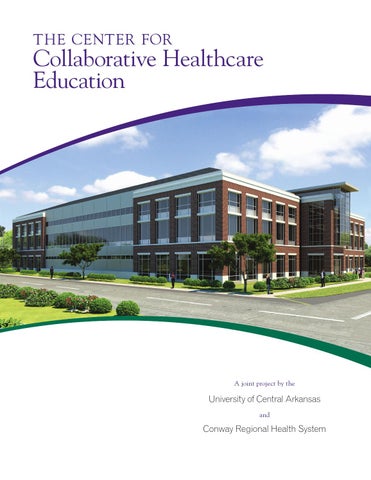
The Center for
Collaborative Healthcare Education
A joint project by the
University of Central Arkansas and
Conway Regional Health System 1
table of contents 3 About the Center for Collaborative Healthcare Education 4
Uniqueness of the CCHE
5 Collaboration 6
Community Education
7 Classrooms 8
Simulation Center
10 Conway Regional Health System 14 University of Central Arkansas 2
About the Center for Collaborative Healthcare Education The Center for Collaborative Healthcare Education
Arkansas (UCA) and Conway Regional Health System
(CCHE) will be an academic-healthcare partnership
(CRHS), partnering to address improvement of the
that promotes quality healthcare and the improved
quality of healthcare through collaborative education.
health of individuals and communities. Through enhanced education in a unique facility, the CCHE will
The CCHE will provide an ideal setting for the
encourage collaboration among academic and practice
education of students, staff, and citizens. Students
professionals. Leading healthcare groups such as the
of UCA and staff members of both UCA and CRHS
National Institute of Medicine, Robert Wood Johnson
will be together in the center, observing and learning
Foundation, Josiah Macy Jr. Foundation, and others have
from each other in both formal and informal settings.
called for a breakdown of barriers between education
Citizens and community members will also be in the
and practice and an increased emphasis on health and
center, interacting with students and staff in an in-
wellness of citizens as an important means of improving
house bistro and community garden, and participating
American healthcare. The CCHE will be a model of
in planned programs including support groups, classes,
two independent institutions, the University of Central
health fairs, and other activities. 3
Uniqueness of the CCHE To our knowledge there is not another facility in the nation that has brought together the three aims of the
4
CCHE: academic nursing education, staff education,
The CCHE will be a national model for breaking down
and community health education. While some
the barriers that have separated the education of
academic nursing programs share a simulation lab
students, staff, and the public. The center will model
with other academic programs and/or hospital, we have
the joining of academic and practice components of
found none that have shared offices, classrooms, and
healthcare for the purpose of improving healthcare
a simulation center and have brought the education of
and enhancing the education of students and staff, as
the community into the facility as well.
well as improving the health of the community.
4
Collaboration The spaces of the CCHE will be shared by CRHS and
research in both facilities that is
UCA. The UCA nurse administrator and CRHS staff
relevant to the improvement of patient care.
education administrator will share the same office suite close to the entrance of the center. The UCA nursing
Several UCA nursing faculty already practice on a part-
faculty and CRHS staff education faculty will share the
time basis in CRHS, while several CRHS staff members
same office area and break room. The simulation lab
teach on a part-time basis for UCA. The two programs
will have a staff of several individuals who will assist
have also co-sponsored a number of conferences for
both CRHS and UCA. Working in close proximity will
practicing nurses and other health professionals.
encourage the sharing of ideas, joint problem-solving
These arrangements are expected to increase,
and collaboration, promoting best practices in the
including joint-appointments as more faculty members
classroom and patient care areas, and encouraging
and staff members become engaged in collaboration. 5
Community Education
A primary focus of the CCHE is community health and wellness education. Spaces within CCHE will be used for a variety of community-related functions, including cooking demonstrations, professional workshops and conferences, forums, and health fairs. A variety of
In 2011, Arkansas was ranked 48th in the nation in
healthy lifestyle classes and services will be provided
terms of overall population health, according to the
for community members such as healthy eating,
Agency for Healthcare Research and Quality (U.S.
hypertension, tobacco cessation, and diabetes awareness.
Department of Health and Human Services). The
Support groups will meet in the center including infant
report also showed that the state was rated as very
bereavement support, spouse bereavement support,
weak in the area of preventive (health and wellness)
Alzheimer caregiver support, and others. The CCHE will
care. The CCHE will serve as a model for Arkansas in
also serve as a community resource center for promoting
promoting preventive health care through education
health and wellness for employers and their workforces,
and partnership with health care providers and
by bringing together area employers to share ideas,
educational institutions.
education programs and resources.
6
tiered classroom rendering
Classrooms The CCHE will house state-of-the-art facilities,
Two classrooms promote group work for projects
providing a variety of formats for different uses.
involving collaboration. Each round table, seating eight,
From formal classrooms to informal gathering places
will have its own projector and will interface with the
to simulation labs - students, staff and community
main classroom projector. The instructor can bring
members will increase their knowledge and skills to
the attention of all class members to the work of a
improve the quality of patient care and improve the
particular table or the front of the classroom where the
health of their own lives and their families.
work of the groups can be presented and critiqued. Because of the interactive nature of education today,
A variety of classrooms will be available that will
these two classrooms are expected to be in high
accommodate large classes or small seminar groups.
demand. CRHS may use this classroom to address
One of the large classrooms will be a case-study design
quality improvement initiatives, dividing staff members
used in law schools. In this classroom, the faces of
into small groups to address particular cases, while
approximately two-thirds of the other students are
UCA could use the classroom for student groups
visible, thus enhancing class discussions.
developing a research project. 7
Simulation Center
In the simulation center, individuals as well as groups
A state-of-the-art simulation laboratory will be shared
competence, and engage in patient simulation cases.
by UCA and CRHS. The simulation lab will consist of
For instance, a group of nursing students can learn
fully equipped hospital rooms, a simulated surgical unit,
a new procedure under the direction of an instructor,
exam rooms, an apartment to simulate independent
individual students or small teams might return to
living, and teaching labs. A variety of models and
the simulation lab on their own time to continue their
manikins will be available for simulation. High-fidelity,
practice; later they can be tested for their competence
life-like manikins that can moan, sweat, and have a
in performing the skill. Students are allowed to see the
variety of vital signs responding to treatment or the lack
outcomes of their decisions, including worsening of
of treatment will be available. Other life-like manikins
the patient’s condition, in this controlled environment,
can simulate infants, children, the elderly and childbirth
allowing them to ‘re-live’ the scenario with improved
delivery. The lab rooms will have audio and visual
critical thinking, resulting in better outcomes. As
recording abilities so staff and students can practice,
students progress in the program, complex patient
then review their performance, assessing for areas of
care simulations will assess their critical thinking and
needed improvement. Electronic medical records and
care coordination. In addition to the manual skills,
medication systems will be available. To the highest
communication skills and interactions may be practiced
extent possible, the environment and equipment in the
as live actors assume the roles of family members, the
simulation center will be the same as that in the hospital.
patient or other healthcare team members.
8
can learn new skills, refine procedures, be assessed for
Hospital staff members will use the simulation lab in a variety of ways. For instance, employees are required to demonstrate skill competency. When new equipment is purchased, staff can come to the center to familiarize themselves with it. If an employee is having difficulty with a skill or procedure, that individual can practice the skill
does not end with graduation but continues throughout
until she/he meets the required standard. Nearby, a
professional life. Other professionals such as first-
multidisciplinary team working with a high-fidelity
responders will use the simulated apartment to practice
manikin in cardiac arrest might use the simulation lab
rescue, while students from other health-related
to practice responding to situations they are likely to
programs will join nursing students to practice inter-
face in practice. Team members can then view the
professional teamwork in various scenarios.
video, identify areas for improvement, and go through additional simulations until they are able to respond
Through the numerous uses of the simulation lab, the
accurately and efficiently.
quality and safety of patient care will be continuously improved. Patients and the patients’ families will benefit
Working in a lab room next to the nursing student
from the staff members’ and the students’ engagement
could be staff members from the hospital, perfecting
in learning that allows them to improve skills and critical
or refining their care. The student will see that learning
thinking prior to their application to patients. 9
Conway Regional Health System Conway Regional Health System is a comprehensive
health services, an imaging center, a fitness center, and
healthcare delivery entity operating in Conway, Ark.,
rehabilitation center. The health system recently added
and serving the city and a five county service area of
an 85,000-square-foot surgery and obstetrics area
Faulkner County, Van Buren County, Perry County,
that provides eight large operating rooms and houses
Conway County, and Cleburne County along with the
some of the state’s
city of Maumelle. The health system initially began in
most advanced surgical
1923 as Conway Memorial Hospital. Since that date,
equipment, including
the CRHS has grown to operate a medical center/
the Da Vinci robotic
hospital, various clinics, outpatient facilities, home
surgery system.
10
CRHS Patient Care
2011 numbers
4 Conway Regional Medical Center treated 8,128
CRHS Community Outreach The number of community outreach programs that
inpatients and 122,624 outpatients.
4 Another 36,193 patients were treated and discharged
from the Emergency Department.
CRHS provides has grown over the years. Currently
4 Conway Regional’s four clinics with locations in Conway,
outreach programs include diabetic education,
Greenbrier, Mayflower and Clinton reported 32,297
newborn/neonatal bereavement, dementia support,
patient visits.
and a speaker’s bureau on topics pertaining to health, wellness, and immunization. In addition, Conway Regional is a leader in Get Smart and Get Healthy
4 The Conway Regional Home Care staff made 18,227
visits to 783 patients.
Conway, a group of key business and community
4 Conway Regional Medical Center is the flagship of
leaders seeking to promote community health and
Conway Regional Health System. The health system
wellness by engaging employers in adopting health and
provided more than $58.8 million in salaries and
wellness programs for their employees. CRHS also has
benefits to 1,227 employees in 2011, making CRHS
a history of providing health and wellness screenings
the fourth largest employer in the city.
to a number of employers and organizations as a community service. 11
C.J. Newton. MSN, RN, has been with CRHS since 1997, and has worked in professional staff development roles for
CRHS Staff Education Department STAFF
Areas of clinical expertise in the department include:
more than 20 years. Her clinical area of practice has been in cardiovascular nursing. C.J. Newton, Director
She is active in the Arkansas Nurses Association and other
4 3 full-time RNs
4 medical-surgical nursing
nursing groups, including assuming leadership roles at the
4 3 part-time RNs
4 critical care nursing
district and state levels. She has developed the CRHS Staff
4 2 administrative
support staff
4 perinatal nursing 4 pediatric nursing
Education Department from a single position within another department that provided minimal education primarily for nursing employees, to a separate department that serves
All nurses of the staff education department have BSN
all employees, volunteers, contract staff, students and the
degrees, and three have MSN degrees. Instructors
community and is recognized in the state as a model for
in the department are also involved in the Arkansas
other staff education departments.
Nurses Association, the American Heart Association, and the March of Dimes. They are involved in a variety of community service activities. 12
Services Provided CRHS was one of the first hospitals in the state to
Classes offered to CRHS
incorporate high-fidelity simulation into educational
staff and new-hires ensure
activities. Instructors re-create actual patient scenarios
regulatory compliance and that staff have the
using manikins that simulate talking, breathing and other
skills necessary to provide high-quality care. The Staff
life-like functions. Nurses and other professionals are able
Education Department also responds to needs of the
to practice intervening, without risk to any actual patients,
organization for additional education when regulations
in situations in which the simulated patient is deteriorating.
change or when quality or safety concerns are identified. Staff members work closely with the Quality
The Staff Education Department provides orientation,
Resources Department to evaluate opportunities for
in-service, continuing education and competency
improvement, and implement necessary changes. The
assessment programs for employees, volunteers,
department staff serve as consultants on scope of
contract staff and students at CRHS. Additionally,
practice and standards of performance. The services
the department provides credentialing services for all
of the department are interwoven into the structure of
non-physicians, and serves as the liaison for all student
CRHS, and play a vital role in the overall performance
experiences within the organization.
of the organization. 13
The University of Central Arkansas Founded in 1907, University of Central Arkansas
degrees, and five doctoral degrees. With rare
strives to provide strong academic programs to
exception, classes are taught by faculty, not graduate
meet the diverse needs of those it serves. Located
assistants. Students, especially in
in Conway, “The City of Colleges,� the university
the sciences, are given research
serves as host to more than 11,000 students from 66
and publication opportunities
different countries, 39 states and enrolls students
at the undergraduate level that
from all 75 counties in Arkansas. UCA offers more
most students do not have until
than 80 undergraduate degree programs, 39 master’s
graduate school.
14
Barbara G. Williams, PhD, RN, has been chairperson of the Department of Nursing since 1990. In addition to her administration of a successful academic unit, Dr.
UCA Nursing Department
William’s leadership experience has focused on building bridges
UCA provides a variety of courses in the healthcare field, including a comprehensive nursing program, which offers the Bachelor of Science in Nursing (BSN)
Dr. Barbara G. WIlliams Chairperson
between nursing practice and nursing education, beginning in
and Master of Science in Nursing (MSN) degrees.
1986 with assisting in the effort to establish a statewide
The BSN degree was established in 1967 and
nursing shortage. In 1990, she was asked to lead Arkansas’
accredited in 1969. The MSE was established in 1970,
articulation task force, establishing connections between
and later renamed MSN. The MSN program was
the various levels of nursing education as they forged and
accredited in 1982. The department is accredited by the
implemented a statewide articulation agreement (the second
Commission on Collegiate Nursing Education (CCNE)
state to have a statewide model). In 2001, she was selected to
and has maintained continuous accreditation.
lead the state’s legislative nursing commission examining the
organization between these two groups to address the
nursing workforce and faculty shortages. In 2010, Dr. Williams The BSN degree program offers the traditional
was appointed to the Board of Directors of Conway Regional
program for unlicensed students as well as tracks for
Health System. She is recognized for her expertise in testing
LPNs and RNs seeking the degree. The MSN degree
and assessment. Her clinical practice has been in the area of
program provides clinical tracks to prepare adult nurse
medical-surgical nursing and psychiatric mental health.
practitioners, family nurse practitioners, clinical nurse leaders, and nurse educators with a clinical specialty. 15
UCA Faculty 4 21 full-time faculty 4 41% doctoral prepared
UCA Nursing Faculty Members of the UCA nursing faculty are actively engaged in clinical practice, scholarship, and service. They engage in practice in area hospitals, clinics, home health, and private practice in various specialty areas. They conduct cutting-edge research on topics such as complementary care, Attention Deficit and Hyperactivity Disorder, diabetic teaching, childhood obesity, elder care, licensing exam preparation, information technology, and practice simulation.
BSN Program Admissions
70 unlicensed students; 20 to 30 licensed students (LPNs and RNs)
Enrollment 350 to 375 pre-nursing students taking courses in order to apply; ~230 BSN majors Graduation Rate
89.5% average for past 5 years
NCLEX passage rate 92.79% average for past 5 years; State average for same period = 85.1%
MSN Program 55 students
Several are also engaged in interdisciplinary
Admissions
scholarship. Faculty members serve the community
Enrollment 175
by volunteering for health fairs, immunization drives,
Graduation Rate
wellness physicals for children; serving on various boards and organizations, leading support groups; and engaging in a variety of other service areas. UCA faculty members are deeply committed to the success of their students and have cultivated an intensive applied learning environment – providing individual attention, mentoring, and connections with leading professionals in the healthcare field. 16
84.8% average for past 5 years
Certification Rate 98% average for past 5 years
100%
One hundred percent of UCA nursing graduates are employed in their fields within a year of graduation.
Floor Plan – Ground Floor
17
Floor Plan – 2ND Floor GROUP STUDY
GROUP STUDY CONTROL ROOM MEDIUM CLASSROOM
SIM APARTMENT FUNDAMENTALS
STORAGE
STORAGE
TELE ELEC
MOTHER BABY NEWBORN
ICU / CC LAB MEN
FUNDAMENTALS
STORAGE
NP ASSESSMENT
MED SURGERYMED SURGERY
WOMEN C.P.R.
TESTING
COMPUTER ROOM
UP
ELEV
ELEV
STAIR
CHASE
OPEN TO BELOW
OPEN TO BELOW
LOBBY
UP
OPEN TO BELOW
STAIR
DN
SIM SUPPORT
Department Legend
SURGERY SUITE
CIRCULATION SIM ROOM
SIM ROOM
TOILET SIM ROOM
FUNCTION
SIM ROOM
PUBLIC STORAGE
SERVICE STORAGE
DEBREIF
DEBREIF
STORAGE MEN STORAGE
STORAGE DEBREIF
DEBREIF STORAGE
PLAN NORTH
WOMEN STORAGE
0'
STORAGE SIM ROOM
SIM ROOM SIM ROOM
UP DN
STAIR
18
SIM ROOM TOILET
DN
SEMINAR
CLEANING
2'
4'
8'
16'
Floor Plan – 3RD Floor OFFICE
OFFICE
OFFICE
OFFICE
OFFICE
OFFICE
OFFICE
OFFICE OFFICE
OFFICE
OFFICE
OFFICE
OFFICE
OFFICE
CORRIDOR WAITING WORK
OFFICE
OFFICE
OFFICE
RECEPTION
OFFICE
OFFICE
OFFICE
CONFERENCE OFFICE
CONF
CONF
OFFICE
CORRIDOR OFFICE
OFFICE
OFFICE
OFFICE OFFICE
TELE ELEC WOMEN
MEN
WORK
WORK
WORK DN
COMPUTER
OFFICE
OFFICE
OFFICE
OFFICE
OFFICE
OFFICE LOUNGE STAIR
ELEV
ELEV
CHASE
OFFICE
PROGRAM DIR.
OFFICE
OFFICE
PROGRAM DIR.
OFFICE
PROGRAM DIIR.
OFFICE
TOILET
OFFICE
LOBBY OPEN TO BELOW
OPEN TO BELOW
STAIR
STUDENT LOUNGE DN
SEMINAR
Department Legend ADMINISTRATION TESTING
CIRCULATION
SEMINAR
FUNCTION PUBLIC SERVICE SEMINAR
SCALE UP
MEDIUM CLASSROOM
STORAGE
PLAN NORTH
SCALE UP
0'
2'
4'
8'
16'
WORK ROOM
DN
19
The Center for
Collaborative Healthcare Education
conwayregional.org 20
uca.edu